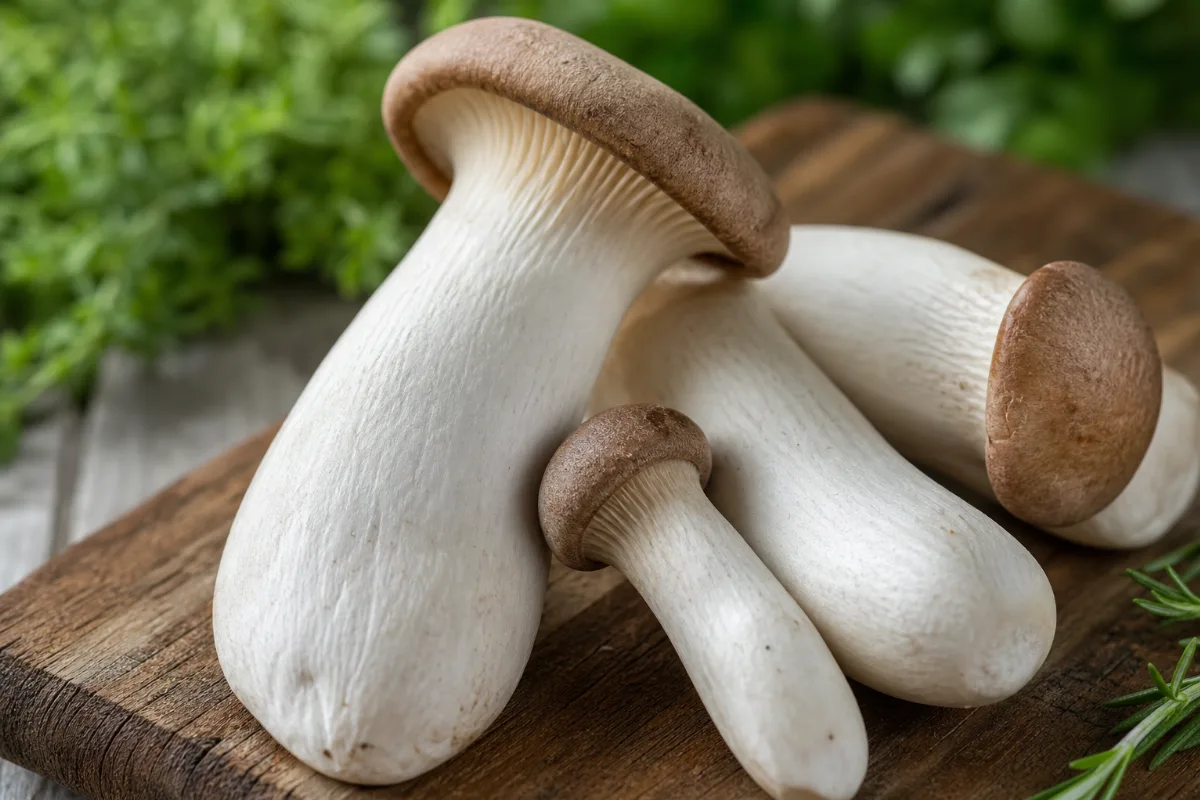
Mushrooms · Culinary mushroom
King oyster mushroom
Pleurotus eryngii · also called King trumpet mushroom, eryngii, eringi, French horn mushroom, seta de cardo
King oyster is a large cultivated food mushroom with a thick, meaty stem. It is low in calories and holds fibre, potassium and ergothioneine. Three small trials from one Greek group found lower blood sugar and appetite after a meal, and better weight and blood markers with a snack over 3 months. The evidence is low. Spore allergy has been reported in mushroom workers.
General information, not medical advice. Last substantive update · Not medically reviewed. A named clinician has not signed off on this page. How this page is made
About King oyster mushroom
King oyster (Pleurotus eryngii) is a cultivated food mushroom. It is low in calories and holds fibre, potassium and ergothioneine. Three small human trials, all from one group in Athens, found a lower blood sugar curve and less hunger after a meal, and better weight and blood markers after a snack over 3 months. Evidence is low and no trial measured disease. Spore allergy has been reported in workers, and powders and extracts have not been studied.
What it is
King oyster is a large mushroom with a thick, firm stem and a small cap. GBIF lists Pleurotus eryngii as the accepted name, in the oyster mushroom family. It is a fungus, not a plant. It is also called king trumpet or eryngii.
Do not confuse it with oyster mushroom (Pleurotus ostreatus). Both belong to the same genus, but results for one cannot be assumed for the other.
What is in it
USDA Foundation Foods lists, per 100 g raw: 46 kcal, 2.4 g protein, 3 g fibre, 295 mg potassium, 23.6 mg ergothioneine and 15.7 mg glutathione, and almost no vitamin D2 (0.07 ug). These values describe one sampled food and vary between crops. Raw values do not apply to dried mushrooms or powders.
Mushrooms make vitamin D2 from ergosterol when exposed to UV light. In one trial, a baked, UV-B-treated king oyster snack raised blood vitamin D2. An ordinary shop mushroom should not be assumed to be a vitamin D source.
What the research shows
All three human trials we found come from the same Athens research group. In a one-meal crossover study of 19 adults with obesity, a king oyster meal gave a lower glucose curve, lower hunger, higher fullness and a lower ghrelin response than a matched meal. Insulin and three other gut hormones did not differ.
In a 100-person, 3-month trial, a baked, UV-B-treated king oyster snack plus counselling gave better weight, waist, glucose, LDL and inflammation markers than counselling alone. The abstract gives no numbers, the snack also supplied vitamin D2, and one author works at a mushroom grower. A small meal study in 13 people found lower rises of three amino acids in blood. A review of mushrooms in general found limited signs of lower triglycerides and hs-CRP, but no effect on glucose control or blood pressure, and it was partly funded by The Mushroom Council.
Lab findings that are not yet shown in people
Lab and cell studies report antioxidant activity from a king oyster polysaccharide extract and changes in immune-cell signals after gut bacteria fermented the mushroom. These do not show a benefit in people. A lab study also found that four king oyster proteins (eryngitins) were fully digested and not toxic to human umbilical-vein cells.
Mushroom, mycelium, powder and extract are different
The human trials used a cooked meal or a baked snack. Liquid-culture king oyster mycelium held far more ergothioneine than fruiting bodies in one lab study, but it is a different material, and it lost its umami taste. We read nothing on the safety or content of powders, extracts or mycelium-on-grain products. Ask a pharmacist before using one.
Legal and regulatory status
King oyster is sold as a food. USDA lists it as a food with measured nutrient content, which is not a safety approval. We did not read EMA, EFSA, FDA, LiverTox, LactMed or WHO statements on it, so none is stated here. Rules differ by country and change.
At a glance
Traditional uses history, not proof
- No traditional-use source was read. King oyster is eaten as a food.
Studied for research
- Blood sugar after a meal (one small trial), low
- Hunger and fullness after a meal (one small trial), low
- Weight, waist and metabolic markers over 3 months (one trial), low
- Vitamin D2 only if UV-treated (one trial), low
- Immune and antioxidant effects (lab only), very low
- Diabetes, heart disease or cancer outcomes, insufficient (not measured)
Main compounds
- Beta-glucans (fibre-like sugars)
- Ergothioneine and glutathione (antioxidants)
- Ergosterol (turns to vitamin D2 under UV light)
- Potassium, niacin, riboflavin and biotin
Common forms
- Fresh mushroom, cooked
- Dried slices
- Fruiting-body powder
- Mycelium-on-grain powder
- Extract capsules (not studied in the sources read)
Research links: USDA FoodData Central: king oyster mushroom · One-meal crossover trial (abstract) · 3-month snack trial (abstract) · Review of mushrooms and heart-metabolic health (abstract) · Lung allergy in king oyster factory worker (abstract) · Metals in cultivated mushrooms (abstract) · Research Library · Genes & Biomarkers Library
What it is and its history
- Accepted scientific name
- Pleurotus eryngii
- Naming authority
- (DC.) Quel. (GBIF)
- Synonyms
- Agaricus eryngii DC.; Pleurotus eryngii var. ferulae (Lanzi) Sacc. (some authors treat the ferula mushroom as its own species); Pleurotus fuscus Battarra ex Bres.; Pleurotus eryngii var. elaeoselini, var. thapsiae, var. tingitanus and var. laserpitii (GBIF synonyms)
- Common names
- King oyster mushroom (English); King trumpet mushroom (English); Eryngii / eringi (English, Japanese); French horn mushroom (English); Seta de cardo (Spanish); Pleurote du panicaut (French); Cardoncello (Italian); Konigsausternpilz (German)
- Family or group
- Pleurotaceae (oyster mushroom family), a fungus, not a plant
- Classification
- Fungi > Basidiomycota > Agaricomycetes > Agaricales > Pleurotaceae > Pleurotus > Pleurotus eryngii
- Native range
- Not checked in the sources read.
- Habitat
- Not checked. The name 'eryngii' refers to the sea holly (Eryngium), which the Latin name suggests it grows with; no source was read.
- What it looks like
- Fruiting body: Not checked in a source we read. Retail king oyster has a thick stem and a small cap.
- Cultivation
- Grown commercially on substrate such as straw; a trial of Italian isolate AF72 used wheat straw and beet in bottles (Petraglia 2023, earlier read). Details not checked.
- Harvest and processing
- Not checked. One trial baked the mushroom and UV-B treated it; this changes its vitamin D2.
- Look-alikes and adulterants
- Name: Other Pleurotus (oyster) species; Note: Same genus; results for one cannot be applied to another. P. ostreatus was used for the allergy case in this page.; Name: Wild mushrooms in general; Note: No identification source was read. Do not eat wild mushrooms unless an expert has identified them.
- Sustainability and conservation
- Not checked.
Traditional use and history history, not clinical proof
| Tradition or era | Documented use | Source |
|---|---|---|
| No traditional-use source read | We did not read a source on traditional medicinal use of king oyster. No claim is made. It is now a widely cultivated food mushroom. | none |
Traditional use shows how it was used. It does not show that it works or is safe today.
What is inside, and how it may work
What it contains and how those compounds act in cells and animals. Laboratory and animal mechanisms are not proven effects in people.
Main compounds
| Compound | Family | Where it is concentrated | Activity studied | Level of evidence |
|---|---|---|---|---|
| Beta-glucans | polysaccharide | Fruiting body USDA: 1.95 g per 100 g raw (fresh). Petraglia 2023: 26.22 g per 100 g dry mass in one cultivated sample (earlier read, summary-only). The two differ by sample and by water content. | Fibre-like sugars; the Athens trial authors credit them for the post-meal effects. Lab extracts scavenge radicals. 12 9 4 | Laboratory research |
| Ergothioneine | amino acid antioxidant | Fruiting body; also mycelium USDA: 23.63 mg per 100 g raw. Liquid-culture mycelium: 5.84 to 5.76 mg/g (Liang 2013). | Antioxidant in the lab; no human outcome from king oyster read. 12 7 | Laboratory research |
| Glutathione | tripeptide antioxidant | Fruiting body USDA: 15.7 mg per 100 g raw. | Antioxidant compound in the food; no human outcome read. 12 | Composition only |
| Ergosterol | sterol | Fruiting body USDA: 48.95 mg per 100 g raw. | Becomes vitamin D2 under UV light. 12 5 | Established chemistry |
| Eryngitins (ribotoxin-like proteins) | protein | Fruiting body Four proteins characterised. | Block protein synthesis in lab tests; fully digested by pepsin and trypsin and not toxic to human umbilical-vein cells, toxic to insect cells. 6 | Laboratory research |
Mechanisms, receptors and pathways
| Target or pathway | Gene or receptor | What was found | Level |
|---|---|---|---|
| Carbohydrate digestion and stomach emptying | Not specified | The meal-trial authors suggest polysaccharides block carbohydrate-splitting enzymes and delay stomach emptying. This was not tested directly. 4 | Hypothesis |
| Gut bacteria and immune cells | TNF-a, IL-1b, IL-10, IL-1Ra (cytokines) | After fermentation by gut bacteria from healthy older people, king oyster changed immune-cell gene activity and cytokines in lab cells. 14 | Laboratory research |
| Free-radical scavenging | Not applicable | A polysaccharide extract scavenged four radicals in test tubes and reduced hydrogen-peroxide stress in cells. 9 | Laboratory research |
Absorption, metabolism and elimination
- Absorption
- Not found in the sources read.
- Distribution
- Not found in the sources read.
- Metabolism
- Not found in the sources read.
- Elimination
- Not found in the sources read.
- Bioavailability
- Not established.
Isolated compounds versus whole extracts
The human trials used whole cooked mushroom in a meal or a baked snack. Lab studies use polysaccharide extracts or cultured mycelium. Liquid-culture mycelium held far more ergothioneine than the fruiting-body range, but it is a different material and lost its umami taste. Mycelium-on-grain products also contain leftover grain. Results cannot be carried from one form to another.
Nutritional composition
King oyster is a low-calorie food with some fibre and potassium. Raw vitamin D2 is very low unless the mushroom is exposed to UV light.
1 moderate certainty4 low certainty3 very low certainty
What was looked at
The 8 benefits and uses checked for King oyster mushroom, each with how strong the evidence is. Tap one to open it.
- Blood sugar after a mealLow certainty
- Hunger and fullness after a mealLow certainty
- Weight, waist and metabolic markers over 3 monthsLow certainty
- Amino acids in the blood after a mealVery low certainty
- Nutrients in the foodModerate certainty
- Vitamin D2 only if the mushroom is UV-treatedLow certainty
- Gut bacteria and immune cells (lab only)Very low certainty
- Antioxidant activity (lab only)Very low certainty
Lab markers tracked in the studies
Blood glucose after a mealGhrelin response after a mealHunger and fullness scoresBody weight, body fat, waist and hip sizeLDL cholesterol and SGOT (AST)IL-6 and oxidised LDLPlasma phenylalanine, tyrosine, tryptophanErgothioneine content of the foodBlood 25(OH)D2
What is King oyster mushroom good for?
The uses people ask about and how strong the human evidence is for each. None is proven. Read this together with the Safety tab.
Benefits, one by one
Each card is a research question, not a promise. Tap a goal to filter. Open a card to see the studies, doses and limits.
Blood sugar after a meal
Low certaintyIn one small crossover study, adults with obesity had a lower blood sugar curve after a meal with king oyster than after a matched meal without it. It was a single meal, so it does not show that the mushroom treats or prevents diabetes.
2 studiesCooked king oyster fruiting body, eaten in a meal. Results do not car…
Studies, doses and limits
What the trials found
19 adults with metabolically unhealthy obesity ate a king oyster meal and a matched control meal on two days, in random order. Blood was drawn over 180 minutes. The mushroom meal gave a lower glucose incremental area under the curve. Insulin did not differ.
Results
Lower glucose curve after the mushroom meal (the abstract gives no size or p value for glucose).
Effect sizes as reported
Lower post-meal glucose curve; size not reported in the abstract
Why this rating
One small randomised crossover trial, one meal, no size given in the abstract, and no repeat by another group. A 2023 review of mushroom eating in general found no clear effect on fasting glucose or HbA1c.
Form and dose studied
Cooked king oyster fruiting body, eaten in a meal. Results do not carry over to powders, extracts or mycelium products.
Who was studied
Adults with obesity and metabolic problems (Greece)
Limits
Does not show an effect on diabetes, weight or long-term blood sugar. People taking diabetes medicines should not change their plan because of a mushroom meal.
Why researchers looked
Mushroom fibres and beta-glucans may slow how fast carbohydrates are broken down and absorbed, so researchers tested a mushroom meal.
Traditional use
No traditional-use source for king oyster was read.
Proposed mechanism Hypothesis
The authors suggest polysaccharides block carbohydrate-digesting enzymes and slow stomach emptying. This is their explanation, not something the trial proved.
A proposed mechanism does not show that the effect happens in people.
King oyster is a food mushroom. The main safety points are allergy to its spores (mostly in people who work with it), and contamination checks on metals. See the Safety tab.
Hunger and fullness after a meal
Low certaintyAfter the same one-meal study, people reported less hunger and more fullness after the king oyster meal, and their level of the hunger hormone ghrelin fell more. Other gut hormones did not differ.
1 studiesCooked king oyster fruiting body, eaten in a meal. Results do not car…
Studies, doses and limits
What the trials found
In the 19-person crossover trial, ghrelin response was lower after the mushroom meal (p = 0.033), hunger was lower (p = 0.046) and fullness higher (p = 0.042). Insulin, PYY, GLP-1 and glicentin did not differ.
Results
Ghrelin response p = 0.033; hunger p = 0.046; fullness p = 0.042
Effect sizes as reported
Small differences in appetite scores for one meal
Why this rating
One small trial; appetite is rated on a scale by the person; the results were not repeated by another group in the sources we read.
Form and dose studied
Cooked king oyster fruiting body, eaten in a meal. Results do not carry over to powders, extracts or mycelium products.
Who was studied
Adults with obesity and metabolic problems (Greece)
Limits
Appetite after one meal does not show that king oyster helps people eat less or lose weight.
Why researchers looked
Hunger and fullness decide how much people eat, so researchers looked at appetite after a mushroom meal.
Traditional use
No traditional-use source for king oyster was read.
Proposed mechanism Hypothesis
The authors suggest delayed stomach emptying from the mushroom's polysaccharides. Not tested directly.
A proposed mechanism does not show that the effect happens in people.
King oyster is a food mushroom. The main safety points are allergy to its spores (mostly in people who work with it), and contamination checks on metals. See the Safety tab.
Weight, waist and metabolic markers over 3 months
Low certaintyA 100-person trial gave a baked, UV-treated king oyster snack daily for three months on top of diet advice. The snack group had better weight, waist, glucose and some inflammation markers than the advice-only group. The snack also raised vitamin D2, so the mushroom alone cannot be credited.
1 studiesA baked, UV-B-treated king oyster snack. Not a powder or extract.
Studies, doses and limits
What the trials found
100 patients with metabolic disorders were randomised. Both groups got nutrition counselling. The snack group also ate the baked, UV-B-treated king oyster snack daily for three months. Compared with the control group, snack eaters had regulated glucose, lower body weight, body fat, waist and hip size. LDL cholesterol and SGOT were lower only in the snack group. IL-6 and oxidised LDL fell, and a physical-health score rose.
Results
Several markers improved versus control; the abstract gives no numbers.
Effect sizes as reported
Improvements in weight, glucose and inflammation markers; no numbers in the abstract
Why this rating
One randomised trial with a clear control group, but no numbers in the abstract, the snack was also a vitamin D2 source, and the research group has links to a mushroom grower. Not repeated.
Form and dose studied
A baked, UV-B-treated king oyster snack. Not a powder or extract.
Who was studied
Adults with metabolic disorders (Greece)
Limits
Cannot say how much of the change came from the mushroom, the vitamin D2 or the counselling. No effect on disease outcomes was measured.
Why researchers looked
People with weight and blood sugar problems were asked to eat a king oyster snack to see if markers changed over weeks, not just one meal.
Traditional use
No traditional-use source for king oyster was read.
Proposed mechanism Hypothesis
Mushroom fibre, beta-glucans, antioxidants and vitamin D2 were all suggested by the authors; the trial could not separate them.
A proposed mechanism does not show that the effect happens in people.
King oyster is a food mushroom. The main safety points are allergy to its spores (mostly in people who work with it), and contamination checks on metals. See the Safety tab.
Amino acids in the blood after a meal
Very low certaintyIn 13 volunteers, three amino acids rose less after a king oyster meal than after a control meal. This is a lab marker with no known health meaning.
1 studiesCooked king oyster fruiting body, eaten in a meal. Results do not car…
Studies, doses and limits
What the trials found
13 volunteers ate a baked king oyster meal and a control meal, one month apart. The rise in phenylalanine (p = 0.027), tyrosine (p = 0.008) and tryptophan (p = 0.003) was higher after the control meal.
Results
Lower rise in three amino acids after the mushroom meal
Effect sizes as reported
Small difference in a lab marker
Why this rating
One meal in 13 people; the abstract describes the group inconsistently (patients with obesity and healthy males); no health outcome.
Form and dose studied
Cooked king oyster fruiting body, eaten in a meal. Results do not carry over to powders, extracts or mycelium products.
Who was studied
13 adult volunteers (Greece)
Limits
A lower rise in amino acids is not good or bad by itself.
Why researchers looked
The same research group asked whether the mushroom's beta-glucans change how protein is digested.
Traditional use
No traditional-use source for king oyster was read.
Proposed mechanism Hypothesis
The authors suggest beta-glucans may change how amino acids are released into the blood. Not tested directly.
A proposed mechanism does not show that the effect happens in people.
King oyster is a food mushroom. The main safety points are allergy to its spores (mostly in people who work with it), and contamination checks on metals. See the Safety tab.
Nutrients in the food
Moderate certaintyRaw king oyster is a low-calorie food with some fibre, potassium, niacin, riboflavin and biotin, and it holds the amino acid antioxidant ergothioneine. These are measured contents, not proof of a health effect.
1 studiesRaw mushroom values. Cooking, drying and powders change them.
Studies, doses and limits
What the trials found
USDA Foundation Foods lists, per 100 g raw: 46.4 kcal, 2.41 g protein, 3.01 g fibre, 1.95 g beta-glucan, 294.5 mg potassium, 6.451 mg niacin, 0.2438 mg riboflavin, 10.83 ug biotin, 23.63 mg ergothioneine and 15.7 mg glutathione. No trial here tested whether those amounts change health.
Results
USDA values for one sampled food, per 100 g raw
Effect sizes as reported
Composition only
Why this rating
The numbers come from a government laboratory database, so the content is well measured for that sample. Values vary between crops. Whether the content leads to a health effect is not shown.
Form and dose studied
Raw mushroom values. Cooking, drying and powders change them.
Who was studied
Anyone eating the mushroom
Limits
Content is not the same as benefit.
Why researchers looked
People ask what the food contains. A national food database has measured it.
Traditional use
No traditional-use source for king oyster was read.
Proposed mechanism Not applicable
Not a mechanism; this is a composition record.
A proposed mechanism does not show that the effect happens in people.
King oyster is a food mushroom. The main safety points are allergy to its spores (mostly in people who work with it), and contamination checks on metals. See the Safety tab.
Vitamin D2 only if the mushroom is UV-treated
Low certaintyThe raw king oyster in the USDA record has almost no vitamin D2. In the 3-month trial, a UV-B-treated snack raised blood 25(OH)D2, so UV treatment matters.
2 studiesUV-B treated, baked snack. Not plain mushroom.
Studies, doses and limits
What the trials found
USDA lists 0.07 ug vitamin D2 per 100 g of the sampled raw mushroom, with no UV-treated sample. In the 100-person trial, the UV-B-treated snack group had a significant rise in blood 25(OH)D2 versus the control group.
Results
25(OH)D2 rose in the snack group (no numbers in the abstract)
Effect sizes as reported
A rise in a blood marker with UV-treated snack
Why this rating
One trial reports the rise, and the snack was specially treated. Plain raw king oyster has little D2 in the one USDA record.
Form and dose studied
UV-B treated, baked snack. Not plain mushroom.
Who was studied
Adults with metabolic disorders
Limits
25(OH)D2 is a blood marker, not proof of better bones. Do not assume ordinary mushrooms are a vitamin D source.
Why researchers looked
Mushrooms make vitamin D2 from ergosterol when exposed to UV light, so researchers tested a UV-treated snack.
Traditional use
No traditional-use source for king oyster was read.
Proposed mechanism Established chemistry
Ergosterol turns into vitamin D2 under UV light (general fungal biochemistry; not tested in the sources here).
A proposed mechanism does not show that the effect happens in people.
King oyster is a food mushroom. The main safety points are allergy to its spores (mostly in people who work with it), and contamination checks on metals. See the Safety tab.
Gut bacteria and immune cells (lab only)
Very low certaintyIn dish experiments, king oyster fermented by gut bacteria from older volunteers changed signals in human immune cells. This has not been tested in people.
1 studiesMushroom fermented in a lab vessel.
Studies, doses and limits
What the trials found
Fermentation supernatants from the stool of healthy older volunteers altered gene expression and cytokines in human macrophage cells and in blood cells, in a way seen for all volunteers' samples. No people ate the mushroom in this study.
Results
Altered immune-cell signals in cell experiments
Effect sizes as reported
Lab signals only
Why this rating
Dish and test-tube work only. No human trial of immune outcomes was found for king oyster.
Form and dose studied
Mushroom fermented in a lab vessel.
Who was studied
Cells and stool samples
Limits
Nothing here shows fewer infections or a stronger immune system.
Why researchers looked
Mushroom fibres reach the large bowel, where bacteria ferment them. Researchers asked whether the products affect immune cells.
Traditional use
No traditional-use source for king oyster was read.
Proposed mechanism Laboratory research
Gut bacteria ferment the mushroom, and the products change immune-cell gene activity and cytokine release in cell culture.
A proposed mechanism does not show that the effect happens in people.
King oyster is a food mushroom. The main safety points are allergy to its spores (mostly in people who work with it), and contamination checks on metals. See the Safety tab.
Antioxidant activity (lab only)
Very low certaintyA polysaccharide extract from king oyster mopped up free radicals in test tubes and in cells. Ergothioneine in the food is a known antioxidant compound, but no human benefit from eating king oyster was shown.
3 studiesEnriched polysaccharide extract; liquid-culture mycelium.
Studies, doses and limits
What the trials found
Petraglia 2023 tested an enriched extract in test tubes and cells (IC50 0.52 to 2.83 mg/mL; cell effect at 0.05 to 0.2 mg/mL). Liang 2013 measured ergothioneine in liquid-culture mycelium. No human antioxidant outcome from king oyster was read.
Results
Radical scavenging in the lab
Effect sizes as reported
Lab only
Why this rating
Lab only. Extract is not the mushroom as eaten. Mycelium from liquid culture is not the fruiting body.
Form and dose studied
Enriched polysaccharide extract; liquid-culture mycelium.
Who was studied
Test tubes and cells
Limits
Antioxidant activity in a dish does not mean a health benefit in the body.
Why researchers looked
Mushrooms contain ergothioneine and polysaccharides that act as antioxidants in the lab.
Traditional use
No traditional-use source for king oyster was read.
Proposed mechanism Laboratory research
In test tubes and cells, the extract scavenged radicals and reduced hydrogen-peroxide stress. Not tested in people.
A proposed mechanism does not show that the effect happens in people.
King oyster is a food mushroom. The main safety points are allergy to its spores (mostly in people who work with it), and contamination checks on metals. See the Safety tab.
Connections to the rest of health
How King oyster mushroom connects to the rest of our health knowledge graph. Every link says what kind of connection it is. A safety link (for example to the liver) is a warning, not a benefit. A study that merely mentions a topic never creates a benefit link.
Explore every connection: goals, body systems, organs, symptoms, genes
A. Wellness goals
| Connected to | Kind of connection | Evidence status | Context | Studies |
|---|---|---|---|---|
| Blood Sugar Balance | Potential benefit | Low certainty | Blood sugar after a meal: In one small crossover study, adults with obesity had a lower blood sugar curve after a meal with king oyster than after a matched meal without it. It was a single meal, so it does not show that the mushroom treats or prevents diabetes. Weight, waist and metabolic markers over 3 months: A 100-person trial gave a baked, UV-treated king oyster snack daily for three months on top of diet advice. The snack group had better weight, waist, glucose and some inflammation markers than the advice-only group. The snack also raised vitamin D2, so the mushroom alone cannot be credited. | 4 13 5 |
| Weight Management | Potential benefit | Low certainty | Hunger and fullness after a meal: After the same one-meal study, people reported less hunger and more fullness after the king oyster meal, and their level of the hunger hormone ghrelin fell more. Other gut hormones did not differ. Weight, waist and metabolic markers over 3 months: A 100-person trial gave a baked, UV-treated king oyster snack daily for three months on top of diet advice. The snack group had better weight, waist, glucose and some inflammation markers than the advice-only group. The snack also raised vitamin D2, so the mushroom alone cannot be credited. | 4 5 |
| Bone Health | Low certainty | Vitamin D2 only if the mushroom is UV-treated: The raw king oyster in the USDA record has almost no vitamin D2. In the 3-month trial, a UV-B-treated snack raised blood 25(OH)D2, so UV treatment matters. | 12 5 | |
| Immune Support | Preliminary mechanism | Very low certainty | Gut bacteria and immune cells (lab only): In dish experiments, king oyster fermented by gut bacteria from older volunteers changed signals in human immune cells. This has not been tested in people. | 14 |
B. Body systems
| Connected to | Kind of connection | Evidence status | Context | Studies |
|---|---|---|---|---|
| Respiratory system | Adverse effect or risk | Low certainty | Case reports of lung inflammation in factory workers; not shown from eating. Preparation or compound: King oyster spores (workplace) |
10 8 |
| Blood sugar | Potential benefit | Low certainty | Lower post-meal glucose curve in one small crossover trial; not shown for diabetes. Preparation or compound: Cooked king oyster meal or snack |
4 5 |
| Blood Sugar Support | Biological association | Low certainty | Studied for: Blood sugar after a meal Studied for: Weight, waist and metabolic markers over 3 months | 4 13 5 |
| Metabolism Weight | Biological association | Low certainty | Studied for: Hunger and fullness after a meal Studied for: Weight, waist and metabolic markers over 3 months | 4 5 1 12 |
E. Health conditions
| Connected to | Kind of connection | Evidence status | Context | Studies |
|---|---|---|---|---|
| Food allergy | Drug or supplement interaction | Very low certainty | Spore allergy documented for the genus; no king oyster eating allergy report read. Preparation or compound: Pleurotus mushrooms |
2 |
I. Biomarkers
| Connected to | Kind of connection | Evidence status | Context | Studies |
|---|---|---|---|---|
| Blood glucose after a meal | Biological association | Low certainty | Measured in trials: lowered. A lab change is not the same as a health benefit. | 4 |
| Ghrelin response after a meal | Biological association | Low certainty | Measured in trials: lowered. A lab change is not the same as a health benefit. | 4 |
| Hunger and fullness scores | Biological association | Low certainty | Measured in trials: mixed. A lab change is not the same as a health benefit. | 4 |
| Body weight, body fat, waist and hip size | Biological association | Low certainty | Measured in trials: lowered. A lab change is not the same as a health benefit. | 5 |
| LDL cholesterol and SGOT (AST) | Biological association | Low certainty | Measured in trials: lowered. A lab change is not the same as a health benefit. | 5 |
| IL-6 and oxidised LDL | Biological association | Low certainty | Measured in trials: lowered. A lab change is not the same as a health benefit. | 5 |
| Plasma phenylalanine, tyrosine, tryptophan | Biological association | Very low certainty | Measured in trials: lowered. A lab change is not the same as a health benefit. | 1 |
| Ergothioneine content of the food | Biological association | Moderate certainty | Measured in trials: not-applicable. A lab change is not the same as a health benefit. | 12 7 |
| Blood 25(OH)D2 | Biological association | Low certainty | Measured in trials: raised. A lab change is not the same as a health benefit. | 5 |
K. Biological pathways
| Connected to | Kind of connection | Evidence status | Context | Studies |
|---|---|---|---|---|
| Ghrelin | Preliminary mechanism | Low certainty | The ghrelin response was lower after a king oyster meal in one small trial. | 4 |
L. Active compounds
| Connected to | Kind of connection | Evidence status | Context | Studies |
|---|---|---|---|---|
| Beta-glucans | Biological association | In vitro | Fibre-like sugars; the Athens trial authors credit them for the post-meal effects. Lab extracts scavenge radicals. Preparation or compound: Fruiting body |
12 9 4 |
| Ergothioneine | Biological association | In vitro | Antioxidant in the lab; no human outcome from king oyster read. Preparation or compound: Fruiting body; also mycelium |
12 7 |
| Glutathione | Biological association | Composition only | Antioxidant compound in the food; no human outcome read. Preparation or compound: Fruiting body |
12 |
| Ergosterol | Biological association | Established chemistry | Becomes vitamin D2 under UV light. Preparation or compound: Fruiting body |
12 5 |
| Eryngitins (ribotoxin-like proteins) | Biological association | In vitro | Block protein synthesis in lab tests; fully digested by pepsin and trypsin and not toxic to human umbilical-vein cells, toxic to insect cells. Preparation or compound: Fruiting body |
6 |
Each connection is stored with the ingredient, the connected record, the kind of connection, the evidence status, the supporting studies, the preparation or compound involved, and a review date (last reviewed October 25, 2026).
Evidence at a glance: what changed in 8 lab markers
Tap a number to show only those markers. Counts are markers, not people.
The evidence
The research centre for King oyster mushroom. Every record here was checked against PubMed or the publisher's page; we never list a study we have not verified.
Evidence by outcome
Bars show how many studies we found for each outcome, not how well it works. People are added up across trials only (reviews are not added, to avoid double counting).
How we rate evidence
High certainty
Several well-run trials or reviews agree; further research is unlikely to change the picture much.
Moderate certainty
Good trials point the same way, but some doubt remains.
Low certainty
Small, short or inconsistent trials. The finding could change with better research.
Very low certainty
Very little or very weak human data. Treat as a possibility only.
Mixed findings
Trials or reviews disagree with each other.
Not enough evidence
Not enough human research to say either way.
Evidence against
Good research found no benefit, or found harm.
We take the reviewers' own risk-of-bias and GRADE statements where they exist, and otherwise judge from study size, design, consistency, directness and whether a product matches what is sold. Many publications do not make evidence high. Method note: We read PubMed records and abstracts for 13 papers (three human trials, one systematic review, three case reports, two food-metal analyses and four lab studies), the USDA FoodData Central record and the GBIF taxonomy record. Only abstracts were read for papers, so numbers come from abstracts. Certainty ratings are the compiler's own reading.
Study library: every study we checked 15
| Study | Design | People | Product, dose, length | Result |
|---|---|---|---|---|
| Amerikanou 2025 The Performance of Pleurotus eryngii β-Glucans on Protein Digestion and the Release of Free Amino Acids in the Bloodstream of Obese Adults. Foods · PMID 40807584 · DOI |
Rct crossover |
13 13 volunteers (the abstract calls them both patients with central obesity and healthy male volunteers) |
One meal made with baked king oyster mushroom with known beta-glucan content Fruiting body (baked, in a meal) Not shown here One meal per visit, visits one month apart · vs Control meal |
The rise in the aromatic amino acids phenylalanine (p = 0.027), tyrosine (p = 0.008) and tryptophan (p = 0.003) was higher after the control meal than after the mushroom meal. Lower rise in three amino acids in blood after the mushroom meal Methods, limits and fundingOutcomes: Plasma levels of 24 free amino acids after the meal Limitations: One meal in 13 people. The abstract describes the volunteers in two different ways. Amino acid levels in blood are not a health outcome. Funding and conflicts: No conflict declared; funding not stated in the abstract; same research group as the 2022 trials Read: abstract |
| Branicka 2021 A case of anaphylactic reaction following oyster mushroom (Pleurotus ostreatus) inhalation. International Journal of Occupational Medicine and Environmental Health · PMID 33630827 · DOI |
Case report |
1 32-year-old woman who started an oyster mushroom farm |
Breathing in oyster mushroom (Pleurotus ostreatus, a different species) spores Spores Not shown here Repeated exposure on the farm |
She had breathlessness, weakness, a fast pulse and hives after short exposures, and a positive prick-to-prick test with oyster mushroom. Doctors diagnosed work-related anaphylaxis and asthma. The authors say constant exposure of indoor mushroom growers to spores raises the risk of breathing allergy. One case of work-related anaphylaxis with a related species Methods, limits and fundingOutcomes: Breathlessness, hives, skin prick-to-prick test, spirometry Limitations: One person; a different species (oyster mushroom), same genus. Not about eating. Funding and conflicts: Not stated in the abstract Read: abstract |
| GBIF Secretariat 2026 GBIF Backbone Taxonomy: Pleurotus eryngii (DC.) Quel., species match and synonym list GBIF API · Source |
Taxonomy record fungus |
n/a | n/a |
GBIF returns Pleurotus eryngii (DC.) Quel. as ACCEPTED, species, key 9075265, family Pleurotaceae, order Agaricales, class Agaricomycetes, with 24 listed synonyms including Pleurotus eryngii var. ferulae and Pleurotus fuscus. Naming only Methods, limits and fundingOutcomes: Accepted name, rank, family and synonyms Limitations: Taxonomy record, checked 2026-10-25. Index Fungorum was not opened. The synonym list counts varieties that other authors treat as separate species. Funding and conflicts: Public biodiversity database Read: API record |
| Kleftaki 2022 Pleurotus eryngii improves postprandial glycaemia, hunger and fullness perception, and enhances ghrelin suppression in people with metabolically unhealthy obesity. Pharmacological Research · PMID 34798266 · DOI |
Rct crossover |
19 19 volunteers with metabolically unhealthy obesity |
A meal containing king oyster mushroom (Pleurotus eryngii), matched to the control meal for macronutrients and calories Fruiting body (cooked in a meal) Not shown here One test meal per visit, two visits in random order · vs Matched control meal without the mushroom |
The mushroom meal gave a lower glucose incremental area under the curve. The ghrelin response (a hunger hormone) was lower (p = 0.033), hunger was lower (p = 0.046) and fullness was higher (p = 0.042). Insulin, PYY, GLP-1 and glicentin did not differ. Lower post-meal glucose curve, lower hunger and higher fullness after one meal; no difference in insulin or three gut hormones Methods, limits and fundingOutcomes: Blood glucose, insulin, ghrelin, peptide YY, GLP-1 and glicentin over 180 minutes after the meal; hunger and fullness scales Limitations: One meal in 19 people. The abstract gives no size for the glucose difference and no p value for it. It says nothing about weight, diabetes or long-term eating. The authors credit the mushroom's polysaccharides, which this design cannot show. Funding and conflicts: Funding not stated in the abstract; one author is in a university agricultural microbiology lab, no company named in the abstract Read: abstract |
| Kleftaki 2022 A Randomized Controlled Trial on Pleurotus eryngii Mushrooms with Antioxidant Compounds and Vitamin D(2) in Managing Metabolic Disorders. Antioxidants (Basel) · PMID 36358485 · DOI |
Controlled trial |
100 100 metabolically unhealthy patients randomised (two arms) |
A baked king oyster mushroom snack, treated with UV-B light to raise its vitamin D2, eaten daily on top of nutrition counselling Fruiting body (baked, UV-B treated) Not shown here 3 months · vs Nutrition counselling alone |
Compared with the control group, snack eaters had regulated glucose levels and lower body weight, body fat, waist and hip size. Blood 25(OH)D2 rose. LDL and SGOT were lower only in the snack group. IL-6 and oxidised LDL fell and overall physical health rose in the mushroom group. Improvements in several weight, glucose and inflammation markers over 3 months; no numbers in the abstract Methods, limits and fundingOutcomes: Glucose, body weight, fat, waist and hip size, 25(OH)D2, LDL, SGOT (a liver enzyme), IL-6, oxidised LDL, physical health score Limitations: The snack was both a mushroom and a vitamin D2 source, so the effect cannot be put down to the mushroom alone. The abstract gives no numbers and does not say who was blinded. Counselling was given to both groups. One of the authors is at a mushroom-growing company. Funding and conflicts: Conflict of interest statement says none; one author's affiliation is Dirfis Mushrooms P.C., a mushroom producer Read: abstract |
| Landi 2022 Characterization and cytotoxic activity of ribotoxin-like proteins from the edible mushroom Pleurotus eryngii. Food Chemistry · PMID 35868286 · DOI |
Laboratory research in-vitro |
Four proteins called eryngitins, isolated from king oyster fruiting bodies; human umbilical vein cells and insect cells | Eryngitins in lab tests Fruiting body Not shown here Lab experiment |
The proteins were fully digested by pepsin and trypsin in the lab and were not toxic to human umbilical-vein cells. They were toxic to insect cells. The authors suggest low toxicity if ingested. Lab sign of low toxicity of these proteins when eaten Methods, limits and fundingOutcomes: Digestion by pepsin and trypsin, cell toxicity Limitations: Lab only; not a safety test in people. Funding and conflicts: Not stated in the abstract Read: abstract |
| Liang 2013 Submerged cultivation of mycelium with high ergothioneine content from the culinary-medicinal king oyster mushroom Pleurotus eryngii (higher Basidiomycetes) and its composition. International Journal of Medicinal Mushrooms · PMID 23557367 · DOI |
Laboratory research fungus |
King oyster mycelium grown in a liquid culture | Mycelium from shaken flask and fermentor Mycelium (not fruiting body) Not shown here 14 to 20 days · vs Control cultures |
Fermentor mycelium held 5.84 to 5.76 mg/g ergothioneine, more than shaken-flask mycelium (4.93 to 5.04 mg/g). The high-ergothioneine mycelium lost its characteristic umami taste. A lab culture can make mycelium rich in ergothioneine Methods, limits and fundingOutcomes: Ergothioneine content of the mycelium Limitations: Mycelium from liquid culture is a different material from the mushroom people eat. No health effect tested. Funding and conflicts: Funding not stated in the abstract Read: abstract |
| Miyazaki 2003 Hypersensitivity pneumonitis induced by Pleurotus eryngii spores--a case report. Nihon Kokyuki Gakkai Zasshi (article in Japanese; abstract in English) · PMID 14661557 |
Case report |
1 52-year-old man working in a king oyster factory since 1996 |
Breathing in king oyster spores at work Spores Not shown here Years of work exposure |
He had recurrent fever, breathlessness and cough, with lung nodules and low oxygen. Symptoms improved in hospital and came back when he returned to work. Tests against king oyster spore extract were positive. The authors write that more than 30 cases of this lung disease from mushroom spores have been reported in Japan. One case with a clear link to workplace spores Methods, limits and fundingOutcomes: Fever, cough, breathlessness, lung scans and tests against spore extract Limitations: One person, a factory worker, not about eating the mushroom. Funding and conflicts: Not stated in the abstract Read: abstract |
| Petraglia 2023 Antioxidant Activity of Polysaccharides from the Edible Mushroom Pleurotus eryngii. Molecules · PMID 36903422 · DOI |
Laboratory research in-vitro |
Cultivated king oyster fruiting body; test-tube and cell-line experiments | Enriched polysaccharide fraction made with hot water and alkali, then ethanol precipitation Fruiting body Not shown here Lab experiment |
The extract scavenged several radicals in test tubes (IC50 0.52 to 2.83 mg/mL) and reduced hydrogen-peroxide-induced reactive oxygen species in cells at 0.05 to 0.2 mg/mL. Antioxidant activity in the lab Methods, limits and fundingOutcomes: Radical scavenging and effect on hydrogen-peroxide stress in DI-TNC1 cells Limitations: Lab only; an enriched extract, not the mushroom as eaten. Does not show an effect in people. Funding and conflicts: No conflict declared Read: abstract |
| Saikai 2002 Hypersensitivity pneumonitis induced by the spore of Pleurotus Eryngii (Eringi). Internal Medicine · PMID 12132527 · DOI |
Case report |
1 54-year-old woman working in a mushroom factory |
Breathing in king oyster (Eringi) spores at work Spores Not shown here Two months in a new king oyster factory after 42 months in another mushroom factory |
Two months after moving to a king oyster factory she was found to have hypersensitivity pneumonitis from the spores. Serum SP-D, a lung marker, had been high six months earlier. One case; the authors call it the first of its kind from an edible mushroom Methods, limits and fundingOutcomes: Lung inflammation (hypersensitivity pneumonitis) Limitations: One person, a factory worker. It is about breathing in spores, not eating the mushroom. Funding and conflicts: Not stated in the abstract Read: abstract |
| Soceanu 2024 Metal Content in Caps and Stalks of Edible Mushrooms: Health Benefits and Risk Evaluation. Biological Trace Element Research · PMID 37542593 · DOI |
Food analysis food |
Five species of edible mushrooms sold in Romania, including a P. eryngii species-complex product | Measured eight metals in caps and stalks Cap and stalk Not shown here |
Almost all samples held more metal in the stalk than in the cap. The levels of toxic metals were low, and the authors concluded the species posed no health risk. Low toxic metal levels in the market samples tested Methods, limits and fundingOutcomes: Copper, lead, nickel, iron, chromium, manganese, cobalt, cadmium Limitations: Small, not scored for king oyster separately in the abstract; an earlier result (Xu 2026) differs for aluminium and lead. Funding and conflicts: No funding or conflict stated in the abstract Read: abstract |
| USDA Agricultural Research Service 2025 U.S. Department of Agriculture, FoodData Central, Foundation Foods: Mushroom, king oyster (FDC ID 2003599) FoodData Central · Source |
Food composition database n/a |
Sampled raw king oyster mushrooms (sample counts not read) | Raw king oyster mushroom Fruiting body Per 100 g raw |
Per 100 g raw: water 88.13 g; energy 46.4 kcal (Atwater general); protein 2.41 g; fibre 3.01 g; beta-glucan 1.95 g; potassium 294.5 mg; niacin 6.451 mg; riboflavin 0.2438 mg; biotin 10.83 ug; ergothioneine 23.63 mg; glutathione 15.7 mg; vitamin D2 0.07 ug. Composition only; no health effect Methods, limits and fundingOutcomes: Nutrient content Limitations: One analysed sample set of the food as sold; values vary between crops, strains and storage. Says nothing about effects or safety. Fetched through the FDC API on 2026-10-25. Funding and conflicts: US government database Read: full record (API) |
| Uffelman 2023 An Assessment of Mushroom Consumption on Cardiometabolic Disease Risk Factors and Morbidities in Humans: A Systematic Review. Nutrients · PMID 36904079 · DOI |
Systematic review |
22 articles (11 experimental, 11 observational) on eating mushrooms in general | Mushrooms of many kinds (king oyster not singled out in the abstract) Mixed Not shown here Varied · vs Varied |
Limited experimental evidence suggested eating mushrooms may lower blood triglycerides and hs-CRP, but not other blood fats, fasting glucose, HbA1c or blood pressure. Observational studies showed no link with cholesterol, glucose or disease. Most articles were rated poor in quality. Possible small effects on triglycerides and hs-CRP; none on glucose control or blood pressure (none given) Methods, limits and fundingOutcomes: Blood fats, glucose control (fasting glucose, HbA1c), blood pressure, inflammation (hs-CRP), disease outcomes Limitations: Most included articles were rated poor in quality. It covers mushrooms as a group, not king oyster. Funding and conflicts: Two authors were supported in part by research funds from The Mushroom Council (the funders had no role, per the paper) Read: abstract |
| Vlassopoulou 2022 Immunomodulating Activity of Pleurotus eryngii Mushrooms Following Their In Vitro Fermentation by Human Fecal Microbiota. Journal of Fungi · PMID 35448559 · DOI |
Laboratory research in-vitro |
Gut-bacteria samples from healthy elderly volunteers (over 60) and human immune cells in a dish | King oyster mushroom after fermentation by gut bacteria in a lab vessel Mushroom (form not stated in the abstract) Not shown here Lab experiment · vs Not fermented samples |
Fermented mushroom changed immune-cell gene activity and cytokine levels in a way seen for all volunteers' samples. Changes in immune-cell signals in dish experiments; no health effect shown Methods, limits and fundingOutcomes: Gene activity and inflammation signals (TNF-a, IL-1b, IL-10, IL-1Ra) in human macrophage cells and blood cells Limitations: Lab only; does not show any effect in a person who eats the mushroom. Funding and conflicts: No conflict declared; funding not stated in the abstract Read: abstract |
| Xu 2026 Element Content of the Fruiting Bodies of Chinese Cultivated Edible Mushrooms. Biological Trace Element Research · PMID 41501223 · DOI |
Food analysis food |
204 204 samples of 6 cultivated mushroom species from Shandong, China, including king oyster |
Measured element content, then a health-risk calculation Fruiting body Not shown here |
Under the maximum-level scenario, aluminium in king oyster (P. eryngii) exceeded the health-risk indices, and lead exceeded them in all species studied. Three shiitake samples exceeded the cadmium limit. The authors say the mushrooms were generally safe on average content except lead, and call for more monitoring. King oyster flagged for aluminium under a worst-case scenario; lead flagged in all species Methods, limits and fundingOutcomes: Trace and macro elements including aluminium, arsenic, cadmium, lead Limitations: One region of China; maximum-level scenario, not typical intake. The abstract gives no king oyster mean values. Funding and conflicts: No competing interests declared Read: abstract |
What we do not know yet
- No trial of king oyster measured diabetes, heart disease or weight over more than 3 months, and none by a group other than the Athens group.
- The 3-month trial gives no numbers in its abstract and its snack also supplied vitamin D2.
- No safety data for powders, extracts or mycelium products, and none on pregnancy, breastfeeding or children.
- Metal contamination results disagree between studies.
- EMA, EFSA, LiverTox and LactMed were not read.
How new research is added
New studies are found by a saved PubMed search and placed in a review queue. A person reads each one before it changes any evidence rating or safety wording. New publications never change ratings automatically.
Lab markers
What changed in blood or saliva tests during trials. A changed number is not the same as feeling or being healthier, and we give no "normal ranges".
Other 9
Blood glucose after a meal
Lowered in trials
The rise and fall of blood sugar over three hours after eating, shown as the area under the curve.
Low certaintyResults and what it means
Why it was measured
Shows how a meal affects blood sugar.
Statistical vs. clinical meaning
Reported as lower; size not given in the abstract.
Safety implication
No safety concern from this marker. It does not show a change in fasting glucose or HbA1c.
| Study | Result | People | Product |
|---|---|---|---|
| 4 | Lower glucose incremental area under the curve after the king oyster meal than after the matched control meal (no size or p value in the abstract). | 19 adults with metabolically unhealthy obesity | One meal with king oyster versus matched control meal |
Ghrelin response after a meal
Lowered in trials
Ghrelin is a hormone that rises before meals and signals hunger.
Low certaintyResults and what it means
Why it was measured
Used as a stand-in for hunger signalling.
Statistical vs. clinical meaning
Statistically significant in one small trial.
Safety implication
None.
| Study | Result | People | Product |
|---|---|---|---|
| 4 | Ghrelin response over time was lower after the mushroom meal (p = 0.033). | 19 adults with metabolically unhealthy obesity | One king oyster meal versus control meal |
Hunger and fullness scores
Mixed results in trials
Marks people give on a scale for how hungry or full they feel.
Low certaintyResults and what it means
Why it was measured
Shows how an appetite effect feels to the person.
Statistical vs. clinical meaning
Small p values, one meal, self-rated.
Safety implication
None.
| Study | Result | People | Product |
|---|---|---|---|
| 4 | Hunger area under the curve was lower (p = 0.046) and fullness was higher (p = 0.042) after the mushroom meal. | 19 adults with metabolically unhealthy obesity | One king oyster meal versus control meal |
Body weight, body fat, waist and hip size
Lowered in trials
Common body measures of weight and fat.
Low certaintyResults and what it means
Why it was measured
Used to judge weight-related risk.
Statistical vs. clinical meaning
Reported as significant in the abstract; no size given.
Safety implication
None reported in the abstract.
| Study | Result | People | Product |
|---|---|---|---|
| 5 | Lower body weight, body fat, waist and hip circumference than the control group after 3 months (numbers not in the abstract). | 100 patients with metabolic disorders randomised | Baked, UV-B treated king oyster snack daily plus counselling, versus counselling alone |
LDL cholesterol and SGOT (AST)
Lowered in trials
LDL is a blood fat linked with heart disease risk. SGOT is a liver enzyme.
Low certaintyResults and what it means
Why it was measured
Used to check blood fats and liver health.
Statistical vs. clinical meaning
Reported; numbers not in the abstract.
Safety implication
A lower liver enzyme was seen, not a rise.
| Study | Result | People | Product |
|---|---|---|---|
| 5 | LDL and SGOT were lower only in the snack group. | 100 patients with metabolic disorders | King oyster snack plus counselling |
IL-6 and oxidised LDL
Lowered in trials
IL-6 is a signal of inflammation. Oxidised LDL is a damaged form of LDL linked with artery disease.
Low certaintyResults and what it means
Why it was measured
Used as stand-ins for inflammation and oxidative stress.
Statistical vs. clinical meaning
Reported in the abstract without numbers.
Safety implication
None.
| Study | Result | People | Product |
|---|---|---|---|
| 5 | IL-6 and oxidised LDL fell in the mushroom group; the physical-health score rose. | 100 patients with metabolic disorders | King oyster snack plus counselling |
Plasma phenylalanine, tyrosine, tryptophan
Lowered in trials
Three amino acids, the building blocks of protein, measured in blood.
Very low certaintyResults and what it means
Why it was measured
Show how much protein-derived material enters the blood.
Statistical vs. clinical meaning
Statistically significant for three of 24 amino acids, one meal.
Safety implication
None.
| Study | Result | People | Product |
|---|---|---|---|
| 1 | Rise was higher after the control meal than after the mushroom meal: phenylalanine p = 0.027, tyrosine p = 0.008, tryptophan p = 0.003. | 13 volunteers | One baked king oyster meal versus control meal |
Ergothioneine content of the food
Not-applicable in trials
Ergothioneine is a natural antioxidant amino acid that mushrooms make.
Moderate certaintyResults and what it means
Why it was measured
Shows how much of this compound is in the food.
Statistical vs. clinical meaning
Well-measured content for one sample; no health outcome.
Safety implication
None.
Blood 25(OH)D2
Raised in trials
The storage form of vitamin D2 in blood.
Low certaintyResults and what it means
Why it was measured
Shows whether vitamin D2 from food reached the blood.
Statistical vs. clinical meaning
Significant in one trial.
Safety implication
None reported in the abstract.
| Study | Result | People | Product |
|---|---|---|---|
| 5 | 25(OH)D2 increased significantly in the group eating the UV-B-treated snack (numbers not in the abstract). | 100 patients with metabolic disorders | UV-B-treated king oyster snack versus counselling alone |
Safety
What studies and official sources say about side effects, medicines and who should check first. Each point shows what kind of evidence it comes from.
Main points to know 3
- Spores can cause lung allergy in people who work with the mushroom. Two Japanese case reports describe hypersensitivity pneumonitis (a lung inflammation) in workers at king oyster factories who breathed in the spores. A Polish case describes anaphylaxis and asthma in an oyster mushroom grower, which is a related species. These are factory and farm exposures. The reports do not show that eating cooked king oyster causes the same problem. Case report 10 8 2
- No source we read reports harm from eating king oyster. We searched PubMed for harm from king oyster in people and found no case of poisoning, liver injury or serious reaction from eating it. The three human trials were of cooked meals or a baked snack, and their abstracts report no side effects, but they do not say whether side effects were looked for. This is not proof of safety. Absence of evidence 4 5 1
- Supplement forms are a different product. Everything above is about the whole mushroom eaten as food. We read nothing on safety of king oyster powders, extracts or mycelium-on-grain products. Their content can differ a lot from the food. Gap
Side effects 3
| Effect | How often | Severity and recovery | Evidence |
|---|---|---|---|
| Breathing allergy and lung inflammation from spores (workers) Occupational exposure in king oyster factories. Not shown for people eating the mushroom. | Case reports only; no rate | moderate to serious Symptoms eased away from work and returned on return to work in one report | Case report 10 8 |
| Anaphylaxis and asthma from spores of a related species (oyster mushroom) Pleurotus ostreatus, not king oyster; shown because it is the same genus. | One case report | serious Not stated in the abstract | Case report 2 |
| Side effects in the human trials Abstracts of the three human trials list no side effects; whether they were recorded is not stated. | Not stated in the abstracts | not stated Not stated | Not reported 4 5 1 |
Liver
We found no case report of liver injury from king oyster. In the 3-month trial, SGOT (a liver enzyme) was lower in the snack group, which is not a sign of harm. LiverTox was not read, and the absence of reports is not proof the food is safe for the liver in everyone. 5
How often. No liver cases found.
Monitoring. No monitoring advice applies to eating the mushroom. Anyone with liver disease can ask their doctor about any new supplement.
This is a safety connection. It is not evidence that King oyster mushroom supports liver health.
Medicines and supplements 2
| With | Why it matters | Importance | Evidence | What to do |
|---|---|---|---|---|
| Diabetes medicines (insulin, tablets) prescription | One mushroom meal lowered the blood sugar curve in a small trial, so a combined effect is a theory. | No interaction has been reported. The trial did not test people on diabetes medicines. | Theoretical Very low certainty 4 | A mushroom meal is not a reason to change diabetes medicine. Ask a doctor or pharmacist if you are unsure. |
| Any medicine prescription | Not studied | No source we read documents an interaction between eating king oyster and any medicine. That is not proof there is none. | None found Not enough evidence | Ask a pharmacist if you take regular medicines and plan to use a king oyster supplement. |
Who should check first 2
| Situation | Advice | Evidence |
|---|---|---|
| Known mushroom allergy, or asthma that flares around mushrooms | Avoid king oyster and ask an allergist. Spores can trigger breathing allergy in growers and factory workers. | Case report 10 8 2 |
| Working in a mushroom farm or factory | Tell your doctor if you get fever, cough or breathlessness that improve on days off. | Case report 8 |
Overdose, product quality and regulators
Summary. We found no poisoning from cultivated king oyster in what we read. A lab study found that four proteins from the mushroom (eryngitins) are fully digested by pepsin and trypsin and were not toxic to human umbilical-vein cells, though they were toxic to insect cells.
Animal. Not reviewed.
Human doses studied. Trials gave single meals or a daily baked snack for three months. This page gives no amounts and none are advised.
High dose or long term signals. Long-term safety beyond the 3-month trial was not found.
Overdose response. Not described in the sources read. Get medical help for severe symptoms.
Genotoxicity. Not read.
Toxic or hazardous parts. Fungus. The fruiting body is the part eaten. No source we read compares caps and stalks for toxicity, but one Romanian study found metals mostly in the stalk.
Mushrooms take up metals from where they grow. Two analyses of market mushrooms disagree: one worst-case scenario flagged aluminium in king oyster and lead in all species, and another found low toxic-metal levels. Wild mushrooms are a separate danger: edible and poisonous species can look alike.
Metals in cultivated king oyster. In 204 cultivated mushrooms from Shandong, China, aluminium in P. eryngii exceeded the health-risk indices under the highest-level scenario, and lead exceeded them in all six species. The authors call the mushrooms generally safe on average content except lead and ask for more monitoring. 15
Metals in stalks versus caps. A Romanian analysis of five market mushroom types, including a king oyster species-complex, found mostly low toxic-metal levels, with more metal in stalks than caps. 11
Powders and extracts. No test of metals, mould toxins or label accuracy in king oyster powders, extracts or mycelium products was read.
Wild mushrooms. King oyster grows wild in some regions, but we did not read an identification source. Do not eat a wild mushroom unless an expert has identified it.
| Body | Action | Date |
|---|---|---|
| US Department of Agriculture (FoodData Central) (United States) | Lists king oyster mushroom as a food with measured nutrient content (record published 2021-10-28 in Foundation Foods). It is a food record, not a safety approval. source | 2025-12-18 |
When to get medical help
- Trouble breathing, wheeze, swelling of the lips or throat, or widespread hives after contact with or eating mushrooms: call emergency services.
- Fever, cough and breathlessness that improve on days away from a mushroom farm or factory: see a doctor.
- After eating a wild mushroom: severe vomiting, belly pain, or confusion. Get urgent help or call poison control.
If someone may be poisoned or in a crisis, contact a clinician or emergency service straight away. In the US, Poison Control is 1-800-222-1222.
General information only, not medical advice. Ask a clinician or pharmacist before use, especially with medicines, in pregnancy or with a health condition. See the Natural Remedy Safety guide.
Frequently asked questions
What is king oyster mushroom?
King oyster, or king trumpet, is a large cultivated food mushroom with a thick, meaty stem. Its Latin name is Pleurotus eryngii. It belongs to the oyster mushroom family (Pleurotaceae) and is a fungus, not a plant.
Is king oyster the same as oyster mushroom?
What nutrients does king oyster contain?
USDA lists, per 100 g raw: 46 kcal, 2.4 g protein, 3 g fibre, 295 mg potassium, niacin, riboflavin, biotin, 23.6 mg ergothioneine and almost no vitamin D2. These are values for one sampled food and vary between crops.
Does king oyster lower blood sugar?
One small trial of 19 adults with obesity found a lower blood sugar curve after a single king oyster meal. A 3-month trial of a UV-treated snack in 100 people reported regulated glucose, without numbers in its abstract. Neither shows that it treats diabetes. A review of mushrooms in general found no clear effect on fasting glucose or HbA1c.
Can king oyster help with weight loss?
Is king oyster a good source of vitamin D?
Is king oyster safe to eat?
Can king oyster cause an allergy?
Spore allergy is documented. Two Japanese case reports describe lung inflammation in king oyster factory workers, and a Polish case describes anaphylaxis in an oyster mushroom grower. None of these is about eating the mushroom. If mushrooms make you wheeze or swell, avoid them and see an allergist.
Does king oyster interact with medicines?
No source we read documents an interaction. Because one meal lowered blood sugar in a small trial, people on diabetes medicine should not change their plan because of a mushroom meal. Ask a doctor or pharmacist about any supplement.
Are metals a concern in king oyster?
Is a king oyster powder or extract the same as the mushroom?
Is king oyster safe in pregnancy or for children?
We read no source on this. Eating cooked mushrooms as part of a normal diet is common, but this page cannot give advice. Ask a doctor or midwife, especially about supplements.
Explore by health goal
Blood Sugar BalanceWeight ManagementBone HealthImmune Support
Editorial transparency
- Written by
- AlternativeMed editorial team. Research compiled with AI assistance, then checked against PubMed records.
- Medical review
- None. This page has not been reviewed by a physician or pharmacist.
- First published
- 2026-10-25
- Last substantive update
- 2026-10-25
- How we research
- We read PubMed records and abstracts for 13 papers (three human trials, one systematic review, three case reports, two food-metal analyses and four lab studies), the USDA FoodData Central record and the GBIF taxonomy record. Only abstracts were read for papers, so numbers come from abstracts. Certainty ratings are the compiler's own reading.
- How we rate evidence
- See "How we rate evidence" in the Evidence tab.
- Independence
- No product is promoted on this page. No affiliate links are shown. This page is information, not a recommendation to use king oyster mushroom or any supplement.
Sources 15
Each source was opened and checked. Where we read only the abstract, it says so. The small numbers in the text point here.
- Amerikanou C, Kleftaki SA, Gioxari A, et al. The Performance of Pleurotus eryngii β-Glucans on Protein Digestion and the Release of Free Amino Acids in the Bloodstream of Obese Adults.. Foods. 2025. PMID 40807584. DOI 10.3390/foods14152649. (abstract)
- Branicka O, Rozlucka L, Gawlik R. A case of anaphylactic reaction following oyster mushroom (Pleurotus ostreatus) inhalation.. International Journal of Occupational Medicine and Environmental Health. 2021. PMID 33630827. DOI 10.13075/ijomeh.1896.01610. (abstract)
- GBIF Secretariat. GBIF Backbone Taxonomy: Pleurotus eryngii (DC.) Quel., species match and synonym list. GBIF API. 2026. (API record)
- Kleftaki SA, Simati S, Amerikanou C, et al. Pleurotus eryngii improves postprandial glycaemia, hunger and fullness perception, and enhances ghrelin suppression in people with metabolically unhealthy obesity.. Pharmacological Research. 2022. PMID 34798266. DOI 10.1016/j.phrs.2021.105979. (abstract)
- Kleftaki SA, Amerikanou C, Gioxari A, et al. A Randomized Controlled Trial on Pleurotus eryngii Mushrooms with Antioxidant Compounds and Vitamin D(2) in Managing Metabolic Disorders.. Antioxidants (Basel). 2022. PMID 36358485. DOI 10.3390/antiox11112113. (abstract)
- Landi N, Grundner M, Ragucci S, et al. Characterization and cytotoxic activity of ribotoxin-like proteins from the edible mushroom Pleurotus eryngii.. Food Chemistry. 2022. PMID 35868286. DOI 10.1016/j.foodchem.2022.133655. (abstract)
- Liang CH, Huang LY, Ho KJ, et al. Submerged cultivation of mycelium with high ergothioneine content from the culinary-medicinal king oyster mushroom Pleurotus eryngii (higher Basidiomycetes) and its composition.. International Journal of Medicinal Mushrooms. 2013. PMID 23557367. DOI 10.1615/intjmedmushr.v15.i2.40. (abstract)
- Miyazaki H, Gemma H, Koshimizu N, et al. Hypersensitivity pneumonitis induced by Pleurotus eryngii spores--a case report.. Nihon Kokyuki Gakkai Zasshi (article in Japanese; abstract in English). 2003. PMID 14661557. (abstract)
- Petraglia T, Latronico T, Fanigliulo A, et al. Antioxidant Activity of Polysaccharides from the Edible Mushroom Pleurotus eryngii.. Molecules. 2023. PMID 36903422. DOI 10.3390/molecules28052176. (abstract)
- Saikai T, Tanaka H, Fuji M, et al. Hypersensitivity pneumonitis induced by the spore of Pleurotus Eryngii (Eringi).. Internal Medicine. 2002. PMID 12132527. DOI 10.2169/internalmedicine.41.571. (abstract)
- Soceanu A, Matei N, Dobrinas S, et al. Metal Content in Caps and Stalks of Edible Mushrooms: Health Benefits and Risk Evaluation.. Biological Trace Element Research. 2024. PMID 37542593. DOI 10.1007/s12011-023-03800-2. (abstract)
- USDA Agricultural Research Service. U.S. Department of Agriculture, FoodData Central, Foundation Foods: Mushroom, king oyster (FDC ID 2003599). FoodData Central. 2025. (full record (API))
- Uffelman CN, Chan NI, Davis EM, et al. An Assessment of Mushroom Consumption on Cardiometabolic Disease Risk Factors and Morbidities in Humans: A Systematic Review.. Nutrients. 2023. PMID 36904079. DOI 10.3390/nu15051079. (abstract)
- Vlassopoulou M, Paschalidis N, Savvides AL, et al. Immunomodulating Activity of Pleurotus eryngii Mushrooms Following Their In Vitro Fermentation by Human Fecal Microbiota.. Journal of Fungi. 2022. PMID 35448559. DOI 10.3390/jof8040329. (abstract)
- Xu Y, Yang A, Cao M, et al. Element Content of the Fruiting Bodies of Chinese Cultivated Edible Mushrooms.. Biological Trace Element Research. 2026. PMID 41501223. DOI 10.1007/s12011-025-04973-8. (abstract)
Where to buy
Check the label first. Whatever you buy, look for these:
- Fruiting body versus mycelium on grain: the label should say which
- The extract type and the beta-glucan amount, if stated
- A third-party testing mark
- Interactions: ask a pharmacist if you take medicines or blood thinners
Talk to a pharmacist or doctor before you start any supplement, especially if you take medicines. See the Safety tab for interactions.
Support our free guides: as an Amazon Associate we earn from qualifying purchases. Full disclosure.


