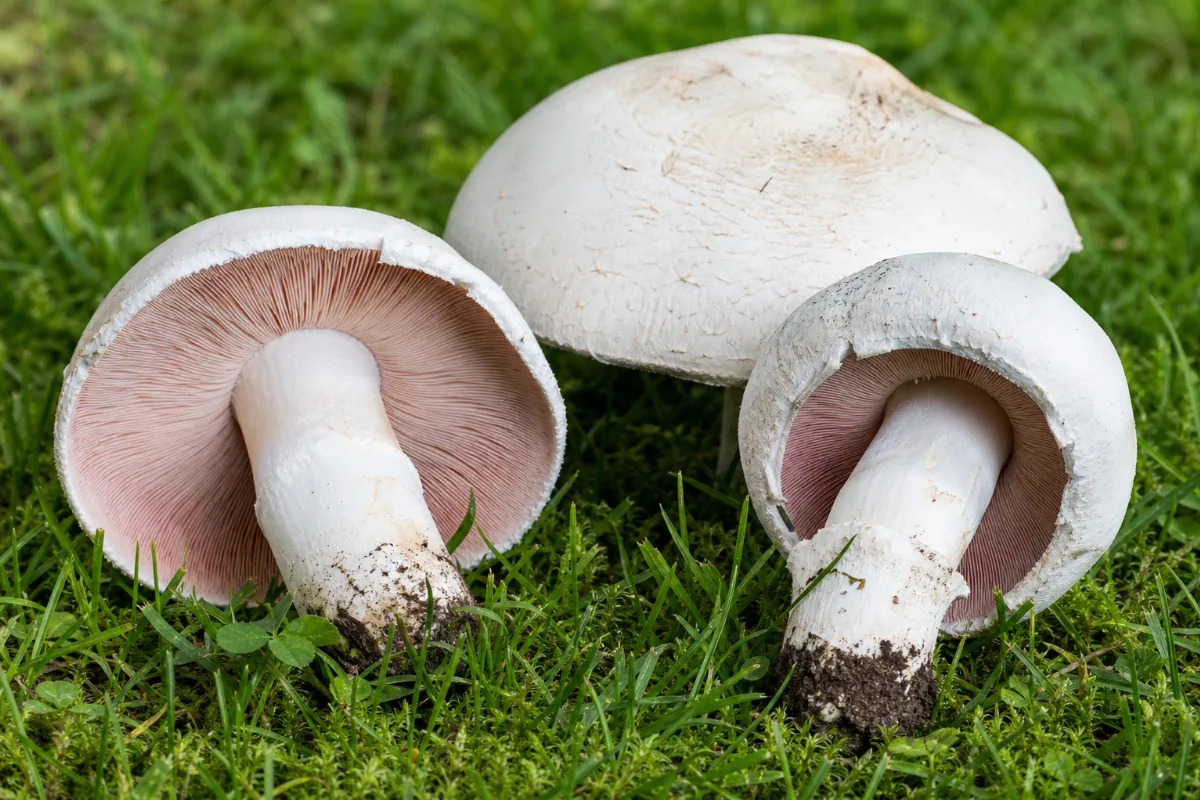
Mushrooms · Wild culinary mushroom
Field mushroom
Agaricus campestris · also called Meadow mushroom, pink bottom (names from our earlier summary, not from a source read for this page)
Field mushroom is a wild grassland mushroom, a close relative of the supermarket button mushroom. It is eaten as a food and sold in Europe, but it is not a supplement and no human study shows a health benefit. The main danger is mistaking a deadly or toxic look-alike for it, and cooking does not make those safe. Wild specimens can also hold cadmium from the soil.
General information, not medical advice. Last substantive update · Not medically reviewed. A named clinician has not signed off on this page. How this page is made
About Field mushroom
Field mushroom (Agaricus campestris) is a wild relative of the button mushroom that is eaten as a food in Europe. It is not sold as a supplement and no human study shows a health benefit. The safety points matter far more: deadly and toxic look-alikes, cadmium taken up from soil, and an unmeasured agaritine content.
Metals in wild specimens
Wild mushrooms take up metals from the soil. In a Romanian study, field mushroom caps held about three times as much cadmium as stalks, and the authors' calculated cadmium risk index was above their recommended level for both adults and children. In two Croatian studies field mushroom held more cadmium than nine other species. Results depend on where it grew, and mushrooms from roadsides or industrial land are of most concern.
What it is
Agaricus campestris is a fungus in the family Agaricaceae, and GBIF lists the name as accepted. It is a close relative of Agaricus bisporus, the cultivated button, cremini and portobello mushroom. For nutrition and the agaritine question for the cultivated mushroom, see the button mushroom page.
A 2020 review reports agaritinal, a compound related to agaritine, in significant amounts in this species, citing an older study. We found no measured value and no report of harm from eating it. Cooking is the cautious choice.
What the research shows
No study in people was found. In one 2025 laboratory study, an ethanol extract made under computer-tuned conditions scored higher than a button mushroom extract on antioxidant tests, blocked two nerve enzymes (weakly, the authors say) and lowered lung cancer cell numbers in a dish. These are test-tube results and do not show that eating the mushroom does anything.
Legal and regulatory status
We did not read any food-safety or medicine regulator statement on field mushroom, so none is stated here. It is a wild food, not an approved medicine or a supplement.
At a glance
Traditional uses history, not proof
- A 2020 review says it is one of the five top-selling edible fungi in Europe and is on most European edible lists (Lagrange and Vernoux).
- A 2024 review of Brazilian wild food mushrooms also lists it as a wild food resource.
Studied for research
- Eating it as a food: no health benefit shown, insufficient
- Antioxidant scores of a lab extract, laboratory only, insufficient
- Nerve-enzyme blocking by a lab extract, laboratory only, insufficient
- Lung cancer cells in a dish, laboratory only, insufficient
Main compounds
- Phenolic acids such as gallic, protocatechuic and caffeic acid (lab extract)
- Agaritinal, related to agaritine (second-hand report; not measured)
- Cadmium and lead taken up from soil (contaminants)
Common forms
- Fresh or cooked wild mushroom
- Laboratory ethanol extract (research only; no product found)
Research links: Agaricus campestris edibility and agaritine (review abstract) · Mushroom poisonings in South Sardinia (abstract) · Death cap liver failure (review abstract) · Heavy metals in wild edible mushrooms (abstract) · Yellow stainer phenol variation (abstract) · Research Library · Genes & Biomarkers Library
What it is and its history
- Accepted scientific name
- Agaricus campestris
- Naming authority
- L. (GBIF)
- Synonyms
- Not listed here; synonyms were not read.
- Common names
- Field mushroom (English); Meadow mushroom (English); Pink bottom (English (from our own earlier summary; no source opened))
- Family or group
- Agaricaceae (a fungus family), not a plant
- Classification
- Fungi > Basidiomycota > Agaricomycetes > Agaricales > Agaricaceae > Agaricus > Agaricus campestris
- Native range
- Not checked.
- Habitat
- Not stated in the sources read beyond being a wild edible mushroom of Europe and recorded in Brazil and Romania.
- What it looks like
- Fruiting body: Deliberately not described: this page gives no identification help.
- Cultivation
- The commercial mushroom is the related Agaricus bisporus. Field mushroom is described as wild-picked.
- Harvest and processing
- Not checked.
- Look-alikes and adulterants
- Name: Death cap and white destroying angels (Amanita); Note: Deadly. A 2024 review says the death cap can easily be confused with the horse mushroom, and a 2022 review says a lethal destroying angel can be confused with young Agaricus. Amatoxins survive cooking and drying.; Name: Yellow-staining Agaricus (Agaricus xanthodermus and relatives); Note: Cause vomiting and diarrhoea within about 2 hours. Phenol is the likely cause.
- Sustainability and conservation
- The Global Fungal Red List assessed A. campestris as Least Concern, according to a 2024 review; the Red List itself was not opened.
Traditional use and history history, not clinical proof
| Tradition or era | Documented use | Source |
|---|---|---|
| Europe, food trade | A 2020 review says Agaricus campestris is one of the five top-selling edible fungi in Europe and is listed in most European edible mushroom lists. | p32751277 |
| Brazil | Recorded in a 2024 review of wild edible mushroom food records from Brazil. | p39673069 |
Traditional use shows how it was used. It does not show that it works or is safe today.
What is inside, and how it may work
What it contains and how those compounds act in cells and animals. Laboratory and animal mechanisms are not proven effects in people.
Main compounds
| Compound | Family | Where it is concentrated | Activity studied | Level of evidence |
|---|---|---|---|---|
| Phenolic acids (gallic, protocatechuic, caffeic) | phenolic acid | Fruiting body extract Reported in a 2025 lab extract; units not used here. | Antioxidant in test tubes; no human effect shown. 7 | Laboratory research |
| Agaritinal (agaritine-related) | hydrazine compound | Not stated Described as 'significant amounts' in a review citing an older study; no measured value. | Related compounds are suspected weak carcinogens in mice (review). 10 | Review |
| Cadmium and lead (contaminants, not natural constituents) | heavy metal | Cap more than stalk Cadmium 0.446 to 1.364 mg per kg dry weight in a Romanian study; site-dependent. | Toxic metals taken up from soil. 3 12 13 | Food survey |
Mechanisms, receptors and pathways
| Target or pathway | Gene or receptor | What was found | Level |
|---|---|---|---|
| Enzyme activity (acetylcholinesterase, butyrylcholinesterase) | AChE, BChE | An extract blocked both enzymes in a test; the authors say activity was weak (high IC50). 7 | Laboratory research |
| Cell growth | not studied here | Extracts lowered A549 cell numbers in a dish. 7 | Laboratory research |
| Toxicity of the yellow-staining look-alike | not applicable | Phenol in A. xanthodermus is high enough to account for its toxicity (abstract). 5 2 | Laboratory research |
Absorption, metabolism and elimination
- Absorption
- Not found.
- Distribution
- Not found.
- Metabolism
- Not found.
- Elimination
- Not found.
- Bioavailability
- Not established.
Isolated compounds versus whole extracts
The only lab work used an ethanol extract made under computer-tuned conditions, which is not like the food. No supplement was found.
Nutritional composition
No official nutrient table was found, so no nutrition value is stated.
4 not enough evidence
What was looked at
The 4 benefits and uses checked for Field mushroom, each with how strong the evidence is. Tap one to open it.
- As a foodNot enough evidence
- Antioxidant activity (laboratory only)Not enough evidence
- Nerve-enzyme blocking (laboratory only)Not enough evidence
- Lung cancer cells in a dish (laboratory only)Not enough evidence
Lab markers tracked in the studies
Total antioxidant status of a laboratory extract (TAS)Lung cancer cell (A549) numbers in a dish
What is Field mushroom good for?
The uses people ask about and how strong the evidence is for each. None is proven in people. Read this together with the Safety tab.
Benefits, one by one
Each card is a research question, not a promise. Tap a goal to filter. Open a card to see the studies, doses and limits.
As a food
Not enough evidenceA wild grassland mushroom that is eaten and sold as a food in Europe. We found no official nutrient table and no human study of health effects, so no nutrition or health claim is made.
2 studiesFresh or cooked mushroom. Cooking is the cautious choice for any Agar…
Studies, doses and limits
What the trials found
No study in people was found that tests eating field mushroom for any health outcome. The only source on its food role says it is widely sold and listed as edible in Europe. A Brazilian review of wild food mushrooms also lists it, which says nothing about health.
Effect sizes as reported
No health effect shown
Why this rating
There are no human studies of health outcomes, and no verified nutrient values were found.
Form and dose studied
Fresh or cooked mushroom. Cooking is the cautious choice for any Agaricus (compiler's reading of the agaritine review, which names button mushrooms only).
Limits
Only second-hand and descriptive sources. The edibility statement is not a safety guarantee, and it applies to correctly identified mushrooms only.
Why researchers looked
It is eaten for taste, not as a remedy.
Traditional use
A 2020 review says Agaricus campestris is one of the five top-selling edible fungi in Europe and is on most European edible lists.
Proposed mechanism Other
Not applicable; this is a food.
A proposed mechanism does not show that the effect happens in people.
The biggest risk with this mushroom is mistaking a deadly or toxic look-alike for it. See the Safety tab first.
Antioxidant activity (laboratory only)
Not enough evidenceIn a laboratory test an ethanol extract of this mushroom scored higher on antioxidant tests than a similar button mushroom extract. Test-tube scores say nothing about what happens when you eat it.
1 studiesA strong ethanol extract made for research. No supplement was found.
Studies, doses and limits
What the trials found
No human study. In one 2025 laboratory study the ethanol extract of Agaricus campestris, made under settings chosen by a computer model, had a total antioxidant status of 5.017 mmol/L, compared with 2.821 for Agaricus bisporus (the button mushroom).
Results
TAS 5.017 vs 2.821 mmol/L; DPPH 74.030 vs 47.246 mg Trolox equivalent per g; FRAP 93.048 vs 60.947 (A. campestris vs A. bisporus extracts)
Effect sizes as reported
Higher scores in a test tube; no effect shown in people
Why this rating
Laboratory extract only. No animal or human study was found.
Form and dose studied
A strong ethanol extract made for research. No supplement was found.
Limits
The extract is not like food, and the authors tuned the extraction to maximise activity. Antioxidant scores do not show a health effect.
Why researchers looked
Researchers measure antioxidant scores in extracts as an early screen.
Proposed mechanism Laboratory research
Phenolic acids such as gallic, protocatechuic and caffeic acid were found at high levels in the extract and may explain the scores (authors' suggestion, lab work).
A proposed mechanism does not show that the effect happens in people.
The biggest risk with this mushroom is mistaking a deadly or toxic look-alike for it. See the Safety tab first.
Nerve-enzyme blocking (laboratory only)
Not enough evidenceExtracts blocked two enzymes that break down the brain messenger acetylcholine, more strongly than a button mushroom extract. These enzymes are targets of some Alzheimer medicines, but this was a test-tube result with weak activity. It does not show any effect on memory.
1 studiesA research ethanol extract
Studies, doses and limits
What the trials found
No human or animal study. In the 2025 laboratory study the Agaricus campestris extracts blocked the two enzymes more strongly than the Agaricus bisporus extracts. The authors themselves say the IC50 values were high, which means a lot of extract was needed, and that purification and absorption studies are needed.
Results
Stronger than button mushroom extract in the lab; exact figures not used
Effect sizes as reported
Weak enzyme blocking in a test tube
Why this rating
Lab test only, with high IC50 values by the authors' own words.
Form and dose studied
A research ethanol extract
Limits
No animal or human data; nothing shows eating the mushroom changes memory or Alzheimer risk.
Why researchers looked
Enzyme blocking is an early screen for brain-related research.
Proposed mechanism Laboratory research
Extracts reduced the activity of acetylcholinesterase and butyrylcholinesterase in a test (authors).
A proposed mechanism does not show that the effect happens in people.
The biggest risk with this mushroom is mistaking a deadly or toxic look-alike for it. See the Safety tab first.
Lung cancer cells in a dish (laboratory only)
Not enough evidenceAn extract lowered the number of human lung cancer cells growing in a dish. This is not a treatment or a finding in people, and nothing suggests eating the mushroom does this.
1 studiesA research ethanol extract
Studies, doses and limits
What the trials found
No animal or human study. All the extracts tested lowered A549 lung cancer cell numbers in a dose-dependent way, with a significant fall at the highest concentration tested (200 micrograms per mL).
Results
Significant fall in cell numbers at 200 micrograms per mL
Effect sizes as reported
Cell-dish result only
Why this rating
One cell line, one lab, extracts tuned for activity; no healthy-cell comparison was noted in our reading.
Form and dose studied
A research ethanol extract
Limits
Dish results rarely carry over to people. This page does not suggest field mushroom treats or prevents cancer.
Why researchers looked
Cell tests are an early screen for anticancer research.
Proposed mechanism Laboratory research
The authors suggest phenolic acids may act on cell-death signals, which is unproven for this extract.
A proposed mechanism does not show that the effect happens in people.
The biggest risk with this mushroom is mistaking a deadly or toxic look-alike for it. See the Safety tab first.
Connections to the rest of health
How Field mushroom connects to the rest of our health knowledge graph. Every link says what kind of connection it is. A safety link (for example to the liver) is a warning, not a benefit. A study that merely mentions a topic never creates a benefit link.
Explore every connection: goals, body systems, organs, symptoms, genes
B. Body systems
| Connected to | Kind of connection | Evidence status | Context | Studies |
|---|---|---|---|---|
| Digestive system | Adverse effect or risk | Moderate certainty | Vomiting and diarrhoea within about 2 hours. Preparation or compound: Yellow-staining Agaricus look-alikes |
9 5 |
C. Body parts and organs
G. Root causes and contributing factors
| Connected to | Kind of connection | Evidence status | Context | Studies |
|---|---|---|---|---|
| Heavy metal exposure | Low certainty | Cadmium and lead found; levels depend on the soil. Cadmium and lead found; depends on the soil. Preparation or compound: Wild field mushroom caps and stalks |
3 12 13 |
I. Biomarkers
| Connected to | Kind of connection | Evidence status | Context | Studies |
|---|---|---|---|---|
| Total antioxidant status of a laboratory extract (TAS) | Biological association | Not enough evidence | Measured in trials: raised. A lab change is not the same as a health benefit. | 7 |
| Lung cancer cell (A549) numbers in a dish | Biological association | Not enough evidence | Measured in trials: lowered. A lab change is not the same as a health benefit. | 7 |
L. Active compounds
| Connected to | Kind of connection | Evidence status | Context | Studies |
|---|---|---|---|---|
| Phenolic acids (gallic, protocatechuic, caffeic) | Biological association | In vitro | Antioxidant in test tubes; no human effect shown. Preparation or compound: Fruiting body extract |
7 |
| Agaritinal (agaritine-related) | Biological association | Review | Related compounds are suspected weak carcinogens in mice (review). | 10 |
| Cadmium and lead (contaminants, not natural constituents) | Biological association | Food survey | Toxic metals taken up from soil. Preparation or compound: Cap more than stalk |
3 12 13 |
Each connection is stored with the ingredient, the connected record, the kind of connection, the evidence status, the supporting studies, the preparation or compound involved, and a review date (last reviewed October 25, 2026).
Evidence at a glance: what changed in 2 lab markers
Tap a number to show only those markers. Counts are markers, not people.
The evidence
The research centre for Field mushroom. Every record here was checked against PubMed or the publisher's page; we never list a study we have not verified.
Evidence by outcome
Bars show how many studies we found for each outcome, not how well it works. People are added up across trials only (reviews are not added, to avoid double counting).
How we rate evidence
High certainty
Several well-run trials or reviews agree; further research is unlikely to change the picture much.
Moderate certainty
Good trials point the same way, but some doubt remains.
Low certainty
Small, short or inconsistent trials. The finding could change with better research.
Very low certainty
Very little or very weak human data. Treat as a possibility only.
Mixed findings
Trials or reviews disagree with each other.
Not enough evidence
Not enough human research to say either way.
Evidence against
Good research found no benefit, or found harm.
We take the reviewers' own risk-of-bias and GRADE statements where they exist, and otherwise judge from study size, design, consistency, directness and whether a product matches what is sold. Many publications do not make evidence high. Method note: We read PubMed records and abstracts for 12 papers (one laboratory study, one hospital case series, four reviews or taxonomy papers, two chemistry or field studies of toxic Agaricus, and three metal surveys including one with a health-risk calculation), read eight of them in full text from Europe PMC, and checked the species name in GBIF. Index Fungorum and regulator pages were not read. Certainty ratings are the compiler's own reading.
Study library: every study we checked 13
| Study | Design | People | Product, dose, length | Result |
|---|---|---|---|---|
| Alvarado 2022 Amanita Section Phalloideae Species in the Mediterranean Basin: Destroying Angels Reviewed. Biology (Basel) · PMID 35625498 · DOI |
Other n/a |
Taxonomy and poisoning review of white deadly Amanita species | n/a |
The abstract says amatoxin-containing mushrooms cause most of the deadly mushroom poisonings in Europe. In the species notes of the full text, one lethal destroying angel is described as easily confused with immature specimens of Agaricus. Review; no new data about Agaricus Methods, limits and fundingOutcomes: Species, amatoxins, poisoning in Spain Limitations: The Agaricus remark sits in the notes of a species entry; which entry it belongs to is not clear from the text extract we read, so we state it for white deadly Amanita in general. Funding and conflicts: Authors declare no conflict of interest. Read: abstract and full text |
| Boxshall 2021 A field-based investigation of simple phenol variation in Australian Agaricus xanthodermus. Mycologia · PMID 34494944 · DOI |
Other n/a |
Wild Agaricus xanthodermus collected in Australia | n/a fruiting body: cap, stalk, young and mature |
The abstract says A. xanthodermus and other yellow-staining species cause poisonings that need treatment, usually with stomach and bowel irritation of varying severity. Phenol was higher in the cap than the stalk, higher in mature than young mushrooms, and higher on woody mulch than on lawns. The authors suggest toxicity varies partly because of this, and that human sensitivity may also play a role (not tested). Toxin level varies between mushrooms, so severity of illness varies Methods, limits and fundingOutcomes: Phenol, hydroquinone and catechol levels Limitations: Australian study of one species. Abstract read only. Funding and conflicts: Research support from non-US government sources listed in the PubMed record; no industry link. Read: abstract |
| Bucurica 2024 Heavy Metals and Associated Risks of Wild Edible Mushrooms Consumption: Transfer Factor, Carcinogenic Risk, and Health Risk Index. Journal of Fungi (Basel) · PMID 39728340 · DOI |
Other n/a |
12 228 mushroom and 114 soil samples from Prahova County, Romania, 2023; 12 samples were Agaricus campestris from two sites |
n/a cap and stalk |
For Agaricus campestris the mean cadmium was 1.364 mg per kg dry weight in caps and 0.446 in stalks; lead 1.738 in caps and 1.534 in stalks. The authors' calculated health risk index for cadmium was 1.293 for adults and 1.939 for children, with 1 as the recommended level, so both are above it; the paper says A. campestris, A. mellea and M. procera exceeded 1 for adults. The soils at the sites were classed as extremely contaminated. Metals were measurable and cadmium risk figure was above the authors' limit Methods, limits and fundingOutcomes: Cadmium, chromium, copper, nickel and lead; calculated health risk Limitations: The risk index rests on the authors' own intake assumptions, which we did not copy. Only two sites, industrial and tourist towns in one county; the paper's own cap and stalk limit comparisons mix dry and fresh weights. Funding and conflicts: Authors declare no conflicts of interest. Read: abstract and full text |
| Drewinski 2024 Over 400 food resources from Brazil: evidence-based records of wild edible mushrooms. IMA Fungus · PMID 39673069 · DOI |
Other n/a |
Records of wild edible mushrooms eaten in Brazil | n/a |
Full text says Agaricus campestris, among other species, was assessed as Least Concern on the Global Fungal Red List. The paper is about Brazilian food records, not this species in particular. Conservation status only Methods, limits and fundingOutcomes: Which wild mushrooms are recorded as food, and which have a conservation status Limitations: Secondary mention. The Red List entry itself was not opened. Funding and conflicts: Not stated in the abstract Read: abstract and full text |
| Gill 1984 Constituents of Agaricus xanthodermus Genevier: the first naturally endogenous azo compound and toxic phenolic metabolites. Zeitschrift fuer Naturforschung C · PMID 6543409 · DOI |
Other n/a |
Fresh Agaricus xanthodermus | n/a fruiting body |
The abstract says phenol is present in the fruiting bodies in a high enough concentration to account for the toxicity of A. xanthodermus. Chemistry of a toxic look-alike species Methods, limits and fundingOutcomes: Chemical constituents Limitations: Old laboratory paper; abstract read only. Funding and conflicts: Not stated Read: abstract |
| Gouvinhas 2024 The most dreadful mushroom toxins: a review of their toxicological mechanisms, chemical structural characteristics, and treatment. EXCLI Journal · PMID 39165585 · DOI |
Narrative review n/a |
Review of dangerous mushroom toxins | n/a |
Full text says the death cap (Amanita phalloides) can easily be confused with the edible horse mushroom (Agaricus arvensis) and with Tricholoma equestre, citing Garcia 2015. It says the poisons (amatoxins) are heat stable, so drying or boiling does not inactivate them, and that severe stomach and bowel symptoms starting 8 to 24 hours after a meal suggest amatoxin poisoning. Review; no new data Methods, limits and fundingOutcomes: Toxins, mechanisms and treatment Limitations: Narrative review. The statement about the horse mushroom is a citation of an earlier paper that was not opened. Funding and conflicts: Authors declare no conflict of interest. Read: abstract and full text |
| Gürgen 2025 Optimization of biological activities of Agaricus species: an artificial intelligence-assisted approach. Scientific Reports · PMID 40603525 · DOI |
Laboratory research in-vitro |
Laboratory extracts of wild-type Agaricus campestris and Agaricus bisporus (no people) | Ethanol Soxhlet extract of Agaricus campestris, compared with A. bisporus fruiting body (not stated in the abstract) |
In the full text, the A. campestris extract made under the single-target best settings had a total antioxidant status of 5.017 mmol/L against 2.821 for A. bisporus, DPPH 74.030 against 47.246 mg Trolox equivalent per g, and FRAP 93.048 against 60.947. A. campestris extracts blocked the two enzymes more strongly than A. bisporus, though the authors note high IC50 values. All extracts lowered A549 cell numbers in a dose-dependent way, with a significant fall at the highest tested concentration (200 micrograms per mL). Gallic, protocatechuic and caffeic acid were found at high levels in A. campestris extracts. Test-tube results only; no effect in people is shown Methods, limits and fundingOutcomes: Antioxidant tests (TAS, TOS, DPPH, FRAP), enzyme inhibition (acetylcholinesterase, butyrylcholinesterase), growth of A549 human lung cancer cells in a dish, phenolic content Limitations: Lab study. Extraction settings were tuned by a computer model to maximise activity, so the extracts are not like food or any product. The authors say high IC50 values mean the extracts are weak enzyme blockers and need purification. Cell-dish results do not predict effects in people. Funding and conflicts: The authors declare no competing interests. Read: abstract and full text |
| Kayes 2024 Amanita phalloides-Associated Liver Failure: Molecular Mechanisms and Management. International Journal of Molecular Sciences · PMID 39684738 · DOI |
Narrative review n/a |
Review of death cap poisoning | n/a |
The abstract says death cap poisoning starts with delayed stomach and bowel symptoms that look like ordinary gastroenteritis, followed by severe liver damage and liver failure, and that liver transplantation is needed in some people. The full text says there is a symptom-free gap of 6 to 18 hours, that amatoxins are not destroyed by cooking or drying, that the mortality of death cap poisoning is 10 to 20%, and that the death cap is commonly mistaken for edible mushrooms. Review; no new data Methods, limits and fundingOutcomes: Toxicity course, treatment Limitations: Narrative review of small case series. Funding and conflicts: Authors declare no conflicts of interest. Read: abstract and full text |
| La Rosa 2024 Epidemiology and clinical aspect of mushroom poisonings in South Sardinia: A 10-year retrospective analysis (2011-2021). Food Science and Nutrition · PMID 38268883 · DOI |
Case series |
164 164 mushroom poisoning cases in South Sardinia, Italy, 2011 to 2021 |
n/a |
Species were identified in 162 of 164 cases. 81 cases were due to toxic species. Agaricus xanthodermus caused 15 cases (18% of the toxic-species cases); mean delay to symptoms 2 hours, mean hospital stay 1 day, with abdominal pain and cramps, diarrhoea, nausea, vomiting, tremor and vertigo. Amanita phalloides appeared in 3 cases in the same table. Six patients were children or adolescents who ate wild mushrooms unintentionally. Yellow-staining Agaricus was one of the two most common toxic causes in this region Methods, limits and fundingOutcomes: Species involved, symptoms, timing Limitations: Regional hospital and inspectorate records from one Italian area; cannot give a rate for the general public. Funding and conflicts: Authors declare no conflict of interest. Read: abstract and full text |
| Lagrange 2020 Warning on False or True Morels and Button Mushrooms with Potential Toxicity Linked to Hydrazinic Toxins: An Update. Toxins (Basel) · PMID 32751277 · DOI |
Narrative review n/a |
Literature review of toxins in false and true morels and Agaricus mushrooms | n/a |
Full text says Agaricus campestris is one of the five top-selling edible fungi in Europe and is on most European edible lists. It says Agaricus species, including cultivated ones, can cause a stomach and bowel illness (diarrhoea, vomiting, cramps, nausea) 1 to 2 hours after eating, from an unknown irritant; the species named are A. xanthodermus and A. moelleri, plus six North American species. It says the compound agaritinal has been shown in significant amounts in A. arvensis, A. augustus, A. campestris and A. macrosporus, citing an older study that was not opened here. The abstract concludes that button mushrooms should not be eaten crude or poorly cooked. An erratum was published for this paper in 2022. Review; no new measurement for this species Methods, limits and fundingOutcomes: Edibility, toxins and poisonings with morels and Agaricus species Limitations: Narrative review. The agaritinal statement for A. campestris is second-hand. No measured agaritine value for A. campestris is given and no study of harm from eating it is given. An erratum exists; its content was not read. Funding and conflicts: Authors declare no conflict of interest. Read: abstract and full text |
| n/a 2026 GBIF Backbone Taxonomy record: Agaricus campestris L. (usage key 5243458), checked by API 2026-10-25 n/a · Source |
Database record n/a |
n/a | n/a |
ACCEPTED, exact match, confidence 99. Methods, limits and fundingOutcomes: Agaricus campestris L. is an ACCEPTED species in Fungi, Basidiomycota, Agaricomycetes, Agaricales, Agaricaceae, genus Agaricus. Limitations: Identity record only; Index Fungorum was not read. Funding and conflicts: Independent public information source Read: full text |
| Širić 2016 Heavy metal bioaccumulation by wild edible saprophytic and ectomycorrhizal mushrooms. Environmental Science and Pollution Research · PMID 27272918 · DOI |
Other n/a |
10 edible mushroom species, Medvednica Nature Park, Croatia | n/a cap and stalk |
The abstract says the highest nickel (3.62 mg per kg), chromium (3.01) and cadmium (2.67) among the ten species were in Agaricus campestris. Caps held more than stalks in all species, and all species were bioaccumulators of cadmium and mercury. A. campestris was top of ten species for three metals at this site Methods, limits and fundingOutcomes: Nickel, chromium, lead, cadmium, mercury Limitations: Single park in Croatia; the abstract does not say whether weights are dry or fresh. Funding and conflicts: Not stated in the abstract Read: abstract |
| Širić 2017 Lead, cadmium and mercury contents and bioaccumulation potential of wild edible saprophytic and ectomycorrhizal mushrooms, Croatia. Journal of Environmental Science and Health B · PMID 28121267 · DOI |
Other n/a |
10 edible mushroom species, Trakošćan, Croatia | n/a cap and stalk |
The abstract says the highest mean cadmium (3.23 mg per kg in caps and 2.24 in stalks) was in Agaricus campestris. Caps held more than stalks. A. campestris held the most cadmium of ten species at this site Methods, limits and fundingOutcomes: Lead, cadmium, mercury Limitations: Single site; the abstract does not say dry or fresh weight. Funding and conflicts: Not stated in the abstract Read: abstract |
What we do not know yet
- No human study of any health effect of field mushroom was found.
- Agaritine and nutrient content of this species are not measured in any source read.
- No pesticide, microbe or radioactivity test was read; metal figures come from three papers at few sites.
- No official food-safety statement was read; Index Fungorum was not read.
- Reviews' statements on look-alikes are quoted from earlier papers we did not open.
How new research is added
New studies are found by a saved PubMed search and placed in a review queue. A person reads each one before it changes any evidence rating or safety wording. New publications never change ratings automatically.
Lab markers
What changed in blood or saliva tests during trials. A changed number is not the same as feeling or being healthier, and we give no "normal ranges".
Other 2
Total antioxidant status of a laboratory extract (TAS)
Raised in trials
A test-tube score for how strongly an extract mops up reactive chemicals. It is a lab measure, not a blood test in a person.
Not enough evidenceResults and what it means
Why it was measured
Used to compare extracts in the lab.
Statistical vs. clinical meaning
Statistically different between the two extracts in the lab.
Safety implication
None for people; no human data.
| Study | Result | People | Product |
|---|---|---|---|
| 7 | TAS 5.017 mmol Trolox equivalent per L for the Agaricus campestris ethanol extract against 2.821 for Agaricus bisporus (single-target optimum). | Laboratory extract; no people | Ethanol Soxhlet extract, 50 C, 1.952 mg per mL |
Lung cancer cell (A549) numbers in a dish
Lowered in trials
How many cells of a human lung cancer cell line survive after an extract is added in the lab.
Not enough evidenceResults and what it means
Why it was measured
A first screen for anticancer research.
Statistical vs. clinical meaning
Significant at the highest concentration in the lab.
Safety implication
None for people.
| Study | Result | People | Product |
|---|---|---|---|
| 7 | All extracts, including the Agaricus campestris ethanol extract, lowered cell proliferation in a dose-dependent way, significantly at 200 micrograms per mL. | Cell line (no people) | Ethanol extracts |
Safety
What studies and official sources say about side effects, medicines and who should check first. Each point shows what kind of evidence it comes from.
Main points to know 5
- Danger first: deadly look-alikes. Mistaking a white deadly Amanita (death cap or a destroying angel) for a field-mushroom relative can be fatal. A 2024 review says the death cap can easily be confused with the horse mushroom, a close relative of the field mushroom (Agaricus arvensis), and a 2022 review says a lethal destroying angel can easily be confused with young Agaricus. The poisons are not destroyed by cooking or drying. Symptoms come after a quiet gap of 6 to 18 hours and can end in liver failure; mortality is 10 to 20% in the review we read. This page gives no way to tell mushrooms apart. Never eat a wild mushroom unless an expert has identified it in person. Narrative review 6 1 8
- Toxic yellow-staining relatives cause stomach and bowel illness. Agaricus xanthodermus and other yellow-staining relatives cause vomiting, diarrhoea and cramps, usually within 1 to 2 hours. In South Sardinia they caused 15 hospital-recorded poisonings in 10 years (18% of the toxic-species cases), with a mean hospital stay of 1 day. Phenol in the mushroom is high enough to account for the toxicity, and the level varies with the mushroom's age, part and where it grew, so severity varies. Case series 9 5 2 10
- Wild mushrooms take up metals from soil. In Romania, field mushroom caps held 1.364 mg per kg cadmium (dry weight) against 0.446 in stalks, and the authors' cadmium health risk index was above their recommended level for adults and children. In two Croatian sites field mushroom held the most cadmium of ten species. Levels depend on the site, and soils from cities or industry are worse. Food survey 3 12 13
- Cooking is the cautious choice; agaritine is not measured for this species. A 2020 review reports agaritinal (a compound related to agaritine, a suspected weak carcinogen in mice) in significant amounts in A. campestris, citing an older study, and advises against eating button mushrooms crude or poorly cooked. We found no measured agaritine value for field mushroom and no study showing harm from eating it. See the button mushroom page for agaritine. Narrative review 10
- No data for pregnancy, breastfeeding or allergy; children are at risk from wild mushrooms in general. No source we read tests field mushroom in pregnancy or breastfeeding, or reports a field-mushroom allergy. In the Sardinian series 6 poisonings were in children and adolescents who ate wild mushrooms unintentionally. Insufficient 9
Side effects 3
| Effect | How often | Severity and recovery | Evidence |
|---|---|---|---|
| Vomiting, diarrhoea, cramps and nausea after a yellow-staining look-alike This is a look-alike effect, not an effect of field mushroom. | Common in those poisoned; onset 1 to 2 hours (review) and about 2 hours (Sardinia) | moderate Mean hospital stay 1 day in Sardinia | Case series 9 10 |
| Delayed vomiting and diarrhoea, then liver failure, after a white deadly Amanita Symptoms begin after a quiet gap of 6 to 18 hours and can look like a simple stomach bug. | Not applicable to field mushroom; look-alike risk. Mortality 10 to 20% in the review | high Some recover; some need a liver transplant | Narrative review 8 6 |
| Cadmium and lead intake No illness from metals in field mushroom eaters has been reported in the sources read. | Estimated, not observed | unknown Not applicable | Food survey 3 |
Liver
No liver injury from field mushroom itself was found. Liver failure is the main danger of a look-alike, the death cap and related white Amanita species, whose amatoxins block a key liver enzyme (RNA polymerase II) and are not destroyed by cooking. 8 6
Monitoring. Anyone who ate a wild mushroom and has vomiting or diarrhoea, especially starting 6 or more hours after the meal, needs urgent medical care even if the symptoms ease. Keep any leftover mushroom or remains for the hospital.
This is a safety connection. It is not evidence that Field mushroom supports liver health.
Medicines and supplements 1
| With | Why it matters | Importance | Evidence | What to do |
|---|---|---|---|---|
| Medicines in general prescription | No source we read describes an interaction between eating field mushroom and any medicine. That is absence of evidence, not proof of safety. | Gap Not enough evidence | Ask a pharmacist if unsure. |
Who should check first 4
| Situation | Advice | Evidence |
|---|---|---|
| Any doubt about the identity of a wild mushroom | Do not eat it. Look-alikes can be deadly and cooking does not make them safe. | Narrative review 6 8 1 |
| Children | Wild mushrooms are a poisoning risk for children; keep them away from wild mushrooms. | Case series 9 |
| Pregnancy and breastfeeding | No data. Ask a clinician rather than assume it is safe. | Insufficient |
| Eating wild mushrooms often, or from roadsides or industrial areas | Metal levels depend on the soil; cadmium risk indices were above the authors' limit in a Romanian study of mushrooms from industrial and tourist towns. | Food survey 3 12 13 |
Overdose, product quality and regulators
Summary. Field mushroom itself has no described poisoning in the sources we read. The documented dangers are look-alikes (see key safety), agaritine-related compounds that are not measured for this species, and metals taken up from soil.
Animal. Not reviewed.
High dose or long term signals. Cadmium intake from frequent wild mushroom meals was calculated, not observed; one paper's risk index was above 1.
Genotoxicity. Not read for this species.
Toxic or hazardous parts. Fungus: the fruiting body is the part eaten. In the Romanian study caps held more cadmium than stalks.
Wild-picked mushrooms reflect their soil. Three studies found cadmium, and others, in field mushroom. No pesticide, microbe or radioactivity test was read.
Cadmium and lead, Romania. Prahova County: cadmium 1.364 (cap) and 0.446 (stalk) mg per kg dry weight; lead 1.738 and 1.534. Health risk index for cadmium 1.293 (adults) and 1.939 (children), where 1 is the recommended level; the soils were classed extremely contaminated. 3
Nickel, chromium, cadmium, Croatia. Medvednica park: field mushroom had the highest nickel (3.62), chromium (3.01) and cadmium (2.67 mg per kg) of ten species. Basis (dry or fresh) not stated in the abstract. 12
Cadmium, lead, mercury, Croatia. Trakošćan: highest mean cadmium of ten species, 3.23 (caps) and 2.24 (stalks) mg per kg. 13
Cap versus stalk. Cadmium was higher in caps than in stalks in all three papers. 3 12 13
| Body | Action | Date |
|---|
When to get medical help
- You or someone else ate a wild mushroom and has vomiting, diarrhoea or belly pain: call your local poison centre or emergency services now, even if the person seems better later. Keep any leftover mushroom or remains for the hospital.
- Stomach symptoms that start 6 or more hours after a wild mushroom meal, ease for a day, then yellow skin or eyes, dark urine or confusion: this is an emergency.
- A child may have swallowed a wild mushroom: call poison control or emergency services at once.
- Swelling of the face or throat or trouble breathing after eating a mushroom: call emergency services.
If someone may be poisoned or in a crisis, contact a clinician or emergency service straight away. In the US, Poison Control is 1-800-222-1222.
General information only, not medical advice. Ask a clinician or pharmacist before use, especially with medicines, in pregnancy or with a health condition. See the Natural Remedy Safety guide.
Frequently asked questions
What is field mushroom?
Can field mushroom be mistaken for a deadly mushroom?
What happens if you eat a death cap or destroying angel by mistake?
What are yellow-staining mushrooms?
Why does the same mushroom make some people very ill and others not?
Phenol levels differ between mushrooms, with age, part and growing place, and people may differ in sensitivity (not tested). This is no reason to try a suspect mushroom.
Does cooking make wild mushrooms safe?
Does field mushroom contain heavy metals?
Is field mushroom healthy?
Does field mushroom have anticancer or antioxidant properties?
Only in the laboratory. An extract had antioxidant activity and lowered lung cancer cell numbers in a dish. That does not show an effect in people, and it is not a treatment.
Is it safe in pregnancy, for children or with medicines?
No data were found for pregnancy, breastfeeding or medicine interactions. Children are at risk from wild mushrooms in general: 6 of the South Sardinian poisonings were in children or teenagers. Ask a doctor or pharmacist.
Explore by health goal
Editorial transparency
- Written by
- AlternativeMed editorial team. Research compiled with AI assistance, then checked against PubMed records.
- Medical review
- None. This page has not been reviewed by a physician or pharmacist.
- First published
- 2026-10-25
- Last substantive update
- 2026-10-25
- How we research
- We read PubMed records and abstracts for 12 papers (one laboratory study, one hospital case series, four reviews or taxonomy papers, two chemistry or field studies of toxic Agaricus, and three metal surveys including one with a health-risk calculation), read eight of them in full text from Europe PMC, and checked the species name in GBIF. Index Fungorum and regulator pages were not read. Certainty ratings are the compiler's own reading.
- How we rate evidence
- See "How we rate evidence" in the Evidence tab.
- Independence
- No product is promoted on this page. No affiliate links are shown. This page is information, not a recommendation to eat wild mushrooms.
Sources 13
Each source was opened and checked. Where we read only the abstract, it says so. The small numbers in the text point here.
- Alvarado P, Gasch-Illescas A, Morel S, et al. Amanita Section Phalloideae Species in the Mediterranean Basin: Destroying Angels Reviewed.. Biology (Basel). 2022. PMID 35625498. DOI 10.3390/biology11050770. (abstract and full text)
- Boxshall AG, Birch JL, Lebel T, et al. A field-based investigation of simple phenol variation in Australian Agaricus xanthodermus.. Mycologia. 2021. PMID 34494944. DOI 10.1080/00275514.2021.1936851. (abstract)
- Bucurica IA, Dulama ID, Radulescu C, Banica AL, Stanescu SG. Heavy Metals and Associated Risks of Wild Edible Mushrooms Consumption: Transfer Factor, Carcinogenic Risk, and Health Risk Index.. Journal of Fungi (Basel). 2024. PMID 39728340. DOI 10.3390/jof10120844. (abstract and full text)
- Drewinski MP, Corrêa-Santos MP, Lima VX, et al. Over 400 food resources from Brazil: evidence-based records of wild edible mushrooms.. IMA Fungus. 2024. PMID 39673069. DOI 10.1186/s43008-024-00171-8. (abstract and full text)
- Gill M, Strauch RJ. Constituents of Agaricus xanthodermus Genevier: the first naturally endogenous azo compound and toxic phenolic metabolites.. Zeitschrift fuer Naturforschung C. 1984. PMID 6543409. DOI 10.1515/znc-1984-11-1203. (abstract)
- Gouvinhas I, Silva J, Alves MJ, Garcia J. The most dreadful mushroom toxins: a review of their toxicological mechanisms, chemical structural characteristics, and treatment.. EXCLI Journal. 2024. PMID 39165585. DOI 10.17179/excli2024-7257. (abstract and full text)
- Gürgen A, Sevindik M. Optimization of biological activities of Agaricus species: an artificial intelligence-assisted approach.. Scientific Reports. 2025. PMID 40603525. DOI 10.1038/s41598-025-08118-8. (abstract and full text)
- Kayes T, Ho V. Amanita phalloides-Associated Liver Failure: Molecular Mechanisms and Management.. International Journal of Molecular Sciences. 2024. PMID 39684738. DOI 10.3390/ijms252313028. (abstract and full text)
- La Rosa L, Corrias S, Pintor I, Cosentino S. Epidemiology and clinical aspect of mushroom poisonings in South Sardinia: A 10-year retrospective analysis (2011-2021).. Food Science and Nutrition. 2024. PMID 38268883. DOI 10.1002/fsn3.3793. (abstract and full text)
- Lagrange E, Vernoux JP. Warning on False or True Morels and Button Mushrooms with Potential Toxicity Linked to Hydrazinic Toxins: An Update.. Toxins (Basel). 2020. PMID 32751277. DOI 10.3390/toxins12080482. (abstract and full text)
- n/a. GBIF Backbone Taxonomy record: Agaricus campestris L. (usage key 5243458), checked by API 2026-10-25. n/a. 2026. (full text)
- Širić I, Humar M, Kasap A, et al. Heavy metal bioaccumulation by wild edible saprophytic and ectomycorrhizal mushrooms.. Environmental Science and Pollution Research. 2016. PMID 27272918. DOI 10.1007/s11356-016-7027-0. (abstract)
- Širić I, Kasap A, Bedeković D, Falandysz J. Lead, cadmium and mercury contents and bioaccumulation potential of wild edible saprophytic and ectomycorrhizal mushrooms, Croatia.. Journal of Environmental Science and Health B. 2017. PMID 28121267. DOI 10.1080/03601234.2017.1261538. (abstract)


