Mushrooms · Wild culinary mushroom
Giant Puffball
Calvatia gigantea (also written Langermannia gigantea) · also called Giant puffball; the Chinese drug "ma bo" comes from several puffball species, not only this one
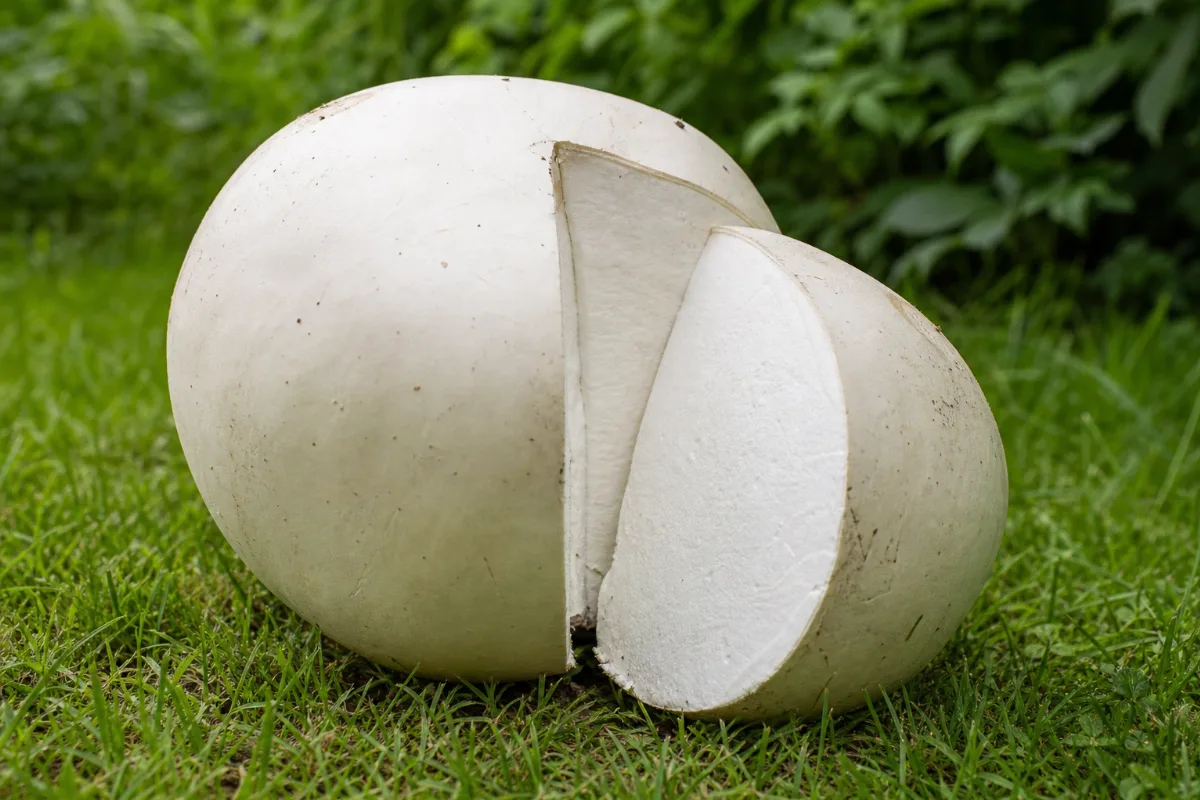
Giant puffball is a huge, smooth, white wild mushroom that is eaten when young, firm and white inside. The danger comes first: young Amanita mushrooms, including the deadly destroying angel, can be mistaken for a puffball until they are cut open. Laboratory and mouse work on extracts and on a protein called calvacin is interesting, but no human trial has tested it.
General information, not medical advice. Last substantive update · Not medically reviewed. A named clinician has not signed off on this page. How this page is made
About Giant Puffball
Giant puffball (Calvatia gigantea) is a very large white fungus. Young ones are eaten; the main risk is mistaking a different mushroom for it. Research on its medicinal use is limited to laboratory and animal work.
What it is
Giant puffball is a fungus. GBIF lists the accepted name as Calvatia gigantea and Langermannia gigantea as a synonym. It is a large, smooth, white ball that can be 8 to 20 inches across and weigh 25 pounds or more. As it ages the inside turns to a powder of spores; a large one may hold as many as seven trillion (MDC).
It lives on decaying organic matter in pastures, woods and lawns and is found in central and eastern USA and Canada (MDC, USU).
Traditional and current uses
The main use is as a wild food. Utah State University says the Lakota packed large wounds with dry spores to slow bleeding. Chinese medicine uses dried puffballs of several species, which a 2026 review says were noted for clearing heat, detoxification, reducing swelling and stopping bleeding.
Traditional use is not proof that something works. We do not recommend packing wounds with spore powder.
What the research shows
A Turkish lab analysis listed protein, carbohydrate, fats, sugars and phenolic compounds. Another listed amino acids. These are what the mushroom contains, not what it does for health.
Calvacin, a protein isolated in the 1960s, slowed a tumour in lab mice, according to Utah State University. The 1960 Science paper has no abstract in PubMed, so we could not read its results. A 2016 study found that an extract slowed lung cancer cells in a dish at a high concentration. No human trial of giant puffball or calvacin was found.
Mouse work found faster wound healing with an extract and with a purified polysaccharide. A rat study found an extract lowered blood glucose, but that mushroom was first identified by its look as a different puffball and then matched by DNA to giant puffball.
Food, spores and extracts are different
The food is the cooked young fruiting body. Spore powder is a traditional wound dressing. Extracts and purified compounds exist only in laboratories. Results from one do not apply to the others, and none is sold with proof of benefit.
The Chinese drug "ma bo" covers several puffball species, so the species in a product may not be giant puffball.
Regulatory status
The Missouri Department of Conservation lists giant puffball as a choice edible, with caution. We found no statement from the FDA, EMA or WHO about its use as medicine; those sources were not searched in depth.
At a glance
Traditional uses history, not proof
- Eaten young as a wild food, often fried in batter (Utah State University).
- Dry spores were packed into large wounds by the Lakota to slow bleeding (Utah State University).
- In Chinese medicine, dried puffballs of several species are used to stop bleeding and reduce swelling (2026 review).
Studied for research
- Food composition: protein, carbohydrate, amino acids; no health effect shown, insufficient
- Anticancer activity in cells in a dish and calvacin in mice; no human trial, insufficient
- Antioxidant compounds in the lab, insufficient
- Wound healing in diabetic mice, insufficient
- Blood glucose in diabetic rats and a test tube, insufficient
Main compounds
- Calvacin, a mucoprotein studied since the 1960s
- Polysaccharides such as CGPA1
- Phenolic acids such as gentisic acid
- Amino acids and fatty acids
Common forms
- Young white fruiting body, cooked as food
- Dry spore powder (traditional, not recommended)
- Laboratory extracts and purified compounds (not products)
Research links: Missouri Department of Conservation: Giant Puffball · Utah State University Herbarium: Giant Puffballs · Review: medicinal potential of Calvatia gigantea (2024) · Research Library · Genes & Biomarkers Library
What it is and its history
- Accepted scientific name
- Calvatia gigantea
- Naming authority
- (Batsch) Lloyd (GBIF)
- Synonyms
- Langermannia gigantea (Batsch) Rostk. (a synonym in GBIF)
- Common names
- Giant puffball (English); Ma bo (a Chinese drug from several puffball species, not only this one) (Chinese)
- Family or group
- Lycoperdaceae (puffball fungi) per GBIF; MDC lists Agaricaceae. A fungus, not a plant.
- Classification
- Fungi > Basidiomycota > Agaricomycetes > Agaricales > Lycoperdaceae > Calvatia > Calvatia gigantea
- Native range
- Utah State University says it is found in central and eastern USA and Canada. Other regions not checked.
- Habitat
- MDC: open pastures, woods and lawns, May to October in Missouri; a saprobe living on decaying organic matter.
- What it looks like
- Fruiting body: MDC describes a huge, smooth, white ball 8 to 20 inches across with a root-like attachment at the base; the inside is solid and white when young and turns into a powder of spores with age. Spores are round, 3.5 to 5.5 microns (USU).
- Cultivation
- Not checked. A 2024 paper reports a genome of a cultivated strain (CGMCC5.9), not read.
- Harvest and processing
- Not covered on this page.
- Look-alikes and adulterants
- Name: Immature Amanita mushrooms, including the deadly destroying angel (Amanita bisporigera); Note: MDC says they have stages that could be mistaken for a puffball until cut open. Deadly. Do not identify from text.
- Sustainability and conservation
- Not checked.
Traditional use and history history, not clinical proof
| Tradition or era | Documented use | Source |
|---|---|---|
| Lakota (North America) | Large wounds were packed with dry puffball spores to slow bleeding and help blood clot, and reportedly to prevent infection. | s-usu-puffballs |
| Traditional Chinese medicine | Dried puffball fruiting bodies (Lasiosphaera calvatia, from several species) are listed in the Mingyi Bielu for clearing heat, detoxification, reducing swelling and stopping bleeding (abstract of the 2026 review). | p41900048 |
| 1960s laboratory work | Calvacin was isolated and reported to inhibit sarcoma in lab mice; USU cites it as one of the first antitumour substances from a mushroom. The 1960 Science paper has no abstract in PubMed, so the result is taken from USU. | s-usu-puffballs |
| Food use | Eaten young; the most popular way is frying in batter; some say it has little taste of its own and soaks up flavours (USU). MDC suggests sliced puffball as an aubergine substitute in a parmesan dish. | s-usu-puffballs |
Traditional use shows how it was used. It does not show that it works or is safe today.
What is inside, and how it may work
What it contains and how those compounds act in cells and animals. Laboratory and animal mechanisms are not proven effects in people.
Main compounds
| Compound | Family | Where it is concentrated | Activity studied | Level of evidence |
|---|---|---|---|---|
| Calvacin (a basic mucoprotein) | protein | Not clear; the 2026 review says both fruiting body and spores | Anti-tumour activity in mice in the 1960s (USU) and in gastric cancer cells in a dish (2026 review, citing a thesis we did not read). 12 11 | Laboratory research |
| Polysaccharides (for example CGPA1) | polysaccharide | Fruiting body CGPA1: 11.69 kDa, mostly galactose | Skin cell movement and wound healing in lab and animal tests. 8 | Laboratory research |
| Gentisic acid and other phenolics | phenolic acid | Fruiting body 23.26 ug/g in the Turkish sample (basis not stated) | Antioxidant tests in the lab. 7 | Laboratory research |
| Free amino acids | amino acid | Fruiting body 199.65 mg/100 g total free amino acids | Nutritional content. 6 | Compositional |
Mechanisms, receptors and pathways
| Target or pathway | Gene or receptor | What was found | Level |
|---|---|---|---|
| Cell division and cell death genes in lung cancer cells | CCND1, CCND2, CDK4, Akt, Bcl-2 down; Bax, p53, caspase-3, caspase-9 up | Seen in A549 cells in a dish at 500 ug/mL for 72 hours. 3 | Laboratory research |
| Wound inflammation and bacteria | IL-1 beta, TNF-alpha | Lower in extract-treated diabetic mouse wounds, with a changed wound bacteria mix. 2 | Animal research |
| Starch digestion | Alpha-amylase | Blocked by a methanol extract in a test tube. 9 | Laboratory research |
Absorption, metabolism and elimination
- Absorption
- Not found.
- Distribution
- Not found.
- Metabolism
- Not found.
- Elimination
- Not found.
- Bioavailability
- Not established.
Isolated compounds versus whole extracts
The wound and cancer-cell results come from laboratory extracts or a purified polysaccharide, and calvacin is a purified protein. The food is the cooked young fruiting body. Results from one do not carry over to the other.
Nutritional composition
A Turkish analysis reported about 34% protein and 52% carbohydrate, with the basis (fresh or dry) not stated. A 2024 review says it is low in calories, cholesterol and sodium. No USDA entry was found.
5 not enough evidence
What was looked at
The 5 benefits and uses checked for Giant Puffball, each with how strong the evidence is. Tap one to open it.
- As a food: what it containsNot enough evidence
- Anticancer lab findings (including calvacin)Not enough evidence
- Antioxidant compoundsNot enough evidence
- Wound healing (traditional use and mouse work)Not enough evidence
- Blood sugar (rats and test tube)Not enough evidence
Lab markers tracked in the studies
Lung cancer cell survival in a dish (IC50)Blood glucose in diabetic rats
What is Giant Puffball good for?
The uses people ask about and how strong the human evidence is for each. None has been tested in people. Read this together with the Safety tab.
Benefits, one by one
Each card is a research question, not a promise. Tap a goal to filter. Open a card to see the studies, doses and limits.
As a food: what it contains
Not enough evidenceGiant puffball is a food mushroom. Laboratory analyses list protein, carbohydrate, fats and amino acids in it. Those are contents, not proven health effects, and no trial tested it in people.
3 studiesFresh young fruiting body eaten as food. No amounts are given here.
Studies, doses and limits
What the trials found
No human study of eating giant puffball for any health outcome was found.
Results
One Turkish analysis (abstract) reported proteins 34.37%, carbohydrates 51.97% and polyunsaturated fatty acids 67.93%; the abstract does not say whether this is fresh or dry weight. A second analysis found free amino acids totalling 199.65 mg/100 g.
Why this rating
Composition from one wild collection, basis not stated, and no human outcome measured.
Form and dose studied
Fresh young fruiting body eaten as food. No amounts are given here.
Limits
No USDA food entry was found. Wild mushrooms vary with place and age. Contents in a table do not show a benefit.
Why researchers looked
Researchers in Turkey measured what a wild-collected giant puffball holds, to ask whether it could be a health food.
Traditional use
Eaten as a wild food in North America and Europe; the Missouri Department of Conservation calls it a choice edible, with caution.
Proposed mechanism Compositional analysis
Not a mechanism. These are measurements of content in the lab.
A proposed mechanism does not show that the effect happens in people.
Wild-mushroom safety comes first: see the Safety tab on deadly look-alikes.
Anticancer lab findings (including calvacin)
Not enough evidenceA substance called calvacin from giant puffball slowed a mouse tumour in the 1960s, and an extract slowed lung cancer cells in a dish. No human trial exists. This is a lab lead, not a treatment.
4 studiesLaboratory extract and a purified protein. Neither is a consumer prod…
Studies, doses and limits
Results
Lung cancer cells: concentration for half effect (IC50) was 500 ug/mL at 72 hours (Eroglu 2016). The Science 1960 paper on calvacin is in PubMed with a title and authors only, so we could not read its results; the mouse-sarcoma finding is taken from the Utah State University page.
Effect sizes as reported
Cell growth slowed in a dish at a high concentration
Why this rating
Cells in a dish and 1960s mouse work only; the original calvacin papers could not be read.
Form and dose studied
Laboratory extract and a purified protein. Neither is a consumer product.
Limits
Mushroom extracts often kill cells in a dish at high concentrations; that rarely carries over to people. The 2026 review names a different first author for calvacin than the 1960 Science paper, so we did not repeat that detail.
Why researchers looked
Folk use of puffballs led researchers to test them. In the 1960s calvacin was isolated, and Utah State University says it is cited as one of the first anti-tumour substances found in a mushroom.
Traditional use
Puffball spores were packed into wounds by the Lakota (Utah State University). That is a wound use, not a cancer use.
Proposed mechanism Laboratory research
In a 2016 dish study an extract made lung cancer cells (A549) divide less and die more, with changes in genes such as Bax, p53 and caspases. A 2026 review also describes calvacin (a mucoprotein) as acting on gastric cancer cells in a dish, citing a 2014 thesis that we did not read.
A proposed mechanism does not show that the effect happens in people.
Do not use any mushroom in place of cancer treatment. Speak to a cancer team before using any mushroom product.
Antioxidant compounds
Not enough evidenceLab tests found phenolic compounds and showed antioxidant activity in the extract. These are test-tube results and say nothing yet about health in people.
1 studiesLaboratory extract.
Studies, doses and limits
Results
The Turkish analysis reported gentisic acid at 23.26 ug/g and described radical-scavenging, reducing-power and lipid-peroxidation tests in the lab; the abstract gives no figures for those tests.
Why this rating
Test-tube chemistry only.
Form and dose studied
Laboratory extract.
Limits
Antioxidant activity in a test tube does not show that eating the mushroom changes oxidative stress in the body.
Why researchers looked
Mushrooms are often screened for antioxidant chemistry.
Proposed mechanism Laboratory research
Phenolic acids (the most abundant was gentisic acid) can mop up reactive molecules in a test tube.
A proposed mechanism does not show that the effect happens in people.
None specific.
Wound healing (traditional use and mouse work)
Not enough evidencePuffball spore powder was traditionally put on bleeding wounds. Mouse and lab work on extracts and a purified sugar chain found faster wound healing. No human wound trial was found, and breathing in spores can cause lung disease.
4 studiesA laboratory extract and a purified polysaccharide. Not the raw mushr…
Studies, doses and limits
Results
The extract speeded healing of diabetic wounds in db/db mice (Ding 2024; no numbers in the abstract). CGPA1 sped healing of acute wounds (Meng 2025; animal species not stated in the abstract).
Effect sizes as reported
Faster healing in mice; no figures in the abstracts
Why this rating
Mouse and cell work only, with the abstracts giving no numbers; no human trial.
Form and dose studied
A laboratory extract and a purified polysaccharide. Not the raw mushroom or spore powder.
Who was studied
Mice and cells
Limits
Old use is not evidence. Spore powder itself was not tested in these papers. Wound care in people with diabetes needs a clinician.
Why researchers looked
Because of the old use on wounds, researchers in China tested extracts on skin cells and mouse wounds.
Traditional use
Utah State University says the Lakota packed large wounds with puffball spores to slow bleeding. A 2026 review says a Chinese puffball drug (ma bo, from several species) is traditionally used to stop bleeding and reduce swelling.
Proposed mechanism Animal research
In diabetic mice an extract lowered the inflammation messengers interleukin-1 beta and TNF-alpha and changed the wound bacteria. A purified polysaccharide (CGPA1) moved skin cells along in a dish and gave more skin re-growth and collagen in animal wounds.
A proposed mechanism does not show that the effect happens in people.
We found no human data on putting puffball powder on wounds. Inhaling large amounts of puffball spores has caused lung disease in case reports (see Safety).
Blood sugar (rats and test tube)
Not enough evidenceA methanol extract of a puffball lowered blood glucose in diabetic rats and blocked a starch-digesting enzyme in a test tube. There are no human data, and the mushroom in that study was not fully settled as giant puffball.
1 studiesMethanol extract of fruiting bodies (laboratory).
Studies, doses and limits
Results
At 400 mg/kg the extract lowered blood glucose 29.3% in alloxan-diabetic rats, against 15% for the diabetes drug glibenclamide at 5 mg/kg (a single-dose test). Test-tube alpha-amylase IC50 was 0.46 ug/mL.
Effect sizes as reported
29.3% fall in rat blood glucose in an acute test
Why this rating
One rat study and a test-tube test. The authors first identified the mushroom as Lycoperdon umbrinum by its look; a DNA match to Calvatia gigantea was 98% identical.
Form and dose studied
Methanol extract of fruiting bodies (laboratory).
Who was studied
Rats
Limits
Rat results often do not carry over to people. No human data. Not a replacement for diabetes care.
Why researchers looked
Researchers in Nigeria tested a local puffball for antidiabetic activity.
Proposed mechanism Laboratory research
The extract blocked alpha-amylase, an enzyme that breaks starch into sugar, in a test tube. How it lowered glucose in rats was not shown.
A proposed mechanism does not show that the effect happens in people.
People taking diabetes medicines should not use extracts without telling their clinician; no interaction has been tested.
Connections to the rest of health
How Giant Puffball connects to the rest of our health knowledge graph. Every link says what kind of connection it is. A safety link (for example to the liver) is a warning, not a benefit. A study that merely mentions a topic never creates a benefit link.
Explore every connection: goals, body systems, organs, symptoms, genes
A. Wellness goals
| Connected to | Kind of connection | Evidence status | Context | Studies |
|---|---|---|---|---|
| Blood Sugar Balance | Preliminary mechanism | Not enough evidence | Blood sugar (rats and test tube): A methanol extract of a puffball lowered blood glucose in diabetic rats and blocked a starch-digesting enzyme in a test tube. There are no human data, and the mushroom in that study was not fully settled as giant puffball. | 9 |
B. Body systems
| Connected to | Kind of connection | Evidence status | Context | Studies |
|---|---|---|---|---|
| Integumentary System | Biological association | Not enough evidence | Studied for: Wound healing (traditional use and mouse work) | 2 8 12 11 |
| Endocrine System | Biological association | Not enough evidence | Studied for: Blood sugar (rats and test tube) | 9 |
C. Body parts and organs
E. Health conditions
| Connected to | Kind of connection | Evidence status | Context | Studies |
|---|---|---|---|---|
| Food allergy | Adverse effect or risk | Low certainty | Some people react to certain fungi; mature spores may act as airborne allergens. Preparation or compound: Eaten fruiting body; airborne spores |
13 11 |
| Wound, non-healed | Preliminary mechanism | Not enough evidence | Mouse and cell work only; no human trial. Preparation or compound: Extract and CGPA1 polysaccharide in mice |
2 8 |
I. Biomarkers
| Connected to | Kind of connection | Evidence status | Context | Studies |
|---|---|---|---|---|
| Lung cancer cell survival in a dish (IC50) | Biological association | Not enough evidence | Measured in trials: lowered. A lab change is not the same as a health benefit. | 3 |
| Blood glucose in diabetic rats | Biological association | Not enough evidence | Measured in trials: lowered. A lab change is not the same as a health benefit. | 9 |
J. Genes, receptors and enzymes
| Connected to | Kind of connection | Evidence status | Context | Studies |
|---|---|---|---|---|
| TP53, caspase-3 and caspase-9 | Preliminary mechanism | In vitro | Switched up in cancer cells in a dish after an extract. | 3 |
K. Biological pathways
| Connected to | Kind of connection | Evidence status | Context | Studies |
|---|---|---|---|---|
| IL-1 beta and TNF-alpha | Preliminary mechanism | Animal | Lower in extract-treated diabetic mouse wounds. | 2 |
L. Active compounds
| Connected to | Kind of connection | Evidence status | Context | Studies |
|---|---|---|---|---|
| Calvacin (a basic mucoprotein) | Biological association | In vitro | Anti-tumour activity in mice in the 1960s (USU) and in gastric cancer cells in a dish (2026 review, citing a thesis we did not read). Preparation or compound: Not clear; the 2026 review says both fruiting body and spores |
12 11 |
| Polysaccharides (for example CGPA1) | Biological association | In vitro | Skin cell movement and wound healing in lab and animal tests. Preparation or compound: Fruiting body |
8 |
| Gentisic acid and other phenolics | Biological association | In vitro | Antioxidant tests in the lab. Preparation or compound: Fruiting body |
7 |
| Free amino acids | Biological association | Compositional | Nutritional content. Preparation or compound: Fruiting body |
6 |
Each connection is stored with the ingredient, the connected record, the kind of connection, the evidence status, the supporting studies, the preparation or compound involved, and a review date (last reviewed October 25, 2026).
Evidence at a glance: what changed in 2 lab markers
Tap a number to show only those markers. Counts are markers, not people.
The evidence
The research centre for Giant Puffball. Every record here was checked against PubMed or the publisher's page; we never list a study we have not verified.
Evidence by outcome
Bars show how many studies we found for each outcome, not how well it works. People are added up across trials only (reviews are not added, to avoid double counting).
How we rate evidence
High certainty
Several well-run trials or reviews agree; further research is unlikely to change the picture much.
Moderate certainty
Good trials point the same way, but some doubt remains.
Low certainty
Small, short or inconsistent trials. The finding could change with better research.
Very low certainty
Very little or very weak human data. Treat as a possibility only.
Mixed findings
Trials or reviews disagree with each other.
Not enough evidence
Not enough human research to say either way.
Evidence against
Good research found no benefit, or found harm.
We take the reviewers' own risk-of-bias and GRADE statements where they exist, and otherwise judge from study size, design, consistency, directness and whether a product matches what is sold. Many publications do not make evidence high. Method note: We read PubMed records and abstracts for 11 papers (two reviews, two composition analyses, four lab or animal studies, one 1960 paper with a title only, one inhalation case report and one environmental study on a related species), two conservation and university pages in full, and checked the species name in GBIF. One 1960 paper had a title only. Only abstracts were read for papers except the 2026 review, so numbers come from abstracts. Certainty ratings are the compiler's own reading.
Study library: every study we checked 14
| Study | Design | People | Product, dose, length | Result |
|---|---|---|---|---|
| Cicha-Jelen 2024 Medicinal Potential of the Giant Puffball Mushroom Calvatia gigantea (Agaricomycetes): A Review. International Journal of Medicinal Mushrooms · PMID 38967208 · DOI |
Narrative review review |
Published laboratory and traditional-use literature on Calvatia gigantea | Calvatia gigantea fruiting body Not shown here |
The abstract says the mushroom holds easily digestible protein, carbohydrates, fibre, phenolic compounds, vitamins and minerals, is low in calories, cholesterol and sodium, and shows antioxidant, anticancer, antimicrobial, antidiabetic and wound-healing effects. Summary of mostly laboratory work Methods, limits and fundingOutcomes: Nutrition and reported biological effects Limitations: Narrative review, abstract only. It does not say that any of these effects was shown in people. Funding and conflicts: Funding not stated in the abstract Read: abstract |
| Ding 2024 Reshaped commensal wound microbiome via topical application of Calvatia gigantea extract contributes to faster diabetic wound healing. Burns & Trauma · PMID 39224840 · DOI |
Animal research mouse |
Diabetic (db/db) mice with skin wounds | Calvatia gigantea extract (CGE), applied to the wound Not shown here · vs Untreated mice |
The extract speeded healing of the wounds, helped new skin form, lowered the activity of the inflammation messengers interleukin-1 beta and TNF-alpha, and changed the mix of bacteria on the wound (more variety and more Escherichia-Shigella). Faster wound healing in mice Methods, limits and fundingOutcomes: Wound healing rate, inflammation, tissue structure, wound bacteria (16S sequencing) Limitations: Mouse study. No numbers are given in the abstract. The extract type and amount are not stated in the abstract. It does not show the extract helps human wounds. Funding and conflicts: Conflict of interest: none declared Read: abstract |
| Eroglu 2016 Extract of Calvatia gigantea inhibits proliferation of A549 human lung cancer cells. Cytotechnology · PMID 26820971 · DOI |
Laboratory research cell-line |
A549 human lung cancer cells in a dish | Calvatia gigantea extract Not shown here 72 hours (cell exposure) · vs Untreated cells |
Concentration that cut cell survival by half (IC50) was 500 ug/mL at 72 hours. At that concentration some cell-division genes (CCND1, CCND2, CDK4, Akt, Bcl-2) were less active and cell-death genes (Bax, p53, caspase-3, caspase-9) more active. p21 did not change. Slowed the growth of lung cancer cells in a dish Methods, limits and fundingOutcomes: Cell survival (XTT test) and activity of genes linked to cell division and cell death Limitations: Cells in a dish only. The concentration needed is high. This does not show the mushroom acts on cancer in a person; the authors only suggest it may merit study. Funding and conflicts: Funding not stated in the abstract Read: abstract |
| Falandysz 2012 Mercury bio-concentration by Puffballs (Lycoperdon perlatum) and evaluation of dietary intake risks. Bulletin of Environmental Contamination and Toxicology · PMID 22898887 · DOI |
Environmental analysis fungus |
Common puffball (Lycoperdon perlatum) from ten sites in Poland, and topsoil | Total mercury in fruiting bodies and soil fruiting body |
Mercury in fruiting bodies was 0.57 to 4.5 ug/g dry weight (site means 0.91 to 2.4); in topsoil 0.0077 to 0.12 ug/g dry weight. Bioconcentration factors averaged 28 to 110, so the species was classed as a mercury accumulator. Accumulates mercury Methods, limits and fundingOutcomes: Mercury content and bioconcentration Limitations: A different, smaller puffball (Lycoperdon perlatum). No figure for Calvatia gigantea was found; this shows a warning sign for puffballs from polluted ground, not a measured risk of giant puffball. Funding and conflicts: Non-US government research support per the record Read: abstract |
| Henriksen 1976 Lycoperdonosis. Acta Paediatrica Scandinavica · PMID 986747 · DOI |
Case report |
1 A typical case (details not in the abstract) |
Spores of puffballs of the genus Lycoperdon, inhaled spores Not shown here |
The abstract says inhaling large quantities of spores from the puffball (Lycoperdon), which has been widely used in folk medicine, can cause a lung disease with pneumonia symptoms and widespread densities in the lungs; the course is rather protracted, the outcome seems good, and steroids probably shorten it. Lung disease after inhaling spores Methods, limits and fundingOutcomes: Respiratory disease after inhaling puffball spores Limitations: Case report on the genus Lycoperdon, not Calvatia gigantea. It shows inhaled puffball spores can harm the lungs; it does not show giant puffball does the same. Funding and conflicts: Not stated Read: abstract |
| Kivrak 2014 Free amino acid profiling in the giant puffball mushroom (Calvatia gigantea) using UPLC-MS/MS. Food Chemistry · PMID 24731318 · DOI |
Composition analysis fungus |
Wild Calvatia gigantea (laboratory analysis) | Calvatia gigantea, laboratory analysis Not shown here |
Total free amino acids 199.65 mg/100 g, of which essential 113.69 mg/100 g and non-essential 85.96 mg/100 g. Nine essential and eleven non-essential amino acids were detected. Amino acids are present Methods, limits and fundingOutcomes: Free amino acid content Limitations: Free amino acids are only a small part of the protein in a food. The abstract does not say whether fresh or dry weight was used. Funding and conflicts: Research support, non-US government (per the PubMed record) Read: abstract |
| Kivrak 2016 Bioactive Compounds, Chemical Composition, and Medicinal Value of the Giant Puffball, Calvatia gigantea (Higher Basidiomycetes), from Turkey. International Journal of Medicinal Mushrooms · PMID 27279532 · DOI |
Composition analysis fungus |
Wild-collected Calvatia gigantea from Turkey (laboratory analysis) | Calvatia gigantea, laboratory analysis Not shown here |
The abstract reports polyunsaturated fatty acids 67.93%, proteins 34.37% and carbohydrates 51.97%; gentisic acid 23.26 ug/g, trehalose 9.78 g/100 g and hexanal 34.71% of aroma compounds. The authors say it might be a promising health food or medicine source. Gives what the mushroom contains, not what it does in people. Methods, limits and fundingOutcomes: Nutrient, phenolic, sugar, fatty acid and aroma content; antioxidant tests in the lab Limitations: Laboratory work on one collection. The abstract does not say whether the percentages are of fresh or dry weight, or what the fatty-acid percentage is a share of. A compound being present does not show a health effect. Funding and conflicts: Funding not stated in the abstract Read: abstract |
| Meng 2025 Isolation and structural identification of the homogeneous polysaccharide CGPA1 from Calvatia gigantea with wound healing effects. Carbohydrate Polymers · PMID 40441836 · DOI |
In vitro animal cell-line and animal |
Mouse skin cells (MSF) in a dish; animal acute wounds (animal species not stated in the abstract) | CGPA1, a water-soluble polysaccharide purified from the fruiting body fruiting body Not shown here |
The abstract says CGPA1 promoted the movement of skin cells in a dish and sped the healing of acute wounds, with more skin re-growth and collagen. Its weight is 11.69 kDa and it is mostly galactose. Faster healing in lab and animal tests Methods, limits and fundingOutcomes: Cell migration and wound healing; skin re-growth and collagen Limitations: Purified compound, not the whole mushroom. Animal species, numbers and amounts are not in the abstract. No human test. Funding and conflicts: Authors declare no competing interests Read: abstract |
| Ogbole 2019 Molecular identification, in vivo and in vitro activities of Calvatia gigantea (macro-fungus) as an antidiabetic agent. Mycology · PMID 31448150 · DOI |
Animal research rat |
Alloxan-induced diabetic rats; a test-tube alpha-amylase assay | Methanol extract of fruiting bodies of a Nigerian puffball fruiting body Not shown here acute (single-dose) test · vs Glibenclamide 5 mg/kg |
The best dose (400 mg/kg) lowered blood glucose by 29.3% in rats, compared with 15% for glibenclamide 5 mg/kg. In the test tube the extract blocked alpha-amylase (IC50 0.46 ug/mL, versus acarbose 45 ug/mL). Lowered blood glucose in diabetic rats Methods, limits and fundingOutcomes: Blood glucose in rats; alpha-amylase blockade in a test tube Limitations: Rats and a test tube. The authors first identified the mushroom by its look as Lycoperdon umbrinum, and a DNA match to Calvatia gigantea was 98% identical, so the species is not fully settled. No human data. Funding and conflicts: Conflict of interest: none reported Read: abstract |
| Roland 1960 Calvacin: A New Antitumor Agent. Science · PMID 17733317 · DOI |
Laboratory report not stated |
Not shown in the PubMed record (no abstract) | Calvacin, a substance from Calvatia Not shown here |
Not read. Only the title and authors are in the record, so no result is quoted from this paper. Methods, limits and fundingOutcomes: Not available: the PubMed record has a title and author list only Limitations: Title only. What it found is taken from the Utah State University page, not from this paper. Funding and conflicts: Not stated Read: title only |
| Wang 2026 A Review on the Botany, Phytochemical Constituents, Pharmacological Activities, Toxicology, and Quality Control of the Medicinal Fungus Lasiosphaera calvatia. Molecules · PMID 41900048 · DOI |
Narrative review review |
Published literature on three puffball species (Lasiosphaera fenzlii, Calvatia gigantea, Calvatia lilacina) | Dried puffball fruiting bodies used in Chinese medicine fruiting body, spores Not shown here |
Says the crude C. gigantea extract was low in toxicity in a brine-shrimp lethality test (LC50 over 1000 ug/mL) and in normal Vero cells (CC50 337.4 ug/mL); says mature C. gigantea spores may act as airborne allergens and trigger immediate-type (type I) allergy, a key point for safety assessment; says most toxicity-related observations concerned hypersensitivity. Describes calvacin as a basic mucoprotein. No human safety trial described Methods, limits and fundingOutcomes: Toxicology and pharmacology of the drug; the section on toxicology covers C. gigantea. Limitations: Covers three species together; some of its data (for example elements in the dried material) may mix species and were not used. Mostly lab work. Its statement on who first isolated calvacin does not match the 1960 paper. Its abstract says the active ingredients have relatively few side effects and suit children; that is the reviewers' view, not a tested finding, and is not used as advice. Funding and conflicts: No conflicts declared Read: full text (Europe PMC) |
| n/a 2026 Utah State University Intermountain Herbarium: Giant Puffballs n/a · Source |
Authoritative guidance n/a |
n/a | n/a |
Says there are two main concerns with harvesting: correct identification and picking at the right age; says not to eat anything with a brown, black, purple or yellow interior, to eat soon after harvest, and that the most popular way is frying in batter. Says the Lakota packed large wounds with puffball spores to slow bleeding, and that calvacin, isolated in the 1960s, inhibited sarcoma in lab mice and is cited as one of the first antitumour substances isolated from a mushroom. Says each spore is 3.5 to 5.5 microns across and found in central and eastern USA and Canada. Methods, limits and fundingOutcomes: Says there are two main concerns with harvesting: correct identification and picking at the right age; says not to eat anything with a brown, black, purple or yellow interior, to eat soon after harvest, and that the most popular way is frying in batter. Says the Lakota packed large wounds with puffball spores to slow bleeding, and that calvacin, isolated in the 1960s, inhibited sarcoma in lab mice and is cited as one of the first antitumour substances isolated from a mushroom. Says each spore is 3.5 to 5.5 microns across and found in central and eastern USA and Canada. Limitations: A university herbarium public page; no references given on the page for the medicinal statements. Funding and conflicts: Public or institutional information source Read: full text |
| n/a 2026 Missouri Department of Conservation: Giant Puffball (Field Guide) n/a · Source |
Authoritative guidance n/a |
n/a | n/a |
Calls giant puffball a choice edible, with caution. Says some other white mushrooms, including the deadly destroying angel (Amanita bisporigera), have stages in which they could be mistaken for a puffball, and that a puffball must be cut through from top to bottom to confirm it is pure white inside, like a marshmallow, with no sign of a cap or stem. Says the inside turns yellowish green with age, the tough outer skin should be peeled off before cooking because it can be hard to digest, lawns may carry lawn-treatment chemicals, some people are allergic to certain chemicals in certain fungi, and mushrooms must be cooked. Gives sizes (8 to 20 inches; 25 pounds or more) and an estimate of up to seven trillion spores. Methods, limits and fundingOutcomes: Calls giant puffball a choice edible, with caution. Says some other white mushrooms, including the deadly destroying angel (Amanita bisporigera), have stages in which they could be mistaken for a puffball, and that a puffball must be cut through from top to bottom to confirm it is pure white inside, like a marshmallow, with no sign of a cap or stem. Says the inside turns yellowish green with age, the tough outer skin should be peeled off before cooking because it can be hard to digest, lawns may carry lawn-treatment chemicals, some people are allergic to certain chemicals in certain fungi, and mushrooms must be cooked. Gives sizes (8 to 20 inches; 25 pounds or more) and an estimate of up to seven trillion spores. Limitations: A state conservation agency field guide, not a medical source. Gives no data on poisoning numbers, medicines or metals. It is not enough to identify a wild mushroom from text. Funding and conflicts: Public or institutional information source Read: full text |
| n/a 2026 GBIF Backbone Taxonomy: Calvatia gigantea (Batsch) Lloyd n/a · Source |
Taxonomy record fungus |
n/a | n/a |
Accepted name Calvatia gigantea (key 2536058), family Lycoperdaceae; Langermannia gigantea is a synonym (key 2536062). Methods, limits and fundingOutcomes: Accepted name Calvatia gigantea (key 2536058), family Lycoperdaceae; Langermannia gigantea is a synonym (key 2536062). Limitations: Index Fungorum not checked. Funding and conflicts: n/a Read: API record |
What we do not know yet
- No human trial of giant puffball or calvacin for any outcome.
- The original calvacin papers (1960, 1963) have no readable abstracts in PubMed.
- No human safety, interaction, pregnancy or breastfeeding data for extracts or spore powder.
- No metal test of giant puffball itself; mercury figures are from a related species.
- The 2019 rat study identified its mushroom by look as another puffball before a 98% DNA match.
How new research is added
New studies are found by a saved PubMed search and placed in a review queue. A person reads each one before it changes any evidence rating or page text.
Lab markers
What changed in blood or saliva tests during trials. A changed number is not the same as feeling or being healthier, and we give no "normal ranges".
Other 2
Lung cancer cell survival in a dish (IC50)
Lowered in trials
The concentration of an extract that cuts the survival of cells in a dish by half. A lower number means a stronger effect in the dish.
Not enough evidenceResults and what it means
Why it was measured
A first screening test for anticancer lab leads.
Statistical vs. clinical meaning
Lab screening result at a high concentration.
Safety implication
None for people: this was not tested in a body.
| Study | Result | People | Product |
|---|---|---|---|
| 3 | IC50 500 ug/mL after 72 hours. | A549 human lung cancer cells in a dish | Calvatia gigantea extract |
Blood glucose in diabetic rats
Lowered in trials
The amount of sugar in the blood. Here it was measured in rats made diabetic with a drug.
Not enough evidenceResults and what it means
Why it was measured
The standard first test of an antidiabetic lead in animals.
Statistical vs. clinical meaning
Animal result; not shown in people.
Safety implication
A blood-sugar-lowering extract could in theory add to diabetes medicines; not tested.
| Study | Result | People | Product |
|---|---|---|---|
| 9 | 29.3% lower at 400 mg/kg, versus 15% for glibenclamide 5 mg/kg (acute test). | Alloxan-diabetic rats | Methanol extract of a puffball identified as Calvatia gigantea by DNA |
Safety
What studies and official sources say about side effects, medicines and who should check first. Each point shows what kind of evidence it comes from.
Main points to know 5
- Deadly look-alikes: young Amanita mushrooms can pass for a puffball. The Missouri Department of Conservation warns that some other white mushrooms, including the deadly destroying angel (Amanita bisporigera), have stages in which they could be mistaken for a puffball. It says every puffball must be cut through from top to bottom and be pure white inside like a marshmallow, with no sign of a cap or stem. Utah State University says not to eat anything with a brown, black, purple or yellow inside. This page cannot teach identification and no one should identify a wild mushroom from text or a photo. If you are not completely certain, do not eat it; ask an expert in person. Authoritative guidance 13 12
- Age matters: only young, firm, white flesh is eaten. Both sources say the inside is pure white when young and turns yellowish green and later brown with age, and that old ones are not eaten. USU adds that puffballs do not keep well and should be eaten soon after harvest. Authoritative guidance 13 12
- Cook it, peel it, and expect that a few people react. MDC says the tough outer skin should be peeled off because it can be hard to digest, that it must be cooked, and that some people are allergic to certain chemicals in certain fungi. Mature spores may also act as airborne allergens (2026 review). Authoritative guidance 13 11
- Spores can harm the lungs when breathed in. Case reports describe pneumonia-like lung disease after a person inhaled large amounts of spores from puffballs of the genus Lycoperdon (a 1976 case report). That was not the giant puffball, and how it applies to giant puffball is not known. A mature giant puffball holds a very large number of spores (MDC estimates up to seven trillion), so we advise not breathing in spore dust and not using spore powder as a folk remedy. Case report 5
- No human safety data for medicinal use. We found no human trial, no interaction study and no pregnancy data for giant puffball extracts, calvacin or spore powder. Lab toxicity tests (per a 2026 review) showed low toxicity in brine shrimp and moderate effects on normal cells; that does not predict safety in people. Laboratory research 11
Side effects 5
| Effect | How often | Severity and recovery | Evidence |
|---|---|---|---|
| Food allergy or intolerance MDC advises trying a small amount first because some people are allergic to chemicals in certain fungi. | No rate given | varies Not described | Authoritative guidance 13 |
| Immediate-type allergy to airborne spores The 2026 review says mature C. gigantea spores may act as airborne allergens. | Not given | unknown Not described | Review 11 |
| Lung disease (lycoperdonosis) after inhaling puffball spores Genus Lycoperdon, not Calvatia gigantea. | Rare case reports; not Calvatia specifically | serious Outcome seems good; protracted course; steroids probably shorten it (1976 case report) | Case report 5 |
| Hard-to-digest skin or stomach upset MDC says the tough outer skin can be hard to digest and is peeled off. | No rate given | mild Not described | Authoritative guidance 13 |
| Poisoning from eating a look-alike by mistake MDC calls the destroying angel deadly; this is a risk of mistaken identity, not of giant puffball itself. | No figure in the sources read | life-threatening Not described | Authoritative guidance 13 |
Liver
Giant puffball itself has no liver-injury reports in the sources we read. MDC calls the look-alike it names, the destroying angel, deadly; we read no source on its effects here, so treat it as a reason to be certain of identity. 13
How often. No data for giant puffball.
This is a safety connection. It is not evidence that Giant Puffball supports liver health.
Medicines and supplements 3
| With | Why it matters | Importance | Evidence | What to do |
|---|---|---|---|---|
| Diabetes medicines prescription | A puffball extract lowered blood glucose in rats and blocked a starch enzyme in a test tube (a 2019 study). | Theoretical only. No human interaction study exists. Eating a normal food portion is a different matter from taking a concentrated extract. | Animal research Not enough evidence 9 | If you take diabetes medicines, ask your doctor or pharmacist before using any puffball extract. |
| Medicines that affect bleeding (blood thinners) prescription | The spore powder was traditionally used to slow bleeding when put on wounds (USU). | No source tested an effect on clotting in people. Not known. | Traditional Not enough evidence 12 | Ask your doctor or pharmacist before using puffball products if you take blood thinners. |
| Cancer medicines or treatment prescription | Extracts act on cancer cells in a dish. | No interaction data in people. Not known. | Laboratory research Not enough evidence 3 | Tell your cancer team about any mushroom product you use. |
Who should check first 8
| Situation | Advice | Evidence |
|---|---|---|
| Not completely sure of the mushroom's identity | Do not eat it. Deadly look-alikes exist, and a text page or app cannot confirm identity. | Authoritative guidance 13 |
| Flesh that is not pure white and firm (yellow, green, brown, purple or black inside) | Both sources say do not eat it. | Authoritative guidance 13 12 |
| Allergy to fungi or mould, or asthma | Take care with any wild fungus and avoid breathing spore dust; ask a doctor. | Review 11 |
| Pregnancy | No data were found. Ask a doctor before eating wild mushrooms or using extracts. | No data |
| Breastfeeding | No data were found. Ask a doctor. | No data |
| Children | No safety data were found for children; a deadly mix-up is possible if an adult misidentifies the mushroom. Ask a doctor about extracts. | No data 13 |
| Taking diabetes medicines or blood thinners and thinking of an extract | Ask your doctor or pharmacist first (see Interactions). | Animal research 9 |
| Open wounds | Do not pack wounds with spore powder; there is no human evidence and spores can cause allergy or lung problems when breathed in. See a clinician for wound care. | Case report 5 12 |
Overdose, product quality and regulators
Summary. Cooked young giant puffball is eaten as a food and the sources read describe no toxin in it. The serious danger is eating the wrong mushroom.
Animal. A crude extract showed low toxicity in a brine-shrimp test (LC50 over 1000 ug/mL) and a CC50 of 337.4 ug/mL in normal Vero cells, according to the 2026 review (taken from papers we did not open).
Human doses studied. No human study. This page gives no amounts.
High dose or long term signals. Not studied in people.
Overdose response. No overdose description was found. If someone becomes ill after any wild mushroom, call poison control or emergency services.
Genotoxicity. Not found.
Toxic or hazardous parts. Fungus. Eaten: young fruiting body. Old, discoloured flesh is not eaten (MDC, USU). Spores: breathe-in risk.
Wild puffballs take up what is in the ground. No metal figure for giant puffball itself was found.
Mercury in a related puffball. Common puffball (Lycoperdon perlatum) in Poland held 0.57 to 4.5 ug/g mercury dry weight and was classed as a mercury accumulator. This is a different species. 4
Lawn chemicals. MDC notes giant puffballs are often found on lawns and the area should be free of lawn-treatment chemicals before collecting for cooking. 13
Dried powders and extracts. No consumer product testing for giant puffball was found. The Chinese drug "ma bo" comes from several puffball species, so the species in a product may not be giant puffball. 11
| Body | Action | Date |
|---|---|---|
| Missouri Department of Conservation (United States (state agency)) | Lists giant puffball as edible, "considered a choice edible, with caution"; warns of deadly look-alikes in the immature stage. source | 2026 |
When to get medical help
- Vomiting, severe stomach pain or diarrhoea hours after eating any wild mushroom: call poison control or emergency services at once and keep a sample of the mushroom if you can.
- Yellow skin or eyes, dark urine, or confusion after a wild mushroom meal: go to emergency care.
- Swelling of the face or throat, wheeze, or trouble breathing after eating or handling a mushroom or breathing in spores: call emergency services.
- Cough, fever and breathlessness after breathing in a cloud of spores from a mature puffball: see a doctor.
If someone may be poisoned or in a crisis, contact a clinician or emergency service straight away. In the US, Poison Control is 1-800-222-1222.
General information only, not medical advice. Ask a clinician or pharmacist before use, especially with medicines, in pregnancy or with a health condition. See the Natural Remedy Safety guide.
Frequently asked questions
What is giant puffball?
What are the dangerous look-alikes?
The Missouri Department of Conservation says some other white mushrooms, including the deadly destroying angel (Amanita bisporigera), have stages in which they could be mistaken for a puffball. This page cannot teach identification and no one should identify a wild mushroom from text or an app. If you are not completely certain, do not eat it.
Why does it matter what the inside looks like?
Is giant puffball safe to eat?
Can giant puffball cause allergy?
Is it dangerous to breathe in puffball spores?
A 1976 case report says inhaling large quantities of spores from puffballs of the genus Lycoperdon can cause a lung disease with pneumonia symptoms. That report was not about giant puffball, so the risk for it is not known. We advise not breathing in spore dust.
Does giant puffball fight cancer?
Does it heal wounds?
Does it lower blood sugar?
Only in rats and a test tube, with one extract. The mushroom in that study was first identified as a different puffball and then matched by DNA to giant puffball. There are no human data, and it is not a replacement for diabetes care.
Can giant puffball contain metals?
Is it safe in pregnancy, breastfeeding or for children?
No data were found for extracts, spore powder or eating it in these groups. Ask a doctor. A deadly mix-up with a look-alike is the main risk for anyone who eats a wild mushroom.
Explore by health goal
Editorial transparency
- Written by
- AlternativeMed editorial team. Research compiled with AI assistance, then checked against PubMed records.
- Medical review
- None. This page has not been reviewed by a physician or pharmacist.
- First published
- 2026-10-25
- Last substantive update
- 2026-10-25
- How we research
- We read PubMed records and abstracts for 11 papers (two reviews, two composition analyses, four lab or animal studies, one 1960 paper with a title only, one inhalation case report and one environmental study on a related species), two conservation and university pages in full, and checked the species name in GBIF. One 1960 paper had a title only. Only abstracts were read for papers except the 2026 review, so numbers come from abstracts. Certainty ratings are the compiler's own reading.
- How we rate evidence
- See "How we rate evidence" in the Evidence tab.
- Independence
- No product is promoted on this page. No affiliate links are shown. This page is information, not a recommendation to eat or use giant puffball.
Sources 14
Each source was opened and checked. Where we read only the abstract, it says so. The small numbers in the text point here.
- Cicha-Jelen M, Muszynska B, Kala K, et al. Medicinal Potential of the Giant Puffball Mushroom Calvatia gigantea (Agaricomycetes): A Review.. International Journal of Medicinal Mushrooms. 2024. PMID 38967208. DOI 10.1615/IntJMedMushrooms.2024054161. (abstract)
- Ding X, Yang C, Li Y, et al. Reshaped commensal wound microbiome via topical application of Calvatia gigantea extract contributes to faster diabetic wound healing.. Burns & Trauma. 2024. PMID 39224840. DOI 10.1093/burnst/tkae037. (abstract)
- Eroglu C, Secme M, Atmaca P, et al. Extract of Calvatia gigantea inhibits proliferation of A549 human lung cancer cells.. Cytotechnology. 2016. PMID 26820971. DOI 10.1007/s10616-016-9947-4. (abstract)
- Falandysz J, Nnorom IC, Jarzynska G, et al. Mercury bio-concentration by Puffballs (Lycoperdon perlatum) and evaluation of dietary intake risks.. Bulletin of Environmental Contamination and Toxicology. 2012. PMID 22898887. DOI 10.1007/s00128-012-0788-3. (abstract)
- Henriksen NT. Lycoperdonosis.. Acta Paediatrica Scandinavica. 1976. PMID 986747. DOI 10.1111/j.1651-2227.1976.tb04945.x. (abstract)
- Kivrak I, Kivrak S, Harmandar M. Free amino acid profiling in the giant puffball mushroom (Calvatia gigantea) using UPLC-MS/MS.. Food Chemistry. 2014. PMID 24731318. DOI 10.1016/j.foodchem.2014.02.108. (abstract)
- Kivrak I, Kivrak S, Harmandar M. Bioactive Compounds, Chemical Composition, and Medicinal Value of the Giant Puffball, Calvatia gigantea (Higher Basidiomycetes), from Turkey.. International Journal of Medicinal Mushrooms. 2016. PMID 27279532. DOI 10.1615/IntJMedMushrooms.v18.i2.10. (abstract)
- Meng X, Zhao W, Zhao Y, et al. Isolation and structural identification of the homogeneous polysaccharide CGPA1 from Calvatia gigantea with wound healing effects.. Carbohydrate Polymers. 2025. PMID 40441836. DOI 10.1016/j.carbpol.2025.123727. (abstract)
- Ogbole OO, Nkumah AO, Linus AU, et al. Molecular identification, in vivo and in vitro activities of Calvatia gigantea (macro-fungus) as an antidiabetic agent.. Mycology. 2019. PMID 31448150. DOI 10.1080/21501203.2019.1595204. (abstract)
- Roland JF, Chmielewicz ZF, Weiner BA, et al. Calvacin: A New Antitumor Agent.. Science. 1960. PMID 17733317. DOI 10.1126/science.132.3443.1897. (title only)
- Wang C, Li Z. A Review on the Botany, Phytochemical Constituents, Pharmacological Activities, Toxicology, and Quality Control of the Medicinal Fungus Lasiosphaera calvatia.. Molecules. 2026. PMID 41900048. DOI 10.3390/molecules31060948. (full text (Europe PMC))
- n/a. Utah State University Intermountain Herbarium: Giant Puffballs. n/a. 2026. (full text)
- n/a. Missouri Department of Conservation: Giant Puffball (Field Guide). n/a. 2026. (full text)
- n/a. GBIF Backbone Taxonomy: Calvatia gigantea (Batsch) Lloyd. n/a. 2026. (API record)


