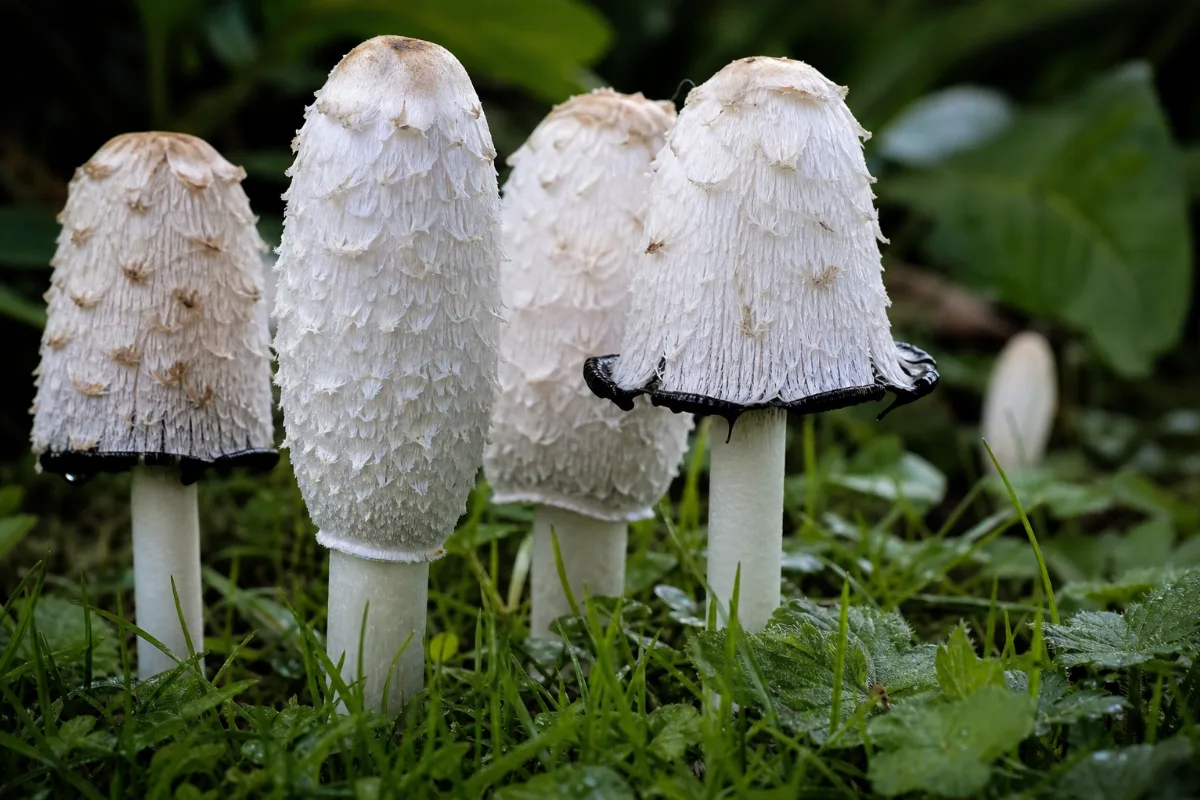
Mushrooms · Wild culinary mushroom
Shaggy mane
Coprinus comatus · also called Shaggy ink cap, shaggy inkcap, lawyer's wig, chicken drumstick mushroom
Shaggy mane is a mushroom of lawns and meadows that people eat when it is young and fresh. Within hours of picking, the cap turns to black fluid, so it cannot be stored. Laboratory and animal studies suggest effects on blood sugar, but human trials are almost absent. Wild mushrooms can be mistaken for dangerous ones: the common ink cap, a look-alike, causes a serious reaction with alcohol. If you are not certain of the species, do not eat it.
General information, not medical advice. Last substantive update · Not medically reviewed. A named clinician has not signed off on this page. How this page is made
About Shaggy mane
Shaggy mane (Coprinus comatus) is mainly a food: a mushroom eaten when young and fresh, which dissolves into black fluid within hours of picking. Reviews list many laboratory and animal effects, especially on blood sugar, but human research is almost absent, so health claims are unproven. The cautions matter more than the claims: look-alikes in the wild, an alcohol reaction that belongs to the common ink cap, fast spoilage, metals in wild mushrooms and allergy in some people.
What it is
Shaggy mane (Coprinus comatus) is a fungus in the family Agaricaceae. GBIF lists the name as accepted. It is also called shaggy ink cap and lawyer's wig. The review says it usually grows on lawns in spring and autumn and also in woods, meadows and verges.
The cap dissolves into black fluid by itself, a process called autodigestion. This is why it is eaten only when young and fresh.
Food use and traditional uses
The review says it is cultivated and eaten in Japan, China and other Asian countries, with about 382,000 tons consumed in China in 2006. In some European countries, such as Poland, it is not legally classed as an edible mushroom (the review's statement; the law was not opened).
We found no source we read that describes a specific traditional medical use of shaggy mane, so none is claimed here.
What the research shows
Most studies are laboratory or animal work. In diabetic rats and mice, extracts and polysaccharide fractions lowered blood sugar. In mice with alcohol-injured livers, a polysaccharide was linked to better liver measures. A weight-gain effect in rats was seen in one commercial product. These findings often do not carry over to people.
The only human study followed 74 adults with insulin resistance taking an eight-ingredient supplement with shaggy mane for 3 months. Insulin, weight and cholesterol markers improved, but no comparison group was described, so nothing can be credited to shaggy mane. In the test tube, none of eight edible mushroom extracts changed standard clotting tests.
Wild, cultivated, powders and fermented products are different
The usual food is the fresh, cooked young mushroom. Animal studies use extracts, purified polysaccharides or fermented mycelium (some with added vanadium), which are not the same thing. A dried powder was used in a snack-bar study that measured taste and laboratory digestion, not blood sugar in people.
One comparison of a wild and a cultivated sample found similar nutrition but differences in sugars, fats and phenolic compounds. Where a wild mushroom grew changes its metal content. No product is recommended here.
Legal and regulatory status
The 2020 review says it is approved as an edible mushroom in Asian countries but, in some European countries such as Poland, is not legally classed as edible. We did not read the law. We did not read EMA, FDA, NCCIH or EFSA statements on shaggy mane, so none is stated here. A search for it in LiverTox returned no records. Rules differ by country and change.
At a glance
Traditional uses history, not proof
- Eaten as a food: the review says it is cultivated and eaten in Japan, China and other Asian countries, with about 382,000 tons consumed in China in 2006.
- In some European countries, such as Poland, it is not legally classed as an edible mushroom (review; the law was not opened).
- We found no source we read that describes a specific traditional medical use, so none is claimed.
Studied for research
- Food nutrition (protein, carbohydrate, fibre), insufficient as a health benefit
- Blood sugar in diabetic rats and mice, insufficient (animal only)
- Insulin, weight and cholesterol in people taking an eight-ingredient supplement, very low
- Liver after alcohol injury in mice, insufficient (animal only)
- Antioxidant, cancer-cell and enzyme tests, insufficient (test tube only)
- Clotting tests in the test tube, no change
Main compounds
- Polysaccharides (alpha-glucans, beta-glucans, a fucogalactan)
- Trehalose, the main free sugar
- Ergothioneine, phenolic compounds and organic acids
Common forms
- Fresh young fruiting body, cooked
- Cultivated fruiting body
- Dried powder (used in one snack-bar study)
- Mycelium or fermented products (animal studies only)
Research links: Nowakowski 2020 review: two faces of Coprinus comatus (full text) · Skin and allergy: shaggy cap patch tests (abstract) · Alcohol reaction of the common ink cap (abstract) · Mushroom poisoning in Ireland (abstract) · Combination supplement study in 74 adults (abstract) · Research Library · Genes & Biomarkers Library
What it is and its history
- Accepted scientific name
- Coprinus comatus
- Naming authority
- (O.F.Müll.) Pers. (GBIF)
- Synonyms
- Agaricus comatus O.F.Müll.; Agaricus comatus Mull. ex Fr.; Agaricus cylindricus Fr.; Agaricus fimetarius Bolton; Coprinus comatus (O.F.Müll.) Gray; Coprinus clavatus Fr., 1838
- Common names
- Shaggy mane (English); Shaggy ink cap (shaggy inkcap) (English); Lawyer's wig (English); Chicken drumstick mushroom (English (named in the 2020 review)); Schopftintling (German); Coprin chevelu (French); ササクレヒトヨタケ (Japanese); 毛头鬼伞 (Chinese)
- Family or group
- Agaricaceae (a fungus family), not a plant
- Classification
- Fungi > Basidiomycota > Agaricomycetes > Agaricales > Agaricaceae > Coprinus > Coprinus comatus
- Native range
- Not checked in the sources read. The review says it is widespread.
- Habitat
- The 2020 review says it usually grows in spring and autumn on lawns, and occurs in woods, meadows and road verges.
- What it looks like
- Fruiting body: Fruiting body that dissolves into black fluid within hours of picking or after releasing spores (autodigestion); the review notes only young mushrooms are edible. No further description is given on purpose.
- Cultivation
- The review says it is cultivated as an edible mushroom in Japan, China and other Asian countries, and that China consumed about 382,000 tons in 2006. In some European countries, such as Poland, it is not legally classed as an edible mushroom (review; the law was not opened).
- Harvest and processing
- The review says fruiting bodies must be eaten, processed or iced within 4 to 6 hours of collection, and they autolyse within 2 days of storage.
- Look-alikes and adulterants
- Name: Common ink cap (Coprinopsis atramentaria); Note: The review names this as the main species it can be confused with. It contains coprine, which causes an alcohol reaction. GBIF places it in the family Psathyrellaceae, whereas shaggy mane is in Agaricaceae. No identification help is given on this page.
- Sustainability and conservation
- Not checked.
Traditional use and history history, not clinical proof
| Tradition or era | Documented use | Source |
|---|---|---|
| Naming, 1780 to 1797 | Described by Otto Friedrich Müller in 1780 as Agaricus comatus and moved to Coprinus by Christiaan Persoon in 1797 (review citing Orton and Watling; GBIF gives 1797 as the publication of Coprinus comatus). | p32462723 |
| Modern cultivation in Asia | Eaten and cultivated in Japan, China and other Asian countries; about 382,000 tons consumed in China in 2006 (review). | p32462723 |
| Traditional medicine | The 2020 review opens by saying mushrooms have been used as food and traditional medicine in general. We found no source we read that describes a specific traditional medical use of shaggy mane, so none is stated here. NOT verified. | p32462723 |
Traditional use shows how it was used. It does not show that it works or is safe today.
What is inside, and how it may work
What it contains and how those compounds act in cells and animals. Laboratory and animal mechanisms are not proven effects in people.
Main compounds
| Compound | Family | Where it is concentrated | Activity studied | Level of evidence |
|---|---|---|---|---|
| Polysaccharides (alpha-glucans, beta-glucans, a fucogalactan) | polysaccharide | Fruiting body (water extract) Not given in the sources read. | Reported blood-sugar-lowering, antioxidant and liver-protective effects in animals and test tubes. 10 18 17 | Animal research |
| Trehalose PubChem 7427 | sugar | Fruiting body The main free sugar (review, citing Stojkovic 2013). | Food sugar; no health claim. 10 15 | Laboratory research |
| Ergothioneine PubChem 5351619 | amino-acid derivative | Fruiting body Not given in the sources read. | Isolated from the mushroom and reduced a white-blood-cell enzyme (MPO) in the test tube (review-quoted). 10 | Laboratory research |
| Phenolic compounds and organic acids | phenolics | Fruiting body Higher in the wild sample than the cultivated one in one comparison. | Linked to antioxidant activity in the test tube. 15 | Laboratory research |
| Comatin and protein complexes | mixed | Fruiting body, mycelium Not given in the sources read. | Comatin lowered blood glucose in alloxan-diabetic rats in a study quoted by the review. 2 10 | Animal research |
Mechanisms, receptors and pathways
| Target or pathway | Gene or receptor | What was found | Level |
|---|---|---|---|
| Blood glucose handling | PTP1B (not involved in this mouse study) | A polysaccharide fraction lowered glucose in diabetic mice; the authors point to immune stimulation, not PTP1B inhibition. Other fractions inhibit alpha-amylase in the test tube (review-quoted). 18 10 | Animal research |
| Insulin and gut hormones | GLP-1, DPP-4 | In diabetic rats an ethanol extract raised GLP-1 and insulin and lowered DPP-4 and HbA1c. 12 | Animal research |
| Androgen receptor signalling in prostate cancer cells | Androgen receptor | Extracts reduced androgen-receptor activity in a prostate cancer cell line (review-quoted). 10 | Laboratory research |
| Acetylcholinesterase | AChE | An extract blocked the enzyme in the test tube (review-quoted). 10 | Laboratory research |
| Alcohol metabolism (of the common ink cap, not shaggy mane) | Aldehyde dehydrogenase (ALDH) | Coprine from Coprinopsis atramentaria blocks ALDH in rats and, with alcohol, causes acetaldehyde build-up. Not shown for shaggy mane. 3 9 | Animal research |
Absorption, metabolism and elimination
- Absorption
- Not found in the sources read.
- Distribution
- Not found in the sources read.
- Metabolism
- Not found in the sources read.
- Elimination
- Not found in the sources read.
- Bioavailability
- Not established.
Isolated compounds versus whole extracts
Almost all the blood-sugar work uses extracts, purified polysaccharides, or fermented products (some with added vanadium), not the cooked mushroom. The only human study used an eight-ingredient supplement. A wild sample and a cultivated sample had similar nutrition but differed in sugars, fats and phenolics. Results from one preparation cannot be applied to another.
Nutritional composition
Shaggy mane is a food. The review quotes about 11.8 to 29.5 g protein, 49.2 to 76.3 g carbohydrate and 1.1 to 5.4 g fat per 100 g dry weight, and 368 to 525 kcal per 100 g dry weight, with water-insoluble fibre as a large part. Figures vary widely between samples. Fresh mushrooms are mostly water, so these dry-weight figures overstate what is in a fresh portion. The review also says its protein is highly digestible (71 to 90%). The original papers behind these ranges were not opened.
1 very low certainty8 not enough evidence
What was looked at
The 9 benefits and uses checked for Shaggy mane, each with how strong the evidence is. Tap one to open it.
- As a food (nutrition)Not enough evidence
- Blood sugar (animal and laboratory work)Not enough evidence
- Metabolic markers in people (a combination product)Very low certainty
- Liver after alcohol injury (mouse work)Not enough evidence
- Antioxidant and germ-killing tests (test tube)Not enough evidence
- Body weight and inflammation (rats)Not enough evidence
- Cancer cell tests (laboratory only)Not enough evidence
- Blood clotting and platelets (test tube)Not enough evidence
- Brain-chemistry enzyme (test tube)Not enough evidence
Lab markers tracked in the studies
Fasting blood glucoseHbA1c (average blood sugar over about 3 months)Insulin and HOMA-IRCholesterol and triglyceridesBody weightLiver enzymes in bloodProthrombin time and INR (blood clotting tests)
What is Shaggy mane good for?
The uses people ask about and how strong the human evidence is for each. None is proven. Read this together with the Safety tab.
Benefits, one by one
Each card is a research question, not a promise. Tap a goal to filter. Open a card to see the studies, doses and limits.
As a food (nutrition)
Not enough evidenceShaggy mane is eaten as a food when it is young and fresh. Laboratory analyses give protein and carbohydrate figures typical of mushrooms. This is nutrition from eating it as food, not a health treatment.
3 studiesEaten as a fresh young mushroom, cooked; also as a dried powder in on…
Studies, doses and limits
What the trials found
No trial tests a health outcome from eating shaggy mane. The review quotes laboratory analyses: 11.8 to 29.5 g protein, 49.2 to 76.3 g carbohydrate and 1.1 to 5.4 g fat per 100 g dry weight, and 368 to 525 kcal per 100 g dry weight. One analysis of a wild and a cultivated sample found similar nutritional value. A taste test of snack bars made with shaggy mane powder (20 healthy volunteers) found the bar very well liked, but measured nobody's blood sugar.
Results
Protein 11.8 to 29.5 g/100 g dry weight (review range); carbohydrate 49.2 to 76.3 g/100 g dry weight; wild and cultivated similar.
Effect sizes as reported
Ranges are wide because they come from different samples and methods
Why this rating
These are food composition figures from lab analyses, not measured health effects. Ranges are wide. We did not open the original papers behind the review's figures.
Form and dose studied
Eaten as a fresh young mushroom, cooked; also as a dried powder in one food-science study. Cultivated and wild samples were compared once.
Who was studied
Not tested in people for a health outcome.
Limits
Dry-weight figures do not describe what is on a plate, because fresh mushrooms are mostly water. There is no standard food-composition table entry for shaggy mane that we found.
Why researchers looked
Reviewers list its nutrient content because it is eaten as a food in China and some other countries.
Traditional use
The review says it is cultivated and eaten in Japan, China and other Asian countries, and that about 382,000 tons were consumed in China in 2006 (Nowakowski 2020).
Proposed mechanism Laboratory research
Food composition is measured in the laboratory; it is not a drug-like mechanism.
A proposed mechanism does not show that the effect happens in people.
The biggest safety points for shaggy mane are wild look-alikes, how fast it spoils, and metals in wild mushrooms. See the Safety tab.
Blood sugar (animal and laboratory work)
Not enough evidenceExtracts of shaggy mane lowered blood sugar in diabetic rats and mice. No trial in people has been found that tests shaggy mane alone. It cannot be used in place of diabetes care.
5 studiesEthanol extract of the fruiting body (rats), water-extracted polysacc…
Studies, doses and limits
Results
Rat extract: fasting glucose down 26.69% at the highest amount, HbA1c down 4 to 4.30%, insulin up 13.83%, GLP-1 up 71.09% (percent changes quoted from the abstract). Mouse polysaccharide: glucose clearly lower within 120 minutes of a single oral amount.
Effect sizes as reported
Lower glucose in diabetic animals; no human effect size
Why this rating
Animal and laboratory work only. The extracts and polysaccharide fractions are not the same as eating the mushroom. Findings in rats and mice often do not carry over to people.
Form and dose studied
Ethanol extract of the fruiting body (rats), water-extracted polysaccharide fraction (mice), fermented or vanadium-enriched products (mice, quoted in a review). Amounts not shown here.
Who was studied
Diabetic rats and mice; none in people.
Limits
Never replace diabetes medicine or monitoring with a mushroom. The review's comparison with metformin concerns a purified compound (comatin) in diabetic rats, not the mushroom.
Why researchers looked
Reviewers say researchers mainly study the blood-sugar effect of Coprinus comatus, so most of the research is here.
Traditional use
Not described in the sources we read.
Proposed mechanism Animal research
In mice, a polysaccharide fraction lowered glucose, and the authors suggest immune stimulation rather than the enzyme PTP1B. Reviews also describe slowing of the digestive enzyme alpha-amylase in the test tube.
A proposed mechanism does not show that the effect happens in people.
People on diabetes medicines should ask their doctor or pharmacist before adding any supplement, because blood sugar could drop too far in theory. No interaction study exists. See the Safety tab.
Metabolic markers in people (a combination product)
Very low certaintyOne small study followed 74 overweight adults taking a supplement that had shaggy mane as one of eight ingredients. Several markers improved, but there was no comparison group described, so the result cannot be credited to shaggy mane.
1 studiesA supplement containing shaggy mane with seven other ingredients. Amo…
Studies, doses and limits
What the trials found
Before-and-after results in 74 adults with insulin resistance, taking a product with myo-inositol, glycine, Coprinus comatus, alpha-lipoic acid, phlorizin, zinc, vitamin B6 and chromium picolinate for 3 months. Insulin, HOMA-IR, weight, BMI, waist, total and LDL cholesterol and triglycerides fell, and HDL rose slightly. Glucose showed a non-significant trend. The authors report no measurable side effects.
Results
Insulin, HOMA-IR, weight, BMI, waist, total cholesterol, LDL cholesterol and triglycerides lowered; HDL slightly higher; glucose not significant.
Effect sizes as reported
Statistically significant changes in several markers (exact sizes not in the abstract)
Why this rating
Eight ingredients at once; no separate comparison group described in the abstract; 3 months; the abstract does not say the product maker was involved or independent.
Form and dose studied
A supplement containing shaggy mane with seven other ingredients. Amounts not shown here.
Who was studied
74 overweight adults (50 women, 24 men) with insulin resistance and altered blood fats.
Limits
Cannot separate shaggy mane from the other seven ingredients. Observational before-and-after design.
Why researchers looked
Shaggy mane is sold in some multi-ingredient metabolic products, so a study looked at one of them.
Traditional use
Not described in the sources we read.
Proposed mechanism Human observational
The authors do not test how shaggy mane works in this study; it was one of eight ingredients.
A proposed mechanism does not show that the effect happens in people.
Reported no measurable side effects in the abstract. A short, small study cannot rule out rarer problems.
Liver after alcohol injury (mouse work)
Not enough evidenceIn mice with liver injury caused by alcohol, a polysaccharide taken from shaggy mane was linked to better liver measures. This is animal work only. It does not mean shaggy mane protects the liver of people who drink alcohol.
2 studiesAlkali-extracted polysaccharide (mostly glucose) from the mushroom. A…
Studies, doses and limits
What the trials found
No human study. Mice given alkali-extracted polysaccharides had lower liver enzymes, lower liver and blood fats and less lipid peroxidation than untreated injured mice. A 2020 review also mentions work in rats.
Results
Liver enzymes, liver and blood fats and lipid peroxidation were lower in treated injured mice (the abstract gives no figures).
Effect sizes as reported
Better liver measures in mice
Why this rating
Mice only; a purified polysaccharide; liver injury was caused by the researchers. Not shown in people.
Form and dose studied
Alkali-extracted polysaccharide (mostly glucose) from the mushroom. Amounts not shown here.
Who was studied
Mice; none in people.
Limits
Not a reason to drink alcohol, and not a substitute for liver care.
Why researchers looked
Chinese researchers studied it because polysaccharides from the mushroom looked antioxidant.
Traditional use
Not described in the sources we read.
Proposed mechanism Animal research
Proposed: antioxidant action and improved alcohol-handling enzymes in the liver (mouse study).
A proposed mechanism does not show that the effect happens in people.
Caution about alcohol: see the Safety tab on the alcohol reaction of a different ink cap.
Antioxidant and germ-killing tests (test tube)
Not enough evidenceIn test-tube tests, extracts of shaggy mane showed antioxidant and some germ-killing activity. This is lab work and has not been shown to matter for people.
2 studiesMethanol extract of the fruiting body (one wild and one cultivated sa…
Studies, doses and limits
What the trials found
No human study. A methanol extract of a cultivated sample had stronger antioxidant and antimicrobial activity than a wild sample, and neither was toxic to pig liver cells. These tests show activity in a dish, not in a person.
Results
Cultivated sample had the highest antioxidant and antimicrobial activity in the dish; the wild sample had more phenolic compounds and organic acids.
Effect sizes as reported
Dish results only
Why this rating
Test-tube measures of antioxidant strength do not show a benefit in the body.
Form and dose studied
Methanol extract of the fruiting body (one wild and one cultivated sample).
Who was studied
No people.
Limits
One wild and one cultivated sample only. Dish tests do not predict results in people.
Why researchers looked
Mushrooms are rich in phenolic compounds and polysaccharides, so researchers measure their antioxidant strength.
Traditional use
Not described in the sources we read.
Proposed mechanism Laboratory research
Phenolic compounds and polysaccharides are the proposed explanation. Ergothioneine from the mushroom reduced a white-blood-cell enzyme (MPO) in the test tube, as quoted in a review.
A proposed mechanism does not show that the effect happens in people.
The biggest safety points for shaggy mane are wild look-alikes, how fast it spoils, and metals in wild mushrooms. See the Safety tab.
Body weight and inflammation (rats)
Not enough evidenceIn rats, a commercial shaggy mane suspension slowed weight gain and lowered a fever test result, but did not reduce paw swelling. Nothing is shown for people alone.
2 studiesA commercial suspension of Coprinus comatus given by mouth to rats. A…
Studies, doses and limits
What the trials found
Rats given the suspension for 7 days gained less weight than untreated rats. There was an effect in a glucose-load test but not at rest. Fever rose less. Paw swelling after formalin did not improve. In mice, vanadium absorbed by the mushroom lowered body weight, while the fermented mushroom did not (second-hand, in a review).
Results
Weight gain: about 15.7 g in untreated rats versus 8.4 g and 3.2 g in the two treated groups (both p < 0.05); no effect on paw swelling.
Effect sizes as reported
Mixed results in rats
Why this rating
One-week rat study of a commercial product with unclear contents. No human data.
Form and dose studied
A commercial suspension of Coprinus comatus given by mouth to rats. Amounts not shown here.
Who was studied
Rats; none in people.
Limits
One animal study; weight loss in rats may reflect something else, such as less eating.
Why researchers looked
A Serbian team tested a commercial shaggy mane product in rats for several possible effects.
Traditional use
Not described in the sources we read.
Proposed mechanism Animal research
Not established.
A proposed mechanism does not show that the effect happens in people.
The mouse work on vanadium-loaded mushroom (review-quoted) found lower body, liver, kidney and heart weights. Vanadium is a metal added in those experiments, not part of ordinary shaggy mane.
Cancer cell tests (laboratory only)
Not enough evidenceExtracts of shaggy mane slowed the growth of some human cancer cells grown in dishes. This is not a cancer treatment and no study in people with cancer was found.
2 studiesHexane, ethyl acetate and other solvent extracts in dishes.
Studies, doses and limits
What the trials found
No human study. The 2020 review lists anticancer and antiandrogenic activity from cell studies only. We did not open the underlying cell papers.
Results
Review-quoted: an ethyl acetate extract reduced the PSA signal by 77% in a prostate cancer cell line. No measure in people.
Effect sizes as reported
Dish results only
Why this rating
Cell-line results rarely predict treatment effects. Second-hand from a review.
Form and dose studied
Hexane, ethyl acetate and other solvent extracts in dishes.
Who was studied
No people.
Limits
Cell lines are not patients.
Why researchers looked
Laboratory teams test mushroom extracts on cancer cell lines as a first screen.
Traditional use
Not described in the sources we read.
Proposed mechanism Laboratory research
In prostate cancer cells (LNCaP) an extract reduced androgen-receptor activity and PSA signalling in the dish (review-quoted).
A proposed mechanism does not show that the effect happens in people.
Do not use a mushroom in place of cancer treatment; tell the cancer team about any supplement.
Blood clotting and platelets (test tube)
Not enough evidenceIn a laboratory screen of eight edible mushrooms, none of the extracts changed standard clotting tests (prothrombin time and INR). The abstract does not report shaggy mane's platelet result separately.
1 studiesHot-water extract of the fruiting body. Amounts not shown here.
Studies, doses and limits
What the trials found
No human study. Hot-water extracts of eight edible mushrooms including shaggy mane were tested on human blood samples. None changed prothrombin time, prothrombin ratio or INR. Other mushrooms (Auricularia, Pleurotus eryngii) showed the strongest antiplatelet effects.
Results
No change in prothrombin time, prothrombin ratio or INR for any of the eight extracts.
Effect sizes as reported
No change in clotting tests
Why this rating
Test tube only; no result for shaggy mane alone is given in the abstract.
Form and dose studied
Hot-water extract of the fruiting body. Amounts not shown here.
Who was studied
Human blood samples in the laboratory.
Limits
Not a test of eating the mushroom.
Why researchers looked
Researchers wanted to know whether common edible mushrooms affect platelets or clotting, because that could matter for heart disease and for people on blood thinners.
Traditional use
Not described in the sources we read.
Proposed mechanism Laboratory research
Antiplatelet effects in the screen were linked to antioxidant strength and polysaccharide and ergosterol content (across the eight species).
A proposed mechanism does not show that the effect happens in people.
No human interaction study with blood thinners exists. Ask a doctor or pharmacist if you take one.
Brain-chemistry enzyme (test tube)
Not enough evidenceAn extract of shaggy mane blocked acetylcholinesterase, an enzyme linked to memory medicines, in a laboratory test. No study in people has been done.
1 studiesExtract in the test tube.
Studies, doses and limits
What the trials found
No human study. The review quotes an extract with an enzyme-blocking value (IC50) of 0.62 mg/mL and says this suggests a possible role in supporting Alzheimer treatment. A test-tube value cannot tell us that.
Results
Review-quoted: IC50 0.62 mg/mL in the test tube.
Effect sizes as reported
Dish result only
Why this rating
Test-tube enzyme results are far from a memory benefit in people. Second-hand from a review.
Form and dose studied
Extract in the test tube.
Who was studied
No people.
Limits
The original paper was not opened.
Why researchers looked
Researchers screen mushrooms for blocking of acetylcholinesterase, the target of some Alzheimer medicines.
Traditional use
Not described in the sources we read.
Proposed mechanism Laboratory research
Enzyme blocking in the test tube (review-quoted).
A proposed mechanism does not show that the effect happens in people.
No safety information for people.
Connections to the rest of health
How Shaggy mane connects to the rest of our health knowledge graph. Every link says what kind of connection it is. A safety link (for example to the liver) is a warning, not a benefit. A study that merely mentions a topic never creates a benefit link.
Explore every connection: goals, body systems, organs, symptoms, genes
A. Wellness goals
| Connected to | Kind of connection | Evidence status | Context | Studies |
|---|---|---|---|---|
| Blood Sugar Balance | Preliminary mechanism | Not enough evidence | Blood sugar (animal and laboratory work): Extracts of shaggy mane lowered blood sugar in diabetic rats and mice. No trial in people has been found that tests shaggy mane alone. It cannot be used in place of diabetes care. | 12 18 10 2 14 |
| Metabolic Health | Preliminary mechanism | Very low certainty | Metabolic markers in people (a combination product): One small study followed 74 overweight adults taking a supplement that had shaggy mane as one of eight ingredients. Several markers improved, but there was no comparison group described, so the result cannot be credited to shaggy mane. | 13 |
| Weight Management | Preliminary mechanism | Very low certainty | Metabolic markers in people (a combination product): One small study followed 74 overweight adults taking a supplement that had shaggy mane as one of eight ingredients. Several markers improved, but there was no comparison group described, so the result cannot be credited to shaggy mane. Body weight and inflammation (rats): In rats, a commercial shaggy mane suspension slowed weight gain and lowered a fever test result, but did not reduce paw swelling. Nothing is shown for people alone. | 13 14 10 |
| Liver Support | Preliminary mechanism | Not enough evidence | Liver after alcohol injury (mouse work): In mice with liver injury caused by alcohol, a polysaccharide taken from shaggy mane was linked to better liver measures. This is animal work only. It does not mean shaggy mane protects the liver of people who drink alcohol. | 17 10 |
| Heart Health | Preliminary mechanism | Not enough evidence | Blood clotting and platelets (test tube): In a laboratory screen of eight edible mushrooms, none of the extracts changed standard clotting tests (prothrombin time and INR). The abstract does not report shaggy mane's platelet result separately. | 11 |
| Memory Support | Preliminary mechanism | Not enough evidence | Brain-chemistry enzyme (test tube): An extract of shaggy mane blocked acetylcholinesterase, an enzyme linked to memory medicines, in a laboratory test. No study in people has been done. | 10 |
B. Body systems
| Connected to | Kind of connection | Evidence status | Context | Studies |
|---|---|---|---|---|
| Digestive system | Moderate certainty | Self-digestion within hours of picking; eat, process or ice within 4 to 6 hours. Preparation or compound: Fresh young caps |
10 | |
| Digestive System | Biological association | Not enough evidence | Studied for: As a food (nutrition) | 10 15 5 |
| Endocrine System | Biological association | Not enough evidence | Studied for: Blood sugar (animal and laboratory work) Studied for: Metabolic markers in people (a combination product) | 12 18 10 2 14 13 |
| Hepatic System | Biological association | Not enough evidence | Studied for: Liver after alcohol injury (mouse work) | 17 10 |
| Immune System | Biological association | Not enough evidence | Studied for: Antioxidant and germ-killing tests (test tube) Studied for: Cancer cell tests (laboratory only) | 15 10 2 |
| Cardiovascular System | Biological association | Not enough evidence | Studied for: Blood clotting and platelets (test tube) | 11 |
| Nervous System | Biological association | Not enough evidence | Studied for: Brain-chemistry enzyme (test tube) | 10 |
E. Health conditions
| Connected to | Kind of connection | Evidence status | Context | Studies |
|---|---|---|---|---|
| Dermatitis and eczema | Adverse effect or risk | Low certainty | Delayed patch-test reactions in 32% of people with atopic dermatitis; not shown to cause eczema. Preparation or compound: Extracts of cap and spores (skin patch tests) |
6 1 |
G. Root causes and contributing factors
| Connected to | Kind of connection | Evidence status | Context | Studies |
|---|---|---|---|---|
| Heavy metal exposure | Moderate certainty | Mercury and cadmium can be high in some wild sites; origin matters. Preparation or compound: Wild fruiting bodies |
10 16 |
I. Biomarkers
| Connected to | Kind of connection | Evidence status | Context | Studies |
|---|---|---|---|---|
| Fasting blood glucose | Biological association | Not enough evidence | Measured in trials: lowered (in animals). A lab change is not the same as a health benefit. | 12 18 13 |
| HbA1c (average blood sugar over about 3 months) | Biological association | Not enough evidence | Measured in trials: lowered (in animals). A lab change is not the same as a health benefit. | 12 10 |
| Insulin and HOMA-IR | Biological association | Very low certainty | Measured in trials: lowered (human, combination product); raised insulin in diabetic rats. A lab change is not the same as a health benefit. | 13 12 |
| Cholesterol and triglycerides | Biological association | Very low certainty | Measured in trials: lowered (human, combination product). A lab change is not the same as a health benefit. | 13 |
| Body weight | Biological association | Not enough evidence | Measured in trials: lowered weight gain (rats); lowered weight (people, combination product). A lab change is not the same as a health benefit. | 14 13 |
| Liver enzymes in blood | Biological association | Not enough evidence | Measured in trials: lowered (mice with alcohol injury). A lab change is not the same as a health benefit. | 17 |
| Prothrombin time and INR (blood clotting tests) | Biological association | Not enough evidence | Measured in trials: no change (test tube). A lab change is not the same as a health benefit. | 11 |
J. Genes, receptors and enzymes
| Connected to | Kind of connection | Evidence status | Context | Studies |
|---|---|---|---|---|
| Aldehyde dehydrogenase (ALDH) | Preliminary mechanism | Animal | Blocked by coprine from the common ink cap, not shown for shaggy mane. | 3 |
| Acetylcholinesterase (AChE) | Preliminary mechanism | In vitro | Blocked in the test tube by an extract (review-quoted). | 10 |
K. Biological pathways
L. Active compounds
| Connected to | Kind of connection | Evidence status | Context | Studies |
|---|---|---|---|---|
| Polysaccharides (alpha-glucans, beta-glucans, a fucogalactan) | Biological association | Animal | Reported blood-sugar-lowering, antioxidant and liver-protective effects in animals and test tubes. Preparation or compound: Fruiting body (water extract) |
10 18 17 |
| Trehalose | Biological association | In vitro | Food sugar; no health claim. Preparation or compound: Fruiting body |
10 15 |
| Ergothioneine | Biological association | In vitro | Isolated from the mushroom and reduced a white-blood-cell enzyme (MPO) in the test tube (review-quoted). Preparation or compound: Fruiting body |
10 |
| Phenolic compounds and organic acids | Biological association | In vitro | Linked to antioxidant activity in the test tube. Preparation or compound: Fruiting body |
15 |
| Comatin and protein complexes | Biological association | Animal | Comatin lowered blood glucose in alloxan-diabetic rats in a study quoted by the review. Preparation or compound: Fruiting body, mycelium |
2 10 |
Each connection is stored with the ingredient, the connected record, the kind of connection, the evidence status, the supporting studies, the preparation or compound involved, and a review date (last reviewed October 25, 2026).
Evidence at a glance: what the research found for 9 outcomes
Each outcome below is one thing researchers measured. Certainty is how far the evidence can be trusted, not how well it works. The full studies are on the next tab.
The evidence
The research centre for Shaggy mane. Every record here was checked against PubMed or the publisher's page; we never list a study we have not verified.
Evidence by outcome
Bars show how many studies we found for each outcome, not how well it works. People are added up across trials only (reviews are not added, to avoid double counting).
How we rate evidence
High certainty
Several well-run trials or reviews agree; further research is unlikely to change the picture much.
Moderate certainty
Good trials point the same way, but some doubt remains.
Low certainty
Small, short or inconsistent trials. The finding could change with better research.
Very low certainty
Very little or very weak human data. Treat as a possibility only.
Mixed findings
Trials or reviews disagree with each other.
Not enough evidence
Not enough human research to say either way.
Evidence against
Good research found no benefit, or found harm.
We take the reviewers' own risk-of-bias and GRADE statements where they exist, and otherwise judge from study size, design, consistency, directness and whether a product matches what is sold. Many publications do not make evidence high. Method note: We read PubMed records and abstracts for 18 papers (two narrative reviews, one with full text read, five animal or laboratory studies, one 74-person observational study of a combination product, two skin or allergy studies, three on the alcohol reaction of look-alike mushrooms, three metal or composition analyses, one poison-centre series and one food-science study), checked the species names in the GBIF database, and searched LiverTox. EMA, FDA, NCCIH and EFSA were not read. For most papers only abstracts were read, so numbers come from abstracts; figures marked review-quoted come from a 2020 review. Certainty ratings are the compiler's own reading.
Study library: every study we checked 21
| Study | Design | People | Product, dose, length | Result |
|---|---|---|---|---|
| Brander 1999 IgE-binding proliferative responses and skin test reactivity to Cop c 1, the first recombinant allergen from the basidiomycete Coprinus comatus. Journal of Allergy and Clinical Immunology · PMID 10482839 · DOI |
Laboratory and skin test study human serum and skin |
92 Sera from 92 people sensitized to basidiomycete fungi; skin prick tests in sensitized people |
Recombinant Cop c 1 protein made in the laboratory protein from C. comatus (spore or fruiting-body source not stated in the abstract) Skin prick test with a tiny amount |
25% of the 92 sera bound Cop c 1, so the authors call it an intermediate allergen. A tiny amount (under 2 pmol) caused strong skin reactions in sensitized people. The authors conclude it is a clinically relevant allergen. Cop c 1 is a real allergen in people already sensitized to fungi Methods, limits and fundingOutcomes: IgE binding; immune-cell responses; skin prick reactions Limitations: Concerns spore and other protein allergy in already sensitized people. The abstract does not say whether eating the mushroom causes reactions. Funding and conflicts: Not stated in the abstract. Read: abstract |
| Cao 2020 The Shaggy Ink Cap Medicinal Mushroom, Coprinus comatus (Agaricomycetes), a Versatile Functional Species: A Review. International Journal of Medicinal Mushrooms · PMID 32479019 · DOI |
Narrative review fungus (review) |
Published studies of extracts and compounds from Coprinus comatus | Polysaccharides, comatin, protein complexes and phenols from fruiting bodies, mycelium or fermentation liquor fruiting body, mycelium, fermentation liquor Not shown here |
Says researchers mainly study the blood-sugar-lowering effect of Coprinus comatus; other functions (antioxidant, alcohol-related liver protection, cancer inhibition, antiandrogenic, anti-inflammatory, leukemia treatment) are less studied. n/a Methods, limits and fundingOutcomes: Summary of reported functions Limitations: Abstract only was read. The abstract does not say how many of the cited studies were in people. Funding and conflicts: Not stated in the abstract. Read: abstract |
| Carlsson 1978 On the disulfiram-like effect of coprine, the pharmacologically active principle of Coprinus atramentarius. Acta Pharmacologica et Toxicologica · PMID 350009 · DOI |
Animal study rat |
Rats | Coprine, the toxin of the common ink cap (Coprinus atramentarius), compared with disulfiram Not shown here · vs Disulfiram |
Coprine raised the acetaldehyde-to-ethanol ratio, so it blocks the enzyme that clears acetaldehyde (ALDH), more strongly than disulfiram. After ethanol, blood pressure fell in both groups; a fast heartbeat followed only with coprine. Coprine blocks alcohol breakdown in rats Methods, limits and fundingOutcomes: Acetaldehyde-to-ethanol ratio in breath; blood pressure and heart rate after ethanol Limitations: Rats and a purified compound from a different mushroom. It does not say shaggy mane contains coprine. Funding and conflicts: Not stated in the abstract. Read: abstract |
| Cassidy 2011 Mushroom poisoning in Ireland: the collaboration between the National Poisons Information Centre and expert mycologists. Clinical Toxicology · PMID 21495886 · DOI |
Case series |
70 70 suspected mushroom exposures reported to the Irish poisons centre, 2004 to 2009 |
Wild mushrooms of many kinds |
45 children ate unknown mushrooms; 11 adults ate toxic wild mushrooms that were wrongly identified or confused with edible kinds. In five detailed cases, Coprinus comatus was one species identified and serious poisoning was excluded. Two cases involved incorrect identification by a health professional using the Internet. The authors say health workers should not identify toxic mushrooms from the Internet. Wrong identification of wild mushrooms is a repeated problem Methods, limits and fundingOutcomes: Who was exposed, to what, and how identification worked Limitations: Ireland only. It shows how mistakes happen; it does not give a rate for shaggy mane. Funding and conflicts: Not stated in the abstract. Read: abstract |
| Dimopoulou 2023 Development of a Functional Acceptable Diabetic and Plant-Based Snack Bar Using Mushroom (Coprinus comatus) Powder. Foods · PMID 37509794 · DOI |
Food science study human (taste panel) and laboratory |
20 20 healthy volunteers rated snack bars; other tests were laboratory measurements |
Plant-based snack bars enriched with C. comatus powder powder (part not stated in the text read) Not shown here · vs Four commercial snack bars in the taste test |
The plant-based bar scored 'like extremely' on a 9-point scale. In a laboratory digestion model the bar released sugars in a way the authors say can control after-meal glucose. Nobody's blood sugar was measured. Food product development; no health result in people Methods, limits and fundingOutcomes: Taste scores, nutrient content, shelf stability, sugars released in a simulated gut digestion Limitations: A taste test and a laboratory digestion model. It says nothing about how the mushroom powder affects people's blood sugar. The abstract says shaggy mane powder 'is claimed' to help diabetes. Funding and conflicts: The paper states it received no external funding; the authors declare no conflict of interest. Read: abstract and funding statement (Europe PMC full text; methods skimmed only) |
| Fischer 1999 Coprinus comatus (shaggy cap) is a potential source of aeroallergen that may provoke atopic dermatitis. Journal of Allergy and Clinical Immunology · PMID 10518829 · DOI |
Diagnostic study |
66 66 people grouped as atopic dermatitis or respiratory allergy by skin prick test, plus 20 people without allergy |
Skin patch tests with extract of C. comatus spore tissue and of cap tissue spores and cap Test extracts in petroleum jelly, not eaten Read after 48 and 72 hours · vs 20 non-allergic control people |
12 of 38 (32%) people with atopic dermatitis who finished the study had a positive patch test; the abstract adds that 8 (57%) also had a positive prick test to shaggy mane. 1 of 11 people with asthma was positive on both tests. No reaction was seen in the 20 non-allergic controls or in people with respiratory allergy and a negative prick test. 32% of those with atopic dermatitis reacted Methods, limits and fundingOutcomes: Positive delayed skin reactions Limitations: A skin test of extracts, not a test of eating the mushroom. It shows that people with atopic dermatitis can react to shaggy mane proteins on the skin, not that eating it causes eczema. Funding and conflicts: Not stated in the abstract. Read: abstract |
| Grodzinskaya 2019 Radiocesium (137Cs) and Mineral Elements in Culinary-Medicinal Mushrooms from the Southern Outskirts of Kyiv, Ukraine. International Journal of Medicinal Mushrooms · PMID 30806257 · DOI |
Laboratory analysis fungus |
Wild mushrooms collected near Kyiv in 2015 to 2017, including Coprinus comatus | Wild fruiting bodies of several species, including C. comatus fruiting body Not shown here · vs Other species in the same study |
The authors say the data suggest safe levels of radiocesium and some essential and toxic elements in the fruit bodies studied. The abstract does not give a separate figure for shaggy mane. Safe levels reported overall; no species-specific result in the abstract Methods, limits and fundingOutcomes: Radiocesium and mineral/metal content Limitations: Several species pooled in the conclusion. One region, a few years. Funding and conflicts: Not stated in the abstract. Read: abstract |
| Haberl 2011 Case series: Alcohol intolerance with Coprine-like syndrome after consumption of the mushroom Lepiota aspera (Pers.:Fr.) Quel., 1886 (Freckled Dapperling). Clinical Toxicology · PMID 21370948 · DOI |
Case series |
5 5 patients in 3 events in Germany who ate self-collected Lepiota aspera |
Lepiota aspera (another wild mushroom) fruiting body Not shown here Symptoms began within minutes of drinking and could be provoked again up to 48 hours later |
After well-cooked mushrooms were tolerated, an alcoholic drink brought on facial flushing, throbbing headache, fast heartbeat and shortness of breath within minutes. Symptoms eased within a few hours with no lasting harm. All five had mistaken the mushroom for edible kinds. The authors say the common ink cap is the best-understood case of alcohol intolerance after wild mushrooms. Alcohol reaction after a wild mushroom that was mistaken for an edible one Methods, limits and fundingOutcomes: Alcohol intolerance symptoms Limitations: Concerns a different species, and shows that the alcohol reaction is not limited to one mushroom. Funding and conflicts: Not stated in the abstract. Read: abstract |
| Michelot 1992 Poisoning by Coprinus atramentarius. Natural Toxins · PMID 1344910 · DOI |
Narrative review human and animal (review) |
People who ate the common ink cap (Coprinus atramentarius, now Coprinopsis atramentaria) and drank alcohol | Coprine from Coprinus atramentarius (a different species from shaggy mane) fruiting body Not shown here |
The ink cap Coprinus atramentarius causes poisoning when eaten with alcohol. The active principle is coprine. The review says coprine's mutagenic and gonadotoxic properties made it unsuitable as a drug for alcoholism. n/a Methods, limits and fundingOutcomes: The 'Coprinus syndrome' with alcohol; the toxin coprine Limitations: Describes the common ink cap, not shaggy mane. It is the source we use for the alcohol reaction. Funding and conflicts: Not stated in the abstract. Read: abstract |
| Nowakowski 2020 The two faces of Coprinus comatus-Functional properties and potential hazards. Phytotherapy Research · PMID 32462723 · DOI |
Narrative review fungus (review of lab, animal and food studies) |
Published laboratory, animal and food-composition papers on Coprinus comatus; no human trial of health benefit is described in the sections read | Shaggy mane (Coprinus comatus) fruiting bodies, extracts, polysaccharides and fermented products fruiting body, mycelium, fermented product Not shown here |
Lists antioxidant, anticancer, antiandrogenic, hepatoprotective, acetylcholinesterase-inhibiting, anti-inflammatory, antidiabetic and other activities from laboratory and animal work. Lists four hazards: skin reactions in people with atopic dermatitis, confusion with poisonous mushrooms, quick autolysis after collection, and contamination with toxic elements. Says fruiting bodies must be eaten, processed or iced within 4 to 6 hours of collection. Reports mercury in wild shaggy mane from some European sites from 2.1 to 144 mg/kg dry weight and estimates intake limits could be exceeded by eating from 20 g to 1.6 kg depending on habitat. Review; no single effect size Methods, limits and fundingOutcomes: Composition, laboratory and animal activities, and hazards (skin reactions, look-alikes, fast autolysis, toxic metals) Limitations: Narrative review, not systematic. Most findings are quoted from other papers we did not open. One sentence about coprine in shaggy mane is garbled in the text we read, so we do not rely on it. Funding and conflicts: University grants named in the paper; the authors declare no conflict of interest. Read: full text (Europe PMC, text to about the end of the discussion; reference list not opened) |
| Poniedzialek 2019 The Effect of Mushroom Extracts on Human Platelet and Blood Coagulation: In vitro Screening of Eight Edible Species. Nutrients · PMID 31842490 · DOI |
In vitro study human blood (in vitro) |
Human blood samples tested in the laboratory | Hot-water extracts of eight edible mushrooms, including Coprinus comatus fruiting body (not stated in the abstract) Not shown here · vs Acetylsalicylic acid (aspirin) |
The strongest antiplatelet effects came from Auricularia and Pleurotus eryngii extracts. The abstract does not single out shaggy mane. None of the eight extracts changed prothrombin time, prothrombin ratio or INR. No change in clotting tests for any extract Methods, limits and fundingOutcomes: Platelet clumping; prothrombin time, prothrombin ratio and INR Limitations: Test tube only. The abstract does not report the shaggy mane platelet result separately. Funding and conflicts: The authors declare no conflict of interest. Read: abstract |
| Ratnaningtyas 2022 Ethanol extract of the mushroom Coprinus comatus exhibits antidiabetic and antioxidant activities in streptozotocin-induced diabetic rats. Pharmaceutical Biology · PMID 35675226 · DOI |
Animal study rat |
Wistar rats made diabetic with streptozotocin | Ethanol extract of C. comatus fruiting body fruiting body Not shown here 14 days · vs Untreated diabetic rats and metformin-treated rats |
Fasting blood glucose fell 26.69% and DPP-4 fell 6.97% at the highest extract amount. HbA1c fell 4 to 4.30%, GLP-1 rose 71.09% and glutathione rose 11.19% at the middle amount. Insulin rose 13.83%. Lower glucose in diabetic rats Methods, limits and fundingOutcomes: Fasting blood glucose, HbA1c, insulin, GLP-1, DPP-4, glutathione Limitations: Rats, not people. The abstract does not give group sizes. A different extract or a person's gut may behave differently. Funding and conflicts: No conflict of interest reported. Read: abstract |
| Ricottini 2024 The Effectiveness and Safety of a Nutraceutical Combination in Overweight Patients with Metabolic Syndrome. Nutrients · PMID 39683371 · DOI |
Observational study |
74 74 overweight adults (50 women, 24 men) with insulin resistance and altered blood fats |
A combination supplement containing myo-inositol, glycine, Coprinus comatus, alpha-lipoic acid, phlorizin, zinc, vitamin B6 and chromium picolinate Not shown here 3 months · vs No separate comparison group is described in the abstract; results are before versus after |
Insulin fell significantly. Glucose showed a non-significant trend to lower values. HOMA-IR, body weight, BMI and waist size fell significantly. Total cholesterol, LDL cholesterol and triglycerides fell and HDL cholesterol rose slightly but significantly. The authors report no measurable side effects. Several metabolic markers moved in a favourable direction Methods, limits and fundingOutcomes: Insulin, glucose, HOMA-IR, weight, BMI, waist, cholesterol, triglycerides Limitations: Eight ingredients at once, so nothing can be credited to shaggy mane. No control group is described in the abstract, so changes could come from other causes, including chance and regression to the mean. Product-maker links were not described in the abstract. Funding and conflicts: The authors declare no known competing interests. Read: abstract |
| Sabo 2010 Pharmacodynamic action of a commercial preparation of the mushroom Coprinus comatus in rats. Phytotherapy Research · PMID 20878706 · DOI |
Animal study rat |
Rats | A commercial suspension of Coprinus comatus Not shown here 7 days · vs Untreated rats |
Rats given the suspension gained less weight than untreated rats (both amounts, p < 0.05). Blood-sugar lowering showed only in a glucose-load test, not at rest. Pancreas slides suggested protection against alloxan poisoning. Treated rats had a smaller rise in body temperature, but there was no reduction in formalin-induced paw swelling. Mixed: some effects, one test with none Methods, limits and fundingOutcomes: Body weight gain, bile secretion, glucose tolerance, fever and paw swelling tests Limitations: Rats, one week, one commercial product. The abstract does not give group sizes. Funding and conflicts: Not stated in the abstract. Read: abstract |
| Stojkovic 2013 Nutrients and non-nutrients composition and bioactivity of wild and cultivated Coprinus comatus (O.F.Mull.) Pers. Food and Chemical Toxicology · PMID 23793036 · DOI |
Laboratory analysis fungus; pig liver cells |
One wild and one cultivated sample of C. comatus | Methanol extract of C. comatus fruiting body fruiting body Not shown here · vs Wild versus cultivated |
Wild and cultivated samples had similar nutritional value and energy. The cultivated sample had more free sugars, monounsaturated fatty acids and tocopherols and stronger antioxidant and antimicrobial activity in the test tube. The wild sample had more saturated and polyunsaturated fatty acids, organic acids and phenolic compounds. Neither was toxic to pig liver cells. Similar nutrition; some differences between wild and cultivated Methods, limits and fundingOutcomes: Sugars, fatty acids, tocopherols, organic and phenolic acids; antioxidant and antimicrobial tests; toxicity to pig liver cells Limitations: One sample of each. Test-tube and cell tests only. Pig liver cells are not a human safety test. Funding and conflicts: Not stated in the abstract. Read: abstract |
| Vondruska 2022 Detrimental and essential elements in fruiting bodies of wild-growing fungi Coprinus comatus, Flammulina velutipes, and Armillaria ostoyae. Journal of Environmental Science and Health, Part B · PMID 35240938 · DOI |
Laboratory analysis fungus |
Wild fruiting bodies collected at selected sites in South Bohemia, Czech Republic | Wild Coprinus comatus fruiting bodies fruiting body Not shown here · vs Two other fungi analysed alongside |
C. comatus concentrated silver, cadmium, copper, selenium and rubidium, with bioconcentration factors of 12, 2.5, 2.3, 1.8 and 1.1. It had high aluminium, calcium, copper, iron, magnesium and zinc. The authors conclude the harmful elements show no considerably negative effect on health if eaten as a delicacy or used in alternative medicine. Some metals concentrated; authors judged this site's samples acceptable Methods, limits and fundingOutcomes: Content of 21 elements Limitations: Samples from selected Czech sites only. Metal levels depend on where the mushroom grows. Funding and conflicts: Not stated in the abstract. Read: abstract |
| Zhao 2018 The antioxidant activities of alkalic-extractable polysaccharides from Coprinus comatus on alcohol-induced liver injury in mice. Scientific Reports · PMID 30076364 · DOI |
Animal study mouse |
Mice with liver injury caused by alcohol | Alkali-extracted polysaccharides (ALPS) from C. comatus, mostly glucose fruiting body (not stated in the abstract) Not shown here · vs Untreated mice with alcohol injury |
The polysaccharides were associated with lower liver enzymes, lower liver and blood fats and less lipid peroxidation, and slides agreed. The authors say they may help prevent and treat alcohol-induced liver injury. Better liver measures in injured mice Methods, limits and fundingOutcomes: Liver enzymes in blood, liver and blood fats, lipid peroxidation, liver slides Limitations: Mice, a purified polysaccharide, injury caused by alcohol in the animals. It does not show shaggy mane protects the liver in people who drink. Funding and conflicts: No competing interests reported. Read: abstract |
| Zhou 2015 Hypoglycemic Activity of Polysaccharide from Fruiting Bodies of the Shaggy Ink Cap Medicinal Mushroom, Coprinus comatus (Higher Basidiomycetes), on Mice Induced by Alloxan and Its Potential Mechanism. International Journal of Medicinal Mushrooms · PMID 26756187 · DOI |
Animal study mouse |
Mice made diabetic with alloxan | Three water-extracted, ethanol-precipitated polysaccharide fractions (CC30, CC60, CC80) from C. comatus fruiting bodies fruiting body Not shown here Up to 21 days · vs Untreated diabetic mice |
Fraction CC60 was the most effective: it clearly lowered blood glucose within 120 minutes after a single oral amount, and kept the effect over 21 days of treatment. The authors suggest immune stimulation rather than PTP1B inhibition as the route. Lower blood glucose in diabetic mice Methods, limits and fundingOutcomes: Blood glucose; spleen lymphocyte growth; PTP1B enzyme activity Limitations: Mice, purified polysaccharide fraction, not whole mushroom. The abstract does not say whether the mice had a comparison group of healthy animals. The 'novel path to improve treatment' wording in the abstract is the authors' hope, not a result in people. Funding and conflicts: Not stated in the abstract. Read: abstract |
| n/a 2026 GBIF Backbone Taxonomy: Coprinopsis atramentaria (Bull.) Redhead, Vilgalys & Moncalvo (key 5242740) n/a · Source |
Database record n/a |
n/a | n/a |
GBIF lists Coprinopsis atramentaria as ACCEPTED, in the family Psathyrellaceae. Shaggy mane is in the family Agaricaceae, so they are not close relatives in GBIF's classification. Methods, limits and fundingOutcomes: Accepted name and family of the common ink cap Limitations: Names only; says nothing on safety. Funding and conflicts: Independent public database Read: API record read on 2026-10-25 |
| n/a 2026 NCBI Bookshelf search (LiverTox) for Coprinus or shaggy mane n/a · Source |
Database record n/a |
n/a | n/a |
A Bookshelf search for 'livertox AND (Coprinus OR shaggy mane)' returned 0 records on 2026-10-25. This shows no LiverTox entry was found by that search; it is not a statement that the mushroom is liver-safe. Methods, limits and fundingOutcomes: Whether a LiverTox entry exists Limitations: A keyword search only; a differently named entry could exist. Funding and conflicts: Independent public database Read: search result read on 2026-10-25 |
| n/a 2026 GBIF Backbone Taxonomy: Coprinus comatus (O.F.Mull.) Pers. (key 7987658) n/a · Source |
Database record n/a |
n/a | n/a |
GBIF lists Coprinus comatus (O.F.Mull.) Pers. as ACCEPTED, family Agaricaceae, published in Tent. Disp. Meth. Fung. (Lipsiae): 62 (1797), with many synonyms such as Agaricus comatus O.F.Mull. and Coprinus comatus var. ovatus. Methods, limits and fundingOutcomes: Accepted name, authority, family and synonyms Limitations: Index Fungorum was not opened; GBIF only. Funding and conflicts: Independent public database Read: API record read on 2026-10-25 |
What we do not know yet
- No trial in people tests shaggy mane alone for any health outcome.
- No study shows whether shaggy mane causes the alcohol reaction; the main review's sentence is unclear.
- No pregnancy, breastfeeding, child or long-term data.
- Metal levels vary by site; original papers behind some figures were not opened.
- No regulator statements were read (EMA, FDA, NCCIH, EFSA).
How new research is added
New studies are found by a saved PubMed search and placed in a review queue. A person reads each one before it changes any evidence rating or safety wording. New publications never change ratings automatically.
Lab markers
What changed in blood or saliva tests during trials. A changed number is not the same as feeling or being healthier, and we give no "normal ranges".
Metabolic 2
HbA1c (average blood sugar over about 3 months)
Lowered (in animals) in trials
A blood test that reflects average blood sugar over the past two to three months.
Not enough evidenceResults and what it means
Why it was measured
It is the standard long-term marker for diabetes control.
Statistical vs. clinical meaning
Animal finding only. A review also quotes lower HbA1c in alloxan mice (second-hand).
Safety implication
Do not use as a reason to change diabetes treatment.
| Study | Result | People | Product |
|---|---|---|---|
| 12 | HbA1c fell 4 to 4.30% in diabetic rats at the middle amount of extract. | Diabetic Wistar rats | Ethanol extract of C. comatus fruiting body |
Body weight
Lowered weight gain (rats); lowered weight (people, combination product) in trials
How much a person or animal weighs.
Not enough evidenceResults and what it means
Why it was measured
A simple way to see whether something changes energy balance.
Statistical vs. clinical meaning
Animal finding; the human change came from a combination product with no comparison group described.
Safety implication
Unplanned weight loss is a reason to see a doctor, not a reason to take a mushroom.
| Study | Result | People | Product |
|---|---|---|---|
| 14 | Rats gained 8.44 g and 3.18 g at the two amounts versus 15.73 g in untreated rats (p < 0.05). | Rats | Commercial C. comatus suspension for 7 days |
| 13 | Body weight, BMI and abdominal circumference fell significantly over 3 months. | 74 overweight adults | Eight-ingredient supplement that included C. comatus |
Other 5
Fasting blood glucose
Lowered (in animals) in trials
The sugar level in the blood after not eating for several hours.
Not enough evidenceResults and what it means
Why it was measured
It is the usual first check for diabetes and blood sugar control.
Statistical vs. clinical meaning
Lower glucose in diabetic animals. In people, the one study of a multi-ingredient product did not show a significant glucose change.
Safety implication
Too low a blood sugar is possible in theory with glucose-lowering medicines. Ask a doctor or pharmacist.
| Study | Result | People | Product |
|---|---|---|---|
| 12 | Fasting glucose fell 26.69% with the highest amount of a fruiting-body ethanol extract in streptozotocin-diabetic rats. | Diabetic Wistar rats | Ethanol extract of C. comatus fruiting body for 14 days |
| 18 | Fraction CC60 clearly lowered glucose within 120 minutes after a single oral amount and kept the effect over 21 days in alloxan-diabetic mice. | Alloxan-diabetic mice | Water-extracted polysaccharide fraction |
| 13 | Glucose showed a non-significant trend to lower values; not significant. | 74 overweight adults | Eight-ingredient supplement that included C. comatus |
Insulin and HOMA-IR
Lowered (human, combination product); raised insulin in diabetic rats in trials
Insulin is the hormone that moves sugar into cells. HOMA-IR is a calculation from fasting glucose and insulin that estimates insulin resistance.
Very low certaintyResults and what it means
Why it was measured
These estimate how well the body responds to insulin.
Statistical vs. clinical meaning
The human result comes from a multi-ingredient product with no comparison group described, so it says little about shaggy mane.
Safety implication
No safety signal was reported in the abstract; the study was short.
| Study | Result | People | Product |
|---|---|---|---|
| 13 | Insulin and HOMA-IR fell significantly over 3 months. | 74 overweight adults with insulin resistance | Eight-ingredient supplement that included C. comatus |
| 12 | Insulin rose 13.83% in diabetic rats, which is the expected direction in animals with damaged insulin-making cells. | Diabetic Wistar rats | Ethanol extract of C. comatus fruiting body |
Cholesterol and triglycerides
Lowered (human, combination product) in trials
Fats in the blood. High LDL cholesterol and triglycerides are linked to heart disease risk.
Very low certaintyResults and what it means
Why it was measured
Often tracked together with blood sugar in metabolic studies.
Statistical vs. clinical meaning
Cannot be credited to shaggy mane because seven other ingredients were in the product and no comparison group was described.
Safety implication
Ask a doctor before changing any cholesterol treatment.
| Study | Result | People | Product |
|---|---|---|---|
| 13 | Total cholesterol, LDL cholesterol and triglycerides fell; HDL rose slightly. All statistically significant over 3 months. | 74 overweight adults with insulin resistance | Eight-ingredient supplement that included C. comatus |
Liver enzymes in blood
Lowered (mice with alcohol injury) in trials
Enzymes such as ALT and AST that leak into blood when liver cells are damaged.
Not enough evidenceResults and what it means
Why it was measured
Raised levels signal liver injury.
Statistical vs. clinical meaning
Animal finding in injured mice only.
Safety implication
Does not show shaggy mane protects people's livers.
| Study | Result | People | Product |
|---|---|---|---|
| 17 | Serum liver-enzyme activities were markedly lower with alkali-extracted polysaccharides than in untreated injured mice; liver slides agreed. | Mice with alcohol-induced liver injury | Alkali-extracted polysaccharides from C. comatus |
Prothrombin time and INR (blood clotting tests)
No change (test tube) in trials
Tests of how fast blood clots; INR is used to monitor warfarin.
Not enough evidenceResults and what it means
Why it was measured
They show whether something could change bleeding risk.
Statistical vs. clinical meaning
A test-tube screen, not people eating the mushroom.
Safety implication
Does not prove there is no interaction with blood thinners.
| Study | Result | People | Product |
|---|---|---|---|
| 11 | None of the eight mushroom extracts, including C. comatus, changed prothrombin time, prothrombin ratio or INR. | Human blood samples in the laboratory | Hot-water extracts of eight edible mushrooms |
Safety
What studies and official sources say about side effects, medicines and who should check first. Each point shows what kind of evidence it comes from.
Main points to know 6
- Wrong picks of wild mushrooms can be dangerous, and shaggy mane has look-alikes. Shaggy mane is usually picked wild. A 2020 review says it can be confused with other mushrooms, mainly the common ink cap (Coprinopsis atramentaria). In Ireland, poison-centre records show adults who ate wild toxic mushrooms that were wrongly identified or confused with edible ones, and health workers who misidentified mushrooms from the Internet. This page gives no identification help. If you are not completely sure of the species, do not eat it. A local mycological society or an expert can help in person. Review and case series 10 4
- The alcohol reaction belongs to the common ink cap, not shown for shaggy mane. The common ink cap (Coprinopsis atramentaria) contains coprine, which blocks the breakdown of alcohol and causes flushing, headache, nausea, fast heartbeat and breathing trouble if alcohol is drunk later. This is well documented for that species. We found no source that shows shaggy mane (Coprinus comatus) causes this reaction, and one sentence in the main review on this point is unclear, so it is best treated as unproven for shaggy mane. Because the two mushrooms get mixed up, and the reaction can start within minutes of drinking and up to about 3 days after the meal, anyone who is unsure which one they ate should avoid alcohol and ask a doctor or poison centre. Review and case report 9 3 8 10 19
- It spoils within hours. Shaggy mane is edible only when young. The cap turns to black fluid by itself (autolysis). The 2020 review says fruiting bodies must be eaten, processed or iced within 4 to 6 hours of collection, and that stored mushrooms undergo autolysis within 2 days. Old, inky mushrooms are not eaten. Buying a freshly grown product, rather than a mushroom of unknown age, avoids part of this problem, but we found no study on food-poisoning from spoiled shaggy mane. Review 10
- Skin and allergy reactions in people with eczema or fungal allergy. Skin patch tests with shaggy mane extracts caused delayed reactions in 12 of 38 people (32%) with atopic dermatitis. A protein from the mushroom, Cop c 1, is a proven allergen in people already sensitised to fungi. These tests used extracts on the skin or in blood tests, not eating, so they do not show that eating the mushroom causes allergy. People with eczema or known mushroom allergy should ask an allergy doctor first. Human diagnostic study 6 1 10
- Wild mushrooms can hold metals, including mercury. Wild shaggy mane takes up metals from the soil. The 2020 review lists mercury from 2.1 mg/kg dry weight in Slovenia to 144 mg/kg in a German mining area, and estimates that intake limits could be passed by eating from 20 g to 1.6 kg depending on the habitat. A 2022 Czech analysis and a 2019 Ukrainian analysis judged their samples acceptable, but one site cannot speak for another. Where it grew matters. Laboratory analysis 10 16 7
- No safety data for pregnancy, breastfeeding or children. We found no study or regulator statement on shaggy mane in pregnancy, breastfeeding or children. In Ireland most of the 70 mushroom-poisoning calls to the poison centre involved children (45) who ate unknown mushrooms. Keep wild mushrooms away from small children. None found 4
Side effects 5
| Effect | How often | Severity and recovery | Evidence |
|---|---|---|---|
| Delayed skin reaction (patch-test) Tested on the skin, not by eating. | 12 of 38 (32%) of people with atopic dermatitis reacted to extract applied to the skin; 0 of 20 non-atopic controls | mild to moderate Not described in the abstract | Human diagnostic study 6 |
| Allergic sensitisation (IgE, positive prick test) Applies to people already sensitised to fungi. | 25% of 92 fungus-sensitised people had IgE to Cop c 1; tiny amounts gave strong skin reactions | not graded Not described | Laboratory and skin test study 1 |
| Alcohol reaction (flushing, headache, nausea, fast heartbeat, breathlessness) Do not attribute to shaggy mane without evidence. | Documented for the common ink cap and for Lepiota aspera, not shown for shaggy mane | unpleasant; usually settles within hours (6 hours in the review) Settles without lasting harm in the cases read | Case series of a different species 8 9 10 |
| Possible exposure to metals (mercury, cadmium) from wild mushrooms No illness from shaggy mane metals was found in the sources read. | Depends on where the mushroom grew | not graded Not described | Laboratory analysis 10 16 |
| Side effects of the one human study of a combination product Eight ingredients, 3 months, 74 people; cannot rule out rarer effects. | None measured by the authors (abstract) | n/a n/a | Observational study 13 |
Liver
We found no human case report of liver injury linked to shaggy mane in the sources read. A search of the LiverTox collection for Coprinus or shaggy mane returned nothing. This is not proof of safety. Studies in mice with alcohol-injured livers found better liver measures with a shaggy mane polysaccharide, but that is animal work. 20 17
How often. No rate can be given.
Monitoring. No agency monitoring advice was read. Anyone with liver disease should ask a doctor before eating wild mushrooms or taking mushroom products.
This is a safety connection. It is not evidence that Shaggy mane supports liver health.
Medicines and supplements 4
| With | Why it matters | Importance | Evidence | What to do |
|---|---|---|---|---|
| Alcohol alcohol | Coprine from the common ink cap blocks the liver enzyme ALDH (rat study), so acetaldehyde builds up. Not shown for shaggy mane. | Documented for a look-alike species and for Lepiota aspera, with symptoms within minutes of drinking and repeatable up to 48 hours later (Lepiota) or up to about 3 days later (review). For shaggy mane the claim is unproven. | Case report of related species Not enough evidence 9 3 8 10 | If you are not sure which ink cap you ate, avoid alcohol and ask a doctor or poison centre. |
| Diabetes medicines (insulin, metformin and others) prescription | Extracts lowered blood glucose in diabetic animals. In theory, an additive effect could lower blood sugar further. | No interaction study in people exists. The human study was of a combination supplement in people with insulin resistance and glucose did not change significantly. | Pharmacological theory Very low certainty 12 18 13 | Ask the prescribing team or a pharmacist before using any shaggy mane product if you take diabetes medicine. |
| Blood thinners and antiplatelet medicines prescription | A test-tube screen of eight edible mushroom extracts found none changed prothrombin time or INR. | No human study. The screen does not single out shaggy mane for antiplatelet effects. | Laboratory research Very low certainty 11 | Ask a doctor or pharmacist if you take a blood thinner. |
| Other medicines and supplements other | No interaction study or case report was found. | None found Not enough evidence 10 | A pharmacist can check your list of medicines. |
Who should check first 6
| Situation | Advice | Evidence |
|---|---|---|
| You cannot be certain of the species | Do not eat it. A wrong pick of a wild mushroom can be dangerous. Ask an expert in person. | Case series 4 10 |
| Planning to drink alcohol soon after eating a wild ink cap | Avoid alcohol unless you are certain of the species, because the common ink cap look-alike causes a reaction that can start within minutes and last for days after the meal. | Case report of related species 8 9 10 |
| Eczema (atopic dermatitis) or known fungal allergy | Ask an allergy doctor first; patch-test reactions were common in people with atopic dermatitis. | Human diagnostic study 6 1 |
| Pregnancy or breastfeeding | No safety data. Ask a doctor or midwife first. | None found 10 |
| Young children | No safety data. Keep wild mushrooms away from small children. | Case series 4 |
| Taking diabetes medicines | Ask the prescriber or pharmacist before using shaggy mane products. | Pharmacological theory 12 18 |
Overdose, product quality and regulators
Summary. Poisoning from properly identified, freshly cooked shaggy mane has not been described in the sources we read. In one Irish case the mushroom was identified and serious poisoning was excluded. The main harms are mistaken identity, spoilage and metals.
Animal. The 2020 review quotes a mouse study in which an injected lipid extract of fermented mushroom had an LD50 of 400 mg/kg, and another in which oral alkali-extracted polysaccharides at very high amounts showed no toxicity signs. We did not open these papers. A rat extract at the amounts tested caused no toxicity in 24 hours.
Human doses studied. No amounts are given here. The one human study of a combination product ran for 3 months.
High dose or long term signals. Long-term safety is unknown. Metals from wild sites are the main long-term concern in the sources read.
Genotoxicity. Not read.
Toxic or hazardous parts. Fungus, not a plant. Only young fresh caps are eaten; old mushrooms turn to black fluid and are not eaten.
The main quality issues are metal uptake in wild mushrooms, spoilage, species mix-ups, and products that are not the whole mushroom.
Mercury and other metals in wild mushrooms. The 2020 review lists mercury from 2.1 to 144 mg/kg dry weight across European sites, with a Polish median of 9.2 mg/kg in caps. A 2022 Czech analysis found shaggy mane concentrated silver, cadmium, copper, selenium and rubidium, but judged harmful elements to have no considerably negative effect. A 2019 Kyiv study judged radiocesium and metal levels safe in the species it tested. Soil and place decide the amount. 10 16 7
Cultivated versus wild. One comparison of a wild and a cultivated sample found similar nutritional value; neither was toxic to pig liver cells. Cultivated mushrooms grown on clean material avoid some wild-harvest problems, but this is one comparison. 15
Look-alikes and wrong picks. The main look-alike named in the review is the common ink cap (Coprinopsis atramentaria), which is in a different family in GBIF. A poison-centre series shows wrong picks of wild mushrooms, including identification errors made from the Internet. 10 4 19 21
Fermented, mycelium and combination products. Most animal studies use extracts, purified polysaccharides or fermented mycelium (some with added vanadium). These are not the same as the mushroom. The only human study used an eight-ingredient supplement. 10 13
| Body | Action | Date |
|---|---|---|
| LiverTox (NIH) (United States) | A search for Coprinus or shaggy mane returned no records. source | 2026-10-25 |
When to get medical help
- You are ill after eating a wild mushroom you did not identify with certainty (vomiting, severe belly pain, confusion, or any worrying symptom): call a poison centre or emergency services now, and tell them exactly what was eaten.
- Flushing, a pounding headache, a racing heartbeat or trouble breathing after drinking alcohol following a mushroom meal: stop drinking alcohol and get medical help, and call emergency services if breathing is hard or you feel faint.
- Swelling of the face or throat, wheeze or hives after eating or touching mushrooms: call emergency services.
If someone may be poisoned or in a crisis, contact a clinician or emergency service straight away. In the US, Poison Control is 1-800-222-1222.
General information only, not medical advice. Ask a clinician or pharmacist before use, especially with medicines, in pregnancy or with a health condition. See the Natural Remedy Safety guide.
Frequently asked questions
What is shaggy mane?
Is shaggy mane safe to eat?
Properly identified, fresh young shaggy mane is eaten as food in several countries, and we found no report of poisoning from it. The risks are mistaken identity (wild mushrooms can be dangerous), spoilage (eat within hours of collection), metals in wild mushrooms, and allergy in some people. If you are not certain of the species, do not eat it.
Can you drink alcohol after eating shaggy mane?
The alcohol reaction (flushing, headache, nausea, racing heart) is well documented for a look-alike, the common ink cap, because it contains coprine. It has not been shown for shaggy mane, and one sentence in the main review about this is unclear. Because the two mushrooms get mixed up and the reaction can start within minutes and last up to about 3 days after the meal, anyone unsure which one they ate should avoid alcohol and ask a doctor or poison centre.
Why does shaggy mane turn black?
It digests itself. Spores form, then the cap dissolves into black fluid. The review says fruiting bodies must be eaten, processed or iced within 4 to 6 hours of collection and that stored ones break down within 2 days. Old inky mushrooms are not eaten.
Which mushrooms is it confused with?
The 2020 review names the common ink cap (Coprinopsis atramentaria) as the main one, which contains coprine and causes the alcohol reaction. In GBIF's classification it is in a different family. Poison-centre records show that wrong picks of wild mushrooms happen, including mistakes made from Internet photos. This page does not teach identification; ask an expert in person.
Does shaggy mane lower blood sugar?
It did in diabetic rats and mice given extracts and polysaccharide fractions. We found no trial in people testing shaggy mane alone. One 74-person study of an eight-ingredient supplement saw lower insulin but only a non-significant trend in glucose. Do not use it in place of diabetes treatment, and ask a doctor or pharmacist if you take diabetes medicine.
Is shaggy mane good for the liver?
Does wild shaggy mane contain mercury or other metals?
Can people with eczema or mushroom allergy eat it?
Is shaggy mane safe in pregnancy, breastfeeding or for children?
Is shaggy mane a medicinal mushroom like reishi?
Is a shaggy mane supplement the same as the mushroom?
Explore by health goal
Weight ManagementBlood Sugar BalanceMetabolic HealthLiver SupportHeart HealthMemory Support
Editorial transparency
- Written by
- AlternativeMed editorial team. Research compiled with AI assistance, then checked against PubMed records.
- Medical review
- None. This page has not been reviewed by a physician or pharmacist.
- First published
- 2026-10-25
- Last substantive update
- 2026-10-25
- How we research
- We read PubMed records and abstracts for 18 papers (two narrative reviews, one with full text read, five animal or laboratory studies, one 74-person observational study of a combination product, two skin or allergy studies, three on the alcohol reaction of look-alike mushrooms, three metal or composition analyses, one poison-centre series and one food-science study), checked the species names in the GBIF database, and searched LiverTox. EMA, FDA, NCCIH and EFSA were not read. For most papers only abstracts were read, so numbers come from abstracts; figures marked review-quoted come from a 2020 review. Certainty ratings are the compiler's own reading.
- How we rate evidence
- See "How we rate evidence" in the Evidence tab.
- Independence
- No product is promoted on this page. No affiliate links are shown. This page is information, not a recommendation to eat or use shaggy mane.
Sources 21
Each source was opened and checked. Where we read only the abstract, it says so. The small numbers in the text point here.
- Brander KA, Borbely P, Crameri R, et al. IgE-binding proliferative responses and skin test reactivity to Cop c 1, the first recombinant allergen from the basidiomycete Coprinus comatus.. Journal of Allergy and Clinical Immunology. 1999. PMID 10482839. DOI 10.1016/s0091-6749(99)70335-0. (abstract)
- Cao H, Qin D, Guo H, et al. The Shaggy Ink Cap Medicinal Mushroom, Coprinus comatus (Agaricomycetes), a Versatile Functional Species: A Review.. International Journal of Medicinal Mushrooms. 2020. PMID 32479019. DOI 10.1615/IntJMedMushrooms.2020033988. (abstract)
- Carlsson A, Henning M, Lindberg P, et al. On the disulfiram-like effect of coprine, the pharmacologically active principle of Coprinus atramentarius.. Acta Pharmacologica et Toxicologica. 1978. PMID 350009. DOI 10.1111/j.1600-0773.1978.tb02204.x. (abstract)
- Cassidy N, Duggan E, Tracey JA. Mushroom poisoning in Ireland: the collaboration between the National Poisons Information Centre and expert mycologists.. Clinical Toxicology. 2011. PMID 21495886. DOI 10.3109/15563650.2011.560854. (abstract)
- Dimopoulou M, Vareltzis P, Floros S, et al. Development of a Functional Acceptable Diabetic and Plant-Based Snack Bar Using Mushroom (Coprinus comatus) Powder.. Foods. 2023. PMID 37509794. DOI 10.3390/foods12142702. (abstract and funding statement (Europe PMC full text; methods skimmed only))
- Fischer B, Yawalkar N, Brander KA, et al. Coprinus comatus (shaggy cap) is a potential source of aeroallergen that may provoke atopic dermatitis.. Journal of Allergy and Clinical Immunology. 1999. PMID 10518829. DOI 10.1016/s0091-6749(99)70295-2. (abstract)
- Grodzinskaya AA, Samchuk AI, Nebesnyi VB, et al. Radiocesium (137Cs) and Mineral Elements in Culinary-Medicinal Mushrooms from the Southern Outskirts of Kyiv, Ukraine.. International Journal of Medicinal Mushrooms. 2019. PMID 30806257. DOI 10.1615/IntJMedMushrooms.2018029583. (abstract)
- Haberl B, Pfab R, Berndt S, et al. Case series: Alcohol intolerance with Coprine-like syndrome after consumption of the mushroom Lepiota aspera (Pers.:Fr.) Quel., 1886 (Freckled Dapperling).. Clinical Toxicology. 2011. PMID 21370948. DOI 10.3109/15563650.2011.554840. (abstract)
- Michelot D. Poisoning by Coprinus atramentarius.. Natural Toxins. 1992. PMID 1344910. DOI 10.1002/nt.2620010203. (abstract)
- Nowakowski P, Naliwajko SK, Markiewicz-Zukowska R, et al. The two faces of Coprinus comatus-Functional properties and potential hazards.. Phytotherapy Research. 2020. PMID 32462723. DOI 10.1002/ptr.6741. (full text (Europe PMC, text to about the end of the discussion; reference list not opened))
- Poniedzialek B, Siwulski M, Wiater A, et al. The Effect of Mushroom Extracts on Human Platelet and Blood Coagulation: In vitro Screening of Eight Edible Species.. Nutrients. 2019. PMID 31842490. DOI 10.3390/nu11123040. (abstract)
- Ratnaningtyas NI, Hernayanti H, Ekowati N, et al. Ethanol extract of the mushroom Coprinus comatus exhibits antidiabetic and antioxidant activities in streptozotocin-induced diabetic rats.. Pharmaceutical Biology. 2022. PMID 35675226. DOI 10.1080/13880209.2022.2074054. (abstract)
- Ricottini L, Basciani S, Spizzichini ML, et al. The Effectiveness and Safety of a Nutraceutical Combination in Overweight Patients with Metabolic Syndrome.. Nutrients. 2024. PMID 39683371. DOI 10.3390/nu16233977. (abstract)
- Sabo A, Stilinovic N, Vukmirovic S, et al. Pharmacodynamic action of a commercial preparation of the mushroom Coprinus comatus in rats.. Phytotherapy Research. 2010. PMID 20878706. DOI 10.1002/ptr.3182. (abstract)
- Stojkovic D, Reis FS, Barros L, et al. Nutrients and non-nutrients composition and bioactivity of wild and cultivated Coprinus comatus (O.F.Mull.) Pers.. Food and Chemical Toxicology. 2013. PMID 23793036. DOI 10.1016/j.fct.2013.06.017. (abstract)
- Vondruska J, Sima J, Kobera M, et al. Detrimental and essential elements in fruiting bodies of wild-growing fungi Coprinus comatus, Flammulina velutipes, and Armillaria ostoyae.. Journal of Environmental Science and Health, Part B. 2022. PMID 35240938. DOI 10.1080/03601234.2022.2046994. (abstract)
- Zhao H, Zhang J, Liu X, et al. The antioxidant activities of alkalic-extractable polysaccharides from Coprinus comatus on alcohol-induced liver injury in mice.. Scientific Reports. 2018. PMID 30076364. DOI 10.1038/s41598-018-30104-6. (abstract)
- Zhou S, Liu Y, Yang Y, et al. Hypoglycemic Activity of Polysaccharide from Fruiting Bodies of the Shaggy Ink Cap Medicinal Mushroom, Coprinus comatus (Higher Basidiomycetes), on Mice Induced by Alloxan and Its Potential Mechanism.. International Journal of Medicinal Mushrooms. 2015. PMID 26756187. DOI 10.1615/intjmedmushrooms.v17.i10.50. (abstract)
- n/a. GBIF Backbone Taxonomy: Coprinopsis atramentaria (Bull.) Redhead, Vilgalys & Moncalvo (key 5242740). n/a. 2026. (API record read on 2026-10-25)
- n/a. NCBI Bookshelf search (LiverTox) for Coprinus or shaggy mane. n/a. 2026. (search result read on 2026-10-25)
- n/a. GBIF Backbone Taxonomy: Coprinus comatus (O.F.Mull.) Pers. (key 7987658). n/a. 2026. (API record read on 2026-10-25)


