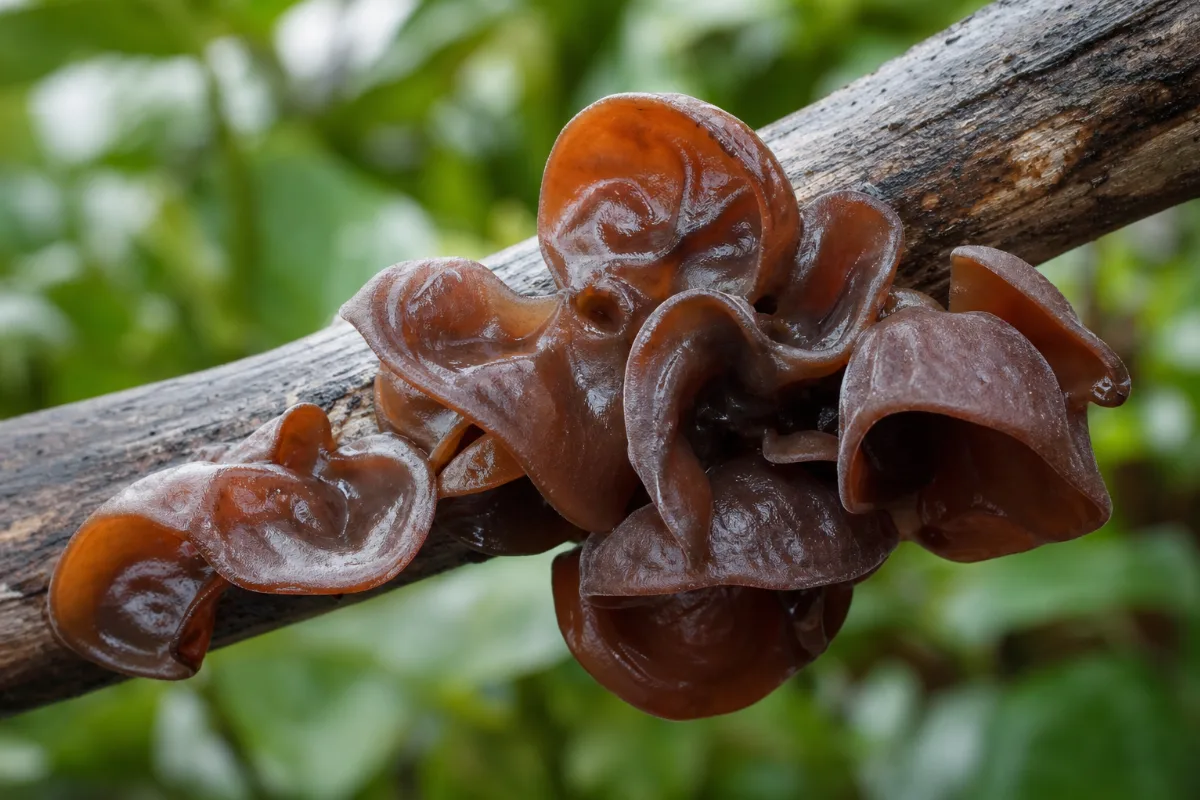
Mushrooms · Culinary and medicinal mushroom
Wood ear
Auricularia auricula-judae (the naming of commercial wood ear is unsettled) · also called Black fungus, black tree fungus, mu-er (names used in the papers we read)
Wood ear, also called black fungus, is a chewy, jelly-like mushroom used in Chinese and other Asian cooking and in traditional medicine. Human research is thin: one small old trial of a fibre supplement eased constipation, a newer 2025 trial of a powder food did not, and most other findings are from test tubes and animals. The most serious caution is food safety: a woman died after eating wood ear soaked for about five days. Lab work also suggests it may slow blood platelets, so ask a pharmacist if you take blood thinners.
General information, not medical advice. Last substantive update · Not medically reviewed. A named clinician has not signed off on this page. How this page is made
About Wood ear
Wood ear is a jelly fungus eaten in Asian dishes. Human research is limited to two small trials with mixed results, and most claims come from the lab. The clearest dangers are food safety: poisoning from long-soaked wood ear and Salmonella in dried product. Lab work suggests it may slow platelets, and the species name on labels is not settled.
What it is
Wood ear is the fruiting body of jelly fungi in the genus Auricularia. It is dried or fresh, chewy and mild. The species name on labels is not settled: a 2022 review says the Chinese black fungus A. heimuer is a completely different species from European A. auricula-judae, while a 2025 review says in its abstract that heimuer was reclassified as A. cornea. GBIF lists A. heimuer and A. cornea as separate accepted species. Many papers use the older name A. polytricha, which GBIF now treats as a synonym of A. nigricans.
Traditional and current uses
Reviews describe wood ear as a food and medicine in Asia, cultivated in China for over a thousand years. We found no regulator monograph or clinical guidance describing medical uses. Today it is mainly a cooking ingredient, and research groups also study its polysaccharides as a possible functional food ingredient.
What the research shows
Two small human trials exist. In 2004, 34 people with constipation took ear mushroom fibre supplements or placebo, and bowel symptoms improved with the mushroom, though one version also contained a laxative herb. In 2025, 50 adults ate wood ear powder foods for 8 weeks: constipation and gut measures did not change significantly, but waist size and triglycerides were lower.
Everything else is test tubes and animals: lower blood glucose in diabetic mice (mainly because they ate less), lower cholesterol and plaque in rabbits, and antioxidant and immune effects in the lab. Reviews list these effects, but none of the papers we read shows them in people.
Food, powder, extract and polysaccharide are different
Most lab findings are for hot-water extracts or purified polysaccharides. The human trials used a fibre supplement and a powder-based functional food. None tested soaked wood ear as eaten in cooking, so results do not carry over between forms. Strains also differ a lot: in one study of 50 A. cornea strains, polysaccharide content and minerals varied widely.
Legal and regulatory status
We did not find a wood ear page from NCCIH or Memorial Sloan Kettering, and we did not read EMA, LiverTox, LactMed or WHO entries. The only regulatory information we found is food safety: dried wood ear was linked to a 2020 Salmonella outbreak in the United States and to recalls, as described in a 2024 study.
At a glance
Traditional uses history, not proof
- A review describes the black fungus A. heimuer as a well-known jelly fungus used for food and medicine, with more than 1000 years of cultivation in China (Sun 2022).
- A review says the use of A. auricula-judae for health in Asia has a long tradition (Liu 2021).
Studied for research
- Constipation (a small 2004 trial helped; a 2025 trial found no change), mixed
- Waist size and triglycerides (one small open-label trial), very low
- Blood sugar and cholesterol (mice and rabbits only), insufficient
- Platelet and clotting effects (lab and animals only; a caution, not a benefit), insufficient
- Antioxidant, immune and anticancer claims (lab and animal work), insufficient
Main compounds
- Polysaccharides, the main component studied (up to 66.1% of dry weight in one review)
- Adenosine and other compounds that slowed platelets in the lab
- Melanin and dietary fibre
Common forms
- Dried wood ear, soaked before cooking
- Fresh wood ear
- Powders used in functional foods
- Hot-water extracts and purified polysaccharides (mainly lab research)
- Fibre supplements (one 2004 trial)
Research links: Fatal bongkrekic acid poisoning case report (abstract) · Forensic review of bongkrekic acid poisoning (abstract) · Dried wood ear handling and the 2020 Salmonella outbreak (abstract) · 2025 trial of wood ear powder foods (abstract) · Platelet inhibition by Mo-er extracts (abstract) · Species naming review, 2025 (abstract) · Research Library · Genes & Biomarkers Library
What it is and its history
- Accepted scientific name
- Auricularia auricula-judae (naming of commercial wood ear is unsettled; see notes)
- Naming authority
- (Bull.) Quel. (GBIF)
- Synonyms
- Auricularia heimuer F.Wu, B.K.Cui & Y.C.Dai (accepted separately in GBIF; reviews disagree on whether it equals A. cornea); Auricularia cornea Ehrenb. (accepted in GBIF); Auricularia polytricha (Mont.) Sacc. (a GBIF synonym of Auricularia nigricans)
- Common names
- Wood ear (English); Black fungus (English); Black tree fungus (English); Jew's ear (name used in a paper title) (English); Mo-er / mu-er (Chinese (as spelled in a paper title))
- Family or group
- Auriculariaceae (a fungus family; jelly fungi), not a plant
- Classification
- Fungi > Basidiomycota > Agaricomycetes > Auriculariales > Auriculariaceae > Auricularia > Auricularia auricula-judae
- Native range
- Not checked in the sources read.
- Habitat
- Not checked in the sources read; cultivated wood-based growing (hardwood chips or logs) is described in reviews.
- What it looks like
- Fruiting body: Described in reviews as a gelatinous fungus; no detailed description was read.
- Cultivation
- Sun 2022 says A. heimuer has been cultivated in China for more than 1000 years, mainly on hardwood chips; Liu 2025 describes log and substitute-substrate cultivation.
- Harvest and processing
- Not checked in the sources read, except that dried wood ear is soaked before cooking.
- Look-alikes and adulterants
- Name: Other Auricularia species (A. heimuer, A. cornea, A. nigricans); Note: The papers read disagree on which name belongs to the commercial Chinese black fungus. Sun 2022 says A. heimuer is a completely different species from European A. auricula-judae. Liu 2025 says in its abstract that 'heimuer' was reclassified as A. cornea, while its full text also lists A. heimuer and A. cornea as separate species.; Name: Wild jelly fungi; Note: No source we read gives identification help. This page gives no foraging advice.
- Sustainability and conservation
- Not checked.
Traditional use and history history, not clinical proof
| Tradition or era | Documented use | Source |
|---|---|---|
| China | A. heimuer is described as a well-known gelatinous fungus used for food and medicine, with more than 1000 years of cultivation in China. | p36439811 |
| Asia | A review says the use of A. auricula-judae for health in Asia has a long tradition. | p33543932 |
Traditional use shows how it was used. It does not show that it works or is safe today.
What is inside, and how it may work
What it contains and how those compounds act in cells and animals. Laboratory and animal mechanisms are not proven effects in people.
Main compounds
| Compound | Family | Where it is concentrated | Activity studied | Level of evidence |
|---|---|---|---|---|
| Polysaccharides (including acidic polysaccharides with glucuronic acid) | polysaccharide | Fruiting body Up to 66.1% of dry weight in one review's abstract; 15.2% to 15.6% crude polysaccharides in the highest of 50 A. cornea strains (colour-test method). | Slowed thrombin via antithrombin in the lab; reviews list antioxidant, immune and other lab activities. 22 15 10 | Laboratory research |
| Adenosine | nucleoside | Dried fungus 133 micrograms per gram dry fungus in A. auricula and 154 in A. polytricha (HPLC, one 1982 study). | Contributes to platelet inhibition in the lab but does not explain all of it. 1 | Laboratory research |
| Melanin | pigment | Fruiting body | Listed by reviews among components with reported lab activity. 20 15 | Review |
| Dietary fibre | fibre | Fruiting body About 50% fibre, per the Kim 2004 abstract (stated as known, not measured there). | Presumed basis for the constipation trials. 11 | Human data |
Mechanisms, receptors and pathways
| Target or pathway | Gene or receptor | What was found | Level |
|---|---|---|---|
| Thrombin inhibition via antithrombin | Antithrombin III | A purified acidic polysaccharide catalysed thrombin inhibition by antithrombin but not by heparin cofactor II; glucuronic acid residues were essential. 22 | Laboratory research |
| Platelet activation markers and antithrombin III / protein C pathways | eNOS, ET-1, PGI2, TXB2, AT-III, protein C | A purified polysaccharide changed these markers in mice with induced thrombosis. 2 | Animal research |
| ADP-induced platelet aggregation | Adenosine pathways and a second unknown agent | Extracts blocked aggregation partly through adenosine and partly through another agent not tied to the platelet cyclic AMP system. 1 | Laboratory research |
| Appetite and food intake | Not studied | In diabetic mice the lower glucose seemed mainly due to eating less. 21 | Animal research |
Absorption, metabolism and elimination
- Absorption
- Not found in the sources read. In rats, orally fed polysaccharide inhibited platelet aggregation ex vivo, which suggests some oral activity in rats.
- Distribution
- Not found.
- Metabolism
- Not found.
- Elimination
- Not found.
- Bioavailability
- Not established in people.
Isolated compounds versus whole extracts
Most lab findings are for purified polysaccharides or hot-water extracts. The human trials used a fibre supplement (Kim 2004) or a powder-based functional food (Son 2025). None used the soaked mushroom as eaten in cooking, so results do not transfer between forms.
Nutritional composition
Kim 2004 says ear mushroom is known to have about 50% fibre, higher than other mushrooms. No nutrient claims are made here.
1 mixed findings1 very low certainty4 not enough evidence
What was looked at
The 6 benefits and uses checked for Wood ear, each with how strong the evidence is. Tap one to open it.
- Bowel regularity and constipationMixed findings
- Waist size and blood fats (triglycerides)Very low certainty
- Platelet and clotting effects (blood-thinning)Not enough evidence
- Blood sugarNot enough evidence
- Cholesterol and artery plaqueNot enough evidence
- Antioxidant, immune and anticancer claimsNot enough evidence
Lab markers tracked in the studies
Bowel movement frequency and stool consistencyTriglycerides (a blood fat)Waist circumferencePlatelet aggregationPlasma glucose (mice)Total cholesterol and beta-lipoprotein (rabbits)Clotting times (APTT, PT, TT)
What is Wood ear good for?
The uses people ask about and how strong the human evidence is for each. None is proven. Read this together with the Safety tab.
Benefits, one by one
Each card is a research question, not a promise. Tap a goal to filter. Open a card to see the studies, doses and limits.
Bowel regularity and constipation
Mixed findingsTwo small trials gave opposite answers. A 2004 trial of an ear-mushroom fibre supplement in 34 people with constipation found better bowel symptoms than placebo. A 2025 trial of a wood ear powder food in 50 adults found no significant change in constipation.
2 studiesThe trials used a fibre supplement (Kim) and a powder-based functiona…
Studies, doses and limits
What the trials found
Kim 2004 randomised 34 adults with functional constipation to placebo, ear mushroom alone, or ear mushroom with additives including cascara sagrada (a laxative herb). Both mushroom groups improved bowel movements, straining, sense of incomplete emptying, stool consistency and satisfaction versus placebo (p<0.05); the version with additives did better but could cause belly discomfort or pain. Son 2025 gave 24 adults a wood ear powder functional food for 8 weeks versus 26 controls and found no significant change in constipation outcomes or gut measures.
Results
Kim 2004: p<0.05 for the listed symptoms, no group sizes or effect sizes in the abstract. Son 2025: no significant difference in gut measures or constipation outcomes.
Effect sizes as reported
Mixed: one small positive trial, one newer null trial
Why this rating
The only positive result is a 34-person trial from 2004 in which one arm also contained a laxative herb. The newer trial of 50 adults found no change. Neither names a product that readers can match to a food.
Form and dose studied
The trials used a fibre supplement (Kim) and a powder-based functional food (Son), not the soaked mushroom used in cooking. This page gives no amounts.
Who was studied
Adults with functional constipation (Kim); middle-aged and older Korean adults, including some with constipation (Son)
Limits
Tiny sample and old (Kim); open label with 50 people (Son). The species is not named in the Kim abstract.
Why researchers looked
Wood ear is eaten for its chewy texture and fibre, so one natural question is whether it helps the bowel.
Traditional use
Described in reviews as a long-used food and medicine in Asia (Liu 2021; Sun 2022).
Proposed mechanism Pharmacological theory
Fibre adds bulk to stool. This is the usual explanation for fibre supplements; neither trial tested a mechanism.
A proposed mechanism does not show that the effect happens in people.
Kim reported no serious side effects; the additive version may cause belly discomfort or pain. See the Safety tab: soaked wood ear that is kept for days can carry a deadly toxin, and lab work suggests it may slow platelets.
Waist size and blood fats (triglycerides)
Very low certaintyIn the same 2025 trial that found no gut change, adults who ate wood ear powder foods for 8 weeks had a smaller waist and lower triglycerides than the control group. This was a side result in a small open-label trial.
2 studiesFunctional foods containing A. auricula-judae powder, taken twice a d…
Studies, doses and limits
What the trials found
Son 2025 (50 adults, 24 intervention, 26 control, 8 weeks, open label): waist circumference p<0.021, abdominal obesity p<0.006, triglycerides p<0.016 in favour of the intervention group. The authors call the improvements limited and note that the main gut outcomes did not change.
Results
Waist circumference, abdominal obesity and triglycerides were lower in the wood ear group (p values as listed); sizes of the changes were not in the abstract.
Effect sizes as reported
Small differences in waist and triglycerides in one trial
Why this rating
One small, open-label trial of a powder-based functional food, with several outcomes tested and these not the main aim. Nobody has repeated it.
Form and dose studied
Functional foods containing A. auricula-judae powder, taken twice a day in the trial. No amounts are given or advised here.
Who was studied
Korean middle-aged and older adults
Limits
Open label, 50 people, many outcomes, product was not plain wood ear. Not clear that the effect comes from wood ear rather than the other ingredients or diet changes.
Why researchers looked
Reviews list blood-fat-lowering as a reported effect of Auricularia polysaccharides, so trials look at waist size and blood fats.
Traditional use
Not described in the sources read.
Proposed mechanism Preliminary mechanism
Not tested in the trial. Reviews attribute lab effects to polysaccharides, which is not proof for the powder foods studied.
A proposed mechanism does not show that the effect happens in people.
No safety findings were reported in the abstract. See the Safety tab: soaked wood ear that is kept for days can carry a deadly toxin, and lab work suggests it may slow platelets.
Platelet and clotting effects (blood-thinning)
Not enough evidenceIn test tubes and animals, wood ear extracts and polysaccharides slowed platelet clumping and clotting. No human trial of eating wood ear has measured this. It matters mainly as a caution for people on blood thinners, not as a benefit to seek.
5 studiesHot-water extracts and purified polysaccharides, not the soaked mushr…
Studies, doses and limits
What the trials found
No human trial. Agarwal 1982: hot-water extracts of Mo-er (A. auricula) strongly inhibited ADP-triggered clumping of human and rat platelets; adenosine at 133 micrograms per gram dry fungus (A. auricula) and 154 (A. polytricha) did not explain it all. Yoon 2003: purified polysaccharide slowed thrombin; rats fed it had inhibited platelet aggregation ex vivo, compared to aspirin. Poniedzialek 2019: hot-water extract of A. auricula-judae beat 140 micromol per litre aspirin in an ADP test, with no change in PT, prothrombin ratio or INR. Bian 2022: a purified polysaccharide reduced thrombosis in mice and lengthened APTT, PT and TT. Fan 1989: rabbits given black tree fungus had less thrombus formation and platelet aggregation.
Results
Qualitative: strong effects in test tubes and animals; no human numbers.
Effect sizes as reported
Antiplatelet and anticoagulant effects seen in test tubes, rats, mice and rabbits
Why this rating
All the evidence is lab or animal work with extracts or purified polysaccharides. No human study of eating wood ear and bleeding was found. The test-tube results mostly agree with each other, which is why the caution is worth stating.
Form and dose studied
Hot-water extracts and purified polysaccharides, not the soaked mushroom. No amounts are given or advised here.
Who was studied
Test tubes, human platelets in the lab, rats, mice, rabbits
Limits
Lab concentrations are not food amounts. Eating wood ear may do nothing to bleeding; nobody has measured it. One in vitro study found no change in PT or INR.
Why researchers looked
The first test-tube reports in 1982 found a food fungus that blocked platelets, and researchers have kept looking since.
Traditional use
Not described in the sources read.
Proposed mechanism Laboratory research
A purified polysaccharide helps antithrombin block thrombin; adenosine and other unidentified compounds in hot-water extracts block ADP-triggered platelet clumping.
A proposed mechanism does not show that the effect happens in people.
People who take blood thinners or antiplatelet medicines, or who have surgery planned, can ask a pharmacist or doctor. See the Safety tab.
Blood sugar
Not enough evidenceOne mouse study found lower blood glucose with a wood ear extract, and the authors think it was mainly because the mice ate less. No human trial was found.
2 studiesHot-water extract at 5% of mouse diet; not a human amount.
Studies, doses and limits
What the trials found
No human trial found. Takeuchi 2004: genetically diabetic KK-Ay mice on a high-fat diet with 5% hot-water extract of A. auricula-judae had lower plasma glucose, similar to mice on low-fat diets, with lower food intake. Miao 2020 lists antidiabetic effects among reported bioactivities of Auricularia polysaccharides.
Results
Qualitative; lower plasma glucose in mice.
Effect sizes as reported
Lower blood glucose in mice
Why this rating
Animal evidence only, in one mouse model, and the effect may come from eating less. No human data.
Form and dose studied
Hot-water extract at 5% of mouse diet; not a human amount.
Who was studied
Genetically diabetic mice
Limits
Mouse study; extract not food; no human data.
Why researchers looked
Reviews list antidiabetic effects among reported actions of Auricularia polysaccharides.
Traditional use
Not described in the sources read.
Proposed mechanism Animal research
The authors suggest eating less food explains most of the effect in mice.
A proposed mechanism does not show that the effect happens in people.
People who take diabetes medicines can ask a pharmacist before using wood ear products. See the Safety tab.
Cholesterol and artery plaque
Not enough evidenceIn rabbits fed a cholesterol-raising diet, black tree fungus lowered cholesterol and plaque. This is a 1989 animal study. In people, only a small 2025 trial showed lower triglycerides.
2 studiesBlack tree fungus diet in rabbits; form and amount not given in the a…
Studies, doses and limits
What the trials found
Fan 1989: rabbits given edible black tree fungus (A. auricula) had lower total cholesterol and beta-lipoprotein than the aspirin group and the no-treatment group, less aortic plaque and less narrowing of heart-muscle arteries.
Results
Lower cholesterol and less plaque in rabbits (P<0.01 for cholesterol and beta-lipoprotein).
Effect sizes as reported
Lower cholesterol and less plaque in rabbits
Why this rating
A single old animal study. The only human blood-fat result is the triglyceride finding listed under the main uses.
Form and dose studied
Black tree fungus diet in rabbits; form and amount not given in the abstract.
Who was studied
Rabbits
Limits
Rabbits are not people; no repeat found; little method detail.
Why researchers looked
Reviews list blood-fat-lowering among reported effects of Auricularia polysaccharides.
Traditional use
Not described in the sources read.
Proposed mechanism Animal research
Not explained in the abstract; the authors say the mechanism needs study.
A proposed mechanism does not show that the effect happens in people.
Same cautions as for clotting. See the Safety tab.
Antioxidant, immune and anticancer claims
Not enough evidenceReviews list antioxidant, immune, anticancer and liver-protective effects for wood ear polysaccharides. These come from lab and animal work. No human trial was found for any of them.
4 studiesExtracts and purified polysaccharides; strains and species differ.
Studies, doses and limits
What the trials found
No human trial found. Miao 2020 and Liu 2025 list antioxidant, antitumour, immunomodulatory, blood-sugar and liver-protective activities, and Liu 2025 reports polysaccharides up to 66.1% of dry weight. Khan 2023 measured antioxidant activity of crude polysaccharides from 50 A. cornea strains in the lab.
Effect sizes as reported
Lab and animal findings only
Why this rating
Reviews summarise lab and animal studies; none of the papers read reports a benefit in people.
Form and dose studied
Extracts and purified polysaccharides; strains and species differ.
Who was studied
Lab, animal
Limits
Lab antioxidant tests do not show an effect in the body. Species naming differs between papers, so findings may not transfer between products.
Why researchers looked
Polysaccharides make up a large share of the dry mushroom, so most laboratory research studies them.
Traditional use
A review describes A. heimuer as a gelatinous fungus used for food and medicine, cultivated in China for more than 1000 years (Sun 2022).
Proposed mechanism Laboratory research
Lab antioxidant tests are colour-based chemical tests; the reviews say polysaccharides act on immune and other pathways in lab and animal work.
A proposed mechanism does not show that the effect happens in people.
No human cancer or immune evidence, so do not use wood ear in place of medical care.
Connections to the rest of health
How Wood ear connects to the rest of our health knowledge graph. Every link says what kind of connection it is. A safety link (for example to the liver) is a warning, not a benefit. A study that merely mentions a topic never creates a benefit link.
Explore every connection: goals, body systems, organs, symptoms, genes
A. Wellness goals
| Connected to | Kind of connection | Evidence status | Context | Studies |
|---|---|---|---|---|
| Cholesterol Balance | Potential benefit | Very low certainty | Waist size and blood fats (triglycerides): In the same 2025 trial that found no gut change, adults who ate wood ear powder foods for 8 weeks had a smaller waist and lower triglycerides than the control group. This was a side result in a small open-label trial. | 19 14 |
| Weight Management | Potential benefit | Very low certainty | Waist size and blood fats (triglycerides): In the same 2025 trial that found no gut change, adults who ate wood ear powder foods for 8 weeks had a smaller waist and lower triglycerides than the control group. This was a side result in a small open-label trial. | 19 14 |
| Blood Sugar Balance | Preliminary mechanism | Not enough evidence | Blood sugar: One mouse study found lower blood glucose with a wood ear extract, and the authors think it was mainly because the mice ate less. No human trial was found. | 21 16 |
| Cholesterol Balance | Preliminary mechanism | Not enough evidence | Cholesterol and artery plaque: In rabbits fed a cholesterol-raising diet, black tree fungus lowered cholesterol and plaque. This is a 1989 animal study. In people, only a small 2025 trial showed lower triglycerides. | 5 16 |
| Heart Health | Preliminary mechanism | Not enough evidence | Cholesterol and artery plaque: In rabbits fed a cholesterol-raising diet, black tree fungus lowered cholesterol and plaque. This is a 1989 animal study. In people, only a small 2025 trial showed lower triglycerides. | 5 16 |
| Immune Support | Preliminary mechanism | Not enough evidence | Antioxidant, immune and anticancer claims: Reviews list antioxidant, immune, anticancer and liver-protective effects for wood ear polysaccharides. These come from lab and animal work. No human trial was found for any of them. | 16 15 10 20 |
B. Body systems
| Connected to | Kind of connection | Evidence status | Context | Studies |
|---|---|---|---|---|
| Blood clotting | Drug or supplement interaction | Not enough evidence | Platelets and clotting slowed in test tubes and animals; no human data. Preparation or compound: Hot-water extracts and polysaccharides (lab) |
1 22 17 |
| Digestive system | Potential benefit | Mixed findings | One small positive and one null trial for constipation. Preparation or compound: Ear mushroom fibre supplement; wood ear powder foods |
11 19 |
| Digestive System | Biological association | Mixed findings | Studied for: Bowel regularity and constipation | 11 19 |
| Metabolism Weight | Biological association | Very low certainty | Studied for: Waist size and blood fats (triglycerides) | 19 14 |
| Cardiovascular System | Biological association | Very low certainty | Studied for: Waist size and blood fats (triglycerides) Studied for: Platelet and clotting effects (blood-thinning) | 19 14 1 22 17 2 5 16 |
| Endocrine System | Biological association | Not enough evidence | Studied for: Blood sugar | 21 16 |
| Immune System | Biological association | Not enough evidence | Studied for: Antioxidant, immune and anticancer claims | 16 15 10 20 |
C. Body parts and organs
| Connected to | Kind of connection | Evidence status | Context | Studies |
|---|---|---|---|---|
| Liver | Adverse effect or risk | Not enough evidence | Acute liver failure in a fatal case of bongkrekic acid poisoning. Acute liver failure in a fatal poisoning case. Preparation or compound: Spoiled soaked wood ear containing bongkrekic acid |
18 4 |
I. Biomarkers
| Connected to | Kind of connection | Evidence status | Context | Studies |
|---|---|---|---|---|
| Bowel movement frequency and stool consistency | Biological association | Mixed findings | Measured in trials: mixed. A lab change is not the same as a health benefit. | 11 19 |
| Triglycerides (a blood fat) | Biological association | Very low certainty | Measured in trials: lowered. A lab change is not the same as a health benefit. | 19 |
| Waist circumference | Biological association | Very low certainty | Measured in trials: lowered. A lab change is not the same as a health benefit. | 19 |
| Platelet aggregation | Biological association | Not enough evidence | Measured in trials: lowered. A lab change is not the same as a health benefit. | 17 1 22 |
| Plasma glucose (mice) | Biological association | Not enough evidence | Measured in trials: lowered. A lab change is not the same as a health benefit. | 21 |
| Total cholesterol and beta-lipoprotein (rabbits) | Biological association | Not enough evidence | Measured in trials: lowered. A lab change is not the same as a health benefit. | 5 |
| Clotting times (APTT, PT, TT) | Biological association | Not enough evidence | Measured in trials: mixed. A lab change is not the same as a health benefit. | 2 17 |
J. Genes, receptors and enzymes
| Connected to | Kind of connection | Evidence status | Context | Studies |
|---|---|---|---|---|
| Antithrombin III | Preliminary mechanism | In vitro | A polysaccharide helped antithrombin block thrombin in the lab. | 22 |
K. Biological pathways
| Connected to | Kind of connection | Evidence status | Context | Studies |
|---|---|---|---|---|
| Platelet aggregation | Drug or supplement interaction | Not enough evidence | Slowed in test tubes and animals; no human data. Preparation or compound: Hot-water extracts and polysaccharides |
1 22 17 |
| Platelet aggregation | Preliminary mechanism | In vitro | Slowed by extracts in the lab. | 1 17 |
L. Active compounds
| Connected to | Kind of connection | Evidence status | Context | Studies |
|---|---|---|---|---|
| Polysaccharides (including acidic polysaccharides with glucuronic acid) | Biological association | In vitro | Slowed thrombin via antithrombin in the lab; reviews list antioxidant, immune and other lab activities. Preparation or compound: Fruiting body |
22 15 10 |
| Adenosine | Biological association | In vitro | Contributes to platelet inhibition in the lab but does not explain all of it. Preparation or compound: Dried fungus |
1 |
| Melanin | Biological association | Review | Listed by reviews among components with reported lab activity. Preparation or compound: Fruiting body |
20 15 |
| Dietary fibre | Biological association | Human | Presumed basis for the constipation trials. Preparation or compound: Fruiting body |
11 |
Each connection is stored with the ingredient, the connected record, the kind of connection, the evidence status, the supporting studies, the preparation or compound involved, and a review date (last reviewed October 25, 2026).
The evidence
The research centre for Wood ear. Every record here was checked against PubMed or the publisher's page; we never list a study we have not verified.
Evidence by outcome
Bars show how many studies we found for each outcome, not how well it works. People are added up across trials only (reviews are not added, to avoid double counting).
How we rate evidence
High certainty
Several well-run trials or reviews agree; further research is unlikely to change the picture much.
Moderate certainty
Good trials point the same way, but some doubt remains.
Low certainty
Small, short or inconsistent trials. The finding could change with better research.
Very low certainty
Very little or very weak human data. Treat as a possibility only.
Mixed findings
Trials or reviews disagree with each other.
Not enough evidence
Not enough human research to say either way.
Evidence against
Good research found no benefit, or found harm.
We take the reviewers' own risk-of-bias and GRADE statements where they exist, and otherwise judge from study size, design, consistency, directness and whether a product matches what is sold. Many publications do not make evidence high. Method note: We read PubMed records and abstracts for 18 papers (two small human trials, one case report read in full, one forensic review, one interview study, four lab studies, three animal studies, four narrative reviews or taxonomy papers, plus two case-report letters read as title and record only), checked the species names in GBIF, and searched PubMed for bleeding case reports. NCCIH and Memorial Sloan Kettering wood ear pages, LiverTox, LactMed, EMA and WHO were not found or not read. Mostly abstracts were read, so numbers come from abstracts. Certainty ratings are the compiler's own reading.
Study library: every study we checked 22
| Study | Design | People | Product, dose, length | Result |
|---|---|---|---|---|
| Agarwal 1982 Inhibition of human and rat platelet aggregation by extracts of Mo-er (Auricularia auricula). Thrombosis and Haemostasis · PMID 6983740 |
Laboratory research in-vitro |
Human and rat platelets in test tubes | Hot-water extract of Mo-er (A. auricula) and a black tree fungus (A. polytricha) dried fungus Not shown here Test-tube experiment · vs Adenosine and other compounds |
Hot-water extracts strongly inhibited ADP-triggered clumping of human and rat platelets. HPLC found adenosine at 133 micrograms per gram of dry fungus in A. auricula and 154 in A. polytricha. Adenosine alone did not explain the effect: extract treated to break down adenosine still blocked clumping, so the authors say other agents are involved. Strong inhibition in the test tube Methods, limits and fundingOutcomes: ADP-induced platelet aggregation Limitations: Test-tube work only. The extract amount used is not a food amount, and the study cannot say what eating wood ear does to bleeding. Funding and conflicts: US government research support (per the PubMed record). Read: abstract |
| Bian 2022 A Novel Polysaccharide from Auricularia auricula Alleviates Thrombosis Induced by Carrageenan in Mice. Molecules · PMID 35956781 · DOI |
Animal research animal |
Mice with carrageenan-induced thrombosis | Purified polysaccharide AAP-b2 (12.02 kDa) from A. auricula fruiting bodies fruiting body Not shown here · vs Control mice |
The polysaccharide inhibited platelet aggregation, shortened the black (clotted) tail and lengthened APTT, PT and TT in mice. The authors link this to platelet-activation markers (eNOS, ET-1, PGI2, TXB2) and the antithrombin III and protein C pathways. Antithrombotic effect in mice Methods, limits and fundingOutcomes: Platelet aggregation, black tail length, clotting times (APTT, PT, TT) Limitations: Mouse model and a purified polysaccharide, not food. Funding and conflicts: The authors declare no conflict of interest. Read: abstract |
| Chen 2024 Evaluation of the Handling Practices and Risk Perceptions of Dried Wood Ear Mushrooms in Asian Restaurants in the United States. Journal of Food Protection · PMID 38007093 · DOI |
Interview study |
25 Managers and chefs of Asian restaurants in the United States |
Dried wood ear mushrooms used in restaurant kitchens dried fruiting body (food) Not shown here |
The abstract says dried wood ear was linked in late 2020 to a Salmonella Stanley outbreak that sickened 55 people across the United States. Of 25 interviewed restaurant staff, 76% did not keep package information such as expiry date and lot number, and many used cold water to rehydrate. Wood ear was blanched before use in all cold dishes and most stir-fries, but less often in stews or ramen. 16% did not see dried wood ear as a raw ingredient, and only 17% knew of the wood ear recall. Qualitative interview results Methods, limits and fundingOutcomes: Handling practices, risk perceptions, recall awareness Limitations: Small interview sample; says nothing about how often wood ear makes people ill. Funding and conflicts: The authors declare no competing financial interests. Read: abstract |
| Chen 2025 Forensic Research Progress on Bongkrekic Acid Poisoning. Fa Yi Xue Za Zhi (Journal of Forensic Medicine) · PMID 40813078 · DOI |
Narrative review review |
Autopsy cases and literature on deaths from bongkrekic acid | Bongkrekic acid toxin Not shown here |
The English abstract says bongkrekic acid is a toxin with stable properties and no distinctive smell. It is found in fermented grain products, potato products, spoiled tremella (Tremella fuciformis) and Auricularia polytricha, and in Auricularia polytricha soaked too long. No complete detection method and no specific antidote exist, so the poisoning is easily misdiagnosed and mortality remains high. It damages the liver, kidney, brain and other organs. Qualitative Methods, limits and fundingOutcomes: Where the toxin is found, how it harms the body, detection, treatment Limitations: Abstract only (the Chinese-language abstract was also shown). Species named in the abstract is A. polytricha, a name GBIF now lists as a synonym. Funding and conflicts: Not stated in the abstract. Read: abstract |
| Fan 1989 The effect of edible black tree fungus (Auricularia auricula) on experimental atherosclerosis in rabbits. Chinese Medical Journal (English) · PMID 2505974 |
Animal research animal |
Rabbits fed a diet to cause artery plaque | Edible black tree fungus (A. auricula) compared with aspirin food form (not described in the abstract) Not shown here · vs Aspirin group and a group with neither |
Total cholesterol and beta-lipoprotein were lower in the fungus group than in the aspirin group and the no-treatment group. Rabbits given the fungus had less aortic plaque and less narrowing of heart-muscle arteries. Thrombus formation, platelet aggregation and thromboxane B2 were inhibited in both the fungus and aspirin groups. Lower cholesterol and platelet activity in rabbits Methods, limits and fundingOutcomes: Serum cholesterol, aortic plaque, thrombus formation, platelet aggregation, thromboxane B2 Limitations: Rabbits, 1989 study, very little method detail in the abstract. Funding and conflicts: Not stated. Read: abstract |
| GBIF Secretariat 2026 GBIF: Auricularia heimuer F.Wu, B.K.Cui & Y.C.Dai GBIF Backbone Taxonomy (API) · Source |
Database record n/a |
n/a | n/a |
Accepted species, key 8168755, listed as a separate species from A. auricula-judae. Methods, limits and fundingOutcomes: Accepted name and rank Limitations: Taxonomy database only; says nothing about health. Funding and conflicts: n/a Read: database record, checked 2026-10-25 |
| GBIF Secretariat 2026 GBIF: Auricularia cornea Ehrenb. GBIF Backbone Taxonomy (API) · Source |
Database record n/a |
n/a | n/a |
Accepted species, key 5249287. Methods, limits and fundingOutcomes: Accepted name and rank Limitations: Taxonomy database only; says nothing about health. Funding and conflicts: n/a Read: database record, checked 2026-10-25 |
| GBIF Secretariat 2026 GBIF: Auricularia auricula-judae (Bull.) Quel. GBIF Backbone Taxonomy (API) · Source |
Database record n/a |
n/a | n/a |
Accepted species, key 5249271; family Auriculariaceae, order Auriculariales, class Agaricomycetes, phylum Basidiomycota. Methods, limits and fundingOutcomes: Accepted name and rank Limitations: Taxonomy database only; says nothing about health. Funding and conflicts: n/a Read: database record, checked 2026-10-25 |
| GBIF Secretariat 2026 GBIF: Auricularia polytricha (Mont.) Sacc. GBIF Backbone Taxonomy (API) · Source |
Database record n/a |
n/a | n/a |
Listed as a synonym (key 5249293); the accepted name is Auricularia nigricans (Sw.) Birkebak, Looney & Sanchez-Garcia (key 7351381). Methods, limits and fundingOutcomes: Accepted name and rank Limitations: Taxonomy database only; says nothing about health. Funding and conflicts: n/a Read: database record, checked 2026-10-25 |
| Khan 2023 Characterization, antioxidant activity, and mineral profiling of Auricularia cornea mushroom strains. Frontiers in Nutrition · PMID 37404858 · DOI |
Lab analysis fungus |
50 strains of cultivated, wild-domesticated and hybrid A. cornea | A. cornea fruiting bodies fruiting body Not shown here Growing trial |
Strains differed a lot. Crude polysaccharides were highest in hybrid strain Ac18 (15.2%) and cultivated strain Ac33 (15.6%); total polysaccharides in the fruiting body reached 216 and 200 mg per gram (Ac1, Ac33). Zinc was highest in strain Ac46 (486.33 mg per kg). Antioxidant tests were done in the lab with colour-based methods. Wide differences between strains Methods, limits and fundingOutcomes: Growth, crude and total polysaccharides, antioxidant tests, minerals Limitations: Strain breeding paper; lab antioxidant tests do not show health effects. Colour-test sugar numbers are not comparable with other methods. Funding and conflicts: Not stated in the abstract. Read: abstract |
| Kim 2004 Effect of ear mushroom (Auricularia) on functional constipation. Korean Journal of Gastroenterology · PMID 15266131 |
Controlled trial |
34 34 adults with functional constipation (modified Rome II) |
Fibre supplement made from ear mushroom, alone or with additives including cascara sagrada Not shown here · vs Placebo |
Both the ear mushroom alone and the ear mushroom with additives improved bowel movements, straining, sense of incomplete evacuation, stool consistency and satisfactory relief (p<0.05). The additive version worked better but may cause belly discomfort or pain. The authors report no serious side effect. Better bowel symptoms than placebo Methods, limits and fundingOutcomes: Bowel movements, straining, incomplete evacuation, stool consistency, satisfaction, pain, colon transit time Limitations: Tiny trial of 34 people split into three groups, from 2004, published in Korean; the species is not named in the abstract; one arm contained a laxative herb (cascara sagrada), so that arm cannot be credited to the mushroom. Funding and conflicts: Not stated in the abstract. Read: abstract (Korean paper, English abstract) |
| Kobayashi 2019 A case of anaphylaxis due to alpha-mannosidase from Auricularia. Allergology International · PMID 30926326 · DOI |
Case report |
1 One patient (details not available) |
Auricularia (eaten); the allergen named in the title is alpha-mannosidase fruiting body (food) Not shown here |
PubMed holds only the title and record (a letter with no abstract). The title reports an anaphylaxis case linked to alpha-mannosidase from Auricularia. Nothing more was read. One case of severe allergy Methods, limits and fundingOutcomes: Allergic reaction Limitations: Title and record only; no details read. Funding and conflicts: Not available. Read: title and record only |
| Lang 2016 Streaky, whiplash-like erythema and succulent papules: flagellate dermatitis following consumption of Auricularia auricula-judae. Journal der Deutschen Dermatologischen Gesellschaft · PMID 26972199 · DOI |
Case report |
1 One patient (details not available) |
Auricularia auricula-judae (eaten) fruiting body (food) Not shown here |
PubMed holds only the title and record (a letter with no abstract). The title reports a streaky, whip-mark skin rash (flagellate dermatitis) after eating A. auricula-judae. Nothing more was read. One case of a skin reaction Methods, limits and fundingOutcomes: Skin reaction Limitations: Title and record only; no details read. Funding and conflicts: Not available. Read: title and record only |
| Liu 2021 Review on Auricularia auricula-judae as a Functional Food: Growth, Chemical Composition, and Biological Activities. Journal of Agricultural and Food Chemistry · PMID 33543932 · DOI |
Narrative review review |
Literature on A. auricula-judae | A. auricula-judae fruiting body Not shown here |
The abstract says use for health in Asia has a long tradition, that research has focused too narrowly on polysaccharides, and that the fungus has potential as a source of bioactive substances. It does not report human trial results. Qualitative Methods, limits and fundingOutcomes: Nutrition, composition, bioactivity Limitations: Narrative review of mostly non-human work; the abstract gives no certainty ratings. Funding and conflicts: Not stated in the abstract record. Read: abstract |
| Liu 2025 Sustainable Cultivation and Functional Bioactive Compounds of Auricularia Mushrooms: Advances, Challenges, and Future Prospects. Biology (Basel) · PMID 41300345 · DOI |
Narrative review review |
Literature on Auricularia | Auricularia (focus on A. auricula) fruiting body Not shown here |
The abstract says molecular work has clarified taxonomy, including the reclassification of 'heimuer' as A. cornea, and reports polysaccharides up to 66.1% of dry weight with hypoglycemic, antitumor, immunomodulatory and antioxidant activities. The full text (PMC) is not consistent: it also states that A. heimuer is a distinct species that was believed to equal European A. auricula-judae, and lists A. cornea and A. heimuer separately as the main cultivated species. Qualitative Methods, limits and fundingOutcomes: Taxonomy, cultivation, bioactive compounds Limitations: Review of mostly lab work. Its own naming statements differ between abstract and full text, which is why this page states the naming as unsettled. Funding and conflicts: The authors declare no conflicts of interest. Read: abstract and full text (PMC) |
| Miao 2020 Isolation, structural characterization and bioactivities of polysaccharides and its derivatives from Auricularia-A review. International Journal of Biological Macromolecules · PMID 32044370 · DOI |
Narrative review review |
Literature on Auricularia polysaccharides | Polysaccharides from A. auricula-judae, A. auricula, A. polytricha and A. cornea var. Li fruiting body Not shown here |
The abstract lists antioxidant, antitumor, immunomodulatory, blood-fat-lowering, antidiabetic, anticoagulant and liver-protective effects reported for Auricularia polysaccharides, and discusses four species together. Qualitative Methods, limits and fundingOutcomes: Reported bioactivities Limitations: Review of mostly lab and animal work; the abstract does not separate human from non-human evidence. Funding and conflicts: The authors declare no competing interests. Read: abstract |
| Poniedzialek 2019 The Effect of Mushroom Extracts on Human Platelet and Blood Coagulation: In vitro Screening of Eight Edible Species. Nutrients · PMID 31842490 · DOI |
Laboratory research in-vitro |
Human blood platelets and plasma in test tubes | Hot-water extracts of eight edible mushrooms including Auricularia auricularia-judae (spelling as in the abstract) fruiting body Not shown here Test-tube experiment · vs Aspirin (acetylsalicylic acid) at 140 micromol per litre |
Among eight species, the Auricularia auricula-judae extract and a king oyster extract were the most promising: their inhibition of ADP-triggered aggregation exceeded that of 140 micromol per litre aspirin and was comparable in the arachidonic-acid test. None of the extracts changed PT, prothrombin ratio or INR. Antiplatelet effect in the test tube; no change in clotting-time tests Methods, limits and fundingOutcomes: ADP- and arachidonic-acid-triggered platelet aggregation; PT, prothrombin ratio and INR Limitations: In vitro only; aspirin dose used for comparison is a lab concentration, not a human dose. Funding and conflicts: The authors declare no conflict of interest. Read: abstract |
| Shi 2024 Severe bongkrekic acid poisoning caused by eating spoiled Auricularia auricula: a case report. BMC Complementary Medicine and Therapies · PMID 39707296 · DOI |
Case report |
1 One 77-year-old woman in China with high blood pressure |
Auricularia auricula, soaked for about 5 days before it was eaten (full text) fruiting body (food) Not shown here One meal; illness began the next day |
She had sweating and loss of consciousness, nausea, vomiting and acute liver failure. She died despite supportive care and plasma exchange (plasmapheresis). The authors say bongkrekic acid poisoning has a case fatality rate above 50%, and that contaminated food looks, smells and tastes normal. One fatal case Methods, limits and fundingOutcomes: Poisoning signs, outcome Limitations: Single case. It shows the risk exists; it cannot say how often it happens. Funding and conflicts: The authors declare no competing interests. Read: abstract and full text (PMC) |
| Son 2025 Effects of the Intestinal Status and Clinical Factors of Korean Middle-Aged People Through the Consumption of Functional Foods Containing Auricularia auricula-judae Powder: Prospective, Randomized, Open-Label, and Control Comparative Trial. Clinical Nutrition Research · PMID 39968271 · DOI |
Rct open label |
50 Korean middle-aged and older adults (50 randomised: 24 intervention, 26 control) |
Functional foods containing A. auricula-judae powder, twice a day powder in functional foods Not shown here 8 weeks · vs Control group |
No significant difference in gut measures, and no significant change in constipation outcomes. The intervention group had lower waist circumference (p<0.021), less abdominal obesity (p<0.006) and lower triglycerides (p<0.016). Fibre, vitamin B1 and folic acid intake from other meals rose in the intervention group. Little change in gut measures; small benefits in waist and triglycerides Methods, limits and fundingOutcomes: Gut environment measures, constipation, waist size, blood tests, diet Limitations: Open label (no blinding), only 50 people, many outcomes tested, waist and triglyceride results were not the main aim. The foods were a powder-based product, not plain wood ear. Funding and conflicts: The authors declare no competing interests. Read: abstract |
| Sun 2022 Research progress of Auricularia heimuer on cultivation physiology and molecular biology. Frontiers in Microbiology · PMID 36439811 · DOI |
Narrative review review |
Literature on A. heimuer | A. heimuer F.Wu, B.K.Cui & Y.C.Dai fruiting body Not shown here |
The abstract calls A. heimuer a well-known gelatinous fungus used for food and medicine, with more than 1000 years of cultivation in China. It states that A. heimuer is a completely different species from the European Auricularia auricula-judae (Bull.) Quel., which was used to characterise it. It lists polysaccharides, melanin and minerals as components. Qualitative Methods, limits and fundingOutcomes: Cultivation, nutrients, molecular biology Limitations: Cultivation-focused review; no human trials. Funding and conflicts: The authors declare no competing interests. Read: abstract |
| Takeuchi 2004 Reductive effect of hot-water extracts from woody ear (Auricularia auricula-judae Quel.) on food intake and blood glucose concentration in genetically diabetic KK-Ay mice. Journal of Nutritional Science and Vitaminology · PMID 15527075 |
Animal research animal |
Genetically diabetic male KK-Ay mice | Hot-water extract of A. auricula-judae at 5% of the diet fruiting body Not shown here 3 extra weeks on the test diet · vs Same diet without extract |
Mice on the high-fat diet with the extract had the lowest plasma glucose, similar to mice on the lowest-fat diets. The authors suggest the blood-sugar effect is mainly caused by eating less. Lower blood glucose in mice, linked to lower food intake Methods, limits and fundingOutcomes: Food intake, plasma glucose, energy expenditure Limitations: Mouse study. Because the mice ate less, the effect may not be a direct sugar-lowering action. Funding and conflicts: Not stated in the abstract. Read: abstract |
| Yoon 2003 The nontoxic mushroom Auricularia auricula contains a polysaccharide with anticoagulant activity mediated by antithrombin. Thrombosis Research · PMID 14967412 · DOI |
In vitro and animal in-vitro |
Isolated polysaccharide; rats fed the polysaccharide | Purified acidic polysaccharide from A. auricula (about 160 kDa; mannose, glucose, glucuronic acid, xylose) fruiting body Not shown here · vs Aspirin used as a reference in the ex vivo test |
The purified polysaccharide slowed clotting by helping the blood protein antithrombin block thrombin (not through heparin cofactor II). In rats fed the polysaccharide, platelet aggregation measured ex vivo was inhibited, which the authors compare to aspirin. They suggest such polysaccharides could be a source of compounds acting on clotting and platelets. Anticoagulant and antiplatelet effects in test tube and rats Methods, limits and fundingOutcomes: Clotting activity, platelet aggregation Limitations: Purified polysaccharide, not whole mushroom; rats, not people. The word 'nontoxic' is the authors' title wording, not a safety finding. Funding and conflicts: Research support, non-US government (per record). Read: abstract |
What we do not know yet
- No human study or case report on wood ear and bleeding or blood-thinner interaction was found.
- No trial used plain soaked wood ear; the two human trials used a fibre supplement and a powder food.
- Species names on labels are not settled, so results may not transfer between products.
- No data on pregnancy, breastfeeding or children.
- EMA/HMPC, LiverTox, LactMed and WHO entries were not found or not read; no heavy-metal or pesticide test was read.
How new research is added
New studies are found by a saved PubMed search and placed in a review queue. A person reads each one before it changes any evidence rating or safety wording. New publications never change ratings automatically.
Lab markers
What changed in blood or saliva tests during trials. A changed number is not the same as feeling or being healthier, and we give no "normal ranges".
Metabolic 1
Triglycerides (a blood fat)
Lowered in trials
A type of fat carried in the blood. High levels are a heart-risk marker.
Very low certaintyResults and what it means
Why it was measured
Often checked as a stand-in for heart risk.
Statistical vs. clinical meaning
Statistically significant, but a secondary result in a small open-label trial.
Safety implication
Not applicable.
| Study | Result | People | Product |
|---|---|---|---|
| 19 | Triglycerides were lower in the wood ear powder group than in controls (p<0.016); size of change not in the abstract. | Middle-aged and older Korean adults | Functional foods with A. auricula-judae powder, 8 weeks |
Other 6
Bowel movement frequency and stool consistency
Mixed results in trials
How often someone has a bowel movement and how hard or soft the stool is.
Mixed findingsResults and what it means
Why it was measured
Standard outcomes in constipation trials.
Statistical vs. clinical meaning
Opposite findings in two small trials.
Safety implication
None found for the symptom itself; see the Safety tab for other cautions.
| Study | Result | People | Product |
|---|---|---|---|
| 11 | Number of bowel movements and stool consistency improved with ear mushroom fibre supplements versus placebo (p<0.05); numbers not given in the abstract. | 34 adults with functional constipation | Ear mushroom fibre supplement, alone or with additives |
| 19 | No significant change in constipation outcomes with wood ear powder foods. | Middle-aged and older Korean adults, 24 vs 26 | Functional foods with A. auricula-judae powder for 8 weeks |
Waist circumference
Lowered in trials
A tape-measure number used as a rough sign of belly fat.
Very low certaintyResults and what it means
Why it was measured
Simple marker of abdominal fat.
Statistical vs. clinical meaning
Small, open-label, secondary result.
Safety implication
Not applicable.
| Study | Result | People | Product |
|---|---|---|---|
| 19 | Waist circumference was lower in the wood ear powder group (p<0.021) and abdominal obesity was lower (p<0.006). | Middle-aged and older Korean adults | Functional foods with A. auricula-judae powder, 8 weeks |
Platelet aggregation
Lowered in trials
How readily platelets (blood cells that stick together to start a clot) clump together.
Not enough evidenceResults and what it means
Why it was measured
Used to see whether something may slow clotting or raise bleeding risk.
Statistical vs. clinical meaning
Strong lab finding; no human result.
Safety implication
This is the basis for the blood-thinner caution on the Safety tab.
| Study | Result | People | Product |
|---|---|---|---|
| 17 | A. auricula-judae hot-water extract inhibited ADP-triggered platelet clumping more than 140 micromol per litre aspirin did, with no change in PT, prothrombin ratio or INR. | Human platelets and plasma in test tubes | Hot-water extract, in vitro |
| 1 | Mo-er hot-water extracts strongly inhibited ADP-triggered clumping of human and rat platelets. | Human and rat platelets in test tubes | Hot-water extract of A. auricula, in vitro |
Plasma glucose (mice)
Lowered in trials
The sugar level in blood plasma.
Not enough evidenceResults and what it means
Why it was measured
Standard measure in diabetes research.
Statistical vs. clinical meaning
Mouse result only.
Safety implication
Not applicable.
| Study | Result | People | Product |
|---|---|---|---|
| 21 | Plasma glucose was lowest in the low-fat diet group and the high-fat diet plus extract group; the authors say the effect is mainly from reduced food intake. | KK-Ay diabetic mice | 5% hot-water extract of A. auricula-judae |
Total cholesterol and beta-lipoprotein (rabbits)
Lowered in trials
Blood fats linked to artery plaque.
Not enough evidenceResults and what it means
Why it was measured
Standard in artery-plaque research.
Statistical vs. clinical meaning
Rabbit result only, from 1989.
Safety implication
Not applicable.
| Study | Result | People | Product |
|---|---|---|---|
| 5 | Total cholesterol and beta-lipoprotein were lower with black tree fungus than in the aspirin and untreated groups (P<0.01). | Rabbits fed a plaque-forming diet | Edible black tree fungus (A. auricula) |
Clotting times (APTT, PT, TT)
Mixed results in trials
Lab tests of how long blood takes to clot.
Not enough evidenceResults and what it means
Why it was measured
Used to check blood-thinning effects.
Statistical vs. clinical meaning
Mouse test lengthened clotting times; the test-tube extract did not. The two used different preparations.
Safety implication
Different preparations give different results, so conclusions for food cannot be drawn.
Safety
What studies and official sources say about side effects, medicines and who should check first. Each point shows what kind of evidence it comes from.
Main points to know 5
- Wood ear that has been soaked for days can carry a deadly toxin. A 77-year-old woman in China died of bongkrekic acid poisoning after eating Auricularia auricula that had been soaked for about five days. She had sweating, loss of consciousness, nausea, vomiting and acute liver failure. The case report says contaminated food has the same look, smell and taste as safe food, and that this poisoning has a fatality rate above 50%. A forensic review says the toxin is stable, there is no specific antidote, and it has been found in Auricularia soaked too long. Case report 18 4
- Dried wood ear has been linked to a Salmonella outbreak. A 2024 study says dried wood ear imported to the United States was linked in late 2020 to a Salmonella Stanley outbreak that made 55 people ill, with several recalls. In interviews, some restaurant staff used cold water to rehydrate it, and 16% did not think of dried wood ear as a raw ingredient. Survey 3
- Lab work suggests wood ear may slow blood platelets. In test tubes, rats, mice and rabbits, wood ear extracts and polysaccharides slowed platelet clumping and clotting. We found no report in people of bleeding linked to eating wood ear, and no human trial. People who take blood thinners or antiplatelet medicines, or who have surgery planned, can ask a pharmacist or doctor first. Laboratory research 1 22 17 2 5
- Allergy and skin reactions are reported in single cases. Case reports in the medical literature describe anaphylaxis linked to a protein (alpha-mannosidase) from Auricularia and a streaky skin rash (flagellate dermatitis) after eating A. auricula-judae. Only the titles and records were available to read, so the details are not known. How common these reactions are is not known. Case report 12 13
- No data were found for pregnancy, breastfeeding or children. None of the sources we read tested wood ear in pregnancy, breastfeeding or children. Eating it as a food in normal meals is not the same as taking concentrated products, and the sources do not say whether either is safe in these groups. Insufficient
Side effects 6
| Effect | How often | Severity and recovery | Evidence |
|---|---|---|---|
| Bongkrekic acid poisoning from spoiled, long-soaked wood ear (sweating, loss of consciousness, nausea, vomiting, liver failure) The toxin is made by bacteria growing on the food; it is not part of fresh, properly handled wood ear. | Not known. Rare in reports, but the case report states a fatality rate above 50%. | serious The reported patient died; no antidote exists per the forensic review | Case report 18 4 |
| Salmonella infection from contaminated dried wood ear The abstract describes the outbreak and recalls, not patient outcomes. | One outbreak: 55 ill in the United States in 2020 | moderate Not described in the abstract | Survey 3 |
| Belly discomfort or pain Additives included cascara sagrada, a laxative herb. The authors report no serious side effect. | Reported as possible with the ear mushroom fibre supplement that also contained additives; no rate in the abstract | mild Not described | Controlled trial 11 |
| Anaphylaxis (severe allergy) linked to a protein from Auricularia Only the title and record were read. | One case report found; frequency unknown | serious Not available (title only) | Case report 12 |
| Streaky whip-mark skin rash (flagellate dermatitis) Only the title and record were read. | One case report found; frequency unknown | mild Not available (title only) | Case report 13 |
| Bleeding Based on lab and animal findings that wood ear slows platelets. This is a possibility, not a documented effect in people. | No human report found | unknown Not applicable | Laboratory research 1 22 17 |
Liver
The one fatal case we found included acute liver failure, but the cause was a bacterial toxin (bongkrekic acid) in spoiled wood ear, not the mushroom itself. A forensic review says the toxin damages the liver, kidney, brain and other organs. We found no report of liver injury from properly handled wood ear. We could not find a LiverTox entry for Auricularia, so that source was not read. 18 4
How often. No rate can be given; no liver safety study of wood ear was found.
- p39707296.
This is a safety connection. It is not evidence that Wood ear supports liver health.
Medicines and supplements 4
| With | Why it matters | Importance | Evidence | What to do |
|---|---|---|---|---|
| Blood thinners (such as warfarin or newer anticoagulants) and antiplatelet medicines (such as aspirin or clopidogrel) prescription | Lab and animal findings: platelet clumping and clotting were slowed by wood ear hot-water extracts and polysaccharides (human platelets in vitro; rats, mice, rabbits). | Unknown. No human interaction report or trial was found. One in vitro study found no change in PT, prothrombin ratio or INR. The possibility is raised by consistent lab findings, not by any human case. | Laboratory research Very low certainty 1 22 17 2 5 | Tell your pharmacist or prescriber that you eat wood ear or take wood ear products, and ask before changing how much you eat. This applies especially before surgery or if you bruise or bleed easily. |
| Other supplements that may thin the blood (for example fish oil, ginkgo, garlic supplements) supplement | Theoretical: effects on platelets could add up. No study combined wood ear with another supplement. | Unknown; no source tested this. | Pharmacological theory Not enough evidence 1 17 | Tell a pharmacist about all supplements you take. |
| Diabetes medicines prescription | A mouse study found lower blood glucose with wood ear extract, mainly through lower food intake. | Unknown; no human data. | Animal research Not enough evidence 21 | If you take diabetes medicines and use wood ear products, mention it to your pharmacist. |
| Immune-suppressing medicines prescription | Reviews describe immune effects of wood ear polysaccharides in lab and animal work. | No source we read addresses this. Not known. | Insufficient Not enough evidence 16 | No evidence either way; ask a pharmacist if you take immune-suppressing medicines and plan to use concentrated products. |
Who should check first 4
| Situation | Advice | Evidence |
|---|---|---|
| Wood ear that has been soaked for a long time, or left in warm conditions after soaking | The case report and forensic review describe poisoning from soaked wood ear and say the toxin has no distinctive smell. Do not rely on looks, smell or taste to judge it. | Case report 18 4 |
| Planned surgery, bleeding disorders, or use of blood thinners or antiplatelet medicines | Raise it with your doctor or pharmacist. The concern comes from lab and animal work only. | Laboratory research 1 22 17 |
| Past allergic or skin reaction after eating wood ear or other Auricularia | Avoid it and ask an allergy clinician. Case reports describe anaphylaxis and a skin rash. | Case report 12 13 |
| Pregnancy, breastfeeding, babies and children | No data were found. Ask a doctor or pharmacist about concentrated products. | Insufficient |
Overdose, product quality and regulators
Summary. Properly handled wood ear is a long-used food. The main documented danger is bacterial contamination after soaking or storage, not the mushroom itself.
Animal. Not reviewed for toxicity. The animal studies read were about effects on platelets, blood sugar and cholesterol and reported no safety findings in their abstracts.
Human doses studied. Trials ran 8 weeks or less. This page gives no amounts, and none are advised.
High dose or long term signals. No long-term safety study was found.
Overdose response. Not described. For the signs of poisoning from spoiled wood ear, see the urgent signs below.
Genotoxicity. Not read.
Toxic or hazardous parts. Fungus: fruiting body (eaten). The wood-ear-like jelly fungi found in the wild are not covered here and no source we read gives identification help. If someone ate a wild mushroom, call poison control.
The sources describe two serious contamination problems: bongkrekic acid-producing bacteria on soaked wood ear and Salmonella on imported dried wood ear. We did not read any test of heavy metals or pesticides in wood ear products.
Bongkrekic acid (bacterial toxin) in soaked wood ear. The case report names Burkholderia cocovenenans as the bacterium and says contaminated food looks, smells and tastes normal. A forensic review says the toxin is stable and found in spoiled Auricularia soaked too long (the abstract names A. polytricha). 18 4
Salmonella in dried wood ear. Dried wood ear was linked to a 2020 Salmonella Stanley outbreak in the United States (55 ill). Interviewed restaurant staff often used cold water to soak it, and many did not track lot numbers. 3
Which species is in the product. Market names such as wood ear and black fungus are not mapped to one species in the sources. Reviews disagree on whether the commercial Chinese black fungus 'heimuer' is A. heimuer, A. cornea or A. auricula-judae. 20 15 6 7 8
| Body | Action | Date |
|---|---|---|
| Food-safety recalls (as described in a 2024 Journal of Food Protection study) (United States) | Dried wood ear was linked to a Salmonella Stanley outbreak in late 2020 and has been the subject of multiple recalls, per the study's abstract. source | 2020-12 |
When to get medical help
- After eating wood ear that was soaked for days: sweating, confusion or fainting, repeated vomiting or a sudden severe illness. Go to emergency care at once and tell staff what was eaten. Poison control can advise.
- Hives, swelling of the lips or throat, wheezing or trouble breathing after eating wood ear: call emergency services.
- Fever, strong belly cramps and diarrhoea after eating wood ear: seek medical care.
- If you take blood thinners: unusual bleeding, black stools or large bruises: seek medical help.
If someone may be poisoned or in a crisis, contact a clinician or emergency service straight away. In the US, Poison Control is 1-800-222-1222.
General information only, not medical advice. Ask a clinician or pharmacist before use, especially with medicines, in pregnancy or with a health condition. See the Natural Remedy Safety guide.
Frequently asked questions
What is wood ear mushroom?
Is wood ear the same as black fungus?
Can wood ear that has been soaked go bad?
Is dried wood ear safe to eat?
A 2024 study says dried wood ear was linked to a Salmonella outbreak in late 2020 that sickened 55 people in the United States. Restaurant staff interviewed often used cold water for soaking, and 16% did not view it as a raw ingredient.
Does wood ear thin the blood?
Is there good evidence that wood ear helps a health condition?
Does wood ear help constipation?
Does wood ear lower cholesterol or blood sugar?
Can wood ear cause an allergic reaction?
Is wood ear safe in pregnancy or breastfeeding?
We found no data. Eating it as a normal food has not been studied in pregnancy or breastfeeding, so ask a doctor or pharmacist about concentrated products.
Is it safe for children?
We found no data on children. Wood ear is eaten as food in some countries, but the sources we read do not address children.
Explore by health goal
Cholesterol BalanceWeight ManagementBlood Sugar BalanceHeart HealthImmune Support
Editorial transparency
- Written by
- AlternativeMed editorial team. Research compiled with AI assistance, then checked against PubMed records.
- Medical review
- None. This page has not been reviewed by a physician or pharmacist.
- First published
- 2026-10-25
- Last substantive update
- 2026-10-25
- How we research
- We read PubMed records and abstracts for 18 papers (two small human trials, one case report read in full, one forensic review, one interview study, four lab studies, three animal studies, four narrative reviews or taxonomy papers, plus two case-report letters read as title and record only), checked the species names in GBIF, and searched PubMed for bleeding case reports. NCCIH and Memorial Sloan Kettering wood ear pages, LiverTox, LactMed, EMA and WHO were not found or not read. Mostly abstracts were read, so numbers come from abstracts. Certainty ratings are the compiler's own reading.
- How we rate evidence
- See "How we rate evidence" in the Evidence tab.
- Independence
- No product is promoted on this page. No affiliate links are shown. This page is information, not a recommendation to eat or use wood ear.
Sources 22
Each source was opened and checked. Where we read only the abstract, it says so. The small numbers in the text point here.
- Agarwal KC, Russo FX, Parks RE Jr. Inhibition of human and rat platelet aggregation by extracts of Mo-er (Auricularia auricula).. Thrombosis and Haemostasis. 1982. PMID 6983740. (abstract)
- Bian C, Ji L, Qu H, et al. A Novel Polysaccharide from Auricularia auricula Alleviates Thrombosis Induced by Carrageenan in Mice.. Molecules. 2022. PMID 35956781. DOI 10.3390/molecules27154831. (abstract)
- Chen H, Kontor-Manu E, Zhu H, et al. Evaluation of the Handling Practices and Risk Perceptions of Dried Wood Ear Mushrooms in Asian Restaurants in the United States.. Journal of Food Protection. 2024. PMID 38007093. DOI 10.1016/j.jfp.2023.100198. (abstract)
- Chen XL, Yuan Q, Sun Y, et al. Forensic Research Progress on Bongkrekic Acid Poisoning.. Fa Yi Xue Za Zhi (Journal of Forensic Medicine). 2025. PMID 40813078. DOI 10.12116/j.issn.1004-5619.2024.440206. (abstract)
- Fan YM, Xu MY, Wang LY, et al. The effect of edible black tree fungus (Auricularia auricula) on experimental atherosclerosis in rabbits.. Chinese Medical Journal (English). 1989. PMID 2505974. (abstract)
- GBIF Secretariat. GBIF: Auricularia heimuer F.Wu, B.K.Cui & Y.C.Dai. GBIF Backbone Taxonomy (API). 2026. (database record, checked 2026-10-25)
- GBIF Secretariat. GBIF: Auricularia cornea Ehrenb.. GBIF Backbone Taxonomy (API). 2026. (database record, checked 2026-10-25)
- GBIF Secretariat. GBIF: Auricularia auricula-judae (Bull.) Quel.. GBIF Backbone Taxonomy (API). 2026. (database record, checked 2026-10-25)
- GBIF Secretariat. GBIF: Auricularia polytricha (Mont.) Sacc.. GBIF Backbone Taxonomy (API). 2026. (database record, checked 2026-10-25)
- Khan AA, Lu LX, Yao FJ, et al. Characterization, antioxidant activity, and mineral profiling of Auricularia cornea mushroom strains.. Frontiers in Nutrition. 2023. PMID 37404858. DOI 10.3389/fnut.2023.1167805. (abstract)
- Kim TI, Park SJ, Choi CH, et al. Effect of ear mushroom (Auricularia) on functional constipation.. Korean Journal of Gastroenterology. 2004. PMID 15266131. (abstract (Korean paper, English abstract))
- Kobayashi T, Ito T, Egusa C, et al. A case of anaphylaxis due to alpha-mannosidase from Auricularia.. Allergology International. 2019. PMID 30926326. DOI 10.1016/j.alit.2019.02.008. (title and record only)
- Lang N, Enk AH, Toberer F. Streaky, whiplash-like erythema and succulent papules: flagellate dermatitis following consumption of Auricularia auricula-judae.. Journal der Deutschen Dermatologischen Gesellschaft. 2016. PMID 26972199. DOI 10.1111/ddg.12769. (title and record only)
- Liu E, Ji Y, Zhang F, et al. Review on Auricularia auricula-judae as a Functional Food: Growth, Chemical Composition, and Biological Activities.. Journal of Agricultural and Food Chemistry. 2021. PMID 33543932. DOI 10.1021/acs.jafc.0c05934. (abstract)
- Liu M, Jiang W, Huang K, et al. Sustainable Cultivation and Functional Bioactive Compounds of Auricularia Mushrooms: Advances, Challenges, and Future Prospects.. Biology (Basel). 2025. PMID 41300345. DOI 10.3390/biology14111555. (abstract and full text (PMC))
- Miao J, Regenstein JM, Qiu J, et al. Isolation, structural characterization and bioactivities of polysaccharides and its derivatives from Auricularia-A review.. International Journal of Biological Macromolecules. 2020. PMID 32044370. DOI 10.1016/j.ijbiomac.2020.02.054. (abstract)
- Poniedzialek B, Siwulski M, Wiater A, et al. The Effect of Mushroom Extracts on Human Platelet and Blood Coagulation: In vitro Screening of Eight Edible Species.. Nutrients. 2019. PMID 31842490. DOI 10.3390/nu11123040. (abstract)
- Shi M, Zeng M, Genjiafu A, et al. Severe bongkrekic acid poisoning caused by eating spoiled Auricularia auricula: a case report.. BMC Complementary Medicine and Therapies. 2024. PMID 39707296. DOI 10.1186/s12906-024-04726-5. (abstract and full text (PMC))
- Son EH, Jung DH, Shin H, et al. Effects of the Intestinal Status and Clinical Factors of Korean Middle-Aged People Through the Consumption of Functional Foods Containing Auricularia auricula-judae Powder: Prospective, Randomized, Open-Label, and Control Comparative Trial.. Clinical Nutrition Research. 2025. PMID 39968271. DOI 10.7762/cnr.2025.14.1.7. (abstract)
- Sun X, Yang C, Ma Y, et al. Research progress of Auricularia heimuer on cultivation physiology and molecular biology.. Frontiers in Microbiology. 2022. PMID 36439811. DOI 10.3389/fmicb.2022.1048249. (abstract)
- Takeuchi H, He P, Mooi LY. Reductive effect of hot-water extracts from woody ear (Auricularia auricula-judae Quel.) on food intake and blood glucose concentration in genetically diabetic KK-Ay mice.. Journal of Nutritional Science and Vitaminology. 2004. PMID 15527075. (abstract)
- Yoon SJ, Yu MA, Pyun YR, et al. The nontoxic mushroom Auricularia auricula contains a polysaccharide with anticoagulant activity mediated by antithrombin.. Thrombosis Research. 2003. PMID 14967412. DOI 10.1016/j.thromres.2003.10.022. (abstract)
Where to buy
Check the label first. Whatever you buy, look for these:
- Fruiting body versus mycelium on grain: the label should say which
- The extract type and the beta-glucan amount, if stated
- A third-party testing mark
- Interactions: ask a pharmacist if you take medicines or blood thinners
Talk to a pharmacist or doctor before you start any supplement, especially if you take medicines. See the Safety tab for interactions.
Support our free guides: as an Amazon Associate we earn from qualifying purchases. Full disclosure.


