Tremella
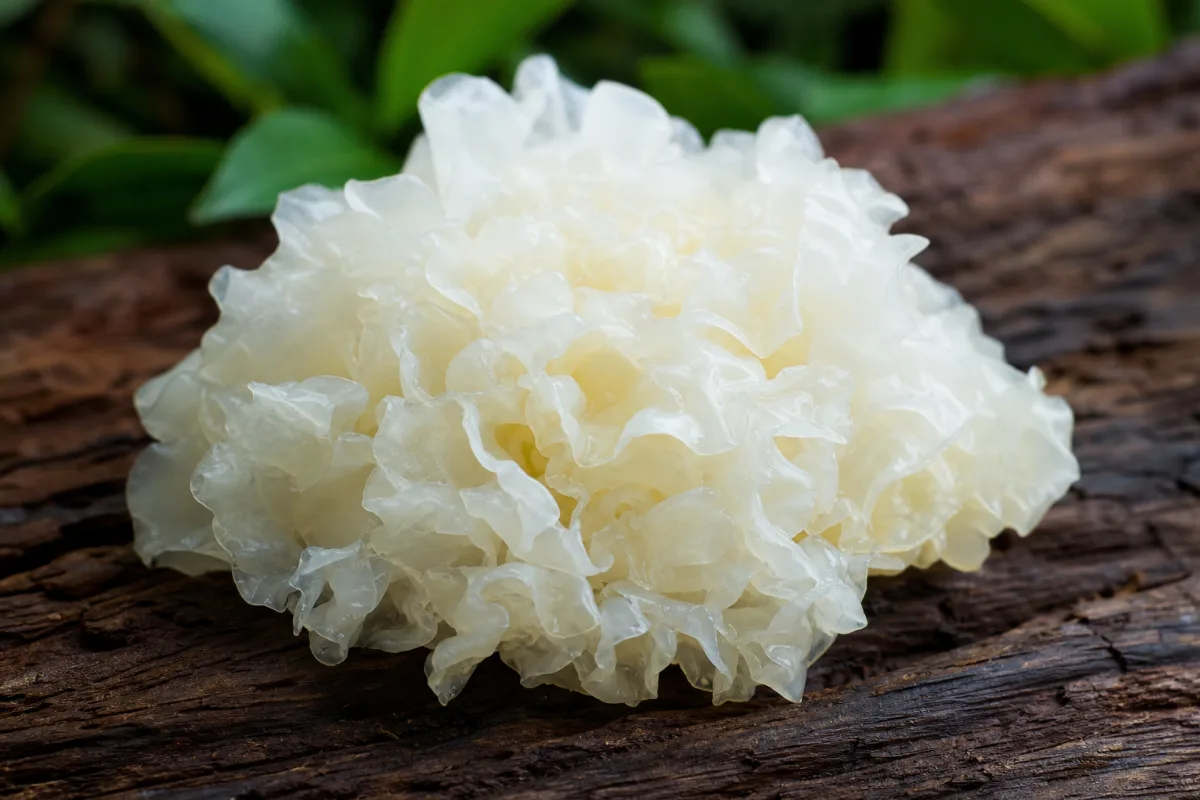
Tremella (snow fungus, Tremella fuciformis) is an edible fungus used in Asian cooking and medicine. One small memory trial exists; skin and drink claims rest mostly on lab work.
Content last updated . This page has not been medically reviewed.
Safety first. Supplements can cause side effects and interact with medicines. Read mushroom safety and interactions before you use any mushroom product.
Documented analytical data
Each group below is one study's measurement of the stated specimen or preparation. It is not a typical value for the species or product, varies between specimens, and says nothing about effects or safety. 10 values from 10 sources.
Ma S et al. Dietary exposure and risk assessment for L-ergothioneine in China. Foods 2026, 15(5):822. doi 10.3390/foo... (1 value)
Source: Ma S et al. Dietary exposure and risk assessment for L-ergothioneine in China. Foods 2026, 15(5):822. doi 10.3390/foods15050822. https://pmc.ncbi.nlm.nih.gov/articles/PMC12985124/ (open access, CC BY). Laboratory: Authors' laboratory (see source). Method: As compiled by the authors from earlier studies. Date: 2026 paper.
| Specimen or preparation | Analyte | Value | What it is | Sample size and scope |
|---|---|---|---|---|
| Cyclocybe aegerita, Hericium erinaceus and Tremella fuciformis (range given for the group) | L-Ergothioneine (high end of range) | 8.36 mg per kg wet weight (fresh weight) | maximum (reported) | not stated. range for three low-ergothioneine mushroom species, not tremella alone |
Ma S et al. Dietary exposure and risk assessment for L-ergothioneine in China. Foods 2026, 15(5):822. doi 10.3390/foo... (1 value)
Source: Ma S et al. Dietary exposure and risk assessment for L-ergothioneine in China. Foods 2026, 15(5):822. doi 10.3390/foods15050822. https://pmc.ncbi.nlm.nih.gov/articles/PMC12985124/ (open access, CC BY). Laboratory: Authors' laboratory (see source). Method: As compiled by the authors from earlier studies. Date: 2026 paper.
| Specimen or preparation | Analyte | Value | What it is | Sample size and scope |
|---|---|---|---|---|
| Cyclocybe aegerita, Hericium erinaceus and Tremella fuciformis (range given for the group) | L-Ergothioneine (low end of range) | 3.5 mg per kg wet weight (fresh weight) | minimum (reported) | not stated. range for three low-ergothioneine mushroom species, not tremella alone |
Zhang Y et al. Effect of ultrafine grinding on the physicochemical properties of Tremella fuciformis powder and its a... (1 value)
Source: Zhang Y et al. Effect of ultrafine grinding on the physicochemical properties of Tremella fuciformis powder and its aqueous extracts. Foods 2026, 15(5):877. doi 10.3390/foods15050877. https://pmc.ncbi.nlm.nih.gov/articles/PMC12984730/ (open access, CC BY). Laboratory: Authors' laboratory (see source). Method: Total sugar assay. Date: 2026 paper.
| Specimen or preparation | Analyte | Value | What it is | Sample size and scope |
|---|---|---|---|---|
| Dried T. fuciformis slices (commercial, Fujian, China), powdered | Total sugar in extract (high end of range) | 79.41 percent of extract (aqueous extracts, dry) | maximum (reported) | not stated. range across grinding and extraction methods |
Zhang Y et al. Effect of ultrafine grinding on the physicochemical properties of Tremella fuciformis powder and its a... (1 value)
Source: Zhang Y et al. Effect of ultrafine grinding on the physicochemical properties of Tremella fuciformis powder and its aqueous extracts. Foods 2026, 15(5):877. doi 10.3390/foods15050877. https://pmc.ncbi.nlm.nih.gov/articles/PMC12984730/ (open access, CC BY). Laboratory: Authors' laboratory (see source). Method: Total sugar assay (method detail not read). Date: 2026 paper.
| Specimen or preparation | Analyte | Value | What it is | Sample size and scope |
|---|---|---|---|---|
| Dried T. fuciformis slices (commercial, Fujian, China), powdered | Total sugar in extract (low end of range) | 68.39 percent of extract (aqueous extracts, dry) | minimum (reported) | not stated. range across grinding and extraction methods |
Zhang Y et al. Effect of ultrafine grinding on the physicochemical properties of Tremella fuciformis powder and its a... (1 value)
Source: Zhang Y et al. Effect of ultrafine grinding on the physicochemical properties of Tremella fuciformis powder and its aqueous extracts. Foods 2026, 15(5):877. doi 10.3390/foods15050877. https://pmc.ncbi.nlm.nih.gov/articles/PMC12984730/ (open access, CC BY). Laboratory: Authors' laboratory (see source). Method: Water-holding assay on powder. Date: 2026 paper.
| Specimen or preparation | Analyte | Value | What it is | Sample size and scope |
|---|---|---|---|---|
| Dried T. fuciformis slices (commercial, Fujian, China), powdered | Water-holding capacity | 19.69 g water per g (dry powder, conventional grinding) | mean (SD 0.64) (reported) | 3. one commercial batch |
Zhang Y et al. Effect of ultrafine grinding on the physicochemical properties of Tremella fuciformis powder and its a... (1 value)
Source: Zhang Y et al. Effect of ultrafine grinding on the physicochemical properties of Tremella fuciformis powder and its aqueous extracts. Foods 2026, 15(5):877. doi 10.3390/foods15050877. https://pmc.ncbi.nlm.nih.gov/articles/PMC12984730/ (open access, CC BY). Laboratory: Authors' laboratory (see source). Method: Water-holding assay on powder. Date: 2026 paper.
| Specimen or preparation | Analyte | Value | What it is | Sample size and scope |
|---|---|---|---|---|
| Dried T. fuciformis slices (commercial, Fujian, China), powdered | Water-holding capacity | 18.08 g water per g (dry powder, ultrafine grinding) | mean (SD 0.62) (reported) | 3. one commercial batch |
Zhang Y et al. Effect of ultrafine grinding on the physicochemical properties of Tremella fuciformis powder and its a... (1 value)
Source: Zhang Y et al. Effect of ultrafine grinding on the physicochemical properties of Tremella fuciformis powder and its aqueous extracts. Foods 2026, 15(5):877. doi 10.3390/foods15050877. https://pmc.ncbi.nlm.nih.gov/articles/PMC12984730/ (open access, CC BY). Laboratory: Authors' laboratory (see source). Method: Water solubility index assay. Date: 2026 paper.
| Specimen or preparation | Analyte | Value | What it is | Sample size and scope |
|---|---|---|---|---|
| Dried T. fuciformis slices (commercial, Fujian, China), powdered | Water solubility index | 6.67 percent (dry powder, conventional grinding) | mean (SD 2.31) (reported) | 3. one commercial batch |
Zhang Y et al. Effect of ultrafine grinding on the physicochemical properties of Tremella fuciformis powder and its a... (1 value)
Source: Zhang Y et al. Effect of ultrafine grinding on the physicochemical properties of Tremella fuciformis powder and its aqueous extracts. Foods 2026, 15(5):877. doi 10.3390/foods15050877. https://pmc.ncbi.nlm.nih.gov/articles/PMC12984730/ (open access, CC BY). Laboratory: Authors' laboratory (see source). Method: Water solubility index assay. Date: 2026 paper.
| Specimen or preparation | Analyte | Value | What it is | Sample size and scope |
|---|---|---|---|---|
| Dried T. fuciformis slices (commercial, Fujian, China), powdered | Water solubility index | 29.33 percent (dry powder, ultrafine grinding) | mean (SD 4.16) (reported) | 3. one commercial batch |
Zhang Y et al. Effect of ultrafine grinding on the physicochemical properties of Tremella fuciformis powder and its a... (1 value)
Source: Zhang Y et al. Effect of ultrafine grinding on the physicochemical properties of Tremella fuciformis powder and its aqueous extracts. Foods 2026, 15(5):877. doi 10.3390/foods15050877. https://pmc.ncbi.nlm.nih.gov/articles/PMC12984730/ (open access, CC BY). Laboratory: Authors' laboratory (see source). Method: Aqueous extraction. Date: 2026 paper.
| Specimen or preparation | Analyte | Value | What it is | Sample size and scope |
|---|---|---|---|---|
| Dried T. fuciformis slices (commercial, Fujian, China), powdered | Extraction yield (high end of range) | 66.48 percent of powder (aqueous extract of ultrafine-ground powder) | maximum (reported) | not stated in abstract. range across extraction methods |
Zhang Y et al. Effect of ultrafine grinding on the physicochemical properties of Tremella fuciformis powder and its a... (1 value)
Source: Zhang Y et al. Effect of ultrafine grinding on the physicochemical properties of Tremella fuciformis powder and its aqueous extracts. Foods 2026, 15(5):877. doi 10.3390/foods15050877. https://pmc.ncbi.nlm.nih.gov/articles/PMC12984730/ (open access, CC BY). Laboratory: Authors' laboratory (see source). Method: Aqueous extraction. Date: 2026 paper.
| Specimen or preparation | Analyte | Value | What it is | Sample size and scope |
|---|---|---|---|---|
| Dried T. fuciformis slices (commercial, Fujian, China), powdered | Extraction yield (low end of range) | 60.98 percent of powder (aqueous extract of ultrafine-ground powder) | minimum (reported) | not stated in abstract. range across extraction methods (hot water, enzyme, microwave) |
What is Tremella good for?
What the body uses it for, and how strong the evidence is. A normal job in the body is not proof that extra supplements add benefit; each card says which.
Subjective memory complaints
Preliminary or mixedOne small 8-week randomized trial in 75 adults with memory complaints found tremella supplements improved questionnaire scores and some memory tests more than placebo.
Supplements: Limited: one small trial, not yet repeated.
Skin hydration, ageing and wound healing (lab work)
Lab or animal research onlyReviews and cell studies describe skin-supporting effects of tremella polysaccharides, compared with hyaluronic acid in cells. Human skin trials of eating or drinking it were not found.
Supplements: No human evidence found for oral or topical benefit.
Immune-modulating polysaccharides (lab work)
Lab or animal research onlyReviews list immune effects among the reported bioactivities of tremella polysaccharides, mostly from cell and animal studies.
Supplements: Not shown in humans in the sources read.
Antioxidant activity (lab work)
Lab or animal research onlyReviews report antioxidant activity of tremella polysaccharides in laboratory tests.
Supplements: Not shown in humans in the sources read.
Blood sugar and cholesterol (reported, unclear)
Not enough evidenceA review lists hypoglycaemic and cholesterol-lowering effects among reported bioactivities; the abstract does not separate human from animal findings.
Supplements: No verified human evidence.
As a food (nutrition)
Preliminary or mixedTremella is eaten as food in Asian cooking. It is not a notable source of ergothioneine (reported 3.5 to 8.36 mg/kg wet weight for a low-ergothioneine group); USDA has no entry for it, and we found no open measured vitamin or mineral values.
Supplements: Food role is plausible but unquantified here; no open measured nutrient values were found.
Safety information gaps
Not enough evidenceNo source we read describes medicine interactions, pregnancy, breastfeeding, child, liver or kidney safety for tremella. One trial reported adverse events similar to placebo over 8 weeks.
Supplements: Ask a pharmacist or clinician before concentrated products.
Connected topics
Open a group to see how each topic connects and how strong the evidence is.
Health goals (4)
- Memory SupportPreliminary or mixed
One small 8-week trial in adults with memory complaints reported benefit versus placebo; it needs repeating.
- Brain HealthPreliminary or mixed
One small 8-week trial in adults with memory complaints reported benefit versus placebo; it needs repeating.
- Healthy SkinLab or animal research only
Only laboratory and animal work; no human skin trial of eating or applying tremella was found.
- Immune SupportLab or animal research only
Reported mostly in cell and animal studies.
Body systems (4)
- Brain & FocusPreliminary or mixed
One small 8-week trial in adults with memory complaints reported benefit versus placebo; it needs repeating.
- Immune SupportLab or animal research only
Reported mostly in cell and animal studies.
- Nervous SystemPreliminary or mixed
One small 8-week trial in adults with memory complaints reported benefit versus placebo; it needs repeating.
- Skin, Hair & BeautyLab or animal research only
Only laboratory and animal work; no human skin trial of eating or applying tremella was found.
Body parts (2)
Functional actions (3)
- Immune ModulationLab or animal research only
Reported mostly in cell and animal studies.
- Anti-AgingLab or animal research only
Skin anti-ageing effects are reported in cells and animals only.
- AntioxidantLab or animal research only
Antioxidant activity is reported in laboratory tests; it does not show an effect in people.
Tremella is a food and traditional-medicine ingredient with very little human research. We found one small randomized trial in people with memory complaints, and reviews that describe skin benefits as mostly lab and animal findings. We found no source we could read that describes medicine interactions, pregnancy or child safety for it, and that is not proof that none exist. Ask a pharmacist or clinician before using concentrated products, and see how interactions are classed.
What tremella is
Tremella is Tremella fuciformis Berk., family Tremellaceae, an accepted species name in the GBIF taxonomy database.[1] It is also called snow mushroom, and a dermatology review describes it as an edible mushroom historically popular in herbal and Asian medicine and cuisine.[2] Another review calls it widely cultivated and used both as food and as a medicinal ingredient in traditional Chinese medicine.[3] Product pages may call it snow fungus or use only a common name, so check the scientific name on the label. See mushroom names.
One review of its bioactive compounds focuses on polysaccharides (large sugar-based molecules).[3] Results on an extract or isolated compound do not transfer to the whole mushroom, a drink or a skin cream.
Traditional use
Tremella has been used in Asian cooking and in traditional Chinese medicine.[2][3] The sources we read do not describe specific traditional claims in detail, so we do not list any here. Traditional use is not evidence of effect.
What research shows
| Use | What the source found | Strength of evidence | Form and population |
|---|---|---|---|
| Memory complaints | A randomized, double-blind trial gave 75 people with subjective cognitive impairment tremella at 600 or 1,200 mg a day, or placebo, for 8 weeks. The tremella groups improved more on a memory-complaint questionnaire and on some memory and executive-function tests, and adverse events were similar across groups (40.4%, 35.1% and 41.4%).[4] | Promising but limited; one small, short trial | Oral tremella product; adults with memory complaints |
| Skin (anti-aging, sun damage, wound healing) | A dermatology review says studies suggest roles in skin aging, photoprotection, wound healing and barrier protection, but most were limited to cell and animal models, and clinical research is needed.[2] | Preclinical (cells or animals) | Extracts and polysaccharides, mainly applied to cells |
| Other effects (immune, blood sugar, cholesterol, tumors) | A review lists these among reported effects of tremella polysaccharides.[3] The abstract does not say which were human findings. | Unclear; do not read as human benefit | Polysaccharide extracts |
| Skin benefit from eating it or drinking it | Proper evidence not found. We searched PubMed for Tremella fuciformis with skin, human and clinical terms and found reviews and cell studies only. | No good evidence of benefit | Food and drinks |
Forms and why they matter
Whole dried or fresh tremella as a food, a polysaccharide extract in a capsule, a skin-care ingredient and a ready-made drink are different products. The memory trial used a tremella supplement at stated amounts,[4] not a cup of tremella soup. Labels differ between products, so check what is actually in one; see skin health and mushrooms for skin claims and mushroom food portions versus supplement amounts.
Lab data and chemistry
Tremella is mostly water-loving sugar chains. The laboratory papers we read describe its main "active" material as a family of polysaccharides (long sugar-based molecules), not a single compound. Wikidata (with the LOTUS natural-products imports) lists only one compound for Tremella fuciformis, gentisic acid, so that database is not a useful guide here; the rest of this section comes from papers we read. A presence entry means "reported in at least one study", not "present in every product".
What the laboratory literature reports
| Compound or group | Class | Where in the mushroom / form | Identity | Source |
|---|---|---|---|---|
| Acidic heteropolysaccharide of the glucuronoxylomannan (GXM) type | Polysaccharide | Fruiting body; also spores, mycelium and fermentation broth. A mannan backbone with side chains of glucuronic acid, xylose, fucose and others; weight is reported around 1.3 to 1.8 million daltons and depends on how it was extracted | No single ID (a family of molecules) | [6] |
| Uronic acids (glucuronic acid) | Sugar acid, part of the polysaccharide | Hot-water, enzyme and microwave extracts of dried powder; uronic acid was measured and stayed fairly stable between treatments | No ID looked up | [7] |
| Total sugar (polysaccharide fraction) | Carbohydrate | Extracts of dried powder: 68.39 to 79.41 percent total sugar | Not a single compound | [7] |
| Protein | Protein | Extracts of dried powder; protein rose when the powder was ground finer | Not a single compound | [7] |
| L-Ergothioneine | Dietary antioxidant amino acid | Fruiting body, low compared with other mushrooms (see below) | No ID looked up | [8] |
| "Fungal-derived hyaluronic acid" | Reported as a hyaluronic-acid-type polysaccharide | One in-vitro study describes a hyaluronic acid extracted from tremella. We did not verify this chemistry independently, and hyaluronic acid from other sources is a different product | No ID looked up | [9] |
| Gentisic acid | Phenolic acid | Reported in Tremella fuciformis (the only compound Wikidata lists for the species) | Wikidata Q417831; ChEBI 17189 | [10] |
Measured values
No USDA FoodData Central entry for tremella exists, so there are no standard nutrition-label numbers here. The numbers below are from open papers.
| Measure | Value | Basis | Sample | Source |
|---|---|---|---|---|
| Water-holding capacity | 19.69 g of water per g (conventional grinding); 18.08 g per g (ultrafine grinding) | Dried, powdered T. fuciformis slices; mean of n = 3 | Commercial dried slices from Fujian, China | [7] |
| Water solubility index | 6.67 percent (conventional); 29.33 percent (ultrafine) | Same powders; n = 3 | Same | [7] |
| Extraction yield | 60.98 to 66.48 percent (ultrafine-ground powder) | Aqueous extracts; method-dependent | Same | [7] |
| Total sugar in the extract | 68.39 to 79.41 percent | Aqueous extracts of the dried powder | Same | [7] |
| L-Ergothioneine | 3.5 to 8.36 mg per kg (wet weight) | Reported as the range for three low-ergothioneine species: Cyclocybe aegerita, Hericium erinaceus and T. fuciformis | Literature range summarised in a Chinese dietary exposure paper | [8] |
| Beta-glucan, triterpenes, vitamin D2, B vitamins, minerals, heavy metals | No open measured value found |
Hyaluronic acid, moisture and skin: what the lab work shows
Tremella polysaccharides are often described as "plant hyaluronic acid" in skin-care marketing. Here is what we read:
- A cell study compared a commercial tremella extract with hyaluronic acid on human skin fibroblasts (cells from the deeper skin layer). Neither affected cell survival. The extract increased DNA synthesis; collagen synthesis rose with hyaluronic acid and with the higher extract level (500 micrograms per mL). The authors say the mechanisms differ and that more work is needed.[5]
- A separate cell-model study of a "fungal-derived hyaluronic acid" from tremella reports it was stable in simulated digestion and crossed a gut-cell layer in vitro.[9] That is a laboratory model, not a human result.
- A 2026 review of edible fungi and skin says oral hyaluronan has human trials that measure skin hydration and wrinkles, but tremella polysaccharides do not: the evidence is mainly animal, gut-microbiota-linked, or topical.[11] We found no human trial of eating tremella for skin.
What the numbers do and do not mean
- Polysaccharide structure and amounts vary with strain, growing substrate, drying and extraction, so a figure from one study is not a label value for any product.
- A lab measurement or a cell result does not show a health effect. Skin findings here are cells, animals or topical use; the only human trial we found is the memory study above.
- Tremella is a poor source of ergothioneine compared with many other edible mushrooms, so it is not the one to pick for that compound.[8]
- Water-holding figures describe a dry powder soaking up water in a lab dish, not what happens in skin after eating it.
- Tremella is widely grown as a fruiting body, but extracts can also come from spores, mycelium or fermentation broth;[6] ask which on the label. See fruiting body versus mycelium.
Frequently asked questions
What is tremella?
It is the edible fungus Tremella fuciformis, also called snow mushroom, used in Asian cuisine and traditional medicine.[2]
Does tremella help skin?
Reviews describe promising effects on skin cells and in animals, but say clinical research is needed.[2] We found no human trial of eating or drinking it for skin.
Does tremella help memory?
One 8-week trial of 75 adults with memory complaints reported improvements versus placebo.[4] That is a single small study, so the evidence is limited.
Is tremella really a mushroom?
It is an edible fungus that reviews call a mushroom.[3] For how mushroom drinks work in general, see mushroom coffee.
Is tremella safe in pregnancy or with medicines?
Proper evidence not found in the sources we read. Ask a pharmacist or clinician.
More details: evidence, limits and cautions
The details behind this page: cautions, limits of the evidence and where sources disagree. Open any note to read it.
Safety: who should ask first
- Evidence is limited. The one trial reported similar rates of adverse events in tremella and placebo groups over 8 weeks,[4] which says little about long-term or high-amount use.
- Medicines, pregnancy, breastfeeding, children, liver or kidney disease, surgery and allergy: Proper evidence not found in the sources we read (PubMed searches on Tremella fuciformis, safety and adverse events, plus the reviews above). Lack of evidence is not proof of safety. See pregnancy and breastfeeding and mushrooms before surgery.
- Quality: see what a label can tell you and supplement quality testing.
A clinician or pharmacist decides what is right for a person. The amounts above are what the trial used, not advice.
References
- GBIF Secretariat, GBIF Backbone Taxonomy record for Tremella fuciformis Berk. (accepted name, family Tremellaceae). Read 2026-10-23.
- Mineroff J, Jagdeo J, The potential cutaneous benefits of Tremella fuciformis. Arch Dermatol Res 2023. Read 2026-10-23.
- Wu YJ et al., Structure, bioactivities and applications of the polysaccharides from Tremella fuciformis mushroom: a review. Int J Biol Macromol 2019. Read 2026-10-23.
- Ban S et al., Efficacy and safety of Tremella fuciformis in individuals with subjective cognitive impairment: a randomized controlled trial. J Med Food 2018. Read 2026-10-23.
- Wolosik K et al., Tremella fuciformis extract evokes similar effect as hyaluronic acid on wound healing but through different mechanisms in human dermal fibroblasts. Molecules 2026, doi 10.3390/molecules31132354. Open access, read in full 2026-10-24.
- Li S et al., Recent advances in polysaccharides from Tremella fuciformis: isolation, structures, bioactivities and application. Front Nutr 2025, doi 10.3389/fnut.2025.1663327. Open access, read 2026-10-24.
- Zhang Y et al., Effect of ultrafine grinding on the physicochemical properties of Tremella fuciformis powder and its aqueous extracts. Foods 2026, doi 10.3390/foods15050877. Open access, read 2026-10-24.
- Ma S et al., Dietary exposure and risk assessment for L-ergothioneine in China. Foods 2026, doi 10.3390/foods15050822. Open access, read 2026-10-24.
- Uberti F et al., Absorption, stability, and bioactivity of fungal-derived hyaluronic acid from Tremella fuciformis in a sequential in vitro multi-barrier model. Foods 2026, doi 10.3390/foods15071137. Open access, abstract and introduction read 2026-10-24.
- Wikidata, gentisic acid (Q417831) and Tremella fuciformis (Q1309195); ChEBI 17189. CC0. Read 2026-10-24.
- Wang C et al., Edible fungi and skin redox homeostasis: bioactive diversity, processing, oral exposure, and evidence gaps. Antioxidants 2026, doi 10.3390/antiox15091111. Open access, relevant passages read 2026-10-24.