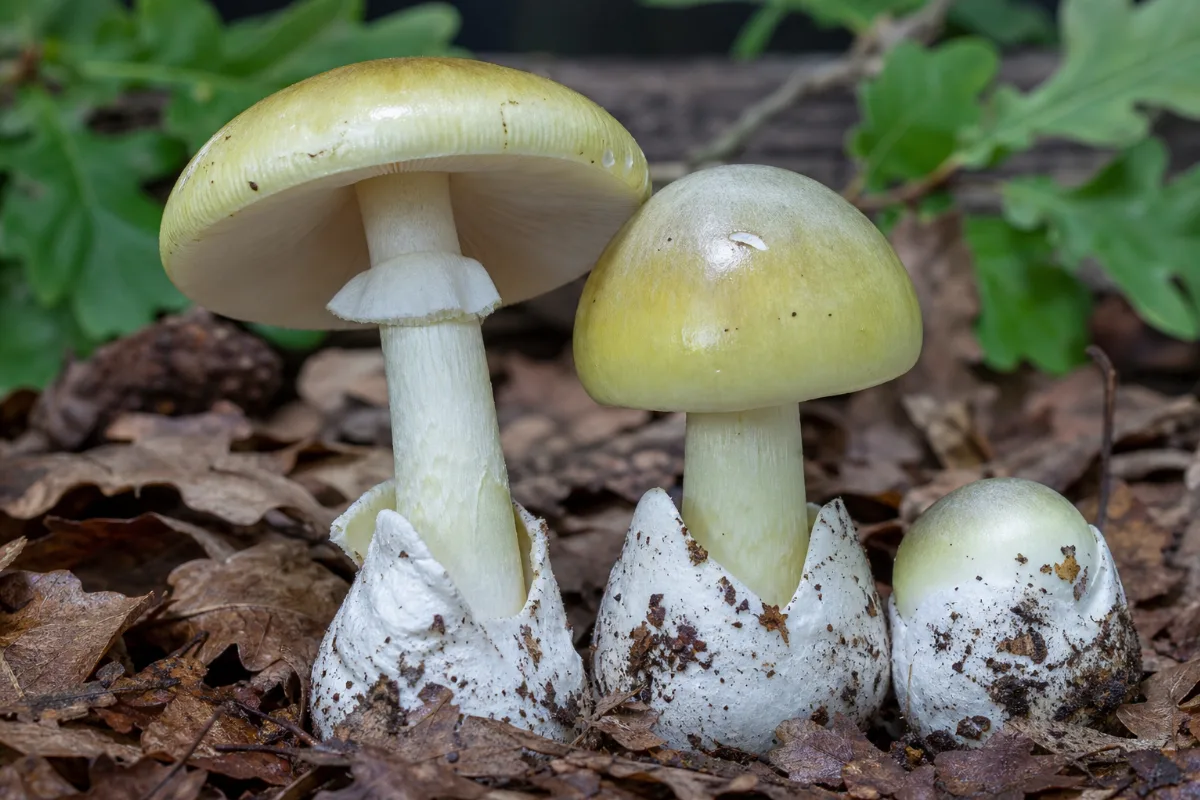
Mushrooms · Deadly poisonous mushroom
Death Cap
Amanita phalloides · also called Deathcap; Knollenblatterpilz (German); amanite phalloide (French)
The death cap (Amanita phalloides) is a deadly poisonous mushroom. Eating even a small amount can destroy the liver and kidneys and cause death, and the first symptoms can be delayed by many hours. Cooking, drying and freezing do not make it safe. Hospitals treat poisoning, but treatment does not always work. No one should eat it for any reason, and no study shows it helps health. If someone has eaten it, call a poison centre or emergency number right away.
General information, not medical advice. Last substantive update · Not medically reviewed. A named clinician has not signed off on this page. How this page is made
About Death Cap
The death cap (Amanita phalloides) is a deadly poisonous mushroom, responsible for most deaths after eating foraged mushrooms worldwide. Its toxins destroy liver cells and injure the kidneys. Symptoms start late, can seem to settle, and then liver failure follows. Reported death rates run from 4.4% to 10 to 20%, and some people need a liver transplant. No study shows any health benefit. If someone has eaten it, call a poison centre or emergency number at once.
Danger first: what it does
The death cap holds amatoxins, which block an enzyme every cell needs to make proteins. Liver cells take them up and die, and the kidneys are injured too. Reports describe liver failure, kidney failure, bleeding problems, brain swelling and multi-organ failure.
In a California outbreak in December 2016, 14 people were poisoned in about two weeks and three needed a liver transplant. In a US registry of acute liver failure, 46% (6 of 13) of those in liver failure from mushroom poisoning survived without a transplant. In Australia, 4 of 10 probable cases died in one series. Cooking, drying and freezing do not make it safe: a review reports about 5% of the toxin left after 6 hours of boiling, and a fatal poisoning after eating mushrooms frozen for 7 to 8 months.
Why it is easy to miss: delayed symptoms
A review describes four phases. After eating there is a quiet period of 6 to 18 hours. Stomach pain, vomiting and watery diarrhoea then start, 6 to 24 hours after eating, and look like a stomach bug. At 36 to 48 hours the person can seem better while liver tests are getting worse. Liver failure then follows within 1 to 3 weeks.
In a Prague series, stomach symptoms began on average 12.5 hours after eating and patients reached hospital on average 26 hours after eating. A Czech study of 45 proven poisonings found later arrival went with worse liver and kidney tests, and that five people who arrived early and had no antidotes did not develop liver injury. Waiting to see what happens is not safe.
What hospitals do (this is medicine, not self-care)
There is no specific antidote. Hospitals give fluids and salts, activated charcoal, and drugs such as N-acetylcysteine, penicillin and silibinin (a purified milk thistle compound given into a vein). Some people have blood filtering, and those in liver failure with a poor outlook may need a liver transplant.
The evidence is thin. A review of 1,119 published cases found 83% survival with charcoal versus 75% without, but case reports are open to bias. In the Czech Republic there was no difference between N-acetylcysteine and silibinin in eight patients. In one Australian series 4 of 10 probable cases died even though silibinin was used. After transplant, 38.1% of 21 patients in Warsaw died within 90 days. Five children in Germany all survived, two after a transplant. No home treatment is safe or known to work.
Accidental poisoning
Reports describe people eating the death cap by mistake. A 2025 review says some poisonous mushrooms cannot be told from edible ones by shape. This page does not teach identification, and a photo, a name or an app is never proof that a mushroom is safe.
Poisonings have risen in places. A German hospital saw cases nearly double over nine years, and the authors suggest climate change may play a part. Czech authors stress that safety information must also reach people new to a country.
The only research that finds a use for the toxin
Alpha-amanitin kills cells, so researchers are testing it as a payload on antibody-drug conjugates, which aim it at cancer cells. In mice with human pancreatic tumours, an antibody joined to alpha-amanitin caused complete regression in 9 of 10 animals at the higher doses. An amanitin-based drug for myeloma was well tolerated in monkeys, and that study is linked to the company developing it.
A 2024 review says clinical studies of effect are lacking. This is a drug being built from a purified toxin. It says nothing in favour of the mushroom, and it does not mean any mushroom product can treat cancer.
At a glance
Traditional uses history, not proof
- No food or medicinal tradition for the death cap is described in the sources we read.
- A 2024 review says its poisonous nature has probably been known since Roman times, and that the death of the emperor Claudius in AD 53 is suspected to have involved it. That is a suspicion, not a certainty (Kayes 2024).
- Medical papers describe it as the cause of most deaths after eating foraged mushrooms worldwide (Vo 2017).
Studied for research
- Eating it for food or health: no benefit; every report describes harm
- Cancer-drug research with its purified toxin: laboratory and animal work only, very low evidence
- Hospital treatment of poisoning: clinical medicine given by doctors, low evidence, not a use of the mushroom
Main compounds
- Alpha-amanitin and beta-amanitin (amatoxins; block an enzyme cells need to make proteins; they poison the liver and kidneys)
- Phalloidin (a phallotoxin; the review says it has minimal effect when eaten)
Common forms
- Wild mushroom, eaten by mistake in the reports we read
- No safe preparation exists: cooking, drying and freezing do not remove the toxin
Research links: Poison Control (US): get help online or call 1-800-222-1222 · NHS (UK): what to do in poisoning · NSW Poisons Information Centre (Australia): 13 11 26 · Amanita phalloides liver failure: mechanisms and management, 2024 review (open access) · Amanita phalloides poisonings, Northern California, 2016 (CDC MMWR abstract) · Trends in death cap poisonings in the Czech Republic, 2026 (abstract) · Research Library · Genes & Biomarkers Library
What it is and its history
- Accepted scientific name
- Amanita phalloides
- Naming authority
- (Vaill. ex Fr.) Link
- Synonyms
- Agaricus phalloides Vaill. ex Fr.; Agaricus phalloides Vaill.; Agaricus virosus Vittad.; Agaricus insidiosus Letell.; Amanita insidiosa (Letell.) Lucand; Amanita phalloides f. viridis (Pers.) E.-J.Gilbert
- Common names
- Death cap (English); Deathcap (English); Knollenblatterpilz (German); Amanite phalloide (French); Oronge verte (French)
- Family or group
- Amanitaceae, a family of fungi (this is a mushroom, not a plant). The part concerned is the fruiting body, which is the mushroom.
- Classification
- Fungi > Basidiomycota > Agaricomycetes > Agaricales > Amanitaceae > Amanita > Amanita phalloides
- Native range
- A 2024 review says it is native to Europe and has spread widely, causing liver toxicity in many parts of the world. Australian reports describe it as widespread and spreading in the south-east. Where it grows in your area was not checked.
- Habitat
- The 2024 review calls it an ectomycorrhizal fungus (it lives with the roots of trees). Local growth patterns were not checked.
- What it looks like
- Part used: The fruiting body (the mushroom). This page does not describe how to recognise the mushroom, on purpose. A photo or a name is never proof that a mushroom is safe.
- Look-alikes and adulterants
- Name: Edible mushrooms; Note: A 2025 review says some poisonous mushrooms cannot be told from edible species by shape. This page does not name or compare look-alikes and does not offer help telling mushrooms apart.; Name: Other amatoxin mushrooms; Note: Other mushrooms hold the same type of liver poison. One case report here (Ward 2013) concerns Amanita ocreata, not the death cap.
- Sustainability and conservation
- Not checked.
Traditional use and history history, not clinical proof
| Tradition or era | Documented use | Source |
|---|---|---|
| Ancient Rome | A 2024 review says the poisonous nature of the mushroom has probably been known since the Roman Empire, and that the death of the emperor Claudius in AD 53 is suspected to have involved it. This is a suspicion, not a certainty. | Kayes & Ho 2024 |
| Modern medicine | Described in medical literature as the cause of most deaths from foraged mushrooms worldwide, with outbreaks in North America, Europe and Australia. | Vo et al. 2017 |
Traditional use shows how it was used. It does not show that it works or is safe today.
What is inside, and how it may work
What it contains and how those compounds act in cells and animals. Laboratory and animal mechanisms are not proven effects in people.
Main compounds
| Compound | Family | Where it is concentrated | Activity studied | Level of evidence |
|---|---|---|---|---|
| Alpha-amanitin PubChem 9543442 | bicyclic octapeptide (amatoxin) | Not checked here | Blocks RNA polymerase II, the enzyme that copies genes, so cells stop making proteins and die. Taken up by liver cells through OATP transporters. About 60% of absorbed alpha-amanitin is reported to be excreted in bile and returned to the liver (review). 22 4 9 | Review |
| Beta-amanitin PubChem 76959217 | bicyclic octapeptide (amatoxin) | Not checked here | A second main amatoxin with the same type of action. The review lists nine amatoxins in all. 22 4 | Review |
| Phalloidin (a phallotoxin) PubChem 441542 | bicyclic heptapeptide (phallotoxin) | Not checked here | Fast-acting toxin when injected, but the review says it has minimal toxic effects when eaten, so it is not the main cause of poisoning by mouth. 22 4 | Review |
Mechanisms, receptors and pathways
| Target or pathway | Gene or receptor | What was found | Level |
|---|---|---|---|
| RNA polymerase II | RNA polymerase II | Alpha-amanitin blocks the enzyme and triggers liver cell death. This is the accepted main mechanism of liver damage (review). 4 9 | Review |
| Liver uptake transporters | OATP transporters (OATP1B3) | Amanitins enter liver cells through OATP transporters. Lab work with human liver cells showed benzylpenicillin limited toxin harm by blocking one of them (OATP1B3). This is lab work cited in a review. 4 | Laboratory research |
| Kidney tubules | n/a | After filtration, amanitins are reabsorbed in kidney tubules, causing tubule injury (review). 4 | Review |
Absorption, metabolism and elimination
- Absorption
- Amatoxins are absorbed from the gut; a latent period of 6 to 18 hours then stomach symptoms (2024 review).
- Distribution
- Taken up mainly by the liver; also reach the kidneys.
- Metabolism
- Not established in the sources we read.
- Elimination
- A review says about 60% of absorbed alpha-amanitin is excreted in bile and returned to the liver, and that amatoxins are found in urine up to 4 days after eating.
- Bioavailability
- Not established.
Isolated compounds versus whole extracts
The mushroom and the purified toxin are different things. Poisoning data are about the mushroom. The cancer research uses purified alpha-amanitin or a derivative attached to an antibody, which is a drug under development and not the mushroom. Nothing about one can be assumed for the other.
Nutritional composition
The death cap is not a food or a nutrient source. It is poisonous.
1 low certainty1 very low certainty1 evidence against
What was looked at
The 3 benefits and uses checked for Death Cap, each with how strong the evidence is. Tap one to open it.
What is Death Cap good for?
The uses people ask about and what the evidence says about each. None is a reason to go near this mushroom. Read every row together with the Safety tab: it is deadly poisonous.
Benefits, one by one
Each card is a research question, not a promise. Tap a goal to filter. Open a card to see the studies, doses and limits.
Cancer-drug research using the toxin (laboratory and animal work only)
Very low certaintyScientists are testing the mushroom's main poison, alpha-amanitin, as a warhead attached to cancer-seeking antibodies. This is early work in cells, mice and monkeys. No one is helped by eating the mushroom, and no human benefit has been shown.
3 studiesNot covered. The research uses purified toxin chemically attached to …
Studies, doses and limits
Results
Mouse study (2012): an antibody joined to alpha-amanitin cut growth of five human cancer cell lines, and in mice with human pancreatic tumours two higher doses caused complete tumour regression in 9 of 10 animals. A 2021 study of an amanitin-based drug against myeloma cells (HDP-101) caused cell death in the lab, tumour regression in mice, and was well tolerated in monkeys. The authors of that paper note alpha-amanitin has no clinical use by itself because of its liver toxicity.
Effect sizes as reported
Mouse model only: complete regression in 9 of 10 mice at the higher doses. No human effect size exists.
Why this rating
Cell and animal studies only, no clinical trial results in the sources we read. The 2021 paper is industry-linked (authors from the company developing the drug). Results in mice often do not carry over to people.
Form and dose studied
Not covered. The research uses purified toxin chemically attached to an antibody inside a drug under development, which is nothing like the mushroom. No amounts are given for any use of the mushroom.
Who was studied
Cancer cell lines, mice carrying human tumours and monkeys; no patients.
Limits
Early research; the reviewers note the toxicology of alpha-amanitin is not fully understood. Nothing here suggests the mushroom, a mushroom extract or any supplement can treat cancer.
Why researchers looked
Alpha-amanitin blocks an enzyme every cell needs to make proteins, so it kills cells, including resting ones. Researchers want to deliver it only to tumour cells by joining it to an antibody, a type of drug called an antibody-drug conjugate.
Traditional use
No traditional medicinal use of the death cap was found in the sources we read.
Proposed mechanism Laboratory research
Alpha-amanitin blocks RNA polymerase II, the enzyme that copies genes into messenger RNA. An antibody attached to the toxin carries it into the targeted cancer cells (lab and animal pharmacology).
A proposed mechanism does not show that the effect happens in people.
This is a deadly poisonous mushroom. Eating it can destroy the liver and kidneys and cause death, and the first symptoms can be delayed. See the Safety tab first. If someone has eaten it, call a poison centre or emergency number right away.
Eating it, or using it as a food, tonic or supplement
Evidence againstThere is no safe or healthy way to eat the death cap. Every report we read describes harm. Medical papers describe accidental poisonings, liver transplants and deaths, not benefits.
7 studiesNone. No form, preparation or amount of the death cap is safe, and th…
Studies, doses and limits
What the trials found
Case series from California (14 people), Australia (7 and 12 people), the US registry (18 people), Czech Republic (45 proven cases), Germany and Poland all describe poisoning. In California in 2016, 3 of 14 poisoned people needed a liver transplant. In one Australian series 4 of 10 probable cases died. In the Czech series 2 of 45 died. In Warsaw, 38.1% of 21 people who had a transplant for death cap poisoning died within 90 days.
Results
Harm, not benefit: stomach illness, liver and kidney injury, transplants and deaths.
Effect sizes as reported
Reported death rates differ by country and treatment setting: about 10 to 20% in a review, 4.4% in one modern Czech series, 4 of 10 in one small Australian series.
Why this rating
Every human source describes poisoning. No source describes a health benefit. The reported death rates are from observational case series, so the exact risk varies, but the direction is not in doubt.
Who was studied
Adults and children have been poisoned; a German series describes five children.
Limits
Case series cannot give an exact risk for any one person. Content of the poison varies from one mushroom to the next.
Why researchers looked
It is studied only because it poisons people, often by accident. The death cap is described as responsible for most deaths after eating foraged mushrooms worldwide.
Traditional use
The 2024 review says the poisonous qualities have likely been known since Roman times, and suggests (without certainty) that it was involved in the death of the emperor Claudius in AD 53. No food or medicinal tradition is described.
Proposed mechanism Review
Amatoxins in the mushroom are taken up by liver cells, block RNA polymerase II and cause liver cell death. They are not destroyed by cooking (review, full text read).
A proposed mechanism does not show that the effect happens in people.
This is a deadly poisonous mushroom. Eating it can destroy the liver and kidneys and cause death, and the first symptoms can be delayed. See the Safety tab first. If someone has eaten it, call a poison centre or emergency number right away.
Hospital treatment of death cap poisoning (silibinin, N-acetylcysteine, charcoal, transplant)
Low certaintyHospitals treat poisoning with fluids, activated charcoal, drugs such as silibinin and N-acetylcysteine, filtering of the blood, and liver transplant for the sickest people. The evidence is from small, non-randomised studies. Getting help early appears to matter, and no treatment is a guaranteed rescue.
9 studiesNot covered. These are clinician-given treatments, and this page give…
Studies, doses and limits
What the trials found
No randomised trial was found in the sources we read. A review of 1,119 published cases found 83% survival with activated charcoal versus 75% without (odds ratio 1.89, 95% CI 1.40 to 2.56). In a US registry of 18 people, N-acetylcysteine was used in nearly all, and no difference between treatments was found in so few patients. In the Czech Republic, 8 patients given one antidote recovered, with no difference between N-acetylcysteine and silibinin, and 5 admitted early without antidotes did not develop liver injury. In Australia, 4 of 10 probable cases died despite silibinin. Five children in Germany all survived, 2 after liver transplant. In Prague, all 16 patients who did not meet transplant criteria survived with intensive care, while 6 of 7 who met them were transplanted. After transplant, 38.1% of 21 patients in Warsaw died within 90 days.
Results
Survival is better when poisoning is recognised early and care is given in a hospital that can offer intensive care and, if needed, transplant. Which single drug helps is not established.
Effect sizes as reported
Charcoal: survival 83% vs 75%, OR 1.89 (95% CI 1.40 to 2.56), from case reports pooled across 133 publications (publication bias likely). Other studies give counts only.
Why this rating
Evidence comes from case reports and small observational series, with sicker patients likely to get more treatments. There are no randomised trials, so we cannot say which treatment works. The charcoal result is from pooled case reports with possible publication bias.
Form and dose studied
Not covered. These are clinician-given treatments, and this page gives no amounts. Do not try any of them yourself.
Who was studied
Adults and some children, in hospital series from Europe, Australia and the US. One case-report paper (Ward 2013) describes two people poisoned by a related amatoxin species, not the death cap.
Limits
Mostly retrospective small series from single centres. Treatments are given together, so one cannot tell which helped. Silibinin supply was a problem in one Australian series.
Why researchers looked
There is no specific antidote for the toxin, so doctors have tried several treatments. Treatments are studied because poisoned people are at risk of liver failure and death.
Traditional use
Silibinin comes from milk thistle seed; here it is a hospital drug given into a vein, not a supplement or herbal tea.
Proposed mechanism Preliminary mechanism
Charcoal may reduce toxin recycling from the gut and bile. Silibinin and penicillin are thought to limit entry of the toxin into liver cells, partly by blocking liver transporters (lab work cited in a review). N-acetylcysteine replaces the liver's depleted antioxidant stores. Transplant replaces the failing liver.
A proposed mechanism does not show that the effect happens in people.
This is a deadly poisonous mushroom. Eating it can destroy the liver and kidneys and cause death, and the first symptoms can be delayed. See the Safety tab first. If someone has eaten it, call a poison centre or emergency number right away. Never try to treat poisoning at home.
Connections to the rest of health
How Death Cap connects to the rest of our health knowledge graph. Every link says what kind of connection it is. A safety link (for example to the liver) is a warning, not a benefit. A study that merely mentions a topic never creates a benefit link.
Explore every connection: goals, body systems, organs, symptoms, genes
B. Body systems
| Connected to | Kind of connection | Evidence status | Context | Studies |
|---|---|---|---|---|
| Liver | Adverse effect or risk | High certainty | Acute liver failure and transplant after eating it; well documented in case series and reviews. Preparation or compound: Mushroom (amatoxins) |
16 3 4 |
| Digestive system | Adverse effect or risk | High certainty | Delayed vomiting and diarrhoea, leading to dehydration. Preparation or compound: Mushroom (amatoxins) |
16 4 |
| Kidneys | Adverse effect or risk | Moderate certainty | Kidney injury and failure reported with severe poisoning. Preparation or compound: Mushroom (amatoxins) |
4 12 |
| Liver Detox | Biological association | Very low certainty | Studied for: Cancer-drug research using the toxin (laboratory and animal work only) Studied for: Eating it, or using it as a food, tonic or supplement | 9 8 1 16 13 3 4 14 10 6 15 11 2 5 17 |
| Digestive System | Biological association | Evidence against | Studied for: Eating it, or using it as a food, tonic or supplement Studied for: Hospital treatment of death cap poisoning (silibinin, N-acetylcysteine, charcoal, transplant) | 16 13 3 4 14 10 6 15 11 2 5 17 |
J. Genes, receptors and enzymes
| Connected to | Kind of connection | Evidence status | Context | Studies |
|---|---|---|---|---|
| RNA polymerase II | Preliminary mechanism | Review | Main target of alpha-amanitin. | 4 |
K. Biological pathways
| Connected to | Kind of connection | Evidence status | Context | Studies |
|---|---|---|---|---|
| OATP1B3 | Preliminary mechanism | In vitro | Liver uptake transporter for amanitin (lab). | 4 |
L. Active compounds
| Connected to | Kind of connection | Evidence status | Context | Studies |
|---|---|---|---|---|
| Alpha-amanitin | Biological association | Review | Blocks RNA polymerase II, the enzyme that copies genes, so cells stop making proteins and die. Taken up by liver cells through OATP transporters. About 60% of absorbed alpha-amanitin is reported to be excreted in bile and returned to the liver (review). Preparation or compound: Not checked here |
22 4 9 |
| Beta-amanitin | Biological association | Review | A second main amatoxin with the same type of action. The review lists nine amatoxins in all. Preparation or compound: Not checked here |
22 4 |
| Phalloidin (a phallotoxin) | Biological association | Review | Fast-acting toxin when injected, but the review says it has minimal toxic effects when eaten, so it is not the main cause of poisoning by mouth. Preparation or compound: Not checked here |
22 4 |
Each connection is stored with the ingredient, the connected record, the kind of connection, the evidence status, the supporting studies, the preparation or compound involved, and a review date (last reviewed October 25, 2026).
Evidence at a glance: what the research found for 3 outcomes
Each outcome below is one thing researchers measured. Certainty is how far the evidence can be trusted, not how well it works. The full studies are on the next tab.
The evidence
The research centre for Death Cap. Every record here was checked against PubMed or the publisher's page; we never list a study we have not verified.
Evidence by outcome
Bars show how many studies we found for each outcome, not how well it works. People are added up across trials only (reviews are not added, to avoid double counting).
How we rate evidence
High certainty
Several well-run trials or reviews agree; further research is unlikely to change the picture much.
Moderate certainty
Good trials point the same way, but some doubt remains.
Low certainty
Small, short or inconsistent trials. The finding could change with better research.
Very low certainty
Very little or very weak human data. Treat as a possibility only.
Mixed findings
Trials or reviews disagree with each other.
Not enough evidence
Not enough human research to say either way.
Evidence against
Good research found no benefit, or found harm.
We take the reviewers' own risk-of-bias and GRADE statements where they exist, and otherwise judge from study size, design, consistency, directness and whether a product matches what is sold. Many publications do not make evidence high. Method note: We searched PubMed and read the abstracts of 16 papers, read the 2024 Kayes and Ho review in full text, read the US, UK and Australian poison-help pages, and checked the scientific name in GBIF and chemical identifiers in PubChem. Index Fungorum was not opened. Where a statement could not be checked it is marked as unverified in our notes.
Study library: every study we checked 22
| Study | Design | People | Product, dose, length | Result |
|---|---|---|---|---|
| Figueroa-Vazquez 2021 HDP-101, an Anti-BCMA Antibody-Drug Conjugate, Safely Delivers Amanitin to Induce Cell Death in Proliferating and Resting Multiple Myeloma Cells. Mol Cancer Ther · PMID 33298585 · DOI |
Preclinical mouse, monkey and cell line |
Myeloma cell lines, mice and cynomolgus monkeys | n/a |
An antibody conjugate carrying an amanitin derivative killed multiple myeloma cells in the lab, caused tumour regression in mice including lasting complete remissions after a single dose, and was well tolerated in monkeys. The abstract notes alpha-amanitin itself has no clinical use because of its high liver toxicity. Methods, limits and fundingOutcomes: Cell death, tumour regression, tolerability Limitations: Preclinical only. Several authors have company addresses (Heidelberg Pharma), so this is industry-linked research. Funding and conflicts: Industry-linked: authors include employees of the company developing HDP-101. Read: abstract |
| Grabhorn 2013 Successful outcome of severe Amanita phalloides poisoning in children. Pediatr Transplant · PMID 23721499 · DOI |
Case series |
5 Five children treated at one German centre, 1995 to 2010 |
n/a |
All five children survived. Two needed an emergency liver transplant and three recovered with intensive care, intravenous silibinin, N-acetylcysteine and detoxification measures. The authors say children should be considered early for emergency transplant and that recovery of liver function after day 4 is possible. Methods, limits and fundingOutcomes: Survival, need for transplant Limitations: Five children at one centre, retrospective; cannot show which treatment worked. Funding and conflicts: Not stated in the abstract. Read: abstract |
| Karvellas 2016 Acute liver injury and acute liver failure from mushroom poisoning in North America. Liver Int · PMID 26837055 · DOI |
Cohort study |
18 18 of 2,224 people in a US acute liver failure registry (1998 to 2014) had mushroom (amatoxin) liver injury or failure |
n/a |
Of 13 people with acute liver failure, 6 (46%) survived without a transplant, 5 (39%) survived with a transplant and 2 (15%) died without one. Of 5 with liver injury, 4 recovered and 1 survived after a transplant. N-acetylcysteine was used in nearly all patients. Silibinin, penicillin and nasobiliary drainage were used less often, and no treatment difference reached statistical significance (P above 0.15). The authors conclude that around half of those with liver failure may eventually need a transplant. Methods, limits and fundingOutcomes: 21-day survival with and without transplant Limitations: Only 18 patients, so no treatment can be judged from it. The registry covers only people already in acute liver failure. Funding and conflicts: Registry study; no industry funding stated in the abstract. Read: abstract |
| Kayes 2024 Amanita phalloides-Associated Liver Failure: Molecular Mechanisms and Management. Int J Mol Sci · PMID 39684738 · DOI |
Review |
Narrative review of the biology, poisoning course and treatment of the death cap | n/a |
Review (open access, full text read). Poisoning has delayed stomach symptoms that look like gastroenteritis, then severe liver damage and multi-organ failure. The main mechanism is blocking of the enzyme RNA polymerase II, causing liver cell death. Treatment is supportive care plus activated charcoal, drugs such as N-acetylcysteine and silibinin, extracorporeal methods, and liver transplant for acute liver failure with a poor outlook. The review gives the mortality rate as 10 to 20%, describes four phases of illness (a latent phase of 6 to 18 hours, a stomach phase 6 to 24 hours after eating, an apparent recovery at 36 to 48 hours while liver tests worsen, then liver failure within 1 to 3 weeks), and says about 5% of the toxin remains after 6 hours of boiling, with toxin found in mushrooms frozen for 7 to 8 months and in dried museum specimens at least 20 years old. Methods, limits and fundingOutcomes: Mechanism, course and management Limitations: Narrative review, not a systematic one; many of the treatment studies it cites are small and retrospective. Funding and conflicts: The authors report no external funding and no conflicts of interest. Read: full-text |
| Kieslichova 2018 Acute Liver Failure due to Amanita phalloides Poisoning: Therapeutic Approach and Outcome. Transplant Proc · PMID 29407307 · DOI |
Cohort study |
23 23 patients at one Prague transplant centre, 2007 to 2016 |
n/a |
Stomach symptoms began on average 12.5 hours after eating and patients reached hospital on average 26 hours after eating. Treatment included activated charcoal, fluids, intravenous N-acetylcysteine and silibinin, and 14 patients (61%) had extracorporeal elimination. Seven met criteria for urgent transplant; six had a transplant and one died while waiting. One transplant patient died 2 months later. All 16 who did not meet the criteria and had conservative treatment survived. Methods, limits and fundingOutcomes: Survival, transplant, treatments Limitations: Retrospective, one centre; no comparison group for any single treatment. Funding and conflicts: Not stated in the abstract. Read: abstract |
| Kruk 2025 Survival Analysis of Liver Transplants in Patients with Acute Liver Failure from Acetaminophen and Mushroom Toxicity. Ann Transplant · PMID 39871459 · DOI |
Cohort study |
39 39 liver transplant patients in Warsaw: 21 for death cap poisoning, 18 for acetaminophen overdose |
n/a |
Ninety-day death rate after transplant was 38.1% for death cap poisoning and 22.2% for acetaminophen, a difference that could be due to chance (P=0.284). The abstract names kidney failure needing dialysis and the amount of blood products used as factors linked to death. Methods, limits and fundingOutcomes: 90-day mortality after transplant Limitations: Retrospective, single centre, only people who had a transplant. The abstract calls the toxin phallotoxin although the main liver poison is amatoxin. Funding and conflicts: Conflict of interest: none declared. Read: abstract |
| Miao 2026 Breast milk-associated mushroom poisoning in a toddler: a case report. BMC Pediatr · PMID 41963859 · DOI |
Case report |
1 A toddler (2 years 8 months) in China, suspected case |
n/a |
The child had raised liver enzymes (AST 64, ALT 46 U/L) and stomach symptoms within 20 hours and recovered fully after activated charcoal, gastric lavage and supportive care. The authors say it suggests toxin can pass in breast milk and call for guidelines and research. Methods, limits and fundingOutcomes: Liver enzymes and symptoms after breast milk from a mother who ate wild amatoxin mushrooms Limitations: A single suspected case; the mushroom species is not named in the abstract, only that it contained amatoxins. Funding and conflicts: No competing interests declared. Read: abstract |
| Moldenhauer 2012 Therapeutic potential of amanitin-conjugated anti-epithelial cell adhesion molecule monoclonal antibody against pancreatic carcinoma. J Natl Cancer Inst · PMID 22457476 · DOI |
Preclinical mouse and cell line |
66 Human cancer cell lines and 66 mice carrying human pancreatic tumours |
n/a |
An antibody joined to alpha-amanitin reduced growth in all five cancer cell lines tested and, in mice, two higher doses caused complete tumour regression in nine of 10 animals. These are cells and mice, not people. Methods, limits and fundingOutcomes: Cell growth and tumour size Limitations: Cell and mouse study only; says nothing yet about safety or benefit in people. Funding and conflicts: Research support from non-US government sources; authors from the German Cancer Research Centre and a Heidelberg research group. Read: abstract |
| Ning 2024 Transforming toxins into treatments: the revolutionary role of alpha-amanitin in cancer therapy. Arch Toxicol · PMID 38555326 · DOI |
Review lab and animal |
Review of alpha-amanitin as a payload on antibody-drug conjugates for cancer | n/a |
Review. Alpha-amanitin blocks RNA polymerase II and has no specific antidote. Antibody-drug conjugates that carry it have shown promising effect and good tolerance in primates in preclinical experiments, but the authors say clinical studies of effect are lacking and the toxicology is not fully understood. Methods, limits and fundingOutcomes: Preclinical and clinical status Limitations: Review of mostly lab and animal work; no human efficacy shown. Funding and conflicts: Not stated in the abstract. Read: abstract |
| Pelclova 2026 Trends in Amanita phalloides intoxications in the Czech Republic: how many antidotes are needed? Cent Eur J Public Health · PMID 41973061 · DOI |
Cohort study |
45 45 proven amatoxin poisonings in the Czech Republic, 2019 to 2024 |
n/a |
Death rate was 4.4% (2 of 45). Thirty-two patients received two or three antidotes. Eight patients given one antidote recovered, with no difference between N-acetylcysteine and silibinin. Five patients admitted early and treated without antidotes did not develop liver injury. Later admission went with higher liver enzymes and creatinine. The authors conclude that deaths from accidental poisoning can be prevented and that early treatment and knowing how much was eaten are key. Methods, limits and fundingOutcomes: Deaths, hospital stay and antidote use Limitations: Observational and small; sicker patients may have been given more antidotes, so the results cannot show which antidote works. Funding and conflicts: Not stated in the abstract. Read: abstract |
| Roberts 2013 Amanita phalloides poisoning and treatment with silibinin in the Australian Capital Territory and New South Wales. Med J Aust · PMID 23330770 · DOI |
Case series |
12 Twelve people in two Australian hospital areas with suspected death cap poisoning, 1999 to 2012 |
n/a |
Ten had probable poisoning. Eight of those developed significant liver injury and four died. Nine received silibinin. The authors say the death rate was high even with current standard care including silibinin, and that the rate of liver injury was more than double that of the previous decade. Silibinin supply was hard to maintain during two clusters of cases. Methods, limits and fundingOutcomes: Liver injury, death, treatments used Limitations: Twelve patients, retrospective, no comparison group, so it cannot show whether silibinin helps. Funding and conflicts: Not stated in the abstract. Read: abstract |
| Stockert 2024 Increasing incidence of mycotoxicosis in South-Eastern Germany: a comprehensive analysis of mushroom poisonings at a University Medical Center. BMC Gastroenterol · PMID 39690424 · DOI |
Cohort study |
43 43 mushroom poisonings at one German university hospital, 2005 to 2022 |
n/a |
Mushroom poisonings nearly doubled over the last nine years of the study. The abstract says death cap poisoning can lead to acute liver and kidney failure, and describes plasmapheresis used to stabilise clotting and as a bridge to transplant. The authors suggest climate change may alter where mushrooms grow. Methods, limits and fundingOutcomes: Trends and plasmapheresis use Limitations: One hospital; the plasmapheresis findings are descriptive and have no comparison group. Funding and conflicts: No competing interests declared. Read: abstract |
| Trim 1999 Poisoning by Amanita phalloides ("deathcap") mushrooms in the Australian Capital Territory. Med J Aust · PMID 10495756 · DOI |
Case series |
7 Seven people treated in hospital in the Australian Capital Territory, 1988 to 1998 |
n/a |
Seven patients were poisoned between 1988 and 1998. Three developed liver damage and one died. The authors say the mushroom is becoming more widespread and that more community and medical awareness is needed. Methods, limits and fundingOutcomes: Liver injury and death Limitations: Very small series, now more than 25 years old. Funding and conflicts: Not stated in the abstract. Read: abstract |
| Tugcan 2025 Mushroom poisoning: An updated review. Turk J Emerg Med · PMID 39882097 |
Review |
Review of poisonous mushroom syndromes | n/a |
Review. Mushrooms with the amatoxin type of poison cause more than 90% of deaths from mushroom poisoning, and the death cap is responsible for many fatal cases. The authors say it is not possible to tell some poisonous species from some edible ones by shape, so accidental eating is an important public health problem. Methods, limits and fundingOutcomes: Mushroom poisoning types and deaths Limitations: Narrative review. Funding and conflicts: No conflict of interest declared. Read: abstract |
| Varekamp 2024 Effects of interrupting the enterohepatic circulation in amatoxin intoxications. Clin Toxicol (Phila) · PMID 38411174 · DOI |
Systematic review of case reports |
1119 1,119 unique amatoxin poisoning cases from 133 publications |
n/a |
Survival was 75% in the comparison group (452 cases) and 83% in the group given activated charcoal (667 cases) (odds ratio 1.89, 95% CI 1.40 to 2.56). Peak bilirubin and INR were lower with charcoal, while peak liver enzyme levels were not different. The authors say charcoal may be a safe, inexpensive therapy for people after the toxin has been absorbed. Methods, limits and fundingOutcomes: Survival and liver blood tests with and without activated charcoal Limitations: Built from case reports, so publication bias is likely; amatoxin was not confirmed in every case; the study could not measure the toxin's recycling through the bile directly. Not a randomised trial. Funding and conflicts: Not stated in the abstract. Read: abstract |
| Vo 2017 Amanita phalloides Mushroom Poisonings - Northern California, December 2016. MMWR Morb Mortal Wkly Rep · PMID 28570504 · DOI |
Case series |
14 14 people poisoned in the San Francisco Bay Area after an unusually large growth of the mushroom |
n/a |
Over about 2 weeks a poison centre was told of 14 cases of liver injury after eating the death cap. Stomach symptoms came late and led to dehydration and liver injury. Three people received liver transplants and all but one recovered completely. The authors call the illness and possible death a serious public health concern and advise against eating foraged wild mushrooms. Methods, limits and fundingOutcomes: Course of poisoning and outcomes Limitations: Short outbreak report of 14 people from one region; no comparison group. Funding and conflicts: Public health agency report; no industry funding stated in the abstract. Read: abstract |
| Ward 2013 Amatoxin poisoning: case reports and review of current therapies. J Emerg Med · PMID 22555054 · DOI |
Case report |
2 Two people in the northeastern US who ate an Amanita species identified as Amanita ocreata (not the death cap) |
n/a |
Two patients treated with N-acetylcysteine, high-dose penicillin, cimetidine and silibinin recovered. The authors review treatments and note that options are controversial and that a delay in symptoms makes it hard to decide who is at risk. Methods, limits and fundingOutcomes: Treatment outcome Limitations: Two cases of a related amatoxin species, not the death cap itself. Case reports cannot show which drug worked. Funding and conflicts: Not stated in the abstract. Read: abstract |
| n/a 2026 Poison Control (National Capital Poison Center): home page and call advice n/a · Source |
Authoritative guidance n/a |
n/a | n/a |
The home page gives the poison help number 1-800-222-1222 (free, expert and confidential) and says to call 911 if the person collapses, has a seizure, has trouble breathing or cannot be awakened. Read 25 October 2026. Methods, limits and fundingOutcomes: What to do in a suspected poisoning in the US Limitations: A public help page. Read: full-text |
| n/a 2026 NHS (UK): Poisoning n/a · Source |
Authoritative guidance n/a |
n/a | n/a |
The page says to call 999 or go to A&E if someone may have swallowed something harmful, has lost consciousness, has stopped breathing, has severe breathing difficulty or has a seizure, and to call NHS 111 if you are not sure whether something swallowed is harmful. Read 25 October 2026. Methods, limits and fundingOutcomes: What to do in suspected poisoning in the UK Limitations: A public help page; it is general, not about mushrooms. Read: full-text |
| n/a 2026 NSW Poisons Information Centre (Australia): home page n/a · Source |
Authoritative guidance n/a |
n/a | n/a |
The home page says the NSW Poisons Information Centre can be called 24/7 on 13 11 26 and to call Triple Zero (000) for an ambulance if someone is unconscious or not breathing. Read 25 October 2026. Methods, limits and fundingOutcomes: Poison advice line in Australia Limitations: A public help page for one Australian state service. Read: full-text |
| n/a 2026 GBIF Backbone Taxonomy: Amanita phalloides (Vaill. ex Fr.) Link (species key 5240325) n/a · Source |
Registry or database n/a |
n/a | n/a |
Read through the GBIF API on 25 October 2026: status ACCEPTED, kingdom Fungi, phylum Basidiomycota, class Agaricomycetes, order Agaricales, family Amanitaceae. Synonyms include Agaricus phalloides Vaill. ex Fr., Agaricus virosus Vittad. and Amanita phalloides f. viridis (Pers.) E.-J.Gilbert. Methods, limits and fundingOutcomes: Accepted name, family and synonyms Limitations: Index Fungorum was not opened; GBIF is the only name authority read. Read: API |
| n/a 2026 PubChem: alpha-amanitin (CID 9543442), beta-amanitin (CID 76959217), phalloidin (CID 441542) n/a · Source |
Registry or database n/a |
n/a | n/a |
Checked through the PubChem REST API on 25 October 2026: alpha-amanitin C39H54N10O14S, CID 9543442; beta-amanitin C39H53N9O15S, CID 76959217; phalloidin C35H48N8O11S, CID 441542. Methods, limits and fundingOutcomes: Chemical identifiers Limitations: Identifiers only. Read: API |
What we do not know yet
- No randomised trial of any treatment for death cap poisoning, so no treatment is proven.
- No reliable worldwide count of poisonings or deaths.
- No studies of death cap poisoning in pregnancy; one case report on breast milk.
- The cancer-drug research is preclinical; no human efficacy results were found.
- Poison-centre numbers for countries beyond the US, UK and Australia were not read for this page; see the poison help by country page.
- No traditional or medicinal use of the death cap was found in the sources we read.
How new research is added
New studies are found by a saved PubMed search and are placed in a review queue. A person reads each one before it changes this page. Poison-help pages are rechecked on a schedule.
Lab markers
What changed in blood or saliva tests during trials. A changed number is not the same as feeling or being healthier, and we give no "normal ranges".
Safety
What studies and official sources say about side effects, medicines and who should check first. Each point shows what kind of evidence it comes from.
Main points to know 6
- If someone has eaten it, get emergency help now. Do not wait for symptoms or for them to pass. In the US call Poison Help at 1-800-222-1222 (free and confidential), or 911 if the person collapses, has a seizure, has trouble breathing or cannot be awakened. In the UK call NHS 111 if you are unsure and 999 in an emergency. In Australia the Poisons Information Centre line is 13 11 26, and Triple Zero (000) if the person is unconscious or not breathing. Other countries: see the poison help by country page. Take the mushroom or a photo of it to show the medical team. Do not try to treat poisoning at home. Authoritative guidance 18 19 20
- It can kill, and the first symptoms can be late. Reported death rates from death cap poisoning range from 10 to 20% in a review to 4.4% in a recent Czech series; in one small Australian series 4 of 10 probable cases died. Stomach symptoms come hours after eating and look like a stomach bug. A review describes an apparent recovery at 36 to 48 hours while liver tests are getting worse, followed by liver failure within 1 to 3 weeks. Feeling better is not a sign of safety. Review 4 10 11
- Cooking, drying and freezing do not make it safe. A review reports that about 5% of the toxin remains after 6 hours of boiling, that a fatal poisoning followed eating mushrooms frozen for 7 to 8 months, and that the toxin was found in dried museum specimens at least 20 years old. There is no safe way to prepare it. Review 4
- The same toxin hurts the liver and the kidneys. Amatoxins are taken up by liver cells, causing severe liver cell death, and are reabsorbed in the kidney tubules, causing kidney injury. Reports describe liver failure, kidney failure, bleeding problems, brain swelling and multi-organ failure. A transplant is needed in some people. Review 4 12
- Do not rely on a photo, a name, an app or folk rules. A 2025 review says some poisonous species cannot be told from edible ones by shape. People have been poisoned after eating wild mushrooms they believed were safe. This page does not teach identification on purpose. A mushroom is never safe because it looks like something edible. Review 14 16
- Children have been poisoned. A German series describes five children treated for death cap poisoning, two of whom needed an emergency liver transplant,. Keep wild mushrooms away from small children and pets and call for help at once after any tasting. Case series 2
Side effects 6
| Effect | How often | Severity and recovery | Evidence |
|---|---|---|---|
| Vomiting, stomach pain and watery diarrhoea (delayed) Starts about 6 to 24 hours after eating, and can look like ordinary gastroenteritis. In Prague, stomach symptoms began on average 12.5 hours after eating. | The first symptom in the California outbreak and described as typical in the 2024 review | severe Can lead to dehydration, low blood pressure and salt imbalance | Review 16 4 |
| Acute liver injury and liver failure Review: liver failure within 1 to 3 weeks of eating. | 8 of 10 probable cases in one Australian series; 3 of 7 in an older Australian series; 3 of 14 needed a transplant in California | life-threatening Some recover fully; some need a transplant or die | Case series 11 13 16 |
| Kidney injury Kidney failure needing dialysis was linked with death after transplant in the Warsaw series. | Described in reviews and hospital series; no reliable rate | severe Not established in the sources read | Review 4 12 6 |
| Bleeding and clotting problems, brain swelling, multi-organ failure Brain swelling and heart and circulation failure were reasons for emergency transplant in two German children. | No reliable rate | life-threatening Not established | Review 4 2 |
| Death Rates depend on how early care started, the amount eaten and where the patient was treated. | 10 to 20% in a review; 2 of 45 in the Czech Republic (2019 to 2024); 4 of 10 probable cases in one Australian series; 38.1% within 90 days after transplant in Warsaw | fatal none | Case series 4 10 11 6 |
| Lasting harm after recovery Lasting effects were reported in some severe cases; the abstract does not give details. People who receive a transplant need lifelong follow-up and medicines to prevent rejection. | Not established | unknown unknown | Case report 16 |
Liver
The death cap is a major cause of liver failure from food. The main poison, alpha-amanitin, enters liver cells and blocks RNA polymerase II, killing them. In a US registry of acute liver failure, 18 of 2,224 patients had mushroom (amatoxin) injury, and about half of those in liver failure needed or may need a transplant (survival without transplant 46%, with transplant 39%, deaths without transplant 15% of 13). 16 3 5 6 4
How often. No reliable population rate exists. Only the number of poisonings reported to poison centres and hospitals is known.
Monitoring. Clinicians monitor liver tests, clotting (INR), kidney function and blood sugar over days. Not something to monitor at home.
- California outbreak, December 2016 (14 people). Delayed stomach symptoms, dehydration and liver injury; three liver transplants; all but one recovered completely. 16
- US Acute Liver Failure Study Group registry (1998 to 2014). 13 with liver failure (6 survived without transplant, 5 with, 2 died); 5 with milder liver injury (4 recovered, 1 transplant). 3
- Prague transplant centre (23 patients, 2007 to 2016). Seven met transplant criteria; six transplanted; one died waiting and one died 2 months after transplant. All 16 who did not meet criteria survived on intensive care. 5
- Warsaw transplant centre (21 death cap transplants). 90-day death rate 38.1% after transplant. 6
This is a safety connection. It is not evidence that Death Cap supports liver health.
Medicines and supplements 2
| With | Why it matters | Importance | Evidence | What to do |
|---|---|---|---|---|
| Medicines and alcohol (general) prescription and non-prescription | No interaction studies exist, because the mushroom is a poison and not an ingredient. Poisoning can damage the liver and kidneys, which clear most medicines, so doses of other medicines may need to be changed by clinicians. | Not studied in people. | Pharmacological theory Not enough evidence 4 | Tell the emergency team about every medicine and substance taken. |
| Hospital drugs given for the poisoning (penicillin, silibinin, N-acetylcysteine) treatment | Review: benzylpenicillin and silibinin limited amatoxin toxicity in lab studies by blocking a liver uptake transporter (OATP1B3); these drugs are given by clinicians only. | Not an interaction to manage at home; for hospital teams. | Laboratory research Low certainty 4 | Do not take these as a home remedy. |
Who should check first 4
| Situation | Advice | Evidence |
|---|---|---|
| Everyone | Do not eat the death cap in any form. No amount, preparation, drying or freezing makes it safe, and there is no health use. | Review 4 16 |
| Pregnancy and breastfeeding | No studies of death cap poisoning in pregnancy were found in the sources we read. For breastfeeding, a 2026 case report describes a toddler who developed raised liver enzymes and stomach symptoms within 20 hours after breast milk from a mother who had eaten wild mushrooms containing amatoxins (the species was not stated); the child recovered with hospital care, and the authors say this suggests the toxin can pass in breast milk and call for guidelines. Anyone pregnant or breastfeeding who may have eaten the death cap should call a poison centre or emergency number at once. | Case report 7 |
| Children and pets | Children are at risk (five children in one German series). Do not let children or pets taste wild mushrooms; if a taste is suspected, call a poison centre or a vet at once. | Case series 2 |
| Allergy | Not studied. The danger here is poisoning, not allergy. | Gap |
Overdose, product quality and regulators
Summary. The death cap contains amatoxins (alpha-amanitin and beta-amanitin among nine amatoxins), which are slow acting, and phallotoxins (such as phalloidin), which a review says have minimal effect when eaten. Amatoxin liver poisoning accounts for more than 90% of deaths from mushroom poisoning, according to a 2025 review.
Amounts. No safe amount exists. A Czech series found that eating more of the mushroom went with a longer hospital stay and a worse peak INR, and some patients in it had eaten only part of one mushroom. We give no figure, because the poison content varies and cannot be judged by eye.
Onset and course. Four phases are described: a quiet period 6 to 18 hours after eating, a stomach phase from 6 to 24 hours, an apparent recovery at 36 to 48 hours while liver tests rise, then liver failure within 1 to 3 weeks (2024 review).
Animal data. The 2024 review says the amanitins are highly toxic, with a wide quoted range for the median lethal dose and death in 2 to 10 days. This is a measure of potency, not a safe-amount guide.
Toxic parts. Do not assume any part is safe. The toxin has been found in whole mushrooms, cooked, frozen or dried.
Not read. Human LD50 estimates and the toxin content tests in the earlier summary file were not reopened. Long-term outcomes after recovery, pregnancy outcomes and reproductive toxicity were not found in the sources we read.
The risk here is the mushroom itself. No tested consumer product containing the death cap was found, and no legal supplement should contain it.
Mistaken for edible mushrooms. A 2025 review says some poisonous mushrooms cannot be told from edible ones by shape. In the Australian series, eight of the people with probable poisoning were not long-term residents of the area and six were immigrants from Asia, and the Czech authors stress that safety information must reach immigrants too. These are small reports and do not show why. 14 11 10
Breast milk. A 2026 case report suggests amatoxin may reach a breastfed toddler through breast milk; see the pregnancy and breastfeeding entry. 7
| Body | Action | Date |
|---|---|---|
| US poison centres (Poison Control) (United States) | Poison Control gives the national poison help number 1-800-222-1222 (free, expert, confidential), and says to call 911 if the person collapses, has a seizure, has trouble breathing or cannot be awakened. source | 2026 |
| NHS (United Kingdom) | The NHS poisoning page says to call 999 or go to A&E if someone may have swallowed something harmful and has lost consciousness, stopped breathing, has severe breathing difficulty or a seizure, and to call NHS 111 if unsure. It is general advice, not specific to mushrooms. source | 2026 |
| NSW Poisons Information Centre (Australia) | Gives 13 11 26 as a 24/7 poisons line and Triple Zero (000) for an unconscious person or one who is not breathing. source | 2026 |
When to get medical help
- If someone may have eaten this mushroom, or any wild mushroom that might be it, call a poison centre or emergency number now, even if they seem well. In the US call Poison Help at 1-800-222-1222 (free and confidential); call 911 if the person collapses, has a seizure, has trouble breathing or cannot be awakened (Poison Control). UK: 999 for loss of consciousness, stopped breathing, severe breathing difficulty or a seizure; NHS 111 if unsure (NHS). Australia: 13 11 26, and Triple Zero (000) for an unconscious person or one not breathing (NSW Poisons Information Centre). For other countries see the poison help by country page.
- Severe vomiting, stomach cramps or watery diarrhoea that starts many hours after a wild mushroom meal. Do not wait; tell the medical team about the mushroom.
- Later signs that mean the liver may be failing: yellow skin or eyes, dark urine, unusual bleeding or bruising, drowsiness or confusion, passing little urine.
- A person who seems better 1 to 2 days after a mushroom meal may still be in danger, because liver tests can be worsening during an apparent recovery (2024 review).
- Keep the mushroom, leftovers and a photo to show staff. Do not make the person vomit and do not give home remedies.
If someone may be poisoned or in a crisis, contact a clinician or emergency service straight away. In the US, Poison Control is 1-800-222-1222.
General information only, not medical advice. Ask a clinician or pharmacist before use, especially with medicines, in pregnancy or with a health condition. See the Natural Remedy Safety guide.
Frequently asked questions
Is the death cap poisonous?
What should I do if someone has eaten it?
Get emergency help now, even if the person seems fine. In the US call Poison Help at 1-800-222-1222 (free, confidential), or 911 if the person collapses, has a seizure, has trouble breathing or cannot be awakened. In the UK call NHS 111 if unsure, or 999 in an emergency. In Australia call 13 11 26, or 000 if the person is unconscious or not breathing. For other countries see the poison help by country page. Keep the mushroom or a photo to show staff. Do not try to treat it at home.
Why do symptoms start so late?
Does cooking, drying or freezing make it safe?
No. A review reports about 5% of the toxin remains after 6 hours of boiling, a fatal poisoning after mushrooms frozen for 7 to 8 months, and toxin in dried specimens at least 20 years old.
Is there an antidote?
Can silibinin or milk thistle supplements treat death cap poisoning?
Can it harm children?
Yes. A German series describes five children with severe poisoning; all survived and two needed an emergency liver transplant. Keep wild mushrooms away from small children and call a poison centre at once if a child may have tasted one.
Is it safe in pregnancy or while breastfeeding?
No study of death cap poisoning in pregnancy was found. A 2026 case report describes a toddler who became ill after breast milk from a mother who had eaten wild amatoxin mushrooms (the species was not named), and who recovered. Anyone pregnant or breastfeeding who may have eaten a wild mushroom should call a poison centre at once.
Can I tell it apart from edible mushrooms?
Does the death cap have any health benefit?
How common is death cap poisoning?
Explore by health goal
Editorial transparency
- Written by
- AlternativeMed editorial team. Research compiled with AI assistance, then checked against PubMed records and regulator and poison-centre pages.
- Medical review
- None. This page has not been reviewed by a physician or pharmacist.
- First published
- 2026-10-25
- Last substantive update
- 2026-10-25
- How we research
- We searched PubMed and read the abstracts of 16 papers, read the 2024 Kayes and Ho review in full text, read the US, UK and Australian poison-help pages, and checked the scientific name in GBIF and chemical identifiers in PubChem. Index Fungorum was not opened. Where a statement could not be checked it is marked as unverified in our notes.
- How we rate evidence
- See "How we rate evidence" in the Evidence tab.
- Independence
- No product is promoted on this page. No affiliate links are shown, and none will be added for the death cap. This page gives no dose, preparation, identification, picking or sourcing advice.
Sources 22
Each source was opened and checked. Where we read only the abstract, it says so. The small numbers in the text point here.
- Figueroa-Vazquez V, Ko J, Breunig C, et al.. HDP-101, an Anti-BCMA Antibody-Drug Conjugate, Safely Delivers Amanitin to Induce Cell Death in Proliferating and Resting Multiple Myeloma Cells.. Mol Cancer Ther. 2021. PMID 33298585. DOI 10.1158/1535-7163.MCT-20-0287. (abstract)
- Grabhorn E, Nielsen D, Hillebrand G, et al.. Successful outcome of severe Amanita phalloides poisoning in children.. Pediatr Transplant. 2013. PMID 23721499. DOI 10.1111/petr.12108. (abstract)
- Karvellas CJ, Tillman H, Leung AA, et al.. Acute liver injury and acute liver failure from mushroom poisoning in North America.. Liver Int. 2016. PMID 26837055. DOI 10.1111/liv.13080. (abstract)
- Kayes T, Ho V. Amanita phalloides-Associated Liver Failure: Molecular Mechanisms and Management.. Int J Mol Sci. 2024. PMID 39684738. DOI 10.3390/ijms252313028. (full-text)
- Kieslichova E, Frankova S, Protus M, et al.. Acute Liver Failure due to Amanita phalloides Poisoning: Therapeutic Approach and Outcome.. Transplant Proc. 2018. PMID 29407307. DOI 10.1016/j.transproceed.2017.11.032. (abstract)
- Kruk E, Krasnodebski M, Rykowski P, et al.. Survival Analysis of Liver Transplants in Patients with Acute Liver Failure from Acetaminophen and Mushroom Toxicity.. Ann Transplant. 2025. PMID 39871459. DOI 10.12659/AOT.946485. (abstract)
- Miao X, Zheng S, Sun Y, He S. Breast milk-associated mushroom poisoning in a toddler: a case report.. BMC Pediatr. 2026. PMID 41963859. DOI 10.1186/s12887-026-06779-6. (abstract)
- Moldenhauer G, Salnikov AV, Luttgau S, et al.. Therapeutic potential of amanitin-conjugated anti-epithelial cell adhesion molecule monoclonal antibody against pancreatic carcinoma.. J Natl Cancer Inst. 2012. PMID 22457476. DOI 10.1093/jnci/djs140. (abstract)
- Ning D, Xue J, Lou X, et al.. Transforming toxins into treatments: the revolutionary role of alpha-amanitin in cancer therapy.. Arch Toxicol. 2024. PMID 38555326. DOI 10.1007/s00204-024-03727-0. (abstract)
- Pelclova D, Navratil T, Kieslichova E, et al.. Trends in Amanita phalloides intoxications in the Czech Republic: how many antidotes are needed?. Cent Eur J Public Health. 2026. PMID 41973061. DOI 10.21101/cejph.a8787. (abstract)
- Roberts DM, Hall MJ, Falkland MM, et al.. Amanita phalloides poisoning and treatment with silibinin in the Australian Capital Territory and New South Wales.. Med J Aust. 2013. PMID 23330770. DOI 10.5694/mja12.11180. (abstract)
- Stockert P, Rusch S, Schlosser-Hupf S, et al.. Increasing incidence of mycotoxicosis in South-Eastern Germany: a comprehensive analysis of mushroom poisonings at a University Medical Center.. BMC Gastroenterol. 2024. PMID 39690424. DOI 10.1186/s12876-024-03550-y. (abstract)
- Trim GM, Lepp H, Hall MJ, et al.. Poisoning by Amanita phalloides ("deathcap") mushrooms in the Australian Capital Territory.. Med J Aust. 1999. PMID 10495756. DOI 10.5694/j.1326-5377.1999.tb123631.x. (abstract)
- Tugcan MO, Akpinar AA. Mushroom poisoning: An updated review.. Turk J Emerg Med. 2025. PMID 39882097. (abstract)
- Varekamp J, Tan JL, Stam J, et al.. Effects of interrupting the enterohepatic circulation in amatoxin intoxications.. Clin Toxicol (Phila). 2024. PMID 38411174. DOI 10.1080/15563650.2024.2312182. (abstract)
- Vo KT, Montgomery ME, Mitchell ST, et al.. Amanita phalloides Mushroom Poisonings - Northern California, December 2016.. MMWR Morb Mortal Wkly Rep. 2017. PMID 28570504. DOI 10.15585/mmwr.mm6621a1. (abstract)
- Ward J, Kapadia K, Brush E, Salhanick SD. Amatoxin poisoning: case reports and review of current therapies.. J Emerg Med. 2013. PMID 22555054. DOI 10.1016/j.jemermed.2012.02.020. (abstract)
- n/a. Poison Control (National Capital Poison Center): home page and call advice. n/a. 2026. (full-text)
- n/a. NHS (UK): Poisoning. n/a. 2026. (full-text)
- n/a. NSW Poisons Information Centre (Australia): home page. n/a. 2026. (full-text)
- n/a. GBIF Backbone Taxonomy: Amanita phalloides (Vaill. ex Fr.) Link (species key 5240325). n/a. 2026. (API)
- n/a. PubChem: alpha-amanitin (CID 9543442), beta-amanitin (CID 76959217), phalloidin (CID 441542). n/a. 2026. (API)


