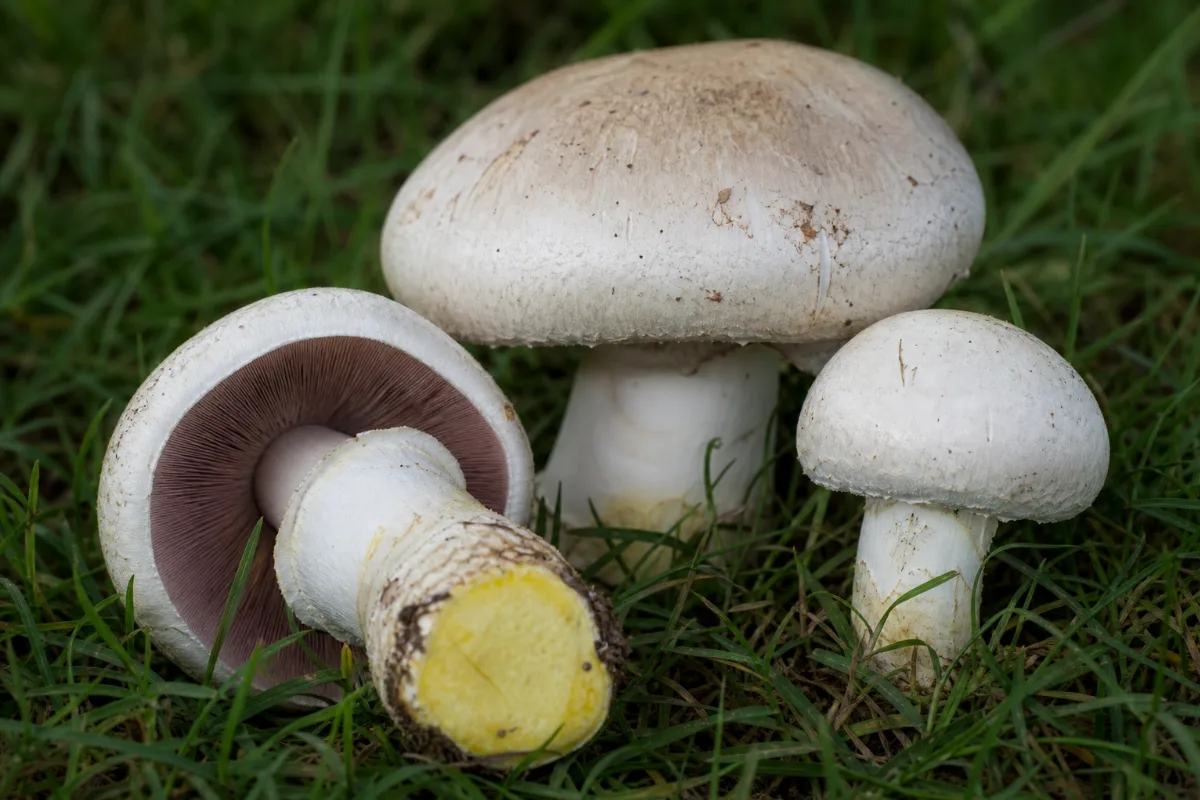
Mushrooms · Poisonous mushroom
Yellow stainer
Agaricus xanthodermus · also called Yellow-staining mushroom, yellow-staining agaricus; the German name means 'carbolic mushroom'
The yellow stainer is a poisonous wild mushroom. Eating it usually causes vomiting, stomach cramps and diarrhoea within a couple of hours, and people often eat it by mistake for an edible mushroom. Reports from Australia and Italy describe mostly mild, short illness, but strength varies from one mushroom to the next and no safe amount is known. No study shows any health benefit. If someone has eaten it, call a poison centre.
General information, not medical advice. Last substantive update · Not medically reviewed. A named clinician has not signed off on this page. How this page is made
About Yellow stainer
The yellow stainer (Agaricus xanthodermus) is a poisonous wild mushroom. Eating it usually causes vomiting, cramps, nausea and diarrhoea within about 2 hours. In reports from Australia and Italy the illness was mostly mild and short, but it is a poisoning, severity varies, and the poison is not fully known. It is a common cause of accidental mushroom poisoning. No study shows any health benefit.
What the poisoning looks like in reports
In South Sardinia, 164 mushroom poisonings were recorded in 10 years. Yellow stainer caused 15 of them, 18% of the 81 caused by toxic species. For these cases the mean delay was 2 hours and the mean hospital stay 1 day, and symptoms included stomach pain and cramps, diarrhoea, nausea, vomiting, tremor, dizziness and shortness of breath. The series recorded no death or severe complication, across all 164 cases and all species.
In Victoria, Australia, 47 people deliberately ate fungi, 46 of them as food. Of these, 41 had eaten this mushroom or another Agaricus. Illness followed in 40 of the 47 (85%), mostly gut irritation of limited length and mild severity. The authors say it was probably confused with edible mushrooms of the same genus. In Tuscany, Italy, it appears 9 times among 448 poisonings on a regional poison-centre list for 2007 to 2017.
What is known about the poison
The poison is not fully known. The 2020 review calls it an unknown gut irritant. A 1984 chemistry paper found phenol in the mushroom in high enough concentration, in its authors' view, to account for the toxicity. A 2021 Australian study measured phenol, hydroquinone and catechol and found more phenol in caps than stems, in mature than young mushrooms, and in mushrooms growing in woody mulch than in lawns. The authors link this to the varying severity people report. This was laboratory measurement; it did not test illness in people, and differences in human sensitivity were not studied.
A 2021 paper on this group of Agaricus species says all of them should be considered potentially poisonous. Results for one species cannot be assumed for another.
Why mix-ups happen, and why this page cannot help you sort them
Poisonings are often a mix-up. This page does not teach identification, on purpose. A photo, a smell, an app or a name is never proof that a wild mushroom is safe, and even public DNA records can be wrong: one record filed under this species matched a different species. If a wild mushroom has been eaten and you are unsure what it was, call a poison centre and keep the leftovers. Many countries also have local mycological services.
What research exists
There is no clinical trial of this mushroom for any use. The human evidence is poison-centre and hospital records, a review, and chemistry papers. The laboratory work found phenol and an unusual azo compound, and in 2023 a team made five lab copies of that compound that stopped yeast growing in dishes. This does not suggest the mushroom itself helps with infections.
A 1989 study injected mice with 4-hydroxybenzenediazonium sulfate, a compound the authors call an ingredient of the mushroom. After 36 weekly injections, 22% of females and 22% of males had tumours under the skin, against 2% and 8% of untreated mice; two injections had no effect. This was an injected single compound in animals, not the mushroom eaten, and it does not show cancer in people.
Metals and products
No supplement or food product made from this mushroom was found. In wild samples, a Turkish study of 21 species found the highest cadmium level in this species, and a South African sample held lead at 50.6 and cadmium at 29.5 mg per kg dry weight. These are small studies from single regions, with no safe limit given for comparison. Nothing here is a product recommendation.
At a glance
Traditional uses history, not proof
- No traditional use as food or medicine is described in the sources we read.
- Medical papers describe it as a cause of accidental poisoning, in Europe, the USA and Australia (Lagrange 2020; Hender 2000; La Rosa 2024).
- A 1984 chemistry paper reported phenol and an unusual azo compound in it, and a 2023 lab study used that compound as a starting point for new antifungal chemicals.
Studied for research
- Eating it as food: harm in poison reports, evidence against
- Lab compounds (test tube): very low evidence, early work on lab-made copies, not the mushroom
- No clinical trial for any use
Main compounds
- Phenol (suspected cause of the gut upset; lab work)
- Hydroquinone and catechol (measured with phenol)
- 4,4'-Dihydroxyazobenzene (an azo compound)
- 4-Hydroxybenzenediazonium (caused tumours in mice when injected; not shown for eating the mushroom)
Common forms
- Wild mushroom, usually eaten by mistake (strength varies)
- No supplement or product based on it was found
Research links: Poison Control (US): get help online or call 1-800-222-1222 · NHS: what to do in poisoning · Poisoning due to eating fungi in Victoria (abstract) · Mushroom poisonings in South Sardinia 2011-2021 (abstract) · Phenol variation in Australian yellow stainer (abstract) · Review of Agaricus and morel toxicity (abstract) · Research Library · Genes & Biomarkers Library
What it is and its history
- Accepted scientific name
- Agaricus xanthodermus
- Naming authority
- Genev.
- Synonyms
- Agaricus xanthoderma (spelling variant); Agaricus xanthodermus var. xanthodermus; Agaricus xanthodermus var. griseus (A.Pearson) Bon & Cappelli; Pratella xanthoderma (Genev.) Gillet; Psalliota flavescens Richon & Roze; Fungus xanthodermus (Genev.) Kuntze
- Common names
- Yellow stainer (English); Yellow-staining mushroom (English); Karbol-Egerling (German); Psalliote jaunissante (French); Champinon amarilleante (Spanish); Karbolchampignon (Dutch); Pecarka zapasna (Czech)
- Family or group
- Agaricaceae, a family of fungi (this is a mushroom, not a plant). Part concerned: the fruiting body, which is the mushroom.
- Classification
- Fungi > Basidiomycota > Agaricomycetes > Agaricales > Agaricaceae > Agaricus > Agaricus xanthodermus
- Native range
- GBIF holds about 14,300 occurrence records of the species (25 October 2026). Records are observations, not a map of native range, and native versus introduced status by country was not checked. Studies we read took samples in Australia, South Africa, Turkey and Italy.
- Habitat
- A 2021 Australian study found it growing both in lawns and in woody mulch. Other habitat details were not checked.
- What it looks like
- Part used: The fruiting body (the mushroom). This page does not describe how to recognise the mushroom, on purpose; a photo, a smell or a name is never proof that a mushroom is safe, and reports say people mistake it for edible mushrooms.
- Look-alikes and adulterants
- Name: Edible mushrooms of the same genus; Note: A 2000 Australian study says the people who ate this species deliberately as food had probably confused it with edible Agaricus. This is not guidance for telling mushrooms apart.; Name: Other species in the same group (section Xanthodermatei); Note: A 2021 taxonomy paper says all species of this group and of the neighbouring section Hondenses should be considered potentially poisonous. Results for one species cannot be assumed for another.
Traditional use and history history, not clinical proof
| Tradition or era | Documented use | Source |
|---|---|---|
| Taxonomy | Described scientifically in 1876 (GBIF). In a recent revision of the genus, the group it belongs to (section Xanthodermatei) was split into two sections, Hondenses and Xanthodermatei (2021 paper). | GBIF; Bashir 2021 |
| Chemistry | In 1984 chemists reported 4,4'-dihydroxy-azobenzene in the mushroom, the first azo compound found arising in nature, plus phenol and related phenolic compounds, and said phenol is present in high enough concentration to account for its toxicity. | Gill & Strauch 1984 |
| Medical literature | Poison-centre papers list it among the species causing a gut-irritant mushroom poisoning in Europe, the USA and Australia. | Lagrange & Vernoux 2020; Hender 2000 |
| Traditional or ceremonial use | None of the sources we read describes a traditional use as food or medicine, so none is described here. | n/a |
Traditional use shows how it was used. It does not show that it works or is safe today.
What is inside, and how it may work
What it contains and how those compounds act in cells and animals. Laboratory and animal mechanisms are not proven effects in people.
Main compounds
| Compound | Family | Where it is concentrated | Activity studied | Level of evidence |
|---|---|---|---|---|
| Phenol PubChem 996 | simple phenol | Cap more than stem; mature more than young; more in mulch-grown mushrooms (Australian study) | Suspected cause of the gut irritation. The 1984 authors say it is present in high enough concentration to account for the toxicity; a 2021 Australian study measured it and links variation in toxicity partly to variation in phenol. Not tested in people. 17 3 2 | Laboratory research |
| Hydroquinone and catechol PubChem 785 | simple phenols | Measured with phenol in the 2021 Australian study | Measured with phenol; their role in illness was not shown. CID 785 is hydroquinone; catechol is CID 289. 17 2 | Laboratory research |
| 4,4'-Dihydroxyazobenzene PubChem 101245 | azo compound | Not reported | Reported as the first azo compound found arising naturally (1984). Lab-made derivatives stopped yeast growth in dishes (2023). 17 3 10 | Laboratory research |
| 4-Hydroxybenzenediazonium ion (tested as the sulfate salt) | diazonium | Not reported | Called an ingredient of the mushroom by the authors of the 1989 mouse study; the 2020 review also says its ion was found in extracts of the mushroom (second-hand). Caused tumours in mice when injected for 36 weeks. 11 8 | Animal research |
| p-Quinol and 4,4'-dihydroxybiphenyl | phenolic compounds | Not reported | Listed in the 1984 abstract as isolated from the mushroom. We did not confirm that p-quinol is the same as hydroquinone, so no CID is given. 3 | Laboratory research |
Mechanisms, receptors and pathways
| Target or pathway | Gene or receptor | What was found | Level |
|---|---|---|---|
| Gut irritation | n/a | The mechanism is not known. A 2020 review calls the poison an unknown gut irritant. Phenol is the suspect (laboratory chemistry and one measurement study, not tested in people). 8 3 2 | Laboratory research |
| Tumour formation in mice | n/a | 4-Hydroxybenzenediazonium sulfate, injected under the skin once a week for 36 weeks, caused tumours in mice (animal study). The mechanism was not given in the abstract. 11 | Animal research |
| Yeast growth | n/a | Lab-made derivatives of 4,4'-dihydroxyazobenzene stopped Candida growth in dishes (test-tube work). 10 | Laboratory research |
Absorption, metabolism and elimination
- Absorption
- Not established. Symptoms start after about 1 to 2 hours in a review and a mean of 2 hours in 15 Sardinian cases.
- Distribution
- Not established.
- Metabolism
- Not established.
- Elimination
- Not established.
- Bioavailability
- Not established.
Isolated compounds versus whole extracts
The whole mushroom causes the poisoning described in people. The single compounds were tested in mice or in dishes. Nothing found about one can be assumed for the other.
Nutritional composition
The yellow stainer is not a food or nutrient. It is poisonous.
1 very low certainty1 evidence against
What was looked at
The 2 benefits and uses checked for Yellow stainer, each with how strong the evidence is. Tap one to open it.
What is Yellow stainer good for?
The uses people ask about and how strong the evidence is for each. None is shown to help. Read every row together with the Safety tab: this is a poisonous mushroom.
Benefits, one by one
Each card is a research question, not a promise. Tap a goal to filter. Open a card to see the studies, doses and limits.
Eating it as a food
Evidence againstThe yellow stainer is not a food. Reports from Australia and Italy show that people who eat it commonly fall ill with stomach and bowel upset. There is no sign of any benefit.
4 studiesNot covered. This page gives no amounts, no preparation and no ways o…
Studies, doses and limits
What the trials found
In Victoria, Australia, 47 people deliberately ate fungi (46 as food); 41 of those had eaten this mushroom or another Agaricus, and 40 of the 47 (85%) became ill, with gut irritation that was usually mild and short. In South Sardinia, 15 poisonings with this mushroom were recorded in 10 years, with a mean delay of 2 hours and a mean hospital stay of 1 day.
Results
Not a benefit. Illness followed in most people who ate it deliberately in the Victorian series. The Sardinian series of 164 poisonings (all species) recorded no death or severe complication.
Why this rating
Case series and poison-centre records consistently show harm. They cannot show that any amount is safe, and the severity of a given mushroom cannot be judged in advance.
Form and dose studied
Not covered. This page gives no amounts, no preparation and no ways of using the mushroom.
Who was studied
Adults and some children who ate wild mushrooms; no clinical group has been studied for benefit.
Limits
Series are small and local. Illness was judged by poison-centre staff as likely or possible. The Victorian figure covers this species together with other Agaricus.
Why researchers looked
Poison centres and hospitals study it because it is one of the species most often reported in wild-mushroom poisoning, and because it is eaten by mistake for edible mushrooms of the same genus.
Traditional use
No traditional food or medicine use is described in the sources we read.
Proposed mechanism Pharmacological theory
The poison is not fully known. A 2020 review calls it an unknown stomach and bowel irritant. A 1984 laboratory paper found phenol in the mushroom in high enough concentration, in its authors' view, to explain the toxicity (laboratory chemistry, not tested in people).
A proposed mechanism does not show that the effect happens in people.
This is a poisonous mushroom. Eating it usually causes vomiting, stomach cramps and diarrhoea within a few hours. See the Safety tab first. If someone has eaten it, call a poison centre.
Laboratory work on a compound found in the mushroom
Very low certaintyChemists found an unusual compound, 4,4'-dihydroxyazobenzene, in the mushroom in 1984. In 2023 a German team made five lab copies based on it and found they stopped drug-resistant yeast growing in dishes. This is early lab work on lab-made chemicals. It does not mean the mushroom helps anyone.
2 studiesNot covered.
Studies, doses and limits
Results
Five lab-made compounds stopped growth of Candida albicans and Candida auris strains in dishes.
Effect sizes as reported
Not given in the abstract.
Why this rating
Test-tube study of lab-made derivatives, not the mushroom, with no animal or human testing.
Form and dose studied
Not covered.
Limits
Only the abstract was read. The compounds tested are not the mushroom and nothing is known about safety in the body.
Why researchers looked
Drug researchers look at natural compounds as starting points for new antifungal medicines.
Proposed mechanism Laboratory research
Growth of two Candida yeast species, including drug-resistant strains, was prevented by five synthetic derivatives (test-tube work). The mechanism was not given in the abstract.
A proposed mechanism does not show that the effect happens in people.
This is a poisonous mushroom. Eating it usually causes vomiting, stomach cramps and diarrhoea within a few hours. See the Safety tab first. If someone has eaten it, call a poison centre.
Connections to the rest of health
How Yellow stainer connects to the rest of our health knowledge graph. Every link says what kind of connection it is. A safety link (for example to the liver) is a warning, not a benefit. A study that merely mentions a topic never creates a benefit link.
Explore every connection: goals, body systems, organs, symptoms, genes
B. Body systems
| Connected to | Kind of connection | Evidence status | Context | Studies |
|---|---|---|---|---|
| Digestive system | Adverse effect or risk | Moderate certainty | Vomiting, cramps, nausea and diarrhoea after eating; consistent across a Sardinian series, a Victorian series and a 2020 review. Preparation or compound: Mushroom (unknown gut irritant; phenol suspected) |
7 5 8 |
| Digestive System | Biological association | Evidence against | Studied for: Eating it as a food | 5 7 8 1 |
C. Body parts and organs
E. Health conditions
| Connected to | Kind of connection | Evidence status | Context | Studies |
|---|---|---|---|---|
| Food poisoning | Adverse effect or risk | Moderate certainty | Mushroom poisoning of the stomach-and-bowel type; the mushroom is a poisonous species, not a spoiled food. Preparation or compound: Mushroom |
7 5 |
| Vomiting | Adverse effect or risk | Moderate certainty | A recorded symptom. Preparation or compound: Mushroom |
7 8 |
| Diarrhea | Adverse effect or risk | Moderate certainty | A recorded symptom. Preparation or compound: Mushroom |
7 8 |
L. Active compounds
| Connected to | Kind of connection | Evidence status | Context | Studies |
|---|---|---|---|---|
| Phenol | Biological association | In vitro | Suspected cause of the gut irritation. The 1984 authors say it is present in high enough concentration to account for the toxicity; a 2021 Australian study measured it and links variation in toxicity partly to variation in phenol. Not tested in people. Preparation or compound: Cap more than stem; mature more than young; more in mulch-grown mushrooms (Australian study) |
17 3 2 |
| Hydroquinone and catechol | Biological association | In vitro | Measured with phenol; their role in illness was not shown. CID 785 is hydroquinone; catechol is CID 289. Preparation or compound: Measured with phenol in the 2021 Australian study |
17 2 |
| 4,4'-Dihydroxyazobenzene | Biological association | In vitro | Reported as the first azo compound found arising naturally (1984). Lab-made derivatives stopped yeast growth in dishes (2023). Preparation or compound: Not reported |
17 3 10 |
| 4-Hydroxybenzenediazonium ion (tested as the sulfate salt) | Biological association | Animal | Called an ingredient of the mushroom by the authors of the 1989 mouse study; the 2020 review also says its ion was found in extracts of the mushroom (second-hand). Caused tumours in mice when injected for 36 weeks. Preparation or compound: Not reported |
11 8 |
| p-Quinol and 4,4'-dihydroxybiphenyl | Biological association | In vitro | Listed in the 1984 abstract as isolated from the mushroom. We did not confirm that p-quinol is the same as hydroquinone, so no CID is given. Preparation or compound: Not reported |
3 |
Each connection is stored with the ingredient, the connected record, the kind of connection, the evidence status, the supporting studies, the preparation or compound involved, and a review date (last reviewed October 25, 2026).
Evidence at a glance: what the research found for 2 outcomes
Each outcome below is one thing researchers measured. Certainty is how far the evidence can be trusted, not how well it works. The full studies are on the next tab.
The evidence
The research centre for Yellow stainer. Every record here was checked against PubMed or the publisher's page; we never list a study we have not verified.
Evidence by outcome
Bars show how many studies we found for each outcome, not how well it works. People are added up across trials only (reviews are not added, to avoid double counting).
How we rate evidence
High certainty
Several well-run trials or reviews agree; further research is unlikely to change the picture much.
Moderate certainty
Good trials point the same way, but some doubt remains.
Low certainty
Small, short or inconsistent trials. The finding could change with better research.
Very low certainty
Very little or very weak human data. Treat as a possibility only.
Mixed findings
Trials or reviews disagree with each other.
Not enough evidence
Not enough human research to say either way.
Evidence against
Good research found no benefit, or found harm.
We take the reviewers' own risk-of-bias and GRADE statements where they exist, and otherwise judge from study size, design, consistency, directness and whether a product matches what is sold. Many publications do not make evidence high. Method note: We read PubMed records and abstracts for 12 papers, read the relevant parts of the free full text for five of them, read the NHS, Poison Control and NSW poisons pages, and checked the scientific name and chemical identifiers in GBIF and PubChem. Where a statement could not be checked, it is marked as unverified in our notes.
Study library: every study we checked 17
| Study | Design | People | Product, dose, length | Result |
|---|---|---|---|---|
| Bashir 2021 An overview of Agaricus section Hondenses and Agaricus section Xanthodermatei with description of eight new species from Pakistan. Sci Rep · PMID 34145323 · DOI |
Review n/a |
106 Taxonomy study of 106 specimens in two groups of Agaricus (sections Hondenses and Xanthodermatei) |
n/a |
A taxonomy paper. In its introduction the authors say most known toxic Agaricus belong to these groups, that all their species should be considered potentially poisonous, and that the mild toxicity causing gastrointestinal upsets is likely due to phenol and quinones. The abstract itself reports that the group was split into two sections in a recent revision. Methods, limits and fundingOutcomes: Species diversity (naming and DNA) Limitations: The poison statement is background in the introduction, not a result of the study. Not a clinical paper. Funding and conflicts: The authors declare no competing interests. Read: full-text |
| Boxshall 2021 A field-based investigation of simple phenol variation in Australian Agaricus xanthodermus. Mycologia · PMID 34494944 · DOI |
Laboratory lab |
Fruiting bodies of Agaricus xanthodermus collected in the field in Australia and measured by gas chromatography-mass spectrometry | Phenol, hydroquinone, catechol measured in the mushroom fruiting body |
The abstract says yellow stainer causes gastrointestinal irritation of varying severity. Phenol was higher in the cap than the stem, in mature than immature mushrooms, and in mushrooms from woody mulch than from lawns. The authors suggest variation in toxicity may be due partly to phenol level, age, the part eaten and the growing surface. Differences in human sensitivity were not tested. Methods, limits and fundingOutcomes: Phenol, hydroquinone and catechol in different parts, ages and growing surfaces Limitations: Measures chemicals in mushrooms, not illness in people. Only the abstract was read, so the numbers are not quoted here. Funding and conflicts: Research Support, Non-U.S. Gov't (no further detail in the abstract). Read: abstract |
| Gill 1984 Constituents of Agaricus xanthodermus Genevier: the first naturally endogenous azo compound and toxic phenolic metabolites. Z Naturforsch C Biosci · PMID 6543409 · DOI |
Laboratory lab |
Extract of fresh fruiting bodies of Agaricus xanthodermus | Extract of the mushroom fruiting body |
Extraction yielded 4,4'-dihydroxy-azobenzene, phenol, p-quinol and 4,4'-dihydroxybiphenyl. The authors say phenol is present in high enough concentration to account for the toxicity of the mushroom. Methods, limits and fundingOutcomes: Compounds present Limitations: Chemistry paper from 1984; the claim that phenol accounts for the toxicity is the authors' interpretation and was not tested in people. Only the abstract was read. Funding and conflicts: Not stated in the abstract. Read: abstract |
| Giusti 2021 Building of an Internal Transcribed Spacer (ITS) Gene Dataset to Support the Italian Health Service in Mushroom Identification. Foods · PMID 34070525 · DOI |
Laboratory |
DNA reference dataset for mushroom species involved in poisonings in Tuscany, Italy, 2007 to 2017, from a list by the Tuscany Poison Control Centre | n/a |
The Tuscany list reported 448 poisoning cases. Agaricus xanthodermus accounted for 9 of them. One public DNA record filed under Agaricus xanthodermus matched another Agaricus species at 100% and the true yellow stainer records at 89.3% or less, showing that public records can be mislabelled. Methods, limits and fundingOutcomes: Poisoning cases by species; quality of public DNA records Limitations: A DNA-database paper, not a clinical study. The case count comes from a regional poison-centre list, not an incidence study. Funding and conflicts: The authors declare no conflict of interest. Read: full-text |
| Hender 2000 Poisoning due to eating fungi in Victoria. Aust Fam Physician · PMID 11059094 |
Case series |
174 174 callers to the Victorian Poisons Information Centre (Australia) who had eaten fungi and posted samples, May 1997 to April 1999; 170 completed a questionnaire |
Wild fungi eaten (mostly Agaricus) fruiting body |
Of 47 deliberate ingestions (46 of them eaten as food), 41 (89%) were Agaricus xanthodermus or other Agaricus species, and illness was 'likely' or 'possibly' due to the fungi in 40 of 47 (85%). Yellow stainer was the main species eaten deliberately and was probably confused with other edible Agaricus. Gastrointestinal irritation was frequent, of limited duration and mild severity. Methods, limits and fundingOutcomes: Which fungi were eaten, whether illness followed and how severe Limitations: Old (1997-1999) study from one Australian state; volunteers who called a poison centre; illness judged as likely or possible, not proven; the abstract does not give figures for yellow stainer alone. Funding and conflicts: Not stated in the abstract. Read: abstract |
| Jonnalagadda 2006 Elemental distribution in selected Agaricus and Rhizina mushrooms in South Africa. J Environ Sci Health A Tox Hazard Subst Environ Eng · PMID 16484080 · DOI |
Laboratory lab |
Four mushroom species in South Africa: two edible Agaricus bisporus, one Agaricus xanthodermus and Rhizina undulata | n/a fruiting body |
Agaricus xanthodermus had lead at 50.6 and cadmium at 29.5 mg per kg dry weight (also Ca 204, Mg 660, Fe 306, Mn 30, Cr 16.2). The authors say the inedible and poisonous types had relatively high levels of manganese, chromium, cadmium and lead compared with the edible types. Methods, limits and fundingOutcomes: Calcium, magnesium, iron, manganese, lead, chromium, cadmium Limitations: Very small sample of species and places. No limit is given in the abstract to compare against. Only the abstract was read. Funding and conflicts: Research Support, Non-U.S. Gov't. Read: abstract |
| La Rosa 2024 Epidemiology and clinical aspect of mushroom poisonings in South Sardinia: A 10-year retrospective analysis (2011-2021). Food Sci Nutr · PMID 38268883 · DOI |
Case series |
164 164 mushroom poisoning cases recorded by regional mycological inspectorates in South Sardinia, Italy, 2011 to 2021 (81 caused by toxic species) |
Wild mushroom eaten fruiting body |
Yellow stainer (Agaricus xanthodermus) caused 15 cases, 18% of the 81 cases from toxic species and the second most common toxic species after Omphalotus olearius (22%). For these 15 cases the table lists a mean delay of 2 hours and a mean hospital stay of 1 day, with symptoms including abdominal pain and cramps, diarrhoea, nausea, vomiting, tremor, vertigo and shortness of breath. Across all 164 cases no death or severe complication was seen; 6 patients were children or adolescents, who tended to be poisoned unintentionally. Methods, limits and fundingOutcomes: Species involved, symptoms, delay before symptoms, hospital stay, outcome Limitations: Regional records from one part of Sardinia. Symptoms are listed for the species as a group, not per person. Means only; no range given for this species. Not specific to yellow stainer outside the table row. Funding and conflicts: The authors declare no conflict of interest. Read: full-text |
| Lagrange 2020 Warning on False or True Morels and Button Mushrooms with Potential Toxicity Linked to Hydrazinic Toxins: An Update. Toxins (Basel) · PMID 32751277 · DOI |
Review |
Review of poison-centre data and chemistry for false and true morels and Agaricus mushrooms | Agaricus mushrooms (review) fruiting body |
The review says Agaricus mushrooms can cause a stomach and bowel illness (diarrhoea, vomiting, cramps, nausea) from an unknown poison, classed as a gastrointestinal irritant, acting 1 to 2 hours after eating. It names A. xanthodermus among the species responsible, with data gathered from poison centres in Europe and the USA. Its main subject (agaritine) is in the button mushroom, a different matter. Methods, limits and fundingOutcomes: Gut poisoning from Agaricus species; hydrazine-type toxins Limitations: Narrative review. The yellow stainer is a small part of it. An erratum was published in 2022 (Toxins 14:345); we did not open it. Abstract and the Agaricus sections of the full text were read. Funding and conflicts: The authors declare no conflict of interest. Read: full-text |
| Oprita 2025 Wild/Woodland Mushroom Poisoning: The Experience of Bucharest Emergency Hospital-Retrospective Study of ER 2023-2024 Presentations. J Fungi (Basel) · PMID 40863529 · DOI |
Case series |
47 47 patients who came to a Bucharest emergency department after eating wild mushrooms, 2023 to 2024 |
n/a |
Stomach and bowel symptoms were seen in 97.87% and 74.46% were admitted for observation or treatment. Species were not identified in the study; in the discussion the authors say the rapid gut-irritant picture resembles what is seen with species such as Agaricus xanthodermus, and call this link hypothetical. Methods, limits and fundingOutcomes: Symptoms, hospital admission Limitations: Yellow stainer is not shown to have caused any of these cases. Used only as background on how wild-mushroom poisoning usually presents in Eastern Europe. Funding and conflicts: None of the authors declare conflicts of interest. Read: full-text |
| Raschig 2023 Azobenzene derivatives with activity against drug-resistant Candida albicans and Candida auris. Arch Pharm (Weinheim) · PMID 36403201 · DOI |
Laboratory lab |
Five lab-made compounds based on 4,4'-dihydroxyazobenzene, a compound found in Agaricus xanthodermus, tested on yeast strains in dishes | Lab-made derivatives of a mushroom compound |
The five synthetic compounds stopped the growth of fluconazole-susceptible and fluconazole-resistant strains of both yeasts in the lab. The authors say further studies in living animals are needed. Methods, limits and fundingOutcomes: Growth of Candida albicans and Candida auris Limitations: Test-tube work on lab-made derivatives, not on the mushroom. Says nothing about people. Funding and conflicts: Not stated in the abstract. Read: abstract |
| Toth 1989 Cancer induction in mice by 4-hydroxybenzenediazonium sulfate of the Agaricus xanthodermus mushroom. In Vivo · PMID 2519869 |
Animal research animal |
Swiss mice given a single chemical, 4-hydroxybenzenediazonium sulfate (HBD), by injection under the skin once a week | 4-hydroxybenzenediazonium sulfate (single compound) |
HBD given 36 times caused tumours under the skin in 22% of females and 22% of males, against 2% and 8% in untreated controls. HBD given only twice had no tumour effect. The authors say HBD is an ingredient of the mushroom. Methods, limits and fundingOutcomes: Tumours of the tissue under the skin Limitations: The compound was injected, not eaten, and was tested on its own, not as the mushroom. No human data. An erratum was published later (In Vivo 1989). It does not show that eating the mushroom causes cancer. Only the abstract was read. Funding and conflicts: Research Support, U.S. Gov't, P.H.S. (no further detail in the abstract). Read: abstract |
| Yesil 2004 Level of heavy metals in some edible and poisonous macrofungi from Batman of South East Anatolia, Turkey. J Environ Biol · PMID 15847333 |
Laboratory lab |
21 21 macrofungi species collected at 29 locations around Batman, Turkey |
n/a fruiting body |
The highest cadmium level among the species was in Agaricus xanthodermus, and its cobalt level was also the highest. Lead and copper were highest in another species. Methods, limits and fundingOutcomes: Heavy metal content Limitations: Wild samples from one region; the abstract gives no levels in numbers for this species. Only the abstract was read. Funding and conflicts: Research Support, Non-U.S. Gov't. Read: abstract |
| n/a 2026 Poison Control (National Capital Poison Center): home page and call advice n/a · Source |
Authoritative guidance n/a |
n/a | n/a |
The home page gives the poison help number 1-800-222-1222 (free, expert and confidential) and says to call 911 if the person collapses, has a seizure, has trouble breathing or cannot be awakened. Read 25 October 2026. Methods, limits and fundingOutcomes: What to do in a suspected poisoning in the US Limitations: A public help page. Read: full-text |
| n/a 2026 NHS (UK): Poisoning n/a · Source |
Authoritative guidance n/a |
n/a | n/a |
The page says to call 999 or go to A&E if someone may have swallowed something harmful, has lost consciousness, has stopped breathing, has severe breathing difficulty or has a seizure, and to call NHS 111 if you are not sure whether something swallowed is harmful. It advises taking the substance or its packaging to show doctors, and not trying to make the person sick or giving food or drink. Read 25 October 2026. Methods, limits and fundingOutcomes: What to do in suspected poisoning in the UK Limitations: A public help page. Read: full-text |
| n/a 2026 NSW Poisons Information Centre (Australia): home page n/a · Source |
Authoritative guidance n/a |
n/a | n/a |
The home page says the NSW Poisons Information Centre can be called 24/7 on 13 11 26 and to call Triple Zero (000) for an ambulance if someone is unconscious. Read 25 October 2026. Methods, limits and fundingOutcomes: Poison advice line in Australia Limitations: A public help page for one Australian state service; 13 11 26 is shown as the poisons line on the page. Read: full-text |
| n/a 2026 GBIF Backbone Taxonomy: Agaricus xanthodermus Genev. (species key 5243412) n/a · Source |
Registry or database n/a |
n/a | n/a |
GBIF lists Agaricus xanthodermus Genev. as ACCEPTED, in the family Agaricaceae (order Agaricales, phylum Basidiomycota), published in 1876 in Bulletin de la Societe Botanique de France 23: 31, with 20 listed synonyms and about 14,300 occurrence records (read through the GBIF API, 25 October 2026). Methods, limits and fundingOutcomes: Accepted name, family, synonyms, vernacular names Limitations: One name authority; Index Fungorum and MycoBank were not checked. Occurrence records are observations, not a range map. Read: full-text |
| n/a 2026 PubChem: Phenol (CID 996) n/a · Source |
Registry or database n/a |
n/a | n/a |
PubChem lists phenol as CID 996, formula C6H6O (REST API, 25 October 2026). Hydroquinone is CID 785, catechol CID 289, 4,4'-dihydroxyazobenzene CID 101245 and 4,4'-biphenol CID 7112 in the same database. Methods, limits and fundingOutcomes: Chemical identity Limitations: Database records of identity only; says nothing about the mushroom. Read: full-text |
What we do not know yet
- No clinical trial of the yellow stainer for any use, and no study of safe amounts.
- The poison is not named with certainty; phenol is suspected from lab work only.
- No study of what cooking, drying or freezing does to the poison.
- No studies in pregnancy, breastfeeding, older adults, pets or people on medicines.
- Poisoning counts come from regional lists and one Australian study that pools this species with other Agaricus.
How new research is added
New studies are found by a saved PubMed search and are placed in a review queue. A person reads each one before it changes this page.
Lab markers
What changed in blood or saliva tests during trials. A changed number is not the same as feeling or being healthier, and we give no "normal ranges".
Safety
What studies and official sources say about side effects, medicines and who should check first. Each point shows what kind of evidence it comes from.
Main points to know 5
- If someone has eaten it, call a poison centre now. Do not wait to see whether symptoms start. In the US call Poison Help at 1-800-222-1222 (free and confidential), or 911 if the person collapses, has a seizure, has trouble breathing or cannot be awakened. In the UK call NHS 111 if you are unsure and 999 in an emergency. In Australia the Poisons Information Centre line is 13 11 26, and Triple Zero (000) if someone is unconscious or not breathing. Do not try to make the person sick and do not give food or drink unless the poison service says so. Keep the mushroom, a photo or the leftovers to show staff. Authoritative guidance 13 14 15
- It is a poisonous mushroom that most often causes a stomach and bowel illness. Eating it causes vomiting, cramps, nausea and diarrhoea, starting about 1 to 2 hours later according to a 2020 review, and a mean of 2 hours in 15 cases from South Sardinia (mean hospital stay 1 day). In Victoria, Australia, 40 of 47 people (85%) who deliberately ate fungi, mostly this mushroom or other Agaricus, became ill, with gut irritation of limited length and mild severity. Case series 8 7 5
- Mild in most reports does not mean safe for you. The Sardinian series of 164 poisonings from all kinds of mushrooms recorded no deaths or severe complications. But these are local records, severity varied, and a laboratory study of this mushroom in Australia found that phenol levels differ with the part, the age and the surface it grew on, which the authors link to the varying severity people report. No safe amount has been found, and nobody can tell from a mushroom how strong it is. Case series 7 2 5
- Most poisonings are a mix-up with edible mushrooms. The Victorian authors say people who ate it on purpose, as food, had probably confused it with edible mushrooms of the same genus. Do not rely on a photo, an app, a book or this page to decide that a wild mushroom is safe. Many countries have a local mycological service or poison centre that can help after a mix-up. DNA records can be wrong too: one public DNA record filed under this species matched a different species. Case series 5 4 7
- One compound from the mushroom caused tumours in mice, by injection. A 1989 study injected mice weekly under the skin with a compound found in the mushroom, 4-hydroxybenzenediazonium sulfate. After 36 injections, 22% of females and 22% of males had tumours, against 2% and 8% of untreated mice. Two injections had no effect. This was injected, not eaten, and tested in animals only. It does not show that eating the mushroom causes cancer in people, but it is one more reason not to eat it. Animal research 11 8
Side effects 4
| Effect | How often | Severity and recovery | Evidence |
|---|---|---|---|
| Vomiting, nausea, diarrhoea and stomach cramps In Victoria, gut irritation was frequent after deliberate eating, of limited duration and mild severity. As background, a Bucharest emergency department saw gut symptoms in 97.87% of 47 wild-mushroom poisonings; species were not identified there. | Listed for the group of 15 Sardinian cases; no per-symptom counts for this species | moderate Usually settles; the mean hospital stay in the Sardinian cases was 1 day | Case series 7 8 5 9 |
| Dizziness (vertigo), tremor and shortness of breath Reported for the species as a group. Other possible causes in each person were not examined. | Listed for the 15 Sardinian cases as a group; how many people had each is not given | moderate Not described | Case series 7 |
| Illness starting within a few hours Gut illness that begins late, after about 6 hours, belongs to other mushroom poisonings that can be far more dangerous, so call a poison centre in either case. | Mean delay 2 hours (15 Sardinian cases); 1 to 2 hours (2020 review) | mild-to-moderate Not applicable | Case series 7 8 |
| Dehydration from vomiting and diarrhoea A general concern with any vomiting and diarrhoea, especially in children and older people. It was not measured in these studies. | Not reported for this species in the sources we read | unknown Unknown | None |
Liver
No liver injury from the yellow stainer was reported in the sources we read, and its poison is described as a gut irritant. This is not an all-clear: we did not search LiverTox, and other wild mushrooms in the same hospital records are known to harm the liver. A hospital team decides which tests are needed after a wild mushroom of unknown type has been eaten. 7
How often. Not studied for this species. The absence of liver reports in the sources we read is not proof of no risk.
- South Sardinia hospital and inspectorate records (2011-2021). No death or severe complication across 164 mushroom poisonings from many species; for the 15 cases from this species the table shows a mean hospital stay of 1 day. 7
This is a safety connection. It is not evidence that Yellow stainer supports liver health.
Medicines and supplements 2
| With | Why it matters | Importance | Evidence | What to do |
|---|---|---|---|---|
| Medicines taken by mouth (tablets, capsules, contraceptive pills and others) prescription and non-prescription | Vomiting and diarrhoea may stop tablets staying down or being absorbed. This is a general effect of gut illness, not something measured for this mushroom. | Not studied. Poison staff and doctors need the full list of what the person takes. | Pharmacological theory Not enough evidence | Tell the poison centre or emergency team about every medicine, supplement and drink taken, and ask a doctor or pharmacist what to do about missed doses. |
| Alcohol substance | No interaction was described in the sources we read. | Unknown. Alcohol also irritates the gut. | None Not enough evidence | Tell the poison centre if alcohol was taken too. |
Who should check first 5
| Situation | Advice | Evidence |
|---|---|---|
| Anyone | It is a poisonous mushroom with no known benefit. Do not eat it, and do not prepare, cook, dry or freeze it in the hope of making it safe. No source we read describes a way to remove the poison. | Case series 5 8 7 |
| Children | In South Sardinia, 6 of the 164 poisoned patients were children or adolescents, who tended to be poisoned by accident from wild mushrooms. No data were found on this species in children. Call a poison centre at once if a child has put a wild mushroom in the mouth. | Case series 7 |
| Pregnancy and breastfeeding | No data were found. Avoid it, and call a poison centre or doctor if it was eaten. | None |
| Older adults and people with heart, kidney or other long-term illness | No data were found for these groups. Vomiting and diarrhoea can be more serious when the body is already unwell, so seek medical advice if it was eaten. | None |
| Pets | No pet data were found in the sources we read. If a pet has eaten a wild mushroom, call a vet or an animal poison service. | None |
Overdose, product quality and regulators
Summary. The poison is not fully known. A 2020 review calls it an unknown poison classified as a gastrointestinal irritant. A 1984 laboratory study found phenol in the mushroom, in a concentration its authors say is high enough to account for the toxicity. A 2021 study of related species says the mild gut upset is likely due to phenol and quinones.
Amounts. No safe amount has been established in any source we read. In an Australian study, phenol was higher in the cap than the stem, higher in mature than young mushrooms, and higher in mushrooms from woody mulch than from lawns. That means mushrooms differ, and a piece cannot be judged safe by size or look.
Onset and course. Symptoms started about 1 to 2 hours after eating in a European review, and after a mean of 2 hours in 15 Sardinian cases, whose mean hospital stay was 1 day. In Victoria the illness was of limited duration.
Repeated use. No data on repeated or long-term eating were found.
Animal data. One compound found in the mushroom (4-hydroxybenzenediazonium sulfate) caused tumours under the skin of mice when injected weekly for 36 weeks, not when injected twice (1989 study). No study of the whole mushroom in animals was read.
Toxic parts. The Australian study found more phenol in caps than in stems. This is not guidance about which part to eat: treat the whole mushroom as poisonous.
Not read. Blood or urine levels, genotoxicity, reproductive toxicity, long-term toxicity and what cooking, drying or freezing does to the poison were not found in the sources we read.
No supplement, extract or food product made from the yellow stainer was found. The contamination findings are about wild mushrooms.
Metals in wild samples. In Turkey, among 21 macrofungi species, the highest cadmium level was in this species. In South Africa one sample held lead at 50.6 and cadmium at 29.5 mg per kg dry weight; the authors say the inedible and poisonous types had relatively high manganese, chromium, cadmium and lead. Two small studies from single regions. 12 6
Mislabelled records and mix-ups. One public DNA record filed under this species matched a different species at 100%, so even reference records can be wrong. In Australia, people who ate it as food had probably confused it with edible mushrooms of the same genus. 4 5
Products. No product based on this mushroom was found. Nothing here is a recommendation of any product.
| Body | Action | Date |
|---|---|---|
| Poison Control, National Capital Poison Center (United States) | Public poison guidance, not a rule about this mushroom: call 1-800-222-1222 (free, expert, confidential), and 911 if the person collapses, has a seizure, has trouble breathing or cannot be awakened. source | 2026-10-25 |
| NHS (United Kingdom) | Public guidance, not a rule about this mushroom: call 999 or go to A&E if someone may have swallowed something harmful, is unconscious, not breathing, has severe breathing difficulty or a seizure; call NHS 111 if you are not sure. Do not try to make the person sick. source | 2026-10-25 |
| NSW Poisons Information Centre (Australia) | Public guidance, not a rule about this mushroom: do not wait for symptoms; call 13 11 26, and Triple Zero (000) if someone is unconscious or not breathing. source | 2026-10-25 |
When to get medical help
- If someone may have eaten this mushroom, or a wild mushroom that might be this one, call a poison centre right away, even if they seem fine. In the US call Poison Help at 1-800-222-1222 (free and confidential), or 911 if the person collapses, has a seizure, has trouble breathing or cannot be awakened. In the UK call NHS 111 if you are unsure and 999 in an emergency. In Australia the Poisons Information Centre line is 13 11 26, and Triple Zero (000) if someone is unconscious or not breathing.
- Go to hospital or call emergency services for repeated vomiting that will not stop, signs of dehydration (very dry mouth, no urine, dizziness when standing), confusion, fainting, a seizure, trouble breathing, or severe belly pain.
- Also seek care if stomach symptoms start 6 or more hours after a wild-mushroom meal, if they seem to improve and then return, or if several people ate the same meal. Some other wild mushrooms cause late and life-threatening illness.
- Take the mushroom, a photo or any leftovers to the hospital. Do not try to make the person sick.
If someone may be poisoned or in a crisis, contact a clinician or emergency service straight away. In the US, Poison Control is 1-800-222-1222.
General information only, not medical advice. Ask a clinician or pharmacist before use, especially with medicines, in pregnancy or with a health condition. See the Natural Remedy Safety guide.
Frequently asked questions
Is the yellow stainer poisonous?
What should I do if someone has eaten it?
Call a poison centre right away, even if the person feels fine. In the US call Poison Help at 1-800-222-1222 (free, confidential), or 911 if the person collapses, has a seizure, has trouble breathing or cannot be awakened. In the UK call NHS 111 if you are unsure, or 999 in an emergency. In Australia the Poisons Information Centre line is 13 11 26. Do not try to make the person sick. Keep the mushroom or a photo to show staff, and call emergency services for a seizure, collapse or trouble breathing.
How soon do symptoms start?
Is it dangerous or just an upset stomach?
In the series we read it mostly caused a gut illness of limited length, and the Sardinian series of 164 poisonings recorded no deaths. But it is a poisoning, the poison is not fully known, and strength varies between mushrooms. Children, older people and people with other illnesses were not studied, so call a poison centre rather than waiting.
What is the poison in it?
Why do the same mushrooms affect people differently?
A 2021 Australian study found phenol levels differ by part of the mushroom, its age and what it grows on, and the authors link this to the varying severity people report. They did not test differences between people.
Does cooking, drying or freezing make it safe?
No source we read says it does. The effect of cooking on this mushroom's poison was not studied in the sources we read, so do not assume that any preparation makes a wild mushroom safe.
Can a photo or an app tell me if a wild mushroom is safe?
No. People who ate this mushroom as food had probably confused it with edible mushrooms of the same genus, and even a public DNA record for it turned out to match another species. This page does not teach identification. If you are unsure, do not eat it, and use a local mycological service or poison centre.
Does it help with any health problem?
Can it cause cancer?
Is it safe in pregnancy, for children or for pets?
No data were found for pregnancy, breastfeeding, older adults or pets. In South Sardinia 6 of the 164 poisoned patients were children or teenagers, who tended to be poisoned by accident. Avoid it, and call a poison centre, doctor or vet if it was eaten.
Can it interact with medicines or alcohol?
No interaction study was found. Vomiting and diarrhoea may stop tablets staying down, so tell the poison centre or emergency team about every medicine and drink taken, and ask a doctor or pharmacist about missed doses.
Explore by health goal
Editorial transparency
- Written by
- AlternativeMed editorial team. Research compiled with AI assistance, then checked against PubMed records.
- Medical review
- None. This page has not been reviewed by a physician or pharmacist.
- First published
- 2026-10-25
- Last substantive update
- 2026-10-25
- How we research
- We read PubMed records and abstracts for 12 papers, read the relevant parts of the free full text for five of them, read the NHS, Poison Control and NSW poisons pages, and checked the scientific name and chemical identifiers in GBIF and PubChem. Where a statement could not be checked, it is marked as unverified in our notes.
- How we rate evidence
- See "How we rate evidence" in the Evidence tab.
- Independence
- No product is promoted on this page. No affiliate links are shown. This page gives no dose, preparation, identification, picking, growing or sourcing advice.
Sources 17
Each source was opened and checked. Where we read only the abstract, it says so. The small numbers in the text point here.
- Bashir H, Chen J, Jabeen S, Ullah S, Khan J, Niazi AR, Zhang M, Khalid AN, Parra LA, Callac P. An overview of Agaricus section Hondenses and Agaricus section Xanthodermatei with description of eight new species from Pakistan.. Sci Rep. 2021. PMID 34145323. DOI 10.1038/s41598-021-92261-5. (full-text)
- Boxshall AG, Birch JL, Lebel T, Symonds MRE, Callahan DL. A field-based investigation of simple phenol variation in Australian Agaricus xanthodermus.. Mycologia. 2021. PMID 34494944. DOI 10.1080/00275514.2021.1936851. (abstract)
- Gill M, Strauch RJ. Constituents of Agaricus xanthodermus Genevier: the first naturally endogenous azo compound and toxic phenolic metabolites.. Z Naturforsch C Biosci. 1984. PMID 6543409. DOI 10.1515/znc-1984-11-1203. (abstract)
- Giusti A, Ricci E, Gasperetti L, Galgani M, Polidori L, Verdigi F, Narducci R, Armani A. Building of an Internal Transcribed Spacer (ITS) Gene Dataset to Support the Italian Health Service in Mushroom Identification.. Foods. 2021. PMID 34070525. DOI 10.3390/foods10061193. (full-text)
- Hender E, May T, Beulke S. Poisoning due to eating fungi in Victoria.. Aust Fam Physician. 2000. PMID 11059094. (abstract)
- Jonnalagadda SB, Pienaar DH, Haripersad K. Elemental distribution in selected Agaricus and Rhizina mushrooms in South Africa.. J Environ Sci Health A Tox Hazard Subst Environ Eng. 2006. PMID 16484080. DOI 10.1080/10934520500542425. (abstract)
- La Rosa L, Corrias S, Pintor I, Cosentino S. Epidemiology and clinical aspect of mushroom poisonings in South Sardinia: A 10-year retrospective analysis (2011-2021).. Food Sci Nutr. 2024. PMID 38268883. DOI 10.1002/fsn3.3793. (full-text)
- Lagrange E, Vernoux JP. Warning on False or True Morels and Button Mushrooms with Potential Toxicity Linked to Hydrazinic Toxins: An Update.. Toxins (Basel). 2020. PMID 32751277. DOI 10.3390/toxins12080482. (full-text)
- Oprita B, Neacsu MC, Dinu BA, Olaru I, Oprita R. Wild/Woodland Mushroom Poisoning: The Experience of Bucharest Emergency Hospital-Retrospective Study of ER 2023-2024 Presentations.. J Fungi (Basel). 2025. PMID 40863529. DOI 10.3390/jof11080578. (full-text)
- Raschig M, Ramirez-Zavala B, Wiest J, Saedtler M, Gutmann M, Holzgrabe U, Morschhauser J, Meinel L. Azobenzene derivatives with activity against drug-resistant Candida albicans and Candida auris.. Arch Pharm (Weinheim). 2023. PMID 36403201. DOI 10.1002/ardp.202200463. (abstract)
- Toth B, Patil K, Taylor J, Stessman C, Gannett P. Cancer induction in mice by 4-hydroxybenzenediazonium sulfate of the Agaricus xanthodermus mushroom.. In Vivo. 1989. PMID 2519869. (abstract)
- Yesil OF, Yildiz A, Yavuz O. Level of heavy metals in some edible and poisonous macrofungi from Batman of South East Anatolia, Turkey.. J Environ Biol. 2004. PMID 15847333. (abstract)
- n/a. Poison Control (National Capital Poison Center): home page and call advice. n/a. 2026. (full-text)
- n/a. NHS (UK): Poisoning. n/a. 2026. (full-text)
- n/a. NSW Poisons Information Centre (Australia): home page. n/a. 2026. (full-text)
- n/a. GBIF Backbone Taxonomy: Agaricus xanthodermus Genev. (species key 5243412). n/a. 2026. (full-text)
- n/a. PubChem: Phenol (CID 996). n/a. 2026. (full-text)


