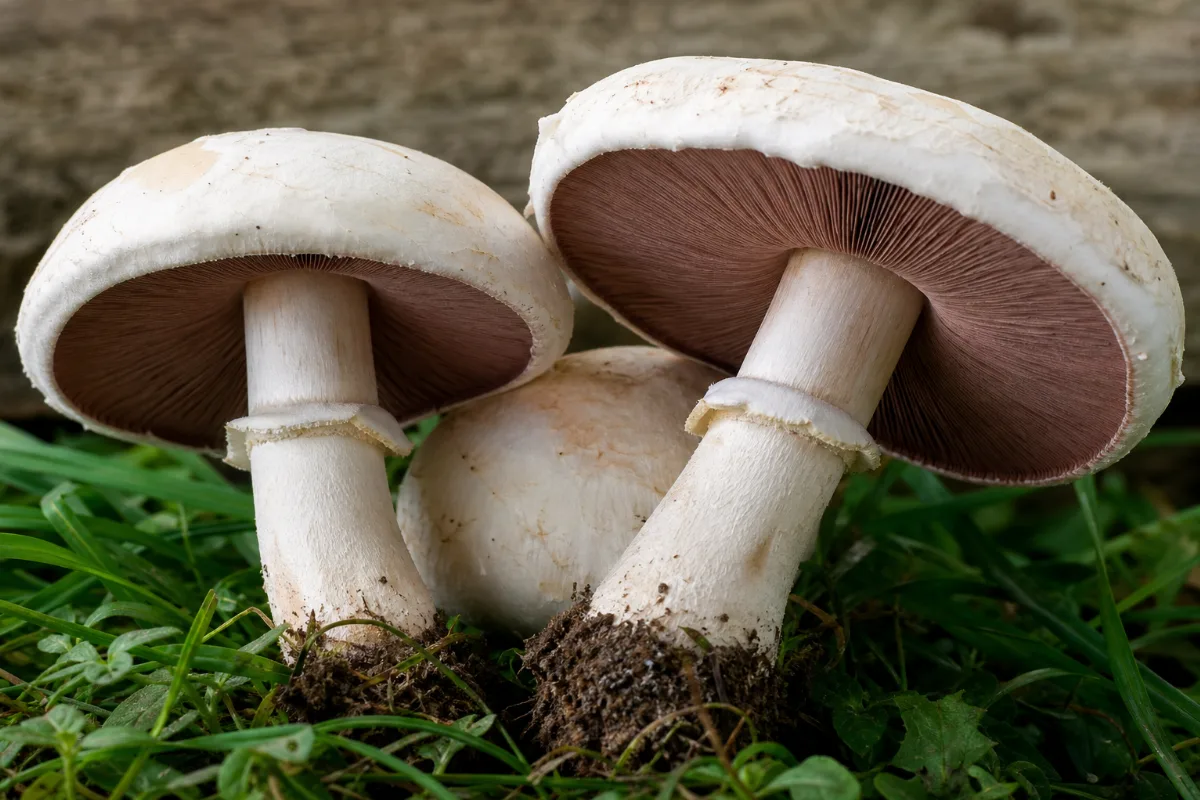
Mushrooms · Wild culinary mushroom
Horse mushroom
Agaricus arvensis · also called Schaeffer's field mushroom (name from our earlier summary, not from a source read for this page)
Horse mushroom is a large wild grassland mushroom and a close relative of the supermarket button mushroom. It is eaten as a food, but it is not a supplement and no human study shows a health benefit. The main danger is mistaking a deadly white Amanita or a toxic yellow-staining look-alike for it, and cooking does not make those safe. Wild specimens can also hold metals such as silver and cadmium from the soil.
General information, not medical advice. Last substantive update · Not medically reviewed. A named clinician has not signed off on this page. How this page is made
About Horse mushroom
Horse mushroom (Agaricus arvensis) is a wild relative of the button mushroom that is eaten as a food. It is not sold as a supplement and no human study shows a health benefit. The safety points matter far more: deadly and toxic look-alikes, metals taken up from the soil, and an unmeasured agaritine content.
Metals in wild specimens
Wild mushrooms take up metals from the soil. In a Polish study of 17 wild species, horse mushroom from city-park sites held the most silver of all (7.00 mg per kg dry weight), above the usual range the authors quote. It also held cadmium, lead, mercury and arsenic at about 0.4 to 1.8 mg per kg. Results depend on where it grew, and mushrooms from city, roadside or industrial ground are of most concern.
What it is
Agaricus arvensis is a fungus in the family Agaricaceae, and GBIF lists the name as accepted. It is a close relative of Agaricus bisporus, the cultivated button, cremini and portobello mushroom, and of the field mushroom. For the agaritine question for the cultivated mushroom, see the button mushroom page.
A 2020 review reports agaritinal, a compound related to agaritine, in significant amounts in this species, citing an older study. We found no measured value and no report of harm from eating it. Cooking is the cautious choice.
What the research shows
No study in people was found. Four papers measured what wild horse mushrooms contain, and the figures differ by place. In the laboratory, a methanol extract scored high on antioxidant tests and slowed some bacteria in a dish, and a purified protein slowed two cancer cell lines in a dish. In rats given a liver-damaging chemical, an extract shifted some blood markers. These are early results and do not show that eating the mushroom does anything.
At a glance
Traditional uses history, not proof
- Described as a wild edible mushroom in analysis papers from India, Turkey, Morocco and Poland. No medicinal tradition was found in the sources read.
Studied for research
- Eating it as a food: measured nutrient content, no health benefit shown, insufficient
- Antioxidant scores of lab extracts, laboratory only, insufficient
- Liver and kidney blood markers in injured rats, animal only, very-low
- Red blood cell measures in injured rats, animal only, very-low
- Bacterial growth in a dish, laboratory only, insufficient
- Cancer cells in a dish (purified protein), laboratory only, insufficient
Main compounds
- Phenols such as catechin, cinnamic acid and protocatechuic acid (lab extracts)
- A heat-stable lectin protein (lab)
- Linoleic acid and glutamic acid (food analysis)
- Agaritinal, related to agaritine (second-hand report; not measured)
- Silver, cadmium, lead, mercury and arsenic taken up from soil (contaminants)
Common forms
- Fresh or cooked wild mushroom
- Dried wild mushroom (drying does not remove the poisons of look-alikes)
- Laboratory extracts and a purified protein (research only; no product found)
Research links: Death cap and horse mushroom confusion (review abstract) · Agaricus edibility and agaritine (review abstract) · Death cap liver failure (review abstract) · Mushroom poisonings in South Sardinia (abstract) · Minerals and metals in wild mushrooms, Poland (abstract) · Poison Control: mushroom poisoning advice · Research Library · Genes & Biomarkers Library
What it is and its history
- Accepted scientific name
- Agaricus arvensis
- Naming authority
- Schaeff. (GBIF; published 1774, Fungorum Bavariae et Palatinatus Nascentium 4: 310)
- Synonyms
- Agaricus arvensis Schaeff. ex Secr.; Agaricus arvensis subsp. exquisitus (Vittad.) Cetto; Agaricus arvensis var. palustris A.H.Sm. and other varieties (first 8 of GBIF's list)
- Common names
- Horse mushroom (English); Schaeffer's field mushroom (English (from our earlier internal summary; no source opened))
- Family or group
- Agaricaceae (a fungus family), not a plant
- Classification
- Fungi > Basidiomycota > Agaricomycetes > Agaricales > Agaricaceae > Agaricus > Agaricus arvensis
- Native range
- Not checked. Samples in the papers came from India, Turkey, Poland and Morocco.
- Habitat
- Not stated in the sources beyond being a wild edible, saprobic mushroom (Table 1 of the Polish paper lists it as saprobic, from city parks).
- What it looks like
- Fruiting body: Deliberately not described: this page gives no identification help.
- Cultivation
- The commercial mushroom is the related Agaricus bisporus. Horse mushroom is described as wild-picked.
- Harvest and processing
- Not checked.
- Look-alikes and adulterants
- Name: Death cap and white destroying angels (Amanita); Note: Deadly. A 2024 review says the death cap can easily be confused with the horse mushroom, and a 2022 review says a lethal destroying angel can be confused with immature Agaricus. Amatoxins survive cooking and drying.; Name: Yellow-staining Agaricus (Agaricus xanthodermus and relatives); Note: Cause vomiting and diarrhoea within about 2 hours. Phenol is the likely cause.
- Sustainability and conservation
- Not checked.
Traditional use and history history, not clinical proof
| Tradition or era | Documented use | Source |
|---|---|---|
| Wild food, several countries | Eaten as a wild edible mushroom in the places studied (India, Turkey, Morocco and Poland papers). No medicinal tradition was found in the sources read. | p26199938 |
Traditional use shows how it was used. It does not show that it works or is safe today.
What is inside, and how it may work
What it contains and how those compounds act in cells and animals. Laboratory and animal mechanisms are not proven effects in people.
Main compounds
| Compound | Family | Where it is concentrated | Activity studied | Level of evidence |
|---|---|---|---|---|
| Lectin (30.4 kDa protein) | protein | Dried fruiting body Not stated | Heat-stable (to 90 C) clumping of red blood cells; slowed two cancer cell lines in a dish (lab only). 16 | Laboratory research |
| Phenols: catechin, cinnamic acid, protocatechuic acid, p-hydroxybenzoic acid | phenolic compounds | Fruiting body extract Catechin 16.359 and cinnamic acid 65.178 micrograms per g dry weight in one 2026 Turkish sample. | Antioxidant in test tubes; no human effect shown. 8 4 | Laboratory research |
| Linoleic acid and glutamic acid | fatty acid; amino acid | Fruiting body Linoleic acid 78.0% of fatty acids; glutamic acid 29.4 micrograms per mg dry weight in a Turkish survey. | Nutrient content only. 2 | Food survey |
| Agaritinal (agaritine-related) | hydrazine compound | Not stated Described as 'significant amounts' in a review citing an older study; no measured value. | Related compounds are suspected weak carcinogens in mice (review). 11 | Review |
| Silver, cadmium, lead, mercury, arsenic (contaminants, not natural constituents) | metals | Whole fruiting body Silver 7.00, cadmium 1.19, lead 1.76, mercury 0.421, arsenic 1.43 mg per kg dry weight in one Polish sample set; site-dependent. | Taken up from soil. 13 | Food survey |
Mechanisms, receptors and pathways
| Target or pathway | Gene or receptor | What was found | Level |
|---|---|---|---|
| Antioxidant enzymes in rat tissue | GSH, GPx, CAT, GST, GR | In CCl4-injured rats, extract-treated groups showed antioxidant enzyme and glutathione values nearer the controls (abstracts). 4 5 | Animal research |
| Cancer cell growth | not studied here | A purified lectin slowed HepG2 and MCF7 cells in a dish. 16 | Laboratory research |
| Toxicity of the yellow-staining look-alike | not applicable | Phenol in A. xanthodermus is high enough to account for its toxicity (abstract). 6 3 | Laboratory research |
Absorption, metabolism and elimination
- Absorption
- Not found.
- Distribution
- Not found.
- Metabolism
- Not found.
- Elimination
- Not found.
- Bioavailability
- Not established.
Isolated compounds versus whole extracts
The lab and rat work used solvent extracts, freeze-dried extracts or a purified protein, which are not like the food. No supplement was found.
Nutritional composition
Four papers report nutrient or mineral content from single wild collections (see Benefits). No official nutrient table was read, so no nutrition value is presented as typical.
2 very low certainty4 not enough evidence
What is Horse mushroom good for?
The uses people ask about and how strong the evidence is for each. None is proven in people. Read this together with the Safety tab.
Benefits, one by one
Each card is a research question, not a promise. Tap a goal to filter. Open a card to see the studies, doses and limits.
As a food (measured nutrient content)
Not enough evidenceResearchers have measured protein, fats and minerals in wild horse mushrooms. The numbers differ a lot from place to place and are not a health claim. No study tested whether eating it improves health.
4 studiesFresh, cooked or dried wild mushroom. Cooking is the cautious choice …
Studies, doses and limits
What the trials found
No study in people tested eating horse mushroom for any health outcome. Four analysis papers report content. One Himalayan collection had protein 22.63% and carbohydrate 57.12% (fresh or dry basis not stated). A Turkish survey found the most linoleic acid (78.0% of fatty acids) of 11 species in horse mushroom. In Poland, dry mushroom held potassium 19,000 and selenium 8.55 mg per kg. In Morocco, potassium was 44,130 and iron 580 mg per kg dry weight.
Results
Composition values only; they vary by place, basis and method
Effect sizes as reported
No health effect shown
Why this rating
There are no human studies of health outcomes, and each composition figure comes from a single wild sample set with its own method.
Form and dose studied
Fresh, cooked or dried wild mushroom. Cooking is the cautious choice for any Agaricus (compiler's reading of the agaritine review).
Who was studied
Not applicable
Limits
Wild samples vary; the same mushrooms also took up metals from the soil (see the Safety tab). Edible status applies only to a correctly identified mushroom.
Why researchers looked
Wild edible mushrooms are analysed to see what they contain.
Traditional use
It is a wild culinary mushroom. The sources read describe it as edible and give no traditional medicine use.
Proposed mechanism Other
Not applicable; this describes food content.
A proposed mechanism does not show that the effect happens in people.
The biggest risk with this mushroom is mistaking a deadly or toxic look-alike for it. See the Safety tab first.
Antioxidant activity (laboratory only)
Not enough evidenceIn a 2026 laboratory study a methanol extract of horse mushroom scored high on antioxidant tests. A rat study reported the same kind of result. Test-tube scores do not show a health effect in people.
2 studiesResearch methanol and similar extracts; no supplement was found.
Studies, doses and limits
What the trials found
No human study. In the 2026 paper, the methanol extract had total phenols of 27.14 mg gallic-acid equivalents per g dry weight and a FRAP score of 11.16 mmol per g, the highest of four wild fungi. In the rat paper a mushroom extract scored higher in test tubes than a reishi-shiitake-maitake reference extract.
Results
TPC 27.14 mg GAE/g DW; DPPH 4.92, ABTS 1.90, FRAP 11.16 mmol/g DW (methanol extract, 100 mg/mL)
Effect sizes as reported
High scores in a test tube; no effect in people shown
Why this rating
Laboratory extracts only, made with solvents and used at high concentration.
Form and dose studied
Research methanol and similar extracts; no supplement was found.
Who was studied
None (no people)
Limits
The extracts are not like food. Antioxidant scores do not predict benefit in the body.
Why researchers looked
Antioxidant scores are an early screen for many mushrooms.
Traditional use
None found in the sources read.
Proposed mechanism Laboratory research
Phenols such as catechin and cinnamic acid were found in the extract and may explain the scores (authors' suggestion, lab work).
A proposed mechanism does not show that the effect happens in people.
The biggest risk with this mushroom is mistaking a deadly or toxic look-alike for it. See the Safety tab first.
Liver and kidney blood markers in injured rats (animal only)
Very low certaintyIn rats given a liver-damaging chemical, a horse mushroom extract moved some blood markers of liver and kidney stress toward normal. This is animal work with a chemical injury and does not show liver protection in people.
1 studiesA research extract given to rats
Studies, doses and limits
What the trials found
No human study. The rat study reported that AST, ALT, LDH, urea and triglyceride levels were significantly shifted in extract-treated rats compared with rats given the chemical alone (abstract). The direction and size of each change were not given in the abstract.
Results
Significant changes in five blood markers versus chemical-only rats
Effect sizes as reported
Not stated in the abstract
Why this rating
One animal study with a chemical injury model, an extract, and no human data.
Form and dose studied
A research extract given to rats
Who was studied
Rats only
Limits
Rat results rarely carry over. Nothing here suggests that horse mushroom protects or treats the liver. Mistaking a deadly look-alike is the real liver danger (see Safety).
Why researchers looked
Researchers test extracts for protection against a standard chemical injury in rats.
Traditional use
None found in the sources read.
Proposed mechanism Animal research
The authors report changes in antioxidant enzymes and fat damage in brain, kidney and liver (rat tissue).
A proposed mechanism does not show that the effect happens in people.
The biggest risk with this mushroom is mistaking a deadly or toxic look-alike for it. See the Safety tab first.
Red blood cell measures in injured rats (animal only)
Very low certaintyIn rats given a damaging chemical, a freeze-dried horse mushroom extract reduced red blood cell breakage and improved several blood counts. This is animal work and says nothing about eating the mushroom.
1 studiesA freeze-dried research extract
Studies, doses and limits
What the trials found
No human study. In rats, the abstract reports lower red cell breakage in the extract groups than the chemical-only group and better counts for red cells, haemoglobin, white cells and platelets. These are group results from one study.
Results
Lower hemolysis (stated 22% and 34% in the two extract groups); improved blood counts
Effect sizes as reported
Rat blood values shifted toward the control group
Why this rating
One rat study, a chemical-injury model, an extract, no human data.
Form and dose studied
A freeze-dried research extract
Who was studied
Rats only
Limits
Same laboratory and model as the liver-marker study. Not a treatment.
Why researchers looked
The same research group looked at blood effects of the extract in the same rat model.
Traditional use
None found in the sources read.
Proposed mechanism Animal research
The authors measured antioxidant enzymes in red cells (glutathione, glutathione peroxidase and others) and report they moved toward normal.
A proposed mechanism does not show that the effect happens in people.
The biggest risk with this mushroom is mistaking a deadly or toxic look-alike for it. See the Safety tab first.
Growth of bacteria in a dish (laboratory only)
Not enough evidenceA methanol extract of horse mushroom slowed the growth of some bacteria in a dish, but only at high concentrations. It is not an antibiotic and the finding does not apply to eating the mushroom.
1 studiesA research methanol extract
Studies, doses and limits
What the trials found
No human or animal study. In the 2026 paper, the lowest minimum inhibitory concentration was 1.6 mg/mL for Enterococcus faecalis, 12.5 mg/mL for a multidrug-resistant Streptococcus pneumoniae strain, and 25 mg/mL for multidrug-resistant E. coli and Klebsiella pneumoniae strains. The hexane extract was much weaker.
Results
MIC 1.6 to 25 mg/mL for methanol extract against the strains named
Effect sizes as reported
Growth stopped in a dish at high concentrations only
Why this rating
Laboratory screening with strong solvent extracts at high concentrations; the other fungi in the paper did better.
Form and dose studied
A research methanol extract
Who was studied
None
Limits
Not tested in animals or people. Nothing suggests horse mushroom treats an infection.
Why researchers looked
Extracts of wild fungi are screened for antibacterial activity.
Traditional use
None found in the sources read.
Proposed mechanism Laboratory research
The authors link the activity to phenols in the extract; this is a correlation in the lab, not a proven cause.
A proposed mechanism does not show that the effect happens in people.
The biggest risk with this mushroom is mistaking a deadly or toxic look-alike for it. See the Safety tab first.
Cancer cells in a dish (laboratory only)
Not enough evidenceA purified protein from dried horse mushroom slowed the growth of two human cancer cell lines in a dish. This is not a treatment, and eating the mushroom is not shown to do this.
1 studiesA purified protein, not a food or product
Studies, doses and limits
What the trials found
No animal or human study. The abstract reports growth of HepG2 and MCF7 cells was slowed by the lectin, with IC50 values of 1.64 and 0.82 micromolar.
Results
IC50 1.64 micromolar (HepG2) and 0.82 micromolar (MCF7)
Effect sizes as reported
Cell-dish result only
Why this rating
Two cell lines, a purified protein, one laboratory, no healthy-cell comparison in the abstract.
Form and dose studied
A purified protein, not a food or product
Who was studied
None
Limits
Dish results rarely carry over to people. This page does not suggest horse mushroom treats or prevents cancer.
Why researchers looked
Cell tests are an early screen for anticancer research.
Traditional use
None found in the sources read.
Proposed mechanism Laboratory research
The protein is a lectin, a sugar-binding protein that clumps red blood cells. How it slows cells was not shown in the abstract.
A proposed mechanism does not show that the effect happens in people.
The biggest risk with this mushroom is mistaking a deadly or toxic look-alike for it. See the Safety tab first.
Connections to the rest of health
How Horse mushroom connects to the rest of our health knowledge graph. Every link says what kind of connection it is. A safety link (for example to the liver) is a warning, not a benefit. A study that merely mentions a topic never creates a benefit link.
Explore every connection: goals, body systems, organs, symptoms, genes
B. Body systems
| Connected to | Kind of connection | Evidence status | Context | Studies |
|---|---|---|---|---|
| Digestive system | Adverse effect or risk | Moderate certainty | Vomiting and diarrhoea within about 2 hours. Preparation or compound: Yellow-staining Agaricus look-alikes; A. arvensis in register reports (second-hand) |
10 6 11 |
C. Body parts and organs
G. Root causes and contributing factors
| Connected to | Kind of connection | Evidence status | Context | Studies |
|---|---|---|---|---|
| Heavy metal exposure | Low certainty | Silver, cadmium, lead, mercury and arsenic found in one Polish sample set; depends on the soil. Preparation or compound: Wild horse mushroom |
13 |
I. Biomarkers
| Connected to | Kind of connection | Evidence status | Context | Studies |
|---|---|---|---|---|
| Antioxidant scores of a laboratory extract (FRAP, DPPH, ABTS) | Biological association | Not enough evidence | Measured in trials: raised. A lab change is not the same as a health benefit. | 8 |
| AST, ALT and LDH in injured rats | Biological association | Very low certainty | Measured in trials: lowered. A lab change is not the same as a health benefit. | 4 |
| Red blood cell breakage (hemolysis) in injured rats | Biological association | Very low certainty | Measured in trials: lowered. A lab change is not the same as a health benefit. | 5 |
| Cancer cell growth in a dish (IC50) | Biological association | Not enough evidence | Measured in trials: lowered. A lab change is not the same as a health benefit. | 16 |
L. Active compounds
| Connected to | Kind of connection | Evidence status | Context | Studies |
|---|---|---|---|---|
| Lectin (30.4 kDa protein) | Biological association | In vitro | Heat-stable (to 90 C) clumping of red blood cells; slowed two cancer cell lines in a dish (lab only). Preparation or compound: Dried fruiting body |
16 |
| Phenols: catechin, cinnamic acid, protocatechuic acid, p-hydroxybenzoic acid | Biological association | In vitro | Antioxidant in test tubes; no human effect shown. Preparation or compound: Fruiting body extract |
8 4 |
| Linoleic acid and glutamic acid | Biological association | Food survey | Nutrient content only. Preparation or compound: Fruiting body |
2 |
| Agaritinal (agaritine-related) | Biological association | Review | Related compounds are suspected weak carcinogens in mice (review). Preparation or compound: Not stated |
11 |
| Silver, cadmium, lead, mercury, arsenic (contaminants, not natural constituents) | Biological association | Food survey | Taken up from soil. Preparation or compound: Whole fruiting body |
13 |
Each connection is stored with the ingredient, the connected record, the kind of connection, the evidence status, the supporting studies, the preparation or compound involved, and a review date (last reviewed October 25, 2026).
Evidence at a glance: what changed in 4 lab markers
Tap a number to show only those markers. Counts are markers, not people.
The evidence
The research centre for Horse mushroom. Every record here was checked against PubMed or the publisher's page; we never list a study we have not verified.
Evidence by outcome
Bars show how many studies we found for each outcome, not how well it works. People are added up across trials only (reviews are not added, to avoid double counting).
How we rate evidence
High certainty
Several well-run trials or reviews agree; further research is unlikely to change the picture much.
Moderate certainty
Good trials point the same way, but some doubt remains.
Low certainty
Small, short or inconsistent trials. The finding could change with better research.
Very low certainty
Very little or very weak human data. Treat as a possibility only.
Mixed findings
Trials or reviews disagree with each other.
Not enough evidence
Not enough human research to say either way.
Evidence against
Good research found no benefit, or found harm.
We take the reviewers' own risk-of-bias and GRADE statements where they exist, and otherwise judge from study size, design, consistency, directness and whether a product matches what is sold. Many publications do not make evidence high. Method note: We read PubMed records and abstracts for 15 papers and one public safety page (laboratory and rat studies, four food-analysis papers, one hospital case series, three reviews of mushroom toxins, and chemistry or taxonomy papers on toxic Agaricus and Amanita), read the Polish, Moroccan, Himalayan and 2026 Turkish papers and several reviews in full text from Europe PMC, and checked the species name in GBIF. Index Fungorum and official regulators were not read. Certainty ratings are the compiler's own reading.
Study library: every study we checked 17
| Study | Design | People | Product, dose, length | Result |
|---|---|---|---|---|
| Alvarado 2022 Amanita Section Phalloideae Species in the Mediterranean Basin: Destroying Angels Reviewed. Biology (Basel) · PMID 35625498 · DOI |
Other n/a |
Taxonomy and poisoning review of white deadly Amanita species | n/a n/a Not applicable n/a · vs n/a |
The abstract says amatoxin-containing mushrooms cause most of the deadly mushroom poisonings in Europe. In a species note of the full text, one lethal destroying angel is described as easily confused with immature specimens of Agaricus. Review; no new data about Agaricus Methods, limits and fundingOutcomes: Species, amatoxins, poisoning Limitations: The Agaricus remark sits in the notes of a species entry; which entry it belongs to is not clear from the text extract we read, so we state it for white deadly Amanita in general. Funding and conflicts: The authors declare no conflict of interest. Read: abstract and full text |
| Ayaz 2011 Fatty acid and amino acid compositions of selected wild-edible mushrooms consumed in Turkey. International Journal of Food Sciences and Nutrition · PMID 21166481 · DOI |
Other n/a |
11 wild edible mushroom species from the East Black Sea region of Turkey | Wild Agaricus arvensis fruiting body, chemical analysis fruiting body Not applicable n/a · vs n/a |
The abstract says all species were high in linoleic acid and glutamic acid, and that the highest linoleic acid (78.0% of fatty acids) and glutamic acid (29.4 micrograms per mg dry weight) were found in Agaricus arvensis. It reports an average of 148 micrograms per mg dry weight of amino acids across species. Composition only; no health effect tested Methods, limits and fundingOutcomes: Fatty acids and amino acids Limitations: Analytical survey of wild-collected samples. The abstract's general praise of the mushrooms as a good nutrient source is the authors' view and was not tested in people. Funding and conflicts: Non-US government research support listed in PubMed; no industry link stated. Read: abstract |
| Boxshall 2021 A field-based investigation of simple phenol variation in Australian Agaricus xanthodermus. Mycologia · PMID 34494944 · DOI |
Other n/a |
Wild Agaricus xanthodermus collected in Australia | n/a fruiting body: cap, stalk, young and mature Not applicable n/a · vs n/a |
The abstract says A. xanthodermus and other yellow-staining species cause poisonings that need treatment, usually with stomach and bowel irritation of varying severity. Phenol was higher in the cap than the stalk, higher in mature than young mushrooms, and higher on woody mulch than on lawns. The authors suggest toxicity varies partly because of this. Toxin level varies between mushrooms, so severity of illness varies Methods, limits and fundingOutcomes: Phenol, hydroquinone and catechol levels Limitations: Australian study of one species. Abstract read only. Funding and conflicts: Non-US government research support listed in PubMed; no industry link. Read: abstract |
| Dogan 2018 Investigation of the protective effects of horse mushroom (Agaricus arvensis Schaeff.) against carbon tetrachloride-induced oxidative stress in rats. Molecular Biology Reports · PMID 29931536 · DOI |
Animal research rat |
Rats given the liver-damaging chemical carbon tetrachloride (CCl4), with or without mushroom extract; also test-tube antioxidant tests | Extract of Agaricus arvensis (extract type not stated in the abstract) fruiting body (not stated in the abstract) Not applicable n/a · vs n/a |
The abstract says the extract had higher antioxidant capacity in test tubes than a reishi-shiitake-maitake reference extract, and that in the CCl4 rats it significantly shifted AST, ALT, LDH, urea and triglyceride levels compared with the CCl4-only group. Antioxidant enzyme activities were regulated in brain and liver, not kidney, at the 100 mg per kg level. The extract contained protocatechuic and p-hydroxybenzoic acids, benzaldehyde, palmitic and linoleic acids, and potassium, silicon, magnesium and sodium. Rat markers moved toward normal after a chemical injury; no human data Methods, limits and fundingOutcomes: Liver and kidney blood markers (AST, ALT, LDH, urea, triglycerides), fat damage and antioxidant enzymes in brain, kidney and liver Limitations: Animal study with a chemical injury model; extract not like the food. The abstract does not give the direction or size of each marker change. The authors' conclusion that the mushroom could be used for nutritional products goes beyond the data. Funding and conflicts: Funded by Van Yuzuncu Yil University (PubMed grant listing); no industry link stated. Read: abstract |
| Dogan 2018 Lyophilized Extract of the Horse Mushroom, Agaricus arvensis (Agaricomycetes), Delays Erythrocyte Hemolysis and Stabilizes Some Blood Parameters in Carbon Tetrachloride-Intoxicated Rats. International Journal of Medicinal Mushrooms · PMID 30806264 · DOI |
Animal research rat |
Four groups of rats: controls, chemical-injured, and chemical-injured plus the extract at two levels | Freeze-dried Agaricus arvensis extract fruiting body (not stated in the abstract) 100 mg per kg or 500 mg per kg in rats (animal study; not advice for people) n/a · vs n/a |
The abstract says red cell breakage in salt solution was lower in the control group and in the two extract groups than in the chemical-only group (by 38%, 22% and 34% as stated), and that the extract improved red cell count, haemoglobin, haematocrit, white cell and platelet counts and red cell distribution width. The extract also moved reduced glutathione and glutathione peroxidase toward the controls. Rat blood measures moved toward the control group after a chemical injury Methods, limits and fundingOutcomes: Red blood cell breakage (hemolysis), blood counts, antioxidant enzymes Limitations: Rat study with a chemical injury model; the abstract lumps comparisons together and the paper's group sizes were not read. The authors' phrase 'therapeutic effects' is not supported for people. Funding and conflicts: Not stated in the abstract Read: abstract |
| Gill 1984 Constituents of Agaricus xanthodermus Genevier: the first naturally endogenous azo compound and toxic phenolic metabolites. Zeitschrift fuer Naturforschung C · PMID 6543409 · DOI |
Other n/a |
Fresh Agaricus xanthodermus | n/a fruiting body Not applicable n/a · vs n/a |
The abstract says phenol is present in the fruiting bodies in a high enough concentration to account for the toxicity of A. xanthodermus. Chemistry of a toxic look-alike species Methods, limits and fundingOutcomes: Chemical constituents Limitations: Old laboratory paper; abstract read only. Funding and conflicts: Not stated Read: abstract |
| Gouvinhas 2024 The most dreadful mushroom toxins: a review of their toxicological mechanisms, chemical structural characteristics, and treatment. EXCLI Journal · PMID 39165585 · DOI |
Narrative review n/a |
Review of dangerous mushroom toxins | n/a n/a Not applicable n/a · vs n/a |
Full text says the death cap (Amanita phalloides) 'can easily be confused with the edible Horse Mushroom (Agaricus arvensis)' and with Tricholoma equestre, citing Garcia 2015. It says amatoxins are heat stable, so drying or boiling does not inactivate them. It describes a latent period of 6 to 48 hours before the stomach and bowel phase, and says severe stomach and bowel symptoms starting 8 to 24 hours after a meal suggest amatoxin poisoning. Review; no new data Methods, limits and fundingOutcomes: Toxins, mechanisms and treatment Limitations: Narrative review. The statement about the horse mushroom is a citation of an earlier paper that was not opened. Funding and conflicts: The authors declare no conflict of interest. Read: abstract and full text |
| Ildiz 2026 Phenolic-Rich Wild Edible Macrofungi: Antimicrobial Activity and Antioxidant Potential. Molecules · PMID 41900077 · DOI |
Laboratory research in-vitro |
Four wild fungi collected in Turkiye in 2022 to 2023, including Agaricus arvensis (identified by form and by DNA sequence); no people | Methanol and hexane extracts of A. arvensis fruiting body (not stated in the abstract) Not applicable n/a · vs n/a |
Full text: the A. arvensis methanol extract (100 mg/mL) had total phenols 27.14 mg gallic-acid equivalents per g dry weight, DPPH 4.92, ABTS 1.90 and FRAP 11.16 mmol per g dry weight, the highest FRAP of the four fungi. Catechin 16.359 and cinnamic acid 65.178 micrograms per g dry weight were found. For antibacterial tests the methanol extract needed 1.6 mg/mL to stop Enterococcus faecalis growth, 12.5 mg/mL for a multidrug-resistant Streptococcus pneumoniae strain and 25 mg/mL for multidrug-resistant E. coli and Klebsiella pneumoniae. Hexane extracts were weaker. Test-tube scores only; no effect in people or animals Methods, limits and fundingOutcomes: Total phenols, antioxidant tests (DPPH, ABTS, FRAP, CUPRAC), antibacterial MIC tests, LC-MS/MS and GC-MS Limitations: Laboratory screening at high extract concentrations (milligrams per mL). Antioxidant scores and growth tests in a dish do not show an effect in people. One collection of each fungus. Funding and conflicts: The authors declare no financial interests; the work received no external funding. Read: abstract and full text |
| Kayes 2024 Amanita phalloides-Associated Liver Failure: Molecular Mechanisms and Management. International Journal of Molecular Sciences · PMID 39684738 · DOI |
Narrative review n/a |
Review of death cap poisoning | n/a n/a Not applicable n/a · vs n/a |
The abstract says death cap poisoning starts with delayed stomach and bowel symptoms that mimic ordinary gastroenteritis, followed by severe liver damage and liver failure, and that treatment includes supportive care and, in some people, liver transplantation. The full text says there is a symptom-free lag of 6 to 18 hours, that the stomach and bowel phase starts 6 to 24 hours after eating, that the death cap is commonly mistaken for edible mushrooms, that the toxins are stable in cooking, and that the death rate of death cap poisoning is 10 to 20%. Review; no new data Methods, limits and fundingOutcomes: Toxicity course, treatment Limitations: Narrative review of small case series. Funding and conflicts: The authors declare no conflicts of interest. Read: abstract and full text |
| La Rosa 2024 Epidemiology and clinical aspect of mushroom poisonings in South Sardinia: A 10-year retrospective analysis (2011-2021). Food Science and Nutrition · PMID 38268883 · DOI |
Case series |
164 164 mushroom poisoning cases in South Sardinia, Italy, 2011 to 2021 |
n/a n/a Not applicable n/a · vs n/a |
Species were identified in 162 of 164 cases. 81 cases were due to toxic species. Agaricus xanthodermus caused 15 cases (18% of the toxic-species cases); in the table its symptoms were abdominal pain and cramps, diarrhoea, nausea, vomiting, tremor and vertigo, with a mean hospital stay of 1 day. Yellow-staining Agaricus was one of the two most common toxic causes in this region Methods, limits and fundingOutcomes: Species involved, symptoms, timing Limitations: Regional hospital and inspectorate records from one Italian area; cannot give a rate for the general public. Funding and conflicts: The authors declare no conflict of interest. Read: abstract and full text |
| Lagrange 2020 Warning on False or True Morels and Button Mushrooms with Potential Toxicity Linked to Hydrazinic Toxins: An Update. Toxins (Basel) · PMID 32751277 · DOI |
Narrative review n/a |
Literature review of toxins in false and true morels and Agaricus mushrooms | n/a n/a Not applicable n/a · vs n/a |
Full text says Agaricus species can cause a stomach and bowel illness (diarrhoea, vomiting, cramps, nausea) 1 to 2 hours after eating, from an unknown irritant. It names A. xanthodermus and A. moelleri, and says A. arvensis, A. augustus, A. californicus, A. hondensis, A. placomyces and A. praeclaresquamosus were previously reported from North American poison case registers. It says agaritinal has been shown in significant amounts in A. arvensis, A. augustus, A. campestris and A. macrosporus, citing an older study that was not opened here. The abstract concludes that button mushrooms should not be eaten crude or poorly cooked. An erratum was published for this paper in 2022. Review; no new measurement for this species Methods, limits and fundingOutcomes: Edibility, toxins and poisonings with morels and Agaricus species Limitations: Narrative review. The statements about A. arvensis are second-hand: the register reports and the agaritinal figure were not opened, and no measured value or case count is given for A. arvensis. An erratum exists; its content was not read. Funding and conflicts: The authors declare no conflict of interest. Read: abstract and full text |
| Lopez 2024 Quantification of Minerals in Edible Mushrooms via Optimized Microwave-Assisted Digestion: Nutritional Contributions of Fe, Mg, Na, K, and Ca. Foods · PMID 39766993 · DOI |
Other n/a |
24 Wild Agaricus arvensis (24 specimens) from Bouhachem, Tangier, Morocco, collected 2019, identified by mycologists; also other mushrooms from Spain and Morocco |
Freeze-dried wild Agaricus arvensis fruiting body Not applicable n/a · vs n/a |
Table 6 of the full text gives for A. arvensis, in mg per kg dry weight (mean of 2 runs): magnesium 1369, iron 580, sodium 1052, potassium 44,130 and calcium 831. Mineral values for one wild sample set; no health effect tested Methods, limits and fundingOutcomes: Iron, magnesium, sodium, potassium, calcium Limitations: One sample set from one place; two analytical runs. The authors' suggestion that mushrooms could feed food supplements is not tested. Funding and conflicts: The authors declare no conflicts of interest. Read: abstract and full text |
| Mleczek 2021 Family and species as determinants modulating mineral composition of selected wild-growing mushroom species. Environmental Science and Pollution Research · PMID 32812153 · DOI |
Other n/a |
17 wild mushroom species collected in Poland in 2018; Agaricus arvensis came from 9 city-park collection sites, 3 fruit bodies per sample | Wild Agaricus arvensis fruiting body, dried at 65 C, acid-digested fruiting body Not applicable n/a · vs n/a |
Full text gives for A. arvensis, in mg per kg dry weight: potassium 19,000; phosphorus 15,800; magnesium 827; calcium 340; selenium 8.55; zinc 252; and, among elements with possible health harm, silver 7.00 (the highest of the 17 species), cadmium 1.19, lead 1.76, mercury 0.421 and arsenic 1.43. The authors list usual literature ranges of up to 5 mg per kg for silver and cadmium and lead, and say A. arvensis is known to accumulate silver. Mineral and metal content of one city-park sample set; no health effect tested Methods, limits and fundingOutcomes: 63 mineral elements Limitations: Mean values only; one country, one year, city-park sites; levels depend on the soil. The paper does not say whether any value exceeded a legal limit and we did not check. Funding and conflicts: Funded by the Polish Ministry of Science and Higher Education; no industry link stated. Read: abstract and full text |
| National Capital Poison Center 2026 Poison Control (US National Capital Poison Center): Mushroom poisoning: Don't invite 'the death angel' to dinner poison.org · Source |
Regulator statement n/a |
Public safety article | n/a n/a Not applicable n/a · vs n/a |
The page says: never pick and eat wild mushrooms unless identified by an expert; look-alikes can fool you; cooking does not make a poisonous mushroom safe; even non-poisonous mushrooms can cause unpleasant reactions in people who are sensitive; symptoms can be delayed for many hours; if you think someone ate a wild mushroom, call a poison center right away at 1-800-222-1222 (US). Advice statement Methods, limits and fundingOutcomes: Wild mushroom safety advice Limitations: US advice; a poison centre number outside the US will differ. Page read 2026-10-25; page date not given beyond the 2026 site footer. Funding and conflicts: Non-profit poison centre; no product promoted. Read: full text |
| Sharma 2015 Chemical, Bioactive, and Antioxidant Potential of Twenty Wild Culinary Mushroom Species. BioMed Research International · PMID 26199938 · DOI |
Other n/a |
Twenty wild culinary mushroom species from the northern Himalayas; Agaricus arvensis collected near Shimla (Himachal Pradesh, India), 2300 m | Wild Agaricus arvensis fruiting body, chemical analysis fruiting body Not applicable n/a · vs n/a |
Full text gives for Agaricus arvensis: protein 22.63%, crude fat 0.22%, fibres 2.11%, ash 0.96% and carbohydrate (by difference) 57.12%. The paper does not say whether these are fresh or dry weight. Glucose was 64.12% of the monosaccharides, the highest of the twenty species. The abstract says all species were rich in protein and carbohydrate and low in fat. Nutrient values for one wild collection; no health effect tested Methods, limits and fundingOutcomes: Protein, fat, fibre, ash, carbohydrate, sugars, antioxidant tests Limitations: Single wild collection from one place; basis (fresh or dry) not stated, so values cannot be compared with food tables. Species identification method was not checked. Funding and conflicts: Not stated in the abstract; the PubMed record lists non-US government research support. Read: abstract and full text |
| Zhao 2011 Isolation and characterization of a novel thermostable lectin from the wild edible mushroom Agaricus arvensis. Journal of Basic Microbiology · PMID 21298684 · DOI |
Laboratory research in-vitro |
Lectin protein purified from dried Agaricus arvensis; cultured human cancer cell lines (no people) | Purified lectin protein from dried fruiting bodies fruiting body, dried Not applicable n/a · vs n/a |
The abstract says a 30.4 kDa lectin was isolated, its blood-cell-clumping activity was stable up to 90 C, and it slowed growth of HepG2 liver cancer cells (IC50 1.64 micromolar) and MCF7 breast cancer cells (IC50 0.82 micromolar) in a dish. It did not inhibit HIV reverse transcriptase and had no antifungal activity. Cell-dish result for a purified protein; no effect in people shown Methods, limits and fundingOutcomes: Protein properties; effect on HepG2 and MCF7 cancer cell growth, HIV enzyme, fungi Limitations: Purified protein, not food. Cell-dish results rarely carry over to people. The abstract does not report effect on healthy cells. Funding and conflicts: Non-US government research support listed in PubMed; no industry link stated. Read: abstract |
| n/a 2026 GBIF Backbone Taxonomy record: Agaricus arvensis Schaeff. (usage key 5243403), checked by API 2026-10-25 n/a · Source |
Database record n/a |
n/a | n/a n/a Not applicable n/a · vs n/a |
Agaricus arvensis Schaeff. is an ACCEPTED species in Fungi, Basidiomycota, Agaricomycetes, Agaricales, Agaricaceae, genus Agaricus. Exact match, confidence 99. Identity record only Methods, limits and fundingOutcomes: Name status and classification Limitations: Index Fungorum was not read. Funding and conflicts: Independent public information source Read: full text |
What we do not know yet
- No human study of any health effect of horse mushroom was found.
- Agaritine and an official nutrient table for this species were not found; composition figures come from single wild sample sets.
- The poison-register reports listing A. arvensis for stomach upset were not opened.
- No pesticide, microbe or radioactivity test was read; metal figures come from one Polish sample set.
- Reviews' statements on look-alikes are quoted from earlier papers we did not open.
How new research is added
New studies are found by a saved PubMed search and placed in a review queue. A person reads each one before it changes any evidence rating or safety wording. New publications never change ratings automatically.
Lab markers
What changed in blood or saliva tests during trials. A changed number is not the same as feeling or being healthier, and we give no "normal ranges".
Other 4
Antioxidant scores of a laboratory extract (FRAP, DPPH, ABTS)
Raised in trials
Test-tube scores for how strongly an extract mops up or reduces reactive chemicals. They are lab measures, not blood tests in a person.
Not enough evidenceResults and what it means
Why it was measured
Used to compare extracts in the lab.
Statistical vs. clinical meaning
Higher than the two truffle samples in the same paper; not compared with food or with people.
Safety implication
None for people; no human data.
| Study | Result | People | Product |
|---|---|---|---|
| 8 | A. arvensis methanol extract: DPPH 4.92, ABTS 1.90, FRAP 11.16 mmol per g dry weight; total phenols 27.14 mg GAE per g. | Laboratory extract; no people | Methanol extract at 100 mg/mL |
AST, ALT and LDH in injured rats
Lowered in trials
Blood enzymes that rise when liver cells are damaged. Here they were measured in rats given a liver-damaging chemical.
Very low certaintyResults and what it means
Why it was measured
Standard markers of liver injury in animal studies.
Statistical vs. clinical meaning
Reported as significant by the authors.
Safety implication
None for people; animal data.
| Study | Result | People | Product |
|---|---|---|---|
| 4 | The abstract says the extract produced significant regulative effects in AST, ALT, LDH, urea and triglyceride levels compared with the chemical-only group; direction and size not stated in the abstract. | Rats given CCl4 | Agaricus arvensis extract |
Red blood cell breakage (hemolysis) in injured rats
Lowered in trials
How easily red blood cells break open in salt water. It was measured in rats given a damaging chemical.
Very low certaintyResults and what it means
Why it was measured
A marker of red cell fragility and oxidative damage in animal studies.
Statistical vs. clinical meaning
Reported by the authors as improved.
Safety implication
None for people; animal data.
| Study | Result | People | Product |
|---|---|---|---|
| 5 | Hemolysis in 0.6% salt solution was lower in the extract groups than in the chemical-only group (22% and 34% as stated in the abstract). | Rats given CCl4 | Freeze-dried Agaricus arvensis extract at two levels |
Cancer cell growth in a dish (IC50)
Lowered in trials
The amount of a substance needed to cut cell growth by half in a culture dish. A lower number means more potent in the dish.
Not enough evidenceResults and what it means
Why it was measured
A first screen for anticancer research.
Statistical vs. clinical meaning
IC50 values as reported; no comparison with healthy cells in the abstract.
Safety implication
None for people.
| Study | Result | People | Product |
|---|---|---|---|
| 16 | Purified lectin IC50 1.64 micromolar for HepG2 and 0.82 micromolar for MCF7 cells. | Human cell lines (no people) | Purified lectin |
Safety
What studies and official sources say about side effects, medicines and who should check first. Each point shows what kind of evidence it comes from.
Main points to know 6
- Danger first: a deadly white Amanita can be mistaken for horse mushroom. A 2024 toxin review says the death cap can easily be confused with the edible horse mushroom (Agaricus arvensis), and a 2022 review says a lethal destroying angel can easily be confused with immature Agaricus. The poisons (amatoxins) are not destroyed by cooking, boiling or drying. After a quiet gap that reviews give as 6 to 18 hours, there is vomiting and diarrhoea, and then the liver can fail. One review gives the death rate as 10 to 20%, and some people need a liver transplant. This page gives no way to tell mushrooms apart. Never eat a wild mushroom unless an expert has identified it in person. See also the field mushroom and button mushroom pages for the same family. Narrative review 7 1 9 14
- Toxic yellow-staining Agaricus relatives cause stomach and bowel illness. Agaricus xanthodermus and other yellow-staining relatives cause vomiting, diarrhoea and cramps, usually within 1 to 2 hours. In South Sardinia they caused 15 hospital-recorded poisonings in 10 years (18% of the toxic-species cases), with a mean hospital stay of 1 day. Phenol in the mushroom is high enough to account for the toxicity, and its level varies with age, part and growing place, so severity varies. Case series 10 6 3 11
- Horse mushroom itself has been listed in stomach-upset reports. A 2020 review lists A. arvensis among Agaricus species that appeared in North American poison case registers for stomach and bowel illness (diarrhoea, vomiting, cramps, nausea) 1 to 2 hours after eating. The review does not give a case count, and we did not open the registers. Poison Control also says even non-poisonous mushrooms can cause unpleasant reactions in people who are sensitive. So a correctly identified horse mushroom is not risk-free for everyone. Narrative review 11 14
- Wild mushrooms take up metals; silver was high in a Polish study. In a Polish study of 17 wild species, horse mushroom from city-park sites held the highest silver (7.00 mg per kg dry weight), against a usual literature range of up to 5 that the authors quote. It also held cadmium 1.19, lead 1.76, mercury 0.421 and arsenic 1.43 mg per kg dry weight. Levels depend on the soil, and mushrooms from city, roadside or industrial ground are of most concern. No illness from metals in horse mushroom eaters was found in the sources read. Food survey 13
- Cooking is the cautious choice; agaritine is not measured for this species. A 2020 review reports agaritinal, a compound related to agaritine (a suspected weak carcinogen in mice), in significant amounts in A. arvensis, citing an older study. It advises against eating button mushrooms crude or poorly cooked. We found no measured agaritine value for horse mushroom and no study showing harm from eating it. Narrative review 11
- No data for pregnancy, breastfeeding or allergy; children are at risk from wild mushrooms in general. No source we read tests horse mushroom in pregnancy or breastfeeding, or reports a horse-mushroom allergy. In the Sardinian series 6 poisonings were in children and adolescents who ate wild mushrooms unintentionally. Insufficient 10
Side effects 4
| Effect | How often | Severity and recovery | Evidence |
|---|---|---|---|
| Delayed vomiting and diarrhoea, then liver failure, after a white deadly Amanita Symptoms begin after a quiet gap of 6 or more hours and can look like a simple stomach bug. | Not applicable to horse mushroom; look-alike risk. Death rate 10 to 20% in the review | high Some recover; some need a liver transplant | Narrative review 9 7 |
| Vomiting, diarrhoea, cramps and nausea after a yellow-staining look-alike This is a look-alike effect. | Common in those poisoned; onset 1 to 2 hours (review) and about 2 hours (Sardinia) | moderate Mean hospital stay 1 day in Sardinia | Case series 10 11 |
| Stomach and bowel upset reported for A. arvensis Second-hand: the registers were not opened and no case count is available. | Not given; listed in poison-register reports quoted by a review | moderate Not stated | Narrative review 11 |
| Metal intake (silver, cadmium, lead, mercury, arsenic) No illness from metals in horse mushroom eaters has been reported in the sources read. | Measured in mushrooms, not in eaters | unknown Not applicable | Food survey 13 |
Liver
No liver injury from horse mushroom itself was found. Liver failure is the main danger of a look-alike, the death cap and related white Amanita species, whose amatoxins block a key liver enzyme (RNA polymerase II) and are not destroyed by cooking or drying. 9 7
How often. Not applicable to horse mushroom; the frequency of look-alike poisoning is not given in the sources we read.
Monitoring. Anyone who ate a wild mushroom and has vomiting or diarrhoea, especially starting 6 or more hours after the meal, needs urgent medical care even if the symptoms ease. Keep any leftover mushroom or remains for the hospital.
This is a safety connection. It is not evidence that Horse mushroom supports liver health.
Medicines and supplements 1
| With | Why it matters | Importance | Evidence | What to do |
|---|---|---|---|---|
| Medicines in general prescription | None found | No source we read describes an interaction between eating horse mushroom and any medicine. That is absence of evidence, not proof of safety. | Gap Not enough evidence | Ask a pharmacist if unsure. |
Who should check first 5
| Situation | Advice | Evidence |
|---|---|---|
| Any doubt about the identity of a wild mushroom | Do not eat it. Look-alikes can be deadly and cooking or drying does not make them safe. | Narrative review 7 9 1 14 |
| Children | Wild mushrooms are a poisoning risk for children; keep them away from wild mushrooms. | Case series 10 |
| Pregnancy and breastfeeding | No data. Ask a clinician rather than assume it is safe. | Insufficient |
| People who react to mushrooms | Poison Control says non-poisonous mushrooms can still cause unpleasant reactions in sensitive people. | Regulator statement 14 |
| Mushrooms from roadsides, city parks or industrial ground | Metal levels depend on the soil; the Polish study sampled city-park sites. | Food survey 13 |
Overdose, product quality and regulators
Summary. Horse mushroom itself has no described severe poisoning in the sources we read, but it was listed in stomach-upset registers according to one review. The documented dangers are look-alikes, agaritine-related compounds that are not measured for this species, and metals taken up from soil.
Animal. Rats were given extracts in two lab studies; no toxicity result is reported in the abstracts we read.
Human doses studied. None; no trial exists. No amounts are given or advised.
High dose or long term signals. Not studied.
Overdose response. Not applicable. For suspected poisoning follow the urgent signs.
Genotoxicity. Not read for this species.
Toxic or hazardous parts. Fungus: the fruiting body is the part eaten.
Wild-picked mushrooms reflect their soil. One Polish study measured metals in horse mushroom. No pesticide, microbe or radioactivity test of this species was read.
Silver, cadmium, lead, mercury, arsenic, Poland. City-park samples (9 sites, 3 fruit bodies each): silver 7.00 (highest of 17 species), cadmium 1.19, lead 1.76, mercury 0.421 and arsenic 1.43 mg per kg dry weight. The authors quote usual literature ranges of up to 5 mg per kg for silver, cadmium and lead. 13
| Body | Action | Date |
|---|---|---|
| US National Capital Poison Center (Poison Control) (US) | Public advice: do not eat wild mushrooms unless an expert has identified them; cooking does not make a poisonous mushroom safe; symptoms can be delayed for many hours; call a poison center right away at 1-800-222-1222 if one may have been eaten. source | 2026-10-25 |
When to get medical help
- You or someone else ate a wild mushroom and has vomiting, diarrhoea or belly pain: call your local poison centre or emergency services now (in the US, 1-800-222-1222), even if the person seems better later. Keep any leftover mushroom or remains for the hospital.
- Stomach symptoms that start 6 or more hours after a wild mushroom meal, ease for a day, then yellow skin or eyes, dark urine or confusion: this is an emergency.
- A child may have swallowed a wild mushroom: call poison control or emergency services at once.
- Swelling of the face or throat or trouble breathing after eating a mushroom: call emergency services.
If someone may be poisoned or in a crisis, contact a clinician or emergency service straight away. In the US, Poison Control is 1-800-222-1222.
General information only, not medical advice. Ask a clinician or pharmacist before use, especially with medicines, in pregnancy or with a health condition. See the Natural Remedy Safety guide.
Frequently asked questions
What is horse mushroom?
Can horse mushroom be mistaken for a deadly mushroom?
Does cooking or drying make a wrong mushroom safe?
What happens in death cap poisoning?
Is a correctly identified horse mushroom safe to eat?
We found no case series of severe harm from horse mushroom itself. But a review lists A. arvensis among Agaricus species in North American poison reports for stomach upset, and Poison Control says even non-poisonous mushrooms can upset sensitive people. We could not open the original reports, so the size of this risk is unknown.
Can horse mushroom contain heavy metals?
Wild mushrooms take up metals from soil. In a Polish study, horse mushroom from city-park sites held the highest silver of 17 species, plus cadmium, lead, mercury and arsenic. Levels depend on where it grew.
Is horse mushroom the same as button or portobello mushroom?
No. They are close relatives in the same genus, but the button, cremini and portobello mushroom is a cultivated species (Agaricus bisporus), and horse mushroom is a wild one. See the button mushroom page for the agaritine discussion.
Does horse mushroom have health benefits?
Is there a horse mushroom supplement or extract?
Is horse mushroom safe in pregnancy or for children?
No data exist for pregnancy or breastfeeding, so ask a clinician. Wild mushrooms are a poisoning risk for children; in the Sardinian series six poisonings were in children and adolescents who ate wild mushrooms by accident.
Does horse mushroom interact with medicines?
We found no report of an interaction. That is absence of evidence, not proof of safety. Ask a pharmacist if you take medicines.
What should I do if I have eaten a wild mushroom and feel unwell?
Explore by health goal
Editorial transparency
- Written by
- AlternativeMed editorial team. Research compiled with AI assistance, then checked against PubMed records.
- Medical review
- None. This page has not been reviewed by a physician or pharmacist.
- First published
- 2026-10-25
- Last substantive update
- 2026-10-25
- How we research
- We read PubMed records and abstracts for 15 papers and one public safety page (laboratory and rat studies, four food-analysis papers, one hospital case series, three reviews of mushroom toxins, and chemistry or taxonomy papers on toxic Agaricus and Amanita), read the Polish, Moroccan, Himalayan and 2026 Turkish papers and several reviews in full text from Europe PMC, and checked the species name in GBIF. Index Fungorum and official regulators were not read. Certainty ratings are the compiler's own reading.
- How we rate evidence
- See "How we rate evidence" in the Evidence tab.
- Independence
- No product is promoted on this page. No affiliate links are shown. This page is information, not a recommendation to eat wild mushrooms.
Sources 17
Each source was opened and checked. Where we read only the abstract, it says so. The small numbers in the text point here.
- Alvarado P, Gasch-Illescas A, Morel S, et al. Amanita Section Phalloideae Species in the Mediterranean Basin: Destroying Angels Reviewed.. Biology (Basel). 2022. PMID 35625498. DOI 10.3390/biology11050770. (abstract and full text)
- Ayaz FA, Chuang LT, Torun H, et al. Fatty acid and amino acid compositions of selected wild-edible mushrooms consumed in Turkey.. International Journal of Food Sciences and Nutrition. 2011. PMID 21166481. DOI 10.3109/09637486.2010.533160. (abstract)
- Boxshall AG, Birch JL, Lebel T, et al. A field-based investigation of simple phenol variation in Australian Agaricus xanthodermus.. Mycologia. 2021. PMID 34494944. DOI 10.1080/00275514.2021.1936851. (abstract)
- Dogan A, Dalar A, Sadullahoglu C, et al. Investigation of the protective effects of horse mushroom (Agaricus arvensis Schaeff.) against carbon tetrachloride-induced oxidative stress in rats.. Molecular Biology Reports. 2018. PMID 29931536. DOI 10.1007/s11033-018-4218-4. (abstract)
- Dogan A. Lyophilized Extract of the Horse Mushroom, Agaricus arvensis (Agaricomycetes), Delays Erythrocyte Hemolysis and Stabilizes Some Blood Parameters in Carbon Tetrachloride-Intoxicated Rats.. International Journal of Medicinal Mushrooms. 2018. PMID 30806264. DOI 10.1615/IntJMedMushrooms.2018028545. (abstract)
- Gill M, Strauch RJ. Constituents of Agaricus xanthodermus Genevier: the first naturally endogenous azo compound and toxic phenolic metabolites.. Zeitschrift fuer Naturforschung C. 1984. PMID 6543409. DOI 10.1515/znc-1984-11-1203. (abstract)
- Gouvinhas I, Silva J, Alves MJ, Garcia J. The most dreadful mushroom toxins: a review of their toxicological mechanisms, chemical structural characteristics, and treatment.. EXCLI Journal. 2024. PMID 39165585. DOI 10.17179/excli2024-7257. (abstract and full text)
- Ildiz E, Yurumez Canpolat E. Phenolic-Rich Wild Edible Macrofungi: Antimicrobial Activity and Antioxidant Potential.. Molecules. 2026. PMID 41900077. DOI 10.3390/molecules31060978. (abstract and full text)
- Kayes T, Ho V. Amanita phalloides-Associated Liver Failure: Molecular Mechanisms and Management.. International Journal of Molecular Sciences. 2024. PMID 39684738. DOI 10.3390/ijms252313028. (abstract and full text)
- La Rosa L, Corrias S, Pintor I, Cosentino S. Epidemiology and clinical aspect of mushroom poisonings in South Sardinia: A 10-year retrospective analysis (2011-2021).. Food Science and Nutrition. 2024. PMID 38268883. DOI 10.1002/fsn3.3793. (abstract and full text)
- Lagrange E, Vernoux JP. Warning on False or True Morels and Button Mushrooms with Potential Toxicity Linked to Hydrazinic Toxins: An Update.. Toxins (Basel). 2020. PMID 32751277. DOI 10.3390/toxins12080482. (abstract and full text)
- Lopez AR, Ortega-Caneda E, Espada-Bellido E, et al. Quantification of Minerals in Edible Mushrooms via Optimized Microwave-Assisted Digestion: Nutritional Contributions of Fe, Mg, Na, K, and Ca.. Foods. 2024. PMID 39766993. DOI 10.3390/foods13244051. (abstract and full text)
- Mleczek M, Budka A, Kalac P, Siwulski M, Niedzielski P. Family and species as determinants modulating mineral composition of selected wild-growing mushroom species.. Environmental Science and Pollution Research. 2021. PMID 32812153. DOI 10.1007/s11356-020-10508-6. (abstract and full text)
- National Capital Poison Center. Poison Control (US National Capital Poison Center): Mushroom poisoning: Don't invite 'the death angel' to dinner. poison.org. 2026. (full text)
- Sharma SK, Gautam N. Chemical, Bioactive, and Antioxidant Potential of Twenty Wild Culinary Mushroom Species.. BioMed Research International. 2015. PMID 26199938. DOI 10.1155/2015/346508. (abstract and full text)
- Zhao JK, Zhao YC, Li SH, Wang HX, Ng TB. Isolation and characterization of a novel thermostable lectin from the wild edible mushroom Agaricus arvensis.. Journal of Basic Microbiology. 2011. PMID 21298684. DOI 10.1002/jobm.201000267. (abstract)
- n/a. GBIF Backbone Taxonomy record: Agaricus arvensis Schaeff. (usage key 5243403), checked by API 2026-10-25. n/a. 2026. (full text)