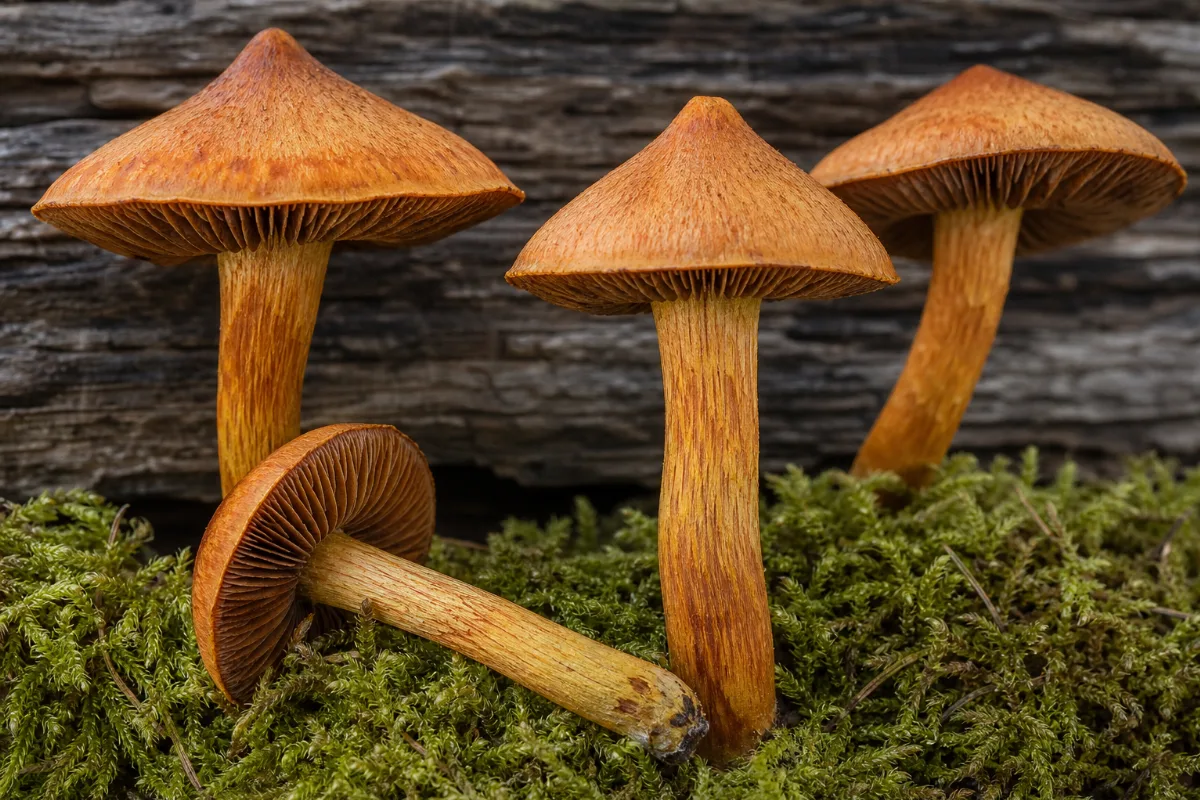
Mushrooms · Poisonous mushroom
Deadly Webcap
Cortinarius rubellus Cooke (with C. orellanus, the fool's webcap) · also called Fool's webcap (C. orellanus); older reports use the name Cortinarius speciosissimus
The deadly webcap (Cortinarius rubellus) and the fool's webcap (C. orellanus) are poisonous wild mushrooms. They contain orellanine, which harms the kidneys. Symptoms are delayed: stomach illness can start about 3 days after a meal and kidney failure about 1 to 2 weeks after. Reports say kidney damage can be permanent. There is no antidote and no health use. If one may have been eaten, call a poison centre now, even if you feel well.
General information, not medical advice. Last substantive update · Not medically reviewed. A named clinician has not signed off on this page. How this page is made
About Deadly Webcap
The deadly webcap (Cortinarius rubellus) and the fool's webcap (C. orellanus) are poisonous mushrooms. Their poison, orellanine, harms the kidneys, and the illness is delayed: stomach symptoms about 3 days after a meal and kidney failure about 1 to 2 weeks after. Reports describe dialysis, transplants and deaths. There is no antidote and no health use.
Danger first: what it is and why it poisons
The deadly webcap and the fool's webcap are wild mushrooms of the genus Cortinarius. They hold orellanine, a poison that is very selective for the kidney's proximal tubule cells. How exactly it damages them is still disputed.
Reviews describe damage to the kidney tissue (interstitial nephritis, tubular damage and scarring). Outcomes in published cases range from recovery to permanent kidney failure. If one may have been eaten, call a poison centre now.
Why the delay is the danger
In a review of 245 published cases (90 analysed in detail), stomach symptoms appeared a few days after the meal (median 3 days) and the kidney phase came later (median 8.5 days). Another review says the delay is typically 1 to 2 weeks, and some people have only mild stomach upset before kidney damage appears.
So a person can feel well, or only mildly unwell, for days after the meal. A US poison centre page says serious damage may already have occurred by the time symptoms appear, and that you should not wait for symptoms before calling.
What happened to people in the reports
Reports favour severe cases, so they cannot tell you the chance of any one outcome. In the 2001 review, kidney failure became long-term in half of cases, and dialysis or a transplant was needed in 70% of those. A 2015 paper says kidney replacement therapy was needed in about 10% of cases. The sources count different groups of people.
In a Swedish follow-up of 28 people poisoned between 1979 and 2012, 22 needed dialysis and 15 were transplanted. At follow-up (average 16.9 years) 23 were alive and 5 had died. The authors conclude that the long-term outlook for those who lost kidney function was similar to other kidney-failure patients.
Treatment
Reviews say there is no specific antidote. Treatment is supportive: preventing complications of kidney failure and dialysis, with a kidney transplant for some people. The 2001 review says no specific treatment can be recommended. A hospital team decides on care; this page gives no home advice.
Cooking, drying and freezing do not help
A US poison centre page says cooking, canning, pickling, freezing and drying poisonous mushrooms does not remove their toxins. In a laboratory test, orellanine was measured in a stew made with edible mushrooms plus a single C. rubellus. One wrong mushroom can affect a whole meal.
Eaten by mistake
Papers say these mushrooms have been confused with edible ones, and a 2025 review says poisonous species cannot always be told from edible ones by their form. This page gives no identification help on purpose. A photo, a name or an app is never proof that a wild mushroom is safe.
Pets
In 421 mushroom ingestions in dogs in Norway, 98.6% survived, but deaths followed ingestion of Cortinarius rubellus and several other species. Call a vet or poison centre at once if a pet may have eaten a wild mushroom.
What the research on the poison shows
In one laboratory study orellanine was found in caps, stems, spores and mycorrhiza roots. Caps held 0.78% (C. rubellus) and 0.94% (C. orellanus). Contents vary between specimens, and the figures say nothing about what amount harms a person.
Because orellanine hits kidney cells, the purified molecule has been studied as a possible kidney cancer drug. A 2017 study killed kidney cancer cells in the laboratory and shrank tumours in rats, and a 2023 review mentions an early 2022 announcement of human trials. We found no results. This is not a reason to eat the mushroom.
At a glance
Traditional uses history, not proof
- No traditional or medicinal use is described in the sources we read.
- A 2016 review says the kidney poisoning of Cortinarius orellanus was recognised in the 1950s after a mass poisoning in Poland (Dinis-Oliveira 2016).
- Medical papers describe it as a cause of accidental poisoning.
Studied for research
- Any health use: none; reports describe harm only
- Purified orellanine as a kidney cancer drug candidate: laboratory and animal research only, very low evidence
Main compounds
- Orellanine (kidney poison; also found as sugar-bound forms)
Common forms
- Wild mushroom, eaten by mistake in the reports (cooking, drying and freezing do not remove poisonous mushroom toxins, per a US poison centre)
- Purified orellanine (laboratory molecule, not a product)
Research links: Poison Control (US): get help online or call 1-800-222-1222 · NHS (UK): Poisoning · NSW Poisons Information Centre (Australia): 13 11 26 · Cortinarius poisoning: literature review (abstract) · Long-term outcome after orellanine poisoning (abstract) · Human and experimental toxicology of orellanine (abstract) · Research Library · Genes & Biomarkers Library
What it is and its history
- Accepted scientific name
- Cortinarius rubellus
- Naming authority
- Cooke
- Synonyms
- Cortinarius speciosissimus Kuhner & Romagn. (listed by GBIF as a synonym of C. rubellus)
- Common names
- Deadly webcap (English); Fool's webcap (C. orellanus) (English)
- Family or group
- Cortinariaceae, a family of fungi (this is a mushroom, not a plant). Part concerned: the fruiting body (the mushroom).
- Classification
- Fungi > Cortinariaceae > Cortinarius > Cortinarius rubellus; Cortinarius orellanus
- Native range
- Papers say the Cortinarius poisoning species grow in Europe and North America and in forests of Northern Europe and Scandinavia. Not otherwise checked.
- Habitat
- Not checked.
- What it looks like
- Part used: The fruiting body (the mushroom). This page does not describe how to recognise it, on purpose; reports say it has been mistaken for edible mushrooms, and a photo or a name is never proof that a wild mushroom is safe.
- Look-alikes and adulterants
- Name: Edible mushrooms for which webcaps were mistaken; Note: A 2012 paper names the funnel chanterelle (Cantharellus tubaeformis) as an edible mushroom with which these species were confused. This is not guidance for telling mushrooms apart.; Name: Other kidney-poisoning mushrooms; Note: A 2021 review lists other kidney-poisoning species, such as Amanita smithiana and Tricholoma equestre. See their pages.
- Sustainability and conservation
- Not checked.
Traditional use and history history, not clinical proof
| Tradition or era | Documented use | Source |
|---|---|---|
| Medical literature | A 2016 review says the kidney poisoning of Cortinarius orellanus was first recognised in the 1950s, when the mushroom was identified as the cause of a mass poisoning in Poland. No traditional or medicinal use is described in the sources we read. | Dinis-Oliveira 2016 |
Traditional use shows how it was used. It does not show that it works or is safe today.
What is inside, and how it may work
What it contains and how those compounds act in cells and animals. Laboratory and animal mechanisms are not proven effects in people.
Main compounds
| Compound | Family | Where it is concentrated | Activity studied | Level of evidence |
|---|---|---|---|---|
| Orellanine | fungal kidney poison (nephrotoxin) | Caps more than stems; also in spores In one laboratory study caps held 0.94% (C. orellanus) and 0.78% (C. rubellus), stems 0.48% and 0.42%, spores 0.31% and 0.09%. It also exists as sugar-bound (glucosylated) forms in C. rubellus. Contents vary between specimens. | Selective for kidney proximal tubule cells; how it damages them is disputed (2023 review). 8 7 9 | Review |
Mechanisms, receptors and pathways
| Target or pathway | Gene or receptor | What was found | Level |
|---|---|---|---|
| Kidney proximal tubule cells | Not established | Orellanine is very selective for these cells, and the mechanism of damage is disputed. Purified orellanine killed clear cell kidney cancer cells in the laboratory. 9 1 | In vitro and animal |
Absorption, metabolism and elimination
- Absorption
- Not established in people from the sources we read.
- Distribution
- In rats given orellanine into a vein, the highest amounts were in the kidney cortex and bladder.
- Metabolism
- The role of breakdown products is unclear (2023 review).
- Elimination
- In rats it left the body almost only through kidney filtration, and also by peritoneal dialysis (half-life about 109 minutes with working kidneys, about 756 minutes with the kidney arteries tied off).
- Bioavailability
- Not established.
Isolated compounds versus whole extracts
The mushroom, the purified molecule and the cancer-drug research are different things. Reports in people are about eating the whole mushroom. Cancer research uses purified orellanine in cells and animals and cannot show any safety or benefit from the mushroom.
Nutritional composition
The deadly webcap is not a food or nutrient. It is poisonous.
1 very low certainty1 not enough evidence
What was looked at
The 2 benefits and uses checked for Deadly Webcap, each with how strong the evidence is. Tap one to open it.
What is Deadly Webcap good for?
The uses people ask about and how strong the human evidence is for each. None is proven. Read every row together with the Safety tab: this is a poisonous mushroom.
Benefits, one by one
Each card is a research question, not a promise. Tap a goal to filter. Open a card to see the studies, doses and limits.
Use as a food, remedy or supplement
Not enough evidenceThere is no health use. Reviews describe the deadly webcap only as a cause of kidney poisoning. It is not a food or a supplement.
3 studiesNot covered. This page gives no amounts, preparation or ways of using…
Studies, doses and limits
What the trials found
Only poisoning reports, case series and reviews. No trial in people has tested the mushroom for any benefit.
Results
Nothing was measured as a benefit. Reports describe delayed stomach illness and then kidney failure, which became long-term in about half of the published cases in one review.
Why this rating
No trial. Poison reports show harm, not benefit.
Form and dose studied
Not covered. This page gives no amounts, preparation or ways of using the mushroom.
Who was studied
People who ate it by mistake.
Limits
Case reports and case series favour severe cases and cannot show how common poisoning is.
Why researchers looked
Medical research looks at it because eating it by mistake can cause delayed kidney failure, and doctors need to know how it behaves.
Traditional use
No traditional or medicinal use is described in the sources we read.
Proposed mechanism Review
Orellanine is described as very selective for kidney proximal tubule cells, but how it damages them is still disputed (2023 review).
A proposed mechanism does not show that the effect happens in people.
This is a deadly poisonous mushroom. Symptoms can be delayed by days, so feeling well does not mean you are safe. If one may have been eaten, call a poison centre now.
Purified orellanine and kidney cancer (laboratory)
Very low certaintyScientists have studied the purified poison in the laboratory as a possible kidney cancer treatment because it hits kidney cells. This is early research and not a reason to eat the mushroom.
3 studiesNot covered. No amounts or ways of using the mushroom are given.
Studies, doses and limits
Results
In cells and rats, selective cancer-cell killing. In rats the poison collected in the kidney and left the body almost only through kidney filtration, with a half-life of about 109 minutes with working kidneys.
Effect sizes as reported
Rat tumour mass fell by more than 90% in one study. Not applicable to people.
Why this rating
Cell and rat studies of the purified molecule only; no human results.
Form and dose studied
Not covered. No amounts or ways of using the mushroom are given.
Who was studied
Cultured cells and rats.
Limits
Results from a purified molecule given in a lab setting do not apply to the whole mushroom and say nothing about safety in people.
Why researchers looked
Orellanine is very selective for kidney proximal tubule cells, and clear cell kidney cancer arises from those cells.
Proposed mechanism In vitro and animal
Purified orellanine killed cultured clear cell kidney cancer cells and, in rats carrying human tumour grafts, brief treatment removed more than 90% of viable tumour (2017 study). The reason it damages kidney cells is still disputed.
A proposed mechanism does not show that the effect happens in people.
This is a deadly poisonous mushroom. Symptoms can be delayed by days, so feeling well does not mean you are safe. If one may have been eaten, call a poison centre now. This research is on the purified molecule, not on the mushroom.
Connections to the rest of health
How Deadly Webcap connects to the rest of our health knowledge graph. Every link says what kind of connection it is. A safety link (for example to the liver) is a warning, not a benefit. A study that merely mentions a topic never creates a benefit link.
Explore every connection: goals, body systems, organs, symptoms, genes
B. Body systems
| Connected to | Kind of connection | Evidence status | Context | Studies |
|---|---|---|---|---|
| Urinary system | Adverse effect or risk | Low certainty | Delayed acute kidney failure; long-term kidney failure, dialysis or transplant in many reported cases. Preparation or compound: Mushroom (orellanine) |
2 6 4 |
| Digestive system | Adverse effect or risk | Low certainty | Nausea, vomiting, diarrhoea and stomach pain in the first phase. Preparation or compound: Mushroom (orellanine) |
2 |
| Urinary System | Biological association | Not enough evidence | Studied for: Use as a food, remedy or supplement Studied for: Purified orellanine and kidney cancer (laboratory) | 2 4 12 1 9 10 |
K. Biological pathways
| Connected to | Kind of connection | Evidence status | Context | Studies |
|---|---|---|---|---|
| Kidney proximal tubule | Preliminary mechanism | Review | Target of orellanine (reviews). | 9 |
L. Active compounds
Each connection is stored with the ingredient, the connected record, the kind of connection, the evidence status, the supporting studies, the preparation or compound involved, and a review date (last reviewed October 25, 2026).
Evidence at a glance: what the research found for 2 outcomes
Each outcome below is one thing researchers measured. Certainty is how far the evidence can be trusted, not how well it works. The full studies are on the next tab.
The evidence
The research centre for Deadly Webcap. Every record here was checked against PubMed or the publisher's page; we never list a study we have not verified.
Evidence by outcome
Bars show how many studies we found for each outcome, not how well it works. People are added up across trials only (reviews are not added, to avoid double counting).
How we rate evidence
High certainty
Several well-run trials or reviews agree; further research is unlikely to change the picture much.
Moderate certainty
Good trials point the same way, but some doubt remains.
Low certainty
Small, short or inconsistent trials. The finding could change with better research.
Very low certainty
Very little or very weak human data. Treat as a possibility only.
Mixed findings
Trials or reviews disagree with each other.
Not enough evidence
Not enough human research to say either way.
Evidence against
Good research found no benefit, or found harm.
We take the reviewers' own risk-of-bias and GRADE statements where they exist, and otherwise judge from study size, design, consistency, directness and whether a product matches what is sold. Many publications do not make evidence high. Method note: We read the abstracts of 14 papers in PubMed, read the Poison Control, NHS, NSW Poisons Information Centre and a US state poison centre page, and checked the scientific names in GBIF. Index Fungorum could not be opened. Where a statement could not be checked it is left out.
Study library: every study we checked 16
| Study | Design | People | Product, dose, length | Result |
|---|---|---|---|---|
| Buvall 2017 Orellanine specifically targets renal clear cell carcinoma. Oncotarget · PMID 29207627 · DOI |
Laboratory and animal animal |
Cultured kidney tumour cells and nude rats carrying human clear cell kidney cancer | n/a |
Purified orellanine killed proximal tubule cells and all clear cell kidney cancer cells tested, with no toxicity in control cells. In nude rats with human tumour grafts, brief treatment removed more than 90% of viable tumour. The authors propose it as a possible treatment concept for people on dialysis. Methods, limits and fundingOutcomes: Cell death and tumour mass Limitations: Cell and rat study of purified orellanine, not of the mushroom; says nothing about safety or benefit in people. Funding and conflicts: Not stated in the abstract. Read: abstract |
| Danel 2001 Main features of Cortinarius spp. poisoning: a literature review. Toxicon · PMID 11223095 · DOI |
Review |
245 245 published Cortinarius poisoning cases collected; 90 analysed in detail |
n/a |
Stomach symptoms came a few days after the meal (median 3 days). The kidney phase was delayed (median 8.5 days). Moderate, short-lived liver test changes were reported; severe liver failure was ruled out; muscle damage was highly questionable. Treatment is supportive and no specific treatment can be recommended. Kidney failure became long-term in half of the cases, and dialysis or a kidney transplant was needed in 70% of those. The authors call it severe and say it should be suspected whenever tubulo-interstitial nephritis is found, as the mushrooms may have been eaten 1 to 2 weeks before. Methods, limits and fundingOutcomes: Symptoms, timing, kidney outcome, treatment Limitations: Published case reports only, which favour severe cases; species mixed (not only C. rubellus). Published in 2001. Funding and conflicts: Not stated in the abstract. Read: abstract |
| Diaz 2021 Nephrotoxic Mushroom Poisoning: Global Epidemiology, Clinical Manifestations, and Management. Wilderness Environ Med · PMID 34629291 · DOI |
Review |
Review of kidney-poisoning mushrooms worldwide (1957 to the present) | n/a |
Amatoxin mushrooms cause most mushroom poisonings and deaths, but kidney-poisoning mushrooms, most commonly Cortinarius species, can cause acute kidney failure. Dialysis is often needed, and kidney transplant is reserved for when other treatment fails. New kidney-poisoning species keep being found. Methods, limits and fundingOutcomes: Epidemiology, clinical picture, kidney replacement therapy Limitations: Narrative review; internet search, not a systematic search. Funding and conflicts: Not stated in the abstract. Read: abstract |
| Dinis-Oliveira 2016 Human and experimental toxicology of orellanine. Hum Exp Toxicol · PMID 26553321 · DOI |
Review |
Review of Cortinarius poisoning in humans and experiments | n/a |
Orellanine comes from some Cortinarius mushrooms in Europe and North America. A mass poisoning in Poland in the 1950s led to the recognition of C. orellanus as a kidney poison. Symptoms are typically delayed by 1 to 2 weeks. Some people have mild stomach upset in the quiet period before kidney damage appears (severe interstitial nephritis, acute focal tubular damage and scarring). There is no specific antidote. Treatment is preventing complications of kidney failure, dialysis, and care for chronic kidney weakness if recovery is incomplete. Methods, limits and fundingOutcomes: Epidemiology, mechanisms, diagnosis, prognosis, treatment Limitations: Narrative review; the abstract gives no case numbers. Funding and conflicts: Not stated in the abstract. Read: abstract |
| Esposito 2015 Renal involvement in mushroom poisoning: The case of Orellanus syndrome. Hemodial Int · PMID 25649895 · DOI |
Case report with review |
1 One patient with mixed wild mushroom poisoning |
n/a |
Orellanine is the main toxin of several Cortinarius species (C. speciosissimus, C. orellanus, C. orellanoides). The illness has progressive phases with the kidney predominant, and the authors say kidney replacement therapy was finally needed in about 10% of cases. Kidney damage is often late, with interstitial nephritis on biopsy. Diagnosis is mainly clinical and no specific therapy has been shown to prevent or treat the kidney damage. Methods, limits and fundingOutcomes: Clinical phases, kidney outcome Limitations: One case plus a short review. The 10% figure differs from the 70% (of those with long-term failure) in the 2001 review; the two count different things and neither is a risk for any one person. Funding and conflicts: Not stated in the abstract. Read: abstract |
| Hedman 2017 Long-term clinical outcome for patients poisoned by the fungal nephrotoxin orellanine. BMC Nephrol · PMID 28372584 · DOI |
Case series with matched controls |
28 28 of 39 people poisoned by deadly webcap in Sweden, 1979 to 2012 (average age 40) |
n/a |
22 of 28 developed acute kidney injury needing dialysis. 15 were transplanted (3 of them twice). Average follow-up was 16.9 years: 23 were alive and 5 had died. No signs of acute damage were present in any other organ. Long-term outcome of those who lost kidney function was not different from that of other people in active uremic care (6 deaths in 20 matched controls). Methods, limits and fundingOutcomes: Kidney failure, dialysis, transplant, survival Limitations: Small series from one country; 11 of 39 cases could not be included; the people who lost kidney function are the ones followed. Funding and conflicts: Research Support, Non-U.S. Gov't (per PubMed). Read: abstract |
| Herrmann 2012 Analysis of the mushroom nephrotoxin orellanine and its glucosides. J Nat Prod · PMID 23046414 · DOI |
Laboratory laboratory |
Cortinarius rubellus, spiked blood plasma and a mushroom stew with one C. rubellus added | n/a |
A test method measured orellanine in C. rubellus, in spiked plasma and in a stew made from funnel chanterelle (Cantharellus tubaeformis) with a single C. rubellus added. Orellanine also exists in mono- and diglucosylated forms in C. rubellus. The authors report that unintentional eating after confusion with edible mushrooms such as Cantharellus tubaeformis has caused several casualties. They note the method works for processed food that may be contaminated. Methods, limits and fundingOutcomes: Measuring orellanine and its sugar-bound forms Limitations: Laboratory method paper; does not describe poisoning in people. Funding and conflicts: Research Support, Non-U.S. Gov't (per PubMed). Read: abstract |
| Koller 2002 The presence of orellanine in spores and basidiocarp from Cortinarius orellanus and Cortinarius rubellus. Mycologia · PMID 21156548 · DOI |
Laboratory laboratory |
Spores, caps, stems and mycorrhiza roots of C. orellanus and C. rubellus | n/a |
Orellanine was found in all parts. Caps held 0.94% (C. orellanus) and 0.78% (C. rubellus); stems 0.48% and 0.42%; spores 0.31% and 0.09%; the mycorrhiza roots of C. rubellus 0.03%. The authors report these as orellanine content measured by chromatography. Methods, limits and fundingOutcomes: Orellanine content by part Limitations: Few specimens; the abstract gives no number of samples. Contents vary between specimens and nothing here says what amount harms a person. Funding and conflicts: Not stated in the abstract. Read: abstract |
| Lyons 2023 Orellanine: From Fungal Origin to a Potential Future Cancer Treatment. J Nat Prod · PMID 37308446 · DOI |
Review review |
Review of orellanine as a kidney poison and as a candidate cancer drug | n/a |
Orellanine, found in mushrooms including Cortinarius orellanus (fool's webcap), is very selective for kidney proximal tubule cells, but how it damages them is still disputed. Measuring it is hard, and the role of active breakdown products is unclear. Preclinical data on metastatic clear cell kidney cancer led to an early 2022 announcement of phase I/II human trials. Methods, limits and fundingOutcomes: History, structure, how it harms kidney cells, anticancer research Limitations: Review; announced trials are not results. The abstract reports no human trial outcome. Funding and conflicts: Not stated in the abstract. Read: abstract |
| Najar 2018 Pharmacokinetic Properties of the Nephrotoxin Orellanine in Rats. Toxins (Basel) · PMID 30126099 · DOI |
Animal study animal |
Rats given a single injection of orellanine into a vein (Wistar and Sprague Dawley) | n/a |
Orellanine collected most in the kidney cortex and bladder. Its half-life was 109 minutes in rats with working kidneys and 756 minutes when the kidney arteries were tied off (238 minutes with peritoneal dialysis). The authors conclude it leaves the body almost only through kidney filtration, and also by peritoneal dialysis. Methods, limits and fundingOutcomes: Where orellanine goes and how fast it leaves Limitations: Rats, injected into a vein, not eaten. Timing in people is not shown by this study. Funding and conflicts: Research Support, Non-U.S. Gov't (per PubMed). Read: abstract |
| Seljetun 2023 A retrospective evaluation of mushroom ingestions in 421 dogs in Norway (2011-2022). Vet Rec Open · PMID 37057032 · DOI |
Retrospective case series dog |
421 421 dog mushroom ingestions reported to the Norwegian Poison Information Center |
n/a |
The survival rate was 98.6%. Deaths followed ingestion of Amanita muscaria, Cortinarius rubellus, Amanita virosa, Clitocybe rivulosa and Inocybe sp. The authors stress rapid, accurate identification of the mushroom so treatment is not delayed. Methods, limits and fundingOutcomes: Species, treatment, survival Limitations: Dogs, one country. The abstract does not say how many dogs died after Cortinarius rubellus. Funding and conflicts: Not stated in the abstract. Read: abstract |
| Tugcan 2025 Mushroom poisoning: An updated review. Turk J Emerg Med · PMID 39882097 · DOI |
Review |
Review of poisonous mushroom syndromes | n/a |
It is not possible to tell poisonous species from some edible species by their form alone, so accidental eating is a public health problem. Orellanine is one of the toxin groups reviewed. Amatoxin mushrooms are responsible for more than 90% of deaths from mushroom poisoning. Methods, limits and fundingOutcomes: Clinical syndromes, toxins, treatment Limitations: Narrative review. Funding and conflicts: Not stated in the abstract. Read: abstract |
| n/a 2026 Poison Control (US, National Capital Poison Center): Need immediate assistance? n/a · Source |
Authoritative guidance n/a |
n/a | n/a |
The page says to get help online or call a poison center at 1-800-222-1222, free, confidential and open 24 hours a day, 7 days a week. If the person collapses, has a seizure, has trouble breathing or cannot be awakened, call 911 immediately. Read 25 October 2026. Methods, limits and fundingOutcomes: What to do in a suspected poisoning in the US Limitations: General poisoning advice, not specific to this mushroom. Read: full-text |
| n/a 2026 NHS (UK): Poisoning n/a · Source |
Authoritative guidance n/a |
n/a | n/a |
The page says to call 999 or go to A&E if you think someone may have swallowed something harmful, has lost consciousness, has stopped breathing, has severe difficulty breathing or has a seizure, and to call NHS 111 if you are not sure whether something swallowed is harmful. Read 25 October 2026. Methods, limits and fundingOutcomes: What to do in suspected poisoning in the UK Limitations: General poisoning advice, not specific to this mushroom. Read: full-text |
| n/a 2026 NSW Poisons Information Centre (Australia) n/a · Source |
Authoritative guidance n/a |
n/a | n/a |
The page says to call 13 11 26, 24 hours a day, 7 days a week, if you think someone has been poisoned, and not to wait for symptoms to occur. If someone is unconscious or not breathing, call Triple Zero (000). Read 25 October 2026. Methods, limits and fundingOutcomes: Poison advice line in Australia Limitations: General poisoning advice, not specific to this mushroom. Read: full-text |
| n/a 2026 University of Kansas Health System Poison Control Center: Poisonous Mushrooms n/a · Source |
Authoritative guidance n/a |
n/a | n/a |
The page says symptoms of some poisonous mushrooms may not develop for a couple of days, and that by then serious damage may already have occurred; it says not to wait for symptoms before calling after someone eats a wild mushroom, and to save a piece of the mushroom if you can. It says cooking, canning, pickling, freezing and drying poisonous mushrooms do not remove the toxins, and that very experienced gatherers can find it hard to tell whether a mushroom is safe. It says to eat only mushrooms bought at the store. The page quotes 1-800-222-1222. Read 25 October 2026. Methods, limits and fundingOutcomes: Poison centre advice on wild mushrooms Limitations: Page for the US state of Kansas, general mushroom advice, not specific to webcaps. Read: full-text |
What we do not know yet
- No trial of the mushroom for any use.
- No reliable count of poisonings, hospital stays or deaths.
- Outcome figures differ between sources because they count different groups of people.
- No studies in pregnancy, breastfeeding or children were found.
- Food-regulator statements about the mushroom were not searched.
How new research is added
New studies are found by a saved PubMed search and are placed in a review queue. A person reads each one before it changes this page.
Lab markers
What changed in blood or saliva tests during trials. A changed number is not the same as feeling or being healthier, and we give no "normal ranges".
Safety
What studies and official sources say about side effects, medicines and who should check first. Each point shows what kind of evidence it comes from.
Main points to know 6
- Danger first: it can poison the kidneys days after a meal. The deadly webcap (Cortinarius rubellus) and the fool's webcap (C. orellanus) contain orellanine, a kidney poison. In a review of published cases, stomach symptoms appeared a few days after the meal (median 3 days) and the kidney phase came later (median 8.5 days). Another review says the delay is typically 1 to 2 weeks. Feeling well after the meal is not a sign of safety. Review 2 4
- If someone has eaten it, call a poison centre now. Do not wait for symptoms. In the US call Poison Help at 1-800-222-1222 (free, confidential, 24 hours); call 911 if the person collapses, has a seizure, has trouble breathing or cannot be awakened. In the UK call NHS 111 if you are unsure and 999 in an emergency. In Australia the Poisons Information Centre line is 13 11 26. Keep a piece of the mushroom to show staff. Authoritative guidance 13 14 15 16
- Cooking, drying or freezing does not make it safe. A US poison centre page says cooking, canning, pickling, freezing and drying poisonous mushrooms does not remove the toxins. A laboratory method found orellanine in a stew that held a single C. rubellus among edible mushrooms. Authoritative guidance 16 7
- No antidote; kidney damage can be permanent. Reviews say there is no specific antidote and treatment is supportive, with dialysis for kidney failure and a transplant in some people. In a review of published cases, kidney failure became long-term in half of cases. In a Swedish follow-up of 28 people, 22 needed dialysis and 15 were transplanted. Review and case series 2 4 6
- Mistaken for edible mushrooms. Papers report that webcaps have been mistaken for edible mushrooms such as the funnel chanterelle. Reviews say poisonous species cannot always be told from edible ones by their form. This page gives no identification help on purpose; a photo, a name or an app is never proof that a wild mushroom is safe. Review 7 12 16
- Dogs can die too. In 421 mushroom ingestions in dogs in Norway, survival was 98.6%, but deaths followed ingestion of Cortinarius rubellus and several other species. Call a vet or a poison centre at once if a pet may have eaten a wild mushroom. Case series 11
Side effects 6
| Effect | How often | Severity and recovery | Evidence |
|---|---|---|---|
| Nausea, vomiting, diarrhoea and stomach pain Some people have only mild stomach upset before the kidneys fail, so it can be missed. | Main symptoms of the first phase; median start 3 days after the meal (review of 90 analysed cases) | moderate The gut symptoms are not the lasting harm | Review 2 |
| Acute kidney failure (orellanus syndrome) Onset is delayed, typically 1 to 2 weeks (Dinis-Oliveira 2016) and median 8.5 days in a case review. | 22 of 28 people in a Swedish series needed dialysis | severe Often not fully reversible; see long-term kidney failure | Case series 6 2 4 |
| Long-term (chronic) kidney failure, dialysis or transplant The figures differ because each source counts different groups of people; none is a risk for any one person. | About half of cases in a 2001 review (dialysis or transplant needed in 70% of those); 15 of 28 transplanted in the Swedish series; about 10% needed kidney replacement therapy per a 2015 paper | severe Can be permanent | Review and case series 2 6 5 |
| Death Authors conclude long-term outlook for those who lost kidney function was similar to other kidney-failure patients. | 5 of 28 had died at follow-up (average 16.9 years) in the Swedish series; 6 of 20 matched controls on kidney care had died | severe Not reversible | Case series 6 |
| Mild, short-lived liver test changes The review says severe liver failure can be ruled out. | Reported in some cases | mild Transient | Review 2 |
| Muscle damage The 2001 review calls muscle lesions highly questionable. | Not established | unclear Unclear | Review 2 |
Liver
A 2001 review of published cases found moderate, transient liver abnormalities and ruled out severe liver failure. In the Swedish follow-up no signs of acute damage were present in any other organ than the kidney. Do not assume a wild mushroom of unknown type is liver-safe: amatoxin mushrooms are different and destroy the liver. 2 6
How often. Not quantified in the abstracts we read.
Monitoring. A clinician decides on tests. Tell the team exactly what was eaten and when.
- Danel 2001 literature review (90 cases analysed in detail). Moderate and transient hepatic abnormalities; severe hepatic failure ruled out. 2
This is a safety connection. It is not evidence that Deadly Webcap supports liver health.
Medicines and supplements 2
| With | Why it matters | Importance | Evidence | What to do |
|---|---|---|---|---|
| Kidney-affecting medicines (for example anti-inflammatory painkillers) and dehydration prescription and non-prescription | Not studied. The concern is only that the kidneys may already be under attack. | No interaction study was found. Ask a doctor or pharmacist about any medicine after a possible poisoning. | Theory Not enough evidence | Tell the emergency team about every medicine and supplement taken. |
| Other wild mushrooms in the same meal mixed ingestion | Mixed meals happen; one 2015 case was mixed wild mushroom poisoning with the typical orellanus course. | Other mushrooms in the meal can add their own poisons, including liver poisons. | Case report Not enough evidence 5 | Report everything eaten and keep a sample of what is left. |
Who should check first 1
| Situation | Advice | Evidence |
|---|---|---|
| Anyone, including children, pregnant or breastfeeding women, older adults and people with kidney disease | There is no benefit to weigh against the danger, and the mushroom is poisonous. Do not eat it. No study of pregnancy, breastfeeding or children was found. | Authoritative guidance 16 2 |
Overdose, product quality and regulators
Summary. Orellanine and related compounds poison the kidney's proximal tubule cells. Mechanism is disputed (2023 review). The mushroom holds orellanine in all measured parts.
Amounts. No safe amount is established. Orellanine content varies between specimens and parts; in one lab study caps held 0.78% (C. rubellus) and 0.94% (C. orellanus) and stems about 0.4 to 0.5%. This is lab chemistry, not an amount that is safe or harmful.
Onset and course. Stomach symptoms median 3 days, kidney phase median 8.5 days in a case review; 1 to 2 weeks typical in another review. Feeling well early on is not a sign of safety.
Animal data. In rats, orellanine collected in the kidney cortex and left the body almost only through kidney filtration. Dogs have died after Cortinarius rubellus.
Toxic parts. Orellanine was found in caps, stems, spores and mycorrhiza roots.
Not read. Genotoxicity, reproductive toxicity, blood levels linked to severity, and detailed treatment trials were not read.
This is not a product. No tested product was found, and no product is recommended or linked here.
Contamination of edible mushrooms in a mixed meal. A laboratory method detected orellanine in a stew with a single C. rubellus added to edible mushrooms. 7
| Body | Action | Date |
|---|---|---|
| Poison centres and health services (US, UK, Australia) (United States, United Kingdom, Australia) | The three pages say to contact poison services or emergency services in a suspected poisoning, without waiting for symptoms, and give the numbers quoted above. None is about this mushroom specifically. source | 2026-10-25 |
When to get medical help
- If this mushroom, or any wild mushroom of unknown type, may have been eaten, call a poison centre right away, even if the person feels fine and even if days have passed. In the US call Poison Help at 1-800-222-1222 (free and confidential); call 911 if the person collapses, has a seizure, has trouble breathing or cannot be awakened (Poison Control, poison.org). In the UK call NHS 111 if unsure and 999 in an emergency (NHS). In Australia call 13 11 26 (NSW Poisons Information Centre).
- Seek medical help for nausea, vomiting, diarrhoea or stomach pain starting days after eating wild mushrooms.
- Seek urgent help for passing much less urine than usual, flank or back pain, extreme thirst or unusual tiredness in the days to weeks after eating wild mushrooms.
- Tell staff exactly what was eaten and when; keep a piece of the mushroom or a photo.
If someone may be poisoned or in a crisis, contact a clinician or emergency service straight away. In the US, Poison Control is 1-800-222-1222.
General information only, not medical advice. Ask a clinician or pharmacist before use, especially with medicines, in pregnancy or with a health condition. See the Natural Remedy Safety guide.
Frequently asked questions
Is the deadly webcap poisonous?
What should I do if someone has eaten it?
Call a poison centre right away, even if the person feels fine. In the US call Poison Help at 1-800-222-1222 (free, confidential, 24 hours). Call 911 if the person collapses, has a seizure, has trouble breathing or cannot be awakened. In the UK call NHS 111 if you are unsure, or 999 in an emergency. In Australia call 13 11 26. Keep a piece of the mushroom or a photo to show staff.
Why do the symptoms start so late?
Can it cause permanent kidney damage?
Is there an antidote?
Does cooking make it safe?
Can I tell it from edible mushrooms myself?
Has it been used as a medicine?
Is the cancer research a reason to try it?
Can children or pregnant women be affected?
Can pets be poisoned?
Yes. In a Norwegian review of 421 dog ingestions, 98.6% survived, but deaths followed ingestion of Cortinarius rubellus and several other species. Call a vet or poison centre at once.
Explore by health goal
Editorial transparency
- Written by
- AlternativeMed editorial team. Research compiled with AI assistance, then checked against PubMed records and poison-centre pages.
- Medical review
- None. This page has not been reviewed by a physician or pharmacist.
- First published
- 2026-10-25
- Last substantive update
- 2026-10-25
- How we research
- We read the abstracts of 14 papers in PubMed, read the Poison Control, NHS, NSW Poisons Information Centre and a US state poison centre page, and checked the scientific names in GBIF. Index Fungorum could not be opened. Where a statement could not be checked it is left out.
- How we rate evidence
- See "How we rate evidence" in the Evidence tab.
- Independence
- No product is promoted on this page. No affiliate links are shown. This page gives no dose, preparation, identification, picking or sourcing advice.
Sources 16
Each source was opened and checked. Where we read only the abstract, it says so. The small numbers in the text point here.
- Buvall L, Hedman H, Khramova A, Najar D, Bergwall L, Ebefors K, et al.. Orellanine specifically targets renal clear cell carcinoma.. Oncotarget. 2017. PMID 29207627. DOI 10.18632/oncotarget.19555. (abstract)
- Danel VC, Saviuc PF, Garon D. Main features of Cortinarius spp. poisoning: a literature review.. Toxicon. 2001. PMID 11223095. DOI 10.1016/s0041-0101(00)00248-8. (abstract)
- Diaz JH. Nephrotoxic Mushroom Poisoning: Global Epidemiology, Clinical Manifestations, and Management.. Wilderness Environ Med. 2021. PMID 34629291. DOI 10.1016/j.wem.2021.09.002. (abstract)
- Dinis-Oliveira RJ, Soares M, Rocha-Pereira C, Carvalho F. Human and experimental toxicology of orellanine.. Hum Exp Toxicol. 2016. PMID 26553321. DOI 10.1177/0960327115613845. (abstract)
- Esposito P, La Porta E, Calatroni M, Bianzina S, Libetta C, Gregorini M. Renal involvement in mushroom poisoning: The case of Orellanus syndrome.. Hemodial Int. 2015. PMID 25649895. DOI 10.1111/hdi.12275. (abstract)
- Hedman H, Holmdahl J, Molne J, Ebefors K, Haraldsson B, Nystrom J. Long-term clinical outcome for patients poisoned by the fungal nephrotoxin orellanine.. BMC Nephrol. 2017. PMID 28372584. DOI 10.1186/s12882-017-0533-6. (abstract)
- Herrmann A, Hedman H, Rosen J, Jansson D, Haraldsson B, Hellenas KE. Analysis of the mushroom nephrotoxin orellanine and its glucosides.. J Nat Prod. 2012. PMID 23046414. DOI 10.1021/np300135k. (abstract)
- Koller GE, Hoiland K, Janak K, Stormer FC. The presence of orellanine in spores and basidiocarp from Cortinarius orellanus and Cortinarius rubellus.. Mycologia. 2002. PMID 21156548. DOI 10.1080/15572536.2003.11833168. (abstract)
- Lyons MJ, Ehrhardt C, Walsh JJ. Orellanine: From Fungal Origin to a Potential Future Cancer Treatment.. J Nat Prod. 2023. PMID 37308446. DOI 10.1021/acs.jnatprod.2c01068. (abstract)
- Najar D, Haraldsson B, Thorsell A, Sihlbom C, Nystrom J, Ebefors K. Pharmacokinetic Properties of the Nephrotoxin Orellanine in Rats.. Toxins (Basel). 2018. PMID 30126099. DOI 10.3390/toxins10080333. (abstract)
- Seljetun KO, Kragstad HR. A retrospective evaluation of mushroom ingestions in 421 dogs in Norway (2011-2022).. Vet Rec Open. 2023. PMID 37057032. DOI 10.1002/vro2.60. (abstract)
- Tugcan MO, Akpinar AA. Mushroom poisoning: An updated review.. Turk J Emerg Med. 2025. PMID 39882097. DOI 10.4103/tjem.tjem_129_24. (abstract)
- n/a. Poison Control (US, National Capital Poison Center): Need immediate assistance?. n/a. 2026. (full-text)
- n/a. NHS (UK): Poisoning. n/a. 2026. (full-text)
- n/a. NSW Poisons Information Centre (Australia). n/a. 2026. (full-text)
- n/a. University of Kansas Health System Poison Control Center: Poisonous Mushrooms. n/a. 2026. (full-text)


