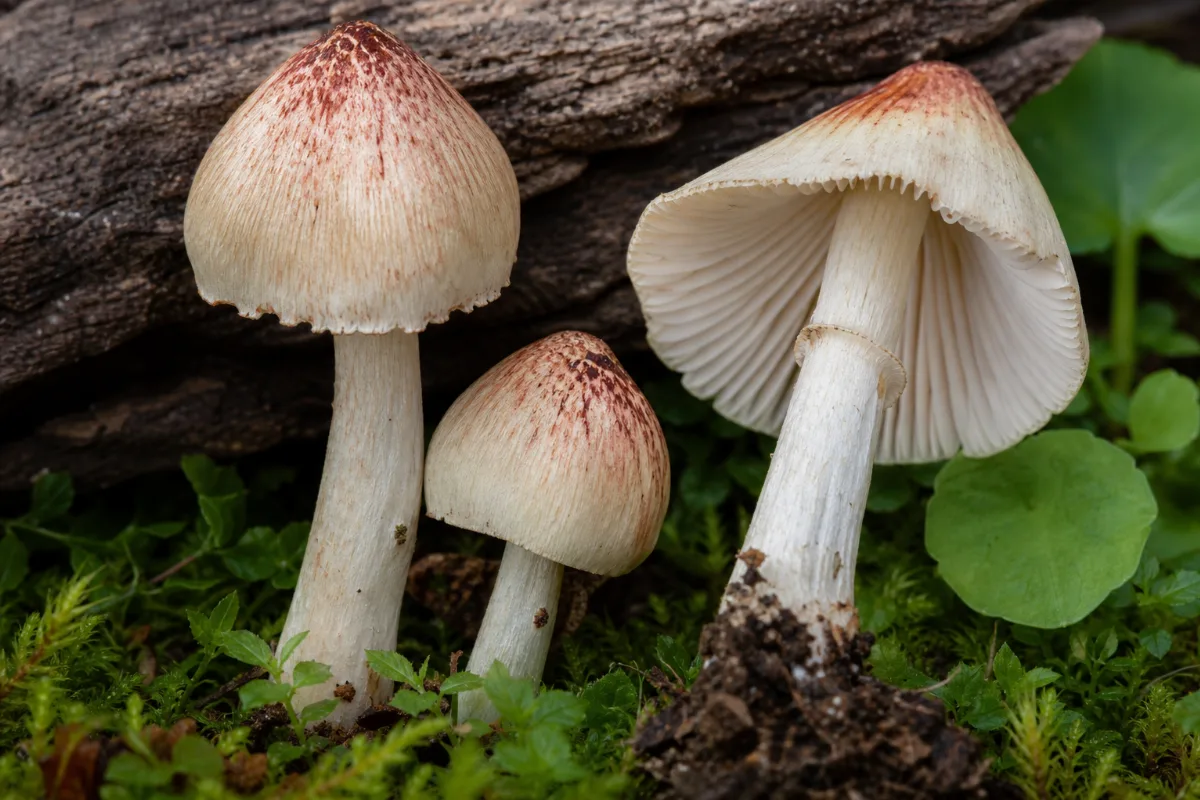
Mushrooms · Poisonous mushroom
Deadly Fibrecap
Inocybe erubescens A.Blytt (also called I. patouillardii; GBIF now accepts Inosperma erubescens) · also called Inocybe patouillardii; Inosperma erubescens (current accepted name)
The deadly fibrecap (Inocybe erubescens, also called I. patouillardii) is a poisonous wild mushroom. It contains muscarine, which over-stimulates the body's nerves. Symptoms usually start within about 2 hours: sweating, tears, drooling, cramps, vomiting and a slow heart rate. In reports, most people recovered within a day with hospital care, but low blood pressure and breathing trouble can happen and a 2024 paper says death is possible. Cooking does not remove the poison. There is no health use. If one may have been eaten, call a poison centre now.
General information, not medical advice. Last substantive update · Not medically reviewed. A named clinician has not signed off on this page. How this page is made
About Deadly Fibrecap
The deadly fibrecap (Inocybe erubescens, also called I. patouillardii) is a poisonous mushroom. Its poison, muscarine, causes sweating, tears, drooling, cramps, vomiting and a slow heart rate, usually within about 2 hours of a meal. Most reported patients recovered within a day with hospital care, but severe cases and deaths are described in the literature. Cooking does not remove the poison. There is no health use.
Danger first: what it is and why it poisons
The deadly fibrecap is a wild mushroom. A 2021 review calls it the most common Inocybe associated with poisoning in Europe. It holds muscarine, which binds the receptors of the body's resting-and-digesting nerves and keeps them switched on.
The result is a recognisable picture: sweating, drooling, tears, a runny nose, cramps, vomiting, diarrhoea, small pupils and blurred vision, a slow heart rate and low blood pressure. If one may have been eaten, call a poison centre now.
It starts fast: hours, not days
In a case series of 14 people, symptoms began 15 minutes to 2 hours after the meal (5 hours in one patient). A poison-centre monograph gives an average onset of 2 hours, and says signs reach their peak quickly and fade within 24 hours.
This is different from the slow, hidden poisons of some other mushrooms. Even so, do not wait to see how it goes: low blood pressure, a very slow heart and breathing trouble need hospital care.
What happened to people in the reports
Reports favour people who reached care, so they cannot tell you the chance of any one outcome. In the 14-patient series all recovered fully within 12 hours after supportive treatment and atropine given in hospital. In a French series quoted by a poison-centre monograph (483 patients), sweating occurred in 96%, vomiting in 70%, diarrhoea in 62%, low blood pressure in 36% and a slow heart rate in 20%.
The same monograph (reviewed in 2000) says fatalities were reported in old literature and none in modern times. A 2021 review says very large amounts can cause death, and a 2024 laboratory paper says muscarine mushrooms can cause circulatory collapse or even death. Treat it as dangerous.
It can look like something else
A 2014 case report describes a man whose sweating, low blood pressure, slow heart rate, confusion and one-sided weakness first looked like a stroke; he had crashed his car. Very small pupils and the story of the mushroom meal led doctors to suspect poisoning, and he recovered after treatment in hospital. His meal contained a different Inocybe species, but the lesson applies: always tell the team about any wild mushroom eaten.
Treatment
Reports describe supportive care in hospital: fluids, anti-sickness medicine and, for strong cholinergic signs, atropine given by staff. The monograph says atropine relieves the signs but does not shorten the illness. A hospital team decides on care; this page gives no home advice.
Cooking, drying and freezing do not help
The monograph says muscarine is not destroyed by heating during cooking, and poisoning has followed fresh, dried and frozen mushrooms. A US poison centre page says cooking, canning, pickling, freezing and drying poisonous mushrooms does not remove toxins.
Eaten by mistake
The monograph says muscarine poisonings usually follow wild mushrooms being eaten by mistake for edible ones, and in some case series more than a quarter of patients ate unidentified mushrooms. A 2025 review says poisonous species cannot always be told from edible ones by their form. This page gives no identification help on purpose. A photo, a name or an app is never proof that a wild mushroom is safe.
Pets
In five dogs that ate Inocybe mushrooms, all recovered after supportive care. In a Norwegian review of 421 mushroom ingestions in dogs, 98.6% survived, but deaths followed ingestion of several species including Inocybe sp. Call a vet or poison centre at once if a pet may have eaten a wild mushroom.
What the research on the poison shows
Muscarine is present in all parts of the mushroom. The monograph gives about 0.1 to 0.3% of dry weight for toxic muscarine species as a group, from older work. Contents vary between specimens, and the figures say nothing about what amount harms a person.
A 2024 laboratory study found a harmless-looking phosphorylated form of muscarine in related fungi, which can release muscarine through enzyme action. It was found in other fungi, not in this species, and has no use or safety meaning for people.
Names
Medical reports use Inocybe erubescens or Inocybe patouillardii. GBIF treats both as the same fungus and now accepts the name Inosperma erubescens. Index Fungorum was not opened.
At a glance
Traditional uses history, not proof
- No traditional or medicinal use is described in the sources we read.
- Medical papers describe it as a cause of accidental poisoning; a 2021 review calls it the most common Inocybe linked to poisoning in Europe (Patocka 2021).
- A poison-centre monograph says muscarine poisonings usually follow mushrooms being eaten by mistake.
Studied for research
- Any health use: none; reports describe harm only
Main compounds
- Muscarine (nerve-stimulating poison)
Common forms
- Wild mushroom, eaten by mistake in the reports (cooking, drying and freezing do not remove poisonous mushroom toxins, per poison-centre sources)
Research links: Poison Control (US): get help online or call 1-800-222-1222 · NHS (UK): Poisoning · NSW Poisons Information Centre (Australia): 13 11 26 · Inocybe poisoning: case series (abstract) · Toxins of Inocybe mushrooms: review (abstract) · Poison-centre monograph on muscarine mushrooms (IPCS INCHEM) · Research Library · Genes & Biomarkers Library
What it is and its history
- Accepted scientific name
- Inosperma erubescens
- Naming authority
- (A.Blytt) Matheny & Esteve-Rav.
- Synonyms
- Inocybe erubescens A.Blytt (the name used in most medical reports); Inocybe patouillardii Bres. (listed by GBIF as a synonym); Inocybe trinii var. rubescens Pat. (listed by GBIF as a synonym)
- Common names
- Deadly fibrecap (English)
- Family or group
- Inocybaceae, a family of fungi (this is a mushroom, not a plant). Part concerned: the fruiting body (the mushroom).
- Classification
- Fungi > Inocybaceae > Inosperma (older reports: Inocybe) > Inosperma erubescens
- Native range
- A 2021 review says it is the most common Inocybe linked to poisoning in Europe. Not otherwise checked.
- Habitat
- Not checked.
- What it looks like
- Part used: The fruiting body (the mushroom). This page does not describe how to recognise it, on purpose; reports say wild mushrooms are mistaken for edible ones, and a photo or a name is never proof that a wild mushroom is safe.
- Look-alikes and adulterants
- Name: Edible mushrooms; Note: A poison-centre monograph says muscarine mushrooms are usually eaten by mistake for edible ones. This is not guidance for telling mushrooms apart.; Name: Other muscarine mushrooms; Note: Other Inocybe and Clitocybe species hold muscarine too; see their reports. The poisoning looks the same whichever species was eaten.
- Sustainability and conservation
- Not checked.
Traditional use and history history, not clinical proof
| Tradition or era | Documented use | Source |
|---|---|---|
| Medical literature | Modern reports describe it only as a cause of accidental muscarine poisoning. No traditional or medicinal use is described in the sources we read. | Patocka 2021 |
Traditional use shows how it was used. It does not show that it works or is safe today.
What is inside, and how it may work
What it contains and how those compounds act in cells and animals. Laboratory and animal mechanisms are not proven effects in people.
Main compounds
| Compound | Family | Where it is concentrated | Activity studied | Level of evidence |
|---|---|---|---|---|
| Muscarine | fungal alkaloid (muscarinic nerve-receptor activator) | All parts of the mushroom (monograph) The monograph says toxic muscarine species hold about 0.1 to 0.3% of dry weight. This is a group figure from older work; it varies between specimens and says nothing about safe or harmful amounts. | Binds the acetylcholine (muscarinic) receptor and keeps those nerves active, causing sweating, drooling, slow heart rate, small pupils and gut cramps. 10 6 | Authoritative guidance |
| Phosphorylated muscarine (4'-phosphomuscarine) | muscarine precursor | Found in the mycelium of a funnel mushroom and in two fiber cap species (not this species) | Weak receptor activation by itself, but it can release muscarine through enzyme action (laboratory paper, 2024). 3 | Laboratory |
Mechanisms, receptors and pathways
| Target or pathway | Gene or receptor | What was found | Level |
|---|---|---|---|
| Muscarinic acetylcholine receptors | Muscarinic receptors (the 2024 paper tested M3) | Muscarine keeps these receptors active; atropine counters the effect in hospital care. 10 3 | Authoritative guidance and laboratory |
Absorption, metabolism and elimination
- Absorption
- Only a very small part of eaten muscarine is absorbed from the gut (monograph).
- Distribution
- Absorbed muscarine spreads quickly through the body; signs can start within 30 minutes to a few hours (monograph).
- Metabolism
- Not established.
- Elimination
- No data available in the monograph. Muscarine was found in the urine of two patients in a 2023 case report.
- Bioavailability
- Not established.
Isolated compounds versus whole extracts
The sources we read cover the whole mushroom eaten by mistake. Laboratory work on muscarine and its precursor in related fungi describes chemistry only and gives no use or safety information for people.
Nutritional composition
The deadly fibrecap is not a food or nutrient. It is poisonous.
1 not enough evidence
What was looked at
The 1 benefits and uses checked for Deadly Fibrecap, each with how strong the evidence is. Tap one to open it.
What is Deadly Fibrecap good for?
The uses people ask about and how strong the human evidence is for each. None is proven. Read every row together with the Safety tab: this is a poisonous mushroom.
Benefits, one by one
Each card is a research question, not a promise. Tap a goal to filter. Open a card to see the studies, doses and limits.
Use as a food, remedy or supplement
Not enough evidenceThere is no health use. Reviews and case reports describe this mushroom only as a cause of muscarine poisoning. It is not a food or a supplement.
3 studiesNot covered. This page gives no amounts, preparation or ways of using…
Studies, doses and limits
What the trials found
Only poisoning reports, case series and reviews. No trial in people has tested the mushroom for any benefit.
Results
Nothing was measured as a benefit. In a case series of 14 people, symptoms started 15 minutes to 2 hours after the meal (5 hours in one) and all recovered within 12 hours after hospital care.
Why this rating
No trial. Poison reports show harm, not benefit.
Form and dose studied
Not covered. This page gives no amounts, preparation or ways of using the mushroom.
Who was studied
People who ate it by mistake.
Limits
Case reports and case series reach hospital, so they cannot show how common poisoning is or how often it is severe.
Why researchers looked
Medical research looks at it because eating it by mistake causes a recognisable poisoning, and doctors and poison centres need to know how it behaves.
Traditional use
No traditional or medicinal use is described in the sources we read.
Proposed mechanism Authoritative guidance
Muscarine binds to the receptors of the body's resting-and-digesting nerves and keeps them switched on (poison-centre monograph, 2000). That explains the sweating, drooling, tears, slow heart rate and gut cramps.
A proposed mechanism does not show that the effect happens in people.
This is a poisonous mushroom. Reports describe sweating, tears, drooling, cramps, a slow heart rate and low blood pressure within hours, and rarely worse. Cooking does not remove the poison. If one may have been eaten, call a poison centre now.
Connections to the rest of health
How Deadly Fibrecap connects to the rest of our health knowledge graph. Every link says what kind of connection it is. A safety link (for example to the liver) is a warning, not a benefit. A study that merely mentions a topic never creates a benefit link.
Explore every connection: goals, body systems, organs, symptoms, genes
B. Body systems
| Connected to | Kind of connection | Evidence status | Context | Studies |
|---|---|---|---|---|
| Nervous system | Adverse effect or risk | Low certainty | Overstimulation of the resting-and-digesting nerves: sweating, drooling, tears, slow heart rate, small pupils. Preparation or compound: Mushroom (muscarine) |
10 5 |
| Digestive system | Adverse effect or risk | Low certainty | Nausea, vomiting, diarrhoea and stomach pain. Preparation or compound: Mushroom (muscarine) |
5 10 |
| Nervous System | Biological association | Not enough evidence | Studied for: Use as a food, remedy or supplement | 5 6 9 |
J. Genes, receptors and enzymes
| Connected to | Kind of connection | Evidence status | Context | Studies |
|---|---|---|---|---|
| Muscarinic acetylcholine receptors | Preliminary mechanism | Authoritative guidance | Target of muscarine (monograph). | 10 |
L. Active compounds
| Connected to | Kind of connection | Evidence status | Context | Studies |
|---|---|---|---|---|
| Muscarine | Biological association | Authoritative guidance | Binds the acetylcholine (muscarinic) receptor and keeps those nerves active, causing sweating, drooling, slow heart rate, small pupils and gut cramps. Preparation or compound: All parts of the mushroom (monograph) |
10 6 |
| Phosphorylated muscarine (4'-phosphomuscarine) | Biological association | Laboratory | Weak receptor activation by itself, but it can release muscarine through enzyme action (laboratory paper, 2024). Preparation or compound: Found in the mycelium of a funnel mushroom and in two fiber cap species (not this species) |
3 |
Each connection is stored with the ingredient, the connected record, the kind of connection, the evidence status, the supporting studies, the preparation or compound involved, and a review date (last reviewed October 25, 2026).
Evidence at a glance: what the research found for 1 outcome
Each outcome below is one thing researchers measured. Certainty is how far the evidence can be trusted, not how well it works. The full studies are on the next tab.
The evidence
The research centre for Deadly Fibrecap. Every record here was checked against PubMed or the publisher's page; we never list a study we have not verified.
Evidence by outcome
Bars show how many studies we found for each outcome, not how well it works. People are added up across trials only (reviews are not added, to avoid double counting).
How we rate evidence
High certainty
Several well-run trials or reviews agree; further research is unlikely to change the picture much.
Moderate certainty
Good trials point the same way, but some doubt remains.
Low certainty
Small, short or inconsistent trials. The finding could change with better research.
Very low certainty
Very little or very weak human data. Treat as a possibility only.
Mixed findings
Trials or reviews disagree with each other.
Not enough evidence
Not enough human research to say either way.
Evidence against
Good research found no benefit, or found harm.
We take the reviewers' own risk-of-bias and GRADE statements where they exist, and otherwise judge from study size, design, consistency, directness and whether a product matches what is sold. Many publications do not make evidence high. Method note: We read the abstracts of 9 papers in PubMed, the open-access text of one review, a poison-centre monograph (IPCS INCHEM), the Poison Control, NHS, NSW Poisons Information Centre and a US state poison centre page, and checked the scientific names in GBIF. Index Fungorum could not be opened. Where a statement could not be checked it is left out.
Study library: every study we checked 15
| Study | Design | People | Product, dose, length | Result |
|---|---|---|---|---|
| Chan 2023 Cholinergic Mushroom Poisoning With a Detection of Muscarine Toxin in Urine. J Med Cases · PMID 37435104 · DOI |
Case report |
2 Two middle-aged patients who ate cooked wild mushrooms, Hong Kong |
n/a |
Both patients had stomach pain, vomiting and diarrhoea, followed by small pupils, palpitations and sweating (a cholinergic picture). One had mildly raised liver enzymes. Muscarine was found in the urine of both. The authors say it is found in mushrooms such as Inocybe and Clitocybe species. Specimens were identified by a mycologist; the abstract does not name the species. Methods, limits and fundingOutcomes: Symptoms, laboratory detection of muscarine Limitations: Two patients; the abstract does not name the species eaten, so it is context for the muscarine syndrome rather than for this species alone. Funding and conflicts: Not stated in the abstract. Read: abstract |
| Comelli 2014 Accidental mushroom poisoning mimicking stroke. A case report and literature review. Acta Biomed · PMID 24458168 |
Case report with review |
1 One 64-year-old man with earlier stroke who had eaten a mixed meal of foraged mushrooms |
n/a |
The man was found sweating, with low blood pressure, a slow heart rate, mild confusion, right-sided weakness and very small pupils; the picture first looked like a stroke and he had crashed his car. A cholinergic poisoning was suspected, atropine and fluids were given in hospital, and he rapidly recovered completely. A mycologist found Inocybe fastigiata (a different Inocybe species) among the mushrooms in the mixed meal. Methods, limits and fundingOutcomes: Presentation, diagnosis, treatment, outcome Limitations: One case; a different Inocybe species; a mixed meal. It shows the poisoning can look like other emergencies, not how common that is. Funding and conflicts: Not stated in the abstract. Read: abstract |
| Dorner 2024 The Fatal Mushroom Neurotoxin Muscarine is Released from a Harmless Phosphorylated Precursor upon Cellular Injury. Angew Chem Int Ed Engl · PMID 39432715 · DOI |
Laboratory chemistry lab |
Mushroom mycelium (Clitocybe rivulosa) and fiber cap mushrooms, cultured human kidney cells | n/a |
The authors say muscarine-producing mushrooms are a severe threat and that eating them can cause circulatory collapse or even death. They found a phosphorylated form of muscarine (4'-phosphomuscarine) in a funnel mushroom and also in two fiber cap species (Pseudosperma spectrale and Inocybe nitidiuscula). This form activated the muscarine receptor only weakly, but it can release muscarine through enzyme action, which matters for judging how poisonous these mushrooms really are. Methods, limits and fundingOutcomes: Toxin chemistry and receptor activation Limitations: Laboratory chemistry in other species; no information on this species or on people. Funding and conflicts: Not stated in the abstract. Read: abstract |
| Lewinsohn 2023 The epidemiology of wild mushroom poisoning in Israel. Mycologia · PMID 36927530 · DOI |
Retrospective review |
Mushroom exposure reports to the Israel Poison Information Center, 2010 to 2021 | n/a |
Inocybe species were the leading mushroom ingestion in winter. Cases were mostly adults and children under 6; most children under 6 did not develop signs of toxicity. Methods, limits and fundingOutcomes: Frequency, ages, species groups, season Limitations: Poison-centre reports for one country; species not given for each case. Funding and conflicts: Not stated in the abstract. Read: abstract |
| Lurie 2009 Mushroom poisoning from species of genus Inocybe (fiber head mushroom): a case series with exact species identification. Clin Toxicol (Phila) · PMID 19566380 · DOI |
Case series |
14 14 consecutive patients with a typical muscarinic syndrome after eating wild mushrooms, Israel, November 2006 to January 2008 |
n/a |
Symptoms included nausea, vomiting, diarrhoea, abdominal pain, drooling, sweating, fast or slow heart rate, low blood pressure, tears, blurred vision, small pupils, tremor, restlessness, flushing and fainting. Onset was between 15 minutes and 2 hours after eating (5 hours in one patient). Treatment was supportive and included intravenous fluids, anti-sickness medicine and atropine given by hospital staff. Full recovery followed within 12 hours. An expert mycologist identified the leftovers as Inocybe fastigiata, I. geophylla and I. patouillardii (which GBIF treats as the same species as I. erubescens). Methods, limits and fundingOutcomes: Symptoms, onset, treatment, recovery Limitations: Small case series from one region; patients reached hospital, so milder and more severe cases elsewhere are not counted; the abstract does not say which patient ate which species. Funding and conflicts: Not stated in the abstract. Read: abstract |
| Patocka 2021 Chemistry and Toxicology of Major Bioactive Substances in Inocybe Mushrooms. Int J Mol Sci · PMID 33672330 · DOI |
Review |
Review of the toxins of the genus Inocybe | n/a |
The review says Inocybe contains muscarine, psilocybin, psilocin, aeruginascin, lectins and baeocystin, and summarises the chemistry, toxic effects and mechanisms of muscarine, psilocybin and psilocin. Treatment and medical applications are also discussed. The full text (open access) says Inocybe erubescens (also called I. patouillardii) is the most common Inocybe associated with toxicity in Europe, and that patients generally recover from muscarine poisoning, though very large amounts can cause death. Methods, limits and fundingOutcomes: Toxins, toxic effects, mechanisms, treatment Limitations: Narrative review; the full text mixes data on several species and quotes older work. Figures from it are not used as amounts. Funding and conflicts: Not stated in the abstract. Read: abstract |
| Seljetun 2017 Acute Inocybe mushroom toxicosis in dogs: 5 cases (2010-2014). J Vet Emerg Crit Care (San Antonio) · PMID 28146341 · DOI |
Case series (dogs) dog |
5 Five dogs that had eaten Inocybe mushrooms, identified by an expert mycologist |
n/a |
Vomiting, drooling, diarrhoea, depression and a fast heart rate were common. All five dogs recovered fully after supportive care, and the authors describe the prognosis as excellent. Methods, limits and fundingOutcomes: Clinical signs, outcome Limitations: Five dogs; species other than I. erubescens may be involved; not a guide for any individual animal. Funding and conflicts: Not stated in the abstract. Read: abstract |
| Seljetun 2023 A retrospective evaluation of mushroom ingestions in 421 dogs in Norway (2011-2022). Vet Rec Open · PMID 37057032 · DOI |
Retrospective review (dogs) dog |
421 421 mushroom ingestions in dogs reported to the Norwegian Poison Information Center |
n/a |
Muscarinic mushrooms were the second most common toxin group after gastrointestinal mushrooms. The survival rate was 98.6%, with deaths after ingestion of Amanita muscaria, Cortinarius rubellus, Amanita virosa, Clitocybe rivulosa and Inocybe sp. About 64% of cases were managed at home and 33% were hospitalised. Methods, limits and fundingOutcomes: Toxin groups, treatment, survival Limitations: Retrospective poison-centre data; the species of Inocybe is not given, and the abstract does not say how many of the deaths followed Inocybe. Funding and conflicts: Not stated in the abstract. Read: abstract |
| Tugcan 2025 Mushroom poisoning: An updated review. Turk J Emerg Med · PMID 39882097 · DOI |
Review |
Review of poisonous mushroom syndromes | n/a |
The review says poisonous species cannot always be told apart from some edible species by their form, so accidental eating is a public health problem. Muscarine is one of the toxin groups reviewed. Mushrooms with amatoxins cause more than 90% of deaths from mushroom poisoning. Methods, limits and fundingOutcomes: Clinical syndromes, toxins, treatment Limitations: Narrative review; the abstract gives no figures for muscarine mushrooms. Funding and conflicts: Not stated in the abstract. Read: abstract |
| n/a 2026 IPCS INCHEM Poisons Information Monograph G028: Inocybe, clitocybe, omphalotus and others n/a · Source |
Authoritative guidance n/a |
n/a | n/a |
The monograph (de Haro, reviewed October 2000) names Inocybe patouillardii among the muscarine species behind most toxic exposures, and says none of the muscarine molecules is destroyed by cooking and that poisoning can follow fresh, dried or frozen mushrooms. It says all parts of the mushrooms hold muscarine. Symptoms begin within 30 minutes to a few hours (average 2 hours) and are due to nerve stimulation: sweating, drooling, tears, runny nose, slow heart rate, small pupils, blurred vision, low blood pressure, bronchial secretions, vomiting, diarrhoea and stomach pain. Signs disappear within 24 hours (average recovery 13 hours). In a French series of 248 incidents (483 patients, 41 children) sweating occurred in 96% of patients. It says fatalities were reported in old literature and none in modern times (Lambert 2000). Treatment is hospital care, with atropine for severe cholinergic signs; atropine does not shorten the illness. It lists no data on interactions or birth defects. It says mistaken eating is the usual route and that more than a quarter of poisonings in some case series involved unidentified mushrooms. Methods, limits and fundingOutcomes: Muscarine mushroom poisoning: toxin, symptoms, course, management Limitations: Monograph reviewed in 2000, so it may not reflect later reports; covers a group of species, not only this one. Read: full-text |
| n/a 2026 Poison Control (US, National Capital Poison Center): Need immediate assistance? n/a · Source |
Authoritative guidance n/a |
n/a | n/a |
The page says to get help online or call a poison center at 1-800-222-1222, free, confidential and open 24 hours a day, 7 days a week. If the person collapses, has a seizure, has trouble breathing or cannot be awakened, call 911 immediately. Read 25 October 2026. Methods, limits and fundingOutcomes: What to do in a suspected poisoning in the US Limitations: General poisoning advice, not specific to this mushroom. Read: full-text |
| n/a 2026 NHS (UK): Poisoning n/a · Source |
Authoritative guidance n/a |
n/a | n/a |
The page says to call 999 or go to A&E if you think someone has swallowed something harmful, has lost consciousness or has stopped breathing, and to call NHS 111 if you are not sure whether something swallowed is harmful. Read 25 October 2026. Methods, limits and fundingOutcomes: What to do in a suspected poisoning in the UK Limitations: General poisoning advice, not specific to this mushroom. Read: full-text |
| n/a 2026 NSW Poisons Information Centre (Australia) n/a · Source |
Authoritative guidance n/a |
n/a | n/a |
The page gives 13 11 26 for poisons advice and says not to wait for symptoms to occur; for an unconscious person or one who has stopped breathing it says to call Triple Zero (000). Read 25 October 2026. Methods, limits and fundingOutcomes: What to do in a suspected poisoning in Australia Limitations: General poisoning advice, not specific to this mushroom. Read: full-text |
| n/a 2026 University of Kansas Health System Poison Control Center: Poisonous Mushrooms n/a · Source |
Authoritative guidance n/a |
n/a | n/a |
The page says to call the poison centre immediately after someone eats a wild mushroom, to save a piece of the mushroom if you can, and not to wait for symptoms before calling. It says cooking, canning, pickling, freezing and drying poisonous mushrooms do not remove toxins, and that very experienced gatherers can find it hard to tell whether a mushroom is safe. It says to eat only mushrooms bought at the store. It quotes 1-800-222-1222. Read 25 October 2026. Methods, limits and fundingOutcomes: Poison centre advice on wild mushrooms Limitations: Page for the US state of Kansas, general mushroom advice, not specific to this mushroom. Read: full-text |
| n/a 2026 GBIF Backbone Taxonomy: Inosperma erubescens (key 10776858) with synonyms Inocybe erubescens (2527939) and Inocybe patouillardii (2527941) n/a · Source |
Database n/a |
n/a | n/a |
GBIF lists Inosperma erubescens (A.Blytt) Matheny & Esteve-Rav. (published 2019) as the accepted name, in the family Inocybaceae. Inocybe erubescens A.Blytt, Inocybe patouillardii Bres. and Inocybe trinii var. rubescens Pat. are listed as synonyms. Read through the GBIF API on 25 October 2026. Methods, limits and fundingOutcomes: Accepted name and synonyms Limitations: Index Fungorum was not opened; names follow GBIF only. Read: full-text |
What we do not know yet
- No trial of the mushroom for any use.
- No reliable count of poisonings, hospital stays or deaths.
- Case series mostly do not say which Inocybe species each patient ate.
- No studies in pregnancy or breastfeeding were found.
- Food-regulator statements about the mushroom were not searched.
How new research is added
New studies are found by a saved PubMed search and are placed in a review queue. A person reads each one before it changes this page.
Lab markers
What changed in blood or saliva tests during trials. A changed number is not the same as feeling or being healthier, and we give no "normal ranges".
Safety
What studies and official sources say about side effects, medicines and who should check first. Each point shows what kind of evidence it comes from.
Main points to know 6
- Danger first: it is a muscarine mushroom. The deadly fibrecap (Inocybe erubescens, also called I. patouillardii) contains muscarine. A 2021 review calls it the most common Inocybe linked to poisoning in Europe. Poison reports describe sweating, drooling, tears, cramps, vomiting, diarrhoea, a slow heart rate, low blood pressure and small pupils. A 2024 laboratory paper says muscarine mushrooms can cause circulatory collapse or even death. Review 6 5 3
- Symptoms usually start within hours. In a case series of 14 people, symptoms began 15 minutes to 2 hours after the meal (5 hours in one). A poison-centre monograph gives an average onset of 2 hours and says signs fade within 24 hours. Do not wait to see: serious cases need hospital care. Case series and authoritative guidance 5 10
- If someone has eaten it, call a poison centre now. Do not wait for symptoms. In the US call Poison Help at 1-800-222-1222 (free, confidential, 24 hours); call 911 if the person collapses, has a seizure, has trouble breathing or cannot be awakened. In the UK call NHS 111 if you are unsure and 999 in an emergency. In Australia the Poisons Information Centre line is 13 11 26. Keep a piece of the mushroom or a photo to show staff. Authoritative guidance 11 12 13 14
- Cooking, drying or freezing does not make it safe. A poison-centre monograph says heating during cooking does not destroy the muscarine molecules, and poisoning has followed fresh, dried and frozen mushrooms. A US poison centre page says cooking, canning, pickling, freezing and drying poisonous mushrooms does not remove toxins. Authoritative guidance 10 14
- Treatment is given by clinicians. Reports say care is supportive (fluids and anti-sickness medicine), with atropine given in hospital for strong cholinergic signs. In a case series of 14 people all recovered within 12 hours. The monograph says atropine relieves the signs but does not shorten the illness. This page gives no home treatment advice. Case series and authoritative guidance 5 10
- Mistaken for edible mushrooms. Reviews say poisonous species cannot always be told apart from edible ones by their form, and the monograph says poisonings usually follow mistaken eating; in some case series more than a quarter of patients ate unidentified mushrooms. This page gives no identification help on purpose. A photo, a name or an app is never proof that a wild mushroom is safe. Review and authoritative guidance 9 10
Side effects 7
| Effect | How often | Severity and recovery | Evidence |
|---|---|---|---|
| Sweating, drooling, tears and runny nose These are the signature signs of muscarine poisoning. | Sweating in 96% of 483 patients in a French series (monograph) | moderate Signs fade within about 24 hours in reports | Authoritative guidance 10 5 |
| Nausea, vomiting, diarrhoea and stomach pain Often the first signs. | Vomiting in 70%, diarrhoea in 62%, stomach pain in 32% of 483 patients (monograph) | moderate Usually settles within a day | Authoritative guidance 10 5 1 |
| Slow heart rate and low blood pressure The most dangerous signs according to the monograph, along with breathing trouble. | Low blood pressure in 36% and slow heart rate in 20% of 483 patients (monograph); both seen in the 14-patient series | severe Reversible with hospital care in the reports | Authoritative guidance 10 5 2 |
| Breathing difficulty from airway secretions and narrowing The monograph lists bronchial secretions and narrowing, which can cause low oxygen. | Not quantified in the sources we read | severe Treated in hospital | Authoritative guidance 10 |
| Small pupils and blurred vision In one case, very small pupils helped doctors realise a stroke-like picture was poisoning. | Small pupils in 25% and blurred vision in 22% of 483 patients (monograph) | mild Fades as the poisoning passes | Authoritative guidance 10 2 |
| Confusion, anxiety and restlessness The poisoning can look like other emergencies such as a stroke. | Reported in some patients | moderate Reversible in the reports | Case report 2 10 5 |
| Death Most reports describe full recovery, but reports are of people who reached care and say nothing about any one person's risk. | The monograph says fatalities were reported in old literature and none in modern times (as of 2000); a 2021 review says very large amounts can cause death | severe Not reversible | Authoritative guidance and review 10 6 3 |
Liver
One of two patients in a 2023 case report had mildly raised liver enzymes. No liver failure was described in the sources we read. Do not assume a wild mushroom of unknown type is liver-safe: some other mushrooms destroy the liver. 1
How often. Not quantified.
Monitoring. A clinician decides on tests. Tell the team exactly what was eaten and when.
- Chan 2023 case report (two patients; species not named). Mildly raised liver enzymes in one patient. 1
This is a safety connection. It is not evidence that Deadly Fibrecap supports liver health.
Medicines and supplements 2
| With | Why it matters | Importance | Evidence | What to do |
|---|---|---|---|---|
| Other wild mushrooms in the same meal mixed ingestion | Mixed foraged meals happen; one case involved a mixed meal that contained a muscarine Inocybe. | Other mushrooms in the meal can add their own poisons, including delayed liver or kidney poisons. | Case report Not enough evidence 2 | Report everything eaten and keep a sample of what is left. |
| Medicines that slow the heart rate or lower blood pressure prescription | Not studied. The concern is only that muscarine itself slows the heart and lowers blood pressure. | No interaction study was found; the poison-centre monograph lists interactions as no data. | Theory Not enough evidence 10 | Tell the emergency team about every medicine and supplement taken. |
Who should check first 1
| Situation | Advice | Evidence |
|---|---|---|
| Anyone, including children, pregnant or breastfeeding women, older adults and people with heart or lung disease | There is no benefit to weigh against the danger, and the mushroom is poisonous. Do not eat it. No study of pregnancy or breastfeeding was found; the monograph lists no data on birth defects. Poisonings in children are reported, and most children under 6 in an Israeli review did not develop signs of toxicity, which is not a reason to wait. | Authoritative guidance 10 4 14 |
Overdose, product quality and regulators
Summary. Muscarine keeps the body's resting-and-digesting nerves switched on. Only a very small part of eaten muscarine is absorbed from the gut, per the monograph. All parts of the mushrooms hold muscarine.
Amounts. No safe amount is established. Muscarine content varies between specimens and species; the monograph says toxic species hold roughly 0.1 to 0.3% of dry weight. This is laboratory chemistry for a group of species, not an amount that is safe or harmful.
Onset and course. Onset 15 minutes to a few hours (average about 2 hours); signs fade within 24 hours (average recovery about 13 hours) in the monograph and the 14-patient series.
Animal data. In five dogs that ate Inocybe mushrooms all recovered. In a Norwegian review of 421 dog ingestions 98.6% survived, but deaths followed several species including Inocybe sp.
Toxic parts. All parts of the mushroom hold muscarine (monograph).
Not read. Blood or urine levels linked to severity, genotoxicity, reproductive toxicity and detailed treatment trials were not read.
This is not a product. No tested product was found, and no product is recommended or linked here.
Mixed meals. A case report describes a mixed meal of foraged mushrooms that contained a muscarine Inocybe, and the monograph notes that poisoning has followed fresh, dried and frozen mushrooms. 2 10
| Body | Action | Date |
|---|---|---|
| Poison centres and health services (US, UK, Australia) (United States, United Kingdom, Australia) | The pages say to contact poison services or emergency services in a suspected poisoning, without waiting for symptoms, and give the numbers quoted above. None is about this mushroom specifically. source | 2026-10-25 |
When to get medical help
- If this mushroom, or any wild mushroom of unknown type, may have been eaten, call a poison centre right away, even if the person feels fine. In the US call Poison Help at 1-800-222-1222 (free and confidential); call 911 if the person collapses, has a seizure, has trouble breathing or cannot be awakened (Poison Control, poison.org). In the UK call NHS 111 if unsure and 999 in an emergency (NHS). In Australia call 13 11 26 (NSW Poisons Information Centre).
- Seek urgent help for heavy sweating, drooling, tears, vomiting, diarrhoea or stomach cramps in the hours after eating wild mushrooms.
- Seek emergency help for a very slow or irregular heartbeat, fainting, confusion, trouble breathing or wheezing after eating wild mushrooms.
- Tell staff exactly what was eaten and when; keep a piece of the mushroom or a photo.
If someone may be poisoned or in a crisis, contact a clinician or emergency service straight away. In the US, Poison Control is 1-800-222-1222.
General information only, not medical advice. Ask a clinician or pharmacist before use, especially with medicines, in pregnancy or with a health condition. See the Natural Remedy Safety guide.
Frequently asked questions
Is the deadly fibrecap poisonous?
What should I do if someone has eaten it?
Call a poison centre right away, even if the person feels fine. In the US call Poison Help at 1-800-222-1222 (free, confidential, 24 hours). Call 911 if the person collapses, has a seizure, has trouble breathing or cannot be awakened. In the UK call NHS 111 if you are unsure, or 999 in an emergency. In Australia call 13 11 26. Keep a piece of the mushroom or a photo to show staff.
How soon do symptoms start?
What are the symptoms?
Is there an antidote?
Can it kill?
Most published patients recovered. A poison-centre monograph (2000) says fatalities were reported in old literature and none in modern times, but a 2021 review says very large amounts can cause death and a 2024 paper says circulatory collapse or death are possible. Reports cannot tell you the risk for one person.
Does cooking make it safe?
Can I tell it from edible mushrooms myself?
Has it been used as a medicine?
Is it the same as Inocybe patouillardii?
Can children or pregnant women be affected?
Anyone who eats it is at risk. No study of pregnancy or breastfeeding was found. Children are among the reported cases; in an Israeli review most children under 6 who were exposed to mushrooms did not develop signs of toxicity, but that is no reason to wait. If a child or pregnant woman may have eaten a wild mushroom, call a poison centre right away.
Explore by health goal
Editorial transparency
- Written by
- AlternativeMed editorial team. Research compiled with AI assistance, then checked against PubMed records and poison-centre pages.
- Medical review
- None. This page has not been reviewed by a physician or pharmacist.
- First published
- 2026-10-25
- Last substantive update
- 2026-10-25
- How we research
- We read the abstracts of 9 papers in PubMed, the open-access text of one review, a poison-centre monograph (IPCS INCHEM), the Poison Control, NHS, NSW Poisons Information Centre and a US state poison centre page, and checked the scientific names in GBIF. Index Fungorum could not be opened. Where a statement could not be checked it is left out.
- How we rate evidence
- See "How we rate evidence" in the Evidence tab.
- Independence
- No product is promoted on this page. No affiliate links are shown. This page gives no dose, preparation, identification, picking or sourcing advice.
Sources 15
Each source was opened and checked. Where we read only the abstract, it says so. The small numbers in the text point here.
- Chan TYC, Ng SW, Chan CK, Lee HHC, Mak TWL. Cholinergic Mushroom Poisoning With a Detection of Muscarine Toxin in Urine.. J Med Cases. 2023. PMID 37435104. DOI 10.14740/jmc4109. (abstract)
- Comelli I, Lippi G, De Blasio A, Cervellin G. Accidental mushroom poisoning mimicking stroke. A case report and literature review.. Acta Biomed. 2014. PMID 24458168. (abstract)
- Dorner S, Trottmann F, Jordan PM, Rogge K, Bartels B, Werz O. The Fatal Mushroom Neurotoxin Muscarine is Released from a Harmless Phosphorylated Precursor upon Cellular Injury.. Angew Chem Int Ed Engl. 2024. PMID 39432715. DOI 10.1002/anie.202417220. (abstract)
- Lewinsohn D, Lurie Y, Gaon A, Biketova AY, Bentur Y. The epidemiology of wild mushroom poisoning in Israel.. Mycologia. 2023. PMID 36927530. DOI 10.1080/00275514.2023.2177471. (abstract)
- Lurie Y, Wasser SP, Taha M, Shehade H, Nijim J, Hoffmann Y. Mushroom poisoning from species of genus Inocybe (fiber head mushroom): a case series with exact species identification.. Clin Toxicol (Phila). 2009. PMID 19566380. DOI 10.1080/15563650903008448. (abstract)
- Patocka J, Wu R, Nepovimova E, Valis M, Wu W, Kuca K. Chemistry and Toxicology of Major Bioactive Substances in Inocybe Mushrooms.. Int J Mol Sci. 2021. PMID 33672330. DOI 10.3390/ijms22042218. (abstract)
- Seljetun KO, von Krogh A. Acute Inocybe mushroom toxicosis in dogs: 5 cases (2010-2014).. J Vet Emerg Crit Care (San Antonio). 2017. PMID 28146341. DOI 10.1111/vec.12567. (abstract)
- Seljetun KO, Kragstad HR. A retrospective evaluation of mushroom ingestions in 421 dogs in Norway (2011-2022).. Vet Rec Open. 2023. PMID 37057032. DOI 10.1002/vro2.60. (abstract)
- Tugcan MO, Akpinar AA. Mushroom poisoning: An updated review.. Turk J Emerg Med. 2025. PMID 39882097. DOI 10.4103/tjem.tjem_129_24. (abstract)
- n/a. IPCS INCHEM Poisons Information Monograph G028: Inocybe, clitocybe, omphalotus and others. n/a. 2026. (full-text)
- n/a. Poison Control (US, National Capital Poison Center): Need immediate assistance?. n/a. 2026. (full-text)
- n/a. NHS (UK): Poisoning. n/a. 2026. (full-text)
- n/a. NSW Poisons Information Centre (Australia). n/a. 2026. (full-text)
- n/a. University of Kansas Health System Poison Control Center: Poisonous Mushrooms. n/a. 2026. (full-text)
- n/a. GBIF Backbone Taxonomy: Inosperma erubescens (key 10776858) with synonyms Inocybe erubescens (2527939) and Inocybe patouillardii (2527941). n/a. 2026. (full-text)


