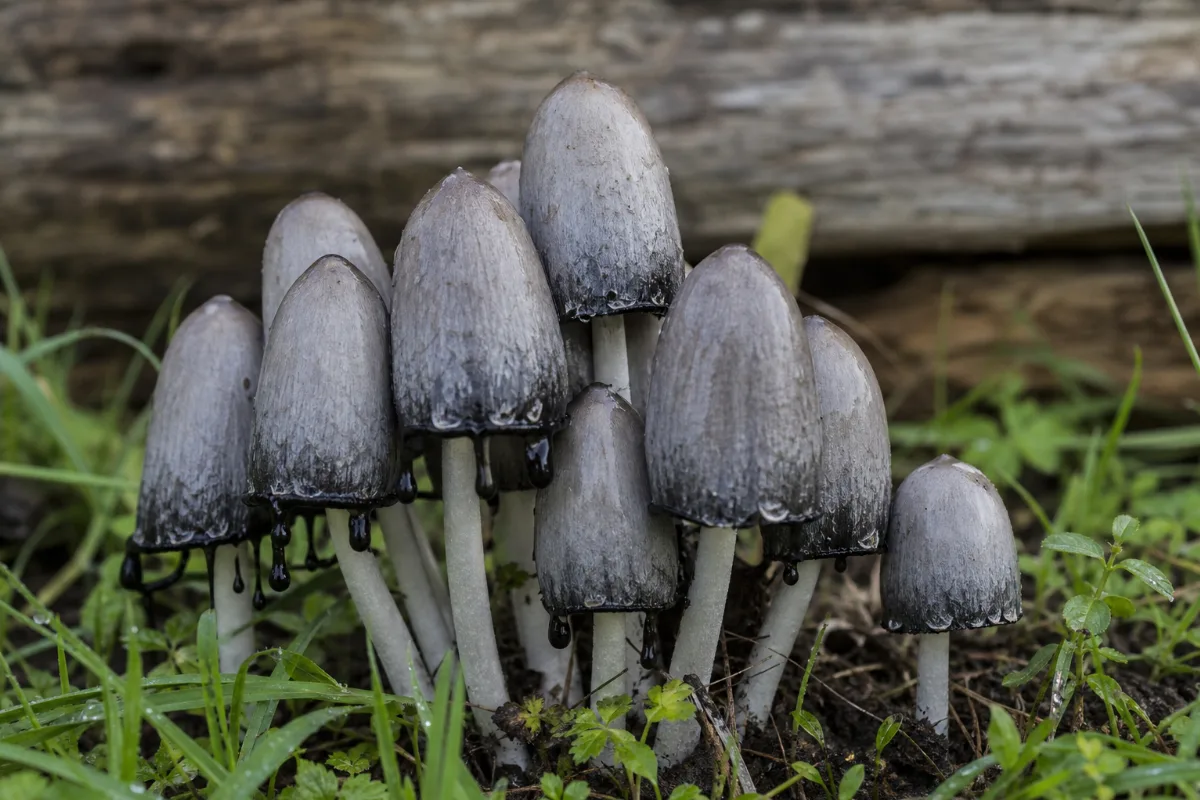
Mushrooms · Mushroom that reacts with alcohol
Common Inky Cap
Coprinopsis atramentaria (Bull.) Redhead, Vilgalys & Moncalvo · also called Common ink-cap, alcohol inky cap; formerly Coprinus atramentarius; not the same as shaggy mane
The common inky cap is a wild mushroom that makes alcohol cause a sudden, unpleasant reaction. Its toxin, coprine, stops the body clearing a harmful breakdown product of alcohol, so flushing, a throbbing head, nausea, sweating and a racing heart can follow. Reports link the reaction to alcohol taken from hours before the meal to about two days after it, and a few severe and fatal cases are on record. No study shows it helps any condition. This page gives no help identifying wild mushrooms.
General information, not medical advice. Last substantive update · Not medically reviewed. A named clinician has not signed off on this page. How this page is made
About Common Inky Cap
The common inky cap (Coprinopsis atramentaria) is a wild mushroom that makes alcohol cause flushing, a throbbing head, nausea, sweating and a racing heart. Its toxin, coprine, blocks the body's clearing of acetaldehyde. Reports describe the reaction with alcohol from hours before the meal to about two days after it. Most episodes pass within an hour or so, but severe heart reactions and one fatal case are reported. No study shows any health benefit.
Danger first: what happens with alcohol
The common inky cap contains coprine. After alcohol, flushing, throbbing in the temples and a headache usually start 5 to 30 minutes after the alcohol, and nausea, sweating and sometimes diarrhea can follow. A clinical chapter by a doctor says the reaction most often starts 3 to 15 minutes after a meal eaten with alcohol, or after alcohol drunk anywhere from minutes to 8 hours earlier.
In the reports we read, the trouble came when alcohol was involved. That does not make the mushroom safe: it can be mistaken for other mushrooms, and this page gives no help identifying wild mushrooms. If someone feels unwell after mushrooms and alcohol, call a poison centre.
How long the risk lasts
Most episodes are over by about 45 minutes, and some last 2 to 3 hours. The reaction can come back if alcohol is drunk again, up to about 48 hours after the meal. The doctor-author of one chapter and his wife tried beer again at 24, 48 and 72 hours and had milder symptoms each time. Both had eaten the mushroom with alcohol before without symptoms, which he says is not an uncommon report.
That means a past meal with no reaction proves nothing, and no source we read gives a safe waiting time.
When it is more than a flush
The same chapter says a few severe poisonings needed monitoring for abnormal heart rhythms, and describes a 53-year-old man with unusually severe vomiting who died of a ruptured food pipe. A 2015 case report describes a 27-year-old with asthma, nasal polyps and aspirin allergy who collapsed with a complete heart block and signs of a heart-artery event after beer and scrambled mushrooms. He improved with treatment. The authors call this poisoning rare but serious.
A 2026 review of food-linked heart-artery events counted this one inky cap case among 53 patients. These are single cases, so they show what can happen, not how often.
Why it happens
Alcohol is first turned into acetaldehyde, which an enzyme called aldehyde dehydrogenase normally clears. In rats, coprine turned out to be a protoxin: it is changed into 1-aminocyclopropanol, which blocks that enzyme quickly and for a long time. Acetaldehyde then builds up. In rats coprine was a stronger blocker than the alcohol-aversion drug disulfiram, and 1-aminocyclopropanol also inactivated the enzyme in human white blood cells in the test tube.
This is animal and test-tube work. It explains the reaction well, but it was not measured in people who had eaten the mushroom.
Other mushrooms can do the same
A case series describes the same syndrome after a different wild mushroom, Lepiota aspera, which all five patients had mistaken for edible mushrooms. Well-cooked mushrooms were tolerated until alcohol was drunk, and the reaction could be set off again up to 48 hours later. A clinical chapter names Clitocybe clavipes as causing a similar syndrome.
So a reaction after alcohol does not prove which mushroom caused it. Experts classify this poisoning as its own syndrome, disulfiram-like poisoning by coprines.
From mushroom to failed drug idea
The illness made researchers hope for a new drug to treat alcoholism, which led to finding coprine and explaining how it works. A 1992 review says detailed toxicology showed coprine is mutagenic and toxic to the gonads, which made it unsuitable. In rats, coprine or a related lab compound caused severe loss of sperm-making tissue.
These findings are for purified compounds in animals. What eating the mushroom does to the testis or genes in people is not known.
What research exists
Human information is expert reviews, a clinical chapter, case reports and a small case series on a different mushroom. There is no clinical trial and no study of benefit. The rest is animal and test-tube work on the toxin, and laboratory chemistry on extracts that says nothing about effects in people.
At a glance
Traditional uses history, not proof
- No traditional medicinal use of the common inky cap is described in the sources we read.
- Medical papers know it as the cause of the 'Coprinus syndrome', an illness when the mushroom is eaten with alcohol (Michelot 1992).
- In the 1970s researchers hoped coprine could become a drug to deter drinking, but toxicity ended that idea (Michelot 1992).
Studied for research
- Coprine as a drug to put people off alcohol: no human trial, dropped because of toxicity (against)
- Antioxidant activity of extracts: very low, test tube only
- Antibacterial and antifungal activity of extracts: very low, test tube only
- Almost all human research is about the alcohol reaction, not benefit
Main compounds
- Coprine (a protoxin that is changed in the body)
- 1-Aminocyclopropanol (the active blocker made from coprine)
- Phenolic acids, sugars and tocopherols (laboratory work only)
Common forms
- Wild mushroom (the form in all the reports we read)
- Purified coprine in animal studies (not a product)
Research links: Poison Control (US): get help online or call 1-800-222-1222 · Clinical reference chapter: disulfiram-like reactions to alcohol (MykoWeb) · Poisoning by Coprinus atramentarius, review (abstract) · Case: collapse after beer and mushrooms, Signa Vitae 2015 (abstract) · Same alcohol reaction after a different mushroom (abstract) · How coprine blocks alcohol breakdown in rats (abstract) · Research Library · Genes & Biomarkers Library
What it is and its history
- Accepted scientific name
- Coprinopsis atramentaria
- Naming authority
- (Bull.) Redhead, Vilgalys & Moncalvo
- Synonyms
- Coprinus atramentarius (Bull.) Fr.; Agaricus atramentarius Bull.; Coprinus fuscescens (Schaeff.) Fr.; Coprinus soboliferus (Hoffm.) Fr.; Coprinus plicatus (Pers.) Gray
- Common names
- Common inky cap (English); Common ink-cap (English); Alcohol inky cap (English); Faltentintling (German); Coprin noir d'encre (French); Hongo entintado (Spanish)
- Family or group
- Psathyrellaceae, a family of fungi (this is a mushroom, not a plant). Part concerned: the fruiting body (the mushroom).
- Classification
- Fungi > Basidiomycota > Agaricomycetes > Agaricales > Psathyrellaceae > Coprinopsis > Coprinopsis atramentaria
- Native range
- GBIF holds about 28,000 occurrence records (count read 2026-10-25). Range was not studied here.
- Habitat
- Not checked.
- What it looks like
- Part used: The fruiting body (the mushroom). This page does not describe how to recognise the mushroom, on purpose: a photo or a description is never proof of what a mushroom is.
- Look-alikes and adulterants
- Name: Other mushrooms with the same alcohol reaction; Note: A case series describes the same syndrome after Lepiota aspera, and a clinical chapter names Clitocybe clavipes and, with more stomach upset, Pholiota squarrosa, Boletus luridus and Boletus pulcherrimus. This is a warning that the cause may not be the mushroom a person thinks it was, not guidance for telling mushrooms apart.; Name: Poisonous species that cannot be told from edible ones by looks; Note: A 2025 review says it is not possible to distinguish some poisonous species from edible ones morphologically. This page gives no identification help.
- Sustainability and conservation
- Not checked.
Traditional use and history history, not clinical proof
| Tradition or era | Documented use | Source |
|---|---|---|
| Medical literature, 1970s to 1990s | The illness after eating the inky cap with alcohol, called the 'Coprinus syndrome', prompted research programmes hoping for a new drug against alcoholism. This led to isolating coprine and explaining how it works, but toxicity ended the drug idea. | Michelot 1992 |
| Chemistry | Coprine was isolated from Coprinus atramentarius and its structure worked out in 1975 (N5-(1-hydroxycyclopropyl)glutamine). | Hatfield and Schaumberg 1975 |
| Modern classification | A 2019 expert classification lists disulfiram-like mushroom poisoning (coprines) as its own syndrome, 4B, in a group of metabolic and endocrine poisonings. | White et al 2019 |
| Traditional or folk medicine | No traditional medicinal use of this mushroom is described in the sources we read. | Searched, none found |
Traditional use shows how it was used. It does not show that it works or is safe today.
What is inside, and how it may work
What it contains and how those compounds act in cells and animals. Laboratory and animal mechanisms are not proven effects in people.
Main compounds
| Compound | Family | Where it is concentrated | Activity studied | Level of evidence |
|---|---|---|---|---|
| Coprine PubChem 108079 | glutamine derivative (amino acid) | Not studied in the sources we read Not measured in any source we read | A 'protoxin': on its own it is a weak blocker of the alcohol-clearing enzyme in the test tube, but in the body it releases 1-aminocyclopropanol (rat work). A 1992 review says it is mutagenic and toxic to the gonads. 23 4 14 11 5 | Review and animal |
| 1-Aminocyclopropanol PubChem 148676 | small amino alcohol | The active blocker. It blocked rat liver acetaldehyde dehydrogenase strongly in the test tube and in living rats, and was a potent inactivator of the enzyme in human white blood cells in the test tube. 24 14 5 | Animal and in vitro | |
| Phenolic acids, sugars and tocopherols | various | Fruiting body Protocatechuic, p-hydroxybenzoic, p-coumaric and cinnamic acids were found in the phenolic fraction of a Portuguese sample set of five wild mushrooms; amounts for C. atramentaria alone are not given in the abstract. | Antioxidant activity in the test tube only. 6 | Laboratory research |
Mechanisms, receptors and pathways
| Target or pathway | Gene or receptor | What was found | Level |
|---|---|---|---|
| Alcohol breakdown (acetaldehyde step) | Aldehyde dehydrogenase (ALDH) | After alcohol is turned into acetaldehyde, ALDH normally clears it (ALDH2 is crucial for this, per a 2012 review). Coprine's product blocks the enzyme, so acetaldehyde builds up and causes flushing, headache, nausea and a racing heart. In rats coprine blocked it more strongly than disulfiram. 1 14 10 2 | Animal research |
| Human blood-cell enzyme | ALDH in white and red blood cells | 1-Aminocyclopropanol strongly inactivated the white-cell enzyme but much less the red-cell enzyme in the test tube; coprine itself was much weaker. 5 | Laboratory research |
| Blood pressure and heart rate after alcohol | Not identified | In rats, ethanol caused a fast fall in blood pressure after coprine or disulfiram; only the coprine group also had a faster heartbeat. The authors link the difference to disulfiram also blocking a second enzyme, DBH. 1 | Animal research |
| Reproductive tissue | Germ cells | Coprine and a related compound damaged sperm-making tissue in rats; the authors say the effect looks direct and resembles alkylating compounds. 8 | Animal research |
Absorption, metabolism and elimination
- Absorption
- Not established in people.
- Distribution
- Not established.
- Metabolism
- Coprine is changed in the body into 1-aminocyclopropanol, which does the blocking (rat and test-tube work).
- Elimination
- Not established. The block in rats was rapid in onset and long-lasting; in people, reactions are reported to recur up to about 48 hours.
- Bioavailability
- Not established.
Isolated compounds versus whole extracts
The mushroom, purified coprine and lab compounds such as benzcoprine are different things. The alcohol reaction in people is documented for the mushroom. Testis and gene-damage findings are for purified compounds in animals. No consumer product made from this mushroom was found in the sources we read.
Nutritional composition
This page makes no nutrition claim. No national food-composition entry was read for this mushroom.
2 very low certainty1 evidence against
What was looked at
The 3 benefits and uses checked for Common Inky Cap, each with how strong the evidence is. Tap one to open it.
What is Common Inky Cap good for?
The uses people ask about and how strong the human evidence is for each. None is proven. Read every row together with the Safety tab: this mushroom reacts with alcohol and can cause serious illness.
Benefits, one by one
Each card is a research question, not a promise. Tap a goal to filter. Open a card to see the studies, doses and limits.
Putting people off alcohol (the coprine drug idea)
Evidence againstCoprine, the toxin in this mushroom, acts like the alcohol-aversion drug disulfiram. It was studied as a possible drug for alcoholism, but its gene-damaging and testis-damaging effects in animals ended that idea. The mushroom itself is not a treatment.
7 studiesNot covered. This page gives no amounts, preparation or ways of using…
Studies, doses and limits
What the trials found
No clinical trial of coprine or the mushroom as a treatment for alcohol problems was found. Human information is the reaction itself, described in reviews and case reports. A 1992 review says detailed toxicology showed coprine was mutagenic and toxic to the gonads, so it was unsuitable as a drug.
Results
Nothing was shown to help people. In rats, coprine blocked alcohol breakdown more strongly than disulfiram. In rats and dogs, coprine or a related lab compound damaged the testis tissue that makes sperm.
Why this rating
Reviewers say the toxicity findings made coprine unsuitable as a drug. There is no human trial. The animal studies show the mechanism and the harm, not a benefit.
Form and dose studied
Not covered. This page gives no amounts, preparation or ways of using the mushroom, and no study tested it as a remedy.
Who was studied
No clinical group has been studied.
Limits
The animal studies are from the 1970s and 1980s on purified compounds. The Michelot review abstract gives no case numbers, and we read abstracts, not full texts, of the animal papers.
Why researchers looked
People noticed the sudden illness that follows eating the mushroom with alcohol. That 'Coprinus syndrome' made researchers hope for a new drug to treat alcoholism, which led them to find coprine and learn how it works.
Traditional use
No traditional medicinal use of this mushroom is described in the sources we read.
Proposed mechanism Animal and laboratory
Coprine is turned in the body into 1-aminocyclopropanol, which blocks aldehyde dehydrogenase, the enzyme that clears acetaldehyde (a harmful breakdown product of alcohol). Acetaldehyde then builds up and causes the unpleasant reaction (rat and test-tube studies, expert reviews).
A proposed mechanism does not show that the effect happens in people.
This mushroom can make alcohol cause flushing, a throbbing head, nausea, a racing heart and, rarely, a serious or fatal reaction. See the Safety tab first. If someone feels unwell after mushrooms and alcohol, call a poison centre.
Antioxidant activity of extracts (laboratory only)
Very low certaintyIn test-tube work, extracts of this mushroom scored high on antioxidant tests compared with four other wild mushrooms. That is chemistry in a dish. It does not show any benefit to people.
1 studiesNot covered. This page gives no amounts, preparation or ways of using…
Studies, doses and limits
Results
In a Portuguese comparison of five wild mushrooms, the phenolic fraction of C. atramentaria (with that of Xerocomus chrysenteron) gave the highest free-radical scavenging, reducing power and protection of brain homogenates from lipid peroxidation, and its polysaccharide fraction had the highest antioxidant activity among the polysaccharide fractions.
Why this rating
Laboratory chemistry only. No living animal or person was tested.
Form and dose studied
Not covered. This page gives no amounts, preparation or ways of using the mushroom, and no study tested it as a remedy.
Limits
Test-tube results often do not carry over to the body. The paper compared fractions made in the lab, not a food or a product. This mushroom also causes the alcohol reaction described on the Safety tab.
Why researchers looked
Researchers screen many wild mushrooms for antioxidant compounds such as phenolic acids.
Proposed mechanism Laboratory research
Phenolic compounds can mop up free radicals in the test tube (laboratory work).
A proposed mechanism does not show that the effect happens in people.
This mushroom can make alcohol cause flushing, a throbbing head, nausea, a racing heart and, rarely, a serious or fatal reaction. See the Safety tab first. If someone feels unwell after mushrooms and alcohol, call a poison centre.
Killing fungi and bacteria in the test tube
Very low certaintyAn extract and its organic acids slowed the growth of some microbes in a laboratory dish. No animal or human work exists, so this says nothing about treating infection.
1 studiesNot covered. This page gives no amounts, preparation or ways of using…
Studies, doses and limits
Results
Antifungal activity was stronger than antibacterial activity, and single organic acids beat the extract. The authors suggest the compounds could be developed as antimicrobial agents.
Why this rating
Laboratory dish work only.
Form and dose studied
Not covered. This page gives no amounts, preparation or ways of using the mushroom, and no study tested it as a remedy.
Limits
No animal or human data; includes lab-made chemical derivatives, not the mushroom.
Why researchers looked
Mushroom acids and phenolic compounds are screened for antimicrobial activity.
Proposed mechanism Laboratory research
Organic acids were more active than the whole extract against microbes in the dish (laboratory work).
A proposed mechanism does not show that the effect happens in people.
This mushroom can make alcohol cause flushing, a throbbing head, nausea, a racing heart and, rarely, a serious or fatal reaction. See the Safety tab first. If someone feels unwell after mushrooms and alcohol, call a poison centre.
Connections to the rest of health
How Common Inky Cap connects to the rest of our health knowledge graph. Every link says what kind of connection it is. A safety link (for example to the liver) is a warning, not a benefit. A study that merely mentions a topic never creates a benefit link.
Explore every connection: goals, body systems, organs, symptoms, genes
B. Body systems
| Connected to | Kind of connection | Evidence status | Context | Studies |
|---|---|---|---|---|
| Liver | Biological association | Evidence against | Studied for: Putting people off alcohol (the coprine drug idea) | 11 1 14 5 8 4 2 |
| Digestive System | Biological association | Evidence against | Studied for: Putting people off alcohol (the coprine drug idea) | 11 1 14 5 8 4 2 |
| Immune System | Biological association | Very low certainty | Studied for: Killing fungi and bacteria in the test tube | 7 |
C. Body parts and organs
| Connected to | Kind of connection | Evidence status | Context | Studies |
|---|---|---|---|---|
| Heart and blood pressure | Adverse effect or risk | Low certainty | Fast heartbeat, rhythm problems in severe cases and one reported heart-artery event. Preparation or compound: Mushroom with alcohol |
16 13 2 |
| Reproductive system | Adverse effect or risk | Very low certainty | Testis damage in rats and dogs with coprine or a related compound; not shown for eating the mushroom. Preparation or compound: Purified coprine (animals) |
8 11 |
| Liver | Low certainty | No liver injury found in the sources read. Preparation or compound: Mushroom |
9 |
J. Genes, receptors and enzymes
| Connected to | Kind of connection | Evidence status | Context | Studies |
|---|---|---|---|---|
| Aldehyde dehydrogenase (ALDH, including ALDH2) | Preliminary mechanism | Animal | The enzyme step blocked by coprine's active product. | 14 10 |
| Dopamine beta-hydroxylase (DBH) | Preliminary mechanism | Animal | Blocked by disulfiram but not by coprine in rats. | 1 |
L. Active compounds
| Connected to | Kind of connection | Evidence status | Context | Studies |
|---|---|---|---|---|
| Alcohol (ethanol) | Drug or supplement interaction | Moderate certainty | Coprine's product blocks acetaldehyde clearance, causing the alcohol reaction. Preparation or compound: Mushroom (coprine) |
2 11 1 |
| Coprine | Biological association | Review and animal | A 'protoxin': on its own it is a weak blocker of the alcohol-clearing enzyme in the test tube, but in the body it releases 1-aminocyclopropanol (rat work). A 1992 review says it is mutagenic and toxic to the gonads. Preparation or compound: Not studied in the sources we read |
23 4 14 11 5 |
| 1-Aminocyclopropanol | Biological association | Animal and in vitro | The active blocker. It blocked rat liver acetaldehyde dehydrogenase strongly in the test tube and in living rats, and was a potent inactivator of the enzyme in human white blood cells in the test tube. | 24 14 5 |
| Phenolic acids, sugars and tocopherols | Biological association | In vitro | Antioxidant activity in the test tube only. Preparation or compound: Fruiting body |
6 |
Each connection is stored with the ingredient, the connected record, the kind of connection, the evidence status, the supporting studies, the preparation or compound involved, and a review date (last reviewed October 25, 2026).
Evidence at a glance: what the research found for 3 outcomes
Each outcome below is one thing researchers measured. Certainty is how far the evidence can be trusted, not how well it works. The full studies are on the next tab.
The evidence
The research centre for Common Inky Cap. Every record here was checked against PubMed or the publisher's page; we never list a study we have not verified.
Evidence by outcome
Bars show how many studies we found for each outcome, not how well it works. People are added up across trials only (reviews are not added, to avoid double counting).
How we rate evidence
High certainty
Several well-run trials or reviews agree; further research is unlikely to change the picture much.
Moderate certainty
Good trials point the same way, but some doubt remains.
Low certainty
Small, short or inconsistent trials. The finding could change with better research.
Very low certainty
Very little or very weak human data. Treat as a possibility only.
Mixed findings
Trials or reviews disagree with each other.
Not enough evidence
Not enough human research to say either way.
Evidence against
Good research found no benefit, or found harm.
We take the reviewers' own risk-of-bias and GRADE statements where they exist, and otherwise judge from study size, design, consistency, directness and whether a product matches what is sold. Many publications do not make evidence high. Method note: We searched PubMed, read the abstracts of 16 papers, read a clinical reference chapter in full and a case report abstract on the journal portal, read the US, UK and Australian poison-help pages, and checked the scientific name and chemical identifiers in GBIF and PubChem. Index Fungorum could not be opened. Where a statement could not be checked it is marked as unverified in our notes.
Study library: every study we checked 24
| Study | Design | People | Product, dose, length | Result |
|---|---|---|---|---|
| Carlsson 1978 On the disulfiram-like effect of coprine, the pharmacologically active principle of Coprinus atramentarius. Acta Pharmacol Toxicol (Copenh) · PMID 350009 · DOI |
Animal study rat |
Rats given coprine or disulfiram, then ethanol | Coprine, the toxin of the common inky cap (Coprinus atramentarius, now Coprinopsis atramentaria) |
Coprine and disulfiram both raised the acetaldehyde-to-ethanol ratio, coprine more strongly. After ethanol, blood pressure fell quickly in both groups. A faster heartbeat followed only in the coprine group. The authors conclude that coprine, like disulfiram, blocks the enzyme (ALDH); only disulfiram also blocked a second enzyme (DBH). Coprine blocked alcohol breakdown at the acetaldehyde step in rats Methods, limits and fundingOutcomes: Breath acetaldehyde-to-ethanol ratio (an index of the enzyme that clears acetaldehyde); blood pressure and heart rate after ethanol Limitations: Rats and a purified compound, not people eating the mushroom. Funding and conflicts: Not stated in the abstract. Read: abstract |
| Duffy TJ (with Wood M) 2008 MykoWeb, Toxic Fungi of Western North America (T. J. Duffy, MD): Disulfiram-like reactions to alcohol MykoWeb · Source |
Expert web chapter human (clinical reference) |
n/a | n/a |
Names Coprinopsis (Coprinus) atramentaria as the common cause. The protoxin coprine is converted to 1-aminocyclopropanol, which blocks aldehyde dehydrogenase, so acetaldehyde builds up. Symptoms: flushing, throbbing in the temples, usually headache starting 5 to 30 minutes after the alcohol; nausea, sweating and occasional diarrhea may follow. A meal eaten with alcohol, or minutes to 8 hours after alcohol, most commonly sets it off 3 to 15 minutes later. Recurrence is usually given as up to 48 hours. The author and his wife had progressively milder symptoms with beer at 24, 48 and 72 hours, and both had eaten the mushroom with alcohol before without symptoms. By 45 minutes the episode is usually over; sometimes it lasts 2 to 3 hours. A few severe poisonings needed heart-rhythm monitoring, and one 53-year-old man with unusually severe vomiting had a fatal rupture of the oesophagus. Treatment is mostly watching vital signs and reassurance. A similar syndrome is named for Clitocybe clavipes, and similar symptoms with more stomach upset for Pholiota squarrosa, Boletus luridus and B. pulcherrimus. Methods, limits and fundingOutcomes: Description of the inky cap alcohol syndrome, timing, symptoms and management Limitations: A clinician's reference chapter (copyright 2008), not a peer-reviewed paper. It also describes how the mushroom looks; this page does not repeat that. We did not use its remark about animal testis damage as a human dose. Read: full-text |
| Haberl 2011 Case series: Alcohol intolerance with Coprine-like syndrome after consumption of the mushroom Lepiota aspera (Pers.:Fr.) Quel., 1886 (Freckled Dapperling). Clin Toxicol (Phila) · PMID 21370948 · DOI |
Case series |
5 Five patients in three events who ate self-collected Lepiota aspera and then drank alcohol |
Lepiota aspera (a different wild mushroom) fruiting body |
Well-cooked mushrooms were tolerated until an alcoholic drink, then within minutes came facial flushing, throbbing headache, fast heartbeat and shortness of breath. Symptoms eased within a few hours with no lasting harm, but could be brought back by more alcohol up to 48 hours later. The authors say this looks identical to the inky cap syndrome, though the toxin in Lepiota aspera is not known. All patients had mistaken it for edible mushrooms. Methods, limits and fundingOutcomes: Symptoms after alcohol following a different wild mushroom, compared with the inky cap syndrome Limitations: A different mushroom (Lepiota aspera). Small series. Funding and conflicts: Not stated in the abstract. Read: abstract |
| Hatfield 1975 Isolation and structural studies of coprine, the disulfiram-like constituent of Coprinus atramentarius. Lloydia · PMID 1241098 |
Animal study mouse |
Mice; chemistry of the isolated compound | Coprine, the toxin of the common inky cap (Coprinus atramentarius, now Coprinopsis atramentaria) |
Coprine was isolated and its structure worked out as N5-(1-hydroxycyclopropyl)glutamine. In mice it produced hyperaldehydemia (too much acetaldehyde in the blood) after ethanol. In the test tube it was not itself an inhibitor of mouse liver aldehyde dehydrogenase. Methods, limits and fundingOutcomes: Structure of coprine; acetaldehyde in blood after ethanol; enzyme block in the test tube Limitations: Early chemistry and mouse work, 1975. Funding and conflicts: Not stated in the abstract. Read: abstract |
| Helander 1988 Effects of disulfiram, cyanamide and 1-aminocyclopropanol on the aldehyde dehydrogenase activity in human erythrocytes and leukocytes. Pharmacol Toxicol · PMID 2848231 · DOI |
Laboratory research human cells (in vitro) |
Human red and white blood cells in the test tube | Coprine and its derivative 1-aminocyclopropanol, compared with disulfiram and cyanamide |
1-Aminocyclopropanol (ACP), the compound made from coprine, was a potent inactivator of the ALDH of human white blood cells (50% block at 50 micromolar) while the red-cell enzyme was much less affected. Coprine itself, from which ACP is derived, was a much weaker inhibitor than disulfiram and ACP. Methods, limits and fundingOutcomes: Block of aldehyde dehydrogenase (ALDH) activity by three inhibitors Limitations: Test-tube work on blood cells, not on people who ate the mushroom. Funding and conflicts: Not stated in the abstract. Read: abstract |
| Heleno 2012 Phenolic, polysaccharidic, and lipidic fractions of mushrooms from northeastern Portugal: chemical compounds with antioxidant properties. J Agric Food Chem · PMID 22515547 · DOI |
Laboratory research laboratory (in vitro) |
Fractions of five wild mushrooms from Portugal, including Coprinopsis atramentaria, in laboratory tests | Phenolic, sugar and fat fractions of wild Coprinopsis atramentaria fruiting body |
The phenolic fractions of C. atramentaria (and of Xerocomus chrysenteron) gave the highest free-radical scavenging, reducing power and protection of brain homogenates from lipid peroxidation. The authors link this to the highest total phenolics. Its polysaccharide fraction also had the highest antioxidant activity among the polysaccharide fractions tested. Methods, limits and fundingOutcomes: Chemical makeup and antioxidant activity in the test tube Limitations: Test-tube chemistry on mushroom extracts. It does not show any effect in people. Funding and conflicts: Not stated in the abstract. Read: abstract |
| Heleno 2014 Coprinopsis atramentaria extract, its organic acids, and synthesized glucuronated and methylated derivatives as antibacterial and antifungal agents. Food Funct · PMID 25131614 · DOI |
Laboratory research laboratory (in vitro) |
Mushroom extract and organic acids tested on microbes in the laboratory | Coprinopsis atramentaria extract and its organic acids fruiting body |
The extract, its organic acids and lab-made derivatives were tested against microbes. Antifungal activity was stronger than antibacterial activity, and single compounds (mostly organic acids) were more active than the extract. The authors say these could be used as antimicrobial agents. Methods, limits and fundingOutcomes: Antibacterial and antifungal activity in the test tube Limitations: Test-tube work; no animal or human data. Funding and conflicts: Not stated in the abstract. Read: abstract |
| Jonsson 1979 Testicular lesions of coprine and benzcoprine. Toxicology · PMID 473235 · DOI |
Animal study rat, dog |
Rats and dogs | Coprine, the toxin of the common inky cap (Coprinus atramentarius, now Coprinopsis atramentaria) |
In rats, repeated oral dosing with coprine or benzcoprine caused severe degeneration of the tissue that makes sperm. In dogs, benzcoprine for one month impaired sperm production. The authors say the effect looks direct on germ cells and resembles that of alkylating compounds. They list bone-marrow depression, low lymphocytes and a positive Ames test (an early test for gene damage) among other effects of the two compounds. Methods, limits and fundingOutcomes: Changes in the testis after oral dosing with coprine or the related compound benzcoprine Limitations: Animal work on purified compounds, not on people eating the mushroom. The dog work used benzcoprine, a related lab compound. Funding and conflicts: Not stated in the abstract. Read: abstract |
| Kaufmann 2007 [Mushroom poisonings: syndromic diagnosis and treatment]. Wien Med Wochenschr · PMID 18030554 · DOI |
Review human (review) |
Review of mushroom poisoning syndromes by timing of symptoms | n/a |
Early syndromes (symptoms in under 6 hours) have little chance of organ damage. Neurotoxic syndromes can appear as dysphoria, delirium, hallucinations or disulfiram-like reactions. Treatment is entirely supportive and, in hospital, the prognosis is good. Methods, limits and fundingOutcomes: How to sort syndromes and how they are treated Limitations: Narrative review in German (English abstract). Not specific to the inky cap. Funding and conflicts: Not stated in the abstract. Read: abstract |
| Koppaka 2012 Aldehyde dehydrogenase inhibitors: a comprehensive review of the pharmacology, mechanism of action, substrate specificity, and clinical application. Pharmacol Rev · PMID 22544865 · DOI |
Review review |
Review of the aldehyde dehydrogenase (ALDH) enzymes and the drugs that block them | n/a |
The abstract says ALDH2 is crucial for alcohol metabolism because it oxidises acetaldehyde, and that inhibitors of the ALDH enzymes have been developed to treat human diseases. It does not mention coprine. Methods, limits and fundingOutcomes: What ALDH enzymes do and how inhibitors work Limitations: General pharmacology review. Used here only for the role of the enzyme that coprine's product blocks. We read the abstract, not the full text. Funding and conflicts: Not stated in the abstract. Read: abstract |
| Michelot 1992 Poisoning by Coprinus atramentarius. Nat Toxins · PMID 1344910 · DOI |
Review human and animal (review) |
Review of the poisoning that follows eating the inky cap together with alcohol | Common inky cap (Coprinus atramentarius, now Coprinopsis atramentaria) and its toxin coprine fruiting body |
The authors call the poisoning minor. It happens when the inky cap is eaten with alcohol. The active principle is coprine. Detailed toxicology showed that coprine is mutagenic and toxic to the gonads, which made it unsuitable as a treatment for alcoholism. Methods, limits and fundingOutcomes: The 'Coprinus syndrome', the toxin coprine, how it works and why it was not made into a drug Limitations: Narrative review from 1992. The abstract gives no case numbers. Funding and conflicts: Not stated in the abstract. Read: abstract |
| Pena-Fernandez 2026 Censored-Data-Aware Screening of Hazardous Metal(loid)s in Wild Mushrooms from Urban and Peri-Urban Green Spaces: Multielement Fingerprints and Adult Exposure Assessment. J Xenobiot · PMID 42646055 · DOI |
Cross sectional fungus samples |
121 121 wild mushroom fruiting-body units from parks in Leicester, UK |
Wild mushrooms including Coprinopsis atramentaria fruiting body |
Cadmium and lead were found in most samples. In a screening scenario of 300 g fresh mushrooms per week, taxon-specific results changed which metal was the main concern, and copper became the leading driver for Coprinopsis atramentaria (and Marasmius oreades). Methods, limits and fundingOutcomes: Metal levels and a screening estimate of adult exposure Limitations: A screening estimate from one UK city. The abstract gives no separate numbers for the inky cap. Funding and conflicts: Not stated in the abstract. Read: abstract |
| Sanchez-Fernandez 2026 Food-Associated Kounis Syndrome: Clinical Spectrum and Diagnostic Considerations from a Case Report and Systematic Qualitative Synthesis of Published Cases. Clin Rev Allergy Immunol · PMID 42859290 · DOI |
Systematic review |
53 53 patients with heart-artery problems linked in time to a food; searches to August 2026 |
Food-linked heart events; one patient after Coprinopsis atramentaria with alcohol |
Of 53 patients, 20 had confirmed and 26 suspected food allergy, six had scombroid fish poisoning and one had a Coprinopsis atramentaria-alcohol interaction. The authors say that non-allergic toxic food reactions can look the same and should be sorted out separately. Methods, limits and fundingOutcomes: Which foods and mechanisms were reported (Kounis syndrome is an allergic heart-artery event) Limitations: The abstract mentions the inky cap only as one patient among 53. Funding and conflicts: Not stated in the abstract. Read: abstract |
| Tottmar 1977 Effects on rat liver acetaldehyde dehydrogenases in vitro and in vivo by coprine, the disulfiram-like constituent of Coprinus atramentarius. Acta Pharmacol Toxicol (Copenh) · PMID 577107 |
Animal study rat |
Rat liver enzymes, in the test tube and in living rats | Coprine, the toxin of the common inky cap (Coprinus atramentarius, now Coprinopsis atramentaria) |
In living rats, coprine blocked the low-Km liver enzyme and raised blood acetaldehyde during ethanol breakdown. In the test tube coprine itself did not block it, but its breakdown product 1-aminocyclopropanol did, strongly. The block began quickly and was long-lasting. The authors suggest 1-aminocyclopropanol causes the block in the body. Methods, limits and fundingOutcomes: Inhibition of liver acetaldehyde dehydrogenase and blood acetaldehyde during ethanol breakdown Limitations: Rats and test-tube work only. Funding and conflicts: Not stated in the abstract. Read: abstract |
| Tugcan 2025 Mushroom poisoning: An updated review. Turk J Emerg Med · PMID 39882097 · DOI |
Review human (review) |
Review of mushroom poisoning syndromes and treatments | n/a |
Coprine is listed as one of the toxin categories. The authors say it is not possible to tell poisonous species from some edible ones by their looks, so accidental poisoning is an important public health problem. Amatoxin mushrooms cause more than 90% of deaths from mushroom poisoning. Methods, limits and fundingOutcomes: Toxin categories, clinical syndromes and treatment Limitations: General review. The abstract does not describe the inky cap. Funding and conflicts: Not stated in the abstract. Read: abstract |
| Valle Alonso 2015 Be careful what you eat and drink; Coprinic and Kounis syndrome in a patient with the Samter's triad Signa Vitae 10(1):136-143 · Source |
Case report |
n/a | n/a |
A 27-year-old with mild persistent asthma, nasal polyps and aspirin allergy arrived with dizziness and tremor after drinking beer at a party. On arrival he collapsed, with ST elevation in the inferior leads and third-degree AV block on the ECG and urticaria-like skin lesions. He and his ECG improved after treatment. History showed he had eaten scrambled mushrooms with beer. Experts found that Coprinopsis atramentaria with alcohol produced a disulfiram-like reaction (coprinic syndrome) and type I Kounis syndrome. The authors call C. atramentaria poisoning rare but with serious consequences and say no such case had been reported before. Methods, limits and fundingOutcomes: A single 27-year-old patient with collapse after beer and scrambled mushrooms Limitations: One case, read from the abstract on the journal's portal (the full PDF was not opened). The patient also had an allergy-prone background. Read: abstract (journal portal) |
| White 2019 Mushroom poisoning: A proposed new clinical classification. Toxicon · PMID 30439442 · DOI |
Review human (review) |
Expert review of mushroom poisoning syndromes since 1994 | n/a |
The authors place 'disulfiram-like (coprines)' poisoning as its own syndrome (4B) in a group of metabolic and endocrine poisonings. They say gastrointestinal symptoms are common to many syndromes. Methods, limits and fundingOutcomes: A classification of mushroom poisoning into six groups Limitations: A classification paper; the abstract gives no details on the inky cap itself. Funding and conflicts: Not stated in the abstract. Read: abstract |
| Xie 2017 Accumulation and tolerance to cadmium heavy metal ions and induction of 14-3-3 gene expression in response to cadmium exposure in Coprinus atramentarius. Microbiol Res · PMID 28164784 · DOI |
Laboratory research laboratory (in vitro) |
Coprinus atramentarius grown on laboratory medium containing cadmium | Coprinus atramentarius grown on solid medium culture |
The authors say C. atramentarius is recognised as able to accumulate heavy metal ions. Grown on laboratory medium, it accumulated 76% of the cadmium present at 1 mg per litre. Methods, limits and fundingOutcomes: Cadmium uptake and gene response Limitations: Laboratory culture, not wild mushrooms in the field. Funding and conflicts: Not stated in the abstract. Read: abstract |
| n/a 2026 Poison Control (National Capital Poison Center): home page and call advice n/a · Source |
Authoritative guidance n/a |
n/a | n/a |
The home page gives the poison help number 1-800-222-1222 (free, expert and confidential) and says to call 911 if the person collapses, has a seizure, has trouble breathing or cannot be awakened. Read 25 October 2026. Methods, limits and fundingOutcomes: What to do in a suspected poisoning in the US Limitations: A public help page. Read: full-text |
| n/a 2026 NHS (UK): Poisoning n/a · Source |
Authoritative guidance n/a |
n/a | n/a |
The page says to call 999 or go to A&E if someone may have swallowed, touched or breathed in something harmful, has lost consciousness, has stopped breathing, has severe difficulty breathing or has a seizure, and to call NHS 111 if you are not sure whether something swallowed is harmful. Read 25 October 2026. Methods, limits and fundingOutcomes: What to do in suspected poisoning in the UK Limitations: A public help page. Read: full-text |
| n/a 2026 NSW Poisons Information Centre (Australia): home page n/a · Source |
Authoritative guidance n/a |
n/a | n/a |
The home page says the centre can be called 24/7 on 13 11 26, says not to wait for symptoms, and says to call Triple Zero (000) and ask for an ambulance for someone who is unconscious or not breathing. Read 25 October 2026. Methods, limits and fundingOutcomes: Poison advice line in Australia Limitations: A public help page for one Australian state service. Read: full-text |
| n/a 2026 GBIF Backbone Taxonomy: Coprinopsis atramentaria (Bull.) Redhead, Vilgalys & Moncalvo (key 5242740) n/a · Source |
Database record n/a |
n/a | n/a |
GBIF lists Coprinopsis atramentaria as ACCEPTED, in the family Psathyrellaceae (order Agaricales). Synonyms include Coprinus atramentarius (Bull.) Fr., Agaricus atramentarius Bull., Coprinus fuscescens and Coprinus soboliferus. English names listed: Alcohol Inky Cap, Common Ink-Cap, Common Inkcap. About 28,000 occurrence records are held (count read 2026-10-25). Methods, limits and fundingOutcomes: Accepted name, synonyms, family and common names Limitations: Names only; says nothing on safety. Index Fungorum was not opened. Funding and conflicts: Independent public database Read: API record read on 2026-10-25 |
| n/a 2026 PubChem: Coprine (CID 108079) n/a · Source |
Database record n/a |
n/a | n/a |
PubChem lists coprine as CID 108079, formula C8H14N2O4, IUPAC name (2S)-2-amino-5-[(1-hydroxycyclopropyl)amino]-5-oxopentanoic acid. Read through the PubChem API 2026-10-25. Methods, limits and fundingOutcomes: Identity of the toxin coprine Limitations: Chemical identity only. Read: API record read on 2026-10-25 |
| n/a 2026 PubChem: 1-Aminocyclopropanol (CID 148676) n/a · Source |
Database record n/a |
n/a | n/a |
PubChem lists 1-aminocyclopropanol as CID 148676, formula C3H7NO. Read through the PubChem API 2026-10-25. Methods, limits and fundingOutcomes: Identity of the active breakdown product of coprine Limitations: Chemical identity only. Read: API record read on 2026-10-25 |
What we do not know yet
- No controlled human study of how often the alcohol reaction happens, who is most affected, or how strong it is.
- No safe waiting time between the meal and alcohol is given in any source we read.
- We did not find whether cooking, drying or pickling changes the risk.
- No data on alcohol hidden in foods, mouthwashes or medicines, and none for pregnancy, breastfeeding, children or pets.
- No regulator statement on this mushroom was searched.
How new research is added
New studies are found by a saved PubMed search and are placed in a review queue. A person reads each one before it changes this page.
Lab markers
What changed in blood or saliva tests during trials. A changed number is not the same as feeling or being healthier, and we give no "normal ranges".
Safety
What studies and official sources say about side effects, medicines and who should check first. Each point shows what kind of evidence it comes from.
Main points to know 6
- Alcohol and this mushroom do not mix, before or after. The common inky cap holds coprine, which makes the body unable to clear acetaldehyde, a breakdown product of alcohol. After alcohol, flushing, a throbbing head and temples, nausea, sweating and a racing heart can follow. Reports say a meal eaten with alcohol, or minutes to 8 hours after alcohol, most often sets it off 3 to 15 minutes later. Expert review and case reports 2 11 1
- The risk can last for days, and past meals prove nothing. Reactions are reported to come back with alcohol for up to about 48 hours after the meal. One doctor-author who tried beer again at 24, 48 and 72 hours had milder symptoms each time. The same author says it is not uncommon for people who ate it with alcohol before, without symptoms, to react later. No source we read gives a safe waiting time. Expert review 2 3
- Most reactions pass, but serious and fatal cases are on record. Most episodes are over by about 45 minutes, and some last 2 to 3 hours. A few severe poisonings needed heart-rhythm monitoring. One reported man with unusually severe vomiting died of a rupture of the food pipe. A 27-year-old with asthma and aspirin allergy collapsed with a heart block and signs of a heart-artery event after beer and scrambled mushrooms, and improved with treatment. Expert review and case report 2 16 13
- If someone feels unwell after mushrooms and alcohol, call for help. In the US call Poison Help at 1-800-222-1222 (free and confidential), or 911 if the person collapses, has a seizure, has trouble breathing or cannot be awakened. In the UK call NHS 111 if you are unsure and 999 in an emergency. In Australia the Poisons Information Centre line is 13 11 26. Authoritative guidance 19 20 21
- This page gives no help identifying wild mushrooms. Other mushrooms can cause the same alcohol reaction, and a review says some poisonous species cannot be told from edible ones by their looks. A photo, an app or a description is never proof of what a mushroom is. Do not eat wild mushrooms unless an expert has identified them in person. Review and case series 15 3 2
- No use of this mushroom as a remedy is supported. There is no human study showing the mushroom or coprine helps any condition. Coprine was dropped as a possible drug for alcoholism because it was mutagenic and harmed the testis in animal studies. Review 11 8
Side effects 7
| Effect | How often | Severity and recovery | Evidence |
|---|---|---|---|
| Facial flushing, throbbing in the temples, headache Described for the inky cap and, in a case series, for a different mushroom with the same syndrome. | The usual picture; no rate given in the sources we read | moderate Usually over within about 45 minutes; sometimes 2 to 3 hours | Expert review 2 3 |
| Nausea, sweating, occasional diarrhea Panic can make some symptoms worse, according to the same chapter. | Not given | mild to moderate Usually passes as the reaction ends | Expert review 2 |
| Fast heartbeat and shortness of breath In rats given coprine and then ethanol, blood pressure fell quickly and the heartbeat sped up. | All five patients in a Lepiota aspera series (different mushroom, same syndrome) | moderate to severe Eased within a few hours in the series | Case series 3 2 |
| Heart-rhythm problems in severe cases The chapter says severe cases needed monitoring for abnormal heart rhythms. | A few severe poisonings (no count given) | severe Not described | Expert review 2 |
| Heart block with a heart-artery event (Kounis syndrome) A 2026 review of food-linked cases found this one inky cap case among 53 patients. | One reported patient, aged 27, with asthma, nasal polyps and aspirin allergy | severe Improved with treatment in the report | Case report 16 13 |
| Severe vomiting leading to a ruptured food pipe Reported in a clinical reference chapter; we did not open the original report. | One fatal case reported (a 53-year-old man) | life-threatening Fatal in the reported case | Case report in review 2 |
| Gene damage and testis damage (purified coprine, animals) A 1992 review says coprine is mutagenic and toxic to the gonads. Rats given coprine or a related compound by mouth had severe loss of sperm-making tissue. These were purified compounds, not the mushroom eaten as food, and the effect of eating the mushroom is not known. | Not applicable (animal studies) | unknown in people Not described | Animal study 11 8 |
Liver
We found no report of liver injury from the common inky cap in the sources we read. A 2007 review says early mushroom syndromes (symptoms within 6 hours) rarely damage organs. LiverTox was not searched. 9
How often. No liver cases were found; this does not prove there are none.
This is a safety connection. It is not evidence that Common Inky Cap supports liver health.
Medicines and supplements 3
| With | Why it matters | Importance | Evidence | What to do |
|---|---|---|---|---|
| Alcohol (beer, wine and spirits) alcohol | Coprine is turned into 1-aminocyclopropanol, which blocks the enzyme that clears acetaldehyde, so acetaldehyde builds up after alcohol (rat and test-tube work, expert reviews). | The main danger of this mushroom. A reaction can follow alcohol taken minutes to 8 hours before the meal and up to about 48 hours after it. Serious and fatal cases are reported. | Case reports and reviews Moderate certainty 2 11 1 14 5 16 | Do not drink alcohol around a meal containing this mushroom. If a reaction starts, stop drinking and get medical or poison-centre advice. Read the Safety tab. |
| Disulfiram (Antabuse) and other medicines that block alcohol breakdown prescription | Coprine acts on the same enzyme step as disulfiram, and in rats it was the stronger blocker (animal work). | Taking both has not been studied in people. The worry is a stronger or longer alcohol reaction. | Pharmacological theory Not enough evidence 1 5 10 | Ask a doctor or pharmacist. People taking these medicines are already told to avoid alcohol. |
| Medicines for blood pressure or heart rhythm prescription | The reaction can lower blood pressure and speed the heart, and severe cases have had rhythm problems (rat study and clinical reports). | Not studied. Doctors treat severe reactions with monitoring and supportive care. | Pharmacological theory Not enough evidence 1 2 | Ask a doctor or pharmacist before drinking alcohol after any mushroom meal if you have a heart condition or take heart or blood pressure medicines. |
Who should check first 5
| Situation | Advice | Evidence |
|---|---|---|
| Anyone who drinks alcohol, or may drink in the coming days | The alcohol reaction is the reason for caution. No safe waiting period is given in the sources we read. | Expert review 2 |
| People with heart disease, heart-rhythm problems, or asthma with aspirin allergy | Reactions have been more serious in reports. One young adult with asthma, nasal polyps and aspirin allergy had a heart block and a heart-artery event. Ask a doctor. | Case report 16 2 |
| People taking disulfiram or other alcohol-aversion medicines | Ask a doctor or pharmacist. Combined effects have not been studied. | Pharmacological theory 1 5 |
| Pregnancy and breastfeeding | No studies were found, and purified coprine harmed reproductive tissue in animals. Ask a doctor. | Animal study 8 11 |
| Children | No studies in children were found. If a child may have eaten any wild mushroom, call a poison centre. | Authoritative guidance 19 20 21 |
Overdose, product quality and regulators
Summary. On its own the mushroom is not described as causing illness in the sources we read; the harm comes when alcohol is involved. The toxin coprine is only a weak blocker of the enzyme in the test tube, but it is changed in the body into 1-aminocyclopropanol, which blocks aldehyde dehydrogenase for a long time.
Amounts. No safe amount of mushroom or alcohol has been established, and we give no figures. People differ: both authors of a clinical chapter had eaten the mushroom with alcohol before without symptoms.
Onset and course. Symptoms most often start 3 to 15 minutes after mushroom and alcohol meet, are usually over by 45 minutes, and sometimes last 2 to 3 hours. They can return with alcohol for up to about 48 hours, and milder symptoms were reported at 24, 48 and 72 hours in one author's own test.
Repeated use. Not studied in people. In rats, repeated oral dosing with coprine or a related compound damaged sperm-making tissue.
Animal data. Rats: coprine blocks alcohol breakdown, more strongly than disulfiram, and raises blood acetaldehyde; blood pressure falls and the heart speeds up after alcohol. Rats and dogs: testis damage. A review says coprine is mutagenic and toxic to the gonads.
Toxic parts. Not covered. This page gives no help identifying or handling the mushroom.
Not read. Original case reports behind the clinical chapter, the Japanese, German, Dutch, Spanish and Polish reports on this mushroom (no abstract in PubMed), and any poison-centre case counts.
Wild mushrooms can carry metals from the soil. Evidence on this species is thin.
Cadmium uptake in the lab. A 2017 laboratory study says Coprinus atramentarius is recognised as able to accumulate heavy metals and took up 76% of the cadmium present in a culture medium at 1 mg per litre. This is culture work, not wild mushrooms. 18
Metals in wild mushrooms from city parks. A 2026 UK screening of wild mushrooms found cadmium and lead in most samples. In a screening scenario, copper became the leading concern for Coprinopsis atramentaria. The abstract gives no separate numbers for this species. 12
| Body | Action | Date |
|---|---|---|
| Poison Control (National Capital Poison Center) (United States) | Gives 1-800-222-1222 for poison help and says to call 911 for collapse, seizure, trouble breathing or inability to wake the person. source | |
| NHS (UK) (United Kingdom) | Says to call 999 or go to A&E for suspected poisoning with collapse, stopped or severely difficult breathing, or a seizure, and to call NHS 111 if you are not sure whether something swallowed is harmful. source | |
| NSW Poisons Information Centre (Australia) | Lists 13 11 26 for 24/7 poison advice and Triple Zero (000) for an unconscious person or someone not breathing. source |
When to get medical help
- If someone feels unwell after eating mushrooms and drinking alcohol, call a poison centre. In the US call Poison Help at 1-800-222-1222 (free and confidential); call 911 now if the person collapses, has a seizure, has trouble breathing or cannot be awakened (Poison Control).
- UK: call 999 if the person has lost consciousness, stopped breathing, has severe breathing difficulty or a seizure; call NHS 111 if you are not sure whether something swallowed is harmful (NHS). Australia: Poisons Information Centre 13 11 26, and Triple Zero (000) if the person is unconscious or not breathing (NSW Poisons Information Centre). For other countries see the poison help by country page.
- Signs that call for emergency help, from reports: a very fast or irregular heartbeat, chest pain, fainting, shortness of breath, severe or repeated vomiting, or a rash with dizziness or collapse.
- Do not try to treat it at home. Stop drinking alcohol, sit or lie down, and tell the emergency team exactly what was eaten and drunk and when.
- If a wild mushroom of unknown type may have been eaten, get medical advice even if symptoms settle. Some other poisonous mushrooms cause delayed organ damage.
- Pets: dogs and other animals can also be poisoned by wild mushrooms. Call a vet.
If someone may be poisoned or in a crisis, contact a clinician or emergency service straight away. In the US, Poison Control is 1-800-222-1222.
General information only, not medical advice. Ask a clinician or pharmacist before use, especially with medicines, in pregnancy or with a health condition. See the Natural Remedy Safety guide.
Frequently asked questions
Is the common inky cap poisonous?
It is known for one thing: it makes alcohol cause a reaction. The toxin coprine stops the body clearing acetaldehyde, a breakdown product of alcohol, so flushing, a throbbing head, nausea, sweating and a racing heart can follow. In the reports we read, trouble came when alcohol was involved. That does not make the mushroom safe, and this page gives no identification help.
What happens if I drink alcohol after eating it?
How long after the meal can alcohol cause a reaction?
A clinical chapter says alcohol drunk anywhere from minutes to 8 hours before the meal can set it off, and reactions can return with alcohol for up to about 48 hours afterwards. One author had milder symptoms at 24, 48 and 72 hours. No source we read gives a safe waiting time, so do not treat any number as a guarantee.
What should I do if someone has a reaction?
Stop alcohol, sit or lie down, and get advice. In the US call Poison Help at 1-800-222-1222 (free and confidential) and call 911 if the person collapses, has a seizure, has trouble breathing or cannot be awakened. In the UK call NHS 111 if you are unsure and 999 in an emergency. In Australia the Poisons Information Centre line is 13 11 26. Tell the team exactly what was eaten and drunk and when.
Can the reaction be serious?
Usually it passes, but not always. A clinical chapter describes severe cases needing heart-rhythm monitoring and one fatal rupture of the food pipe after severe vomiting. A 27-year-old with asthma and aspirin allergy collapsed with a complete heart block after beer and mushrooms and improved with treatment.
I ate it with alcohol before and felt fine. Is it safe?
Not necessarily. A clinical chapter says it is not uncommon for people who ate it with alcohol before, without symptoms, to react later. The chapter's author and his wife were among them.
Does cooking remove the reaction?
Is it the same as Antabuse (disulfiram)?
Why did coprine never become a drug?
Do other mushrooms cause the same reaction?
Is there any proven health use?
Explore by health goal
Editorial transparency
- Written by
- AlternativeMed editorial team. Research compiled with AI assistance, then checked against PubMed records and public pages.
- Medical review
- None. This page has not been reviewed by a physician or pharmacist.
- First published
- 2026-10-25
- Last substantive update
- 2026-10-25
- How we research
- We searched PubMed, read the abstracts of 16 papers, read a clinical reference chapter in full and a case report abstract on the journal portal, read the US, UK and Australian poison-help pages, and checked the scientific name and chemical identifiers in GBIF and PubChem. Index Fungorum could not be opened. Where a statement could not be checked it is marked as unverified in our notes.
- How we rate evidence
- See "How we rate evidence" in the Evidence tab.
- Independence
- No product is promoted on this page. No affiliate links are shown. This page gives no dose, preparation, identification, picking, growing or sourcing advice.
Sources 24
Each source was opened and checked. Where we read only the abstract, it says so. The small numbers in the text point here.
- Carlsson A, Henning M, Lindberg P, Martinson P, Trolin G, Waldeck B, Wickberg B. On the disulfiram-like effect of coprine, the pharmacologically active principle of Coprinus atramentarius.. Acta Pharmacol Toxicol (Copenh). 1978. PMID 350009. DOI 10.1111/j.1600-0773.1978.tb02204.x. (abstract)
- Duffy TJ (with Wood M). MykoWeb, Toxic Fungi of Western North America (T. J. Duffy, MD): Disulfiram-like reactions to alcohol. MykoWeb. 2008. (full-text)
- Haberl B, Pfab R, Berndt S, Greifenhagen C, Zilker T. Case series: Alcohol intolerance with Coprine-like syndrome after consumption of the mushroom Lepiota aspera (Pers.:Fr.) Quel., 1886 (Freckled Dapperling).. Clin Toxicol (Phila). 2011. PMID 21370948. DOI 10.3109/15563650.2011.554840. (abstract)
- Hatfield GM, Schaumberg JP. Isolation and structural studies of coprine, the disulfiram-like constituent of Coprinus atramentarius.. Lloydia. 1975. PMID 1241098. (abstract)
- Helander A, Tottmar O. Effects of disulfiram, cyanamide and 1-aminocyclopropanol on the aldehyde dehydrogenase activity in human erythrocytes and leukocytes.. Pharmacol Toxicol. 1988. PMID 2848231. DOI 10.1111/j.1600-0773.1988.tb00951.x. (abstract)
- Heleno SA, Barros L, Martins A, Queiroz MJ, Santos-Buelga C, Ferreira IC. Phenolic, polysaccharidic, and lipidic fractions of mushrooms from northeastern Portugal: chemical compounds with antioxidant properties.. J Agric Food Chem. 2012. PMID 22515547. DOI 10.1021/jf300739m. (abstract)
- Heleno SA, Ferreira IC, Ciric A, Glamoclija J, Martins A, Queiroz MJ, Sokovic M. Coprinopsis atramentaria extract, its organic acids, and synthesized glucuronated and methylated derivatives as antibacterial and antifungal agents.. Food Funct. 2014. PMID 25131614. DOI 10.1039/c4fo00490f. (abstract)
- Jonsson M, Lindquist NG, Ploen L, Ekvarn S, Kronevi T. Testicular lesions of coprine and benzcoprine.. Toxicology. 1979. PMID 473235. DOI 10.1016/0300-483x(79)90035-0. (abstract)
- Kaufmann P. [Mushroom poisonings: syndromic diagnosis and treatment].. Wien Med Wochenschr. 2007. PMID 18030554. DOI 10.1007/s10354-007-0465-z. (abstract)
- Koppaka V, Thompson DC, Chen Y, et al. Aldehyde dehydrogenase inhibitors: a comprehensive review of the pharmacology, mechanism of action, substrate specificity, and clinical application.. Pharmacol Rev. 2012. PMID 22544865. DOI 10.1124/pr.111.005538. (abstract)
- Michelot D. Poisoning by Coprinus atramentarius.. Nat Toxins. 1992. PMID 1344910. DOI 10.1002/nt.2620010203. (abstract)
- Pena-Fernandez A, Lobo MC, Pena Fernandez MA, et al. Censored-Data-Aware Screening of Hazardous Metal(loid)s in Wild Mushrooms from Urban and Peri-Urban Green Spaces: Multielement Fingerprints and Adult Exposure Assessment.. J Xenobiot. 2026. PMID 42646055. DOI 10.3390/jox16040141. (abstract)
- Sanchez-Fernandez S, Lasarte GG, Garofalo CD, et al. Food-Associated Kounis Syndrome: Clinical Spectrum and Diagnostic Considerations from a Case Report and Systematic Qualitative Synthesis of Published Cases.. Clin Rev Allergy Immunol. 2026. PMID 42859290. DOI 10.1007/s12016-026-09210-1. (abstract)
- Tottmar O, Lindberg P. Effects on rat liver acetaldehyde dehydrogenases in vitro and in vivo by coprine, the disulfiram-like constituent of Coprinus atramentarius.. Acta Pharmacol Toxicol (Copenh). 1977. PMID 577107. (abstract)
- Tugcan MO, Akpinar AA. Mushroom poisoning: An updated review.. Turk J Emerg Med. 2025. PMID 39882097. DOI 10.4103/tjem.tjem_129_24. (abstract)
- Valle Alonso J, Navarro C, Lopera E, Hernandez Montes Y, Ceballos Garcia P, Tejeda J. Be careful what you eat and drink; Coprinic and Kounis syndrome in a patient with the Samter's triad. Signa Vitae 10(1):136-143. 2015. (abstract (journal portal))
- White J, Weinstein SA, De Haro L, Bedry R, Schaper A, Rumack BH, Zilker T. Mushroom poisoning: A proposed new clinical classification.. Toxicon. 2019. PMID 30439442. DOI 10.1016/j.toxicon.2018.11.007. (abstract)
- Xie C, Hu L, Yang Y, Liao D, Yang X. Accumulation and tolerance to cadmium heavy metal ions and induction of 14-3-3 gene expression in response to cadmium exposure in Coprinus atramentarius.. Microbiol Res. 2017. PMID 28164784. DOI 10.1016/j.micres.2016.11.012. (abstract)
- n/a. Poison Control (National Capital Poison Center): home page and call advice. n/a. 2026. (full-text)
- n/a. NHS (UK): Poisoning. n/a. 2026. (full-text)
- n/a. NSW Poisons Information Centre (Australia): home page. n/a. 2026. (full-text)
- n/a. GBIF Backbone Taxonomy: Coprinopsis atramentaria (Bull.) Redhead, Vilgalys & Moncalvo (key 5242740). n/a. 2026. (API record read on 2026-10-25)
- n/a. PubChem: Coprine (CID 108079). n/a. 2026. (API record read on 2026-10-25)
- n/a. PubChem: 1-Aminocyclopropanol (CID 148676). n/a. 2026. (API record read on 2026-10-25)


