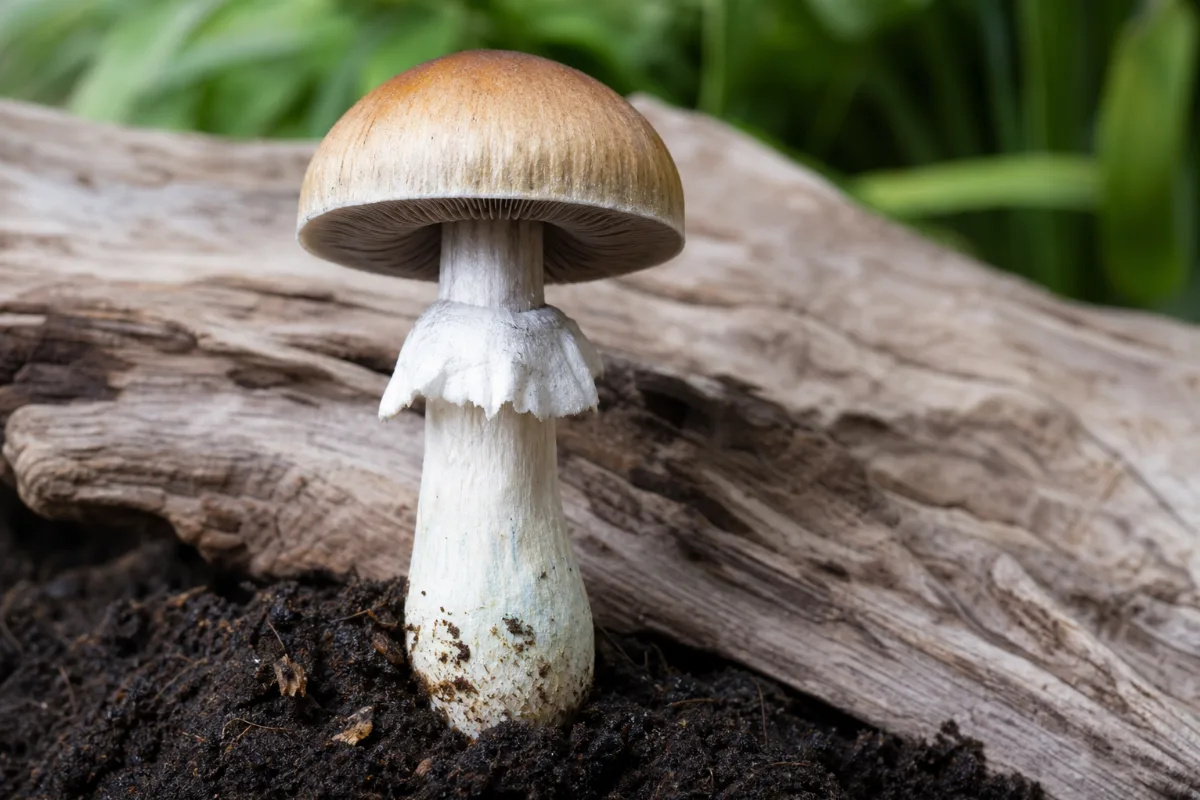
Psychedelic Therapy · Fungus
Psilocybe cubensis
Psilocybe cubensis (Earle) Singer · also called Magic mushroom (a general term for many species); Stropharia cubensis (former name)
Psilocybe cubensis is a mushroom that contains psilocybin, which the body turns into psilocin, a drug that changes perception and mood. Clinical trials of purified psilocybin for depression show mixed results, and no trial has shown the mushroom itself treats anything. It is illegal in many places, and wild mushrooms can look like deadly ones. A name or photo never makes a mushroom safe.
General information, not medical advice. Last substantive update · Not medically reviewed. A named clinician has not signed off on this page. How this page is made
About Psilocybe cubensis
Psilocybe cubensis is a tropical mushroom whose main compounds are psilocybin and psilocin. Research on depression, cancer distress, alcohol and smoking uses purified psilocybin with therapy and gives low certainty. The mushroom itself has had one small controlled trial, which found no benefit beyond placebo. Safety risks include fear, raised blood pressure, mental-health crises, seizure reports with lithium, and fatal mix-ups with toxic wild mushrooms.
What it is
Psilocybe cubensis (Earle) Singer is an accepted species in the family Hymenogastraceae (GBIF). It has had several older names, including Stropharia cubensis. GBIF holds about 3,934 records, mostly from the Americas and Oceania.
The fruiting body holds psilocybin, psilocin, baeocystin, norbaeocystin and aeruginascin. Content varies greatly between and within named strains (0.879% to 1.36% total psilocybin plus psilocin in five strains in one study).
How it works in the body
Psilocybin is a prodrug. The body converts it to psilocin, which activates serotonin 2A receptors. In eight volunteers, effect strength tracked receptor occupancy and blood psilocin.
Psilocin peaks at about 2 hours in volunteers and has a half-life of roughly 1.4 to 3 hours. These numbers come from synthetic psilocybin.
What the clinical trials show
Depression: results range from large benefits in a small waiting-list trial to a missed main target in the 2026 EPISODE trial. A 2024 pooled analysis found a moderate benefit with moderate risk of bias.
Other areas: one trial each for cancer distress and alcohol use disorder, and pilots for smoking.
Blinding: a 2026 review found people and raters often guess who got a psychedelic, which can inflate effects.
Whole mushroom versus purified drug
A purified drug is measured and consistent. The mushroom varies in strength and contains other tryptamines, which could change effects (2022 paper). Researchers in Mexico have only published a plan to study a characterised P. cubensis in people.
The only controlled trial of the actual mushroom tested very low amounts and found no benefit beyond placebo.
At a glance
Traditional uses history, not proof
- NIDA says Indigenous people in Central America used psilocybin mushrooms for healing and spiritual rituals, with evidence going back as far as 3000 B.C. This is tradition, not clinical proof.
Studied for research
- Depression, synthetic psilocybin in trials, low (mixed results)
- Anxiety and depression in cancer, one small trial, low
- Alcohol use disorder, one trial, low
- Quitting smoking, pilot trials, low
- Low amounts of the whole mushroom for mood and thinking, one small trial, low (no benefit beyond placebo)
Main compounds
- Psilocybin (becomes psilocin in the body)
- Psilocin, the active form
- Baeocystin and norbaeocystin
- Aeruginascin
Common forms
- Dried mushrooms (the form studied in the one controlled microdosing trial)
- Edibles and candies (unregulated; higher risk category)
- Purified synthetic psilocybin (what clinical trials used)
Research links: NIDA: Psilocybin (Magic Mushrooms) · Adverse events in classic psychedelic studies, 2024 (abstract) · Blinding in psychedelic trials, 2026 (abstract) · Microdosing mushroom trial, 2022 (abstract) · Research Library · Genes & Biomarkers Library
What it is and its history
- Accepted scientific name
- Psilocybe cubensis
- Naming authority
- (Earle) Singer
- Synonyms
- Stropharia cubensis Earle; Stropharia cyanescens Murrill; Hypholoma caerulescens (Pat.) Sacc. & Trotter; Naematoloma caerulescens Pat.; Psilocybe cubensis var. caerulescens (Pat.) Singer & A.H.Sm.; Psilocybe cubensis var. cyanescens (Murrill) Singer & A.H.Sm.
- Common names
- Magic mushroom (English)
- Family or group
- Hymenogastraceae (GBIF). A 2021 paper still files the genus under Strophariaceae, an older placement.
- Classification
- Fungi > Basidiomycota > Agaricomycetes > Agaricales > Hymenogastraceae > Psilocybe > Psilocybe cubensis
- Native range
- Not verified. GBIF holds about 3,934 records, mostly from North America, South America and Oceania, with fewer from Asia, Europe and Africa. GBIF records show where it was recorded, not where it is native.
- Habitat
- Not verified in a source read.
- What it looks like
- Roots: Not checked.; Stems: Not checked.; Fruit: The fruiting body (cap and stalk) is the part studied; spores carried no tryptamines in one lab study.
- Cultivation
- Not covered on purpose.
- Harvest and processing
- Not covered on purpose.
- Look-alikes and adulterants
- Name: Deadly amatoxin mushrooms (Galerina, Amanita, Lepiota) and other toxic species; Note: NIDA lists mistaking a toxic mushroom for a psilocybin one as a risk, and a review says most fatal mushroom poisonings involve amatoxins. This page does not teach identification and no photo or name makes a mushroom safe.
- Sustainability and conservation
- Not checked.
Traditional use and history history, not clinical proof
| Tradition or era | Documented use | Source |
|---|---|---|
| Central America, traditional use | NIDA says there is evidence that Indigenous people in Central America used mushrooms like these for healing and spiritual rituals as far back as 3000 B.C. | s-nida-psilocybin |
| Modern research | NIDA says scientists began studying psilocybin decades ago and interest has surged in depression, PTSD, addiction, pain and neurodegenerative disorders. Other historical claims (named healers, first Western documentation) were not read in a source and are NOT verified. | s-nida-psilocybin |
Traditional use shows how it was used. It does not show that it works or is safe today.
What is inside, and how it may work
What it contains and how those compounds act in cells and animals. Laboratory and animal mechanisms are not proven effects in people.
Main compounds
| Compound | Family | Where it is concentrated | Activity studied | Level of evidence |
|---|---|---|---|---|
| Psilocybin PubChem 10624 | tryptamine (prodrug) | Fruiting body Total psilocybin plus psilocin averaged 0.879% to 1.36% (w/w) across five named strains in one lab study; content varies between mushrooms. | A prodrug turned into psilocin in the body (human data). 29 9 26 2 | Human data |
| Psilocin PubChem 4980 | tryptamine | Fruiting body (small amounts); the only one found in mycelium in one study Variable. | The active form; activates serotonin 2A receptors. 29 20 11 | Human data |
| Baeocystin and norbaeocystin PubChem 161359 | tryptamines | Fruiting body Measured in wild-grown mushrooms; effects not established. | Not established from the sources read. 29 12 | Lab |
| Aeruginascin PubChem 60208480 | tryptamine | Fruiting body Measured; effects not established. | Not established from the sources read. 29 12 | Lab |
Mechanisms, receptors and pathways
| Target or pathway | Gene or receptor | What was found | Level |
|---|---|---|---|
| Serotonin 2A receptor | 5-HT2A receptor (HTR2A) | In eight volunteers, receptor occupancy up to 72% and effect intensity tracked occupancy and blood psilocin, supporting 5-HT2A activation as a key driver of the psychedelic experience. 20 | Human data |
| Default mode network | Brain network | NIDA says studies suggest psilocybin can temporarily disrupt communication among regions in this network. 27 | Authoritative guidance |
Absorption, metabolism and elimination
- Absorption
- Taken by mouth, psilocybin is converted to psilocin; no psilocybin was found in blood or urine in 12 adults.
- Distribution
- Not read.
- Metabolism
- Psilocin is broken down in the body in two metabolic steps (review).
- Elimination
- Psilocin half-life about 3 hours (SD 1.1) in one study; 1.4 to 1.8 hours in another; peak at about 2 hours and subjective effects about 5.5 to 6.4 hours.
- Bioavailability
- Not established in the sources read for whole mushrooms; these data are from synthetic psilocybin.
Isolated compounds versus whole extracts
Almost all human trials used purified synthetic psilocybin. The mushroom itself contains other tryptamines and varies in strength, so its effects may differ. A 2022 paper says this "cocktail" could change medical effect and complicate data, and a research plan has been published to test a characterised P. cubensis in people.
Nutritional composition
Not a nutrient and has no nutritional claim.
5 low certainty
What was looked at
The 5 benefits and uses checked for Psilocybe cubensis, each with how strong the evidence is. Tap one to open it.
- Depression (major and treatment-resistant)Low certainty
- Anxiety and depression in life-threatening cancerLow certainty
- Low-amount use of the whole mushroom (mood, creativity, thinking)Low certainty
- Alcohol use disorderLow certainty
- Quitting smokingLow certainty
Lab markers tracked in the studies
Depression rating scores (MADRS, GRID-HAMD, QIDS-SR)Mystical-type experience scorePercentage of heavy drinking daysBiochemically verified smoking abstinence
What is Psilocybe cubensis good for?
The uses people ask about and how strong the human evidence is. Nearly all of it comes from purified psilocybin in supervised clinics, not from mushrooms.
Benefits, one by one
Each card is a research question, not a promise. Tap a goal to filter. Open a card to see the studies, doses and limits.
Depression (major and treatment-resistant)
Low certaintyTrials of synthetic psilocybin with therapy show larger depression score drops than comparison groups, but results are mixed, trials are small, and people can usually tell they got the drug. Wild or home-grown mushrooms were not tested.
7 studiesThe trials used a purified synthetic drug in fixed clinic protocols w…
Studies, doses and limits
What the trials found
Everything below is about synthetic psilocybin, a purified drug given in supervised clinical trials. None of it tests wild or home-grown Psilocybe cubensis mushrooms, which vary a lot in strength and are not a medicine. Several mid-stage trials compared one or two supervised sessions with a very low dose, a niacin placebo, a waiting list or an antidepressant.
Results
A waiting-list trial (27 adults) found large drops in depression scores. A company-sponsored trial in treatment-resistant depression (233 adults) found benefit at 3 weeks for the high dose only, not shown sustained at 12 weeks. A 104-person trial found a clear edge over niacin at 6 weeks. Versus the antidepressant escitalopram (59 adults), the main measure was not significantly different. The 2026 German EPISODE trial (144 adults) did not meet its main target, with response of 17.0% versus 10.6% on placebo. A 2024 meta-analysis of seven trials (436 people) found a pooled effect of g 0.66, with moderate risk of bias.
Effect sizes as reported
Pooled effect size about 0.66 (95% CI 0.46 to 0.86) in one meta-analysis; individual trials range from clearly positive to not significant.
Why this rating
Small trials, short follow-up, widespread functional unblinding (people guess which arm they are in), company sponsorship in some, and one large 2026 trial missed its main test.
Form and dose studied
The trials used a purified synthetic drug in fixed clinic protocols with trained therapists. Dose information is not given here.
Who was studied
Adults who were screened and monitored; people with psychosis or mania history were generally excluded.
Limits
Participants were selected; blinding failure and expectation can inflate effects; a separate analysis found placebo groups improved less in psilocybin trials than in antidepressant trials.
Why researchers looked
Psilocybin is the main research focus for depression; it is not an approved treatment in most places.
Traditional use
NIDA says Indigenous people in Central America used psilocybin mushrooms for healing and spiritual rituals. That tradition is separate from the clinical evidence here.
Proposed mechanism Human pet imaging
Psilocin, the active form, switches on serotonin 2A receptors in the brain. This is thought to drive the psychedelic experience (human PET study). How this relates to any lasting benefit is not settled.
A proposed mechanism does not show that the effect happens in people.
Even in clinics, adverse events are common and include headache, nausea, anxiety, raised blood pressure and suicidal thoughts in some. See the Safety tab.
Anxiety and depression in life-threatening cancer
Low certaintyA small crossover trial of 51 people found large, lasting drops in anxiety and depression after a high dose of synthetic psilocybin with support. It has not been repeated at scale and is not an approved care.
2 studiesThe trials used a purified synthetic drug in fixed clinic protocols w…
Studies, doses and limits
What the trials found
Everything below is about synthetic psilocybin, a purified drug given in supervised clinical trials. None of it tests wild or home-grown Psilocybe cubensis mushrooms, which vary a lot in strength and are not a medicine. One randomised double-blind crossover trial gave a high versus a very low dose, with a 6-month follow-up.
Results
High dose produced large decreases in clinician- and self-rated depression and anxiety; about 80% still showed clinically significant decreases at 6 months. The mystical-type experience on session day mediated the effect.
Effect sizes as reported
Large reported effects in one trial of 51 people.
Why this rating
One small trial from 2016; the very low comparison dose is not a true placebo, so people could tell; not repeated here.
Form and dose studied
The trials used a purified synthetic drug in fixed clinic protocols with trained therapists. Dose information is not given here.
Who was studied
Adults who were screened and monitored; people with psychosis or mania history were generally excluded.
Limits
Crossover design makes it hard to read the later comparison; only one centre group; results may not apply to other people.
Why researchers looked
People facing life-threatening illness often have distress that standard treatment helps only partly.
Traditional use
NIDA says Indigenous people in Central America used psilocybin mushrooms for healing and spiritual rituals. That tradition is separate from the clinical evidence here.
Proposed mechanism Human pet imaging
Psilocin, the active form, switches on serotonin 2A receptors in the brain. This is thought to drive the psychedelic experience (human PET study). How this relates to any lasting benefit is not settled.
A proposed mechanism does not show that the effect happens in people.
Even in clinics, adverse events are common and include headache, nausea, anxiety, raised blood pressure and suicidal thoughts in some. See the Safety tab.
Low-amount use of the whole mushroom (mood, creativity, thinking)
Low certaintyOne small placebo-controlled trial of Psilocybe cubensis itself found no real benefit for mood, creativity or thinking beyond expectation. NIDA says microdosing has not been shown safe or effective.
2 studiesThe trials used a purified synthetic drug in fixed clinic protocols w…
Studies, doses and limits
What the trials found
A double-blind placebo-controlled trial of dried Psilocybe cubensis in 34 adults who were starting to microdose.
Results
Effects were more intense than placebo only in people who correctly guessed their condition. Brain-wave theta power fell. There was no evidence of better well-being, creativity or thinking, and a few small changes pointed to slight cognitive impairment. The authors conclude that expectation underlies some of the benefits people report.
Effect sizes as reported
No benefit beyond placebo on creativity, mood or cognition.
Why this rating
Only one small trial (34 adults) and the main tests were negative; this is the best direct test of the mushroom itself.
Form and dose studied
The trials used a purified synthetic drug in fixed clinic protocols with trained therapists. Dose information is not given here.
Who was studied
Adults who were screened and monitored; people with psychosis or mania history were generally excluded.
Limits
Small, short, and people planning to microdose may have strong expectations.
Why researchers looked
Many people try tiny amounts hoping for mood or focus benefits; this is the one controlled test of the actual mushroom.
Traditional use
NIDA says Indigenous people in Central America used psilocybin mushrooms for healing and spiritual rituals. That tradition is separate from the clinical evidence here.
Proposed mechanism Human pet imaging
Psilocin, the active form, switches on serotonin 2A receptors in the brain. This is thought to drive the psychedelic experience (human PET study). How this relates to any lasting benefit is not settled.
A proposed mechanism does not show that the effect happens in people.
Even in clinics, adverse events are common and include headache, nausea, anxiety, raised blood pressure and suicidal thoughts in some. See the Safety tab.
Alcohol use disorder
Low certaintyOne 95-person trial found fewer heavy drinking days after two sessions of synthetic psilocybin with therapy than after an antihistamine control. It is one trial and not an approved treatment.
1 studiesThe trials used a purified synthetic drug in fixed clinic protocols w…
Studies, doses and limits
What the trials found
Everything below is about synthetic psilocybin, a purified drug given in supervised clinical trials. None of it tests wild or home-grown Psilocybe cubensis mushrooms, which vary a lot in strength and are not a medicine. A double-blind randomised trial compared psilocybin with diphenhydramine during two long sessions inside 12 weeks of psychotherapy.
Results
Heavy drinking days over 32 weeks were 9.7% with psilocybin and 23.6% with diphenhydramine (difference 13.9 points, 95% CI 3.0 to 24.7, P=.01). No serious adverse events occurred in the psilocybin group.
Effect sizes as reported
About 14 percentage points fewer heavy drinking days.
Why this rating
One moderate-sized trial; likely unblinding; excluded people with major psychiatric disorders.
Form and dose studied
The trials used a purified synthetic drug in fixed clinic protocols with trained therapists. Dose information is not given here.
Who was studied
Adults who were screened and monitored; people with psychosis or mania history were generally excluded.
Limits
Only one trial; replication is needed.
Why researchers looked
Alcohol use disorder is common and treatments are only partly effective.
Traditional use
NIDA says Indigenous people in Central America used psilocybin mushrooms for healing and spiritual rituals. That tradition is separate from the clinical evidence here.
Proposed mechanism Human pet imaging
Psilocin, the active form, switches on serotonin 2A receptors in the brain. This is thought to drive the psychedelic experience (human PET study). How this relates to any lasting benefit is not settled.
A proposed mechanism does not show that the effect happens in people.
Even in clinics, adverse events are common and include headache, nausea, anxiety, raised blood pressure and suicidal thoughts in some. See the Safety tab.
Quitting smoking
Low certaintyA small 2026 randomised pilot found higher abstinence after psilocybin plus therapy than after the nicotine patch plus therapy, but people knew which they got. An earlier 15-person study had no control group.
3 studiesThe trials used a purified synthetic drug in fixed clinic protocols w…
Studies, doses and limits
What the trials found
Everything below is about synthetic psilocybin, a purified drug given in supervised clinical trials. None of it tests wild or home-grown Psilocybe cubensis mushrooms, which vary a lot in strength and are not a medicine. An open-label pilot (15 smokers) and a randomised pilot (82 smokers) added psilocybin to a structured quit programme.
Results
In the randomised pilot, 40.5% of the psilocybin group were abstinent at 6 months (biochemically verified) versus 10.0% on the patch (OR 6.12, 95% CI 1.99 to 23.26). In the earlier pilot 12 of 15 were abstinent at 6 months, which the authors say cannot show efficacy without a control group. NIDA says a larger multi-site study is under way.
Effect sizes as reported
Odds ratio about 6 in an unblinded pilot.
Why this rating
Pilot size, unblinded, only psychiatrically healthy smokers.
Form and dose studied
The trials used a purified synthetic drug in fixed clinic protocols with trained therapists. Dose information is not given here.
Who was studied
Adults who were screened and monitored; people with psychosis or mania history were generally excluded.
Limits
Open design inflates expectations; a larger trial is still needed.
Why researchers looked
Quitting tobacco is hard and long-term success is modest with common methods.
Traditional use
NIDA says Indigenous people in Central America used psilocybin mushrooms for healing and spiritual rituals. That tradition is separate from the clinical evidence here.
Proposed mechanism Human pet imaging
Psilocin, the active form, switches on serotonin 2A receptors in the brain. This is thought to drive the psychedelic experience (human PET study). How this relates to any lasting benefit is not settled.
A proposed mechanism does not show that the effect happens in people.
Even in clinics, adverse events are common and include headache, nausea, anxiety, raised blood pressure and suicidal thoughts in some. See the Safety tab.
Connections to the rest of health
How Psilocybe cubensis connects to the rest of our health knowledge graph. Every link says what kind of connection it is. A safety link (for example to the liver) is a warning, not a benefit. A study that merely mentions a topic never creates a benefit link.
Explore every connection: goals, body systems, organs, symptoms, genes
B. Body systems
I. Biomarkers
| Connected to | Kind of connection | Evidence status | Context | Studies |
|---|---|---|---|---|
| Depression rating scores (MADRS, GRID-HAMD, QIDS-SR) | Biological association | Low certainty | Measured in trials: lowered. A lab change is not the same as a health benefit. | 25 21 |
| Mystical-type experience score | Biological association | Low certainty | Measured in trials: raised. A lab change is not the same as a health benefit. | 13 27 |
| Percentage of heavy drinking days | Biological association | Low certainty | Measured in trials: lowered. A lab change is not the same as a health benefit. | 1 |
| Biochemically verified smoking abstinence | Biological association | Low certainty | Measured in trials: raised. A lab change is not the same as a health benefit. | 17 |
J. Genes, receptors and enzymes
| Connected to | Kind of connection | Evidence status | Context | Studies |
|---|---|---|---|---|
| HTR2A (serotonin 2A receptor) | Preliminary mechanism | Human | Main receptor target of psilocin. | 20 |
L. Active compounds
| Connected to | Kind of connection | Evidence status | Context | Studies |
|---|---|---|---|---|
| Psilocybin | Biological association | Human | A prodrug turned into psilocin in the body (human data). Preparation or compound: Fruiting body |
29 9 26 2 |
| Psilocin | Biological association | Human | The active form; activates serotonin 2A receptors. Preparation or compound: Fruiting body (small amounts); the only one found in mycelium in one study |
29 20 11 |
| Baeocystin and norbaeocystin | Biological association | Lab | Not established from the sources read. Preparation or compound: Fruiting body |
29 12 |
| Aeruginascin | Biological association | Lab | Not established from the sources read. Preparation or compound: Fruiting body |
29 12 |
Each connection is stored with the ingredient, the connected record, the kind of connection, the evidence status, the supporting studies, the preparation or compound involved, and a review date (last reviewed October 25, 2026).
Evidence at a glance: what changed in 4 lab markers
Tap a number to show only those markers. Counts are markers, not people.
The evidence
The research centre for Psilocybe cubensis. Every record here was checked against PubMed or the publisher's page; we never list a study we have not verified.
Evidence by outcome
Bars show how many studies we found for each outcome, not how well it works. People are added up across trials only (reviews are not added, to avoid double counting).
How we rate evidence
High certainty
Several well-run trials or reviews agree; further research is unlikely to change the picture much.
Moderate certainty
Good trials point the same way, but some doubt remains.
Low certainty
Small, short or inconsistent trials. The finding could change with better research.
Very low certainty
Very little or very weak human data. Treat as a possibility only.
Mixed findings
Trials or reviews disagree with each other.
Not enough evidence
Not enough human research to say either way.
Evidence against
Good research found no benefit, or found harm.
We take the reviewers' own risk-of-bias and GRADE statements where they exist, and otherwise judge from study size, design, consistency, directness and whether a product matches what is sold. Many publications do not make evidence high. Method note: We read the abstracts of 26 PubMed papers, read NIDA and the US federal drug schedule, checked the name in GBIF and compounds in PubChem. Certainty ratings are the compiler's own reading. Several trials were sponsored by a psilocybin company or had blinding problems; these are flagged. UN and Australian regulatory entries were not verified with the regulators.
Study library: every study we checked 30
| Study | Design | People | Product, dose, length | Result |
|---|---|---|---|---|
| Bogenschutz 2022 Percentage of Heavy Drinking Days Following Psilocybin-Assisted Psychotherapy vs Placebo in the Treatment of Adult Patients With Alcohol Use Disorder. JAMA Psychiatry · PMID 36001306 · DOI |
Controlled trial |
95 Adults with alcohol dependence (2 US centres) |
Synthetic psilocybin versus diphenhydramine (an antihistamine active placebo), with psychotherapy Fixed protocol doses; not reproduced here See results · vs See results |
9.7% heavy drinking days with psilocybin versus 23.6% with diphenhydramine (difference 13.9 points, 95% CI 3.0 to 24.7; P=.01). No serious adverse events in the psilocybin group. Fewer heavy drinking days (3.0 to 24.7) Methods, limits and fundingOutcomes: Percentage of heavy drinking days over 32 weeks Limitations: Moderate size; unblinding likely; people with major psychiatric disorders excluded. Funding and conflicts: NIH-funded (research support listed) Read: abstract |
| Brown 2017 Pharmacokinetics of Escalating Doses of Oral Psilocybin in Healthy Adults. Clin Pharmacokinet · PMID 28353056 · DOI |
Controlled clinical trial |
12 12 healthy adults |
Oral synthetic psilocybin, escalating Fixed protocol doses; not reproduced here See results · vs See results |
No psilocybin was found in blood or urine; psilocin was the circulating form; elimination half-life of psilocin about 3 hours (SD 1.1). Psilocin is the active form Methods, limits and fundingOutcomes: Blood and urine psilocin Limitations: Small. Funding and conflicts: Non-US government research support listed Read: abstract |
| Carhart-Harris 2021 Trial of Psilocybin versus Escitalopram for Depression. N Engl J Med · PMID 33852780 · DOI |
Controlled trial |
59 Adults with long-standing moderate to severe depression (UK) |
Two sessions of synthetic psilocybin versus 6 weeks of daily escitalopram (an antidepressant), all with psychological support Fixed protocol doses; not reproduced here See results · vs See results |
The main result was not significant: -8.0 points with psilocybin versus -6.0 with escitalopram (difference 2.0, 95% CI -5.0 to 0.9; P=0.17). Remission was 57% versus 28%, but secondary results were not corrected for multiple comparisons. No significant difference on the main measure (-5.0 to 0.9) Methods, limits and fundingOutcomes: Change in QIDS-SR-16 depression score at week 6 Limitations: Small, short, secondary results uncorrected; participants knew which treatment was psychedelic. Funding and conflicts: Mosley Charitable Trust and Imperial College London centre Registration: NCT03429075 Read: abstract |
| Cavanna 2022 Microdosing with psilocybin mushrooms: a double-blind placebo-controlled study. Transl Psychiatry · PMID 35918311 · DOI |
Controlled trial |
34 Adults starting to microdose with Psilocybe cubensis |
Dried Psilocybe cubensis mushrooms at a very low amount versus placebo Fixed protocol doses; not reproduced here See results · vs See results |
Acute effects were more intense with the mushroom only in people who correctly guessed their condition. EEG theta power fell. Otherwise no effect except a few small changes toward cognitive impairment. No evidence for better well-being, creativity or cognition; the authors conclude expectation underlies some anecdotal benefits. No benefit beyond placebo Methods, limits and fundingOutcomes: Subjective effects, creativity, cognition, EEG Limitations: Small; short; people already planning to microdose. Funding and conflicts: Non-US government research support listed Read: abstract |
| Davis 2021 Effects of Psilocybin-Assisted Therapy on Major Depressive Disorder: A Randomized Clinical Trial. JAMA Psychiatry · PMID 33146667 · DOI |
Controlled trial |
27 Adults aged 21 to 75 with major depression, off antidepressants, no history of psychosis (Baltimore, US) |
Synthetic psilocybin (a purified drug, not mushrooms) given in a supervised clinical trial with about 11 hours of supportive psychotherapy Fixed protocol doses; not reproduced here See results · vs See results |
Mean GRID-HAMD scores at weeks 1 and 4 were 8.0 and 8.5 in the immediate group versus 23.8 and 23.5 in the waiting-list group at matched times (Cohen d 2.5 and 2.6; both P<.001). Large drop in depression scores versus waiting list (d 2.5, 95% CI 1.4 to 3.5 (week 5)) Methods, limits and fundingOutcomes: Depression severity (GRID-HAMD) at weeks 1 and 4 after treatment versus a waiting-list group Limitations: Small (24 of 27 evaluable), no blinded placebo, waiting-list control, so expectation could account for part of the effect. Funding and conflicts: Not stated in the abstract Read: abstract |
| Diaz 2018 Amatoxin-Containing Mushroom Poisonings: Species, Toxidromes, Treatments, and Outcomes. Wilderness Environ Med · PMID 29325729 · DOI |
Review |
Review of amatoxin mushroom poisonings | Amanita, Lepiota and Galerina mushrooms Fixed protocol doses; not reproduced here See results · vs See results |
Most mushroom poisonings are caused by unknown mushrooms, and most fatal ones by amatoxin-containing mushrooms. Galerina marginata is the most frequent fatal Galerina. Treatment is mainly supportive and some patients need a liver transplant. Deadly poisonings come mostly from unidentified wild mushrooms Methods, limits and fundingOutcomes: Epidemiology and outcomes Limitations: Narrative review. Funding and conflicts: Not stated in the abstract Read: abstract |
| Escamilla 2023 A Proposal to Study the Safety and Efficacy of Psilocybe cubensis in Preclinical and Clinical Studies as a Therapeutic Alternative for Major Depressive Disorder. J Psychoactive Drugs · PMID 37594163 · DOI |
Study proposal n/a |
Proposal (Mexico) | Proposed study of a characterised P. cubensis Fixed protocol doses; not reproduced here See results · vs See results |
This is a research proposal, not a result: it plans animal and human studies of a fully characterised P. cubensis, because research so far used pure psilocybin. No results yet Methods, limits and fundingOutcomes: Study design only Limitations: No data. Funding and conflicts: Non-US government research support listed Read: abstract |
| Freitas 2025 The safety of psilocybin-assisted psychotherapy: A systematic review. Aust N Z J Psychiatry · PMID 39670342 · DOI |
Systematic review |
24 articles from psilocybin-assisted psychotherapy trials | Psilocybin-assisted psychotherapy Fixed protocol doses; not reproduced here See results · vs See results |
Common events were raised blood pressure, headache, nausea, vomiting, fatigue and anxiety. Suicidal thoughts and behaviour were infrequent, mostly in people with prior suicidal history. No deaths were attributed to psilocybin. The authors urge caution because safety data are preliminary and varied. Generally supported, preliminary Methods, limits and fundingOutcomes: Adverse events Limitations: Heterogeneous reporting. Funding and conflicts: Non-US government research support listed Read: abstract |
| Goff 2024 Determination of psilocybin and psilocin content in multiple Psilocybe cubensis mushroom strains using liquid chromatography - tandem mass spectrometry. Anal Chim Acta · PMID 38220293 · DOI |
Lab analysis lab |
15 Five strains of dried Psilocybe cubensis, 3 mushrooms each |
Total psilocybin plus psilocin by LC-MS/MS Fixed protocol doses; not reproduced here See results · vs See results |
Average totals ranged from 0.879% to 1.36% (w/w) across the five named strains, with differences between mushrooms of the same strain. Content differs between and within named strains Methods, limits and fundingOutcomes: Content by strain Limitations: Five supplied strains only; names as supplied. Funding and conflicts: Not stated in the abstract Read: abstract |
| Goodwin 2022 Single-Dose Psilocybin for a Treatment-Resistant Episode of Major Depression. N Engl J Med · PMID 36322843 · DOI |
Controlled trial |
233 Adults with treatment-resistant depression |
A company's proprietary synthetic psilocybin, single session, with psychological support, versus a very low control dose Fixed protocol doses; not reproduced here See results · vs See results |
Mean change was -12.0 in the high-dose group versus -5.4 for the control dose (difference -6.6, 95% CI -10.2 to -2.9; P<0.001). The middle dose did not differ significantly. The benefit at week 3 was not shown to be sustained at 12 weeks. Adverse events occurred in 77% of participants, and suicidal thoughts or self-injury occurred in all dose groups. Better score at 3 weeks only for the high dose (-10.2 to -2.9) Methods, limits and fundingOutcomes: Change in MADRS depression score from baseline to week 3 Limitations: Short follow-up, functional unblinding likely, company-sponsored. Funding and conflicts: Funded by COMPASS Pathfinder (a company developing psilocybin) Registration: NCT03775200 Read: abstract |
| Gotvaldová 2021 Stability of psilocybin and its four analogs in the biomass of the psychotropic mushroom Psilocybe cubensis. Drug Test Anal · PMID 33119971 · DOI |
Lab analysis lab |
P. cubensis fruiting bodies and mycelium | Tryptamine alkaloids by UHPLC-MS Fixed protocol doses; not reproduced here See results · vs See results |
No tryptamines were found in spores; mycelium held only psilocin; stalks held about half the alkaloid of caps (0.52 vs 1.03 wt.%), though not statistically significant because individual mushrooms vary widely. Content differs by part and by mushroom Methods, limits and fundingOutcomes: Content by part Limitations: Laboratory study. Funding and conflicts: Not stated in the abstract Read: abstract |
| Gotvaldová 2022 Extensive Collection of Psychotropic Mushrooms with Determination of Their Tryptamine Alkaloids. Int J Mol Sci · PMID 36430546 · DOI |
Lab analysis lab |
226 226 wild-grown fruiting bodies, 82 collections, 7 genera |
Psilocybin, psilocin, baeocystin, norbaeocystin, aeruginascin measured Fixed protocol doses; not reproduced here See results · vs See results |
Highest psilocybin/psilocin levels were in Psilocybe species, but concentrations were extremely variable, with none detected in two collections of other Psilocybe species. The authors say variable cocktails of tryptamines could change effects compared with pure psilocybin. Very variable content Methods, limits and fundingOutcomes: Alkaloid concentrations Limitations: Laboratory measurements of wild-grown mushrooms; says nothing about effects. Funding and conflicts: Not stated in the abstract Read: abstract |
| Griffiths 2016 Psilocybin produces substantial and sustained decreases in depression and anxiety in patients with life-threatening cancer: A randomized double-blind trial. J Psychopharmacol · PMID 27909165 · DOI |
Controlled trial |
51 Adults with life-threatening cancer and depression or anxiety |
Synthetic psilocybin, high versus very low dose, crossover, with support Fixed protocol doses; not reproduced here See results · vs See results |
High dose produced large decreases in depressed mood and anxiety; at 6 months about 80% still showed clinically significant decreases. The mystical-type experience mediated the effect. Large, sustained decreases in distress Methods, limits and fundingOutcomes: Clinician and self-rated depression and anxiety, quality of life Limitations: Small; very low dose is not a true placebo so people could tell; crossover design. Funding and conflicts: NIH-funded (research support listed) Registration: NCT00465595 Read: abstract |
| Hinkle 2024 Adverse Events in Studies of Classic Psychedelics: A Systematic Review and Meta-Analysis. JAMA Psychiatry · PMID 39230883 · DOI |
Meta-analysis |
3504 |
Classic psychedelics in clinical or research settings Fixed protocol doses; not reproduced here See results · vs See results |
Serious events were reported for no healthy participants and about 4% of people with existing neuropsychiatric disorders (worsening depression, suicidal behaviour, psychosis, convulsions). No deaths by suicide, persistent psychosis or hallucinogen persisting perception disorder were reported in contemporary research settings. Monitoring quality varied: of 68 studies since 2005, only 16 used systematic adverse-event assessment. Generally well tolerated in research settings, with uneven monitoring Methods, limits and fundingOutcomes: Serious and non-serious adverse events Limitations: Research settings only, with screening and support; says little about unsupervised use. Funding and conflicts: Not stated in the abstract Read: abstract |
| Holze 2023 Pharmacokinetics and Pharmacodynamics of Oral Psilocybin Administration in Healthy Participants. Clin Pharmacol Ther · PMID 36507738 · DOI |
Pk study |
79 28, 23 and 28 healthy participants in three groups |
Oral synthetic psilocybin Fixed protocol doses; not reproduced here See results · vs See results |
Peak psilocin came at about 2 hours; half-lives were 1.4 to 1.8 hours; subjective effects lasted about 5.5 to 6.4 hours and were dose-dependent. Timing of effects in healthy volunteers Methods, limits and fundingOutcomes: Plasma psilocin and subjective effects Limitations: Healthy volunteers, synthetic psilocybin. Funding and conflicts: Non-US government research support listed Read: abstract |
| Johnson 2014 Pilot study of the 5-HT2AR agonist psilocybin in the treatment of tobacco addiction. J Psychopharmacol · PMID 25213996 · DOI |
Open label pilot |
15 Healthy nicotine-dependent smokers |
Synthetic psilocybin within a 15-week quit-smoking programme Fixed protocol doses; not reproduced here See results · vs See results |
12 of 15 (80%) were abstinent at 6 months. The authors state the open-label design cannot show efficacy. 80% abstinent, no control group Methods, limits and fundingOutcomes: Seven-day abstinence at 6 months Limitations: Open label, 15 people, no control. Funding and conflicts: NIH-funded (research support listed) Read: abstract |
| Johnson 2026 Psilocybin or Nicotine Patch for Smoking Cessation: A Pilot Randomized Clinical Trial. JAMA Netw Open · PMID 41805956 · DOI |
Controlled trial |
82 Psychiatrically healthy adult smokers (Baltimore, US) |
Synthetic psilocybin plus CBT versus nicotine patch plus CBT Fixed protocol doses; not reproduced here See results · vs See results |
40.5% with psilocybin versus 10.0% with the patch (OR 6.12, 95% CI 1.99 to 23.26; P=.003). Participants and investigators knew which treatment was given. Higher abstinence than patch (1.99 to 23.26) Methods, limits and fundingOutcomes: Biochemically verified prolonged abstinence at 6 months Limitations: Pilot, open (unblinded) design. Funding and conflicts: Not stated in the abstract Registration: NCT01943994 Read: abstract |
| Jorgenson 2026 Psychoactive mushroom edibles: trends and toxicities reported to the United States National Poison Data System, 2023-2024. Clin Toxicol (Phila) · PMID 41493095 · DOI |
Observational |
362 362 poison-centre exposures to mushroom edibles (Amanita muscaria, psilocybin or unspecified) |
Unregulated psychoactive mushroom edibles Fixed protocol doses; not reproduced here See results · vs See results |
Polysubstance exposure, confusion and CNS depression were linked to admission and worse toxicity. No deaths were reported. The authors call the effects unpredictable and the products unregulated with unlisted ingredients. Unpredictable effects from edibles Methods, limits and fundingOutcomes: Hospital admission, severity Limitations: Reported cases only; product contents unknown. Funding and conflicts: Not stated in the abstract Read: abstract |
| Leonard 2018 Does getting high hurt? J Psychopharmacol · PMID 30182795 · DOI |
Observational |
5883 5,883 single-substance psilocybin-mushroom exposures reported to US poison centres |
Psilocybin-containing mushrooms (unsupervised use) Fixed protocol doses; not reproduced here See results · vs See results |
Most patients were 13 to 29 years old and male. Common effects were hallucinations (45.8%), agitation (24.1%) and fast heart rate (18.0%). Serious effects were infrequent but included overheating, seizures, coma and cardiac arrest. Most were treated and released from the emergency department. Mostly mild or moderate, with rare serious cases Methods, limits and fundingOutcomes: Clinical effects and outcomes Limitations: Reported cases only; mushroom type and amount unconfirmed. Funding and conflicts: Not stated in the abstract Read: abstract |
| Madsen 2019 Psychedelic effects of psilocybin correlate with serotonin 2A receptor occupancy and plasma psilocin levels. Neuropsychopharmacology · PMID 30685771 · DOI |
Pet imaging |
8 Eight healthy volunteers |
Oral psilocybin with PET brain imaging Fixed protocol doses; not reproduced here See results · vs See results |
Dose-related receptor occupancy up to 72%; effect intensity tracked occupancy and blood psilocin levels, supporting 5-HT2A receptor activation as a key driver of the experience. Mechanism in humans Methods, limits and fundingOutcomes: 5-HT2A receptor occupancy and effect intensity Limitations: Very small. Funding and conflicts: Non-US government research support listed Read: abstract |
| Mertens 2026 Efficacy and Safety of Psilocybin in Treatment-Resistant Major Depression: The EPISODE Randomized Clinical Trial. JAMA Psychiatry · PMID 41848690 · DOI |
Controlled trial |
144 Adults aged 25 to 65 with treatment-resistant depression, off antidepressants (Germany) |
Synthetic psilocybin versus an active placebo (nicotinamide), with psychotherapy Fixed protocol doses; not reproduced here See results · vs See results |
The main test was not significant: response was 17.0% with the higher psilocybin dose, 12.5% with the lower and 10.6% with placebo (adjusted OR 1.73, 95% CI 0.53 to 6.23; P=.19). Secondary measures showed a possibly meaningful effect. Suicidal thoughts on dosing days were more often reported with the higher dose (4% vs 1-2%). Two serious adverse reactions followed the higher dose, including one case of hallucinogen persisting perception disorder. Primary outcome not met (0.53 to 6.23) Methods, limits and fundingOutcomes: Treatment response (50% or more drop on HAMD17) at week 6 Limitations: Exploratory secondary results only; small groups. Funding and conflicts: Not stated in the abstract Read: abstract |
| Metaxa 2024 Efficacy of psilocybin for treating symptoms of depression: systematic review and meta-analysis. BMJ · PMID 38692686 · DOI |
Meta-analysis |
436 Seven of nine randomised trials of psilocybin for depression |
Psilocybin (synthetic) versus placebo or non-psychoactive comparators Fixed protocol doses; not reproduced here See results · vs See results |
Pooled benefit favoured psilocybin (Hedges g 0.66, 95% CI 0.46 to 0.86). All studies had moderate risk of bias. Moderate-size pooled benefit, moderate risk of bias (0.46 to 0.86) Methods, limits and fundingOutcomes: Change in depression scores Limitations: Few small trials; unblinding and expectation not resolved. Funding and conflicts: Not stated in the abstract Read: abstract |
| Nayak 2021 Classic Psychedelic Coadministration with Lithium, but Not Lamotrigine, is Associated with Seizures: An Analysis of Online Psychedelic Experience Reports. Pharmacopsychiatry · PMID 34348413 · DOI |
Case report series |
Online experience reports (Erowid, Shroomery, Reddit) | Classic psychedelics taken with mood stabilisers Fixed protocol doses; not reproduced here See results · vs See results |
In 62 lithium plus psychedelic reports, 47% involved seizures and 39% involved medical attention; none of 34 lamotrigine reports did. The authors provisionally conclude a significant seizure risk with lithium. Possible seizure risk with lithium Methods, limits and fundingOutcomes: Seizures and medical attention Limitations: Self-selected anonymous online reports, not verified, not a trial. Funding and conflicts: Not stated in the abstract Read: abstract |
| Orsini 2026 Blinding Integrity in Psychedelic Randomized Clinical Trials: A Systematic Review. JAMA Psychiatry · PMID 41984443 · DOI |
Systematic review |
112 |
Various psychedelics (11 psilocybin trials) Fixed protocol doses; not reproduced here See results · vs See results |
Only 29.5% of trials tested blinding. Functional unblinding is widespread Methods, limits and fundingOutcomes: How often blinding was tested and failed Limitations: Review of trial reporting, not of efficacy. Funding and conflicts: Not stated in the abstract Read: abstract |
| Raison 2023 Single-Dose Psilocybin Treatment for Major Depressive Disorder: A Randomized Clinical Trial. JAMA · PMID 37651119 · DOI |
Controlled trial |
104 Adults aged 21 to 65 with major depression for 60+ days (11 US sites) |
Synthetic psilocybin single dose versus a niacin placebo, with psychological support Fixed protocol doses; not reproduced here See results · vs See results |
Psilocybin lowered MADRS scores more than niacin (mean difference -12.3, 95% CI -17.5 to -7.2; P<.001 at day 43). More people had sustained response, but not remission. There were no serious treatment-related adverse events, but psilocybin had more adverse events overall and more severe ones. Lower depression score than placebo at 6 weeks (-17.5 to -7.2) Methods, limits and fundingOutcomes: Change in MADRS depression score from baseline to day 43 Limitations: Niacin is not an inert placebo but people can usually still tell which they got; people with psychosis or mania history were excluded. Funding and conflicts: Funding source not stated in the abstract Read: abstract |
| Thaoboonruang 2025 Pharmacokinetics of Psilocybin, a Tryptamine Alkaloid in Magic Mushroom (Psilocybe cubensis): A Systematic Review. J Psychoactive Drugs · PMID 39257234 · DOI |
Systematic review |
20 studies in vitro, animal and human | Psilocybin and psilocin Fixed protocol doses; not reproduced here See results · vs See results |
Psilocybin is a prodrug turned into psilocin by alkaline phosphatase; psilocin has a half-life of 2 to 3 hours; knowledge gaps remain. Summary of kinetics Methods, limits and fundingOutcomes: Pharmacokinetics Limitations: Review. Funding and conflicts: Non-US government research support listed Read: abstract |
| n/a 2026 NIDA: Psilocybin (Magic Mushrooms) (page read 2026-10-25) n/a · Source |
Authoritative guidance n/a |
n/a | n/a |
NIDA says psilocybin has low toxicity, raises blood pressure and heart rate, can cause fear or panic and risky behaviour, and that misidentifying mushrooms and taking a toxic one is a risk. It says there is no data on safety in pregnancy, that research has not established that microdosing is safe or effective, and that FDA granted Breakthrough Therapy designation to a few psilocybin formulations being studied for depression. It notes use in Central America for healing and ritual dating back to evidence from about 3000 B.C. Methods, limits and fundingOutcomes: NIDA says psilocybin has low toxicity, raises blood pressure and heart rate, can cause fear or panic and risky behaviour, and that misidentifying mushrooms and taking a toxic one is a risk. It says there is no data on safety in pregnancy, that research has not established that microdosing is safe or effective, and that FDA granted Breakthrough Therapy designation to a few psilocybin formulations being studied for depression. It notes use in Central America for healing and ritual dating back to evidence from about 3000 B.C. Limitations: Regulator-style fact page, not a trial; the date claim is NIDA's own. Read: full-text |
| n/a 2026 US eCFR: 21 CFR 1308.11 Schedule I (version dated 2026-10-20) n/a · Source |
Regulation n/a |
n/a | n/a |
Schedule I hallucinogenic substances list includes Psilocybin (code 7437) and Psilocyn (code 7438). Methods, limits and fundingOutcomes: Schedule I hallucinogenic substances list includes Psilocybin (code 7437) and Psilocyn (code 7438). Limitations: Lists the chemicals; it does not discuss the mushrooms or any state-level changes. Read: full-text |
| n/a 2026 PubChem: Psilocybin (CID 10624), psilocin (CID 4980), baeocystin (CID 161359), norbaeocystin (CID 9795063), aeruginascin (CID 60208480) n/a · Source |
Database n/a |
n/a | n/a |
Psilocybin C12H17N2O4P, molecular weight 284.25; psilocin C12H16N2O, 204.27. Methods, limits and fundingOutcomes: Psilocybin C12H17N2O4P, molecular weight 284.25; psilocin C12H16N2O, 204.27. Limitations: Chemical database, not a safety source. Read: api |
| n/a 2026 GBIF Backbone Taxonomy: Psilocybe cubensis (Earle) Singer (key 5242510), retrieved 2026-10-25 n/a · Source |
Database n/a |
n/a | n/a |
Accepted species, family Hymenogastraceae, order Agaricales, phylum Basidiomycota; synonyms include Stropharia cubensis Earle and Stropharia cyanescens Murrill. About 3,934 GBIF occurrence records, mostly North America (2,204), South America (892), Oceania (382), Asia (91), Europe (34) and Africa (24). Methods, limits and fundingOutcomes: Accepted species, family Hymenogastraceae, order Agaricales, phylum Basidiomycota; synonyms include Stropharia cubensis Earle and Stropharia cyanescens Murrill. About 3,934 GBIF occurrence records, mostly North America (2,204), South America (892), Oceania (382), Asia (91), Europe (34) and Africa (24). Limitations: GBIF records show where it has been recorded, not where it is native. Read: full-text |
What we do not know yet
- No controlled trial of the whole mushroom for any illness.
- Functional unblinding limits how far benefits can be trusted.
- Long-term and unsupervised-use safety is poorly measured.
- Interactions with common antidepressants were not found in the sources read.
- Native range and conservation were not verified.
How new research is added
New studies go to a review queue and a person reads each before any rating changes.
Lab markers
What changed in blood or saliva tests during trials. A changed number is not the same as feeling or being healthier, and we give no "normal ranges".
Other 4
Depression rating scores (MADRS, GRID-HAMD, QIDS-SR)
Lowered in trials
Standard questionnaires or interviews that turn depression symptoms into a score. Lower means fewer symptoms.
Low certaintyResults and what it means
Why it was measured
They are the main way trials judge whether a depression treatment works.
Statistical vs. clinical meaning
Score changes can be real yet inflated by expectation when people know they got a psychedelic.
Safety implication
Suicidal thoughts on dosing days were more often reported in one trial.
| Study | Result | People | Product |
|---|---|---|---|
| 25 | Lower MADRS scores than niacin placebo at day 43 (mean difference -12.3, 95% CI -17.5 to -7.2). | 104 adults with major depression | Synthetic psilocybin single dose versus niacin |
| 21 | Response (50% drop) was 17.0% vs 10.6% on placebo; not significant (P=.19). | 144 adults with treatment-resistant depression | Synthetic psilocybin versus nicotinamide |
Mystical-type experience score
Raised in trials
A questionnaire about the intensity of the session experience, such as a sense of unity or deep meaning.
Low certaintyResults and what it means
Why it was measured
Researchers wondered whether the intensity of the experience relates to later benefit.
Statistical vs. clinical meaning
A link in one study, not proof of cause.
Safety implication
Intense experiences can be frightening for some people (NIDA).
| Study | Result | People | Product |
|---|---|---|---|
| 13 | Mystical-type experience on session day mediated the effect of dose on outcomes. | 51 cancer patients | High versus very low synthetic psilocybin dose |
Percentage of heavy drinking days
Lowered in trials
The share of days a person drank heavily, recorded by an interview that goes back day by day.
Low certaintyResults and what it means
Why it was measured
It is the standard main outcome in alcohol treatment trials.
Statistical vs. clinical meaning
A self-reported outcome in a trial where blinding probably failed.
Safety implication
No serious adverse events in the psilocybin group.
| Study | Result | People | Product |
|---|---|---|---|
| 1 | 9.7% with psilocybin vs 23.6% with diphenhydramine over 32 weeks (P=.01). | 95 adults with alcohol dependence | Synthetic psilocybin plus therapy vs active placebo plus therapy |
Biochemically verified smoking abstinence
Raised in trials
Not smoking at follow-up, confirmed by a body test rather than only by report.
Low certaintyResults and what it means
Why it was measured
It avoids relying on people reporting that they quit.
Statistical vs. clinical meaning
Unblinded pilot trial.
Safety implication
No serious adverse events were attributed to psilocybin or the patch.
| Study | Result | People | Product |
|---|---|---|---|
| 17 | 40.5% vs 10.0% prolonged abstinence at 6 months. | 82 adult smokers | Synthetic psilocybin plus CBT vs nicotine patch plus CBT |
Safety
What studies and official sources say about side effects, medicines and who should check first. Each point shows what kind of evidence it comes from.
Main points to know 10
- Wild mushrooms can look like deadly ones: a name or a photo does not make a mushroom safe. Most mushroom poisonings come from unidentified wild mushrooms, and most deaths come from mushrooms that contain amatoxins (found in Amanita, Lepiota and Galerina species). NIDA lists misidentification, taking a toxic mushroom in place of one that contains psilocybin, as a risk. Small brown mushrooms are easy to mix up, even for experienced people. Deadly lookalike poisoning can look like a mild stomach upset at first and then cause liver failure days later. This page does not teach identification and nothing here makes any mushroom safe to eat. Review 6 27
- Psychosis, mania, bipolar disorder and serious mental illness. Clinical trials excluded people with a history of psychosis or mania. Serious events in research settings included worsening depression, suicidal behaviour and psychosis in people with existing neuropsychiatric conditions. NIDA says mental-health problems are more likely with use outside clinical settings. Systematic review 14 25 27
- Lithium and seizures. In 62 online reports of lithium combined with a classic psychedelic, 47% involved seizures. These are anonymous, unverified reports, not a trial, but the authors call the seizure risk significant. Case report 23
- Fear, panic and risky behaviour. NIDA says the experience can be frightening and can lead to dangerous behaviour such as unsafe driving or walking into traffic. Poison-centre data found hallucinations, agitation and fast heart rate most common; serious effects (overheating, seizures, coma, cardiac arrest) were infrequent. Observational 27 19
- Strength varies a lot from one mushroom to the next. Laboratory studies found extremely variable alkaloid levels, even within named strains of Psilocybe cubensis and between mushrooms of one strain. The authors warn this makes it hard to know what is being taken. Wild mushrooms also carry other tryptamines besides psilocybin. Lab analysis 12 9 11
- Heart and blood pressure. Psilocybin typically raises blood pressure and heart rate, which NIDA says may be dangerous for people with heart conditions. Raised blood pressure was among the most common events in clinical trials. Authoritative guidance 27 8
- Even in clinics, adverse events are common. In a company-sponsored trial 77% of participants had an adverse event, and suicidal thoughts or self-injury happened in all dose groups. In the 2026 German trial, suicidal thoughts on dosing days were reported more often with the higher dose, and one serious reaction was hallucinogen persisting perception disorder. A large review found no deaths by suicide or persistent psychosis in contemporary research settings but said monitoring was uneven. Controlled trial 10 21 14
- Edibles and look-alike products. US poison centres received 362 reports of mushroom edibles in 2023-2024. Effects were unpredictable, ingredients were often unlisted, and mixing substances raised the chance of admission. NIDA cites CDC reports that some candies marketed as psilocybin products contained toxic chemicals and caused severe illness. Observational 18 27
- Pregnancy. NIDA says there is no data on the safety of psilocybin in pregnancy. People should ask their health provider before taking any drug in pregnancy. Authoritative guidance 27
- Legal status. Psilocybin and psilocyn are Schedule I controlled substances in the United States. Laws differ by country and some places have changed rules for supervised uses. Laws change; check a current official source. Regulation 28
Side effects 6
| Effect | How often | Severity and recovery | Evidence |
|---|---|---|---|
| Headache, nausea, vomiting, fatigue, dizziness | Among the most common events in trials; no single rate used | mild to moderate Usually short-lived | Systematic review 8 14 |
| Raised blood pressure and heart rate NIDA warns about heart conditions. | Common in trials | mild to moderate; risky with heart disease Usually while effects last | Systematic review 8 27 |
| Anxiety, fear, panic, paranoia ("bad trip") More likely outside supervised settings. | Not established | moderate Usually resolves | Authoritative guidance 27 |
| Suicidal thoughts or behaviour Mostly in people with prior suicidal history in one review. | Infrequent; higher on dosing days with the high dose in the 2026 German trial (4% vs 1 to 2%) | serious Not applicable | Controlled trial 21 10 8 |
| Hallucinogen persisting perception disorder Very rare in trials; reports outside trials exist. | One serious case in the 2026 trial; none reported in contemporary research in a large review | serious Unclear | Controlled trial 21 14 |
| Hallucinations, agitation, fast heart rate (unsupervised use) Serious cases included overheating, seizures, coma and cardiac arrest. | Hallucinations 45.8%, agitation 24.1%, tachycardia 18.0% of 5,883 poison-centre cases | mild to moderate; serious cases rare Most treated and released | Observational 19 |
Liver
No liver injury from psilocybin was found in the sources read. Liver failure is the hallmark of poisoning by deadly amatoxin mushrooms, which are not psilocybin mushrooms. 6
Monitoring. Not assessed.
This is a safety connection. It is not evidence that Psilocybe cubensis supports liver health.
Medicines and supplements 3
| With | Why it matters | Importance | Evidence | What to do |
|---|---|---|---|---|
| Lithium prescription | Unknown. | 47% of 62 online reports involved seizures. | Case report Very low certainty 23 | Do not combine without a doctor; reports suggest a real seizure risk. |
| Antidepressants such as SSRIs, and MAOIs prescription | Serotonin-system overlap is expected, but no interaction study was read for this page. | Not verified. | Not read Not enough evidence 25 21 | Ask a doctor or pharmacist; do not stop any medicine on your own. Some trials had participants taper antidepressants first. |
| Alcohol, cannabis and other drugs recreational | Not studied here. | Poison-centre data link polysubstance exposure to higher admission rates for mushroom edibles. | Observational Low certainty 18 | Mixing substances makes outcomes less predictable. |
Who should check first 5
| Situation | Advice | Evidence |
|---|---|---|
| History of psychosis, mania or bipolar disorder (or a close family history) | Excluded from major trials. Talk to a doctor. Serious events including psychosis occurred in people with existing conditions in research. | Systematic review 14 25 |
| Heart disease or high blood pressure | Psilocybin raises blood pressure and heart rate (NIDA). | Authoritative guidance 27 |
| Pregnancy and breastfeeding | No safety data (NIDA). | Authoritative guidance 27 |
| Taking lithium | Reports of seizures. See Interactions. | Case report 23 |
| Driving or operating machinery | NIDA warns of dangerous behaviour including unsafe driving. | Authoritative guidance 27 |
Overdose, product quality and regulators
Summary. NIDA describes psilocybin itself as having low toxicity, meaning breathing failure or heart attack are unlikely, but it says real health risks exist. The largest danger to a person who picks or is handed a wild mushroom is eating the wrong species.
Animal. Not reviewed.
Human doses studied. Not given here.
High dose or long term signals. Not reviewed.
Overdose response. Not reviewed; seek emergency care for severe effects.
Genotoxicity. Not read.
Edible products are unregulated and may contain unlisted ingredients; mushrooms of unknown origin may not be what they are sold as.
Edibles. 362 poison-centre reports, ingredients often unlisted; NIDA cites CDC reports of toxic chemicals in some psilocybin-labelled candies. 18 27
Content variability. Alkaloid content varies widely between and within strains. 12 9
| Body | Action | Date |
|---|---|---|
| US Drug Enforcement Administration (via 21 CFR 1308.11) (United States) | Psilocybin (code 7437) and psilocyn (code 7438) are listed in Schedule I. source | 2026-10-25 |
| US Food and Drug Administration (United States) | NIDA says FDA granted Breakthrough Therapy designation for a few psilocybin formulations studied for depression. That is a development status, not an approval. source | 2026-10-25 |
When to get medical help
- Anyone who has eaten a wild mushroom and develops vomiting, diarrhea or belly pain, even if they feel better later: call poison control or emergency services at once and keep a sample if safe. Amatoxin poisoning can seem to improve before the liver fails.
- Chest pain, seizure, very high temperature, confusion that does not clear, or loss of consciousness: call your local emergency number now.
- Thoughts of suicide or self-harm after use: call your local emergency number or crisis line.
- In the US, Poison Help is 1-800-222-1222 (poison.org). Numbers elsewhere were not verified here; use your local emergency number.
If someone may be poisoned or in a crisis, contact a clinician or emergency service straight away. In the US, Poison Control is 1-800-222-1222.
General information only, not medical advice. Ask a clinician or pharmacist before use, especially with medicines, in pregnancy or with a health condition. See the Natural Remedy Safety guide.
Frequently asked questions
What is Psilocybe cubensis?
Is it safe?
Can wild mushrooms be mistaken for deadly ones?
Does it treat depression?
What is the evidence for cancer anxiety?
One crossover trial of 51 people found large, lasting drops after synthetic psilocybin with support. It is small, from 2016, and people could tell which dose they had.
Does microdosing work?
Why do experts worry about blinding?
People often know they got a psychedelic, which can raise expectations and inflate results. A 2026 review found blinding failure above 90% in many psilocybin trials.
Who should avoid it?
Is it addictive?
NIDA says research suggests it does not typically lead to addiction. It can still cause harm.
What about edibles and candies?
Is it legal?
In the US, psilocybin is Schedule I. Laws vary by country and change, so check a current official source. This is not legal advice.
Explore by health goal
Editorial transparency
- Written by
- AlternativeMed editorial team. Research compiled with AI assistance, then checked against PubMed records.
- Medical review
- None. This page has not been reviewed by a physician or pharmacist.
- First published
- 2026-10-25
- Last substantive update
- 2026-10-25
- How we research
- We read the abstracts of 26 PubMed papers, read NIDA and the US federal drug schedule, checked the name in GBIF and compounds in PubChem. Certainty ratings are the compiler's own reading. Several trials were sponsored by a psilocybin company or had blinding problems; these are flagged. UN and Australian regulatory entries were not verified with the regulators.
- How we rate evidence
- See "How we rate evidence" in the Evidence tab.
- Independence
- No product is promoted. No affiliate links are shown. This page is information, not encouragement to use anything, and does not teach identification, growing or foraging.
Sources 30
Each source was opened and checked. Where we read only the abstract, it says so. The small numbers in the text point here.
- Bogenschutz MP, Ross S, Bhatt S et al. Percentage of Heavy Drinking Days Following Psilocybin-Assisted Psychotherapy vs Placebo in the Treatment of Adult Patients With Alcohol Use Disorder.. JAMA Psychiatry. 2022. PMID 36001306. DOI 10.1001/jamapsychiatry.2022.2096. (abstract)
- Brown RT, Nicholas CR, Cozzi NV et al. Pharmacokinetics of Escalating Doses of Oral Psilocybin in Healthy Adults.. Clin Pharmacokinet. 2017. PMID 28353056. DOI 10.1007/s40262-017-0540-6. (abstract)
- Carhart-Harris R, Giribaldi B, Watts R et al. Trial of Psilocybin versus Escitalopram for Depression.. N Engl J Med. 2021. PMID 33852780. DOI 10.1056/NEJMoa2032994. (abstract)
- Cavanna F, Muller S, de la Fuente LA et al. Microdosing with psilocybin mushrooms: a double-blind placebo-controlled study.. Transl Psychiatry. 2022. PMID 35918311. DOI 10.1038/s41398-022-02039-0. (abstract)
- Davis AK, Barrett FS, May DG et al. Effects of Psilocybin-Assisted Therapy on Major Depressive Disorder: A Randomized Clinical Trial.. JAMA Psychiatry. 2021. PMID 33146667. DOI 10.1001/jamapsychiatry.2020.3285. (abstract)
- Diaz JH. Amatoxin-Containing Mushroom Poisonings: Species, Toxidromes, Treatments, and Outcomes.. Wilderness Environ Med. 2018. PMID 29325729. DOI 10.1016/j.wem.2017.10.002. (abstract)
- Escamilla R, González-Trujano ME, González Mariscal JM et al. A Proposal to Study the Safety and Efficacy of Psilocybe cubensis in Preclinical and Clinical Studies as a Therapeutic Alternative for Major Depressive Disorder.. J Psychoactive Drugs. 2023. PMID 37594163. DOI 10.1080/02791072.2023.2246459. (abstract)
- Freitas RR, Gotsis ES, Gallo AT et al. The safety of psilocybin-assisted psychotherapy: A systematic review.. Aust N Z J Psychiatry. 2025. PMID 39670342. DOI 10.1177/00048674241289024. (abstract)
- Goff R, Smith M, Islam S et al. Determination of psilocybin and psilocin content in multiple Psilocybe cubensis mushroom strains using liquid chromatography - tandem mass spectrometry.. Anal Chim Acta. 2024. PMID 38220293. DOI 10.1016/j.aca.2023.342161. (abstract)
- Goodwin GM, Aaronson ST, Alvarez O et al. Single-Dose Psilocybin for a Treatment-Resistant Episode of Major Depression.. N Engl J Med. 2022. PMID 36322843. DOI 10.1056/NEJMoa2206443. (abstract)
- Gotvaldová K, Hájková K, Borovička J et al. Stability of psilocybin and its four analogs in the biomass of the psychotropic mushroom Psilocybe cubensis.. Drug Test Anal. 2021. PMID 33119971. DOI 10.1002/dta.2950. (abstract)
- Gotvaldová K, Borovička J, Hájková K et al. Extensive Collection of Psychotropic Mushrooms with Determination of Their Tryptamine Alkaloids.. Int J Mol Sci. 2022. PMID 36430546. DOI 10.3390/ijms232214068. (abstract)
- Griffiths RR, Johnson MW, Carducci MA et al. Psilocybin produces substantial and sustained decreases in depression and anxiety in patients with life-threatening cancer: A randomized double-blind trial.. J Psychopharmacol. 2016. PMID 27909165. DOI 10.1177/0269881116675513. (abstract)
- Hinkle JT, Graziosi M, Nayak SM et al. Adverse Events in Studies of Classic Psychedelics: A Systematic Review and Meta-Analysis.. JAMA Psychiatry. 2024. PMID 39230883. DOI 10.1001/jamapsychiatry.2024.2546. (abstract)
- Holze F, Becker AM, Kolaczynska KE et al. Pharmacokinetics and Pharmacodynamics of Oral Psilocybin Administration in Healthy Participants.. Clin Pharmacol Ther. 2023. PMID 36507738. DOI 10.1002/cpt.2821. (abstract)
- Johnson MW, Garcia-Romeu A, Cosimano MP et al. Pilot study of the 5-HT2AR agonist psilocybin in the treatment of tobacco addiction.. J Psychopharmacol. 2014. PMID 25213996. DOI 10.1177/0269881114548296. (abstract)
- Johnson MW, Naudé GP, Hendricks PS et al. Psilocybin or Nicotine Patch for Smoking Cessation: A Pilot Randomized Clinical Trial.. JAMA Netw Open. 2026. PMID 41805956. DOI 10.1001/jamanetworkopen.2026.0972. (abstract)
- Jorgenson DM, Santos Leon E, Vakkalanka JP et al. Psychoactive mushroom edibles: trends and toxicities reported to the United States National Poison Data System, 2023-2024.. Clin Toxicol (Phila). 2026. PMID 41493095. DOI 10.1080/15563650.2025.2599402. (abstract)
- Leonard JB, Anderson B, Klein-Schwartz W. Does getting high hurt?. J Psychopharmacol. 2018. PMID 30182795. DOI 10.1177/0269881118793086. (abstract)
- Madsen MK, Fisher PM, Burmester D et al. Psychedelic effects of psilocybin correlate with serotonin 2A receptor occupancy and plasma psilocin levels.. Neuropsychopharmacology. 2019. PMID 30685771. DOI 10.1038/s41386-019-0324-9. (abstract)
- Mertens LJ, Koslowski M, Betzler F et al. Efficacy and Safety of Psilocybin in Treatment-Resistant Major Depression: The EPISODE Randomized Clinical Trial.. JAMA Psychiatry. 2026. PMID 41848690. DOI 10.1001/jamapsychiatry.2026.0132. (abstract)
- Metaxa AM, Clarke M. Efficacy of psilocybin for treating symptoms of depression: systematic review and meta-analysis.. BMJ. 2024. PMID 38692686. DOI 10.1136/bmj-2023-078084. (abstract)
- Nayak SM, Gukasyan N, Barrett FS et al. Classic Psychedelic Coadministration with Lithium, but Not Lamotrigine, is Associated with Seizures: An Analysis of Online Psychedelic Experience Reports.. Pharmacopsychiatry. 2021. PMID 34348413. DOI 10.1055/a-1524-2794. (abstract)
- Orsini DK, Wong S, Di Luch S et al. Blinding Integrity in Psychedelic Randomized Clinical Trials: A Systematic Review.. JAMA Psychiatry. 2026. PMID 41984443. DOI 10.1001/jamapsychiatry.2026.0255. (abstract)
- Raison CL, Sanacora G, Woolley J et al. Single-Dose Psilocybin Treatment for Major Depressive Disorder: A Randomized Clinical Trial.. JAMA. 2023. PMID 37651119. DOI 10.1001/jama.2023.14530. (abstract)
- Thaoboonruang N, Lohitnavy M, Lohitnavy O. Pharmacokinetics of Psilocybin, a Tryptamine Alkaloid in Magic Mushroom (Psilocybe cubensis): A Systematic Review.. J Psychoactive Drugs. 2025. PMID 39257234. DOI 10.1080/02791072.2024.2399128. (abstract)
- n/a. NIDA: Psilocybin (Magic Mushrooms) (page read 2026-10-25). n/a. 2026. (full-text)
- n/a. US eCFR: 21 CFR 1308.11 Schedule I (version dated 2026-10-20). n/a. 2026. (full-text)
- n/a. PubChem: Psilocybin (CID 10624), psilocin (CID 4980), baeocystin (CID 161359), norbaeocystin (CID 9795063), aeruginascin (CID 60208480). n/a. 2026. (api)
- n/a. GBIF Backbone Taxonomy: Psilocybe cubensis (Earle) Singer (key 5242510), retrieved 2026-10-25. n/a. 2026. (full-text)


