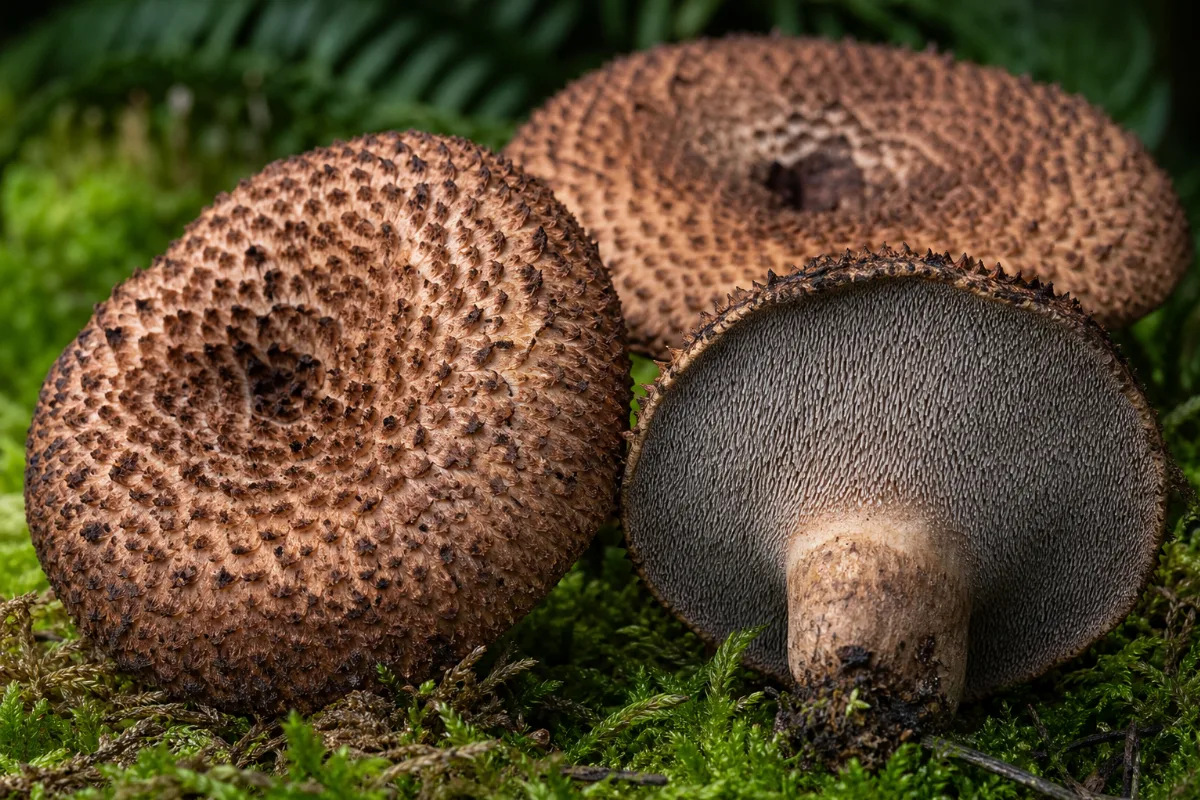
Mushrooms · Wild culinary mushroom
Scaly hedgehog
Sarcodon imbricatus · also called Shingled hedgehog, scaly tooth, hawk's wing, scaly urchin, Habichtspilz, Hydnum imbricatum (older name)
Scaly hedgehog is a wild tooth mushroom with spines under the cap instead of gills, eaten as food in several countries. We found no human trial showing a health benefit from eating it, only lab and mouse studies. Sources describe it as slightly bitter, and in Poland it took up more radioactive caesium than 18 other wild species. Never eat a wild mushroom unless an expert has identified it in person.
General information, not medical advice. Last substantive update · Not medically reviewed. A named clinician has not signed off on this page. How this page is made
About Scaly hedgehog
Scaly hedgehog is a wild tooth mushroom eaten as food, and most of what is known about it is about taste and contaminants rather than health. Sources call it slightly bitter and best when young. In Poland it took up more radioactive caesium than 18 other wild species, and cadmium was elevated in some Polish samples. We found no human health trial. The practical cautions are where it grew, and identification by an expert.
Taste, bitterness and stomach upset
The Colorado guide lists scaly hedgehog as edible, best in young specimens, tasting very mushroomy with a slight bitterness. It says a close relative, Sarcodon scabrosus, is very bitter and some people can get sick from it. It does not say that scaly hedgehog itself causes illness. The Swedish guide gives it one star out of five for taste and describes the flesh as somewhat astringent.
We found no safety study of eating scaly hedgehog, so stomach upset is neither confirmed nor ruled out. A 2026 food-science study found that treating the mushroom with food enzymes lowered electronic-tongue bitterness readings, which shows bitterness is something researchers measure in it.
Radioactive caesium from old fallout
In north-eastern Poland, 8 scaly hedgehog samples held caesium-137 at 159.0 Bq per kg fresh (1,976.7 dry), the highest of 19 species, with the highest soil-to-mushroom transfer factor (41.86). The calculated yearly dose from 1 kg of fresh mushrooms was 2.32 microsieverts, and from 1 kg of dried ones 29.3. The authors found no sample above the EU limit they cite (1,250 Bq per kg fresh) and judged the region's mushrooms radiologically safe.
In a heavily contaminated reserve in Ukraine the species was also among the highest, up to 464 kBq per kg dry mass (units as printed in the abstract). Where it grew matters more than the species.
Cadmium, arsenic and other metals
In four Polish regions, cap samples held 4.5 to 6.3 mg cadmium per kg dry mass (0.45 to 0.63 fresh) and 1.0 to 1.9 mg arsenic. The authors call both elevated and say eating the mushroom could increase cadmium exposure. Caps held more cadmium than stalks.
Other studies point the other way. A second Polish study found cadmium, mercury and lead below weekly tolerance limits. A Turkish study judged scaly hedgehog safe by two risk indices, while noting cadmium above legal limits among the mushrooms studied. A dried sample from China reported cadmium, lead, mercury and arsenic as not detected. Places and methods differ, so we show all of them.
Fresh and dried
Drying removes water, so a gram of dried mushroom holds more caesium and metals than a gram of fresh. The Polish paper's yearly dose figures reflect this: 2.32 microsieverts for 1 kg fresh against 29.3 for 1 kg dried. We found no study of how soaking or cooking changes caesium or cadmium in this species.
What it is
Scaly hedgehog is a fungus, Sarcodon imbricatus, in the family Bankeraceae. GBIF lists the name as accepted. It is a tooth fungus that grows with trees, notably spruce, and is collected wild; only the fruiting body is eaten. It is a different genus from the hedgehog mushroom (Hydnum), so findings for one should not be assumed for the other. A 2024 study of Southwest China markets found eight species inside what used to be called the S. imbricatus group, so some Chinese lab results may describe a different species from the European samples.
What the research shows on benefits
One Chinese analysis measured sugars, protein, fat and minerals in a dried sample. In mice, a powder improved endurance scores and extracts partly reversed drug-induced immune suppression. In cells, a water extract slowed breast cancer cell growth, a purified fraction helped a gut-barrier model, and single compounds reduced influenza A and a seasonal coronavirus. None of this shows a benefit in people, and we found no human trial of scaly hedgehog for any health outcome. Our search was not exhaustive.
Legal and regulatory status
The Polish radiocaesium paper says scaly hedgehog is not permitted for commercial sale under current Polish food-safety regulations, though foragers may collect it for personal use. We did not open the regulation, and we did not read EFSA, FDA or other national limits for caesium or cadmium, so none is stated beyond what that paper says. Rules differ by country and change.
At a glance
Traditional uses history, not proof
- Eaten as a wild mushroom; the Colorado and Swedish guides list it as edible.
- No traditional medicine use was found in the sources we read.
Studied for research
- Nutrition as a food (one composition analysis), insufficient evidence of any health effect
- Immune effects in mice and cells, insufficient (animal and lab only)
- Breast cancer cells and mouse tumours with an extract, insufficient (animal and lab only)
- Fatigue in mice, insufficient (animals only)
- Gut barrier and antiviral readings with purified compounds, insufficient (lab only)
Main compounds
- Sugars (including mannitol), protein and fats in one dried sample
- Polysaccharides, sterols and nitrogen compounds studied in the lab
- Also cadmium, arsenic and radioactive caesium-137 taken up from the soil
Common forms
- Fresh, cooked mushroom
- Dried mushroom
- Water extracts, polysaccharides and isolated compounds (lab and mouse studies only)
- Capsule or powder supplement (not assessed for people in the sources we read)
Research links: Radiocaesium in wild mushrooms, north-eastern Poland (open access) · Cadmium and other elements in Sarcodon imbricatus, Poland (abstract) · Elements in scaly tooth mushroom, northern Poland (abstract) · Metals in 19 wild mushrooms, Turkey (abstract) · Antifatigue study and composition, mice (open access) · Penn State Extension: Preparing and preserving mushrooms · Research Library · Genes & Biomarkers Library
What it is and its history
- Accepted scientific name
- Sarcodon imbricatus
- Naming authority
- (L.) P.Karst. (GBIF)
- Synonyms
- Hydnum imbricatum L. (a GBIF synonym that points to the accepted name); Hydnum imbricatum var. squamosum Pers. (GBIF synonym); Fungus imbricatus (L.) Paulet (GBIF synonym)
- Common names
- Scaly hedgehog (English); Shingled hedgehog (English); Scaly tooth (English); Hawk's wing (English); Scaly urchin (English); Habichtspilz (German); Hydne imbriqué (French); Hidno imbricado (Spanish); Sarniak świerkowy (Polish)
- Family or group
- Bankeraceae (a fungus family of tooth fungi), not a plant
- Classification
- Fungi > Basidiomycota > Agaricomycetes > Thelephorales > Bankeraceae > Sarcodon > Sarcodon imbricatus
- Native range
- Not checked as a range. The studies read sampled Poland, Ukraine, Turkey and China; the Swedish guide says it grows in the Nordic region.
- Habitat
- The Colorado guide says it grows at higher elevations in coniferous woods, associated with spruce; the Swedish guide says it grows with spruce in coniferous forest. The Polish radiocaesium paper classes it as mycorrhizal (living on tree roots).
- What it looks like
- Fruiting body: Not described here. Identification of wild mushrooms must be done in person by an expert, so no field description is given. It is a tooth fungus, with spines rather than gills.
- Cultivation
- Wild-collected in all sources read; no cultivation source was read.
- Harvest and processing
- Eaten fresh or dried. Drying concentrates caesium and metals per gram. Enzyme treatment of the mushroom has been studied as a way to change its taste (Foods 2026).
- Look-alikes and adulterants
- Name: Other tooth fungi; Note: Guides say several toothed fungi can be confusing to identify and that many have been moved to Hydnellum; the Swedish guide lists several Hydnellum species as inedible. No identification advice is given here.; Name: Hedgehog mushroom (Hydnum repandum); Note: A different, unrelated-genus mushroom with its own page. GBIF places it in another order and family.
- Sustainability and conservation
- The Swedish guide page carries a Near threatened label; it does not say which red list that comes from. Not otherwise checked.
Traditional use and history history, not clinical proof
| Tradition or era | Documented use | Source |
|---|---|---|
| Food use | Eaten as a wild mushroom in several countries; the Colorado and Swedish guides both list it as edible. A taxonomy study says more than 1,500 tonnes of Sarcodon and Hydnellum are estimated to be sold as edible each year in Southwest China. No traditional medicine history source was read, so none is stated. | s-colorado-sarcodon |
Traditional use shows how it was used. It does not show that it works or is safe today.
What is inside, and how it may work
What it contains and how those compounds act in cells and animals. Laboratory and animal mechanisms are not proven effects in people.
Main compounds
| Compound | Family | Where it is concentrated | Activity studied | Level of evidence |
|---|---|---|---|---|
| Sugars and mannitol | carbohydrates | Fruiting body Total sugar 35.22% and mannitol 9.40% of a dried Chinese sample (moisture basis not stated). | Nutrient composition; no health effect shown. 15 | Compositional analysis |
| Protein, fat and ash | macronutrients | Fruiting body Protein 18.33%, crude fat 3.02%, ash 9.30% of the same sample. | Nutrient composition. 15 | Compositional analysis |
| Polysaccharides SIP-1 and SIP-2 | polysaccharide | Fruiting body, extracted SIP-1: 2.4 kDa beta-(1,6)-glucan backbone with glucuronic acid side chains. SIP-2: 4.1 kDa branched beta-(1,4)-glucan with terminal mannose. | Gut-barrier and immune effects in cells and mice. 6 | Laboratory research |
| Sarcodonols A to D | ergostane-type sterols | Fruiting body (70% ethanol extract) Not given. | Antiviral reading in cells (sarcodonol D). 5 | Laboratory research |
| Nitrogen-containing compounds (six) | amino acid derivatives and heterocycles | Fruiting body Not given. | Anti-influenza reading in cells (compound 2). 18 | Laboratory research |
| Cadmium (contaminant) | toxic metal | Caps more than stalks 4.5 to 6.3 mg per kg dry biomass in Polish caps; not detected in a Chinese dried sample. | Contaminant taken up from soil. 7 15 | Compositional analysis |
| Caesium-137 (contaminant) | radionuclide | Fruiting body 159.0 Bq per kg fresh and 1,976.7 Bq per kg dry mass in north-eastern Poland. | Contaminant from fallout. 9 | Compositional analysis |
Mechanisms, receptors and pathways
| Target or pathway | Gene or receptor | What was found | Level |
|---|---|---|---|
| Nrf2-related antioxidant pathways | Nrf2, SOD, HO-1, catalase | In mice, powder and polysaccharides raised antioxidant enzymes and Nrf2-linked genes in liver, muscle or immune organs. This is a mouse finding. 15 16 | Animal research |
| Immune signalling | IL-2, IL-6, TNF-alpha, PD-L1 | A water extract raised some cytokines and natural killer cell activity and lowered PD-L1 in tumour-bearing mice. No receptor was identified. 14 | Animal research |
| Gut barrier and microbes | not specified | SIP-1 improved barrier measures in cells and was linked to changes in gut bacteria in mice; SIP-2 acted more on immune cells. 6 | Animal research |
| Virus-induced cell death | ZBP-1 (necroptosis); mitochondrial stress | An isolated amino-acid ester reduced influenza A in lung cells, linked to necroptosis; sarcodonol D reduced a seasonal coronavirus, linked to mitochondrial stress. 18 5 | Laboratory research |
Absorption, metabolism and elimination
- Absorption
- Not found for scaly hedgehog.
- Distribution
- Not found.
- Metabolism
- Not found.
- Elimination
- Not found.
- Bioavailability
- Not established.
Isolated compounds versus whole extracts
Scaly hedgehog is eaten as a whole food, fresh or dried. The immune, tumour and gut-barrier studies used water extracts, enriched polysaccharides or purified fractions, and the antiviral studies used single compounds. Only the fatigue study fed a dried powder (to mice). No capsule or supplement for people was assessed in the sources read.
Nutritional composition
USDA has no entry for scaly hedgehog in the files we hold. The only measured composition we found is from one dried Chinese batch (protein 18.33%, total sugar 35.22%, fat 3.02%, ash 9.30%; moisture basis not stated).
6 not enough evidence
What was looked at
The 6 benefits and uses checked for Scaly hedgehog, each with how strong the evidence is. Tap one to open it.
- Nutrition as a food (one composition analysis)Not enough evidence
- Immune effects in mice and cellsNot enough evidence
- Breast cancer cells and tumours in miceNot enough evidence
- Fatigue and exercise endurance in miceNot enough evidence
- Gut barrier in cell tests and miceNot enough evidence
- Antiviral readings in cellsNot enough evidence
What is Scaly hedgehog good for?
The uses people ask about and how strong the human evidence is for each. None is proven for scaly hedgehog. Read this together with the Safety tab.
Benefits, one by one
Each card is a research question, not a promise. Tap a goal to filter. Open a card to see the studies, doses and limits.
Nutrition as a food (one composition analysis)
Not enough evidenceScaly hedgehog is a wild tooth mushroom eaten as food. One Chinese analysis of a dried sample found about 35% sugars (9.4% of it mannitol), 18% protein, 3% fat and 9% ash. This describes what was in one batch. No trial shows a health benefit from eating it.
2 studiesEaten as the fruiting body, fresh or dried. Drying removes water, so …
Studies, doses and limits
What the trials found
No human trial of eating scaly hedgehog was found.
Results
Dried, powdered fruiting body collected in Yunnan (September 2015): total sugar 35.22%, mannitol 9.40%, crude fat 3.02%, total ash 9.30%, total protein 18.33% (percent; moisture basis not stated). Minerals per 100 g: potassium 3,957 mg, iron 78.42 mg, zinc 10.92 mg, copper 3.31 mg.
Why this rating
Composition of a single batch from a single place; no study measured a health effect of eating it.
Form and dose studied
Eaten as the fruiting body, fresh or dried. Drying removes water, so figures per gram of dried mushroom are higher than per gram of fresh. Always check which basis a number uses.
Who was studied
General food use
Limits
One batch, one province, moisture basis not stated. The sample may belong to a group of related Chinese species (see the Science notes). USDA has no entry for it.
Why researchers looked
It is eaten as a wild food, so researchers measure what it contains.
Traditional use
No traditional medicine use was found in the sources we read. A taxonomy study says more than 1,500 tonnes of Sarcodon and Hydnellum are estimated to be sold as edible each year in Southwest China.
Proposed mechanism Compositional analysis
Not applicable: this is a composition fact, not a mechanism.
A proposed mechanism does not show that the effect happens in people.
Wild scaly hedgehog also takes up cadmium and radioactive caesium from the soil; see the Safety tab.
Immune effects in mice and cells
Not enough evidenceIn mice made immune-suppressed with a cancer drug, extracts and polysaccharides from this mushroom raised immune-organ weights, antibody levels and some immune signals. In cell tests, a purified fraction (SIP-2) raised immune responses. These are animal and lab findings only. Nothing is known in people.
3 studiesWater or polysaccharide-enriched extracts and purified fractions in t…
Studies, doses and limits
Results
Three animal or cell studies: polysaccharide-enriched extract (30 days) and polysaccharides (28 days) each partly reversed drug-induced immune suppression in mice (spleen and thymus indexes, immunoglobulins, cytokines, antioxidant enzymes); purified fraction SIP-2 raised immune responses in macrophages and was linked to more immune-regulating gut bacteria. The abstracts give no numbers.
Why this rating
Mouse and cell studies of extracts and isolated polysaccharides; abstracts without figures; no human data.
Form and dose studied
Water or polysaccharide-enriched extracts and purified fractions in the lab; not food and not a studied supplement.
Who was studied
Mice and cultured cells only
Limits
Immune-organ weights and antibody levels in mice do not show fewer infections in people. A drug-suppressed mouse is a poor model for a healthy eater.
Why researchers looked
Chinese researchers test edible fungi for immune effects, often in mice given the drug cyclophosphamide to suppress immunity.
Proposed mechanism Animal research
Polysaccharides (sugar chains) from the fruiting body are thought to act on immune cells and on antioxidant pathways such as Nrf2. This is a proposal from mouse and cell work.
A proposed mechanism does not show that the effect happens in people.
Nothing here supports using scaly hedgehog to treat or prevent illness. People who take immune-suppressing medicines should ask their prescriber before using any mushroom extract.
Breast cancer cells and tumours in mice
Not enough evidenceA water extract of this mushroom slowed the growth of breast cancer cells in a dish and slowed tumour growth in mice, and raised some immune measures in those mice. This is lab and mouse work on an extract. It is not a treatment, and nothing is known in people.
1 studiesWater extract made in the lab; not a food or supplement.
Studies, doses and limits
Results
The abstract reports slower cell growth, migration and invasion in a dish and reduced tumour growth in mice; it gives no numbers.
Why this rating
One mouse breast cancer model, one study, no numbers in the abstract, no human data.
Form and dose studied
Water extract made in the lab; not a food or supplement.
Who was studied
Mouse cancer cells and mice only
Limits
The authors suggest therapeutic use in breast cancer patients; that is far beyond what mouse data can show.
Why researchers looked
Researchers screen edible mushroom extracts for effects on cancer cells.
Proposed mechanism Animal research
The authors report higher IL-2, IL-6, TNF-alpha and natural killer cell activity and lower PD-L1 in the mice. This is a description of measurements, not a proven mechanism.
A proposed mechanism does not show that the effect happens in people.
Do not use this mushroom or any extract in place of cancer care. People with cancer should ask their oncology team before using any mushroom product.
Fatigue and exercise endurance in mice
Not enough evidenceIn mice, a dried powder of this mushroom improved swimming and rota-rod scores and raised antioxidant enzymes. It was tested in tired and exercised mice only. We found no test in people.
1 studiesDried fruiting body powder fed to mice; the amounts are not given her…
Studies, doses and limits
Results
Three dose levels of dried powder improved scores in swimming and rota-rod tests, reduced immobility in chronic-fatigue mice, raised liver glycogen and ATP, and lowered lactic acid and blood urea nitrogen, compared with control mice. The abstract gives no numbers.
Effect sizes as reported
Better endurance scores in mice
Why this rating
One mouse study (110 mice in total); mice are a weak guide to human tiredness.
Form and dose studied
Dried fruiting body powder fed to mice; the amounts are not given here and none are advised.
Who was studied
Male mice only
Limits
Swimming time in mice does not equal less tiredness in people. The authors' call for a health-food supplement goes beyond the data.
Why researchers looked
The mushroom was tested as a possible functional food for tiredness.
Proposed mechanism Animal research
The authors link the effect to energy metabolism and Nrf2-related antioxidant pathways in the mouse liver and muscle.
A proposed mechanism does not show that the effect happens in people.
Persistent tiredness has many causes and needs a medical check, not a mushroom.
Gut barrier in cell tests and mice
Not enough evidenceA purified fraction (SIP-1) from this mushroom improved gut-barrier measures in cell tests and had anti-inflammatory effects in cells and animals. A second fraction (SIP-2) did not. This is early lab work on isolated sugar chains.
1 studiesPurified fractions; not the whole mushroom.
Studies, doses and limits
Results
SIP-1 raised electrical resistance and lowered dye leakage across a cell layer, and was linked to more Muribaculaceae in mice. The abstract gives no numbers.
Why this rating
One 2026 study, abstract without numbers, isolated fractions, cells and mice only.
Form and dose studied
Purified fractions; not the whole mushroom.
Who was studied
Cultured cells and mice
Limits
Not tested with the whole mushroom or in people.
Why researchers looked
Fungal polysaccharides are tested for effects on the gut lining and gut microbes.
Proposed mechanism Animal research
The authors link the fractions to different sugar linkages and to changes in gut bacteria in mice.
A proposed mechanism does not show that the effect happens in people.
Nothing here supports using scaly hedgehog for gut problems. Ask a doctor about persistent gut symptoms.
Antiviral readings in cells
Not enough evidenceCompounds isolated from the fruiting body reduced influenza A virus in cultured lung cells (one compound), and one of four newly found sterols reduced a seasonal coronavirus in cultured cells. These are single purified chemicals tested in a dish. They are not a treatment.
2 studiesIsolated compounds in the lab; not food and not a supplement.
Studies, doses and limits
Results
Influenza A: compound 2 had an IC50 of 14.9 micromoles per litre in lung cells. Seasonal coronavirus HCoV-OC43: sarcodonol D had an IC50 of 2.26 micromoles per litre in lung fibroblast cells (selectivity index above 44.2).
Effect sizes as reported
Lab readings for isolated compounds
Why this rating
In-vitro only, isolated compounds, abstracts only, no animal or human data.
Form and dose studied
Isolated compounds in the lab; not food and not a supplement.
Limits
Activity in a dish does not show that eating the mushroom does anything against a virus. HCoV-OC43 is a seasonal coronavirus, not SARS-CoV-2.
Why researchers looked
Chemists isolate compounds from edible fungi and screen them against viruses.
Proposed mechanism Laboratory research
The influenza paper links the effect to a type of cell death called necroptosis; the coronavirus paper links it to stress in the cell's energy structures (mitochondria). Both are cell findings.
A proposed mechanism does not show that the effect happens in people.
Do not use mushrooms in place of vaccination or medical care for infections.
Connections to the rest of health
How Scaly hedgehog connects to the rest of our health knowledge graph. Every link says what kind of connection it is. A safety link (for example to the liver) is a warning, not a benefit. A study that merely mentions a topic never creates a benefit link.
Explore every connection: goals, body systems, organs, symptoms, genes
F. Functional actions
| Connected to | Kind of connection | Evidence status | Context | Studies |
|---|---|---|---|---|
| Immune Modulation | Biological association | Not enough evidence | Mouse and cell studies only; no human data. Preparation or compound: Extracts and polysaccharides |
8 16 6 |
G. Root causes and contributing factors
| Connected to | Kind of connection | Evidence status | Context | Studies |
|---|---|---|---|---|
| Environmental toxins | Moderate certainty | Highest caesium-137 of 19 species in north-eastern Poland; depends on site. Preparation or compound: Wild scaly hedgehog (radiocaesium) |
9 3 | |
| Heavy metal exposure | Low certainty | Cap cadmium 4.5 to 6.3 mg per kg dry biomass in Poland; other studies found lower or undetected levels. Preparation or compound: Wild scaly hedgehog (cadmium, arsenic) |
7 11 12 |
K. Biological pathways
L. Active compounds
| Connected to | Kind of connection | Evidence status | Context | Studies |
|---|---|---|---|---|
| Sugars and mannitol | Biological association | Compositional analysis | Nutrient composition; no health effect shown. Preparation or compound: Fruiting body |
15 |
| Protein, fat and ash | Biological association | Compositional analysis | Nutrient composition. Preparation or compound: Fruiting body |
15 |
| Polysaccharides SIP-1 and SIP-2 | Biological association | In vitro | Gut-barrier and immune effects in cells and mice. Preparation or compound: Fruiting body, extracted |
6 |
| Sarcodonols A to D | Biological association | In vitro | Antiviral reading in cells (sarcodonol D). Preparation or compound: Fruiting body (70% ethanol extract) |
5 |
| Nitrogen-containing compounds (six) | Biological association | In vitro | Anti-influenza reading in cells (compound 2). Preparation or compound: Fruiting body |
18 |
| Cadmium (contaminant) | Biological association | Compositional analysis | Contaminant taken up from soil. Preparation or compound: Caps more than stalks |
7 15 |
| Caesium-137 (contaminant) | Biological association | Compositional analysis | Contaminant from fallout. Preparation or compound: Fruiting body |
9 |
Each connection is stored with the ingredient, the connected record, the kind of connection, the evidence status, the supporting studies, the preparation or compound involved, and a review date (last reviewed October 25, 2026).
Evidence at a glance: what the research found for 6 outcomes
Each outcome below is one thing researchers measured. Certainty is how far the evidence can be trusted, not how well it works. The full studies are on the next tab.
The evidence
The research centre for Scaly hedgehog. Every record here was checked against PubMed or the publisher's page; we never list a study we have not verified.
Evidence by outcome
Bars show how many studies we found for each outcome, not how well it works. People are added up across trials only (reviews are not added, to avoid double counting).
How we rate evidence
High certainty
Several well-run trials or reviews agree; further research is unlikely to change the picture much.
Moderate certainty
Good trials point the same way, but some doubt remains.
Low certainty
Small, short or inconsistent trials. The finding could change with better research.
Very low certainty
Very little or very weak human data. Treat as a possibility only.
Mixed findings
Trials or reviews disagree with each other.
Not enough evidence
Not enough human research to say either way.
Evidence against
Good research found no benefit, or found harm.
We take the reviewers' own risk-of-bias and GRADE statements where they exist, and otherwise judge from study size, design, consistency, directness and whether a product matches what is sold. Many publications do not make evidence high. Method note: We read PubMed records for 14 papers: abstracts for all, plus the open-access full text for the antifatigue and composition study and the radiocaesium study. We also read three guidance pages (Colorado Mushrooms, Svampguiden and Penn State Extension) and checked the name in GBIF. Index Fungorum, EFSA, FDA, the Euratom regulation and poison-centre statements were not read. Certainty ratings are the compiler's own reading.
Study library: every study we checked 18
| Study | Design | People | Product, dose, length | Result |
|---|---|---|---|---|
| Colorado Mushrooms 2024 Colorado Mushrooms: Sarcodon imbricatus (Hawks Wing, Scaly Urchin, Shingled Hedgehog), last updated 3 May 2024, read 2026-10-25 coloradomushrooms.com · Source |
Guidance page n/a |
n/a | n/a Not shown here |
The page lists Sarcodon imbricatus as edible, best in younger specimens, tasting very mushroomy with a slight bitterness, and tending to get infested with bugs quickly after fruiting. It says a close relative, Sarcodon scabrosus, is very bitter and some people can get sick from it. It says several toothed fungi in Colorado are still being studied, some can be confusing to identify, and many have been moved to Hydnellum. Its disclaimer says to be 100% sure of identification before eating any wild mushroom and to consult a local expert or mycological society. Methods, limits and fundingOutcomes: Habitat, edibility and taste Limitations: An amateur-run regional guide; the page says it may contain errors. The bitterness and illness comment is about the relative S. scabrosus, not S. imbricatus. Funding and conflicts: Public or independent information source Read: full text |
| GBIF 2026 GBIF Backbone Taxonomy: Sarcodon imbricatus (L.) P.Karst. (key 5238865), checked 2026-10-25 GBIF API · Source |
Taxonomy record n/a |
n/a | n/a Not shown here |
GBIF returns Sarcodon imbricatus (L.) P.Karst. as ACCEPTED (key 5238865), kingdom Fungi, phylum Basidiomycota, class Agaricomycetes, order Thelephorales, family Bankeraceae, genus Sarcodon. Synonyms listed include Hydnum imbricatum L. and Hydnum imbricatum var. squamosum Pers. Vernacular names include Scaly Tooth and Shingled hedgehog (English), Habichtspilz (German), Hydne imbrique and Epervier (French), Hidno imbricado (Spanish) and Sarniak swierkowy (Polish). Hydnum repandum is a different, accepted species in the order Cantharellales, family Hydnaceae. Methods, limits and fundingOutcomes: Accepted name, classification, synonyms and vernacular names Limitations: A database record. Index Fungorum was not checked. Funding and conflicts: Public or independent information source Read: record |
| Grodzinskaya 2022 Radioactive Contamination of Wild Mushrooms from Ukraine under Conditions of Contrasting Radiation Loads: 36 Years after the Chernobyl Nuclear Power Plant Catastrophe. International Journal of Medicinal Mushrooms · PMID 36004707 · DOI |
Laboratory survey fungus (laboratory survey) |
Wild mushrooms from Zhytomyr Polissya, Ukraine, including a nature reserve with heavy contamination | Wild fruiting bodies measured for caesium-137 and strontium-90 fruiting body Not shown here |
The abstract says consuming wild mushrooms in Ukrainian Polissya is still dangerous because the area is heavily contaminated, and lists Sarcodon imbricatus among the species with the highest caesium-137 in the Drevlyanskyi Nature Reserve (up to 464 kBq per kg dry mass, units as printed in the abstract). Annual doses were calculated only for Boletus edulis and Imleria badia in that abstract, not for scaly hedgehog. Scaly hedgehog among the high caesium-137 species in a heavily contaminated Ukrainian reserve Methods, limits and fundingOutcomes: Caesium-137 and strontium-90 in dry mass; calculated annual dose from caesium-137 Limitations: A heavily contaminated area, so these values show what can happen, not what is typical. No dose for scaly hedgehog in the abstract. Abstract only was read. Funding and conflicts: Funding not stated in the abstract Read: abstract |
| Guan 2026 Comparative Effects of Different Proteases on the Non-Volatile Taste Compounds and Volatile Flavor Fingerprints of Sarcodon imbricatus Hydrolysates. Foods · PMID 42279711 · DOI |
Food science laboratory fungus (food chemistry) |
Sarcodon imbricatus treated with three food enzymes (Flavourzyme, Protamex, bromelain) | Enzyme-treated mushroom (hydrolysates) fruiting body Not shown here Not shown here · vs Untreated mushroom |
The abstract says enzyme treatment changed flavour. Flavourzyme gave the most free amino acids (47.46 mg per g) and the highest degree of hydrolysis (29.24%); Protamex gave the highest umami value. Electronic-tongue readings showed that treatment generally raised umami and reduced bitterness. 69 aroma compounds were identified. Enzyme treatment lowered electronic-tongue bitterness readings Methods, limits and fundingOutcomes: Free amino acids, 5'-nucleotides, electronic-tongue taste readings, volatile aroma compounds Limitations: Food-science test with an electronic tongue, not human tasters; it concerns processed hydrolysates, not the cooked mushroom. Abstract only was read. Funding and conflicts: Funding not stated in the abstract Read: abstract |
| Jin Yang 2023 Sarcodonol A-D from fruiting bodies of Sarcodon imbricatus inhibits HCoV-OC43 induced apoptosis in MRC-5 cells. Bioorganic Chemistry · PMID 37669581 · DOI |
Laboratory research cell lines |
Human lung fibroblast (MRC-5) cells infected with the seasonal coronavirus HCoV-OC43 | Four newly isolated sterols, sarcodonol A to D, from a 70% ethanol extract of dried fruiting bodies fruiting body (isolated compounds) Not shown here Not shown here · vs Untreated infected cells |
The abstract says sarcodonol D had significant antiviral activity against the seasonal coronavirus HCoV-OC43 in cells (IC50 2.26 micromoles per litre; CC50 above 100; selectivity index above 44.2), and that this was linked to less virus-induced cell death. Antiviral reading for one isolated compound in cultured cells Methods, limits and fundingOutcomes: Antiviral activity and cell death Limitations: Cells only; a seasonal coronavirus, not SARS-CoV-2; an isolated compound. Abstract only was read. Funding and conflicts: Research support from a non-US government source per the record Read: abstract |
| Lo 2026 Two low molecular weight-polysaccharides isolated from the edible fungus Sarcodon imbricatus: Isolation, characterization, immunomodulatory and intestinal barrier-protective effects. Carbohydrate Polymers · PMID 41943383 · DOI |
In vitro and animal study cell lines and mouse |
Cultured gut and immune cells, and mice | Two purified polysaccharides, SIP-1 (2.4 kDa) and SIP-2 (4.1 kDa) fruiting body (isolated polysaccharides) Not shown here Not shown here · vs Untreated cells and animals |
The abstract says SIP-1, a beta-(1,6)-glucan, improved gut-barrier measures in cell tests, had anti-inflammatory effects in cells and animals, and was linked to more of a gut bacterial family (Muribaculaceae). SIP-2, a branched beta-(1,4)-glucan, showed limited barrier effects but raised immune responses in normal macrophages while lowering inflammation in stimulated cells, and was linked to more Blautia and Akkermansia. No numbers in the abstract. Different effects of two purified fractions in cells and animals Methods, limits and fundingOutcomes: Gut-barrier measures (electrical resistance, dye leakage), cytokines, immune responses in macrophages, gut microbes Limitations: Isolated fractions, not the whole mushroom; cells and animals only; no figures in the abstract. Abstract only was read. Funding and conflicts: Funding not stated in the abstract Read: abstract |
| Medyk 2017 Specific accumulation of cadmium and other trace elements in Sarcodon imbricatus using ICP-MS with a chemometric approach. Journal of Environmental Science and Health, Part B · PMID 28277082 · DOI |
Laboratory survey fungus (laboratory survey) |
Wild Sarcodon imbricatus foraged in four regions of Poland (composite samples of caps and stipes) | Wild fruiting bodies analysed by ICP-MS fruiting body (caps, stipes) Not shown here |
Composite cap samples (mg per kg dry biomass): cadmium 4.5 to 6.3, arsenic 1.0 to 1.9, lead 0.94 to 1.6, caesium (the stable element) 20 to 38, silver 0.27 to 0.29, copper 28 to 35, zinc 140 to 160. Cadmium was 0.45 to 0.63 mg per kg in fresh caps. Silver, arsenic, cadmium, caesium, lead and zinc were higher in caps than in stipes. The authors say the cadmium content was elevated and eating the mushroom could increase exposure to cadmium, and that arsenic was also elevated. Cap cadmium 4.5 to 6.3 mg per kg dry biomass in four Polish regions Methods, limits and fundingOutcomes: 18 elements in mg per kg dry biomass Limitations: Composite samples from four regions; the abstract gives no number of mushrooms and no comparison with a legal limit. Abstract only was read. Funding and conflicts: Funding not stated in the abstract Read: abstract |
| Meng 2017 Investigation on the immunomodulatory activities of Sarcodon imbricatus extracts in a cyclophosphamide (CTX)-induced immunosuppressanted mouse model. Saudi Pharmaceutical Journal · PMID 28579875 · DOI |
Animal study mouse |
Mice made immune-suppressed with the drug cyclophosphamide | Polysaccharide-enriched Sarcodon imbricatus extract (SP) by mouth for thirty days; Astragalus polysaccharide as positive control fruiting body (polysaccharide-enriched extract) Not shown here 30 days · vs Cyclophosphamide-treated mice without extract |
The abstract says the extract raised spleen and thymus indexes, reduced paw swelling and raised blood immunoglobulins (IgA, IgG, IgM) in the drug-treated mice, lowered a marker of oxidative damage and raised antioxidant enzymes. The abstract gives no numbers. Partial reversal of drug-induced immune suppression in mice Methods, limits and fundingOutcomes: Spleen and thymus indexes, paw swelling, immunoglobulins, IL-2, antioxidant measures in blood and liver Limitations: Mouse study of an enriched extract. Immune-organ weights and antibody levels in mice do not show protection from infection in people. Abstract only was read. Funding and conflicts: Funding not stated in the abstract Read: abstract |
| Mironczuk-Chodakowska 2025 Forty Years After Chernobyl: Radiocaesium in Wild Edible Mushrooms from North-Eastern Poland and Its Relevance for Dietary Exposure and Food Safety. Toxics · PMID 40711045 · DOI |
Laboratory survey fungus (laboratory survey) |
230 230 samples of 19 wild edible species from north-eastern Poland, with soil samples; 8 were Sarcodon imbricatus (Narew 2, Suprasl 6) |
Wild fruiting bodies measured by gamma spectrometry fruiting body Not shown here |
Across all 19 species, caesium-137 ranged from 0.94 to 159.0 Bq per kg fresh mass and none of the samples exceeded the 1,250 Bq per kg fresh-mass limit the paper cites. Scaly hedgehog had the highest value: 159.0 Bq per kg fresh and 1,976.7 Bq per kg dry mass, and the highest soil-to-mushroom transfer factor for caesium-137 (41.86, range 29.43 to 61.11). The calculated annual effective dose was 2.32 microsieverts for 1 kg of fresh mushrooms and 29.3 microsieverts for 1 kg of dried ones (35.89 with potassium-40). The authors say that rehydrating dried samples at 1 to 9, as the Euratom rule requires, put even the most contaminated dried samples within the limit. They also state that Russula aeruginea, Sarcodon imbricatus and Tricholoma portentosum are not permitted for commercial sale under current Polish food safety regulations, though foragers may collect them for personal use. Highest caesium-137 and transfer factor of 19 species; all samples within the cited limit Methods, limits and fundingOutcomes: Caesium-137 and potassium-40 in fresh and dry mass; soil-to-mushroom transfer; estimated annual effective dose; comparison with regulatory limit Limitations: Eight scaly hedgehog samples from two places; a modelled dose for an assumed 1 kg a year; it describes north-eastern Poland, not every forest. Abstract and open-access full text were read. Funding and conflicts: Funding not stated in the abstract Read: abstract and full text |
| Penn State Extension 2024 Penn State Extension: Preparing and Preserving Mushrooms (updated 22 November 2024), read 2026-10-25 extension.psu.edu · Source |
Guidance page n/a |
n/a | n/a Not shown here |
The page says only an expert can tell poisonous from edible mushrooms, that unless you are an expert you should not forage your own, and that no matter how much you cook or dry them you will not destroy their toxins. Methods, limits and fundingOutcomes: Wild mushroom safety advice Limitations: A US university extension page, general to all mushrooms; it does not mention scaly hedgehog. Funding and conflicts: Public or independent information source Read: full text |
| Saba 2020 Accumulation Pattern of Inorganic Elements in Scaly Tooth Mushroom (Sarcodon imbricatus) from Northern Poland. Chemistry & Biodiversity · PMID 32233068 · DOI |
Laboratory survey fungus (laboratory survey) |
Caps and stems of Sarcodon imbricatus from two Polish forests (Wdzydze, central; Augustowska, eastern) | Wild fruiting bodies analysed for 20 elements fruiting body (caps, stems) Not shown here |
The abstract says metal levels varied widely between the two forests, that cadmium and mercury accumulated more in caps than stems, and that the concentrations of cadmium, mercury and lead were below the established weekly intake tolerance limits. No numbers in the abstract. Cadmium, mercury and lead below weekly tolerance limits in these samples Methods, limits and fundingOutcomes: Metals in caps and stems; comparison with weekly intake tolerance limits Limitations: The abstract gives no figures, portion size or number of samples; the result depends on how much is eaten and how often. Abstract only was read. Funding and conflicts: Funding not stated in the abstract Read: abstract |
| Sarikurkcu 2021 Evaluation of the metal concentrations of wild mushroom species with their health risk assessments. Environmental Science and Pollution Research · PMID 33415633 · DOI |
Laboratory survey fungus (laboratory survey) |
Nineteen wild mushroom species (edible, inedible and poisonous) from Uzungol, Trabzon, Turkey | Wild fruiting bodies analysed for eight metals; daily intake of metal (DIM) and health risk index (HRI) calculated fruiting body Not shown here |
The abstract says that for daily metal intake, Hygrophorus pudorinus, Meripilus giganteus and Sarcodon imbricatus were safe for all the metals examined, and that by health risk index only M. giganteus and S. imbricatus could be consumed safely. It adds that cadmium was found to be above the legal limits (stated for the mushrooms as a group, not for scaly hedgehog on its own). No species-level numbers in the abstract. Scaly hedgehog judged safe by the authors' two risk indices for the eight metals studied Methods, limits and fundingOutcomes: Zn, Fe, Co, Mn, Cu, Pb, Ni, Cd; DIM; HRI Limitations: Index results depend on the eating-amount assumptions in the paper, which the abstract does not give. The cadmium comment is not attributed to this species. Abstract only was read. Funding and conflicts: Funding not stated in the abstract Read: abstract |
| Svampguiden 2026 Svampguiden: Shingled Hedgehog (Sarcodon imbricatus), read 2026-10-25 svampguiden.com · Source |
Guidance page n/a |
n/a | n/a Not shown here |
The page lists the species as edible with a taste rating of one star out of five, flesh with a somewhat astringent taste and sour smell, and a Near threatened status label. It lists several related tooth fungi (Hydnellum species) as inedible, and the Bitter Tooth as inedible; the species it names as the Bitter Tooth is Hydnellum scabrosum (the Colorado page calls the same name Sarcodon scabrosus). Methods, limits and fundingOutcomes: Edibility, taste, conservation status Limitations: A Nordic mushroom guide; the page shows no date and does not say which red list the Near threatened label comes from. Read from the web version; the app has more. Funding and conflicts: Public or independent information source Read: full text |
| Tan 2020 Anti-tumor and immunomodulatory activity of the aqueous extract of Sarcodon imbricatus in vitro and in vivo. Food & Function · PMID 31825431 · DOI |
In vitro and animal study mouse and cell lines |
Mouse breast cancer (4T1) cells and mice carrying 4T1 tumours | Aqueous (water) extract of Sarcodon imbricatus (SIE) fruiting body (water extract) Not shown here Not shown here · vs Untreated tumour-bearing mice |
The abstract says the extract inhibited growth, migration and invasion of breast cancer cells in a dish and reduced tumour growth in mice. In tumour-bearing mice it raised serum IL-2, IL-6 and TNF-alpha, natural killer cell activity and spleen-cell viability, and lowered PD-L1 expression. The abstract gives no numbers. Slower tumour growth in mice; no numbers in the abstract Methods, limits and fundingOutcomes: Breast cancer cell growth, movement and invasion; tumour growth; blood cytokines; natural killer cell activity; PD-L1 Limitations: Cells and mice only. A water extract is not the same as eating the mushroom. The authors write of potential therapeutic use in breast cancer patients; no human data support that. Abstract only was read. Funding and conflicts: Funding not stated in the abstract Read: abstract |
| Wang 2018 Antifatigue Potential Activity of Sarcodon imbricatus in Acute Excise-Treated and Chronic Fatigue Syndrome in Mice via Regulation of Nrf2-Mediated Oxidative Stress. Oxidative Medicine and Cellular Longevity · PMID 30050662 · DOI |
Animal study with composition mouse (and fungus composition) |
Dried Sarcodon imbricatus fruiting body collected in broad-leaved forest in Yunnan, September 2015 (composition); 110 male Kunming mice (acute exercise and chronic-fatigue models, 10 per group in the acute model) | Dried, powdered fruiting body given by mouth to mice at three dose levels, with ginsenoside as the positive control fruiting body (dried powder) Not shown here Up to 32 days in the chronic-fatigue model · vs Vehicle (control mice) and ginsenoside |
Composition table (percent, basis not stated): total sugar 35.22, mannitol 9.40, crude fat 3.02, total ash 9.30, total protein 18.33, polyphenols 0.41, sterols 3.16. Minerals (mg per 100 g): potassium 3,957, iron 78.42, zinc 10.92, copper 3.31. Lead, mercury, arsenic, cadmium, chromium and selenium were reported as not detected (detection limits 1, 0.1, 0.5, 0.5, 1 and 2 mg per kg). In mice the powder improved swimming and rota-rod performance, reduced immobility in chronic-fatigue mice, raised liver glycogen and ATP, lowered lactic acid and blood urea nitrogen, and raised antioxidant enzyme levels, compared with control mice. Better endurance scores in mice; one batch of the mushroom analysed for composition Methods, limits and fundingOutcomes: Composition of the powder; swimming and rota-rod endurance, tail-suspension immobility, liver glycogen, ATP, lactic acid, blood urea nitrogen, antioxidant enzymes Limitations: One batch from one province; moisture basis of the composition percentages not stated; mouse results do not show an effect in people; the authors call it a possible antifatigue health-food supplement, which goes beyond mouse data. Abstract and full text (open access) were read. Funding and conflicts: Provincial government grants (Jilin, China); authors declare no conflict of interest Read: abstract and full text |
| Wang 2018 Sarcodon imbricatus polysaccharides protect against cyclophosphamide-induced immunosuppression via regulating Nrf2-mediated oxidative stress. International Journal of Biological Macromolecules · PMID 30171947 · DOI |
Animal study mouse |
Balb/c mice made immune-suppressed with cyclophosphamide | Sarcodon imbricatus polysaccharides (SIPS) by mouth for 28 days fruiting body (polysaccharides) Not shown here 28 days · vs Cyclophosphamide-treated mice without polysaccharides |
The abstract says the polysaccharides raised spleen and thymus indexes, eased body-weight loss, raised natural killer cell activity and lymphocyte growth, changed immunoglobulins and raised several cytokines (IL-2, IL-6, IL-10, IL-12, interferon-gamma) and antioxidant enzymes in the drug-treated mice. The abstract gives no numbers. Partial reversal of drug-induced immune suppression in mice Methods, limits and fundingOutcomes: Spleen and thymus indexes, body weight, natural killer cell activity, lymphocyte proliferation, immunoglobulins, cytokines, antioxidant enzymes Limitations: Mouse study of isolated polysaccharides, not the whole mushroom. Abstract only was read. Funding and conflicts: Funding not stated in the abstract Read: abstract |
| Wang 2024 New insights into the stipitate hydnoid fungi Sarcodon, Hydnellum, and the formerly informally defined Neosarcodon, with emphasis on the edible species marketed in Southwest China. IMA Fungus · PMID 38528625 · DOI |
Taxonomy study Funding not stated in the abstract |
Specimens collected in the field and bought in markets in Southwest China | DNA sequence and shape analysis of tooth fungi fruiting body Not shown here |
Where Sarcodon and Hydnellum species belong, and which are sold as food The abstract says more than 1,500 tonnes of Sarcodon and Hydnellum are estimated to be sold as edible each year in Southwest China, and that the market samples held 17 phylogenetic species. Eight species were resolved in the traditional S. imbricatus complex, with S. imbricatus in the strict sense the most common edible one; five were described as new species. (https://pubmed.ncbi.nlm.nih.gov/38528625/) Methods, limits and fundingOutcomes: n/a Limitations: Eight species within what used to be called S. imbricatus in this region Funding and conflicts: Study of Southwest China markets. It does not say which species any one lab or health paper used, so it does not tell us how far Chinese research results apply to the European species. Abstract only was read. Read: fungus |
| Yang 2025 Antiviral-effect of nitrogen-containing compounds isolated from Sarcodon imbricatus on influenza A virus through regulation of ZBP-1 mediated necroptosis. Biomedicine & Pharmacotherapy · PMID 39671721 · DOI |
Laboratory research cell lines |
Human lung (A549) cells infected with influenza A virus | Six nitrogen-containing compounds isolated from the fruiting body fruiting body (isolated compounds) Not shown here Not shown here · vs Untreated infected cells |
The abstract says compound 2 (an amino-acid ester) reduced viral protein and replication in cells, with an IC50 of 14.9 micromoles per litre, and lowered TNF-alpha, IL-6 and IL-1 beta and oxidative stress. The other compounds are not described in the abstract. Antiviral reading for one isolated compound in cultured cells Methods, limits and fundingOutcomes: Viral protein, viral replication, cytokines, oxidative stress, cell death (necroptosis) Limitations: Cells only; a single purified compound, not the mushroom. Abstract only was read. Funding and conflicts: Funding not stated in the abstract Read: abstract |
What we do not know yet
- No human trial of scaly hedgehog for any health outcome was found.
- No safety study of eating it; bitterness and illness are described only in guides, and the illness comment is about a relative.
- No regulation text for cadmium or caesium limits was opened.
- No study of cooking, soaking or drying effects on caesium or cadmium in this species was found, and no data on allergy, pregnancy, breastfeeding or medicine interactions.
- Survey figures are for particular places and years and may not match any mushroom you buy or pick.
- Some Chinese lab results may describe a related species rather than the European one.
How new research is added
New studies are found by a saved PubMed search and placed in a review queue. A person reads each one before it changes any evidence rating or safety wording. New publications never change ratings automatically.
Lab markers
What changed in blood or saliva tests during trials. A changed number is not the same as feeling or being healthier, and we give no "normal ranges".
Safety
What studies and official sources say about side effects, medicines and who should check first. Each point shows what kind of evidence it comes from.
Main points to know 6
- Wild mushrooms must be identified in person by an expert; cooking or drying does not remove toxins. Penn State Extension says only an expert can tell poisonous from edible mushrooms, that you should not forage your own unless you are an expert, and that no amount of cooking or drying destroys toxins. The Colorado guide adds that several toothed fungi are still being studied, some are confusing to identify, and many have been moved to another genus; it tells readers to be 100% sure of identification and to consult a local expert. This page gives no identification help. Authoritative guidance 10 1
- It can taste bitter, and sources link a bitter relative to illness. The Colorado guide lists scaly hedgehog as edible, best when young, with a slight bitterness, and says a close relative (Sarcodon scabrosus) is very bitter and some people get sick from it. It does not say that scaly hedgehog itself makes people ill. The Swedish guide gives scaly hedgehog one star out of five for taste, describes the flesh as somewhat astringent, and lists several related tooth fungi as inedible. We found no safety study of eating scaly hedgehog, so stomach upset is neither confirmed nor ruled out for this species. Authoritative guidance 1 13
- Wild scaly hedgehog can hold a lot of radioactive caesium. In north-eastern Poland it had the highest caesium-137 of 19 wild species: 159.0 Bq per kg fresh mass (1,976.7 dry mass) in 8 samples, and the highest soil-to-mushroom transfer factor (41.86). The calculated yearly dose from 1 kg of fresh mushrooms was 2.32 microsieverts and from 1 kg of dried ones 29.3. The authors found no sample above the EU limit they cite (1,250 Bq per kg fresh) and judged the region's mushrooms radiologically safe under their scenarios. In a heavily contaminated Ukrainian reserve the species was also among the highest, up to 464 kBq per kg dry mass as printed in the abstract. Where it grew matters most. Laboratory survey 9 3
- Cadmium and arsenic: studies disagree. In four Polish regions, cap samples held 4.5 to 6.3 mg cadmium per kg dry mass (0.45 to 0.63 fresh) and 1.0 to 1.9 mg arsenic; the authors call both elevated and say eating the mushroom could increase cadmium exposure. A second Polish study found cadmium, mercury and lead below weekly tolerance limits. A Turkish study of 19 species judged scaly hedgehog safe by its two risk indices, but noted cadmium above legal limits among the mushrooms studied. A Chinese dried sample reported cadmium, lead, mercury and arsenic as not detected (detection limits 0.5, 1, 0.1 and 0.5 mg per kg). Places and methods differ, so one result cannot stand for a mushroom you buy or pick. Laboratory survey 7 11 12 15
- Dried scaly hedgehog is more concentrated per gram. The Polish radiocaesium paper calculated 2.32 microsieverts for 1 kg fresh and 29.3 for 1 kg dried. Drying removes water, so a gram of dried mushroom holds more caesium and metals than a gram of fresh. We found no study of how soaking or cooking changes caesium or cadmium in this species. Laboratory survey 9
- In Poland it may not be sold commercially. The Polish radiocaesium paper says scaly hedgehog is not permitted for commercial sale under current Polish food-safety regulations, though foragers may collect it for personal use. We did not open the regulation, and rules in other countries differ. Authoritative guidance 9
Side effects 4
| Effect | How often | Severity and recovery | Evidence |
|---|---|---|---|
| Bitterness and astringent taste Described as a slight bitterness in young mushrooms (Colorado) and a somewhat astringent flesh (Svampguiden). | Not found as a rate | mild (taste) Not applicable | Authoritative guidance 1 13 |
| Stomach upset The Colorado page says some people get sick from the very bitter relative S. scabrosus; it does not say the same of S. imbricatus. | Not found for scaly hedgehog | unknown for this species unknown | Authoritative guidance 1 |
| Poisoning from a mistaken wild mushroom General guidance, not a report about this species. | Not found for scaly hedgehog | unknown for this species; wild mushroom poisoning can be severe unknown | Authoritative guidance 10 1 |
| Allergic reactions to mushrooms A PubMed search on the species name returned no allergy paper. | Not found for scaly hedgehog | unknown unknown | None found |
Liver
No liver injury from eating scaly hedgehog was found in the sources read.
Monitoring. No routine monitoring is suggested by the sources read. Seek medical care for poisoning signs.
This is a safety connection. It is not evidence that Scaly hedgehog supports liver health.
Medicines and supplements 1
| With | Why it matters | Importance | Evidence | What to do |
|---|---|---|---|---|
| Prescription and over-the-counter medicines prescription | No interaction report for scaly hedgehog was found in the sources read. This is absence of evidence, not proof of safety. | None found Not enough evidence | Ask a pharmacist if you take regular medicines and plan to eat wild mushrooms often. |
Who should check first 4
| Situation | Advice | Evidence |
|---|---|---|
| Anyone who cannot be sure of the mushroom's identity | Do not eat it. Only an expert can separate poisonous from edible mushrooms, and cooking or drying does not destroy toxins (Penn State Extension). | Authoritative guidance 10 1 |
| Known mushroom allergy | Ask an allergy specialist before eating. | Expert opinion |
| Pregnancy, breastfeeding and young children | No safety data for scaly hedgehog in these groups were found. Because wild mushrooms can hold cadmium and caesium, ask a clinician before eating them often. | Laboratory survey 7 9 |
| Kidney disease or heavy, frequent wild-mushroom eating | Cadmium builds up in the body over time, and caps held more than stalks in the Polish studies. The studies do not set a safe amount, so ask a clinician if you eat wild mushrooms often. | Laboratory survey 7 11 |
Overdose, product quality and regulators
Summary. Scaly hedgehog is eaten in several countries. The hazards in the sources read are mistaken identity of wild mushrooms, bitterness, and cadmium, arsenic and radiocaesium taken up from the forest.
Animal. The mouse fatigue study did not report toxicity in its abstract; no toxicity study of the mushroom was found.
Human doses studied. No dose studies in people. No amounts are advised here.
High dose or long term signals. Cadmium and caesium would add up with frequent large servings of contaminated mushrooms; the studies do not set a safe limit.
Genotoxicity. Not read.
Toxic or hazardous parts. Fungus: cap and stalk are eaten. In the Polish metal study, silver, arsenic, cadmium, caesium, lead and zinc were higher in caps than in stipes.
Scaly hedgehog is wild-collected, so what it carries depends on the soil, the forest and the year. Drying leaves more per gram.
Radiocaesium (caesium-137). 159.0 Bq per kg fresh and 1,976.7 Bq per kg dry mass in north-eastern Poland (highest of 19 species); up to 464 kBq per kg dry mass (units as printed) in a heavily contaminated Ukrainian reserve. 9 3
Cadmium. 4.5 to 6.3 mg per kg dry biomass in caps from four Polish regions; not detected in a Chinese dried sample (detection limit 0.5 mg per kg); below weekly tolerance limits in a second Polish study. 7 11 15
Arsenic and lead. Arsenic 1.0 to 1.9 and lead 0.94 to 1.6 mg per kg dry biomass in Polish caps; not detected in the Chinese sample. 7 15
Mercury. Below the weekly tolerance limit in a Polish study (no figure in the abstract); not detected in the Chinese sample (detection limit 0.1 mg per kg). 11 15
| Body | Action | Date |
|---|---|---|
| Penn State Extension (United States (university)) | Says only an expert can separate poisonous from edible mushrooms and that cooking or drying will not destroy toxins. source | 2024-11-22 |
When to get medical help
- Severe or repeated vomiting, diarrhoea or belly pain, dizziness, confusion or heavy sweating after eating a wild mushroom: get emergency medical help or call your local poison service now. Do not wait for it to pass.
- Passing very little urine, yellow skin or eyes, dark urine or unusual bleeding after eating wild mushrooms: get medical help now.
- Wheezing, chest tightness, swelling of the lips or face, or hives after eating mushrooms: treat as an emergency.
If someone may be poisoned or in a crisis, contact a clinician or emergency service straight away. In the US, Poison Control is 1-800-222-1222.
General information only, not medical advice. Ask a clinician or pharmacist before use, especially with medicines, in pregnancy or with a health condition. See the Natural Remedy Safety guide.
Frequently asked questions
What is scaly hedgehog?
Scaly hedgehog, also called shingled hedgehog, is Sarcodon imbricatus, a wild tooth mushroom with spines under the cap. GBIF lists the name as accepted. It is eaten fresh or dried in several countries.
Is scaly hedgehog the same as hedgehog mushroom?
No. Hedgehog mushroom is Hydnum repandum, a different genus in a different order. Do not assume findings for one apply to the other. See our hedgehog mushroom page.
Is scaly hedgehog safe to eat?
Why is it sometimes bitter?
Can it cause stomach upset?
We found no study or report of stomach upset from scaly hedgehog itself. The only link is a source saying a very bitter relative makes some people sick. If you feel unwell after eating wild mushrooms, get medical advice.
Is scaly hedgehog radioactive?
Is it high in cadmium or other metals?
Does cooking or drying remove toxins, caesium or metals?
Does scaly hedgehog have health benefits?
Is it sold as a supplement?
Is it safe in pregnancy, breastfeeding or for children, and does it interact with medicines?
Explore by health goal
Editorial transparency
- Written by
- AlternativeMed editorial team. Research compiled with AI assistance, then checked against PubMed records.
- Medical review
- None. This page has not been reviewed by a physician or pharmacist.
- First published
- 2026-10-25
- Last substantive update
- 2026-10-25
- How we research
- We read PubMed records for 14 papers: abstracts for all, plus the open-access full text for the antifatigue and composition study and the radiocaesium study. We also read three guidance pages (Colorado Mushrooms, Svampguiden and Penn State Extension) and checked the name in GBIF. Index Fungorum, EFSA, FDA, the Euratom regulation and poison-centre statements were not read. Certainty ratings are the compiler's own reading.
- How we rate evidence
- See "How we rate evidence" in the Evidence tab.
- Independence
- No product is promoted on this page. No affiliate links are shown. This page is information, not a recommendation to eat wild mushrooms.
Sources 18
Each source was opened and checked. Where we read only the abstract, it says so. The small numbers in the text point here.
- Colorado Mushrooms. Colorado Mushrooms: Sarcodon imbricatus (Hawks Wing, Scaly Urchin, Shingled Hedgehog), last updated 3 May 2024, read 2026-10-25. coloradomushrooms.com. 2024. (full text)
- GBIF. GBIF Backbone Taxonomy: Sarcodon imbricatus (L.) P.Karst. (key 5238865), checked 2026-10-25. GBIF API. 2026. (record)
- Grodzinskaya AA, Nebesnyi VB, Landin VP, Gabriel J. Radioactive Contamination of Wild Mushrooms from Ukraine under Conditions of Contrasting Radiation Loads: 36 Years after the Chernobyl Nuclear Power Plant Catastrophe.. International Journal of Medicinal Mushrooms. 2022. PMID 36004707. DOI 10.1615/IntJMedMushrooms.2022044725. (abstract)
- Guan J, Li Y, Wang T, et al. Comparative Effects of Different Proteases on the Non-Volatile Taste Compounds and Volatile Flavor Fingerprints of Sarcodon imbricatus Hydrolysates.. Foods. 2026. PMID 42279711. DOI 10.3390/foods15111924. (abstract)
- Jin Yang H, Kwon EB, Choi JG, et al. Sarcodonol A-D from fruiting bodies of Sarcodon imbricatus inhibits HCoV-OC43 induced apoptosis in MRC-5 cells.. Bioorganic Chemistry. 2023. PMID 37669581. DOI 10.1016/j.bioorg.2023.106824. (abstract)
- Lo TH, Zheng X, Chen K, et al. Two low molecular weight-polysaccharides isolated from the edible fungus Sarcodon imbricatus: Isolation, characterization, immunomodulatory and intestinal barrier-protective effects.. Carbohydrate Polymers. 2026. PMID 41943383. DOI 10.1016/j.carbpol.2026.125161. (abstract)
- Medyk M, Chudzinska M, Baralkiewicz D, Falandysz J. Specific accumulation of cadmium and other trace elements in Sarcodon imbricatus using ICP-MS with a chemometric approach.. Journal of Environmental Science and Health, Part B. 2017. PMID 28277082. DOI 10.1080/03601234.2017.1283145. (abstract)
- Meng F, Xu P, Wang X, et al. Investigation on the immunomodulatory activities of Sarcodon imbricatus extracts in a cyclophosphamide (CTX)-induced immunosuppressanted mouse model.. Saudi Pharmaceutical Journal. 2017. PMID 28579875. DOI 10.1016/j.jsps.2017.04.006. (abstract)
- Mironczuk-Chodakowska I, Kapala J, Kujawowicz K, et al. Forty Years After Chernobyl: Radiocaesium in Wild Edible Mushrooms from North-Eastern Poland and Its Relevance for Dietary Exposure and Food Safety.. Toxics. 2025. PMID 40711045. DOI 10.3390/toxics13070601. (abstract and full text)
- Penn State Extension. Penn State Extension: Preparing and Preserving Mushrooms (updated 22 November 2024), read 2026-10-25. extension.psu.edu. 2024. (full text)
- Saba M, Falandysz J, Loganathan B. Accumulation Pattern of Inorganic Elements in Scaly Tooth Mushroom (Sarcodon imbricatus) from Northern Poland.. Chemistry & Biodiversity. 2020. PMID 32233068. DOI 10.1002/cbdv.202000167. (abstract)
- Sarikurkcu C, Yildiz D, Akata I, Tepe B. Evaluation of the metal concentrations of wild mushroom species with their health risk assessments.. Environmental Science and Pollution Research. 2021. PMID 33415633. DOI 10.1007/s11356-020-11685-0. (abstract)
- Svampguiden. Svampguiden: Shingled Hedgehog (Sarcodon imbricatus), read 2026-10-25. svampguiden.com. 2026. (full text)
- Tan X, Chen W, Jiao C, et al. Anti-tumor and immunomodulatory activity of the aqueous extract of Sarcodon imbricatus in vitro and in vivo.. Food & Function. 2020. PMID 31825431. DOI 10.1039/c9fo01230c. (abstract)
- Wang X, Qu Y, Zhang Y, et al. Antifatigue Potential Activity of Sarcodon imbricatus in Acute Excise-Treated and Chronic Fatigue Syndrome in Mice via Regulation of Nrf2-Mediated Oxidative Stress.. Oxidative Medicine and Cellular Longevity. 2018. PMID 30050662. DOI 10.1155/2018/9140896. (abstract and full text)
- Wang X, Wang Z, Wu H, et al. Sarcodon imbricatus polysaccharides protect against cyclophosphamide-induced immunosuppression via regulating Nrf2-mediated oxidative stress.. International Journal of Biological Macromolecules. 2018. PMID 30171947. DOI 10.1016/j.ijbiomac.2018.08.157. (abstract)
- Wang D, Feng H, Zhou J, et al. New insights into the stipitate hydnoid fungi Sarcodon, Hydnellum, and the formerly informally defined Neosarcodon, with emphasis on the edible species marketed in Southwest China.. IMA Fungus. 2024. PMID 38528625. DOI 10.1186/s43008-023-00138-1. (fungus)
- Yang HJ, Kwon EB, Kim YS, et al. Antiviral-effect of nitrogen-containing compounds isolated from Sarcodon imbricatus on influenza A virus through regulation of ZBP-1 mediated necroptosis.. Biomedicine & Pharmacotherapy. 2025. PMID 39671721. DOI 10.1016/j.biopha.2024.117732. (abstract)


