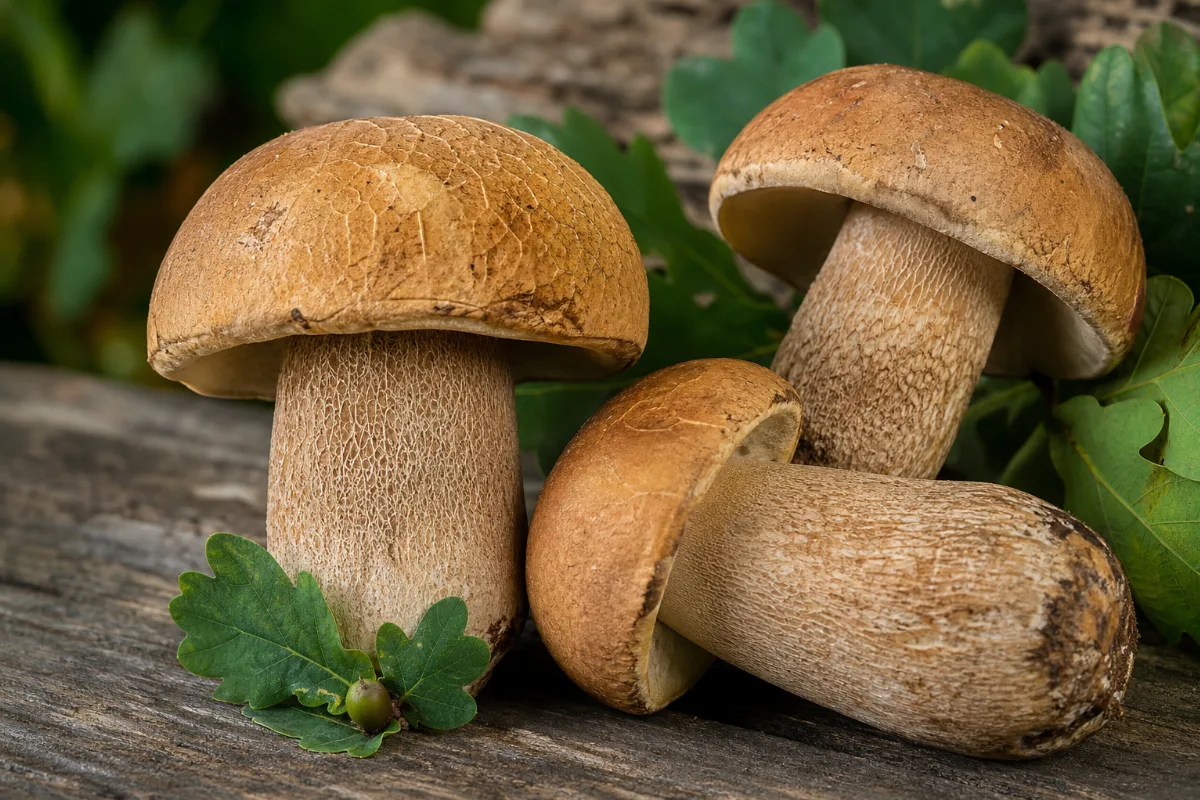
Mushrooms · Wild culinary mushroom
Summer cep
Boletus reticulatus · also called Summer bolete, Sommer-Steinpilz, Eichensteinpilz, cepe d'ete, Boletus aestivalis (older name)
Summer cep is a wild culinary mushroom of the porcini group, eaten fresh or dried. We found no human trial showing a health benefit from eating it. Its big research topics are what it picks up from the forest: mercury and radioactive caesium. Never eat a wild mushroom unless an expert has identified it in person.
General information, not medical advice. Last substantive update · Not medically reviewed. A named clinician has not signed off on this page. How this page is made
About Summer cep
Summer cep is a wild culinary mushroom closely related to porcini. Most research on it is about what it picks up from forest soil rather than health: it is a strong mercury accumulator, and Polish and Belarusian samples held radioactive caesium. We found no human health trial. The practical cautions are where it grew and identification by an expert.
Mercury: a strong accumulator
In ten forest areas of Poland and Belarus, median mercury in summer cep caps reached 4.7 mg per kg dry matter. The mushroom took up far more mercury than was in the soil (up to 130 times in caps). The authors estimate that eating the caps from one nature reserve would give 1.4 mg of mercury (the abstract gives no portion size) and say occasional eating may be safe.
Near a mercury smelter and a copper smelter in eastern Slovakia, mercury up to 50 mg per kg dry matter was found in summer cep and two other species. That is a heavily polluted site, so it shows what can happen, not what is typical. Caps held more mercury than stalks.
Radioactive caesium from old fallout
Three pools of summer cep held caesium-137 in the caps at 1,094 Bq per kg dry matter (Poland, 2006), 393 (Belarus, Borysow, 2010) and 6,614 (Belarus, Chojniki, 2010). Stalks held 498, 363 and 3,482. The authors say the Chojniki figure fits Chernobyl hot-spot fallout. For comparison, porcini from Yunnan, China, held 5 to 10 Bq per kg in caps.
These are older samples. The paper compares them with no safety limit, so we do not say whether any amount is safe. The level depends on the forest, so the origin matters more than the species.
Other natural radioactivity and metals
Natural polonium-210 and lead-210 were low in boletes from Poland and Belarus, a group that included summer cep (about 1 to 6 Bq per kg dry biomass across the species). The authors call these mushrooms comparatively safe on that measure. An old survey in northern Poland noted silver above 1.0 mg per kg dry weight in Boletus aestivalis, the older name for summer cep, without a health comparison.
Fresh and dried
Every contaminant figure here is per kg of dry matter. Drying removes water, so a gram of dried mushroom holds more of everything than a gram of fresh one. We found no study of how soaking, cooking or drying changes mercury or caesium in summer cep.
What it is
Summer cep is a fungus, Boletus reticulatus, in the family Boletaceae. GBIF lists the name as accepted and gives Summer cep as the English name. Boletus aestivalis is an older name for the same fungus. It is a bolete, a group that lives on tree roots, so it is collected wild. The part eaten is the cap and stalk. For the other porcini-group boletes, see Porcini, Pine bolete and Bay bolete, which are different species.
What the research shows on benefits
Researchers have measured the fat in summer cep: most is unsaturated, mainly oleic and linoleic acids. In test tubes, extracts soaked up free radicals and slowed some microbes. In one rat study, a hot-water extract lowered blood pressure. None of this shows a health benefit in people, and we found no human trial of summer cep for any health outcome. Our search was not exhaustive.
Legal and regulatory status
We did not open any regulation. We did not read EFSA, FDA or national limits for mercury or caesium, so none is stated. Rules differ by country and change.
At a glance
Traditional uses history, not proof
- Eaten as a wild culinary mushroom of the porcini group.
- No traditional medicine use was found in the sources we read.
Studied for research
- Nutrition as a food (fat profile), insufficient evidence of any health effect
- Antioxidant readings in the test tube, insufficient (lab only)
- Blood pressure in rats with a hot-water extract, insufficient (animals only)
- Germ-killing activity of extracts in the test tube, insufficient (lab only)
Main compounds
- Fats, mostly oleic and linoleic acids
- Phenolic compounds and flavonoids in extracts
- Also mercury and radioactive caesium-137 taken up from the soil
Common forms
- Fresh, cooked mushroom
- Dried mushroom, soaked before use
- Hot-water or solvent extracts (lab and rat studies only)
- Capsule or powder supplement (not assessed in the sources we read)
Research links: Mercury in boletes, Poland and Belarus (abstract) · Radiocaesium in Boletus mushrooms, Europe and Yunnan (abstract) · Mercury near smelters, Slovakia (abstract) · Polonium-210 and lead-210 in boletes (abstract) · Fatty acids of six wild mushrooms (abstract) · Penn State Extension: Preparing and preserving mushrooms · Research Library · Genes & Biomarkers Library
What it is and its history
- Accepted scientific name
- Boletus reticulatus
- Naming authority
- Schaeff. (1774) (GBIF)
- Synonyms
- Boletus aestivalis (Paulet) Fr. (a GBIF synonym that points to the accepted name)
- Common names
- Summer cep (English); Summer bolete (English); Sommer-Steinpilz (German); Eichensteinpilz (German); Cepe d'ete (French)
- Family or group
- Boletaceae (a fungus family; boletes), not a plant
- Classification
- Fungi > Basidiomycota > Agaricomycetes > Boletales > Boletaceae > Boletus > Boletus reticulatus
- Native range
- Not checked as a range. The studies read sampled Poland, Belarus, Slovakia and Turkey.
- Habitat
- No habitat source for this species was read. The Missouri page says boletes in general are mycorrhizal (the fungus lives on tree roots); that page is about the bitter bolete.
- What it looks like
- Fruiting body: Not described here. Identification of wild mushrooms must be done in person by an expert, so no field description is given.
- Cultivation
- Wild-collected in all sources read; no cultivation source was read.
- Harvest and processing
- Eaten fresh or dried. Drying concentrates mercury, caesium and metals per gram. Details not checked.
- Look-alikes and adulterants
- Name: Bitter bolete (Tylopilus felleus); Note: The Missouri Department of Conservation lists it as not edible and extremely bitter and says it resembles the king bolete (Boletus edulis). No source we read says it is confused with summer cep.; Name: Other boletes; Note: The same page says other boletes may look alike. No source we read names look-alikes of summer cep.
- Sustainability and conservation
- Not checked.
Traditional use and history history, not clinical proof
| Tradition or era | Documented use | Source |
|---|---|---|
| Food use | Eaten as a wild culinary mushroom of the porcini group. No traditional medicine history source was read, so none is stated. | s-gbif-boletus-reticulatus |
Traditional use shows how it was used. It does not show that it works or is safe today.
What is inside, and how it may work
What it contains and how those compounds act in cells and animals. Laboratory and animal mechanisms are not proven effects in people.
Main compounds
| Compound | Family | Where it is concentrated | Activity studied | Level of evidence |
|---|---|---|---|---|
| Fatty acids (oleic, linoleic) | lipids | Fruiting body Oleic acid 37.61% and linoleic acid 36.60% of total fatty acids (one Turkish sample, dry basis). | Nutrient composition; no health effect shown. 5 | Compositional analysis |
| Phenolic compounds and flavonoids | phenolics | Fruiting body extracts Boletus aestivalis acetone extract: 6.73 ug pyrocatechol equivalents and 3.20 ug rutin equivalents per mg extract. | Track the test-tube antioxidant readings. 6 | Laboratory research |
| Selenium | trace element | Fruiting body A caesium paper says Boletus edulis, B. pinophilus and B. reticulatus are naturally rich in selenium, citing earlier work. No measured selenium value for summer cep was read. | Statement only, summary-only. 3 | Compositional analysis |
| Mercury (contaminant) | toxic metal | Caps more than stalks Cap median up to 4.7 mg per kg dry matter (Poland and Belarus); up to 50 mg per kg dry matter near a smelter (Slovakia). | Contaminant taken up from soil. 2 11 | Compositional analysis |
| Caesium-137 (contaminant) | radionuclide | Caps higher than stalks Caps 393 to 6,614 and stalks 363 to 3,482 Bq per kg dry matter across three pools. | Contaminant from fallout. 3 | Compositional analysis |
Mechanisms, receptors and pathways
| Target or pathway | Gene or receptor | What was found | Level |
|---|---|---|---|
| Radical scavenging | not specified | Solvent extracts scavenged free radicals in a test tube; the acetone extract was far stronger than the methanol extract. Not a finding in people. 6 | Laboratory research |
| Blood pressure | not specified | A hot-water extract lowered blood pressure in hypertensive rats. The abstract does not describe a mechanism. 7 | Animal research |
Absorption, metabolism and elimination
- Absorption
- Not found for summer cep.
- Distribution
- Not found.
- Metabolism
- Not found.
- Elimination
- Not found.
- Bioavailability
- Not established.
Isolated compounds versus whole extracts
Summer cep is eaten as a whole food, fresh or dried. The two extract studies used lab solvents or hot water. No capsule or powder supplement was assessed in the sources read.
Nutritional composition
USDA has no summer cep entry in the files we hold. The only nutrient measurement we found is the fat profile.
4 not enough evidence
What was looked at
The 4 benefits and uses checked for Summer cep, each with how strong the evidence is. Tap one to open it.
What is Summer cep good for?
The uses people ask about and how strong the human evidence is for each. None is proven for summer cep. Read this together with the Safety tab.
Benefits, one by one
Each card is a research question, not a promise. Tap a goal to filter. Open a card to see the studies, doses and limits.
Nutrition as a food (fat profile)
Not enough evidenceSummer cep is a wild culinary mushroom of the porcini group. The one nutrition measurement we found is its fat profile: in one Turkish sample about 40% of the fat was monounsaturated and 38% polyunsaturated. This describes what is in it. No trial shows a health benefit from eating it.
1 studiesFresh and dried forms exist. Drying removes water, so figures per gra…
Studies, doses and limits
What the trials found
No human trial of eating summer cep was found.
Results
Boletus reticulatus from Ilgaz Mountain, Turkey: 21.14% saturated, 40.34% monounsaturated and 38.40% polyunsaturated fatty acids (percent of total fatty acids, dry basis). Oleic acid 37.61% and linoleic acid 36.60%.
Why this rating
Composition data from a single collection; no study measured a health effect of eating summer cep.
Form and dose studied
Fresh and dried forms exist. Drying removes water, so figures per gram of dried mushroom are higher than per gram of fresh. Always check which basis a number uses.
Who was studied
General food use
Limits
One site in Turkey. Percent of the fat, not the amount of fat. USDA has no summer cep entry, and we found no measured protein, fibre or vitamin values.
Why researchers looked
It is a prized wild food, so researchers measure what it contains.
Traditional use
No traditional medicine use was found in the sources we read.
Proposed mechanism Compositional analysis
Not applicable: this is a composition fact, not a mechanism.
A proposed mechanism does not show that the effect happens in people.
Wild summer cep also carries mercury and radioactive caesium that depend on where it grew; see the Safety tab.
Antioxidant readings in the test tube
Not enough evidenceIn a test-tube study, acetone and methanol extracts of this mushroom (under the older name Boletus aestivalis) soaked up free radicals. The acetone extract was far stronger. This was done in a dish, not in animals or people.
1 studiesLab solvent extracts, not food and not a supplement.
Studies, doses and limits
Results
Radical-scavenging IC50 (lower is stronger): acetone extract 8.63 ug/mL, methanol extract 187.73 ug/mL. In the same table ascorbic acid scored 4.22, BHA 6.42 and alpha-tocopherol 62.43 ug/mL.
Why this rating
In-vitro solvent extracts from a single collection; no animal or human data on this result.
Form and dose studied
Lab solvent extracts, not food and not a supplement.
Limits
Test-tube readings do not show that eating the mushroom does anything in the body.
Why researchers looked
Researchers test mushroom extracts for antioxidant behaviour as a first step.
Proposed mechanism Laboratory research
Chemical radical-scavenging and reducing-power assays on solvent extracts. Phenol and flavonoid content in the extracts tracked the antioxidant readings.
A proposed mechanism does not show that the effect happens in people.
Nothing here supports using summer cep as a treatment.
Blood pressure and heart rate in rats (hot-water extract)
Not enough evidenceA hot-water extract of this mushroom (under the older name Boletus aestivalis) lowered blood pressure and heart rate in rats bred to have high blood pressure. This is an animal study of an extract. Nothing is known in people.
1 studiesHot-water extract given to rats; not a food or supplement for people.
Studies, doses and limits
Results
Once-daily extract for 18 weeks lowered systolic and diastolic blood pressure and heart rate in spontaneously hypertensive rats; it also lowered blood urea nitrogen, creatinine and triglycerides and raised HDL-cholesterol. The abstract gives no numbers.
Why this rating
Animal-only evidence from an abstract with no figures or group sizes.
Form and dose studied
Hot-water extract given to rats; not a food or supplement for people.
Who was studied
Rats only
Limits
Rat findings often fail to carry over to people. Eating the mushroom is not the same as the extract.
Why researchers looked
Researchers test mushroom extracts in animal models of high blood pressure.
Proposed mechanism Animal research
Not described in the abstract.
A proposed mechanism does not show that the effect happens in people.
Nothing here is a reason to use summer cep for blood pressure. Ask a doctor about blood pressure.
Germ-killing activity in the test tube (extracts)
Not enough evidenceThe same test-tube study found that extracts of this mushroom stopped the growth of several bacteria and fungi, but only at high concentrations. It is a lab finding, not a treatment.
1 studiesLab solvent extracts.
Studies, doses and limits
Results
Across the extracts tested, minimum inhibitory concentrations were 1.25 to 10 mg per mL. The text says the acetone and methanol extracts of Boletus aestivalis and Boletus edulis had about equal activity, inhibiting the microbes at 2.5, 5 and 10 mg per mL.
Why this rating
In-vitro only, high concentrations, a single collection.
Form and dose studied
Lab solvent extracts.
Limits
Activity in a dish at these concentrations does not show that eating the mushroom fights infection.
Why researchers looked
Mushroom extracts are screened for antibacterial and antifungal activity.
Proposed mechanism Laboratory research
Minimum inhibitory concentration against five bacteria and five fungi in a dish.
A proposed mechanism does not show that the effect happens in people.
Do not use mushrooms in place of medicine for an infection.
Connections to the rest of health
How Summer cep connects to the rest of our health knowledge graph. Every link says what kind of connection it is. A safety link (for example to the liver) is a warning, not a benefit. A study that merely mentions a topic never creates a benefit link.
Explore every connection: goals, body systems, organs, symptoms, genes
F. Functional actions
| Connected to | Kind of connection | Evidence status | Context | Studies |
|---|---|---|---|---|
| Antioxidant | Biological association | Not enough evidence | Test-tube assays only; no trial. Preparation or compound: Boletus aestivalis solvent extracts |
6 |
G. Root causes and contributing factors
| Connected to | Kind of connection | Evidence status | Context | Studies |
|---|---|---|---|---|
| Heavy metal exposure | Moderate certainty | Cap median up to 4.7 mg per kg dry matter in Poland and Belarus; depends on site. Preparation or compound: Wild summer cep (mercury) |
2 11 | |
| Environmental toxins | Moderate certainty | Caps 393 to 6,614 Bq per kg dry matter in three pools; depends on site. Preparation or compound: Wild summer cep (radiocaesium) |
3 |
L. Active compounds
| Connected to | Kind of connection | Evidence status | Context | Studies |
|---|---|---|---|---|
| Fatty acids (oleic, linoleic) | Biological association | Compositional analysis | Nutrient composition; no health effect shown. Preparation or compound: Fruiting body |
5 |
| Phenolic compounds and flavonoids | Biological association | In vitro | Track the test-tube antioxidant readings. Preparation or compound: Fruiting body extracts |
6 |
| Selenium | Biological association | Compositional analysis | Statement only, summary-only. Preparation or compound: Fruiting body |
3 |
| Mercury (contaminant) | Biological association | Compositional analysis | Contaminant taken up from soil. Preparation or compound: Caps more than stalks |
2 11 |
| Caesium-137 (contaminant) | Biological association | Compositional analysis | Contaminant from fallout. Preparation or compound: Caps higher than stalks |
3 |
Each connection is stored with the ingredient, the connected record, the kind of connection, the evidence status, the supporting studies, the preparation or compound involved, and a review date (last reviewed October 25, 2026).
Evidence at a glance: what the research found for 4 outcomes
Each outcome below is one thing researchers measured. Certainty is how far the evidence can be trusted, not how well it works. The full studies are on the next tab.
The evidence
The research centre for Summer cep. Every record here was checked against PubMed or the publisher's page; we never list a study we have not verified.
Evidence by outcome
Bars show how many studies we found for each outcome, not how well it works. People are added up across trials only (reviews are not added, to avoid double counting).
How we rate evidence
High certainty
Several well-run trials or reviews agree; further research is unlikely to change the picture much.
Moderate certainty
Good trials point the same way, but some doubt remains.
Low certainty
Small, short or inconsistent trials. The finding could change with better research.
Very low certainty
Very little or very weak human data. Treat as a possibility only.
Mixed findings
Trials or reviews disagree with each other.
Not enough evidence
Not enough human research to say either way.
Evidence against
Good research found no benefit, or found harm.
We take the reviewers' own risk-of-bias and GRADE statements where they exist, and otherwise judge from study size, design, consistency, directness and whether a product matches what is sold. Many publications do not make evidence high. Method note: We read PubMed records for 8 papers: abstracts for all, plus full-text tables for the fatty-acid, caesium and test-tube antioxidant studies. We also read two guidance pages (Missouri Department of Conservation and Penn State Extension) and checked the name in GBIF. Index Fungorum, EFSA, FDA and poison-centre statements were not read. Certainty ratings are the compiler's own reading.
Study library: every study we checked 11
| Study | Design | People | Product, dose, length | Result |
|---|---|---|---|---|
| Falandysz 1994 Silver content of wild-grown mushrooms from northern Poland. Zeitschrift fur Lebensmittel-Untersuchung und -Forschung · PMID 7975911 · DOI |
Laboratory survey fungus (lab survey) |
527 527 samples of 25 wild mushroom species collected 1989 to 1992 in northern Poland |
Wild fruiting bodies; the abstract uses the name Boletus aestivalis fruiting body Not shown here |
The abstract says only two Agaricus species were strong silver accumulators. Silver above 1.0 mg per kg dry weight was noted in Boletus aestivalis and in a few other species. Silver above 1.0 mg per kg dry weight noted in B. aestivalis (no figure given) Methods, limits and fundingOutcomes: Silver (mg per kg dry weight) Limitations: Old samples from one region. The abstract gives no value for the summer cep and no health comparison. Abstract only was read. Funding and conflicts: Funding not stated in the abstract Read: abstract |
| Falandysz 2014 Mercury in certain boletus mushrooms from Poland and Belarus. Journal of Environmental Science and Health, Part B · PMID 25035918 · DOI |
Laboratory survey fungus (lab survey) |
Four Boletus species and the soil under them from ten forested areas in Poland and Belarus | Wild caps and stipes of Boletus reticulatus (with B. pinophilus, B. impolitus, B. luridus) fruiting body Not shown here |
The abstract says median mercury in caps of the four species ran from 0.38 to 4.7 mg per kg dry matter and in stipes from 0.13 to 2.5. Medians for B. reticulatus and B. pinophilus caps were up to 4.7 and 3.6 mg per kg, and they bioaccumulate mercury very efficiently (median bioconcentration factors up to 130 for caps and 58 for stipes). Soil mercury was at background level. Eating the caps would give an estimated 1.4 mg of mercury for B. reticulatus from the Kacze Legi nature reserve (portion size not given in the abstract). The authors conclude that occasional eating of B. reticulatus and B. pinophilus may be safe. Median cap mercury up to 4.7 mg per kg dry matter for summer cep Methods, limits and fundingOutcomes: Mercury in caps, stipes and soil; bioconcentration factor; estimated mercury intake Limitations: Wild samples from ten places; dry-matter basis; the abstract does not say how many summer cep samples or what portion the 1.4 mg refers to, and it compares with no safety limit. Abstract only was read. Funding and conflicts: Research support from a non-US government source; no conflict statement in the abstract Read: abstract |
| Falandysz 2015 Evaluation of the radioactive contamination in fungi genus Boletus in the region of Europe and Yunnan Province in China. Applied Microbiology and Biotechnology · PMID 26048471 · DOI |
Laboratory survey fungus (lab survey) |
Boletus mushrooms collected 1995 to 2014 in Poland, Belarus, Sweden and Yunnan (China); pooled samples of caps and stipes | Wild Boletus reticulatus (with five other Boletus species), caps and stipes fruiting body Not shown here |
In the full-text table, three pools of Boletus reticulatus held caesium-137 as follows (caps / stipes, Bq per kg dry matter): Poland, Kacze Legi, 2006 (n=20): 1,094 / 498; Belarus, Borysow, 2010 (n=18): 393 / 363; Belarus, Chojniki, 2010 (n=15): 6,614 / 3,482. The text calls the Chojniki level consistent with Chernobyl hot-spot deposition. The abstract says European boletes showed two to four orders of magnitude more caesium-137 than Boletus edulis from Yunnan (5.2 to 10 Bq per kg in caps). Summer cep caps 393 to 6,614 Bq per kg dry matter across three pools Methods, limits and fundingOutcomes: Caesium-137 and potassium-40 in Bq per kg dry matter Limitations: Three pooled samples for this species; old collections (1995 to 2010 for the European set; the summer cep pools are from 2006 and 2010); the abstract compares with no safety limit. Abstract and the full-text table were read. Funding and conflicts: Research support from a non-US government source; no conflict statement in the abstract Read: abstract and full-text table |
| GBIF 2026 GBIF Backbone Taxonomy: Boletus reticulatus Schaeff. (key 5954691), checked 2026-10-25 GBIF API · Source |
Taxonomy record n/a |
n/a | n/a Not shown here |
GBIF returns Boletus reticulatus Schaeff. as ACCEPTED (key 5954691), kingdom Fungi, phylum Basidiomycota, class Agaricomycetes, order Boletales, family Boletaceae, genus Boletus, published 1774 (Fungi Bavaricae et Palatinatus Nascentes 4: 78). The English vernacular name given is Summer cep. A name match for Boletus aestivalis (Paulet) Fr. returns a SYNONYM that points to key 5954691. Vernacular names listed include Cepe d'ete (French) and Sommer-Steinpilz and Eichensteinpilz (German). Methods, limits and fundingOutcomes: Accepted name and synonym Limitations: A database record. Index Fungorum was tried (the web service returned nothing) and is not confirmed. Funding and conflicts: Public database Read: record |
| Gunc Ergonul 2013 Fatty acid compositions of six wild edible mushroom species. ScientificWorldJournal · PMID 23844377 · DOI |
Laboratory composition fungus (lab composition) |
Six wild edible mushroom species from Anatolia, Turkey; summer cep (Boletus reticulatus) from Ilgaz Mountain | Fruit bodies of Boletus reticulatus, analysed by gas chromatography fruiting body Not shown here |
The abstract says the dominant fatty acid in all six species was cis-linoleic acid and that unsaturated fatty acids were higher than saturated ones. In the full-text table, Boletus reticulatus held 21.14% saturated, 40.34% monounsaturated and 38.40% polyunsaturated fatty acids (percent of total fatty acids, dry basis), with cis-oleic acid 37.61% and cis-linoleic acid 36.60%. The text says trans isomers were very low (0.02 to 0.12%) in the studied mushrooms. Mostly unsaturated fat in the fat fraction; a composition fact, not a health effect Methods, limits and fundingOutcomes: Fatty acid composition (percent of total fatty acids, dry basis) Limitations: One collection from one mountain in Turkey. Percent of the fat, not the amount of fat. For this species oleic acid (37.61%) was slightly above linoleic (36.60%), which differs from the abstract statement about all six species; we report the table values. Abstract and Table 2 of the full text were read. Funding and conflicts: Academic study; funding not stated in the text we read Read: abstract and full-text table |
| Kosanic 2012 Mushrooms as possible antioxidant and antimicrobial agents. Iranian Journal of Pharmaceutical Research · PMID 24250542 |
Laboratory research fungus (in-vitro extracts) |
Test-tube study of extracts of three wild mushrooms (Boletus aestivalis, Boletus edulis, Leccinum carpini) collected at Kopaonik, Serbia, June 2010 | Acetone and methanol extracts of the fruiting body (Boletus aestivalis is the older name now treated by GBIF as a synonym of Boletus reticulatus) fruiting body Not shown here |
Radical-scavenging IC50 (lower is stronger) for Boletus aestivalis was 8.63 ug/mL for the acetone extract and 187.73 ug/mL for the methanol extract (full-text table). Reference antioxidants in the same table: ascorbic acid 4.22, BHA 6.42, alpha-tocopherol 62.43 ug/mL. The abstract names Boletus edulis acetone extract (4.72 ug/mL) as the strongest. For antimicrobial tests the abstract gives minimum inhibitory concentrations of 1.25 to 10 mg/mL across all extracts; the full text says the Boletus aestivalis and Boletus edulis extracts had about equal activity, inhibiting the tested microbes at 2.5, 5 and 10 mg/mL. Test-tube antioxidant and antimicrobial readings only; no animals or people Methods, limits and fundingOutcomes: Radical scavenging, reducing power, phenol and flavonoid content, minimum inhibitory concentration against 5 bacteria and 5 fungi Limitations: Solvent extracts tested in a dish. Findings do not carry over to eating the mushroom. One collection from one site. The abstract is more upbeat about use as medicine than the results support. Abstract and full-text tables were read. Funding and conflicts: Academic study; funding not stated in the text we read Read: abstract and full-text tables |
| Midoh 2013 Effects of a hot-water extract of porcini (Boletus aestivalis) mushrooms on the blood pressure and heart rate of spontaneously hypertensive rats. Bioscience, Biotechnology, and Biochemistry · PMID 23924709 · DOI |
Animal study rat |
Spontaneously hypertensive rats (a strain bred to have high blood pressure) | Hot-water extract of Boletus aestivalis fruiting bodies, given by mouth once daily fruiting body (hot-water extract) Not shown here 18 weeks |
The abstract says 18 weeks of once-daily extract lowered systolic and diastolic blood pressure and heart rate in the rats. It also lowered blood urea nitrogen, creatinine and triglyceride and raised HDL-cholesterol. The abstract gives no numbers and no group sizes. Lower blood pressure and heart rate in rats; no numbers in the abstract Methods, limits and fundingOutcomes: Systolic and diastolic blood pressure, heart rate, blood urea nitrogen, creatinine, triglycerides, HDL-cholesterol Limitations: Animal study of an extract, not a food or supplement for people. The abstract gives no figures, group sizes or dose. Abstract only was read. Funding and conflicts: Funding not stated in the abstract Read: abstract |
| Missouri Department of Conservation 2026 Missouri Department of Conservation: Bitter Bolete (field guide page), read 2026-10-25 mdc.mo.gov · Source |
Guidance page n/a |
n/a | n/a Not shown here |
The page lists the bitter bolete as not edible and says it can be extremely bitter. It says this species resembles the choice king bolete (Boletus edulis), and that other boletes may look alike and some may be edible. It does not mention summer cep. Methods, limits and fundingOutcomes: Edibility and resemblance Limitations: A US state field guide; it compares the bitter bolete to the king bolete, not to summer cep. The page shows no update date. Funding and conflicts: Public body Read: full text |
| Penn State Extension 2024 Penn State Extension: Preparing and Preserving Mushrooms (updated 22 November 2024), read 2026-10-25 extension.psu.edu · Source |
Guidance page n/a |
n/a | n/a Not shown here |
The page says only an expert can tell poisonous from edible mushrooms, that unless you are an expert you should not forage your own, and that no matter how much you cook or dry them you will not destroy their toxins. Methods, limits and fundingOutcomes: Wild mushroom safety advice Limitations: A US university extension page, general to all mushrooms; it does not mention summer cep. Funding and conflicts: Public body Read: full text |
| Struminska-Parulska 2021 210Po and 210Pb in King Bolete (Boletus edulis) and Related Mushroom Species: Estimated Effective Radiation Dose and Geospatial Distribution in Central and Eastern Europe. International Journal of Environmental Research and Public Health · PMID 34574498 · DOI |
Laboratory survey fungus (lab survey) |
Boletus edulis and related species (including B. reticulatus) from Poland and Belarus | Wild caps and stipes; results given across all species in the abstract fruiting body Not shown here |
The abstract says polonium-210 ranged from 0.91 to 4.47 and lead-210 from 0.82 to 5.82 Bq per kg dry biomass across the species studied, caps and stipes were similar, and eating boletes foraged in Poland could give a combined dose of 10 microsieverts per kg dry biomass. The authors say this is not significant against the total annual dose from all sources (54 to 471 microsieverts) and call the mushrooms comparatively safe to eat. Low natural radioactivity across the group; no figure for summer cep alone in the abstract Methods, limits and fundingOutcomes: Natural radioactive polonium-210 and lead-210; estimated radiation dose from eating Limitations: Ranges are for all species together; the abstract gives no summer-cep-only value. Abstract only was read. Funding and conflicts: Research support from a non-US government source; no conflict statement in the abstract Read: abstract |
| Svoboda 2000 Concentrations of mercury, cadmium, lead and copper in fruiting bodies of edible mushrooms in an emission area of a copper smelter and a mercury smelter. Science of the Total Environment · PMID 10682377 · DOI |
Laboratory survey fungus (lab survey) |
56 56 samples of 23 wild mushroom species from a heavily polluted area of eastern Slovakia, 1997 and 1998 |
Wild fruiting bodies including Boletus reticulatus fruiting body Not shown here |
The abstract says the area was contaminated by mining and smelting, including a mercury smelter that ran from 1969 to 1993. Mercury up to 50 mg per kg dry matter was found in Boletus reticulatus, Lycoperdon perlatum and Marasmius oreades. Mercury and copper in caps of four Boletaceae species were significantly higher than in stipes. Mercury up to 50 mg per kg dry matter in a smelter-polluted area Methods, limits and fundingOutcomes: Mercury, cadmium, lead and copper (dry matter) Limitations: A heavily polluted site, so these values show what can happen near a smelter, not what is typical. The abstract does not say how many summer cep samples. Abstract only was read. Funding and conflicts: Funding not stated in the abstract Read: abstract |
What we do not know yet
- No human trial of summer cep for any health outcome was found.
- No source naming look-alikes of summer cep was read.
- No regulatory text was opened.
- No study of cooking, soaking or drying effects on mercury or caesium in summer cep was found, and no data on allergy, pregnancy or breastfeeding, or powders, extracts and capsules for people.
- Survey figures are for particular places and years and may not match any product you buy.
How new research is added
New studies are found by a saved PubMed search and placed in a review queue. A person reads each one before it changes any evidence rating or safety wording. New publications never change ratings automatically.
Lab markers
What changed in blood or saliva tests during trials. A changed number is not the same as feeling or being healthier, and we give no "normal ranges".
Safety
What studies and official sources say about side effects, medicines and who should check first. Each point shows what kind of evidence it comes from.
Main points to know 5
- A wild mushroom must be identified in person by an expert, and cooking does not remove toxins. Penn State Extension says only an expert can tell poisonous from edible mushrooms, that you should not forage your own unless you are an expert, and that cooking or drying will not destroy toxins. The Missouri Department of Conservation lists the bitter bolete as not edible and extremely bitter and says it resembles the king bolete (porcini); it adds that other boletes may look alike. That page does not mention summer cep. We read no source naming particular poisonous or bitter look-alikes of summer cep, so none is named here. Authoritative guidance 9 8
- Wild summer cep is a strong mercury accumulator. In ten forest areas of Poland and Belarus, median mercury in summer cep caps reached 4.7 mg per kg dry matter, and the mushroom took up much more mercury than was in the soil (bioconcentration factor up to 130 in caps). The authors estimate that eating caps from one nature reserve would give 1.4 mg of mercury (the abstract does not give the portion) and conclude that occasional eating may be safe. Near a mercury and copper smelter in eastern Slovakia, mercury up to 50 mg per kg dry matter was found in summer cep and two other species. Levels depend on the site. Laboratory survey 2 11
- Wild summer cep can hold radioactive caesium from old fallout. Three pools of summer cep collected in Poland (2006) and Belarus (2010) held caesium-137 at 1,094, 393 and 6,614 Bq per kg dry matter in the caps (498, 363 and 3,482 in the stalks). The highest came from the Chojniki area, which the authors link to Chernobyl hot-spot fallout. Levels depend on the forest, so where it grew matters more than the species. The paper compares the figures with no safety limit. Laboratory survey 3
- Other contaminants: natural radioactivity and silver. Naturally occurring polonium-210 and lead-210 were low in boletes from Poland and Belarus (about 1 to 6 Bq per kg dry biomass across the species studied, which included summer cep); the authors call the mushrooms comparatively safe on this measure. An old Polish survey noted silver above 1.0 mg per kg dry weight in Boletus aestivalis (the older name for summer cep) with no health comparison. Laboratory survey 10 1
- Dried summer cep is more concentrated per gram. Every contaminant figure above is per kg of dry matter. Drying removes water, so a gram of dried mushroom holds more of everything than a gram of fresh one. We found no study of how soaking, cooking or drying changes mercury or caesium in summer cep. Expert opinion 2 3
Side effects 2
| Effect | How often | Severity and recovery | Evidence |
|---|---|---|---|
| Poisoning from a mistaken wild mushroom General guidance, not a report about summer cep. | Not found for summer cep | unknown for summer cep; wild mushroom poisoning can be severe unknown | Authoritative guidance 9 8 |
| Allergic reactions to mushrooms A PubMed search on the two names returned no allergy paper. | Not found for summer cep | unknown unknown | None found |
Liver
No liver injury from eating summer cep was found in the sources read.
Monitoring. No routine monitoring is suggested by the sources read. Seek medical care for poisoning signs.
This is a safety connection. It is not evidence that Summer cep supports liver health.
Medicines and supplements 1
| With | Why it matters | Importance | Evidence | What to do |
|---|---|---|---|---|
| Prescription and over-the-counter medicines prescription | No interaction report for summer cep was found in the sources read. This is absence of evidence, not proof of safety. | None found Not enough evidence | Ask a pharmacist if you take regular medicines and plan to eat wild mushrooms often. |
Who should check first 3
| Situation | Advice | Evidence |
|---|---|---|
| Anyone who cannot be sure of the mushroom's identity | Do not eat it. Only an expert can separate poisonous from edible mushrooms, and cooking or drying does not destroy toxins (Penn State Extension). | Authoritative guidance 9 8 |
| Known mushroom allergy | Ask an allergy specialist before eating. | Expert opinion |
| Pregnancy, breastfeeding and young children | No summer-cep-specific safety data were found. Because wild boletes can hold mercury, ask a clinician about eating wild mushrooms in these groups. | Laboratory survey 2 |
Overdose, product quality and regulators
Summary. Summer cep is a widely eaten wild mushroom. The hazards in the sources read are mistaken identity of wild mushrooms and contaminants taken up from the forest (mercury, caesium).
Animal. The one animal study (a hot-water extract in rats) did not report toxicity in its abstract.
Human doses studied. No dose studies. No amounts are advised here.
High dose or long term signals. Mercury and caesium intake would add up with frequent large servings of contaminated mushrooms; the studies do not set a safe limit.
Genotoxicity. Not read.
Toxic or hazardous parts. Fungus: cap and stalk are eaten. In the Polish and Belarusian studies caps held more mercury and caesium than stalks.
Summer cep is wild-collected, so what it carries depends on the soil, the forest and the year. Drying leaves more per gram.
Mercury. Caps median up to 4.7 mg per kg dry matter in Poland and Belarus; up to 50 mg per kg dry matter near a smelter in Slovakia. 2 11
Radiocaesium (caesium-137). Caps 393 to 6,614 Bq per kg dry matter across three pools from Poland and Belarus; the highest was from a Chernobyl-affected area. 3
Polonium-210 and lead-210. Low (about 1 to 6 Bq per kg dry biomass) across the boletes studied. 10
Silver. Above 1.0 mg per kg dry weight noted in Boletus aestivalis in northern Poland, 1989 to 1992. 1
| Body | Action | Date |
|---|---|---|
| Missouri Department of Conservation (United States (state)) | Field guide page lists the bitter bolete as not edible and extremely bitter and says it resembles the king bolete. Not a statement about summer cep. source | 2026-10-25 |
| Penn State Extension (United States (university)) | Says only an expert can separate poisonous from edible mushrooms and that cooking or drying will not destroy toxins. source | 2024-11-22 |
When to get medical help
- Severe or repeated vomiting, diarrhoea or belly pain, dizziness, confusion or heavy sweating after eating a wild mushroom: get emergency medical help or call your local poison service now. Do not wait for it to pass.
- Unusual bleeding, easy bruising, passing very little urine, yellow skin or eyes, or dark urine after eating wild mushrooms: get medical help now.
- Wheezing, chest tightness, swelling of the lips or face, or hives after eating mushrooms: treat as an emergency.
If someone may be poisoned or in a crisis, contact a clinician or emergency service straight away. In the US, Poison Control is 1-800-222-1222.
General information only, not medical advice. Ask a clinician or pharmacist before use, especially with medicines, in pregnancy or with a health condition. See the Natural Remedy Safety guide.
Frequently asked questions
What is summer cep?
Summer cep is Boletus reticulatus, a wild culinary mushroom in the porcini group. GBIF gives Summer cep as its English name. It is eaten fresh or dried.
Is summer cep the same as porcini?
Not exactly. Porcini usually means Boletus edulis, and summer cep is a separate species of the same group. Boletus aestivalis is an older name for summer cep. See our Porcini page for Boletus edulis.
Is summer cep healthy?
It is a food, and its fat is mostly unsaturated in one sample. No human trial shows a specific health benefit from eating it.
Does summer cep contain mercury?
Is wild summer cep radioactive?
It can hold radioactive caesium-137 from old fallout. Three pools had 393 to 6,614 Bq per kg dry matter in caps. Levels depend on the forest, so ask a local food-safety service about your area.
What mushrooms look like summer cep?
Does cooking or drying remove mercury, caesium or toxins?
Penn State Extension says cooking or drying will not destroy mushroom toxins. We found no study of cooking or drying on mercury or caesium in summer cep. Drying removes water, so figures per kg of dried mushroom are higher than per kg fresh.
Does summer cep lower blood pressure?
Not shown in people. A hot-water extract lowered blood pressure in rats bred to have high blood pressure. Ask a doctor about blood pressure.
Is summer cep an antioxidant food?
Extracts scavenged free radicals in a test tube. That is a chemical reading, not proof of a benefit when eaten.
Can you be allergic to summer cep?
Mushroom allergy exists in general, but we found no paper about allergy to summer cep. Wheezing, swelling or hives after eating mushrooms is an emergency.
Is summer cep safe in pregnancy, breastfeeding or for children?
No summer-cep-specific safety data were found. Because wild boletes can hold mercury, ask a clinician about wild mushrooms in these groups.
Does summer cep interact with medicines?
No interaction report was found in the sources we read, which is not proof of safety. Ask a pharmacist if you take regular medicines.
Explore by health goal
Editorial transparency
- Written by
- AlternativeMed editorial team. Research compiled with AI assistance, then checked against PubMed records.
- Medical review
- None. This page has not been reviewed by a physician or pharmacist.
- First published
- 2026-10-25
- Last substantive update
- 2026-10-25
- How we research
- We read PubMed records for 8 papers: abstracts for all, plus full-text tables for the fatty-acid, caesium and test-tube antioxidant studies. We also read two guidance pages (Missouri Department of Conservation and Penn State Extension) and checked the name in GBIF. Index Fungorum, EFSA, FDA and poison-centre statements were not read. Certainty ratings are the compiler's own reading.
- How we rate evidence
- See "How we rate evidence" in the Evidence tab.
- Independence
- No product is promoted on this page. No affiliate links are shown. This page is information, not a recommendation to eat wild mushrooms.
Sources 11
Each source was opened and checked. Where we read only the abstract, it says so. The small numbers in the text point here.
- Falandysz J, Bona H, Danisiewicz D. Silver content of wild-grown mushrooms from northern Poland.. Zeitschrift fur Lebensmittel-Untersuchung und -Forschung. 1994. PMID 7975911. DOI 10.1007/BF01193449. (abstract)
- Falandysz J, Krasinska G, Pankavec S, Nnorom IC. Mercury in certain boletus mushrooms from Poland and Belarus.. Journal of Environmental Science and Health, Part B. 2014. PMID 25035918. DOI 10.1080/03601234.2014.922853. (abstract)
- Falandysz J, Zalewska T, Krasinska G, Apanel A, Wang Y. Evaluation of the radioactive contamination in fungi genus Boletus in the region of Europe and Yunnan Province in China.. Applied Microbiology and Biotechnology. 2015. PMID 26048471. DOI 10.1007/s00253-015-6668-0. (abstract and full-text table)
- GBIF. GBIF Backbone Taxonomy: Boletus reticulatus Schaeff. (key 5954691), checked 2026-10-25. GBIF API. 2026. (record)
- Gunc Ergonul P, Akata I, Kalyoncu F, Ergonul B. Fatty acid compositions of six wild edible mushroom species.. ScientificWorldJournal. 2013. PMID 23844377. DOI 10.1155/2013/163964. (abstract and full-text table)
- Kosanic M, Rankovic B, Dasic M. Mushrooms as possible antioxidant and antimicrobial agents.. Iranian Journal of Pharmaceutical Research. 2012. PMID 24250542. (abstract and full-text tables)
- Midoh N, Miyazawa N, Eguchi F. Effects of a hot-water extract of porcini (Boletus aestivalis) mushrooms on the blood pressure and heart rate of spontaneously hypertensive rats.. Bioscience, Biotechnology, and Biochemistry. 2013. PMID 23924709. DOI 10.1271/bbb.130085. (abstract)
- Missouri Department of Conservation. Missouri Department of Conservation: Bitter Bolete (field guide page), read 2026-10-25. mdc.mo.gov. 2026. (full text)
- Penn State Extension. Penn State Extension: Preparing and Preserving Mushrooms (updated 22 November 2024), read 2026-10-25. extension.psu.edu. 2024. (full text)
- Struminska-Parulska D, Moniakowska A, Olszewski G, Falandysz J. 210Po and 210Pb in King Bolete (Boletus edulis) and Related Mushroom Species: Estimated Effective Radiation Dose and Geospatial Distribution in Central and Eastern Europe.. International Journal of Environmental Research and Public Health. 2021. PMID 34574498. DOI 10.3390/ijerph18189573. (abstract)
- Svoboda L, Zimmermannova K, Kalac P. Concentrations of mercury, cadmium, lead and copper in fruiting bodies of edible mushrooms in an emission area of a copper smelter and a mercury smelter.. Science of the Total Environment. 2000. PMID 10682377. DOI 10.1016/s0048-9697(99)00411-8. (abstract)


