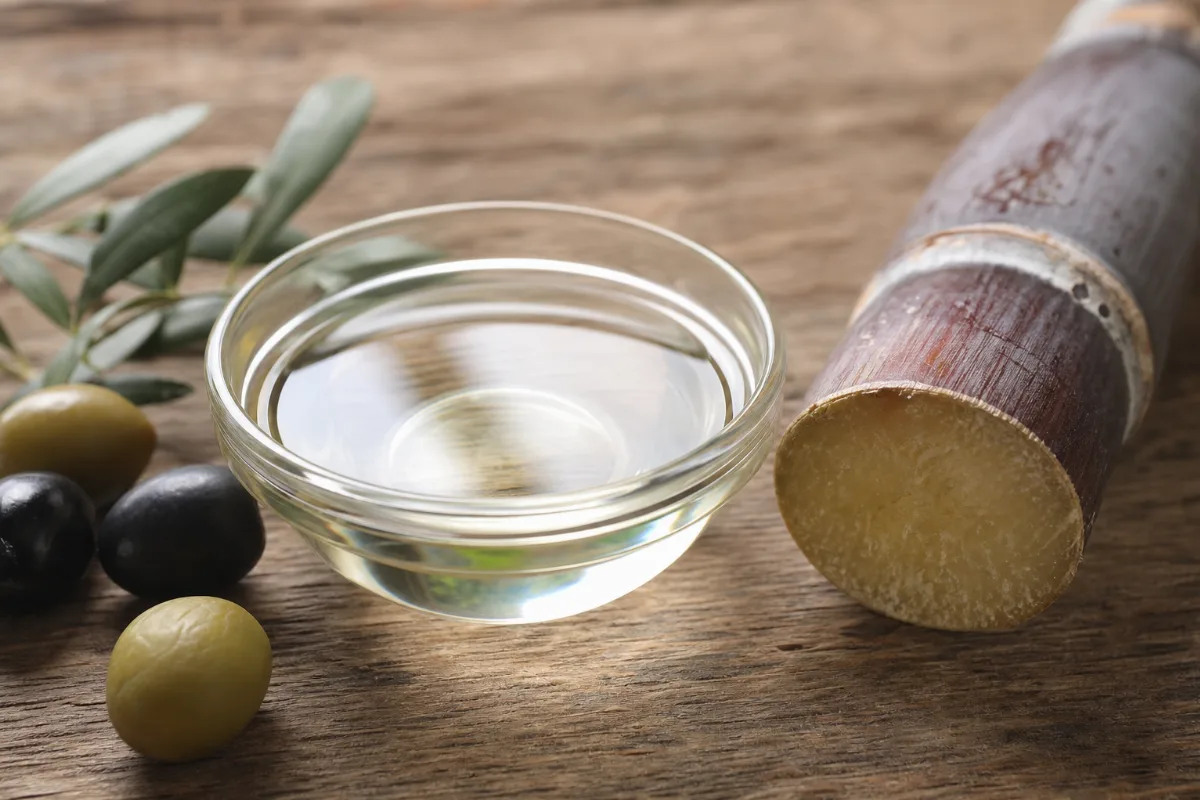
Natural Oils & Butters · Skin oil
Squalane
Hydrogenated squalene (C30H62) · also called Plant squalane, olive squalane, sugarcane squalane. Not the same as squalene.
Squalane is a light, clear skin oil made by adding hydrogen to squalene, an oil found in olives, in human skin oil and in shark liver. It is used in creams and facial oils to soften skin. We found no human trial of squalane on its own, only trials of whole creams and lab tests on cells. A cosmetic safety panel says it is safe in cosmetics as used. Keep it on the skin, out of vaporisers, and check the label if you want to avoid shark-derived oil.
General information, not medical advice. Last substantive update · Not medically reviewed. A named clinician has not signed off on this page. How this page is made
About Squalane
Squalane is a light, stable oil used in skin care. It is made from squalene, which comes from olive by-products, shark liver and other sources. Human research on squalane itself is missing. It is best seen as a pleasant, widely used softening ingredient, not a treatment.
What it is
Squalane is squalene with hydrogen added. Squalene is a natural oil found in olives, in human skin oil (sebum) and in shark liver. Hydrogenation makes it more stable, so squalane is described as a more stable form. Its formula is C30H62.
Olive-derived squalane starts with squalene recovered from olive pomace and refining by-products. The sources we read do not describe how sugarcane-derived squalane is made.
How it is used
It is sold as a thin, clear facial oil and as an ingredient in creams and balms with other emollients. Studies cover whole creams, a vitamin E carrier test on pig skin, and cells in a dish.
No trial was found for hair, scalp, lips, stretch marks or scars.
What the research shows
The one human trial of a moisturizer containing squalane found that skin hydration rose in both creams over 14 days, and that the cream with extra anti-inflammatory ingredients did better. The abstract does not say if the control cream held squalane.
A trial in 23 women compared a fullerene-in-squalane cream with a squalane-only cream. Fullerene made the difference at 8 weeks, so squalane itself was not tested.
Skin cell work suggests squalane may protect cells from UVA harm, but cells in a dish are not people. A pilot on acne-prone skin looked at squalene, the natural oil, and not at squalane.
Squalane, squalene and shark oil
Squalene is the natural oil. Squalane is made from it. Authors of one review write that about 3,000 sharks must be killed to get 1 ton of squalene, and another paper's model says microbes could replace over 156,661 sharks a year. These are the authors' figures. We did not check them.
A label may not say which source was used. If you want to avoid shark-derived oil, choose a product that says it is plant-derived and names the source.
Rules and labels
The cosmetic safety panel's 2023 abstract is the only regulator-style statement we read. The EU and FDA positions were not checked for this page.
Cosmetics are generally not approved before sale in the US, so the label and the maker's quality checks matter. We found no tests of commercial squalane for purity.
At a glance
Traditional uses history, not proof
- No traditional use is described in the sources read. Squalane is a modern, purified ingredient. The shark-liver source and the olive source are described only as the papers we read state them.
Studied for research
- Dry, eczema-type skin, as one ingredient in moisturizers, insufficient
- Carrier for other skin ingredients (pig skin, lab), insufficient
- Ageing skin and UV damage (cells in a dish), insufficient
- Acne-prone skin, insufficient
- Head lice, as part of a company-made product (lab), very low
Main compounds
- Squalane (C30H62), the main and only ingredient
- Squalene (C30H50), the natural form it is made from
- Olive by-products, the source described in the papers read
Common forms
- Pure squalane facial oil
- Creams and balms that include squalane
- Olive-derived, shark-derived or sugarcane-derived squalane (the label may not say which)
Research links: Cosmetic safety panel: squalane and squalene (abstract) · Moisturizer trial in atopic dermatitis (abstract) · Review of emollients for dry skin in eczema (abstract) · From olive pomace to squalane (abstract) · Squalane and squalene in lung fluid after vaping (abstract) · Research Library · Genes & Biomarkers Library
What it is and its history
- Accepted scientific name
- Squalane (hydrogenated squalene)
- Naming authority
- Not a species. A purified oil, chemical formula C30H62.
- Common names
- Squalane (English); Plant squalane (English (label name)); Olive squalane (English (label name)); Sugarcane squalane (English (label name))
- Family or group
- A hydrocarbon (a long chain made only of carbon and hydrogen)
- What it looks like
- Fruit: Olive-derived squalane starts from squalene recovered from olive pressing by-products such as pomace and refining distillates.
- Harvest and processing
- Squalene is extracted from olive pomace (solvent extraction) and from deodorizer distillates, then hydrogenated to squalane. A 2025 chemistry study did this at 60 C with a palladium catalyst in 2-MeTHF solvent. Industrial hydrogenation is described as 200 C and 4 to 30 bar for 6 to 7 hours.
- Look-alikes and adulterants
- Name: Squalene; Note: The natural, unhydrogenated oil found in olive oil, in human skin oil (sebum) and in shark liver. It oxidises more easily; squalane is made from it.; Name: Shark-derived squalane; Note: Made from shark liver oil. A label may not say which source was used.; Name: Hemisqualane; Note: A related but different ingredient. Not assessed here.
- Sustainability and conservation
- Authors of two papers call shark squalene sources a conservation problem and say sharks are critically endangered or on the verge of extinction. Not independently checked.
Traditional use and history history, not clinical proof
| Tradition or era | Documented use | Source |
|---|---|---|
| Shark liver as a major source, as authors state | A 2022 review says shark liver is the major and most popular source of squalene and that about 3,000 sharks must be killed for 1 ton, which is why they look at microalgae. This is the authors' statement and was not independently verified here. | p35789811 |
| Cosmetic safety review | The Expert Panel for Cosmetic Ingredient Safety first assessed squalane and squalene in 1982 and re-reviewed them in 2023, according to the abstract. | p37752766 |
Traditional use shows how it was used. It does not show that it works or is safe today.
What is inside, and how it may work
What it contains and how those compounds act in cells and animals. Laboratory and animal mechanisms are not proven effects in people.
Main compounds
| Compound | Family | Where it is concentrated | Activity studied | Level of evidence |
|---|---|---|---|---|
| Squalane PubChem 8089 | saturated hydrocarbon (fully hydrogenated) | Made from squalene; not found as such in plants Not applicable. | A light emollient oil. Cells in a dish showed protection against UVA effects; carrier for vitamin E in pig skin tests. 12 14 5 | Laboratory research |
| Squalene PubChem 638072 | triterpene (unsaturated hydrocarbon) | Extra virgin olive oil and its by-products; also human sebum and shark liver About 12 percent of human sebum, as stated by authors of one review. | The starting material for squalane. Peroxide form found in acne-prone skin in a pilot. 1 3 13 | Human (observational) |
Mechanisms, receptors and pathways
| Target or pathway | Gene or receptor | What was found | Level |
|---|---|---|---|
| UVA-induced collagen loss and inflammation (cells) | NF-kB, COX-2, Nrf2, beta1-integrin, IGF-I receptor | In human skin cells, squalane at 0.005 to 0.015 percent counteracted UVA effects on these markers and stimulated cell migration. 12 | Laboratory research |
| Carrier for fat-soluble ingredients | n/a | Squalane nanoemulsions released more vitamin E and moved more through pig ear skin than coconut-oil-rich ones. 14 | Laboratory research |
Absorption, metabolism and elimination
- Absorption
- Not described for people. In pig skin, squalane-based nanoemulsions carried vitamin E through the skin.
- Distribution
- Not described.
- Metabolism
- Not described.
- Elimination
- Not described.
- Bioavailability
- Not described.
Isolated compounds versus whole extracts
Squalane is a single purified compound, not a whole food or plant extract. Products can hold squalane alone, or blends with other emollients, silicones or active ingredients, so results from blends do not belong to squalane.
Nutritional composition
Squalane is not a nutrient. Squalene occurs in olive oil and its by-products, and olive-derived squalane starts from it, but squalane on skin is not a food.
1 very low certainty4 not enough evidence
What was looked at
The 5 benefits and uses checked for Squalane, each with how strong the evidence is. Tap one to open it.
- Dry skin and eczema-type dryness (in moisturizers)Not enough evidence
- Carrying other skin ingredients into the skinNot enough evidence
- Ageing skin and wrinklesNot enough evidence
- Acne-prone, oily skinNot enough evidence
- Head lice (as part of a product)Very low certainty
Lab markers tracked in the studies
Skin hydrationCollagen production in skin cells (lab)Squalene peroxide in the skin's oil
What is Squalane good for?
What the research shows for each use, and how strong it is. None of it is proven for squalane itself. Read the Safety tab too.
Benefits, one by one
Each card is a research question, not a promise. Tap a goal to filter. Open a card to see the studies, doses and limits.
Dry skin and eczema-type dryness (in moisturizers)
Not enough evidenceSqualane is a light oil used in creams to soften skin. We found no trial of squalane on its own. It shows up only as one of many ingredients in tested moisturizers, so no result can be credited to it.
2 studiesSqualane in finished creams and oils; amounts are not given in the ab…
Studies, doses and limits
What the trials found
One 14-day double-blind trial in adults with mild to moderate atopic dermatitis compared two moisturizers. The better one added anti-inflammatory ingredients to a base that already held several emollients, among them shea butter and squalane. A 2025 review of basic emollients for dry skin in atopic dermatitis found most emollient formulas safe and effective, but it names squalene (not squalane) only in its search list.
Results
In the trial, skin hydration rose in both groups. The group with the added ingredients went from 35.97 to 66.06 and the control group from 40.74 to 56.12 (units not given), a significant difference on day 14 (p<0.05). The abstract does not say whether the control cream also held squalane.
Effect sizes as reported
No effect sizes in the abstract; before and after averages and p-values only.
Why this rating
No study isolates squalane. In the one trial it is one of many ingredients and the control cream's make-up is not described. The review covers emollients in general.
Form and dose studied
Squalane in finished creams and oils; amounts are not given in the abstract.
Who was studied
Adults with mild to moderate atopic dermatitis (one trial).
Limits
Cannot separate squalane from the other ingredients. Short trial. The review has author ties to skin-care and drug companies.
Why researchers looked
Dry skin loses water. Light oils such as squalane are added to creams as emollients to make skin feel soft and help hold moisture in.
Traditional use
No traditional use is described in the sources read. Squalane is a modern, lab-refined ingredient.
Proposed mechanism Pharmacological theory
Not shown for squalane. Emollients as a group are said to restore skin hydration and barrier function through their physical properties.
A proposed mechanism does not show that the effect happens in people.
Squalane is a skin oil, not a food. Allergy to any skin product is possible. See the Safety tab.
Carrying other skin ingredients into the skin
Not enough evidenceIn a lab test on pig skin, a squalane-based mix carried far more vitamin E through the skin than a coconut-oil-rich mix. This is a lab result, not a test in people.
1 studiesLab-made nanoemulsions, not a product you can buy.
Studies, doses and limits
Results
The pure squalane formula released vitamin E fastest and carried 164.71 micrograms per cm2 through pig skin in 24 hours, compared with 11.72 for the coconut-oil-rich formula. All formulas stayed stable for 90 days at 25 C in the dark.
Effect sizes as reported
Large difference between formulas in pig skin (about 14-fold by the figures above).
Why this rating
One lab study on animal skin. The authors themselves say studies in living skin are needed.
Form and dose studied
Lab-made nanoemulsions, not a product you can buy.
Limits
Lab test only. Safety and benefit of more vitamin E in the skin were not tested.
Why researchers looked
Vitamin E does not mix with water and is hard to deliver. Makers test light oils as carriers in creams.
Traditional use
No traditional use is described in the sources read. Squalane is a modern, lab-refined ingredient.
Proposed mechanism Laboratory research
Not established. The authors tested particle size, stability and release rates of oil-in-water nanoemulsions.
A proposed mechanism does not show that the effect happens in people.
Squalane is a skin oil, not a food. Allergy to any skin product is possible. See the Safety tab.
Ageing skin and wrinkles
Not enough evidenceNo trial shows that squalane itself reduces wrinkles. One trial used squalane as the base of a cream whose active ingredient was fullerene. Lab work on skin cells in a dish suggests squalane protects cells from UVA damage, but that is not a test in people.
2 studiesSqualane in a cream as a base; cells treated with purified squalane. …
Studies, doses and limits
What the trials found
One 8-week randomised double-blind trial in 23 women. One half of the face got a cream with fullerene dissolved in olive-derived squalane, the other half got squalane cream without fullerene. The fullerene cream beat the squalane-only cream at week 8 (p<0.05) without severe side effects.
Results
The difference came from the fullerene, since squalane was in both halves. Roughness improved against baseline with the fullerene cream but not against the squalane placebo. In human skin cells (fibroblasts) squalane at 0.005 to 0.015 percent counteracted UVA harm to collagen production and sped up cell migration in a scratch test.
Effect sizes as reported
No effect sizes in the abstracts; p-values only.
Why this rating
Human trial tests fullerene, not squalane; squalane's effect is only seen in cells in a dish.
Form and dose studied
Squalane in a cream as a base; cells treated with purified squalane. Amounts are in the papers and not given here.
Who was studied
23 healthy Japanese women (trial); human skin cells (lab).
Limits
Small. Squalane is the vehicle, not the test item. Cell studies do not show effects on real skin.
Why researchers looked
Squalane is stable and light. Researchers ask if it protects skin cells from sun damage and helps repair.
Traditional use
No traditional use is described in the sources read. Squalane is a modern, lab-refined ingredient.
Proposed mechanism Laboratory research
In dish studies squalane cut UVA-induced loss of collagen production, lowered inflammation markers (NF-kB, COX-2) and raised Nrf2, a cell protection switch. Not shown in people.
A proposed mechanism does not show that the effect happens in people.
Squalane is a skin oil, not a food. Allergy to any skin product is possible. See the Safety tab.
Acne-prone, oily skin
Not enough evidenceNo trial of squalane for acne was found. A small pilot found that acne-prone skin carries more of its own squalene (the unhydrogenated oil) and that part of it is in a peroxide form. That is about the skin's natural oil, not about squalane creams.
1 studiesNot applicable: no product was tested.
Studies, doses and limits
What the trials found
One pilot in volunteers with acne-prone skin and healthy controls measured the skin's own squalene. It did not apply squalane.
Results
Acne-prone skin had more squalene, its peroxide form was present in the outer layer, and peroxide squalene tracked with sebum amount and with porphyrin intensity.
Effect sizes as reported
Rank correlations reported; no figures in the abstract.
Why this rating
Pilot study of natural skin oil. No test of squalane on acne.
Who was studied
Volunteers with acne-prone skin and healthy controls.
Limits
Squalene is not squalane. Number of people not in the abstract. Pilot. No claim that squalane clogs or clears pores can be made from this paper.
Why researchers looked
Squalene is a major part of skin oil (sebum). When it is oxidised by sun or air it is thought to feed clogged pores and spots. Squalane is the more stable version, so people ask whether it is gentler for oily skin.
Traditional use
No traditional use is described in the sources read. Squalane is a modern, lab-refined ingredient.
Proposed mechanism Pharmacological theory
Proposed by the pilot authors: squalene peroxide may help drive blocked pores and spots. Not shown to be the cause.
A proposed mechanism does not show that the effect happens in people.
Squalane is a skin oil, not a food. Allergy to any skin product is possible. See the Safety tab.
Head lice (as part of a product)
Very low certaintyA squalane and dimethicone lice product killed all lice and late-stage eggs in a lab test. The company behind it funded or took part in the work, and squalane cannot be separated from the silicone it was mixed with.
1 studiesA squalane and dimethicone-based lice formula.
Studies, doses and limits
What the trials found
A skin tolerance check in children with atopic skin from 12 months of age. Numbers are not given in the abstract.
Results
In the lab 100 percent of crawling lice and late-stage eggs died after 2 and 5 minutes in the product. The product was described as well tolerated in children with atopic skin.
Effect sizes as reported
100 percent mortality in the lab test.
Why this rating
Lab kill result plus a short skin-tolerance check, by authors linked to the maker, with squalane mixed with dimethicone.
Form and dose studied
A squalane and dimethicone-based lice formula.
Who was studied
Lice in a dish; children with atopic skin.
Limits
Company-linked. Squalane not separated from dimethicone. No result from treating real infestations is in the abstract.
Why researchers looked
Oils and silicones that coat and smother lice are used as alternatives to insecticides.
Traditional use
No traditional use is described in the sources read. Squalane is a modern, lab-refined ingredient.
Proposed mechanism Laboratory research
The authors call this a physically acting product, not a nerve poison. Squalane's own role was not isolated.
A proposed mechanism does not show that the effect happens in people.
Squalane is a skin oil, not a food. Allergy to any skin product is possible. See the Safety tab.
Connections to the rest of health
How Squalane connects to the rest of our health knowledge graph. Every link says what kind of connection it is. A safety link (for example to the liver) is a warning, not a benefit. A study that merely mentions a topic never creates a benefit link.
Explore every connection: goals, body systems, organs, symptoms, genes
A. Wellness goals
| Connected to | Kind of connection | Evidence status | Context | Studies |
|---|---|---|---|---|
| Healthy Skin | Preliminary mechanism | Not enough evidence | Dry skin and eczema-type dryness (in moisturizers): Squalane is a light oil used in creams to soften skin. We found no trial of squalane on its own. It shows up only as one of many ingredients in tested moisturizers, so no result can be credited to it. Carrying other skin ingredients into the skin: In a lab test on pig skin, a squalane-based mix carried far more vitamin E through the skin than a coconut-oil-rich mix. This is a lab result, not a test in people. | 10 11 14 8 12 9 |
| Anti Aging Support | Preliminary mechanism | Not enough evidence | Ageing skin and wrinkles: No trial shows that squalane itself reduces wrinkles. One trial used squalane as the base of a cream whose active ingredient was fullerene. Lab work on skin cells in a dish suggests squalane protects cells from UVA damage, but that is not a test in people. | 8 12 |
| Healthy Skin | Biological association | Not enough evidence | Acne-prone, oily skin: No trial of squalane for acne was found. A small pilot found that acne-prone skin carries more of its own squalene (the unhydrogenated oil) and that part of it is in a peroxide form. That is about the skin's natural oil, not about squalane creams. | 3 |
B. Body systems
C. Body parts and organs
| Connected to | Kind of connection | Evidence status | Context | Studies |
|---|---|---|---|---|
| Skin | Biological association | Not enough evidence | Used as a soft emollient; no trial isolates it. Cosmetic safety panel abstract says safe as used. One emollient inside tested moisturizers; lab results in skin cells. Preparation or compound: Squalane in creams and oils |
6 10 12 |
I. Biomarkers
| Connected to | Kind of connection | Evidence status | Context | Studies |
|---|---|---|---|---|
| Skin hydration | Biological association | Not enough evidence | Measured in trials: raised. A lab change is not the same as a health benefit. | 10 |
| Collagen production in skin cells (lab) | Biological association | Not enough evidence | Measured in trials: raised. A lab change is not the same as a health benefit. | 12 |
| Squalene peroxide in the skin's oil | Biological association | Not enough evidence | Measured in trials: observed (not changed by a treatment). A lab change is not the same as a health benefit. | 3 |
J. Genes, receptors and enzymes
| Connected to | Kind of connection | Evidence status | Context | Studies |
|---|---|---|---|---|
| NFKB1 / PTGS2 (COX-2) pathway | Preliminary mechanism | In vitro | Markers of inflammation lowered by squalane in UVA-exposed skin cells in a dish. | 12 |
L. Active compounds
| Connected to | Kind of connection | Evidence status | Context | Studies |
|---|---|---|---|---|
| Squalane | Biological association | In vitro | A light emollient oil. Cells in a dish showed protection against UVA effects; carrier for vitamin E in pig skin tests. Preparation or compound: Made from squalene; not found as such in plants |
12 14 5 |
| Squalene | Biological association | Human (observational) | The starting material for squalane. Peroxide form found in acne-prone skin in a pilot. Preparation or compound: Extra virgin olive oil and its by-products; also human sebum and shark liver |
1 3 13 |
Each connection is stored with the ingredient, the connected record, the kind of connection, the evidence status, the supporting studies, the preparation or compound involved, and a review date (last reviewed October 25, 2026).
Evidence at a glance: what changed in 2 lab markers
Tap a number to show only those markers. Counts are markers, not people.
The evidence
The research centre for Squalane. Every record here was checked against PubMed or the publisher's page; we never list a study we have not verified.
Evidence by outcome
Bars show how many studies we found for each outcome, not how well it works. People are added up across trials only (reviews are not added, to avoid double counting).
How we rate evidence
High certainty
Several well-run trials or reviews agree; further research is unlikely to change the picture much.
Moderate certainty
Good trials point the same way, but some doubt remains.
Low certainty
Small, short or inconsistent trials. The finding could change with better research.
Very low certainty
Very little or very weak human data. Treat as a possibility only.
Mixed findings
Trials or reviews disagree with each other.
Not enough evidence
Not enough human research to say either way.
Evidence against
Good research found no benefit, or found harm.
We take the reviewers' own risk-of-bias and GRADE statements where they exist, and otherwise judge from study size, design, consistency, directness and whether a product matches what is sold. Many publications do not make evidence high. Method note: We read PubMed abstracts of 14 papers, checked plant names in GBIF and chemistry in PubChem. Only abstracts were read for papers; the cosmetic safety panel's full report was not read. Certainty ratings are the compiler's own reading. Several papers are company-linked or sponsored and are labelled. No study is cited that we could not verify.
Study library: every study we checked 15
| Study | Design | People | Product, dose, length | Result |
|---|---|---|---|---|
| Barp 2024 Analytical Determination of Squalene in Extra Virgin Olive Oil and Olive Processing By-Products, and Its Valorization as an Ingredient in Functional Food-A Critical Review. Molecules · PMID 39519842 · DOI |
Critical review n/a |
Olive oil and olive by-products | Squalene in extra virgin olive oil and by-products Olive Not given here |
Squalene is found mostly in extra virgin olive oil and its processing by-products. There is no official method to measure it, which limits comparing studies. The authors favour recovering squalene from by-products to cut waste. Methods, limits and fundingOutcomes: How squalene is measured; recovery from by-products Limitations: A review of measuring methods. It is about squalene, not squalane, and not about skin. Funding and conflicts: Authors declare no conflicts of interest. Read: abstract |
| Ciolino 2021 EVALI Vaping Liquids Part 2: Mass Spectrometric Identification of Diluents and Additives. Front Chem · PMID 34760870 · DOI |
Product analysis n/a |
About 300 cannabis vaping liquids | Squalane found as one of several additives Vaping liquids Not given here |
Squalane was among the additives identified in a large set of cannabis vaping liquids, alongside vitamin E acetate, MCT oil, polyethylene glycols and others. Vitamin E acetate was strongly linked to the 2019 US lung illness outbreak (EVALI). Methods, limits and fundingOutcomes: Which additives are in vaping liquids Limitations: The paper shows squalane is present in some vaping liquids. It does not say squalane caused any lung injury. Funding and conflicts: Authors declare no commercial or financial relationships. Read: abstract |
| Condro 2023 Squalene Peroxidation and Biophysical Parameters in Acne-Prone Skin: A Pilot "In Vivo" Study. Pharmaceuticals (Basel) · PMID 38139830 · DOI |
Pilot observational |
Volunteers with acne-prone skin and healthy volunteers as controls (number not given in the abstract) | None applied. The study measured the skin's own squalene Skin surface sampling Not given here Single visit · vs Healthy volunteers |
Acne-prone skin had more squalene, and its peroxide form was present in the outer skin layer. Peroxide squalene correlated with sebum content and with porphyrin intensity. Methods, limits and fundingOutcomes: Squalene and squalene peroxide in skin; sebum, protein, water loss Limitations: Pilot. Measures the skin's natural squalene, not squalane that is applied. Says nothing on whether squalane helps or harms acne. Funding and conflicts: Authors declare no conflict of interest. Read: abstract |
| Cowan 2022 The Quantitation of Squalene and Squalane in Bronchoalveolar Lavage Fluid Using Gas Chromatography Mass Spectrometry. Front Chem · PMID 35464226 · DOI |
Method development human samples |
Lung fluid samples from people in the 2019 vaping lung-injury outbreak and a comparison group | Squalane and squalene measured in lung fluid Not given here · vs Comparison group |
The authors write that squalane is used in products applied to skin and swallowed, but limited information is available on inhalational exposure and toxicity. Neither squalane nor squalene was detected above the limit of detection (0.50 micrograms per mL) in any of the lung fluid samples. Methods, limits and fundingOutcomes: Whether squalane or squalene builds up in lungs after inhaling vaping products Limitations: A method paper. A negative finding at that detection limit does not show inhaling squalane is safe. Funding and conflicts: Authors declare no commercial or financial relationships. Read: abstract |
| Cravotto 2025 From Olive Pomace to Squalane: A Green Chemistry Route Using 2-Methyltetrahydrofuran. ACS Omega · PMID 40787365 · DOI |
Chemistry study n/a |
Olive pomace (the solid waste left after pressing olives) | Squalene extracted from olive pomace and hydrogenated to squalane Olive pomace and refining by-products Not given here · vs Conventional hexane extraction and harsher industrial hydrogenation |
The solvent 2-MeTHF recovered 83 percent of the squalene from pomace. Hydrogenation to squalane was fully converted within 1 hour at 60 C, compared with the harsher industrial conditions (200 C, 4 to 30 bar, 6 to 7 hours). With squalene from refining by-products, impurities poisoned the catalyst and the squalane yield was only 19.8 percent. Methods, limits and fundingOutcomes: Squalene recovery and conversion to squalane Limitations: A chemistry study with no tests on people. Shows how olive squalane can be made, not what any product contains. Funding and conflicts: No conflict statement in PubMed record. Read: abstract |
| Fiume 2023 Squalane and Squalene. Int J Toxicol · PMID 37752766 · DOI |
Authoritative guidance n/a |
n/a (safety assessment for cosmetic ingredients) | Squalane and squalene as cosmetic ingredients Not given here |
The Expert Panel for Cosmetic Ingredient Safety reviewed new studies since its 1982 assessment, plus updated product types and use concentrations, and confirmed that squalane and squalene are safe as cosmetic ingredients in the practices of use and concentration described in the report. Methods, limits and fundingOutcomes: Cosmetic safety Limitations: Only the abstract was read. The full report (concentrations, irritation and sensitisation data) was not read. The supplement was sponsored by the Cosmetic Ingredient Review, which is the industry-funded body that runs the panel. Funding and conflicts: Supplement sponsored by the Cosmetic Ingredient Review (as stated in the paper). Read: abstract |
| Furlan 2025 Thraustochytrium sp. and Aurantiochytrium sp.: Sustainable Alternatives for Squalene Production. Mar Drugs · PMID 40137318 · DOI |
Lab and model n/a |
Two marine microbes grown in tanks | Squalene produced by microbes Not given here Batch cultures, 72 to 96 hours |
The microbes made 26.13 and 54.97 mg of squalene per litre. The authors' model says large plants could make up to 59.50 tons a year, which they say would prevent catching over 156,661 sharks a year. Methods, limits and fundingOutcomes: Squalene yield; a model of industrial output Limitations: The shark figure comes from the authors' own model. Squalene, not squalane, and lab scale. Funding and conflicts: Authors declare no conflicts of interest. Read: abstract |
| Kato 2010 Clinical evaluation of fullerene-C60 dissolved in squalane for anti-wrinkle cosmetics. J Nanosci Nanotechnol · PMID 21137794 · DOI |
Controlled trial |
23 23 Japanese women, mean age about 39 |
Fullerene-C60 (278 ppm) dissolved in squalane made from olive oil, in a cream (LF-SQ) Cream, face Not given here 8 weeks · vs Squalane cream without fullerene on the other half of the face (placebo) |
The fullerene-squalane cream was not effective at week 4 but was significantly better than the squalane-only placebo at week 8 (p<0.05), without severe side effects. Roughness area improved versus baseline but not versus the placebo. Methods, limits and fundingOutcomes: Wrinkle grade, skin replicas, water loss, moisture, elasticity Limitations: The tested active was fullerene. Squalane was the vehicle in both halves of the face, so the trial says nothing about squalane's own effect. Small. Funding and conflicts: No conflict of interest statement in the abstract; PubMed lists non-US government research support. Read: abstract |
| Martinez de Murguia Fernandez 2021 Effectiveness and tolerability of a squalane and dimethicone-based treatment for head lice. Parasitol Res · PMID 33797611 · DOI |
Lab and tolerance study lab / human tolerance |
Head lice and eggs in the lab; children with atopic skin for skin tolerance (numbers not given in the abstract) | Squalane and dimethicone-based lice product Finished product Not given here 2 and 5 minutes immersion (lab) |
In the lab, 100 percent of crawling lice and late-stage eggs died after 2 and 5 minutes of immersion. The product was well tolerated and suitable for children with atopic skin from 12 months of age, according to the authors. Methods, limits and fundingOutcomes: Lice and egg mortality in vitro; skin tolerance Limitations: The lice result is from the lab, not from people. Squalane cannot be separated from dimethicone. Company-linked. Funding and conflicts: One author is a consultant of Ferrer International S.A. and three are employees of the company. The company is said not to have taken part in design, performance or interpretation. Read: abstract |
| Prakoeswa 2024 The Role of Moisturizer Containing Anti-inflammatory on Skin Hydration in Mild-Moderate Atopic Dermatitis Patients. Dermatol Res Pract · PMID 39741562 · DOI |
Controlled trial |
Adults with mild to moderate atopic dermatitis (number not given in the abstract) | Moisturizer with added anti-inflammatory ingredients; its emollients include shea butter and squalane Finished cream, applied to skin Not given here 14 days · vs Moisturizer without the added anti-inflammatory ingredients |
Skin hydration rose in both groups. In the group with added anti-inflammatory ingredients it went from 35.97 to 66.06; in the control group from 40.74 to 56.12 (units not given in the abstract). The difference between groups on day 14 was significant (p<0.05), and so was SCORAD. Methods, limits and fundingOutcomes: Skin hydration; SCORAD severity score Limitations: Squalane is one of several emollients in a product. The abstract does not say whether the control cream also held squalane, so no result can be credited to squalane. Short (14 days). Number of people not in the abstract. Funding and conflicts: Authors declare no conflicts of interest. Read: abstract |
| Wollenberg 2025 Basic Emollients for Xerosis Cutis in Atopic Dermatitis: A Review of Clinical Studies. Int J Dermatol · PMID 40265493 · DOI |
Narrative review |
People with atopic dermatitis and dry skin (xerosis) | Basic emollients in general (the search list includes squalene, not squalane) Finished products Not given here |
Studies varied widely, but most basic emollient formulas were safe and effective at improving objective and subjective measures of dry skin. Ongoing use helped avoid relapse. Methods, limits and fundingOutcomes: Dry skin in atopic dermatitis Limitations: A narrative review, not a meta-analysis. Squalene (not squalane) is named only in the search list. Does not isolate any single oil. Funding and conflicts: Authors report advisory, speaker or investigator ties to many pharmaceutical and skin-care companies; one author reports support from Pierre Fabre for the manuscript. Read: abstract |
| Wolosik 2025 Squalane as a Promising Agent Protecting UV-Induced Inhibition of Collagen Biosynthesis and Wound Healing in Human Dermal Fibroblast. Molecules · PMID 40363772 · DOI |
Laboratory research in-vitro |
Human dermal fibroblasts (skin cells in a dish) | Squalane at 0.005 to 0.015 percent Pure compound in cell culture Not given here Not given in the abstract · vs Untreated UVA-exposed cells |
Squalane counteracted UVA-induced drops in collagen biosynthesis and rises in NF-kB and COX-2, raised Nrf2, and stimulated fibroblast migration in a scratch model. Methods, limits and fundingOutcomes: Collagen synthesis, oxidative stress, inflammation markers, cell migration Limitations: Cells in a dish only. Not a person, not a cream, and concentration in cells may not match what reaches skin. Funding and conflicts: Authors declare no conflicts of interest. Read: abstract |
| Yarkent 2022 Recent Progress in Microalgal Squalene Production and Its Cosmetic Application. Biotechnol Bioprocess Eng · PMID 35789811 · DOI |
Review n/a |
n/a | Squalene (and squalane) from sharks, plants and microalgae Not given here |
The authors write that squalene makes up about 12 percent of human sebum and that about 3,000 sharks must be killed to obtain 1 ton of squalene, so they look at microalgae as an alternative. Methods, limits and fundingOutcomes: Sources of squalene Limitations: The shark figure is the authors' statement; it is not checked here. The abstract wrongly calls squalane the oxidized form of squalene; squalane is the hydrogenated form. Used only for the shark and sebum statements. Funding and conflicts: Authors declare no conflict of interest. Read: abstract |
| de Souza 2025 Effect of Squalane as a Carrier in O/W Nanoemulsions for Dermal Delivery of Vitamin E. ACS Omega · PMID 41427219 · DOI |
Laboratory research in-vitro (pig skin) |
Nanoemulsions tested on porcine (pig) ear skin in a diffusion cell | Vitamin E in oil-in-water nanoemulsions with squalane, coconut oil or mixes Lab formulations Not given here 24 h permeation; 90 day storage · vs Coconut-oil-rich formulations |
The pure squalane formula released the most vitamin E and carried the most through pig skin in 24 hours (164.71 micrograms per cm2) compared with the coconut-oil-rich formula (11.72). Formulas stayed stable for 90 days at 25 C in the dark. Methods, limits and fundingOutcomes: Particle size, stability, vitamin E release and skin permeation Limitations: Lab test on pig skin. The authors say in vivo studies are needed to confirm effect and safety. Funding and conflicts: Authors declare no conflicts of interest. Read: abstract |
| n/a 2026 PubChem: squalane (CID 8089) and squalene (CID 638072) PubChem REST · Source |
Database record n/a |
n/a | n/a |
Squalane C30H62, molecular weight 422.8. Squalene C30H50, molecular weight 410.7. Methods, limits and fundingOutcomes: Chemical identity Limitations: A name check only. Read: api |
What we do not know yet
- What the evidence supports: insufficient for dry skin, carrier use, ageing skin and acne; very low for head lice.
- No human trial of squalane on its own.
- No data on allergy rates, pregnancy, breastfeeding or babies.
- How sugarcane-derived squalane is made, and purity of commercial squalane, were not found.
- EU and FDA statements, LiverTox and shelf life were not checked.
How new research is added
New studies are found by a saved PubMed search and placed in a review queue. A person reads each one before it changes any rating or safety wording.
Lab markers
What changed in blood or saliva tests during trials. A changed number is not the same as feeling or being healthier, and we give no "normal ranges".
Other 3
Skin hydration
Raised in trials
How much water the outer skin layer holds, measured by a skin probe. Higher means better hydrated skin.
Not enough evidenceResults and what it means
Why it was measured
A simple check of dry skin and how well a moisturizer works.
Statistical vs. clinical meaning
Shows moisturizers can raise hydration. It does not show that squalane is the reason.
Safety implication
None reported in the abstract.
| Study | Result | People | Product |
|---|---|---|---|
| 10 | Rose in both groups over 14 days (35.97 to 66.06 with added anti-inflammatory ingredients; 40.74 to 56.12 in the control cream). Units not given in the abstract. | Adults with mild to moderate atopic dermatitis | Moisturizers that include squalane among several emollients, 14 days |
Collagen production in skin cells (lab)
Raised in trials
How much collagen skin cells in a dish make. Collagen gives skin its firmness.
Not enough evidenceResults and what it means
Why it was measured
UV light lowers collagen production in cells, so it is used to test if a substance protects them.
Statistical vs. clinical meaning
A lab result that has not been tested in people.
Safety implication
None reported.
| Study | Result | People | Product |
|---|---|---|---|
| 12 | Squalane counteracted the drop in collagen biosynthesis caused by UVA light in human skin cells. | Human dermal fibroblasts in a dish | Squalane 0.005 to 0.015 percent |
Squalene peroxide in the skin's oil
Observed (not changed by a treatment) in trials
The oxidised form of the skin's own squalene. Higher levels were seen in acne-prone skin.
Not enough evidenceResults and what it means
Why it was measured
Thought to relate to clogged pores and inflamed spots.
Statistical vs. clinical meaning
A link seen in a pilot. It does not show what squalane does.
Safety implication
None reported.
| Study | Result | People | Product |
|---|---|---|---|
| 3 | Present in the outer layer of acne-prone skin and linked to sebum content and porphyrin intensity. | Volunteers with acne-prone skin versus healthy controls | None (measurement only) |
Safety
What studies and official sources say about side effects, medicines and who should check first. Each point shows what kind of evidence it comes from.
Main points to know 5
- Made for the skin, not for swallowing or inhaling. Squalane is sold as a skin oil. The cosmetic safety panel (Expert Panel for Cosmetic Ingredient Safety) confirmed in 2023 that squalane and squalene are safe as cosmetic ingredients in the practices of use and concentrations described in its report. We read only the abstract, not the full report. We found no safety study of swallowed squalane, so this page gives no swallowing advice. Shark liver oil supplements are a different product and were not studied here. Authoritative guidance 6
- Do not put it in a vaporiser. Squalane has been found as an additive in some cannabis vaping liquids, next to vitamin E acetate, which was strongly linked to the 2019 US vaping lung illness outbreak. The squalane paper does not say squalane caused lung injury. A second paper says little is known about the toxicity of inhaled squalane, and neither squalane nor squalene was found in lung fluid samples above its detection limit. Not detected is not the same as safe, so keep skin oils out of vaping devices. Product analysis 2 4
- Allergy: none found, but that is not proof of safety. Our searches of PubMed found no case reports or studies of allergic reaction to squalane. The cosmetic safety panel's full data on irritation and sensitisation was not read. Any skin product can cause a reaction in some people, so test a small patch first and stop if you get redness, itching or swelling. Insufficient 6
- Check where it comes from if that matters to you. Squalane can be made from olive by-products, from shark liver oil, or sold as sugarcane-derived. Authors of a 2022 review write that about 3,000 sharks must be killed for 1 ton of squalene, and a 2025 paper models over 156,661 sharks a year saved if microbes replaced them. These are the authors' figures, not checked here. A label may not say which source was used. The sources we read do not describe how sugarcane squalane is made. Review authors statement 13 7 5
- Pregnancy, breastfeeding and children. No source we read tests squalane in pregnancy or breastfeeding, so this is unknown, not a sign of safety. One company-linked report describes a squalane and dimethicone lice product as well tolerated in children with atopic skin from 12 months of age. That product held a silicone too. Ask a doctor or pharmacist before using it on babies or during pregnancy. Insufficient 9
Side effects 3
| Effect | How often | Severity and recovery | Evidence |
|---|---|---|---|
| Skin reaction to squalane itself Absence of reports in our searches is not proof of safety. | Not known; no case reports found | Not known Not known | Insufficient 6 |
| No severe side effects reported in a cream trial where squalane was the base The trial tested a fullerene cream against squalane-only cream. Side effects of squalane alone were not the question. | 23 women, 8 weeks | none severe Not stated | Controlled trial 8 |
| Well tolerated in children with atopic skin (lice product with squalane and dimethicone) Authors are linked to the product's maker. | Numbers not given in the abstract | Not stated Not stated | Tolerance study 9 |
Liver
No source read describes liver injury from squalane on skin. LiverTox was not searched for this page.
How often. Not known.
This is a safety connection. It is not evidence that Squalane supports liver health.
Medicines and supplements 2
| With | Why it matters | Importance | Evidence | What to do |
|---|---|---|---|---|
| Prescription and over-the-counter medicines prescription | No interaction was described in the sources read. | None documented in the sources read. | Insufficient Not enough evidence | Tell your pharmacist or doctor about skin products if you use medicated creams. |
| Other skin ingredients in the same product (for example vitamin E) formulation | In a lab test on pig skin, a squalane-based mix carried much more vitamin E through the skin than a coconut-oil-rich mix. | Squalane can change how much of another ingredient gets into skin in this lab model. What that means for people was not tested. | Laboratory research Not enough evidence 14 | If you use medicated creams or strong skin actives, ask a pharmacist how an added oil may change how they work. |
Who should check first 5
| Situation | Advice | Evidence |
|---|---|---|
| Earlier reaction to squalane, squalene or a product that contains it | Do not use it. Ask a doctor or allergist. | General precaution |
| Vaping or inhaling | Do not put squalane or any skin oil into a vaporiser or inhale it. Toxicity when inhaled is not well known. | Product analysis 2 4 |
| Swallowing it | No safety data were found for swallowed squalane. Do not swallow skin oils. If a child swallows some, call a poison centre. | Insufficient |
| Avoiding animal-derived ingredients | Check that the product says plant-derived. Shark-derived squalane exists and the label may not say. | Review authors statement 13 7 |
| Pregnancy, breastfeeding, babies | Not studied in the sources read. Ask a doctor or pharmacist. | Insufficient |
Overdose, product quality and regulators
Summary. The cosmetic safety panel's abstract says squalane and squalene are safe as cosmetic ingredients as used. No toxic dose or poisoning is described in the sources we read.
Animal. Not reviewed (full report not read).
Human doses studied. Creams with squalane were used on the face for 8 weeks and on atopic skin for 14 days, with no severe side effects reported in the abstracts.
High dose or long term signals. Not found in the sources read.
Overdose response. Not described.
Genotoxicity. Not read.
Quality of a squalane product depends on how it was made and purified. We found no analysis of commercial squalane for contaminants or purity.
Source is not always on the label. Squalane may come from olive, shark liver, or other sources. The sources read do not describe how sugarcane-derived squalane is made. 13 5
Purity depends on processing. In a chemistry study, squalane made from squalene in olive refining by-products came out at only 19.8 percent yield because impurities poisoned the catalyst. This is a lab-process finding, not a test of any product. 5
Solvents used in extraction. The authors note that conventional hexane extraction of squalene from olive pomace raises environmental and health concerns. Whether residues remain in finished squalane was not studied. 5
Squalene versus squalane. Squalene is the natural oil in olive and in human skin oil; squalane is made from it by adding hydrogen. A 2022 abstract wrongly calls squalane the oxidized form; the other papers read treat it as the hydrogenated form. 13 12 5
| Body | Action | Date |
|---|---|---|
| Expert Panel for Cosmetic Ingredient Safety (Cosmetic Ingredient Review) (United States (industry-sponsored panel)) | Re-reviewed squalane and squalene after its 1982 assessment, including new studies and updated use concentrations, and confirmed they are safe as cosmetic ingredients in the practices of use and concentrations described in the report. source | 2023-12 |
When to get medical help
- Swelling of the lips, tongue or face, wheezing or trouble breathing after using a skin product: call emergency services now.
- Spreading rash, hives, blistering or strong burning on skin after using it: stop and get medical advice.
- Cough, chest pain or shortness of breath after vaping or inhaling any oil: get medical help promptly.
- A child has swallowed a skin oil: call your local poison centre or emergency number.
Stop using the product and contact a clinician or emergency service. In the US, Poison Control is 1-800-222-1222.
General information only, not medical advice. Ask a clinician or pharmacist before use, especially with medicines, in pregnancy or with a health condition. See the Natural Remedy Safety guide.
Frequently asked questions
What is squalane?
Is squalane the same as squalene?
Is it made from olives, sugarcane or sharks?
Are sharks really used?
Does squalane moisturize dry skin?
Does it help with wrinkles or sun damage?
Is it good for acne-prone skin?
No trial was found. A pilot study found more squalene, the natural oil, and its peroxide form in acne-prone skin. That does not show that squalane clears or causes spots.
Is squalane safe?
A 2023 cosmetic safety panel abstract says squalane and squalene are safe as cosmetic ingredients as used. We read only the abstract. We found no allergy reports, but that is not proof. Patch test first, and ask a doctor if you have eczema or sensitive skin.
Can I swallow it or put it in a vaporiser?
Is it safe in pregnancy or for babies?
Not studied in the papers we read. A company-linked report called a squalane and silicone lice product well tolerated in children with atopic skin from 12 months of age. Ask a doctor or pharmacist before using it on babies or in pregnancy.
Does it clog pores?
We found no test of squalane for clogged pores in this research. Claims on labels are not backed by the papers read here. Patch test first and stop if you get spots or a rash.
Is squalane the same as hemp or jojoba oil?
No. Squalane is a single purified hydrocarbon. Hemp seed oil and jojoba are plant oils with different make-ups. Look at each page for its own research and safety notes.
Explore by health goal
Editorial transparency
- Written by
- AlternativeMed editorial team. Research compiled with AI assistance, then checked against PubMed records.
- Medical review
- None. This page has not been reviewed by a physician or pharmacist.
- First published
- 2026-10-25
- Last substantive update
- 2026-10-25
- How we research
- We read PubMed abstracts of 14 papers, checked plant names in GBIF and chemistry in PubChem. Only abstracts were read for papers; the cosmetic safety panel's full report was not read. Certainty ratings are the compiler's own reading. Several papers are company-linked or sponsored and are labelled. No study is cited that we could not verify.
- How we rate evidence
- See "How we rate evidence" in the Evidence tab.
- Independence
- No product is promoted on this page. No affiliate links are shown.
Sources 15
Each source was opened and checked. Where we read only the abstract, it says so. The small numbers in the text point here.
- Barp L, Miklavcic Visnjevec A, Moret S. Analytical Determination of Squalene in Extra Virgin Olive Oil and Olive Processing By-Products, and Its Valorization as an Ingredient in Functional Food-A Critical Review.. Molecules. 2024. PMID 39519842. DOI 10.3390/molecules29215201. (abstract)
- Ciolino LA, Falconer TM, Ranieri TL et al. EVALI Vaping Liquids Part 2: Mass Spectrometric Identification of Diluents and Additives.. Front Chem. 2021. PMID 34760870. DOI 10.3389/fchem.2021.746480. (abstract)
- Condro G, Sciortino R, Perugini P. Squalene Peroxidation and Biophysical Parameters in Acne-Prone Skin: A Pilot "In Vivo" Study.. Pharmaceuticals (Basel). 2023. PMID 38139830. DOI 10.3390/ph16121704. (abstract)
- Cowan EA, Tran H, Watson CH et al. The Quantitation of Squalene and Squalane in Bronchoalveolar Lavage Fluid Using Gas Chromatography Mass Spectrometry.. Front Chem. 2022. PMID 35464226. DOI 10.3389/fchem.2022.874373. (abstract)
- Cravotto C, Bucciol F, Mazzitelli JB et al. From Olive Pomace to Squalane: A Green Chemistry Route Using 2-Methyltetrahydrofuran.. ACS Omega. 2025. PMID 40787365. DOI 10.1021/acsomega.5c03685. (abstract)
- Fiume M, Bergfeld WF, Belsito DV et al. Squalane and Squalene.. Int J Toxicol. 2023. PMID 37752766. DOI 10.1177/10915818231204276. (abstract)
- Furlan JM, Centenaro GS, Bittencourt Fagundes M et al. Thraustochytrium sp. and Aurantiochytrium sp.: Sustainable Alternatives for Squalene Production.. Mar Drugs. 2025. PMID 40137318. DOI 10.3390/md23030132. (abstract)
- Kato S, Taira H, Aoshima H et al. Clinical evaluation of fullerene-C60 dissolved in squalane for anti-wrinkle cosmetics.. J Nanosci Nanotechnol. 2010. PMID 21137794. DOI 10.1166/jnn.2010.3053. (abstract)
- Martinez de Murguia Fernandez L, Puig Algora G, Bajona Roig M et al. Effectiveness and tolerability of a squalane and dimethicone-based treatment for head lice.. Parasitol Res. 2021. PMID 33797611. DOI 10.1007/s00436-021-07113-y. (abstract)
- Prakoeswa CRS, Damayanti, Anggraeni S et al. The Role of Moisturizer Containing Anti-inflammatory on Skin Hydration in Mild-Moderate Atopic Dermatitis Patients.. Dermatol Res Pract. 2024. PMID 39741562. DOI 10.1155/drp/3586393. (abstract)
- Wollenberg A, Barbarot S, Torrelo A. Basic Emollients for Xerosis Cutis in Atopic Dermatitis: A Review of Clinical Studies.. Int J Dermatol. 2025. PMID 40265493. DOI 10.1111/ijd.17793. (abstract)
- Wolosik K, Chalecka M, Gasiewska G et al. Squalane as a Promising Agent Protecting UV-Induced Inhibition of Collagen Biosynthesis and Wound Healing in Human Dermal Fibroblast.. Molecules. 2025. PMID 40363772. DOI 10.3390/molecules30091964. (abstract)
- Yarkent C, Oncel SS. Recent Progress in Microalgal Squalene Production and Its Cosmetic Application.. Biotechnol Bioprocess Eng. 2022. PMID 35789811. DOI 10.1007/s12257-021-0355-z. (abstract)
- de Souza AC, Sipoli CC, Samulewski RB et al. Effect of Squalane as a Carrier in O/W Nanoemulsions for Dermal Delivery of Vitamin E.. ACS Omega. 2025. PMID 41427219. DOI 10.1021/acsomega.5c08561. (abstract)
- n/a. PubChem: squalane (CID 8089) and squalene (CID 638072). PubChem REST. 2026. (api)
Where to buy
Check the label first. Whatever you buy, look for these:
- 100% pure with no added fragrance or fillers
- Cold-pressed or unrefined if you want the most natural form
- For skin use, do a small patch test first
- Cosmetic or food grade, matched to how you will use it
Talk to a pharmacist or doctor before you start any supplement, especially if you take medicines. See the Safety tab for interactions.
Support our free guides: as an Amazon Associate we earn from qualifying purchases. Full disclosure.


