Natural Oils & Butters · Butter
Shea Butter
Vitellaria paradoxa (kernel fat; older name Butyrospermum parkii) · also called Karite butter, manteca de karite, Butyrospermum parkii butter (label name)
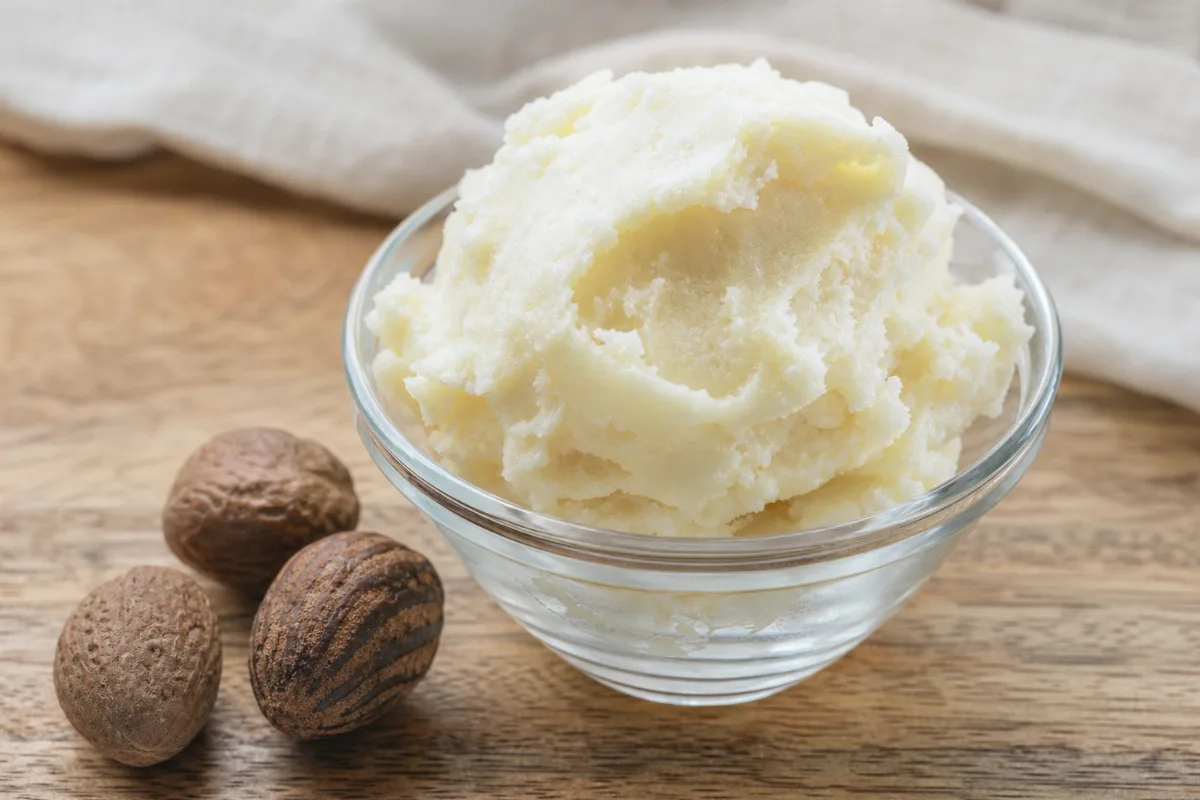
Shea butter is the solid fat pressed from the kernel of the West African shea tree. It is used on skin and hair, in lip balms and in some foods. No trial of the plain butter on skin that we could read was found, only small studies of creams that contain it. The main cautions are skin allergy, never putting it on a newborn's cord stump, and butter that has gone off.
General information, not medical advice. Last substantive update · Not medically reviewed. A named clinician has not signed off on this page. How this page is made
About Shea Butter
Shea butter is a pale, solid fat from the kernel of the shea tree (Vitellaria paradoxa). People use it on skin and hair, in lip balms and sometimes in food. The research on the plain butter is thin: no trial of it alone on skin was found. The key cautions are skin allergy, tree nut allergy questions, never putting it on a newborn's cord stump, and butter that has gone off.
What it is
Shea butter is the fat from the kernel (nut) of Vitellaria paradoxa C.F.Gaertn., family Sapotaceae. GBIF accepts this name and lists the older name Butyrospermum parkii as a synonym, which is why labels often use either.
A review says kernels hold 17.4 to 59.1 g of fat per 100 g dry weight and that reported composition varies widely. In lab samples the two main fatty acids were stearic and oleic acid.
Unrefined versus refined
Traditional butter is made by roasting and pressing the kernels, churning with water, boiling, sieving and cooling. Industry also refines and fractionates it into stearin and olein.
In one lab study, refined shea stearin had lower spoilage markers (peroxide value, free fatty acids) than crude butter, but also lower phenolics, tocopherols, sterols and antibacterial activity. This is lab chemistry; it does not show which is better for skin.
A 2018 review of skin oils says cold-pressed, unrefined oils are preferred for skin care, because heat and chemicals can leave irritating by-products. It did not study shea.
What the research shows
On skin: no trial of plain shea was found. There are small studies of creams that contain shea among many ingredients, one maker-funded diaper trial, and reviews of oils in general.
Other uses rest on an oral extract (33 adults, no control group), purified triterpenes (34 adults), a rat burn study, a lipstick SPF test and a small food-fat trial. None tests the butter you buy.
Skin barrier: what reviews say
Reviews say the fatty-acid make-up of an oil shapes how it acts on the skin barrier. On inflamed skin, oils high in oleic acid and low in linoleic acid may add damage, while oils high in linoleic and saturated fatty acids may help; healthy skin may not react badly to oleic-rich oils. Frequency and length of use also matter.
Shea butter is rich in stearic (saturated) and oleic acid, but the abstracts read give no shea-specific barrier result, so we do not claim one.
Quality, storage and going off
In village storage tests, acid value rose from 3.3 to 5.4 and peroxide value from 8.1 to 10.1 over 2 months, and yeasts and moulds varied with the packaging. A review of African oils says adverse effects are mainly due to processing and storage hygiene.
Keep butter closed and cool. Throw it away if it smells sour or sharp or shows mould.
At a glance
Traditional uses history, not proof
- Reviews describe shea butter as a traditional food fat and skin treatment in Sub-Saharan Africa, most often studied for scabies, wounds and umbilical cord care. Traditional use is not proof it works, and cord use is a documented risk.
Studied for research
- Skin moisturising (plain butter), insufficient
- Eczema creams that contain shea, very-low
- Baby diaper-area redness (shea-emollient diaper), low
- Knee osteoarthritis (shea nut oil extract, not butter), very-low
- Nasal congestion (1979 study), very-low
- Wounds and burns, insufficient
- Sun protection as an add-on to UV filters, very-low
- Food fat and blood-fat markers (blend), very-low
Main compounds
- Stearic acid (saturated fat, makes it solid)
- Oleic acid (omega-9)
- Triterpenes such as lupeol and beta-amyrin
- Phenolic compounds, tocopherols and sterols (more in crude than refined butter in one lab study)
Common forms
- Unrefined (crude) butter, often traditionally made
- Refined butter and fractions (stearin, olein)
- Creams, balms and lip products that contain it
- Food fat in some regions
- A concentrated shea nut oil extract (a different product)
Research links: Cosmetic safety panel assessment of shea ingredients (abstract) · Review of clinical studies of vegetable butters and oils on skin (abstract) · Shea-based diaper emollient trial (abstract) · Newborn cord infection after shea butter (abstract) · Refining and fractionation of shea butter, lab study (abstract) · Shea butter composition review (abstract) · Research Library · Genes & Biomarkers Library
What it is and its history
- Accepted scientific name
- Vitellaria paradoxa
- Naming authority
- C.F.Gaertn.
- Synonyms
- Butyrospermum parkii (G.Don) Kotschy
- Common names
- Shea butter (English); Manteca de karité (Spanish); Shea tree (English)
- Family or group
- Sapotaceae (the sapote family)
- Classification
- Plantae > Tracheophyta > Magnoliopsida > Ericales > Sapotaceae > Vitellaria > Vitellaria paradoxa
- Native range
- Not stated in the sources read; the papers describe West and Sub-Saharan African use.
- Habitat
- Not checked.
- What it looks like
- Roots: Not checked.; Stems: Not checked.; Leaves: Not checked.; Flowers: Not checked.; Fruit: The butter comes from the fat-rich kernel. A review says kernels contain 17.4 to 59.1 g fat per 100 g dry weight and the pulp is rich in vitamin C.
- Cultivation
- Not checked.
- Harvest and processing
- A review says fat extraction is mainly traditional: roast and press the kernels, churn the liquid with water, boil, sieve and cool. Industrial refining and fractionation also exist (stearin and olein).
- Look-alikes and adulterants
- Name: Other butters sold as "shea" or blended with it; Note: Cosmetic blends and cocoa butter substitutes use shea fractions; a bottle that says shea may contain other fats. Not tested in the sources read.
- Sustainability and conservation
- Not checked.
Traditional use and history history, not clinical proof
| Tradition or era | Documented use | Source |
|---|---|---|
| Traditional West and Sub-Saharan African use | Reviews say shea butter is used in food preparation and as a traditional skin treatment (scabies, wounds, umbilical cord care were most often studied). Some surveys describe it as a baby skin emollient in Nigeria. The review gives no detail on dates. | p33480103 |
Traditional use shows how it was used. It does not show that it works or is safe today.
What is inside, and how it may work
What it contains and how those compounds act in cells and animals. Laboratory and animal mechanisms are not proven effects in people.
Main compounds
| Compound | Family | Where it is concentrated | Activity studied | Level of evidence |
|---|---|---|---|---|
| Stearic acid PubChem 5281 | saturated fatty acid | Kernel fat One of the two main fatty acids in shea butter samples | Gives the butter its solidity. 1 | Chemistry |
| Oleic acid PubChem 445639 | omega-9 monounsaturated fatty acid | Kernel fat One of the two main fatty acids in shea butter samples | Softens the butter; oleic-rich oils are discussed in barrier reviews. 1 19 | Chemistry |
| Lupeol PubChem 259846 | triterpene | Unsaponifiable part of the fat Not stated in the abstracts read | Studied as a wound-healing triterpene. 2 | Human small |
| Beta-amyrin PubChem 73145 | triterpene | Unsaponifiable part of the fat Not stated in the abstracts read | Studied as a wound-healing triterpene. 2 | Human small |
Mechanisms, receptors and pathways
| Target or pathway | Gene or receptor | What was found | Level |
|---|---|---|---|
| Radical and singlet-oxygen quenching | n/a | Crude shea butters and their polar extracts scavenged radicals and singlet oxygen in test tubes and protected cultured skin cells in a light-damage model. 9 | Laboratory research |
| Inflammation and growth factors in wounds | MMP-8, EGF | In 34 adults all purified triterpene groups showed lower MMP-8 and higher EGF; groups did not differ significantly. 2 | Human small |
Absorption, metabolism and elimination
- Absorption
- Not described for skin use.
- Distribution
- Not described.
- Metabolism
- Not described.
- Elimination
- Not described.
- Bioavailability
- Fat digestion: in a 16-man trial blends of shea butter and sunflower oil were well digested and absorbed.
Isolated compounds versus whole extracts
Crude (unrefined) butter, refined fractions, cosmetic creams that contain shea, a shea nut oil extract capsule and purified triterpenes are different products. Results for one do not apply to another.
Nutritional composition
Shea butter is a food fat in some regions; in a trial a shea and sunflower oil blend was well absorbed. Cosmetic and food grades are not the same.
1 low certainty5 very low certainty2 not enough evidence
What was looked at
The 8 benefits and uses checked for Shea Butter, each with how strong the evidence is. Tap one to open it.
- Skin moisturising and skin barrier (shea alone)Not enough evidence
- Eczema (atopic dermatitis) creams that contain sheaVery low certainty
- Baby diaper-area skin redness (shea-based emollient diaper)Low certainty
- Knee osteoarthritis (a concentrated shea nut oil extract, not the butter)Very low certainty
- Nasal congestion (a 1979 preliminary study)Very low certainty
- Wounds and burnsNot enough evidence
- Sun protectionVery low certainty
- Food use: after-meal blood fats and heart risk markersVery low certainty
Lab markers tracked in the studies
Eczema severity score (SCORAD)Redness of diapered skin (erythema)Knee pain scoreAfter-meal blood fat (postprandial lipemia)Sun protection factor (SPF)
What is Shea Butter good for?
What the research shows for each use, and how strong it is. For plain shea butter most of it is missing; the studies use creams, extracts or blends. Read the Safety tab too.
Benefits, one by one
Each card is a research question, not a promise. Tap a goal to filter. Open a card to see the studies, doses and limits.
Skin moisturising and skin barrier (shea alone)
Not enough evidenceShea butter is widely used as a body and hair moisturiser. We found no trial of plain shea butter on skin that we could read, so its benefit rests on custom, composition and general reviews of oils.
4 studiesUnrefined (crude) and refined butter exist; creams that contain it. A…
Studies, doses and limits
Results
A 2022 review of 27 clinical studies of 17 oils and butters (shea included) concluded that oleic-rich, linoleic-poor oils may add damage on inflamed skin while oils high in linoleic and saturated fatty acids may help. A 2018 review says cold-pressed oils are preferred and that more irritating oleic acid may harm the barrier. A 2022 review of African oils says benefits are plausible and adverse effects are mainly linked to processing and storage hygiene.
Why this rating
No trial of plain shea on skin was found; reviews do not give a shea-specific result.
Form and dose studied
Unrefined (crude) and refined butter exist; creams that contain it. Amounts are not given here.
Who was studied
Not studied separately.
Limits
Reviews of oils in general are not evidence about shea in particular. Only abstracts were read.
Why researchers looked
It is a fat that is solid at room temperature, rich in stearic and oleic acids, and used for dry skin for generations.
Traditional use
The sources read describe shea butter as a traditional skin and food fat in West Africa; traditional use is not proof of benefit.
Proposed mechanism Review based inference
Reviews say the fatty-acid make-up of an oil shapes its effect on the skin barrier, with oleic-rich oils possibly harmful on inflamed skin. Where shea sits in that picture is not stated in the abstracts read.
A proposed mechanism does not show that the effect happens in people.
Patch test first. Shea butter can cause contact allergy (see the Safety tab).
Eczema (atopic dermatitis) creams that contain shea
Very low certaintySmall trials tested creams that contain shea butter or shea extract among many ingredients in children and adults with eczema. They cannot show that shea itself did anything.
3 studiesBranded creams with shea extract or butter among many ingredients. Am…
Studies, doses and limits
What the trials found
Three small studies of combination products: 34 children, 29 children, and an adult study of unstated size.
Results
In 34 children, a cream with a shea butter extract lipid complex was rated good by 74% after 4 weeks, with a small itch change only in those who liked it, and no difference from a ceramide product in an earlier study. In 29 children, a cream with shea extract, spent grain wax and argan oil matched 1% hydrocortisone at 4 weeks. In a 14-day trial in adults, a moisturizer with extra anti-inflammatory ingredients including shea did better than one without.
Effect sizes as reported
Itch score 6.7 to 6.0 in the accepting group (P=0.036); no significant difference from hydrocortisone at week 4.
Why this rating
Small studies, no shea-only comparison, combination products, one uncontrolled.
Form and dose studied
Branded creams with shea extract or butter among many ingredients. Amounts are not given here.
Who was studied
Children and adults with mild to moderate eczema.
Limits
Shea cannot be separated from the other ingredients. Eczema needs a doctor's care.
Why researchers looked
Emollients are a base of eczema care, and shea butter is a common ingredient in them.
Traditional use
The sources read describe shea butter as a traditional skin and food fat in West Africa; traditional use is not proof of benefit.
Proposed mechanism Combination product
Not tested for shea alone. The papers suggest barrier and anti-inflammatory effects of the whole product.
A proposed mechanism does not show that the effect happens in people.
Eczema skin is easily irritated; ask a doctor or pharmacist before trying a new product on a child.
Baby diaper-area skin redness (shea-based emollient diaper)
Low certaintyIn one trial a diaper lined with a shea butter-based emollient kept babies' skin free of redness more often than a diaper with no emollient, and about as well as one with a petrolatum emollient.
1 studiesA diaper product with an anhydrous shea butter-based emollient. Amoun…
Studies, doses and limits
What the trials found
One randomised crossover study in babies (6 weeks) plus two adult forearm studies, funded by the diaper maker.
Results
Babies in the shea diaper were 2.6 times more likely to be free of perianal redness than in the no-emollient diaper; shea and petrolatum diapers were similar. The paper calls the shea diaper well tolerated.
Effect sizes as reported
2.6 times more likely to be redness-free versus no emollient.
Why this rating
Randomised crossover, but industry-funded, a product inside a diaper (not butter rubbed on), and baby numbers are not in the abstract.
Form and dose studied
A diaper product with an anhydrous shea butter-based emollient. Amounts are not given here.
Who was studied
Babies in diapers; adults in the forearm models.
Limits
Not evidence for putting shea butter on a baby by hand. Ask a pediatrician about diaper rash.
Why researchers looked
Urine and stool irritate baby skin, and emollients are used to protect it.
Traditional use
The sources read describe shea butter as a traditional skin and food fat in West Africa; traditional use is not proof of benefit.
Proposed mechanism Suggested
Suggested to be a barrier layer; not measured in the abstract.
A proposed mechanism does not show that the effect happens in people.
Do not put any butter on a baby's umbilical cord stump (see the Safety tab).
Knee osteoarthritis (a concentrated shea nut oil extract, not the butter)
Very low certaintyOne small study without a control group gave 33 people with knee osteoarthritis a concentrated shea nut oil extract for 16 weeks. Pain scores fell. It was not shea butter.
1 studiesA concentrated shea nut oil extract (SheaFlex75) taken by mouth. Amou…
Studies, doses and limits
What the trials found
One uncontrolled study of 33 adults. Animal studies exist but were not read.
Results
Pain scale fell significantly by week 16 and knee muscle control improved at one contraction level.
Effect sizes as reported
Not given in the abstract.
Why this rating
No control group, a branded oral extract, product maker links not stated.
Form and dose studied
A concentrated shea nut oil extract (SheaFlex75) taken by mouth. Amounts are not given here.
Who was studied
33 adults, average age 63.6, with knee osteoarthritis.
Limits
Not evidence for shea butter from the kitchen or the cosmetic shelf.
Why researchers looked
Shea nut oil contains triterpenes that were studied for joint inflammation.
Traditional use
The sources read describe shea butter as a traditional skin and food fat in West Africa; traditional use is not proof of benefit.
Proposed mechanism Suggested
Triterpene content suggested; not shown in people in this study.
A proposed mechanism does not show that the effect happens in people.
Ask a doctor before taking concentrated extracts; interactions were not studied in the abstract.
Nasal congestion (a 1979 preliminary study)
Very low certaintyA 1979 preliminary trial reported that shea butter in the nose relieved congestion more than nose drops or petroleum jelly. No numbers are in the abstract and we found no later trial. This is not a suggestion to try it.
1 studiesShea butter prepared in the laboratory; not a shop product.
Studies, doses and limits
What the trials found
One controlled study, in rhinitis with moderate to severe congestion.
Results
The abstract says congestion was relieved more satisfactorily with shea butter than with xylometazoline or petroleum jelly.
Effect sizes as reported
No numbers given.
Why this rating
A single 1979 preliminary study with no data in the abstract and no later replication found.
Form and dose studied
Shea butter prepared in the laboratory; not a shop product.
Who was studied
People with rhinitis.
Limits
Old, unreplicated, details unavailable. Ask a doctor about nasal congestion.
Why researchers looked
Traditional healers said shea butter relieves inflammation of the nostrils.
Traditional use
The sources read describe shea butter as a traditional skin and food fat in West Africa; traditional use is not proof of benefit.
Proposed mechanism Traditional
Not studied in the abstract.
A proposed mechanism does not show that the effect happens in people.
Do not put cosmetic or food butter in the nose.
Wounds and burns
Not enough evidenceShea butter is used on wounds in traditional medicine, but the research is thin. A small trial of purified shea triterpenes found no clear difference from standard care, and a rat burn study raised a caution about raw butter.
3 studiesPurified shea triterpene ointments; raw butter samples in rats.
Studies, doses and limits
What the trials found
A 34-adult trial of purified triterpene ointments (not the butter) and a 9-rat burn study.
Results
In 34 adults with long-lasting wounds, all triterpene groups contracted but differences between groups were not significant and no adverse events were reported. In 9 rats, the authors said raw shea bought in a market might have a bad effect on burned skin.
Effect sizes as reported
No significant difference between groups.
Why this rating
Purified compounds, not butter, in people; the rat study was tiny and its samples differed in more than shea.
Form and dose studied
Purified shea triterpene ointments; raw butter samples in rats.
Who was studied
Adults with chronic wounds; rats.
Limits
Wounds and burns need a clinician. Do not treat them with butter at home.
Why researchers looked
Wound healing is one of the most frequently studied traditional uses of shea butter in Sub-Saharan Africa.
Traditional use
A review of 30 references found wound healing among the most often studied traditional uses, mostly interviews and surveys.
Proposed mechanism Suggested
Triterpenes (lupeol, amyrins) are suggested to modulate inflammation and growth factors; shown only as lab and small-study markers.
A proposed mechanism does not show that the effect happens in people.
Burns and open wounds: see a clinician.
Sun protection
Very low certaintyShea butter is not a sunscreen. In one lipstick study, adding shea to a formula that already had UV filters raised its measured SPF by 35% at the highest level, and in the lab shea extracts mopped up free radicals.
2 studiesShea butter at 10% or 15% in a lipstick with UV filters; crude shea a…
Studies, doses and limits
What the trials found
One in vivo SPF test of a lipstick and one lab and cell study.
Results
The highest level (15%) raised in vivo SPF by 35% and made a UV filter more photostable. Ten shea butters, tested in test tubes and skin cells, scavenged radicals and protected cells from light damage in a lab model.
Effect sizes as reported
SPF raised 35% in a formula with UV filters.
Why this rating
Add-on to real UV filters; the cell study was not in people.
Form and dose studied
Shea butter at 10% or 15% in a lipstick with UV filters; crude shea and polar extracts in the lab.
Who was studied
Human volunteers for the SPF test.
Limits
Does not show that shea butter alone protects against sunburn.
Why researchers looked
Shea butter absorbs some UV light and contains antioxidants.
Traditional use
The sources read describe shea butter as a traditional skin and food fat in West Africa; traditional use is not proof of benefit.
Proposed mechanism Laboratory research
Lab studies show radical and singlet-oxygen quenching by shea extracts.
A proposed mechanism does not show that the effect happens in people.
Use proper sunscreen; do not rely on shea.
Food use: after-meal blood fats and heart risk markers
Very low certaintyA small trial fed 16 men a shea and sunflower oil blend rich in stearic acid. It did not worsen blood-fat and clotting markers and lowered after-meal blood fat compared with an oleic-rich meal.
2 studiesA blend of shea butter and sunflower oil (not shea alone).
Studies, doses and limits
What the trials found
One crossover trial in 16 men.
Results
Both blends were well digested and absorbed. Plain blend versus an oleic-rich meal: 53% lower after-meal blood fat, 25% lower rise in factor VIIa.
Effect sizes as reported
53% lower postprandial lipemia vs oleic-rich meal.
Why this rating
Small, short, a blend with sunflower oil, markers only.
Form and dose studied
A blend of shea butter and sunflower oil (not shea alone).
Who was studied
16 men.
Limits
Says nothing about heart attacks or long-term health. Not advice to eat shea butter.
Why researchers looked
Shea fat is stearic-acid rich and used in foods such as chocolate fats.
Traditional use
The sources read describe shea butter as a traditional skin and food fat in West Africa; traditional use is not proof of benefit.
Proposed mechanism Human trial
The authors link the effect to the high share of solid fat at body temperature.
A proposed mechanism does not show that the effect happens in people.
Food-grade and cosmetic shea are not the same; do not swallow cosmetic butter.
Connections to the rest of health
How Shea Butter connects to the rest of our health knowledge graph. Every link says what kind of connection it is. A safety link (for example to the liver) is a warning, not a benefit. A study that merely mentions a topic never creates a benefit link.
Explore every connection: goals, body systems, organs, symptoms, genes
A. Wellness goals
| Connected to | Kind of connection | Evidence status | Context | Studies |
|---|---|---|---|---|
| Healthy Skin | Traditional use | Not enough evidence | Skin moisturising and skin barrier (shea alone): Shea butter is widely used as a body and hair moisturiser. We found no trial of plain shea butter on skin that we could read, so its benefit rests on custom, composition and general reviews of oils. | 19 26 15 3 |
| Healthy Skin | Biological association | Very low certainty | Eczema (atopic dermatitis) creams that contain shea: Small trials tested creams that contain shea butter or shea extract among many ingredients in children and adults with eczema. They cannot show that shea itself did anything. Baby diaper-area skin redness (shea-based emollient diaper): In one trial a diaper lined with a shea butter-based emollient kept babies' skin free of redness more often than a diaper with no emollient, and about as well as one with a petrolatum emollient. | 10 13 20 16 21 9 |
| Joint Health | Biological association | Very low certainty | Knee osteoarthritis (a concentrated shea nut oil extract, not the butter): One small study without a control group gave 33 people with knee osteoarthritis a concentrated shea nut oil extract for 16 weeks. Pain scores fell. It was not shea butter. | 8 |
| Respiratory Health | Traditional use | Very low certainty | Nasal congestion (a 1979 preliminary study): A 1979 preliminary trial reported that shea butter in the nose relieved congestion more than nose drops or petroleum jelly. No numbers are in the abstract and we found no later trial. This is not a suggestion to try it. | 22 |
| Wound Healing | Traditional use | Not enough evidence | Wounds and burns: Shea butter is used on wounds in traditional medicine, but the research is thin. A small trial of purified shea triterpenes found no clear difference from standard care, and a rat burn study raised a caution about raw butter. | 2 23 25 |
| Heart Health | Biological association | Very low certainty | Food use: after-meal blood fats and heart risk markers: A small trial fed 16 men a shea and sunflower oil blend rich in stearic acid. It did not worsen blood-fat and clotting markers and lowered after-meal blood fat compared with an oleic-rich meal. | 4 12 |
B. Body systems
| Connected to | Kind of connection | Evidence status | Context | Studies |
|---|---|---|---|---|
| Skin Hair Beauty | Biological association | Not enough evidence | Studied for: Skin moisturising and skin barrier (shea alone) Studied for: Eczema (atopic dermatitis) creams that contain shea | 19 26 15 3 10 13 20 16 2 23 25 21 9 |
| Musculoskeletal | Biological association | Very low certainty | Studied for: Knee osteoarthritis (a concentrated shea nut oil extract, not the butter) | 8 |
| Respiratory | Biological association | Very low certainty | Studied for: Nasal congestion (a 1979 preliminary study) | 22 |
| Cardiovascular | Biological association | Very low certainty | Studied for: Food use: after-meal blood fats and heart risk markers | 4 12 |
C. Body parts and organs
| Connected to | Kind of connection | Evidence status | Context | Studies |
|---|---|---|---|---|
| Skin | Adverse effect or risk | Not enough evidence | One contact allergy case report (title only); frequency unknown. Preparation or compound: Shea butter on skin |
6 |
| Umbilical cord | Adverse effect or risk | Not enough evidence | One neonatal infection case report. Preparation or compound: Shea butter on the cord stump |
17 |
| Skin | Biological association | Not enough evidence | Creams containing shea in small eczema trials; a shea-based emollient diaper in babies. Preparation or compound: Shea butter on skin |
10 13 16 |
I. Biomarkers
| Connected to | Kind of connection | Evidence status | Context | Studies |
|---|---|---|---|---|
| Eczema severity score (SCORAD) | Biological association | Very low certainty | Measured in trials: lowered. A lab change is not the same as a health benefit. | 13 |
| Redness of diapered skin (erythema) | Biological association | Low certainty | Measured in trials: lowered. A lab change is not the same as a health benefit. | 16 |
| Knee pain score | Biological association | Very low certainty | Measured in trials: lowered. A lab change is not the same as a health benefit. | 8 |
| After-meal blood fat (postprandial lipemia) | Biological association | Very low certainty | Measured in trials: lowered. A lab change is not the same as a health benefit. | 4 |
| Sun protection factor (SPF) | Biological association | Very low certainty | Measured in trials: raised. A lab change is not the same as a health benefit. | 21 |
L. Active compounds
| Connected to | Kind of connection | Evidence status | Context | Studies |
|---|---|---|---|---|
| Stearic acid | Biological association | Chemistry | Gives the butter its solidity. Preparation or compound: Kernel fat |
1 |
| Oleic acid | Biological association | Chemistry | Softens the butter; oleic-rich oils are discussed in barrier reviews. Preparation or compound: Kernel fat |
1 19 |
| Lupeol | Biological association | Human small | Studied as a wound-healing triterpene. Preparation or compound: Unsaponifiable part of the fat |
2 |
| Beta-amyrin | Biological association | Human small | Studied as a wound-healing triterpene. Preparation or compound: Unsaponifiable part of the fat |
2 |
Each connection is stored with the ingredient, the connected record, the kind of connection, the evidence status, the supporting studies, the preparation or compound involved, and a review date (last reviewed October 30, 2026).
Evidence at a glance: what changed in 5 lab markers
Tap a number to show only those markers. Counts are markers, not people.
The evidence
The research centre for Shea Butter. Every record here was checked against PubMed or the publisher's page; we never list a study we have not verified.
Evidence by outcome
Bars show how many studies we found for each outcome, not how well it works. People are added up across trials only (reviews are not added, to avoid double counting).
How we rate evidence
High certainty
Several well-run trials or reviews agree; further research is unlikely to change the picture much.
Moderate certainty
Good trials point the same way, but some doubt remains.
Low certainty
Small, short or inconsistent trials. The finding could change with better research.
Very low certainty
Very little or very weak human data. Treat as a possibility only.
Mixed findings
Trials or reviews disagree with each other.
Not enough evidence
Not enough human research to say either way.
Evidence against
Good research found no benefit, or found harm.
We take the reviewers' own risk-of-bias and GRADE statements where they exist, and otherwise judge from study size, design, consistency, directness and whether a product matches what is sold. Many publications do not make evidence high. Method note: We read the PubMed abstracts of 24 papers and the titles of two that have no abstract, checked the plant name in GBIF and NCBI Taxonomy and compounds in PubChem, and read the FDA allergen page through a fetch tool. Certainty ratings are the compiler's own reading. One trial is maker-funded; funding is not stated in most abstracts. No study is cited that we could not verify.
Study library: every study we checked 27
| Study | Design | People | Product, dose, length | Result |
|---|---|---|---|---|
| Abdel-Razek 2023 Effect of Refining and Fractionation Processes on Minor Components, Fatty Acids, Antioxidant and Antimicrobial Activities of Shea Butter. Foods · PMID 37107421 · DOI |
Lab study n/a |
Crude shea butter, refined shea stearin and olein, and a 1:1 mix | Crude versus refined shea fractions butter · vs Crude shea butter |
Refined shea stearin had lower peroxide value and free fatty acids than crude butter, but also lower phenolics, flavonoids, tocopherols, sterols and radical-scavenging activity, and much lower antibacterial activity in the lab. The two main fats in all samples were stearic and oleic acid. Lab only Methods, limits and fundingOutcomes: Fatty acids, peroxide value, free fatty acids, phenolics, tocopherols, sterols, antioxidant and antimicrobial activity Limitations: Lab measurements only; no skin or health outcome. Funding and conflicts: Funding not stated in the abstract. Read: abstract |
| Anyanwu 2026 Ethnopharmacological evaluation of Vitellaria paradoxa triterpenes for wound healing: In vivo evidence of lupeol and alpha/beta-amyrin in promoting dermal regeneration. J Ethnopharmacol · PMID 41619863 · DOI |
Randomized trial |
34 34 adults aged 40 to 65 in a Nigerian hospital with wounds lasting over four weeks |
Ointments of single triterpenes (lupeol, alpha-amyrin, beta-amyrin) purified from shea butter oil, 50 mg/mL purified shea triterpenes (not the butter) 50 mg/mL ointment, three times a week 4 weeks · vs Standard wound care |
All triterpene groups showed wound contraction. Differences between groups were not statistically significant (p > 0.05). No adverse events were reported. No significant difference between groups Methods, limits and fundingOutcomes: Wound contraction, tissue repair, MMP-8 and EGF levels Limitations: Called quasi-experimental in the text. Small groups. Purified single compounds, not shea butter. Funding and conflicts: Not stated in the abstract. Read: abstract |
| Ayanlowo 2022 African oils in dermatology. Dermatol Ther · PMID 33928725 · DOI |
Review mixed |
Literature review plus interviews with traditional healers and practitioners; seven oils and fats used in Nigeria, shea butter among them | Seven oils and fats (review) oil/fat |
The review says these oils contain fatty acids, ceramides, vitamins and antioxidants shown to support skin-barrier function, wound healing and anti-inflammatory and antimicrobial effects. It says they are not without adverse effects, which may be mainly due to processing and storage hygiene, and that more study is needed. Review; no pooled effect Methods, limits and fundingOutcomes: Uses and adverse effects Limitations: Abstract read; it does not separate shea from the other oils. Funding and conflicts: Funding not stated in the abstract. Read: abstract |
| Berry 2007 The solid fat content of stearic acid-rich fats determines their postprandial effects. Am J Clin Nutr · PMID 17556683 · DOI |
Randomized trial |
16 16 men in a crossover study |
Diets with 30 g/day of blends of shea butter and sunflower oil (about 50% stearic acid), unrandomized or randomized butter blended with sunflower oil (food use) 30 g/day in a 3-week diet; 50 g test-fat meals 3 weeks · vs An oleic acid-rich sunflower oil meal |
Both blends were well digested and absorbed. Compared with the oleic-rich meal, the plain blend gave 53% lower after-meal blood fat, 23% higher hepatic lipase and a 25% lower rise in factor VIIa. The authors conclude stearic-acid-rich fats do not adversely affect these heart risk markers. 53% lower postprandial lipemia vs oleic-rich meal Methods, limits and fundingOutcomes: Blood fats, glucose, insulin, clotting factor VIIa, fat digestion Limitations: Small; a shea and sunflower blend, not shea alone; only short-term blood markers, no heart events. Funding and conflicts: No grant listed in the abstract. Read: abstract |
| Burnett 2024 Safety Assessment of Butyrospermum parkii (Shea)-Derived Ingredients as Used in Cosmetics. Int J Toxicol · PMID 38166445 · DOI |
Expert panel report mixed |
Expert panel review of 13 shea-derived cosmetic ingredients | Shea-derived ingredients in cosmetics butter and derivatives |
The panel concluded these ingredients are safe in the present practices of use and concentration when formulated to be non-sensitizing. It advises formulators to watch for constituents of concern when several botanicals are combined, and industry to use good manufacturing practices to limit impurities. Safe as used when formulated to be non-sensitizing (panel opinion) Methods, limits and fundingOutcomes: Cosmetic safety Limitations: Abstract read only. A safety opinion for cosmetics, not a trial of benefit. Funding not stated in the abstract. Funding and conflicts: Not stated in the abstract. Read: abstract |
| Castelain 2024 Contact allergy to Butyrospermum parkii butter in a patient with cheilitis. Contact Dermatitis · PMID 38123238 · DOI |
Case report |
1 A patient with cheilitis (swollen, sore lips); details not available (PubMed lists no abstract) |
Shea butter butter |
Only the title was read; PubMed has no abstract. The title reports contact allergy to shea butter in a patient with cheilitis. Case report Methods, limits and fundingOutcomes: Contact allergy Limitations: Title only. How the allergy was shown and the outcome were not read. Funding and conflicts: Not stated. Read: title-only |
| Chawla 2011 Shea butter contains no IgE-binding soluble proteins. J Allergy Clin Immunol · PMID 21146867 · DOI |
Letter mixed |
Not available (PubMed lists no abstract) | Shea butter butter |
Only the title was read; PubMed has no abstract. The title reports that no IgE-binding soluble proteins were found in shea butter. Letter; not read beyond the title Methods, limits and fundingOutcomes: IgE binding to soluble proteins Limitations: Title only. The methods, the number of products or people, and what it means for people with tree nut allergy were not read. Funding and conflicts: Not stated. Read: title-only |
| Chen 2013 Validating efficacy of shea nut oil extract in knee osteoarthritis patients. Evid Based Complement Alternat Med · PMID 24454485 · DOI |
Uncontrolled trial |
33 33 adults (average age 63.6) with knee osteoarthritis |
Shea nut oil extract (SheaFlex75), a concentrated extract taken by mouth shea nut oil extract (not the butter) Amounts are in the paper; not given here 16 weeks |
Pain scores fell significantly by week 16, and knee muscle control improved at one contraction level. Pain score fell significantly (no size in abstract) Methods, limits and fundingOutcomes: Knee muscle thickness and activity on ultrasound and electromyography; pain scale Limitations: No control group. A concentrated oral extract, not shea butter. Funding and links to the product maker are not stated in the abstract. Funding and conflicts: Not stated in the abstract. Read: abstract |
| Goumbri 2025 Effects of Crude Shea Butters and Their Polar Extracts on Singlet Oxygen Quenching and Against Rose Bengal-Induced HaCaT Cell Phototoxicity. Molecules · PMID 40142134 · DOI |
Lab study in-vitro |
10 traditional and industrial shea butters tested in test tubes and skin-cell cultures | Crude shea butters and their polar (water-friendly) extracts butter |
Phenolic content varied from 14.16 to 82.99 ppm pyrogallol equivalent, which the authors link to origin and extraction method. The extracts mopped up free radicals and singlet oxygen in the lab and protected cultured skin cells in a light-damage model. Lab only Methods, limits and fundingOutcomes: Radical scavenging and cell protection Limitations: Test tubes and cells only. Not tested on people. Funding and conflicts: Funding not stated in the abstract. Read: abstract |
| Hon 2015 Patient acceptability, efficacy, and skin biophysiology of a cream and cleanser containing lipid complex with shea butter extract versus a ceramide product for eczema. Hong Kong Med J · PMID 26314567 · DOI |
Uncontrolled trial |
34 34 children with atopic dermatitis at one Hong Kong clinic |
Branded cream and cleanser with a lipid complex containing shea butter extract (a combination product) shea butter extract in cream Amounts are in the paper; not given here 4 weeks · vs Compared with a ceramide-precursor product from an earlier study |
74% rated the cream good or very good. Among those who accepted it, mean itch score fell from 6.7 to 6.0 and the children's skin quality-of-life score improved from 10.0 to 8.0. It did not differ in acceptability or efficacy from the ceramide product (compared with data from another study). Itch 6.7 to 6.0 (P=0.036) in the accepting group only Methods, limits and fundingOutcomes: Acceptability, SCORAD, itch, hydration, water loss, quality of life Limitations: No randomised control group; combination product; shea extract not the plain butter; the comparison used data from another study. Funding and conflicts: Funding not stated in the abstract; the cream is a named commercial product. Read: abstract |
| Honfo 2011 Effect of storage conditions on microbiological and physicochemical quality of shea butter. J Food Sci Technol · PMID 23572746 · DOI |
Lab study n/a |
Freshly made shea butter in five traditional packagings in tropical conditions | Shea butter stored in five packaging types butter 2 months · vs Different packaging materials |
After 2 months, acid value rose from 3.3 to 5.4 mg KOH/g and peroxide value from 8.1 to 10.1 meq O2/kg, whatever the packaging. Yeasts, moulds and total germs varied with packaging. A basket lined with jute bag was least effective; plastic containers and bags seemed best. Acid value 3.3 to 5.4; peroxide value 8.1 to 10.1 Methods, limits and fundingOutcomes: Microbes, moisture, acid value, peroxide value Limitations: Traditional village butter in tropical conditions. Not a store-bought cosmetic. Funding and conflicts: Funding not stated in the abstract. Read: abstract |
| Honfo 2014 Nutritional composition of shea products and chemical properties of shea butter: a review. Crit Rev Food Sci Nutr · PMID 24261539 · DOI |
Review mixed |
Review of shea pulp, kernels and butter | Shea products (review) pulp, kernel, butter |
The kernels contain a high level of fat (17.4-59.1 g/100 g dry weight). The butter is used in food preparation and in medicinal and cosmetic industries, and is said to have some antioxidant and anti-inflammatory activity. Large variations are reported in the composition of shea products. The pulp is rich in vitamin C. Review Methods, limits and fundingOutcomes: Composition and properties Limitations: Abstract read only. Funding and conflicts: Funding not stated in the abstract. Read: abstract |
| Jirabundansuk 2014 Comparative trial of moisturizer containing spent grain wax, Butyrospermum parkii extract, Argania spinosa kernel oil vs. 1% hydrocortisone cream in the treatment of childhood atopic dermatitis. J Med Assoc Thai · PMID 25345257 |
Randomized trial |
29 29 children aged 2 to 15 with mild to moderate atopic dermatitis |
Moisturizer with spent grain wax, shea (Butyrospermum parkii) extract and argan kernel oil (a combination product) shea extract in cream Amounts are in the paper; not given here 4 weeks · vs 1% hydrocortisone cream on the other side of the body |
Both creams improved SCORAD after 2 weeks. At 4 weeks the two did not differ significantly. The moisturizer side had a higher remission rate, but not significantly so. No significant difference from 1% hydrocortisone at 4 weeks Methods, limits and fundingOutcomes: SCORAD score, remission and recurrence Limitations: Very small; side-by-side design; mixed product, so shea cannot be separated from the other ingredients. Funding and conflicts: Funding not stated in the abstract. Read: abstract |
| Karels 2026 To Avoid or Not to Avoid: Cross-Reactivity Between Fragrance and Common Botanicals. Contact Dermatitis · PMID 41652868 · DOI |
Cohort study |
2038 2,038 patients patch-tested at one referral centre in 2020-2024; those with fragrance allergy were studied |
Patch tests to botanicals in personal-care products, including shea butter butter (patch test) |
Among fragrance-allergic patients there was no significant cross-reactivity to any of the botanicals tested, which included shea butter. The authors say fragrance-allergic patients do not need to avoid these botanicals. No significant cross-reactivity Methods, limits and fundingOutcomes: Cross-reaction rate (over 10% counted as cross-reactivity) Limitations: One referral centre. The abstract does not give a shea-only rate. Funding and conflicts: Not stated in the abstract. Read: abstract |
| Lin 2017 Anti-Inflammatory and Skin Barrier Repair Effects of Topical Application of Some Plant Oils. Int J Mol Sci · PMID 29280987 · DOI |
Review mixed |
Review of 19 plant oils and fats, shea butter among them | Plant oils on skin (review) oils |
The abstract lists shea butter among the oils reviewed for anti-inflammatory and antioxidant effects, wound healing and skin-barrier repair. It gives no shea-specific result. Review; no pooled effect Methods, limits and fundingOutcomes: Anti-inflammatory, antioxidant, wound-healing and barrier effects Limitations: Abstract only; it does not say what the review found for shea. Funding and conflicts: Funding not stated in the abstract. Read: abstract |
| O'Connor 2025 Clinical Evaluation of a Diaper Containing a Shea Butter-Based Emollient and Impact on Diapered Skin Erythema. Pediatr Dermatol · PMID 40189822 · DOI |
Randomized trial |
Babies in a 6-week on-baby crossover study, plus two adult forearm studies | Disposable diaper lined with an anhydrous shea butter-based emollient shea butter-based emollient in a diaper Amounts are in the paper; not given here 6 weeks · vs Diapers with a petrolatum-based emollient, or no emollient |
Babies in the shea-emollient diaper were 2.6 times more likely to have no redness at the perianal site than in the no-emollient diaper. The shea and petrolatum emollient diapers protected similarly. The paper calls the shea diaper well tolerated. 2.6x more likely to be redness-free vs no emollient Methods, limits and fundingOutcomes: Skin redness (erythema) at the diapered site Limitations: A diaper product, not a butter applied by hand. Number of babies not stated in the abstract. Industry-funded. Funding and conflicts: Grant listed: Procter and Gamble (the maker's parent company). Read: abstract |
| Omotosho 2025 Shea Butter Application to the Umbilical Stump Resulting in Omphalitis and Leclercia adecarboxylata Bacteremia in a Neonate: A Case Report. Case Rep Infect Dis · PMID 41424753 · DOI |
Case report |
1 A 10-day-old boy with a red, tender umbilical stump, irritability and refusal to feed |
Shea butter applied to the umbilical cord butter |
Blood culture grew Leclercia adecarboxylata. He was treated with IV ampicillin and gentamicin for 6 days and fully recovered. The authors say applying substances such as shea butter to the cord is a significant risk factor for cord infection and newborn sepsis in developing countries. Case report Methods, limits and fundingOutcomes: Infection of the stump and blood Limitations: One case; cause is suggested, not proven. Funding and conflicts: Not stated in the abstract. Read: abstract |
| Otrofanowei 2026 Accessibility and affordability of emollients in the management of atopic dermatitis in Africa. J Invest Dermatol · PMID 41780744 · DOI |
Survey |
Dermatologists in 16 African countries, survey October 2023 to April 2024 | Emollients including shea butter butter |
Traditional emollients such as coconut oil and shea butter are widely available, though quality and consistency vary. Imported emollients such as petroleum jelly and branded creams are more often prescribed but cost is a barrier. Survey; no effect size Methods, limits and fundingOutcomes: Availability and cost of emollients Limitations: A survey of availability, not of benefit. Funding and conflicts: Not stated in the abstract. Read: abstract |
| Poljsak 2022 Vegetable Butters and Oils as Therapeutically and Cosmetically Active Ingredients for Dermal Use: A Review of Clinical Studies. Front Pharmacol · PMID 35548366 · DOI |
Review |
27 27 clinical studies of 17 vegetable oils and butters (shea butter is one) |
Vegetable oils and butters on skin (review) butter/oil |
The review says that on inflamed skin, oils high in oleic acid and low in linoleic acid may add damage to the skin's outer layer, while oils high in linoleic and saturated fatty acids may show positive effects. Healthy skin may not react badly to oleic-rich oils. How often and how long an oil is used matters. The abstract gives no separate shea result. Review; no pooled effect Methods, limits and fundingOutcomes: Skin effects by fatty acid make-up Limitations: Abstract read only. It does not give shea results on their own. Funding and conflicts: Funding not stated in the abstract. Read: abstract |
| Prakoeswa 2024 The Role of Moisturizer Containing Anti-inflammatory on Skin Hydration in Mild-Moderate Atopic Dermatitis Patients. Dermatol Res Pract · PMID 39741562 · DOI |
Randomized trial |
Adults with mild to moderate atopic dermatitis at a hospital clinic in Indonesia | Moisturizer with several added anti-inflammatory ingredients including shea butter (a combination product) shea butter in a multi-ingredient moisturizer Amounts are in the paper; not given here 14 days · vs Moisturizer without the anti-inflammatory ingredients |
Skin hydration and SCORAD were significantly better with the added-ingredient moisturizer than with the control at day 14 (p < 0.05). Both products contained some shea butter as an emollient. Significant difference at day 14; size not stated in abstract Methods, limits and fundingOutcomes: Skin hydration, SCORAD Limitations: The tested difference came from a mix of added ingredients, not from shea alone. Number of people not stated in the abstract. Funding and conflicts: Funding not stated in the abstract. Read: abstract |
| Sarruf 2020 Butyrospermum parkii butter increased the photostability and in vivo SPF of a molded sunscreen system. J Cosmet Dermatol · PMID 32385930 · DOI |
Lab and human test |
In vivo sun-protection-factor test and lab tests of a lipstick | Lipstick containing 10% or 15% shea butter with two UV filters butter in a lipstick 10% or 15% of the formula Single test · vs Same lipstick without added shea |
The highest shea level raised the lipstick's in vivo SPF by 35% and made one UV filter more photostable. The product caused no skin-barrier interference or adverse reactions. SPF raised 35% (in a formula with UV filters) Methods, limits and fundingOutcomes: In vivo SPF and filter photostability Limitations: Shea was an add-on to real UV filters. This does not show shea butter alone protects against sun. Funding and conflicts: Grants listed: CNPq, FAPESP and CAPES (Brazilian public bodies). Read: abstract |
| Tella 1979 Preliminary studies on nasal decongestant activity from the seed of the shea butter tree, Butyrospermum parkii. Br J Clin Pharmacol · PMID 89854 · DOI |
Randomized trial |
People with rhinitis and moderate to severe nasal congestion | Shea butter prepared in the laboratory, put in the nose butter · vs Xylometazoline nose drops, and white petroleum jelly as placebo |
The abstract says congestion was relieved more satisfactorily in the shea butter group than in the other two groups, and concludes that shea butter may prove more efficacious than conventional nose drops. Better relief reported; no numbers in the abstract Methods, limits and fundingOutcomes: Relief of nasal congestion Limitations: A 1979 preliminary study. Number of people and measurements not in the abstract. We found no later trial. Funding and conflicts: Not stated in the abstract. Read: abstract |
| Treesh 2021 Experimental study comparing burn healing effects of raw South African Shea butter and the samples from a Libyan market. Open Vet J · PMID 33614438 · DOI |
Animal study rat |
9 Nine male rats with a deep second-degree burn |
Raw shea butter samples applied daily butter Thin film daily Up to 7 days · vs Control shea sample and market samples |
The authors say one raw shea sample provoked an inflammatory cell response and that shea butter bought as raw "might have a bad effect on burned skin". A sample from Poland, which contained other oils, had a therapeutic effect. Descriptive; no numbers Methods, limits and fundingOutcomes: Tissue appearance under the microscope Limitations: Nine rats. Samples differed in more than shea. Not a human study. Funding and conflicts: Not stated in the abstract. Read: abstract |
| US Food and Drug Administration 2026 FDA: Frequently Asked Questions on Food Allergen Labeling Guidance for Industry (Tree Nut List, 5th edition Q&A) FDA web page · Source |
Regulatory statement n/a |
n/a | n/a |
The page lists shea nut among tree nuts no longer on the list of major food allergens (with coconut and lichee nut, among others). It says a removed nut should not appear in a 'Contains' statement but must still be listed in the ingredient list by its common or usual name. It does not say shea is non-allergenic. Page showed 'content current as of 10/29/2026' when read. Methods, limits and fundingOutcomes: Which tree nuts count as major allergens for US labelling Limitations: Page text was read through a fetch tool summary, not a downloaded copy. A labelling rule, not a safety finding. Read: web page |
| Ugwu-Dike 2022 A review of ethnomedicinal uses of shea butter for dermatoses in Sub-Saharan Africa. Dermatol Ther · PMID 33480103 · DOI |
Review |
30 30 references from 8 Sub-Saharan African countries |
Shea butter, often mixed with other ingredients (review) butter |
The review found 24 skin uses across 30 references. Most studies were interviews, focus groups and surveys. The most often studied uses were scabies, wound healing and umbilical cord care. Shea butter was most often combined with other ingredients, most often African oil palm. Descriptive; no effect size Methods, limits and fundingOutcomes: Traditional skin uses Limitations: Describes what people do, not whether it works. Mostly surveys. Funding and conflicts: Funding not stated in the abstract. Read: abstract |
| Vaughn 2018 Natural Oils for Skin-Barrier Repair: Ancient Compounds Now Backed by Modern Science. Am J Clin Dermatol · PMID 28707186 · DOI |
Review |
Review of natural plant oils for skin-barrier repair | Plant oils on skin (review) oils |
The review says oils with more linoleic acid than oleic acid have better barrier-repair potential, and oils with more of the irritating oleic acid may harm the barrier. It says cold pressing, a heat- and chemical-free method, is the preferred way to make oils for skin care. Its abstract names six oils (olive, sunflower, coconut, jojoba, oat, argan). Shea butter is not among them. Review; no pooled effect Methods, limits and fundingOutcomes: Skin-barrier repair Limitations: Does not name shea in the abstract. Applies to oils in general. Funding and conflicts: Funding not stated in the abstract. Read: abstract |
| n/a 2026 GBIF Backbone Taxonomy: Vitellaria paradoxa C.F.Gaertn. (species match) GBIF API · Source |
Database record n/a |
n/a | n/a |
Match 'Vitellaria paradoxa C.F.Gaertn.', status ACCEPTED, key 2886750; family Sapotaceae, order Ericales. The name Butyrospermum parkii (G.Don) Kotschy (key 2886770) is listed as a SYNONYM. Methods, limits and fundingOutcomes: Accepted name and classification Limitations: Name database; says nothing about use or safety. Read: database |
What we do not know yet
- What the evidence supports: insufficient for plain butter on skin and for wounds; very-low for eczema creams, the knee extract, nasal congestion, sun protection and the food-fat trial; low for the diaper trial.
- No randomised trial of plain shea butter on skin, eczema, scars or stretch marks.
- No data on how often shea causes skin allergy, and no study of shea in people with tree nut allergy.
- Pregnancy, breastfeeding, pets, medicine interactions and pore-clogging ratings were not described in the sources read.
- No EMA, EFSA, LiverTox or NCCIH statement was read. Only abstracts were read for the studies.
How new research is added
New studies are found by a saved PubMed search and placed in a review queue. A person reads each one before it changes any rating or safety wording.
Lab markers
What changed in blood or saliva tests during trials. A changed number is not the same as feeling or being healthier, and we give no "normal ranges".
Other 5
Eczema severity score (SCORAD)
Lowered in trials
A clinician score of how widespread and severe eczema is.
Very low certaintyResults and what it means
Why it was measured
The standard way to track atopic dermatitis in trials.
Statistical vs. clinical meaning
Clinical severity score; combination product.
Safety implication
None reported in the abstract.
| Study | Result | People | Product |
|---|---|---|---|
| 13 | Improved with both the shea-extract moisturizer and hydrocortisone; no significant difference at 4 weeks. | 29 children, 2 to 15 | Moisturizer with shea extract, grain wax and argan oil |
Redness of diapered skin (erythema)
Lowered in trials
A graded score of redness at the diaper area.
Low certaintyResults and what it means
Why it was measured
A direct sign of irritated baby skin.
Statistical vs. clinical meaning
Skin sign; diaper product.
Safety implication
Described as well tolerated.
| Study | Result | People | Product |
|---|---|---|---|
| 16 | 2.6 times more likely to have a redness score of zero at the perianal site than with a no-emollient diaper. | Babies in a 6-week crossover study (number not in the abstract) | Diaper with shea butter-based emollient |
Knee pain score
Lowered in trials
A self-reported pain rating.
Very low certaintyResults and what it means
Why it was measured
The main symptom in osteoarthritis.
Statistical vs. clinical meaning
Symptom score; uncontrolled.
Safety implication
None reported in the abstract.
| Study | Result | People | Product |
|---|---|---|---|
| 8 | Pain scale reported a significant decrease at week 16; no size in the abstract. | 33 adults with knee osteoarthritis | Shea nut oil extract (SheaFlex75) |
After-meal blood fat (postprandial lipemia)
Lowered in trials
How high blood fats rise after a fatty meal.
Very low certaintySun protection factor (SPF)
Raised in trials
How much a product delays sunburn in a standard test.
Very low certaintyResults and what it means
Why it was measured
A standard measure of sunscreen performance.
Statistical vs. clinical meaning
Formula effect with real UV filters.
Safety implication
No adverse skin reactions reported.
| Study | Result | People | Product |
|---|---|---|---|
| 21 | Highest shea level raised in vivo SPF by 35%. | Human volunteers (number not stated in the abstract) | Lipstick with 15% shea plus UV filters |
Safety
What studies and official sources say about side effects, medicines and who should check first. Each point shows what kind of evidence it comes from.
Main points to know 5
- Skin allergy is possible, and shea butter is not "hypoallergenic". A 2024 case report is titled "Contact allergy to Butyrospermum parkii butter in a patient with cheilitis" (only the title could be read). A cosmetic safety panel judged shea-derived ingredients safe as used when formulated to be non-sensitizing. How often shea causes allergy is not known from the sources read. Patch test a small area first and stop if a rash, swelling or burning appears. Case report 6 5
- Tree nut allergy: sources disagree in tone, so ask an allergist. The US FDA lists shea nut among tree nuts no longer treated as major food allergens for labelling, and says a removed nut must still appear in the ingredient list. That is a labelling rule, not a statement that shea is safe for allergic people. A 2011 letter is titled "Shea butter contains no IgE-binding soluble proteins" (title only was read). No source we read tested people with tree nut allergy. If you have a tree nut allergy, ask an allergist before using shea products, especially on the mouth or on a child. Regulatory statement 24 7
- Never put shea butter or any butter on a newborn's umbilical cord stump. A 2025 case report describes a 10-day-old with cord infection and bacteria in the blood after shea butter was applied to the stump; he recovered with antibiotics. The authors call applying such substances a significant risk factor for cord infection and newborn sepsis. A 2022 review lists umbilical cord care among the most often studied traditional uses. Ask a midwife, nurse or doctor how to care for a cord stump. Case report 17 25
- Burns and open wounds need a clinician. In a 9-rat study the authors said raw shea butter bought in a market might have a bad effect on burned skin. A human wound study used purified compounds, not butter. Do not use butter on a burn or open wound; get medical care. Animal study 23 2
- Quality varies: raw village butter can go off or carry germs. In village storage tests, acid and peroxide values (signs of spoiling) rose over 2 months and yeasts and moulds varied with the packaging. A review says reported composition varies widely. Unrefined and refined butters differ in the lab. Smell and look for a sour, sharp or paint-like odour or mould and throw the butter away if present. Lab analysis 11 12 1
Side effects 3
| Effect | How often | Severity and recovery | Evidence |
|---|---|---|---|
| Contact allergy (rash, swelling, burning on the skin or lips) Only the title was read. | Not known; one case report found | Not stated (title only) Not stated | Case report 6 |
| Infection of a newborn's cord stump after butter was applied A cause is suggested by the authors, not proven. | Not known; one case report found | Serious: bacteria in the blood; recovered with IV antibiotics Recovered in the reported case | Case report 17 |
| No skin reactions reported in a lipstick study and in a diaper trial Small and product-specific. | Not stated in the abstracts | None reported n/a | Human trial 21 16 |
Liver
No liver injury linked to shea butter was found in the sources read. LiverTox was not read.
How often. Not known.
This is a safety connection. It is not evidence that Shea Butter supports liver health.
Medicines and supplements 3
| With | Why it matters | Importance | Evidence | What to do |
|---|---|---|---|---|
| Fragrance allergy (patch-tested patients) condition | Tested whether people allergic to fragrance also react to botanicals such as shea butter. | No significant cross-reactivity was found; the abstract gives no shea-only figure. | Cohort study Low certainty 14 | Fragrance allergy alone did not predict a reaction to shea in this study; still patch test. |
| Tree nut allergy condition | Shea is the fat of a tree nut. A 2011 letter title says it has no IgE-binding soluble proteins; the methods were not read. | Not tested in allergic people in any source read. | Letter title only Not enough evidence 7 24 | Ask an allergist before using shea products if you have a tree nut allergy. |
| Medicines drug | No interaction between shea butter on skin or in food and any medicine was found in the sources read. | Not known. | None found Not enough evidence | Ask a pharmacist if you use concentrated shea extracts or skin medicines under the same product. |
Who should check first 2
Overdose, product quality and regulators
Summary. No poisoning from shea butter as a food or cosmetic fat was found in the sources read. Toxicity studies were not reviewed.
Animal. Not reviewed.
Human doses studied. A food trial of a shea and sunflower oil blend in 16 men and cosmetic and diaper trials; none reported harm in the abstracts.
Genotoxicity. Not read.
Toxic or hazardous parts. Not covered. Only the kernel fat is the subject.
Quality depends on how the butter is made and kept. Refining lowers spoilage markers but also removes some natural minor compounds in the lab. The cosmetic panel advises formulators to limit impurities and watch constituents of concern when products combine botanicals.
Refined vs unrefined. In one lab study refined shea stearin had lower peroxide value and free fatty acids than crude butter but lower phenolics, tocopherols and sterols and much lower antibacterial activity. 1
Storage and spoilage. After 2 months of storage at tropical conditions acid value rose from 3.3 to 5.4 and peroxide value from 8.1 to 10.1, whatever the packaging; yeasts and moulds varied by packaging. 11
Wide variation. A review says large variations are reported in the composition of shea products. 12
| Body | Action | Date |
|---|---|---|
| US Food and Drug Administration (FDA) (US) | Lists shea nut among tree nuts no longer on the list of major food allergens; a removed nut must still be in the ingredient list. source | 2026-10-30 |
| Cosmetic Ingredient Review Expert Panel (via Int J Toxicol) (US) | Concluded 13 shea-derived ingredients are safe in the present practices of use and concentration when formulated to be non-sensitizing. source | 2024 |
When to get medical help
- Swelling of the lips, face or throat, hives or trouble breathing after eating or using a shea product: get emergency help.
- A newborn whose cord stump is red, swollen, smelly, or who has fever, is irritable or will not feed: see a doctor the same day.
- A rash that spreads, blisters, or a burn that is deep or blistered: see a clinician.
Stop using the product and contact a clinician or emergency service. In the US, Poison Control is 1-800-222-1222.
General information only, not medical advice. Ask a clinician or pharmacist before use, especially with medicines, in pregnancy or with a health condition. See the Natural Remedy Safety guide.
Frequently asked questions
Is shea butter good for skin?
Is shea butter safe if I have a tree nut allergy?
Why was shea removed from the FDA tree nut list?
The FDA page we read says shea nut is no longer on the list of tree nuts considered major food allergens, and that it must still be in the ingredient list. It does not say shea is non-allergenic or explain more.
Can shea butter cause an allergic reaction?
Is unrefined shea butter better than refined?
Does shea butter help eczema?
Is shea butter safe for babies?
Can I use it on a burn or wound?
Is shea butter a sunscreen?
No. Adding 15% to a lipstick that already had UV filters raised its SPF by 35% in one test, but shea alone was not shown to protect.
Is it safe in pregnancy or breastfeeding?
The sources read do not cover shea butter in pregnancy or breastfeeding, which is not the same as safe. Ask a doctor, midwife or pharmacist.
How do I know shea butter has gone off?
Spoilage markers rose in stored village butter over 2 months. If it smells sour or sharp or shows mould, throw it away.
Explore by health goal
Healthy SkinJoint HealthRespiratory HealthWound HealingHeart Health
Editorial transparency
- Written by
- AlternativeMed editorial team. Research compiled with AI assistance, then checked against PubMed records.
- Medical review
- None. This page has not been reviewed by a physician or pharmacist.
- First published
- 2026-10-30
- Last substantive update
- 2026-10-30
- How we research
- We read the PubMed abstracts of 24 papers and the titles of two that have no abstract, checked the plant name in GBIF and NCBI Taxonomy and compounds in PubChem, and read the FDA allergen page through a fetch tool. Certainty ratings are the compiler's own reading. One trial is maker-funded; funding is not stated in most abstracts. No study is cited that we could not verify.
- How we rate evidence
- See "How we rate evidence" in the Evidence tab.
- Independence
- No product is promoted on this page. No affiliate links are shown.
Sources 27
Each source was opened and checked. Where we read only the abstract, it says so. The small numbers in the text point here.
- Abdel-Razek AG, Abo-Elwafa GA, Al-Amrousi EF, Badr AN. Effect of Refining and Fractionation Processes on Minor Components, Fatty Acids, Antioxidant and Antimicrobial Activities of Shea Butter.. Foods. 2023. PMID 37107421. DOI 10.3390/foods12081626. (abstract)
- Anyanwu EG, Onuchukwu CL, Ojukwu CP, Anyanwu CN. Ethnopharmacological evaluation of Vitellaria paradoxa triterpenes for wound healing: In vivo evidence of lupeol and alpha/beta-amyrin in promoting dermal regeneration.. J Ethnopharmacol. 2026. PMID 41619863. DOI 10.1016/j.jep.2026.121293. (abstract)
- Ayanlowo O, Cole-Adeife O, Ilomuanya M, Ebie C. African oils in dermatology.. Dermatol Ther. 2022. PMID 33928725. DOI 10.1111/dth.14968. (abstract)
- Berry SE, Miller GJ, Sanders TA. The solid fat content of stearic acid-rich fats determines their postprandial effects.. Am J Clin Nutr. 2007. PMID 17556683. DOI 10.1093/ajcn/85.6.1486. (abstract)
- Burnett CL, Bergfeld WF, Belsito DV, Hill RA. Safety Assessment of Butyrospermum parkii (Shea)-Derived Ingredients as Used in Cosmetics.. Int J Toxicol. 2024. PMID 38166445. DOI 10.1177/10915818231224230. (abstract)
- Castelain F, Aubin F, Pelletier F. Contact allergy to Butyrospermum parkii butter in a patient with cheilitis.. Contact Dermatitis. 2024. PMID 38123238. DOI 10.1111/cod.14478. (title-only)
- Chawla KK, Bencharitiwong R, Ayuso R, Grishina G. Shea butter contains no IgE-binding soluble proteins.. J Allergy Clin Immunol. 2011. PMID 21146867. DOI 10.1016/j.jaci.2010.10.022. (title-only)
- Chen SP, Lo SF, Wang YC, Chou TY. Validating efficacy of shea nut oil extract in knee osteoarthritis patients.. Evid Based Complement Alternat Med. 2013. PMID 24454485. DOI 10.1155/2013/147163. (abstract)
- Goumbri BWF, Jansen O, Djang'eing'a RM, Frederich M. Effects of Crude Shea Butters and Their Polar Extracts on Singlet Oxygen Quenching and Against Rose Bengal-Induced HaCaT Cell Phototoxicity.. Molecules. 2025. PMID 40142134. DOI 10.3390/molecules30061360. (abstract)
- Hon KL, Tsang YC, Pong NH, Lee VW. Patient acceptability, efficacy, and skin biophysiology of a cream and cleanser containing lipid complex with shea butter extract versus a ceramide product for eczema.. Hong Kong Med J. 2015. PMID 26314567. DOI 10.12809/hkmj144472. (abstract)
- Honfo F, Hell K, Akissoe N, Coulibaly O. Effect of storage conditions on microbiological and physicochemical quality of shea butter.. J Food Sci Technol. 2011. PMID 23572746. DOI 10.1007/s13197-010-0150-x. (abstract)
- Honfo FG, Akissoe N, Linnemann AR, Soumanou M. Nutritional composition of shea products and chemical properties of shea butter: a review.. Crit Rev Food Sci Nutr. 2014. PMID 24261539. DOI 10.1080/10408398.2011.604142. (abstract)
- Jirabundansuk P, Ophaswongse S, Udompataikul M. Comparative trial of moisturizer containing spent grain wax, Butyrospermum parkii extract, Argania spinosa kernel oil vs. 1% hydrocortisone cream in the treatment of childhood atopic dermatitis.. J Med Assoc Thai. 2014. PMID 25345257. (abstract)
- Karels S, Weber B, Hylwa S, Ophaug S. To Avoid or Not to Avoid: Cross-Reactivity Between Fragrance and Common Botanicals.. Contact Dermatitis. 2026. PMID 41652868. DOI 10.1111/cod.70107. (abstract)
- Lin TK, Zhong L, Santiago JL. Anti-Inflammatory and Skin Barrier Repair Effects of Topical Application of Some Plant Oils.. Int J Mol Sci. 2017. PMID 29280987. DOI 10.3390/ijms19010070. (abstract)
- O'Connor RJ, Visscher MO, Narendran V, Wang Y. Clinical Evaluation of a Diaper Containing a Shea Butter-Based Emollient and Impact on Diapered Skin Erythema.. Pediatr Dermatol. 2025. PMID 40189822. DOI 10.1111/pde.15944. (abstract)
- Omotosho MB, Adefila WO, Yusuf AO, Osei I. Shea Butter Application to the Umbilical Stump Resulting in Omphalitis and Leclercia adecarboxylata Bacteremia in a Neonate: A Case Report.. Case Rep Infect Dis. 2025. PMID 41424753. DOI 10.1155/crdi/9889633. (abstract)
- Otrofanowei E, Ahogo CK, Atadokpede F, Bahloul E. Accessibility and affordability of emollients in the management of atopic dermatitis in Africa.. J Invest Dermatol. 2026. PMID 41780744. DOI 10.1016/j.jid.2026.02.013. (abstract)
- Poljsak N, Kocevar Glavac N. Vegetable Butters and Oils as Therapeutically and Cosmetically Active Ingredients for Dermal Use: A Review of Clinical Studies.. Front Pharmacol. 2022. PMID 35548366. DOI 10.3389/fphar.2022.868461. (abstract)
- Prakoeswa CRS, Damayanti, Anggraeni S, Umborowati MA. The Role of Moisturizer Containing Anti-inflammatory on Skin Hydration in Mild-Moderate Atopic Dermatitis Patients.. Dermatol Res Pract. 2024. PMID 39741562. DOI 10.1155/drp/3586393. (abstract)
- Sarruf FD, Sauce R, Candido TM, Oliveira CA. Butyrospermum parkii butter increased the photostability and in vivo SPF of a molded sunscreen system.. J Cosmet Dermatol. 2020. PMID 32385930. DOI 10.1111/jocd.13429. (abstract)
- Tella A. Preliminary studies on nasal decongestant activity from the seed of the shea butter tree, Butyrospermum parkii.. Br J Clin Pharmacol. 1979. PMID 89854. DOI 10.1111/j.1365-2125.1979.tb00992.x. (abstract)
- Treesh SA, Saadawi SS, Alennabi KA, Aburawi SM. Experimental study comparing burn healing effects of raw South African Shea butter and the samples from a Libyan market.. Open Vet J. 2021. PMID 33614438. DOI 10.4314/ovj.v10i4.10. (abstract)
- US Food and Drug Administration. FDA: Frequently Asked Questions on Food Allergen Labeling Guidance for Industry (Tree Nut List, 5th edition Q&A). FDA web page. 2026. (web page)
- Ugwu-Dike P, Nambudiri VE. A review of ethnomedicinal uses of shea butter for dermatoses in Sub-Saharan Africa.. Dermatol Ther. 2022. PMID 33480103. DOI 10.1111/dth.14786. (abstract)
- Vaughn AR, Clark AK, Sivamani RK, Shi VY. Natural Oils for Skin-Barrier Repair: Ancient Compounds Now Backed by Modern Science.. Am J Clin Dermatol. 2018. PMID 28707186. DOI 10.1007/s40257-017-0301-1. (abstract)
- n/a. GBIF Backbone Taxonomy: Vitellaria paradoxa C.F.Gaertn. (species match). GBIF API. 2026. (database)
Where to buy
Check the label first. Whatever you buy, look for these:
- 100% pure with no added fragrance or fillers
- Cold-pressed or unrefined if you want the most natural form
- For skin use, do a small patch test first
- Cosmetic or food grade, matched to how you will use it
Talk to a pharmacist or doctor before you start any supplement, especially if you take medicines. See the Safety tab for interactions.
Support our free guides: as an Amazon Associate we earn from qualifying purchases. Full disclosure.


