Natural Oils & Butters · Butter
Cupuacu Butter
Theobroma grandiflorum (seed butter) · also called Cupuassu butter, cupuaçu butter, cupuacu seed butter. Not the same as cocoa butter.
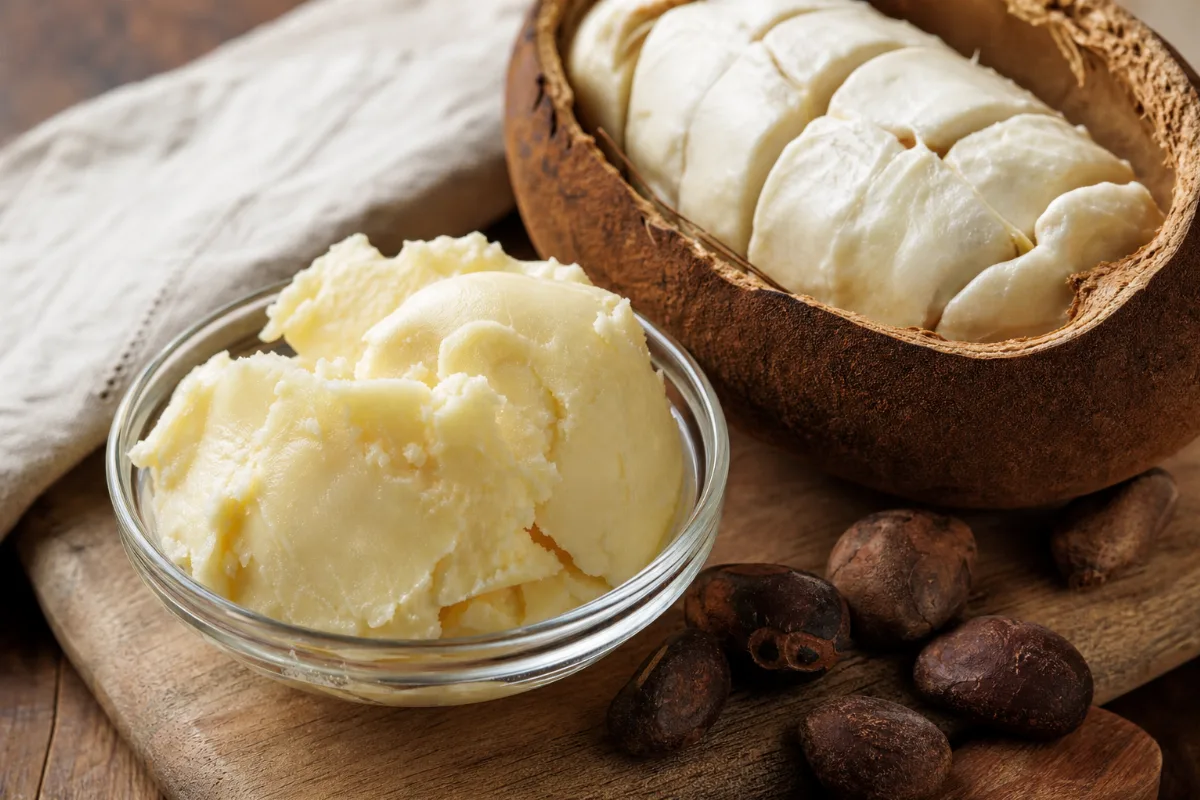
Cupuacu butter is a pale-yellow fat pressed from the seeds of an Amazon tree that is a close relative of the cocoa tree. It is used in creams, body butters and hair and lip products. We found no trial in people. The research is cell and lab work, so claims about healing, sun protection or holding water are not proven. Ask an allergist first if you react to cocoa, and keep it away from burns and open wounds.
General information, not medical advice. Last substantive update · Not medically reviewed. A named clinician has not signed off on this page. How this page is made
About Cupuacu Butter
Cupuacu butter is a solid fat pressed from the seeds of Theobroma grandiflorum, a tree in the same genus as cocoa. It is used mainly as a cosmetic fat. The research is early lab and cell work, so it is best seen as a plain skin fat with unproven extra claims.
What it is
Cupuacu butter is pressed from the seeds of Theobroma grandiflorum (GBIF accepts this name). It is pale yellow. A review gives about 58% saturated, 39% monounsaturated and 3% polyunsaturated fatty acids, mainly oleic and stearic acid.
The same genus includes the cocoa tree, and the fruits look alike. Cupuacu butter and cocoa butter are different fats from different species.
How it is used
It is used in creams, body butters and hair and lip products. A lab study treats it as an industrial fat and suggests refining crude cupuacu fat to improve its stability.
The pulp of the fruit is eaten, and the beans can be made into a chocolate-like product called cupulate. Those are different products from the butter.
What the research shows
There is no human trial. In a dish, the butter changed skin cell numbers and growth-factor genes and helped a scratch close. A seed extract did similar things and did not irritate reconstructed skin. Butter nanoparticles with sugars shifted skin microbes in a dish.
One mouse study of sunscreen gels is described by a review. Two authors of that review work for a company that sells Amazonian products, and the data article on skin cells came from a cosmetics company. Treat these as early signals.
At a glance
Traditional uses history, not proof
- The sources read describe the pulp as a food and the butter as a cosmetic ingredient. No long traditional skin use of the butter is described.
Studied for research
- Skin cells and wound-healing tests in a dish, insufficient
- Moisturising and dry skin (no skin test found), insufficient
- Skin microbes in a dish, insufficient
- Antioxidant tests in a tube, insufficient
- Sun protection in mice and the lab, insufficient
- Other lab screens (enzymes, parasites, cancer cell lines), insufficient
Main compounds
- Oleic acid (about 40 to 46% of the fatty acids)
- Stearic acid (about 33 to 36%)
- Arachidic acid (about 7 to 12%)
- Polyphenols (reported high in crude fat in one paper, low in butter in another)
Common forms
- Crude (unrefined) pressed butter
- Refined butter
- Creams, body butters, lip and hair products that contain it
Research links: Review of rare Amazonian oils, including cupuacu butter (open access) · Lab analysis of murumuru fat, cupuassu fat and pracaxi oil · Cupuassu butter and human skin cells (data article) · Cupuacu seed extract and skin regeneration, lab study · Cupuacu butter nanoparticles and skin microbes, lab study · Safety assessment of 244 plant-derived fatty acid oils (cosmetics panel) · Cocoa and cupuassu pods and seeds, review · Research Library · Genes & Biomarkers Library
What it is and its history
- Accepted scientific name
- Theobroma grandiflorum
- Naming authority
- (Willd. ex Spreng.) Schum.
- Common names
- Cupuacu butter (English); Cupuassu butter (English (alternate spelling)); Cupuacu seed butter (English)
- Family or group
- Malvaceae (mallow family); same genus as the cacao tree
- Classification
- Plantae > Tracheophyta > Magnoliopsida > Malvales > Malvaceae > Theobroma > Theobroma grandiflorum
- Native range
- Native to Brazil in north-east Maranhao and south and south-east Para, and found in the Guianas shield according to a 2022 review.
- Habitat
- A tree of the Amazon region; one review says it is common in jungle regions of northern Brazil, Peru, Colombia and Bolivia.
- What it looks like
- Roots: Not checked.; Stems: A bushy tree 5 to 15 m tall (review).; Leaves: Not checked.; Flowers: Not checked.; Fruit: Oval fruit with a brown shell around white pulp (review). The seeds are pressed for the butter.
- Cultivation
- Not studied in the sources read.
- Harvest and processing
- A 2025 review says the butter is extracted by mechanical pressure from the seeds and is pale yellow. A lab study compared crude fat with refining and suggests refining improves stability; how commercial butters are refined was not described.
- Look-alikes and adulterants
- Name: Cocoa butter; Note: From a related tree, Theobroma cacao. A different fat from a different species.; Name: Other Amazonian butters (murumuru, bacuri); Note: Different plants with different fat mixes; results do not transfer.
- Sustainability and conservation
- Not checked.
Traditional use and history history, not clinical proof
| Tradition or era | Documented use | Source |
|---|---|---|
| Modern use as described in reviews | A 2025 review describes the pulp as used for juice and dessert, and the butter as extracted from the seeds for cosmetic use. The 2022 Foods review says the beans can be made into a chocolate-like product called cupulate. No long traditional skin use of the butter is described in the sources read. | p40863170 |
Traditional use shows how it was used. It does not show that it works or is safe today.
What is inside, and how it may work
What it contains and how those compounds act in cells and animals. Laboratory and animal mechanisms are not proven effects in people.
Main compounds
| Compound | Family | Where it is concentrated | Activity studied | Level of evidence |
|---|---|---|---|---|
| Oleic acid PubChem 445639 | monounsaturated fatty acid | Seed butter About 40 to 46% of the fatty acids (review). | A main fat in the butter. A review links it to wound healing, but it was not tested on its own here. 4 | Review |
| Stearic acid PubChem 5281 | saturated fatty acid | Seed butter About 33 to 36% of the fatty acids (review). | Makes the fat solid. No activity tested. 4 | Review |
| Arachidic acid (eicosanoic acid) PubChem 10467 | saturated fatty acid | Seed butter About 7 to 12% (review). | Higher in cupuacu butter than in other Amazonian butters, per the review. 4 | Review |
| Polyphenols and flavonoids | phenolic compounds | Seed (butter and extract) High in crude fat in one lab paper; low in butter (about 0.12 mg gallic acid equivalents per g) in another. | Antioxidant in tubes; not shown in people. 7 5 | Laboratory research |
| Methylxanthines (theobromine and caffeine) | alkaloids | Beans, not shown for the butter Cupuassu beans held about 0.1 g theobromine and 0.05 g caffeine per 100 g dry weight versus 3.3 and 0.56 in cocoa beans (review). | Food-side information; the butter was not analysed for them in sources read. 3 | Review |
Mechanisms, receptors and pathways
| Target or pathway | Gene or receptor | What was found | Level |
|---|---|---|---|
| Skin cell growth and repair genes | MKI67, ELN, HAS2 (extract); bFGF, SCF, VEGF, HGF, FGF7, EGF (butter) | In skin cells in a dish, the butter and a seed extract changed the activity of repair-related genes and encouraged cell growth and migration. 6 1 | Laboratory research |
| Skin microbes | n/a | Butter nanoparticles with sugars favoured a friendly skin bacterium and slowed two yeasts in a dish. 5 | Laboratory research |
Absorption, metabolism and elimination
- Absorption
- A review says a seed-extract nanocapsule with a chitosan coat doubled the oleic acid that entered skin in a skin explant test. Absorption of the plain butter was not studied in the sources read.
- Distribution
- Not described.
- Metabolism
- Not described.
- Elimination
- Not described.
- Bioavailability
- Not described.
Isolated compounds versus whole extracts
Plain butter, crude versus refined fat, seed extract and lab nanoparticles are different materials. Results for one should not be assumed for another.
Nutritional composition
The butter is mainly saturated and monounsaturated fat. The sources read treat it as a cosmetic and industrial fat, not as a nutrition source.
6 not enough evidence
What was looked at
The 6 benefits and uses checked for Cupuacu Butter, each with how strong the evidence is. Tap one to open it.
- Skin cells and wound-healing tests (lab)Not enough evidence
- Dry skin and moisturising (no skin test found)Not enough evidence
- Skin microbes (lab)Not enough evidence
- Antioxidant tests (lab)Not enough evidence
- Sun protection (mice and lab)Not enough evidence
- Other lab findings (enzymes, parasites, cancer cell lines)Not enough evidence
Lab markers tracked in the studies
Skin cell (fibroblast) number in a dishAntioxidant activity (DPPH test)Sun protection factor (lab SPF)
What is Cupuacu Butter good for?
What the research shows for each use, and how strong it is. All of it is lab or cell work, none in people. Read the Safety tab too.
Benefits, one by one
Each card is a research question, not a promise. Tap a goal to filter. Open a card to see the studies, doses and limits.
Skin cells and wound-healing tests (lab)
Not enough evidenceIn a dish, cupuacu butter made human skin cells (fibroblasts) multiply, helped them close a scratch and changed the activity of growth-factor genes. A seed extract made into lab nanocapsules did similar things and did not irritate reconstructed skin. No animal or human wound trial was found. These results do not show that the butter heals a wound.
3 studiesButter dissolved for cell culture (the amount is in the paper and is …
Studies, doses and limits
What the trials found
No human trial was found. Two cell studies are the base: a data article on fibroblasts treated with the butter, and a study of a seed extract (not the butter) in nanocapsules.
Results
Butter on fibroblasts: significant effects on cell numbers, growth-factor gene activity and scratch closure at 18 hours versus untreated cells (graphs in the paper; the abstract has no numbers). Seed extract: more cell growth and migration, higher MKI67, ELN and HAS2 gene activity, and no irritation of reconstructed human epidermis.
Effect sizes as reported
No effect sizes in the abstracts.
Why this rating
Cell studies only. One tested the butter, the other a seed extract in a lab formulation. No animals or people. One group of authors works for a cosmetics company.
Form and dose studied
Butter dissolved for cell culture (the amount is in the paper and is not given here); seed extract in chitosan-coated nanocapsules.
Who was studied
Human skin cells in a dish and reconstructed human epidermis; not people.
Limits
A cell result does not show healing in a person. The butter is not a treatment for burns or open wounds. The 2025 review that describes these studies has authors tied to a company that sells Amazonian products.
Why researchers looked
Cupuacu butter is rich in oleic acid, and a review suggests this may help wound healing. Researchers tested whether it changes how skin cells behave.
Traditional use
The sources read describe the pulp as a food and the butter as a cosmetic ingredient; they describe no long traditional skin use of the butter.
Proposed mechanism Laboratory research
Suggested by a review: oleic acid and other components may affect skin cell growth and repair genes. Not tested as the cause.
A proposed mechanism does not show that the effect happens in people.
No trial in people has tested this butter, so skin allergy and irritation rates are unknown. Patch test first, and see the Safety tab.
Dry skin and moisturising (no skin test found)
Not enough evidenceCupuacu butter is used in creams as a moisturising fat. We found no trial in people, and no lab paper, that measured skin moisture, dryness or water loss with it. Some sellers say it can take up several times its weight in water. No source we read states or measures this.
2 studiesButter in creams, body butters and lip or hair products; amounts vary…
Studies, doses and limits
Results
No result to report. No skin hydration, dryness or water-loss measurement of cupuacu butter was found.
Why this rating
A claim without a skin test. Seller figures about water uptake could not be traced to a published method.
Form and dose studied
Butter in creams, body butters and lip or hair products; amounts vary by product.
Who was studied
Not studied.
Limits
The claim rests on general knowledge of fats and on seller material, not on a test of this butter.
Why researchers looked
It is a solid fat made mostly of oleic and stearic acid, a kind of fat used in many skin creams. Reviews call it an emollient, which means a skin softener.
Traditional use
The sources read describe the pulp as a food and the butter as a cosmetic ingredient; they describe no long traditional skin use of the butter.
Proposed mechanism Pharmacological theory
Any fat can soften skin and slow water loss. This butter has not been compared with other fats in a skin test.
A proposed mechanism does not show that the effect happens in people.
No trial in people has tested this butter, so skin allergy and irritation rates are unknown. Patch test first, and see the Safety tab.
Skin microbes (lab)
Not enough evidenceLab-made nanoparticles of cupuacu butter with added sugars helped a friendly skin bacterium grow and slowed a yeast in a dish. The butter nanoparticles alone slowed another yeast, Candida albicans. This is early formulation work. It does not show a change in the skin of a person.
1 studiesNanoparticles about 110 nm across made of cupuacu butter with or with…
Studies, doses and limits
Results
The version with alpha-glucan sugar stimulated Staphylococcus epidermidis and inhibited Malassezia furfur; the butter nanoparticles alone inhibited Candida albicans. The formulations showed neither eye irritation nor phototoxicity potential in the screens.
Effect sizes as reported
No effect sizes in the abstract.
Why this rating
One lab paper (2026) on lab-made nanoparticles; the authors call for clinical trials.
Form and dose studied
Nanoparticles about 110 nm across made of cupuacu butter with or without sugars.
Who was studied
Microbes in a dish.
Limits
The test product is not butter you can buy. Funding is not stated in the abstract.
Why researchers looked
The skin has a community of microbes. Researchers asked if butter-based carriers with prebiotic sugars could support the helpful ones.
Traditional use
The sources read describe the pulp as a food and the butter as a cosmetic ingredient; they describe no long traditional skin use of the butter.
Proposed mechanism Laboratory research
Prebiotic sugars may feed some microbes. Not shown in people.
A proposed mechanism does not show that the effect happens in people.
No trial in people has tested this butter, so skin allergy and irritation rates are unknown. Patch test first, and see the Safety tab.
Antioxidant tests (lab)
Not enough evidenceIn test-tube tests the butter showed moderate antioxidant activity (about 20% in one test) and low levels of phenolic compounds. It gave intermediate protection against UVA-induced reactive oxygen species in the same lab paper. A separate lab analysis found a high polyphenol content in the crude fat. The two papers do not agree on how rich in polyphenols it is, so no firm statement is made.
2 studiesButter or crude fat samples tested in the lab.
Studies, doses and limits
Results
About 20% DPPH scavenging and phenolics of about 0.12 mg gallic acid equivalents per g were reported in one lab paper; another lab paper reported high polyphenol content in crude cupuassu fat without a figure in its abstract.
Effect sizes as reported
No effect sizes.
Why this rating
Test-tube results on different samples that point in different directions.
Form and dose studied
Butter or crude fat samples tested in the lab.
Who was studied
Chemicals in a tube.
Limits
Antioxidant activity in a tube does not mean a benefit when used on skin.
Why researchers looked
Fats from seeds can hold natural compounds that mop up reactive molecules. Researchers measured this.
Traditional use
The sources read describe the pulp as a food and the butter as a cosmetic ingredient; they describe no long traditional skin use of the butter.
Proposed mechanism Laboratory research
Chemical tests of scavenging. Not shown to protect skin or the body in people.
A proposed mechanism does not show that the effect happens in people.
No trial in people has tested this butter, so skin allergy and irritation rates are unknown. Patch test first, and see the Safety tab.
Sun protection (mice and lab)
Not enough evidenceA review describes gels with 5 to 20% cupuacu butter that gave lab sun-protection values of about 9 to 12 and, in mice, less skin damage after UVB light. This is described through a review only. It is not a tested sunscreen and the butter should not be used as one.
1 studiesEmulgels with the butter, as described in the review.
Studies, doses and limits
Results
Emulgels with 5, 10 and 20% cupuacu butter had lab SPF values of 9.44, 9.63 and 11.67. Treated mice had less damage and lower severity, described as comparable to a commercial standard.
Effect sizes as reported
No effect sizes beyond the SPF values.
Why this rating
Mouse and lab data passed on by a review whose authors have commercial ties. The original study was not read.
Form and dose studied
Emulgels with the butter, as described in the review.
Who was studied
Mice and lab samples.
Limits
SPF values from a lab are not proof of protection on human skin. Not a sunscreen.
Why researchers looked
Researchers tried butter in a gel to see if it protects skin from UV light.
Traditional use
The sources read describe the pulp as a food and the butter as a cosmetic ingredient; they describe no long traditional skin use of the butter.
Proposed mechanism Laboratory research
Not described in the review beyond the results.
A proposed mechanism does not show that the effect happens in people.
No trial in people has tested this butter, so skin allergy and irritation rates are unknown. Patch test first, and see the Safety tab.
Other lab findings (enzymes, parasites, cancer cell lines)
Not enough evidenceThe same review lists lab findings for cupuacu fatty acids, seed extract or seed compounds: moderate blocking of an enzyme linked to memory loss, a 20 to 24% slowing of the malaria parasite in a dish, moderate toxicity to colon cancer cells for one seed compound, and strong blocking of a starch-digesting enzyme. All are test-tube or dish results on different materials. None shows an effect in a person and none is a reason to use the butter.
1 studiesNot applicable.
Studies, doses and limits
Results
As listed in the review: about 40 to 48% inhibition of acetylcholinesterase by cupuacu fatty acids; 20 to 24% inhibition of Plasmodium falciparum growth by an oily seed extract; theograndin II from the seed moderately toxic to colon cancer cell lines; 97% inhibition of alpha-amylase attributed to seed butter. The original papers were not read.
Effect sizes as reported
Percentages are lab inhibition values, not effects in people.
Why this rating
Second-hand lab results on different materials (fatty acids, extract, a seed compound, butter).
Who was studied
Enzymes, parasites and cell lines.
Limits
Passed on through one review; the original papers were not read, so the materials tested are not independently confirmed.
Why researchers looked
Researchers screen seed fats and extracts for many lab activities.
Traditional use
The sources read describe the pulp as a food and the butter as a cosmetic ingredient; they describe no long traditional skin use of the butter.
Proposed mechanism Laboratory research
Enzyme and cell tests as described in the review.
A proposed mechanism does not show that the effect happens in people.
No trial in people has tested this butter, so skin allergy and irritation rates are unknown. Patch test first, and see the Safety tab.
Connections to the rest of health
How Cupuacu Butter connects to the rest of our health knowledge graph. Every link says what kind of connection it is. A safety link (for example to the liver) is a warning, not a benefit. A study that merely mentions a topic never creates a benefit link.
Explore every connection: goals, body systems, organs, symptoms, genes
A. Wellness goals
| Connected to | Kind of connection | Evidence status | Context | Studies |
|---|---|---|---|---|
| Healthy Skin | Preliminary mechanism | Not enough evidence | Skin cells and wound-healing tests (lab): In a dish, cupuacu butter made human skin cells (fibroblasts) multiply, helped them close a scratch and changed the activity of growth-factor genes. A seed extract made into lab nanocapsules did similar things and did not irritate reconstructed skin. No animal or human wound trial was found. These results do not show that the butter heals a wound. Skin microbes (lab): Lab-made nanoparticles of cupuacu butter with added sugars helped a friendly skin bacterium grow and slowed a yeast in a dish. The butter nanoparticles alone slowed another yeast, Candida albicans. This is early formulation work. It does not show a change in the skin of a person. | 6 1 4 5 |
| Wound Healing | Preliminary mechanism | Not enough evidence | Skin cells and wound-healing tests (lab): In a dish, cupuacu butter made human skin cells (fibroblasts) multiply, helped them close a scratch and changed the activity of growth-factor genes. A seed extract made into lab nanocapsules did similar things and did not irritate reconstructed skin. No animal or human wound trial was found. These results do not show that the butter heals a wound. | 6 1 4 |
| Healthy Skin | Not enough evidence | Dry skin and moisturising (no skin test found): Cupuacu butter is used in creams as a moisturising fat. We found no trial in people, and no lab paper, that measured skin moisture, dryness or water loss with it. Some sellers say it can take up several times its weight in water. No source we read states or measures this. | 4 7 | |
| Microbiome Balance | Preliminary mechanism | Not enough evidence | Skin microbes (lab): Lab-made nanoparticles of cupuacu butter with added sugars helped a friendly skin bacterium grow and slowed a yeast in a dish. The butter nanoparticles alone slowed another yeast, Candida albicans. This is early formulation work. It does not show a change in the skin of a person. | 5 |
| Cellular Protection | Preliminary mechanism | Not enough evidence | Antioxidant tests (lab): In test-tube tests the butter showed moderate antioxidant activity (about 20% in one test) and low levels of phenolic compounds. It gave intermediate protection against UVA-induced reactive oxygen species in the same lab paper. A separate lab analysis found a high polyphenol content in the crude fat. The two papers do not agree on how rich in polyphenols it is, so no firm statement is made. | 5 7 |
B. Body systems
| Connected to | Kind of connection | Evidence status | Context | Studies |
|---|---|---|---|---|
| Skin Hair Beauty | Biological association | Not enough evidence | Studied for: Skin cells and wound-healing tests (lab) Studied for: Dry skin and moisturising (no skin test found) | 6 1 4 7 5 |
| Integumentary System | Biological association | Not enough evidence | Studied for: Skin cells and wound-healing tests (lab) | 6 1 4 |
C. Body parts and organs
| Connected to | Kind of connection | Evidence status | Context | Studies |
|---|---|---|---|---|
| Skin | Adverse effect or risk | Not enough evidence | No allergy data exist; lab screens found no irritation of reconstructed skin for a seed extract formulation. Preparation or compound: Butter on skin |
1 |
| Skin | Biological association | Not enough evidence | Skin-cell and reconstructed-skin lab studies; no trial in people. Preparation or compound: Butter or seed extract, cells in a dish |
6 1 |
I. Biomarkers
| Connected to | Kind of connection | Evidence status | Context | Studies |
|---|---|---|---|---|
| Skin cell (fibroblast) number in a dish | Biological association | Not enough evidence | Measured in trials: raised (in cells). A lab change is not the same as a health benefit. | 6 1 |
| Antioxidant activity (DPPH test) | Biological association | Not enough evidence | Measured in trials: moderate. A lab change is not the same as a health benefit. | 5 |
| Sun protection factor (lab SPF) | Biological association | Not enough evidence | Measured in trials: reported. A lab change is not the same as a health benefit. | 4 |
J. Genes, receptors and enzymes
| Connected to | Kind of connection | Evidence status | Context | Studies |
|---|---|---|---|---|
| HAS2 (hyaluronic acid synthase 2) and ELN (elastin) | Preliminary mechanism | In vitro | Higher activity in skin cells treated with a cupuacu seed extract. | 1 |
L. Active compounds
| Connected to | Kind of connection | Evidence status | Context | Studies |
|---|---|---|---|---|
| Oleic acid | Biological association | Review | A main fat in the butter. A review links it to wound healing, but it was not tested on its own here. Preparation or compound: Seed butter |
4 |
| Stearic acid | Biological association | Review | Makes the fat solid. No activity tested. Preparation or compound: Seed butter |
4 |
| Arachidic acid (eicosanoic acid) | Biological association | Review | Higher in cupuacu butter than in other Amazonian butters, per the review. Preparation or compound: Seed butter |
4 |
| Polyphenols and flavonoids | Biological association | In vitro | Antioxidant in tubes; not shown in people. Preparation or compound: Seed (butter and extract) |
7 5 |
| Methylxanthines (theobromine and caffeine) | Biological association | Review | Food-side information; the butter was not analysed for them in sources read. Preparation or compound: Beans, not shown for the butter |
3 |
Each connection is stored with the ingredient, the connected record, the kind of connection, the evidence status, the supporting studies, the preparation or compound involved, and a review date (last reviewed October 25, 2026).
Evidence at a glance: what the research found for 6 outcomes
Each outcome below is one thing researchers measured. Certainty is how far the evidence can be trusted, not how well it works. The full studies are on the next tab.
The evidence
The research centre for Cupuacu Butter. Every record here was checked against PubMed or the publisher's page; we never list a study we have not verified.
Evidence by outcome
Bars show how many studies we found for each outcome, not how well it works. People are added up across trials only (reviews are not added, to avoid double counting).
How we rate evidence
High certainty
Several well-run trials or reviews agree; further research is unlikely to change the picture much.
Moderate certainty
Good trials point the same way, but some doubt remains.
Low certainty
Small, short or inconsistent trials. The finding could change with better research.
Very low certainty
Very little or very weak human data. Treat as a possibility only.
Mixed findings
Trials or reviews disagree with each other.
Not enough evidence
Not enough human research to say either way.
Evidence against
Good research found no benefit, or found harm.
We take the reviewers' own risk-of-bias and GRADE statements where they exist, and otherwise judge from study size, design, consistency, directness and whether a product matches what is sold. Many publications do not make evidence high. Method note: We read PubMed abstracts of 6 papers and the open-access full text of two reviews and one data article, and checked the plant name in GBIF and compounds in PubChem. Certainty ratings are the compiler's own reading. Funding is not stated in most abstracts. No study is cited that we could not verify.
Study library: every study we checked 8
| Study | Design | People | Product, dose, length | Result |
|---|---|---|---|---|
| Barbalho 2022 Skin Regenerative Potential of Cupuacu Seed Extract (Theobroma grandiflorum), a Native Fruit from the Amazon: Development of a Topical Formulation Based on Chitosan-Coated Nanocapsules. Pharmaceutics · PMID 35057102 · DOI |
Laboratory research cells |
Human skin cells in a dish and reconstructed human epidermis | Cupuacu seed extract (not the butter) in nanocapsules coated with chitosan seed extract |
The extract significantly stimulated cell growth and migration. Genes for a growth marker (MKI67), elastin (ELN) and hyaluronic acid synthase 2 (HAS2) were high after treatment. The nanocapsules held more than 94% of the extract, stayed stable for at least 120 days, and were non-irritating to reconstructed human epidermis. Methods, limits and fundingOutcomes: Cell growth and migration, gene activity (MKI67, ELN, HAS2), particle size and stability, irritation of reconstructed skin. Limitations: This tested a seed extract made into a lab formulation, not the butter. Cells and a reconstructed skin model only. No animals or people. Funding and conflicts: The authors declare no conflict of interest. Read: abstract |
| Burnett 2017 Safety Assessment of Plant-Derived Fatty Acid Oils. Int J Toxicol · PMID 29243540 · DOI |
Expert panel safety review review |
Cosmetic ingredient safety review of 244 plant-derived fatty acid oils | 244 plant-derived fatty acid oils as used in cosmetics oils (class review) |
The Cosmetic Ingredient Review Expert Panel concluded that the 244 plant-derived fatty acid oils are safe as used in cosmetics. The abstract says the review focused on skin effects because many of the oils are edible and their toxicity throughout the body is low. The abstract does not list the oils. Methods, limits and fundingOutcomes: Safety of the oils as used in cosmetics, mainly skin effects. Limitations: Only the abstract was read. It does not say whether cupuacu butter is among the 244 oils or what use levels were reviewed. A class-level conclusion, not a test of this butter. Funding and conflicts: The panel is run by an industry-funded body (Cosmetic Ingredient Review); funding details are not in the abstract. Read: abstract |
| Jean-Marie 2022 Theobroma cacao and Theobroma grandiflorum: Botany, Composition and Pharmacological Activities of Pods and Seeds. Foods · PMID 36553708 · DOI |
Narrative review review |
Review of cocoa and cupuassu pods and beans | Cocoa and cupuassu pods and beans pods, beans |
Cocoa and cupuassu are evergreen Amazonian trees of the genus Theobroma. The full text says cupuassu is native to north-east Maranhao and south and south-east Para in Brazil, and that cupuassu beans can be turned into a chocolate-like product called cupulate. In one comparison of beans, cocoa beans held much more theobromine (3.3 versus 0.1 g per 100 g dry weight) and caffeine (0.56 versus 0.05 g per 100 g) than cupuassu beans. Theophylline was not detected in cupuassu. Methods, limits and fundingOutcomes: Botany, composition (polyphenols, methylxanthines) and pharmacological properties of pods and beans. Limitations: About pods and beans, not the butter. It says nothing about allergy or about skin use of the butter. Funding and conflicts: The authors declare no conflict of interest. Read: abstract + full text (open-access) |
| Merckling-Almeida da Silva 2025 Review of Biological Activities of Some Rare Oils from Amazonian Plants. Metabolites · PMID 40863170 · DOI |
Narrative review review |
Literature review of six Amazonian oils and butters, including cupuacu butter | Cupuacu (Theobroma grandiflorum) seed butter and seed extract, as described in other papers seed butter / seed extract |
The review lists lab, cell and mouse findings for cupuacu seed butter and extract. It reports that cupuacu butter is pressed from the seeds, is pale yellow, and has about 58% saturated, 39% monounsaturated and 3% polyunsaturated fatty acids, mainly oleic and stearic acid. It describes skin-cell results from two papers and a mouse sunscreen study with emulgels holding 5, 10 and 20% butter (reported lab SPF 9.44, 9.63 and 11.67). It states that clinical trials in people are needed. Methods, limits and fundingOutcomes: Reported biological activities of cupuacu butter (antioxidant, wound healing, emollient, sun protection, others). Limitations: A narrative review that mostly repeats other papers. Its statement that the butter is an excellent emollient rests on references that are not trials of skin hydration. No human trial of the butter is described. Funding and conflicts: Two authors are the owner and an employee of Dumato, a company that specialises in Amazonian natural products. The other authors declare no conflicts. Read: full-text (open-access) |
| Riccio 2026 Cupuacu (Theobroma grandiflorum) butter nanoparticles associated with oligosaccharides as cosmetic carriers for prebiotic effect: development, physicochemical characterization, and preclinical evaluation. Eur J Pharm Biopharm · PMID 42178033 · DOI |
Laboratory research lab |
Lab-made nanoparticles tested in a dish and in standard safety screens | Cupuacu butter nanoparticles, alone or with added sugars (alpha-glucan oligosaccharide or polydextrose) seed butter formulation |
The nanoparticles were about 110 nm across. The formulations showed neither eye irritation nor phototoxicity potential in the screens. In a dish, the version with the alpha-glucan sugar stimulated the friendly skin bacterium Staphylococcus epidermidis and slowed the yeast Malassezia furfur, while the butter nanoparticles alone slowed Candida albicans. Antioxidant activity was moderate (about 20% in a DPPH test), the butter held low phenolic compounds (about 0.12 mg gallic acid equivalents per g) and gave intermediate protection against UVA-induced reactive oxygen species. Methods, limits and fundingOutcomes: Particle size and structure, eye irritation and phototoxicity screens (OECD TG 491 and 432), effects on skin microbes, antioxidant tests. Limitations: Lab-made nanoparticles, not plain butter on skin. Dish and screening tests only. The authors call for tests in more complex systems such as clinical trials. Funding and conflicts: Funding and conflicts are not stated in the abstract. Read: abstract |
| Sano 2018 Effect of cupuassu butter on human skin cells. Data Brief · PMID 30370321 · DOI |
Laboratory research cells |
Normal human skin fibroblasts in a dish (cell line NB1RGB) | Cupuassu butter dissolved for cell culture, bought from a cosmetic ingredient supplier seed butter Low concentrations (0.1 to 10 micrograms per mL) in a dish 24 hours; wound scratch read at 18 hours · vs Untreated cells |
The data article reports cell numbers, growth-factor gene activity and scratch closure after exposure to the butter, with several results marked significant against untreated cells (p<0.05 or lower). A 2025 review describes the butter as having a significant proliferative effect on the fibroblasts at 0.1 to 10 micrograms per mL, better cell migration in the scratch test, and altered growth-factor gene activity. The abstract itself gives no numbers. Results in cells only; size and direction varied by gene and time and are shown in graphs. Methods, limits and fundingOutcomes: Cell number (calcein assay), growth-factor gene activity (bFGF, SCF, VEGF, HGF, FGF7, EGF), scratch closure. Limitations: Cells in a dish, three repeats, no animals or people. A cell result does not show that rubbing the butter on skin heals a wound. Data article with limited discussion. Funding and conflicts: Authors work for ALBION Co. Ltd., a cosmetics company. The butter was bought from Croda Japan. Read: full-text (open-access) |
| Souza 2024 Comprehensive analysis of Amazonian oil and fats with different fatty composition: Murumuru fat (Astrocaryum murumuru), cupuassu fat (Theobroma grandiflorum), and pracaxi oil (Pentaclethera macroloba). Food Res Int · PMID 39614543 · DOI |
Laboratory analysis lab |
Samples of crude murumuru fat, cupuassu fat and pracaxi oil | Crude cupuassu fat from T. grandiflorum seeds seed fat |
The fats were mostly yellow with high total lipid and a high share of triacylglycerols, low water content and low acid value. Cupuassu fat had a high content of polyphenols. Murumuru and cupuassu fats had high levels of calcium, iron, magnesium and phosphorus, which speed up oxidation, although they resisted oxidation better than pracaxi oil and other conventional fat sources because of their higher saturated fat share. For the crude fats, the authors suggest further refining to improve oxidative stability by also lowering the metal levels. Methods, limits and fundingOutcomes: Colour, lipid content, water content, acid value, polyphenols, metals, oxidation behaviour. Limitations: A lab analysis of a small set of samples. Nothing about people, skin or safety. The authors describe the fats as excellent alternatives to palm oil, which is an opinion about industry use. Funding and conflicts: The authors declare no competing interests. Read: abstract |
| n/a 2026 GBIF Backbone Taxonomy: Theobroma grandiflorum (Willd. ex Spreng.) Schum. (accepted name) n/a · Source |
Authoritative guidance n/a |
n/a | n/a |
Accepted: Theobroma grandiflorum (Willd. ex Spreng.) Schum., key 3152208, family Malvaceae, order Malvales. Methods, limits and fundingOutcomes: Accepted scientific name and family. Limitations: A database record. Read: api |
What we do not know yet
- What the evidence supports: insufficient for every use. No human trial.
- No patch-test or allergy data, and nothing on cocoa cross-allergy.
- No skin-moisture test and no check of the water-holding claims.
- No data on pregnancy, breastfeeding, babies, pets or interactions; regulators outside the cosmetics panel were not checked.
How new research is added
New studies are found by a saved PubMed search and placed in a review queue. A person reads each one before it changes any rating or safety wording.
Lab markers
What changed in blood or saliva tests during trials. A changed number is not the same as feeling or being healthier, and we give no "normal ranges".
Other 3
Skin cell (fibroblast) number in a dish
Raised (in cells) in trials
How many fibroblasts, the cells that make the skin's supporting tissue, are alive in the dish after treatment.
Not enough evidenceResults and what it means
Why it was measured
A lab way to see if a substance helps skin cells multiply.
Statistical vs. clinical meaning
Dish results only.
Safety implication
None reported.
| Study | Result | People | Product |
|---|---|---|---|
| 6 | Cell numbers and growth-factor gene activity were changed with significant results marked against untreated cells; the numbers are in graphs and not in the abstract. | Normal human skin fibroblasts (cell line) | Cupuassu butter at low concentrations for 24 hours |
| 1 | The seed extract (not the butter) significantly stimulated cell growth and migration and raised MKI67, ELN and HAS2 gene activity. | Human skin cells | Cupuacu seed extract |
Antioxidant activity (DPPH test)
Moderate in trials
A test-tube test of how well a sample neutralises a test molecule.
Not enough evidenceResults and what it means
Sun protection factor (lab SPF)
Reported in trials
A lab number that estimates how much a product reduces sunburn-causing UVB light.
Not enough evidenceResults and what it means
Why it was measured
A standard way to rate sunscreens.
Statistical vs. clinical meaning
Lab values do not equal protection in people.
Safety implication
Not a sunscreen.
| Study | Result | People | Product |
|---|---|---|---|
| 4 | Lab SPF 9.44, 9.63 and 11.67 for gels with 5, 10 and 20% butter, as reported by the review. | Lab samples and mice | Cupuacu butter emulgels |
Safety
What studies and official sources say about side effects, medicines and who should check first. Each point shows what kind of evidence it comes from.
Main points to know 5
- Nobody has tested this butter for safety in people. No patch test, allergy study or safety trial of cupuacu butter in people was found. How often it irritates or causes allergy is unknown. A patch test of a small area before wider use is sensible, as for any new skin product. Insufficient 4
- A panel found 244 plant oils safe as used in cosmetics. The Cosmetic Ingredient Review panel concluded that 244 plant-derived fatty acid oils are safe as used in cosmetics. The abstract does not list the oils, so it is not confirmed that cupuacu butter was included or what use levels were reviewed. The panel is part of the cosmetics industry's own review system. Expert review 2
- Lab screens found no eye irritation or phototoxicity. Lab-made nanoparticles of cupuacu butter showed neither eye irritation nor phototoxicity potential in standard screens, and a seed extract in nanocapsules did not irritate reconstructed human skin. These were lab formulations tested in screening systems, not the butter you buy and not people. Laboratory research 5 1
- Cell results do not make it a wound treatment. Cell-dish results about wound healing are not a reason to put the butter on burns or open wounds. Ask a clinician about wound care. Laboratory research 6 1
- Cocoa relative: allergy is not addressed. Cupuacu is a close relative of cocoa (same genus, Theobroma). No source we read says whether people with cocoa or chocolate allergy react to the butter. That means unknown, not safe. Ask an allergist if you react to cocoa. Insufficient 3
Side effects 1
| Effect | How often | Severity and recovery | Evidence |
|---|---|---|---|
| Skin irritation or allergy Absence of reports is not proof of safety. | Not known; none reported in the sources read | Not described Not described | Insufficient |
Liver
No source read describes liver injury from cupuacu butter. LiverTox was not searched. Skin use is the studied use.
How often. Not known.
This is a safety connection. It is not evidence that Cupuacu Butter supports liver health.
Medicines and supplements 1
| With | Why it matters | Importance | Evidence | What to do |
|---|---|---|---|---|
| Medicines and skin products prescription | No interaction was described in the sources read. | None documented. | Insufficient Not enough evidence | Tell your pharmacist or doctor what you put on your skin, especially if you use medicated creams. |
Who should check first 6
| Situation | Advice | Evidence |
|---|---|---|
| Known allergy to cocoa, chocolate, other Theobroma products, or earlier reaction to plant butters | No source covers this. Ask an allergist first and do a small patch test. Stop if there is rash, swelling or itching. | Insufficient 3 |
| Burns, open wounds or broken skin | Cell-dish results do not support use here. Ask a clinician. | Laboratory research 6 1 |
| Pregnancy and breastfeeding | No source read covers use of the butter. Ask a doctor or midwife. | Insufficient |
| Babies and children | No source read covers use of the butter. Ask a doctor or pharmacist. | Insufficient |
| Pets | Not covered by any source read. Ask a vet before using it near animals. | Insufficient |
| Using it as a sunscreen | Lab and mouse numbers are not a tested sunscreen. Use a product sold as a sunscreen. | Laboratory research 4 |
Overdose, product quality and regulators
Summary. No poisoning from cupuacu butter is described in the sources read. Neither is a safe limit for swallowing it.
Animal. Mouse sunscreen study described in a review; no toxicity data were read.
High dose or long term signals. Not found in the sources read.
Overdose response. Not described.
Genotoxicity. Not read.
Toxic or hazardous parts. Not described in the sources read.
Quality has been studied in the lab only. The crude fat has metals and polyphenols that speed oxidation, so it can turn rancid.
Metals and oxidation of crude fat. Crude cupuassu fat had high calcium, iron, magnesium and phosphorus. These speed oxidation, though the fat resisted oxidation better than pracaxi oil and other conventional fat sources. The authors suggest refining to improve stability. 7
No product testing for pesticides or heavy metals found. No analysis of toxic metals, pesticides or adulteration in market butters was found.
| Body | Action | Date |
|---|---|---|
| Cosmetic Ingredient Review Expert Panel (United States (industry-funded panel)) | Concluded that 244 plant-derived fatty acid oils are safe as used in cosmetics. Whether cupuacu butter is among them is not stated in the abstract. source | 2017-11 |
When to get medical help
- Swelling of the lips, tongue or face, wheezing or trouble breathing after using it: call emergency services now.
- Spreading rash, hives or blistering: stop using it and get medical advice.
- A wound that is red, hot, swollen or leaking after something was put on it: get medical advice.
Stop using the product and contact a clinician or emergency service. In the US, Poison Control is 1-800-222-1222.
General information only, not medical advice. Ask a clinician or pharmacist before use, especially with medicines, in pregnancy or with a health condition. See the Natural Remedy Safety guide.
Frequently asked questions
What is cupuacu butter?
Is it the same as cocoa butter?
No. Both come from trees of the genus Theobroma, but they are different species and different fats. Cupuassu beans have much less theobromine and caffeine than cocoa beans.
Does it moisturise skin?
It is used as a softening fat, but we found no test of skin moisture or dryness with it. Reviews call it an emollient without such a test.
Is it true it holds many times its weight in water?
Sellers sometimes say so. No source we read states or measures this. The one lab analysis we read found low water content in the fat itself.
Does it heal wounds or scars?
Can it be used as a sunscreen?
No. A review describes gels with the butter that had lab SPF values of about 9 to 12 and less damage in mice. That is not a tested sunscreen.
Can I be allergic to it?
Is it safe for the skin?
Is it safe in pregnancy, for babies or for pets?
No source we read covers pregnancy, breastfeeding, babies or pets. That is not the same as safe. Ask a doctor, pharmacist or vet.
Does it interact with medicines?
No interaction was found in the sources read, which is not proof there is none. Tell your pharmacist what you put on your skin.
Does it go rancid, and is refined better?
Crude cupuassu fat held metals that speed oxidation, though it resisted oxidation better than some other fats. The authors suggest refining improves stability. No trial compared them on skin.
Explore by health goal
Healthy SkinWound HealingMicrobiome BalanceCellular Protection
Editorial transparency
- Written by
- AlternativeMed editorial team. Research compiled with AI assistance, then checked against PubMed records.
- Medical review
- None. This page has not been reviewed by a physician or pharmacist.
- First published
- 2026-10-25
- Last substantive update
- 2026-10-25
- How we research
- We read PubMed abstracts of 6 papers and the open-access full text of two reviews and one data article, and checked the plant name in GBIF and compounds in PubChem. Certainty ratings are the compiler's own reading. Funding is not stated in most abstracts. No study is cited that we could not verify.
- How we rate evidence
- See "How we rate evidence" in the Evidence tab.
- Independence
- No product is promoted on this page. No affiliate links are shown.
Sources 8
Each source was opened and checked. Where we read only the abstract, it says so. The small numbers in the text point here.
- Barbalho GN, Matos BN, da Silva Brito GF et al. Skin Regenerative Potential of Cupuacu Seed Extract (Theobroma grandiflorum), a Native Fruit from the Amazon: Development of a Topical Formulation Based on Chitosan-Coated Nanocapsules.. Pharmaceutics. 2022. PMID 35057102. DOI 10.3390/pharmaceutics14010207. (abstract)
- Burnett CL, Fiume MM, Bergfeld WF et al. Safety Assessment of Plant-Derived Fatty Acid Oils.. Int J Toxicol. 2017. PMID 29243540. DOI 10.1177/1091581817740569. (abstract)
- Jean-Marie E, Jiang W, Bereau D et al. Theobroma cacao and Theobroma grandiflorum: Botany, Composition and Pharmacological Activities of Pods and Seeds.. Foods. 2022. PMID 36553708. DOI 10.3390/foods11243966. (abstract + full text (open-access))
- Merckling-Almeida da Silva L, Merckling N, Bigi E et al. Review of Biological Activities of Some Rare Oils from Amazonian Plants.. Metabolites. 2025. PMID 40863170. DOI 10.3390/metabo15080554. (full-text (open-access))
- Riccio BVF, Debiasi BW, Silva IJD et al. Cupuacu (Theobroma grandiflorum) butter nanoparticles associated with oligosaccharides as cosmetic carriers for prebiotic effect: development, physicochemical characterization, and preclinical evaluation.. Eur J Pharm Biopharm. 2026. PMID 42178033. DOI 10.1016/j.ejpb.2026.115119. (abstract)
- Sano K, Kawanobe H, Someya T. Effect of cupuassu butter on human skin cells.. Data Brief. 2018. PMID 30370321. DOI 10.1016/j.dib.2018.10.026. (full-text (open-access))
- Souza PT, Pereira GSL, Almeida RF et al. Comprehensive analysis of Amazonian oil and fats with different fatty composition: Murumuru fat (Astrocaryum murumuru), cupuassu fat (Theobroma grandiflorum), and pracaxi oil (Pentaclethera macroloba).. Food Res Int. 2024. PMID 39614543. DOI 10.1016/j.foodres.2024.115022. (abstract)
- n/a. GBIF Backbone Taxonomy: Theobroma grandiflorum (Willd. ex Spreng.) Schum. (accepted name). n/a. 2026. (api)
Where to buy
Check the label first. Whatever you buy, look for these:
- 100% pure with no added fragrance or fillers
- Cold-pressed or unrefined if you want the most natural form
- For skin use, do a small patch test first
- Cosmetic or food grade, matched to how you will use it
Talk to a pharmacist or doctor before you start any supplement, especially if you take medicines. See the Safety tab for interactions.
Support our free guides: as an Amazon Associate we earn from qualifying purchases. Full disclosure.


