Natural Oils & Butters · Butter
Kokum Butter
Garcinia indica (Thouars) Choisy (seed butter) · also called Kokam butter, Goa butter, kokum fat, kokum gurgi.
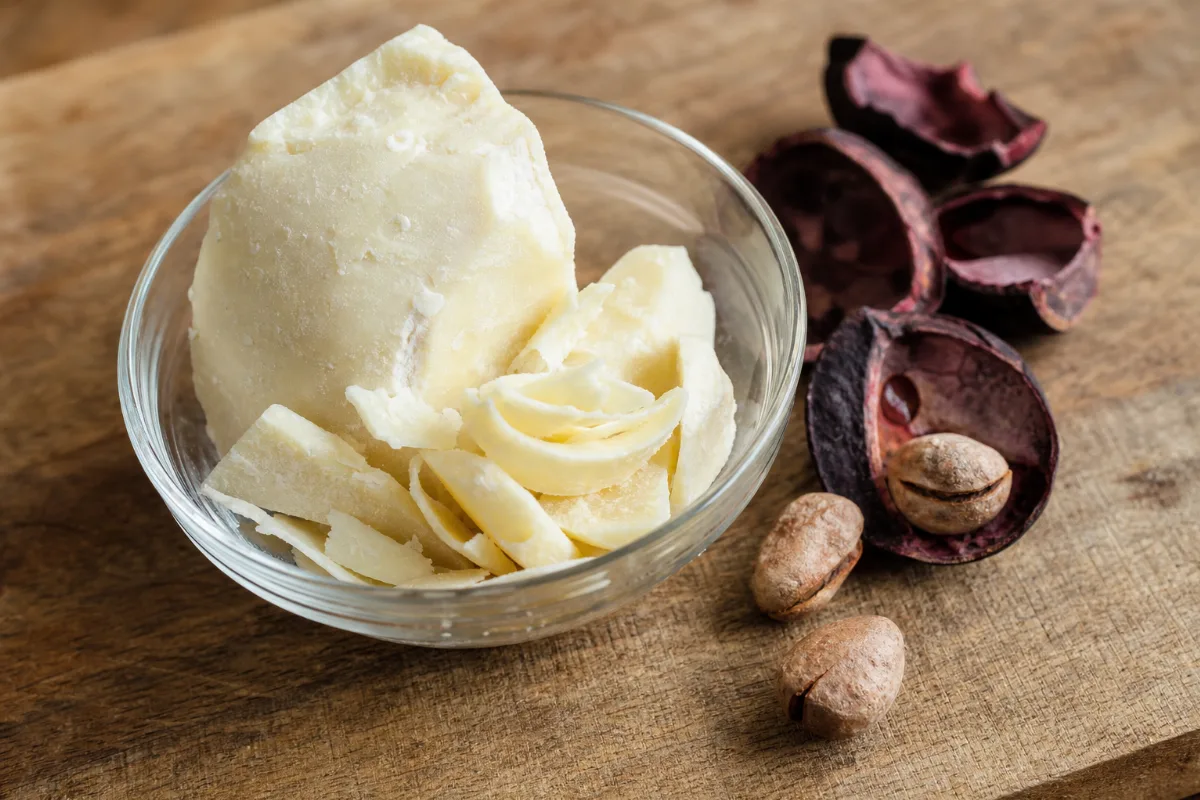
Kokum butter is a hard, pale fat pressed or boiled out of the seeds of the kokum tree, which grows in the Western Ghats of India. It is used in sweets, creams and lip balms. No study has tested the butter on its own on skin. The only human study used a cream with many ingredients. Test a small patch first, and use a grade made for food or for skin.
General information, not medical advice. Last substantive update · Not medically reviewed. A named clinician has not signed off on this page. How this page is made
About Kokum Butter
Kokum butter is a hard seed fat from the kokum tree (Garcinia indica) of the Western Ghats in India. It is used as a confectionery fat and as a base for creams and lip balms. Human research on the butter is almost nothing, so treat it as a plain, rich fat and not as a treatment.
What it is
Kokum butter is the fat from the seeds of Garcinia indica (GBIF accepts this name), a tree of the mangosteen family. It is solid, hard and greyish at room temperature and melts sharply at about 40 C.
It is mostly stearic acid (about 38 to 59%) and oleic acid (about 30 to 53%). It is not the same as the dried sour kokum rind used in curries, which comes from the same tree.
How it is used
In India it is made by crushing and boiling seeds, skimming the fat and shaping it into egg-shaped balls. It is used in sweets, in creams for cracked lips and hands, and as a low grade in soap and candles.
In industry it is a hard fat in balms, lotions and lipsticks, and a partner or extender for cocoa butter in chocolate.
What the research shows
One 30-person open-label study of an acne gel cream listing kokum seed butter found about one third fewer lesions. It had no control group, many ingredients and a sponsor-linked author, so it says little about the butter.
A review of 27 clinical studies of 17 oils and butters did not include kokum butter. Most kokum research is lab and animal work on the fruit and rind, which is a different part of the tree.
Rules and labels
The EU lists "kokum gurgi" among vegetable fats other than cocoa butter that may be used in chocolate if refined or fractionated. A cosmetic safety panel judged 244 plant oils safe as used, but we could not confirm kokum butter is among them.
Look for "Garcinia indica" on the label and a grade for food or for skin. Rules in other countries were not read.
At a glance
Traditional uses history, not proof
- Creams for ulcers, cracked lips and hands, as described in a plant handbook (PROSEA).
- Edible confectionery fat; also used to extend cocoa butter and to adulterate ghee (PROSEA).
- Low grades for soap and candles (PROSEA).
Studied for research
- Acne-prone skin (cream with kokum seed butter among many ingredients), very low
- Dry or cracked skin, insufficient
- Skin barrier by fatty acids, insufficient
- Pore-clogging claims, insufficient
- Food fat for chocolate, not a health use
Main compounds
- Stearic acid (about 38 to 59%)
- Oleic acid (about 30 to 53%)
- Mostly triglycerides, melting at about 40 C
Common forms
- Traditional butter boiled from crushed seeds and shaped into balls
- Refined, deodorised white butter
- Food-grade fat for confectionery
- Balms, creams and lip products
- Low-grade fat for soap and candles
Research links: PROSEA entry for Garcinia indica · Acne gel cream study (abstract) · Botanical oils fatty acids review (abstract) · Plant fatty acid oils cosmetic safety review (abstract) · EU chocolate directive Annex II · Research Library · Genes & Biomarkers Library
What it is and its history
- Accepted scientific name
- Garcinia indica
- Naming authority
- (Thouars) Choisy
- Synonyms
- Brindonia indica Thouars; Garcinia microstigma Kurz
- Common names
- Kokum butter (English); Kokam butter (English); Goa butter (English (PROSEA: Goa butter is a name for the tree)); Kokum gurgi (EU legislation label)
- Family or group
- Clusiaceae (the mangosteen family)
- Classification
- Plantae > Clusiaceae > Garcinia > Garcinia indica
- Native range
- PROSEA: probably originates in the Western Ghats of India and is cultivated in India and other tropical Asian countries.
- Habitat
- Humid tropical climate with 6 to 10 rainy months (PROSEA).
- What it looks like
- Roots: Not checked.; Stems: Tree 10 to 15 m with a blackish trunk and sticky latex (PROSEA).; Leaves: Red when young, then shiny dark green (PROSEA).; Flowers: Small, white, unisexual per tree (PROSEA).; Fruit: Dark purple to pink berry 2.5 to 4 cm wide with 5 to 8 seeds; the seeds give the fat (PROSEA).
- Cultivation
- Usually from seed, or by grafting (PROSEA).
- Harvest and processing
- Cottage industry: seeds are crushed, boiled in water and the fat skimmed off, then made into egg-shaped balls and mostly sold uncleaned. Refined, deodorised butter is white (PROSEA).
- Look-alikes and adulterants
- Name: Kokum (dried rind spice); Note: The same tree but a different part; see the kokum page.; Name: Tamal fat (Garcinia morella); Note: Softer, melts at 33 C (PROSEA).; Name: Shea, mango, sal and cocoa butters; Note: Other hard butters; results for them do not carry over.
- Sustainability and conservation
- PROSEA says the species is on a CITES endangered plants list but there is not enough information to say how serious. The current status was not checked.
Traditional use and history history, not clinical proof
| Tradition or era | Documented use | Source |
|---|---|---|
| Western Ghats, India (food and cosmetic use) | PROSEA says the seed fat is used as an edible confectionery butter and in creams for ulcers, cracked lips and hands, with low grades for candles and soap. The dried rind is a sweet-sour curry condiment. | s-prosea |
| Regional naming (Konkan) | No source read ties kokum butter to the Konkan coast by name. PROSEA and a 2022 review place the tree in the Western Ghats region. | p35933691 |
| Modern food rules (EU) | Kokum gurgi is on the EU list of vegetable fats other than cocoa butter allowed in chocolate under conditions (Directive 2000/36/EC). | s-eu-2000-36 |
Traditional use shows how it was used. It does not show that it works or is safe today.
What is inside, and how it may work
What it contains and how those compounds act in cells and animals. Laboratory and animal mechanisms are not proven effects in people.
Main compounds
| Compound | Family | Where it is concentrated | Activity studied | Level of evidence |
|---|---|---|---|---|
| Stearic acid PubChem 5281 | saturated fatty acid | Seed fat About 38 to 56% (PROSEA); 59% (Moore 2020) | Makes the fat hard at room temperature. 12 8 | Composition |
| Oleic acid PubChem 445639 | monounsaturated fatty acid | Seed fat About 30 to 53% (PROSEA); 38% (Moore 2020) | Softer fat part of the butter. 12 8 | Composition |
| Triglycerides, mostly stearic-oleic-stearic type | fats | Seed fat Neutral lipids about 88% of the lipid, 85% of those triglycerides (PROSEA) | Gives the sharp melting point of 39.5 to 40 C. 12 | Composition |
Mechanisms, receptors and pathways
| Target or pathway | Gene or receptor | What was found | Level |
|---|---|---|---|
| Hard-fat structure | n/a | A sharp melting point near body temperature and high stearic acid give a butter that is hard in a room and melts on warm skin or in the mouth. Composition fact, not a health effect. 12 8 | Composition |
| Carrier for other ingredients | n/a | Kokum butter gels held and slowly released curcumin in the lab. 11 | Laboratory research |
Absorption, metabolism and elimination
- Absorption
- Not described.
- Distribution
- Not described.
- Metabolism
- Not described.
- Elimination
- Not described.
- Bioavailability
- Not described.
Isolated compounds versus whole extracts
The seed butter, the dried rind spice, fruit extracts and rind supplements are different products from one tree. Findings on the rind and fruit (garcinol, hydroxycitric acid) do not apply to the butter, and cream trials with many ingredients do not apply to the butter alone.
Nutritional composition
Kokum butter is a saturated, stearic-acid-rich fat used mainly in confectionery. No source read gives a nutrition table for it.
1 very low certainty8 not enough evidence
What was looked at
The 9 benefits and uses checked for Kokum Butter, each with how strong the evidence is. Tap one to open it.
- Acne-prone skin (cream with kokum seed butter among many ingredients)Very low certainty
- Dry or cracked skin (lips and hands)Not enough evidence
- Skin barrier: what its fatty acids might do (inference only)Not enough evidence
- Hard fat that thickens creams, balms and lip productsNot enough evidence
- Pore-clogging (comedogenic) claimsNot enough evidence
- Food fat for chocolate and sweetsNot enough evidence
- Carrier for drugs and nutrients in the labNot enough evidence
- Traditional use on ulcers, burns and chafed skinNot enough evidence
- Kokum fruit and rind research (not the butter)Not enough evidence
Lab markers tracked in the studies
Acne lesion counts
What is Kokum Butter good for?
What research shows for each use, and how strong it is. Most uses have no human study. Read the Safety tab too.
Benefits, one by one
Each card is a research question, not a promise. Tap a goal to filter. Open a card to see the studies, doses and limits.
Acne-prone skin (cream with kokum seed butter among many ingredients)
Very low certaintyOne small open-label study of a many-ingredient gel cream that listed kokum seed butter found about one third fewer acne lesions after six weeks. It had no comparison group and the sponsor made the cream. It cannot tell us what kokum butter does by itself.
1 studiesGel cream applied to the skin; the amount is in the paper and is not …
Studies, doses and limits
What the trials found
A 7-week open-label study of 30 adults with mild to moderate non-cystic acne-prone skin. All used a standard cleanser and the gel cream. No control group.
Results
Non-inflammatory lesions fell 36.0%, inflammatory lesions 34.5% and total lesions 35.9% compared with the start. No adverse effects were reported.
Effect sizes as reported
Reductions of about one third compared with baseline; no comparison group.
Why this rating
One small uncontrolled study, product-sponsored, many ingredients, the part played by kokum unknown.
Form and dose studied
Gel cream applied to the skin; the amount is in the paper and is not given here.
Who was studied
Adults with mild to moderate non-cystic acne-prone skin.
Limits
No control group; sponsor-linked; the abstract does not name kokum (the full-text ingredient list does).
Why researchers looked
Researchers wanted to see if a prebiotic gel cream changes the skin microbiome and acne. Kokum seed butter was one of its ingredients.
Traditional use
No traditional use for acne is described in the sources read.
Proposed mechanism Pharmacological theory
Proposed by the authors: the prebiotic ingredients shift skin bacteria. Nothing is said about kokum butter as the cause.
A proposed mechanism does not show that the effect happens in people.
Kokum butter has no safety trials of its own in the sources read. Do a small skin patch test first and stop if there is a rash. See the Safety tab.
Dry or cracked skin (lips and hands)
Not enough evidenceKokum butter is traditionally made into creams for cracked lips and hands. No trial of kokum butter on dry or cracked skin was found, so this is traditional use and not proof.
2 studiesButter applied to skin; no dosing studied.
Studies, doses and limits
What the trials found
No human trial of kokum butter on dry skin was found. A 2022 review of 27 clinical studies of 17 oils and butters did not include kokum butter.
Why this rating
Only a handbook entry on traditional use and a review that does not cover kokum.
Form and dose studied
Butter applied to skin; no dosing studied.
Limits
Traditional use is not evidence of an effect. Shea butter is a different butter.
Why researchers looked
Kokum butter is hard, rich in stearic acid, and long used as a balm base in India.
Traditional use
PROSEA says kokam butter is made into creams applied to ulcers, cracked lips and hands.
Proposed mechanism Pharmacological theory
The idea is that a hard fat sits on the skin surface and softens it. This was not tested for kokum butter.
A proposed mechanism does not show that the effect happens in people.
Kokum butter has no safety trials of its own in the sources read. Do a small skin patch test first and stop if there is a rash. See the Safety tab.
Skin barrier: what its fatty acids might do (inference only)
Not enough evidenceKokum butter is about 59% stearic acid and 38% oleic acid. A 2022 review says oils high in saturated fats may help inflamed skin, but it did not test kokum. This is a guess from the make-up of the fat, not a result.
3 studiesNot applicable.
Studies, doses and limits
What the trials found
No human skin-barrier trial of kokum butter was found. The review looked at other oils and butters.
Why this rating
Composition data and a review of other products only.
Limits
The review reports that oils high in oleic acid may harm inflamed skin; kokum is also about 38% oleic, so the guess could cut either way.
Why researchers looked
Researchers compare oils by fatty acids to guess how they act on the skin surface layer.
Proposed mechanism Pharmacological theory
Fatty acid make-up is thought to affect the skin surface layer. Not tested for kokum butter.
A proposed mechanism does not show that the effect happens in people.
Kokum butter has no safety trials of its own in the sources read. Do a small skin patch test first and stop if there is a rash. See the Safety tab.
Hard fat that thickens creams, balms and lip products
Not enough evidenceKokum butter is listed among the plant fats and waxes used to thicken and soften creams, lotions, balms and lipsticks. It melts at about 40 C, so it stays hard in a room and melts on warm skin. This is a role in a product, not a proven skin benefit.
2 studiesUsed inside creams and balms.
Studies, doses and limits
What the trials found
Described in a review and a handbook. No skin measurements for kokum butter were read.
Why this rating
A description of use, with no outcome measured in people.
Form and dose studied
Used inside creams and balms.
Limits
Does not show moisturising or healing.
Why researchers looked
Formulators use hard butters to give balms body.
Traditional use
Named among common plant fats and waxes in cosmetics.
Proposed mechanism Laboratory
Physical property: a sharp melting point near body temperature.
A proposed mechanism does not show that the effect happens in people.
Kokum butter has no safety trials of its own in the sources read. Do a small skin patch test first and stop if there is a rash. See the Safety tab.
Pore-clogging (comedogenic) claims
Not enough evidenceWebsites often rate kokum butter as non-clogging or clogging. We found no test of kokum butter in people. Popular ratings come from a rabbit-ear test that studies say tends to overreact, so they are weak guides.
2 studiesNot applicable.
Studies, doses and limits
What the trials found
A 66-woman study looked at how best to test pore-clogging in people, not at kokum.
Why this rating
No test of kokum butter either way.
Limits
Method study; the one acne cream study above contained kokum butter but was not a pore-clogging test.
Why researchers looked
People with acne-prone skin ask whether a butter will clog pores.
Proposed mechanism Laboratory
Not applicable.
A proposed mechanism does not show that the effect happens in people.
Kokum butter has no safety trials of its own in the sources read. Do a small skin patch test first and stop if there is a rash. See the Safety tab.
Food fat for chocolate and sweets
Not enough evidenceKokum butter is used as a hard fat in sweets. EU rules allow "kokum gurgi" in chocolate with cocoa butter when it is refined or fractionated. A lab study scored it as moderately similar to cocoa butter. This is a food use, not a health benefit.
3 studiesFood ingredient, usually blended with other fats.
Studies, doses and limits
What the trials found
Lab scoring of fats, a handbook entry and EU legislation. No health outcome.
Results
Kokum scored 78.3 against cocoa butter in one lab model (illipe 89.7, shea 64.0).
Why this rating
Not a health claim; no human outcomes.
Form and dose studied
Food ingredient, usually blended with other fats.
Limits
It solidifies with a rough surface, so it is often mixed with other fats (PROSEA).
Why researchers looked
Food makers look for fats that behave like cocoa butter.
Traditional use
PROSEA: used as a confectionery butter and as an extender of or alternative to cocoa butter; also an adulterant of ghee.
Proposed mechanism Laboratory
Melting and crystal behaviour similar to cocoa butter in some respects.
A proposed mechanism does not show that the effect happens in people.
Kokum butter has no safety trials of its own in the sources read. Do a small skin patch test first and stop if there is a rash. See the Safety tab.
Carrier for drugs and nutrients in the lab
Not enough evidenceLab teams have made kokum butter gels and particles to carry curcumin or a drug. These are chemistry tests in a lab or in rats, not tests of a health benefit for people.
1 studiesLaboratory formulations.
Studies, doses and limits
What the trials found
Lab formulation work only. One lab bigel study was read.
Results
Gels with more oleogel released less curcumin in vitro.
Why this rating
Lab chemistry.
Form and dose studied
Laboratory formulations.
Who was studied
No people.
Limits
No effect on health shown.
Why researchers looked
A solid fat can hold and slowly release other ingredients.
Proposed mechanism Laboratory
Physical property of the fat as a carrier.
A proposed mechanism does not show that the effect happens in people.
Kokum butter has no safety trials of its own in the sources read. Do a small skin patch test first and stop if there is a rash. See the Safety tab.
Traditional use on ulcers, burns and chafed skin
Not enough evidenceOld Indian use is for creams on ulcers and sore skin. No trial of kokum butter on wounds, burns or ulcers was found. See a doctor for burns or wounds that do not heal.
2 studiesNot applicable.
Studies, doses and limits
What the trials found
No trial found. Reviews of the fruit and rind report lab and animal effects, which are not about the seed butter.
Why this rating
Traditional use only.
Limits
Reviews cover the fruit and rind, not the butter.
Why researchers looked
Traditional healers used the tree in many ways.
Traditional use
PROSEA: creams applied to ulcers, cracked lips and hands. Kokum reviews also mention traditional use of the plant for inflammation and dermatitis.
Proposed mechanism Pharmacological theory
Not tested for the butter.
A proposed mechanism does not show that the effect happens in people.
Kokum butter has no safety trials of its own in the sources read. Do a small skin patch test first and stop if there is a rash. See the Safety tab.
Kokum fruit and rind research (not the butter)
Not enough evidenceMost health research on kokum is lab and animal work on the fruit and rind. It does not apply to the seed butter, which is a different part of the plant with a different make-up.
2 studiesNot applicable.
Studies, doses and limits
What the trials found
Two reviews describe lab and animal findings; one says human information is limited.
Why this rating
Wrong plant part for the butter, and mostly lab or animal.
Limits
Do not carry rind results over to the butter.
Why researchers looked
The rind has compounds such as garcinol and hydroxycitric acid.
Traditional use
The dried rind is a sour curry condiment; PROSEA says it contains hydroxycitric acid, which may have a regulatory effect on obesity and appetite.
Proposed mechanism Laboratory research
Lab and animal findings for rind compounds.
A proposed mechanism does not show that the effect happens in people.
Kokum butter has no safety trials of its own in the sources read. Do a small skin patch test first and stop if there is a rash. See the Safety tab.
Connections to the rest of health
How Kokum Butter connects to the rest of our health knowledge graph. Every link says what kind of connection it is. A safety link (for example to the liver) is a warning, not a benefit. A study that merely mentions a topic never creates a benefit link.
Explore every connection: goals, body systems, organs, symptoms, genes
A. Wellness goals
| Connected to | Kind of connection | Evidence status | Context | Studies |
|---|---|---|---|---|
| Healthy Skin | Preliminary mechanism | Very low certainty | Acne-prone skin (cream with kokum seed butter among many ingredients): One small open-label study of a many-ingredient gel cream that listed kokum seed butter found about one third fewer acne lesions after six weeks. It had no comparison group and the sponsor made the cream. It cannot tell us what kokum butter does by itself. Skin barrier: what its fatty acids might do (inference only): Kokum butter is about 59% stearic acid and 38% oleic acid. A 2022 review says oils high in saturated fats may help inflamed skin, but it did not test kokum. This is a guess from the make-up of the fat, not a result. | 1 8 10 12 |
| Healthy Skin | Traditional use | Not enough evidence | Dry or cracked skin (lips and hands): Kokum butter is traditionally made into creams for cracked lips and hands. No trial of kokum butter on dry or cracked skin was found, so this is traditional use and not proof. | 12 10 |
| Healthy Skin | Not enough evidence | Hard fat that thickens creams, balms and lip products: Kokum butter is listed among the plant fats and waxes used to thicken and soften creams, lotions, balms and lipsticks. It melts at about 40 C, so it stays hard in a room and melts on warm skin. This is a role in a product, not a proven skin benefit. Pore-clogging (comedogenic) claims: Websites often rate kokum butter as non-clogging or clogging. We found no test of kokum butter in people. Popular ratings come from a rabbit-ear test that studies say tends to overreact, so they are weak guides. | 9 12 2 1 | |
| Skin Support | Traditional use | Not enough evidence | Traditional use on ulcers, burns and chafed skin: Old Indian use is for creams on ulcers and sore skin. No trial of kokum butter on wounds, burns or ulcers was found. See a doctor for burns or wounds that do not heal. | 12 7 |
B. Body systems
| Connected to | Kind of connection | Evidence status | Context | Studies |
|---|---|---|---|---|
| Skin Hair Beauty | Biological association | Very low certainty | Studied for: Acne-prone skin (cream with kokum seed butter among many ingredients) Studied for: Dry or cracked skin (lips and hands) | 1 12 10 8 9 2 7 |
| Digestive System | Biological association | Not enough evidence | Studied for: Food fat for chocolate and sweets Studied for: Carrier for drugs and nutrients in the lab | 12 5 6 11 |
| Whole Body Balance | Biological association | Not enough evidence | Studied for: Kokum fruit and rind research (not the butter) | 7 4 |
C. Body parts and organs
| Connected to | Kind of connection | Evidence status | Context | Studies |
|---|---|---|---|---|
| Skin | Adverse effect or risk | Not enough evidence | No reports of skin reactions found; the rate is unknown. Preparation or compound: Kokum butter on skin |
1 |
| Skin | Biological association | Very low certainty | One uncontrolled acne study. Preparation or compound: Cream with kokum seed butter among many ingredients |
1 |
I. Biomarkers
| Connected to | Kind of connection | Evidence status | Context | Studies |
|---|---|---|---|---|
| Acne lesion counts | Biological association | Very low certainty | Measured in trials: lowered. A lab change is not the same as a health benefit. | 1 |
L. Active compounds
| Connected to | Kind of connection | Evidence status | Context | Studies |
|---|---|---|---|---|
| Stearic acid | Biological association | Composition | Makes the fat hard at room temperature. Preparation or compound: Seed fat |
12 8 |
| Oleic acid | Biological association | Composition | Softer fat part of the butter. Preparation or compound: Seed fat |
12 8 |
| Triglycerides, mostly stearic-oleic-stearic type | Biological association | Composition | Gives the sharp melting point of 39.5 to 40 C. Preparation or compound: Seed fat |
12 |
Each connection is stored with the ingredient, the connected record, the kind of connection, the evidence status, the supporting studies, the preparation or compound involved, and a review date (last reviewed October 25, 2026).
Evidence at a glance: what changed in 1 lab markers
Tap a number to show only those markers. Counts are markers, not people.
The evidence
The research centre for Kokum Butter. Every record here was checked against PubMed or the publisher's page; we never list a study we have not verified.
Evidence by outcome
Bars show how many studies we found for each outcome, not how well it works. People are added up across trials only (reviews are not added, to avoid double counting).
How we rate evidence
High certainty
Several well-run trials or reviews agree; further research is unlikely to change the picture much.
Moderate certainty
Good trials point the same way, but some doubt remains.
Low certainty
Small, short or inconsistent trials. The finding could change with better research.
Very low certainty
Very little or very weak human data. Treat as a possibility only.
Mixed findings
Trials or reviews disagree with each other.
Not enough evidence
Not enough human research to say either way.
Evidence against
Good research found no benefit, or found harm.
We take the reviewers' own risk-of-bias and GRADE statements where they exist, and otherwise judge from study size, design, consistency, directness and whether a product matches what is sold. Many publications do not make evidence high. Method note: We read PubMed abstracts of 9 papers (plus the full-text ingredient list of the acne study), a plant handbook entry and EU legislation in full text, checked the plant name in GBIF and compounds in PubChem. Certainty ratings are the compiler's own reading. No study is cited that we could not verify.
Study library: every study we checked 13
| Study | Design | People | Product, dose, length | Result |
|---|---|---|---|---|
| Afzal 2025 Open-Label, Prospective Study of a Prebiotic Gel Cream on Its Efficacy of Mild to Moderate Acne Management and Effects on the Functional Skin Microbiome. J Cosmet Dermatol · PMID 41098119 · DOI |
Open label trial |
30 Adults with mild to moderate non-cystic, acne-prone skin |
A prebiotic gel cream (water, glycerin, inulin, squalane, Garcinia indica seed butter and other ingredients) used with a standard cleanser Seed butter was one of many ingredients (ingredient list read in the full text) Not given here Visit at week 0 and week 6 (7-week study) |
Acne lesions fell: non-inflammatory -36.0%, inflammatory -34.5%, total -35.9%. The gel cream was rated very well tolerated and no adverse effects were reported. Fewer acne lesions (about one third) compared with the start of the study Methods, limits and fundingOutcomes: C. acnes abundance and skin microbiome genes (main); lesion counts Limitations: Open-label, no control group, 30 people. A many-ingredient cream, so the part played by kokum seed butter cannot be separated. The abstract does not mention kokum; the full text lists it in the ingredients. Funding and conflicts: A co-author works for the company named as study sponsor (Burt's Bees); one author reports consulting for it. Read: abstract plus full text (ingredient list) |
| Baek 2016 Analysis of comedone, sebum and porphyrin on the face and body for comedogenicity assay. Skin Res Technol · PMID 26094640 · DOI |
Clinical study |
66 Women aged 20 to 52 with mild to moderate facial acne |
No ingredient tested; a method study of where on the body to test pore-clogging Not given here |
The abstract states that the rabbit ear model is a method that earlier studies found overreacts to pore-clogging materials. It recommends testing on the back and directly on the face. Methods, limits and fundingOutcomes: Where on face or body best predicts comedones, sebum and porphyrin Limitations: Not a test of kokum butter or of any oil. Funding and conflicts: Not stated in the abstract. Read: abstract |
| Burnett 2017 Safety Assessment of Plant-Derived Fatty Acid Oils. Int J Toxicol · PMID 29243540 · DOI |
Authoritative review n/a |
244 Cosmetic use of 244 plant-derived fatty acid oils |
244 plant-derived fatty acid oils (Cosmetic Ingredient Review expert panel) Plant oils Not given here |
The Cosmetic Ingredient Review expert panel concluded the 244 plant-derived fatty acid oils are safe as used in cosmetics. Because many are edible and systemic toxicity potential is low, the review focused on skin effects. Methods, limits and fundingOutcomes: Safety as used in cosmetics, mainly skin effects Limitations: Only the abstract was read. We could not confirm from the abstract whether kokum butter is among the 244. Funding and conflicts: Cosmetic Ingredient Review is an industry-supported safety panel (research support noted in PubMed). Read: abstract |
| Desai 2022 Bioactive compounds, bio-functional properties, and food applications of Garcinia indica: A review. J Food Biochem · PMID 35933691 · DOI |
Narrative review lab, animal and limited human |
Kokum fruit and rind studies | Garcinia indica fruit and rind compounds (garcinol, hydroxycitric acid, anthocyanins) Fruit and rind Not given here |
Describes kokum as an underexplored fruit tree of the Western Ghats region, with major compounds garcinol, hydroxycitric acid and anthocyanins. Says information on human studies is limited. Methods, limits and fundingOutcomes: Bioactive compounds and health reports Limitations: About fruit and rind, not the seed butter. Funding and conflicts: Not stated in the abstract. Read: abstract |
| European Parliament and Council 2000 Directive 2000/36/EC relating to cocoa and chocolate products, Annex II (vegetable fats other than cocoa butter) Official Journal of the EU (UK legislation.gov.uk copy) · Source |
Authoritative guidance n/a |
n/a | Kokum gurgi (Garcinia indica) as a vegetable fat Seed fat Not given here |
Lists illipe, palm oil, sal, shea, kokum gurgi (Garcinia indica) and mango kernel fats as vegetable fats that may be used when obtained only by refining and/or fractionation. The percentage cap in the main articles was not read. Methods, limits and fundingOutcomes: Which vegetable fats may be used in chocolate besides cocoa butter Limitations: Annex only was read; later changes in EU or UK law were not checked. Funding and conflicts: n/a Read: page text read |
| Jia 2019 Evaluation model for cocoa butter equivalents based on fatty acid compositions and triacylglycerol patterns. Food Sci Biotechnol · PMID 31807337 · DOI |
Laboratory analysis n/a |
Fats tested in the laboratory | Kokum fat and other fats compared with cocoa butter Seed fats Not given here · vs Cocoa butter |
Similarity scores to cocoa butter: kokum 78.3, mango 76.3, shea 64.0, illipe 89.7, sal 84.7. The scores matched physical properties such as melting and crystal form. Methods, limits and fundingOutcomes: Similarity of fats to cocoa butter Limitations: A lab scoring model for food fats, not a health study. Funding and conflicts: The authors declare no conflict of interest. Read: abstract |
| Lim 2021 Pharmacological Activity of Garcinia indica (Kokum): An Updated Review. Pharmaceuticals (Basel) · PMID 34959738 · DOI |
Narrative review lab and animal |
Lab and animal studies of kokum, mostly fruit and rind | Garcinia indica fruit, rind and isolated compounds Mostly fruit rind Not given here |
Says kokum is used in curries, pickles, drinks, wine and butter, and in traditional medicine for inflammation, dermatitis and diarrhoea. Reports antioxidant, anti-inflammatory and other effects in vitro and in animals. Methods, limits and fundingOutcomes: Antioxidant, anti-inflammatory and other activities in vitro and in animals Limitations: Does not test the seed butter. Lab and animal work cannot show effects on human skin. Funding and conflicts: The authors declare no conflict of interest. Read: abstract and full-text scan for butter |
| Moore 2020 The Enigma of Bioactivity and Toxicity of Botanical Oils for Skin Care. Front Pharmacol · PMID 32547393 · DOI |
Narrative review n/a |
Over 70 plant oils grouped by fatty acids | Botanical oils including kokum seed Seed oils and butters Not given here |
Review grouped over 70 oils by fatty acids. Its table gives kokum seed as 61:38:1 saturated:monounsaturated:polyunsaturated, with stearic acid 59%, oleic 38%, palmitic 2% and linoleic 1%. It says kokum, sal, mango and shea butters have a semisolid consistency from stearic acid. Methods, limits and fundingOutcomes: Fatty acid make-up and skin effects Limitations: A review; the table shows composition, not skin results for kokum. Funding and conflicts: Not stated in the abstract. Read: abstract and full-text table |
| Nadeeshani Dilhara Gamage 2022 Global Perspective of Plant-Based Cosmetic Industry and Possible Contribution of Sri Lanka to the Development of Herbal Cosmetics. Evid Based Complement Alternat Med · PMID 35280508 · DOI |
Narrative review n/a |
Plant ingredients in cosmetics | Plant-derived oils, fats and waxes Seed butters and waxes Not given here |
The full text lists kokum butter among the most commonly used plant-derived fats and waxes, which are used in creams, lotions, balms, ointments and lipsticks for emollient, moisturising and thickening roles. Methods, limits and fundingOutcomes: Plants used in the cosmetic industry Limitations: Describes a role in products, not a skin benefit shown in people. Funding and conflicts: The authors declare no conflicts of interest. Read: abstract and full-text passage |
| Poljsak 2022 Vegetable Butters and Oils as Therapeutically and Cosmetically Active Ingredients for Dermal Use: A Review of Clinical Studies. Front Pharmacol · PMID 35548366 · DOI |
Narrative review |
27 27 clinical studies of 17 plant oils and butters on skin (non-affected skin, infant skin, psoriasis, dry skin, atopic dermatitis and others) |
17 oils and butters (almond, argan, avocado, shea butter and others). Kokum butter is not on the list. Seed oils and butters Not given here Varied · vs Varied |
Concluded that in inflamed skin oils high in oleic acid and low in linoleic acid may add structural damage to the skin surface layer, while oils high in linoleic and saturated fatty acids may have positive effects. Frequency and duration of use matter. Methods, limits and fundingOutcomes: Skin barrier effects of oils by fatty acid make-up Limitations: Kokum butter was not among the 17 products with clinical studies, so any link to kokum is an inference from fatty acids. Funding and conflicts: The authors state no commercial or financial relationships. Read: abstract |
| Suman 2024 Novel nutraceutical delivery system utilizing a bigel formulated with sesame oil, kokum butter, and pectin. Food Sci Biotechnol · PMID 39220304 · DOI |
Laboratory analysis n/a |
Laboratory gels, no people | Kokum butter oleogel with sesame oil and pectin carrying curcumin Kokum butter Not given here · vs 10% oleogel control gel |
Bigels with more oleogel released less curcumin in lab release tests. Authors say the gels may regulate oral curcumin delivery. Methods, limits and fundingOutcomes: Gel structure and curcumin release in a lab test Limitations: Laboratory formulation only; no animals or people. Funding and conflicts: The authors declare no conflict of interest. Read: abstract |
| n/a PROSEA (Plant Resources of South-East Asia): Garcinia indica and Garcinia morella entry (no year given on the page) n/a · Source |
Reference handbook n/a |
n/a | Kokam butter / kokam fat Seed fat Not given here |
Seeds give an edible fat called kokam butter or kokam fat. It is used as a confectionery butter but solidifies with a rough surface, so is often mixed with other fats. It is also used as an adulterant of ghee and an extender of or alternative for cocoa butter. Made into creams for ulcers, cracked lips and hands. Low-quality non-edible grades are used for candles and soap. Seed fat is mostly stearic acid (38 to 56%) and oleic acid (30 to 53%), melting at 39.5 to 40 C, solid, hard and greyish at room temperature. Extraction is mostly a cottage industry: seeds are crushed, boiled in water and the fat skimmed off, made into egg-shaped balls and mostly sold without further cleaning. Refined, deodorised butter is white. About 200 t of butter a year from about 500 t of seed in the Western Ghats (estimate). Listed in the CITES endangered plants list, with not enough information to say how seriously. Methods, limits and fundingOutcomes: Origin, uses, fat make-up, melting point, processing Limitations: A handbook entry with no dates or study methods; fatty acid ranges differ a little from Moore 2020. Funding and conflicts: n/a Read: full web page text |
| n/a 2026 GBIF Backbone Taxonomy: Garcinia indica (Thouars) Choisy (accepted name) n/a · Source |
Authoritative guidance n/a |
n/a | n/a Not given here |
Accepted: Garcinia indica (Thouars) Choisy, key 3189566, family Clusiaceae, exact match, retrieved 2026-10-25. Methods, limits and fundingOutcomes: Accepted scientific name and family Limitations: A database record. Funding and conflicts: n/a Read: api |
What we do not know yet
- What the evidence supports: very low for acne-prone skin (one uncontrolled study of a many-ingredient cream), insufficient for everything else.
- No trial of kokum butter alone on any skin condition, and no pore-clogging test.
- No safety, allergy, pregnancy, baby, pet or medicine-interaction data.
- FDA, Health Canada, LiverTox and contaminant testing were not checked.
How new research is added
New studies are found by a saved PubMed search and placed in a review queue. A person reads each one before it changes any rating or safety wording.
Lab markers
What changed in blood or saliva tests during trials. A changed number is not the same as feeling or being healthier, and we give no "normal ranges".
Other 1
Acne lesion counts
Lowered in trials
The number of pimples and blackheads counted on the face by the study team.
Very low certaintyResults and what it means
Why it was measured
A direct way to follow acne during a study.
Statistical vs. clinical meaning
One uncontrolled study; the effect of kokum butter alone is unknown.
Safety implication
No adverse effects reported in the abstract.
| Study | Result | People | Product |
|---|---|---|---|
| 1 | Total lesions fell 35.9% (non-inflammatory 36.0%, inflammatory 34.5%) compared with the start. | Adults with mild to moderate non-cystic acne-prone skin | Many-ingredient gel cream listing kokum seed butter, 6 weeks |
Safety
What studies and official sources say about side effects, medicines and who should check first. Each point shows what kind of evidence it comes from.
Main points to know 3
- No safety trials of kokum butter itself. None of the sources read describes harm from kokum butter, and none tests its safety in people. That is not the same as proven safe. A 2017 Cosmetic Ingredient Review panel concluded 244 plant-derived fatty acid oils are safe as used in cosmetics, but the abstract does not say whether kokum butter is one of them. Authoritative guidance 3
- Cosmetic and food grades are not the same. The traditional butter is boiled from crushed seeds, skimmed, shaped into balls and mostly sold without further cleaning. Low-quality, non-edible grades are used for candles and soap. Use only a grade made for the purpose (food or skin) and ask the seller which it is. Reference handbook 12
- Patch test first. Allergy to kokum butter is not described in the sources read, so its rate is unknown. As with any new skin product, try a small patch and stop if there is redness, itching or a rash. Insufficient
Side effects 2
| Effect | How often | Severity and recovery | Evidence |
|---|---|---|---|
| Skin irritation or allergy to kokum butter Absence of reports is not proof of safety. | Not known; no report found | not stated Not stated | Insufficient |
| Side effects of a cream with kokum seed butter among many ingredients Open-label, no comparison group; the cream had many ingredients. | None reported in 30 people | none reported n/a | Open label trial 1 |
Liver
No source read describes liver harm from kokum butter. LiverTox was not searched. Safety signals for fruit-rind supplements are a different product and were not checked here.
How often. Not known.
This is a safety connection. It is not evidence that Kokum Butter supports liver health.
Medicines and supplements 1
| With | Why it matters | Importance | Evidence | What to do |
|---|---|---|---|---|
| Prescription and over-the-counter medicines prescription | None documented. | Insufficient Not enough evidence | Used on skin or as a food fat there is no known problem, but ask your pharmacist if you use any medicated skin product. |
Who should check first 7
| Situation | Advice | Evidence |
|---|---|---|
| Earlier skin reaction to butters, waxes or cosmetics | Patch test first and ask a doctor if unsure. | Insufficient |
| Allergy to Garcinia (mangosteen family) plants | Not described in the sources read. Ask an allergist before use. | Insufficient |
| Pregnancy | Not described in the sources read. Ask a doctor or midwife before using anything new. | Insufficient |
| Breastfeeding | Not described in the sources read. Ask a doctor. Wash off before feeding if used on the breast. | Insufficient |
| Babies and children | Not described in the sources read. Ask a paediatrician before use on a baby or child. | Insufficient |
| Pets | Not described in the sources read. Ask a vet. | Insufficient |
| Broken, burnt or infected skin | Traditional use on ulcers is not proof it helps. See a doctor for wounds that do not heal. | Reference handbook 12 |
Overdose, product quality and regulators
Summary. No toxic amount or poisoning from kokum butter is described in the sources read. Safety work on the cosmetic panel is general to plant oils.
Animal. Not reviewed for the butter.
Human doses studied. No dosing studies of kokum butter exist.
High dose or long term signals. Not found.
Overdose response. Not described.
Genotoxicity. Not read.
Toxic or hazardous parts. Not described for the seed butter. The tree has latex in all parts (PROSEA); whether any reaches the butter was not described.
Grade and cleanliness vary. No contaminant testing of kokum butter was found.
Uncleaned traditional butter. Much cottage-made butter is sold in balls without further cleaning or processing. 12
Adulteration of other foods. Kokum butter is also used to adulterate ghee, so labels matter in both directions. 12
Rancidity and shelf life. Not described for kokum butter in the sources read. Smell and colour changes are a sign to throw it away, as with any fat.
| Body | Action | Date |
|---|---|---|
| European Union (chocolate rules) (EU) | Directive 2000/36/EC Annex II lists kokum gurgi (Garcinia indica) among vegetable fats other than cocoa butter that may be used in chocolate if obtained only by refining and/or fractionation. The percentage cap was not read. source | 2000-06-23 |
| Cosmetic Ingredient Review (industry safety panel) (US) | Concluded that 244 plant-derived fatty acid oils are safe as used in cosmetics. Whether kokum butter is one of them was not confirmed. source | 2017-11 |
When to get medical help
- Swelling of the lips, tongue or face, wheezing or trouble breathing after eating a food containing it or using it: call emergency services now.
- Spreading rash, hives, blistering or strong burning on skin after use: stop and get medical advice.
- A burn, wound or ulcer that is getting worse or looks infected: see a doctor rather than relying on a butter.
Stop using the product and contact a clinician or emergency service. In the US, Poison Control is 1-800-222-1222.
General information only, not medical advice. Ask a clinician or pharmacist before use, especially with medicines, in pregnancy or with a health condition. See the Natural Remedy Safety guide.
Frequently asked questions
What is kokum butter?
A hard, pale seed fat from the kokum tree (Garcinia indica) of western India. It is used in sweets, creams and lip balms.
Is it the same as kokum the spice?
Does it help dry or cracked skin?
It is traditionally used for cracked lips and hands, but no trial of kokum butter was found, so it is not shown.
Does it help acne?
Only one small uncontrolled study of a cream with kokum seed butter among many ingredients, with about one third fewer lesions. That cannot show what the butter does alone.
Will it clog my pores?
Unknown. We found no test of kokum butter in people, and popular ratings come from a rabbit-ear test that studies say tends to overreact.
Is it safe?
No safety trial of the butter was found, and no reports of harm either. Try a small patch first and ask a professional if you are unsure.
Can I be allergic to it?
Allergy is not described in the sources read, so how common it is is unknown. Stop if you get a rash, itching or swelling.
Is it safe in pregnancy, for babies or for pets?
No source read covers these. Ask a doctor, midwife, paediatrician or vet.
Can I eat it?
Does it interact with medicines?
No interaction was found in the sources read, which is not proof there is none. Tell your pharmacist what you use.
How is it different from shea or cocoa butter?
Why does it come in balls?
The traditional method boils crushed seeds in water, skims off the fat and shapes it into egg-shaped balls, often sold without further cleaning.
Explore by health goal
Editorial transparency
- Written by
- AlternativeMed editorial team. Research compiled with AI assistance, then checked against PubMed records.
- Medical review
- None. This page has not been reviewed by a physician or pharmacist.
- First published
- 2026-10-25
- Last substantive update
- 2026-10-25
- How we research
- We read PubMed abstracts of 9 papers (plus the full-text ingredient list of the acne study), a plant handbook entry and EU legislation in full text, checked the plant name in GBIF and compounds in PubChem. Certainty ratings are the compiler's own reading. No study is cited that we could not verify.
- How we rate evidence
- See "How we rate evidence" in the Evidence tab.
- Independence
- No product is promoted on this page. No affiliate links are shown.
Sources 13
Each source was opened and checked. Where we read only the abstract, it says so. The small numbers in the text point here.
- Afzal L, Dulai AS, Khan ZE et al. Open-Label, Prospective Study of a Prebiotic Gel Cream on Its Efficacy of Mild to Moderate Acne Management and Effects on the Functional Skin Microbiome.. J Cosmet Dermatol. 2025. PMID 41098119. DOI 10.1111/jocd.70138. (abstract plus full text (ingredient list))
- Baek JH, Ahn SM, Choi KM et al. Analysis of comedone, sebum and porphyrin on the face and body for comedogenicity assay.. Skin Res Technol. 2016. PMID 26094640. DOI 10.1111/srt.12244. (abstract)
- Burnett CL, Fiume MM, Bergfeld WF et al. Safety Assessment of Plant-Derived Fatty Acid Oils.. Int J Toxicol. 2017. PMID 29243540. DOI 10.1177/1091581817740569. (abstract)
- Desai S, Sharma P, Kashyap P et al. Bioactive compounds, bio-functional properties, and food applications of Garcinia indica: A review.. J Food Biochem. 2022. PMID 35933691. DOI 10.1111/jfbc.14344. (abstract)
- European Parliament and Council. Directive 2000/36/EC relating to cocoa and chocolate products, Annex II (vegetable fats other than cocoa butter). Official Journal of the EU (UK legislation.gov.uk copy). 2000. (page text read)
- Jia CH, Shin JA, Lee KT. Evaluation model for cocoa butter equivalents based on fatty acid compositions and triacylglycerol patterns.. Food Sci Biotechnol. 2019. PMID 31807337. DOI 10.1007/s10068-019-00630-8. (abstract)
- Lim SH, Lee HS, Lee CH et al. Pharmacological Activity of Garcinia indica (Kokum): An Updated Review.. Pharmaceuticals (Basel). 2021. PMID 34959738. DOI 10.3390/ph14121338. (abstract and full-text scan for butter)
- Moore EM, Wagner C, Komarnytsky S. The Enigma of Bioactivity and Toxicity of Botanical Oils for Skin Care.. Front Pharmacol. 2020. PMID 32547393. DOI 10.3389/fphar.2020.00785. (abstract and full-text table)
- Nadeeshani Dilhara Gamage DG, Dharmadasa RM, Chandana Abeysinghe D et al. Global Perspective of Plant-Based Cosmetic Industry and Possible Contribution of Sri Lanka to the Development of Herbal Cosmetics.. Evid Based Complement Alternat Med. 2022. PMID 35280508. DOI 10.1155/2022/9940548. (abstract and full-text passage)
- Poljsak N, Kocevar Glavac N. Vegetable Butters and Oils as Therapeutically and Cosmetically Active Ingredients for Dermal Use: A Review of Clinical Studies.. Front Pharmacol. 2022. PMID 35548366. DOI 10.3389/fphar.2022.868461. (abstract)
- Suman DK, Pal K, Mohanty B, Erva RR. Novel nutraceutical delivery system utilizing a bigel formulated with sesame oil, kokum butter, and pectin.. Food Sci Biotechnol. 2024. PMID 39220304. DOI 10.1007/s10068-024-01559-3. (abstract)
- n/a. PROSEA (Plant Resources of South-East Asia): Garcinia indica and Garcinia morella entry (no year given on the page). n/a. . (full web page text)
- n/a. GBIF Backbone Taxonomy: Garcinia indica (Thouars) Choisy (accepted name). n/a. 2026. (api)
Where to buy
Check the label first. Whatever you buy, look for these:
- 100% pure with no added fragrance or fillers
- Cold-pressed or unrefined if you want the most natural form
- For skin use, do a small patch test first
- Cosmetic or food grade, matched to how you will use it
Talk to a pharmacist or doctor before you start any supplement, especially if you take medicines. See the Safety tab for interactions.
Support our free guides: as an Amazon Associate we earn from qualifying purchases. Full disclosure.


