Salts & Minerals · Bath
Sulfur (Sulphur) Baths
Sulfur (S) and hydrogen sulfide (H2S) · also called Sulphur baths, sulphurous water, sulphur spa, hydrogen sulfide baths
Sulfur (sulphur) baths are soaks in spring water that contains hydrogen sulfide, the rotten-egg gas, usually at a spa. Small trials of spa baths for osteoarthritis and psoriasis report some benefit, but they are weak and mixed. Nobody has tested sulphur powder in a home bath. The key caution: hydrogen sulfide is a toxic gas that has killed hot-spring workers in enclosed spaces, and at high levels you can no longer smell it.
General information, not medical advice. Last substantive update · Not medically reviewed. A named clinician has not signed off on this page. How this page is made
About Sulfur (Sulphur) Baths
Sulfur baths are soaks in spring water with hydrogen sulfide in it. Small trials of spa bathing report less pain in osteoarthritis and better skin in psoriasis, but the old Cochrane review found no clear gain for sulphur baths alone, and reviewers rate quality low. Sulphur powder for home baths has not been tested. The gas itself can kill in enclosed spaces, and at high levels you stop smelling it.
What it is
Balneotherapy means spa therapy or mineral baths. Sulphur baths are spa soaks in natural water that contains dissolved hydrogen sulfide, the gas that smells of rotten eggs. One Hungarian spa water used in a hip trial had sulfide ion at 13.2 mg/L.
Sulphur powder sold for home baths and leave-on sulphur skin medicines are different products. The trials read are about spa water.
How it is used
In the trials read, people took supervised baths, for example 15 baths over 3 weeks for the hip and hand trials, and 30 baths over 10 weeks for the knee trial, often together with exercise. No amounts are advised here.
Sulphur has also long been used on skin. Gupta 2004 lists acne, rosacea, dandruff, scabies and warts as past uses, and says reactions to topical sulfur are rare and mild.
What the research shows
Osteoarthritis. The 2007 Cochrane review pooled 7 trials. It found mineral baths may ease pain compared with no treatment, but sulphur baths alone showed no significant difference at 1 or 3 months. The authors say the evidence is weak. Three small trials later favoured sulphurous water: in the hip trial 81% of 21 bath patients had a clear improvement in function at 12 weeks against 30% of 20 patients doing exercise only; the hand trial found sulphurous water beat warm tap water for pain at 3 months; and the knee trial found both sulphurous and plain thermal baths beat no treatment, with sulphurous water lasting longer. Controls often had no bath, and patients could not be fully blinded.
Skin. A 2024 review reported improvement in all 8 studies of thermal baths in psoriasis and eczema, but said quality was often low. A 16-person sulphur-water pilot had no control group.
Newer reviews of thermal mineral water in general, not sulphur only, report less pain in osteoarthritis (16 trials in a 2021 meta-analysis; 17 studies in a 2023 review). The authors flag low study quality.
Spa water, home powder and skin medicines
Spa sulphur water is natural spring water used in a ventilated bathhouse under supervision. Sulphur powder in a home bath has no human research, and we do not know how much gas, if any, it gives off. Leave-on acne products use a regulated sulphur recipe; that is not the same as a bath.
Health-body statements
ATSDR and OSHA publish hazard information and workplace limits for hydrogen sulfide (OSHA ceiling 20 ppm in general industry; NIOSH 10 ppm for 10 minutes; 100 ppm immediately dangerous). These are workplace rules, not bath limits. The US FDA lists sulfur 3 to 10 percent as an allowed over-the-counter acne ingredient. We found no statement about sulphur baths from other regulators, but we did not check them all, and the NIOSH page could not be opened.
At a glance
Traditional uses history, not proof
- Soaking in sulphur spring water at spas for painful joints and skin conditions (the Cochrane review calls spa therapy one of the oldest therapies for arthritis).
- Sulfur has long been used on skin for acne, dandruff, scabies and other conditions (Gupta 2004).
- Sulphur powder is sold for home baths; no source read describes traditional use of the powder.
Studied for research
- Osteoarthritis pain and function (spa baths), mixed
- Psoriasis and eczema (thermal and sulphur spa baths), low
- Sulfur in leave-on acne products (not a bath), low
- Sulphur powder in a home bath, insufficient
- Detox and toxin removal claims, insufficient
- Hydrogen sulfide as a body signal (lab and animal), insufficient
Main compounds
- Hydrogen sulfide (H2S), the gas that smells of rotten eggs
- Sulfide ion, 13.2 mg/L in one Hungarian spa water used in a trial
- Elemental sulfur, used on skin in leave-on products
Common forms
- Natural sulphurous spring water bathed in at a spa
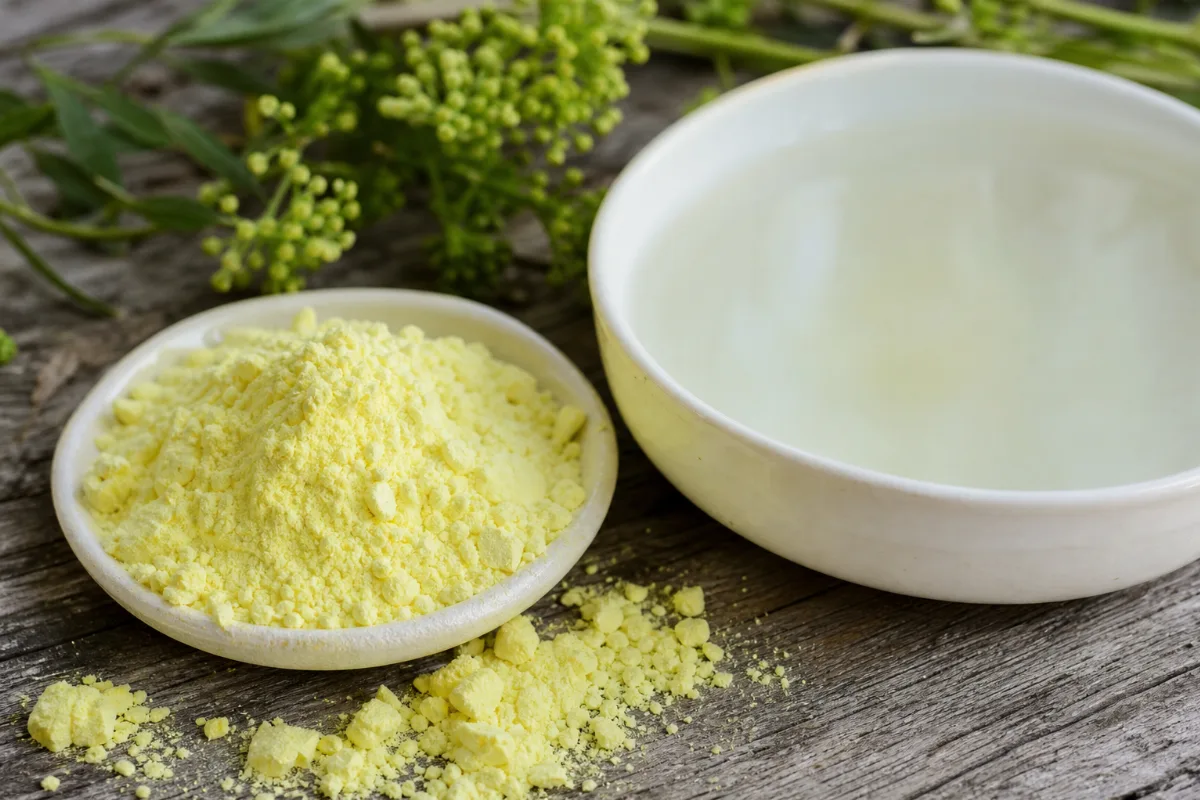
- Sulphur powder sold for home baths (not tested in the trials read)
- Leave-on sulphur skin medicines (a different product)
Research links: ATSDR: Hydrogen sulfide public health statement · OSHA: Hydrogen sulfide hazards · Cochrane review: balneotherapy for osteoarthritis (abstract) · Sulphurous water baths for knee osteoarthritis trial (abstract) · Thermal baths and skin disease, systematic review (abstract) · Hot-spring reservoir poisonings, two case reports (abstract) · Research Library · Genes & Biomarkers Library
What it is and its history
- Accepted scientific name
- Sulfur (sulphur), element S, and hydrogen sulfide (H2S) in sulphurous water
- Synonyms
- sulphur baths; sulfur baths; sulfurous water; sulphurous water; sulphur spa; sulfur spring bath; hydrogen sulfide baths
- Common names
- Sulfur baths (English); Sulphur baths (English (UK)); Sulphurous water baths (English); Balneotherapy with sulphurous water (English)
- Family or group
- Sulfur / hydrogen sulfide spa water
- Native range
- Sulphur springs occur in many places, for example volcanic areas and hot springs (ATSDR names sulfur springs and volcanoes as natural sources). Specific places in the papers read include Hungary, Portugal and Taiwan.
- Habitat
- Natural spring water that contains dissolved hydrogen sulfide.
- Harvest and processing
- Spa water is used directly from the spring. Sulphur powder sold for home baths is a different product; no source read describes how it is made.
- Look-alikes and adulterants
- Name: Epsom salt baths; Note: Magnesium sulfate, a different compound. The name sounds similar but it is not sulphur or hydrogen sulfide.; Name: Dead Sea or other mineral baths; Note: Salt-rich mineral water. The Cochrane review treats Dead Sea baths separately from sulphur baths.; Name: Sulphur mud (peloids); Note: Mud baths are a separate form; not covered here.
Photographs
Traditional use and history history, not clinical proof
| Tradition or era | Documented use | Source |
|---|---|---|
| Spa medicine | Cochrane says balneotherapy (spa therapy, mineral baths) for arthritis is one of the oldest forms of therapy (2007 review background). | p17943920 |
| Skin medicine | Gupta 2004 says sulfur was widely used in the past for acne, rosacea, seborrheic dermatitis, dandruff, pityriasis versicolor, scabies and warts. | p15303787 |
Traditional use shows how it was used. It does not show that it works or is safe today.
What is inside, and how it may work
What it contains and how those compounds act in cells and animals. Laboratory and animal mechanisms are not proven effects in people.
Main compounds
| Compound | Family | Where it is concentrated | Activity studied | Level of evidence |
|---|---|---|---|---|
| Hydrogen sulfide PubChem 402 | inorganic gas | The mineral water used in one hip trial had sulfide ion 13.2 mg/L (Kovacs 2016, described as among the highest in Hungary). | A colourless flammable gas that smells of rotten eggs; the toxic part. Your body also makes small amounts. 1 9 3 | Authoritative guidance |
| Sulfur (elemental) PubChem 5362487 | non-metal element | Not found for bath powders. | Used on skin as a keratolytic, antifungal and antibacterial (Gupta 2004). 6 | Narrative review |
| Sulfide ion PubChem 29109 | inorganic ion | 13.2 mg/L in one Hungarian spa water. | Carbajo 2025 describes the H2S/HS- balance depending on pH, temperature and oxygen. 3 9 | Narrative review |
Mechanisms, receptors and pathways
| Target or pathway | Gene or receptor | What was found | Level |
|---|---|---|---|
| Cell signalling by hydrogen sulfide (protein persulfidation, Nrf2, NF-kappaB) | Nrf2/ARE, NF-kappaB | The 2025 review lists these as the main cell pathways of hydrogen sulfide in cell and animal work. Whether bathing delivers enough to matter in people is not shown. 3 | Laboratory research |
| Heat, buoyancy and relaxation of warm water | Not applicable | Trials with plain warm-water controls (hand trial) are the only way to separate sulphur from heat. The knee trial found both sulphurous and non-sulphurous baths beat no treatment. 8 2 | Clinical trial |
Isolated compounds versus whole extracts
Spa results use natural sulphurous spring water at a spa, often with exercise and rest. Sulphur powder, sulphur soap or mud and leave-on sulphur medicines are different products and the results should not be carried across.
Nutritional composition
Sulfur is part of some amino acids and so is needed in the body, but baths are not a nutrient source. Hydrogen sulfide is also made by gut and mouth bacteria (ATSDR).
1 mixed findings2 low certainty3 not enough evidence
What was looked at
The 6 benefits and uses checked for Sulfur (Sulphur) Baths, each with how strong the evidence is. Tap one to open it.
- Osteoarthritis pain and function (spa baths in sulphur or mineral water)Mixed findings
- Psoriasis and eczema (thermal and sulphur spa baths)Low certainty
- Sulfur in leave-on acne products (not a bath)Low certainty
- Sulfur powder added to a home bathNot enough evidence
- 'Detox' or 'pulls out toxins' claimsNot enough evidence
- Hydrogen sulfide as a body signalling gas (lab and animal research)Not enough evidence
Lab markers tracked in the studies
Joint pain and function scores (WOMAC)Psoriasis Area and Severity Index (PASI)Hand osteoarthritis pain
What is Sulfur (Sulphur) Baths good for?
The uses and claims people ask about, and how strong the human evidence is for each. Almost all of it comes from supervised spa bathing in natural sulphur water, not home baths. Read it together with the safety section.
Benefits, one by one
Each card is a research question, not a promise. Tap a goal to filter. Open a card to see the studies, doses and limits.
Osteoarthritis pain and function (spa baths in sulphur or mineral water)
Mixed findingsSoaking in spa water, including sulphur water, has been studied for knee, hip and hand osteoarthritis. Many small trials report less pain, but they are weak, and the oldest Cochrane review found no clear gain for sulphur baths alone.
6 studiesSupervised baths in natural sulphurous spring water at spas, typicall…
Studies, doses and limits
What the trials found
Cochrane 2007 pooled 7 trials (498 people). Three small later trials tested sulphurous water: hip (41 people), hand (47 people) and knee (140 people). Two 2021-2023 reviews of thermal mineral waters in general were also read.
Results
Cochrane 2007: sulphur baths versus no treatment, no significant difference in pain or function at 1 or 3 months (difference 0.4, 95% CI -0.9 to 1.7). Hip trial 2016: 81% of the bath group (17 of 21) reached a clinically important improvement in function at 12 weeks, against 30% (6 of 20) of the exercise-only group. Hand trial 2012: sulphurous water beat warm tap water for pain at 3 months. Knee trial 2016: both sulphurous and non-sulphurous baths beat no treatment; sulphurous water was better at 2 months after treatment. A 2021 meta-analysis of 16 trials (thermal mineral water, not sulphur only) reported less pain and better function; a 2023 review of 17 studies said all reported improvement but many were low quality.
Effect sizes as reported
Not pooled for sulphur alone. The hip trial's 81% versus 30% is large but comes from 41 people.
Why this rating
Newer small trials favour sulphur baths, but the Cochrane review found no clear gain for sulphur baths alone, controls usually had no bath at all, and patients cannot be truly blinded to a hot bath that smells of sulphur. Reviewers rate method quality as low.
Form and dose studied
Supervised baths in natural sulphurous spring water at spas, typically several sessions a week for a few weeks. No amounts are advised here. These results do not apply to sulphur powder in a home bath.
Who was studied
Adults with osteoarthritis of the knee, hip or hand, usually at spa resorts.
Limits
Small trials, mostly no-bath or exercise-only controls, short follow-up, little safety reporting (Cochrane found adverse events were not measured). Funding not stated in the abstracts read.
Why researchers looked
Warm mineral water baths are a long-standing spa treatment for painful joints, and sulphur springs are used in many European spa towns.
Traditional use
Spa bathing in sulphur springs is a traditional practice at hot springs. The sources read do not give a start date, so none is stated here.
Proposed mechanism Pharmacological theory
The reviews we read say the effects may relate to the heat and buoyancy of warm water and to its chemistry. No source read shows which part matters. Hydrogen sulfide is discussed as a possible active part in a 2025 review.
A proposed mechanism does not show that the effect happens in people.
Hydrogen sulfide gas can be dangerous in closed spaces. See the Safety tab. Ask your doctor before hot baths if you have heart, blood pressure or breathing problems.
Psoriasis and eczema (thermal and sulphur spa baths)
Low certaintyA 2024 review found eight studies, seven on psoriasis and one on atopic dermatitis, that all reported improvement after thermal mineral water baths. The studies were few and often low quality, and a small open sulphur-water study had no control group.
2 studiesSpa bathing in thermal or sulphur water. No amounts advised here.
Studies, doses and limits
What the trials found
One systematic review (8 studies) of thermal mineral water baths and one open-label pilot study of 16 people bathing in Lake Hevíz sulphur water.
Results
The review: all 8 studies reported improvement in psoriasis and eczema-type disease. The pilot: skin microbiome diversity did not clearly change; PASI score improved significantly in people with mild psoriasis.
Effect sizes as reported
Not given in the abstracts.
Why this rating
The review says evidence is limited and quality often low. The sulphur study was open label, had 16 people and no control group. The reviewed waters were thermal mineral waters of many kinds, not sulphur only.
Form and dose studied
Spa bathing in thermal or sulphur water. No amounts advised here.
Who was studied
Adults with psoriasis (7 studies) and atopic dermatitis (1 study).
Limits
Few studies, low quality, mixed waters, no long-term follow-up in the abstracts. Skin disease can improve with sun, rest and warm water on their own.
Why researchers looked
Sulphur has long been used on skin, and spa towns with sulphur water treat skin disease with baths.
Traditional use
Spa treatment of skin disease with thermal water is described in the sources read as long established. A French history paper exists, but we read only its title and did not use its claims.
Proposed mechanism Laboratory research
Lab work on skin cells suggests hydrogen sulfide can reduce inflammatory signals. This is cell research only and does not show a bath does this in people.
A proposed mechanism does not show that the effect happens in people.
See the Safety tab for gas and skin irritation points. Tell your skin doctor before stopping prescribed treatment.
Sulfur in leave-on acne products (not a bath)
Low certaintySulfur is a listed active ingredient in US over-the-counter acne products. That is a regulatory listing for a skin product. It tells us nothing about bathing in sulphur.
3 studiesLeave-on skin medicines made to a regulated recipe. Not applicable to…
Studies, doses and limits
What the trials found
A US regulation, plus two reviews (2004 and 2025). No trial was read for this page.
Results
US 21 CFR 333.310 lists sulfur at 3 to 10 percent, or 3 to 8 percent with resorcinol, as an allowed acne active ingredient. Gupta 2004 says adverse events with topical sulfur are rare and mainly mild application-site reactions.
Why this rating
Rests on a regulation and narrative reviews; no trial was read.
Form and dose studied
Leave-on skin medicines made to a regulated recipe. Not applicable to baths. No amounts are advised here.
Who was studied
People with acne using over-the-counter skin products.
Limits
The 2025 review says there are critical gaps in understanding and a need for more preclinical work.
Why researchers looked
Sulfur has been used on skin for a long time for acne and other conditions.
Traditional use
Gupta 2004 lists acne, rosacea, seborrheic dermatitis, dandruff, pityriasis versicolor, scabies and warts as past uses of topical sulfur.
Proposed mechanism Authoritative guidance
Gupta 2004 says sulfur has antifungal, antibacterial and keratolytic (skin-peeling) activity.
A proposed mechanism does not show that the effect happens in people.
Skin irritation is the usual reaction. Read product labels and ask a pharmacist.
Sulfur powder added to a home bath
Not enough evidenceWe found no human study of sulphur powder in a home bath for any condition. Spa results come from natural sulphur spring water used under supervision and should not be assumed for powder.
1 studiesNot applicable.
Studies, doses and limits
Why this rating
No human research on the product.
Limits
The spa trials used natural sulphurous water at spas; the sulfide content in one hip trial's water was 13.2 mg/L. We did not find the sulfide level of any bath powder.
Why researchers looked
Sulphur bath powder is sold for home use.
Traditional use
Not described in the sources read.
Proposed mechanism Insufficient
No mechanism specific to home sulphur powder was found in the sources read.
A proposed mechanism does not show that the effect happens in people.
We do not know how much gas, if any, a home sulphur bath releases. Do not use in a closed room. See the Safety tab.
'Detox' or 'pulls out toxins' claims
Not enough evidenceNo human study shows that a sulphur bath removes toxins. Some lab work describes sulphur compounds as antioxidants. That is not the same thing.
1 studiesNot applicable.
Studies, doses and limits
Why this rating
No human trial measured toxin removal.
Limits
Lab and animal findings were not used to support a body-level claim.
Why researchers looked
Sellers of sulphur products use detox language.
Traditional use
Not described in the sources read.
Proposed mechanism Laboratory research
The 2025 balneology review describes antioxidant and cell-signalling actions of hydrogen sulfide in cells and animals.
A proposed mechanism does not show that the effect happens in people.
Do not replace medical care with baths.
Hydrogen sulfide as a body signalling gas (lab and animal research)
Not enough evidenceYour cells make tiny amounts of hydrogen sulfide and it acts as a signal. A 2025 review covers cell and animal work on this. It does not show that bathing in the gas helps.
1 studiesNot applicable.
Studies, doses and limits
What the trials found
Review of preclinical and clinical work; abstract read.
Results
The review says it does not extend beyond the available data.
Why this rating
Lab and animal research cannot show a human benefit.
Who was studied
Cells and animals; some human spa studies.
Limits
Mechanisms were not proven in people.
Why researchers looked
Researchers study whether hydrogen sulfide in spa water can reach the body and what it might do.
Proposed mechanism Laboratory research
The review lists pathways such as protein persulfidation, Nrf2 and NF-kappaB signalling in cell and animal work.
A proposed mechanism does not show that the effect happens in people.
The same gas is toxic at high levels. See the Safety tab.
Connections to the rest of health
How Sulfur (Sulphur) Baths connects to the rest of our health knowledge graph. Every link says what kind of connection it is. A safety link (for example to the liver) is a warning, not a benefit. A study that merely mentions a topic never creates a benefit link.
Explore every connection: goals, body systems, organs, symptoms, genes
A. Wellness goals
| Connected to | Kind of connection | Evidence status | Context | Studies |
|---|---|---|---|---|
| Joint Support | Potential benefit | Mixed findings | Osteoarthritis pain and function (spa baths in sulphur or mineral water): Soaking in spa water, including sulphur water, has been studied for knee, hip and hand osteoarthritis. Many small trials report less pain, but they are weak, and the oldest Cochrane review found no clear gain for sulphur baths alone. | 17 9 8 2 12 11 |
| Healthy Skin | Potential benefit | Low certainty | Psoriasis and eczema (thermal and sulphur spa baths): A 2024 review found eight studies, seven on psoriasis and one on atopic dermatitis, that all reported improvement after thermal mineral water baths. The studies were few and often low quality, and a small open sulphur-water study had no control group. | 13 10 |
| Healthy Skin | Traditional use | Low certainty | Sulfur in leave-on acne products (not a bath): Sulfur is a listed active ingredient in US over-the-counter acne products. That is a regulatory listing for a skin product. It tells us nothing about bathing in sulphur. | 15 6 4 |
B. Body systems
| Connected to | Kind of connection | Evidence status | Context | Studies |
|---|---|---|---|---|
| Respiratory system | Adverse effect or risk | High certainty | Gas can irritate airways and, at high levels in closed spaces, cause fatal lung injury. Preparation or compound: Hydrogen sulfide gas from sulphur water |
1 16 5 |
| Musculoskeletal system | Potential benefit | Mixed findings | Small spa trials report less osteoarthritis pain; the Cochrane review found no clear gain for sulphur baths alone. Preparation or compound: Sulphurous spa water |
17 9 2 |
| Musculoskeletal System | Biological association | Mixed findings | Studied for: Osteoarthritis pain and function (spa baths in sulphur or mineral water) | 17 9 8 2 12 11 |
| Integumentary System | Biological association | Low certainty | Studied for: Psoriasis and eczema (thermal and sulphur spa baths) Studied for: Sulfur in leave-on acne products (not a bath) | 13 10 15 6 4 |
E. Health conditions
I. Biomarkers
| Connected to | Kind of connection | Evidence status | Context | Studies |
|---|---|---|---|---|
| Joint pain and function scores (WOMAC) | Biological association | Low certainty | Measured in trials: improved. A lab change is not the same as a health benefit. | 9 2 |
| Psoriasis Area and Severity Index (PASI) | Biological association | Very low certainty | Measured in trials: lowered. A lab change is not the same as a health benefit. | 10 |
| Hand osteoarthritis pain | Biological association | Low certainty | Measured in trials: lowered. A lab change is not the same as a health benefit. | 8 |
K. Biological pathways
| Connected to | Kind of connection | Evidence status | Context | Studies |
|---|---|---|---|---|
| Nrf2 and NF-kappaB signalling | Preliminary mechanism | In vitro | Cell and animal findings for hydrogen sulfide. | 3 |
L. Active compounds
| Connected to | Kind of connection | Evidence status | Context | Studies |
|---|---|---|---|---|
| Hydrogen sulfide | Biological association | Authoritative guidance | A colourless flammable gas that smells of rotten eggs; the toxic part. Your body also makes small amounts. | 1 9 3 |
| Sulfur (elemental) | Biological association | Narrative review | Used on skin as a keratolytic, antifungal and antibacterial (Gupta 2004). | 6 |
| Sulfide ion | Biological association | Narrative review | Carbajo 2025 describes the H2S/HS- balance depending on pH, temperature and oxygen. | 3 9 |
Each connection is stored with the ingredient, the connected record, the kind of connection, the evidence status, the supporting studies, the preparation or compound involved, and a review date (last reviewed October 25, 2026).
Evidence at a glance: what changed in 2 lab markers
Tap a number to show only those markers. Counts are markers, not people.
The evidence
The research centre for Sulfur (Sulphur) Baths. Every record here was checked against PubMed or the publisher's page; we never list a study we have not verified.
Evidence by outcome
Bars show how many studies we found for each outcome, not how well it works. People are added up across trials only (reviews are not added, to avoid double counting).
How we rate evidence
High certainty
Several well-run trials or reviews agree; further research is unlikely to change the picture much.
Moderate certainty
Good trials point the same way, but some doubt remains.
Low certainty
Small, short or inconsistent trials. The finding could change with better research.
Very low certainty
Very little or very weak human data. Treat as a possibility only.
Mixed findings
Trials or reviews disagree with each other.
Not enough evidence
Not enough human research to say either way.
Evidence against
Good research found no benefit, or found harm.
We take the reviewers' own risk-of-bias and GRADE statements where they exist, and otherwise judge from study size, design, consistency, directness and whether a product matches what is sold. Many publications do not make evidence high. Method note: We searched PubMed for sulphur and sulfurous balneotherapy, osteoarthritis, psoriasis and hydrogen sulfide poisoning, read the abstracts of every PubMed paper cited, and read the ATSDR and OSHA pages and the FDA acne regulation text in full. Certainty ratings are the compiler's own reading. The oldest Cochrane review is from 2007 and newer trials were read separately. No study is cited that we could not verify.
Study library: every study we checked 18
| Study | Design | People | Product, dose, length | Result |
|---|---|---|---|---|
| Agency for Toxic Substances and Disease Registry (US CDC) ATSDR Public Health Statement: Hydrogen Sulfide ATSDR (web page) · Source |
Regulatory text n/a |
General public | n/a |
Says hydrogen sulfide is a flammable, colourless gas that smells of rotten eggs and is found in sulfur springs. At high concentrations people may lose their ability to smell it and wrongly think it is gone. Effects of higher levels include eye, nose and throat irritation, difficulty breathing in people with asthma, headaches, poor memory, tiredness and balance problems. Very high levels can cause severe breathing problems and loss of consciousness; some people have longer lasting effects. It mainly enters through breathing; much less through skin. Little is known about effects on children or whether it causes birth defects in humans; animal studies at low levels showed no birth defects. A toxic gas that can be harmful when breathed; smell is not a reliable warning Methods, limits and fundingOutcomes: Health effects and exposure of hydrogen sulfide Limitations: The page is undated on the version read (page date not confirmed). It is general, not specific to spa baths. Funding and conflicts: Government text. Read: full-text |
| Branco 2016 Bath thermal waters in the treatment of knee osteoarthritis: a randomized controlled clinical trial European Journal of Physical and Rehabilitation Medicine · PMID 26899038 |
Controlled trial |
140 140 adults (mean age 64.8) with knee osteoarthritis and chronic knee pain, at a spa resort |
Hot sulphurous or non-sulphurous thermal water baths (37-39 C) 30 baths of 20 minutes, three a week 10 weeks, followed 2 months · vs No treatment |
Both bath groups improved against the no-treatment group at the end and 2 months later (p < 0.001). At the end, sulphurous and non-sulphurous baths did not differ. Two months later the sulphurous group reported less pain and better function than the non-sulphurous group. Both bath types beat no treatment; sulphurous may last longer Methods, limits and fundingOutcomes: Pain (VAS), WOMAC, Lequesne, HAQ and pain-medicine use, before, after and 2 months after treatment Limitations: Patients were not blinded, and the control group had no bath, so expectation could explain part of the gain. Assessor-blind only. Funding not stated. Funding and conflicts: Not stated in the abstract. Read: abstract |
| Carbajo 2025 Hydrogen sulfide in balneology: physiology, evidence, and clinical translation International Journal of Molecular Sciences · PMID 41226825 · DOI |
Narrative review mixed |
Review of hydrogen sulfide biology and sulphurous waters | n/a |
Describes how hydrogen sulfide and HS- balance with water pH, temperature and oxygen, which governs what is available in sulphurous water, and lists cell pathways (protein persulfidation, Nrf2, NF-kappaB and others) from preclinical work. Summarises preclinical and clinical evidence in skin, joint and breathing conditions and says it does so without extrapolating beyond the available data. Describes bathing, mud, inhalation and drinking cures. Review linking chemistry and mechanisms to spa use; not a trial Methods, limits and fundingOutcomes: Chemistry, mechanisms and clinical evidence of hydrogen sulfide in spa water Limitations: A narrative review with mostly preclinical mechanisms. Abstract read (reference list long). Funding and conflicts: Funding listed as the Complutense University Medical Hydrology Group; authors declare no conflicts of interest. Read: abstract |
| Chen 2025 Sulfur and its derivatives in dermatology: insights into therapeutic applications - a narrative review Journal of Cosmetic Dermatology · PMID 40814742 · DOI |
Narrative review n/a |
Narrative review of sulfur and sulfur compounds in skin disease | Sulfur and sulfur compounds on skin Varied Varied · vs Varied |
Says sulfur has antimicrobial and immune-modulating activity and has been used in scabies, tinea versicolor, psoriasis and atopic dermatitis. The authors conclude there are critical gaps in understanding and a need for preclinical studies. Review points to gaps; calls for more preclinical work Methods, limits and fundingOutcomes: Uses, mechanisms and regulation of sulfur in dermatology Limitations: A narrative review, abstract only. Covers many forms of sulfur, not baths. Funding and conflicts: Funded by Chinese national and provincial science foundations; no conflicts declared. Read: abstract |
| Deng 1987 Hydrogen sulfide poisonings in hot-spring reservoir cleaning: two case reports American Journal of Industrial Medicine · PMID 3578297 · DOI |
Case report |
7 7 workers cleaning hot-spring reservoirs in Taiwan, in two incidents |
n/a |
In the first incident five workers lost consciousness right after climbing into a reservoir despite a strong rotten-egg smell, and one died at once. Three of the four survivors developed eye damage (hemorrhagic keratoconjunctivitis) and aspiration pneumonia; no after-effects were seen at 2 years. In the second, two workers cleaning for about 2 hours both died of fluid in the lungs within 12 hours. Fatal gas poisoning in an enclosed hot-spring reservoir Methods, limits and fundingOutcomes: Outcomes after hydrogen sulfide exposure in reservoirs Limitations: Two incidents, workers not bathers; shows the danger of the gas in closed tanks, not of bathing. Old report (1987). Funding and conflicts: Not stated in the abstract. Read: abstract |
| Gupta 2004 The use of sulfur in dermatology Journal of Drugs in Dermatology · PMID 15303787 |
Narrative review n/a |
Review of topical sulfur use in skin disease | Topical sulfur products Varied Varied · vs Varied |
Says sulfur has antifungal, antibacterial and keratolytic (skin-peeling) activity, and has been used for acne, rosacea, seborrheic dermatitis, dandruff, pityriasis versicolor, scabies and warts. Adverse events with topically applied sulfur are rare and mainly mild application-site reactions. Topical sulfur products have a long history; reactions are usually mild Methods, limits and fundingOutcomes: Uses and adverse events of topical sulfur Limitations: An old narrative review about leave-on sulfur products, not baths. Abstract only. Funding and conflicts: The PubMed record lists non-US government research support; no conflict is stated in the abstract. Read: abstract |
| Khodasevich 2015 The toxic complications of hydrogen sulfide-based balneotherapy in the spa and health resort practice (review, Russian journal, English abstract) Voprosy Kurortologii, Fizioterapii i Lechebnoi Fizicheskoi Kultury · PMID 26852506 · DOI |
Narrative review n/a |
Review of toxic complications of hydrogen sulfide baths in spa practice | n/a |
Says such complications rarely occur in everyday practice but amount to hydrogen sulfide intoxication, and their severity depends on the route of entry, the concentration in the bath and the length of treatment. They can threaten a patient's health, so prevention is needed. Rare, but a recognised risk in spa practice Methods, limits and fundingOutcomes: Complications of hydrogen sulfide balneotherapy Limitations: Abstract only; no case numbers given in the abstract. Funding and conflicts: Not stated in the abstract. Read: abstract |
| Kovacs 2012 The effect of sulphurous water in patients with osteoarthritis of hand. Double-blind, randomized, controlled follow-up study Clinical Rheumatology · PMID 22843170 · DOI |
Controlled trial |
47 47 patients with hand osteoarthritis (24 sulphurous water, 21 tap water in the groups reported) |
Sulphurous thermal water bath 20 minutes per bath, 15 baths 3 weeks, followed to 6 months · vs Warm tap water bath |
Between groups, the difference was significant at 3 months for pain and the EuroQol visual scale. Quality-of-life gains were not kept to 6 months. Pain, HAQ and AUSCAN stayed better than baseline at 6 months. Sulphurous water beat warm tap water for pain at 3 months Methods, limits and fundingOutcomes: Hand pain, morning stiffness, grip strength, HAQ, AUSCAN, EuroQol Limitations: Small trial. Sulphurous water has a smell, which may make it hard to keep patients truly blinded (our comment, not the authors). Single centre. Funding and conflicts: Not stated in the abstract. Read: abstract |
| Kovacs 2016 Effects of sulfur bath on hip osteoarthritis: a randomized, controlled, single-blind, follow-up trial: a pilot study International Journal of Biometeorology · PMID 27324883 · DOI |
Controlled trial |
41 41 outpatients with hip osteoarthritis (21 bath group, 20 controls in the analysis) |
Sulphur-rich spa water bath (sulfide ion 13.2 mg/L) plus home exercise 15 baths 3 weeks, then followed to 12 weeks · vs Home exercise alone |
At 12 weeks, 17 of 21 (81%) in the bath group had a minimal clinically important improvement in function against 6 of 20 (30%) of controls (p = 0.001). Pain, stiffness, function and total WOMAC scores were better in the bath group at 12 weeks. Bath plus exercise did better than exercise alone at 12 weeks Methods, limits and fundingOutcomes: WOMAC pain, stiffness and function; EQ-5D; minimal clinically important improvement at 12 weeks Limitations: A small pilot. Only the investigator was blinded, not the patients, so expectation may play a part. The control group had no bath at all, so the trial cannot separate sulphur from warm water or from the spa visit. Funding and conflicts: Not stated in the abstract. Read: abstract |
| Kulisch 2023 Evaluation of the effects of Lake Hevíz sulfur thermal water on skin microbiome in plaque psoriasis: an open label, pilot study International Journal of Biometeorology · PMID 36864227 · DOI |
Open label |
16 16 people with plaque psoriasis |
Bathing in Lake Hevíz sulphur thermal water at 36 C 30-minute sessions, 5 days a week 3 weeks |
Overall microbiome diversity did not change in a way that could be seen between before and after. In people with mild psoriasis, PASI scores improved significantly. PASI improved in mild psoriasis; microbiome unchanged overall Methods, limits and fundingOutcomes: Skin microbiome diversity; Psoriasis Area and Severity Index (PASI) Limitations: Open label with no control group, 16 people, no comparison with plain warm water or no treatment. Measured right after treatment only. Funding and conflicts: Not stated in the abstract. Read: abstract |
| Ma 2021 The effect of thermal mineral waters on pain relief, physical function and quality of life in patients with osteoarthritis: a systematic review and meta-analysis Medicine (Baltimore) · PMID 33530266 · DOI |
Systematic review |
16 randomised trials in people with osteoarthritis | Thermal mineral water therapy Varied Varied · vs Varied |
Pooled results showed thermal mineral waters reduced pain and the Lequesne index and improved quality of life (p < .001 for pain and Lequesne; p < .05 for quality of life). The authors say there is no evidence they are unsafe. Pooled trials favoured thermal mineral waters for pain and function Methods, limits and fundingOutcomes: Pain (VAS, WOMAC), Lequesne index, EQ-5D, HAQ Limitations: Covers thermal mineral waters in general, not sulphur alone. Included trials differ in water type and have mixed method quality; effect sizes not given in the abstract. Funding and conflicts: Funded by Chinese national and provincial research programmes; authors declare no conflicts. Read: abstract |
| Protano 2023 Balneotherapy for osteoarthritis: a systematic review Rheumatology International · PMID 37301799 · DOI |
Systematic review |
17 studies of adults and older adults with osteoarthritis of knees, hips, hands or lumbar spine | Thermal mineral water baths Varied Varied · vs Varied |
All 17 included studies reported improvement in the outcomes studied; pain and quality of life improved in every one. The authors say many studies were of low quality. All studies reported improvement, quality low Methods, limits and fundingOutcomes: Pain, function, quality of life and other symptoms after thermal mineral water baths Limitations: The review covers thermal mineral water baths in general, not sulphur alone. Reviewers note many studies were of low quality. Number of people not given in the abstract. Funding and conflicts: Authors report no conflict of interest. Read: abstract |
| Protano 2024 Balneotherapy using thermal mineral water baths and dermatological diseases: a systematic review International Journal of Biometeorology · PMID 38530467 · DOI |
Systematic review |
8 studies: 7 in adults with psoriasis, 1 in atopic dermatitis | Thermal mineral water baths Varied Varied · vs Varied |
All eight studies reported clear improvement in psoriasis and eczema-type disease after thermal mineral water baths. The authors say studies are still limited and often low quality, and that new studies with better methods are needed. All 8 studies reported improvement; evidence limited and low quality Methods, limits and fundingOutcomes: Signs and symptoms of skin disease after thermal mineral water baths Limitations: Thermal waters of many kinds, not only sulphur. Registered on PROSPERO (CRD42022295913). Number of people not given in the abstract. Funding and conflicts: Authors declare no conflict of interest. Read: abstract |
| Santana Maldonado 2023 A comprehensive review of treatments for hydrogen sulfide poisoning: past, present, and future Toxicology Mechanisms and Methods · PMID 36076319 · DOI |
Narrative review n/a |
Review of hydrogen sulfide poisoning | n/a |
Says hydrogen sulfide poisoning is a major cause of workplace deaths and the second most common cause of toxic gas deaths. It harms the nervous, breathing and heart systems, causing breathing distress, convulsions, low blood pressure and heart rhythm problems. Some survivors have lasting brain effects. Treatment is mainly supportive care; no drug is FDA approved for it. Serious toxic gas; no approved antidote Methods, limits and fundingOutcomes: Toxicity and treatment of hydrogen sulfide poisoning Limitations: Narrative review, abstract only. Funding and conflicts: Not stated in the abstract. Read: abstract |
| US Food and Drug Administration (regulation text) 2010 US Code of Federal Regulations, 21 CFR 333.310: Acne active ingredients Electronic Code of Federal Regulations · Source |
Regulatory text n/a |
Over-the-counter acne drug products | n/a |
Lists sulfur at 3 to 10 percent, or 3 to 8 percent when combined with resorcinol or resorcinol monoacetate, among allowed acne active ingredients. This is a rule for leave-on skin medicines. Sulfur is a listed OTC acne ingredient Methods, limits and fundingOutcomes: Which active ingredients are allowed in OTC acne products Limitations: Not a trial. Applies to the leave-on product, not to baths. Section amended 4 March 2010 (75 FR 9776) as shown on the page; current status of the wider acne monograph not checked. Funding and conflicts: Government text. Read: full-text |
| US Occupational Safety and Health Administration OSHA Hydrogen Sulfide: Hazards OSHA (web page) · Source |
Regulatory text n/a |
Workers | n/a |
Gives a table of effects by air concentration: from eye, nose and throat irritation at low levels, to loss of smell at 100 to 150 ppm, and rapid unconsciousness and death within minutes at 700 ppm or more. Says people with asthma may be more sensitive, that some who become unconscious keep headaches and poor memory, and that the gas is highly flammable and explosive. NIOSH immediately-dangerous level: 100 ppm. Concentration-by-concentration effects; death at high levels Methods, limits and fundingOutcomes: Health effects by air concentration, exposure limits Limitations: Workplace limits, not bath limits. Page read on 2026-10-25. Funding and conflicts: Government text. Read: full-text |
| Verhagen 2007 Balneotherapy for osteoarthritis (Cochrane review) Cochrane Database of Systematic Reviews · PMID 17943920 · DOI |
Systematic review |
498 7 randomised trials, 498 people with osteoarthritis; 3 trials tested sulphur or Dead Sea baths |
Mineral, sulphur or Dead Sea baths Not pooled Varied · vs No treatment or tap water baths |
Silver-level evidence that mineral baths beat no treatment for pain, quality of life and pain-medicine use. Sulphur baths versus no treatment: no significant difference in pain or function at one or three months (weighted mean difference 0.4, 95% CI -0.9 to 1.7). Dead Sea plus sulphur baths beat no treatment at the end of treatment (5.7, 3.3 to 8.1) but not at 3 months. Adverse events were not measured in the included trials. Mineral baths may ease pain; sulphur baths alone showed no clear difference Methods, limits and fundingOutcomes: Pain, function, quality of life and pain-medicine use after baths compared with no treatment or tap water baths Limitations: The authors call the evidence weak: poor method quality, inadequate statistics, only one trial with an intention-to-treat analysis. Their words: the positive findings should be viewed with caution. Search ended October 2006, so newer trials are not included. Funding and conflicts: Not stated in the abstract. Authors are academic; no conflicts shown in the abstract. Read: abstract |
| Wen 2026 Analysis of patients with hydrogen sulfide poisoning reported to the Taiwan Poison Control Center between 1986 and 2021 Clinical Toxicology · PMID 42290626 · DOI |
Case series |
168 168 people reported to the Taiwan Poison Control Center |
n/a |
Over 70% were exposed at work; 14.3% in hot-spring reservoirs. Severe or fatal poisoning occurred in 93 (46 severe, 47 deaths). Working in confined spaces raised the odds of severe or fatal outcome (adjusted odds ratio 2.59, p = 0.03), underground workplaces more (6.60, p = 0.002). Most cases occurred at work, often in confined spaces; about half were severe or fatal Methods, limits and fundingOutcomes: Severity and predictors of severe-to-fatal hydrogen sulfide poisoning Limitations: Reported cases only, so not a rate; mostly workers rather than bathers. Funding and conflicts: Not stated in the abstract. Read: abstract |
What we do not know yet
- What the evidence supports: sulphur spa baths and osteoarthritis are mixed (weak trials, Cochrane found no clear gain for sulphur alone); skin results are low quality; home sulphur powder, detox claims and gas signalling in bathers have no human evidence.
- No trial compares sulphur powder in a home bath with plain water.
- Trials rarely measure harms and none read measured gas levels in the bathhouse air.
- No data for pregnancy, children, medicine interactions or sulphur bath contamination. EMA, EFSA and NCCIH statements were not found; the NIOSH page could not be opened.
How new research is added
New studies are found by a saved PubMed search and placed in a review queue. A person reads each one before it changes any evidence rating or safety wording. New publications never change ratings automatically.
Lab markers
What changed in blood or saliva tests during trials. A changed number is not the same as feeling or being healthier, and we give no "normal ranges".
Other 3
Joint pain and function scores (WOMAC)
Improved in trials
A questionnaire where people with knee or hip osteoarthritis score pain, stiffness and difficulty with daily tasks.
Low certaintyResults and what it means
Why it was measured
To see whether baths change how painful and usable the joint feels.
Statistical vs. clinical meaning
Self-reported scores in unblinded trials, with no-bath controls.
Safety implication
Not measured in the trials read.
| Study | Result | People | Product |
|---|---|---|---|
| 9 | At 12 weeks 17 of 21 (81%) in the sulphur bath group had a minimal clinically important improvement in function, against 6 of 20 (30%) with exercise alone (p = 0.001). | 41 people with hip osteoarthritis | 15 sulphur spa-water baths plus home exercise versus exercise alone |
| 2 | Pain, WOMAC, Lequesne and HAQ scores were better in both bath groups than in the no-treatment group; sulphurous water scored better than non-sulphurous at 2 months after treatment. | 140 people with knee osteoarthritis | 30 hot baths (sulphurous or not) versus no treatment |
Psoriasis Area and Severity Index (PASI)
Lowered in trials
A doctor's score of how widespread and severe psoriasis skin patches are.
Very low certaintyResults and what it means
Why it was measured
To see whether baths change how bad psoriasis looks.
Statistical vs. clinical meaning
A pilot with no control group; short term only.
Safety implication
Not reported in the abstract.
| Study | Result | People | Product |
|---|---|---|---|
| 10 | PASI improved significantly in people with mild psoriasis after 3 weeks of sulphur thermal water baths. No comparison group. | 16 people with plaque psoriasis | 30-minute baths, 5 days a week for 3 weeks |
Hand osteoarthritis pain
Lowered in trials
Pain in the finger and thumb joints, scored by the patient.
Low certaintyResults and what it means
Why it was measured
To see whether sulphur water eases hand pain more than plain warm water.
Statistical vs. clinical meaning
One small trial; blinding may have been imperfect because of the smell.
Safety implication
Not reported in the abstract.
| Study | Result | People | Product |
|---|---|---|---|
| 8 | Pain was lower with sulphurous water than with tap water at 3 months (between-group difference significant). | 47 people with hand osteoarthritis | 15 sulphurous water baths versus tap water baths |
Safety
What studies and official sources say about side effects, medicines and who should check first. Each point shows what kind of evidence it comes from.
Main points to know 5
- Hydrogen sulfide gas can be deadly in closed spaces. Sulphur spring water gives off hydrogen sulfide. In enclosed hot-spring spaces, the gas can build up. In Taiwan, five workers climbing into a hot-spring reservoir lost consciousness immediately and one died; in a second incident two workers died within 12 hours. Of 168 cases reported to the Taiwan Poison Control Center, 93 were severe or fatal, and working in a confined space raised the odds. ATSDR says that at high concentrations people can lose the ability to smell the gas and may wrongly think it is gone. OSHA's table says 700 ppm or more can cause collapse within a few breaths and death within minutes. These are mostly worker cases, not bathers, but they show the gas can kill. Leave the area at once if you feel dizzy, short of breath or very sleepy, and call emergency services. Case report 5 18 1 16 14
- Do not rely on the smell as a warning. The rotten-egg smell is noticeable at very low levels. But ATSDR and OSHA both say that at higher levels people lose their sense of smell, so the smell stops being a warning just when the danger rises. Authoritative guidance 1 16
- Asthma and breathing conditions. OSHA says people with asthma may be more sensitive, and ATSDR lists difficulty breathing in people with asthma among effects at higher levels. Ask your doctor before using sulphur spa water if you have asthma or lung disease. Authoritative guidance 1 16
- Spa toxic reactions are described as rare. A Russian-language review (English abstract) says toxic complications of hydrogen sulfide baths rarely occur in everyday spa practice, but that they are really hydrogen sulfide poisoning and depend on the concentration in the bath and how long the bath lasts. Narrative review 7
- Most bath trials did not measure harms. The Cochrane review reported that adverse events were not measured in the trials it included. A 2021 meta-analysis of thermal mineral waters said there was no evidence they are unsafe, but that is not the same as showing safety for sulphur baths specifically. Systematic review 17 11
Side effects 3
| Effect | How often | Severity and recovery | Evidence |
|---|---|---|---|
| Eye, nose and throat irritation, headache, tiredness, difficulty breathing in people with asthma Listed by ATSDR and OSHA for hydrogen sulfide in air generally, not measured in bath trials. | Not established | mild to moderate Expected to settle when exposure stops; not documented in the sources read for spa bathers. | Authoritative guidance 1 16 |
| Loss of consciousness, fluid in the lungs, death (high gas levels in enclosed spaces) Reported cases do not give a risk rate for bathers. | In 168 Taiwan reports, 93 were severe or fatal (47 deaths). Most were workers. | life-threatening Some survivors have lasting headaches and poor memory (ATSDR, OSHA). | Case series 18 5 16 1 |
| Mild reactions at the skin site (topical sulfur products) From a 2004 review of leave-on sulfur products, not baths. | Described as rare | mild Not described | Narrative review 6 |
Medicines and supplements 1
| With | Why it matters | Importance | Evidence | What to do |
|---|---|---|---|---|
| Prescribed skin or arthritis treatments prescription | No interaction data were found for sulphur baths with medicines. The trials in the hip and knee studies used baths together with exercise or usual care. | Insufficient Not enough evidence 9 | Tell the doctor treating you before starting spa bathing. Do not stop a prescribed medicine for baths. |
Who should check first 6
| Situation | Advice | Evidence |
|---|---|---|
| Closed or poorly ventilated rooms | Do not bathe or work in closed spaces where sulphur water is present. This follows the worker case reports and OSHA/ATSDR gas information. Spa towns use ventilated bathhouses. | Case report 5 18 16 |
| Asthma or other lung disease | Ask your doctor first (OSHA, ATSDR say asthma may increase sensitivity). | Authoritative guidance 16 1 |
| Pregnancy and breastfeeding | No sulphur-bath study in pregnancy was found. ATSDR says it is not known whether hydrogen sulfide causes birth defects in humans; low-level animal exposure showed none. Ask your midwife or doctor. Hot baths in pregnancy were not covered by the sources read. | Authoritative guidance 1 |
| Children | ATSDR says there is very little information on children and it is not known whether they are more sensitive. Children are not described in the bath trials read. Ask a paediatrician. | Authoritative guidance 1 |
| Heart disease, very high or low blood pressure, or feeling faint in heat | Hot baths were not assessed in the sources read for these groups. Ask your doctor before any hot soak. | Insufficient |
| Open or inflamed skin | No source read covers sulphur bath water on broken skin; topical sulfur products can cause mild site reactions (Gupta 2004). Ask a skin doctor. | Narrative review 6 |
Overdose, product quality and regulators
Summary. The toxic part is the gas, hydrogen sulfide, not the sulphur itself. It is breathed in, and much less enters through skin (ATSDR). Effects depend on the concentration and time. Hot-spring workers have died after entering enclosed reservoirs.
Animal. Low-level exposure in pregnancy did not cause birth defects in animals (ATSDR). Not otherwise reviewed.
Human doses studied. The hip trial used water with sulfide ion 13.2 mg/L. No trial abstract read gave the air level of hydrogen sulfide in the bathhouse.
High dose or long term signals. Some people who became unconscious had lasting headaches, poor attention, memory and movement problems (ATSDR, OSHA).
Overdose response. Treat as an emergency. Move the person into fresh air only if you can do so without entering the gas yourself, then call your local emergency number (in the US, 911; Poison Help 1-800-222-1222). Do not go into an enclosed space to rescue someone. Treatment in hospital is mainly supportive; no drug is FDA approved for it (Santana Maldonado 2023).
Genotoxicity. Not shown. ATSDR says hydrogen sulfide has not been shown to cause cancer in humans.
We found no analysis of heavy metals or contaminants in sulphur bath water or sulphur bath powders. Natural spring water varies by spring.
| Body | Action | Date |
|---|---|---|
| ATSDR (US Agency for Toxic Substances and Disease Registry) (US) | Public Health Statement says hydrogen sulfide from sulfur springs can be harmful when breathed; at high concentrations people may lose their sense of smell. source | 2026-10-25 (page read; page date not shown) |
| OSHA / NIOSH (US) (US) | Sets workplace limits for hydrogen sulfide (OSHA ceiling 20 ppm general industry; NIOSH recommended 10 ppm for 10 minutes; immediately dangerous 100 ppm) and lists effects from irritation to death by concentration. These are workplace rules, not bath rules. source | 2026-10-25 (page read) |
| US Food and Drug Administration (21 CFR 333.310) (US) | Lists sulfur 3 to 10 percent (or 3 to 8 percent with resorcinol) as an allowed active ingredient in over-the-counter acne products. Applies to leave-on skin medicines, not baths. source | 2010-03-04 (amendment shown on page) |
When to get medical help
- Dizziness, confusion, headache, nausea, shortness of breath, burning eyes or throat while near sulphur water: leave the area into fresh air and call emergency services.
- Anyone who collapses or stops responding near sulphur spring water, a closed bathhouse or a tank: call emergency services. Do not go into the enclosed space to rescue them.
- A cough, fever or breathing trouble in the hours after exposure: seek urgent care, since fluid in the lungs can come on later (reported in the Taiwan cases).
Stop using the product and contact a clinician or emergency service. In the US, Poison Control is 1-800-222-1222.
General information only, not medical advice. Ask a clinician or pharmacist before use, especially with medicines, in pregnancy or with a health condition. See the Natural Remedy Safety guide.
Frequently asked questions
What are sulfur baths?
Is hydrogen sulfide in sulfur baths dangerous?
It can be. It is a toxic gas. In Taiwan, hot-spring workers died after entering an enclosed reservoir, and of 168 reported poisonings 93 were severe or fatal. Most cases were at work, not in baths. Bathhouses must be ventilated. If you feel dizzy, short of breath or sleepy, get out into fresh air and call emergency services.
Can I rely on the smell to know when it is unsafe?
Do sulfur baths help osteoarthritis?
Maybe a little, but the evidence is mixed and weak. The 2007 Cochrane review found no clear difference for sulphur baths alone against no treatment. Three small later trials (hip, hand, knee) favoured sulphurous water, but controls usually had no bath and patients could not be fully blinded.
Do sulfur baths help psoriasis or eczema?
Does sulphur powder in a home bath work?
Do sulfur baths detox the body?
No human study shows that they remove toxins. Lab and animal work on sulphur compounds describes antioxidant and cell-signalling effects, which is not the same thing.
Is sulfur used for acne?
Are sulfur baths safe in pregnancy or for children?
We found no sulphur-bath study for either group. ATSDR says little is known for children, and that it is not known whether hydrogen sulfide causes birth defects in humans. Ask your midwife, doctor or paediatrician.
Is it safe with asthma or lung disease?
Did the trials report side effects?
Who paid for the studies, and how big were they?
The abstracts we read did not state funding for the three sulphur-water trials, which enrolled 41, 47 and 140 people. The two reviews of thermal waters declared no conflicts, and the 2021 meta-analysis was funded by Chinese research programmes. No study read was paid for by a bath or product seller, but the abstracts may not show it.
Explore by health goal
Editorial transparency
- Written by
- AlternativeMed editorial team. Research compiled with AI assistance, then checked against PubMed records.
- Medical review
- None. This page has not been reviewed by a physician or pharmacist.
- First published
- 2026-10-25
- Last substantive update
- 2026-10-25
- How we research
- We searched PubMed for sulphur and sulfurous balneotherapy, osteoarthritis, psoriasis and hydrogen sulfide poisoning, read the abstracts of every PubMed paper cited, and read the ATSDR and OSHA pages and the FDA acne regulation text in full. Certainty ratings are the compiler's own reading. The oldest Cochrane review is from 2007 and newer trials were read separately. No study is cited that we could not verify.
- How we rate evidence
- See "How we rate evidence" in the Evidence tab.
- Independence
- No product is promoted on this page. No affiliate links are shown. This page is information, not a recommendation to bathe in or buy anything.
Sources 18
Each source was opened and checked. Where we read only the abstract, it says so. The small numbers in the text point here.
- Agency for Toxic Substances and Disease Registry (US CDC). ATSDR Public Health Statement: Hydrogen Sulfide. ATSDR (web page). . (full-text)
- Branco M, Rego NN, Silva PH, et al. Bath thermal waters in the treatment of knee osteoarthritis: a randomized controlled clinical trial. European Journal of Physical and Rehabilitation Medicine. 2016. PMID 26899038. (abstract)
- Carbajo JM, Maraver F, Vela L, Munteanu C. Hydrogen sulfide in balneology: physiology, evidence, and clinical translation. International Journal of Molecular Sciences. 2025. PMID 41226825. DOI 10.3390/ijms262110790. (abstract)
- Chen YJ, Tang J, Wang L, Hua W. Sulfur and its derivatives in dermatology: insights into therapeutic applications - a narrative review. Journal of Cosmetic Dermatology. 2025. PMID 40814742. DOI 10.1111/jocd.70402. (abstract)
- Deng JF, Chang SC. Hydrogen sulfide poisonings in hot-spring reservoir cleaning: two case reports. American Journal of Industrial Medicine. 1987. PMID 3578297. DOI 10.1002/ajim.4700110407. (abstract)
- Gupta AK, Nicol K. The use of sulfur in dermatology. Journal of Drugs in Dermatology. 2004. PMID 15303787. (abstract)
- Khodasevich LS. The toxic complications of hydrogen sulfide-based balneotherapy in the spa and health resort practice (review, Russian journal, English abstract). Voprosy Kurortologii, Fizioterapii i Lechebnoi Fizicheskoi Kultury. 2015. PMID 26852506. DOI 10.17116/kurort2015561-66. (abstract)
- Kovacs C, Pecze M, Tihanyi A, et al. The effect of sulphurous water in patients with osteoarthritis of hand. Double-blind, randomized, controlled follow-up study. Clinical Rheumatology. 2012. PMID 22843170. DOI 10.1007/s10067-012-2026-0. (abstract)
- Kovacs C, Bozsik A, Pecze M, et al. Effects of sulfur bath on hip osteoarthritis: a randomized, controlled, single-blind, follow-up trial: a pilot study. International Journal of Biometeorology. 2016. PMID 27324883. DOI 10.1007/s00484-016-1158-3. (abstract)
- Kulisch A, Mando Z, Sandor E, et al. Evaluation of the effects of Lake Hevíz sulfur thermal water on skin microbiome in plaque psoriasis: an open label, pilot study. International Journal of Biometeorology. 2023. PMID 36864227. DOI 10.1007/s00484-023-02443-1. (abstract)
- Ma T, Song X, Ma Y, et al. The effect of thermal mineral waters on pain relief, physical function and quality of life in patients with osteoarthritis: a systematic review and meta-analysis. Medicine (Baltimore). 2021. PMID 33530266. DOI 10.1097/MD.0000000000024488. (abstract)
- Protano C, Fontana M, De Giorgi A, et al. Balneotherapy for osteoarthritis: a systematic review. Rheumatology International. 2023. PMID 37301799. DOI 10.1007/s00296-023-05358-7. (abstract)
- Protano C, Vitali M, De Giorgi A, et al. Balneotherapy using thermal mineral water baths and dermatological diseases: a systematic review. International Journal of Biometeorology. 2024. PMID 38530467. DOI 10.1007/s00484-024-02649-x. (abstract)
- Santana Maldonado C, Weir A, Rumbeiha WK. A comprehensive review of treatments for hydrogen sulfide poisoning: past, present, and future. Toxicology Mechanisms and Methods. 2023. PMID 36076319. DOI 10.1080/15376516.2022.2121192. (abstract)
- US Food and Drug Administration (regulation text). US Code of Federal Regulations, 21 CFR 333.310: Acne active ingredients. Electronic Code of Federal Regulations. 2010. (full-text)
- US Occupational Safety and Health Administration. OSHA Hydrogen Sulfide: Hazards. OSHA (web page). . (full-text)
- Verhagen AP, Bierma-Zeinstra SM, Boers M, et al. Balneotherapy for osteoarthritis (Cochrane review). Cochrane Database of Systematic Reviews. 2007. PMID 17943920. DOI 10.1002/14651858.CD006864. (abstract)
- Wen YC, Chu FY, Wang TH, et al. Analysis of patients with hydrogen sulfide poisoning reported to the Taiwan Poison Control Center between 1986 and 2021. Clinical Toxicology. 2026. PMID 42290626. DOI 10.1080/15563650.2026.2675040. (abstract)
Where to buy
Check the label first. Whatever you buy, look for these:
- Whether it is iodized if you rely on salt for iodine
- The origin and purity statement
- Food grade versus bath or cosmetic grade
- Sodium amount, which matters for blood pressure
Talk to a pharmacist or doctor before you start any supplement, especially if you take medicines. See the Safety tab for interactions.
Support our free guides: as an Amazon Associate we earn from qualifying purchases. Full disclosure.


