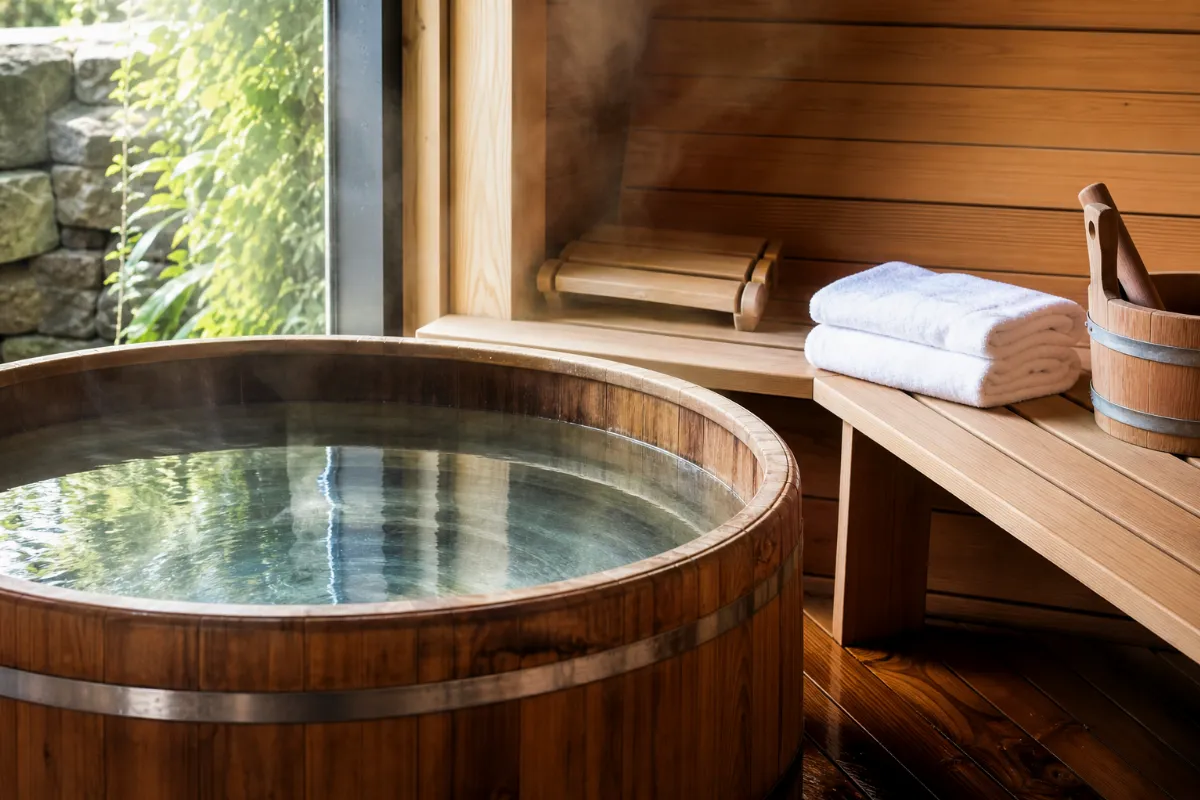
Specialty Topics · Wellness practice
Cold and Heat Exposure: Cold Plunges, Saunas and Biohacking Claims
Cold and heat exposure (cold plunges, ice baths, cold showers, saunas and contrast therapy) · also called Cold plunge, ice bath, cold-water immersion, cold shower, sauna, contrast therapy, hot and cold therapy, inmersion en agua fria, sauna, terapia de contraste
Cold and heat exposure means using cold plunges, cold showers, saunas or hot baths on purpose for health or performance. The evidence is small: cold water may ease post-exercise soreness, and Finnish men who used saunas often had fewer deaths, but those studies are mostly low quality or observational. Cold shock, heart strain, fainting, overheating and drowning are real risks, and alcohol and being alone make them worse.
General information, not medical advice. Last substantive update · Not medically reviewed. A named clinician has not signed off on this page. How this page is made
About Cold and Heat Exposure: Cold Plunges, Saunas and Biohacking Claims
Cold and heat exposure means deliberately using cold plunges, ice baths, cold showers, saunas or hot baths to chase a health benefit. Some claims have small, low-certainty support: cold-water immersion for post-exercise soreness, a cold-ending shower for sick days, and Finnish sauna use linked to lower mortality (observational). Others do not hold up: cold plunges lowering inflammation, or any fat-loss or longevity 'reset'. Cold shock, cardiac events, drowning, fainting from low blood pressure and alcohol are the real dangers.
What this page covers
This is the claims check for cold plunges, cold showers, saunas and contrast therapy as used in biohacking. The traditional water treatments are on the hydrotherapy pages; this page asks what research shows for the modern claims.
Cold-water immersion in the studies read means water below about 15 C; saunas range from roughly 45 to 100 C depending on type. Times and temperatures on this page appear only as reported in studies and are not advice.
Cold exposure: what studies found
For muscle soreness after exercise, 17 small trials favour cold-water immersion over rest, with low certainty. For stress, sleep and mood the picture is mixed, and inflammation markers rise right afterwards. A cold-ending shower cut sick days from work in one trial but not days of illness. After strength training, repeated cold immersion may blunt muscle gains.
A survey of regular plungers found better reported mental health and shorter colds up to about twice a week, then worse, but it cannot show cause.
Heat exposure: what studies found
Finnish men who used saunas 4 to 7 times a week had lower rates of sudden cardiac death, all-cause death, high blood pressure and dementia than men who used one a week. These are observational findings from one region and cannot prove cause.
Heat treatments lower blood pressure for hours, but lasting benefit is unproven. A single supervised session of whole-body heating helped depression in one very small trial; reviews call this promising but not ready for recommendations.
At a glance
Traditional uses history, not proof
- Sauna bathing is a long Finnish tradition, mainly for pleasure and relaxation
- Cold plunges, cold showers and hot baths are modern biohacking and recovery habits more than single traditional remedies
Studied for research
- Muscle soreness after exercise, low certainty
- Sick days from work with a cold shower, low certainty
- Stress, sleep and mood with cold immersion, mixed
- Sauna use and heart disease and death, low certainty (observational)
- Sauna and blood pressure, low certainty
- Whole-body heating for depression, low certainty
- Cold immersion for inflammation, against (markers rose)
Main compounds
- Cold-water immersion
- Cold shower
- Finnish sauna
- Contrast water therapy
- Whole-body hyperthermia
Common forms
- Cold plunge or ice bath
- Cold-ending shower
- Dry or Finnish sauna
- Contrast (hot then cold) bathing
Research links: Cochrane review: cold-water immersion for muscle soreness · Cold showering and work: randomised trial (3,018 adults) · Sauna bathing and mortality, Finnish cohort (2,315 men) · Cold-water immersion review: wellbeing meta-analysis · Beyond hypothermia: cold-water death mechanisms (2026 review) · Research Library · Genes & Biomarkers Library
What it is and its history
- Accepted scientific name
- Cold and heat exposure (deliberate use of cold water, cold showers, saunas and hot baths for health claims)
- Common names
- Cold plunge (English); Ice bath (English); Cold-water immersion (English); Sauna bathing (English); Contrast therapy (English); Inmersion en agua fria (Spanish); Sauna (Spanish); Baño de contraste (Spanish)
- Family or group
- Temperature-exposure practices, often grouped with biohacking and hydrotherapy.
- Look-alikes and adulterants
- Name: Hydrotherapy; Note: The traditional water-treatment page has its own entry.; Name: Wim Hof-style breathing with cold; Note: Not reviewed here.; Name: Whole-body cryotherapy; Note: Extremely cold air chambers, a different practice from a cold plunge.; Name: Infrared sauna; Note: Not reviewed separately here.
Traditional use and history history, not clinical proof
| Tradition or era | Documented use | Source |
|---|---|---|
| Finnish sauna tradition | A 2018 review says sauna bathing has been a tradition in Finland for thousands of years, mainly for pleasure and relaxation, and is becoming popular in many other populations. | p30077204 |
Traditional use shows how it was used. It does not show that it works or is safe today.
What is inside, and how it may work
What it contains and how those compounds act in cells and animals. Laboratory and animal mechanisms are not proven effects in people.
Main compounds
| Compound | Family | Where it is concentrated | Activity studied | Level of evidence |
|---|---|---|---|---|
| Cold-water immersion | cold exposure | The Cochrane review defines cold-water immersion as water below 15 C; the 2025 review pooled trials at 7 to 15 C for 30 seconds to 2 hours. | Studied for soreness, mood, stress, sleep, immunity and training adaptations. 4 6 | Human data |
| Cold shower | cold exposure | The Dutch trial used a hot shower ending with 30, 60 or 90 seconds of cold. | Studied for sick days. 5 | Human data |
| Finnish sauna | heat exposure | A review describes typical sauna temperatures as 45 to 100 C, depending on type. | Observed in Finnish cohorts for heart disease, blood pressure and dementia. 17 13 | Human (observational) |
| Contrast water therapy | hot and cold | Alternating hot and cold water; included in the network meta-analysis. | Studied for muscle soreness. 19 | Human data |
| Whole-body hyperthermia | heat exposure | Supervised heating in a clinic; the review notes target temperatures of 38 to 39 C gave larger effects. | Studied for depression. 10 9 | Human data |
| Whole-body cryotherapy | cold exposure | Extremely cold dry air (below -100 C) for 2 to 4 minutes in a chamber, per the Cochrane review. | Studied for muscle soreness; evidence very low quality. 7 | Human data |
Mechanisms, receptors and pathways
| Target or pathway | Gene or receptor | What was found | Level |
|---|---|---|---|
| Cold shock response | Not specified | Skin cooling triggers a gasp, fast breathing, racing heart and raised blood pressure; the response shrinks with repeated immersions. 2 1 | Human data |
| Heat stress and blood vessels | Not specified | Reviews propose that heat improves blood-vessel function and lowers blood pressure; this is proposed, not shown by the cohort studies. 15 20 | Hypothesis (review) |
2 mixed findings5 low certainty3 very low certainty
What was looked at
The 10 benefits and uses checked for Cold and Heat Exposure: Cold Plunges, Saunas and Biohacking Claims, each with how strong the evidence is. Tap one to open it.
- Cold-water immersion for muscle soreness after exerciseLow certainty
- Cold plunges after strength training: do they cost you muscle?Mixed findings
- Cold showers and sick daysLow certainty
- Cold-water immersion for stress, mood, sleep and inflammationMixed findings
- Regular cold plungers and colds: a surveyVery low certainty
- Whole-body hyperthermia (heat in a clinic) for depressionLow certainty
- Frequent sauna bathing and heart disease and death (Finnish men)Low certainty
- Frequent sauna bathing and dementiaVery low certainty
- Sauna and blood pressureLow certainty
- Contrast water therapy and heat for muscle sorenessVery low certainty
Lab markers tracked in the studies
Inflammation markers after cold-water immersionBlood pressure after heat exposure
What is Cold and Heat Exposure: Cold Plunges, Saunas and Biohacking Claims good for?
The claims studied for cold and heat exposure and how strong the human evidence is for each.
Benefits, one by one
Each card is a research question, not a promise. Tap a goal to filter. Open a card to see the studies, doses and limits.
Cold-water immersion for muscle soreness after exercise
Low certaintyA Cochrane review of 17 small, low-quality trials found people who sat in cold water after exercise reported less muscle soreness over the next one to four days than people who rested. A newer comparison of ten recovery methods ranked hot packs and contrast water ahead for pain in the first 24 hours, and the authors say none of the evidence is strong.
3 studiesAs reported in the Cochrane review: water below 15 C; temperature, ti…
Studies, doses and limits
What the trials found
Cochrane review (searches to 2011): 17 trials, 366 participants, using water below 15 C. Fourteen compared cold immersion with rest. A 2022 network meta-analysis of 59 trials (1,367 people) compared ten cold and heat methods. A 2015 Cochrane review of whole-body cryotherapy (extremely cold air chambers) found only four small trials.
Results
Soreness was lower with cold immersion than rest at 24, 48, 72 and 96 hours, with varied results between trials. There was no clear difference from contrast or warm-water immersion. Most trials did not check for harms. Whole-body cryotherapy: evidence rated very low quality; no firm conclusion.
Effect sizes as reported
Cochrane: soreness SMD -0.55 at 24 h, -0.66 at 48 h, -0.93 at 72 h, -0.58 at 96 h versus rest. Cryotherapy chamber: SMD -0.77 at 1 hour (20 participants).
Why this rating
Rated low because the trials were small, low quality and varied, most did not look for harms, and the newest big comparison says firm conclusions need better research. The effect looks real in the pooled numbers but it is soreness reported by the person, which is easy to influence.
Form and dose studied
As reported in the Cochrane review: water below 15 C; temperature, time and number of sessions varied widely between trials. No recommended amount is given here.
Who was studied
Mostly physically active young adults, many of them male; one trial type used runners. No trial evidence for older adults.
Limits
Self-reported pain; low-quality trials; the review is from 2012; harms were rarely tracked.
Why researchers looked
Cold-water plunges are popular with athletes, so reviewers asked whether they really ease the sore, stiff feeling that follows hard exercise.
Proposed mechanism Hypothesis
Cold may reduce swelling and the sensation of pain, but the reviews did not test how it works.
A proposed mechanism does not show that the effect happens in people.
Cold water carries real risks for the heart and breathing, and most exercise trials did not report harms. See the Safety tab first: cold water can trigger cold shock, which affects the heart and breathing, and drowning risk is real.
Cold plunges after strength training: do they cost you muscle?
Mixed findingsA review of the research says that using cold-water immersion after every strength session may blunt gains in strength, power and muscle size over weeks, even while it helps people feel recovered sooner. Endurance training gains did not seem to be harmed.
1 studiesVaried; not stated in the abstract.
Studies, doses and limits
What the trials found
Narrative review of studies of long-term post-exercise cold-water immersion with resistance and endurance training.
Results
The review concludes repeated cold immersion after resistance training can attenuate gains in strength, power and muscle growth, without clearly harming endurance gains.
Effect sizes as reported
No pooled effect size in the abstract.
Why this rating
Rated mixed because the review is narrative (not a systematic search), says the evidence on mechanisms is limited, and warns that methods differ a lot between studies.
Form and dose studied
Varied; not stated in the abstract.
Who was studied
Healthy people in training studies.
Limits
Narrative review; the methods of the studies it covers differ.
Why researchers looked
Athletes want faster recovery, but recovery is not the same as getting stronger, so researchers looked at what repeated cold immersion does to training results.
Proposed mechanism Hypothesis
The review says cold may dampen the signals that tell muscle to grow, but evidence for this is limited.
A proposed mechanism does not show that the effect happens in people.
The training effect is about results, not harm. See the Safety tab first: cold water can trigger cold shock, which affects the heart and breathing, and drowning risk is real.
Cold showers and sick days
Low certaintyIn a Dutch trial of 3,018 adults, people who finished their daily shower with 30, 60 or 90 seconds of cold water took 29 percent fewer sick days from work than people who did not. The number of days they actually felt ill did not change.
2 studiesAs reported: a hot-to-cold shower with 30, 60 or 90 seconds of cold a…
Studies, doses and limits
What the trials found
Randomised trial: 3,018 adults aged 18 to 65 were split into four groups (hot shower ending with 30, 60 or 90 seconds of cold, or usual showers) for 30 days, then 60 more days of cold showers at their own choice for the cold groups.
Results
Sickness absence from work was 29 percent lower with the cold-shower routine. Days of illness showed no clear difference. No serious related adverse events were reported.
Effect sizes as reported
Sickness absence incidence rate ratio 0.71 (P = 0.003); illness days not significant.
Why this rating
Rated low because it is one trial, the main result (illness days) was not different, and the absence result relies on self-report; people could not be blinded to a cold shower.
Form and dose studied
As reported: a hot-to-cold shower with 30, 60 or 90 seconds of cold at the end, daily for 30 days.
Who was studied
Adults 18 to 65 without severe illness and without a cold-shower habit, in the Netherlands.
Limits
Self-reported absence; 79 percent of the cold groups completed the 30 days; not tested in people with heart or circulation problems.
Why researchers looked
Cold showers are said to toughen the body against colds, so researchers tested whether a simple daily habit would change illness or work absence.
Proposed mechanism Hypothesis
Not tested in this trial; the authors do not prove why absence changed.
A proposed mechanism does not show that the effect happens in people.
No serious related events in the trial, which excluded people with severe illness. People with heart disease, high blood pressure or Raynaud's should ask a clinician first.
Cold-water immersion for stress, mood, sleep and inflammation
Mixed findingsA 2025 review of 11 trials (3,177 people) found stress was lower 12 hours after cold immersion, sleep quality and quality of life improved, but mood did not, and markers of inflammation actually rose right after the dip. The authors say the evidence is thin.
1 studiesWater 7 to 15 C and 30 seconds to 2 hours, as reported across trials.
Studies, doses and limits
What the trials found
Systematic review and meta-analysis of 11 randomised trials in healthy adults using water 15 C or colder for at least 30 seconds (baths in 10, a shower in 1).
Results
Inflammation measures rose immediately and at 1 hour. Stress was lower at 12 hours but not at other times. Sleep quality and quality of life improved; mood did not. No clear immune effect at 0 or 1 hour.
Effect sizes as reported
Inflammation SMD 1.03 (95% CI 0.37 to 1.68) immediately and 1.26 (0.59 to 1.94) at 1 hour; stress SMD -1.00 (-1.40 to -0.61) at 12 hours.
Why this rating
Rated mixed because some outcomes improved, some did not, inflammation went up, and the authors cite few trials, small samples and little diversity.
Form and dose studied
Water 7 to 15 C and 30 seconds to 2 hours, as reported across trials.
Who was studied
Healthy adults.
Limits
Few trials; pre-versus-post comparisons; healthy people only; different temperatures and times mixed together.
Why researchers looked
Cold plunging is widely promoted for mood, energy and calm, so reviewers pooled the randomised trials in healthy adults.
Proposed mechanism Hypothesis
Cold is a physical stress; the review describes a short-term inflammatory response but does not test why stress or sleep might improve.
A proposed mechanism does not show that the effect happens in people.
See the Safety tab first: cold water can trigger cold shock, which affects the heart and breathing, and drowning risk is real.
Regular cold plungers and colds: a survey
Very low certaintyIn an online survey, 732 regular cold-water plungers reported better mental health and shorter colds and sick leave than 501 non-plungers. Benefits seemed greatest at about twice a week, and results got worse beyond that. Because it is a survey, it cannot show the plunges caused the difference.
1 studiesSelf-reported frequency of plunging per week.
Studies, doses and limits
What the trials found
Cross-sectional online survey (June 2022), 1,233 people, self-reported general health questionnaire and days of upper respiratory infection and sick leave.
Results
Plungers reported better mental health, shorter respiratory infections and shorter sick leave. The pattern had an inverted-U shape: better up to about twice a week, then worse.
Effect sizes as reported
Small effect sizes of about -0.14 to -0.16 up to twice a week.
Why this rating
Rated very low because it is a self-reported survey at one point in time; people who already feel well and healthy may be more likely to plunge.
Form and dose studied
Self-reported frequency of plunging per week.
Who was studied
Adults who identified as regular cold plungers, and controls.
Limits
Cross-sectional; self-reported; cannot show cause.
Why researchers looked
Cold-water swimmers often say they catch fewer colds, so researchers compared them with non-swimmers.
Proposed mechanism Hypothesis
Not tested.
A proposed mechanism does not show that the effect happens in people.
See the Safety tab first: cold water can trigger cold shock, which affects the heart and breathing, and drowning risk is real.
Whole-body hyperthermia (heat in a clinic) for depression
Low certaintyIn one small, careful trial, 30 adults with major depression who had a single clinical session of whole-body heating felt less depressed than those who had a sham session, for up to six weeks. A review of seven small studies agrees the idea is promising but says there is not enough evidence to recommend it. This was medically supervised, not a home sauna.
2 studiesA single supervised session in the trial; the review notes target tem…
Studies, doses and limits
What the trials found
Randomised double-blind trial (34 randomised, 30 treated, 29 analysed), single session versus sham, 6 weeks of follow-up, plus a 2019 review of 7 studies (148 people; hot baths and infrared heating).
Results
Depression scores were lower after real heating than sham at weeks 1, 2, 4 and 6, and side effects were generally mild. The review found large improvements in most outcomes but small studies and several without control groups.
Effect sizes as reported
Difference from sham on the Hamilton scale: -6.53 at week 1 (95% CI -9.90 to -3.16) and -4.27 at week 6 (-7.94 to -0.61).
Why this rating
Rated low because the one controlled trial is very small, blinding was imperfect (most people guessed their group), and the review says it cannot yet support recommendations.
Form and dose studied
A single supervised session in the trial; the review notes target temperatures of 38 to 39 C gave larger effects. No home protocol is given here.
Who was studied
Adults aged 18 to 65 with major depression, medically healthy, not on psychiatric medicine.
Limits
Very small; one centre; uncontrolled studies in the review; not a test of saunas used at home.
Why researchers looked
Researchers noticed that warming the body might lift mood, and asked whether deliberate heating works better than a fake treatment.
Proposed mechanism Hypothesis
Proposed: heating affects the body's stress and mood pathways. The trial did not show how.
A proposed mechanism does not show that the effect happens in people.
Heat treatment for depression should only be done in a supervised clinical setting. Depression needs proper care: see the Safety tab.
Frequent sauna bathing and heart disease and death (Finnish men)
Low certaintyIn a study of 2,315 middle-aged Finnish men followed for about 21 years, those who used a sauna 4 to 7 times a week had about a third of the sudden-cardiac-death risk of those who used it once a week, and lower overall death rates. This is an observational link: it does not prove that saunas protect the heart.
3 studiesAs reported in the study: frequency from once to 7 times a week; sess…
Studies, doses and limits
What the trials found
Prospective cohort study (Kuopio Ischemic Heart Disease Risk Factor Study): 2,315 men aged 42 to 60, median 20.7 years of follow-up, with reviews summarising the field.
Results
More frequent sauna bathing went with fewer deaths. Sudden cardiac death was 10.1 percent in men bathing once a week, 7.8 percent at 2 to 3 times and 5.0 percent at 4 to 7 times. All-cause death was 49.1, 37.8 and 30.8 percent. Sessions longer than 19 minutes also went with lower sudden-death risk.
Effect sizes as reported
Sudden cardiac death HR 0.78 (0.57 to 1.07) for 2 to 3 sessions a week and 0.37 (0.18 to 0.75) for 4 to 7, versus once a week; sessions over 19 minutes HR 0.48 (0.31 to 0.75) versus under 11 minutes.
Why this rating
Rated low (not higher) because it is observational, all participants were men from one region, and healthier or fitter men may bathe more. Reviews call sauna a probable healthspan aid but rest on the same Finnish cohorts.
Form and dose studied
As reported in the study: frequency from once to 7 times a week; session length under 11 minutes to over 19 minutes. Not advice.
Who was studied
Apparently healthy middle-aged men from Eastern Finland in the 1980s.
Limits
Observational; one region; men only; self-reported; confounding possible. The effect of session length on all-cause death was not significant.
Why researchers looked
Sauna is part of daily life in Finland, so researchers could follow thousands of men and compare frequent users with occasional ones.
Proposed mechanism Hypothesis
Proposed: heat may improve blood-vessel function and lower blood pressure. These ideas come from reviews, not from this cohort.
A proposed mechanism does not show that the effect happens in people.
Sauna carries its own risks, including low blood pressure, overheating and alcohol-related deaths. See the Safety tab.
Frequent sauna bathing and dementia
Very low certaintyIn the same Finnish group of men, those who used a sauna 4 to 7 times a week were diagnosed with dementia and Alzheimer's disease about a third as often as those who used it once a week. Again this shows a link, not a cause.
1 studiesFrequency of sauna bathing as reported by the men.
Studies, doses and limits
What the trials found
Prospective cohort of 2,315 men followed a median 20.7 years; 204 dementia and 123 Alzheimer's cases.
Results
Compared with one session a week, dementia risk was lower at 4 to 7 sessions a week. Two to three sessions a week was not clearly different.
Effect sizes as reported
Dementia HR 0.34 (0.16 to 0.71); Alzheimer's HR 0.35 (0.14 to 0.90) for 4 to 7 versus 1 session a week.
Why this rating
Rated very low because it is a single observational cohort of men from one region and the 2 to 3 sessions result was not clearly different from one session.
Form and dose studied
Frequency of sauna bathing as reported by the men.
Who was studied
Middle-aged Finnish men.
Limits
Observational; men only; cannot show cause; the author group also wrote the other Finnish reports.
Why researchers looked
If heat helps the blood vessels, researchers asked whether it might also protect the brain.
Proposed mechanism Hypothesis
Not tested.
A proposed mechanism does not show that the effect happens in people.
See the Safety tab for who should avoid saunas.
Sauna and blood pressure
Low certaintyIn the Finnish cohort, men who used a sauna 4 to 7 times a week developed high blood pressure about half as often as those who used it once a week. A 2026 review found blood pressure falls for a while after heat treatments, but whether regular use lowers blood pressure for good is unproven.
2 studiesFrequency of sessions as reported; the review mixed many temperatures…
Studies, doses and limits
What the trials found
Cohort of 1,621 men without high blood pressure (24.7 years of follow-up, 251 cases) and a narrative review of 21 human studies of saunas, hot springs, hot-water immersion and mud packs.
Results
Cohort: fewer new cases at 4 to 7 sessions a week; 2 to 3 sessions not clearly different. Review: systolic pressure fell by about 11 to 27 mmHg within 24 hours, but most studies had no control group and long-term benefit is unproven.
Effect sizes as reported
Hypertension HR 0.54 (0.32 to 0.91) for 4 to 7 sessions versus once a week; acute systolic fall about 11 to 27 mmHg.
Why this rating
Rated low because the cohort is observational and the acute drops are temporary; the review says long-term benefit is unproven and safety in frail older adults and beta-blocker users is not defined.
Form and dose studied
Frequency of sessions as reported; the review mixed many temperatures and times.
Who was studied
Finnish men for the cohort; adults aged 18 to 94 in the review.
Limits
Observational; most acute studies had no control group.
Why researchers looked
Heat widens blood vessels and blood pressure drops while you are in a sauna, so researchers asked whether that adds up to long-term benefit.
Proposed mechanism Hypothesis
Proposed: heat widens blood vessels and relaxes arteries (from review background).
A proposed mechanism does not show that the effect happens in people.
A fall in blood pressure can cause dizziness or fainting, especially when standing up. People on blood pressure medicines, including beta-blockers, should ask a clinician first.
Contrast water therapy and heat for muscle soreness
Very low certaintyA network meta-analysis of 59 trials (1,367 people) ranked hot packs first and contrast water therapy second for easing soreness in the first 24 hours after exercise. The authors say the studies were not good enough for firm conclusions. The Cochrane cold-water review found no clear difference between cold and contrast or warm-water immersion.
2 studiesVaried between trials.
Studies, doses and limits
What the trials found
Network meta-analysis of 59 randomised trials in people with delayed-onset muscle soreness; Cochrane review of cold-water immersion (5 trials compared with contrast, 4 with warm water).
Results
Within 24 hours hot packs ranked best, then contrast water therapy. Cochrane found no clear difference in pain between cold and contrast immersion or cold and warm water.
Effect sizes as reported
Rankings only; Cochrane pooled comparisons showed no clear difference.
Why this rating
Rated very low because the evidence compares rankings of many small low-quality trials and gives no clear winner.
Form and dose studied
Varied between trials.
Who was studied
People with exercise-related soreness.
Limits
Low trial quality; rankings are not proof.
Why researchers looked
Contrast therapy swaps hot and cold water on the idea that it pumps away soreness, so reviewers compared it with other recovery methods.
Proposed mechanism Hypothesis
Not tested in the studies read.
A proposed mechanism does not show that the effect happens in people.
Alternating hot and cold water combines the risks of both. See the Safety tab.
Connections to the rest of health
How Cold and Heat Exposure: Cold Plunges, Saunas and Biohacking Claims connects to the rest of our health knowledge graph. Every link says what kind of connection it is. A safety link (for example to the liver) is a warning, not a benefit. A study that merely mentions a topic never creates a benefit link.
Explore every connection: goals, body systems, organs, symptoms, genes
A. Wellness goals
| Connected to | Kind of connection | Evidence status | Context | Studies |
|---|---|---|---|---|
| Joint Support | Low certainty | Cold-water immersion for muscle soreness after exercise: A Cochrane review of 17 small, low-quality trials found people who sat in cold water after exercise reported less muscle soreness over the next one to four days than people who rested. A newer comparison of ten recovery methods ranked hot packs and contrast water ahead for pain in the first 24 hours, and the authors say none of the evidence is strong. Contrast water therapy and heat for muscle soreness: A network meta-analysis of 59 trials (1,367 people) ranked hot packs first and contrast water therapy second for easing soreness in the first 24 hours after exercise. The authors say the studies were not good enough for firm conclusions. The Cochrane cold-water review found no clear difference between cold and contrast or warm-water immersion. | 4 7 19 | |
| Pain Relief | Low certainty | Cold-water immersion for muscle soreness after exercise: A Cochrane review of 17 small, low-quality trials found people who sat in cold water after exercise reported less muscle soreness over the next one to four days than people who rested. A newer comparison of ten recovery methods ranked hot packs and contrast water ahead for pain in the first 24 hours, and the authors say none of the evidence is strong. Contrast water therapy and heat for muscle soreness: A network meta-analysis of 59 trials (1,367 people) ranked hot packs first and contrast water therapy second for easing soreness in the first 24 hours after exercise. The authors say the studies were not good enough for firm conclusions. The Cochrane cold-water review found no clear difference between cold and contrast or warm-water immersion. | 4 7 19 | |
| Preventive Wellness | Mixed findings | Cold plunges after strength training: do they cost you muscle?: A review of the research says that using cold-water immersion after every strength session may blunt gains in strength, power and muscle size over weeks, even while it helps people feel recovered sooner. Endurance training gains did not seem to be harmed. | 18 | |
| Immune Support | Low certainty | Cold showers and sick days: In a Dutch trial of 3,018 adults, people who finished their daily shower with 30, 60 or 90 seconds of cold water took 29 percent fewer sick days from work than people who did not. The number of days they actually felt ill did not change. | 5 6 | |
| Preventive Wellness | Low certainty | Cold showers and sick days: In a Dutch trial of 3,018 adults, people who finished their daily shower with 30, 60 or 90 seconds of cold water took 29 percent fewer sick days from work than people who did not. The number of days they actually felt ill did not change. | 5 6 | |
| Stress Reduction | Mixed findings | Cold-water immersion for stress, mood, sleep and inflammation: A 2025 review of 11 trials (3,177 people) found stress was lower 12 hours after cold immersion, sleep quality and quality of life improved, but mood did not, and markers of inflammation actually rose right after the dip. The authors say the evidence is thin. | 6 | |
| Better Sleep | Mixed findings | Cold-water immersion for stress, mood, sleep and inflammation: A 2025 review of 11 trials (3,177 people) found stress was lower 12 hours after cold immersion, sleep quality and quality of life improved, but mood did not, and markers of inflammation actually rose right after the dip. The authors say the evidence is thin. | 6 | |
| Mood Balance | Mixed findings | Cold-water immersion for stress, mood, sleep and inflammation: A 2025 review of 11 trials (3,177 people) found stress was lower 12 hours after cold immersion, sleep quality and quality of life improved, but mood did not, and markers of inflammation actually rose right after the dip. The authors say the evidence is thin. | 6 | |
| Immune Support | Very low certainty | Regular cold plungers and colds: a survey: In an online survey, 732 regular cold-water plungers reported better mental health and shorter colds and sick leave than 501 non-plungers. Benefits seemed greatest at about twice a week, and results got worse beyond that. Because it is a survey, it cannot show the plunges caused the difference. | 8 | |
| Mood Balance | Very low certainty | Regular cold plungers and colds: a survey: In an online survey, 732 regular cold-water plungers reported better mental health and shorter colds and sick leave than 501 non-plungers. Benefits seemed greatest at about twice a week, and results got worse beyond that. Because it is a survey, it cannot show the plunges caused the difference. | 8 | |
| Mood Balance | Low certainty | Whole-body hyperthermia (heat in a clinic) for depression: In one small, careful trial, 30 adults with major depression who had a single clinical session of whole-body heating felt less depressed than those who had a sham session, for up to six weeks. A review of seven small studies agrees the idea is promising but says there is not enough evidence to recommend it. This was medically supervised, not a home sauna. | 10 9 | |
| Anxiety Support | Low certainty | Whole-body hyperthermia (heat in a clinic) for depression: In one small, careful trial, 30 adults with major depression who had a single clinical session of whole-body heating felt less depressed than those who had a sham session, for up to six weeks. A review of seven small studies agrees the idea is promising but says there is not enough evidence to recommend it. This was medically supervised, not a home sauna. | 10 9 | |
| Heart Health | Low certainty | Frequent sauna bathing and heart disease and death (Finnish men): In a study of 2,315 middle-aged Finnish men followed for about 21 years, those who used a sauna 4 to 7 times a week had about a third of the sudden-cardiac-death risk of those who used it once a week, and lower overall death rates. This is an observational link: it does not prove that saunas protect the heart. Sauna and blood pressure: In the Finnish cohort, men who used a sauna 4 to 7 times a week developed high blood pressure about half as often as those who used it once a week. A 2026 review found blood pressure falls for a while after heat treatments, but whether regular use lowers blood pressure for good is unproven. | 13 17 15 21 20 | |
| Healthy Aging | Low certainty | Frequent sauna bathing and heart disease and death (Finnish men): In a study of 2,315 middle-aged Finnish men followed for about 21 years, those who used a sauna 4 to 7 times a week had about a third of the sudden-cardiac-death risk of those who used it once a week, and lower overall death rates. This is an observational link: it does not prove that saunas protect the heart. Frequent sauna bathing and dementia: In the same Finnish group of men, those who used a sauna 4 to 7 times a week were diagnosed with dementia and Alzheimer's disease about a third as often as those who used it once a week. Again this shows a link, not a cause. | 13 17 15 14 | |
| Brain Health | Very low certainty | Frequent sauna bathing and dementia: In the same Finnish group of men, those who used a sauna 4 to 7 times a week were diagnosed with dementia and Alzheimer's disease about a third as often as those who used it once a week. Again this shows a link, not a cause. | 14 | |
| Blood Pressure Support | Low certainty | Sauna and blood pressure: In the Finnish cohort, men who used a sauna 4 to 7 times a week developed high blood pressure about half as often as those who used it once a week. A 2026 review found blood pressure falls for a while after heat treatments, but whether regular use lowers blood pressure for good is unproven. | 21 20 |
B. Body systems
| Connected to | Kind of connection | Evidence status | Context | Studies |
|---|---|---|---|---|
| Musculoskeletal System | Biological association | Low certainty | Studied for: Cold-water immersion for muscle soreness after exercise Studied for: Cold plunges after strength training: do they cost you muscle? | 4 7 19 18 |
| Immune System | Biological association | Low certainty | Studied for: Cold showers and sick days Studied for: Regular cold plungers and colds: a survey | 5 6 8 |
| Stress Mood | Biological association | Mixed findings | Studied for: Cold-water immersion for stress, mood, sleep and inflammation Studied for: Whole-body hyperthermia (heat in a clinic) for depression | 6 10 9 |
| Nervous System | Biological association | Mixed findings | Studied for: Cold-water immersion for stress, mood, sleep and inflammation Studied for: Whole-body hyperthermia (heat in a clinic) for depression | 6 10 9 14 |
| Cardiovascular System | Biological association | Low certainty | Studied for: Frequent sauna bathing and heart disease and death (Finnish men) Studied for: Sauna and blood pressure | 13 17 15 21 20 |
E. Health conditions
| Connected to | Kind of connection | Evidence status | Context | Studies |
|---|---|---|---|---|
| Healthy aging | Observational evidence | Finnish cohort studies link frequent sauna use with lower mortality; not proof of cause. Frequent sauna use is linked with lower mortality in Finnish men; cause is not shown. Preparation or compound: Sauna bathing |
13 14 |
I. Biomarkers
| Connected to | Kind of connection | Evidence status | Context | Studies |
|---|---|---|---|---|
| Inflammation markers after cold-water immersion | Biological association | Low certainty | Measured in trials: rose immediately after cold immersion in the pooled trials. A lab change is not the same as a health benefit. | 6 |
| Blood pressure after heat exposure | Biological association | Low certainty | Measured in trials: lower for hours after heat exposure; long-term effect unproven. A lab change is not the same as a health benefit. | 20 21 |
L. Active compounds
| Connected to | Kind of connection | Evidence status | Context | Studies |
|---|---|---|---|---|
| Cold-water immersion | Biological association | Human | Studied for soreness, mood, stress, sleep, immunity and training adaptations. | 4 6 |
| Cold shower | Biological association | Human | Studied for sick days. | 5 |
| Finnish sauna | Biological association | Human (observational) | Observed in Finnish cohorts for heart disease, blood pressure and dementia. | 17 13 |
| Contrast water therapy | Biological association | Human | Studied for muscle soreness. | 19 |
| Whole-body hyperthermia | Biological association | Human | Studied for depression. | 10 9 |
| Whole-body cryotherapy | Biological association | Human | Studied for muscle soreness; evidence very low quality. | 7 |
Each connection is stored with the ingredient, the connected record, the kind of connection, the evidence status, the supporting studies, the preparation or compound involved, and a review date (last reviewed October 31, 2026).
Evidence at a glance: what the research found for 10 outcomes
Each outcome below is one thing researchers measured. Certainty is how far the evidence can be trusted, not how well it works. The full studies are on the next tab.
The evidence
The research centre for Cold and Heat Exposure: Cold Plunges, Saunas and Biohacking Claims. Every record here was checked against PubMed or the publisher's page; we never list a study we have not verified.
Evidence by outcome
Bars show how many studies we found for each outcome, not how well it works. People are added up across trials only (reviews are not added, to avoid double counting).
How we rate evidence
High certainty
Several well-run trials or reviews agree; further research is unlikely to change the picture much.
Moderate certainty
Good trials point the same way, but some doubt remains.
Low certainty
Small, short or inconsistent trials. The finding could change with better research.
Very low certainty
Very little or very weak human data. Treat as a possibility only.
Mixed findings
Trials or reviews disagree with each other.
Not enough evidence
Not enough human research to say either way.
Evidence against
Good research found no benefit, or found harm.
We take the reviewers' own risk-of-bias and GRADE statements where they exist, and otherwise judge from study size, design, consistency, directness and whether a product matches what is sold. Many publications do not make evidence high. Method note: We searched PubMed, re-read the abstract of every review, trial and cohort study cited, and read the EMAS and NHS Raynaud's pages in full. Full texts of papers were not read. Temperatures and times appear only as reported in studies.
Study library: every study we checked 23
| Study | Design | People | Product, dose, length | Result |
|---|---|---|---|---|
| Barwood 2018 Acute Anxiety Predicts Components of the Cold Shock Response on Cold Water Immersion: Toward an Integrated Psychophysiological Model of Acute Cold Water Survival. Front Psychol · PMID 29695988 · DOI |
Experimental laboratory |
48 48 volunteers new to cold water; 25 also completed repeated immersions |
Cold-water immersion at 15 C 7 minutes per immersion 1 to 6 immersions · vs Immersion without added anxiety |
Higher anxiety before immersion predicted a larger heart-rate response. Even after volunteers had become used to the cold, raised anxiety brought back parts of the shock response. Methods, limits and fundingOutcomes: Heart rate, breathing and anxiety ratings in the first minute Limitations: Small laboratory study. Funding and conflicts: The PubMed record read gives no funding or conflict-of-interest statement. Read: abstract |
| Barwood 2024 Habituation of the cold shock response: A systematic review and meta-analysis. J Therm Biol · PMID 38211547 · DOI |
Systematic review meta analysis |
145 17 groups of volunteers in laboratory cold-water immersion studies |
Repeated cold-water immersion Same cold stimulus repeated About 4 immersions needed for the response to shrink (review's wording) · vs First versus later immersions |
The gasp-and-breathe-fast response and the heart-rate surge got smaller with repeated immersions. The authors suggest this could reduce drowning risk but note variation between studies. Heart rate change -14 beats per minute (d -1.19); breathing rate -8 per minute (d -0.78) Methods, limits and fundingOutcomes: Heart rate, breathing rate, minute ventilation, tidal volume Limitations: Laboratory studies; shows the reflex shrinks, not that open-water drowning falls; variation between studies was large. Funding and conflicts: The PubMed record read gives no funding or conflict-of-interest statement. Read: abstract |
| Bierens 2016 Physiology Of Drowning: A Review. Physiology (Bethesda) · PMID 26889019 · DOI |
Narrative review |
Review of drowning physiology | Immersion and submersion |
Drowning starts with immersion responses (cold shock, loss of muscle function, fluid shifts) that lead to collapse and submersion. The authors name hot-water immersion and cold shock as areas where understanding is limited. Methods, limits and fundingOutcomes: Mechanisms of drowning Limitations: Narrative review. Funding and conflicts: The PubMed record read gives no funding or conflict-of-interest statement. Read: abstract |
| Bleakley 2012 Cold-water immersion (cryotherapy) for preventing and treating muscle soreness after exercise. Cochrane Database Syst Rev · PMID 22336838 · DOI |
Systematic review meta analysis |
366 17 small randomised or quasi-randomised trials of cold-water immersion after exercise; study quality low |
Cold-water immersion (water below 15 C) Temperature, duration and frequency varied between trials Varied · vs Rest or no intervention (14 trials); contrast immersion (5); warm-water immersion (4) |
Compared with rest, cold-water immersion lowered muscle soreness at 24, 48, 72 and 96 hours; results were varied between trials. No clear difference against contrast or warm-water immersion. Most trials did not actively look for harms. Soreness SMD -0.55 (24 h), -0.66 (48 h), -0.93 (72 h), -0.58 (96 h) (24 h -0.84 to -0.27; 48 h -0.97 to -0.35; 72 h -1.36 to -0.51; 96 h -1.00 to -0.16) Methods, limits and fundingOutcomes: Muscle soreness, tenderness, subjective recovery, adverse events Limitations: Small, low-quality, varied trials; most did not track predefined adverse events; searches ended 2011; the authors call for better research. Funding and conflicts: The PubMed record read gives no funding or conflict-of-interest statement. Cochrane review. Read: abstract |
| Buijze 2016 The Effect of Cold Showering on Health and Work: A Randomized Controlled Trial. PLoS One · PMID 27631616 · DOI |
Randomised controlled trial |
3018 Adults aged 18 to 65 in the Netherlands without severe illness and no routine cold-shower habit |
Routine (hot-to-) cold shower Cold phase of 30, 60 or 90 seconds at the end of a shower 30 consecutive days, then 60 days of cold showering at own discretion · vs Usual showering |
Sickness absence from work was 29 percent lower with the cold-shower routine. Days of illness did not differ. No serious adverse events related to the showers were reported. Sickness absence incidence rate ratio 0.71 (P = 0.003); illness days not significant Methods, limits and fundingOutcomes: Illness days and related sickness absence from work (primary); quality of life, work productivity, anxiety, thermal sensation, adverse reactions Limitations: Sickness absence was self-reported; participants could not be blinded; 79 percent of the cold-shower groups completed the 30-day protocol; results do not cover people with serious illness. Funding and conflicts: Registered in the Netherlands National Trial Register (NTR5183). The PubMed record read gives no funding or conflict-of-interest statement. Read: abstract |
| Cain 2025 Effects of cold-water immersion on health and wellbeing: A systematic review and meta-analysis. PLoS One · PMID 39879231 · DOI |
Systematic review meta analysis |
3177 11 randomised trials in healthy adults (mostly moderate to high quality on the PEDro scale) |
Cold-water immersion by bath (10 studies) or shower (1 study) Water 7 to 15 C; 30 seconds to 2 hours (as reported) Acute and longer-term · vs Pre- versus post-exposure outcomes |
Inflammation measures rose right after immersion. Stress was lower 12 hours later but not at other times. No clear immune effect at 0 or 1 hour; a narrative look at longer-term trials noted the 29 percent drop in sickness absence in cold-shower users. Sleep quality and quality of life improved; mood did not. Inflammation SMD 1.03 (immediately) and 1.26 (1 hour); stress SMD -1.00 at 12 hours (Inflammation 0.37 to 1.68 and 0.59 to 1.94; stress -1.40 to -0.61) Methods, limits and fundingOutcomes: Sleep, stress, fatigue, immunity, inflammation, mood, depression, anxiety Limitations: Few randomised trials, small samples and limited diversity; the authors call for longer high-quality trials. Pre/post comparisons used for the pooled results. Funding and conflicts: The PubMed record read gives no funding or conflict-of-interest statement. Read: abstract |
| Costello 2015 Whole-body cryotherapy (extreme cold air exposure) for preventing and treating muscle soreness after exercise in adults. Cochrane Database Syst Rev · PMID 26383887 · DOI |
Systematic review meta analysis |
64 4 laboratory trials in physically active, mostly young men (mean age 23) |
Whole-body cryotherapy: extremely cold dry air (below -100 C) in a chamber 2 to 4 minutes per exposure (as described by the review) Varied · vs Rest or no cryotherapy; far-infrared therapy (1 trial) |
Evidence was rated very low quality. Self-reported soreness was lower at 1 hour after cryotherapy, but the ranges around later results included no difference. No trial looked for harms. The authors concluded there was not enough evidence to say whether it works. Soreness SMD -0.77 at 1 h (20 participants) (-1.42 to -0.12) Methods, limits and fundingOutcomes: Muscle soreness, subjective recovery, adverse effects Limitations: Four small trials with high risk of bias; no data on women or elite athletes; no active surveillance of harms. Funding and conflicts: The PubMed record read gives no funding or conflict-of-interest statement. Cochrane review. Read: abstract |
| Czarnecki 2025 Inverted "u-shaped" association of cold-water immersion frequency with mental health and upper respiratory tract infection: a cross-sectional study. Brain Behav Immun Health · PMID 41127868 · DOI |
Cross sectional |
1233 732 'polar plungers' and 501 controls in an online self-report survey (June 2022) |
Regular cold-water immersion (self-reported frequency) Frequency per week as self-reported Survey · vs People who did not plunge |
Plungers reported better mental health and shorter infections and sick leave. Up to about twice a week, more plunging went with better scores; beyond that, results got worse again (an inverted U-shape). Effect sizes about -0.16 (mental health index), -0.14 (infection length), -0.15 (sick leave) Methods, limits and fundingOutcomes: General mental health questionnaire (GHQ-28), days of upper respiratory infection, sick-leave days Limitations: Cross-sectional and self-reported: it cannot show that plunging caused the differences, and people who feel well may be more likely to plunge. Funding and conflicts: The PubMed record read gives no funding or conflict-of-interest statement. Read: abstract |
| Hanusch 2019 The impact of whole-body hyperthermia interventions on mood and depression - are we ready for recommendations for clinical application? Int J Hyperthermia · PMID 31159624 · DOI |
Systematic review |
148 7 clinical studies (3 hot baths, 4 infrared heating), mean age 46 |
Whole-body hyperthermia Target temperatures of 38 to 39 C gave larger effects (as reported); average treatment time about 66 minutes 1 to 6 weeks · vs Mostly none (3 of 7 studies had no control group) |
Most outcome measures showed large improvements, but the studies were small and often lacked a control group. The authors call it promising with low risk of side effects but say there is not enough evidence for general recommendations. Methods, limits and fundingOutcomes: Mood and depression scores Limitations: Small, mostly uncontrolled studies; reviewers include the lead author of the controlled trial. Funding and conflicts: The PubMed record read gives no funding or conflict-of-interest statement. Read: abstract |
| Janssen 2016 Whole-Body Hyperthermia for the Treatment of Major Depressive Disorder: A Randomized Clinical Trial. JAMA Psychiatry · PMID 27172277 · DOI |
Randomised controlled trial |
30 Medically healthy adults aged 18 to 65 with major depression, not on psychiatric medicine; 34 randomised, 30 treated, 29 analysed |
Single session of whole-body hyperthermia (supervised, medical setting) One session 6 weeks of follow-up · vs Sham session matched in length without intense heat |
Depression scores fell more after real hyperthermia than sham for the full 6 weeks. Adverse events were generally mild. Most participants guessed which group they were in, so the blinding was imperfect. Difference in score vs sham: -6.53 (week 1), -6.35 (week 2), -4.50 (week 4), -4.27 (week 6) (-9.90 to -3.16; -9.95 to -2.74; -8.17 to -0.84; -7.94 to -0.61) Methods, limits and fundingOutcomes: Hamilton Depression Rating Scale scores Limitations: Very small trial; single session in a clinic; blinding imperfect (94 percent of the active group and 71 percent of the sham group thought they had real treatment); not a home sauna study. Funding and conflicts: Registered at clinicaltrials.gov NCT01625546. The PubMed record read gives no funding or conflict-of-interest statement. Read: abstract |
| Kenttamies 2008 Death in sauna. J Forensic Sci · PMID 18471223 · DOI |
Case series |
Deaths that occurred in a sauna in Finland, 1990 to 2002, from police, autopsy and toxicology reports | Sauna 1990 to 2002 |
Death in a sauna is rare, under 2 per 100,000 people a year even in Finland. About half (51 percent) were natural deaths, heat was the cause in 25 percent, and 50 percent of people had alcohol in their system. The authors advise less drinking and not leaving a drunk bather alone in the sauna. Under 2 deaths per 100,000 inhabitants per year; alcohol in 50 percent Methods, limits and fundingOutcomes: Causes of death and alcohol Limitations: Older Finnish data; counts deaths only, not all harm. Funding and conflicts: The PubMed record read gives no funding or conflict-of-interest statement. Read: abstract |
| Kumar 2019 A literature review of immersion pulmonary edema. Phys Sportsmed · PMID 30403902 · DOI |
Systematic review |
121 articles, including 54 case reports, on fluid in the lungs during swimming and diving | Water immersion, often cold, with exercise Varied |
Incidence is estimated at about 1.1 to 1.8 percent. Risk factors include age over 50, cold water, tight wetsuits and heart disease, but it also happens in healthy people. It can come back and can be fatal; people who had it should have heart and lung checks and avoid cold water. Incidence about 1.1 to 1.8 percent Methods, limits and fundingOutcomes: Incidence, risk factors, management Limitations: Mostly case reports and small studies. Funding and conflicts: The PubMed record read gives no funding or conflict-of-interest statement. Read: abstract |
| Laukkanen 2015 Association between sauna bathing and fatal cardiovascular and all-cause mortality events. JAMA Intern Med · PMID 25705824 · DOI |
Prospective cohort |
2315 Men aged 42 to 60 from Eastern Finland (Kuopio Ischemic Heart Disease Risk Factor Study), followed a median 20.7 years |
Finnish sauna bathing (self-reported frequency and length of sessions) 1, 2 to 3, or 4 to 7 sessions per week; session length under 11, 11 to 19, over 19 minutes (as reported) Median 20.7 years · vs 1 session per week |
More frequent sauna bathing went with fewer deaths. Sudden cardiac death: 10.1 percent of men with 1 session a week, 7.8 percent with 2 to 3, 5.0 percent with 4 to 7. All-cause death: 49.1, 37.8 and 30.8 percent. Longer sessions also went with lower sudden cardiac death risk. Sudden cardiac death HR 0.78 (2 to 3 sessions) and 0.37 (4 to 7 sessions) versus 1 session a week; sessions over 19 minutes HR 0.48 versus under 11 minutes (0.57 to 1.07; 0.18 to 0.75; 0.31 to 0.75) Methods, limits and fundingOutcomes: Sudden cardiac death, fatal coronary heart disease, fatal cardiovascular disease, all-cause death Limitations: Observational: men chose how often to bathe, all were Finnish men from one region, so healthy habits or fitness may explain part of the link; results do not prove saunas cause lower risk. Funding and conflicts: The PubMed record read gives no funding or conflict-of-interest statement. Read: abstract |
| Laukkanen 2017 Sauna bathing is inversely associated with dementia and Alzheimer's disease in middle-aged Finnish men. Age Ageing · PMID 27932366 · DOI |
Prospective cohort |
2315 Same Finnish cohort of men aged 42 to 60, median follow-up 20.7 years |
Finnish sauna bathing (self-reported frequency) 1, 2 to 3, or 4 to 7 sessions per week Median 20.7 years · vs 1 session per week |
Men who bathed in a sauna 4 to 7 times a week had lower rates of dementia (204 cases overall) and Alzheimer's disease (123 cases overall) than men with one session a week. Dementia HR 0.34 (4 to 7 sessions) and 0.78 (2 to 3); Alzheimer's HR 0.35 and 0.80 (0.16 to 0.71; 0.57 to 1.06; 0.14 to 0.90; 0.53 to 1.20) Methods, limits and fundingOutcomes: Diagnosed dementia and Alzheimer's disease Limitations: Observational, men only, one region; the 2 to 3 sessions result was not clearly different from 1 session; cannot show cause. Funding and conflicts: The PubMed record read gives no funding or conflict-of-interest statement. Read: abstract |
| Laukkanen 2018 Cardiovascular and Other Health Benefits of Sauna Bathing: A Review of the Evidence. Mayo Clin Proc · PMID 30077204 · DOI |
Narrative review |
Review of observational studies, randomised and non-randomised trials of Finnish sauna | Finnish sauna bathing Varied Varied |
The review says sauna bathing has been linked to lower risk of high blood pressure, cardiovascular disease and dementia and discusses possible mechanisms such as better blood-vessel function. It also notes uncertainty and calls for more research. Methods, limits and fundingOutcomes: Blood pressure, cardiovascular disease, brain disease, lung disease, death Limitations: Narrative review; written by the Finnish cohort's own investigators. Funding and conflicts: The PubMed record read gives no funding or conflict-of-interest statement. Read: abstract |
| Leuci 2026 Beyond hypothermia: mechanisms of death, rescue, and prevention in cold water immersion. J Appl Physiol (1985) · PMID 42532024 · DOI |
Narrative review |
Review of epidemiology and physiology of cold water immersion deaths | Cold water immersion Seconds to sustained immersion |
The review says many open-water cold deaths come from responses in the first minutes (cold shock, swimming failure) before the body core has cooled much. Cold shock can cause death through breathing in water, reduced blood flow to the brain from over-breathing, and abnormal heart rhythm. It also discusses alcohol and drug effects and collapse on rescue. Methods, limits and fundingOutcomes: Mechanisms of death in cold water, rescue, prevention Limitations: Narrative review; written for clinicians and rescue services. Funding and conflicts: The PubMed record read gives no funding or conflict-of-interest statement. Read: abstract |
| Patrick 2021 Sauna use as a lifestyle practice to extend healthspan. Exp Gerontol · PMID 34363927 · DOI |
Narrative review |
Review of sauna research | Sauna use Typical sauna temperatures described as 45 to 100 C (113 to 212 F), depending on type Varied |
The review calls sauna bathing a probable means of extending healthspan based on observational, interventional and mechanistic data, and describes the body's heat-stress response. It rests heavily on the Finnish cohort studies. Methods, limits and fundingOutcomes: Healthspan, physiology of heat stress Limitations: Narrative review by authors who favour the idea; draws on the observational cohorts; the abstract does not give a funding statement. Funding and conflicts: The PubMed record read gives no funding or conflict-of-interest statement. Read: abstract |
| Petersen 2021 Post-exercise Cold Water Immersion Effects on Physiological Adaptations to Resistance Training and the Underlying Mechanisms in Skeletal Muscle: A Narrative Review. Front Sports Act Living · PMID 33898988 · DOI |
Narrative review |
Review of studies of cold-water immersion after resistance and endurance training | Post-exercise cold-water immersion Varied Short and long term · vs Training without cold immersion |
The review says cold immersion can speed short-term recovery but, with repeated use, can blunt gains in strength, power and muscle growth after resistance training, without harming endurance training gains. Evidence for the mechanism is limited. Methods, limits and fundingOutcomes: Strength, power, muscle growth, anabolic signalling Limitations: Narrative review (not a systematic search); the authors list method differences that make studies hard to compare. Funding and conflicts: The PubMed record read gives no funding or conflict-of-interest statement. Read: abstract |
| Wang 2022 Effect of cold and heat therapies on pain relief in patients with delayed onset muscle soreness: A network meta-analysis. J Rehabil Med · PMID 34636405 · DOI |
Network meta analysis |
1367 59 randomised studies of people with delayed-onset muscle soreness |
Ten approaches including contrast water therapy, cold-water immersion, hot or warm water immersion, hot packs and cold packs Varied Varied · vs Passive recovery |
Within 24 hours after exercise hot packs ranked best for pain relief, followed by contrast water therapy. The authors stress the poor quality of the studies and say firm conclusions need better research. Methods, limits and fundingOutcomes: Pain relief at under 24 h, 48 h and over 48 h Limitations: Rankings, not proof; study quality limited; approaches differ widely. Funding and conflicts: The PubMed record read gives no funding or conflict-of-interest statement. Read: abstract |
| Yamasaki 2026 Acute blood pressure responses and safety considerations in heat therapy interventions: A narrative review. Complement Ther Med · PMID 41794190 · DOI |
Narrative review |
21 human studies (2 randomised, 1 crossover, 7 non-randomised, 11 observational) of saunas, hot springs, hot-water immersion and mud packs; ages 18 to 94 | Heat therapy: sauna, mineral hot-spring bathing, hot-water immersion, mud packs Varied Acute (within 24 hours) · vs Mostly no control group |
Systolic blood pressure fell by roughly 11 to 27 mmHg within 24 hours, consistently but temporarily. A few small studies suggested bigger drops in people taking beta-blockers. Serious events were rare, but few studies looked at people 65 or older or reported other illnesses and medicines. Systolic reductions about 11 to 27 mmHg within 24 hours Methods, limits and fundingOutcomes: Blood pressure within 24 hours; safety in older adults and beta-blocker users Limitations: Most studies had no control group and differed widely; long-term benefit unproven; safety in frail older adults and beta-blocker users not defined. Funding and conflicts: The PubMed record read gives no funding or conflict-of-interest statement. Read: abstract |
| Zaccardi 2017 Sauna Bathing and Incident Hypertension: A Prospective Cohort Study. Am J Hypertens · PMID 28633297 · DOI |
Prospective cohort |
1621 Men aged 42 to 60 without high blood pressure at the start, Eastern Finland; median follow-up 24.7 years; 251 new cases |
Finnish sauna bathing (self-reported frequency) 1, 2 to 3, or 4 to 7 sessions per week Median 24.7 years · vs 1 session per week |
Fewer new cases of high blood pressure among men who bathed 4 to 7 times a week. The 2 to 3 sessions group was not clearly different. HR 0.54 (4 to 7 sessions) and 0.76 (2 to 3) after basic adjustment; HR 0.53 and 0.83 after fuller adjustment (0.32 to 0.91; 0.57 to 1.02; 0.28 to 0.98; 0.59 to 1.18) Methods, limits and fundingOutcomes: New high blood pressure (diagnosis, measured pressure over 140/90, or medicine) Limitations: Observational, men only, one region; lifestyle differences may remain. Funding and conflicts: The PubMed record read gives no funding or conflict-of-interest statement. Read: abstract |
| s-emas-cold East Midlands Ambulance Service (NHS): Thinking of swimming in open water? Don't risk it (published 17 July 2021) · Source |
Official guidance n/a |
Methods, limits and fundingRead: full-text | ||
| s-nhs-raynauds NHS: Raynaud's (reviewed 20 July 2023) · Source |
Official guidance n/a |
Methods, limits and fundingRead: full-text |
What we do not know yet
- No trial read shows that cold plunges or saunas help with fat loss, longevity or a 'reset'.
- Sauna evidence comes mostly from Finnish men; women, children, older adults and other regions are under-studied.
- No source read gave safe temperatures or times, so none are advised.
- Pregnancy, children, frostbite, burns, heat stroke and infrared saunas were not covered by a source read.
- The only controlled depression trial of whole-body heating is very small.
How new research is added
New studies are found by a saved PubMed search and placed in a review queue before the page changes.
Lab markers
What changed in blood or saliva tests during trials. A changed number is not the same as feeling or being healthier, and we give no "normal ranges".
Other 2
Inflammation markers after cold-water immersion
Rose immediately after cold immersion in the pooled trials in trials
Blood tests that rise when the body is under physical stress or inflammation.
Low certaintyResults and what it means
Why it was measured
To test the claim that cold plunges 'reduce inflammation'.
Statistical vs. clinical meaning
A short-term rise in the hours after a dip does not show long-term harm or benefit. The data do not support the claim that cold plunges lower inflammation.
Safety implication
None reported in the abstract.
| Study | Result | People | Product |
|---|---|---|---|
| 6 | Inflammation markers rose immediately (SMD 1.03) and 1 hour after (SMD 1.26) | 11 randomised trials, healthy adults |
Blood pressure after heat exposure
Lower for hours after heat exposure; long-term effect unproven in trials
The pressure of blood in the arteries, measured in mmHg; a clinical marker for heart and stroke risk.
Low certaintyResults and what it means
Why it was measured
To see whether heat treatments change blood pressure.
Statistical vs. clinical meaning
Short-term drops are consistent, but they are not proof of lasting benefit and they raise a fall and fainting risk.
Safety implication
A sudden fall in blood pressure can cause dizziness or fainting; beta-blocker users may see larger drops in small studies.
Safety
What studies and official sources say about side effects, medicines and who should check first. Each point shows what kind of evidence it comes from.
Main points to know 6
- Cold shock can kill within minutes, even in fit people. The NHS ambulance service page says sudden cold water tightens skin blood vessels, raises blood pressure and makes the heart work harder, which can trigger a heart attack even in young, healthy people. It also causes an involuntary gasp and fast breathing, which makes breathing in water more likely, and drowning can happen within minutes. A 2026 review says many cold-water deaths come from these first-minutes responses (breathing in water, less blood to the brain from over-breathing, abnormal heart rhythm) before the body has cooled much. Health agency guidance and narrative review 22 16 3
- Never go alone, never after alcohol. Reviews of cold-water deaths discuss alcohol and drugs as modifying factors, and the Finnish sauna-death study found alcohol in 50 percent of people who died in a sauna and advises not leaving a drunk bather alone. Cold plunges and saunas both reduce judgement and the ability to get out, so a second sober person should be nearby, and open water should not be used by people who are unsure of it. Narrative review and case series 16 11
- Repeated dips shrink the reflex, but that is not a safety guarantee. A meta-analysis of 17 laboratory groups found the heart-rate surge and fast breathing shrank after repeated immersions (about 4 in the review's wording). Anxiety can bring parts of the shock response back even in people who are used to the cold. The reduction in lab responses has not been shown to prevent open-water drowning. Systematic review and laboratory study 2 1
- Cold-water lung fluid (immersion pulmonary edema) can recur. A review of 121 articles estimates immersion pulmonary edema at about 1.1 to 1.8 percent of swimmers or divers, with cold water, age over 50 and heart disease among the risk factors. It can come back and can be fatal. People who have had it should have heart and lung checks and avoid cold water. Systematic review 12
- Heat adds its own dangers: blood pressure drops, overheating, alcohol. A 2026 review found saunas and hot baths consistently lower blood pressure for hours, and safety is not well defined in frail older adults or people taking beta-blockers. In Finland, deaths in saunas are rare (under 2 per 100,000 people per year), with heat the cause in 25 percent and alcohol present in 50 percent. Heat illness and dehydration are not measured in the studies read for this page, so no safe time or temperature is stated. Narrative review and case series 20 11
- Whole-body cold chambers and clinic heating are not home practices. Extremely cold air chambers were tested in only four small trials and none looked for harms. The depression-treatment trials used supervised single sessions in a medical setting. Systematic review and randomised trial 7 10
Side effects 7
| Effect | How often | Severity and recovery | Evidence |
|---|---|---|---|
| Cold shock: gasping, fast breathing, racing heart, higher blood pressure Anxiety can magnify the response. | In laboratory work the heart-rate change was about 14 beats per minute smaller after habituation. | Can be life-threatening in open water Passes within about a minute if you can stay afloat (per EMAS), but can end in drowning or heart attack | Health agency guidance and meta analysis 22 2 |
| Drowning and cold-water death Most deaths occur before deep cooling (hypothermia) happens. | Not given as a rate in the sources read. | Fatal Not reversible | Narrative review 16 3 |
| Fluid in the lungs after cold swimming (immersion pulmonary edema) Cough, coughing blood-tinged sputum and breathlessness after a swim are warning signs. | About 1.1 to 1.8 percent estimated | Usually settles in 24 to 48 hours; can be fatal and can recur Usually recovers | Systematic review 12 |
| Inflammation markers rise right after cold immersion Contradicts the claim that a dip lowers inflammation. | SMD 1.03 immediately and 1.26 at 1 hour | Short-term lab change; clinical meaning unclear Not assessed | Meta analysis of randomised trials 6 |
| Low blood pressure, dizziness or fainting after heat Possibly larger in people on beta-blockers (small studies). | Systolic falls of about 11 to 27 mmHg within 24 hours | Can cause falls Temporary | Narrative review 20 |
| Death in a sauna Half were natural deaths, 25 percent heat, 50 percent had alcohol present. | Under 2 per 100,000 people per year in Finland | Fatal Not reversible | Case series 11 |
| Possible loss of strength and muscle gain if used after every strength session Endurance gains did not appear affected. | Not given | Not a medical harm; a training cost Not assessed | Narrative review 18 |
Liver
No source read links cold or heat exposure to liver problems.
How often. No case reports were searched.
Monitoring. No monitoring advice applies to a non-ingested practice.
This is a safety connection. It is not evidence that Cold and Heat Exposure: Cold Plunges, Saunas and Biohacking Claims supports liver health.
Medicines and supplements 2
| With | Why it matters | Importance | Evidence | What to do |
|---|---|---|---|---|
| Blood pressure medicines, especially beta-blockers prescription | Both heat and some drugs lower blood pressure; the review does not explain the mechanism. | Small studies in the 2026 review suggested larger blood pressure drops in beta-blocker users; safety margins are not defined. | Narrative review Very low certainty 20 | Ask the doctor or pharmacist who manages your medicines before using saunas or hot baths. Do not stop any medicine. |
| Alcohol substance | Alcohol is discussed as a factor in sauna and cold-water deaths; the abstracts do not explain how. | Alcohol was present in half the sauna deaths in Finland; reviews of cold-water deaths address alcohol and drugs. | Case series and narrative review Low certainty 11 16 | Do not use saunas, cold plunges or open water after drinking. |
Who should check first 8
| Situation | Advice | Evidence |
|---|---|---|
| Heart disease, abnormal heart rhythm or chest pain | Cold shock can trigger heart attacks and rhythm problems in the first minutes; sauna safety in heart disease is not settled. See a doctor before any cold plunge or sauna. | Health agency guidance and narrative review 22 16 20 |
| High or uncontrolled blood pressure, or taking blood pressure medicines | Cold raises blood pressure and heart workload; heat lowers it and can cause fainting. Ask a clinician first. | Health agency guidance and narrative review 22 20 |
| Raynaud's phenomenon or poor circulation in the fingers and toes | The NHS lists cold as a trigger, so deliberate cold exposure may bring on attacks. The NHS advises keeping warm and avoiding sudden temperature changes, and lists reasons to see a GP. | Health agency guidance 23 |
| Previous immersion pulmonary edema | The review says to have heart and lung checks and avoid cold water. | Systematic review 12 |
| Older adults and frail people | The 2026 review says safety margins for frail older adults are not defined; and age over 50 is a risk factor for cold-water lung fluid. Check with a clinician. | Narrative review and systematic review 20 12 |
| Pregnancy | No source on cold plunges, saunas or hot baths in pregnancy was read for this page. As a general caution, ask your midwife or doctor before using heat or cold in pregnancy. | General caution, not from a source read |
| Drinking alcohol, or being alone | Do not use saunas, cold plunges or open water after alcohol, and do not do it alone. | Case series and narrative review 11 16 |
| Depression or other mental health conditions | Do not replace treatment with heat or cold practices. The depression trials were supervised clinical sessions. | Randomised trial and systematic review 10 9 |
Overdose, product quality and regulators
Summary. Neither cold nor heat exposure is a toxic substance, but both can injure through physical stress: cold shock, drowning, hypothermia and heart strain for cold; low blood pressure, overheating and dehydration for heat.
Animal. Not reviewed.
Human doses studied. Temperatures and times appear only inside the studies tables, as reported.
High dose or long term signals. The inverted-U survey result suggests more is not better, but it is self-reported. The Finnish sauna cohorts found the lowest risk at the highest frequency, which is observational.
Overdose response. The sources read do not describe a dose-response for harm. Frostbite, burns and heat stroke are not covered by a source read here.
| Body | Action | Date |
|---|---|---|
| East Midlands Ambulance Service (NHS) (United Kingdom) | Publishes warnings about cold water shock and advice to float and wait for the first shock to pass if you unexpectedly end up in cold open water. source | 2021-07-17 |
When to get medical help
- Chest pain, fainting, severe dizziness, confusion, a racing or irregular heartbeat, or trouble breathing during or after cold or heat: get out, stay with someone and call emergency services (999 in the UK, 911 in the US). General safety guidance, not from a single source read.
- Coughing, coughing pink or bloody fluid, or breathlessness after cold swimming: seek urgent care (immersion pulmonary edema is described in the review).
- If you unexpectedly end up in cold open water, the NHS ambulance service advises to wait about a minute for the shock to pass, float on your back with your face clear, and call for help.
- Shivering that will not stop, slurred speech, clumsiness or confusion after cold: get warm, dry and seek help. General safety guidance, not from a source read.
- Headache, nausea, cramps, very hot dry skin or confusion in heat: leave the heat, cool down and seek help. General safety guidance, not from a source read.
Stop using the product and contact a clinician or emergency service. In the US, Poison Control is 1-800-222-1222.
General information only, not medical advice. Ask a clinician or pharmacist before use, especially with medicines, in pregnancy or with a health condition. See the Natural Remedy Safety guide.
Frequently asked questions
Is a cold plunge safe for everyone?
Can I cold plunge or use a sauna alone?
What happens to the body when you jump into cold water?
Do cold plunges help muscle soreness?
A Cochrane review of 17 small, low-quality trials found less soreness after cold-water immersion than after rest. Certainty is low and most trials did not look for harms.
Do cold plunges build muscle or hurt gains?
A review says repeated cold immersion after strength training may blunt gains in strength and muscle size, while not clearly hurting endurance gains.
Do cold showers boost immunity?
One trial of 3,018 adults found 29 percent fewer sick days from work with a cold-ending shower routine, but no change in days of feeling ill. Evidence is low.
Do cold plunges lower inflammation or improve mood?
A 2025 review found inflammation markers rose right after cold immersion. Stress was lower at 12 hours and sleep improved, but mood did not. Trials were few and small.
Do saunas help you live longer?
In Finnish men followed for about 21 years, frequent sauna users had fewer deaths. That is an observational link and does not prove saunas caused it.
Do saunas lower blood pressure?
Can a sauna treat depression?
Is contrast therapy (hot then cold) better?
A large comparison ranked contrast water therapy second to hot packs for soreness in the first 24 hours, but the authors say the studies were not good enough for firm conclusions.
Who should avoid cold and heat exposure?
Explore by health goal
Mood BalanceJoint SupportPain ReliefPreventive WellnessImmune SupportHeart HealthHealthy AgingStress ReductionBetter SleepAnxiety SupportBrain HealthBlood Pressure Support
Editorial transparency
- Written by
- AlternativeMed editorial team. Research compiled with AI assistance, then checked against the sources.
- Medical review
- None. This page has not been reviewed by a physician or pharmacist.
- First published
- 2026-10-31
- Last substantive update
- 2026-10-31
- How we research
- We searched PubMed, re-read the abstract of every review, trial and cohort study cited, and read the EMAS and NHS Raynaud's pages in full. Full texts of papers were not read. Temperatures and times appear only as reported in studies.
- How we rate evidence
- See "How we rate evidence" in the Evidence tab.
- Independence
- No product is promoted on this page. No affiliate links are shown.
Sources 23
Each source was opened and checked. Where we read only the abstract, it says so. The small numbers in the text point here.
- Barwood MJ, Corbett J, Massey H, McMorris T, Tipton M, Wagstaff CRD. Acute Anxiety Predicts Components of the Cold Shock Response on Cold Water Immersion: Toward an Integrated Psychophysiological Model of Acute Cold Water Survival.. Front Psychol. 2018. PMID 29695988. DOI 10.3389/fpsyg.2018.00510. (abstract)
- Barwood MJ, Eglin C, Hills SP, Johnston N, Massey H, McMorris T. Habituation of the cold shock response: A systematic review and meta-analysis.. J Therm Biol. 2024. PMID 38211547. DOI 10.1016/j.jtherbio.2023.103775. (abstract)
- Bierens JJ, Lunetta P, Tipton M, Warner DS. Physiology Of Drowning: A Review.. Physiology (Bethesda). 2016. PMID 26889019. DOI 10.1152/physiol.00002.2015. (abstract)
- Bleakley C, McDonough S, Gardner E, Baxter GD, Hopkins JT, Davison GW. Cold-water immersion (cryotherapy) for preventing and treating muscle soreness after exercise.. Cochrane Database Syst Rev. 2012. PMID 22336838. DOI 10.1002/14651858.CD008262.pub2. (abstract)
- Buijze GA, Sierevelt IN, van der Heijden BC, Dijkgraaf MG, Frings-Dresen MH. The Effect of Cold Showering on Health and Work: A Randomized Controlled Trial.. PLoS One. 2016. PMID 27631616. DOI 10.1371/journal.pone.0161749. (abstract)
- Cain T, Brinsley J, Bennett H, Nelson M, Maher C, Singh B. Effects of cold-water immersion on health and wellbeing: A systematic review and meta-analysis.. PLoS One. 2025. PMID 39879231. DOI 10.1371/journal.pone.0317615. (abstract)
- Costello JT, Baker PR, Minett GM, Bieuzen F, Stewart IB, Bleakley C. Whole-body cryotherapy (extreme cold air exposure) for preventing and treating muscle soreness after exercise in adults.. Cochrane Database Syst Rev. 2015. PMID 26383887. DOI 10.1002/14651858.CD010789.pub2. (abstract)
- Czarnecki J, Mokros L. Inverted "u-shaped" association of cold-water immersion frequency with mental health and upper respiratory tract infection: a cross-sectional study.. Brain Behav Immun Health. 2025. PMID 41127868. DOI 10.1016/j.bbih.2025.101118. (abstract)
- Hanusch KU, Janssen CW. The impact of whole-body hyperthermia interventions on mood and depression - are we ready for recommendations for clinical application?. Int J Hyperthermia. 2019. PMID 31159624. DOI 10.1080/02656736.2019.1612103. (abstract)
- Janssen CW, Lowry CA, Mehl MR, Allen JJ, Kelly KL, Gartner DE. Whole-Body Hyperthermia for the Treatment of Major Depressive Disorder: A Randomized Clinical Trial.. JAMA Psychiatry. 2016. PMID 27172277. DOI 10.1001/jamapsychiatry.2016.1031. (abstract)
- Kenttamies A, Karkola K. Death in sauna.. J Forensic Sci. 2008. PMID 18471223. DOI 10.1111/j.1556-4029.2008.00703.x. (abstract)
- Kumar M, Thompson PD. A literature review of immersion pulmonary edema.. Phys Sportsmed. 2019. PMID 30403902. DOI 10.1080/00913847.2018.1546104. (abstract)
- Laukkanen T, Khan H, Zaccardi F, Laukkanen JA. Association between sauna bathing and fatal cardiovascular and all-cause mortality events.. JAMA Intern Med. 2015. PMID 25705824. DOI 10.1001/jamainternmed.2014.8187. (abstract)
- Laukkanen T, Kunutsor S, Kauhanen J, Laukkanen JA. Sauna bathing is inversely associated with dementia and Alzheimer's disease in middle-aged Finnish men.. Age Ageing. 2017. PMID 27932366. DOI 10.1093/ageing/afw212. (abstract)
- Laukkanen JA, Laukkanen T, Kunutsor SK. Cardiovascular and Other Health Benefits of Sauna Bathing: A Review of the Evidence.. Mayo Clin Proc. 2018. PMID 30077204. DOI 10.1016/j.mayocp.2018.04.008. (abstract)
- Leuci L, Melau J, Messina A, Tipton M, Carenzo L. Beyond hypothermia: mechanisms of death, rescue, and prevention in cold water immersion.. J Appl Physiol (1985). 2026. PMID 42532024. DOI 10.1152/japplphysiol.00578.2026. (abstract)
- Patrick RP, Johnson TL. Sauna use as a lifestyle practice to extend healthspan.. Exp Gerontol. 2021. PMID 34363927. DOI 10.1016/j.exger.2021.111509. (abstract)
- Petersen AC, Fyfe JJ. Post-exercise Cold Water Immersion Effects on Physiological Adaptations to Resistance Training and the Underlying Mechanisms in Skeletal Muscle: A Narrative Review.. Front Sports Act Living. 2021. PMID 33898988. DOI 10.3389/fspor.2021.660291. (abstract)
- Wang Y, Lu H, Li S, Zhang Y, Yan F, Huang Y. Effect of cold and heat therapies on pain relief in patients with delayed onset muscle soreness: A network meta-analysis.. J Rehabil Med. 2022. PMID 34636405. DOI 10.2340/jrm.v53.331. (abstract)
- Yamasaki S, Tokunou T, Kashiwado Y, Makishi M, Horiuchi T. Acute blood pressure responses and safety considerations in heat therapy interventions: A narrative review.. Complement Ther Med. 2026. PMID 41794190. DOI 10.1016/j.ctim.2026.103341. (abstract)
- Zaccardi F, Laukkanen T, Willeit P, Kunutsor SK, Kauhanen J, Laukkanen JA. Sauna Bathing and Incident Hypertension: A Prospective Cohort Study.. Am J Hypertens. 2017. PMID 28633297. DOI 10.1093/ajh/hpx102. (abstract)
- . East Midlands Ambulance Service (NHS): Thinking of swimming in open water? Don't risk it (published 17 July 2021). . . (full-text)
- . NHS: Raynaud's (reviewed 20 July 2023). . . (full-text)


