Gut & Digestive Health
Manage Nausea & Stomach Discomfort
Feeling queasy or having an unsettled stomach is very common, and most of the time it passes by itself within a day or two. This page covers the gentle steps that can help you feel better in the meantime, what the research says about ginger, peppermint and wrist acupressure, and the signs that mean you should get checked.
General information, not medical advice. Last updated October 31, 2026. Written by the AlternativeMed editorial team. Not medically reviewed.
Start here
- Sip fluids little and often (water, cold drinks, weak ginger or peppermint tea), and eat small, plain, dry or cold foods when you feel able.
- Get fresh air, avoid strong smells and greasy or very spicy food, and sit upright after eating instead of lying down.
- If you are being sick, cannot keep fluids down, or the queasiness is not better in a few days, speak to a pharmacist or doctor.
Be careful with
- Vomiting can lead to dehydration, especially in babies, young children, older adults and pregnant women. Fluids matter more than food.
- Ginger and peppermint are generally gentle in food and tea, but supplements are different: check with a pharmacist or doctor first if you are pregnant, breastfeeding, having cancer treatment or surgery, or taking any medicine.
- Do not stop or change a medicine your doctor prescribed because it makes you feel sick. Ask your doctor or pharmacist what can be done instead.
- This page is general information, not a diagnosis. Nausea can sometimes be the first sign of something that needs prompt care.
Get help when
- Call emergency services if nausea comes with chest pain that feels tight or heavy, pain spreading to the arm, back, neck or jaw, or shortness of breath (it could be a heart attack).
- Get urgent medical help for vomiting blood or vomit that looks like coffee grounds, black or bloody stools, a sudden severe headache or stiff neck, a sudden severe tummy ache, confusion, or having swallowed something poisonous.
- See a doctor promptly if you cannot keep fluids down, vomiting lasts more than a day or two, you have signs of dehydration (dry mouth, very dark urine, passing little urine, dizziness on standing), or you have a high temperature.
- See a doctor if you feel sick often or it keeps coming back, you have lost weight without trying, have trouble swallowing, or have persistent or night-time pain, or if you are 50 or older with new symptoms, anaemia, or a family history of bowel cancer or inflammatory bowel disease.
- In pregnancy, call your midwife or doctor if you cannot keep food or fluids down for 24 hours, have very dark urine or have not passed urine in more than 8 hours, feel faint, have tummy pain, a high temperature, vomit blood, or are losing weight.
- Nausea that lasts more than a few days, or recurs, deserves a check even when it seems mild: a doctor can look for the cause (infection, reflux, medicines, migraine, gallbladder or other conditions).
About Manage Nausea & Stomach Discomfort
What this goal means
This goal is about easing the queasy, "about to be sick" feeling (nausea), the act of vomiting, and the general stomach upset that often goes with them. It is for short spells such as a stomach bug, a rough journey, early pregnancy, a heavy meal, or the side effect of a treatment. It does not cover heartburn, bloating, gas or bowel habits, which have their own goals.
Nausea is a symptom, not a disease. MedlinePlus describes it as feeling sick to your stomach, as if you are going to throw up, and says nausea and vomiting are common and usually not serious. The aim here is comfort and safe self-care, while watching for the few situations that need a clinician.
1,2Common experiences
People describe a rolling or churning stomach, a sour or watery mouth, a dislike of food smells, light-headedness, sweating, going pale or cold, and sometimes retching or vomiting. The NHS lists dizziness, headache, sweating and going pale as common with motion sickness.
Nausea often comes in waves. Many people find it eases after vomiting, but vomiting itself can bring dehydration, so fluids are the priority.
3,4Contributing factors
Common causes listed by MedlinePlus include morning sickness, stomach infections, food poisoning, migraines, motion sickness, medicines (including cancer treatment), reflux and ulcers. The NHS also lists anxiety, alcohol, recent surgery and inner-ear problems such as vertigo.
Clues can help but do not replace a diagnosis: diarrhoea with vomiting points to a stomach bug or food poisoning, headache with sensitivity to light or sound to migraine, dizziness to an inner-ear problem, and heartburn or bloating after eating to acid reflux. The NHS advises against self-diagnosing and seeing a GP if you are worried.
1,2Relevant conditions
Nausea features in several conditions that have their own pages: indigestion and functional dyspepsia, heartburn and reflux, gastroenteritis with diarrhoea, and nausea and vomiting of pregnancy, which can become severe (hyperemesis gravidarum). Cyclic vomiting syndrome, where bouts of severe vomiting repeat, is another example listed by MedlinePlus and needs medical assessment.
1,5Realistic expectations
The NHS says feeling sick is common and usually goes away on its own, and that vomiting from a stomach bug usually stops within 1 or 2 days (diarrhoea within 5 to 7 days). Small steps often take the edge off, but none of the natural options is a guaranteed fix.
Evidence is strongest for ginger in pregnancy and for stimulating the wrist point called PC6 (or P6) after surgery; it is weaker or mixed for motion sickness, chemotherapy and peppermint. Honest expectation: some people feel a clear benefit, some a little, some none.
4,6,7Who this applies to
Healthy adults and older children with short-lived queasiness; people who get travel sickness; people in early pregnancy (with extra care); and people recovering from surgery or having treatments that cause nausea (always alongside their care team). Babies, young children, older adults and anyone with a long-term condition need a lower threshold for getting medical advice.
4Related conditions and symptoms
Indigestion, functional dyspepsia and nausea → Heartburn, acid reflux and GERD → Diarrhea: causes, dehydration and when to get help → Irritable bowel syndrome (IBS) → Bloating and gas →
A manageable starting plan
An educational starting point, not a personal prescription. Adjust it to your own situation and any advice from your clinician.
Your first actions
- Today: sip fluids little and often, eat small plain meals or crackers when you can, get fresh air and avoid strong smells.
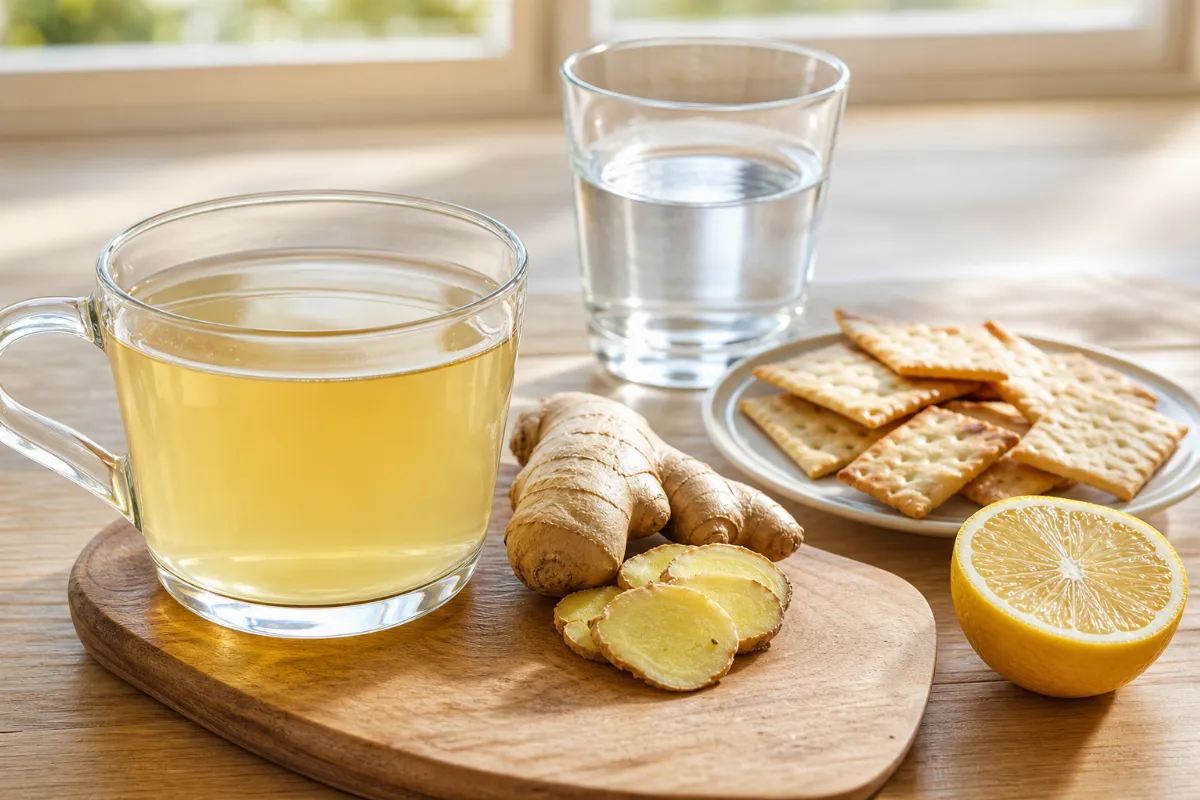
- Try ginger tea or ginger biscuits, and peppermint tea if you like it, and notice what actually helps you.
- Watch for warning signs (dehydration, blood, severe pain, vomiting that continues) and act early.
Optional additions
- Try a PC6 acupressure wristband or finger pressure, especially for travel, surgery or pregnancy sickness.
- For travel, sit where there is least movement, look at the horizon, avoid reading and heavy meals, and ask a pharmacist about proven travel-sickness products.
- Ask a pharmacist about oral rehydration powders if vomiting or diarrhoea continues, particularly for children and older adults.
What to track
- When it started, what you had eaten or taken, and whether anything triggered it (travel, a certain food, a new medicine).
- How much you are drinking and passing urine (dark or very little urine is a warning).
- What helped and what made it worse, which will help a clinician if you need to book an appointment.
When to reassess
Most short bouts settle within a day or two (the NHS says vomiting from a stomach bug usually stops within 1 or 2 days). If you still feel sick after a few days, if it keeps returning, or if any warning sign appears, see a doctor rather than trying more remedies.
When to seek professional support
- Pharmacist: for oral rehydration, travel-sickness products and checking supplements and medicines.
- Doctor or midwife: for pregnancy sickness that is more than mild, for repeated nausea, and for unexplained weight loss or persistent symptoms.
- Your oncology or surgical team: before using any ginger, herbal or other supplement around treatment or surgery.
What helps
Ordered by how well the research supports each step. Evidence strength is shown on every card; precautions sit next to the advice.
Start here
Sip fluids little and often
High certaintyAddresses: Helps prevent dehydration, which can make nausea worse
Why it may help: The NHS says the most important thing with vomiting is to have lots of fluids and to take small sips if you feel sick. MedlinePlus advises small amounts of clear liquids often if you struggle to keep liquids down. Cold drinks are suggested by the NHS for feeling sick.
How to apply it: Take a mouthful or two every few minutes rather than a big drink. Water, cold drinks and weak tea are fine. Pharmacies sell oral rehydration powders that you mix with water, which the NHS suggests for people at higher risk of dehydration.
Who it may suit: Everyone with nausea or vomiting; essential for children, older adults and pregnant women.
Precautions: Large drinks with meals can make nausea worse (NHS). Avoid fruit juice and fizzy drinks if you also have diarrhoea. Seek help if you cannot keep any fluid down.
4,2,1Diarrhea: causes, dehydration and when to get help → Stay Hydrated for Daily Wellbeing →
Eat small, plain, low-fat meals more often
Moderate certaintyAddresses: Keeps something in your stomach without overloading it
Why it may help: The NHS advises eating smaller, more frequent meals and avoiding hot, fried or greasy food and strong-smelling food. MedlinePlus suggests bland foods, smaller meals more often, and staying away from spicy, fatty or salty foods.
How to apply it: Try dry toast, plain crackers, rice, pasta, bread, bananas or cold foods (cold food smells less). Eat slowly and stop before you feel full. Return to your normal diet gradually as you feel better.
Who it may suit: Most people with short-term nausea who can eat a little.
Precautions: These are common-sense recommendations from health agencies rather than results of large trials. If you cannot eat for more than a day or two, or are losing weight, get advice.
2,1Fresh air, rest and distraction
Low certaintyAddresses: Often takes the edge off queasiness
Why it may help: The NHS lists getting plenty of fresh air and distracting yourself, for example with music or a film, among things that may help you stop feeling sick. For pregnancy sickness it also recommends plenty of rest, since tiredness can make nausea worse.
How to apply it: Open a window, sit upright somewhere cool and quiet, and put on something absorbing. Rest when you can.
Who it may suit: Anyone with mild nausea.
Precautions: Support from agencies rather than trial evidence. Persistent symptoms still need a check.
2,5Avoid strong smells, heat and food that triggers you
Low certaintyAddresses: Removes common triggers
Why it may help: The NHS says not to eat or cook strong-smelling food, and in pregnancy to avoid foods or smells that make you feel sick and to choose cold foods if hot meals smell too strong. MedlinePlus also lists avoiding strong smells.
How to apply it: Ask someone else to cook if you can, open windows, eat food at room temperature or cold, and notice which foods or smells set you off.
Who it may suit: People whose nausea is set off by cooking smells or particular foods.
Precautions: Keep a short note of triggers if the nausea repeats; it will help a doctor find the cause.
2,5,1Ginger as food or tea
Moderate certaintyAddresses: May ease nausea, with the best support in pregnancy
Why it may help: The NHS suggests ginger or peppermint tea and foods containing ginger, such as ginger biscuits, for feeling sick, and ginger in pregnancy sickness and motion sickness. See the Natural remedies tab for how strong the trial evidence is by situation.
How to apply it: Steep a few slices of fresh ginger (or a ginger teabag) in hot water, let it cool a little, and sip. Ginger biscuits or crystallised ginger are alternatives.
Who it may suit: Most adults. For pregnancy see the cautions below.
Precautions: Ginger can cause heartburn, stomach discomfort or diarrhoea in some people (NCCIH). In pregnancy the NHS advises checking with a pharmacist before taking ginger supplements.
2,5,6,8Ginger tea → Ginger (herb profile) → Psyllium, ginger and peppermint for digestion →
For travel sickness: reduce motion and look ahead
Moderate certaintyAddresses: Lowers the mismatch between what your eyes and inner ear sense
Why it may help: The NHS explains that motion sickness happens when the inner ear and the eyes send different signals. It advises sitting at the front of a car or middle of a boat, looking at a fixed point such as the horizon, getting fresh air, closing your eyes and breathing slowly, and not reading or using screens.
How to apply it: Choose a seat with less movement, look at the horizon, open a window, take breaks on long journeys, and avoid heavy meals, spicy food and alcohol before and during travel.
Who it may suit: People who get car, boat, plane or train sickness, including children.
Precautions: Pharmacy remedies exist for travel sickness; ask a pharmacist, especially for children. Dizziness that appears without travel needs a medical check.
3Additional options
Wrist acupressure (PC6 / P6)
Moderate certaintyAddresses: May reduce nausea after surgery and in early pregnancy
Why it may help: A Cochrane review of 59 trials (7,667 people) found that stimulating the PC6 wrist point reduced nausea, vomiting and the need for rescue anti-sickness medicine compared with sham treatment, though the evidence was rated low quality. The same review found results similar to anti-sickness drugs, with moderate-quality evidence. The NHS says there is some evidence that pressing the wrist or using a band may help pregnancy sickness, and that bands for motion sickness do not work for everyone.
How to apply it: Use a wristband made for the purpose, following its instructions for where it sits on the inner wrist, or press the point on the inner forearm with a finger as shown by a pharmacist or practitioner.
Who it may suit: Adults and older children who want a drug-free option; used around surgery and in pregnancy.
Precautions: Very safe in general. Stop if the band causes skin irritation or numbness. Most trials were about surgery; evidence in pregnancy is more limited.
7,5,3,9Peppermint tea or inhaled peppermint aroma
Low certaintyAddresses: A gentle option that may help mild queasiness
Why it may help: The NHS lists peppermint tea among things that may help when you feel sick. A 2024 review of aromatherapy for nausea after surgery (eight trials in the meta-analysis) found reduced nausea severity, with ginger, lavender and peppermint oils standing out, but certainty was low.
How to apply it: Sip a cup of peppermint tea, or smell peppermint from a tissue or bottle held near, not on, the nose. Do not swallow essential oil.
Who it may suit: Adults with mild nausea who like the taste or smell.
Precautions: Peppermint can aggravate heartburn or reflux in some people. Keep essential oils away from babies and young children and do not take them by mouth. In pregnancy, check with your midwife or pharmacist.
2,10Peppermint tea → Peppermint (herb profile) → Peppermint oil →
Cool, slow breathing and a calm setting
Very low certaintyAddresses: Can steady the body when queasiness is rising
Why it may help: For motion sickness the NHS advises closing the eyes and breathing slowly while focusing on the breath. Effects on other kinds of nausea have not been well tested.
How to apply it: Breathe in slowly through the nose for about four counts and out gently for about six, for a few minutes, somewhere cool with fresh air.
Who it may suit: Anyone with passing queasiness, including nerves-related nausea.
Precautions: Only the motion sickness advice is directly from an agency; effects for other kinds of nausea are not well tested. Stop if breathing exercises make you dizzy.
3Rest the stomach briefly, then restart gently
Low certaintyAddresses: Lets an upset stomach settle before you build back up
Why it may help: MedlinePlus suggests drinking clear liquids in small amounts first, then bland foods and small meals as you feel able. The NHS says to eat when you feel able and that it may help to avoid fatty or spicy food.
How to apply it: Start with sips for a few hours, add dry crackers or toast, then plain rice, pasta or banana, and slowly return to normal meals over a day or two.
Who it may suit: Adults and older children with a stomach bug.
Precautions: Babies and young children should keep feeding (breast, bottle or solids in small amounts as advised). Do not starve a child or an older person. Call for advice if there is no improvement.
1,4Still being studied
Ginger for chemotherapy-related nausea (alongside the care team)
Mixed findingsAddresses: Possible extra help for some people, not a replacement for anti-sickness treatment
Why it may help: A 2019 meta-analysis of 18 articles found lower odds of acute vomiting with ginger at up to 1 g a day for more than 3 days (moderate-quality evidence from three studies) but no significant effect on overall or delayed vomiting or on nausea. A 2025 meta-analysis of 35 randomized trials found ginger capsules added to standard anti-sickness treatment reduced severe nausea and vomiting, although the NCCIH says it is uncertain whether ginger helps as an addition to standard care.
How to apply it: Only after speaking to your oncology team. Do not take ginger instead of the anti-sickness plan you have been given.
Who it may suit: People having chemotherapy who want to ask their team about an add-on.
Precautions: Supplements can interact with treatments or affect surgery or blood tests; tell your cancer team about everything you take. Reviews are of low to moderate methodological quality.
11,12,6,13Ginger for nausea after surgery
Low certaintyAddresses: May lower nausea scores for some patients
Why it may help: A 2022 meta-analysis of 14 randomized trials (1,506 patients) found lower nausea scores with ginger than placebo at 2, 6 and 12 hours after surgery, but no clear effect on vomiting after leaving the recovery room. The NCCIH says it is uncertain whether ginger helps with nausea after surgery.
How to apply it: Discuss with your surgical or anaesthetic team before the operation; do not start supplements on your own.
Who it may suit: People preparing for surgery who want to ask about options.
Precautions: Tell your surgical team about all supplements before an operation.
14,6Ginger and peppermint for travel sickness
Mixed findingsAddresses: Unclear and inconsistent
Why it may help: A small crossover trial of 13 volunteers with a history of motion sickness found that 1,000 and 2,000 mg of ginger reduced nausea and delayed its onset during a spinning-chair test. The NHS suggests trying ginger, but the NCCIH says most studies of ginger for motion sickness have not shown it to be helpful.
How to apply it: If you want to try it, use ginger tea, biscuits or a standard supplement from a pharmacist, and combine with the behaviour tips above.
Who it may suit: People who get mild travel sickness.
Precautions: Evidence is inconsistent, so do not rely on ginger for long or rough journeys; ask a pharmacist about proven travel-sickness products.
15,6,3Food & nutrition
Foods and drinks when you feel sick
Agency advice is consistent: small sips of fluid, then small, plain, low-fat meals eaten slowly. The NHS suggests foods containing ginger, such as ginger biscuits, and says to avoid hot, fried, greasy and strong-smelling food. For pregnancy sickness it suggests dry toast or a plain biscuit in the morning, small frequent plain meals high in carbohydrate and low in fat (bread, rice, crackers, pasta), and cold foods if hot meals smell too strong.
- Water, cold drinks, and weak tea (ginger or peppermint) in small sips
- Dry toast, plain crackers or biscuits, plain rice, pasta, bread
- Cold or room-temperature foods with little smell
- Ginger biscuits, fresh ginger tea, crystallised ginger (small amounts)
- Oral rehydration drinks made from pharmacy powders when you are being sick
Foods and drinks to go easy on
Greasy, fried, very spicy or salty foods; large meals; alcohol; and fruit juice and fizzy drinks if you also have diarrhoea (the NHS says these can make diarrhoea worse).
- Fried and fatty food
- Very spicy or heavily salted dishes
- Large meals or big drinks taken all at once
- Alcohol
- Fruit juice and fizzy drinks when there is diarrhoea
Fluids for babies, children and older adults
The NHS says breast- or bottle-fed babies who are being sick should keep feeding, with small feeds more often than usual, and that formula must never be made weaker. Babies and children are more at risk of dehydration, and the NHS advises calling 111 for babies under 12 months or if a child stops feeding. Older people and those with weakened immune systems or other health conditions should speak to a pharmacist early.
4Remedies & supplements
Traditional use, laboratory findings and human trials are kept apart. "Natural" does not mean safe.
Ginger (fresh, tea, biscuits or capsules)
Moderate certaintyStudied form and route: Fresh root, tea, ginger biscuits, or standard capsules
Intended outcome: Less nausea and sometimes less vomiting
Human evidence: A 2026 umbrella review of 18 systematic reviews concluded that ginger supplements reduced the severity and occurrence of pregnancy nausea and vomiting compared with placebo. A 2023 meta-analysis of 33 trials found ginger beat placebo on effective rate and nausea score in pregnancy (low-certainty evidence). The 2015 Cochrane review said ginger may be helpful in pregnancy but the evidence was limited and not consistent. For chemotherapy, a 2019 meta-analysis found fewer acute vomiting episodes only at a particular low dose and duration; for post-surgery nausea a 2022 meta-analysis found lower nausea scores than placebo at some times.
Traditional use: Used in many cultures for stomach upset, indigestion and nausea. The NCCIH says it has been used in folk medicine since ancient times for indigestion and gastrointestinal discomfort.
Laboratory findings: A small randomized crossover trial of 13 volunteers found 1,000 and 2,000 mg of ginger reduced nausea and abnormal stomach rhythms and a stress hormone (vasopressin) during a spinning-chair test.
Limits: Many reviews are of low methodological quality. Most trials used capsules, not food. Results differ by situation (good in pregnancy, mixed in chemotherapy and motion sickness, uncertain after surgery).
Interactions and precautions: Possible side effects are abdominal discomfort, heartburn, diarrhoea and mouth or throat irritation (NCCIH). Check with a pharmacist or doctor before supplements if pregnant, breastfeeding (little is known), having surgery or cancer treatment, or taking any medicine.
Dose, only as reported in studies: Pregnancy reviews included supplements of about 450 to 1,950 mg of ginger a day (umbrella review). Trials in the chemotherapy review that showed benefit used 1 g a day or less for more than 3 days. Do not treat these as personal advice; ask a pharmacist for the product and amount that suit you.
8,16,9,11,14,15,6,13Ginger (herb profile) → Ginger tea → Psyllium, ginger and peppermint for digestion →
Peppermint (tea and inhaled aroma)
Low certaintyStudied form and route: Tea; inhaled essential oil aroma (not swallowed)
Intended outcome: A modest, short-lived settling effect for some people
Human evidence: The NHS lists peppermint tea among things that may help when you feel sick. A 2024 meta-analysis of aromatherapy for preventing post-surgery nausea (eight randomized trials) found reduced nausea severity, with ginger essence, lavender and peppermint oils standing out; certainty was low and vomiting was not clearly reduced. For indigestion (not nausea alone), a combination of peppermint and caraway oil improved symptoms in a meta-analysis of five trials, also with low or very low quality evidence.
Traditional use: Peppermint has long been used as a digestive herb and after-meal tea.
Laboratory findings: No laboratory findings are used on this page; the evidence is from human trials and agency advice.
Limits: Aromatherapy trials were small and varied, and mixed several oils. Evidence that peppermint tea itself relieves nausea comes mainly from agency advice rather than trials.
Interactions and precautions: Peppermint can make heartburn or reflux worse for some people. Do not swallow essential oil or use it undiluted on skin, and keep it away from babies and young children. In pregnancy, check with your midwife or pharmacist.
2,10,17Peppermint tea → Peppermint (herb profile) → Peppermint oil → Psyllium, ginger and peppermint for digestion →
Vitamin B6 (pregnancy nausea)
Low certaintyStudied form and route: Supplement under the guidance of a midwife, doctor or pharmacist
Intended outcome: May reduce pregnancy nausea, with limited evidence
Human evidence: The 2015 Cochrane review found only limited evidence from trials for vitamin B6 for mild to moderate nausea in early pregnancy. In a triple-blind trial of 77 women, both ginger and vitamin B6 reduced symptom scores, and so did placebo, over four days. A 2026 network meta-analysis of 24 trials ranked vitamin B6 combined with pomegranate and mint among the more effective options, with considerable uncertainty and low to moderate quality evidence.
Traditional use: A vitamin used in modern prenatal care rather than a traditional herb.
Laboratory findings: No laboratory findings are used on this page.
Limits: Small, short trials; large placebo response; combination products make it hard to know what worked.
Interactions and precautions: Take only on the advice of your midwife, doctor or pharmacist, who will check total vitamin B6 from all sources, including multivitamins and prenatal vitamins.
9,18,19Vitamin B6 → Pregnancy, postpartum and breastfeeding: wellness and supplements →
Herbal combinations for functional dyspepsia (STW5 and similar)
Very low certaintyStudied form and route: Multi-herb liquid or capsule products
Intended outcome: Possible easing of upper-stomach discomfort and nausea-like fullness
Human evidence: A 2023 Cochrane review of 41 trials (4,477 people) of non-Chinese herbal medicines for functional dyspepsia found that STW5 may moderately improve overall symptoms compared with placebo at 28 to 56 days, but the evidence was very uncertain (very low certainty).
Traditional use: Combinations of bitter and carminative herbs are used in European herbal tradition for stomach upset.
Laboratory findings: No laboratory findings are used on this page.
Limits: Very low certainty; products contain several herbs and may not be available everywhere; studies were about dyspepsia in general rather than nausea.
Interactions and precautions: Ask a pharmacist or doctor first, particularly with liver conditions, pregnancy, breastfeeding or other medicines. Long-lasting upper-stomach symptoms need a medical check.
20Aromatherapy with ginger, lavender or peppermint (after surgery)
Low certaintyStudied form and route: Inhaled from a tissue, inhaler stick or diffuser, usually in a clinical setting
Intended outcome: Lower nausea scores in some studies
Human evidence: A 2024 systematic review and meta-analysis of 11 studies (8 randomized trials in the meta-analysis) found aromatherapy reduced the severity of nausea after surgery, with ginger essence, lavender and peppermint oils particularly effective, but the reduction in vomiting episodes was not statistically significant and the certainty was low.
Traditional use: Aromatic plants have been used for comfort in many traditions.
Laboratory findings: No laboratory findings are used on this page.
Limits: Heterogeneous, mostly small studies, with some bias risk.
Interactions and precautions: Use only by inhalation; allergy and asthma are possible with strong scents; ask the care team before using anything in hospital.
10Therapies & care
A doctor or pharmacist can find the cause of persistent nausea and, if needed, recommend or prescribe anti-sickness treatment that is safe for your situation (including pregnancy, childhood and cancer treatment). Do not stop a prescribed medicine because of nausea; ask your doctor or pharmacist what to do. For vomiting that will not stop, fluids may need to be given in a clinic or hospital, according to MedlinePlus.
Acupressure and wrist stimulation (PC6)
Moderate certaintyMind-body / traditional Chinese medicine technique Pressure on the PC6 point on the inner forearm, using a band or finger pressure. The Cochrane review of 59 trials found fewer cases of nausea and vomiting after surgery than with sham treatment (low-quality evidence) and results similar to anti-sickness drugs (moderate-quality evidence).
Who it may suit: People having surgery and people with early-pregnancy sickness who want a drug-free option.
Precautions: Generally safe; skin irritation is possible. Evidence in pregnancy is more limited.
7,9,5Acupuncture
Low certaintyTraditional Chinese medicine technique The 2015 Cochrane review found that acupuncture at P6 or traditional points showed no significant benefit for early-pregnancy nausea. A 2023 meta-analysis found some benefit compared with conventional medicine, but the evidence was low quality.
Who it may suit: People who prefer acupuncture and are in the care of a trained, licensed practitioner.
Precautions: Choose a qualified practitioner using single-use needles; tell them if you are pregnant or have a bleeding problem.
9,16Pharmacist or doctor review
High certaintyEstablished professional care A pharmacist can suggest suitable remedies for travel sickness or oral rehydration for vomiting. A GP can look for the cause of repeated or long-lasting nausea and may prescribe anti-sickness medicine if needed. For severe pregnancy sickness, specialist care, sometimes in hospital, may be needed.
Who it may suit: Anyone whose nausea is not better in a few days, keeps coming back, or comes with warning signs.
Precautions: Bring a list of medicines and supplements you take, as many can cause nausea.
2,5,3,4Indigestion, functional dyspepsia and nausea → Digestive symptoms: red flags and when to get help →
What to avoid
Habits, products and claims that can get in the way. Never stop a prescribed medicine without talking to the professional who prescribed it.
Risks that apply to most people
Large, greasy, fried or very spicy meals
Moderate certaintyWhy: The NHS says not to eat hot, fried or greasy food or to eat too quickly while feeling sick; MedlinePlus advises staying away from spicy, fatty or salty food.
Who it applies to: Anyone with an unsettled stomach.
Try instead: Small, plain meals; cold or room-temperature foods.
2,1Lying down straight after eating or drinking
Low certaintyWhy: The NHS lists not lying down soon after eating among things to avoid.
Who it applies to: Anyone feeling sick, especially with reflux.
Try instead: Stay upright for a while after a meal, and sit or recline slightly raised if you need to rest.
2Drinking a large amount at once with meals
Low certaintyWhy: The NHS says not to have a large drink with meals when feeling sick.
Who it applies to: People who feel full or sick when eating.
Try instead: Take small sips between bites and between meals.
2Tight clothing around the waist or tummy
Low certaintyWhy: The NHS lists tight waistbands as something that can make feeling sick worse.
Who it applies to: Anyone with queasiness or after eating.
Try instead: Loosen belts and waistbands.
2Personal triggers to check
Strong smells, cooking odours and perfume
Moderate certaintyWhy: The NHS and MedlinePlus both advise avoiding strong smells and strong-smelling food.
Who it applies to: People with morning sickness and many with other nausea.
Try instead: Ventilate, eat cold food, ask someone else to cook.
2,5,1Reading, screens and watching moving objects while travelling
Moderate certaintyWhy: The NHS says not to read, watch films, use devices or look at passing cars or waves when you have motion sickness.
Who it applies to: People prone to travel sickness.
Try instead: Look at the horizon or a fixed point ahead and take breaks.
3Alcohol, and heavy or spicy meals before travel
Moderate certaintyWhy: The NHS advises not eating heavy meals, spicy foods or drinking alcohol shortly before or during travel when prone to motion sickness; alcohol is also listed as a cause of feeling sick.
Who it applies to: People who get travel sickness or who feel sick after drinking.
Try instead: Eat light before travelling and drink water.
3,2An empty stomach and tiredness in pregnancy
Low certaintyWhy: The NHS notes tiredness can make pregnancy sickness worse and suggests dry toast or a plain biscuit in the morning and small frequent meals.
Who it applies to: People in early pregnancy.
Try instead: Rest, eat a plain snack before getting up, and eat little and often.
5Pregnancy, postpartum and breastfeeding: wellness and supplements →
Products that need caution
Ginger, peppermint or herbal supplements without checking first
Moderate certaintyWhy: The NCCIH says to talk to your health care provider before using ginger or other herbal products if you take any medicine because some herbs and medicines interact in harmful ways, and says supplements are not approved by the FDA before sale. The NHS advises checking with a pharmacist before taking ginger supplements in pregnancy.
Who it applies to: Anyone pregnant, breastfeeding, having surgery or cancer treatment, or taking medicines.
Try instead: Start with ginger tea or food, and ask a pharmacist or doctor about supplements.
6,5Essential oils swallowed or applied undiluted
Not enough evidenceWhy: Essential oils are used in aromatherapy trials by inhalation; the evidence reviewed here does not support swallowing them for nausea.
Who it applies to: Anyone, especially children, pregnant women and people with asthma.
Try instead: Smell the oil from a tissue, or use peppermint or ginger tea instead.
10Over-the-counter anti-sickness or anti-diarrhoea medicines for babies and children without advice
High certaintyWhy: The NHS says not to give medicine to stop diarrhoea to children under 12 and not to give aspirin to children under 16, and that a pharmacist can recommend the right travel-sickness remedy for a child.
Who it applies to: Parents and carers.
Try instead: Ask a pharmacist or doctor; focus on fluids.
4,3Unsupported claims
"Ginger cures all nausea"
Moderate certaintyWhy: Reviews find benefit in some situations (pregnancy, some post-surgery nausea) but mixed or uncertain results for chemotherapy and motion sickness; reviews of ginger are often of low methodological quality.
Who it applies to: Social media, supplement labels.
Try instead: Use ginger as a gentle option, not a guarantee, and keep to the care plan for serious nausea.
13,6"Natural options can replace anti-sickness treatment for severe vomiting"
High certaintyWhy: Cochrane found no single intervention in pregnancy had strong evidence; severe pregnancy sickness (hyperemesis gravidarum) can cause dehydration and malnutrition and may need hospital treatment.
Who it applies to: People with severe or prolonged vomiting, pregnant women, people in cancer treatment.
Try instead: Seek medical care promptly if you cannot keep fluids down.
9,5"Detoxes or cleanses settle the stomach"
Not enough evidenceWhy: The reviews and agency pages used here recommend fluids, plain food and rest, and none supports detox or cleanse products for nausea.
Who it applies to: Cleanse and detox marketing.
Try instead: See the claim check on gut cleanses for the evidence.
4Common mistakes
Forcing food or big drinks while vomiting
Moderate certaintyWhy: The NHS recommends small sips and eating only when you feel able.
Who it applies to: Anyone with vomiting.
Try instead: Rest the stomach briefly, then use sips and small snacks.
4Ignoring signs of dehydration
High certaintyWhy: The NHS and MedlinePlus list dark urine, passing little urine, dry mouth and dizziness as signs of dehydration and reasons to get advice.
Who it applies to: Older adults, babies, children, pregnant women.
Try instead: Act early: oral rehydration, advice from a pharmacist or doctor.
4,1Putting up with recurring nausea for weeks
High certaintyWhy: The NHS says to see a GP if you feel sick and do not feel better in a few days or if it keeps coming back, so the cause can be found.
Who it applies to: Anyone with repeated or long-lasting nausea.
Try instead: Keep a simple note of timing, food and other symptoms and see a doctor.
2Evidence & safety
What the research shows
Health agencies agree on the basics: fluids in small sips, small plain meals, rest, fresh air and avoiding triggers, plus careful attention to dehydration and warning signs. Among natural options, ginger has the most research. It looks helpful for nausea and vomiting of pregnancy (low to moderate certainty), may reduce nausea after surgery at some time points, and has mixed or uncertain results for chemotherapy and motion sickness. Wrist (PC6) stimulation reduced nausea and vomiting after surgery in a Cochrane review, with low to moderate certainty. Peppermint and aromatherapy have small, low-certainty signals. No natural option should replace medical assessment for persistent or severe symptoms.
Limits of the evidence
- An overview of 15 ginger meta-analyses judged their methodological quality as low to critically low.
- Many trials were small, short, used different ginger products and doses, or measured symptoms in different ways, so results cannot always be pooled.
- Trials in pregnancy, after surgery and with chemotherapy cannot be assumed to apply to everyday queasiness.
- Placebo responses are large in nausea trials, which makes small benefits hard to detect.
- Evidence on side effects and safety in pregnancy and breastfeeding is limited.
Precautions and interactions
- Check supplements, including ginger, with a pharmacist or doctor if you take any medicine, as the NCCIH warns that some herbs and medicines interact in harmful ways.
- Supplements are not approved by the FDA before sale, so quality and strength vary (NCCIH).
- Never stop a prescribed medicine on your own because it makes you feel sick.
- Essential oils are for inhaling, not swallowing; keep them away from babies and young children.
Life-stage considerations
- Pregnancy: nausea and vomiting is very common; the NHS says it usually clears by weeks 16 to 20 and does not put the baby at increased risk, but severe sickness (hyperemesis gravidarum) needs care. Ask a pharmacist before ginger supplements, and see the pregnancy page for supplements.
- Breastfeeding: little is known about ginger supplements (NCCIH); choose food-level amounts or ask a health professional.
- Babies and children: dehydration develops faster; keep feeding, give small sips, and follow NHS advice to call 111 for babies under 12 months or children who stop feeding or cannot keep fluids down.
- Older adults and people with long-term conditions or weakened immunity: speak to a pharmacist early about dehydration risk and medicine side effects.
Warning signs
- Vomiting blood or vomit that looks like coffee grounds; black or bloody stools.
- Severe or sudden abdominal pain, or pain at night.
- Severe headache, stiff neck, confusion, or a high temperature.
- Chest pain, pain spreading to the arm, jaw or back, or breathlessness with nausea.
- Signs of dehydration: dry mouth, very dark urine or passing little urine, dizziness on standing.
- Vomiting that lasts more than a day or two, or being unable to keep fluids down.
- Unexplained weight loss, trouble swallowing, nausea that persists for several weeks or keeps returning, new symptoms at 50 or older, anaemia, or a family history of bowel cancer or inflammatory bowel disease.
Claim checks
Ginger works for nausea
Moderate certaintyPartly supported. Best support in pregnancy; mixed or uncertain for chemotherapy, after surgery and motion sickness.
8,16,11,14,6Wrist acupressure bands stop nausea
Moderate certaintySome support, mostly from surgery trials: a Cochrane review found reductions in nausea and vomiting (low-quality evidence). The NHS notes bands for motion sickness do not work for everyone.
7,3Peppermint oil or tea cures nausea
Low certaintyWeakly supported. Small, low-certainty aromatherapy signals; tea is suggested by the NHS but trial evidence is limited.
10,2Vitamin B6 is a proven cure for morning sickness
Low certaintyLimited evidence; placebo also improved symptoms in a small trial.
9,18You should avoid fluids if you are being sick
High certaintyNot supported. Small, frequent sips are recommended to prevent dehydration.
4,1Questions people ask
What is the quickest way to settle nausea at home?
There is no instant fix, but agencies suggest fresh air, distraction, small sips of cold drinks, ginger or peppermint tea, and eating small, plain meals (NHS). Avoid greasy food and strong smells.
Does ginger really help nausea?
It seems to help in pregnancy and may help in some other situations, but results for motion sickness and chemotherapy are mixed. The NCCIH says it may be helpful in pregnancy and that most studies for motion sickness did not show benefit.
How much ginger should I take?
There is no single recommended amount. Trials in pregnancy used roughly 450 to 1,950 mg of ginger supplements daily, and one chemotherapy review found benefit at 1 g a day or less for more than 3 days. Ginger tea and food are gentler, and a pharmacist can advise on supplements.
Is it safe to use ginger when pregnant?
Ginger food and tea are widely used. The NCCIH says ginger supplements may be safe in pregnancy but advises consulting a health care provider, and the NHS says to check with a pharmacist before taking supplements.
What helps morning sickness?
The NHS suggests rest, avoiding trigger smells, dry toast or a plain biscuit in the morning, small frequent plain meals, plenty of fluids, ginger and wrist acupressure. See a midwife or doctor if you cannot keep fluids down for 24 hours or have other warning signs.
What should I drink when I feel sick or am vomiting?
Take small sips often: water, cold drinks, weak tea or oral rehydration solution from a pharmacy. The NHS says not to give fruit juice or fizzy drinks when there is diarrhoea.
How long does nausea usually last?
The NHS says vomiting from a stomach bug usually stops in 1 or 2 days and diarrhoea in 5 to 7 days. Nausea without vomiting often passes in a day or two. If you still feel sick after a few days, see a doctor.
When should I worry about nausea?
Get help for vomiting blood, severe pain, chest pain, severe headache with a stiff neck, signs of dehydration, vomiting for more than a day or two, or nausea that keeps coming back. See the warning-signs list on this page.
What helps travel sickness?
Reduce motion, look at the horizon, get fresh air, avoid reading and screens and heavy or spicy meals, and ask a pharmacist about remedies such as tablets, patches or acupressure bands (NHS).
Can my medicine be making me feel sick?
Yes, medicines are a common cause (NHS, MedlinePlus). Do not stop a prescribed medicine yourself; ask your doctor or pharmacist about timing, with food, or alternatives.
What is the difference between nausea and indigestion?
Nausea is feeling sick; indigestion is discomfort or fullness in the upper stomach, often after meals. They often occur together. See the indigestion and nausea page for functional dyspepsia.
References
- MedlinePlus. Nausea and Vomiting. Read 2026-10-31. source
- NHS. Feeling sick (nausea). Page last reviewed 17 November 2023. Read 2026-10-31. source
- NHS. Motion sickness. Page last reviewed 19 June 2023. Read 2026-10-31. source
- NHS. Diarrhoea and vomiting. Read 2026-10-31. source
- NHS. Vomiting and morning sickness. Page last reviewed 17 April 2024. Read 2026-10-31. source
- NCCIH. Ginger: Usefulness and Safety. Read 2026-10-31. source
- Lee A, Chan SK, Fan LT. Stimulation of the wrist acupuncture point PC6 for preventing postoperative nausea and vomiting. Cochrane Database Syst Rev. 2015;2015:CD003281. source
- Tahergorabi Z, Eslami M, Arab-Zozani M, et al. Treatment of Nausea and Vomiting With Zingiber officinale in Pregnancy: An Umbrella Review of Systematic Reviews With Meta-Synthesis. Phytother Res. 2026;40:5538-5550. source
- Matthews A, Haas DM, O'Mathúna DP, Dowswell T. Interventions for nausea and vomiting in early pregnancy. Cochrane Database Syst Rev. 2015;2015:CD007575. source
- Wang JY, Huang HY, Chu WO, et al. Aromatherapy for the prevention of postoperative nausea and vomiting: A systematic review and meta-analysis. Tzu Chi Med J. 2024;36:330-339. source
- Crichton M, Marshall S, Marx W, et al. Efficacy of Ginger (Zingiber officinale) in Ameliorating Chemotherapy-Induced Nausea and Vomiting and Chemotherapy-Related Outcomes: A Systematic Review Update and Meta-Analysis. J Acad Nutr Diet. 2019;119:2055-2068. source
- Lin CY, Huang SH, Tam KW, et al. Efficacy and Safety of Ginger on Chemotherapy-Induced Nausea and Vomiting: A Systematic Review and Meta-analysis of Randomized Controlled Trials. Cancer Nurs. 2025;48:455-466. source
- Li Z, Wu J, Song J, et al. Ginger for treating nausea and vomiting: an overview of systematic reviews and meta-analyses. Int J Food Sci Nutr. 2024;75:122-133. source
- Lu C, Chen X, Yan X, et al. The preventive and relieving effects of ginger on postoperative nausea and vomiting: A systematic review and meta-analysis of randomized controlled trials. Int J Nurs Stud. 2022;125:104094. source
- Lien HC, Sun WM, Chen YH, et al. Effects of ginger on motion sickness and gastric slow-wave dysrhythmias induced by circular vection. Am J Physiol Gastrointest Liver Physiol. 2003;284:G481-G489. source
- Tan MY, Shu SH, Liu RL, et al. The efficacy and safety of complementary and alternative medicine in the treatment of nausea and vomiting during pregnancy: A systematic review and meta-analysis. Front Public Health. 2023;11:1108756. source
- Li J, Lv L, Zhang J, et al. A Combination of Peppermint Oil and Caraway Oil for the Treatment of Functional Dyspepsia: A Systematic Review and Meta-Analysis. Evid Based Complement Alternat Med. 2019;2019:7654947. source
- Sharifzadeh F, Kashanian M, Koohpayehzadeh J, et al. A comparison between the effects of ginger, pyridoxine (vitamin B6) and placebo for the treatment of the first trimester nausea and vomiting of pregnancy (NVP). J Matern Fetal Neonatal Med. 2018;31:2509-2514. source
- Frivaldszky L, Obeidat M, Hegyi P, et al. Comparative Effectiveness of Pharmacological and Non-Pharmacological Interventions for Nausea and Vomiting in Pregnancy: A Systematic Review and Network Meta-Analysis. Nutrients. 2026;18. source
- Báez G, Vargas C, Arancibia M, et al. Non-Chinese herbal medicines for functional dyspepsia. Cochrane Database Syst Rev. 2023;6:CD013323. source
Related on AlternativeMed
Related goals
Feel More Comfortable After Meals → Manage Occasional Heartburn → Manage Loose Stools & Diarrhea → Reduce Bloating → Understand Your Food Triggers → Manage Stress-Related Digestive Discomfort → Stay Hydrated for Daily Wellbeing →
Ingredients, foods and supplements
Ginger (herb profile) → Ginger tea → Peppermint (herb profile) → Peppermint tea → Peppermint oil → Ginger oil → Vitamin B6 → Psyllium, ginger and peppermint for digestion →
Research, safety and claim-check resources
Digestive symptoms: red flags and when to get help → Gut and digestive health research and evidence → Acupressure → Acupuncture → Pregnancy, postpartum and breastfeeding: wellness and supplements →