Whole Grains · Whole grain product
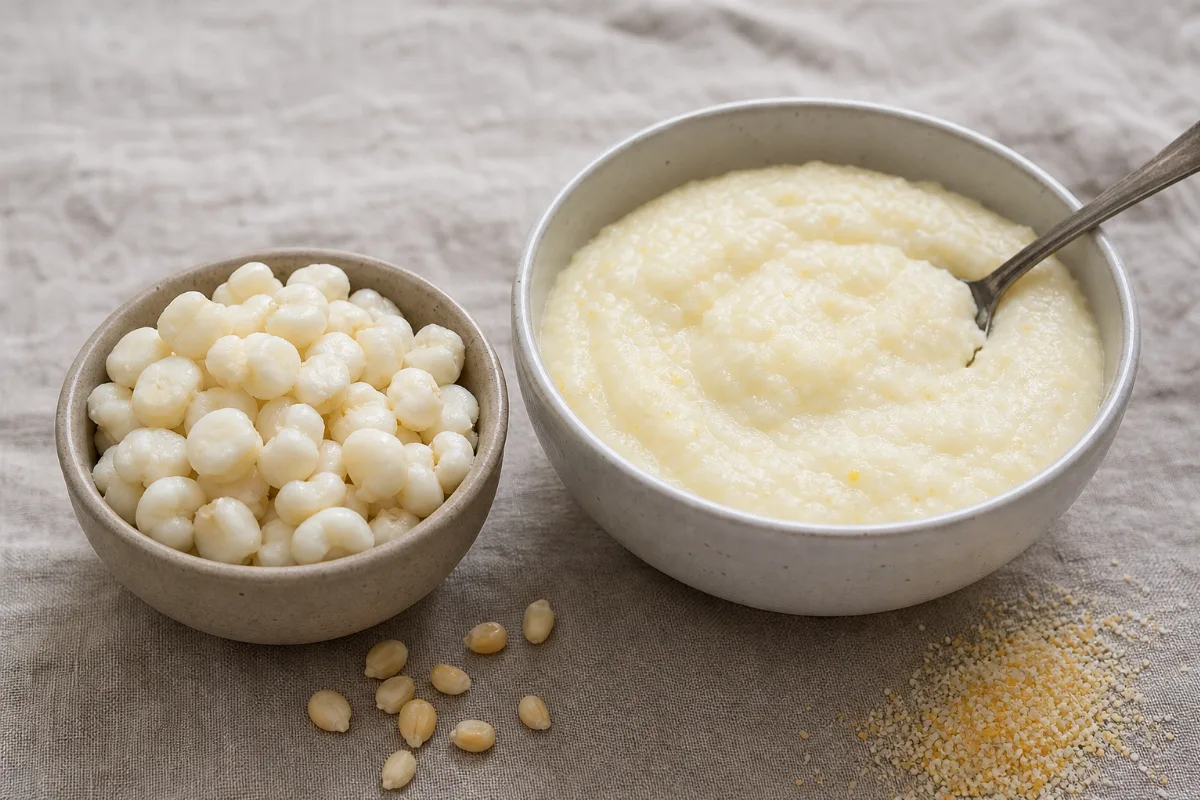
Hominy and Grits
Zea mays · also called Hominy, grits, hominy grits, corn grits, pozole corn
Hominy is whole corn kernels, usually sold canned. Grits are coarsely ground corn cooked into a hot porridge. Both are mostly starch, and the dry grits entry in USDA data carries added-looking iron and B vitamins. Research on these two foods themselves is thin: the best-known point is that corn treated with limewater releases its niacin, but we found no study of hominy or grits on this. The main cautions are sodium in canned hominy, what gets added (salt, butter, cheese), and mould toxins in stored corn.
General information, not medical advice. Last substantive update · Not medically reviewed. A named clinician has not signed off on this page. How this page is made
About Hominy and Grits
Hominy and grits are two ways of eating dried corn. They are everyday carbohydrate foods, not remedies. The firmest facts are their USDA nutrient values and the safety points: salt in canned hominy, what is added to grits, and mould toxins in stored corn.
What it is
Hominy is whole corn kernels (Zea mays, a grass), usually sold canned. Grits are coarsely ground corn, cooked into a porridge. USDA lists them as canned white hominy and as hominy grits. Hominy is usually described as corn treated with an alkali, but none of the sources we read explains how the canned hominy or the grits in stores are made, so we do not say.
USDA data for canned white hominy, per 100 g: 72 kcal, 1.48 g protein, 14.26 g carbohydrate, 2.5 g fibre, 267 mg sodium. One cup (165 g) has about 119 kcal, 4.1 g fibre and 441 mg sodium. USDA data for dry white grits (a brand-labelled entry), per 100 g: 361 kcal, 8.8 g protein, 79.2 g carbohydrate, 1.6 g fibre, 1 mg sodium, 4.42 mg iron, 0.61 mg thiamin and 5.32 mg niacin. A 41 g portion (1/4 cup dry) has about 148 kcal. The grits numbers are for the dry product, before cooking in water.
Niacin and limewater-treated corn
Corn is a weak source of tryptophan, and its niacin is tightly bound, says MedlinePlus. Niacin is released when corn is soaked in limewater overnight, the method used to make tortillas in Central America, where pellagra (the niacin-deficiency disease) is rare. A 2016 review says nixtamalization (alkaline soaking) can increase niacin and riboflavin bioavailability and that for niacin processing is sometimes necessary.
This is a principle about treated corn. We found no study that tested hominy or grits, and USDA lists only 0.033 mg niacin per 100 g of canned hominy. That figure does not show how much a body can use. Pellagra is a whole-diet problem, and this page does not say hominy prevents or treats it.
What the research shows
A 2026 narrative review of dry-milled corn foods (which include grits) says whole corn is supported by population studies, trials are positive for whole-grain products and mixed for refined ones, and long-term studies are needed. The USDA grits entry has only 1.6 g of fibre per 100 g, which looks like a refined product, but USDA does not say so.
For blood sugar, two small test-meal studies gave very different results. In 10 women in the Philippines, grits from a protein-improved maize had a glycaemic index of about 80 against about 120 for milled rice. In 11 volunteers in Malawi, a grits porridge scored about 110 and a fermented grits porridge about 65. These used other maize and recipes, so they do not describe ordinary US grits.
Food versus other corn products
The research here is on corn foods and processing, not on a hominy or grits supplement, and we found none. Corn flour, masa, popcorn, sweet corn and corn oil are different foods with their own pages.
At a glance
Traditional uses history, not proof
- Hominy kernels eaten in stews and pozole; grits eaten as a hot breakfast porridge or side dish
- Soaking maize in limewater (nixtamalization) is an old method in Central America
- Long use as food is not proof that it treats any condition
Studied for research
- Niacin from limewater-treated corn, low certainty (health-agency statement and a review; no study of hominy or grits)
- Iron and B vitamins in dry grits, high certainty for the USDA numbers, no outcome trial
- Long-term health of dry-milled corn foods, mixed (narrative review)
- Blood sugar response of maize grits, very low (two tiny test-meal studies of other maize)
- Fibre and digestion, insufficient evidence (composition only)
Main compounds
- Starch
- Niacin, thiamin, riboflavin and iron (dry grits entry)
- Dietary fibre
- Sodium (canned hominy)
Common forms
- Canned white hominy (USDA values)
- Dry white grits, regular (USDA values for one brand-labelled entry)
- Cooked grits made with water, milk, butter or cheese (not in the data read)
- Instant or flavoured packets, stone-ground grits and corn flour are different products and are not covered
Research links: 2026 review: dry-milled corn foods and health · 2016 review: how processing changes maize nutrients · 2025 trial: limewater cooking and mould toxins · Research Library · Genes & Biomarkers Library
What it is and its history
- Accepted scientific name
- Zea mays
- Naming authority
- L. (GBIF accepted)
- Common names
- Hominy (English); Grits (English); Hominy grits (English); Pozole corn (English); Maiz pozolero (hominy for pozole) (Spanish)
- Family or group
- Poaceae (the grass family), as given by GBIF.
- Classification
- Plantae > Tracheophyta > Liliopsida > Poales > Poaceae > Zea > Zea mays
- Native range
- Not verified from a source read.
- Habitat
- Not verified from a source read.
- What it looks like
- Roots: Not verified.; Stems: Not verified.; Leaves: Not verified.; Flowers: Not verified.; Fruit: The kernels (grains) are eaten. Hominy is sold as whole kernels, often canned; grits are a coarse meal cooked into a porridge. USDA household portions: 1 cup of canned hominy = 165 g; 1/4 cup of dry grits = 41 g.
- Cultivation
- Not verified from a source read.
- Harvest and processing
- The Kern and Hooshmand review says dry-milled corn products include whole or refined grits and that processing can include nixtamalization (alkali treatment). No source read describes how canned hominy is made or whether the USDA grits entry was made from alkali-treated corn.
- Look-alikes and adulterants
- Name: Popcorn, sweet corn and corn masa; Note: Other corn foods with their own pages and different processing.; Name: Polenta and cornmeal; Note: Dry-milled corn products also covered by the dry-milled corn review.; Name: Corn flour and starch; Note: Different products, not covered by the results here.
- Sustainability and conservation
- Not assessed.
Photographs
What is inside, and how it may work
What it contains and how those compounds act in cells and animals. Laboratory and animal mechanisms are not proven effects in people.
Main compounds
| Compound | Family | Where it is concentrated | Activity studied | Level of evidence |
|---|---|---|---|---|
| Starch (carbohydrate) | carbohydrate | Kernel USDA: 79.2 g carbohydrate per 100 g dry grits; 14.26 g per 100 g canned hominy | Energy source. Glycaemic index values for maize grits porridges ranged widely in two small studies. 17 16 7 6 | Human data |
| Niacin (vitamin B3) | B vitamin | Kernel USDA: 5.32 mg per 100 g dry grits; 0.033 mg per 100 g canned hominy | Corn's own niacin is tightly bound and released by alkali treatment (MedlinePlus; Suri review). The grits figure looks like added niacin. 17 16 13 9 | Authoritative guidance |
| Iron, thiamin and riboflavin | mineral and B vitamins | Kernel USDA dry grits per 100 g: iron 4.42 mg, thiamin 0.61 mg, riboflavin 0.36 mg; canned hominy: iron 0.62 mg, thiamin 0.003 mg, riboflavin 0.006 mg | Nutrient content only. Absorption was not read. 17 16 | Human data |
| Dietary fibre | carbohydrate | Kernel USDA: 2.5 g per 100 g canned hominy; 1.6 g per 100 g dry grits | Composition only. 16 17 | Human data |
| Sodium | mineral | Added in canning USDA: 267 mg per 100 g canned hominy; 1 mg per 100 g dry grits | See Safety tab. The sodium in a prepared bowl of grits depends on what is added. 16 17 10 | Authoritative guidance |
Mechanisms, receptors and pathways
| Target or pathway | Gene or receptor | What was found | Level |
|---|---|---|---|
| Alkali release of bound niacin | Not specified | MedlinePlus says corn's niacin is tightly bound and is released when corn is soaked in limewater. The 2016 review says nixtamalization can increase niacin and riboflavin bioavailability. Not shown for hominy or grits. 13 9 | Authoritative guidance |
| Alkali effects on mould toxins | Not specified | Toxins may be physically removed in steeping and washing, or degraded, modified or bound in the food by high pH and heat; part of the aflatoxin effect might reverse in acid (German review). 8 | Narrative review |
Absorption, metabolism and elimination
- Absorption
- Not found for hominy or grits. The 2016 review says nixtamalization and fermentation can increase bioavailability of niacin and riboflavin, and that mineral availability can improve when phytic acid is reduced.
- Distribution
- Not found.
- Metabolism
- Not found.
- Elimination
- Not found.
- Bioavailability
- Not established for hominy or grits in the sources read.
Isolated compounds versus whole extracts
The food is whole kernels (hominy) or ground kernels (grits). We found no trial of a hominy or grits supplement, extract or powder. Blood sugar studies used maize grits porridges; the mould-toxin studies used maize, masa and tortillas.
Nutritional composition
Nutrition from USDA FoodData Central (SR Legacy, April 2018 release; values read 2026-10-26 from a saved copy of the data). Canned white hominy (FDC 169701), per 100 g: 72 kcal, 1.48 g protein, 0.88 g fat, 14.26 g carbohydrate, 1.51 g sugars, 2.5 g fibre, 267 mg sodium, 9 mg potassium, 35 mg phosphorus, 16 mg magnesium, 0.62 mg iron, 1.05 mg zinc, 0.033 mg niacin. One cup (165 g): about 119 kcal, 2.4 g protein, 23.5 g carbohydrate, 4.1 g fibre, 441 mg sodium, 15 mg potassium, 58 mg phosphorus, 1.0 mg iron. Dry white regular grits (FDC 174630, a brand-labelled entry), per 100 g: 361 kcal, 8.8 g protein, 1.6 g fat, 79.2 g carbohydrate, 1.6 g fibre, 1 mg sodium, 137 mg potassium, 73 mg phosphorus, 27 mg magnesium, 4.42 mg iron, 0.61 mg thiamin, 0.36 mg riboflavin, 5.32 mg niacin, 0.15 mg vitamin B6. One nutrition-label portion, 1/4 cup dry (41 g): about 148 kcal, 3.6 g protein, 32.5 g carbohydrate, 0.7 g fibre, 0.4 mg sodium, 56 mg potassium, 30 mg phosphorus, 1.8 mg iron, 0.25 mg thiamin, 0.15 mg riboflavin, 2.2 mg niacin (per-100 g values scaled by weight, rounded). USDA lists no folate for the grits entry. The grits values are for the dry product before cooking in water; cooked grits, stone-ground grits and instant or flavoured packets were not read, and added butter, cheese, salt or sugar change calories, fat and sodium. Values vary with the product and its enrichment.
1 high certainty1 mixed findings1 low certainty1 very low certainty1 not enough evidence
What was looked at
The 5 benefits and uses checked for Hominy and Grits, each with how strong the evidence is. Tap one to open it.
- Niacin from limewater-treated corn (pellagra)Low certainty
- Iron, thiamin, riboflavin and niacin in dry gritsHigh certainty
- Long-term health of dry-milled corn foodsMixed findings
- Blood sugar response to maize gritsVery low certainty
- Fibre and digestionNot enough evidence
Lab markers tracked in the studies
Glycaemic index
What is Hominy and Grits good for?
The main studied uses and how strong the evidence is for each. No study of hominy or grits eaten as normal food was found for any health outcome; most points come from nutrient data or from reviews of corn foods.
Benefits, one by one
Each card is a research question, not a promise. Tap a goal to filter. Open a card to see the studies, doses and limits.
Niacin from limewater-treated corn (pellagra)
Low certaintyCorn is a poor source of usable niacin unless it is treated with an alkali such as limewater. MedlinePlus says soaking corn in limewater releases the niacin, which is why pellagra is rare where tortillas are made this way. A 2016 review agrees. No source we read tests hominy or grits themselves, and USDA lists very little niacin in canned hominy (0.033 mg per 100 g).
4 studiesCorn kernels soaked in limewater (nixtamalized), as food.
Studies, doses and limits
What the trials found
MedlinePlus (reviewed October 2024) says niacin is released from corn soaked in limewater overnight, the method used to make tortillas in Central America, where pellagra is rare. A 2016 review (Suri and Tanumihardjo) says nixtamalization can increase the bioavailability of riboflavin and niacin and that, for niacin, processing is in some cases actually necessary. Neither source tested canned hominy or grits.
Results
The principle is accepted by a health agency and a review. We found no trial that measured niacin status after people ate hominy or grits. We also found no source describing how canned hominy is made or whether a given box of grits is alkali-treated.
Effect sizes as reported
Not given. USDA: 0.033 mg niacin per 100 g of canned hominy; 5.32 mg per 100 g of dry grits (a brand-labelled entry that looks enriched).
Why this rating
The principle comes from a health-agency page and a narrative review, but no study of hominy or grits was read, and the sources do not say how store-bought hominy and grits are made.
Form and dose studied
Corn kernels soaked in limewater (nixtamalized), as food.
Who was studied
Populations that rely heavily on corn as a staple.
Limits
Pellagra is a deficiency of the whole diet. This is not a claim that hominy treats or prevents it in a person eating a varied diet. The USDA niacin figure does not show how well the body can use the niacin.
Why researchers looked
Hominy is made from corn, and people ask whether the alkali treatment used for hominy and tortillas protects against niacin deficiency.
Traditional use
Soaking maize in lime or ash water (nixtamalization) is an old method in Central America. Long use is not proof that a particular store-bought product has the same effect.
Proposed mechanism Authoritative guidance
MedlinePlus says corn's niacin is tightly bound and is released when corn is soaked in limewater. The 2016 review says nixtamalization can increase the bioavailability of niacin and riboflavin.
A proposed mechanism does not show that the effect happens in people.
None specific to this benefit.
Iron, thiamin, riboflavin and niacin in dry grits
High certaintyThe USDA entry for dry white grits has 4.42 mg of iron, 0.61 mg of thiamin, 0.36 mg of riboflavin and 5.32 mg of niacin per 100 g. In one 41 g portion (1/4 cup dry) that is about 1.8 mg iron, 0.25 mg thiamin, 0.15 mg riboflavin and 2.2 mg niacin. This is a nutrient fact for one brand-labelled entry, not a trial.
2 studiesDry white grits as food; the USDA portion is 1/4 cup dry (41 g).
Studies, doses and limits
What the trials found
USDA FoodData Central lists the figures above for dry, white, regular grits (SR Legacy, April 2018). USDA lists no folate for this item. The numbers describe the dry product, before cooking in water, and flavoured or instant grits are not covered.
Results
The grits entry is a source of iron and B vitamins by these figures. No source we read tested whether eating grits changes iron or vitamin status.
Effect sizes as reported
USDA per 100 g dry: iron 4.42 mg, thiamin 0.61 mg, riboflavin 0.36 mg, niacin 5.32 mg, vitamin B6 0.15 mg.
Why this rating
High that this one USDA entry contains these amounts. Other brands, stone-ground grits and flavoured packets will differ, and no outcome trial was read.
Form and dose studied
Dry white grits as food; the USDA portion is 1/4 cup dry (41 g).
Who was studied
General diet.
Limits
One brand-labelled entry. Values change with the product, its enrichment and how it is cooked. Stone-ground whole grits are not in the data read.
Why researchers looked
People ask whether grits give useful vitamins and iron, since the grain is mostly starch.
Traditional use
Grits are a Southern United States breakfast porridge and side dish. Long use is not proof of any health effect.
Proposed mechanism Nutrient database
Not a mechanism question. These amounts are far above those USDA lists for canned hominy (0.003 mg thiamin, 0.033 mg niacin), which fits the idea that the grits entry is enriched, but the USDA data we read do not say so.
A proposed mechanism does not show that the effect happens in people.
None specific.
Long-term health of dry-milled corn foods
Mixed findingsA 2026 review of dry-milled corn foods (which include grits) says population studies support whole dry-milled corn, trials are mostly positive for whole-grain corn products and mixed for refined ones, and long-term studies are needed. Hominy and grits are not singled out in the abstract.
2 studiesWhole and refined dry-milled corn foods.
Studies, doses and limits
What the trials found
The 2026 narrative review by Kern and Hooshmand says epidemiological research supports whole dry-milled corn products, limited clinical trials tend to report positive results for whole-grain products and mixed results for refined products, and that long-term dose-response studies of both are needed.
Results
Mixed. Whole-grain corn looks better than refined in the review's summary; refined grits are in the weaker group. We found no trial of hominy or grits on their own.
Effect sizes as reported
Not given in the abstract.
Why this rating
A narrative (not systematic) review with no numbers in the abstract; whole and refined products are pooled in different ways, and hominy is not named.
Form and dose studied
Whole and refined dry-milled corn foods.
Limits
A narrative review. The USDA grits entry (1.6 g fibre per 100 g) looks like a refined product, but USDA does not say so; check the package for 'whole grain'.
Why researchers looked
Whole grains are linked to better health, so researchers ask whether corn foods behave the same way, and whether refined ones lose the benefit.
Traditional use
Corn products have been staple foods for centuries. Long use is not proof of any health effect.
Proposed mechanism Narrative review
The review says whole grain products tend to be richer in nutrients that are lost when bran and germ are removed. No pathway is given in the abstract.
A proposed mechanism does not show that the effect happens in people.
See the Safety tab for sodium in canned hominy and mould toxins in stored corn.
Blood sugar response to maize grits
Very low certaintyTwo small test-meal studies measured how fast blood sugar rises after maize grits. In 10 women in Manila, grits made from a protein-improved maize (QPM) had a glycaemic index of about 80, lower than milled rice at about 120. In 11 volunteers in Malawi, grits porridge scored about 110, and fermented grits about 65. These are not ordinary US grits and are not studies of diabetes.
3 studiesCooked maize grits (QPM variety in one study; Malawian stiff porridge…
Studies, doses and limits
What the trials found
Panlasigui 2010: randomised crossover trial in 10 women; GI 80.36 for QPM grits, 119.78 for milled rice, 93.17 for a mixture, compared with bread. Mlotha 2016: 11 healthy volunteers in Malawi; GI 109.64 for maize-grits stiff porridge, 94.06 for whole maize flour and 65.49 for fermented grits porridge, compared with glucose.
Results
Mixed and very uncertain. The two studies used different maize, recipes and reference foods, and their GI values differ widely. The Manila authors suggest grits may suit people with diabetes; we do not make that claim.
Effect sizes as reported
GI 80.36 (QPM grits), 109.64 (Malawi grits porridge), 65.49 (fermented grits porridge).
Why this rating
Two tiny test-meal studies (10 and 11 people), different maize and methods, single meals, no clinical outcome, and neither studied US-style grits.
Form and dose studied
Cooked maize grits (QPM variety in one study; Malawian stiff porridge in the other), as single test meals.
Who was studied
10 women (Philippines); 11 healthy volunteers (Malawi). No people with diabetes in the abstracts.
Limits
Tiny studies. Glycaemic index depends on the recipe, cooking and what is eaten with the grits. Butter, cheese and sugar were not tested.
Why researchers looked
Grits are mostly starch (79.2 g carbohydrate per 100 g dry by USDA), so people ask how much they raise blood sugar.
Traditional use
Maize porridges are staple foods in Africa, Latin America and the southern United States. Long use is not proof of any health effect.
Proposed mechanism Authors hypothesis
The Manila authors suggest fibre content and physical properties may play a part. Not tested.
A proposed mechanism does not show that the effect happens in people.
People with diabetes who count carbohydrate should use the label of the exact product and ask their care team.
Fibre and digestion
Not enough evidenceCanned hominy has 2.5 g of fibre per 100 g (4.1 g in a 165 g cup) and the dry grits entry has 1.6 g per 100 g (0.66 g in a 41 g portion). No trial of either food for bowel health was found.
3 studiesCanned hominy and dry grits as food.
Studies, doses and limits
What the trials found
USDA FoodData Central lists the fibre figures above. The 2026 corn review says whole-grain corn products keep more of the nutrients lost in refining, but gives no fibre numbers in the abstract.
Results
These are nutrient facts. No study of eating hominy or grits on bowel function was found.
Effect sizes as reported
USDA: hominy 2.5 g fibre per 100 g; dry grits 1.6 g per 100 g.
Why this rating
Only composition data. No trial.
Form and dose studied
Canned hominy and dry grits as food.
Who was studied
General diet.
Limits
The fibre of cooked grits (diluted by water) was not in the data read.
Why researchers looked
People ask whether corn foods help digestion; the answer starts with how much fibre they contain.
Traditional use
Hominy is eaten in stews and sides, and grits as a porridge. Long use is not proof of a digestive benefit.
Proposed mechanism Unknown
Not established in the sources read.
A proposed mechanism does not show that the effect happens in people.
None specific.
Connections to the rest of health
How Hominy and Grits connects to the rest of our health knowledge graph. Every link says what kind of connection it is. A safety link (for example to the liver) is a warning, not a benefit. A study that merely mentions a topic never creates a benefit link.
Explore every connection: goals, body systems, organs, symptoms, genes
A. Wellness goals
| Connected to | Kind of connection | Evidence status | Context | Studies |
|---|---|---|---|---|
| Balanced Nutrition | Low certainty | Niacin from limewater-treated corn (pellagra): Corn is a poor source of usable niacin unless it is treated with an alkali such as limewater. MedlinePlus says soaking corn in limewater releases the niacin, which is why pellagra is rare where tortillas are made this way. A 2016 review agrees. No source we read tests hominy or grits themselves, and USDA lists very little niacin in canned hominy (0.033 mg per 100 g). | 13 9 16 17 | |
| Balanced Nutrition | High certainty | Iron, thiamin, riboflavin and niacin in dry grits: The USDA entry for dry white grits has 4.42 mg of iron, 0.61 mg of thiamin, 0.36 mg of riboflavin and 5.32 mg of niacin per 100 g. In one 41 g portion (1/4 cup dry) that is about 1.8 mg iron, 0.25 mg thiamin, 0.15 mg riboflavin and 2.2 mg niacin. This is a nutrient fact for one brand-labelled entry, not a trial. | 17 16 | |
| Heart Health | Mixed findings | Long-term health of dry-milled corn foods: A 2026 review of dry-milled corn foods (which include grits) says population studies support whole dry-milled corn, trials are mostly positive for whole-grain corn products and mixed for refined ones, and long-term studies are needed. Hominy and grits are not singled out in the abstract. | 3 17 | |
| Metabolic Health | Mixed findings | Long-term health of dry-milled corn foods: A 2026 review of dry-milled corn foods (which include grits) says population studies support whole dry-milled corn, trials are mostly positive for whole-grain corn products and mixed for refined ones, and long-term studies are needed. Hominy and grits are not singled out in the abstract. | 3 17 | |
| Blood Sugar Balance | Very low certainty | Blood sugar response to maize grits: Two small test-meal studies measured how fast blood sugar rises after maize grits. In 10 women in Manila, grits made from a protein-improved maize (QPM) had a glycaemic index of about 80, lower than milled rice at about 120. In 11 volunteers in Malawi, grits porridge scored about 110, and fermented grits about 65. These are not ordinary US grits and are not studies of diabetes. | 7 6 17 | |
| Digestive Support | Not enough evidence | Fibre and digestion: Canned hominy has 2.5 g of fibre per 100 g (4.1 g in a 165 g cup) and the dry grits entry has 1.6 g per 100 g (0.66 g in a 41 g portion). No trial of either food for bowel health was found. | 16 17 3 |
B. Body systems
| Connected to | Kind of connection | Evidence status | Context | Studies |
|---|---|---|---|---|
| Nutrition | Biological association | Low certainty | Studied for: Niacin from limewater-treated corn (pellagra) Studied for: Iron, thiamin, riboflavin and niacin in dry grits | 13 9 16 17 |
| Cardiovascular System | Biological association | Mixed findings | Studied for: Long-term health of dry-milled corn foods | 3 17 |
| Metabolism Weight | Biological association | Mixed findings | Studied for: Long-term health of dry-milled corn foods Studied for: Blood sugar response to maize grits | 3 17 7 6 |
| Digestive System | Biological association | Not enough evidence | Studied for: Fibre and digestion | 16 17 3 |
E. Health conditions
| Connected to | Kind of connection | Evidence status | Context | Studies |
|---|---|---|---|---|
| Food allergy | Documented risk | Corn is not named among the most common allergens by MedlinePlus, but prepared grits can contain milk or other allergens. Preparation or compound: Cheese grits and flavoured packets |
12 | |
| Celiac disease | Documented risk | Corn is not a gluten grain, but processed foods can carry gluten through ingredients or cross-contact. Preparation or compound: Processed corn foods |
14 | |
| Pellagra | Insufficient evidence | Limewater treatment releases corn's bound niacin (MedlinePlus); hominy and grits themselves were not tested. Preparation or compound: Limewater-treated corn |
13 9 | |
| High blood pressure | Documented risk | Canned hominy has 441 mg sodium per cup; CDC says too much sodium can raise blood pressure. Preparation or compound: Canned hominy |
16 10 |
G. Root causes and contributing factors
| Connected to | Kind of connection | Evidence status | Context | Studies |
|---|---|---|---|---|
| Environmental Toxins | Adverse effect or risk | Documented risk | Maize can carry aflatoxins and fumonisins when stored badly (WHO). Stored maize can carry aflatoxins and fumonisins (WHO); alkali cooking lowers but does not remove them. Preparation or compound: Stored maize |
18 5 |
I. Biomarkers
| Connected to | Kind of connection | Evidence status | Context | Studies |
|---|---|---|---|---|
| Glycaemic index | Biological association | Very low certainty | Measured in trials: mixed. A lab change is not the same as a health benefit. | 7 6 |
K. Biological pathways
| Connected to | Kind of connection | Evidence status | Context | Studies |
|---|---|---|---|---|
| Niacin (vitamin B3) | Preliminary mechanism | Authoritative guidance | Corn's bound niacin is released by alkali treatment; the grits entry shows 5.32 mg per 100 g. | 13 17 |
| Sodium | Preliminary mechanism | Authoritative guidance | Canned hominy is salty; plain dry grits are not. | 16 10 |
L. Active compounds
| Connected to | Kind of connection | Evidence status | Context | Studies |
|---|---|---|---|---|
| Starch (carbohydrate) | Biological association | Human | Energy source. Glycaemic index values for maize grits porridges ranged widely in two small studies. Preparation or compound: Kernel |
17 16 7 6 |
| Niacin (vitamin B3) | Biological association | Authoritative guidance | Corn's own niacin is tightly bound and released by alkali treatment (MedlinePlus; Suri review). The grits figure looks like added niacin. Preparation or compound: Kernel |
17 16 13 9 |
| Iron, thiamin and riboflavin | Biological association | Human | Nutrient content only. Absorption was not read. Preparation or compound: Kernel |
17 16 |
| Dietary fibre | Biological association | Human | Composition only. Preparation or compound: Kernel |
16 17 |
| Sodium | Biological association | Authoritative guidance | See Safety tab. The sodium in a prepared bowl of grits depends on what is added. Preparation or compound: Added in canning |
16 17 10 |
Each connection is stored with the ingredient, the connected record, the kind of connection, the evidence status, the supporting studies, the preparation or compound involved, and a review date (last reviewed October 26, 2026).
Evidence at a glance: what changed in 1 lab markers
Tap a number to show only those markers. Counts are markers, not people.
The evidence
The research centre for Hominy and Grits. Every record here was checked against PubMed or the publisher's page; we never list a study we have not verified.
Evidence by outcome
Bars show how many studies we found for each outcome, not how well it works. People are added up across trials only (reviews are not added, to avoid double counting).
How we rate evidence
High certainty
Several well-run trials or reviews agree; further research is unlikely to change the picture much.
Moderate certainty
Good trials point the same way, but some doubt remains.
Low certainty
Small, short or inconsistent trials. The finding could change with better research.
Very low certainty
Very little or very weak human data. Treat as a possibility only.
Mixed findings
Trials or reviews disagree with each other.
Not enough evidence
Not enough human research to say either way.
Evidence against
Good research found no benefit, or found harm.
We take the reviewers' own risk-of-bias and GRADE statements where they exist, and otherwise judge from study size, design, consistency, directness and whether a product matches what is sold. Many publications do not make evidence high. Method note: We started from our existing hominy and grits summary, re-checked nutrition against a saved copy of USDA FoodData Central data, re-read the WHO, CDC, NIDDK and MedlinePlus pages, and re-read PubMed abstracts for the reviews and studies cited. Only abstracts were read for studies. Items we could not verify are flagged in the research gaps.
Study library: every study we checked 18
| Study | Design | People | Product, dose, length | Result |
|---|---|---|---|---|
| Cabrera-Meraz 2021 Incidence of aflatoxins and fumonisins in grain, masa and corn tortillas in four municipalities in the department of Lempira, Honduras. Heliyon · PMID 34977400 · DOI |
Cross sectional survey |
144 144 samples from 48 farmers in Lempira, Honduras |
Maize grain, masa and tortilla samples Maize grain, masa, tortilla |
Sixty-five percent of samples had aflatoxins and fumonisins were found in 100%. Processing grain into tortillas reduced aflatoxin by 83% and fumonisin by 52%. With 490 g of tortilla a day, intake of fumonisins was estimated at 6.16 to 151.98 micrograms per kg body weight a day, and the authors called the exposure risk high. Aflatoxin -83%, fumonisin -52% (grain to tortilla) (Not applicable) Methods, limits and fundingOutcomes: Aflatoxin and fumonisin levels; estimated intake Limitations: A survey in one region, of tortillas, not hominy or grits. Fluorometry measurement. Funding and conflicts: The authors declare no conflict of interest. Read: abstract |
| Hooper 2020 Reduction in saturated fat intake for cardiovascular disease. Cochrane Database Syst Rev · PMID 32428300 · DOI |
Systematic review meta analysis |
59000 About 59,000 adults in 15 randomised trials (each at least 24 months) |
Reduced saturated fat intake, compared with higher intake or usual diet Dietary saturated fat in general At least 24 months · vs Higher saturated fat or usual diet |
Reducing saturated fat lowered combined cardiovascular events by 21% (RR 0.79; 95% CI 0.66 to 0.93; 11 trials; moderate-quality evidence). There was little or no effect on all-cause mortality (RR 0.96; 95% CI 0.90 to 1.03) or cardiovascular mortality (RR 0.95; 95% CI 0.80 to 1.12). Combined CVD events RR 0.79 (95% CI 0.66 to 0.93) Methods, limits and fundingOutcomes: Cardiovascular events, mortality Limitations: About saturated fat in general, not butter on grits. The abstract shown is the May 2020 version; PubMed notes an August 2020 update. Funding and conflicts: Cochrane review; author interests are not stated in the abstract. Read: abstract |
| Kern 2026 Dry-Milled Corn and Corn Products and Health: A Narrative Review. Food Sci Nutr · PMID 41695107 · DOI |
Narrative review |
Review of dry-milled corn products (whole or refined grits, cornmeal, corn flour, polenta, tortillas, chips, cereals) | Dry-milled corn products Whole and refined dry-milled corn foods |
The abstract says whole grain products tend to be richer in nutrients lost when bran and germ are removed to make refined products; epidemiological research supports whole dry-milled corn products; limited clinical trials tend to report positive results for whole grain products and mixed results for refined ones; long-term studies of both are needed; zeaxanthin and macular health should be studied. Positive for whole-grain corn products, mixed for refined (narrative summary) (Not applicable) Methods, limits and fundingOutcomes: Health outcomes of dry-milled corn foods Limitations: A narrative review (not systematic). Numbers are not given in the abstract. It covers many products, and hominy is not named in the abstract. Funding and conflicts: The authors declare no conflicts of interest. Read: abstract |
| Mannara 2025 Dietary exposure of school children to aflatoxin and fumonisin through githeri and effectiveness of nixtamalization in reduction of these toxins in githeri from Turkana County. Mycotoxin Res · PMID 39392572 · DOI |
Cross sectional survey plus lab |
128 128 school-meal samples of githeri (maize and beans), Turkana County, Kenya |
Calcium hydroxide treatment of contaminated samples Maize and bean mixture Ca(OH)2 0.5 to 2.5% Soaked 6 or 8 hours, cooked 60 or 75 minutes · vs Untreated samples |
Forty percent of schools had githeri with aflatoxin B1 above Kenya's 5 micrograms per kg limit. Treatment with up to 2.5% Ca(OH)2 reduced aflatoxin by 75% and fumonisin by 72%. Aflatoxin -75%, fumonisin -72% (lab treatment) (Not stated in the abstract) Methods, limits and fundingOutcomes: Aflatoxin and fumonisin levels; estimated child intake Limitations: A food survey plus lab treatment of maize and beans, not hominy or grits; the abstract states it is not a clinical trial. Funding and conflicts: The authors declare no competing interests. Read: abstract |
| Maris 2025 Nixtamalization of Maize to Reduce Mycotoxin Exposure: A Human Biomonitoring Intervention Study in Soweto, South Africa. Toxins (Basel) · PMID 41295842 · DOI |
Randomised trial |
40 40 healthy adult volunteers, Soweto, South Africa |
Visibly mouldy maize after nixtamalization, or control maize Maize kernels · vs Control maize |
Nixtamalization reduced fumonisin B3 and deoxynivalenol (DON) to unquantifiable or undetectable levels and reduced fumonisin B1, fumonisin B2 and zearalenone by 95%, 95% and 89%. Aflatoxin B1 was unquantifiable before and eliminated after. Urinary FB1, zearalenone and its metabolites were not significantly different between the two groups (p > 0.05); DON and tenuazonic acid in urine were not affected by the intervention. Fumonisin B1 -95%, fumonisin B2 -95%, zearalenone -89% in the maize (p > 0.05 for urinary differences) Methods, limits and fundingOutcomes: Mycotoxin levels in maize; urinary biomarkers of exposure Limitations: Small study (40 people); maize kernels, not hominy or grits as sold; urine markers only. Funding and conflicts: The authors declare no conflicts of interest. Read: abstract |
| Mlotha 2016 Glycemic responses to maize flour stiff porridges prepared using local recipes in Malawi. Food Sci Nutr · PMID 27004122 · DOI |
Crossover test meal study |
11 11 healthy volunteers in Malawi |
Stiff porridges from whole maize flour, maize grits, and fermented maize grits Maize grits and flour porridges Two sessions a week for 3 weeks · vs Glucose reference |
Porridge from fermented maize grits had a moderate glycaemic index of 65.49. Porridges from whole maize flour and from grits were high, at 94.06 and 109.64. Responses varied between people and porridge types. GI 109.64 (grits porridge), 94.06 (whole maize flour), 65.49 (fermented grits) (Not applicable) Methods, limits and fundingOutcomes: Glycaemic index Limitations: Eleven healthy volunteers; Malawian stiff porridge recipes, not US-style grits; no long-term outcome. Funding and conflicts: Funding is not stated in the abstract. Read: abstract |
| Panlasigui 2010 Glycaemic response to quality protein maize grits. J Nutr Metab · PMID 20862364 · DOI |
Randomised crossover trial |
10 10 female volunteers, Manila, Philippines |
Quality protein maize (QPM) grits, milled rice, or a rice and QPM grits mixture QPM grits (a protein-improved maize variety) Single test meals after overnight fasting · vs Control bread |
Test foods differed in blood glucose response (P < .0379); pure QPM grits gave the lowest response. Bootstrapped glycaemic index values were 80.36 (SEM 14.24) for QPM grits, 119.78 (SEM 18.81) for milled rice and 93.17 (SEM 27.27) for the mixture. The authors concluded QPM grits has a lower glycaemic response than milled rice. GI 80.36 (QPM grits) versus 119.78 (milled rice) (Not applicable) Methods, limits and fundingOutcomes: Glycaemic index (finger-prick blood glucose over 120 minutes) Limitations: Ten women; a special high-protein maize variety, not ordinary US hominy grits; single meals; no long-term outcome. Funding and conflicts: Funding is not stated in the abstract. Read: abstract |
| Schaarschmidt 2019 Mycotoxins during the Processes of Nixtamalization and Tortilla Production. Toxins (Basel) · PMID 30995755 · DOI |
Narrative review |
Review of studies of mycotoxins in alkali-cooked maize and tortillas (German Federal Institute for Risk Assessment) | Nixtamalization and tortilla baking Maize kernels, masa, tortillas |
Many studies show reduced mycotoxin levels in alkali-cooked maize and tortillas, mostly for aflatoxins and fumonisins. Toxins may be washed away or degraded or modified. The aflatoxin reduction might be partly reversed in acidic conditions. Some studies suggest toxicologically relevant modified or matrix-associated fumonisins may form. More data are needed. Reduced levels in many studies; some modified forms possible (Not applicable) Methods, limits and fundingOutcomes: Changes in mycotoxins during alkaline cooking Limitations: A narrative review; other mycotoxins are poorly studied; not hominy or grits as sold. Funding and conflicts: The authors declare no conflicts of interest. Read: abstract |
| Suri 2016 Effects of Different Processing Methods on the Micronutrient and Phytochemical Contents of Maize: From A to Z. Compr Rev Food Sci Food Saf · PMID 33401800 · DOI |
Narrative review |
Review of how milling, soaking, cooking, fermenting and nixtamalization change vitamins, minerals and plant compounds in maize | Maize processing (milling, soaking, cooking, fermentation, nixtamalization) Maize products |
The abstract says most B vitamins are lost during storage and milling, with more loss on soaking and cooking, but fermentation and nixtamalization (soaking in alkaline solution) can increase bioavailability of riboflavin and niacin. For niacin, processing is in some cases actually necessary for bioavailability. Whole-grain maize products are encouraged over degermed, refined ones. Nixtamalization can increase niacin and riboflavin bioavailability (Not applicable) Methods, limits and fundingOutcomes: Vitamin, mineral and phytochemical content and bioavailability Limitations: A review of processing methods, not a trial of hominy or grits. The abstract notes high variability between maize varieties and processing methods. Funding and conflicts: Funding is not stated in the abstract. Read: abstract |
| s-cdc-sodium CDC: About sodium and health · Source |
Health agency n/a |
Methods, limits and fundingRead: full-text | ||
| s-gbif-zea-mays GBIF species match: Zea mays · Source |
Taxonomy database n/a |
Methods, limits and fundingRead: api | ||
| s-medlineplus-foodallergy MedlinePlus: Food allergy · Source |
Health agency n/a |
Methods, limits and fundingRead: full-text | ||
| s-medlineplus-pellagra MedlinePlus: Pellagra · Source |
Health agency n/a |
Methods, limits and fundingRead: full-text | ||
| s-niddk-celiac NIDDK: Eating, diet, and nutrition for celiac disease · Source |
Health agency n/a |
Methods, limits and fundingRead: full-text | ||
| s-niddk-ckd NIDDK: Healthy eating for adults with chronic kidney disease · Source |
Health agency n/a |
Methods, limits and fundingRead: full-text | ||
| s-usda-fdc-169701 USDA FoodData Central: Hominy, canned, white (SR Legacy, FDC 169701) · Source |
Nutrient database n/a |
Methods, limits and fundingRead: full-text | ||
| s-usda-fdc-174630 USDA FoodData Central: Cereals, hominy grits, white, regular, dry (SR Legacy, FDC 174630) · Source |
Nutrient database n/a |
Methods, limits and fundingRead: full-text | ||
| s-who-mycotoxins WHO: Mycotoxins (fact sheet) · Source |
Health agency n/a |
Methods, limits and fundingRead: full-text |
What we do not know yet
- No study of hominy or grits eaten as normal food was found for niacin status, blood sugar, cholesterol, blood pressure, weight or digestion.
- How canned hominy and store-bought grits are made (alkali treatment, whole or refined, enrichment) was not described in any source read.
- The blood sugar studies used other maize types, recipes and tiny groups; the mould-toxin studies were of maize, masa, tortillas and maize-and-bean meals.
- Cooked grits, instant packets, corn allergy, pregnancy and breastfeeding, FODMAP, heavy metals, children's choking risk and the effect of rinsing canned hominy were not researched.
How new research is added
New studies are found by a saved PubMed search and placed in a review queue before the page changes.
Lab markers
What changed in blood or saliva tests during trials. A changed number is not the same as feeling or being healthier, and we give no "normal ranges".
Other 1
Glycaemic index
Mixed results in trials
A number that compares how much a food raises blood sugar over about two hours with a reference food such as glucose or white bread.
Very low certaintyResults and what it means
Why it was measured
It is a simple test-meal measure used to compare starchy foods.
Statistical vs. clinical meaning
The two studies disagree on whether plain grits are a high or moderate GI food, so no conclusion is drawn.
Safety implication
People who count carbohydrate should check the product label.
| Study | Result | People | Product |
|---|---|---|---|
| 7 | Bootstrapped GI 80.36 (SEM 14.24) for QPM grits, 119.78 (SEM 18.81) for milled rice, 93.17 (SEM 27.27) for the mixture; P < .0379 across test foods. | 10 women | Single test meals of QPM grits, milled rice or a mixture |
| 6 | GI 109.64 for maize grits stiff porridge, 94.06 for whole maize flour porridge, 65.49 for fermented maize grits porridge. | 11 healthy volunteers | Stiff porridges, glucose reference |
Safety
What studies and official sources say about side effects, medicines and who should check first. Each point shows what kind of evidence it comes from.
Main points to know 5
- Mould toxins can build up in stored corn. WHO lists maize among cereals often affected by Aspergillus moulds that make aflatoxins. Large doses of aflatoxin can cause acute poisoning, usually through liver damage, and aflatoxins can cause liver cancer. WHO also links fumonisins in maize to cancer of the oesophagus (gullet). WHO advises inspecting whole grains and throwing away any that look mouldy, discoloured or shrivelled, buying fresh and storing food dry and cool. We read no source on mould testing of hominy or grits products. Authoritative guidance 18
- Alkali cooking lowers mould toxins but does not remove the risk. Studies of nixtamalization (cooking maize in limewater) found large drops in some toxins: 95% for fumonisin B1 in a trial of 40 volunteers using visibly mouldy maize, 75% for aflatoxin and 72% for fumonisin in a lab treatment of Kenyan maize and bean meals, and 83% for aflatoxin and 52% for fumonisin from grain to tortilla in Honduras, where exposure was still judged high. A German risk-assessment review adds that part of the aflatoxin reduction may be reversed in acid and that some altered forms of fumonisin may form. These studies were of maize, masa and tortillas, not hominy or grits as sold. Do not count on cooking to rescue grain that looks mouldy. Randomised trial 5 4 1 8 18
- Canned hominy is salty; plain dry grits are not. USDA lists 267 mg of sodium per 100 g of canned hominy, which is about 441 mg in one 165 g cup. Dry grits list only 1 mg per 100 g, so the sodium in a bowl of grits comes from salt, butter, cheese or stock added in cooking, and from instant packets (not in the data read). CDC cites a federal recommendation of less than 2,300 mg of sodium a day for teens and adults, says too much sodium can raise blood pressure, and says most sodium comes from processed and restaurant foods. Authoritative guidance 16 17 10
- Butter, cheese and bacon on grits change the picture. Dry grits and canned hominy are very low in fat by USDA (1.6 and 0.88 g per 100 g), so the saturated fat in a plate of cheese grits comes from what is added. A Cochrane review of 15 long trials (about 59,000 adults) found that cutting saturated fat in general lowered combined cardiovascular events by 21% (RR 0.79, moderate-quality evidence) but made little or no difference to deaths from any cause (RR 0.96). That review is about saturated fat overall, not butter on grits, and we did not read USDA values for butter or cheese. Systematic review 2 16 17
- Cheese grits and instant packets can contain allergens. MedlinePlus does not name corn among the most common food allergens (milk, egg, shellfish, fish, peanut, sesame, soy, tree nuts, wheat). Cheese grits contain milk, and prepared or instant products can contain other allergens, so read the label. This does not rule out a corn allergy; we read no source on corn allergy. For trouble breathing or swelling of the face or throat, call 911 or your local emergency number. Authoritative guidance 12
Side effects 2
| Effect | How often | Severity and recovery | Evidence |
|---|---|---|---|
| Illness from mouldy corn (aflatoxin poisoning) WHO describes acute poisoning from large doses of aflatoxin. No frequency was given for hominy or grits. | Not established | can be severe (liver damage) Not stated in the source read. | Authoritative guidance 18 |
| Higher blood pressure from a high-sodium diet One cup of canned hominy has about 441 mg of sodium by USDA; the effect depends on everything else eaten. | Not established | gradual, depends on total diet Not stated. | Authoritative guidance 10 16 |
Liver
No liver injury from eating hominy or grits was found in the sources read. The liver concern is aflatoxin in mouldy stored corn (WHO). LiverTox was not checked for food. 18
How often. No frequency was found for hominy or grits.
Monitoring. No agency monitoring advice was found.
This is a safety connection. It is not evidence that Hominy and Grits supports liver health.
Medicines and supplements 2
| With | Why it matters | Importance | Evidence | What to do |
|---|---|---|---|---|
| Medicines for diabetes (including insulin) prescription | Grits are mostly starch (79.2 g carbohydrate per 100 g dry by USDA), so a portion adds carbohydrate that your dose plan may need to count. | No source read names a medicine interaction with hominy or grits. This is a carbohydrate-counting point, not a drug reaction. | Theoretical Not enough evidence 17 | Ask your care team how to count carbohydrate; use the label of the exact product. |
| Blood pressure medicines or a low-sodium prescription diet | Canned hominy adds sodium (441 mg per 165 g cup by USDA); butter, salt and cheese add more. | A diet point rather than a drug interaction. Many people with kidney disease need a sodium limit lower than 2,300 mg a day, set by their care team (NIDDK). | Authoritative guidance Moderate certainty 16 15 10 | Compare the sodium on the label and ask your clinician about your own limit. |
Who should check first 3
| Situation | Advice | Evidence |
|---|---|---|
| Celiac disease or a need to avoid gluten | Corn is not one of the gluten grains NIDDK lists (wheat, barley, rye, triticale), and it lists corn flour among gluten-free flours. Gluten can still reach processed foods through ingredients or cross-contact, so look for a gluten-free label, which means less than 20 parts per million. | Authoritative guidance 14 |
| Milk allergy (cheese grits, creamy packets) | Read the ingredient list. Plain grits and hominy are not milk foods, but many prepared versions are. | Authoritative guidance 12 |
| Chronic kidney disease or a sodium limit | Ask your kidney team. NIDDK advises limiting packaged foods with added phosphorus and working with a dietitian on potassium. Canned hominy has little potassium (9 mg per 100 g) and 35 mg phosphorus per 100 g by USDA, but its sodium matters. | Authoritative guidance 15 16 |
Overdose, product quality and regulators
Summary. Cooked hominy and grits are ordinary foods. The toxicity concern in the sources read is mould toxins in stored or poorly handled corn.
Animal. WHO links fumonisins to liver and kidney toxicity in animals.
High dose or long term signals. WHO links long-term fumonisin exposure from maize to oesophageal cancer and aflatoxins to liver cancer.
Overdose response. Not found.
Genotoxicity. Not reviewed.
Mould toxins (aflatoxins, fumonisins, zearalenone, deoxynivalenol) are the main contamination issue found for maize products. Surveys in Honduras and Kenya found them in maize foods, and alkali cooking reduced but did not eliminate them. Heavy metals, pesticide residues and the lining of cans were not researched.
Mould toxins in maize foods, Honduras (2021). Aflatoxins were found in 65% of 144 samples and fumonisins in all of them. Tortillas had 83% less aflatoxin and 52% less fumonisin than grain. The authors rated the exposure risk as high for people eating about 490 g of tortilla a day. 1
Alkali cooking and mould toxins (trial 2025, reviews). A trial of 40 adults found nixtamalization cut fumonisins and zearalenone in visibly mouldy maize by 89 to 95%, and urine markers did not differ from control maize. A German review says some altered forms may form and part of the effect can reverse in acid. 5 8
| Body | Action | Date |
|---|---|---|
| World Health Organization (International) | Mycotoxins fact sheet: maize among cereals often affected by aflatoxins; fumonisins linked to oesophageal cancer; discard mouldy, discoloured or shrivelled grain. source | 2023-10-02 |
| CDC (United States) | Sodium: a federal recommendation of less than 2,300 mg a day for teens and adults; too much can raise blood pressure. source | 2026-06-29 |
| NIDDK (US National Institutes of Health) (United States) | Celiac disease: corn is not a gluten grain; 'gluten-free' means under 20 parts per million. source | 2020-10 |
When to get medical help
- Trouble breathing, swelling of the lips, face or throat, widespread hives or collapse after eating: call 911 or your local emergency number
- Repeated vomiting, yellow skin or eyes, or severe stomach pain after eating food that may have been mouldy: seek medical advice
Stop using the product and contact a clinician or emergency service. In the US, Poison Control is 1-800-222-1222.
General information only, not medical advice. Ask a clinician or pharmacist before use, especially with medicines, in pregnancy or with a health condition. See the Natural Remedy Safety guide.
Frequently asked questions
What are hominy and grits?
Is canned hominy high in sodium?
Do hominy and grits have niacin, and does limewater matter?
MedlinePlus says corn's niacin is released when corn is soaked in limewater, and a 2016 review agrees. We found no study of hominy or grits on this, and USDA lists only 0.033 mg niacin per 100 g of canned hominy. The USDA dry grits entry has 5.32 mg per 100 g, which looks like added niacin.
Are grits a whole grain?
Are grits healthy?
Do grits raise blood sugar?
Are hominy and grits gluten-free?
NIDDK does not list corn among gluten grains and lists corn flour as gluten-free. Processed foods can still pick up gluten from ingredients or cross-contact. A gluten-free label means under 20 parts per million.
Can you be allergic to hominy or grits?
MedlinePlus does not name corn among the most common food allergens, but cheese grits contain milk and prepared products can contain others. We read no source on corn allergy. For trouble breathing or swelling of the face or throat, call 911 or your local emergency number.
Can grits or hominy contain mould toxins?
Corn is among the cereals WHO says are often affected by aflatoxins, and WHO links fumonisins in maize to oesophageal cancer. It says to throw away grain that looks mouldy, discoloured or shrivelled and to store food dry and cool. We read no source on testing of hominy or grits products.
Does cooking corn in limewater remove mould toxins?
It lowers some. A 2025 trial found fumonisins in visibly mouldy maize fell by 95%, and other studies found 52 to 83% drops from grain to tortilla and 72 to 75% in lab treatment. A German review says part of the effect can reverse in acid and altered toxin forms may form. These are studies of maize, masa and tortillas, not hominy or grits.
Are hominy and grits safe with kidney disease?
Are hominy and grits safe in pregnancy or with medicines?
We did not find a warning specific to these foods, and no official page on them was read. No source read names a medicine interaction. Ask your doctor, midwife or pharmacist.
Explore by health goal
Balanced NutritionHeart HealthMetabolic HealthBlood Sugar BalanceDigestive Support
Editorial transparency
- Written by
- AlternativeMed editorial team. Research compiled with AI assistance, then checked against the sources listed.
- Medical review
- None. This page has not been reviewed by a physician or pharmacist.
- First published
- 2026-10-26
- Last substantive update
- 2026-10-26
- How we research
- We started from our existing hominy and grits summary, re-checked nutrition against a saved copy of USDA FoodData Central data, re-read the WHO, CDC, NIDDK and MedlinePlus pages, and re-read PubMed abstracts for the reviews and studies cited. Only abstracts were read for studies. Items we could not verify are flagged in the research gaps.
- How we rate evidence
- See "How we rate evidence" in the Evidence tab.
- Independence
- No product is promoted on this page. No affiliate links are shown.
Sources 18
Each source was opened and checked. Where we read only the abstract, it says so. The small numbers in the text point here.
- Cabrera-Meraz J, Maldonado L, Bianchini A, Espinal R. Incidence of aflatoxins and fumonisins in grain, masa and corn tortillas in four municipalities in the department of Lempira, Honduras.. Heliyon. 2021. PMID 34977400. DOI 10.1016/j.heliyon.2021.e08506. (abstract)
- Hooper L, Martin N, Jimoh OF, et al.. Reduction in saturated fat intake for cardiovascular disease.. Cochrane Database Syst Rev. 2020. PMID 32428300. DOI 10.1002/14651858.CD011737.pub2. (abstract)
- Kern M, Hooshmand S. Dry-Milled Corn and Corn Products and Health: A Narrative Review.. Food Sci Nutr. 2026. PMID 41695107. DOI 10.1002/fsn3.71518. (abstract)
- Mannara C, Njue LG, Abong' GO. Dietary exposure of school children to aflatoxin and fumonisin through githeri and effectiveness of nixtamalization in reduction of these toxins in githeri from Turkana County.. Mycotoxin Res. 2025. PMID 39392572. DOI 10.1007/s12550-024-00570-1. (abstract)
- Maris E, Ndlangamandla P, Adelusi OA, et al.. Nixtamalization of Maize to Reduce Mycotoxin Exposure: A Human Biomonitoring Intervention Study in Soweto, South Africa.. Toxins (Basel). 2025. PMID 41295842. DOI 10.3390/toxins17110527. (abstract)
- Mlotha V, Mwangwela AM, Kasapila W, Siyame EW, Masamba K. Glycemic responses to maize flour stiff porridges prepared using local recipes in Malawi.. Food Sci Nutr. 2016. PMID 27004122. DOI 10.1002/fsn3.293. (abstract)
- Panlasigui LN, Bayaga CL, Barrios EB, Cochon KL. Glycaemic response to quality protein maize grits.. J Nutr Metab. 2010. PMID 20862364. DOI 10.1155/2010/697842. (abstract)
- Schaarschmidt S, Fauhl-Hassek C. Mycotoxins during the Processes of Nixtamalization and Tortilla Production.. Toxins (Basel). 2019. PMID 30995755. DOI 10.3390/toxins11040227. (abstract)
- Suri DJ, Tanumihardjo SA. Effects of Different Processing Methods on the Micronutrient and Phytochemical Contents of Maize: From A to Z.. Compr Rev Food Sci Food Saf. 2016. PMID 33401800. DOI 10.1111/1541-4337.12216. (abstract)
- . CDC: About sodium and health. . . (full-text)
- . GBIF species match: Zea mays. . . (api)
- . MedlinePlus: Food allergy. . . (full-text)
- . MedlinePlus: Pellagra. . . (full-text)
- . NIDDK: Eating, diet, and nutrition for celiac disease. . . (full-text)
- . NIDDK: Healthy eating for adults with chronic kidney disease. . . (full-text)
- . USDA FoodData Central: Hominy, canned, white (SR Legacy, FDC 169701). . . (full-text)
- . USDA FoodData Central: Cereals, hominy grits, white, regular, dry (SR Legacy, FDC 174630). . . (full-text)
- . WHO: Mycotoxins (fact sheet). . . (full-text)
Where to buy
Check the label first. Whatever you buy, look for these:
- Whole grain listed first, with no added sugar
- Gluten-free labeling if you need it, since cross-contact is common
- A best-by date and airtight storage
- Allergen statements
Talk to a pharmacist or doctor before you start any supplement, especially if you take medicines. See the Safety tab for interactions.
Support our free guides: as an Amazon Associate we earn from qualifying purchases. Full disclosure.


