Vegetables · Vegetable
Sweet Corn
Zea mays · also called Sweetcorn, corn on the cob, maíz dulce (Spanish)
Sweet corn is the kernel of a sweet kind of maize, eaten fresh on the cob, frozen or canned. It gives some fibre and a little folate, thiamin, magnesium and potassium, and it contains the yellow pigments lutein and zeaxanthin. Most health claims come from studies of lutein in all foods or in capsules, not from eating corn. The main cautions are mould toxins in spoiled corn, corn allergy (uncommon) and food poisoning germs on fresh produce.
General information, not medical advice. Last substantive update · Not medically reviewed. A named clinician has not signed off on this page. How this page is made
About Sweet Corn
Sweet corn is a vegetable with some fibre and modest amounts of folate, thiamin, magnesium and potassium. It is a food, not a proven remedy. Eye-health claims come mostly from lutein studies of all foods or capsules, not from eating corn.
What it is
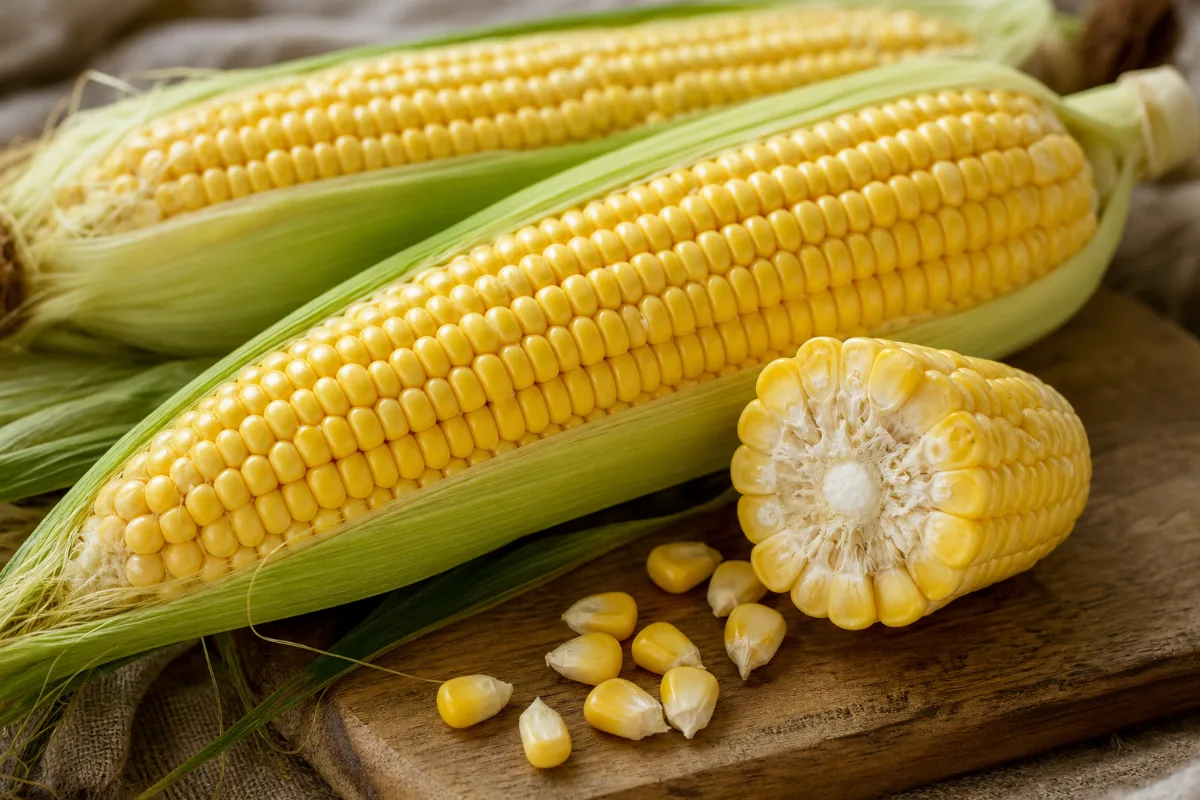
Sweet corn (Zea mays) is the kernel of a sweet kind of maize, a grass in the Poaceae family. People eat it fresh on the cob, or as frozen or canned kernels.
USDA data for raw yellow sweet corn: 86 kcal per 100 g. One cup of raw kernels (145 g) has about 125 kcal, 27 g carbohydrate of which about 9 g is sugars, 2.9 g fibre, 4.7 g protein, 61 micrograms folate (DFE), 54 mg magnesium, 392 mg potassium, 9.9 mg vitamin C and 0.22 mg thiamin. One medium ear yields about 102 g of kernels. Boiled, frozen, canned and white corn were not read.
NHS lists sweetcorn as an example of a vegetable portion, fresh, tinned or frozen, and suggests tinned corn without added salt or sugar.
What the research shows
The eye studies are about lutein and zeaxanthin. A 2012 pooled analysis of six cohort studies linked more of these pigments from food to less late macular degeneration, but not early disease. That cannot show cause, and it was not about sweet corn alone.
Trials of lutein capsules are mixed. The large AREDS2 trial found no significant benefit for progression to advanced AMD. A Cochrane review said such capsules may have little or no effect, and a 2026 analysis of nine small trials reported better eye measures mainly in early AMD.
No study of eating sweet corn itself was found, for the eyes or anything else. A 2002 laboratory study found heating raised measured antioxidant activity and lowered vitamin C; that is not a health result in people.
Food versus capsules and extracts
The AREDS2 and other eye trials used lutein capsules, not corn. In AREDS2, beta carotene capsules were also linked to more lung cancers in former smokers; that finding is about capsules, and sweet corn has little beta-carotene (USDA: 47 micrograms per 100 g). Corn silk and corn flour are different products from the kernels.
Amounts
This page gives no amounts to eat. Ask a doctor, pharmacist or dietitian what is right for you, especially if you have a food allergy or a medical condition.
At a glance
Traditional uses history, not proof
- Eaten as a vegetable, boiled, grilled or steamed, or as frozen or canned kernels
- Long use as food is not proof that it treats any condition
Studied for research
- Dietary lutein and zeaxanthin and late macular degeneration, low certainty, observational
- Lutein capsules and macular degeneration, mixed evidence, not corn
- Eating sweet corn itself for eye health, insufficient evidence
- Fibre and digestion, moderate certainty for fibre in general
- Nutrients (folate, thiamin, magnesium, vitamin C, potassium), composition facts
- Cooking and antioxidant activity, very low certainty, laboratory only
Main compounds
- Lutein and zeaxanthin
- Fibre
- Folate
- Thiamin
- Magnesium
- Potassium
- Ferulic acid
Common forms
- Fresh ears on the cob
- Frozen kernels
- Canned kernels (NHS suggests ones without added salt or sugar)
- Corn silk is a separate herbal product with its own page
Research links: USDA FoodData Central: Corn, sweet, yellow, raw · FDA: Mycotoxins · AREDS2 randomized clinical trial (PubMed) · Research Library · Genes & Biomarkers Library
What it is and its history
- Accepted scientific name
- Zea mays
- Naming authority
- L. (GBIF accepted)
- Common names
- Sweet corn (English); Sweetcorn (English); Corn on the cob (English); Maíz dulce (Spanish); Elote (Spanish)
- Family or group
- Poaceae (the grass family), as given by GBIF.
- Classification
- Plantae > Tracheophyta > Liliopsida > Poales > Poaceae > Zea > Zea mays
- Native range
- Not verified from a source read.
- Habitat
- Not verified from a source read.
- What it looks like
- Roots: Not verified.; Stems: Not verified.; Leaves: Not verified.; Flowers: Corn silk, the thread-like part of the ear, is a separate herbal product with its own page. Botany details were not read.; Fruit: The kernels, eaten as a vegetable. USDA household portions: 1 cup of kernels = 145 g; one medium ear yields 102 g of kernels.
- Cultivation
- Not verified from a source read.
- Harvest and processing
- Eaten fresh on the cob (boiled, grilled or steamed), or as frozen or canned kernels (existing nutrient summary). NHS says frozen and tinned sweetcorn give the same portion as fresh, and suggests tinned versions without added salt or sugar.
- Look-alikes and adulterants
- Name: Popcorn, grain corn, masa and polenta; Note: Made from other types or products of maize with their own pages and nutrition. Studies of corn flour or staple maize are not sweet corn studies.; Name: Corn silk; Note: The thread-like part of the same plant, sold as a tea or extract; a different product with its own page.
- Sustainability and conservation
- Not assessed.
Photographs
What is inside, and how it may work
What it contains and how those compounds act in cells and animals. Laboratory and animal mechanisms are not proven effects in people.
Main compounds
| Compound | Family | Where it is concentrated | Activity studied | Level of evidence |
|---|---|---|---|---|
| Lutein (with zeaxanthin) PubChem 5281243 | carotenoid | Kernel USDA: 644 micrograms lutein plus zeaxanthin per 100 g raw yellow corn | Yellow carotenoid pigments. Higher dietary intake was linked to less late AMD in observational studies; capsule trials were mixed. PubChem CID 5281243 is lutein; zeaxanthin is CID 5280899 (same formula). 15 4 1 | Human data |
| Ferulic acid PubChem 445858 | phenolic acid | Kernel Not given in the sources read | Measured level rose 550% when sweet corn was heated in a laboratory study. 2 | Lab |
| Folate (vitamin B9) | vitamin | Kernel USDA: 42 micrograms DFE per 100 g raw | B vitamin; composition fact only for this page. A single PubChem entry was not chosen because food folate is several related forms. 15 | Human data |
| Thiamin (vitamin B1) PubChem 1130 | vitamin | Kernel USDA: 0.155 mg per 100 g raw | B vitamin; composition fact only. 15 | Human data |
| Beta-carotene PubChem 5280489 | carotenoid | Kernel USDA: 47 micrograms per 100 g raw | A low level in sweet corn. In AREDS2, beta carotene capsules were linked to more lung cancers in former smokers. 15 1 | Human data |
Mechanisms, receptors and pathways
| Target or pathway | Gene or receptor | What was found | Level |
|---|---|---|---|
| Heat processing and measured antioxidant activity | Not specified | Heating at 115 C for 25 minutes raised measured antioxidant activity, ferulic acid and phenolics, and lowered vitamin C, in a laboratory test. 2 | Lab |
Absorption, metabolism and elimination
- Absorption
- Not found for sweet corn nutrients in the sources read.
- Distribution
- Not found.
- Metabolism
- Not found.
- Elimination
- Not found.
- Bioavailability
- Not established. How well lutein from sweet corn is absorbed was not read.
Isolated compounds versus whole extracts
The eye trials used lutein and zeaxanthin capsules, not corn, and the diet analysis pooled many foods. Results for capsules do not carry over to eating sweet corn, and the other way round. Corn silk and corn flour are different products from the kernels.
Nutritional composition
Nutrition from USDA FoodData Central (Corn, sweet, yellow, raw, FDC 169998, SR Legacy, last updated 4/1/2019, read 2026-10-26). Per 100 g of raw kernels: 86 kcal, 3.27 g protein, 1.35 g fat (0.33 g saturated), 18.7 g carbohydrate of which 6.26 g sugars and 5.7 g starch, 2.0 g fibre, about 76 g water, 2 mg calcium, 0.52 mg iron, 37 mg magnesium, 89 mg phosphorus, 270 mg potassium, 15 mg sodium, 6.8 mg vitamin C, 0.155 mg thiamin, 1.77 mg niacin, 42 micrograms folate (DFE), 9 micrograms vitamin A (RAE), 644 micrograms lutein plus zeaxanthin, 0.3 micrograms vitamin K. One cup of raw kernels (145 g), scaled from those figures: about 125 kcal, 4.7 g protein, 2.0 g fat, 27.1 g carbohydrate, 9.1 g sugars, 2.9 g fibre, 392 mg potassium, 54 mg magnesium, 61 micrograms folate, 9.9 mg vitamin C, 0.22 mg thiamin and 934 micrograms lutein plus zeaxanthin. One medium ear yields about 102 g of kernels. These are raw yellow sweet corn values; white sweet corn and boiled, frozen or canned corn were not read. Figures vary with variety, ripeness and storage.
1 high certainty1 moderate certainty1 mixed findings1 low certainty1 very low certainty1 not enough evidence
What was looked at
The 6 benefits and uses checked for Sweet Corn, each with how strong the evidence is. Tap one to open it.
- Eye health: dietary lutein and zeaxanthin and late macular degenerationLow certainty
- Eye health: lutein capsules in people who already have macular degenerationMixed findings
- Eye health from eating sweet corn itselfNot enough evidence
- Fibre and digestionModerate certainty
- Nutrients in the food: folate, thiamin, magnesium, vitamin C and potassiumHigh certainty
- Cooking and measured antioxidant activity (laboratory)Very low certainty
Lab markers tracked in the studies
Risk of late age-related macular degenerationProgression to advanced macular degenerationMacular pigment density and visual acuityTotal antioxidant activity (laboratory measure)
What is Sweet Corn good for?
The main studied uses and how strong the human evidence is for each. Most results are for lutein in all foods or for capsules, not for eating sweet corn.
Benefits, one by one
Each card is a research question, not a promise. Tap a goal to filter. Open a card to see the studies, doses and limits.
Eye health: dietary lutein and zeaxanthin and late macular degeneration
Low certaintySweet corn contains the yellow pigments lutein and zeaxanthin (USDA: 644 micrograms per 100 g raw). In a 2012 pooled analysis of six cohort studies, people who ate more of these pigments from food had a lower risk of late age-related macular degeneration (RR 0.74), but not of early disease. The studies were about all foods, not sweet corn, and cannot prove cause.
2 studiesLutein and zeaxanthin from food (all foods).
Studies, doses and limits
What the trials found
A 2012 systematic review pooled six longitudinal cohort studies. Comparing the highest with the lowest intake of dietary lutein and zeaxanthin, the pooled relative risk was 0.96 (95% CI 0.78 to 1.17) for early AMD, 0.74 (0.57 to 0.97) for late AMD and 0.68 (0.51 to 0.92) for neovascular AMD. The authors say additional studies are needed to confirm these relationships. USDA lists 644 micrograms of lutein plus zeaxanthin per 100 g of raw yellow sweet corn (about 934 micrograms in one cup of kernels, 145 g).
Results
A link with less late AMD, none with early AMD. Sweet corn was not analysed on its own.
Effect sizes as reported
Late AMD RR 0.74 (0.57-0.97); neovascular AMD RR 0.68 (0.51-0.92); early AMD RR 0.96 (0.78-1.17).
Why this rating
Low: observational cohorts cannot show cause, the studies pool lutein and zeaxanthin from all foods, and the late-AMD interval comes close to 1.
Form and dose studied
Lutein and zeaxanthin from food (all foods).
Who was studied
Adults in six cohort studies.
Limits
Not a study of sweet corn. People who eat more lutein-rich foods differ in other ways.
Why researchers looked
Lutein and zeaxanthin collect in the back of the eye, so researchers ask whether people who eat more of them keep their sight longer.
Traditional use
Sweet corn is eaten as a vegetable, fresh on the cob, frozen or canned. Long use as food is not proof that it treats any condition.
Proposed mechanism Unknown
Not established by the studies read. Whether the pigments protect the retina was not shown by the sources read.
A proposed mechanism does not show that the effect happens in people.
None specific.
Eye health: lutein capsules in people who already have macular degeneration
Mixed findingsCapsules of lutein are not sweet corn. The large AREDS2 trial found adding lutein plus zeaxanthin capsules did not significantly slow progression to advanced AMD (HR 0.90). A Cochrane review said such supplements may have little or no effect. A 2026 analysis of nine small trials reported better macular pigment and visual acuity, mainly in early AMD. The picture is mixed.
3 studiesLutein (with or without zeaxanthin) capsules. In AREDS2: lutein 10 mg…
Studies, doses and limits
What the trials found
AREDS2 randomised 4,203 people aged 50 to 85 at risk of advanced AMD. Progression to advanced AMD by 5 years was 31% with placebo and 29% with lutein 10 mg plus zeaxanthin 2 mg (HR 0.90, 98.7% CI 0.76 to 1.07, P = .12). The 2017 Cochrane review (six lutein trials, 6,891 eyes) found a risk ratio of 0.94 (0.87 to 1.01) for late AMD, low-certainty evidence, and said these supplements may have little or no effect on progression. The 2026 meta-analysis of nine randomised trials (860 people) reported better macular pigment (Hedges' g -0.589) and visual acuity (Hedges' g -0.827), mainly in early AMD, with no significant benefit in late disease.
Results
The largest trial and the Cochrane review did not show a clear benefit on progression. A newer pooled analysis found improvements in measures of the eye in early AMD.
Effect sizes as reported
AREDS2 HR 0.90 (0.76-1.07). Cochrane RR 0.94 (0.87-1.01), low certainty. 2026 meta-analysis: MPOD g -0.589, BCVA g -0.827.
Why this rating
Mixed: the largest trial and the Cochrane review are null or low certainty, the 2026 analysis is positive on surrogate measures. All are supplements, not food.
Form and dose studied
Lutein (with or without zeaxanthin) capsules. In AREDS2: lutein 10 mg plus zeaxanthin 2 mg.
Who was studied
People with, or at risk of, age-related macular degeneration.
Limits
Capsules, not sweet corn. AREDS2 also reported more lung cancers in the beta carotene group, mostly in former smokers (23 [2.0%] versus 11 [0.9%], nominal P = .04); that is about beta carotene capsules, not corn.
Why researchers looked
Because diet studies hint at a link, trials tested lutein pills in people with AMD.
Traditional use
Sweet corn is eaten as a vegetable, fresh on the cob, frozen or canned. Long use as food is not proof that it treats any condition.
Proposed mechanism Human surrogate
Lutein and zeaxanthin are yellow carotenoid pigments. A 2026 meta-analysis measured macular pigment optical density, a measure of pigment in the back of the eye.
A proposed mechanism does not show that the effect happens in people.
Beta carotene capsules and lung cancer in former smokers: see the Safety tab.
Eye health from eating sweet corn itself
Not enough evidenceNo trial or cohort study of eating sweet corn and eye disease was found. The eye findings above come from lutein in all foods, or from capsules.
1 studiesNot applicable.
Studies, doses and limits
What the trials found
A PubMed search for sweet corn in the title with trial, cohort or meta-analysis terms (2026-10-26) returned only crop-science papers (genetics, fertiliser, pest control). No human study of eating sweet corn was found.
Results
No evidence either way.
Effect sizes as reported
Not available.
Why this rating
No human study of sweet corn was found.
Limits
The search was a quick one and may have missed studies that do not name sweet corn in the title.
Why researchers looked
People ask whether the lutein in sweet corn is enough to matter for the eyes.
Traditional use
Sweet corn is eaten as a vegetable, fresh on the cob, frozen or canned. Long use as food is not proof that it treats any condition.
Proposed mechanism Unknown
Not established.
A proposed mechanism does not show that the effect happens in people.
None specific.
Fibre and digestion
Moderate certaintySweet corn has fibre: USDA lists 2.0 g per 100 g of raw kernels, about 2.9 g in one cup (145 g). MedlinePlus says fibre adds bulk, helps digestion and helps prevent constipation. That is a general statement about fibre, not a trial of sweet corn.
2 studiesRaw kernels (USDA). Cooked, canned and frozen values were not read.
Studies, doses and limits
What the trials found
MedlinePlus lists fruit and vegetables among good sources of dietary fibre and says fibre adds bulk, makes you feel full faster and helps prevent constipation. It adds that increasing fibre too quickly can cause gas, bloating and cramps. USDA lists 2.0 g total dietary fibre per 100 g of raw yellow sweet corn.
Results
The digestive role of fibre in general is a health-agency statement. No trial of sweet corn for constipation or bowel habits was read.
Effect sizes as reported
USDA: 2.0 g fibre per 100 g raw kernels; about 2.9 g per cup (145 g).
Why this rating
Moderate for fibre in general (health-agency statement; the trials behind it were not read). Insufficient for sweet corn specifically, because no corn trial was read.
Form and dose studied
Raw kernels (USDA). Cooked, canned and frozen values were not read.
Who was studied
General adult population; no group studied.
Limits
A general statement about fibre, not a test of sweet corn.
Why researchers looked
Sweet corn is often named as a fibre-containing vegetable, so people ask what it does for the gut.
Traditional use
Sweet corn is eaten as a vegetable, fresh on the cob, frozen or canned. Long use as food is not proof that it treats any condition.
Proposed mechanism Authoritative guidance
Fibre is a plant carbohydrate that adds bulk to the diet (MedlinePlus).
A proposed mechanism does not show that the effect happens in people.
MedlinePlus: raise fibre slowly, because a fast increase can cause gas, bloating and cramps.
Nutrients in the food: folate, thiamin, magnesium, vitamin C and potassium
High certaintyPer USDA, one cup of raw sweet corn kernels (145 g) has about 61 micrograms of folate (DFE), 0.22 mg of thiamin, 54 mg of magnesium, 9.9 mg of vitamin C and 392 mg of potassium. These are composition facts. They do not show that eating sweet corn treats or prevents any condition.
1 studiesRaw yellow sweet corn kernels. White sweet corn, and boiled, frozen o…
Studies, doses and limits
What the trials found
USDA FoodData Central (SR Legacy, raw yellow sweet corn) per 100 g: folate 42 micrograms DFE, thiamin 0.155 mg, magnesium 37 mg, vitamin C 6.8 mg, potassium 270 mg, niacin 1.77 mg, vitamin B-6 0.093 mg, phosphorus 89 mg. Vitamin K is very low (0.3 micrograms). No trial of sweet corn and nutrient status was read.
Results
Sweet corn supplies modest amounts of several nutrients. This is composition data, not a trial.
Effect sizes as reported
Per cup (145 g), scaled from USDA: folate about 61 micrograms; thiamin about 0.22 mg; magnesium about 54 mg; vitamin C about 9.9 mg; potassium about 392 mg.
Why this rating
High for what the USDA record lists in raw yellow sweet corn. It does not show any health effect, and values vary with variety, ripeness and storage.
Form and dose studied
Raw yellow sweet corn kernels. White sweet corn, and boiled, frozen or canned corn, were not read.
Limits
Composition only. No daily-value percentages were checked for this page.
Why researchers looked
Sweet corn is often described by its vitamins and minerals, so people ask which it supplies.
Traditional use
Sweet corn is eaten as a vegetable, fresh on the cob, frozen or canned. Long use as food is not proof that it treats any condition.
Proposed mechanism Nutrient database
Not applicable: this is food composition.
A proposed mechanism does not show that the effect happens in people.
None specific.
Cooking and measured antioxidant activity (laboratory)
Very low certaintyIn a 2002 laboratory study, heating sweet corn at 115 C for 25 minutes raised its measured antioxidant activity by 44% and ferulic acid by 550%, while vitamin C fell by 25%. This was a test on corn extracts, not a study in people, so it does not show a health benefit.
1 studiesSweet corn heated at 115 C for 25 minutes (a canning-type process).
Studies, doses and limits
What the trials found
No human study. The 2002 paper tested sweet corn in the laboratory: after thermal processing at 115 C for 25 minutes, total antioxidant activity rose 44%, ferulic acid 550%, total phenolics 54%, and vitamin C fell 25%. The authors say the findings do not support the idea that processed fruit and vegetables are less nutritious than fresh.
Results
A laboratory measure went up with heat; vitamin C went down. No health outcome was tested.
Effect sizes as reported
Antioxidant activity +44%; ferulic acid +550%; phenolics +54%; vitamin C -25%.
Why this rating
Very low: a laboratory measure, one study, from 2002, not a health outcome in people.
Form and dose studied
Sweet corn heated at 115 C for 25 minutes (a canning-type process).
Limits
Antioxidant tests in a test tube do not show what happens in the body. Home boiling or grilling was not tested in the abstract.
Why researchers looked
People ask whether cooking, freezing or canning ruins the goodness of vegetables.
Traditional use
Sweet corn is eaten as a vegetable, fresh on the cob, frozen or canned. Long use as food is not proof that it treats any condition.
Proposed mechanism Lab
The abstract reports higher measured ferulic acid and total phenolics after heating but does not explain why.
A proposed mechanism does not show that the effect happens in people.
None specific.
Connections to the rest of health
How Sweet Corn connects to the rest of our health knowledge graph. Every link says what kind of connection it is. A safety link (for example to the liver) is a warning, not a benefit. A study that merely mentions a topic never creates a benefit link.
Explore every connection: goals, body systems, organs, symptoms, genes
B. Body systems
| Connected to | Kind of connection | Evidence status | Context | Studies |
|---|---|---|---|---|
| Eyes And Vision | Biological association | Low certainty | Studied for: Eye health: dietary lutein and zeaxanthin and late macular degeneration Studied for: Eye health: lutein capsules in people who already have macular degeneration | 4 15 1 3 6 |
| Digestive System | Biological association | Moderate certainty | Studied for: Fibre and digestion | 12 15 |
C. Body parts and organs
| Connected to | Kind of connection | Evidence status | Context | Studies |
|---|---|---|---|---|
| Liver | Adverse effect or risk | Documented risk | Regular intake of aflatoxin raises liver cancer risk (FDA); the risk comes from mouldy or poorly stored corn. Aflatoxin in contaminated corn raises liver cancer risk with regular intake (FDA). Preparation or compound: Aflatoxin in contaminated corn |
8 7 |
| Eyes | Low certainty | Dietary lutein and zeaxanthin (from all foods) was linked to less late macular degeneration; capsule trials were mixed; no sweet corn study. Preparation or compound: Lutein and zeaxanthin in the diet |
4 1 3 |
E. Health conditions
| Connected to | Kind of connection | Evidence status | Context | Studies |
|---|---|---|---|---|
| Food allergy | Adverse effect or risk | Documented risk | Corn allergy is uncommon and needs a supervised food challenge to confirm. Preparation or compound: Corn as food |
5 11 |
I. Biomarkers
| Connected to | Kind of connection | Evidence status | Context | Studies |
|---|---|---|---|---|
| Risk of late age-related macular degeneration | Biological association | Low certainty | Measured in trials: lowered. A lab change is not the same as a health benefit. | 4 |
| Progression to advanced macular degeneration | Biological association | Low certainty | Measured in trials: no-change. A lab change is not the same as a health benefit. | 1 3 |
| Macular pigment density and visual acuity | Biological association | Low certainty | Measured in trials: improved. A lab change is not the same as a health benefit. | 6 |
| Total antioxidant activity (laboratory measure) | Biological association | Very low certainty | Measured in trials: raised. A lab change is not the same as a health benefit. | 2 |
K. Biological pathways
| Connected to | Kind of connection | Evidence status | Context | Studies |
|---|---|---|---|---|
| Lutein and zeaxanthin | Preliminary mechanism | Human | Carotenoid pigments in yellow corn; studied for age-related macular degeneration. | 15 4 1 |
| Dietary fibre | Preliminary mechanism | Human | Sweet corn supplies some fibre; fibre helps digestion in general. | 12 15 |
L. Active compounds
| Connected to | Kind of connection | Evidence status | Context | Studies |
|---|---|---|---|---|
| Lutein (with zeaxanthin) | Biological association | Human | Yellow carotenoid pigments. Higher dietary intake was linked to less late AMD in observational studies; capsule trials were mixed. PubChem CID 5281243 is lutein; zeaxanthin is CID 5280899 (same formula). Preparation or compound: Kernel |
15 4 1 |
| Ferulic acid | Biological association | Lab | Measured level rose 550% when sweet corn was heated in a laboratory study. Preparation or compound: Kernel |
2 |
| Folate (vitamin B9) | Biological association | Human | B vitamin; composition fact only for this page. A single PubChem entry was not chosen because food folate is several related forms. Preparation or compound: Kernel |
15 |
| Thiamin (vitamin B1) | Biological association | Human | B vitamin; composition fact only. Preparation or compound: Kernel |
15 |
| Beta-carotene | Biological association | Human | A low level in sweet corn. In AREDS2, beta carotene capsules were linked to more lung cancers in former smokers. Preparation or compound: Kernel |
15 1 |
Each connection is stored with the ingredient, the connected record, the kind of connection, the evidence status, the supporting studies, the preparation or compound involved, and a review date (last reviewed October 26, 2026).
Evidence at a glance: what changed in 3 lab markers
Tap a number to show only those markers. Counts are markers, not people.
The evidence
The research centre for Sweet Corn. Every record here was checked against PubMed or the publisher's page; we never list a study we have not verified.
Evidence by outcome
Bars show how many studies we found for each outcome, not how well it works. People are added up across trials only (reviews are not added, to avoid double counting).
How we rate evidence
High certainty
Several well-run trials or reviews agree; further research is unlikely to change the picture much.
Moderate certainty
Good trials point the same way, but some doubt remains.
Low certainty
Small, short or inconsistent trials. The finding could change with better research.
Very low certainty
Very little or very weak human data. Treat as a possibility only.
Mixed findings
Trials or reviews disagree with each other.
Not enough evidence
Not enough human research to say either way.
Evidence against
Good research found no benefit, or found harm.
We take the reviewers' own risk-of-bias and GRADE statements where they exist, and otherwise judge from study size, design, consistency, directness and whether a product matches what is sold. Many publications do not make evidence high. Method note: We started from our existing sweet corn summary, re-checked nutrition at USDA FoodData Central, read the health agency pages (FDA, MedlinePlus, NHS) and re-read PubMed abstracts for reviews, trials and the allergy and laboratory studies. Only abstracts were read for studies. A quick PubMed search for human studies of sweet corn found none. Items we could not verify are flagged in the research gaps.
Study library: every study we checked 15
| Study | Design | People | Product, dose, length | Result |
|---|---|---|---|---|
| Age-Related Eye Disease Study 2 Research Group 2013 Lutein + zeaxanthin and omega-3 fatty acids for age-related macular degeneration: the Age-Related Eye Disease Study 2 (AREDS2) randomized clinical trial. JAMA · PMID 23644932 · DOI |
Controlled trial |
4,203 people aged 50 to 85 at risk of advanced AMD | Lutein 10 mg plus zeaxanthin 2 mg capsules (not corn), with or without DHA plus EPA, added to the AREDS formula Capsule 10 mg lutein + 2 mg zeaxanthin Median 5 years · vs Placebo |
Progression to advanced AMD by 5 years was 31% with placebo and 29% with lutein plus zeaxanthin. This was not a statistically significant reduction. More lung cancers were noted in the beta carotene group than the no-beta-carotene group, mostly in former smokers. Lutein + zeaxanthin versus placebo HR 0.90; lung cancer 2.0% (23) with beta carotene versus 0.9% (11) without (HR 0.90 (98.7% CI 0.76-1.07; P = .12)) Methods, limits and fundingOutcomes: Progression to advanced AMD; lung cancer as a safety signal Limitations: Capsules in people at risk of advanced AMD, not food. Lung cancer finding was nominal (P = .04). The PubMed record lists US National Institutes of Health research support. Funding and conflicts: Research Support, N.I.H. (public funding per PubMed record). Read: abstract |
| Dewanto 2002 Processed sweet corn has higher antioxidant activity. J Agric Food Chem · PMID 12166989 · DOI |
Laboratory research lab |
Laboratory analysis of sweet corn (no people) | Sweet corn, heated at 115 C for 25 minutes Kernels 25 minutes of heating · vs Unheated sweet corn |
Heating at 115 C for 25 minutes raised the measured total antioxidant activity of sweet corn by 44%, ferulic acid by 550% and total phenolics by 54%, while vitamin C fell by 25%. Antioxidant activity +44%; ferulic acid +550%; phenolics +54%; vitamin C -25% (Not given in the abstract) Methods, limits and fundingOutcomes: Total antioxidant activity, ferulic acid, total phenolics, vitamin C Limitations: Laboratory measure on corn extracts, not a health result in people. Strong heating (115 C, 25 minutes) is more like canning than home boiling. Funding and conflicts: Not stated in the abstract. Read: abstract |
| Evans 2017 Antioxidant vitamin and mineral supplements for slowing the progression of age-related macular degeneration. Cochrane Database Syst Rev · PMID 28756618 · DOI |
Systematic review meta analysis |
People with AMD in 19 randomised trials (6 compared lutein with or without zeaxanthin with placebo) | Lutein (with or without zeaxanthin) supplements Capsule Not given in the abstract 6 months to 5 years · vs Placebo |
People taking lutein or zeaxanthin may have a similar or slightly reduced risk of progression to late AMD (low-certainty evidence). The authors say supplements with lutein and zeaxanthin are heavily marketed for AMD but may have little or no effect on progression. Progression to late AMD RR 0.94 (low certainty) (95% CI 0.87-1.01; 6891 eyes) Methods, limits and fundingOutcomes: Progression to late AMD, neovascular AMD, geographic atrophy, vision loss Limitations: Supplements, not food. Low-certainty evidence. The abstract notes an update of this review exists (2023); that update was not read. Funding and conflicts: Conflict of interest: none known. Read: abstract |
| Ma 2012 Lutein and zeaxanthin intake and the risk of age-related macular degeneration: a systematic review and meta-analysis. Br J Nutr · PMID 21899805 · DOI |
Systematic review meta analysis |
Adults in six longitudinal cohort studies | Dietary lutein and zeaxanthin from food (all foods, not sweet corn alone) Food Highest versus lowest intake category Cohort follow-up · vs Lowest intake |
Higher dietary lutein and zeaxanthin was not significantly linked to early AMD, but was linked to lower risk of late AMD and of neovascular AMD. The authors say more studies are needed to confirm this. Early AMD RR 0.96; late AMD RR 0.74; neovascular AMD RR 0.68 (Early 0.78-1.17; late 0.57-0.97; neovascular 0.51-0.92) Methods, limits and fundingOutcomes: Early AMD, late AMD, neovascular AMD Limitations: Observational, six cohorts. Cannot show cause. Intake came from many foods, not sweet corn specifically. The upper end of the late-AMD interval is close to 1. Funding and conflicts: Not stated in the abstract. Read: abstract |
| Pasini 2002 IgE-mediated allergy to corn: a 50 kDa protein, belonging to the Reduced Soluble Proteins, is a major allergen. Allergy · PMID 11929411 · DOI |
Diagnostic study |
16 16 people with positive skin prick and blood tests (IgE) to corn flour |
Cooked corn flour (polenta) food challenge Grain (flour) Not given in the abstract Single challenge · vs Placebo (double-blind challenge) |
Only six of the 16 had symptoms such as hives after eating corn foods, and the oral challenge was positive only in those six. A 50 kDa protein was recognised by the IgE of all challenge-positive people and resisted heating and digestion. The authors conclude that positive skin and blood tests had no clinical meaning for most patients and that corn allergy has to be proved by a double-blind food challenge. 6 of 16 challenge-positive (Not applicable) Methods, limits and fundingOutcomes: Reaction to the corn challenge; IgE-binding proteins; effect of cooking and digestion Limitations: Small study of people already sensitised, using corn flour (polenta), not sweet corn on the cob. It says nothing on how common corn allergy is. Funding and conflicts: Not stated in the abstract. Read: abstract |
| Wang 2026 From Supplements to Sight: Quantifying the Impact of Lutein and Carotenoid on Age-Related Macular Degeneration-A Systematic Review and Meta-Analysis of Randomized Controlled Trials. J Ophthalmol · PMID 42028334 · DOI |
Systematic review meta analysis |
860 people with AMD in nine randomised trials | Oral lutein, alone or with zeaxanthin or epilutein (supplements) Capsule Varied; the authors link larger total exposure and longer duration to larger effects Varied · vs Placebo |
Lutein-containing supplements improved MPOD and BCVA, mostly in early-stage AMD. No significant benefit was found in late-stage disease. MPOD Hedges' g -0.589 (p < 0.001); BCVA Hedges' g -0.827 (p = 0.001) (Not given in the abstract) Methods, limits and fundingOutcomes: Macular pigment optical density (MPOD), best-corrected visual acuity (BCVA) Limitations: Abstract only. Supplements, not food. Surrogate and short-term outcomes in small trials; the pooled number of eyes and the heterogeneity were not given in the abstract. Funding and conflicts: Authors declare no conflicts of interest. Read: abstract |
| Wild 2010 Mycotoxins and human disease: a largely ignored global health issue. Carcinogenesis · PMID 19875698 · DOI |
Narrative review |
Review of human and animal evidence on aflatoxins and fumonisins, mainly in maize-staple regions | Aflatoxins and fumonisins in maize (corn), cereals, groundnuts and tree nuts Grain |
Aflatoxins and fumonisins contaminate a large share of the world's food, including maize, and often occur together. Where maize is a dietary staple and regulations are weak or unenforced, exposure is high and chronic. Aflatoxins cause liver cancer in humans, especially with chronic hepatitis B, and cause aflatoxicosis in outbreaks. Fumonisins are classed Group 2B (possibly carcinogenic to humans); studies suggest a possible link with oesophageal cancer and, in some maize-eating populations, neural tube defects. The authors call for better evidence and for reducing exposure in vulnerable populations. Not applicable (narrative review) (Not applicable) Methods, limits and fundingOutcomes: Liver cancer, aflatoxicosis, immune effects, oesophageal cancer, neural tube defects Limitations: Narrative review mostly about maize as a staple food in places with weak controls, not about sweet corn bought in shops in regulated markets. The fumonisin links to cancer and neural tube defects are possible, not proven. Funding and conflicts: Author based at the International Agency for Research on Cancer; NIH extramural support listed in PubMed. Read: abstract |
| s-fda-mycotoxins FDA: Mycotoxins · Source |
Health agency n/a |
Methods, limits and fundingRead: full-text | ||
| s-fda-produce FDA: Selecting and Serving Produce Safely · Source |
Health agency n/a |
Methods, limits and fundingRead: full-text | ||
| s-gbif-zea-mays GBIF Backbone: Zea mays L. (usageKey 5290052) · Source |
Reference database n/a |
Methods, limits and fundingRead: full-text | ||
| s-medlineplus-allergy MedlinePlus: Food allergy · Source |
Health agency n/a |
Methods, limits and fundingRead: full-text | ||
| s-medlineplus-fiber MedlinePlus: Dietary Fiber · Source |
Health agency n/a |
Methods, limits and fundingRead: full-text | ||
| s-nhs-portions NHS: 5 A DAY portion sizes · Source |
Health agency n/a |
Methods, limits and fundingRead: full-text | ||
| s-nhs-what-counts NHS: 5 A DAY: what counts? · Source |
Health agency n/a |
Methods, limits and fundingRead: full-text | ||
| s-usda-fdc-169998 USDA FoodData Central: Corn, sweet, yellow, raw (FDC 169998) · Source |
Reference database n/a |
Methods, limits and fundingRead: full-text |
What we do not know yet
- No human study of eating sweet corn itself was found, for the eyes, digestion, blood sugar, weight or heart health.
- The eye diet analysis pools lutein and zeaxanthin from all foods; a sweet-corn-only figure was not given.
- Mould-toxin levels in sweet corn sold in shops were not found, and the allergy and mould studies are about corn flour or staple maize.
- Boiled, frozen and canned corn values, white sweet corn and absorption of lutein were not read.
- Pesticide residues, heavy metals, genetically modified varieties, breastfeeding, choking risk for young children, FODMAP, histamine and blood sugar effects were not researched.
How new research is added
New studies are found by a saved PubMed search and placed in a review queue before the page changes.
Lab markers
What changed in blood or saliva tests during trials. A changed number is not the same as feeling or being healthier, and we give no "normal ranges".
Other 4
Risk of late age-related macular degeneration
Lowered in trials
How many people in a study go on to develop late-stage AMD, the stage that threatens central vision.
Low certaintyResults and what it means
Why it was measured
Cohort studies count new cases of AMD and compare people who eat more or less lutein and zeaxanthin.
Statistical vs. clinical meaning
An association in observational studies, not proof that eating lutein-rich food protects the eyes.
Safety implication
None specific.
| Study | Result | People | Product |
|---|---|---|---|
| 4 | Highest versus lowest dietary lutein and zeaxanthin: late AMD RR 0.74 (95% CI 0.57-0.97); early AMD RR 0.96 (0.78-1.17) | Adults in six cohort studies | Dietary lutein and zeaxanthin from food (not sweet corn alone) |
Progression to advanced macular degeneration
No clear change in trials
Whether AMD in an eye worsens to the advanced stage.
Low certaintyResults and what it means
Why it was measured
It is the main outcome that matters in AMD trials.
Statistical vs. clinical meaning
No clear effect of lutein capsules on progression; the Cochrane authors say they may have little or no effect.
Safety implication
AREDS2: more lung cancers with beta carotene capsules, mostly in former smokers.
| Study | Result | People | Product |
|---|---|---|---|
| 1 | Progression by 5 years 31% placebo versus 29% lutein + zeaxanthin; HR 0.90 (98.7% CI 0.76-1.07), not significant | 4,203 people at risk of advanced AMD | Lutein 10 mg + zeaxanthin 2 mg capsules |
| 3 | Late AMD RR 0.94 (0.87-1.01), low-certainty evidence | People with AMD, six lutein trials (6,891 eyes) | Lutein with or without zeaxanthin supplements |
Macular pigment density and visual acuity
Improved in trials
Macular pigment optical density (MPOD) measures yellow pigment in the central retina. Best-corrected visual acuity (BCVA) is the sharpest vision a person reaches with glasses.
Low certaintyResults and what it means
Why it was measured
Smaller trials use these measures because they change sooner than disease progression.
Statistical vs. clinical meaning
Short-term eye measures improved in a pooled analysis of small trials of supplements. It does not show that sweet corn does the same.
Safety implication
None reported in the abstract.
| Study | Result | People | Product |
|---|---|---|---|
| 6 | MPOD Hedges' g -0.589 (p < 0.001); BCVA Hedges' g -0.827 (p = 0.001); improvements mainly in early AMD, no significant benefit in late AMD | 860 people with AMD in nine randomised trials | Oral lutein-containing supplements |
Total antioxidant activity (laboratory measure)
Raised in trials
A test-tube measure of how strongly a food extract can neutralise reactive chemicals. It is not measured in a person.
Very low certaintyResults and what it means
Why it was measured
Food scientists use it to compare foods and cooking methods.
Statistical vs. clinical meaning
A laboratory measure only. It does not show that eating the corn improves health.
Safety implication
None specific.
| Study | Result | People | Product |
|---|---|---|---|
| 2 | Heated sweet corn: total antioxidant activity +44%, ferulic acid +550%, phenolics +54%, vitamin C -25% | Laboratory samples (no people) | Sweet corn heated at 115 C for 25 minutes |
Safety
What studies and official sources say about side effects, medicines and who should check first. Each point shows what kind of evidence it comes from.
Main points to know 3
- Mould toxins: aflatoxin and fumonisin can contaminate corn. The FDA names corn among the foods most susceptible to aflatoxins, and says regularly eating foods with aflatoxins can increase the risk of liver cancer, cause birth defects and lead to kidney and immune problems. Fumonisins commonly infect corn; the FDA says more research is needed on their effects in people. The FDA tests foods and has published guidance levels. Do not eat corn that looks mouldy or rotten. A 2010 review found the biggest exposures where maize is a staple food and controls are weak. No source read gives risk figures for sweet corn bought in shops. Authoritative guidance 8 7 9
- Corn allergy is uncommon but real, and hard to diagnose. MedlinePlus lists corn products under food intolerance (heartburn, cramps, belly pain, diarrhoea) and does not list corn among the most common food allergies. In a small study of 16 people with positive skin or blood tests to corn flour, only 6 reacted in a supervised food challenge, so the tests alone did not show true allergy. For trouble breathing or swelling of the face, lips or throat, call emergency services. Authoritative guidance 11 5
- Fresh produce can carry germs. The FDA says washing produce under running water (no soap or produce wash) reduces but does not eliminate bacteria, and that cut or packaged produce should be kept at 40 F (4 C) or below. Pregnant women, young children, older adults and people with weakened immunity are especially vulnerable to foodborne illness. Authoritative guidance 9
Side effects 4
| Effect | How often | Severity and recovery | Evidence |
|---|---|---|---|
| Allergic reaction to corn: hives, swelling, trouble breathing These were people already sensitised, so this is not how common allergy is. | 6 of 16 sensitised people reacted to a supervised corn flour challenge | not stated Not stated | Diagnostic study 5 11 |
| Food intolerance after corn products: heartburn, cramps, belly pain, diarrhoea MedlinePlus lists corn products among foods that many people find hard to tolerate. No frequency was given. | Not established | not stated Not stated | Authoritative guidance 11 |
| Gas, bloating and cramps if fibre is raised too fast MedlinePlus says to add fibre slowly. This is about fibre in general, not corn specifically. | Not established | not stated Not stated | Authoritative guidance 12 |
| More lung cancers in former smokers taking beta carotene capsules Capsules in the AREDS2 eye trial, not corn. USDA lists only 47 micrograms of beta-carotene per 100 g of raw yellow sweet corn. The trial does not show that eating corn does this. | 2.0% (23 people) versus 0.9% (11 people) without beta carotene | serious Not applicable | Controlled trial 1 |
Liver
No liver injury from eating sweet corn was found in the sources read. The FDA links regular intake of aflatoxin (a mould toxin that can contaminate corn) to liver cancer. LiverTox was not checked for sweet corn. 8
How often. No frequency was found.
Monitoring. No agency monitoring advice for individuals was found; the FDA tests foods for aflatoxin.
This is a safety connection. It is not evidence that Sweet Corn supports liver health.
Medicines and supplements 1
| With | Why it matters | Importance | Evidence | What to do |
|---|---|---|---|---|
| Prescription and over-the-counter medicines prescription | No source read describes a medicine interaction with eating sweet corn. Vitamin K is very low in sweet corn (USDA: 0.3 micrograms per 100 g). Corn silk, a separate herbal product, and corn supplements were not checked here. | None found Not enough evidence 15 | A pharmacist can check your own medicines. |
Who should check first 4
| Situation | Advice | Evidence |
|---|---|---|
| Known or suspected corn allergy | Avoid corn foods that cause symptoms and ask an allergist. Diagnosis needs a supervised food challenge, not only skin or blood tests (Pasini 2002). Call emergency services for trouble breathing or swelling of the face, lips or throat. | Authoritative guidance 5 11 |
| Corn that looks mouldy, rotten or damaged | Throw it away. The FDA says to throw away produce that looks rotten and to cut away damaged areas. | Authoritative guidance 9 8 |
| Pregnancy, young children, older age or weakened immunity (foodborne illness) | The FDA says these groups can be especially vulnerable to foodborne illness. Follow official food-safety advice for fresh produce. | Authoritative guidance 9 |
| Pregnancy and mould toxins | The FDA says regular intake of aflatoxins can cause birth defects, and a 2010 review links fumonisins to possible neural tube defects in some maize-eating populations. These findings are about heavily contaminated staple maize, not shop-bought sweet corn. Ask your midwife or doctor if you are worried. | Authoritative guidance 8 7 |
Overdose, product quality and regulators
Summary. No toxicity from sweet corn as an ordinary fresh food was found in the sources read. The concerns are mould toxins in spoiled or poorly stored corn, allergy and food-poisoning germs.
Animal. Not reviewed, apart from the FDA's statement that fumonisins damage the brain, heart, liver and kidneys of animals.
Human doses studied. No human trial of sweet corn safety was found.
High dose or long term signals. Long-term high mould-toxin exposure from staple maize in weak-regulation settings is linked to liver cancer (aflatoxin) and possibly other harms (fumonisin).
Overdose response. Not found.
Genotoxicity. Not researched for sweet corn.
Corn is a crop where mould toxins can occur, mainly after hot dry then humid weather and poor storage. Fresh produce can also carry bacteria. Pesticide residues, heavy metals and genetically modified varieties were not researched.
Aflatoxin. The FDA says foods most susceptible to aflatoxins include peanuts, corn, tree nuts and some small grains, and that regularly eating foods with aflatoxins can increase liver cancer risk. It regularly tests foods. 8
Fumonisins. Fumonisins are made by Fusarium molds that commonly infect corn; levels depend on weather (hot dry weather followed by high humidity) and on milling, storage and processing. The FDA says more research is needed to know how they affect humans, and has published guidance levels. A 2010 review classes fumonisins as possibly carcinogenic to humans (Group 2B). 8 7
Where the risk is highest. The 2010 review reports high, chronic exposure to aflatoxin and fumonisin where maize is a staple and regulations are weak or unenforced. No figures for sweet corn bought in shops were found in the sources read. 7
Food safety handling. The FDA says wash all produce under running water, not with soap, detergent or commercial produce wash; washing reduces bacteria but does not eliminate them; keep cut or packaged produce at 40 F (4 C) or below. 9
| Body | Action | Date |
|---|---|---|
| FDA (US Food and Drug Administration) (United States) | Mycotoxins page: corn is among the foods most susceptible to aflatoxins; fumonisins commonly infect corn; FDA monitors foods and has published action and guidance levels source | 2026-07-06 |
| MedlinePlus (US National Library of Medicine) (United States) | Food allergy page: corn products listed under food intolerance; corn not among the most common food allergens; emergency advice for severe reactions source | 2024-10-29 |
| FDA (US Food and Drug Administration) (United States) | Selecting and serving produce safely: wash under running water without soap, refrigerate cut produce at 40 F or below, vulnerable groups source | 2024-03-05 |
When to get medical help
- Trouble breathing, swelling of the lips, face or throat, or widespread hives after eating corn
- Vomiting, diarrhoea, stomach pain or fever after eating fresh produce that may not have been washed or kept cold
- Repeated symptoms such as cramps or diarrhoea after eating corn products (a doctor can look for intolerance or allergy)
Stop using the product and contact a clinician or emergency service. In the US, Poison Control is 1-800-222-1222.
General information only, not medical advice. Ask a clinician or pharmacist before use, especially with medicines, in pregnancy or with a health condition. See the Natural Remedy Safety guide.
Frequently asked questions
What is sweet corn good for?
Is sweet corn a vegetable or a starchy food?
Does the lutein in corn protect my eyes?
Higher dietary lutein and zeaxanthin was linked to less late macular degeneration (RR 0.74) in six cohort studies, but not to less early disease. That cannot show cause, and the studies were about all foods, not sweet corn alone.
Do lutein supplements help macular degeneration?
Is corn allergy common?
Is mouldy corn dangerous?
Is sweet corn safe with medicines?
No medicine interaction with sweet corn was found in the sources read. That is not proof of safety. A pharmacist can check your own medicines.
Does cooking destroy the nutrients in sweet corn?
In a 2002 laboratory test, heating at 115 C for 25 minutes raised measured antioxidant activity and cut vitamin C by 25%. That is a lab measure, not a health result, and boiled or grilled corn was not tested in the abstract.
Is sweet corn good for digestion?
Is sweet corn safe in pregnancy?
How should I wash and store fresh sweet corn?
The FDA says to rinse produce under running water without soap or produce wash, which reduces but does not remove bacteria, and to keep cut or packaged produce at 40 F (4 C) or below. Throw away ears that look rotten.
Is corn silk the same as sweet corn?
No. Corn silk is the thread-like part of the same plant, sold as a tea or extract, and it has its own page. Results for the kernels do not apply to corn silk.
Explore by health goal
Editorial transparency
- Written by
- AlternativeMed editorial team. Research compiled with AI assistance, then checked against the sources listed.
- Medical review
- None. This page has not been reviewed by a physician or pharmacist.
- First published
- 2026-10-26
- Last substantive update
- 2026-10-26
- How we research
- We started from our existing sweet corn summary, re-checked nutrition at USDA FoodData Central, read the health agency pages (FDA, MedlinePlus, NHS) and re-read PubMed abstracts for reviews, trials and the allergy and laboratory studies. Only abstracts were read for studies. A quick PubMed search for human studies of sweet corn found none. Items we could not verify are flagged in the research gaps.
- How we rate evidence
- See "How we rate evidence" in the Evidence tab.
- Independence
- No product is promoted on this page. No affiliate links are shown.
Sources 15
Each source was opened and checked. Where we read only the abstract, it says so. The small numbers in the text point here.
- Age-Related Eye Disease Study 2 Research Group. Lutein + zeaxanthin and omega-3 fatty acids for age-related macular degeneration: the Age-Related Eye Disease Study 2 (AREDS2) randomized clinical trial.. JAMA. 2013. PMID 23644932. DOI 10.1001/jama.2013.4997. (abstract)
- Dewanto V, Wu X, Liu RH. Processed sweet corn has higher antioxidant activity.. J Agric Food Chem. 2002. PMID 12166989. DOI 10.1021/jf0255937. (abstract)
- Evans JR, Lawrenson JG. Antioxidant vitamin and mineral supplements for slowing the progression of age-related macular degeneration.. Cochrane Database Syst Rev. 2017. PMID 28756618. DOI 10.1002/14651858.CD000254.pub4. (abstract)
- Ma L, Dou HL, Wu YQ, et al.. Lutein and zeaxanthin intake and the risk of age-related macular degeneration: a systematic review and meta-analysis.. Br J Nutr. 2012. PMID 21899805. DOI 10.1017/S0007114511004260. (abstract)
- Pasini G, Simonato B, Curioni A, et al.. IgE-mediated allergy to corn: a 50 kDa protein, belonging to the Reduced Soluble Proteins, is a major allergen.. Allergy. 2002. PMID 11929411. DOI 10.1034/j.1398-9995.2002.1o3413.x. (abstract)
- Wang WX, Wang CC, Hsu WC, et al.. From Supplements to Sight: Quantifying the Impact of Lutein and Carotenoid on Age-Related Macular Degeneration-A Systematic Review and Meta-Analysis of Randomized Controlled Trials.. J Ophthalmol. 2026. PMID 42028334. DOI 10.1155/joph/2155378. (abstract)
- Wild CP, Gong YY. Mycotoxins and human disease: a largely ignored global health issue.. Carcinogenesis. 2010. PMID 19875698. DOI 10.1093/carcin/bgp264. (abstract)
- . FDA: Mycotoxins. . . (full-text)
- . FDA: Selecting and Serving Produce Safely. . . (full-text)
- . GBIF Backbone: Zea mays L. (usageKey 5290052). . . (full-text)
- . MedlinePlus: Food allergy. . . (full-text)
- . MedlinePlus: Dietary Fiber. . . (full-text)
- . NHS: 5 A DAY portion sizes. . . (full-text)
- . NHS: 5 A DAY: what counts?. . . (full-text)
- . USDA FoodData Central: Corn, sweet, yellow, raw (FDC 169998). . . (full-text)


