Clays & Charcoal · Charcoal
Charcoal Toothpaste and Whitening Powder
Activated carbon in toothpaste and tooth powder (a processed material, not a plant) · also called Black toothpaste, charcoal tooth powder, charcoal whitening powder
Charcoal toothpaste and powder contain activated charcoal, a black carbon with many tiny pores. It is sold to whiten teeth. In one small 14-day trial it whitened about as much as a regular toothpaste, and the authors said these products should be discouraged. Many charcoal products have no fluoride, and lab results on enamel wear are mixed.
General information, not medical advice. Last substantive update · Not medically reviewed. A named clinician has not signed off on this page. How this page is made
About Charcoal Toothpaste and Whitening Powder
Charcoal toothpaste and powder use activated charcoal to remove surface stain. The best human evidence is one small 14-day trial with a minor whitening effect like regular toothpaste. Many products have no fluoride, lab studies on enamel wear disagree, and detox and germ-killing claims are not backed by the studies read.
What it is
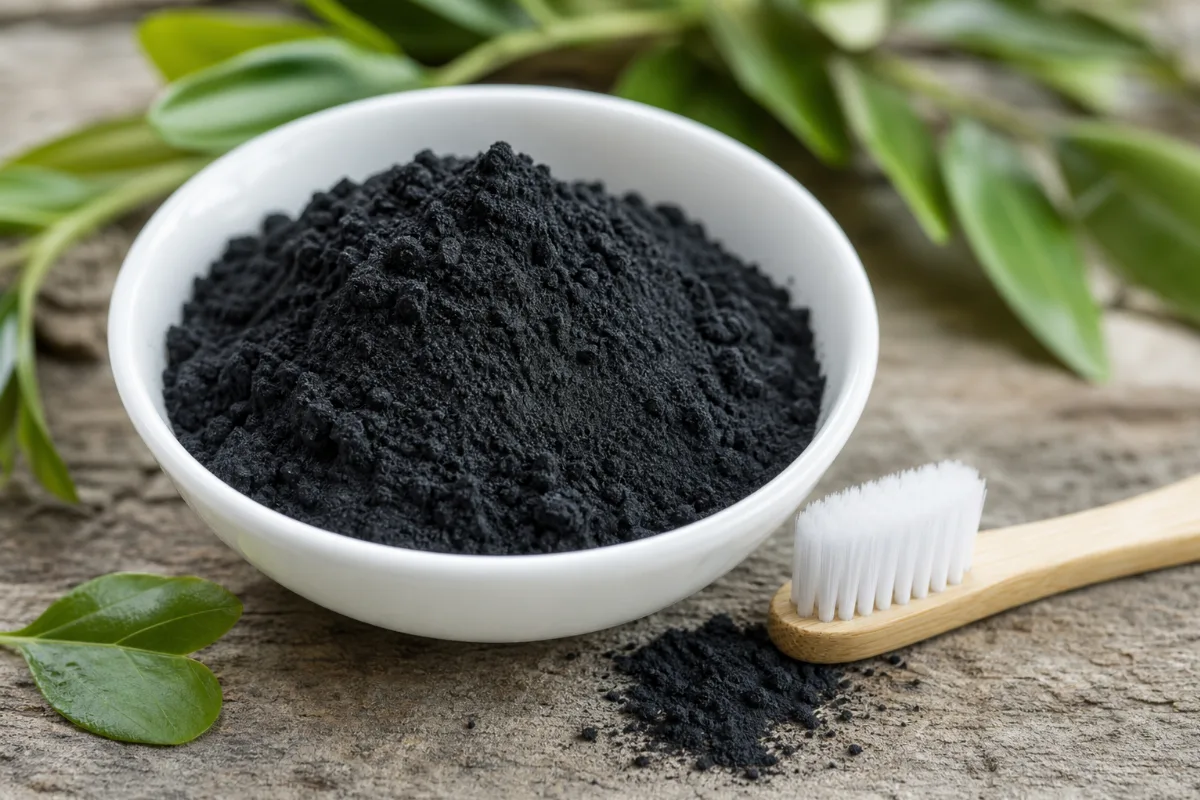
Activated charcoal is a black carbon powder made by burning carbon-rich material, then treating it so it has many tiny pores. Substances stick to its surface. In toothpaste it acts mainly as a gritty ingredient.
Products differ a lot. In one survey, 36 products were found. A 2026 lab study found silica, carbonates and hydrogen peroxide in some charcoal toothpaste particles besides charcoal. In a 2017 review, one-third of products contained bentonite clay.
Traditional and current uses
Brushing with raw charcoal or soot is an old folk practice. A 2017 review found 13 studies of it, none meeting its trial rules.
Charcoal toothpastes and powders are sold today for whitening, with adverts also claiming germ-killing and detox. Poison Control calls the usefulness of charcoal in toothpaste questionable.
Traditional or popular use is not proof that it works or is safe.
What the research shows
People: one randomized trial (56 adults, 14 days) and a second report from the same group on how people felt about their smile. The charcoal products did less than peroxide.
Lab: a review of 11 mostly lab studies found a lower whitening effect than other options. Tests on extracted and cattle teeth give mixed enamel results.
Nothing read shows long-term benefit or harm in people.
At a glance
Traditional uses history, not proof
- Brushing teeth with raw charcoal or soot is an old folk practice, but a 2017 review found none of 13 studies met its trial rules, and three reported harm such as more cavities or enamel abrasion (Brooks 2017).
Studied for research
- Whitening teeth, low certainty (one small trial, mostly lab work)
- Wear on enamel, mixed (lab only)
- Cavity protection, insufficient (many products lack fluoride)
- Germ-killing and mouth detox claims, insufficient
- Fresher breath, insufficient
- Removing toxins from the body, insufficient
Main compounds
- Activated carbon
- Silica, carbonates and hydrogen peroxide (found in some products)
- Fluoride (missing from many products)
Common forms
- Toothpaste
- Loose black powder wet on a toothbrush
- Raw charcoal or soot (homemade, older practice)
Research links: Whitening trial, 2024 (abstract) · Systematic review of lab studies, 2023 (abstract) · Literature review, 2017 (abstract) · ADA: Toothpastes · Poison Control: activated charcoal · Research Library · Genes & Biomarkers Library
What it is and its history
- Accepted scientific name
- Activated charcoal (activated carbon) used in toothpastes and tooth powders
- Synonyms
- Charcoal toothpaste; Black toothpaste; Charcoal tooth powder; Charcoal whitening powder
- Common names
- Charcoal toothpaste (English); Charcoal whitening powder (English)
- Family or group
- Activated carbon: a black carbon powder made by burning carbon-rich material and treating it so it has many tiny pores (Poison Control).
- Harvest and processing
- Source materials differ by maker (wood, coconut shell, bamboo and others). Poison Control says hospital-type charcoal is 'activated' by a special process and that over-the-counter products might not be as activated. The source of the charcoal in tested toothpastes is not given in the abstracts read.
- Look-alikes and adulterants
- Name: Burnt toast, barbecue charcoal and soot; Note: Poison Control says burnt toast and barbecue briquettes are not activated charcoal and some briquettes have chemicals not meant to touch skin or be swallowed. Raw charcoal and soot are different from made toothpaste.; Name: Bentonite clay in some products; Note: In the 2017 review, one-third of charcoal dentifrices contained bentonite clay.
Traditional use and history history, not clinical proof
| Tradition or era | Documented use | Source |
|---|---|---|
| Folk tooth cleaning | The 2017 review found 13 older studies of brushing with raw charcoal or soot, but none met its inclusion rules. | p28599961 |
| Internet-era products | The 2017 review says sales of charcoal dentifrices and powders emerged rapidly in the internet marketplace. | p28599961 |
Traditional use shows how it was used. It does not show that it works or is safe today.
What is inside, and how it may work
What it contains and how those compounds act in cells and animals. Laboratory and animal mechanisms are not proven effects in people.
Main compounds
| Compound | Family | Where it is concentrated | Activity studied | Level of evidence |
|---|---|---|---|---|
| Activated carbon | carbon | Not given in the abstracts read. | Many tiny pores give a large surface area and let other substances stick to it (Poison Control: about the surface area of a football field per teaspoon). 12 | Authoritative guidance |
| Silica, carbonates and hydrogen peroxide (found in some charcoal toothpastes) | other ingredients | Not given. | Spectroscopy found these in the particles of some charcoal toothpastes and linked them to the enamel changes seen. 1 | Laboratory |
| Fluoride | cavity-protecting ingredient | Only 3 of 36 products listed it in one survey; none detected in one charcoal powder. | The ADA says fluoride helps prevent decay by strengthening enamel. 2 11 | Authoritative guidance |
Mechanisms, receptors and pathways
| Target or pathway | Gene or receptor | What was found | Level |
|---|---|---|---|
| Surface abrasion | None | Abrasive particles can lift surface stain and also wear surfaces. Particle size, shape and other ingredients change the effect (cattle-enamel lab work). 1 8 | Laboratory |
| Adsorption (sticking to the surface) | None | Charcoal binds many substances onto its surface. This is the basis of its hospital use for poisonings. Whether it does anything useful in the mouth is not shown. 12 | Authoritative guidance |
Absorption, metabolism and elimination
- Absorption
- Not studied for toothpaste.
- Distribution
- Not studied.
- Elimination
- Not studied.
Isolated compounds versus whole extracts
Charcoal toothpastes differ in the charcoal used, particle size and added ingredients such as silica and peroxide. A result for one product cannot be assumed for another.
Nutritional composition
Charcoal is not a food or nutrient and nothing here is about eating it.
1 mixed findings1 low certainty5 not enough evidence
What was looked at
The 7 benefits and uses checked for Charcoal Toothpaste and Whitening Powder, each with how strong the evidence is. Tap one to open it.
- Whitening teethLow certainty
- Wear on enamel (abrasion)Mixed findings
- Cavity protection and fluorideNot enough evidence
- Germ-killing and "mouth detox" claimsNot enough evidence
- Fresher breathNot enough evidence
- Removing toxins from the bodyNot enough evidence
- Brushing with raw charcoal or soot (homemade)Not enough evidence
What is Charcoal Toothpaste and Whitening Powder good for?
The uses people ask about and how strong the evidence is for each. None is well proven for charcoal toothpaste, and lab results do not show what happens in a mouth over years.
Benefits, one by one
Each card is a research question, not a promise. Tap a goal to filter. Open a card to see the studies, doses and limits.
Whitening teeth
Low certaintySellers say charcoal whitens teeth. In one small trial, charcoal toothpaste and powder whitened about as much as a regular fluoride toothpaste. A peroxide product whitened more. The authors call the charcoal effect minor and unsatisfactory.
5 studiesBrushing with commercial charcoal toothpaste or powder. No amounts or…
Studies, doses and limits
What the trials found
One randomized trial of 56 adult volunteers (14 per group) over 14 days, plus lab studies on extracted or cattle teeth and a review of mostly lab studies.
Results
Charcoal powder and charcoal toothpaste gave colour and whiteness changes similar to regular fluoride toothpaste. Carbamide peroxide whitened best. A cattle-tooth lab study found no colour change difference between products. The review concluded charcoal toothpastes have a lower whitening effect than other options.
Effect sizes as reported
The abstracts give no figures for the size of change.
Why this rating
One small, short trial and mostly lab work. The effect is small. The review rated its studies at medium-high risk of bias.
Form and dose studied
Brushing with commercial charcoal toothpaste or powder. No amounts or schedule are given here.
Who was studied
Adult volunteers (one trial); extracted and cattle teeth in the lab.
Limits
14 days only. Whether results last is unknown. The smile questionnaire paper looks like a second report of the same trial.
Why researchers looked
Charcoal is black and gritty, so people ask whether it scrubs stains away.
Traditional use
The sources read give no dated history of charcoal for teeth. Online sellers promote it as a natural whitener.
Proposed mechanism Pharmacological theory
Charcoal particles are abrasive and may lift surface stain. The ADA says abrasives in toothpaste may whiten by removing surface stains. That is a description of how any abrasive works, not proof that charcoal does it better.
A proposed mechanism does not show that the effect happens in people.
See the enamel and fluoride points below. A dentist can advise on stain removal.
Wear on enamel (abrasion)
Mixed findingsThis is a safety question rather than a benefit. Lab results disagree. A review found most studies reported charcoal toothpaste as more abrasive. A test of 12 charcoal toothpastes found wear within the range of other toothpastes. No long-term human study was found.
5 studiesBrushing slurries in the lab; no amounts or schedule are advised here.
Studies, doses and limits
What the trials found
No long-term human study of enamel wear from charcoal toothpaste was found. The evidence is lab tests on extracted teeth and cattle enamel.
Results
A review of 11 mostly lab studies: most studies agree charcoal toothpaste has higher abrasive potential. A test of 12 charcoal toothpastes: dentin abrasivity 24 to 166 and enamel abrasivity 0 to 14, not different from other commercial toothpastes tested before. A cattle-enamel study: charcoal toothpaste and powder lowered hardness and raised roughness. A 2026 cattle-enamel study: roughness did not differ, but mineral loss and deeper abrasion appeared with some products.
Effect sizes as reported
The ADA says toothpastes with its Seal must have a relative dentin abrasivity of 250 or less, and also says this number should not be used to rank safety.
Why this rating
Lab studies point in different directions and no human long-term study exists. Results vary by product.
Form and dose studied
Brushing slurries in the lab; no amounts or schedule are advised here.
Who was studied
Extracted human teeth, cattle teeth, tooth slurries.
Limits
Lab models use short brushing cycles and cannot show years of use. The charcoal-related risk may depend on the product.
Why researchers looked
Gritty particles can scrape teeth, and many whitening products are abrasive.
Proposed mechanism Laboratory
Wear depends on particle size and shape and on other ingredients such as silica, not only on charcoal. One lab study found larger, uneven particles linked to deeper abrasion.
A proposed mechanism does not show that the effect happens in people.
Gum recession or sensitive, worn teeth are a reason to ask a dentist before using any abrasive.
Cavity protection and fluoride
Not enough evidenceFluoride is what protects teeth from cavities. Many charcoal products contain none. No trial of cavities with charcoal toothpaste was found.
4 studiesCheck the label for fluoride. No amounts are advised here.
Studies, doses and limits
What the trials found
No human study of cavities with charcoal toothpaste was found. The evidence is about what is in the products.
Results
In a survey of 36 charcoal products sold online in Brazil, only 3 contained fluoride. A lab study found no detectable soluble fluoride in a charcoal powder. A study of 12 charcoal toothpastes noted many lack fluoride. The ADA says toothpastes with its cavity-protection claim must contain fluoride, and its page does not mention charcoal.
Effect sizes as reported
Only 3 of 36 products listed fluoride.
Why this rating
The fluoride gap in the products is documented, but no one has measured cavity rates with charcoal products.
Form and dose studied
Check the label for fluoride. No amounts are advised here.
Who was studied
Products on the Brazilian online market (survey); lab slurries.
Limits
Label survey from one country. A product that lists fluoride may still differ from one that does not in other ways.
Why researchers looked
People switching to a charcoal product may lose the fluoride in their usual toothpaste.
Proposed mechanism Authoritative guidance
Fluoride helps prevent decay by strengthening enamel (ADA). Charcoal has no known role in cavity prevention in the sources read.
A proposed mechanism does not show that the effect happens in people.
Children under school age and anyone prone to cavities should ask a dentist or pharmacist about fluoride.
Germ-killing and "mouth detox" claims
Not enough evidenceAdverts say charcoal kills germs and detoxifies the mouth. A 2017 review found these claims were not backed up. Evidence is insufficient.
3 studiesBrushing; no amounts advised.
Studies, doses and limits
What the trials found
No clinical trial of germ counts, gum disease or mouth detox with charcoal toothpaste was found in the sources read.
Results
The 2017 review of adverts found antibacterial, antifungal, antiviral and mouth-detox claims were unsubstantiated. A Brazilian label survey saw antiviral, antifungal and 'oral immunity' claims.
Effect sizes as reported
No effect sizes in the sources read.
Why this rating
Claims are made on labels and adverts. No supporting study was read.
Form and dose studied
Brushing; no amounts advised.
Who was studied
Not studied in people.
Limits
Review of adverts and sparse studies; search ended 2017.
Why researchers looked
Charcoal sticks other substances to its surface, so sellers say it pulls out germs and toxins.
Proposed mechanism Pharmacological theory
Activated charcoal adsorbs other substances onto its surface in the gut (Poison Control). Whether that does anything in a mouth is not shown in the sources read.
A proposed mechanism does not show that the effect happens in people.
Do not use a toothpaste as a replacement for a dentist's care for gum bleeding or infection.
Fresher breath
Not enough evidencePoison Control lists bad-breath relief among the claims made for charcoal products. No study of charcoal toothpaste and breath was found.
1 studiesBrushing; no amounts advised.
Studies, doses and limits
Results
No results to report.
Effect sizes as reported
No effect sizes.
Why this rating
No study read.
Form and dose studied
Brushing; no amounts advised.
Who was studied
Not studied.
Limits
No data.
Why researchers looked
Charcoal is sold as an odour absorber.
Proposed mechanism Pharmacological theory
Poison Control says activated charcoal is used to adsorb odour-causing substances in some products. That is not shown for breath.
A proposed mechanism does not show that the effect happens in people.
Ongoing bad breath can have a medical cause. A dentist or doctor can check.
Removing toxins from the body
Not enough evidenceNo study shows that brushing with charcoal clears toxins from the body. The US government centre NCCIH reports a 2015 review that found no compelling research that detox diets remove toxins.
2 studiesNot applicable. Activated charcoal for poisoning is a medical treatme…
Studies, doses and limits
What the trials found
No study of charcoal toothpaste and body toxins was found.
Results
No results.
Effect sizes as reported
No effect sizes.
Why this rating
The detox idea is a claim. General detox programmes lack good research, and toothpaste was not tested.
Who was studied
Not studied.
Limits
The NCCIH page is about detox diets, not toothpaste.
Why researchers looked
Charcoal's use in poisonings makes people think it detoxifies the body.
Proposed mechanism Authoritative guidance
In hospital poison care, charcoal swallowed soon after a poison can reduce its absorption in the gut (Poison Control). That is an emergency treatment, not a daily detox, and it is not about brushing.
A proposed mechanism does not show that the effect happens in people.
Call poison control for any suspected poisoning (see Safety).
Brushing with raw charcoal or soot (homemade)
Not enough evidenceOlder studies of brushing with raw charcoal or soot are of mixed quality. In a 2017 review, none met the review's rules, and three reported harm such as more cavities or enamel abrasion.
1 studiesRaw charcoal or soot; no advice given here.
Studies, doses and limits
What the trials found
Thirteen older studies of raw charcoal or soot, none meeting the review's inclusion rules.
Results
Two studies reported unspecific cavity reductions, three reported harmful outcomes (more cavities, enamel abrasion or an unquantified negative effect), one reported no harm to oral hygiene, and seven reported only on oral hygiene use.
Effect sizes as reported
No pooled figures.
Why this rating
Weak, older studies pointing both ways, with some harm reported.
Form and dose studied
Raw charcoal or soot; no advice given here.
Who was studied
Varied older study populations.
Limits
Studies did not meet the review's trial criteria; search ended 2017.
Why researchers looked
Charcoal and soot are old folk tooth cleaners in many places.
Traditional use
The 2017 review describes studies of raw charcoal and soot brushing but gives no dated history.
Proposed mechanism Pharmacological theory
Rough, uneven grit can wear teeth. This is a general idea, not tested here.
A proposed mechanism does not show that the effect happens in people.
Homemade or raw charcoal is not the same as a made toothpaste. Do not swallow soot or burnt material.
Connections to the rest of health
How Charcoal Toothpaste and Whitening Powder connects to the rest of our health knowledge graph. Every link says what kind of connection it is. A safety link (for example to the liver) is a warning, not a benefit. A study that merely mentions a topic never creates a benefit link.
Explore every connection: goals, body systems, organs, symptoms, genes
L. Active compounds
| Connected to | Kind of connection | Evidence status | Context | Studies |
|---|---|---|---|---|
| Activated carbon | Biological association | Authoritative guidance | Many tiny pores give a large surface area and let other substances stick to it (Poison Control: about the surface area of a football field per teaspoon). | 12 |
| Silica, carbonates and hydrogen peroxide (found in some charcoal toothpastes) | Biological association | Laboratory | Spectroscopy found these in the particles of some charcoal toothpastes and linked them to the enamel changes seen. | 1 |
| Fluoride | Biological association | Authoritative guidance | The ADA says fluoride helps prevent decay by strengthening enamel. | 2 11 |
Each connection is stored with the ingredient, the connected record, the kind of connection, the evidence status, the supporting studies, the preparation or compound involved, and a review date (last reviewed October 25, 2026).
Evidence at a glance: what the research found for 7 outcomes
Each outcome below is one thing researchers measured. Certainty is how far the evidence can be trusted, not how well it works. The full studies are on the next tab.
The evidence
The research centre for Charcoal Toothpaste and Whitening Powder. Every record here was checked against PubMed or the publisher's page; we never list a study we have not verified.
Evidence by outcome
Bars show how many studies we found for each outcome, not how well it works. People are added up across trials only (reviews are not added, to avoid double counting).
How we rate evidence
High certainty
Several well-run trials or reviews agree; further research is unlikely to change the picture much.
Moderate certainty
Good trials point the same way, but some doubt remains.
Low certainty
Small, short or inconsistent trials. The finding could change with better research.
Very low certainty
Very little or very weak human data. Treat as a possibility only.
Mixed findings
Trials or reviews disagree with each other.
Not enough evidence
Not enough human research to say either way.
Evidence against
Good research found no benefit, or found harm.
We take the reviewers' own risk-of-bias and GRADE statements where they exist, and otherwise judge from study size, design, consistency, directness and whether a product matches what is sold. Many publications do not make evidence high. Method note: We read the abstract of each cited paper and the ADA, NCCIH and Poison Control pages. Certainty ratings are the compiler's own reading. The 2023 smile-perception paper and the 2024 whitening trial look like two reports of one trial. Regulators other than the ADA were not checked. No study is cited that we could not verify.
Study library: every study we checked 12
| Study | Design | People | Product, dose, length | Result |
|---|---|---|---|---|
| Alvarenga 2026 Elemental and Morphological Mapping of Enamel Surface to Predict the Potential Impact of Charcoal-Based Dentifrices. ACS Omega · PMID 41970904 · DOI |
Laboratory study animal-tissue-lab |
50 Bovine enamel surfaces, 10 per group (five groups) |
Three activated charcoal toothpastes compared with a conventional toothpaste and a whitening toothpaste activated carbon (not a plant part) |
Surface roughness did not differ significantly between groups. Mineral loss was significant with the conventional toothpaste and one charcoal toothpaste, and electron microscopy showed deeper abrasion linked to larger, uneven particles. Spectroscopy found silica, carbonates, hydrogen peroxide and charcoal in the dentifrice particles. One charcoal toothpaste produced the most mineral loss; the others were intermediate or protective. Methods, limits and fundingOutcomes: Enamel mineral content, roughness, surface angle and particle make-up Limitations: Cattle enamel in the lab, 10 samples per group, products are named in the abstract but results differ product by product, so no single charcoal result can be assumed. Funding and conflicts: No funding or conflict statement in the abstract. Read: abstract |
| Bauler 2021 Charcoal-based dentifrices and powders: analyses of product labels, Instagram engagement, and altmetrics. Brazilian Dental Journal · PMID 34614064 · DOI |
Product survey and literature review product-and-literature |
36 36 charcoal dentifrices and powders sold online in Brazil, plus 22 published articles |
Charcoal toothpastes and abrasive powders (labels and literature) activated carbon (not a plant part) |
Only 3 of 36 products contained fluoride. Labels claimed germ-killing, antiviral, antifungal and anti-inflammatory activity, and non-scientific claims such as calming teeth or increasing oral immunity. Of 22 published articles, 21 were lab studies and the single clinical study was sponsored by a charcoal product and had no control group. Of the studies, 23 percent showed positive results and 55 percent negative results for charcoal, including no whitening, more roughness, surface changes and less protection from demineralisation. The authors say the risks to health are still unknown. Methods, limits and fundingOutcomes: Fluoride on labels, advertised claims, published results Limitations: Brazilian online market only; label review, not product testing. Counts come from the abstract. Funding and conflicts: No funding or conflict statement in the abstract. Read: abstract |
| Brooks 2017 Charcoal and charcoal-based dentifrices: A literature review. Journal of the American Dental Association · PMID 28599961 · DOI |
Narrative review review |
118 118 potentially eligible articles; first 50 charcoal dentifrices from Google and Amazon for products and adverts |
Raw charcoal or soot, and charcoal-based toothpastes and powders activated carbon (not a plant part) |
Thirteen studies of brushing with raw charcoal or soot were found and none met the inclusion criteria. Among them, two reported unspecific caries reductions, three reported harmful outcomes (more caries, enamel abrasion or an unquantified negative effect), one reported no harm to oral hygiene, and seven reported only on oral hygiene use. Adverts made unsubstantiated antibacterial, antifungal, antiviral and mouth-detox claims. One-third of the products contained bentonite clay and one contained betel leaves. The authors conclude data are insufficient to support safety and efficacy claims and that dentists should advise caution. Methods, limits and fundingOutcomes: Efficacy, safety and advertised claims Limitations: Searches ended in February 2017, so newer work is not covered. No randomized trial of three months or longer was found. Raw-charcoal studies are older and of mixed quality. Funding and conflicts: No funding or conflict statement in the abstract. Read: abstract |
| Cutrim 2024 Optical, Mechanical, and Chemical Impact of Brushing with Activated Charcoal Toothpowder and Toothpaste on Dental Enamel: An In Vitro Evaluation. Materials (Basel) · PMID 39769703 · DOI |
Laboratory study animal-tissue-lab |
48 48 stained bovine (cattle) enamel samples in four groups of 12 |
Activated charcoal toothpaste, activated charcoal powder, hydrogen-peroxide whitening toothpaste, conventional toothpaste activated carbon (not a plant part) |
After brushing, both charcoal products lowered enamel hardness and raised roughness, and colour change did not differ between groups. The charcoal powder had no detectable soluble fluoride and showed significantly more calcium loss. Fewer surface changes were seen with the conventional toothpaste. All brushing slurries were alkaline. The authors conclude charcoal powder and paste do not change colour, and the powder roughens enamel, softens it, lacks fluoride and loses more calcium. Methods, limits and fundingOutcomes: Colour change, hardness, roughness, slurry pH, fluoride and calcium Limitations: Cattle enamel, one brushing cycle in a lab model, so it cannot show what happens in people over years. Brands are not given in the abstract. Funding and conflicts: The authors declare no conflicts of interest. State research agencies are thanked for funding. Read: abstract |
| Klein-Schwartz 2010 Drug adsorption efficacy and palatability of a novel charcoal cookie formulation. Pharmacotherapy · PMID 20795844 · DOI |
Randomized crossover trial |
8 Eight healthy adult volunteers (swallowed charcoal, not toothpaste) |
Swallowed activated charcoal (cookie or water suspension) given 15 minutes after a single cimetidine tablet activated carbon (not a plant part) Medical-type charcoal amount (not advice) Single dose with 1-week gaps · vs Water |
Both charcoal products markedly reduced absorption of the medicine cimetidine. The median fall in total exposure was 91.8 percent with the water suspension and 82.1 percent with the cookie. The study did not test toothpaste. Methods, limits and fundingOutcomes: Cimetidine exposure and palatability Limitations: Eight people, swallowed medical-type amounts, one medicine. It does not describe the tiny amounts that may be swallowed while brushing. Funding and conflicts: Supported by US National Institutes of Health research funding (NCRR). Read: abstract |
| Ribeiro 2023 Dental aesthetic perception of patients submitted to activated charcoal-based bleaching agents: A randomized clinical trial. Journal of Dentistry · PMID 37852572 · DOI |
Randomized controlled trial |
56 Fifty-six participants in four groups of 14 |
Activated charcoal powder, activated charcoal dentifrice, conventional fluoride toothpaste, 10 percent carbamide peroxide activated carbon (not a plant part) 14 days · vs Conventional toothpaste and carbamide peroxide |
Carbamide peroxide lowered the psychological impact of tooth appearance and the aesthetic perception scores. In the charcoal powder group only the psychological impact domain fell significantly. The authors conclude that charcoal products had inferior quality-of-life and aesthetic results compared with carbamide peroxide. Methods, limits and fundingOutcomes: Questionnaires on how people feel about their teeth (PIDAQ, OHIP-Esthetics, OES) Limitations: Group size and design match the 2024 whitening trial from the same group, so this is probably a second report of the same trial and is not counted as independent. Questionnaire results, 14 days only. Funding and conflicts: The abstract's competing-interest statement says there are none. Non-US government research support is listed. Read: abstract |
| Ribeiro 2024 Whitening efficacy of activated charcoal-based products: A single-blind randomized controlled clinical trial. Journal of Dentistry · PMID 38316199 · DOI |
Randomized controlled trial |
56 Fifty-six adult volunteers in four groups of 14 (Brazil) |
Activated charcoal powder, activated charcoal toothpaste, regular fluoride toothpaste, 10 percent carbamide peroxide activated carbon (not a plant part) 14 days · vs Regular fluoride toothpaste and carbamide peroxide |
Charcoal powder and charcoal toothpaste gave colour and whiteness changes similar to regular fluoride toothpaste. The authors call the charcoal whitening effect minor and unsatisfactory. Carbamide peroxide whitened best. Sensitivity risk did not differ significantly between groups and rose after 7 and 14 days, with higher sensitivity in the peroxide group. Volunteers rated the charcoal powder lowest for ease of use, comfort and whitening satisfaction. The authors say charcoal-based products should be discouraged. Methods, limits and fundingOutcomes: Colour change (objective and subjective), whiteness index, tooth sensitivity, satisfaction Limitations: Only 14 people per group and 14 days, so it says nothing about long-term effects. Single-blind. Brand names and amounts are not in the abstract. Funding and conflicts: The abstract's competing-interest statement says there are none. Non-US government research support is listed. Read: abstract |
| Tomás 2023 Effectiveness and abrasiveness of activated charcoal as a whitening agent: A systematic review of in vitro studies. Annals of Anatomy · PMID 36183933 · DOI |
Systematic review lab-and-human |
11 11 studies of the 208 found, done on humans or extracted teeth; risk of bias medium-high |
Activated charcoal toothpastes activated carbon (not a plant part) |
Whitening results varied: some studies found no significant difference between treatments and others found charcoal was not the most whitening agent. Most studies agreed charcoal toothpaste has higher abrasive potential. The authors conclude it has a lower whitening effect than other options and can be considered less safe because of its high abrasive potential. Methods, limits and fundingOutcomes: Whitening effect and abrasiveness Limitations: Mostly lab studies on extracted teeth with medium-high risk of bias. The abstract gives no figures. English-language papers only. Funding and conflicts: The abstract's competing-interest statement says there are none. Read: abstract |
| Zoller 2023 Relative dentin and enamel abrasivity of charcoal toothpastes. International Journal of Dental Hygiene · PMID 36303293 · DOI |
Laboratory study lab |
12 Radioactively labelled dentin and enamel samples brushed with slurries of 12 charcoal toothpastes |
12 charcoal toothpastes compared with a standard abrasive activated carbon (not a plant part) |
Relative dentin abrasivity ranged from 24 to 166 and relative enamel abrasivity from 0 to 14. The authors say these values do not differ significantly from commercial toothpastes tested before. They add that many of the charcoal toothpastes lack fluoride, which may be less beneficial for consumers. Methods, limits and fundingOutcomes: Relative dentin abrasivity and relative enamel abrasivity Limitations: Lab test on prepared samples, not mouths. Brands and individual values are not in the abstract. It measures wear from a slurry, not whitening or cavities. Funding and conflicts: The abstract's competing-interest statement says there are none. Read: abstract |
| n/a 2025 NCCIH: Detoxes and Cleanses: What You Need To Know (last updated March 2025) n/a · Source |
Authoritative guidance n/a |
n/a | n/a |
Reports a 2015 review that concluded there was no compelling research to support detox diets for eliminating toxins from the body. Says some detox and cleansing products have been the subject of FDA and FTC action for hidden ingredients or false claims. The page does not mention charcoal toothpaste. Methods, limits and fundingOutcomes: Whether detox programmes remove toxins Limitations: About detox diets and programmes in general, not toothpaste. Read: full-text |
| n/a 2026 American Dental Association: Toothpastes (topic last updated February 11, 2026) n/a · Source |
Authoritative guidance n/a |
n/a | n/a |
Says all toothpastes with an ADA Seal claim of cavity protection must contain fluoride. Says abrasive agents in toothpaste may whiten teeth by removing surface stains. Describes the Relative Dentin Abrasivity scale (reference abrasive set at 100) and says all dentifrices at or below 250 are considered safe and effective, but that RDA should not be used to rank safety. All products with the Seal must be 250 or below. The page does not mention charcoal. Methods, limits and fundingOutcomes: What the ADA says about fluoride, abrasives and RDA Limitations: General page on toothpastes. It takes no position on charcoal. Charcoal is not mentioned. Read: full-text |
| n/a 2026 Poison Control: Activated charcoal, an effective treatment for poisonings (page shows references to 2026) n/a · Source |
Authoritative guidance n/a |
n/a | n/a |
Describes activated charcoal as treatment in poisonings given in an emergency room, and says do not try to treat a poisoning with it at home. Says it has been put into toothpaste for whitening and some skin cosmetics and that its usefulness there is questionable. Says over-the-counter products might not be as activated as the hospital kind. Lists side effects (nausea, vomiting, breathing the dry powder or slurry into the lungs if very drowsy) and says it should not be taken by anyone with gut bleeding, perforation or blockage. Methods, limits and fundingOutcomes: Poison centre view of activated charcoal Limitations: Page is about poisoning treatment. It does not discuss tooth-brushing amounts, and it does not give a position on how safe charcoal toothpaste is. Read: full-text |
What we do not know yet
- No long-term trial of charcoal toothpaste on whitening, enamel or cavities.
- No human study of enamel wear from charcoal products.
- No metal or contaminant testing of charcoal toothpastes found.
- No data on pregnancy, children, dental work or medicines with brushing.
How new research is added
New studies are found by a saved PubMed search and are placed in a review queue. A person reads each one before it changes any evidence rating or safety wording.
Lab markers
What changed in blood or saliva tests during trials. A changed number is not the same as feeling or being healthier, and we give no "normal ranges".
Safety
What studies and official sources say about side effects, medicines and who should check first. Each point shows what kind of evidence it comes from.
Main points to know 5
- Many charcoal products have no fluoride. Only 3 of 36 charcoal products in a Brazilian survey listed fluoride, and a lab study found no detectable soluble fluoride in a charcoal powder. The ADA says toothpastes with a cavity-protection claim must contain fluoride. Check the label. Product survey 2 4 11
- Wear on enamel is unsettled. Lab studies disagree: a review found most reported charcoal toothpaste as more abrasive, one test found abrasivity within the range of other toothpastes, and cattle-enamel studies saw rougher or softer enamel with some products. No long-term human study exists. Laboratory 8 9 4 1
- Whitening is minor. In a small 14-day trial, charcoal products whitened about like regular toothpaste and the authors said charcoal products should be discouraged. Randomized controlled trial 7
- Do not swallow charcoal in larger amounts or give it to a child. Activated charcoal is a hospital poison treatment. Poison Control says do not try to treat a poisoning with it at home. For a worrying swallow, call poison control. Authoritative guidance 12
- Swallowed charcoal can block medicines. In eight volunteers, swallowed medical-type charcoal cut the absorption of one medicine by about 82 to 92 percent. That was not toothpaste, and the sources do not say how much is swallowed when brushing. Randomized crossover trial 5
Side effects 4
| Effect | How often | Severity and recovery | Evidence |
|---|---|---|---|
| Tooth sensitivity Small trial. Sensitivity risk became high after 7 and 14 days across the study. | No significant difference between charcoal products and regular toothpaste in one 14-day trial; highest with 10 percent carbamide peroxide | unknown Not stated | Randomized controlled trial 7 |
| Rougher, softer or worn enamel Seen in some cattle-enamel and lab tests; not shown in people. Results differ by product. | Not established | unknown Not stated | Laboratory 4 1 8 |
| Losing the cavity protection of fluoride (if the product has none) No cavity-rate study with charcoal products was found. | Only 3 of 36 products in one survey listed fluoride | unknown Not stated | Product survey 2 9 |
| Nausea, vomiting, or breathing powder into the lungs (after swallowing medical-type charcoal) Poison Control lists these for hospital charcoal, not for brushing. Lung entry is described in a very drowsy person. | Not established | unknown Not stated | Authoritative guidance 12 |
Liver
No report of liver injury from charcoal toothpaste was found in the sources read. LiverTox was not searched.
How often. No rate in people.
Monitoring. No monitoring advice was found.
This is a safety connection. It is not evidence that Charcoal Toothpaste and Whitening Powder supports liver health.
Medicines and supplements 3
| With | Why it matters | Importance | Evidence | What to do |
|---|---|---|---|---|
| Medicines taken by mouth (if charcoal is swallowed) prescription | Activated charcoal sticks other substances to its surface in the gut and can reduce their absorption. | In eight volunteers swallowed charcoal lowered exposure to one medicine (cimetidine) by a median of 82.1 to 91.8 percent when given 15 minutes later. The study did not test toothpaste. | Human data Low certainty 5 12 | The sources do not say whether the small amount swallowed while brushing matters. Ask a pharmacist if you take medicines and swallow charcoal products. |
| Other toothpastes, fluoride rinses or whitening products other | Not described in the sources read. | No study found. | Gap Not enough evidence | Ask a dentist before combining whitening products. |
| Dental work (crowns, fillings, braces) other | Not described in the sources read. | No study found. | Gap Not enough evidence | Ask a dentist. |
Who should check first 5
| Situation | Advice | Evidence |
|---|---|---|
| Children, especially those who may swallow toothpaste | The sources do not cover charcoal toothpaste in children. A dentist can advise on the right fluoride toothpaste. Keep charcoal powders out of reach. | Gap 11 12 |
| Pregnancy and breastfeeding | Not described in the sources read. Not described is not proof of safety. Ask a dentist or doctor. | Gap |
| Worn enamel, gum recession or exposed root surfaces | The ADA notes that dentin under the enamel can become exposed through enamel wear or gum recession. Lab results for charcoal are mixed. Ask a dentist before using an abrasive product. | Laboratory 8 9 11 |
| Bleeding, perforation or blockage of the gut (if charcoal is swallowed in medical amounts) | Poison Control says medical activated charcoal should not be taken in these conditions. | Authoritative guidance 12 |
| Anyone who is drowsy, or has swallowed a poison | Charcoal powder can be breathed into the lungs when a person is very drowsy. Call poison control; this is a clinician's decision. | Authoritative guidance 12 |
Overdose, product quality and regulators
Summary. No toxicity study of charcoal toothpaste was found. Poison Control describes activated charcoal as well tolerated, with few side effects such as nausea, vomiting and breathing it into the lungs. It is given to people in emergencies by clinicians.
Animal. Not found for toothpaste.
Human doses studied. No safe-amount studies of charcoal toothpaste. Not given here.
High dose or long term signals. No long-term human study was found. Lab studies report rougher enamel with some products.
Overdose response. After a worrying swallow, or if a child has eaten a charcoal product, call poison control (US 1-800-222-1222) or your local emergency number. Call 911 for collapse, a seizure, trouble breathing or being impossible to wake.
Genotoxicity. Not read.
The sources read did not measure metals or other contaminants in charcoal toothpaste. Products differ widely in what they contain besides charcoal.
What else is in the product. A 2026 lab study found silica, carbonates, hydrogen peroxide and charcoal in the particles of some charcoal toothpastes. In the 2017 review, one-third of 50 charcoal products contained bentonite clay and one contained betel leaves. 1 3
Unproven claims on labels. Labels in the Brazilian survey made antiviral, antifungal and 'oral immunity' claims, and the 2017 review called online claims unsubstantiated. 2 3
Metals. No metal testing of charcoal toothpaste was found in the sources read.
| Body | Action | Date |
|---|---|---|
| American Dental Association (ADA) (United States) | Toothpastes with a cavity-protection claim and the ADA Seal must contain fluoride. Seal products must have a relative dentin abrasivity of 250 or less. The page does not mention charcoal and takes no charcoal position. source | 2026-02-11 |
| Poison Control (United States) | Activated charcoal is a hospital treatment for some poisonings; do not try to treat a poisoning with it at home. Its usefulness in toothpaste and skin products is questionable. source |
When to get medical help
- Collapse, a seizure, trouble breathing or being impossible to wake after swallowing or breathing in a charcoal product: call 911 or your local emergency number.
- A child, or anyone, has swallowed a large amount of a charcoal product or any toothpaste and feels unwell: call poison control (US 1-800-222-1222).
- Teeth that suddenly hurt with hot, cold or sweet food, bleeding gums, or a sore that does not heal: see a dentist.
Stop using the product and contact a clinician or emergency service. In the US, Poison Control is 1-800-222-1222.
General information only, not medical advice. Ask a clinician or pharmacist before use, especially with medicines, in pregnancy or with a health condition. See the Natural Remedy Safety guide.
Frequently asked questions
Does charcoal toothpaste whiten teeth?
Is charcoal toothpaste bad for enamel?
Does charcoal toothpaste have fluoride?
What does the ADA say about charcoal toothpaste?
The ADA page on toothpastes we read does not mention charcoal. It says abrasives may whiten by removing surface stains, that products with its Seal must have fluoride for a cavity claim, and that Seal products have a relative dentin abrasivity of 250 or less.
Does charcoal toothpaste kill germs or detox the mouth?
Does it detox the body?
Does charcoal toothpaste freshen breath?
No study of this was found. Poison Control lists bad-breath relief as a claim made for charcoal products.
Is it a problem if I swallow some, or if a child does?
The sources do not say how much is swallowed during brushing. Activated charcoal is a hospital poison treatment. If someone swallows a large amount of any charcoal product and feels unwell, call poison control (US 1-800-222-1222).
Can charcoal affect my medicines?
Swallowed medical-type charcoal cut the absorption of one medicine by a median of 82 to 92 percent in eight volunteers. That was not toothpaste. Ask a pharmacist if you take medicines.
Is brushing with raw charcoal or soot a good idea?
The evidence is weak. In a 2017 review none of 13 studies met its rules, and three reported harm such as more cavities or enamel abrasion.
Does charcoal toothpaste cause tooth sensitivity?
In the 14-day trial, sensitivity did not differ significantly between charcoal products and regular toothpaste. It was highest with the peroxide product. The trial was small and short.
Are there studies on pregnancy, children or dental work?
The sources we read do not cover these. Not described is not proof of safety. A dentist can advise.
Explore by health goal
Editorial transparency
- Written by
- AlternativeMed editorial team. Research compiled with AI assistance, then checked against PubMed records.
- Medical review
- None. This page has not been reviewed by a physician or pharmacist.
- First published
- 2026-10-25
- Last substantive update
- 2026-10-25
- How we research
- We read the abstract of each cited paper and the ADA, NCCIH and Poison Control pages. Certainty ratings are the compiler's own reading. The 2023 smile-perception paper and the 2024 whitening trial look like two reports of one trial. Regulators other than the ADA were not checked. No study is cited that we could not verify.
- How we rate evidence
- See "How we rate evidence" in the Evidence tab.
- Independence
- No product is promoted on this page. No affiliate links are shown.
Sources 12
Each source was opened and checked. Where we read only the abstract, it says so. The small numbers in the text point here.
- Alvarenga MP, S Soares LE. Elemental and Morphological Mapping of Enamel Surface to Predict the Potential Impact of Charcoal-Based Dentifrices.. ACS Omega. 2026. PMID 41970904. DOI 10.1021/acsomega.5c11029. (abstract)
- Bauler LD, Santos CSD, Lima GS, et al. Charcoal-based dentifrices and powders: analyses of product labels, Instagram engagement, and altmetrics.. Brazilian Dental Journal. 2021. PMID 34614064. DOI 10.1590/0103-6440202104233. (abstract)
- Brooks JK, Bashirelahi N, Reynolds MA. Charcoal and charcoal-based dentifrices: A literature review.. Journal of the American Dental Association. 2017. PMID 28599961. DOI 10.1016/j.adaj.2017.05.001. (abstract)
- Cutrim EAC, Penha KJS, Silva PBD, et al. Optical, Mechanical, and Chemical Impact of Brushing with Activated Charcoal Toothpowder and Toothpaste on Dental Enamel: An In Vitro Evaluation.. Materials (Basel). 2024. PMID 39769703. DOI 10.3390/ma17246104. (abstract)
- Klein-Schwartz W, Doyon S, Dowling T. Drug adsorption efficacy and palatability of a novel charcoal cookie formulation.. Pharmacotherapy. 2010. PMID 20795844. DOI 10.1592/phco.30.9.888. (abstract)
- Ribeiro EP, Emídio AG, Zanin GT, et al. Dental aesthetic perception of patients submitted to activated charcoal-based bleaching agents: A randomized clinical trial.. Journal of Dentistry. 2023. PMID 37852572. DOI 10.1016/j.jdent.2023.104744. (abstract)
- Ribeiro EP, Zanin GT, Gonçalves AE, et al. Whitening efficacy of activated charcoal-based products: A single-blind randomized controlled clinical trial.. Journal of Dentistry. 2024. PMID 38316199. DOI 10.1016/j.jdent.2024.104877. (abstract)
- Tomás DBM, Pecci-Lloret MP, Guerrero-Gironés J. Effectiveness and abrasiveness of activated charcoal as a whitening agent: A systematic review of in vitro studies.. Annals of Anatomy. 2023. PMID 36183933. DOI 10.1016/j.aanat.2022.151998. (abstract)
- Zoller MJ, Hamza B, Cucuzza C, et al. Relative dentin and enamel abrasivity of charcoal toothpastes.. International Journal of Dental Hygiene. 2023. PMID 36303293. DOI 10.1111/idh.12634. (abstract)
- n/a. NCCIH: Detoxes and Cleanses: What You Need To Know (last updated March 2025). n/a. 2025. (full-text)
- n/a. American Dental Association: Toothpastes (topic last updated February 11, 2026). n/a. 2026. (full-text)
- n/a. Poison Control: Activated charcoal, an effective treatment for poisonings (page shows references to 2026). n/a. 2026. (full-text)


