Clays & Charcoal · Charcoal
Activated Charcoal
Activated carbon (a carbon material, not a plant extract) · also called Activated carbon, medicinal charcoal
Activated charcoal is a clinician-given emergency treatment for some swallowed poisons, not a home remedy or a detox. It sticks to medicines and nutrients in the gut and can block them. If someone may have swallowed something harmful, call Poison Help at 1-800-222-1222 (US) or your local emergency number first. We found no trial showing that it detoxes a healthy person.
General information, not medical advice. Last substantive update · Not medically reviewed. A named clinician has not signed off on this page. How this page is made
About Activated Charcoal
Activated charcoal is a clinician-given emergency treatment, not a detox. In hospital it is sometimes given soon after a poison is swallowed, for some poisons only. At home, Poison Control says not to try to treat a poisoning with it. Charcoal blocks medicines and nutrients, can be breathed into the lungs and can cause vomiting and bowel problems. We found no trial of it as a detox for healthy people.
What it is
Activated charcoal is carbon made by heating carbon-rich material such as wood at very high temperatures and then treating it so the particles are full of tiny holes. The huge surface lets other substances stick to it. This is called adsorption, with a d.
It is not burned toast or barbecue briquettes. Those do not adsorb poisons, and some briquettes are treated with chemicals that were never meant to be swallowed.
Medical use: hospital treatment, decided by clinicians
Poison Control says charcoal can adsorb many poisons in the gut so less enters the body, and that the sooner it is given the better it works.
A 2005 position paper found that in volunteer studies absorption fell by about 47% when charcoal was given 30 minutes after a dose, 40% at 60 minutes, and 17 to 21% at 2 to 3 hours. It also found no satisfactorily designed clinical studies of benefit and no evidence of better clinical outcome. A 2021 systematic review of 296 human studies found most were low quality, but reported a benefit beyond one hour in many clinical scenarios. A 2026 expert group now advises poison by poison, with up to about 6 hours common for many poisons, and says its evidence is mostly low or very low quality.
Over-the-counter tablets may not be as activated as hospital charcoal, and the hospital amount would take hundreds of tablets, according to Poison Control. That is a reason not to treat a poisoning with tablets.
Wellness claims, checked
Detox: no trial found, and NCCIH reports a 2015 review that found no compelling research for detox diets. Teeth: a 2017 review found insufficient data and a 2023 systematic review found charcoal toothpastes whiten less than other options and are more abrasive. Gas: a 1981 abstract reported benefit, a 2004 review found no consistent evidence.
One 2026 randomised trial of 348 people with gout found charcoal added to a low dose of febuxostat did not lower urate more but was linked to fewer flares and lower LDL cholesterol. A tiny 1994 study in 19 women with a pregnancy liver condition lowered bile acids but not itching. Both are for doctors, not for self-treatment.
Regulatory notes
US rules list activated charcoal among ingredients with inadequate data to say it is safe and effective for certain over-the-counter uses, including antidiarrheal and digestive aid products. A food-officials association asked FDA in 2018 to look at charcoal used in food and drink, saying its supposed health benefits are not proven and the source may contain heavy metals.
We did not check regulators outside the US.
At a glance
Traditional uses history, not proof
- Poison Control reports that in 1813 a French chemist survived swallowing arsenic trioxide mixed with activated charcoal. It tells readers not to try this at home.
Studied for research
- Hospital treatment after a poison is swallowed, mixed
- Lowering medicine absorption in volunteers, moderate
- Repeated hospital doses for certain poisons, low
- Detox for healthy people, insufficient
- Whitening teeth, low
- Gas and bloating, very low
- Gout flares (one supervised trial), low
- Pregnancy liver itching (one tiny 1994 study), very low
- Over-the-counter diarrhea or indigestion, insufficient
Main compounds
- Carbon (elemental), porous so other substances stick to it
Common forms
- Charcoal and water mixture given in hospital (swallowed or by tube)
- Over-the-counter tablets and capsules
- Toothpastes and tooth powders
- Black food and drink additive
- Water filters (not covered here)
Research links: Poison Control: activated charcoal · 2026 expert recommendations (abstract) · 2021 systematic review (abstract) · Drug exposure meta-analysis, 2009 (abstract) · NCCIH: Detoxes and cleanses · Charcoal toothpaste review, 2017 (abstract) · Research Library · Genes & Biomarkers Library
What it is and its history
- Accepted scientific name
- Activated charcoal (activated carbon): carbon heated and treated so it is full of tiny pores
- Synonyms
- Activated carbon; Medicinal charcoal
- Common names
- Activated charcoal (English); Activated carbon (English)
- Family or group
- Elemental carbon material (PubChem CID 5462310 is carbon, formula C).
- Classification
- A carbon material, not a plant or a plant extract. It can be made from carbon-rich starting material such as wood, as Poison Control describes.
- What it looks like
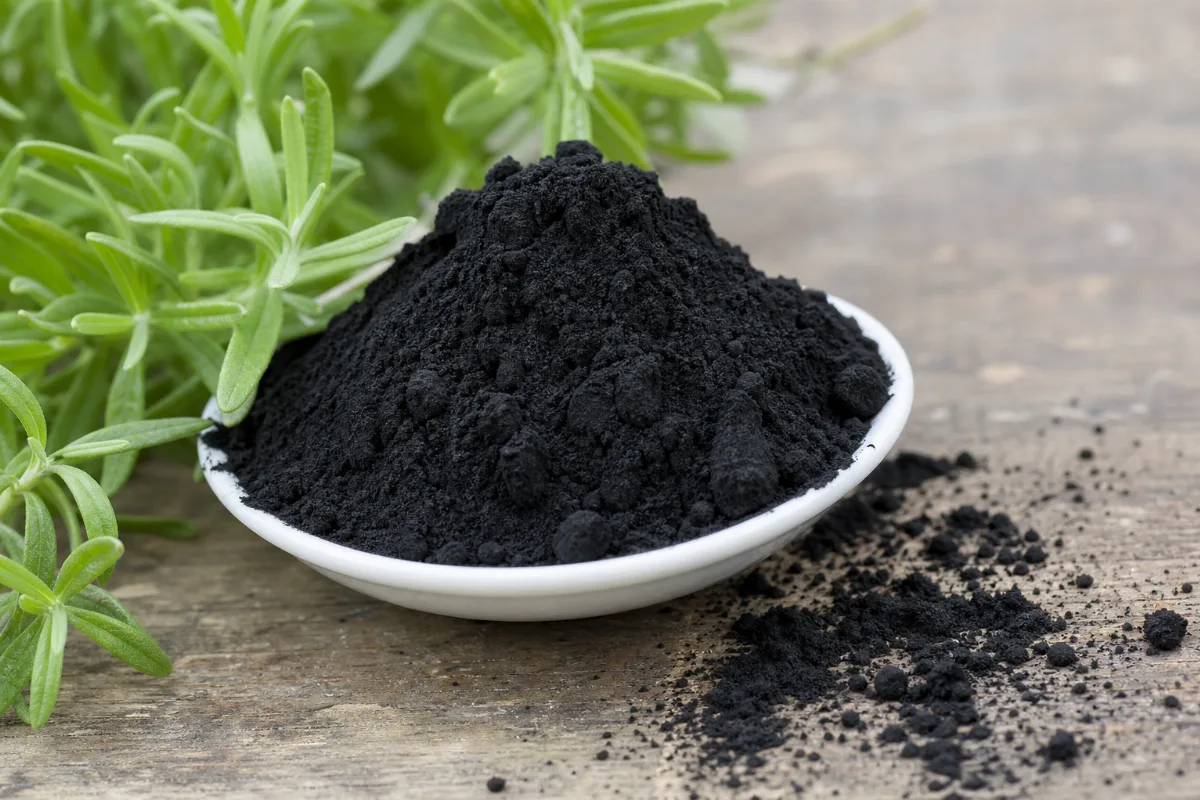
- A black, odorless powder (Poison Control).
- Harvest and processing
- Poison Control says carbon-rich materials such as wood are burned at very high temperatures to make charcoal, which is then activated through a special process that makes lots of holes and crevices in the particles to increase exposed surface area. One teaspoonful has about the surface area of a football field.
- Look-alikes and adulterants
- Name: Barbecue briquettes and burned toast; Note: Poison Control says these only share the black colour; some briquettes have chemicals added that were never meant to be swallowed or touch skin.; Name: Coconut or bamboo charcoal sold for wellness; Note: Other charcoals with similar claims; results should not be carried across.
Traditional use and history history, not clinical proof
| Tradition or era | Documented use | Source |
|---|---|---|
| 1813 (France) | Poison Control reports that the French chemist Bertrand drank 5 g of arsenic trioxide mixed with activated charcoal and survived, as an early demonstration of adsorption. Poison Control adds: do not try this at home. | s-poison-charcoal |
| 2005 to 2026 (hospital toxicology) | Expert position papers (2005), a systematic review (2021) and recommendations (2026) have set out when clinicians should and should not use charcoal for poisoning. | p41906697 |
Traditional use shows how it was used. It does not show that it works or is safe today.
What is inside, and how it may work
What it contains and how those compounds act in cells and animals. Laboratory and animal mechanisms are not proven effects in people.
Main compounds
| Compound | Family | Where it is concentrated | Activity studied | Level of evidence |
|---|---|---|---|---|
| Carbon PubChem 5462310 | elemental carbon | Not stated. | Porous carbon whose large surface lets other substances stick to it. 15 | Authoritative guidance |
Mechanisms, receptors and pathways
| Target or pathway | Gene or receptor | What was found | Level |
|---|---|---|---|
| Adsorption (substances stick to the surface) | None | The pores give a very large surface to which other substances stick. In the gut this lowers how much of a swallowed substance enters the blood. The effect is larger with more charcoal relative to the drug and when given early. 15 10 | Human (volunteers) and authoritative guidance |
| Gut-based drug clearance (multiple doses) | None | Expert recommendations support repeated charcoal for a short list of poisons to enhance elimination, on low-quality evidence. 9 | Expert consensus |
Absorption, metabolism and elimination
- Absorption
- Poison Control says charcoal stays in the gut and binds poisons there so they do not enter the body. It is not absorbed.
- Distribution
- Not studied.
- Elimination
- Leaves in the stool (black stools are described by food officials).
Nutritional composition
Charcoal has no nutritional role. Food officials say it can bind vitamins, minerals and antioxidants in food.
1 moderate certainty1 mixed findings3 low certainty2 very low certainty2 not enough evidence
What was looked at
The 9 benefits and uses checked for Activated Charcoal, each with how strong the evidence is. Tap one to open it.
- Hospital treatment after swallowing a poison (single dose)Mixed findings
- Lowering how much of a medicine is absorbed (healthy volunteers)Moderate certainty
- Repeated doses in hospital to help the body clear certain poisonsLow certainty
- "Detox" or "cleanse" for a healthy personNot enough evidence
- Whitening teeth with charcoal toothpaste or powderLow certainty
- Intestinal gas and bloatingVery low certainty
- Gout flares (added to a prescription medicine, in a trial)Low certainty
- Itching liver condition of pregnancy (cholestasis)Very low certainty
- Over-the-counter use for diarrhea or indigestionNot enough evidence
What is Activated Charcoal good for?
The uses people ask about and how strong the evidence is. Read this with the safety section first. None of these is advice to swallow charcoal.
Benefits, one by one
Each card is a research question, not a promise. Tap a goal to filter. Open a card to see the studies, doses and limits.
Hospital treatment after swallowing a poison (single dose)
Mixed findingsIn hospital, clinicians sometimes give activated charcoal soon after a poison is swallowed so less of it reaches the blood. It is a clinician decision for some poisons only, and it is not a home remedy.
4 studiesNo home use is described or advised here. Hospital use is decided by …
Studies, doses and limits
What the trials found
No randomised trial in poisoned patients shows better outcomes. Volunteer studies and expert reviews are the main evidence. The newest expert recommendations (2026) say charcoal is appropriate after many specific poisons, often within about 6 hours, and has no role after others.
Results
In volunteers given at least 50 g, absorption fell by about 47% when charcoal was given 30 minutes after the dose, 40% at 60 minutes, 17% at 120 and 21% at 180 (2005 position paper). A 2021 systematic review of 296 human studies found most were low quality, but reported a benefit beyond one hour in many clinical scenarios. A 2026 expert vote listed poisons with no role for charcoal (arsenic, caesium, copper, ethanol, methanol, ethylene glycol, iron, lead, lithium, metformin) and many where it is appropriate.
Effect sizes as reported
See results. The studies measure drug levels, mostly in healthy volunteers, more than patient outcomes.
Why this rating
Volunteer studies show less absorption, especially when given early. The 2005 position paper found no good clinical studies and no evidence of better outcome, while the 2021 review found low-quality data with a reported benefit beyond one hour. Experts now give poison-by-poison advice.
Form and dose studied
No home use is described or advised here. Hospital use is decided by poison-centre and emergency staff.
Who was studied
See limitations.
Limits
Most clinical data are low or very low quality. The decision depends on which poison, how long ago, the person's condition and available antidotes. A 2026 expert group says one dose beyond one hour can be appropriate for certain poisons, which differs from the older 2005 paper.
Why researchers looked
It was the first widely taught way to reduce how much poison is absorbed from the gut.
Traditional use
Poison Control reports that in 1813 the French chemist Bertrand swallowed a large amount of arsenic trioxide mixed with activated charcoal and survived, and says not to try this at home. (Today arsenic is on the list of poisons for which experts see no role for charcoal.)
Proposed mechanism Authoritative guidance
Activated charcoal has a huge surface full of tiny pores. Swallowed substances stick to it (adsorption) in the gut and then leave in the stool instead of entering the blood.
A proposed mechanism does not show that the effect happens in people.
Danger: it can be breathed into the lungs, can cause vomiting, and should not be given if the airway is not safe. Only a clinician can decide.
Lowering how much of a medicine is absorbed (healthy volunteers)
Moderate certaintyWhen charcoal is swallowed soon after a medicine, much less of that medicine gets into the blood. This is why charcoal blocks medicines. It is a drug effect, not a health benefit for a healthy person.
2 studiesNo home use is described or advised here. Hospital use is decided by …
Studies, doses and limits
What the trials found
A meta-analysis of 64 controlled volunteer studies and one small crossover trial of eight volunteers.
Results
Charcoal given 0 to 5 minutes after a drug cut median drug exposure by 88.4%. The effect stayed significant up to 4 hours (median reduction 27.4%). The reduction was larger with more charcoal relative to the drug. In eight volunteers given a cimetidine tablet, charcoal 15 minutes later cut cimetidine AUC by a median of 91.8% (water mixture) or 82.1% (cookie form).
Effect sizes as reported
See results (median reductions).
Why this rating
A meta-analysis of 64 controlled studies agrees in direction, but the outcome is blood levels of drugs in healthy volunteers, not patient outcomes, and effects differ by drug and timing.
Form and dose studied
No home use is described or advised here. Hospital use is decided by poison-centre and emergency staff.
Who was studied
See limitations.
Limits
Healthy volunteers, single doses, blood-level outcome only. Which medicines are affected most depends on the medicine.
Why researchers looked
Researchers measured it to learn how well charcoal works as an antidote and to understand medicine blocking.
Traditional use
Not described in the sources read.
Proposed mechanism Authoritative guidance
Activated charcoal has a huge surface full of tiny pores. Swallowed substances stick to it (adsorption) in the gut and then leave in the stool instead of entering the blood.
A proposed mechanism does not show that the effect happens in people.
This is the reason not to swallow charcoal near any medicine. Ask a pharmacist.
Repeated doses in hospital to help the body clear certain poisons
Low certaintyFor a short list of poisons that circulate in the body, hospital teams sometimes give several charcoal doses to speed clearance. This is specialist hospital care.
1 studiesNo home use is described or advised here. Hospital use is decided by …
Studies, doses and limits
What the trials found
Expert recommendations only (2026), based on a systematic review of mostly low-quality studies.
Results
The 2026 recommendations support multiple-dose charcoal for carbamazepine, cardiac glycosides, colchicine, dapsone, phenobarbital, phenytoin, thallium and theophylline. The group said the evidence is mostly low or very low quality.
Effect sizes as reported
No effect sizes in the abstract.
Why this rating
Expert consensus on low or very low quality evidence, as the authors state.
Form and dose studied
No home use is described or advised here. Hospital use is decided by poison-centre and emergency staff.
Who was studied
See limitations.
Limits
Abstract-level reading. Guidance for hospital teams, not for the public.
Why researchers looked
Some drugs pass back into the gut, so repeated charcoal may reduce levels over time.
Traditional use
Not described in the sources read.
Proposed mechanism Pharmacological theory
Charcoal in the gut can bind drug that passes back into the intestine, so less is reabsorbed.
A proposed mechanism does not show that the effect happens in people.
Only a clinician can decide. Breathing it into the lungs and bowel problems are risks.
"Detox" or "cleanse" for a healthy person
Not enough evidenceNo trial shows that swallowing activated charcoal detoxes a healthy person. Charcoal can also block medicines and nutrients.
3 studiesNo home use is described or advised here. Hospital use is decided by …
Studies, doses and limits
What the trials found
No trial found. We searched PubMed for human studies of charcoal for detox and found none. NCCIH reports a 2015 review of detox diets in general.
Results
NCCIH reports a 2015 review that found no compelling research that "detox" diets eliminate toxins. The AFDO food-officials resolution says the supposed health benefits of charcoal in food and drink are not proven.
Why this rating
No human trial of charcoal for detox, and the general detox evidence is weak.
Form and dose studied
No home use is described or advised here. Hospital use is decided by poison-centre and emergency staff.
Who was studied
See limitations.
Limits
Our search was PubMed plus the regulator and poison-centre pages named. The absence of a trial is not proof of no effect, but there is no evidence of benefit.
Why researchers looked
Marketing builds on the true fact that charcoal sticks to poisons in the gut.
Traditional use
Not described in the sources read.
Proposed mechanism Not established
Activated charcoal has a huge surface full of tiny pores. Swallowed substances stick to it (adsorption) in the gut and then leave in the stool instead of entering the blood.
A proposed mechanism does not show that the effect happens in people.
Swallowing charcoal can block medicines and nutrients and can slow the bowel.
Whitening teeth with charcoal toothpaste or powder
Low certaintyCharcoal toothpastes are sold to whiten teeth. The reviews we read found no good proof it works, and lab studies suggest it is rougher on teeth than other options.
3 studiesNo home use is described or advised here. Hospital use is decided by …
Studies, doses and limits
What the trials found
A 2017 literature review and a 2023 systematic review of mostly laboratory studies. No good long-term human trial was found.
Results
The 2017 review found insufficient data to back safety or efficacy claims and noted three studies reporting harm from brushing with raw charcoal. The 2023 review of 11 articles (medium to high risk of bias) found charcoal toothpastes whiten less than other options and are more abrasive.
Effect sizes as reported
No effect sizes in the abstracts.
Why this rating
Two reviews agree that proof is missing and that abrasion is a concern, but the underlying studies are few and mostly lab-based, so the certainty is low.
Form and dose studied
No home use is described or advised here. Hospital use is decided by poison-centre and emergency staff.
Who was studied
See limitations.
Limits
Mostly in vitro and extracted-teeth work. No long-term human trial found.
Why researchers looked
Charcoal is black and gritty, and was marketed as a natural stain remover.
Traditional use
Not described in the sources read.
Proposed mechanism Preliminary mechanism
Abrasion: charcoal particles are gritty and may scrub stains and enamel alike.
A proposed mechanism does not show that the effect happens in people.
Abrasion of tooth surface is a concern. Ask a dentist.
Intestinal gas and bloating
Very low certaintyOne small 1981 trial reported fewer gas events after a gas-producing meal, but a 2004 review found no consistent evidence for charcoal.
3 studiesNo home use is described or advised here. Hospital use is decided by …
Studies, doses and limits
What the trials found
A 1981 placebo-controlled trial (abstract only, no numbers) and a 2004 review.
Results
The 1981 abstract says charcoal prevented the rise in flatus events and breath hydrogen after a gas-producing meal compared with placebo. The 2004 review says there is no consistent evidence to support charcoal or simethicone.
Why this rating
Old, tiny, number-free trial against a later review that found no consistent evidence.
Form and dose studied
No home use is described or advised here. Hospital use is decided by poison-centre and emergency staff.
Who was studied
See limitations.
Limits
The 1981 abstract does not give group size or side effects.
Why researchers looked
Charcoal sticks to gas-producing compounds in the gut in theory.
Traditional use
Not described in the sources read.
Proposed mechanism Pharmacological theory
Activated charcoal has a huge surface full of tiny pores. Swallowed substances stick to it (adsorption) in the gut and then leave in the stool instead of entering the blood.
A proposed mechanism does not show that the effect happens in people.
Charcoal can cause constipation and blocks medicines.
Gout flares (added to a prescription medicine, in a trial)
Low certaintyIn one large, supervised trial, charcoal added to a low dose of a gout medicine did not lower uric acid more, but fewer people had flares. This is one trial, in clinic conditions, and not a reason to swallow charcoal.
1 studiesNo home use is described or advised here. Hospital use is decided by …
Studies, doses and limits
What the trials found
One double-blind, double-dummy randomised trial of 348 people with primary gout, registered as ChiCTR2000034138.
Results
The charcoal combinations did not lower urate more than febuxostat. They significantly reduced gout flares compared with febuxostat 20 mg alone, delayed the first flare and gave lower LDL cholesterol at week 24. Adverse events were similar across groups.
Effect sizes as reported
The abstract gives P values (P < 0.05 for one or more flares, P < 0.01 for three or more against febuxostat 40 mg) but no flare counts.
Why this rating
One well-designed trial, but the main goal was not met, the flare result is secondary and the setting is supervised.
Form and dose studied
No home use is described or advised here. Hospital use is decided by poison-centre and emergency staff.
Who was studied
See limitations.
Limits
Single trial, adults in China on febuxostat. Needs repeating. The charcoal product and dose were set by the study team.
Why researchers looked
Charcoal is thought to adsorb urate and related compounds in the gut.
Traditional use
Not described in the abstract.
Proposed mechanism Pharmacological theory
Activated charcoal has a huge surface full of tiny pores. Swallowed substances stick to it (adsorption) in the gut and then leave in the stool instead of entering the blood.
A proposed mechanism does not show that the effect happens in people.
Charcoal can block other medicines, so it must be timed by a clinician if used at all.
Itching liver condition of pregnancy (cholestasis)
Very low certaintyA tiny 1994 study in 19 women found bile acids fell more with charcoal, but itching did not change. This is for doctors to judge. Never self-treat pregnancy conditions.
1 studiesNo home use is described or advised here. Hospital use is decided by …
Studies, doses and limits
What the trials found
One preliminary randomised study of 19 women (20 pregnancies), open-label.
Results
Serum total bile acids were lower in the charcoal group by day 8 (P < 0.05), but pruritus and other measures did not change significantly. Outcome of pregnancy was good in both groups.
Effect sizes as reported
Total bile acids fell in seven charcoal-group patients and in only one control (P < 0.05).
Why this rating
Very small, no placebo, 1994, surrogate marker moved but the symptom did not.
Form and dose studied
No home use is described or advised here. Hospital use is decided by poison-centre and emergency staff.
Who was studied
Pregnant women with cholestasis (medical care only).
Limits
Preliminary study; no larger trial was found in this search.
Why researchers looked
High bile acids may play a role in symptoms and charcoal can bind bile acids in the gut.
Traditional use
Not described in the abstract.
Proposed mechanism Pharmacological theory
Binds bile acids in the gut.
A proposed mechanism does not show that the effect happens in people.
Pregnancy is a reason for extra caution. The sources read do not cover safety of consumer charcoal products in pregnancy.
Over-the-counter use for diarrhea or indigestion
Not enough evidenceUS rules list activated charcoal among ingredients with inadequate data to say it is safe and effective as an over-the-counter antidiarrheal or digestive aid.
1 studiesNo home use is described or advised here. Hospital use is decided by …
Studies, doses and limits
What the trials found
A regulatory listing only. No trial for these uses was found.
Results
21 CFR 310.545 lists charcoal (activated) under antidiarrheal and digestive aid drug products as an ingredient with inadequate data for general recognition of safety and effectiveness for those uses.
Why this rating
A legal statement about missing data, not a trial result.
Form and dose studied
No home use is described or advised here. Hospital use is decided by poison-centre and emergency staff.
Who was studied
See limitations.
Limits
We did not search regulators outside the US.
Why researchers looked
Charcoal is sold for upset stomach and diarrhea.
Traditional use
Not described in the sources read.
Proposed mechanism Pharmacological theory
Activated charcoal has a huge surface full of tiny pores. Swallowed substances stick to it (adsorption) in the gut and then leave in the stool instead of entering the blood.
A proposed mechanism does not show that the effect happens in people.
Charcoal can block medicines.
Connections to the rest of health
How Activated Charcoal connects to the rest of our health knowledge graph. Every link says what kind of connection it is. A safety link (for example to the liver) is a warning, not a benefit. A study that merely mentions a topic never creates a benefit link.
Explore every connection: goals, body systems, organs, symptoms, genes
A. Wellness goals
| Connected to | Kind of connection | Evidence status | Context | Studies |
|---|---|---|---|---|
| Digestive Support | Very low certainty | Intestinal gas and bloating: One small 1981 trial reported fewer gas events after a gas-producing meal, but a 2004 review found no consistent evidence for charcoal. | 7 2 15 | |
| Gut Health | Very low certainty | Intestinal gas and bloating: One small 1981 trial reported fewer gas events after a gas-producing meal, but a 2004 review found no consistent evidence for charcoal. | 7 2 15 | |
| Joint Support | Low certainty | Gout flares (added to a prescription medicine, in a trial): In one large, supervised trial, charcoal added to a low dose of a gout medicine did not lower uric acid more, but fewer people had flares. This is one trial, in clinic conditions, and not a reason to swallow charcoal. | 6 | |
| Womens Wellness | Very low certainty | Itching liver condition of pregnancy (cholestasis): A tiny 1994 study in 19 women found bile acids fell more with charcoal, but itching did not change. This is for doctors to judge. Never self-treat pregnancy conditions. | 11 | |
| Digestive Support | Not enough evidence | Over-the-counter use for diarrhea or indigestion: US rules list activated charcoal among ingredients with inadequate data to say it is safe and effective as an over-the-counter antidiarrheal or digestive aid. | 17 |
B. Body systems
| Connected to | Kind of connection | Evidence status | Context | Studies |
|---|---|---|---|---|
| Digestive System | Biological association | Mixed findings | Studied for: Hospital treatment after swallowing a poison (single dose) Studied for: Lowering how much of a medicine is absorbed (healthy volunteers) | 4 8 9 15 10 12 13 1 7 2 17 |
| Whole Body | Biological association | Low certainty | Studied for: Whitening teeth with charcoal toothpaste or powder | 3 16 15 |
| Musculoskeletal System | Biological association | Low certainty | Studied for: Gout flares (added to a prescription medicine, in a trial) | 6 |
| Hepatic System | Biological association | Very low certainty | Studied for: Itching liver condition of pregnancy (cholestasis) | 11 |
| Reproductive System | Biological association | Very low certainty | Studied for: Itching liver condition of pregnancy (cholestasis) | 11 |
L. Active compounds
| Connected to | Kind of connection | Evidence status | Context | Studies |
|---|---|---|---|---|
| Carbon | Biological association | Authoritative guidance | Porous carbon whose large surface lets other substances stick to it. | 15 |
Each connection is stored with the ingredient, the connected record, the kind of connection, the evidence status, the supporting studies, the preparation or compound involved, and a review date (last reviewed October 30, 2026).
Evidence at a glance: what the research found for 9 outcomes
Each outcome below is one thing researchers measured. Certainty is how far the evidence can be trusted, not how well it works. The full studies are on the next tab.
The evidence
The research centre for Activated Charcoal. Every record here was checked against PubMed or the publisher's page; we never list a study we have not verified.
Evidence by outcome
Bars show how many studies we found for each outcome, not how well it works. People are added up across trials only (reviews are not added, to avoid double counting).
How we rate evidence
High certainty
Several well-run trials or reviews agree; further research is unlikely to change the picture much.
Moderate certainty
Good trials point the same way, but some doubt remains.
Low certainty
Small, short or inconsistent trials. The finding could change with better research.
Very low certainty
Very little or very weak human data. Treat as a possibility only.
Mixed findings
Trials or reviews disagree with each other.
Not enough evidence
Not enough human research to say either way.
Evidence against
Good research found no benefit, or found harm.
We take the reviewers' own risk-of-bias and GRADE statements where they exist, and otherwise judge from study size, design, consistency, directness and whether a product matches what is sold. Many publications do not make evidence high. Method note: We read the abstract of each cited paper on PubMed and the Poison Control, NCCIH, food-officials (AFDO) and US eCFR pages. Certainty ratings are the compiler's own reading. Regulators outside the US were not checked. No study is cited that we could not verify.
Study library: every study we checked 17
| Study | Design | People | Product, dose, length | Result |
|---|---|---|---|---|
| Association of Food and Drug Officials (Board of Directors) 2018 AFDO Resolution 2019-01 (dated July 9, 2018): Charcoal aka Activated Carbon Used as a Food or Beverage Ingredient AFDO · Source |
Authoritative guidance n/a |
n/a | Charcoal added to food and drink Not reproduced here (no dose advice is given on this page). |
A resolution by an association of US food and drug officials. It says charcoal in food and drink is popular, its supposed health benefits are not proven, and it is not specifically listed as a generally recognized as safe food ingredient. It says the source of the charcoal may be unknown and may contain heavy metals or residual plastics. It says charcoal can bind some vitamins, minerals and antioxidants and could lead to nutrient deficiency, can bind some medicines including some antidepressants and anti-inflammatory medicines and make them less effective, and slows the bowel, absorbs water from the gut, and is known to cause nausea, constipation and black stools. It asks FDA to examine use of activated charcoal in retail food. Methods, limits and fundingOutcomes: Risks of charcoal in food and drink Limitations: A regulators' association resolution, not a rule and not a trial. It is about food and drink, and gives no references. Funding and conflicts: n/a Read: full-text |
| Azpiroz 2004 Treatment of Excessive Intestinal Gas Current Treatment Options in Gastroenterology · PMID 15238205 · DOI |
Narrative review human (review) |
n/a | Treatments for excessive intestinal gas Not reproduced here (no dose advice is given on this page). |
The review says there is no consistent evidence to support gas-reducing substances such as charcoal or simethicone. It recommends other approaches depending on the cause, such as diet changes or retraining air swallowing. Methods, limits and fundingOutcomes: Treatment options Limitations: A narrative review from 2004. Funding and conflicts: None stated in the abstract. Read: abstract |
| Brooks 2017 Charcoal and charcoal-based dentifrices: A literature review Journal of the American Dental Association · PMID 28599961 · DOI |
Literature review human and laboratory |
118 articles screened; 13 reported brushing with raw charcoal or soot | Charcoal and charcoal toothpastes and powders Not reproduced here (no dose advice is given on this page). |
None of 13 studies of brushing with raw charcoal or soot met the inclusion criteria. Of the studies reported, two gave nonspecific caries reductions, three reported harm (increased caries, enamel abrasion or a non-quantified negative impact) and one found no adverse effect on oral hygiene. In 50 internet products, ads made unsubstantiated claims (antibacterial, antifungal, antiviral, oral detoxification). The authors found insufficient clinical and laboratory data to back safety or efficacy claims. Methods, limits and fundingOutcomes: Efficacy and safety claims Limitations: A literature review, not a trial. It found few eligible studies. Funding and conflicts: None stated in the abstract. Read: abstract |
| Chyka 2005 Position paper: Single-dose activated charcoal Clinical Toxicology (Phila) · PMID 15822758 · DOI |
Guideline position paper human (volunteers) and clinical |
Poisoned patients and volunteer studies (reviewed) | Single-dose activated charcoal given after a poison is swallowed Not reproduced here (no dose advice is given on this page). |
In volunteer studies using at least 50 g of charcoal, the mean reduction in absorption was 47.3%, 40.07%, 16.5% and 21.13% when given 30, 60, 120 and 180 minutes after the dose. The paper found no satisfactorily designed clinical studies of benefit and no evidence that charcoal improves clinical outcome. It said single-dose charcoal should not be given routinely, may be considered within one hour of a potentially toxic amount of a poison known to be adsorbed, and is contraindicated unless the airway is intact or protected. Methods, limits and fundingOutcomes: Absorption of poisons; clinical outcome; airway safety Limitations: Older position paper (2005). It has since been followed by a 2021 systematic review and 2026 recommendations that go further on timing. Funding and conflicts: None stated in the abstract. Read: abstract |
| Gilbert 2025 Use of activated charcoal in poisoned patients aged over than 5 year old CJEM (Canadian Journal of Emergency Medicine) · PMID 40131706 · DOI |
Multicentre record review |
935 935 poisoned patients over age 5 in Quebec emergency departments (2015 to 2016); 120 received charcoal |
Activated charcoal in the emergency department Not reproduced here (no dose advice is given on this page). · vs Patients who did not receive charcoal |
120 of 935 patients (12.8%) received charcoal. Treated patients had a 9.2% lower risk of increased toxicity in the first 12 hours but twice the likelihood of being admitted and of a stay of 12 hours or more. The most common side effect was vomiting (20.8%). One patient had aspiration pneumonia and two later had gastrointestinal obstruction after charcoal. Methods, limits and fundingOutcomes: Progression of toxicity; mortality; length of stay; side effects Limitations: A records review, not a randomised trial. People who got charcoal differed from those who did not. The abstract gives percentages for aspiration and obstruction that do not match the counts, so only counts are used here. Funding and conflicts: No conflicts declared. Read: abstract |
| Guo 2026 Efficacy and safety of activated charcoal in primary gout: A double-blind, double-dummy, randomized controlled trial American Journal of Medicine · PMID 41547464 · DOI |
Randomised controlled trial |
348 348 patients with primary gout |
Activated charcoal added to a low dose of febuxostat, given in a supervised trial Not reproduced here (no dose advice is given on this page). 24 weeks · vs Febuxostat 40 mg or 20 mg alone |
The combination did not lower urate better than febuxostat alone. It significantly reduced the number of patients with one or more and three or more flares compared with febuxostat 20 mg, delayed the first flare and gave lower LDL cholesterol at week 24. Adverse events were similar across groups. Methods, limits and fundingOutcomes: Share reaching the target blood urate level; gout flares; LDL cholesterol Limitations: The primary goal (urate target) was not shown to be better. The flare and cholesterol findings are secondary results from one trial. It combined charcoal with a prescription medicine under study supervision and is not advice to use charcoal for gout. Funding and conflicts: The authors declare no competing financial interests. Registration: ChiCTR2000034138 Read: abstract |
| Hall RG Jr 1981 Effects of orally administered activated charcoal on intestinal gas American Journal of Gastroenterology · PMID 7015846 |
Randomised controlled trial |
Not stated in the abstract | Activated charcoal versus placebo after a gas-producing meal Not reproduced here (no dose advice is given on this page). · vs Placebo |
The abstract says charcoal was effective in preventing the large rise in flatus events and breath hydrogen that normally follows a gas-producing meal compared with placebo. Methods, limits and fundingOutcomes: Number of flatus events and breath hydrogen Limitations: A 1981 abstract with no numbers, no group size and no side-effect data. It has not been repeated in the sources read. Funding and conflicts: Not stated in the abstract. Read: abstract |
| Hoegberg 2021 Systematic review on the use of activated charcoal for gastrointestinal decontamination following acute oral overdose Clinical Toxicology (Phila) · PMID 34424785 · DOI |
Systematic review human, animal and in vitro |
296 human studies, 118 animal studies and 145 in vitro studies (plus 71 human and two animal studies on adverse events) | Oral activated charcoal after an acute oral overdose Not reproduced here (no dose advice is given on this page). |
From 22,950 titles the review included 296 human, 118 animal and 145 in vitro studies. Quality was Low or Very Low GRADE in 469 (83%) of the studies and Moderate or High in ninety. No studies on the best dose were found. The review called the data heterogeneous. Studies of patients with unknown or mixed overdoses had low rates of meaningful toxicity or death, but the authors reported a benefit of charcoal beyond one hour in many clinical scenarios. Methods, limits and fundingOutcomes: Toxicity, clinical outcome, survival, drug levels, adverse events Limitations: Most included studies were low or very low quality. Several authors are poison-centre and emergency clinicians who also wrote the 2026 recommendations. One author lists a pharmaceutical company affiliation. No funding statement in the abstract. Funding and conflicts: Not stated in the abstract (one author lists SERB Pharmaceuticals as a workplace). Read: abstract |
| Hoegberg 2026 Recommendations from the Clinical Toxicology Recommendations Collaborative on the administration of activated charcoal in acute oral overdose Clinical Toxicology (Phila) · PMID 41906697 · DOI |
Consensus statement human (guidance for clinicians) |
43 poisons or poison groups appraised (systematic review plus two-round Delphi expert vote) | Single-dose, additional-dose and multiple-dose activated charcoal in poisoning Not reproduced here (no dose advice is given on this page). |
The expert group concluded there is no role for activated charcoal in poisoning from arsenic, caesium, copper, ethanol, methanol, ethylene glycol, iron, lead, lithium and metformin. It is appropriate after many other poisons (for example paracetamol, salicylates, tricyclic antidepressants and others listed in the paper), with up to about 6 hours as a common limit under an individual risk assessment. The group said the evidence is mostly low or very low quality. It said a tube should not be placed or a person put on a breathing tube solely to give charcoal in people not expected to develop significant poisoning. Multiple-dose charcoal is recommended for carbamazepine, cardiac glycosides, colchicine, dapsone, phenobarbital, phenytoin, thallium and theophylline. Methods, limits and fundingOutcomes: Expert consensus on when charcoal is appropriate Limitations: Expert consensus on low-quality evidence. It is guidance for clinicians; it is not advice for home use. One author lists a pharmaceutical company affiliation. Funding and conflicts: Not stated in the abstract. Read: abstract |
| Jurgens 2009 The effect of activated charcoal on drug exposure in healthy volunteers: a meta-analysis Clinical Pharmacology and Therapeutics · PMID 19194372 · DOI |
Meta-analysis human (volunteers) |
Healthy volunteers in 64 controlled studies | Activated charcoal given 0 to 6 hours after a drug Not reproduced here (no dose advice is given on this page). Charcoal given 0 to 6 hours after the drug · vs No charcoal |
Charcoal given 0 to 5 minutes after a drug cut median drug exposure by 88.4% (25th to 75th percentile 65.0 to 96.8). The effect stayed statistically significant when given up to 4 hours after the drug (median reduction 27.4%, range 21.3 to 31.5%). The reduction was greater with a larger charcoal-to-drug ratio, and charcoal worked best when given right away and in a large amount. Methods, limits and fundingOutcomes: Drug exposure (how much of a drug reached the blood) Limitations: Healthy volunteers and blood levels of drugs, not patients and not clinical outcomes. Funding and conflicts: None stated in the abstract. Read: abstract |
| Kaaja 1994 Treatment of cholestasis of pregnancy with peroral activated charcoal. A preliminary study Scandinavian Journal of Gastroenterology · PMID 8171288 · DOI |
Randomised controlled trial |
19 19 women (20 pregnancies) with cholestasis of pregnancy |
Activated charcoal by mouth for 8 days versus normal follow-up Not reproduced here (no dose advice is given on this page). 8 days · vs Normal follow-up only |
Serum total bile acids were lower on day 8 in the charcoal group than in the control group. Bile acids fell in seven patients but in only one control. Itching and other measures did not change significantly. The outcome of pregnancy was good in both groups. Methods, limits and fundingOutcomes: Serum bile acids, liver tests and itching Limitations: Tiny, open (no placebo), 1994 preliminary study. It is not advice for pregnant women. Funding and conflicts: None stated in the abstract. Read: abstract |
| Klein-Schwartz 2010 Drug adsorption efficacy and palatability of a novel charcoal cookie formulation Pharmacotherapy · PMID 20795844 · DOI |
Crossover trial human (volunteers) |
8 Eight healthy volunteers |
Charcoal (a cookie form or a water mixture) 15 minutes after one cimetidine tablet Not reproduced here (no dose advice is given on this page). Single doses, one-week washout between treatments · vs Cimetidine with water only |
Both charcoal forms effectively adsorbed cimetidine and decreased absorption of most of the dose. The median fall in cimetidine AUC was 91.8% with the water mixture and 82.1% with the cookie (no significant difference). Both were well tolerated and no adverse events were reported. Methods, limits and fundingOutcomes: Cimetidine absorption (AUC, Cmax) and palatability Limitations: Eight people, one medicine, charcoal given 15 minutes after the tablet. It does not show what happens with other medicines or at other times. Funding and conflicts: None stated in the abstract. Read: abstract |
| National Center for Complementary and Integrative Health (NIH) 2025 "Detoxes" and "Cleanses": What You Need To Know (NCCIH) NCCIH fact sheet (last updated March 2025) · Source |
Authoritative guidance n/a |
n/a | Detox and cleanse programmes in general (not charcoal-specific) Not reproduced here (no dose advice is given on this page). |
NCCIH reports a 2015 review that found no compelling research to support "detox" diets for weight management or for eliminating toxins from the body. It notes that studies of detox programmes in people are few and low quality, and that FDA and FTC have acted against companies selling detox products with hidden ingredients or false claims. Methods, limits and fundingOutcomes: Whether detox programmes remove toxins Limitations: The page is about detox programmes in general. It does not discuss activated charcoal products. Funding and conflicts: None stated. Read: full-text |
| Ramirez-Romero 2025 Pulmonary aspiration after activated charcoal in unintentional acute poisonings in childhood Archives of Disease in Childhood · PMID 39798953 · DOI |
Cohort registry substudy human (children) |
1983 1,983 episodes of accidental ingestion in children under 7 years at 58 paediatric emergency departments in Spain (2008 to 2022); 517 received charcoal |
Activated charcoal given in an emergency department, by mouth or by nasogastric tube Not reproduced here (no dose advice is given on this page). · vs Children who did not receive charcoal (not compared for aspiration in the abstract) |
517 of 1,983 children (26.1%) received charcoal, 167 of them (32.3%) by nasogastric tube. All patients did well and no cases of pulmonary aspiration were reported, whatever the route. The authors concluded charcoal in children after accidental ingestion seems safe in this setting. Most swallowed substances were medicines. Methods, limits and fundingOutcomes: Pulmonary aspiration Limitations: Hospital setting with trained staff. Not evidence that charcoal is safe at home. Registry data on certain days; most children were awake on arrival. Funding and conflicts: No competing interests declared. Read: abstract |
| Reviewed by Pela Soto 2026 Activated charcoal: An effective treatment for poisonings (Poison Control) Poison Control (National Capital Poison Center) · Source |
Authoritative guidance n/a |
n/a | Activated charcoal Not reproduced here (no dose advice is given on this page). |
Poison Control says activated charcoal can adsorb many poisons in the gut so less enters the body, that it works better the sooner it is given, and that even 4 hours after swallowing a poison it adsorbs, it can cut the amount taken in by almost a third. It says not to try to treat a poisoning with it at home. Over-the-counter tablets may be less "activated" than hospital charcoal. Listed risks: nausea and vomiting, and breathing the powder or slurry into the lungs if very drowsy. It should not be taken with gastrointestinal bleeding, a bowel perforation or a bowel blockage. Filters, toothpaste and skin cosmetics: usefulness "questionable". Methods, limits and fundingOutcomes: What activated charcoal is, how clinicians use it, and its risks Limitations: A consumer-health page by a poison-information organisation, not a trial. It does not give a reference for each statement. Funding and conflicts: None stated. Read: full-text |
| Tomas 2023 Effectiveness and abrasiveness of activated charcoal as a whitening agent: A systematic review of in vitro studies Annals of Anatomy · PMID 36183933 · DOI |
Systematic review in vitro and human |
11 articles (208 screened), humans or extracted teeth | Activated charcoal toothpastes Not reproduced here (no dose advice is given on this page). |
Risk of bias was medium to high. Whitening results varied: some studies found no significant differences between treatments and in others charcoal was not the most whitening agent. Most studies agreed that charcoal toothpaste has higher abrasive potential. The authors concluded charcoal toothpastes whiten less than other options and may be less safe because of high abrasiveness. Methods, limits and fundingOutcomes: Tooth whitening and abrasiveness Limitations: Mostly laboratory studies on extracted teeth. Medium to high risk of bias. Funding and conflicts: None stated; the authors declare no competing interests. Read: abstract |
| US Food and Drug Administration (Code of Federal Regulations) 2026 21 CFR 310.545: Drug products containing certain active ingredients offered over-the-counter (OTC) for certain uses electronic Code of Federal Regulations (version dated 2026-10-01) · Source |
Regulation text n/a |
n/a | Activated charcoal as an over-the-counter ingredient Not reproduced here (no dose advice is given on this page). |
Paragraph (a) says that for the ingredients listed there are inadequate data to establish general recognition of safety and effectiveness for the specified uses. Charcoal (activated) is listed under antidiarrheal drug products and under digestive aid drug products. Methods, limits and fundingOutcomes: Whether OTC use for certain purposes is generally recognised as safe and effective Limitations: A legal listing, not a review of the science. Read by retrieving the electronic CFR text on 2026-10-30. Funding and conflicts: n/a Read: full-text |
What we do not know yet
- No human trial of swallowed charcoal for detox in healthy people.
- No randomised trial in poisoned patients shows better clinical outcomes; later data are low quality.
- No safety data for consumer charcoal in pregnancy, breastfeeding, kidney or liver disease.
- No metal test data for shop charcoal products.
- Only one gout trial and one tiny pregnancy study; neither repeated.
- Regulators outside the US were not checked.
How new research is added
New studies are found by a saved PubMed search and placed in a review queue. A person reads each one before it changes any evidence rating or safety wording.
Lab markers
What changed in blood or saliva tests during trials. A changed number is not the same as feeling or being healthier, and we give no "normal ranges".
Safety
What studies and official sources say about side effects, medicines and who should check first. Each point shows what kind of evidence it comes from.
Main points to know 6
- Danger first: it is a clinician-given emergency treatment, not a home remedy. Poison Control says not to try to treat a poisoning with activated charcoal at home. If someone may have swallowed something harmful, use the Poison Control online tool or call Poison Help at 1-800-222-1222 in the US, or your local emergency number. Call 911 now if the person collapses, has a seizure, has trouble breathing or cannot be awakened. Hospital teams decide whether charcoal helps for the specific poison and timing. Authoritative guidance 15 9
- It blocks medicines and nutrients. Charcoal sticks to substances in the gut. In a meta-analysis of 64 controlled volunteer studies, charcoal given right after a drug cut drug exposure by a median of 88.4%, and it still had a significant effect up to 4 hours later (median 27.4%). In eight volunteers it cut absorption of cimetidine by most of the dose. Food officials add that it can bind vitamins, minerals and antioxidants. Ask a pharmacist before taking charcoal near any medicine. Meta-analysis 10 12 1
- It does not work for every poison. A 2026 expert group concluded there is no role for activated charcoal in poisoning from arsenic, caesium, copper, ethanol, methanol, ethylene glycol, iron, lead, lithium and metformin. This is one more reason the decision belongs to poison-centre and hospital staff. Consensus statement 9
- Breathing it into the lungs, vomiting and bowel problems. Poison Control lists nausea, vomiting and breathing the powder or slurry into the lungs if the person is very drowsy. It should not be taken with gastrointestinal bleeding, a bowel perforation or a bowel blockage. The 2005 position paper says charcoal is contraindicated unless the airway is intact or protected. In a Quebec records review of 120 treated patients, vomiting was the most common side effect (20.8%), one had aspiration pneumonia and two later had gastrointestinal obstruction. Authoritative guidance 15 4 5
- Not the same as barbecue charcoal or burned toast. Poison Control says burned toast and barbecue briquettes are not activated charcoal and do not adsorb poisons. Some briquettes are treated with chemicals that were never intended to be swallowed or touch skin. Authoritative guidance 15
- Not a detox. No trial shows that swallowing charcoal detoxes a healthy person. NCCIH reports a 2015 review that found no compelling research that detox diets remove toxins. Authoritative guidance 13 1
Side effects 6
| Effect | How often | Severity and recovery | Evidence |
|---|---|---|---|
| Nausea and vomiting Poison Control says this is often a reaction to the gritty feel of the mixture. | Vomiting 20.8% in one Quebec review of treated patients | mild to moderate Not stated | Observational study 15 5 |
| Charcoal breathed into the lungs (aspiration) Higher risk if the person is very drowsy. Those figures come from hospitals with trained staff. | One patient with aspiration pneumonia among 120 treated (Quebec review). No cases among 517 children in a Spanish registry. | serious Not stated | Observational study 15 5 14 4 |
| Bowel obstruction Counts only; the abstract's percentages do not match the counts. | Two patients among 120 treated (Quebec review) | serious Not stated | Observational study 5 |
| Constipation, dehydration, black stools From a food-officials resolution, not a trial. | Not established | unknown Not stated | Regulatory statement 1 |
| Less effect from medicines, lower nutrient uptake Strong in volunteer studies; nutrient effects are described by food officials without a trial. | Not established | unknown Not stated | Meta-analysis 10 12 1 |
| Tooth abrasion or harm from brushing with charcoal Three studies in the 2017 review reported harm; a 2023 review found most studies agree charcoal toothpaste is more abrasive. | Not established | unknown Not stated | Narrative review 3 16 |
Liver
No report of liver injury from activated charcoal was found in the sources read. LiverTox was not searched in this build.
How often. No rate in people.
Monitoring. No monitoring advice was found.
This is a safety connection. It is not evidence that Activated Charcoal supports liver health.
Medicines and supplements 4
| With | Why it matters | Importance | Evidence | What to do |
|---|---|---|---|---|
| Medicines taken by mouth (in general) prescription | Charcoal binds medicines in the gut so less is absorbed. | Large effect on drug levels in volunteers: median 88.4% reduction when given 0 to 5 minutes after a drug and 27.4% up to 4 hours after (64 studies). In eight volunteers cimetidine absorption fell by most of the dose. | Meta-analysis Moderate certainty 10 12 | Ask a pharmacist before taking charcoal if you take any medicine, especially medicines for long-term conditions. Do not skip or delay a medicine because of charcoal. |
| Some antidepressants and anti-inflammatory medicines prescription | Binding in the gut. | Named by food officials as medicines that charcoal can make less effective. This is a resolution, not a study of those medicines. | Regulatory statement Low certainty 1 | Ask a pharmacist. |
| Vitamins, minerals and antioxidants in food nutrient | Charcoal binds them in the gut. | Described by food officials as a possible cause of nutrient deficiency with frequent use. No measured nutrient study was found. | Regulatory statement Low certainty 1 | Ask a doctor or dietitian if you rely on supplements. |
| Sorbitol-containing charcoal products other | Poison Control says some products contain sorbitol, which adds sweetness and is also a laxative. | Described for hospital-type products. | Authoritative guidance Not enough evidence 15 | Check labels and ask a pharmacist. |
Who should check first 5
| Situation | Advice | Evidence |
|---|---|---|
| Gastrointestinal bleeding, bowel perforation or bowel blockage | Poison Control says activated charcoal should not be taken in these situations. | Authoritative guidance 15 |
| A person who is very drowsy, vomiting or whose airway is not protected | The 2005 position paper says charcoal is contraindicated unless the airway is intact or protected. Call emergency services; do not give anything by mouth. | Guideline 4 15 |
| Anyone who takes medicines that must be absorbed | Charcoal can reduce absorption of medicines. Ask a pharmacist before using it. | Meta-analysis 10 |
| Poisons on the 2026 no-role list (for example iron, lead, lithium, alcohols, metformin) | Experts see no role for charcoal for these. Call poison control rather than reaching for charcoal. | Consensus statement 9 |
| Pregnancy, breastfeeding, young children, kidney or liver disease, before surgery | The sources read give no safety data for consumer charcoal products in these situations. Ask a doctor or pharmacist first, and call Poison Help for any swallowing emergency. | Authoritative guidance 15 |
Overdose, product quality and regulators
Summary. Poison Control says activated charcoal is overall well tolerated in hospital use, with few adverse effects. The main dangers are breathing it into the lungs, vomiting, and blocking medicines.
Animal. Not read.
Human doses studied. Hospital use is decided by clinicians. No home dose is given on this page.
High dose or long term signals. Food officials warn that frequent use over time could cause nutrient deficiency, constipation and dehydration. No long-term trial was found.
Overdose response. If someone may have swallowed something harmful, use the Poison Control online tool or call Poison Help at 1-800-222-1222 in the US, or your local emergency number. Call 911 if the person collapses, has a seizure, has trouble breathing or cannot be awakened.
Genotoxicity. Not read.
Charcoal quality varies and a label cannot tell you how well it is activated or what is in it.
Source and metals. Food officials say the source of charcoal used in food may be unknown and may contain heavy metals or residual plastics. 1
How well it is activated. Poison Control says over-the-counter products might not be as activated as hospital charcoal, so they would be less effective. 15
Look-alikes. Burned toast and barbecue briquettes are not activated charcoal and some briquettes contain chemicals never meant to be swallowed. 15
| Body | Action | Date |
|---|---|---|
| FDA (US), 21 CFR 310.545 (United States) | Lists charcoal (activated) among ingredients with inadequate data to establish general recognition of safety and effectiveness for certain over-the-counter uses, including antidiarrheal and digestive aid products. source | 2026-10-01 |
| Association of Food and Drug Officials (AFDO), US (United States (association of officials)) | 2018 resolution (2019-01) asks FDA to examine charcoal used as a food or beverage ingredient and says its supposed health benefits are not proven. source | 2018-07-09 |
| Clinical Toxicology Recommendations Collaborative (AACT, EAPCCT, APAMT) (International) | 2026 consensus recommendations on when activated charcoal is appropriate in acute oral overdose, poison by poison. source | 2026-03-30 |
When to get medical help
- Someone may have swallowed a medicine, chemical or anything harmful: use the Poison Control online tool or call Poison Help at 1-800-222-1222 now (US), or your local emergency number.
- Call 911 (or your local emergency number) now if the person collapses, has a seizure, has trouble breathing or cannot be awakened.
- After any charcoal: trouble breathing, coughing or choking, repeated vomiting, severe belly pain or swelling, or no bowel movement with a swollen belly need urgent medical care.
- A child has swallowed anything unsafe: call Poison Help first. Do not give charcoal, food or drink unless a poison-centre or medical professional tells you to.
Stop using the product and contact a clinician or emergency service. In the US, Poison Control is 1-800-222-1222.
General information only, not medical advice. Ask a clinician or pharmacist before use, especially with medicines, in pregnancy or with a health condition. See the Natural Remedy Safety guide.
Frequently asked questions
Can I use activated charcoal at home after a poisoning?
No. Poison Control says not to try to treat a poisoning with activated charcoal at home. Use the Poison Control online tool or call Poison Help at 1-800-222-1222 in the US, or your local emergency number. Call 911 if the person collapses, has a seizure, has trouble breathing or cannot be awakened.
What does activated charcoal do in hospital?
Clinicians sometimes give it soon after a poison is swallowed so less of the poison enters the blood. Volunteer studies show less absorption, most when given early. A 2005 position paper found no good clinical studies and no evidence of better outcomes, while a 2021 systematic review found mostly low-quality data but reported a benefit beyond one hour in many scenarios. Expert recommendations from 2026 go poison by poison.
Does it work for every poison?
No. A 2026 expert group concluded there is no role for activated charcoal in poisoning from arsenic, caesium, copper, ethanol, methanol, ethylene glycol, iron, lead, lithium and metformin. That is one reason to call poison control instead of guessing.
Is activated charcoal a detox?
Does charcoal affect my medicines?
Yes, it can. In a meta-analysis of 64 controlled volunteer studies, charcoal given right after a drug cut drug exposure by a median of 88.4%, and it still had an effect up to 4 hours later (median 27.4%). In eight volunteers it cut absorption of cimetidine by most of the dose. Ask a pharmacist before taking charcoal near any medicine.
Is store-bought charcoal the same as hospital charcoal?
Not necessarily. Poison Control says over-the-counter products might not be as activated as hospital charcoal, so they would be less effective.
What are the side effects and risks?
Poison Control lists nausea and vomiting and breathing the powder or slurry into the lungs, especially if the person is very drowsy. In a Quebec records review of 120 treated patients, vomiting was the most common side effect (20.8%), one had aspiration pneumonia and two later had bowel obstruction. Food officials add constipation, dehydration and black stools. It should not be taken with gastrointestinal bleeding, a bowel perforation or a bowel blockage.
Does it block vitamins and minerals?
Food officials say charcoal can bind some vitamins, minerals and antioxidants in food and could lead to nutrient deficiency. We found no measured nutrient study.
Is charcoal toothpaste proven to whiten teeth?
Does charcoal help with gas or bloating?
Is activated charcoal safe in pregnancy, while breastfeeding or for children?
We found no safety data for consumer charcoal products in pregnancy or breastfeeding, so ask a doctor or pharmacist. In hospital, charcoal has been given to children after accidental swallowing: in a Spanish registry of 517 children, no lung aspiration was reported. For children, call Poison Help first.
Is barbecue charcoal or burned toast the same as activated charcoal?
No. Poison Control says they only share the black colour and do not adsorb poisons. Some briquettes are treated with chemicals that were never meant to be swallowed.
Explore by health goal
Editorial transparency
- Written by
- AlternativeMed editorial team. Research compiled with AI assistance, then checked against PubMed records.
- Medical review
- None. This page has not been reviewed by a physician or pharmacist.
- First published
- 2026-10-30
- Last substantive update
- 2026-10-30
- How we research
- We read the abstract of each cited paper on PubMed and the Poison Control, NCCIH, food-officials (AFDO) and US eCFR pages. Certainty ratings are the compiler's own reading. Regulators outside the US were not checked. No study is cited that we could not verify.
- How we rate evidence
- See "How we rate evidence" in the Evidence tab.
- Independence
- No product is promoted on this page. No affiliate links are shown.
Sources 17
Each source was opened and checked. Where we read only the abstract, it says so. The small numbers in the text point here.
- Association of Food and Drug Officials (Board of Directors). AFDO Resolution 2019-01 (dated July 9, 2018): Charcoal aka Activated Carbon Used as a Food or Beverage Ingredient. AFDO. 2018. (full-text)
- Azpiroz F, Serra J. Treatment of Excessive Intestinal Gas. Current Treatment Options in Gastroenterology. 2004. PMID 15238205. DOI 10.1007/s11938-004-0016-2. (abstract)
- Brooks JK, Bashirelahi N, Reynolds MA. Charcoal and charcoal-based dentifrices: A literature review. Journal of the American Dental Association. 2017. PMID 28599961. DOI 10.1016/j.adaj.2017.05.001. (abstract)
- Chyka PA, Seger D, Krenzelok EP, Vale JA; American Academy of Clinical Toxicology; European Association of Poisons Centres and Clinical Toxicologists. Position paper: Single-dose activated charcoal. Clinical Toxicology (Phila). 2005. PMID 15822758. DOI 10.1081/clt-200051867. (abstract)
- Gilbert S, St-Onge M, Neveu X. Use of activated charcoal in poisoned patients aged over than 5 year old. CJEM (Canadian Journal of Emergency Medicine). 2025. PMID 40131706. DOI 10.1007/s43678-025-00881-x. (abstract)
- Guo K, Sun M, Hu S, Wang X, Ji X, Chen Y, Cui L, Liu Z, Li X, He Y, Lu J, Sun W, Cheng J, Wang W, Li C, Wang C. Efficacy and safety of activated charcoal in primary gout: A double-blind, double-dummy, randomized controlled trial. American Journal of Medicine. 2026. PMID 41547464. DOI 10.1016/j.amjmed.2025.12.026. (abstract)
- Hall RG Jr, Thompson H, Strother A. Effects of orally administered activated charcoal on intestinal gas. American Journal of Gastroenterology. 1981. PMID 7015846. (abstract)
- Hoegberg LCG, Shepherd G, Wood DM, Johnson J, Hoffman RS, Caravati EM, Chan WL, Smith SW, Olson KR, Gosselin S. Systematic review on the use of activated charcoal for gastrointestinal decontamination following acute oral overdose. Clinical Toxicology (Phila). 2021. PMID 34424785. DOI 10.1080/15563650.2021.1961144. (abstract)
- Hoegberg LCG, Gosselin S, Buckley NA, Wood DM, Shepherd G, Hanley J, Bates N, St-Onge M, Caravati EM, Smith SW, and others. Recommendations from the Clinical Toxicology Recommendations Collaborative on the administration of activated charcoal in acute oral overdose. Clinical Toxicology (Phila). 2026. PMID 41906697. DOI 10.1080/15563650.2025.2609807. (abstract)
- Jurgens G, Hoegberg LC, Graudal NA. The effect of activated charcoal on drug exposure in healthy volunteers: a meta-analysis. Clinical Pharmacology and Therapeutics. 2009. PMID 19194372. DOI 10.1038/clpt.2008.278. (abstract)
- Kaaja RJ, Kontula KK, Raiha A, Laatikainen T. Treatment of cholestasis of pregnancy with peroral activated charcoal. A preliminary study. Scandinavian Journal of Gastroenterology. 1994. PMID 8171288. DOI 10.3109/00365529409090459. (abstract)
- Klein-Schwartz W, Doyon S, Dowling T. Drug adsorption efficacy and palatability of a novel charcoal cookie formulation. Pharmacotherapy. 2010. PMID 20795844. DOI 10.1592/phco.30.9.888. (abstract)
- National Center for Complementary and Integrative Health (NIH). "Detoxes" and "Cleanses": What You Need To Know (NCCIH). NCCIH fact sheet (last updated March 2025). 2025. (full-text)
- Ramirez-Romero J, Cifuentes Zamalloa C, Elorza Elena A, Azkunaga B, Mintegi S, and the Surveillance System of the Intoxications Working Group of the Spanish Society of Pediatric Emergencies. Pulmonary aspiration after activated charcoal in unintentional acute poisonings in childhood. Archives of Disease in Childhood. 2025. PMID 39798953. DOI 10.1136/archdischild-2024-327478. (abstract)
- Reviewed by Pela Soto, PharmD, DABAT, and William G. Troutman, PharmD (named on the page). Activated charcoal: An effective treatment for poisonings (Poison Control). Poison Control (National Capital Poison Center). 2026. (full-text)
- Tomas DBM, Pecci-Lloret MP, Guerrero-Gironés J. Effectiveness and abrasiveness of activated charcoal as a whitening agent: A systematic review of in vitro studies. Annals of Anatomy. 2023. PMID 36183933. DOI 10.1016/j.aanat.2022.151998. (abstract)
- US Food and Drug Administration (Code of Federal Regulations). 21 CFR 310.545: Drug products containing certain active ingredients offered over-the-counter (OTC) for certain uses. electronic Code of Federal Regulations (version dated 2026-10-01). 2026. (full-text)


