Clays & Charcoal · Charcoal
Bamboo Charcoal
Bamboo-derived carbon (a material, not a plant extract) · also called Bamboo biochar, bamboo carbon, activated bamboo charcoal
Bamboo charcoal is bamboo heated without oxygen until it turns to porous carbon. It is sold as sticks, powder, capsules, black food colour and in cosmetics. One small trial of a medical-style product in kidney disease looked hopeful, and animal and lab work exist. It is not a detox, and charcoal can block medicines from being absorbed.
General information, not medical advice. Last substantive update · Not medically reviewed. A named clinician has not signed off on this page. How this page is made
About Bamboo Charcoal
Bamboo charcoal is bamboo turned into porous carbon. The human evidence is one small pilot trial in kidney disease. Animal and lab work cover blood fats, water and air. It is not a detox and it can block medicines.
What it is
Bamboo is heated with little or no oxygen. A review reports charcoal yields of 24.60 to 74.27%, depending on bamboo and conditions. Activation adds more pores.
Raw, activated and chemically treated carbons differ, so a result for one does not carry over to another.
Traditional and current uses
Bamboo charcoal is sold as sticks, powder, capsules, black food colour and in cosmetics. It is also used industrially for cleaning water and soil. We found no dated history as a remedy.
What the research shows
People: one pilot trial of 46 adults with stage 3 kidney disease. Uremic toxins fell and eGFR change was +4.6% versus -8.6% in controls. It was small, short and open in design.
Animals: rats and mice on high-fat diets had lower blood fats and fat stores. One mouse study had a company link.
Lab: treated bamboo carbons took up metals, nitrate, arsenic and formaldehyde. Computer work suggested binding to oxidised LDL.
Skin products: we found no human study.
At a glance
Traditional uses history, not proof
- No dated history of bamboo charcoal as a remedy was found in the sources read.
Studied for research
- Kidney disease toxin binding, very low (one pilot trial)
- Blood fats and body fat, very low (animals only)
- Detox, against (no human evidence)
- Cleaning water and air, low and very low (lab tests)
- Skin products, insufficient (none found)
- Food colour, low (regulator review)
Main compounds
- Porous carbon from bamboo
Common forms
- Sticks and chunks
- Powder
- Activated charcoal
- Capsules
- Cosmetics and food colour
Research links: Kidney disease pilot trial, 2025 (abstract) · Charcoal and a medicine, 2010 (abstract) · EFSA opinion on E 153, 2026 · Poison Control: activated charcoal · NCCIH: Detoxes and cleanses · Research Library · Genes & Biomarkers Library
What it is and its history
- Accepted scientific name
- Bamboo charcoal: carbon made by heating bamboo with little or no oxygen
- Synonyms
- Bamboo biochar; Bamboo-derived carbon; Activated bamboo charcoal (a more processed kind)
- Common names
- Bamboo charcoal (English); Bamboo carbon (English)
- Family or group
- Carbon material from bamboo (a grass); not a plant extract.
- Native range
- Made where bamboo grows, including China, Japan and Taiwan in the studies.
- What it looks like
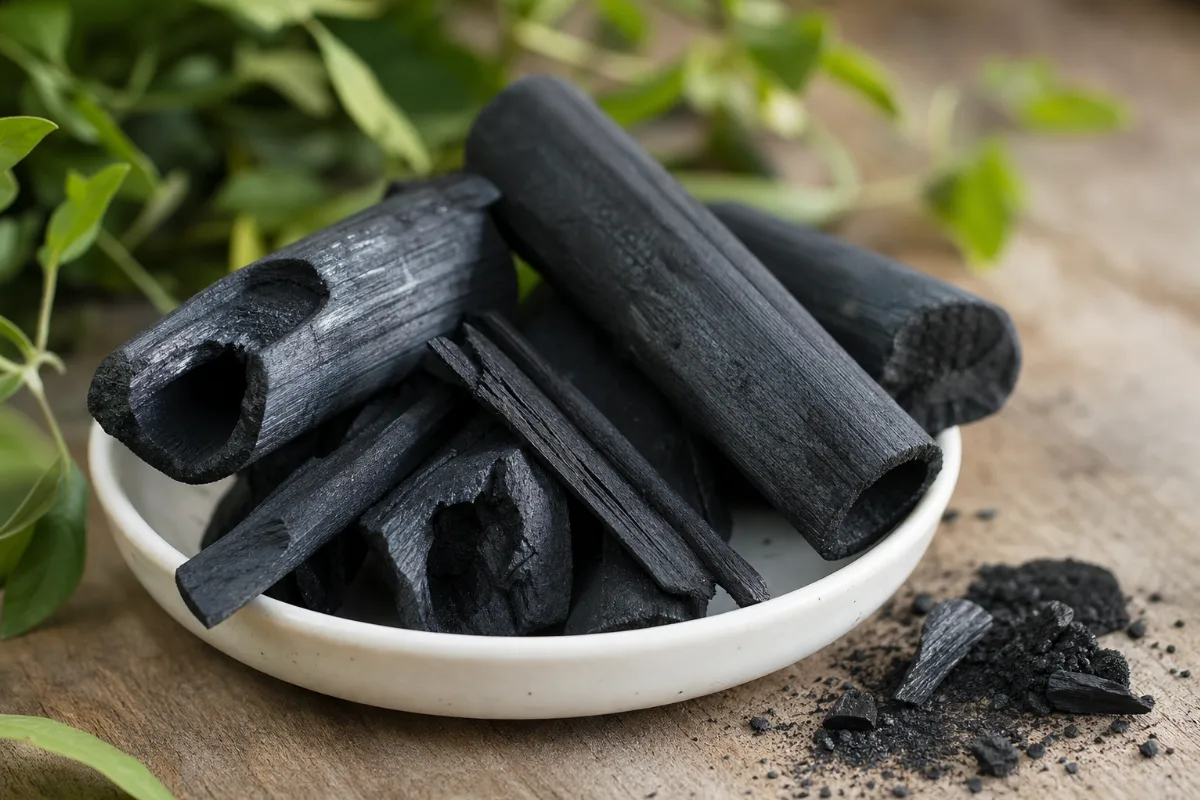
- Black solid keeping the bamboo shape, or ground powder.
- Harvest and processing
- Bamboo is heated without oxygen (pyrolysis). A review reports charcoal yields of 24.60 to 74.27% depending on bamboo and conditions. Activation adds more pores.
- Look-alikes and adulterants
- Name: Coconut shell charcoal, wood charcoal, medical activated charcoal; Note: Different raw materials and processing. A result for one charcoal should not be applied to another.
Traditional use and history history, not clinical proof
| Tradition or era | Documented use | Source |
|---|---|---|
| Not sourced | No dated history of bamboo charcoal as a remedy was found in the sources read. |
Traditional use shows how it was used. It does not show that it works or is safe today.
What is inside, and how it may work
What it contains and how those compounds act in cells and animals. Laboratory and animal mechanisms are not proven effects in people.
Main compounds
| Compound | Family | Where it is concentrated | Activity studied | Level of evidence |
|---|---|---|---|---|
| Carbon (porous) | carbon material | Bamboo stem Not given in the abstracts. | A review reports bamboo charcoal as having four times the absorption rate and ten times the surface area of regular charcoal. 4 | Review |
Mechanisms, receptors and pathways
| Target or pathway | Gene or receptor | What was found | Level |
|---|---|---|---|
| Adsorption | None | Substances stick to the large porous surface. Used in water and air filtering studies. 12 10 5 3 | Laboratory |
| Binding in the gut | None | Charcoal binds bile acids, uremic toxins and medicines in the gut and is not absorbed. Shown in animals and a volunteer study with medical charcoal. 11 9 8 | Animal research |
Absorption, metabolism and elimination
- Absorption
- Charcoal is described as an indigestible carrier not absorbed from the gut.
- Distribution
- Not studied.
- Elimination
- Leaves in stool.
Isolated compounds versus whole extracts
Raw, activated, chemically treated and iron-coated bamboo carbons behave differently in the lab, so results for one do not carry over to another.
Nutritional composition
Charcoal is not a nutrient or food.
2 low certainty3 very low certainty2 not enough evidence1 evidence against
What was looked at
The 8 benefits and uses checked for Bamboo Charcoal, each with how strong the evidence is. Tap one to open it.
- Kidney disease: lowering blood uremic toxins (activated bamboo charcoal)Very low certainty
- Blood fats and body fatVery low certainty
- Oxidised LDL and artery cell modelsNot enough evidence
- Detox or removing toxins from the bodyEvidence against
- Cleaning waterLow certainty
- Indoor air and formaldehydeVery low certainty
- Skin products, soaps and masksNot enough evidence
- Use as a black food colourLow certainty
What is Bamboo Charcoal good for?
The uses people ask about and how strong the evidence is for each. Only one human trial exists, and it was small.
Benefits, one by one
Each card is a research question, not a promise. Tap a goal to filter. Open a card to see the studies, doses and limits.
Kidney disease: lowering blood uremic toxins (activated bamboo charcoal)
Very low certaintyOne small pilot trial in 46 adults with stage 3 chronic kidney disease found lower blood uremic toxins and a better kidney-filtering (eGFR) change with a specific activated bamboo charcoal product over 3 months. It is a pilot, so it needs larger trials. It is not a reason to self-treat.
2 studiesTested as a medical-style activated bamboo charcoal product under cli…
Studies, doses and limits
What the trials found
One pilot randomised trial (PROBE design) in 46 adults with stage 3 chronic kidney disease, Taiwan, plus a rat and test-tube study from the same group.
Results
After 3 months, serum TMAO, p-cresyl sulfate, indoxyl sulfate and phenyl sulfate fell with the charcoal (all p < 0.05). Indoxyl sulfate changed -23.9% versus +33.9% in controls. eGFR change was +4.6% versus -8.6% in controls (p = 0.011). Probiotics alone did not do the same.
Effect sizes as reported
Indoxyl sulfate -23.9 +/- 28.9% vs +33.9 +/- 63.4% (p = 0.005); eGFR change +4.6 +/- 10.2% vs -8.6 +/- 12.5% (p = 0.011).
Why this rating
One small pilot with four groups, 3 months, an open design and a specific novel product. Rat work supports the idea but is not human evidence.
Form and dose studied
Tested as a medical-style activated bamboo charcoal product under clinic care. No home schedule is given here.
Who was studied
Adults with stage 3 chronic kidney disease only.
Limits
Small groups, short time, no adverse event data in the abstract, one product. It does not apply to food-colour charcoal, toothpaste or charcoal sticks.
Why researchers looked
Uremic toxins build up in kidney disease. A charcoal that sticks to compounds in the gut could in theory leave less to be absorbed.
Traditional use
The sources read give no dated history of this use.
Proposed mechanism Laboratory
Charcoal has a very large surface that binds compounds in the gut; in a gut simulation the charcoal bound indoxyl sulfate, p-cresol and phosphate.
A proposed mechanism does not show that the effect happens in people.
Charcoal can block medicines from being absorbed (see Safety). People with kidney disease should talk to their kidney team before any charcoal product.
Blood fats and body fat
Very low certaintyIn rats and mice on high-fat diets, bamboo charcoal powder lowered blood fats and fat stores. The authors link this to more fat leaving in the stool. No human trial was found.
2 studiesNo form or amount is suggested for people.
Studies, doses and limits
What the trials found
No human trial of bamboo charcoal for blood fats or weight was found in PubMed.
Results
Rats (90 days) had lower plasma triglyceride, cholesterol and LDL and lower liver fat than high-fat controls. Mice (80 days, 0.5% of diet) had less visceral fat.
Effect sizes as reported
No figures given in the abstracts.
Why this rating
Animal work only, at large doses for body size. One mouse study was supplied with charcoal by a company whose employees are authors.
Form and dose studied
No form or amount is suggested for people.
Who was studied
Not studied in people.
Limits
Animals only; the rat doses were far larger than any food-colour use. Fat leaving in stool may also carry away fat-soluble nutrients, which these abstracts did not measure.
Why researchers looked
Charcoal is not absorbed and may bind bile acids and slow a fat-digesting enzyme in the gut.
Traditional use
The sources read give no dated history of this use.
Proposed mechanism Animal research
In mice, bile-acid binding and inhibition of pancreatic lipase; both animal studies saw more faecal fat.
A proposed mechanism does not show that the effect happens in people.
Charcoal can reduce absorption of medicines taken at the same time.
Oxidised LDL and artery cell models
Not enough evidenceA 2025 computer and cell study found bamboo charcoal bound parts of oxidised LDL and reduced fat build-up in mouse immune cells in dishes. This is a lab result only.
1 studiesNone.
Studies, doses and limits
Results
Reduced foam cell formation in mouse macrophages exposed to oxidised LDL.
Why this rating
Computer models and cells in a dish do not show any effect on arteries or the heart.
Who was studied
Not studied in people.
Limits
In silico and cell work only.
Why researchers looked
Foam cells form when immune cells take up oxidised cholesterol, a step in artery plaque.
Traditional use
The sources read give no dated history of this use.
Proposed mechanism Laboratory
Computer docking showed binding to oxidised cholesterol and apolipoprotein B-100; cell staining showed less lipid build-up.
A proposed mechanism does not show that the effect happens in people.
None for people.
Detox or removing toxins from the body
Evidence againstSellers say charcoal removes toxins. NCCIH reports a 2015 review that found no compelling research that detox diets remove toxins. We found no human trial of bamboo charcoal for detox in healthy people. Activated charcoal is a hospital treatment for some poisonings; that is not a detox.
3 studiesNo form or amount suggested.
Studies, doses and limits
What the trials found
No trial of bamboo charcoal for detox in healthy people was found.
Results
No results to report for detox. Hospital activated charcoal reduced absorption of one medicine in eight volunteers (see Safety), which is a poisoning treatment given by clinicians.
Effect sizes as reported
No effect sizes for detox.
Why this rating
Reviews of detox products find no compelling evidence for detox, and charcoal also binds medicines and nutrients.
Form and dose studied
No form or amount suggested.
Who was studied
Not studied.
Limits
No human detox data.
Why researchers looked
Charcoal sticks other substances to its surface, which is the idea behind the claim.
Traditional use
The sources read give no dated history.
Proposed mechanism Pharmacological theory
Adsorption: molecules stick to the charcoal surface. In the body this also applies to medicines and nutrients.
A proposed mechanism does not show that the effect happens in people.
Do not use charcoal to detox. Poisoning needs emergency care (see Safety).
Cleaning water
Low certaintyIn the lab, bamboo charcoal and bamboo biochar took up copper, cadmium, nitrate and arsenic from water. These are engineering tests of treated materials. They are not tests of charcoal sticks put in a drinking jug.
3 studiesNot applicable (materials research).
Studies, doses and limits
What the trials found
No human trial; the studies are lab and column tests.
Results
Modified bamboo charcoal took up copper and cadmium from solution; bamboo powder charcoal took up nitrate-nitrogen better than commercial activated carbon in the range tested; an iron-coated bamboo biochar removed arsenic from a naturally contaminated tap water in a 1 g column.
Effect sizes as reported
Arsenic: 960 mL of arsenic-free water from a 1 g bed of the iron-coated biochar (tap water with 165 ug/L arsenic).
Why this rating
Several consistent lab results for materials made on purpose; none tested in homes or against disease.
Limits
Lab tests of treated or coated materials; results do not carry over to untreated bamboo charcoal sticks.
Why researchers looked
Charcoal has a large surface area and many tiny pores.
Traditional use
The sources read give no dated history of this use.
Proposed mechanism Laboratory
Metals and nitrate stick to the charcoal surface; iron coating helped with arsenic.
A proposed mechanism does not show that the effect happens in people.
Clean drinking water for health should rely on tested treatment, not on charcoal sticks. Ask a local water authority.
Indoor air and formaldehyde
Very low certaintyIn a lab test, bamboo-based activated carbon that was chemically treated removed almost 99% of formaldehyde gas. No study tested untreated bamboo charcoal in real rooms or measured health effects.
1 studiesNot applicable.
Studies, doses and limits
What the trials found
No human study.
Results
98.89% removal for the treated carbon, 18.38% more than the plain activated sample; 87.93% at 75% humidity; 82.81% after five regeneration cycles.
Effect sizes as reported
98.89% removal in the lab test.
Why this rating
One lab test of a treated material; no room or health testing.
Limits
The tested material was activated and impregnated, not bamboo charcoal as sold in bags.
Why researchers looked
Formaldehyde gives off from some furniture and building materials; carbon adsorbs gases.
Traditional use
The sources read give no dated history of this use.
Proposed mechanism Laboratory
Gas sticks to the carbon surface; the treatment added more active groups.
A proposed mechanism does not show that the effect happens in people.
None.
Skin products, soaps and masks
Not enough evidenceWe searched PubMed and found no human trial of bamboo charcoal in skin products, soaps or masks. Claims of deep cleansing or oil control are not backed by research we found.
0 studiesNot studied.
Studies, doses and limits
Why this rating
No studies found.
Form and dose studied
Not studied.
Who was studied
Not studied.
Limits
No evidence either way.
Why researchers looked
Charcoal is added to cleansers because it sticks to oils and dirt in the lab.
Traditional use
The sources read give no dated history of this use.
Proposed mechanism Pharmacological theory
No mechanism tested on skin in the sources read.
A proposed mechanism does not show that the effect happens in people.
Patch test any new skin product. People who react should stop using it.
Use as a black food colour
Low certaintyVegetable carbon (E 153) is allowed in the EU as a food colour. In 2026 EFSA reviewed the data and recommended tighter limits for toxic metals and PAHs. A 90-day rat study found no harm at very high doses, but EFSA said it could not simply be applied to the approved additive.
2 studiesNot applicable.
Studies, doses and limits
What the trials found
No human study of eating bamboo charcoal as a colour was found.
Results
EFSA: all 22 samples met the current benzo[a]pyrene limit but one reached 37 ug/kg and four had PAH4 levels above the highest industry-proposed limit; arsenic exposure raised concern at current limits; all samples had a small-particle fraction including nanoparticles.
Effect sizes as reported
See results.
Why this rating
Regulator report rather than a trial; end of the opinion not read.
Who was studied
General population exposure.
Limits
Opinion covers vegetable carbon in general; bamboo was one possible source.
Why researchers looked
Black food colouring for sweets, baked goods and some trendy foods.
Traditional use
The sources read give no dated history.
Proposed mechanism Narrative review
Not a health use. Fine particles and contaminants are the questions.
A proposed mechanism does not show that the effect happens in people.
Colouring is not a health product.
Connections to the rest of health
How Bamboo Charcoal connects to the rest of our health knowledge graph. Every link says what kind of connection it is. A safety link (for example to the liver) is a warning, not a benefit. A study that merely mentions a topic never creates a benefit link.
Explore every connection: goals, body systems, organs, symptoms, genes
A. Wellness goals
| Connected to | Kind of connection | Evidence status | Context | Studies |
|---|---|---|---|---|
| Detoxification Support | Very low certainty | Kidney disease: lowering blood uremic toxins (activated bamboo charcoal): One small pilot trial in 46 adults with stage 3 chronic kidney disease found lower blood uremic toxins and a better kidney-filtering (eGFR) change with a specific activated bamboo charcoal product over 3 months. It is a pilot, so it needs larger trials. It is not a reason to self-treat. | 6 9 | |
| Cholesterol Balance | Very low certainty | Blood fats and body fat: In rats and mice on high-fat diets, bamboo charcoal powder lowered blood fats and fat stores. The authors link this to more fat leaving in the stool. No human trial was found. | 7 11 | |
| Weight Management | Very low certainty | Blood fats and body fat: In rats and mice on high-fat diets, bamboo charcoal powder lowered blood fats and fat stores. The authors link this to more fat leaving in the stool. No human trial was found. | 7 11 | |
| Healthy Skin | Not enough evidence | Skin products, soaps and masks: We searched PubMed and found no human trial of bamboo charcoal in skin products, soaps or masks. Claims of deep cleansing or oil control are not backed by research we found. |
B. Body systems
| Connected to | Kind of connection | Evidence status | Context | Studies |
|---|---|---|---|---|
| Urinary System | Biological association | Very low certainty | Studied for: Kidney disease: lowering blood uremic toxins (activated bamboo charcoal) | 6 9 |
| Digestive System | Biological association | Very low certainty | Studied for: Blood fats and body fat | 7 11 |
| Cardiovascular System | Biological association | Not enough evidence | Studied for: Oxidised LDL and artery cell models | 1 |
| Integumentary System | Biological association | Not enough evidence | Studied for: Skin products, soaps and masks |
L. Active compounds
| Connected to | Kind of connection | Evidence status | Context | Studies |
|---|---|---|---|---|
| Carbon (porous) | Biological association | Review | A review reports bamboo charcoal as having four times the absorption rate and ten times the surface area of regular charcoal. Preparation or compound: Bamboo stem |
4 |
Each connection is stored with the ingredient, the connected record, the kind of connection, the evidence status, the supporting studies, the preparation or compound involved, and a review date (last reviewed October 25, 2026).
Evidence at a glance: what the research found for 8 outcomes
Each outcome below is one thing researchers measured. Certainty is how far the evidence can be trusted, not how well it works. The full studies are on the next tab.
The evidence
The research centre for Bamboo Charcoal. Every record here was checked against PubMed or the publisher's page; we never list a study we have not verified.
Evidence by outcome
Bars show how many studies we found for each outcome, not how well it works. People are added up across trials only (reviews are not added, to avoid double counting).
How we rate evidence
High certainty
Several well-run trials or reviews agree; further research is unlikely to change the picture much.
Moderate certainty
Good trials point the same way, but some doubt remains.
Low certainty
Small, short or inconsistent trials. The finding could change with better research.
Very low certainty
Very little or very weak human data. Treat as a possibility only.
Mixed findings
Trials or reviews disagree with each other.
Not enough evidence
Not enough human research to say either way.
Evidence against
Good research found no benefit, or found harm.
We take the reviewers' own risk-of-bias and GRADE statements where they exist, and otherwise judge from study size, design, consistency, directness and whether a product matches what is sold. Many publications do not make evidence high. Method note: We searched PubMed, read the abstract of each cited paper, and read the EFSA, Poison Control and NCCIH pages (EFSA only in part). Certainty ratings are the compiler's own reading. Regulators outside the EU and US were not checked. No study is cited that we could not verify.
Study library: every study we checked 16
| Study | Design | People | Product, dose, length | Result |
|---|---|---|---|---|
| Abdullah 2025 Bamboo charcoal mitigates oxidised LDL-induced foam cell formation via molecular interaction and adsorption: Evidence from in silico and in vitro studies Chemistry and Physics of Lipids · PMID 40750056 · DOI |
Laboratory research in-vitro |
Computer models and mouse macrophage cells (RAW 264.7) in dishes | Bamboo charcoal bamboo charcoal · vs Untreated cells |
Computer docking and simulation showed bamboo charcoal binding oxidised cholesterol and apolipoprotein B-100. In oxLDL-treated mouse macrophages, charcoal reduced foam cell formation and lipid build-up. Methods, limits and fundingOutcomes: Binding to oxidised LDL parts; foam cell formation Limitations: Computer and cell work only. Says nothing about arteries or hearts in people. Funding and conflicts: Funding from the Malaysia Ministry of Higher Education; no other conflicts declared. Read: abstract |
| Alchouron 2021 Household arsenic contaminated water treatment employing iron oxide/bamboo biochar composite: An approach to technology transfer Journal of Colloid and Interface Science · PMID 33309243 · DOI |
Laboratory study lab |
Lab columns, including naturally arsenic-contaminated tap water (165 +/- 5 ug/L arsenic) | Biochar from Guadua chacoensis bamboo, with and without iron oxide nanoparticles bamboo biochar (iron-coated) 1 g fixed bed Column runs · vs Raw biochar |
The iron-coated bamboo biochar removed arsenic well in a column test; 960 mL of arsenic-free water came from a 1 g bed of the tested tap water. Plain biochar was weaker than the iron-coated kind. Methods, limits and fundingOutcomes: Arsenic removal Limitations: Lab columns, not a household trial. The iron-coated material is not the same as bamboo charcoal sold as sticks. Funding and conflicts: No conflict declared. Read: abstract |
| Alfei 2024 Bamboo-Based Biochar: A Still Too Little-Studied Black Gold and Its Current Applications Journal of Xenobiotics · PMID 38535501 · DOI |
Review review |
Review of studies on bamboo biochar and activated bamboo biochar | Bamboo biochar and activated bamboo biochar bamboo biochar |
The review describes bamboo biochar mainly as an adsorbent that removes heavy metals and organic contaminants from wastewater and soil, and for energy, catalysis and water desalination devices. The authors say study of bamboo-derived materials is still in its infancy. Methods, limits and fundingOutcomes: Uses of bamboo biochar Limitations: A materials-science review; not about health in people. Funding and conflicts: No conflicts declared. Read: abstract |
| Chaturvedi 2023 Bamboo for producing charcoal and biochar for versatile applications Biomass Conversion and Biorefinery · PMID 36817514 · DOI |
Review review |
Review of bamboo charcoal and biochar production | Bamboo charcoal and biochar bamboo charcoal |
The review covers how bamboo is turned into charcoal by heating without oxygen. It says charcoal yield ranges from 24.60 to 74.27% and that bamboo charcoal is preferred over regular charcoal, with reported four times the absorption rate and ten times the surface area. Methods, limits and fundingOutcomes: Making and using bamboo charcoal Limitations: Materials review; the abstract reports no health outcomes. Funding and conflicts: No competing interests declared. Read: abstract |
| Duan 2023 Adsorptivity and kinetics for low concentration of gaseous formaldehyde on bamboo-based activated carbon loaded with ammonium acetate particles Environmental Research · PMID 36736757 · DOI |
Laboratory study lab |
Formaldehyde gas at low concentration in a lab test at room temperature | Bamboo charcoal, activated with boric acid then loaded with ammonium acetate bamboo-based activated carbon (treated) Five regeneration cycles tested · vs Plain activated bamboo carbon |
The treated carbon removed 98.89% of the formaldehyde, 18.38% more than the plain activated sample. Removal was 87.93% at 75% humidity and 82.81% after five regeneration cycles. Methods, limits and fundingOutcomes: Formaldehyde removal rate Limitations: Lab test of a treated material, not of plain bamboo charcoal sticks and not a test in a room with people. Two authors are from a company, Guilin Huayue Entech, though none declare a conflict. Funding and conflicts: No competing interests declared. Read: abstract |
| Hung 2025 Efficacy of novel activated bamboo charcoal in reducing uremic toxins and enhancing kidney function in chronic kidney disease patients: a pilot randomized controlled trial PeerJ · PMID 40093417 · DOI |
Controlled trial |
46 Adults with stage 3 chronic kidney disease (mean age 66.7; 71.7% men), Taiwan |
Activated bamboo charcoal (novel product), alone or with probiotics activated bamboo charcoal 3 months · vs Standard treatment; a probiotics-only group |
Four groups: charcoal, probiotics, charcoal plus probiotics, standard treatment. The charcoal groups had lower serum levels of the four uremic toxins after 3 months (all p < 0.05). Indoxyl sulfate changed by -23.9% (charcoal) and -29.3% (charcoal plus probiotics) versus +33.9% in the control group (p = 0.005 and 0.009). eGFR change was +4.6% with charcoal versus -8.6% in controls (p = 0.011). Probiotics alone showed no similar change. eGFR change ratio +4.6 +/- 10.2% vs -8.6 +/- 12.5% (p = 0.011) Methods, limits and fundingOutcomes: Blood uremic toxins (TMAO, p-cresyl sulfate, indoxyl sulfate, phenyl sulfate) and eGFR change Limitations: Pilot trial of 46 people split over four groups, so each group was small. Open design with blinded end-point assessment. Only 3 months. Adverse events and group sizes are not in the abstract. The authors call for larger, longer trials. Funding and conflicts: The authors declare no competing interests; funding is not stated in the abstract. Read: abstract |
| Jia 2024 Dietary bamboo charcoal powder ameliorates high-fat diet-induced hyperlipidemia by enhancing fecal lipid excretions in Sprague-Dawley rats Frontiers in Nutrition · PMID 39444574 · DOI |
Animal research animal |
50 50 male Sprague-Dawley rats fed a high-fat diet |
Bamboo charcoal powder given by gavage bamboo charcoal powder 2.81, 5.62 or 11.24 g per kg body weight (animal doses; not advice) 90 days · vs Low-fat diet and high-fat diet control groups |
After 90 days the charcoal groups had lower body weight, plasma triglyceride, cholesterol and LDL, and lower liver triglyceride and cholesterol, than high-fat controls. Faecal dry weight and faecal fat rose. The authors suggest that more fat leaving in the stool explains the change. Methods, limits and fundingOutcomes: Body weight, blood and liver fats, antioxidant markers, faecal fat Limitations: Rats, very large doses for body size, not people. Abstract gives no figures for the size of the changes. Funding and conflicts: The authors declare no commercial or financial conflicts. Read: abstract |
| Klein-Schwartz 2010 Drug adsorption efficacy and palatability of a novel charcoal cookie formulation Pharmacotherapy · PMID 20795844 · DOI |
Controlled trial |
8 Eight healthy adult volunteers |
Standard activated charcoal (as a suspension or as cookies), given 15 minutes after a cimetidine tablet activated charcoal (not bamboo specifically) 7.2 g charcoal in a clinic study of drug overdose treatment (not advice) Single sessions, 1-week washout · vs Water |
Both charcoal products cut absorption of the medicine. Median fall in AUC was 91.8% with the suspension and 82.1% with the cookie. No adverse events were reported. Methods, limits and fundingOutcomes: How much of a medicine (cimetidine 800 mg) was absorbed Limitations: Eight volunteers, open-label crossover, one medicine, a hospital-type activated charcoal. It does not test bamboo charcoal products. Funding and conflicts: National Institutes of Health extramural support among listed funders. Read: abstract |
| Lin 2020 CharXgen-Activated Bamboo Charcoal Encapsulated in Sodium Alginate Microsphere as the Absorbent of Uremic Toxins to Retard Kidney Function Deterioration International Journal of Molecular Sciences · PMID 32070049 · DOI |
Animal research animal |
Rats with induced chronic kidney disease, plus a gut-simulation test tube study | Activated bamboo charcoal (CharXgen) in alginate microspheres activated bamboo charcoal Not given here (animal study) · vs Untreated kidney-disease rats; a group given AST-120 (a charcoal medicine) |
In a gut simulation the charcoal bound indoxyl sulfate, p-cresol and phosphate. In kidney-disease rats it did not blacken the intestine, left serum albumin and liver tests unchanged, improved kidney function compared with untreated rats, and lowered serum indoxyl sulfate and p-cresyl sulfate. Kidney function did not differ from the AST-120 group. Methods, limits and fundingOutcomes: Binding of uremic toxins and phosphate in test tubes; kidney function and serum toxins in rats Limitations: Rat and test tube work only. The same research group later ran the human pilot trial. Funding and conflicts: No competing interests declared. Read: abstract |
| Mizuta 2004 Removal of nitrate-nitrogen from drinking water using bamboo powder charcoal Bioresource Technology · PMID 15288267 · DOI |
Laboratory study lab |
Nitrate solutions at 0-10 mg/L | Bamboo powder charcoal from Moso bamboo residue bamboo powder charcoal · vs Commercial activated carbon |
Bamboo powder charcoal adsorbed nitrate-nitrogen better than commercial activated carbon across the range tested, and was less affected by temperature (10-20 C). Methods, limits and fundingOutcomes: Nitrate-nitrogen uptake Limitations: Lab test with solutions; no figures in the abstract. Funding and conflicts: Not stated in the abstract. Read: abstract |
| Sugimoto 2023 Dietary Bamboo Charcoal Decreased Visceral Adipose Tissue Weight by Enhancing Fecal Lipid Excretions in Mice with High-Fat Diet-Induced Obesity Preventive Nutrition and Food Science · PMID 37842254 · DOI |
Animal research animal |
Four-week-old male C57BL/6J mice on low-fat, high-fat, or high-fat plus 0.5% bamboo charcoal diets | Bamboo charcoal powder in the diet (0.5%) bamboo charcoal powder 0.5% of the diet (mouse study; not advice) 80 days · vs High-fat diet without charcoal |
Mice on the charcoal diet had lower epididymal and mesenteric fat pad weights than high-fat controls. The authors link this to more faecal fat, bile-acid binding and inhibition of the fat-digesting enzyme pancreatic lipase. Gut microbes did not change significantly. Methods, limits and fundingOutcomes: Visceral fat weight, faecal fat, bile acid binding, lipase, gut microbes Limitations: Mice only. No human data. Funding and conflicts: Two authors work for Kandagiko Co., Ltd., which supplied the bamboo charcoal (industry-linked). Read: abstract |
| Wang 2022 Adsorption Characteristics of Modified Bamboo Charcoal on Cu(II) and Cd(II) in Water Toxics · PMID 36548620 · DOI |
Laboratory study lab |
Copper and cadmium solutions in the lab | Chemically modified Moso bamboo charcoal bamboo charcoal (modified) · vs Other modification methods |
The authors modified bamboo charcoal several ways, picked the best, and described how concentration, time, pH and temperature affect uptake of copper and cadmium from water. Methods, limits and fundingOutcomes: Uptake of copper and cadmium from water Limitations: Lab study of a modified charcoal. The abstract gives no uptake figures. Not a tested drinking-water product. Funding and conflicts: No conflict declared. Read: abstract |
| Zhenchao 2015 Safety assessment of dietary bamboo charcoal powder: a 90-day subchronic oral toxicity and mutagenicity studies Food and Chemical Toxicology · PMID 25445512 · DOI |
Animal research animal |
Sprague-Dawley rats (90 days, plus a 28-day recovery group) and mutagenicity tests | Bamboo charcoal powder by mouth bamboo charcoal powder 2.81, 5.62 and 11.24 g per kg body weight (animal doses; not advice) 90 days · vs Control group |
No significant differences between treated and control rats. The mutagenicity tests did not show genotoxicity. The authors set the no-observed-adverse-effect level at 11.24 g/kg body weight per day. Methods, limits and fundingOutcomes: Clinical signs, organ weights, blood tests, tissue exams, Ames test, comet assay, micronucleus test Limitations: Rats and cell tests, not people. The EFSA panel later said this study gave no particle-size details and that read-across to the approved food additive was not justified. Funding and conflicts: No competing interests stated in the abstract. Read: abstract |
| n/a 2025 NCCIH: Detoxes and Cleanses: What You Need To Know (web page read 2026-10-25) NCCIH (US National Institutes of Health) · Source |
Authoritative guidance n/a |
n/a | n/a |
Reports a 2015 review that found no compelling research that detox diets remove toxins from the body. Says the FDA and FTC have acted against detox product sellers for hidden ingredients and false claims. Methods, limits and fundingOutcomes: Detox claims Limitations: Page last updated March 2025. It does not mention bamboo charcoal. Read: full-text |
| n/a 2026 Poison Control: Activated charcoal: An effective treatment for poisonings (web page read 2026-10-25) Poison Control (National Capital Poison Center) · Source |
Authoritative guidance n/a |
n/a | n/a |
Says clinicians give activated charcoal to bind a swallowed poison in the gut so less is absorbed. It should not be given to people with gastrointestinal bleeding, bowel perforation or blockage. Side effects include nausea, vomiting and breathing the powder into the lungs if very drowsy. It says not to treat a poisoning with activated charcoal at home, and warns about over-the-counter products sold for adsorbing toxins. Methods, limits and fundingOutcomes: Medical use of activated charcoal in poisoning Limitations: Service information from a US poison centre, not research. US numbers only. Read: full-text |
| n/a 2026 EFSA FAF Panel: Scientific opinion on the amendment of the specifications for vegetable carbon (E 153) as a food additive (read 2026-10-25) EFSA Journal 2026;24(1):e9855 · Source |
Authoritative guidance n/a |
n/a | n/a |
Reviewed data on charcoal food colouring: about 270 samples for toxic elements and 22 for PAHs. All 22 met the current benzo[a]pyrene limit of 50 ug/kg; one sample reached 37 ug/kg and four had PAH4 levels of 116-288 ug/kg, above the highest limit proposed by the industry applicant. Arsenic exposure raised concern at current and proposed limits. All samples held small particles including nanoparticles (more than 10% under 250 nm). The Panel said a read-across from non-activated bamboo-derived carbon was not sufficiently justified, and recommended tighter limits. Methods, limits and fundingOutcomes: Safety of vegetable carbon as a food colour Limitations: First 100,000 of about 155,000 characters read; the end of the discussion and the formal conclusions were not read. Covers vegetable carbon in general, not only bamboo. Read: full-text |
What we do not know yet
- No large or long trial in kidney disease.
- No human trial for blood fats or weight.
- No human trial for skin products.
- No human safety study of bamboo charcoal powder or capsules.
How new research is added
New studies are found by a saved PubMed search and placed in a review queue. A person reads each one before it changes any rating or safety wording.
Lab markers
What changed in blood or saliva tests during trials. A changed number is not the same as feeling or being healthier, and we give no "normal ranges".
Safety
What studies and official sources say about side effects, medicines and who should check first. Each point shows what kind of evidence it comes from.
Main points to know 5
- Charcoal is not a detox. Activated charcoal is a medical treatment that clinicians give in an emergency for some swallowed poisons. It is not a home detox, and poison control says not to treat a poisoning with activated charcoal at home. Authoritative guidance 15 14
- It can block medicines. Activated charcoal can stop swallowed medicines being absorbed. In eight volunteers it cut absorption of one medicine by a median of about 92%. That study used hospital activated charcoal, not bamboo products, but any charcoal swallowed near a medicine could do the same. Ask a pharmacist. Controlled trial 8
- Who should not swallow it. Poison Control says activated charcoal should not be given to people with gastrointestinal bleeding, a bowel perforation or a blockage. Very drowsy people can breathe it into the lungs. Authoritative guidance 15
- Contaminants in charcoal food colouring. EFSA found PAHs above proposed limits in some charcoal food colouring samples and said arsenic exposure was of concern. Labels cannot tell you the metal or PAH content. Authoritative guidance 16
- No home-use advice. This page gives no amounts or ways to use charcoal at home. The only human trial was a pilot of a medical-style product in people under kidney clinic care. Controlled trial 6
Side effects 4
| Effect | How often | Severity and recovery | Evidence |
|---|---|---|---|
| Nausea and vomiting Described for activated charcoal given in poisoning. | Not established | mild to moderate Not stated | Authoritative guidance 15 |
| Breathing charcoal into the lungs (aspiration) in very drowsy people Why clinicians control its use. | Not established | serious Not stated | Authoritative guidance 15 |
| Adverse events from the kidney pilot trial Not in the abstract. Not reported is not proof of safety. | Not established | unknown Not stated | Gap 6 |
| Bowel blockage (a reason not to give charcoal) Rates for bamboo charcoal were not found. | Not established | unknown Not stated | Gap 15 |
Liver
A rat study found liver function unchanged with an activated bamboo charcoal, and a 90-day rat study found no organ harm at very high doses. No human liver injury report was found. LiverTox was not searched. 9 13
How often. No rate in people.
Monitoring. No monitoring advice found.
This is a safety connection. It is not evidence that Bamboo Charcoal supports liver health.
Medicines and supplements 2
| With | Why it matters | Importance | Evidence | What to do |
|---|---|---|---|---|
| Medicines taken by mouth (in general) prescription | Charcoal binds other substances in the gut, so less medicine may be absorbed. | In eight volunteers, activated charcoal cut absorption of cimetidine (AUC median fall 91.8%) when given 15 minutes after the tablet. Not tested with bamboo charcoal products. | Controlled trial Moderate certainty 8 | Ask a pharmacist before any charcoal supplement if you take medicines. |
| Vitamins and minerals from food nutrient | Charcoal is described as carrying nutrients as well as toxic substances out of the gut. | The mouse study abstract says bamboo charcoal prevents the absorption of toxic substances and nutrients. No human nutrient study found. | Animal research Not enough evidence 11 | Ask a clinician. |
Who should check first 5
| Situation | Advice | Evidence |
|---|---|---|
| Chronic kidney disease | Only one small supervised pilot trial exists. Talk to your kidney team before any charcoal product. | Controlled trial 6 |
| Bleeding in the gut, bowel perforation or blockage | Poison Control says activated charcoal should not be used in these. | Authoritative guidance 15 |
| Pregnancy, breastfeeding, babies and children | No data on bamboo charcoal were found. Do not give charcoal to children or use it in pregnancy without medical advice. Keep powders away from children. | Gap |
| Very drowsy or unwell people | Powder can be breathed into the lungs. Emergency teams decide on charcoal. | Authoritative guidance 15 |
| Allergy or skin reaction | No data found for bamboo charcoal. Stop a skin product that irritates. | Gap |
Overdose, product quality and regulators
Summary. A 90-day rat study at up to 11.24 g/kg body weight per day found no significant differences from controls and no genotoxicity. It was in rats, and EFSA said the study lacked particle details and could not support read-across to the approved additive.
Animal. No adverse effects in 90-day rats (NOAEL 11.24 g/kg/day per the authors).
Human doses studied. The human pilot trial used an activated bamboo charcoal product; amount not stated in the abstract.
Overdose response. If someone has swallowed charcoal or any product and feels unwell, call poison control (US 1-800-222-1222) or local emergency number. Call 911 for collapse, seizure, trouble breathing or inability to wake.
Genotoxicity. The rat-study authors found no genotoxicity in Ames, comet and micronucleus tests.
Charcoal can carry PAHs and metals from the burning process and the raw material. A label cannot tell you which.
PAHs. In 22 charcoal food colouring samples EFSA found all met the benzo[a]pyrene limit of 50 ug/kg; one reached 37 ug/kg and four had PAH4 of 116-288 ug/kg, above the highest limit proposed by industry. 16
Arsenic and other metals. EFSA said arsenic exposure was of concern at current and proposed limits and recommended lower limits for lead, mercury, cadmium and arsenic and a new limit for aluminium. 16
Fine particles. All samples held a small-particle fraction including nanoparticles; EFSA said the 2012 assessment should be complemented with nanoscale considerations. 16
| Body | Action | Date |
|---|---|---|
| EFSA (EU) (European Union) | January 2026 opinion on vegetable carbon (E 153) as a food additive recommended tighter limits for toxic elements and PAHs and said read-across from bamboo-derived carbon was not sufficiently justified. source | 2026-01-28 |
| Poison Control (US) (United States) | Activated charcoal is a treatment clinicians give for some poisonings; do not try it at home. source | 2026 |
| NCCIH (US NIH) (United States) | Reports no compelling research that detox diets remove toxins; notes FDA and FTC actions against detox sellers. source | 2025-03 |
When to get medical help
- Collapse, a seizure, trouble breathing or being impossible to wake after swallowing or breathing in charcoal or any product: call 911 or your local emergency number.
- Swallowed a poison or too much of a medicine: call poison control (US 1-800-222-1222) or go to an emergency room. Do not try charcoal at home.
- Vomiting, severe belly pain or a swollen belly with charcoal use: get medical help.
Stop using the product and contact a clinician or emergency service. In the US, Poison Control is 1-800-222-1222.
General information only, not medical advice. Ask a clinician or pharmacist before use, especially with medicines, in pregnancy or with a health condition. See the Natural Remedy Safety guide.
Frequently asked questions
What is bamboo charcoal?
Is bamboo charcoal a detox?
Can charcoal affect my medicines?
Yes, in principle. Activated charcoal cut absorption of one medicine by a median of about 92% in eight volunteers. Bamboo products were not tested. Ask a pharmacist.
Does bamboo charcoal help kidney disease?
Does it lower cholesterol or body fat?
Does it clean water or air?
Is charcoal food colouring safe?
Does bamboo charcoal help skin?
We found no human study of bamboo charcoal for skin. Patch test any new product.
Is it safe in pregnancy, breastfeeding or for children?
No data were found. Ask a clinician, and keep powders away from children.
Who should not swallow charcoal?
Poison Control says activated charcoal should not be given to people with gut bleeding, a perforation or a blockage, and that very drowsy people can breathe it into the lungs.
What if someone swallowed a poison?
Call poison control (US 1-800-222-1222) or your local emergency number. Do not try charcoal at home.
Is bamboo charcoal the same as coconut or medical charcoal?
No. Raw materials and processing differ, so one charcoal's results should not be applied to another.
Explore by health goal
Detoxification SupportCholesterol BalanceWeight ManagementHealthy Skin
Editorial transparency
- Written by
- AlternativeMed editorial team. Research compiled with AI assistance, then checked against PubMed records.
- Medical review
- None. This page has not been reviewed by a physician or pharmacist.
- First published
- 2026-10-25
- Last substantive update
- 2026-10-25
- How we research
- We searched PubMed, read the abstract of each cited paper, and read the EFSA, Poison Control and NCCIH pages (EFSA only in part). Certainty ratings are the compiler's own reading. Regulators outside the EU and US were not checked. No study is cited that we could not verify.
- How we rate evidence
- See "How we rate evidence" in the Evidence tab.
- Independence
- No product is promoted on this page. No affiliate links are shown.
Sources 16
Each source was opened and checked. Where we read only the abstract, it says so. The small numbers in the text point here.
- Abdullah MH, Shuid AN, Aziz MY, et al. Bamboo charcoal mitigates oxidised LDL-induced foam cell formation via molecular interaction and adsorption: Evidence from in silico and in vitro studies. Chemistry and Physics of Lipids. 2025. PMID 40750056. DOI 10.1016/j.chemphyslip.2025.105528. (abstract)
- Alchouron J, Navarathna C, Rodrigo PM, et al. Household arsenic contaminated water treatment employing iron oxide/bamboo biochar composite: An approach to technology transfer. Journal of Colloid and Interface Science. 2021. PMID 33309243. DOI 10.1016/j.jcis.2020.11.036. (abstract)
- Alfei S, Pandoli OG. Bamboo-Based Biochar: A Still Too Little-Studied Black Gold and Its Current Applications. Journal of Xenobiotics. 2024. PMID 38535501. DOI 10.3390/jox14010026. (abstract)
- Chaturvedi K, Singhwane A, Dhangar M, et al. Bamboo for producing charcoal and biochar for versatile applications. Biomass Conversion and Biorefinery. 2023. PMID 36817514. DOI 10.1007/s13399-022-03715-3. (abstract)
- Duan C, Meng M, Huang H, et al. Adsorptivity and kinetics for low concentration of gaseous formaldehyde on bamboo-based activated carbon loaded with ammonium acetate particles. Environmental Research. 2023. PMID 36736757. DOI 10.1016/j.envres.2023.115364. (abstract)
- Hung KC, Lee MY, Hung SY, et al. Efficacy of novel activated bamboo charcoal in reducing uremic toxins and enhancing kidney function in chronic kidney disease patients: a pilot randomized controlled trial. PeerJ. 2025. PMID 40093417. DOI 10.7717/peerj.19007. (abstract)
- Jia Z, Zhou Y, Chen X, et al. Dietary bamboo charcoal powder ameliorates high-fat diet-induced hyperlipidemia by enhancing fecal lipid excretions in Sprague-Dawley rats. Frontiers in Nutrition. 2024. PMID 39444574. DOI 10.3389/fnut.2024.1458350. (abstract)
- Klein-Schwartz W, Doyon S, Dowling T. Drug adsorption efficacy and palatability of a novel charcoal cookie formulation. Pharmacotherapy. 2010. PMID 20795844. DOI 10.1592/phco.30.9.888. (abstract)
- Lin CJ, Sun CY, Wu CJ, et al. CharXgen-Activated Bamboo Charcoal Encapsulated in Sodium Alginate Microsphere as the Absorbent of Uremic Toxins to Retard Kidney Function Deterioration. International Journal of Molecular Sciences. 2020. PMID 32070049. DOI 10.3390/ijms21041257. (abstract)
- Mizuta K, Matsumoto T, Hatate Y, et al. Removal of nitrate-nitrogen from drinking water using bamboo powder charcoal. Bioresource Technology. 2004. PMID 15288267. DOI 10.1016/j.biortech.2004.02.015. (abstract)
- Sugimoto K, Shinagawa T, Kuroki K, et al. Dietary Bamboo Charcoal Decreased Visceral Adipose Tissue Weight by Enhancing Fecal Lipid Excretions in Mice with High-Fat Diet-Induced Obesity. Preventive Nutrition and Food Science. 2023. PMID 37842254. DOI 10.3746/pnf.2023.28.3.246. (abstract)
- Wang Y, Li H, Lin S. Adsorption Characteristics of Modified Bamboo Charcoal on Cu(II) and Cd(II) in Water. Toxics. 2022. PMID 36548620. DOI 10.3390/toxics10120787. (abstract)
- Zhenchao J, Yuting Z, Jiuming Y, et al. Safety assessment of dietary bamboo charcoal powder: a 90-day subchronic oral toxicity and mutagenicity studies. Food and Chemical Toxicology. 2015. PMID 25445512. DOI 10.1016/j.fct.2014.11.002. (abstract)
- n/a. NCCIH: Detoxes and Cleanses: What You Need To Know (web page read 2026-10-25). NCCIH (US National Institutes of Health). 2025. (full-text)
- n/a. Poison Control: Activated charcoal: An effective treatment for poisonings (web page read 2026-10-25). Poison Control (National Capital Poison Center). 2026. (full-text)
- n/a. EFSA FAF Panel: Scientific opinion on the amendment of the specifications for vegetable carbon (E 153) as a food additive (read 2026-10-25). EFSA Journal 2026;24(1):e9855. 2026. (full-text)


