Clays & Charcoal · Charcoal
Coconut Shell Charcoal
Carbon from Cocos nucifera shell (a carbon material, not a plant extract) · also called Coconut charcoal, coconut shell carbon, coconut activated carbon
Coconut shell charcoal is carbon made by heating coconut shells. Activated forms are used in water filters and, in hospitals, to treat some poisonings. We found no trial showing it detoxes the body. It can block medicines and nutrients, so ask a doctor or pharmacist before swallowing any charcoal.
General information, not medical advice. Last substantive update · Not medically reviewed. A named clinician has not signed off on this page. How this page is made
About Coconut Shell Charcoal
Coconut shell charcoal is carbon made from coconut shells. The best-supported use is as carbon in certified water filters. Swallowing it for detox is not supported, and hospital poison treatment with activated charcoal belongs to clinicians. It can block medicines and nutrients.
What it is
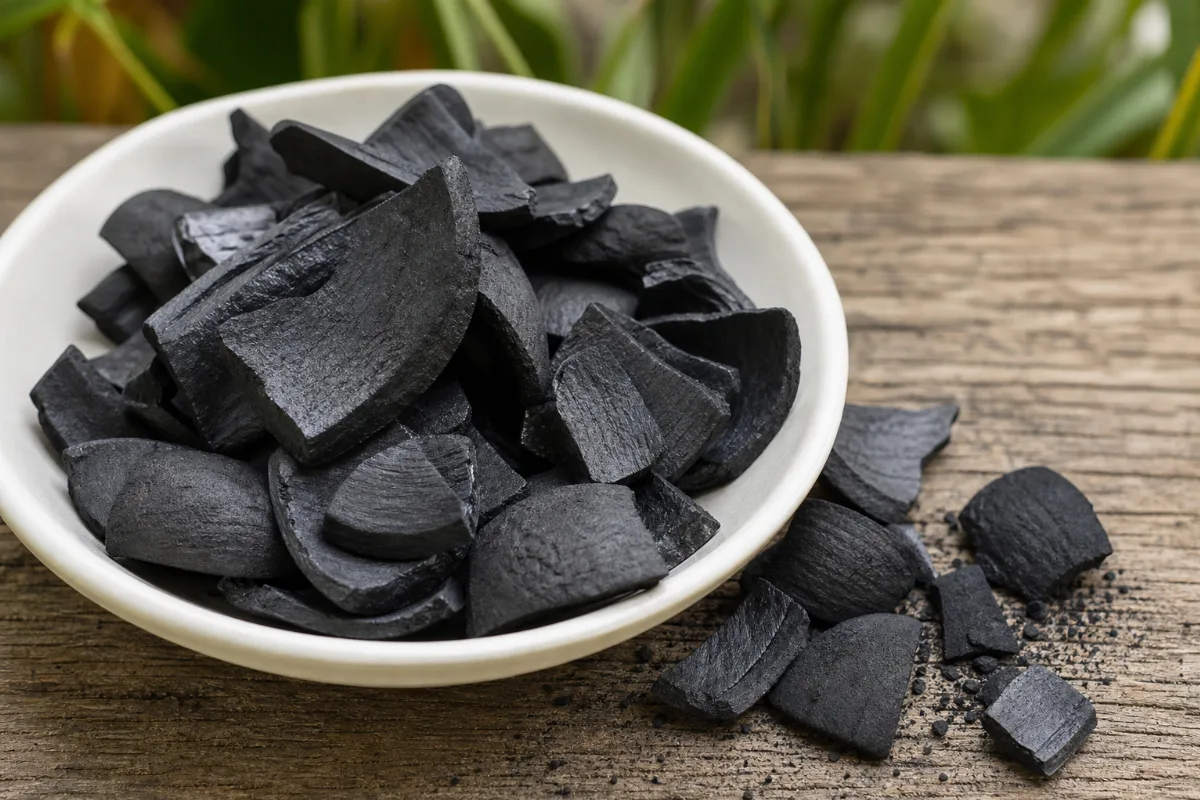
Coconut shell charcoal is made by heating the hard shells left over after coconuts are used. That gives a black, carbon-rich material.
"Activated" charcoal is treated further so each particle is full of tiny holes. The huge surface lets other substances stick to it, which is called adsorption. In one lab study, steam-activated shell carbon had a surface area of 738 square metres per gram and KOH-activated carbon 1600.
Burned toast and barbecue briquettes are not activated charcoal, and some briquettes are treated with chemicals.
Uses
Activated carbon is used inside water filters. The CDC says in pitcher and fridge filters it mainly improves taste and smell.
In hospital, clinicians sometimes give activated charcoal soon after a poison is swallowed. It is also sold as powders, capsules, toothpastes and masks for wellness, and those uses lack support.
What the research shows
The only coconut-specific paper we found is a 2026 lab study of dyes in water. It tells us about the material, not about people.
Hospital data are about activated charcoal in general. In volunteers, absorption fell by about 47% when given at 30 minutes and about 21% at 180 minutes. No good clinical studies show better patient outcomes.
A 2017 review found too little data to support charcoal toothpaste claims.
At a glance
Traditional uses history, not proof
- Charcoal has long been made by heating plant material; the sources read give no dated history of coconut shell charcoal as a remedy.
Studied for research
- Drinking-water filters, moderate (certified filters, guidance only)
- Swallowing for detox, insufficient
- Hospital poison treatment, mixed (activated charcoal in general)
- Teeth whitening, insufficient
- Skin masks and soaps, insufficient
- Dye uptake in the lab, very low
Main compounds
- Carbon (graphene-like layers)
Common forms
- Filter granules or blocks
- Powder or capsule (sold for wellness)
- Toothpaste or tooth powder
- Skin mask or soap
- Fuel or craft charcoal (not activated)
Research links: Position paper: single-dose activated charcoal, 2005 (abstract) · Charcoal toothpastes review, 2017 (abstract) · Coconut shell activated carbons, 2026 (abstract) · Poison Control: activated charcoal · NCCIH: Detoxes and cleanses · Research Library · Genes & Biomarkers Library
What it is and its history
- Accepted scientific name
- Coconut shell charcoal: carbon made by heating the hard shell of the coconut (Cocos nucifera)
- Synonyms
- Coconut shell activated carbon; Coconut activated charcoal; Coconut carbon
- Common names
- Coconut charcoal (English); Coconut shell carbon (English)
- Family or group
- Carbon material made from plant shell; the source plant is in the palm family (Arecaceae), not checked in a database for this build.
- Classification
- Source plant: Cocos nucifera (the coconut palm). The charcoal itself is a carbon material, not a plant.
- Cultivation
- Made from coconut shell left over after the coconut is used.
- Harvest and processing
- Shells are heated to make a black, carbon-rich material. "Activated" charcoal is treated further (air, CO2, steam or chemicals such as KOH) to fill it with tiny pores.
- Look-alikes and adulterants
- Name: Barbecue briquettes and burned toast; Note: Poison Control says these are not activated charcoal; some briquettes are treated with chemicals never meant to be swallowed.; Name: Bamboo or wood charcoal; Note: Other charcoals with similar claims; results should not be carried across.
Traditional use and history history, not clinical proof
| Tradition or era | Documented use | Source |
|---|---|---|
| 1813 (France) | A chemist named Bertrand is reported to have survived swallowing arsenic trioxide mixed with activated charcoal. Poison Control says not to try this at home. | s-poison-charcoal |
Traditional use shows how it was used. It does not show that it works or is safe today.
What is inside, and how it may work
What it contains and how those compounds act in cells and animals. Laboratory and animal mechanisms are not proven effects in people.
Main compounds
| Compound | Family | Where it is concentrated | Activity studied | Level of evidence |
|---|---|---|---|---|
| Carbon (graphene-like layers) | elemental carbon | Coconut shell Not stated in the abstract. | Steam-activated shell carbon had a surface area of 738 m2/g and KOH-activated 1600 m2/g; dyes are held through pores and pi-pi interactions with the carbon layers. 3 | Laboratory |
Mechanisms, receptors and pathways
| Target or pathway | Gene or receptor | What was found | Level |
|---|---|---|---|
| Adsorption (substances stick to the surface) | None | The pores give a very large surface to which other substances stick. Poison Control says one teaspoonful has about the surface area of a football field. 7 | Authoritative guidance |
| Dye uptake in water | None | Uptake rose with pore surface and favourable surface charge; methylene blue was held most strongly. 3 | Laboratory |
Absorption, metabolism and elimination
- Absorption
- Poison Control says activated charcoal stays in the gut and binds poisons there so they do not enter the body. Not studied for coconut shell.
- Distribution
- Not studied.
Isolated compounds versus whole extracts
Activation method changes the carbon a lot in the lab (738 versus 1600 m2/g), and Poison Control says over-the-counter products might not be as activated as the emergency-room product. Shop powders, filter carbon and fuel charcoal are different products.
Nutritional composition
Charcoal is not a food or nutrient. It can bind nutrients in food.
1 moderate certainty1 mixed findings1 very low certainty3 not enough evidence
What was looked at
The 6 benefits and uses checked for Coconut Shell Charcoal, each with how strong the evidence is. Tap one to open it.
- Drinking-water filters (taste, smell and certified lead reduction)Moderate certainty
- Swallowing charcoal to "detox"Not enough evidence
- Hospital treatment after swallowing a poisonMixed findings
- Whitening teeth with charcoal toothpaste or powderNot enough evidence
- Skin masks and soapsNot enough evidence
- Holding dyes and contaminants in water (lab)Very low certainty
What is Coconut Shell Charcoal good for?
The uses people ask about and how strong the evidence is. Filter use is the best supported, and it is not about swallowing charcoal. Hospital poison treatment is for clinicians. Detox is not supported.
Benefits, one by one
Each card is a research question, not a promise. Tap a goal to filter. Open a card to see the studies, doses and limits.
Drinking-water filters (taste, smell and certified lead reduction)
Moderate certaintyActivated carbon is widely used inside drinking-water filter cartridges. The CDC says its main job in pitcher and fridge filters is better taste and smell, not safety. Certified filters may reduce lead. This is about a certified filter product, not about swallowing charcoal.
2 studiesNo home use is described or advised here.
Studies, doses and limits
What the trials found
No human trial. The source is public-health guidance (summary-only).
Results
The CDC says carbon filters may remove heavy metals like lead, points to NSF Standard 53 for lead reduction, and says these filters usually do not remove germs. The page does not name coconut shell.
Effect sizes as reported
No effect sizes for coconut shell charcoal in the sources read.
Why this rating
Consistent public-health guidance for certified filters, but it is guidance, not a trial, it was carried from our earlier summary, and it does not name coconut shell.
Form and dose studied
No home use is described or advised here.
Who was studied
See limitations.
Limits
Applies to certified filter cartridges. A loose charcoal powder is not a certified filter.
Why researchers looked
Carbon from coconut shell is a common raw material for filter carbon, so people ask whether it cleans water.
Traditional use
Not described in the sources read.
Proposed mechanism Pharmacological theory
Activated carbon has many tiny pores and a very large surface that other substances stick to (adsorption).
A proposed mechanism does not show that the effect happens in people.
Not a reason to swallow charcoal.
Swallowing charcoal to "detox"
Not enough evidenceSellers say charcoal powders and capsules pull toxins out of the body. We found no trial of coconut shell charcoal for this in healthy people. NCCIH reports a 2015 review that found no compelling research that detox diets remove toxins.
3 studiesNo home use is described or advised here.
Studies, doses and limits
What the trials found
No human trial of coconut shell charcoal for detox in healthy people was found.
Results
No results to report. NCCIH says studies of detox programs are few and of low quality. Food officials say the benefits of charcoal in food are not proven.
Effect sizes as reported
No effect sizes for coconut shell charcoal in the sources read.
Why this rating
No trial for this use. General detox reviews found no compelling support, and the hospital poison evidence is a different situation.
Form and dose studied
No home use is described or advised here.
Who was studied
See limitations.
Limits
The detox sources are general, not about charcoal specifically.
Why researchers looked
Charcoal sticks to substances in the lab and in poisoning treatment, so sellers extend that to everyday detox.
Traditional use
Not described in the sources read.
Proposed mechanism Pharmacological theory
Sticking to substances in the gut (adsorption) is real chemistry. It does not show that a person is cleared of toxins, and it also sticks to nutrients and medicines.
A proposed mechanism does not show that the effect happens in people.
Charcoal can bind medicines and nutrients, so it is not a harmless extra (see Safety).
Hospital treatment after swallowing a poison
Mixed findingsIn emergency rooms, clinicians sometimes give activated charcoal after a poison is swallowed, because it can reduce how much enters the body when given early. This is a medical treatment decided by clinicians. It is not a home remedy and not specific to coconut shell.
2 studiesNo home use is described or advised here.
Studies, doses and limits
What the trials found
Volunteer studies of absorption, but no satisfactorily designed clinical studies of patient benefit (2005 position paper).
Results
In volunteers the mean reduction in absorption was 47.3% when given at 30 minutes and 21.13% at 180 minutes. The authors found no evidence that it improves clinical outcome and said it should not be given routinely. Poison Control says it works better the sooner it is given and that it belongs in an emergency room.
Effect sizes as reported
No effect sizes for coconut shell charcoal in the sources read.
Why this rating
Absorption fell in volunteers, but no clinical trials show better outcomes for patients, and the product studied is not specified as coconut shell.
Form and dose studied
No home use is described or advised here.
Who was studied
See limitations.
Limits
Single dose, given by clinicians to a poisoned patient, with the airway protected. It cannot be carried over to a daily powder.
Why researchers looked
This is the best-known use of activated charcoal, and it is where wellness claims come from.
Traditional use
A French chemist is reported to have survived swallowing arsenic mixed with activated charcoal in 1813 (Poison Control). Do not copy this.
Proposed mechanism Pharmacological theory
Activated charcoal binds many poisons in the gut so less enters the body.
A proposed mechanism does not show that the effect happens in people.
Poison Control says not to try to treat a poisoning with activated charcoal at home. If someone may have swallowed something harmful, call poison control (US 1-800-222-1222) or your local emergency number.
Whitening teeth with charcoal toothpaste or powder
Not enough evidenceCharcoal toothpastes and powders are sold for whitening. A 2017 dental review found too little clinical and lab data to back the safety and benefit claims, and three studies of brushing with raw charcoal reported harm. Coconut shell was not singled out.
2 studiesNo home use is described or advised here.
Studies, doses and limits
What the trials found
No randomized controlled trial of 3 months or longer met the review's inclusion rules.
Results
Of 118 potentially eligible articles, thirteen studies brushed with raw charcoal or soot but none met the inclusion criteria. Three reported harm (increased caries, enamel abrasion, unquantified negative impact). About one third of 50 products checked contained bentonite clay.
Effect sizes as reported
No effect sizes for coconut shell charcoal in the sources read.
Why this rating
The review found insufficient clinical and laboratory data; the evidence is old (searched to February 2017) and not coconut-specific.
Form and dose studied
No home use is described or advised here.
Who was studied
See limitations.
Limits
Charcoal in general; some studies were of raw charcoal or soot, not shop products.
Why researchers looked
Charcoal toothpastes became popular online, so dentists reviewed the evidence.
Traditional use
Not described in the sources read.
Proposed mechanism Pharmacological theory
Not tested. Poison Control calls the usefulness of charcoal in toothpaste questionable.
A proposed mechanism does not show that the effect happens in people.
The review advises caution with unproven claims; ask a dentist.
Skin masks and soaps
Not enough evidenceCharcoal masks and soaps are sold to cleanse skin. We found no human study of coconut shell charcoal on skin in the sources read. Poison Control calls the usefulness of charcoal in skin cosmetics questionable.
1 studiesNo home use is described or advised here.
Studies, doses and limits
What the trials found
No human study of coconut shell charcoal on skin was found.
Results
No results to report.
Effect sizes as reported
No effect sizes for coconut shell charcoal in the sources read.
Why this rating
No study found; "not described" is not proof of safety or of no effect.
Form and dose studied
No home use is described or advised here.
Who was studied
See limitations.
Limits
No data on skin reactions, allergy or contamination of cosmetic charcoal.
Why researchers looked
Charcoal is added to cosmetics because it sticks to oils and dirt in the lab.
Traditional use
Not described in the sources read.
Proposed mechanism Pharmacological theory
Not tested on skin.
A proposed mechanism does not show that the effect happens in people.
Patch test any new skin product and stop if it irritates. Charcoal in food has been flagged for possible heavy metals (see Safety); cosmetic charcoal was not tested in the sources read.
Holding dyes and contaminants in water (lab)
Very low certaintyIn the lab, coconut shell activated carbons took up dyes from water, and the ones with the largest pore surface took up the most. That describes the material, not an effect in a person.
1 studiesNo home use is described or advised here.
Studies, doses and limits
What the trials found
No human data. Test-tube work only.
Results
Steam-activated carbon had a surface area of 738 m2/g and KOH-activated carbon 1600 m2/g. They took up the most methylene blue, methyl orange and orange G dye.
Effect sizes as reported
No effect sizes for coconut shell charcoal in the sources read.
Why this rating
Lab only; dyes in water are not toxins in a body.
Form and dose studied
No home use is described or advised here.
Who was studied
See limitations.
Limits
Dyes in water only. Shop products may be made differently.
Why researchers looked
Coconut shell is cheap waste material, so researchers test it as a water-cleaning carbon.
Traditional use
Not described in the sources read.
Proposed mechanism Laboratory
Pores and surface chemistry of the carbon hold dye molecules (a 2026 lab study).
A proposed mechanism does not show that the effect happens in people.
This is not a reason to swallow charcoal.
Connections to the rest of health
How Coconut Shell Charcoal connects to the rest of our health knowledge graph. Every link says what kind of connection it is. A safety link (for example to the liver) is a warning, not a benefit. A study that merely mentions a topic never creates a benefit link.
Explore every connection: goals, body systems, organs, symptoms, genes
A. Wellness goals
| Connected to | Kind of connection | Evidence status | Context | Studies |
|---|---|---|---|---|
| Healthy Skin | Not enough evidence | Skin masks and soaps: Charcoal masks and soaps are sold to cleanse skin. We found no human study of coconut shell charcoal on skin in the sources read. Poison Control calls the usefulness of charcoal in skin cosmetics questionable. | 7 |
B. Body systems
| Connected to | Kind of connection | Evidence status | Context | Studies |
|---|---|---|---|---|
| Integumentary System | Biological association | Not enough evidence | Studied for: Skin masks and soaps | 7 |
L. Active compounds
| Connected to | Kind of connection | Evidence status | Context | Studies |
|---|---|---|---|---|
| Carbon (graphene-like layers) | Biological association | Laboratory | Steam-activated shell carbon had a surface area of 738 m2/g and KOH-activated 1600 m2/g; dyes are held through pores and pi-pi interactions with the carbon layers. Preparation or compound: Coconut shell |
3 |
Each connection is stored with the ingredient, the connected record, the kind of connection, the evidence status, the supporting studies, the preparation or compound involved, and a review date (last reviewed October 25, 2026).
Evidence at a glance: what the research found for 6 outcomes
Each outcome below is one thing researchers measured. Certainty is how far the evidence can be trusted, not how well it works. The full studies are on the next tab.
The evidence
The research centre for Coconut Shell Charcoal. Every record here was checked against PubMed or the publisher's page; we never list a study we have not verified.
Evidence by outcome
Bars show how many studies we found for each outcome, not how well it works. People are added up across trials only (reviews are not added, to avoid double counting).
How we rate evidence
High certainty
Several well-run trials or reviews agree; further research is unlikely to change the picture much.
Moderate certainty
Good trials point the same way, but some doubt remains.
Low certainty
Small, short or inconsistent trials. The finding could change with better research.
Very low certainty
Very little or very weak human data. Treat as a possibility only.
Mixed findings
Trials or reviews disagree with each other.
Not enough evidence
Not enough human research to say either way.
Evidence against
Good research found no benefit, or found harm.
We take the reviewers' own risk-of-bias and GRADE statements where they exist, and otherwise judge from study size, design, consistency, directness and whether a product matches what is sold. Many publications do not make evidence high. Method note: We read the abstract of each cited paper on PubMed and the Poison Control, NCCIH and food-officials (AFDO) pages. The CDC water filter page refused our request, so it is shown from an earlier summary. Certainty ratings are the compiler's own reading. Regulators outside the US were not checked. No study is cited that we could not verify.
Study library: every study we checked 7
| Study | Design | People | Product, dose, length | Result |
|---|---|---|---|---|
| Association of Food and Drug Officials (Board of Directors) 2018 AFDO Resolution 2019-01 (dated July 9, 2018): Charcoal aka Activated Carbon Used as a Food or Beverage Ingredient n/a · Source |
Authoritative guidance n/a |
n/a | n/a |
A resolution by an association of US food and drug officials. It says the health benefits of charcoal in food are not proven; that charcoal is not specifically listed as a generally recognized as safe direct food ingredient in 21 CFR Part 184; that the source may be unknown and may contain heavy metals or residual plastics; that it can bind vitamins, minerals and some medicines (some antidepressants and anti-inflammatory medicines), making them less effective; and that it slows the bowel, can lead to dehydration, and is known to cause nausea, constipation and black stools. It asks the FDA to examine its use in retail food. Methods, limits and fundingOutcomes: Risks of charcoal added to foods and drinks Limitations: A regulators' resolution, not a trial or a lab test of any product. Not specific to coconut shell. It is a call for FDA action, not an FDA rule. Read: full-text |
| Brooks 2017 Charcoal and charcoal-based dentifrices: A literature review Journal of the American Dental Association · PMID 28599961 · DOI |
Narrative review review |
Published studies of charcoal and charcoal toothpastes and powders; the first 50 charcoal dentifrices found online | Charcoal and charcoal-based toothpastes and powders charcoal, source not specified |
The search found 118 potentially eligible articles. Thirteen studies brushed with raw charcoal or soot but none met the inclusion criteria; three reported harm (increased caries, enamel abrasion, unquantified negative impact). Online adverts made unsubstantiated claims; about one third of the products contained bentonite clay. The authors found insufficient clinical and laboratory data to support safety and efficacy claims and advise dentists to tell patients to be cautious. Methods, limits and fundingOutcomes: Efficacy and safety of charcoal for teeth Limitations: Review of charcoal in general, not coconut shell. Search ended February 2017. Abstract only read. Funding and conflicts: No funding or conflict statement in the abstract. Read: abstract |
| Cachola Maldito Lowden 2026 Coconut Shell-Derived Activated Carbons: Preparation, Physicochemical Properties, and Dye Removal from Water Molecules · PMID 41599313 · DOI |
Laboratory study lab |
Coconut shells turned into activated carbons in the lab and tested with dyes in water | Coconut shell activated carbons made by air, CO2, steam, H3PO4, ZnCl2 or KOH activation Cocos nucifera shell (carbon) |
Steam activation gave the best physically activated carbon (surface area 738 m2/g); KOH activation gave the top carbon overall (1600 m2/g). These two took up the most dye, and methylene blue was held most strongly. The authors conclude the shells can make tailored sorbents for removing organic contaminants from water. Methods, limits and fundingOutcomes: Pore surface and uptake of methylene blue, methyl orange and orange G dyes Limitations: Test-tube work on dyes. Nothing about the body, skin, teeth or swallowing. Shop products may be made differently. Funding and conflicts: No funding or conflict statement in the abstract. Read: abstract |
| Chyka 2005 Position paper: Single-dose activated charcoal Clinical Toxicology · PMID 15822758 · DOI |
Position paper |
Poisoned patients in hospital (volunteer studies and the clinical literature) | Single dose of activated charcoal given after a poison was swallowed activated charcoal, source not specified |
In volunteer studies the benefit fell with time: the mean reduction in absorption was 47.3% at 30 minutes, 40.07% at 60 minutes, 16.5% at 120 minutes and 21.13% at 180 minutes. The authors found no satisfactorily designed clinical studies of benefit and no evidence that it improves clinical outcome. They say it should not be given routinely to poisoned patients, may be considered when a potentially toxic amount of a poison known to be adsorbed was swallowed up to one hour earlier, and is contraindicated unless the airway is intact or protected. Methods, limits and fundingOutcomes: Reduction in poison absorption; patient outcome Limitations: Hospital treatment of poisoning by clinicians. Does not name coconut shell and says nothing about daily wellness use. Abstract only read. Funding and conflicts: No funding or conflict statement in the abstract. Read: abstract |
| n/a 2024 CDC: About Choosing Home Water Filters (2024) n/a · Source |
Authoritative guidance n/a |
n/a | n/a |
Per our earlier summary of this page (not re-opened in this build, because the CDC server refused our request): pitcher and refrigerator filters often use activated carbon, mainly to improve taste and smell rather than safety; carbon filters may remove heavy metals such as lead, and NSF Standard 53 covers lead reduction; these filters usually do not remove germs. Methods, limits and fundingOutcomes: What home water filters do Limitations: Summary-only. The page does not name coconut shell. Applies to certified filter products, not to loose charcoal. Read: summary-only |
| n/a 2026 NCCIH: Detoxes and Cleanses: What You Need To Know (page read 2026-10-25) n/a · Source |
Authoritative guidance n/a |
n/a | n/a |
Says there are only a small number of studies of detox programs in people and they are of low quality. A 2015 review concluded there was no compelling research to support detox diets for weight management or for eliminating toxins from the body. Some detox and cleansing products have been the subject of FDA and FTC action for hidden ingredients or false claims. Methods, limits and fundingOutcomes: Evidence on detox and cleanse programs Limitations: General detox guidance. Does not mention charcoal or coconut shell. Read: full-text |
| n/a 2026 Poison Control: Activated charcoal: An effective treatment for poisonings (page read 2026-10-25) n/a · Source |
Authoritative guidance n/a |
n/a | n/a |
Says activated charcoal binds many poisons in the gut and works better the sooner it is given; even 4 hours after a swallowed substance it can cut what enters the body by almost a third. It says not to try to treat a poisoning with activated charcoal at home, that a seriously poisoned person should be monitored in an emergency room, and that over-the-counter products might not be as activated as the emergency product. Burned toast and barbecue briquettes are not activated charcoal, and some briquettes are treated with chemicals. Side effects include nausea and vomiting, and breathing in the dry powder or liquid mixture, which can happen if the person is very drowsy. It should not be taken by anyone with gastrointestinal bleeding, a bowel perforation or a bowel blockage. It adds that use in toothpaste and skin cosmetics is of questionable usefulness and that charcoal is used in water filters. Help is at 1-800-222-1222 (US). Methods, limits and fundingOutcomes: Medical use, home use and risks of activated charcoal Limitations: Patient information from a US poison service. Does not mention coconut shell. US phone number only. Read: full-text |
What we do not know yet
- The source plant family was not checked in a database for this build.
- No data on how shop products compare with the lab carbons.
- No human trial of coconut shell charcoal for detox or any other swallowed use.
- The CDC page and the poison sources do not name coconut shell, so results are for activated carbon in general.
- No human study of coconut shell charcoal on teeth or skin.
- No data on swallowing in pregnancy, children or kidney disease.
How new research is added
New studies are found by a saved PubMed search and are placed in a review queue. A person reads each one before it changes any evidence rating or safety wording.
Lab markers
What changed in blood or saliva tests during trials. A changed number is not the same as feeling or being healthier, and we give no "normal ranges".
Safety
What studies and official sources say about side effects, medicines and who should check first. Each point shows what kind of evidence it comes from.
Main points to know 5
- Not a detox, and not for home poison treatment. We found no trial showing coconut shell charcoal detoxes a healthy person. Activated charcoal for poisoning is a hospital treatment given by clinicians, and Poison Control says not to try to treat a poisoning with it at home. If someone may have swallowed something harmful, call poison control (US 1-800-222-1222) or your local emergency number. Authoritative guidance 6 7 4
- It can block medicines and nutrients. A food-officials' resolution says charcoal can bind some medicines (it names some antidepressants and anti-inflammatory medicines), making them less effective, and can bind vitamins, minerals and antioxidants. This comes from a regulators' resolution, not a trial of coconut charcoal. Ask a pharmacist or doctor before taking charcoal if you use any medicine. Regulatory statement 1
- Bowel problems. The same resolution says charcoal slows the bowel, absorbs water from the gut, and is known to cause nausea, constipation and black stools. Poison Control says it should not be taken by anyone with gastrointestinal bleeding, a bowel perforation or a bowel blockage. Regulatory statement 1 7
- Breathing it into the lungs. Poison Control lists breathing in (aspirating) the dry powder or liquid mixture as a risk, which can happen if the person is very drowsy. The hospital position paper says charcoal is contraindicated unless the airway is intact or protected. Authoritative guidance 7 4
- Unknown source and possible metals. Food officials say the source of charcoal used in food may be unknown and may contain heavy metals or residual plastics. Burned toast and barbecue briquettes are not activated charcoal, and some briquettes are treated with chemicals that were never meant to be swallowed. Regulatory statement 1 7
Side effects 5
| Effect | How often | Severity and recovery | Evidence |
|---|---|---|---|
| Nausea and vomiting Poison Control says this is often a reaction to the gritty feel of the mixture. | Not established | mild to moderate Not stated | Authoritative guidance 7 |
| Constipation, dehydration, black stools From a regulators' resolution about charcoal in food, not a trial. | Not established | unknown Not stated | Regulatory statement 1 |
| Charcoal breathed into the lungs (aspiration) Risk is higher if the person is very drowsy. | Not established | serious Not stated | Authoritative guidance 7 4 |
| Reduced effect of medicines and lower nutrient uptake Described by food officials; no coconut-specific study found. | Not established | unknown Not stated | Regulatory statement 1 |
| Tooth harm from brushing with raw charcoal Three studies in the review reported increased caries, enamel abrasion or other negative impact. | Not established | unknown Not stated | Narrative review 2 |
Liver
No report of liver injury from coconut shell charcoal was found in the sources read. LiverTox was not searched.
How often. No rate in people.
Monitoring. No monitoring advice was found.
This is a safety connection. It is not evidence that Coconut Shell Charcoal supports liver health.
Medicines and supplements 3
| With | Why it matters | Importance | Evidence | What to do |
|---|---|---|---|---|
| Medicines taken by mouth (in general) prescription | Activated charcoal can bind medicines in the gut and reduce how much is absorbed. | AFDO names some antidepressants and anti-inflammatory medicines. It is a regulators' resolution, not an interaction study, and not specific to coconut shell. | Regulatory statement Low certainty 1 | Ask a pharmacist before using charcoal if you take any medicine. Medicines that need to be absorbed (for example for long-term conditions) are the concern. |
| Vitamins, minerals and other nutrients nutrient | Charcoal binds vitamins, minerals and antioxidants in food, which could lower nutrient uptake. | Described in the AFDO resolution; no measured nutrient study found. | Regulatory statement Low certainty 1 | Ask a doctor or dietitian if you rely on supplements. |
| Sorbitol-containing products other | Poison Control says some activated charcoal products contain sorbitol, which adds sweetness and is also a laxative. | Applies to some hospital-style products; not studied for coconut charcoal. | Authoritative guidance Not enough evidence 7 | Read ingredient lists and ask a pharmacist. |
Who should check first 6
| Situation | Advice | Evidence |
|---|---|---|
| Gastrointestinal bleeding, bowel perforation or bowel blockage | Poison Control says activated charcoal should not be taken in these situations. | Authoritative guidance 7 |
| Drowsiness or a poorly protected airway | Breathing charcoal into the lungs is a risk. In hospital it is contraindicated unless the airway is intact or protected. | Authoritative guidance 4 7 |
| Pregnancy and breastfeeding | No data on coconut shell charcoal were found. Not described is not proof of safety. Ask a clinician. | Gap |
| Babies and children | No data on coconut shell charcoal were found. Poison Control describes giving activated charcoal to children as a hospital matter. If a child has swallowed charcoal or anything unsafe, call poison control. | Gap 7 |
| People who take regular medicines | Charcoal may bind medicines. Ask a pharmacist first. | Regulatory statement 1 |
| Kidney disease or allergy | Not described in the sources read. Ask a clinician. | Gap |
Overdose, product quality and regulators
Summary. Poison Control says activated charcoal is overall well tolerated in hospital use, with few side effects. No toxicity study of coconut shell charcoal as a daily powder was found. Concerns in the sources are medicine and nutrient binding, constipation, breathing it in, and unknown metals in food-added charcoal.
Animal. Not found.
Human doses studied. No dose studies of coconut shell charcoal in people were found.
High dose or long term signals. Food officials warn that frequent use over time could cause nutrient loss and reduce medicines' effect. They cite no trial.
Overdose response. If someone may have swallowed something harmful, or a child has swallowed charcoal or anything unsafe, call poison control (US 1-800-222-1222) or your local emergency number.
Genotoxicity. Not read.
Charcoal quality varies, and a label cannot tell you what is in it.
Source and metals. Food officials say the source of charcoal used in food may be unknown and may contain heavy metals or residual plastics. 1
Not the same as activated charcoal. Poison Control says burned toast and barbecue briquettes are not activated charcoal, and some briquettes are treated with chemicals never meant to be swallowed. 7
How active a product is. Poison Control says over-the-counter products might not be as activated as the emergency-room product. Lab work shows activation method changes pore surface a lot (738 versus 1600 m2/g). 7 3
| Body | Action | Date |
|---|---|---|
| Association of Food and Drug Officials (AFDO), US (United States (association of officials)) | 2018 resolution (numbered 2019-01) asks the FDA to examine charcoal used in food and drink. It says benefits are unproven and that charcoal is not specifically listed as generally recognized as safe in 21 CFR Part 184. source | 2018-07-09 |
| Poison Control (America's Poison Centers) (United States) | Says not to try to treat a poisoning with activated charcoal at home; use belongs in an emergency room. source |
When to get medical help
- Swallowed charcoal, or anything unsafe, and feel unwell, or a child has swallowed it: call poison control (US 1-800-222-1222) or your local emergency number.
- Trouble breathing, coughing or choking after swallowing charcoal, or being very drowsy: get emergency help.
- Severe belly pain, a swollen belly, vomiting that will not stop, or no bowel movement with pain: contact a clinician urgently.
Stop using the product and contact a clinician or emergency service. In the US, Poison Control is 1-800-222-1222.
General information only, not medical advice. Ask a clinician or pharmacist before use, especially with medicines, in pregnancy or with a health condition. See the Natural Remedy Safety guide.
Frequently asked questions
What is coconut shell charcoal?
Is coconut shell charcoal a detox?
No trial shows that it detoxes a healthy person. NCCIH reports a 2015 review that found no compelling research that detox diets remove toxins from the body.
Does activated charcoal treat poisoning?
In hospital, clinicians sometimes give it soon after a poison is swallowed. Volunteer studies found less absorption when it was given early, but no good clinical studies show better patient outcomes. Poison Control says not to treat a poisoning with it at home. Call poison control (US 1-800-222-1222) or your local emergency number.
Can charcoal affect my medicines?
It can. A food-officials' resolution says charcoal can bind some medicines, including some antidepressants and anti-inflammatory medicines, and make them less effective. That is not a trial of coconut charcoal. Ask a pharmacist.
Does it block vitamins and minerals?
The same resolution says charcoal binds some vitamins, minerals and antioxidants in food and could lower their uptake. We found no measured nutrient study.
What are the side effects?
Who should not take charcoal?
Poison Control says anyone with gastrointestinal bleeding, a bowel perforation or a bowel blockage should not. We found no data for pregnancy, breastfeeding, children or kidney disease, so ask a clinician.
Are charcoal water filters useful?
The CDC says home filters that use activated carbon mainly improve taste and smell, may remove lead if certified to NSF Standard 53, and usually do not remove germs. This is about filter products, not swallowing charcoal. It is a summary of a page we could not re-open.
Does charcoal toothpaste whiten teeth?
A 2017 dental review found insufficient clinical and lab data to support safety and benefit claims, and three studies reported harm such as enamel abrasion or more caries. Ask a dentist.
Is charcoal good for skin?
We found no human study of coconut shell charcoal on skin. Poison Control calls the usefulness of charcoal in skin cosmetics questionable.
Is barbecue charcoal the same as activated charcoal?
No. Poison Control says burned toast and barbecue briquettes are not activated charcoal, and some briquettes are treated with chemicals never meant to be swallowed.
Could charcoal in food contain metals?
Food officials say the source of charcoal used in food may be unknown and may contain heavy metals or residual plastics. We found no metal test of coconut charcoal products.
Explore by health goal
Editorial transparency
- Written by
- AlternativeMed editorial team. Research compiled with AI assistance, then checked against PubMed records.
- Medical review
- None. This page has not been reviewed by a physician or pharmacist.
- First published
- 2026-10-25
- Last substantive update
- 2026-10-25
- How we research
- We read the abstract of each cited paper on PubMed and the Poison Control, NCCIH and food-officials (AFDO) pages. The CDC water filter page refused our request, so it is shown from an earlier summary. Certainty ratings are the compiler's own reading. Regulators outside the US were not checked. No study is cited that we could not verify.
- How we rate evidence
- See "How we rate evidence" in the Evidence tab.
- Independence
- No product is promoted on this page. No affiliate links are shown.
Sources 7
Each source was opened and checked. Where we read only the abstract, it says so. The small numbers in the text point here.
- Association of Food and Drug Officials (Board of Directors). AFDO Resolution 2019-01 (dated July 9, 2018): Charcoal aka Activated Carbon Used as a Food or Beverage Ingredient. n/a. 2018. (full-text)
- Brooks JK, Bashirelahi N, Reynolds MA. Charcoal and charcoal-based dentifrices: A literature review. Journal of the American Dental Association. 2017. PMID 28599961. DOI 10.1016/j.adaj.2017.05.001. (abstract)
- Cachola Maldito Lowden VM, Alexandre-Franco MF, Garrido-Zoido JM, et al. Coconut Shell-Derived Activated Carbons: Preparation, Physicochemical Properties, and Dye Removal from Water. Molecules. 2026. PMID 41599313. DOI 10.3390/molecules31020263. (abstract)
- Chyka PA, Seger D, Krenzelok EP, et al. Position paper: Single-dose activated charcoal. Clinical Toxicology. 2005. PMID 15822758. DOI 10.1081/clt-200051867. (abstract)
- n/a. CDC: About Choosing Home Water Filters (2024). n/a. 2024. (summary-only)
- n/a. NCCIH: Detoxes and Cleanses: What You Need To Know (page read 2026-10-25). n/a. 2026. (full-text)
- n/a. Poison Control: Activated charcoal: An effective treatment for poisonings (page read 2026-10-25). n/a. 2026. (full-text)


