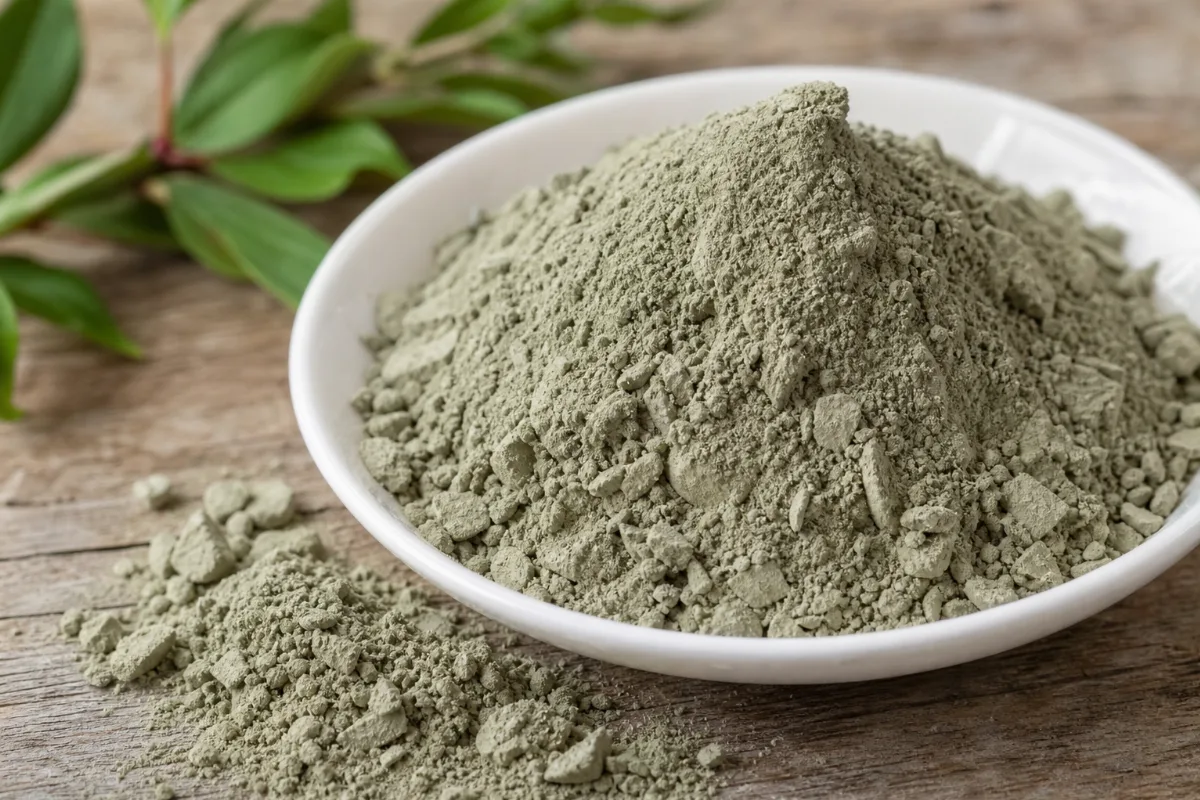
Clays & Charcoal · Clay
Illite Clay
Illite (a clay mineral, not a plant) · also called Illite clay, mica clay, sometimes sold as French green clay
Illite clay is a pale clay powder sold for face masks and, by some sellers, for swallowing. Two small skin studies were positive. No study shows it detoxes the body. Clays vary and can hold metals, so safety comes first. Do not swallow it for a detox, and keep the dry powder out of your lungs.
General information, not medical advice. Last substantive update · Not medically reviewed. A named clinician has not signed off on this page. How this page is made
About Illite Clay
Illite clay is a clay mineral sold as a powder for face masks, and sometimes for swallowing. The human research is two small skin studies read as abstracts. No study shows detox, acne or digestive benefit. Metals, quartz and dust vary from deposit to deposit and a label cannot show them.
What it is, and how it relates to French green clay
Illite is a clay mineral. Clay powders are mixtures, so a jar called illite usually holds other minerals too. In one Durban study a red clay was 56.7 percent illite with 31.3 percent quartz.
French green clay is often sold as illite or illite-smectite. A 2008 study of two French green clays found them dominated by illite and iron-rich smectite. But a 2021 test of an Argiletz green clay, which its authors call illite or sea clay, listed it as 91 percent quartz and 2 percent illite-smectite. A name on a jar does not tell you what is inside.
Two similar-looking French green clays acted in opposite ways on bacteria in earlier work: one helped them grow and the other killed them. That is why lab results for one clay do not carry over to another.
What the research shows
Skin is the only area with human studies. In a split-face study, illite and illite-goethite packs both improved oily skin according to the authors, with the mixture better for pores. In a placebo-controlled study, a lotion with an illite water extract improved water loss through the skin and redness on skin damaged on purpose. We read only abstracts of both, so sizes and numbers are unknown, and neither study checked the clay for metals.
The extract in the lotion was made by soaking the mineral in water for two days and held about 6 mg/L of potassium. It is not the same as a clay mask.
Lab studies show some natural clays kill bacteria, but acidity and the exact deposit mattered. Pig gut cells did not show toxicity from illite at the levels tested. None of this shows benefit in people.
There is no study of illite for acne, eczema, detox or digestion.
What we still do not know
We do not know how large the skin effects were, whether an illite pack beats an inactive pack, or what metals the tested clays held. We do not know anything about illite in pregnancy, in children or with medicines. Which sold products are truly illite has not been tested.
At a glance
Traditional uses history, not proof
- Natural clays have been put on the skin to heal infections since the earliest recorded history (Williams and Haydel 2010; a review of healing clays, not of illite by name).
- Clay eating (geophagy) has been seen in all parts of the world since antiquity (Gomes 2018).
- French green clays were used on Buruli ulcer in Ivory Coast; the two studied were mostly illite and iron-rich smectite (Williams 2008).
Studied for research
- Face packs for oily skin, very low (one small study, abstract only)
- An illite extract in a lotion for the skin barrier, low (one placebo-controlled study, abstract only)
- Acne and eczema, insufficient (no study)
- Detox, insufficient (no study)
- Swallowing for minerals or digestion, insufficient, with risks reported for eaten clays
- Killing bacteria, very low (lab only)
Main compounds
- Illite (clay mineral)
- Often mixed with quartz, albite, kaolinite or smectite
- Metals in some samples: lead, chromium, mercury
Common forms
- Dry powder
- Mask paste mixed with water
- Ready-mixed face mask
- Water extract in a lotion (one study)
- Spa mud-pack
Research links: Illite face pack study, 2013 (abstract) · Illite extract lotion study, 2024 (abstract) · Mercury in cosmetic clays, 2025 (abstract) · NCCIH: Detoxes and cleanses · Poison Control · Research Library · Genes & Biomarkers Library
What it is and its history
- Accepted scientific name
- Illite (a clay mineral; sold as a powder usually mixed with other minerals)
- Synonyms
- Illite clay; Mica clay (one study describes its extract this way); Illite-smectite (a mixed-layer form); Sea clay or illite clay (a 2021 paper's description of the Argiletz green clay)
- Common names
- Illite clay (English); Illite (English); Argile illite (French); Arcilla illita (Spanish)
- Family or group
- Clay mineral group; deposits are mixtures. In the studies read, illite sat beside quartz, albite, kaolinite or smectite.
- Native range
- Deposits in many countries. The studies read include clays from Durban (South Africa), France and Korea.
- Habitat
- Mined from sediment deposits.
- Harvest and processing
- Dug, dried and ground to a powder. Processing differs by supplier and was not described in the sources read. One study made a water extract by soaking the mineral in distilled water for 2 days.
- Look-alikes and adulterants
- Name: French green clay; Note: Often sold as illite or illite-smectite. The two French green clays in a 2008 study were mostly 1Md illite and iron-rich smectite, but a 2021 test of an Argiletz green clay listed 91 percent quartz and 2 percent illite-smectite. Names do not guarantee content.; Name: Red and white clays; Note: A red clay from Durban was 56.7 percent illite and a white clay 34.5 percent illite.; Name: Bentonite and montmorillonite; Note: Smectite clays. In one cell study they were more toxic to pig gut cells than illite at the higher levels tested.
Traditional use and history history, not clinical proof
| Tradition or era | Documented use | Source |
|---|---|---|
| Ancient to modern | Natural clays have been used to heal skin infections since the earliest recorded history (Williams and Haydel 2010). The review is about healing clays in general, not illite by name. | p20640226 |
| Ancient to modern | Clay eating (geophagy) has been seen in all parts of the world since antiquity (Gomes 2018). | p28150053 |
| Early 2000s | French green clays were used on Buruli ulcer in Ivory Coast; later lab tests found two similar clays acted in opposite ways on bacteria (Williams 2008). | p19079803 |
Traditional use shows how it was used. It does not show that it works or is safe today.
What is inside, and how it may work
What it contains and how those compounds act in cells and animals. Laboratory and animal mechanisms are not proven effects in people.
Main compounds
| Compound | Family | Where it is concentrated | Activity studied | Level of evidence |
|---|---|---|---|---|
| Illite | clay mineral | 56.7 percent of a red clay and 34.5 percent of a white clay from Durban (XRD); dominant with iron-rich smectite in two French green clays. | No drug-like activity shown. 11 16 | Product analysis |
| Goethite (iron hydroxide) | iron mineral | Used in the Korean study as a mixture with illite; amount not given in the abstract. | The mixture did better on pores in a small study. 8 | Human data |
| Potassium (in a water extract) | mineral element | About 6 mg/L in the illite extract used in the lotion study. | Not tested. 12 | Product analysis |
| Quartz (impurity) | silica mineral | 31.3 percent of the red Durban clay. | A concern above 15 percent according to a cited author. 11 | Product analysis |
| Chromium, lead, mercury (contaminants) | metals | Chromium 130 to 560 ppm and lead 16 to 27 ppm in two Durban clays; mercury in every Polish cosmetic clay tested. | Not a benefit; a safety concern. 11 5 | Product analysis |
Mechanisms, receptors and pathways
| Target or pathway | Gene or receptor | What was found | Level |
|---|---|---|---|
| Soaking up oil from skin (proposed) | None | Offered as the reason clay packs might help oily skin. The Korean study measured results but did not test how a pack works. A 2024 paper reports oil absorption measurements for two clays. 8 11 | Pharmacological theory |
| Bacterial iron overload (proposed, in some clays) | None | Natural antibacterial clays contained very small illite-smectite and reduced iron. The authors propose that the clay buffers acidity and oxidation so that dissolved iron kills bacteria. 18 | Laboratory |
| Acidity of a clay suspension | None | In a six-clay test only a green clay stopped bacteria, only as a suspension; the effect was lost when neutralised, so acidity may explain it. 7 | Laboratory |
| Skin barrier (unclear) | None | A lotion with an illite water extract improved water loss and redness in a placebo-controlled study; the study does not show which ingredient or process did this. 12 | Human data |
Absorption, metabolism and elimination
- Absorption
- Not studied for illite in people. In mice, lead from a green clay reached the liver and kidney after skin use.
- Distribution
- Lead rose in mouse liver and kidney (green clay, not named as illite).
- Elimination
- Not studied.
- Bioavailability
- Not studied.
Isolated compounds versus whole extracts
A water extract of illite in a lotion (Park 2024) is not the same as clay powder in a mask (Kim 2013). A suspension, a filtered leachate and a neutralised clay behaved differently in the six-clay lab test. Results for one form do not carry over to another.
Nutritional composition
Clay is not a food or a nutrient. Reviews of clay eating describe low iron and zinc in regular clay eaters, not a mineral benefit.
1 low certainty3 very low certainty3 not enough evidence
What was looked at
The 7 benefits and uses checked for Illite Clay, each with how strong the evidence is. Tap one to open it.
- Face packs for oily skinVery low certainty
- An illite water extract in a lotion, for damaged skinLow certainty
- Acne, eczema and other skin conditionsNot enough evidence
- Detox or drawing toxins out of the bodyNot enough evidence
- Swallowing for minerals or digestionNot enough evidence
- Killing bacteria in the labVery low certainty
- Effects on cells in a dishVery low certainty
Lab markers tracked in the studies
Skin oil, moisture and pores on skin measurementsWater loss through the skin (TEWL) and skin rednessSurvival of skin-type cells exposed to cosmetic clays (lab)Cell toxicity of illite versus bentonite (pig gut cells, lab)
What is Illite Clay good for?
The uses people ask about and how strong the evidence is for each. Only the skin studies are in people, and they are small.
Benefits, one by one
Each card is a research question, not a promise. Tap a goal to filter. Open a card to see the studies, doses and limits.
Face packs for oily skin
Very low certaintyOne small Korean study put illite face packs on the faces of adults in their 20s and 30s. The authors report that both an illite pack and an illite-goethite pack improved oily skin. We read only the short abstract, so we do not know how many people took part or how big the change was.
1 studiesFace packs; no amounts or timings in the abstract. Not advice.
Studies, doses and limits
What the trials found
One split-face study in adults in their 20s and 30s (abstract only).
Results
The authors say illite and an illite-goethite mixture both improved oily skin, and that the mixture did better on pores. Both were safe without skin irritation. The abstract gives no numbers.
Effect sizes as reported
Not given in the abstract.
Why this rating
One small study, abstract only, with no numbers. It compared two illite products with each other, not with an inactive pack.
Form and dose studied
Face packs; no amounts or timings in the abstract. Not advice.
Who was studied
Adults in their 20s and 30s with oily skin.
Limits
No sample size or statistics seen. No inactive comparison. Only the pack that was tested; other products may differ a lot. Metal content of the clay used is not given.
Why researchers looked
Illite is sold as a gentle clay that soaks up skin oil. The authors wanted to know whether it could be used in face packs for oily skin.
Traditional use
No history of use is claimed by this study. A 2024 cosmetics paper from South Africa says illite clay is promoted for exfoliation and for tightening pores (a seller-style claim, not a finding).
Proposed mechanism Pharmacological theory
Proposed: clay particles soak up oil. The study did not test how a pack works.
A proposed mechanism does not show that the effect happens in people.
Metals and dust are real concerns for clay products in general (see the Safety tab). Patch-test and stop if the skin reacts.
An illite water extract in a lotion, for damaged skin
Low certaintyA placebo-controlled study tested a lotion made with a water extract of illite (mica) clay on skin that had been damaged on purpose. The authors report less water loss through the skin and less redness than with the control lotion. The abstract gives no numbers.
1 studiesA lotion containing the extract. Not advice.
Studies, doses and limits
What the trials found
One placebo-controlled clinical study (abstract only).
Results
Statistically significant improvement in water loss through the skin and in redness compared with the control product, on skin damaged by a detergent (sodium lauryl sulfate) or tape stripping.
Effect sizes as reported
Not given in the abstract.
Why this rating
A placebo-controlled design is a strength. But it is one study, abstract only, with no participant number, no figures and no funding statement, and it tested damaged-on-purpose skin, not a skin disease.
Form and dose studied
A lotion containing the extract. Not advice.
Who was studied
People whose skin was damaged on purpose in the test.
Limits
Applies to that one lotion and that one extract. It is not a clay mask and does not support clay powder on the skin or swallowing clay.
Why researchers looked
Sellers say illite soothes skin. The authors wanted to see whether an extract of it could help the skin barrier recover after irritation.
Proposed mechanism Unknown
Not tested. The extract was a water in which the mineral had been soaked for 2 days; it held about 6 mg/L of potassium. The authors do not show what in the extract does the work.
A proposed mechanism does not show that the effect happens in people.
No safety findings are reported in the abstract.
Acne, eczema and other skin conditions
Not enough evidenceIllite is promoted for acne and eczema. We found no study of illite in people with acne or eczema. The one face-pack study measured oily skin, and its abstract reports no acne result.
2 studiesNot applicable.
Studies, doses and limits
Results
A 2025 safety study of kaolinite-illite gels (healthy volunteers) states that clays may be explored for acne, eczema or seborrheic dermatitis and that more studies are needed. That is a hope, not a result.
Why this rating
No human study of illite for any skin disease was found.
Limits
Absence of evidence. The sand-clay safety study did not test benefit.
Why researchers looked
Sellers connect oil-soaking clays with acne. Researchers who test cosmetic clays say that such uses may be explored in future studies.
Proposed mechanism Pharmacological theory
Proposed only: soaking up oil, calming irritation. Not shown for illite.
A proposed mechanism does not show that the effect happens in people.
Do not use clay instead of treatment for infected, weeping or worsening skin. See a clinician.
Detox or drawing toxins out of the body
Not enough evidenceSellers say clay pulls toxins or heavy metals out of the body. We found no human study showing this for illite. NCCIH reports that a 2015 review found no compelling research that detox diets remove toxins.
2 studiesNot applicable.
Studies, doses and limits
Results
No trial found. NCCIH says there is no compelling research that detox diets remove toxins.
Why this rating
No human data for illite on this claim; general agency statement only.
Limits
Absence of evidence. The agency statement is about detox diets in general.
Why researchers looked
Clay particles can hold on to some substances in a dish. That gave rise to the idea that they could do the same in the body.
Traditional use
Clay has been taken for health for a very long time (Gomes 2018).
Proposed mechanism Pharmacological theory
Clay particles could hold on to toxic substances in the gut, but the same review says they could also hold on to and release heavy metals. No test in people for illite.
A proposed mechanism does not show that the effect happens in people.
Swallowing clay is not supported. Clays can hold metals and can block absorption of other things (see the Safety tab).
Swallowing for minerals or digestion
Not enough evidenceIllite is sold as a powder, and some people swallow clay powders. We found no human study of swallowing illite for any benefit. Reviews of clay eating say its safety is not well established.
2 studiesNot applicable. No amount is suggested.
Studies, doses and limits
Results
Bonglaisin 2022 says the safety of geophagy is not fully established and that some minerals in eaten clays are toxic.
Why this rating
No studies of benefit; risk findings for eaten clays in general.
Limits
Reviews of other clays and soils, not illite. Abstracts and one full text read.
Why researchers looked
People have eaten clay in many cultures. Reviews ask whether it helps or harms.
Traditional use
Clay eating (geophagy) has been seen in all parts of the world since antiquity (Gomes 2018) and is thought to be common in pregnant women (Bonglaisin 2022).
Proposed mechanism Narrative review
Proposed: some minerals could be released in the gut. Reviews also describe clay holding iron and other minerals so they are not absorbed.
A proposed mechanism does not show that the effect happens in people.
We do not advise swallowing clay. If someone is unwell after swallowing it, call a poison centre (see the Safety tab).
Killing bacteria in the lab
Very low certaintyIn test tubes, some natural clays that contain very small illite-smectite and iron particles killed bacteria. In a 2021 test of six clays, only a green clay stopped bacteria, only as a thick suspension, and the effect disappeared once its acidity was neutralised. None of this was tested on skin infections.
2 studiesNot applicable.
Studies, doses and limits
Results
Lab only. The 2021 study listed its green clay as mostly quartz with 2 percent illite-smectite, so it does not clearly show that an illite clay is antibacterial.
Why this rating
Dish work with one sample of each clay; no human infection trial.
Limits
Which clay was tested matters a lot; two similar-looking green clays acted in opposite ways in earlier work (see the Science notes).
Why researchers looked
Researchers looked for natural substances that might help against resistant bacteria.
Traditional use
Clays have been used on skin infections for a very long time (Williams and Haydel 2010).
Proposed mechanism Laboratory
Proposed by the 2011 authors: wet clay buffers acidity and oxidation so iron stays dissolved and kills the bacteria. The 2021 authors found acidity was the main factor in their green clay.
A proposed mechanism does not show that the effect happens in people.
Do not put clay on an infection instead of seeing a clinician.
Effects on cells in a dish
Very low certaintyIn pig gut-lining cells, illite did not cause toxicity, while bentonite at the higher levels did. Wound closure in the dish was higher after 6 hours of contact than after 2 or 4 hours; the abstract does not say it beat untreated cells. In a six-clay test, clay leachates harmed immune-type cells and often boosted healing responses in skin-type cells. This is cell work only.
2 studiesNot applicable.
Studies, doses and limits
Results
See summary. The pig-cell study is about feed additives; the six-clay study used skin-type and immune-type cell lines.
Why this rating
Laboratory only.
Limits
Cells in a dish do not show what happens in a body. Pig cells are not human cells.
Why researchers looked
A first safety and activity check before animal or human work.
Proposed mechanism Laboratory
Not established.
A proposed mechanism does not show that the effect happens in people.
Not a benefit for people.
Connections to the rest of health
How Illite Clay connects to the rest of our health knowledge graph. Every link says what kind of connection it is. A safety link (for example to the liver) is a warning, not a benefit. A study that merely mentions a topic never creates a benefit link.
Explore every connection: goals, body systems, organs, symptoms, genes
A. Wellness goals
| Connected to | Kind of connection | Evidence status | Context | Studies |
|---|---|---|---|---|
| Healthy Skin | Very low certainty | Face packs for oily skin: One small Korean study put illite face packs on the faces of adults in their 20s and 30s. The authors report that both an illite pack and an illite-goethite pack improved oily skin. We read only the short abstract, so we do not know how many people took part or how big the change was. An illite water extract in a lotion, for damaged skin: A placebo-controlled study tested a lotion made with a water extract of illite (mica) clay on skin that had been damaged on purpose. The authors report less water loss through the skin and less redness than with the control lotion. The abstract gives no numbers. | 8 12 | |
| Healthy Skin | Not enough evidence | Acne, eczema and other skin conditions: Illite is promoted for acne and eczema. We found no study of illite in people with acne or eczema. The one face-pack study measured oily skin, and its abstract reports no acne result. | 8 19 | |
| Detoxification Support | Not enough evidence | Detox or drawing toxins out of the body: Sellers say clay pulls toxins or heavy metals out of the body. We found no human study showing this for illite. NCCIH reports that a 2015 review found no compelling research that detox diets remove toxins. | 20 6 | |
| Digestive Support | Not enough evidence | Swallowing for minerals or digestion: Illite is sold as a powder, and some people swallow clay powders. We found no human study of swallowing illite for any benefit. Reviews of clay eating say its safety is not well established. | 1 6 | |
| Healthy Skin | Very low certainty | Killing bacteria in the lab: In test tubes, some natural clays that contain very small illite-smectite and iron particles killed bacteria. In a 2021 test of six clays, only a green clay stopped bacteria, only as a thick suspension, and the effect disappeared once its acidity was neutralised. None of this was tested on skin infections. Effects on cells in a dish: In pig gut-lining cells, illite did not cause toxicity, while bentonite at the higher levels did. Wound closure in the dish was higher after 6 hours of contact than after 2 or 4 hours; the abstract does not say it beat untreated cells. In a six-clay test, clay leachates harmed immune-type cells and often boosted healing responses in skin-type cells. This is cell work only. | 18 7 3 |
B. Body systems
| Connected to | Kind of connection | Evidence status | Context | Studies |
|---|---|---|---|---|
| Integumentary System | Biological association | Very low certainty | Studied for: Face packs for oily skin Studied for: An illite water extract in a lotion, for damaged skin | 8 12 19 18 7 3 |
| Digestive System | Biological association | Not enough evidence | Studied for: Detox or drawing toxins out of the body Studied for: Swallowing for minerals or digestion | 20 6 1 3 7 |
I. Biomarkers
| Connected to | Kind of connection | Evidence status | Context | Studies |
|---|---|---|---|---|
| Skin oil, moisture and pores on skin measurements | Biological association | Very low certainty | Measured in trials: improved (as reported by the authors). A lab change is not the same as a health benefit. | 8 |
| Water loss through the skin (TEWL) and skin redness | Biological association | Low certainty | Measured in trials: lowered (water loss and redness, as reported by the authors). A lab change is not the same as a health benefit. | 12 |
| Survival of skin-type cells exposed to cosmetic clays (lab) | Biological association | Very low certainty | Measured in trials: stayed high. A lab change is not the same as a health benefit. | 19 |
| Cell toxicity of illite versus bentonite (pig gut cells, lab) | Biological association | Very low certainty | Measured in trials: illite no increase; bentonite higher at 1.5 and 2 percent. A lab change is not the same as a health benefit. | 3 |
L. Active compounds
| Connected to | Kind of connection | Evidence status | Context | Studies |
|---|---|---|---|---|
| Illite | Biological association | Product analysis | No drug-like activity shown. | 11 16 |
| Goethite (iron hydroxide) | Biological association | Human | The mixture did better on pores in a small study. | 8 |
| Potassium (in a water extract) | Biological association | Product analysis | Not tested. | 12 |
| Quartz (impurity) | Biological association | Product analysis | A concern above 15 percent according to a cited author. | 11 |
| Chromium, lead, mercury (contaminants) | Biological association | Product analysis | Not a benefit; a safety concern. | 11 5 |
Each connection is stored with the ingredient, the connected record, the kind of connection, the evidence status, the supporting studies, the preparation or compound involved, and a review date (last reviewed October 25, 2026).
Evidence at a glance: what the research found for 7 outcomes
Each outcome below is one thing researchers measured. Certainty is how far the evidence can be trusted, not how well it works. The full studies are on the next tab.
The evidence
The research centre for Illite Clay. Every record here was checked against PubMed or the publisher's page; we never list a study we have not verified.
Evidence by outcome
Bars show how many studies we found for each outcome, not how well it works. People are added up across trials only (reviews are not added, to avoid double counting).
How we rate evidence
High certainty
Several well-run trials or reviews agree; further research is unlikely to change the picture much.
Moderate certainty
Good trials point the same way, but some doubt remains.
Low certainty
Small, short or inconsistent trials. The finding could change with better research.
Very low certainty
Very little or very weak human data. Treat as a possibility only.
Mixed findings
Trials or reviews disagree with each other.
Not enough evidence
Not enough human research to say either way.
Evidence against
Good research found no benefit, or found harm.
We take the reviewers' own risk-of-bias and GRADE statements where they exist, and otherwise judge from study size, design, consistency, directness and whether a product matches what is sold. Many publications do not make evidence high. Method note: We searched PubMed, read the abstract of each cited paper, read the full text of the Durban clay paper, the 2021 six-clay paper, the 2025 sand-clay safety paper and a review of clay eating, read the abstract of the two illite skin studies (the 2013 study on the journal page, the 2024 study through Crossref), and read the FDA cosmetics, NCCIH detox and Poison Control pages. Certainty ratings are the compiler's own reading. Regulators outside the US, and EFSA beyond its abstract, were not checked. No study is cited that we could not verify.
Study library: every study we checked 20
| Study | Design | People | Product, dose, length | Result |
|---|---|---|---|---|
| Bonglaisin 2022 Geophagia: Benefits and potential toxicity to human-A review Frontiers in Public Health · PMID 35958861 · DOI |
Narrative review |
Review of clay and soil eating (geophagy) in people | Clay soils such as chalk or kaolin eaten by people (not illite-specific) mineral clay (not a plant) |
The abstract says the safety of geophagy is yet to be fully established, that it is thought to be highly prevalent in pregnant women, that clay content varies from place to place, and that some minerals in the materials are toxic to people. The full text describes anaemia and zinc deficiency in clay consumers, and says kaolin may block iron absorption. Methods, limits and fundingOutcomes: Safety and toxicity of eating clay Limitations: A review of clay eating, mostly kaolin and soils. It does not study illite or cosmetic clays. Funding and conflicts: Open-access review; no conflict read. Read: full-text |
| Burnett 2026 Amended Safety Assessment of Naturally-Sourced Clays as Used in Cosmetics International Journal of Toxicology · PMID 42313106 · DOI |
Authoritative guidance n/a |
Expert panel review of 8 naturally-sourced clay ingredients used in cosmetics | 8 naturally-sourced clays (the abstract does not list them) |
The Cosmetic Ingredient Review panel concluded kaolin is safe in cosmetics as used. The other 7 clays are safe as used, except that data were insufficient to decide whether they are safe in products that may be incidentally inhaled. Methods, limits and fundingOutcomes: Cosmetic safety Limitations: The abstract does not say whether illite is among the 8 clays. Treated here as about natural cosmetic clays in general. Funding and conflicts: Not stated in the abstract (who funds the panel was not checked). Read: abstract |
| Chang 2026 Effects of illite or bentonite on cytotoxicity, antibacterial and adsorption capacity in porcine intestinal epithelial cells Journal of Animal Science and Technology · PMID 41982988 · DOI |
Lab study lab |
Pig gut-lining cells (IPEC-J2) in a dish, with and without E. coli | Illite or bentonite added to the cell medium mineral clay (not a plant) 1 to 2 percent of the medium 2, 4 or 6 hours of contact · vs Untreated cells |
Bentonite at 1.5 and 2 percent was more toxic to the cells than illite or no clay. Illite did not cause toxicity at any level tested. Wound closure was higher after 6 hours of contact with either clay than after 2 or 4 hours (the abstract does not compare with untreated cells). In the E. coli test only one bentonite group had more live cells. Methods, limits and fundingOutcomes: Cell toxicity, wound closure, E. coli attachment and cell survival Limitations: Pig cells in a dish; the study concerns feed supplements. Not human. Says nothing about skin or swallowing by people. Funding and conflicts: Not stated in the abstract. Read: abstract |
| EFSA Panel on Additives and Products or Substances used in Animal Feed (FEEDAP) 2026 Assessment of a feed additive consisting of montmorillonite-illite mixed layer clay mineral (1g557) for all animal species for the renewal of its authorisation (FIM Biotech GmbH) EFSA Journal · PMID 42564637 · DOI |
Authoritative guidance n/a |
Animal feed additive review | A montmorillonite-illite mixed-layer clay used as a feed additive |
EFSA could not conclude whether the additive remains safe for the animals it is fed to; it concluded it remains safe for the consumer and the environment. The additive should be considered a skin and respiratory sensitiser, eye irritation could not be judged, and exposure of users by any route is a risk and should be minimised. Methods, limits and fundingOutcomes: Safety for animals, consumers, environment and users Limitations: A feed additive for animals, not a cosmetic or supplement for people. The user-safety statement is about handling the powder at work. Funding and conflicts: Regulator opinion; the request came from the European Commission, the applicant is a feed company. Read: abstract |
| Fischer 2025 Analysis of Mercury Concentration in Cosmetic Clays Toxics · PMID 40559980 · DOI |
Product analysis product |
Cosmetic clays sold in Poland, of different colours and makers | Cosmetic clays of different colours (green, white, purple, blue and others) mineral clay (not a plant) |
Mercury was found in every sample: average 28.91 micrograms per kg, range 1.87 to 200.81. Highest averages were in green clays (53.26) and white clays (52.80); lowest in purple (2.56) and blue (3.69). Differences between types were statistically significant. The authors say such products likely need to be tested for metals. Methods, limits and fundingOutcomes: Mercury in the clay powder Limitations: Colour is not mineral type: the abstract does not say which samples were illite. Number of samples not given in the abstract. Funding and conflicts: Not stated in the abstract. Read: abstract |
| Gomes 2018 Healing and edible clays: a review of basic concepts, benefits and risks Environmental Geochemistry and Health · PMID 28150053 · DOI |
Narrative review n/a |
Review of healing and edible clays in general | Healing clays and edible clays in general (not illite-specific) mineral clay (not a plant) |
Says clay particles could adsorb toxins so they leave the body, but could also adsorb and make available toxic elements such as heavy metals through swallowing or skin absorption. Notes clay eating has been seen in all parts of the world since antiquity. Methods, limits and fundingOutcomes: Benefits and risks of healing clays Limitations: Review of clays in general. Abstract only read. Funding and conflicts: Not stated. Read: abstract |
| Incledion 2021 A New Look at the Purported Health Benefits of Commercial and Natural Clays Biomolecules 11(1):58 · Source · DOI |
Lab study lab |
6 Six commercial or natural clays tested in a dish (THP-1 immune-type cells, HaCaT skin-type cells, five wound bacteria) |
Six clay samples. The green clay (Argiletz) is described by the authors as illite or sea clay; the mineral table lists it as 91% quartz and 2% illite-smectite (table text as extracted; read with care). The other clays included montmorillonite-rich clays, a kaolinite and a red clay. mineral clay (not a plant) Up to 168 h in cell tests · vs Untreated cells |
All six clay leachates were toxic to immune-type (THP-1) cells; suspensions less so. Many leachates stimulated wound-healing responses in skin-type cells. Only the green clay stopped bacteria, only as a suspension, and the effect was lost when the acidity was neutralised. Methods, limits and fundingOutcomes: Antibacterial strength, cell survival, wound closure of skin-type cells Limitations: Dish work, not people. One sample of each clay. The mineral listing for the green clay shows little illite, so it may not represent an illite clay. Funding and conflicts: Funded by a Cardiff University tissue engineering programme; authors declare no conflict of interest. Read: full-text |
| Kim 2013 A Comparative Study of the Effects of Illite and Illite-Iron Hydroxide (Goethite) Mixture on the Improvement of Oily Skin Conditions in Adults of the 20s and 30s Korean Journal of Aesthetic Cosmetology (Kor J Aesthet Cosmetol) 11(6):1073-1082 · Source |
Small human trial |
Adults in their 20s and 30s with oily skin (number not given in the abstract) | Face pack of illite alone on one side of the face, and a face pack of an illite and iron hydroxide (goethite) mixture on the other side mineral clay (not a plant) · vs Split-face: each person's two sides were compared with each other; no inactive pack described |
The authors report that both the illite pack and the illite-goethite pack were effective in improving oily skin, and that the mixture was more effective for pores. Both were safe without skin irritation. The abstract does not report an acne result. Methods, limits and fundingOutcomes: Skin oil, moisture, number of pores, number of papules, pustules and nodules (photos or dermatologist rating), skin irritation questionnaire Limitations: Abstract only. No sample size, no numbers and no statistics in the abstract. Split-face design compares two illite products with each other, so it cannot show either beats doing nothing. Short report from a cosmetic journal. Funding and conflicts: Not stated in the abstract. Read: abstract |
| Labarthe 2025 A protocol for heat treatment of four types of clay minerals used in French pelotherapy facilities International Journal of Biometeorology · PMID 40455249 · DOI |
Lab study lab |
Four clay types used in French spa mud-packs, tested in a heating cabinet | Mud-packs of four clay types, one a montmorillonite, illite and kaolinite mix mineral clay (not a plant) 17 to 33 hours per heating cycle |
The abstract says repeated contact with people and storage for re-use bring microbiological risks, and that in France there are no quality standards or guidelines for the sanitary monitoring of the treatment. It reports the heating settings needed for each clay. Methods, limits and fundingOutcomes: Heating settings that reach 70 C for 30 minutes Limitations: Spa mud-packs, not home masks. It tested heating settings and did not test infections in people. Funding and conflicts: Not stated in the abstract. Read: abstract |
| National Capital Poison Center 2026 Poison Control (National Capital Poison Center), home page n/a · Source |
Authoritative guidance n/a |
n/a | n/a |
Says to call a poison centre at 1-800-222-1222 (US) or use the online tool, free and confidential, and to call 911 if the person collapses, has a seizure, has trouble breathing or cannot be awakened. Methods, limits and fundingOutcomes: What to do after a poisoning Limitations: US service; other countries have their own poison centres. Read: full-text |
| Nkosi 2024 Physical, chemical and biological characteristics of clays from Durban (South Africa) for applications in cosmetics Analytical Science Advances · PMID 38827024 · DOI |
Product analysis product |
2 Two clay samples mined near Durban, a red clay and a white clay |
A red clay (main mineral illite, 56.7%) and a white clay (illite 34.5%, albite, montmorillonite) mineral clay (not a plant) |
Full text: red clay was 56.7% illite with 31.3% quartz; white clay 34.5% illite. Arsenic, mercury, cadmium and selenium were not found, but lead was found at 27 ppm (red) and 16 ppm (white), which the authors call below the permissible 200 ppm. Chromium was 130 ppm (red) and 560 ppm (white), above the 5 ppm suggested for end-user products by one cited author; the paper notes chromium can cause contact allergy. The authors cite a quartz level above 15 percent as a concern even for use on skin. Methods, limits and fundingOutcomes: Minerals, metals (X-ray fluorescence), oil absorption, microbes Limitations: Two samples from one area. Authors' safety limits are quoted from other papers. Abstract does not list these figures; they come from the full text. Funding and conflicts: Not read. Read: full-text |
| Park 2024 Natural Illite Liquid Mineral Extract: A Clinical Study of an Emulsion to Improve Skin Barrier Function Minerals 14(12):1194 · Source · DOI |
Placebo controlled trial |
People whose skin was damaged on purpose by sodium lauryl sulfate (a detergent) or tape stripping (number not given in the abstract) | A cosmetic emulsion (lotion) containing a water extract made from illite (mica) clay. The extract held about 6 mg/L of potassium mineral clay (not a plant) · vs Control product (described as placebo-controlled) |
The authors report a statistically significant improvement in water loss through the skin and in redness compared with the control product, and that the emulsion stayed stable over 3 months. Methods, limits and fundingOutcomes: Water loss through the skin (TEWL) and skin redness; product stability over 3 months Limitations: Abstract only (read through Crossref). No participant number, no figures, no funding statement in the abstract. The test was on skin damaged on purpose, not on a skin disease. The product is a water extract of the clay in a lotion, not a clay mask. Funding and conflicts: Not stated in the abstract. Read: abstract |
| Ramirez-Diaz 2025 Cell Death and Proliferation Variability Caused by Different Dust Clay Minerals Using the Single-Cell Method GeoHealth · PMID 40476086 · DOI |
Lab study lab |
Human lung-lining cells (A549) in a dish | Five clay minerals: three montmorillonites, illite and kaolinite mineral clay (not a plant) 48 hours · vs Compared clays with each other |
Calcium-rich montmorillonite was the most toxic and kaolinite the least toxic. The abstract does not say where illite ranked. Deaths rose between 34 and 48 hours, which the authors say may mean the health effect is delayed. Methods, limits and fundingOutcomes: Cell death and cell division Limitations: Dust-storm research in a dish. Illite's own result is not stated in the abstract. Not a study of cosmetic use. Funding and conflicts: Not stated in the abstract. Read: abstract |
| US Food and Drug Administration 2025 FDA Authority Over Cosmetics: How Cosmetics Are Not FDA-Approved, but Are FDA-Regulated (content current as of 11/18/2025) n/a · Source |
Authoritative guidance n/a |
n/a | n/a |
Says cosmetic products and ingredients, except colour additives, do not need FDA premarket approval, though the FDA can act against products on the market that do not comply with the law. Methods, limits and fundingOutcomes: Whether cosmetics need FDA approval Limitations: General cosmetics law page, not about clays. Read: full-text |
| Whiteside 2020 Elevated Arsenic and Lead Concentrations in Natural Healing Clay Applied Topically as a Treatment for Ulcerative Dermatitis in Mice Journal of the American Association for Laboratory Animal Science · PMID 32059757 · DOI |
Animal study animal |
40 Two groups of 20 shaved adult male CD1 mice without skin disease |
A green clay paste (a therapeutic clay, not named as illite) applied to the skin daily mineral clay (not a plant) 2 weeks · vs Saline |
The clay product held high concentrations of arsenic and lead. After topical use, lead was higher in mouse liver and kidney than in controls; arsenic was not. The lead-sensitive enzyme did not differ, so no measurable biologic effect was found. Methods, limits and fundingOutcomes: Arsenic and lead in liver, kidney and blood; a lead-sensitive enzyme Limitations: Mice, not people. A green clay, not shown to be illite. Short exposure. Abstract only. Funding and conflicts: Intramural US government (NIEHS) research. Read: abstract |
| Williams 2008 Chemical and mineralogical characteristics of French green clays used for healing Clays and Clay Minerals · PMID 19079803 · DOI |
Lab study lab |
2 Two commercial French green clays used for Buruli ulcer care in Ivory Coast |
Two French green clays tested against a broad range of bacteria mineral clay (not a plant) |
The two clays are dominated by 1Md illite and iron-rich smectite. One promoted bacterial growth and the other killed or strongly slowed bacteria. The authors conclude that the clay's chemistry and surface properties, which control the water used to moisten poultices, supply the key antibacterial factor. Methods, limits and fundingOutcomes: Mineral and chemical make-up of two French green clays; effect on bacteria Limitations: Two clay samples; lab work, not people. Funding and conflicts: Not stated in the abstract. Read: abstract |
| Williams 2010 Evaluation of the medicinal use of clay minerals as antibacterial agents International Geology Review · PMID 20640226 · DOI |
Narrative review n/a |
Review and lab work on healing clays and antibacterial clays | Healing clays in general, French green clays in particular mineral clay (not a plant) |
Says natural clays have been used to heal skin infections since the earliest recorded history. Two French green clays similar in mineralogy had opposite effects on bacteria, one promoting growth and the other killing. The authors distinguish healing clays, which may simply adsorb, from the few antibacterial clays. Methods, limits and fundingOutcomes: Which clays kill bacteria and why Limitations: Abstract only read here. Not about illite as such. Funding and conflicts: Not stated in the abstract. Read: abstract |
| Williams 2011 What makes a natural clay antibacterial? Environmental Science & Technology · PMID 21413758 · DOI |
Lab study lab |
Clays that kill bacteria in the lab, compared with clays that do not | Natural clays that killed a range of human pathogens including antibiotic-resistant strains mineral clay (not a plant) · vs Non-antibacterial clays |
Natural antibacterial clays contained very small (under 200 nm) illite-smectite and reduced-iron phases. The authors propose that the clay buffers acidity and oxidation so that dissolved iron kills the bacteria. Methods, limits and fundingOutcomes: Mineral make-up of antibacterial clays; how they kill E. coli Limitations: Lab work only. The abstract does not say that illite itself is the killer; illite-smectite was one of the phases found in antibacterial clays. Funding and conflicts: Government and non-US research funding listed in the record. Read: abstract |
| da Silva Favero 2025 Physicochemical Characterization and Safety Assessment of Cosmetic Gels and Emulsions Containing Sand-Extraction Clays Journal of Cosmetic Dermatology · PMID 41128013 · DOI |
Safety test human and cell |
53 53 healthy volunteers (patch test); HaCaT skin-type cells |
Gels and emulsions containing four clays from sand-extraction leftovers; the full text says the clays were mostly kaolinite and illite, sometimes with smectite mineral clay (not a plant) Patch test and cell exposure up to 1000 micrograms per mL · vs Control vehicle in the full text (not checked in detail) |
All four clays kept skin-type cells above 75 percent alive at the highest level tested. Patch tests on 53 healthy volunteers showed no sign of skin irritation or sensitisation. The full text calls uses against acne, eczema or seborrheic dermatitis something that may be explored with further studies, not something shown. Methods, limits and fundingOutcomes: Cell survival, skin irritation and sensitisation on patch testing, gel stability Limitations: Safety study of gels in healthy people, not a benefit study. The clays are not sold products and were not labelled illite clays. Funding and conflicts: Not read. Read: full-text |
| n/a 2025 NCCIH (NIH): Detoxes and Cleanses: What You Need To Know (last updated March 2025) n/a · Source |
Authoritative guidance n/a |
n/a | n/a |
Says a 2015 review concluded there was no compelling research to support the use of detox diets for weight management or for eliminating toxins from the body. Methods, limits and fundingOutcomes: Whether detox products and diets remove toxins Limitations: A health agency fact sheet about detoxes in general, not a clay study. Read: full-text |
What we do not know yet
- No study of an illite face pack with an inactive comparison and a reported sample size.
- No study of illite for acne, eczema or any skin disease.
- No metal testing of the clays used in the two illite skin studies.
- No human data on swallowing illite, pregnancy, children or medicine interactions.
- No testing of whether clays sold as illite are really illite.
How new research is added
New studies are found by a saved PubMed search and are placed in a review queue. A person reads each one before it changes any evidence rating or safety wording.
Lab markers
What changed in blood or saliva tests during trials. A changed number is not the same as feeling or being healthier, and we give no "normal ranges".
Other 4
Skin oil, moisture and pores on skin measurements
Improved (as reported by the authors) in trials
How oily the skin surface is, how much water it holds and how many pores are counted, measured with skin instruments and photos.
Very low certaintyResults and what it means
Why it was measured
To see whether a face pack makes oily skin look and measure less oily.
Statistical vs. clinical meaning
Not known: the abstract gives no numbers or statistics.
Safety implication
The authors report no skin irritation with either pack.
| Study | Result | People | Product |
|---|---|---|---|
| 8 | Authors report that illite and an illite-goethite mixture improved oily skin and that the mixture was better for pores. No figures in the abstract. | Adults in their 20s and 30s with oily skin | Illite pack on one side of the face, illite-goethite pack on the other |
Water loss through the skin (TEWL) and skin redness
Lowered (water loss and redness, as reported by the authors) in trials
TEWL measures how much water escapes through the skin surface. Higher loss means a weaker skin barrier. Redness is measured with an instrument.
Low certaintyResults and what it means
Why it was measured
To see whether skin recovers faster after irritation.
Statistical vs. clinical meaning
Statistically significant per the authors; size not seen.
Safety implication
None reported in the abstract.
| Study | Result | People | Product |
|---|---|---|---|
| 12 | Statistically significant improvement in water loss through the skin and in redness versus the control product. No figures in the abstract. | People whose skin was damaged on purpose by a detergent or tape stripping | Emulsion with an illite (mica clay) water extract versus a control emulsion |
Survival of skin-type cells exposed to cosmetic clays (lab)
Stayed high in trials
In a dish, how many skin-type cells stay alive after exposure to a clay.
Very low certaintyResults and what it means
Why it was measured
A first check of whether a clay is toxic to skin cells before it is put on people.
Statistical vs. clinical meaning
A safety check, not a benefit.
Safety implication
Suggests these tested formulations did not irritate healthy skin. It does not cover metals in other clays or sold products.
| Study | Result | People | Product |
|---|---|---|---|
| 19 | All four clays from sand-extraction leftovers kept HaCaT skin-type cells above 75 percent alive at the highest level tested; patch tests on 53 healthy volunteers showed no irritation or sensitisation. | HaCaT cells and 53 healthy volunteers | Gels and emulsions with kaolinite-and-illite clays (not sold illite products) |
Cell toxicity of illite versus bentonite (pig gut cells, lab)
Illite no increase; bentonite higher at 1.5 and 2 percent in trials
How many cells in a dish die when a material is added.
Very low certaintyResults and what it means
Why it was measured
A first screen of whether a material harms gut-lining cells.
Statistical vs. clinical meaning
Statistically significant in the dish.
Safety implication
Does not show swallowing illite is safe for people.
| Study | Result | People | Product |
|---|---|---|---|
| 3 | Bentonite at 1.5 and 2 percent was more toxic than illite or no clay; illite caused no toxicity at the levels tested. | Pig intestinal cells (IPEC-J2) | Illite or bentonite in the cell medium |
Safety
What studies and official sources say about side effects, medicines and who should check first. Each point shows what kind of evidence it comes from.
Main points to know 6
- Do not swallow illite clay for a "detox". No study shows illite clay detoxes the body. Reviews say the safety of clay eating is not fully established, that some minerals in eaten clays are toxic, and that clay can both hold toxins and hold and release heavy metals. Eaten clay is also linked in reviews to low iron and zinc. Narrative review 1 6 20
- Metals vary from jar to jar. Clay is dug from the ground. In Polish cosmetic clays mercury was in every sample, highest on average in green clays. An illite-rich red clay from Durban had lead of 27 ppm and chromium of 130 ppm, which the authors call above a suggested limit for end products. A green clay used on mouse skin raised lead in the liver and kidney. A label cannot tell you the metal content. Product analysis 5 11 15
- Keep the dry powder out of your lungs. An expert panel judged natural cosmetic clays safe as used, but said there were not enough data to judge products that may be breathed in. EFSA says an illite-containing clay feed additive should be treated as a skin and respiratory sensitiser and that user exposure should be kept low. Some clay deposits contain quartz, which the Durban authors flag above 15 percent. Authoritative guidance 2 4 11
- Skin reactions are possible; tests so far found none. In a patch test of 53 healthy volunteers with gels made from kaolinite-and-illite clays, no irritation or allergy appeared. Illite face packs in a small Korean study caused no irritation according to the authors. Chromium in a clay can cause contact allergy. Stop if the skin reacts. Human safety test 19 8 11
- Pregnancy and children: no safe-use data. Clay eating is thought to be common in pregnant women, but its safety is not established. No study of illite in pregnancy, breastfeeding or children was found. Gap 1
- Shared spa mud-packs carry germ risk. For re-used spa mud-packs, a 2025 French paper says repeated contact between people and storage bring microbiological risks and there are no quality standards for monitoring. This is about spa muds, not home masks. Laboratory 9
Side effects 5
| Effect | How often | Severity and recovery | Evidence |
|---|---|---|---|
| Lead build-up in liver and kidney after clay was put on skin (mice, green clay) The authors found no measurable biological effect in the lead-sensitive enzyme they tested. The clay was a green healing clay, not named as illite. | Seen in both groups of 20 mice after 2 weeks of daily use | unknown Not tested | Animal study 15 |
| Mercury in cosmetic clays Amounts were micrograms per kg. The study did not measure what enters the body. | Found in all samples tested in Poland | unknown Not applicable | Product analysis 5 |
| Low iron and zinc (anaemia) in people who eat clay regularly Review of clay and soil eating, mostly kaolin. Not an illite study. | No rate given in the sources read | unknown Not stated | Narrative review 1 |
| Contact allergy from chromium in a clay The paper says chromium can act as an allergen and measured it in two clays; it did not test people. | Not measured | unknown Not applicable | Product analysis 11 |
| Irritation of airways and skin from the dry powder EFSA calls a montmorillonite-illite feed additive a skin and respiratory sensitiser. A dish study of lung cells compared five clay minerals; it did not say how illite ranked. | Not measured in people | unknown Not applicable | Authoritative guidance 4 13 |
Liver
No report of liver injury from illite clay was found. Lead rose in the liver and kidney of mice after green clay was put on their skin, with no measurable effect on the enzyme tested. 15
How often. No rate in people. LiverTox was not searched.
Monitoring. No monitoring advice was found.
This is a safety connection. It is not evidence that Illite Clay supports liver health.
Medicines and supplements 3
| With | Why it matters | Importance | Evidence | What to do |
|---|---|---|---|---|
| Medicines taken by mouth (in general) prescription | Clays can hold on to other substances, which could in theory lower how much of a medicine is absorbed. | No interaction study with illite was found. | Pharmacological theory Not enough evidence 6 | If you take any medicine, ask a pharmacist before swallowing any clay. |
| Iron and zinc from food and supplements nutrient | A review says clay can bind iron so it is not absorbed. | Review of kaolin and soils; not tested for illite. | Narrative review Low certainty 1 | Avoid swallowing clay if you are low in iron or zinc, pregnant, or have anaemia; ask a clinician. |
| Skin products and medicines put on the skin topical | Not studied. | No data found. | None found Not enough evidence | Do not put clay on broken or infected skin without asking a clinician. |
Who should check first 6
| Situation | Advice | Evidence |
|---|---|---|
| Anyone considering swallowing clay | Not supported by the sources. Ask a doctor or pharmacist first. | Narrative review 1 6 |
| Pregnancy and breastfeeding | No data on illite were found. Clay eating is thought to be common in pregnancy but its safety is not established. Ask a clinician. | Gap 1 |
| Babies and children | No data were found. Keep powder out of reach and do not let children swallow or breathe it. | Gap 4 |
| Asthma or lung disease | No illite-specific data. Because dry clay dust may be breathed in and the expert panel found data insufficient for inhaled products, avoid raising dust. | Authoritative guidance 2 |
| Broken, infected or weeping skin | No study supports clay on these. See a clinician. | Gap |
| Known allergy to chromium or other metals | The Durban paper found chromium in two clays. Patch-test and ask a clinician. | Product analysis 11 |
Overdose, product quality and regulators
Summary. Clay is a mineral, not a plant, so there are no toxic plant parts. The concern is what a deposit contains: metals and quartz.
Animal. Mice given green clay paste on the skin for two weeks had more lead in the liver and kidney.
Human doses studied. No dose studies of illite in people were found.
High dose or long term signals. Reviews of clay eating describe anaemia, zinc deficiency and other effects over years. They concern clay and soils in general.
Overdose response. If someone has swallowed a clay product and feels unwell, call poison control (US 1-800-222-1222) or your local emergency number.
Genotoxicity. Not read.
Clay is dug from the ground and can carry metals. Labels rarely say which metals, and illite is usually mixed with other minerals.
Mercury. In Polish cosmetic clays mercury was in every sample (1.87 to 200.81 micrograms per kg), with the highest averages in green and white clays. 5
Lead and chromium in illite-rich clays. A red clay from Durban with 56.7 percent illite had lead of 27 ppm and chromium of 130 ppm; a white clay (34.5 percent illite) had lead of 16 ppm and chromium of 560 ppm. The authors call lead below 200 ppm but chromium above a suggested limit for end products. 11
Quartz. The red clay held 31.3 percent quartz. The authors cite a quartz level above 15 percent as a concern even on skin. 11
Lead and arsenic in a green healing clay. A green clay used to treat mouse dermatitis held high arsenic and lead; lead rose in mouse liver and kidney after skin use. 15
Mixed minerals. A six-clay test listed its green Argiletz clay as mostly quartz with 2 percent illite-smectite, while the authors also call it illite or sea clay. Clays sold as illite are mixtures and a name does not tell you what is inside. 7
| Body | Action | Date |
|---|---|---|
| US FDA (United States) | Cosmetic products and ingredients (except colour additives) do not need FDA premarket approval; the FDA can act on products on the market that break the law. source | 2025-11-18 |
| Cosmetic Ingredient Review Expert Panel (United States) | Judged naturally-sourced cosmetic clays (8 ingredients) safe as used, but data insufficient for products that may be incidentally inhaled. source | 2026 |
| EFSA FEEDAP Panel (European Union) | For a montmorillonite-illite feed additive: skin and respiratory sensitiser; user exposure by any route is a risk and should be minimised. source | 2026-08 |
| NCCIH (US National Institutes of Health) (United States) | Says a 2015 review found no compelling research that detox diets remove toxins. source | 2025-03 |
| Poison Control (National Capital Poison Center) (United States) | Call 1-800-222-1222 or use the online tool after a poisoning; call 911 for collapse, seizure, trouble breathing or if the person cannot be awakened. source | 2026 |
When to get medical help
- Collapse, a seizure, trouble breathing or being impossible to wake after swallowing or breathing in clay or clay dust: call emergency services (911 in the US) now.
- Swallowed a clay product and feel unwell, or a child has swallowed it: call poison control (US 1-800-222-1222) or your local emergency number.
- Wheeze, cough or chest tightness after breathing in dry powder: stop and get medical advice.
- Itching, rash or swelling after putting clay on the skin: wash it off and stop. Get medical care if it spreads or you have trouble breathing.
- A skin ulcer or wound with spreading redness, pus, fever or pain that is getting worse: get medical care; do not use clay instead.
Stop using the product and contact a clinician or emergency service. In the US, Poison Control is 1-800-222-1222.
General information only, not medical advice. Ask a clinician or pharmacist before use, especially with medicines, in pregnancy or with a health condition. See the Natural Remedy Safety guide.
Frequently asked questions
What is illite clay?
Illite is a clay mineral sold as a powder for face masks and sometimes for swallowing. Clay powders are mixtures, so a jar usually holds other minerals such as quartz as well. A red clay in one study was 56.7 percent illite.
Is French green clay the same as illite clay?
Does illite clay help oily skin?
One small split-face study reports that illite and illite-goethite packs improved oily skin. We read only the abstract, which gives no numbers and no inactive comparison, so the evidence is very weak.
Does illite clay treat acne?
Does illite clay detox the body?
Is it safe to eat or drink illite clay?
Can illite clay contain heavy metals?
Is the dry powder dangerous to breathe?
Is illite clay antibacterial?
Is illite clay safe in pregnancy or for children?
We found no data. Clay eating is thought to be common in pregnant women but its safety is not established. Keep powder away from children and ask a clinician.
Can I put illite clay on a wound or infected skin?
No study supports that. See a clinician for infected, weeping or worsening skin, and do not use clay instead of care.
Is clay regulated like a medicine?
Not as a cosmetic. The FDA says cosmetic products and ingredients, except colour additives, do not need premarket approval, though it can act against non-compliant products. Other countries were not checked.
Explore by health goal
Editorial transparency
- Written by
- AlternativeMed editorial team. Research compiled with AI assistance, then checked against PubMed records.
- Medical review
- None. This page has not been reviewed by a physician or pharmacist.
- First published
- 2026-10-25
- Last substantive update
- 2026-10-25
- How we research
- We searched PubMed, read the abstract of each cited paper, read the full text of the Durban clay paper, the 2021 six-clay paper, the 2025 sand-clay safety paper and a review of clay eating, read the abstract of the two illite skin studies (the 2013 study on the journal page, the 2024 study through Crossref), and read the FDA cosmetics, NCCIH detox and Poison Control pages. Certainty ratings are the compiler's own reading. Regulators outside the US, and EFSA beyond its abstract, were not checked. No study is cited that we could not verify.
- How we rate evidence
- See "How we rate evidence" in the Evidence tab.
- Independence
- No product is promoted on this page. No affiliate links are shown.
Sources 20
Each source was opened and checked. Where we read only the abstract, it says so. The small numbers in the text point here.
- Bonglaisin JN, Kunsoan NB, Bonny P, Matchawe C. Geophagia: Benefits and potential toxicity to human-A review. Frontiers in Public Health. 2022. PMID 35958861. DOI 10.3389/fpubh.2022.893831. (full-text)
- Burnett CL, Bergfeld WF, Belsito DV, Cohen DE. Amended Safety Assessment of Naturally-Sourced Clays as Used in Cosmetics. International Journal of Toxicology. 2026. PMID 42313106. DOI 10.1177/10915818261455355. (abstract)
- Chang S, Lee J, Jung S, Song D. Effects of illite or bentonite on cytotoxicity, antibacterial and adsorption capacity in porcine intestinal epithelial cells. Journal of Animal Science and Technology. 2026. PMID 41982988. DOI 10.5187/jast.2024.e107. (abstract)
- EFSA Panel on Additives and Products or Substances used in Animal Feed (FEEDAP). Assessment of a feed additive consisting of montmorillonite-illite mixed layer clay mineral (1g557) for all animal species for the renewal of its authorisation (FIM Biotech GmbH). EFSA Journal. 2026. PMID 42564637. DOI 10.2903/j.efsa.2026.10244. (abstract)
- Fischer A, Brodziak-Dopierala B, Janska W, Jeyranyan L. Analysis of Mercury Concentration in Cosmetic Clays. Toxics. 2025. PMID 40559980. DOI 10.3390/toxics13060507. (abstract)
- Gomes CSF. Healing and edible clays: a review of basic concepts, benefits and risks. Environmental Geochemistry and Health. 2018. PMID 28150053. DOI 10.1007/s10653-016-9903-4. (abstract)
- Incledion A, Boseley M, Moses RL, et al. A New Look at the Purported Health Benefits of Commercial and Natural Clays. Biomolecules 11(1):58. 2021. DOI 10.3390/biom11010058. (full-text)
- Kim HJ, Kim GS, Kang SO. A Comparative Study of the Effects of Illite and Illite-Iron Hydroxide (Goethite) Mixture on the Improvement of Oily Skin Conditions in Adults of the 20s and 30s. Korean Journal of Aesthetic Cosmetology (Kor J Aesthet Cosmetol) 11(6):1073-1082. 2013. (abstract)
- Labarthe S, Dubourg K, Bauduer F. A protocol for heat treatment of four types of clay minerals used in French pelotherapy facilities. International Journal of Biometeorology. 2025. PMID 40455249. DOI 10.1007/s00484-025-02938-z. (abstract)
- National Capital Poison Center. Poison Control (National Capital Poison Center), home page. n/a. 2026. (full-text)
- Nkosi SM, Thembane N. Physical, chemical and biological characteristics of clays from Durban (South Africa) for applications in cosmetics. Analytical Science Advances. 2024. PMID 38827024. DOI 10.1002/ansa.202300062. (full-text)
- Park J, Kim M, Kim Y, Lee J, Kim B. Natural Illite Liquid Mineral Extract: A Clinical Study of an Emulsion to Improve Skin Barrier Function. Minerals 14(12):1194. 2024. DOI 10.3390/min14121194. (abstract)
- Ramirez-Diaz Z, Deonarine A, Plantier M, Shaghaghi N. Cell Death and Proliferation Variability Caused by Different Dust Clay Minerals Using the Single-Cell Method. GeoHealth. 2025. PMID 40476086. DOI 10.1029/2024GH001280. (abstract)
- US Food and Drug Administration. FDA Authority Over Cosmetics: How Cosmetics Are Not FDA-Approved, but Are FDA-Regulated (content current as of 11/18/2025). n/a. 2025. (full-text)
- Whiteside TE, Qu W, DeVito MJ, Brar SS. Elevated Arsenic and Lead Concentrations in Natural Healing Clay Applied Topically as a Treatment for Ulcerative Dermatitis in Mice. Journal of the American Association for Laboratory Animal Science. 2020. PMID 32059757. DOI 10.30802/AALAS-JAALAS-19-000068. (abstract)
- Williams LB, Haydel SE, Giese RF, Eberl DD. Chemical and mineralogical characteristics of French green clays used for healing. Clays and Clay Minerals. 2008. PMID 19079803. DOI 10.1346/CCMN.2008.0560405. (abstract)
- Williams LB, Haydel SE. Evaluation of the medicinal use of clay minerals as antibacterial agents. International Geology Review. 2010. PMID 20640226. DOI 10.1080/00206811003679737. (abstract)
- Williams LB, Metge DW, Eberl DD, Harvey RW. What makes a natural clay antibacterial?. Environmental Science & Technology. 2011. PMID 21413758. DOI 10.1021/es1040688. (abstract)
- da Silva Favero J, Dos Santos V, Weiss-Angeli V, Garcia CSC. Physicochemical Characterization and Safety Assessment of Cosmetic Gels and Emulsions Containing Sand-Extraction Clays. Journal of Cosmetic Dermatology. 2025. PMID 41128013. DOI 10.1111/jocd.70517. (full-text)
- n/a. NCCIH (NIH): Detoxes and Cleanses: What You Need To Know (last updated March 2025). n/a. 2025. (full-text)


