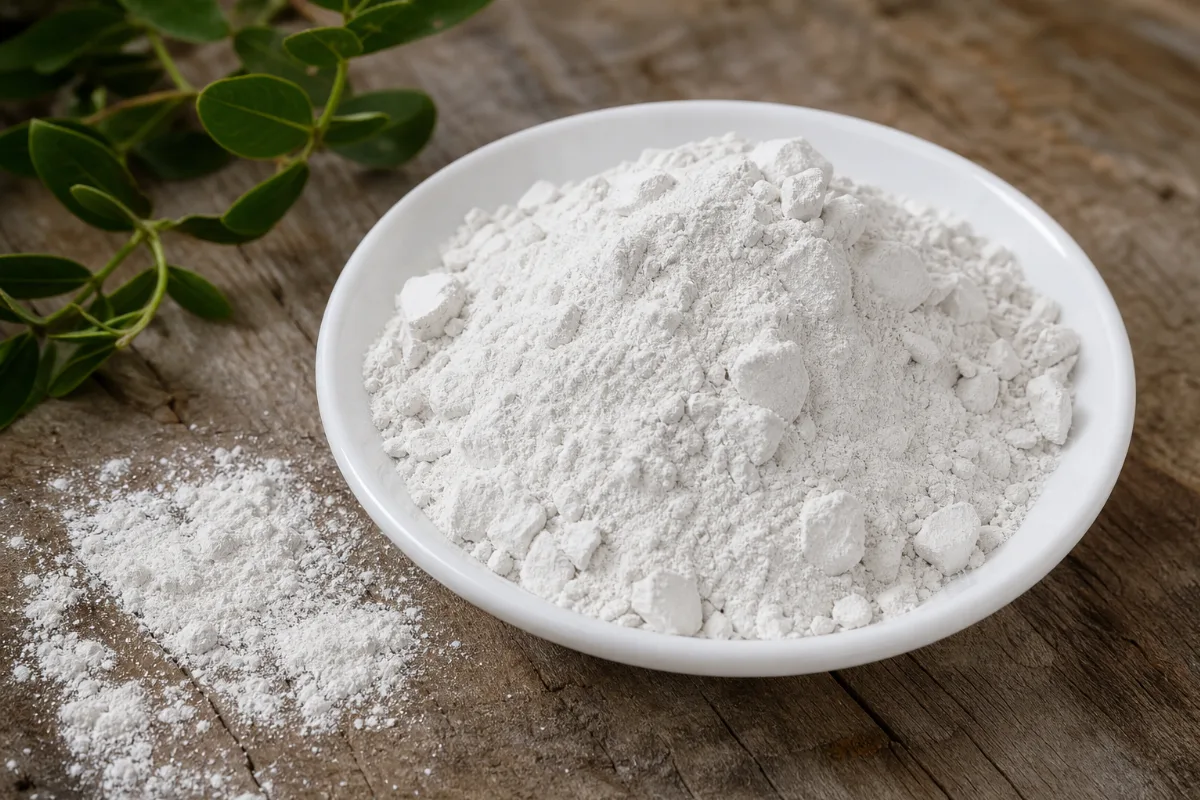
Clays & Charcoal · Clay
Kaolin Clay
Kaolin (a clay mineral, kaolinite; not a plant) · also called Kaolin, kaolinite, white clay, China clay
Kaolin is a white clay used in medicines, cosmetics and some bleeding-control dressings. Hospital and military dressings with kaolin have mixed results. No trial we could read shows it helps diarrhoea or face masks. Keep the dry powder out of your lungs, off broken skin, and do not eat it. It can also slow or lower the absorption of medicines such as digoxin.
General information, not medical advice. Last substantive update · Not medically reviewed. A named clinician has not signed off on this page. How this page is made
About Kaolin Clay
Kaolin is a white clay (mostly the mineral kaolinite) used as a tablet ingredient, in cosmetic masks, in older diarrhoea medicines and in some bleeding-control dressings. The best-studied use is in dressings, with mixed results. For diarrhoea, skin masks and eating it, no readable trial shows benefit. The cautions are dust, medicine interactions and eating clay.
What it is
Kaolin is a clay made mostly of kaolinite, a hydrous aluminium silicate. Two kaolins from southern China were more than 90 percent kaolinite. Its particles are very small, usually under 2 micrometres.
A review lists many pharmaceutical uses: as a tablet ingredient, and as an active agent on the skin and by mouth. It lists them as uses, not as proven benefits. Kaolin is not bentonite or illite, which are different clays.
What the research shows
Bleeding control is the best-studied area, and the products studied are specific kaolin-impregnated gauzes and pads. A battlefield registry and a small Gaza series reported bleeding control in most uses. A 2013 review said the evidence did not conclusively show effectiveness. In a 60-knee randomised trial the kaolin gauze did not reduce bleeding; in a 200-patient trial a kaolin pad was less effective than standard compression. In pigs it left vessels open and clot-free.
For diarrhoea, skin and cosmetic use we found no study we could read that shows benefit. The skin rule is a labelling rule, and the digestive rule says data are inadequate.
A 2026 review proposes pectin plus kaolin for ulcerative colitis but says direct clinical evidence is lacking.
At a glance
Traditional uses history, not proof
- Clay eating (geophagy) is described as a habit around the world, with kaolin among the materials eaten (Bonglaisin 2022).
- Kaolinite has been used as a tablet and cream ingredient and, as an active agent, on the skin and by mouth for diarrhoea (Awad 2017, a review of uses).
- Kaolin-pectin suspensions were a common over-the-counter diarrhoea remedy in studies of the 1970s and 1980s.
Studied for research
- Bleeding-control dressings with kaolin, mixed (small trials and field reports)
- Kaolin by mouth for diarrhoea, insufficient
- Skin protectant for poison ivy, regulatory wording only, insufficient
- Pectin plus kaolin for ulcerative colitis, insufficient (a review calls for trials)
- Eating kaolin, insufficient, with harms reported
- White clay face masks, insufficient (no study found)
Main compounds
- Kaolinite (hydrous aluminium silicate)
- Often with quartz, illite or other minerals
Common forms
- Dry powder
- Cosmetic face mask paste
- Kaolin-pectin suspension (older medicine)
- Kaolin-impregnated gauze and pads (medical devices)
- Pharmaceutical grade used as a tablet ingredient
Research links: US rule: kaolin as a skin protectant · US rule: digestive-aid ingredients with inadequate data · Kaolin-pectin and digoxin, NEJM 1976 (abstract) · Review of clay eating, 2022 · Poison Control · Research Library · Genes & Biomarkers Library
What it is and its history
- Accepted scientific name
- Kaolin (a clay made mostly of the mineral kaolinite)
- Synonyms
- Kaolinite (the main mineral); White clay; China clay
- Common names
- Kaolin (English); White clay (English); China clay (English); Caolin (Spanish); Arcilla blanca (Spanish)
- Family or group
- Kaolin mineral group (kaolinite, halloysite, dickite, nacrite), hydrous aluminium silicates
- Native range
- Deposits in many countries; the sources read include kaolins from southern China, Georgia (USA) and Cornwall (UK).
- Habitat
- Mined from clay deposits.
- What it looks like
- Platelets usually smaller than 2 micrometres, stacked in booklet-like shapes.
- Harvest and processing
- Dug, processed and ground. Pharmaceutical grades exist. Details were not given in the abstracts read.
- Look-alikes and adulterants
- Name: Bentonite and montmorillonite; Note: Swelling smectite clays; a different mineral.; Name: Illite; Note: Another clay mineral, found alongside kaolinite in some deposits and in some eaten clays.; Name: Calabar chalk; Note: An eaten clay in Cameroon; the abstract read does not call it kaolin.
Traditional use and history history, not clinical proof
| Tradition or era | Documented use | Source |
|---|---|---|
| Worldwide, long-standing | Clay eating (geophagy) is described as a habit practised around the world, with kaolin among the materials eaten (Bonglaisin 2022). | p35958861 |
| Pharmacy and industry | Kaolinite has been used as a tablet and cream ingredient (diluent, binder, disintegrant and more) and as an active agent: on skin as a hemostatic agent and protector, by mouth as a gut protector and antidiarrhoeal (Awad 2017). The review is a list of uses, not a dated history. | p28943206 |
| 1970s and 1980s | Kaolin-pectin suspensions were an over-the-counter diarrhoea remedy studied for drug interactions with digoxin and clindamycin (1976 to 1981). | p972657 |
| 2008 onward | A kaolin-impregnated combat gauze was fielded by the US military in 2008 (Schauer 2017) and used in the field by 2009 (Ran 2010). | p28599041 |
Traditional use shows how it was used. It does not show that it works or is safe today.
What is inside, and how it may work
What it contains and how those compounds act in cells and animals. Laboratory and animal mechanisms are not proven effects in people.
Main compounds
| Compound | Family | Where it is concentrated | Activity studied | Level of evidence |
|---|---|---|---|---|
| Kaolinite | clay mineral | More than 90 percent by weight in two kaolins from southern China. | Promoted blood clotting in laboratory tests. 4 8 | Laboratory |
| Quartz and other minerals (impurities) | mineral mixture | Not given in the abstracts read for kaolin samples. Edible West African clays contained kaolinite with illite, muscovite and quartz. | Not a benefit. 12 | Laboratory |
Mechanisms, receptors and pathways
| Target or pathway | Gene or receptor | What was found | Level |
|---|---|---|---|
| Blood clotting surface (proposed) | None | In laboratory tests two kaolins promoted clotting (thrombelastography, clotting time, recalcification time). 8 | Laboratory |
| Adsorption in the gut (proposed) | None | Offered as the reason kaolin might firm stools or bind toxins; the sources read show adsorption of medicines (digoxin, clindamycin) but no human trial showing a gut benefit. 7 1 20 | Pharmacological theory |
Absorption, metabolism and elimination
- Absorption
- Absorption of kaolin itself was not studied in the sources read. What was studied is its effect on other substances: kaolin-pectin lowered or slowed absorption of digoxin and clindamycin.
- Distribution
- Not studied.
- Elimination
- Not studied.
Isolated compounds versus whole extracts
Kaolin dressings, kaolin-pectin suspensions, cosmetic powders and eaten clays are different products. Results for one (for example a branded gauze or a pad) do not carry over to the others.
Nutritional composition
Kaolin is not a food or a nutrient. A laboratory simulation found some copper, iron and zinc released from edible clays in stomach acid, but a case report links eating kaolin with iron-deficiency anaemia.
1 mixed findings5 not enough evidence
What was looked at
The 6 benefits and uses checked for Kaolin Clay, each with how strong the evidence is. Tap one to open it.
- Kaolin-impregnated gauze and pads to help stop bleedingMixed findings
- Kaolin by mouth for diarrhoeaNot enough evidence
- On the skin: poison ivy drying and skin protectantNot enough evidence
- Pectin plus kaolin for ulcerative colitisNot enough evidence
- Eating kaolin for minerals, nausea or detoxNot enough evidence
- White clay face masks and cosmeticsNot enough evidence
Lab markers tracked in the studies
Successful control of bleedingBlood transfusion needed
What is Kaolin Clay good for?
The uses people ask about and how strong the evidence is for each. Most of it is old, small or regulatory wording only.
Benefits, one by one
Each card is a research question, not a promise. Tap a goal to filter. Open a card to see the studies, doses and limits.
Kaolin-impregnated gauze and pads to help stop bleeding
Mixed findingsKaolin is used in some medical dressings that are packed into or pressed over a bleeding wound by trained responders and clinicians. Results are mixed. Military case reports and registries describe bleeding control in most uses. Two small controlled comparisons found no benefit in knee surgery and slightly worse results for a wrist-puncture pad. This is a medical product, not something to apply at home.
8 studiesKaolin-impregnated gauze and a kaolin pad as medical devices used by …
Studies, doses and limits
What the trials found
Case series, a registry, a retrospective matched comparison, two small randomised trials and a review (all abstracts).
Results
Registry of 705 battlefield patients: bleeding control in 88.3 percent of encounters with a documented result; survival to discharge was not significantly different from those not given the gauze, who were less sick. 14 cases in Gaza: 79 percent success, no complications. Pelvic fractures (53 patients, matched): fewer extra red-cell units in 12 hours (4.1 vs 7.6), no difference in deaths. Knee replacement (60 knees, randomised): no significant difference from standard gauze. Wrist-artery pad after angiography (200 patients, randomised): success 92 percent vs 100 percent for standard compression, similar complication rates, less pain.
Effect sizes as reported
See results; most are small and compare different products with different controls.
Why this rating
Support is mostly uncontrolled field reports; the controlled comparisons are small, and one found the kaolin pad worked less well than standard compression. A 2013 review said evidence did not conclusively show effectiveness.
Form and dose studied
Kaolin-impregnated gauze and a kaolin pad as medical devices used by clinicians. No amounts apply to home use.
Who was studied
Trauma casualties, surgical patients, patients after cardiac catheterisation.
Limits
Many reports are military and uncontrolled. Groups differed in how sick they were. Products studied are specific branded devices, so results do not carry over to kaolin powder or clay masks. All abstracts only.
Why researchers looked
Kaolin switches on the blood-clotting chain in laboratory tests, so it was built into gauze for severe bleeding that direct pressure cannot control.
Traditional use
The 2013 review notes that a kaolin combat gauze was recommended by the US military as a first-line hemostatic agent for severe bleeding.
Proposed mechanism Laboratory
In laboratory tests kaolin promoted blood clotting (two Chinese kaolins, more than 90 percent kaolinite). The research reads this as a procoagulant mineral surface.
A proposed mechanism does not show that the effect happens in people.
In pigs, kaolin-coated gauze left treated vessels open with no clot, unlike a smectite granule product that caused blocking clots. Do not use kaolin powder on a bleeding wound; call emergency services for serious bleeding.
Kaolin by mouth for diarrhoea
Not enough evidenceKaolin and pectin was a classic over-the-counter diarrhoea remedy. We did not find a trial result we could read that shows it works, and the US regulator lists colloidal kaolin among digestive-aid ingredients with inadequate data. It can also slow or lower the absorption of some medicines.
4 studiesNot applicable. Not advice.
Studies, doses and limits
What the trials found
No randomised trial of kaolin for diarrhoea with a readable abstract was found. A 1979 Swedish comparison of charcoal, kaolin-pectin and diphenoxylate exists but its PubMed record has no abstract, so its result is unknown to us.
Results
No result to report. The US regulation says there are inadequate data to establish general recognition of safety and effectiveness of colloidal kaolin for digestive-aid uses.
Why this rating
No readable controlled trial. Only regulatory and review statements.
Limits
Absence of evidence rather than proof of no effect. Older research was not retrievable in full.
Why researchers looked
Kaolin is a fine clay that can hold on to substances, and was thought to firm stools and bind germs or toxins in the gut.
Traditional use
A 2017 review lists kaolinite among materials used by mouth as a gut protector and for diarrhoea. A 2003 review lists easing diarrhoea among the reasons people give for eating clay.
Proposed mechanism Pharmacological theory
Proposed: the clay adsorbs substances in the gut and coats the gut lining. Not shown in people in the sources read.
A proposed mechanism does not show that the effect happens in people.
Medicine interactions are real; see the Safety tab. A single case report describes dependence on a kaolin and morphine mixture bought over the counter.
On the skin: poison ivy drying and skin protectant
Not enough evidenceIn the US a kaolin powder or lotion can be sold over the counter as a skin protectant that dries the oozing of poison ivy, oak or sumac, if it has 4 to 20 percent kaolin. That is a labelling rule for a drug product. We found no trial in the sources read, so the evidence is insufficient.
2 studiesNot applicable.
Studies, doses and limits
Results
US rule: kaolin 4 to 20 percent is an allowed skin protectant active; powder labels warn not to use on broken skin and to keep powder away from face and mouth.
Why this rating
A regulatory list is not a trial. No study read.
Limits
Regulatory wording only. Does not cover cosmetic masks.
Why researchers looked
Kaolin absorbs moisture, which is the reason given for using it on weeping skin.
Traditional use
A 2017 review lists kaolinite as used on the skin as a dermatological protector and in mud therapy.
Proposed mechanism Pharmacological theory
Proposed: absorbs moisture and forms a dry layer. Not tested in the sources read.
A proposed mechanism does not show that the effect happens in people.
Powders: not on broken skin, and do not breathe the dust (label wording from the rule).
Pectin plus kaolin for ulcerative colitis
Not enough evidenceA 2026 review proposes pectin plus kaolin as an add-on to keep ulcerative colitis in remission. The same review says direct clinical evidence is lacking and that evidence is insufficient to justify routine use. It is an idea for future trials.
1 studiesNot applicable.
Studies, doses and limits
What the trials found
No human trial of the combination reported by the review.
Why this rating
The reviewers themselves say direct evidence is lacking.
Limits
Narrative review proposing future trials.
Why researchers looked
Researchers are interested in fibre that feeds gut bacteria, together with a clay that may protect the gut lining.
Proposed mechanism Pharmacological theory
Proposed: fermentable fibre raises short-chain fatty acids; kaolin adsorbs. The review calls this plausible, not proven.
A proposed mechanism does not show that the effect happens in people.
People with ulcerative colitis should not replace prescribed treatment; ask the treating clinician.
Eating kaolin for minerals, nausea or detox
Not enough evidencePeople in many places eat kaolin or similar clays, including during pregnancy. Reviews say the safety is not fully established and that studies of benefit are lacking. A case report links eating kaolin clay to iron-deficiency anaemia that cleared when the habit stopped.
5 studiesNot applicable. Not advice.
Studies, doses and limits
What the trials found
No benefit trial found. One case of anaemia attributed to the habit.
Results
One case report of iron-deficiency anaemia that resolved after stopping. A laboratory simulation of seven edible West African clays found lead, manganese and nickel below measurable limits and some copper, iron and zinc released at stomach acidity.
Why this rating
No trial of benefit. The harm evidence is a single case and reviews.
Who was studied
Pregnant women are described as frequent clay eaters.
Limits
The laboratory clays are West African edible clays, not pharmacy kaolin. A Cameroon pregnancy study of "calabar chalk" found very high cord lead in both eaters and non-eaters, but that clay is not described as kaolin.
Why researchers looked
Reasons people give include detox, easing nausea in pregnancy, minerals and easing stomach acid.
Traditional use
A 2022 review calls clay eating a worldwide habit.
Proposed mechanism Pharmacological theory
Proposed reasons are detox, mineral supplementation and acid control. A 2003 review says information on the materials is fragmentary and that mineral claims need physiological tests.
A proposed mechanism does not show that the effect happens in people.
See Safety tab: medicines, iron, lead in some eaten clays.
White clay face masks and cosmetics
Not enough evidenceKaolin is a common ingredient in cosmetic face masks and powders. We searched PubMed for kaolin skin and cosmetic studies and found no study of benefit that we could read. The evidence is insufficient.
1 studiesNot applicable.
Studies, doses and limits
What the trials found
No study found.
Results
No result.
Why this rating
No study found in our search.
Limits
Nothing to assess. The skin protectant rule does not cover masks.
Why researchers looked
Sellers say white clay cleanses and soaks up oil.
Proposed mechanism Unknown
Not tested in the sources read.
A proposed mechanism does not show that the effect happens in people.
Powder: avoid breathing the dust. Stop if skin reacts.
Connections to the rest of health
How Kaolin Clay connects to the rest of our health knowledge graph. Every link says what kind of connection it is. A safety link (for example to the liver) is a warning, not a benefit. A study that merely mentions a topic never creates a benefit link.
Explore every connection: goals, body systems, organs, symptoms, genes
A. Wellness goals
| Connected to | Kind of connection | Evidence status | Context | Studies |
|---|---|---|---|---|
| Bleeding Control | Mixed findings | Kaolin-impregnated gauze and pads to help stop bleeding: Kaolin is used in some medical dressings that are packed into or pressed over a bleeding wound by trained responders and clinicians. Results are mixed. Military case reports and registries describe bleeding control in most uses. Two small controlled comparisons found no benefit in knee surgery and slightly worse results for a wrist-puncture pad. This is a medical product, not something to apply at home. | 18 17 9 15 16 13 11 8 | |
| Digestive Health | Not enough evidence | Kaolin by mouth for diarrhoea: Kaolin and pectin was a classic over-the-counter diarrhoea remedy. We did not find a trial result we could read that shows it works, and the US regulator lists colloidal kaolin among digestive-aid ingredients with inadequate data. It can also slow or lower the absorption of some medicines. Pectin plus kaolin for ulcerative colitis: A 2026 review proposes pectin plus kaolin as an add-on to keep ulcerative colitis in remission. The same review says direct clinical evidence is lacking and that evidence is insufficient to justify routine use. It is an idea for future trials. | 21 4 24 5 20 | |
| Healthy Skin | Not enough evidence | On the skin: poison ivy drying and skin protectant: In the US a kaolin powder or lotion can be sold over the counter as a skin protectant that dries the oozing of poison ivy, oak or sumac, if it has 4 to 20 percent kaolin. That is a labelling rule for a drug product. We found no trial in the sources read, so the evidence is insufficient. White clay face masks and cosmetics: Kaolin is a common ingredient in cosmetic face masks and powders. We searched PubMed for kaolin skin and cosmetic studies and found no study of benefit that we could read. The evidence is insufficient. | 22 4 | |
| Detoxification Support | Not enough evidence | Eating kaolin for minerals, nausea or detox: People in many places eat kaolin or similar clays, including during pregnancy. Reviews say the safety is not fully established and that studies of benefit are lacking. A case report links eating kaolin clay to iron-deficiency anaemia that cleared when the habit stopped. | 6 3 12 24 23 |
B. Body systems
| Connected to | Kind of connection | Evidence status | Context | Studies |
|---|---|---|---|---|
| Circulatory System | Biological association | Mixed findings | Studied for: Kaolin-impregnated gauze and pads to help stop bleeding | 18 17 9 15 16 13 11 8 |
| Digestive System | Biological association | Not enough evidence | Studied for: Kaolin by mouth for diarrhoea Studied for: Pectin plus kaolin for ulcerative colitis | 21 4 24 5 20 6 3 12 23 |
| Integumentary System | Biological association | Not enough evidence | Studied for: On the skin: poison ivy drying and skin protectant Studied for: White clay face masks and cosmetics | 22 4 |
E. Health conditions
| Connected to | Kind of connection | Evidence status | Context | Studies |
|---|---|---|---|---|
| Iron-deficiency anaemia | Adverse effect or risk | Very low certainty | One case report. Preparation or compound: Eating kaolin clay |
3 |
| Pneumoconiosis (kaolinosis) | Adverse effect or risk | Low certainty | About 9 percent of workers in two surveys. Preparation or compound: Workplace kaolin dust |
10 19 |
I. Biomarkers
| Connected to | Kind of connection | Evidence status | Context | Studies |
|---|---|---|---|---|
| Successful control of bleeding | Biological association | Mixed findings | Measured in trials: mixed. A lab change is not the same as a health benefit. | 18 17 16 |
| Blood transfusion needed | Biological association | Low certainty | Measured in trials: mixed. A lab change is not the same as a health benefit. | 13 15 |
L. Active compounds
Each connection is stored with the ingredient, the connected record, the kind of connection, the evidence status, the supporting studies, the preparation or compound involved, and a review date (last reviewed October 30, 2026).
Evidence at a glance: what changed in 2 lab markers
Tap a number to show only those markers. Counts are markers, not people.
The evidence
The research centre for Kaolin Clay. Every record here was checked against PubMed or the publisher's page; we never list a study we have not verified.
Evidence by outcome
Bars show how many studies we found for each outcome, not how well it works. People are added up across trials only (reviews are not added, to avoid double counting).
How we rate evidence
High certainty
Several well-run trials or reviews agree; further research is unlikely to change the picture much.
Moderate certainty
Good trials point the same way, but some doubt remains.
Low certainty
Small, short or inconsistent trials. The finding could change with better research.
Very low certainty
Very little or very weak human data. Treat as a possibility only.
Mixed findings
Trials or reviews disagree with each other.
Not enough evidence
Not enough human research to say either way.
Evidence against
Good research found no benefit, or found harm.
We take the reviewers' own risk-of-bias and GRADE statements where they exist, and otherwise judge from study size, design, consistency, directness and whether a product matches what is sold. Many publications do not make evidence high. Method note: We searched PubMed, read the abstract of each cited paper, and read the US Code of Federal Regulations text for the skin-protectant and digestive-aid rules and the Poison Control page. Certainty ratings are the compiler's own reading. Regulators outside the US were not checked. No study is cited that we could not verify.
Study library: every study we checked 24
| Study | Design | People | Product, dose, length | Result |
|---|---|---|---|---|
| Albert 1978 Pharmacokinetic evaluation of a drug interaction between kaolin-pectin and clindamycin Journal of Pharmaceutical Sciences · PMID 712595 · DOI |
Small human trial |
Healthy volunteers (number not given in the abstract) | Oral clindamycin taken with a kaolin-pectin antidiarrhoeal suspension mineral clay (not a plant) · vs Clindamycin without the suspension |
The half-time for absorption was prolonged about 20-fold (from about 16 minutes to more than 300 minutes), but the extent of absorption was not changed. Methods, limits and fundingOutcomes: Speed and extent of clindamycin absorption Limitations: Small, old study. Abstract only. Funding and conflicts: Not stated in the abstract. Read: abstract |
| Allen 1981 Effect of magnesium-aluminum hydroxide and kaolin-pectin on absorption of digoxin from tablets and capsules Journal of Clinical Pharmacology · PMID 7012189 · DOI |
Controlled trial |
12 12 healthy fasting volunteers |
Digoxin tablets or capsules taken with water, an antacid or a kaolin-pectin suspension mineral clay (not a plant) Single dose, six-way crossover · vs Water |
Both the antacid and the kaolin-pectin suspension lowered the peak digoxin blood level but did not significantly change the total over 24 hours. Urine recovery from tablets tended to be lower, not from capsules. Methods, limits and fundingOutcomes: Digoxin blood levels and urine recovery Limitations: Twelve healthy volunteers, single doses. Abstract only. Funding and conflicts: Not stated in the abstract. Read: abstract |
| Attarha 2021 Kaolin Clay Anemia Cureus · PMID 33842169 · DOI |
Case report |
1 One patient with iron deficiency anemia |
Eating kaolin clay (geophagia) mineral clay (not a plant) |
The authors present a case of iron deficiency anemia caused by geophagia. After the habit stopped, the anemia resolved. Methods, limits and fundingOutcomes: Iron deficiency anemia Limitations: One case. Abstract only. Funding and conflicts: No competing interests declared. Read: abstract |
| Awad 2017 Kaolinite in pharmaceutics and biomedicine International Journal of Pharmaceutics · PMID 28943206 · DOI |
Narrative review n/a |
Review of pharmaceutical and biomedical uses of kaolinite | Kaolinite and pharmaceutical kaolin grades mineral clay (not a plant) |
Describes kaolinite as an abundant, inexpensive hydrous aluminium silicate clay mineral (Al2Si2O5(OH)4) used as a tablet and cream ingredient (diluent, binder, disintegrant and more). As an active agent it says kaolinite has been used on the skin as a hemostatic agent, skin protector and in mud therapy, and by mouth as a gut protector and for diarrhoea. It lists these as uses, not as proven benefits. Methods, limits and fundingOutcomes: Uses as excipient and as active agent Limitations: Review abstract only; it lists uses and does not rate their evidence. Funding and conflicts: Not stated in the abstract. Read: abstract |
| Boland 2010 Over-the-counter kaolin and morphine: two hazards in one BMJ Case Reports · PMID 22448184 · DOI |
Case report |
1 A 56-year-old woman admitted with low potassium, high blood pressure and metabolic alkalosis |
A kaolin and morphine mixture bought over the counter mineral clay (not a plant) |
She was found to be dependent on kaolin and morphine, a common diarrhoea remedy. The authors use the case to show the problems of a product like this being sold in large quantities. Methods, limits and fundingOutcomes: Dependence on the mixture Limitations: One case. The morphine, not the kaolin, is the likely reason for dependence; the abstract does not separate them. Abstract only. Funding and conflicts: Not stated in the abstract. Read: abstract |
| Bonglaisin 2022 Geophagia: Benefits and potential toxicity to human, a review Frontiers in Public Health · PMID 35958861 · DOI |
Narrative review n/a |
Review of clay and soil eating (geophagy) worldwide | Geophagic materials such as chalk and kaolin mineral clay (not a plant) |
Says the safety of people who eat clay is not fully established. Clay composition varies by region. Geophagy is thought to be common in pregnant women. The review found a lack of adequate studies on toxicity and says some minerals in these materials are toxic if swallowed. Methods, limits and fundingOutcomes: Safety and toxicity of clay eating Limitations: Review; mostly about clays and soils in general, not kaolin products. Abstract only. Funding and conflicts: No conflicts declared. Read: abstract |
| Brown 1976 Decreased bioavailability of digoxin due to antacids and kaolin-pectin New England Journal of Medicine · PMID 972657 · DOI |
Small human trial |
10 10 healthy volunteers |
Digoxin taken with kaolin-pectin, antacids, or alone mineral clay (not a plant) Single doses, crossover · vs Digoxin alone |
Recovery of a 0.75 mg digoxin dose in urine was 40.1 percent (control) and 23.4 percent with kaolin-pectin, a significant drop. The authors say this reflected a striking reduction in digoxin absorption. Methods, limits and fundingOutcomes: Six-day urine recovery of digoxin Limitations: Ten healthy people, single doses, 1976. Abstract only. Funding and conflicts: Not stated in the abstract. Read: abstract |
| Gan 2019 Characterization and Hemostatic Potential of Two Kaolins from Southern China Molecules · PMID 31480278 · DOI |
Lab study lab |
2 Two kaolin samples from southern China (Wenchang and Maoming) |
Two kaolins tested in blood-clotting laboratory tests mineral clay (not a plant) |
Both kaolins had typical kaolinite signals, with more than 90 percent kaolinite by weight. Both promoted blood clotting in laboratory tests and were compatible with cells; the Wenchang kaolin clotted blood better. Methods, limits and fundingOutcomes: Mineral make-up, particle size, clotting tests, cell compatibility Limitations: Laboratory work on two samples. Abstract only. Funding and conflicts: No conflict of interest declared. Read: abstract |
| Gegel 2013 An evidence-based review of the use of a combat gauze (QuikClot) for hemorrhage control AANA Journal · PMID 24597007 |
Narrative review n/a |
Lower-level human and animal studies of a kaolin-impregnated combat gauze in trauma | Kaolin-impregnated hemostatic gauze mineral clay (not a plant) |
The authors say the evidence did not conclusively demonstrate that the gauze is effective for trauma patients, but the results are promising. The evidence did not describe serious side effects, heat injury or clots travelling in the blood that were associated with other hemostatic agents. They call for large multicentre prehospital randomised trials. Methods, limits and fundingOutcomes: Effectiveness and safety in prehospital bleeding Limitations: Review of low-level evidence. Abstract only. Funding and conflicts: Not stated in the abstract. Read: abstract |
| Kennedy 1983 Pneumoconiosis in Georgia kaolin workers American Review of Respiratory Disease · PMID 6830038 · DOI |
Observational |
459 459 middle Georgia kaolin workers surveyed by chest x-ray, questionnaire and breathing tests |
Workplace kaolin dust mineral clay (not a plant) More than 15 years in the dustiest jobs linked to disease |
Pneumoconiosis (dust lung disease) was found in 9.2 percent. It was linked only with age over 55 and more than 15 years in the highest-dust job. Breathing tests were not significantly different from workers with normal x-rays except in advanced cases, and impairment appeared mild even then. Methods, limits and fundingOutcomes: Pneumoconiosis on chest x-ray; breathing function Limitations: Mine and plant workers, not users of cosmetic or medicine kaolin. Abstract only. Funding and conflicts: US government research funding. Read: abstract |
| Kheirabadi 2010 Safety evaluation of new hemostatic agents, smectite granules, and kaolin-coated gauze in a vascular injury wound model in swine Journal of Trauma · PMID 20154537 · DOI |
Animal study animal |
24 Pigs with a cut neck artery and vein (8 per group) |
Kaolin-coated gauze versus a smectite granule product versus regular gauze mineral clay (not a plant) Wounds packed, debrided at 2 hours; scans 2 hours later · vs Regular gauze |
All vessels treated with the kaolin gauze or regular gauze were open with no clot. In contrast, seven of eight arteries and six of eight veins treated with the smectite granules had large blocking clots. The kaolin gauze did not show that problem in this model. Methods, limits and fundingOutcomes: Clots in treated vessels, lungs and brain Limitations: Pigs, not people. Short follow-up. Abstract only. Funding and conflicts: US Army research; no industry funding stated in the abstract. Read: abstract |
| Kikouama 2009 Evaluation of trace elements released by edible clays in physicochemically simulated physiological media International Journal of Food Sciences and Nutrition · PMID 18608568 · DOI |
Lab study lab |
7 Seven West African edible clays (mainly kaolinite, illite, muscovite and quartz) |
Edible clays in simulated mouth, stomach and gut fluids mineral clay (not a plant) |
More copper, Fe(III) and zinc was released at lower pH. Manganese, nickel and lead were below measurable limits. Heating the clays released more trace elements. All samples met European Pharmacopoeia microbiology recommendations. Methods, limits and fundingOutcomes: Release of copper, iron, zinc, manganese, nickel, lead Limitations: Laboratory simulation of clays eaten in West Africa; not shown to be cosmetic or pharmacy kaolin. Abstract only. Funding and conflicts: Not stated in the abstract. Read: abstract |
| Kim 2020 Effectiveness of kaolin-impregnated hemostatic gauze use in preperitoneal pelvic packing for patients with pelvic fractures and hemodynamic instability: a propensity score matching analysis PLoS One · PMID 32706824 · DOI |
Observational |
53 53 patients with unstable severe pelvic fractures who had pelvic packing; 21 had the kaolin gauze |
Kaolin-impregnated hemostatic gauze plus surgical tape in pelvic packing mineral clay (not a plant) · vs Surgical tape alone (32 patients) |
After matching, deaths and bleeding deaths did not differ. Extra red blood cells needed over the next 12 hours were fewer with the kaolin gauze (4.1 vs 7.6 units, p = 0.035). Intensive care and hospital stays tended to be shorter but not significantly (p = 0.16 and 0.19). Methods, limits and fundingOutcomes: Death; need for red blood cell transfusion Limitations: Small, non-randomised, one centre. Abstract only. Funding and conflicts: No competing interests declared. Read: abstract |
| National Capital Poison Center 2026 Poison Control home page n/a · Source |
Authoritative guidance n/a |
n/a | n/a mineral clay (not a plant) |
Says to call a poison center at 1-800-222-1222 (US) or use the online tool, and to call 911 if the person collapses, has a seizure, has trouble breathing or cannot be awakened. Methods, limits and fundingOutcomes: Regulatory wording Limitations: US service; other countries have their own poison centres. Read: full-text |
| Noh 2017 Is Intraoperative Use of QuikClot Combat Gauze Effective for Hemostasis after Total Knee Arthroplasty? Clinics in Orthopedic Surgery · PMID 28261426 · DOI |
Controlled trial |
60 60 knees undergoing total knee replacement with a tourniquet |
Kaolin-impregnated gauze packed into the joint for 5 minutes mineral clay (not a plant) 5 minutes · vs Standard gauze |
Mean bleeding during surgery was 64.7 mL with the kaolin gauze and 63.9 mL with standard gauze (p = 0.808). Blood drained afterwards was 349.0 and 270.1 mL (p = 0.057). Transfusion volume was 323.7 and 403.6 mL (p = 0.314). The authors conclude it was not significantly effective compared with standard gauze. Methods, limits and fundingOutcomes: Bleeding during and after surgery; transfusion volume Limitations: Small trial. Abstract only. Elective surgery, not trauma. Funding and conflicts: No conflict of interest reported. Read: abstract |
| Pawel 2020 Efficacy and safety of kaolin-based hemostatic pad vs. standard mechanical compression following transradial and transulnar access for elective coronary angiography and PCI: RAUL trial substudy Heart and Vessels · PMID 31655876 · DOI |
Controlled trial |
200 200 patients after coronary angiography through the wrist artery |
Kaolin-based hemostatic pad (a branded radial pad) over the puncture site mineral clay (not a plant) · vs Standard mechanical compression |
Successful hemostasis was reached in 92 percent with the kaolin pad and 100 percent with standard compression (p < 0.006). Complications were 8 percent and 9 percent (p = 0.8). Pain during use was lower with the pad (2.6 vs 3.4 on a 10-point scale, p < 0.03). The authors conclude the pad had lower efficacy, less discomfort and similar safety. Methods, limits and fundingOutcomes: Successful hemostasis; artery occlusion, pseudoaneurysm, hematoma; pain score Limitations: Single centre. Abstract only. Funding and conflicts: The authors declare no conflict of interest. Read: abstract |
| Ran 2010 QuikClot Combat Gauze use for hemorrhage control in military trauma: January 2009 Israel Defense Force experience in the Gaza Strip, a preliminary report of 14 cases Prehospital and Disaster Medicine · PMID 21181695 · DOI |
Case series |
14 14 uses of the gauze in military injuries, mostly blast or gunshot |
Kaolin-impregnated hemostatic gauze applied by advanced life support providers mineral clay (not a plant) |
Success was reported in 11 of 14 uses (79 percent). The three failures were attributed to severe soft tissue and vascular injuries. No complications or adverse events were reported. Methods, limits and fundingOutcomes: Success of bleeding control; complications Limitations: Very small, uncontrolled report. Abstract only. Funding and conflicts: Not stated in the abstract. Read: abstract |
| Schauer 2017 QuikClot Combat Gauze Use by Ground Forces in Afghanistan: The Prehospital Trauma Registry Experience Journal of Special Operations Medicine · PMID 28599041 · DOI |
Observational |
705 705 patients in a military prehospital trauma registry; 118 had documented use of a kaolin-impregnated gauze |
Kaolin-impregnated hemostatic gauze (a branded combat gauze) applied by medics mineral clay (not a plant) · vs Patients in the registry who did not receive it |
Hemorrhage control occurred in 88.3 percent of encounters with a documented control status. Of patients linked to outcome records, 25 of 28 (89.3 percent) with the gauze and 153 of 162 (94.4 percent) without it were discharged alive (p = .300). The authors say patients given the gauze were generally sicker. Methods, limits and fundingOutcomes: Hemorrhage control; discharge alive Limitations: Registry data, no randomisation. Groups differ in injury severity. Abstract only. Funding and conflicts: Not stated in the abstract. Read: abstract |
| Sheers 1964 Prevalence of pneumoconiosis in Cornish kaolin workers British Journal of Industrial Medicine · PMID 14180481 · DOI |
Observational |
553 553 Cornish china clay workers exposed to kaolin dust for more than five years |
Workplace kaolin dust mineral clay (not a plant) More than 5 years |
Kaolinosis was seen in 48 workers (9 percent). None was found in men exposed for less than five years. In the dustiest jobs it rose from 6 percent after 5 to 15 years to 23 percent after more than 15 years. Massive fibrosis was seen in a few men. Methods, limits and fundingOutcomes: Kaolinosis on chest x-ray Limitations: 1960s survey of industry workers; dust levels then were far higher than home use. Abstract only. Funding and conflicts: Not stated in the abstract. Read: abstract |
| Triantafillidis 2026 Pectin and Kaolin as Adjunctive Metabolic Therapy for Maintaining Remission in Ulcerative Colitis: Biological Rationale, Current Evidence and Future Clinical Perspectives Nutrients · PMID 42738997 · DOI |
Narrative review n/a |
Narrative review about pectin plus kaolin in ulcerative colitis | Pectin combined with kaolin mineral clay (not a plant) |
The authors say direct clinical evidence for combined pectin and kaolin in ulcerative colitis is currently lacking, and that evidence remains insufficient to justify routine clinical use. They describe kaolin as having adsorptive and barrier-protective properties that may improve stool consistency, and call for randomised trials. Methods, limits and fundingOutcomes: Biological rationale and clinical evidence Limitations: Narrative review, proposal for future research. Abstract only. Funding and conflicts: No conflicts declared. Read: abstract |
| US Food and Drug Administration (Code of Federal Regulations) 2026 Drug products containing certain active ingredients offered over-the-counter (OTC) for certain uses (21 CFR 310.545) Electronic CFR · Source |
Authoritative guidance n/a |
n/a | n/a mineral clay (not a plant) |
The section says there are inadequate data to establish general recognition of safety and effectiveness of the listed ingredients for the specified uses. "Kaolin, colloidal" appears in the list under digestive aid drug products. Methods, limits and fundingOutcomes: Regulatory wording Limitations: A statement about over-the-counter digestive-aid labelling in the US, not a trial. Read: full-text |
| US Food and Drug Administration (Code of Federal Regulations) 2026 Skin protectant drug products for over-the-counter human use (21 CFR Part 347), sections 347.10 and 347.50 Electronic CFR · Source |
Authoritative guidance n/a |
n/a | n/a mineral clay (not a plant) |
Section 347.10 lists kaolin as a skin protectant active ingredient at 4 to 20 percent. Section 347.50 lets products with kaolin carry the identity "Poison ivy, oak, sumac drying". For powder products with kaolin the warnings are "Do not use on broken skin" and "keep away from face and mouth to avoid breathing it". Methods, limits and fundingOutcomes: Regulatory wording Limitations: US drug labelling rule. It is not trial evidence and does not cover cosmetic masks. Read: full-text |
| Vofo 2019 High umbilical cord blood lead levels and "calabar chalk" consumption amongst pregnant women in two hospitals in Cameroon Pan African Medical Journal · PMID 31489087 · DOI |
Observational |
300 300 pregnant women in Cameroon; cord blood lead in 51 who ate "calabar chalk" and 51 who did not |
"Calabar chalk" (a lead-laden clay material; the abstract does not call it kaolin) mineral clay (not a plant) · vs Women who did not eat it |
About 43 percent ate calabar chalk. Cord blood lead was very high in both groups (39.19 vs 25.33 micrograms per decilitre, p = 0.111, not a significant difference). The abstract says the material has had lead up to 40 mg per kilogram. Methods, limits and fundingOutcomes: Cord blood lead Limitations: Cross-sectional. The clay is not described as kaolin. Abstract only. Funding and conflicts: No competing interests declared. Read: abstract |
| Wilson 2003 Clay mineralogical and related characteristics of geophagic materials Journal of Chemical Ecology · PMID 12921434 · DOI |
Narrative review n/a |
Review of clays and soils eaten by animals and people | Geophagic materials including kaolin minerals mineral clay (not a plant) |
Lists the main reasons offered for clay eating: detoxifying the diet, easing diarrhoea, mineral supplements and easing excess stomach acid. The review says information on the materials is often fragmentary and inconsistent and that more is needed on their minerals, including kaolin minerals. Methods, limits and fundingOutcomes: What is in eaten clays and whether it fits the reasons given for eating them Limitations: Abstract only; a review of mineral descriptions, not of health results. Funding and conflicts: Not stated in the abstract. Read: abstract |
What we do not know yet
- No readable trial of kaolin for diarrhoea.
- No study of kaolin face masks.
- No data on metals in cosmetic or over-the-counter kaolin.
- No large randomised trial of kaolin dressings in trauma.
- Interaction data cover only digoxin and clindamycin and are decades old.
How new research is added
New studies are found by a saved PubMed search and are placed in a review queue. A person reads each one before it changes any evidence rating or safety wording.
Lab markers
What changed in blood or saliva tests during trials. A changed number is not the same as feeling or being healthier, and we give no "normal ranges".
Other 2
Successful control of bleeding
Mixed results in trials
Whether bleeding stopped with the dressing, as judged by the treating team.
Mixed findingsResults and what it means
Why it was measured
The basic goal of a bleeding-control dressing.
Statistical vs. clinical meaning
Uncontrolled reports look good; the randomised comparison favoured standard compression.
Safety implication
No complications reported in the small series; complication rates were similar to compression in the randomised trial.
| Study | Result | People | Product |
|---|---|---|---|
| 18 | 88.3 percent of encounters with a documented result had hemorrhage control. | Battlefield patients in a registry | Kaolin-impregnated gauze |
| 17 | 11 of 14 uses (79 percent) reported successful. | Military injuries in Gaza, 2009 | Kaolin-impregnated gauze |
| 16 | 92 percent with the kaolin pad vs 100 percent with standard compression (p < 0.006). | 200 patients after wrist-artery catheterisation | Kaolin-based hemostatic pad vs standard compression |
Blood transfusion needed
Mixed results in trials
Units of red blood cells given after surgery or injury.
Low certaintyResults and what it means
Why it was measured
A practical measure of how much blood was lost.
Statistical vs. clinical meaning
One non-randomised study found less transfusion; one randomised trial found no difference.
Safety implication
None reported in these abstracts.
Safety
What studies and official sources say about side effects, medicines and who should check first. Each point shows what kind of evidence it comes from.
Main points to know 5
- Do not breathe the dry powder, and keep it off broken skin. The US skin protectant rule requires powder products with kaolin to say "Do not use on broken skin" and "keep away from face and mouth to avoid breathing it". Long-term workplace dust is a separate matter: in two worker surveys about 9 percent of kaolin workers had pneumoconiosis (dust lung disease) on chest x-ray, linked to years in the dustiest jobs. Authoritative guidance 22 10 19
- Kaolin can lower or slow the absorption of some medicines taken by mouth. In healthy volunteers kaolin-pectin cut urine recovery of digoxin from 40.1 to 23.4 percent in one study, and in another lowered the peak digoxin level without changing the 24-hour total. It slowed clindamycin absorption about 20-fold without changing how much was absorbed. If you take any medicine, ask a pharmacist before using kaolin by mouth. Human pharmacokinetic 7 2 1
- Eating kaolin is not shown to be safe. A 2022 review says the safety of clay eating is not fully established and that some minerals in eaten clays are toxic. A case report links eating kaolin clay to iron-deficiency anaemia that resolved after stopping. Lead in eaten clays varies; one study found very high cord blood lead in women in Cameroon whether or not they ate "calabar chalk", a clay not described as kaolin. Narrative review 6 3 23
- Kaolin dressings are medical devices for clinicians. Kaolin-impregnated gauze has been used in military and hospital settings with no serious complications described in the abstracts read, and in pigs it left vessels open and clot-free. It is not a home treatment, and a wrist-puncture pad worked less well than standard compression in a randomised trial. Animal and human 11 17 16 9
- Kaolin and morphine mixtures. One case report describes a woman dependent on an over-the-counter kaolin and morphine mixture, admitted with low potassium and metabolic alkalosis. The morphine is the likely cause of dependence, but the abstract does not separate the two. Case report 5
Side effects 4
| Effect | How often | Severity and recovery | Evidence |
|---|---|---|---|
| Iron-deficiency anaemia from eating kaolin clay A single case; no rate is known. | One case report | moderate Resolved after the habit stopped | Case report 3 |
| Pneumoconiosis (kaolinosis) from long workplace dust exposure Workers in mines and plants. In Georgia, impairment of breathing tests was mild even with x-ray changes; massive fibrosis was reported in a few Cornish men. | About 9 percent of workers in two surveys (Georgia 1983, Cornwall 1964) | mild to severe Not stated | Observational 10 19 |
| Reduced or slowed absorption of other medicines Studies were of kaolin-pectin suspensions from the 1970s and 1980s. | Seen in healthy volunteers | unknown Not applicable | Human pharmacokinetic 7 2 1 |
| Skin irritation or breathing in powder The regulatory warning is about broken skin and the face and mouth. | Not measured in the sources read | unknown Not applicable | Authoritative guidance 22 |
Liver
No report of liver injury from kaolin was found in the sources read. LiverTox was not searched.
How often. Not known.
This is a safety connection. It is not evidence that Kaolin Clay supports liver health.
Medicines and supplements 4
| With | Why it matters | Importance | Evidence | What to do |
|---|---|---|---|---|
| Digoxin prescription | Kaolin-pectin reduced digoxin absorption in healthy volunteers (a striking reduction in urine recovery in one study; lower peaks but similar 24-hour total in another). | Digoxin has a narrow safety range; a pharmacist should advise on timing. | Human pharmacokinetic Low certainty 7 2 | Ask a pharmacist before taking kaolin-pectin with digoxin. |
| Clindamycin prescription | Kaolin-pectin slowed absorption about 20-fold; total absorbed did not change. | Possibly a slower start of the antibiotic. | Human pharmacokinetic Low certainty 1 | Ask a pharmacist before taking them together. |
| Other medicines taken by mouth (in general) prescription | Adsorbent clays can in theory hold on to other substances in the gut. | Only digoxin and clindamycin were read here. | Pharmacological theory Not enough evidence | Ask a pharmacist before swallowing any clay if you take medicines. |
| Iron nutrient | A case report links eating kaolin clay with iron-deficiency anaemia. | One case report; mechanism not shown in the abstract. | Case report Very low certainty 3 | Mention any clay eating to a clinician if you are anaemic. |
Who should check first 6
| Situation | Advice | Evidence |
|---|---|---|
| Anyone considering eating kaolin clay | Not supported by the sources read. Ask a doctor or pharmacist first. | Narrative review 6 |
| Pregnancy and breastfeeding | Clay eating is described as common in pregnancy, but its safety is not established. No data on kaolin products were found for breastfeeding. Ask a clinician. | Gap 6 |
| Babies and children | No data were found. Keep powder away from children and do not let them swallow or breathe it. | Gap 22 |
| People taking digoxin or clindamycin | Ask a pharmacist before using kaolin-pectin. | Human pharmacokinetic 7 1 |
| Broken skin or serious bleeding | The powder label says not to use it on broken skin. Serious bleeding needs emergency care, not kaolin powder. | Authoritative guidance 22 |
| Lung disease or work with clay dust | Avoid raising dust; workplace dust has caused pneumoconiosis over years. | Observational 10 19 |
Overdose, product quality and regulators
Summary. Kaolin is a mineral, so there are no toxic plant parts. The concerns are dust in the lungs after years of work exposure, absorption of other medicines, and what unknown clays can contain.
Animal. In pigs, a kaolin-coated gauze left treated vessels open and clot-free.
Human doses studied. No dose studies are relevant to safety advice here.
High dose or long term signals. Eaten clay has been linked to iron-deficiency anaemia in one case; workplace dust to pneumoconiosis.
Overdose response. If someone has swallowed a lot of clay or a clay product and is unwell, call poison control (US 1-800-222-1222) or your local emergency number.
Genotoxicity. Not read.
Clay is dug from the ground. Eaten clays vary by place. We found no source measuring metals in cosmetic or over-the-counter kaolin products.
Lead in an eaten clay (not kaolin). A Cameroon study says "calabar chalk" has had lead up to 40 mg per kilogram. Cord blood lead was very high in both eaters and non-eaters, so the difference was not significant. 23
Trace elements in seven West African edible clays. Mostly kaolinite, illite, muscovite and quartz. In simulated gut fluids, manganese, nickel and lead were below measurable limits; copper, Fe(III) and zinc were released more at stomach acidity. 12
Purity of kaolin samples. Two Chinese kaolins were over 90 percent kaolinite. Other clays sold as kaolin may be mixed. 8
| Body | Action | Date |
|---|---|---|
| US FDA (21 CFR 347.10 and 347.50) (United States) | Lists kaolin as an over-the-counter skin protectant active at 4 to 20 percent; products may be labelled for drying poison ivy, oak or sumac; powders must warn against use on broken skin and breathing the dust. source | 2026-10-01 |
| US FDA (21 CFR 310.545) (United States) | Lists "Kaolin, colloidal" among digestive-aid ingredients for which there are inadequate data to establish general recognition of safety and effectiveness for the specified OTC uses. source | 2026-10-01 |
When to get medical help
- Collapse, a seizure, trouble breathing or being impossible to wake after swallowing or breathing in clay: call emergency services (911 in the US) now.
- Swallowed a clay product and feel unwell, or a child has swallowed it: call poison control (US 1-800-222-1222) or your local emergency number.
- Heavy bleeding that does not stop with firm pressure: call emergency services; do not rely on kaolin powder.
- Cough, breathlessness or chest tightness after breathing in dry powder or dust: stop and get medical advice.
- Tiredness, pallor or breathlessness in someone who eats clay regularly (possible anaemia): see a clinician.
Stop using the product and contact a clinician or emergency service. In the US, Poison Control is 1-800-222-1222.
General information only, not medical advice. Ask a clinician or pharmacist before use, especially with medicines, in pregnancy or with a health condition. See the Natural Remedy Safety guide.
Frequently asked questions
What is kaolin clay?
Do kaolin dressings stop bleeding?
Does kaolin treat diarrhoea?
We did not find a trial result that shows it does. The US regulator lists colloidal kaolin among digestive-aid ingredients with inadequate data.
Does kaolin interact with medicines?
Is kaolin safe to eat?
What are the warnings on kaolin powder?
Do not use it on broken skin, and keep it away from the face and mouth to avoid breathing it.
Can breathing kaolin dust harm the lungs?
Does kaolin work as a face mask?
We searched for studies and found none we could read. Kaolin as a drug skin protectant is a different, regulated use.
Is kaolin the same as bentonite or illite?
No. They are different clay minerals; kaolin is mostly kaolinite.
Is kaolin safe in pregnancy?
Clay eating is described as common in pregnancy but its safety is not established. No data on kaolin products in pregnancy were found. Ask a clinician.
Does pectin plus kaolin help ulcerative colitis?
A 2026 review says direct evidence is lacking and that it is insufficient to justify routine use.
What if someone swallows a lot of clay?
Call poison control (US 1-800-222-1222) or your local emergency number, and call 911 for collapse, seizure or trouble breathing.
Explore by health goal
Digestive HealthHealthy SkinBleeding ControlDetoxification Support
Editorial transparency
- Written by
- AlternativeMed editorial team. Research compiled with AI assistance, then checked against PubMed records.
- Medical review
- None. This page has not been reviewed by a physician or pharmacist.
- First published
- 2026-10-30
- Last substantive update
- 2026-10-30
- How we research
- We searched PubMed, read the abstract of each cited paper, and read the US Code of Federal Regulations text for the skin-protectant and digestive-aid rules and the Poison Control page. Certainty ratings are the compiler's own reading. Regulators outside the US were not checked. No study is cited that we could not verify.
- How we rate evidence
- See "How we rate evidence" in the Evidence tab.
- Independence
- No product is promoted on this page. No affiliate links are shown.
Sources 24
Each source was opened and checked. Where we read only the abstract, it says so. The small numbers in the text point here.
- Albert KS, DeSante KA, Welch RD, DiSanto AR. Pharmacokinetic evaluation of a drug interaction between kaolin-pectin and clindamycin. Journal of Pharmaceutical Sciences. 1978. PMID 712595. DOI 10.1002/jps.2600671120. (abstract)
- Allen MD, Greenblatt DJ, Harmatz JS, Smith TW. Effect of magnesium-aluminum hydroxide and kaolin-pectin on absorption of digoxin from tablets and capsules. Journal of Clinical Pharmacology. 1981. PMID 7012189. DOI 10.1002/j.1552-4604.1981.tb01728.x. (abstract)
- Attarha BO, Mikulic S, Harris C, Scolapio JS. Kaolin Clay Anemia. Cureus. 2021. PMID 33842169. DOI 10.7759/cureus.13796. (abstract)
- Awad ME, Lopez-Galindo A, Setti M, El-Rahmany MM, Iborra CV. Kaolinite in pharmaceutics and biomedicine. International Journal of Pharmaceutics. 2017. PMID 28943206. DOI 10.1016/j.ijpharm.2017.09.056. (abstract)
- Boland A, Tunnard GJ, Bazaz R. Over-the-counter kaolin and morphine: two hazards in one. BMJ Case Reports. 2010. PMID 22448184. DOI 10.1136/bcr.07.2009.2117. (abstract)
- Bonglaisin JN, Kunsoan NB, Bonny P, et al.. Geophagia: Benefits and potential toxicity to human, a review. Frontiers in Public Health. 2022. PMID 35958861. DOI 10.3389/fpubh.2022.893831. (abstract)
- Brown DD, Juhl RP. Decreased bioavailability of digoxin due to antacids and kaolin-pectin. New England Journal of Medicine. 1976. PMID 972657. DOI 10.1056/NEJM197611042951902. (abstract)
- Gan C, Hu H, Meng Z, et al.. Characterization and Hemostatic Potential of Two Kaolins from Southern China. Molecules. 2019. PMID 31480278. DOI 10.3390/molecules24173160. (abstract)
- Gegel BT, Austin PN, Johnson AD. An evidence-based review of the use of a combat gauze (QuikClot) for hemorrhage control. AANA Journal. 2013. PMID 24597007. (abstract)
- Kennedy T, Rawlings W Jr, Baser M, Tockman M. Pneumoconiosis in Georgia kaolin workers. American Review of Respiratory Disease. 1983. PMID 6830038. DOI 10.1164/arrd.1983.127.2.215. (abstract)
- Kheirabadi BS, Mace JE, Terrazas IB, et al.. Safety evaluation of new hemostatic agents, smectite granules, and kaolin-coated gauze in a vascular injury wound model in swine. Journal of Trauma. 2010. PMID 20154537. DOI 10.1097/TA.0b013e3181c97ef1. (abstract)
- Kikouama JR, Le Cornec F, Bouttier S, et al.. Evaluation of trace elements released by edible clays in physicochemically simulated physiological media. International Journal of Food Sciences and Nutrition. 2009. PMID 18608568. DOI 10.1080/09637480701614956. (abstract)
- Kim K, Shim H, Jung PY, et al.. Effectiveness of kaolin-impregnated hemostatic gauze use in preperitoneal pelvic packing for patients with pelvic fractures and hemodynamic instability: a propensity score matching analysis. PLoS One. 2020. PMID 32706824. DOI 10.1371/journal.pone.0236645. (abstract)
- National Capital Poison Center. Poison Control home page. n/a. 2026. (full-text)
- Noh JH, Lee JW, Nam YJ, Choi KY. Is Intraoperative Use of QuikClot Combat Gauze Effective for Hemostasis after Total Knee Arthroplasty?. Clinics in Orthopedic Surgery. 2017. PMID 28261426. DOI 10.4055/cios.2017.9.1.43. (abstract)
- Pawel L, Dagmara GL, Pawel M, et al.. Efficacy and safety of kaolin-based hemostatic pad vs. standard mechanical compression following transradial and transulnar access for elective coronary angiography and PCI: RAUL trial substudy. Heart and Vessels. 2020. PMID 31655876. DOI 10.1007/s00380-019-01520-z. (abstract)
- Ran Y, Hadad E, Daher S, et al.. QuikClot Combat Gauze use for hemorrhage control in military trauma: January 2009 Israel Defense Force experience in the Gaza Strip, a preliminary report of 14 cases. Prehospital and Disaster Medicine. 2010. PMID 21181695. DOI 10.1017/s1049023x00008797. (abstract)
- Schauer SG, April MD, Naylor JF, et al.. QuikClot Combat Gauze Use by Ground Forces in Afghanistan: The Prehospital Trauma Registry Experience. Journal of Special Operations Medicine. 2017. PMID 28599041. DOI 10.55460/MJDI-7NPA. (abstract)
- Sheers G. Prevalence of pneumoconiosis in Cornish kaolin workers. British Journal of Industrial Medicine. 1964. PMID 14180481. DOI 10.1136/oem.21.3.218. (abstract)
- Triantafillidis JK, Panayiotou A, Papalois AE. Pectin and Kaolin as Adjunctive Metabolic Therapy for Maintaining Remission in Ulcerative Colitis: Biological Rationale, Current Evidence and Future Clinical Perspectives. Nutrients. 2026. PMID 42738997. DOI 10.3390/nu18172822. (abstract)
- US Food and Drug Administration (Code of Federal Regulations). Drug products containing certain active ingredients offered over-the-counter (OTC) for certain uses (21 CFR 310.545). Electronic CFR. 2026. (full-text)
- US Food and Drug Administration (Code of Federal Regulations). Skin protectant drug products for over-the-counter human use (21 CFR Part 347), sections 347.10 and 347.50. Electronic CFR. 2026. (full-text)
- Vofo BN, Vofo GVFN, Fonge BA, et al.. High umbilical cord blood lead levels and "calabar chalk" consumption amongst pregnant women in two hospitals in Cameroon. Pan African Medical Journal. 2019. PMID 31489087. DOI 10.11604/pamj.2019.33.109.13999. (abstract)
- Wilson MJ. Clay mineralogical and related characteristics of geophagic materials. Journal of Chemical Ecology. 2003. PMID 12921434. DOI 10.1023/a:1024262411676. (abstract)


