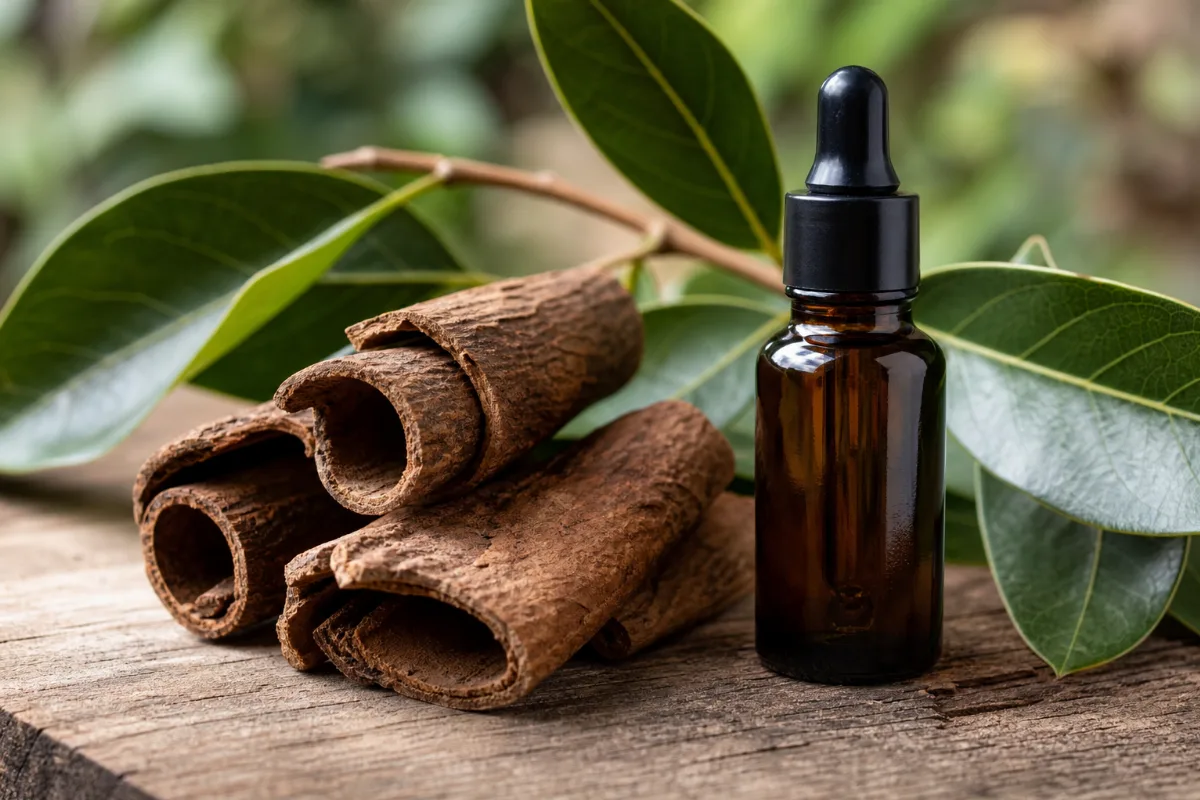
Essential Oils & Aromatherapy · Essential oil
Cassia Oil
Cinnamomum cassia (also named Cinnamomum aromaticum) · also called Cassia oil, cassia bark oil, Chinese cinnamon oil, cassia cinnamon oil
Cassia oil is a strong, spicy-sweet essential oil from the bark or leaves of the Chinese cassia tree, a close relative of cinnamon. It is mostly cinnamaldehyde, the compound that gives cinnamon its smell. People use it for scent and try it for infections and nausea, but the evidence is thin: one small gel pilot and lab work. The main caution: aromatherapy groups and NCCIH describe it as a strong skin irritant and sensitiser, and it must never be swallowed or used undiluted.
General information, not medical advice. Last substantive update · Not medically reviewed. A named clinician has not signed off on this page. How this page is made
About Cassia Oil
Cassia oil is a strong, spicy scent made from the bark or leaves of a cinnamon relative. The human research is thin: a pilot of a mouth gel that also held pomegranate extract, and a trial of cinnamon leaf oil for nausea that found no benefit. Safety comes first: aromatherapy groups and NCCIH describe it as a skin irritant and sensitiser, it must not be swallowed or used undiluted, and coumarin, linked to the liver in reports about the bark spice, is a question to keep separate for the oil.
What cassia oil is
Cassia oil comes from the Chinese cassia tree, a cinnamon relative in the laurel family (Lauraceae). The tree has two scientific names in use: most papers on the oil say Cinnamomum cassia, while NCCIH and GBIF accept Cinnamomum aromaticum. The oil can be made from bark or from leaves.
The oil is mostly cinnamaldehyde, about 87% to 92% in the oils measured, which gives the cinnamon smell. It is also the cinnamal skin allergen. Bark and leaf oils differ in smaller compounds, and across 20 oils researchers found four chemotypes (kinds).
Cassia is not the same as Ceylon cinnamon. The two trees differ in coumarin: a review gives up to 3.6 g/kg in cassia against 15 mg/kg or less in Ceylon cinnamon (spice figures).
What people use it for, and how strong the evidence is
For thrush, the one human study of a cassia oil product was a 2026 pilot of a gel that also held pomegranate peel extract, in denture wearers. Symptoms resolved after 14 days, while the comparison medicine gave partial improvement. The abstract gives no patient numbers, so this is a promising lead at best.
For nausea after cesarean section, a trial of cinnamon leaf oil (species not stated) with oxygen found no difference from saline.
Everything else is laboratory or animal work. Test tubes show the oil slowing bacteria, Candida and moulds, and a mouse study shows less lung inflammation. Neither shows a benefit in people.
The spice is a different product
Most human trials of cinnamon, mainly for blood sugar, used the spice or extracts of mixed species. They report modest falls in blood sugar. They say nothing about the essential oil, and the coumarin question belongs to the bark spice. NCCIH says research does not clearly support cinnamon for any health condition.
The research in one view
No trial of cassia bark oil alone in people was found. The only human studies are a pilot of a two-plant gel and a null trial of cinnamon leaf oil. No meta-analysis of the oil was found.
Lab evidence is not human evidence. Strong germ-killing in a dish goes with strong irritation of living tissue.
What regulators and expert groups say
NCCIH says research does not clearly support cinnamon for any health condition and describes skin irritation, coumarin and liver reports, and theoretical interactions. The European Commission's lay summary of a 2012 safety opinion lists cinnamal, cinnamyl alcohol, coumarin and eugenol among the fragrance chemicals most often reported as contact allergens.
We did not find or read a statement from IFRA, FDA or EMA about cassia oil, and we did not open the EFSA coumarin opinion.
At a glance
Traditional uses history, not proof
- NCCIH says the bark, leaves, flowers, fruits and roots of cinnamon have a long history in traditional medicine and cooking in China, India and Persia (this covers cinnamon in general).
- The authors of a 2024 mouse study say cassia is recorded in an old Chinese herbal text for lung problems and inflammation; we did not read that text.
- We did not find a history specific to the essential oil in the sources read, so none is claimed.
Studied for research
- Oral thrush, a mouth gel with pomegranate extract, very-low
- Nausea after surgery, inhaled cinnamon leaf oil, insufficient (no benefit found)
- Germ-killing in the laboratory, insufficient
- Lung inflammation in mice, insufficient
- Blood sugar, studied only with the spice, insufficient for the oil
- Mosquito repellent, unclear (NCCIH)
Main compounds
- Cinnamaldehyde, about 87% to 92% of the oils measured
- Coumarin, a minor constituent in one bark oil analysis
- o-Methoxycinnamaldehyde, a main compound in one oil
- Caryophyllene, borneol and nerolidol, aroma compounds
Common forms
- Essential oil from the bark
- Essential oil from the leaves
- A prepared mouth gel with cassia oil (research product)
- Cassia bark as a spice, tea or capsule (a different product)
Research links: NCCIH: Cinnamon usefulness and safety · Poison Control: Essential oils · Pet Poison Helpline: Essential oils · Tisserand Institute: Cinnamon survey (summary) · NAHA: Aromatherapy safety · Cassia oil gel for oral thrush, pilot (abstract) · Cinnamon leaf oil and nausea, randomised trial (abstract) · Mud bath dermatitis from cinnamon oil, case report (abstract) · GBIF: Cinnamomum aromaticum · Research Library · Genes & Biomarkers Library
What it is and its history
- Accepted scientific name
- Cinnamomum aromaticum
- Naming authority
- Nees
- Synonyms
- Name: Cinnamomum cassia; Note: Name used in most papers on the oil; see naming note.
- Common names
- Cassia oil (English); Cassia bark oil (English); Chinese cinnamon oil (English); Cassia cinnamon oil (English)
- Family or group
- Lauraceae (laurel family), per GBIF.
- Classification
- Plantae > Tracheophyta > Magnoliopsida > Laurales > Lauraceae > Cinnamomum > Cinnamomum aromaticum
- Native range
- NCCIH says cassia cinnamon is grown in areas of southeastern Asia and is the most common type sold in North America. Native range not checked in a botanical source.
- Habitat
- Not checked in a source read.
- What it looks like
- Part used: Oil is made from bark or from leaves. One paper hydrodistilled both; bark gave 1.56% and leaf 0.83% of oil. This page does not describe how to recognise the tree.
- Look-alikes and adulterants
- Name: Ceylon cinnamon (Cinnamomum verum, also called C. zeylanicum) and other Cinnamomum species such as C. burmannii and C. loureiroi; Note: Different trees with different coumarin levels and oil chemistry; results do not carry between them. Labels and papers often do not say which was used.
- Sustainability and conservation
- Not checked (no IUCN or CITES source read).
Photographs
Traditional use and history history, not clinical proof
| Tradition or era | Documented use | Source |
|---|---|---|
| Traditional medicine, spice and cuisine | NCCIH says the bark, leaves, flowers, fruits and roots of cinnamon have a long history in traditional medicine and cuisine in China, India and Persia, and that cinnamon was thought to help inflammation, nerve pain, heart disease and cough. This covers the spice and cinnamon in general. | NCCIH, Cinnamon: Usefulness and Safety (2024) |
| Traditional Chinese medicine | The authors of a 2024 mouse study say cassia is recorded in Shennong's Herbal Classic and used for respiratory conditions and inflammation. We did not read that text and treat this as the authors' statement. | Liu et al. 2024 (abstract) |
Traditional use shows how it was used. It does not show that it works or is safe today.
What is inside, and how it may work
What it contains and how those compounds act in cells and animals. Laboratory and animal mechanisms are not proven effects in people.
Main compounds
| Compound | Family | Where it is concentrated | Activity studied | Level of evidence |
|---|---|---|---|---|
| Cinnamaldehyde (trans-cinnamaldehyde) PubChem 637511 | phenylpropanoid aldehyde | Bark and leaf oil About 87% in one bark oil, 89% in another; a review gives 55% to 85% of bark oil; 91% to 93% in spring and autumn leaf oil. Varies. | The main aroma compound; the authors say it activates TRPA1 and TRPV1 channels that give the sense of spiciness. Strong activity against germs in test tubes. It is also the cinnamal skin allergen. 20 4 16 3 5 10 6 | Laboratory |
| Coumarin PubChem 323 | benzopyrone | Cassia bark spice; minor constituent in one bark oil Spice: up to 3.6 g/kg in cassia (review); up to 43.73 mg/g in some extracts (lab study). No figure for oils in the abstracts read. | Linked to liver problems in reports about the spice; on the European fragrance allergen list. 20 3 13 4 15 6 | Human case reports |
| o-Methoxycinnamaldehyde | phenylpropanoid aldehyde | Bark oil Named a main compound in one mouse-study oil; amount not given in the abstract. | Not described beyond its listing. 12 | Laboratory |
| alpha-Caryophyllene, borneol, nerolidol | terpenes | Bark (caryophyllene, borneol) and leaf (caryophyllene, nerolidol) oil Odour-active compounds in one study; amounts not given in the abstract. | Contribute to the aroma; no health activity described in the abstract. 10 | Laboratory |
Mechanisms, receptors and pathways
| Target or pathway | Gene or receptor | What was found | Level |
|---|---|---|---|
| Bacterial and mould growth (test tube) | Not specified | Cassia bark oil slowed or killed gram-positive and gram-negative bacteria and moulds; whole oil acted better than purified cinnamaldehyde in one study; computer docking predicted coumarin binding to germ proteins. 4 16 | Laboratory research |
| Candida albicans cell membrane and lipid metabolism (test tube and computer) | Docking targets named in the paper, a prediction only | The oil damaged Candida cell membranes; metabolic changes pointed to fatty-acid and lipid pathways; six components were predicted to be functional. 9 | Laboratory research |
| Macrophage polarisation and TLR4/MyD88/NF-kB signalling (mouse) | TLR4, MyD88, NF-kB p65 | In mice with toxin-induced lung injury the oil lowered inflammatory signals and shifted macrophage types. 12 | Animal research |
| Skin allergy | Not specified | Cinnamal, cinnamyl alcohol, coumarin and eugenol are recognised contact allergens; patch tests in a mud-bath case were positive to several of them. This is an immune reaction, not a lab mechanism. 6 8 | Human case reports |
Absorption, metabolism and elimination
- Absorption
- Not established in the sources read.
- Distribution
- Not established.
- Metabolism
- Not established.
- Elimination
- Not established.
- Bioavailability
- Not established.
Isolated compounds versus whole extracts
In one test-tube study the whole bark oil slowed bacteria better than purified cinnamaldehyde although it had less of it. Oils differ by plant part, season and origin (four chemotypes in 20 oils), so a result for one oil or one compound does not describe another.
Nutritional composition
Cassia oil is not a food or a nutrient. Cassia bark spice is a separate product with its own coumarin question.
1 very low certainty5 not enough evidence
What is Cassia Oil good for?
The uses people ask about and how strong the evidence is for each. Read the certainty label first: nothing here is better than very low, and several results are about the spice or other cinnamon oils, not cassia bark oil.
Benefits, one by one
Each card is a research question, not a promise. Tap a goal to filter. Open a card to see the studies, doses and limits.
Oral thrush in denture wearers (a gel made with cassia oil and pomegranate peel extract)
Very low certaintyIn one 2026 pilot study, a gel containing cassia oil and pomegranate peel extract was followed by resolution of thrush symptoms in denture wearers after 14 days, while the comparison antifungal medicine (nystatin) gave only partial improvement. It was a two-ingredient gel, the abstract gives no patient numbers or blinding, and it says nothing about bottled oil.
1 studiesNot covered. This page gives no amounts and no way to use the oil.
Studies, doses and limits
What the trials found
One pilot clinical study of a finished mouth gel (cassia essential oil plus Punica granatum peel extract) against nystatin for 14 days. Number of patients not given in the abstract.
Results
The gel group had a satisfactory response with resolution of symptoms at the end of 14 days, and did better on ease of application, no irritation and less interference with speech and swallowing. The nystatin group improved only partly, and some needed more treatment. The authors call the gel promising and ask for longer follow-up.
Effect sizes as reported
No effect sizes or p-values in the abstract.
Why this rating
A pilot with no stated size, blinding or randomisation in the abstract; the gel has two plants so cassia oil cannot be credited alone; one short follow-up.
Form and dose studied
Not covered. This page gives no amounts and no way to use the oil.
Who was studied
Denture wearers with thrush.
Limits
Only the abstract was read. This is a prepared pharmaceutical gel, not evidence for putting bottled essential oil in the mouth. Cassia oil is a known irritant and sensitiser (see Safety).
Why researchers looked
Thrush (Candida) is common under dentures, and researchers look for plant-based options.
Traditional use
The authors say both plants are recognised for antimicrobial activity; the abstract gives no source.
Proposed mechanism Preliminary mechanism
In the test tube the two plant materials together slowed Candida albicans more than expected (synergy). Why the gel worked in people was not tested.
A proposed mechanism does not show that the effect happens in people.
A mouth gel is a finished product. Do not put essential oil in the mouth; cassia and cinnamon oils irritate mucous membranes and skin.
Nausea after cesarean section (inhaled cinnamon leaf oil with oxygen)
Not enough evidenceIn one 2026 trial of 60 women having a cesarean section, breathing cinnamon leaf oil with oxygen did not reduce nausea or vomiting in the first 6 hours compared with saline. It used leaf oil of an unstated species, so it cannot be credited to cassia bark oil.
1 studiesNot covered. This page gives no amounts and no way to use the oil.
Studies, doses and limits
What the trials found
One double-blind randomised trial: 60 women in four groups (28% or 40% oxygen, each with or without cinnamon leaf oil).
Results
No statistically significant difference between groups in vomiting episodes or nausea severity at the end of recovery or 6 hours later. The authors conclude neither high oxygen alone nor with cinnamon oil reduced nausea in that time.
Effect sizes as reported
No effect sizes in the abstract; the differences were not significant.
Why this rating
A single small trial with a null result. A null result from 60 people does not show the oil never helps, and the species of the leaf oil is unknown.
Form and dose studied
Not covered. This page gives no amounts and no way to use the oil.
Who was studied
Women having a planned cesarean under spinal anesthesia in Iran.
Limits
Leaf oil of unstated species. Abstract only.
Why researchers looked
Nausea after surgery is common, and earlier work has suggested inhaled cinnamon oil may help nausea after chemotherapy (the trial authors say so; their abstract gives no source).
Traditional use
None given.
Proposed mechanism Preliminary mechanism
Not assessed in this trial.
A proposed mechanism does not show that the effect happens in people.
Inhaled oil was used under supervision in a hospital. This is not advice to diffuse cassia oil.
Germ-killing action in the laboratory (bacteria, yeast and moulds)
Not enough evidenceIn test tubes, cassia bark and leaf oils slowed or killed several bacteria, a yeast (Candida albicans) and moulds. This is laboratory work only. A dish of germs is very different from an infection in a body, and strong oils that kill germs also irritate skin.
4 studiesNot covered. This page gives no amounts and no way to use the oil.
Studies, doses and limits
What the trials found
None. Laboratory studies of cassia bark oil and leaf oil.
Results
Bark oil (cinnamaldehyde 87.14%) slowed S. aureus, B. subtilis, E. coli and P. aeruginosa (MIC 0.52-1.04 mg/mL) and acted on the moulds Alternaria alternata and Aspergillus niger. In another paper whole bark oil beat purified cinnamaldehyde against six bacteria. A third showed strong action on Candida albicans with damage to its cell membrane. Leaf oil from spring had the lowest MIC (0.25 mg/mL) against S. aureus and L. monocytogenes, and its makeup changed by season. Across 20 cassia oils, composition fell into four chemotypes.
Effect sizes as reported
Test-tube MIC values only.
Why this rating
Test-tube and computer work only; amounts in a dish are not what reaches the body, and the oils differ between batches, plant parts and seasons.
Form and dose studied
Not covered. This page gives no amounts and no way to use the oil.
Who was studied
None (laboratory).
Limits
Does not show treatment of any infection. Some of the authors speak of food preservative use; none of this is advice to swallow or apply the oil.
Why researchers looked
Researchers screen plant oils as natural preservatives and germ-fighters.
Traditional use
One paper says the plant has wide use in traditional Chinese medicine for bacterial and fungal infections; this is the authors' statement.
Proposed mechanism Preliminary mechanism
Cinnamaldehyde is the main compound (about 87% to 92% in the oils measured). In one study cassia oil damaged the cell membranes of Candida, and in another the whole oil beat purified cinnamaldehyde. Computer docking predictions are guesses, not proof.
A proposed mechanism does not show that the effect happens in people.
Test-tube activity does not make the oil safe or useful on the body.
Lung inflammation in mice (animal study)
Not enough evidenceIn mice given a bacterial toxin into the lungs, cassia bark oil given by mouth reduced signs of lung inflammation and damage. This is animal work only and says nothing about people breathing or swallowing the oil.
1 studiesNot covered. This page gives no amounts and no way to use the oil.
Studies, doses and limits
What the trials found
None. Mouse study.
Results
The oil lowered inflammatory signals (TNF-alpha, IL-6, IL-1beta), lung fluid and tissue damage and improved lung function in the injured mice.
Effect sizes as reported
No human effect sizes.
Why this rating
Animal only.
Form and dose studied
Not covered. This page gives no amounts and no way to use the oil.
Who was studied
Mice.
Limits
Does not show any effect or safety in people. A swallowed essential oil can reach the lungs and cause pneumonia (Poison Control).
Why researchers looked
The authors say the plant is recorded in an old Chinese herbal text for lung conditions and inflammation.
Traditional use
Recorded in "Shennong's Herbal Classic" according to the paper's abstract; we did not read that text.
Proposed mechanism Preliminary mechanism
The authors report effects on macrophage types and the TLR4/MyD88/NF-kB signalling pathway in mice.
A proposed mechanism does not show that the effect happens in people.
Poison Control warns that oil entering the lungs can cause pneumonia.
Blood sugar (studied with the spice and extracts, not the oil)
Not enough evidenceReviews of trials of whole cinnamon spice or extracts report modest drops in fasting blood sugar and HbA1c, but the species, preparation and amount differ too much to compare. No source we read tested the essential oil for blood sugar. NCCIH says research does not clearly support cinnamon for any health condition.
2 studiesNot covered. This page gives no amounts and no way to use the oil.
Studies, doses and limits
What the trials found
Review of trials of spice or extract (mixed species) and an NCCIH summary. No trial of the oil.
Results
Spice and extract trials show consistent but modest falls in fasting glucose and HbA1c, most reliably in people with established blood sugar problems. NCCIH says it is unclear whether cinnamon supplements help diabetes or weight loss. Cassia spice can carry high coumarin (see Safety).
Effect sizes as reported
Modest reductions; no figures taken from the abstract.
Why this rating
These are spice or extract results, mixed species, and not the oil. Nothing here supports using the oil for blood sugar.
Form and dose studied
Not covered. This page gives no amounts and no way to use the oil.
Who was studied
People with and without diabetes, in spice and extract trials.
Limits
Different product from the oil. Keep the spice evidence separate from this page's subject.
Why researchers looked
Cinnamon is widely marketed for diabetes and weight loss.
Traditional use
NCCIH says cinnamon was thought to help inflammation, nerve pain, heart disease and cough in traditional medicine.
Proposed mechanism Preliminary mechanism
Preclinical work suggests several ways cinnamon compounds act on glucose; none was tested for the oil.
A proposed mechanism does not show that the effect happens in people.
Do not swallow the oil. People on diabetes medicines should ask a pharmacist before any cinnamon product.
Mosquito repellent claim
Not enough evidenceNCCIH says it is unclear whether cassia cinnamon works as a mosquito repellent. We found no trial of the oil, and the oil is a strong skin sensitiser.
1 studiesNot covered. This page gives no amounts and no way to use the oil.
Studies, doses and limits
What the trials found
None found.
Results
NCCIH: unclear. No human repellent trial of cassia oil was read.
Effect sizes as reported
None.
Why this rating
No trial found; regulator summary says unclear.
Form and dose studied
Not covered. This page gives no amounts and no way to use the oil.
Who was studied
None.
Limits
Only an NCCIH page was read on this topic.
Why researchers looked
Cassia cinnamon is promoted for use on the skin to repel mosquitoes.
Traditional use
NCCIH lists it among promoted uses.
Proposed mechanism Preliminary mechanism
Not assessed.
A proposed mechanism does not show that the effect happens in people.
Strong skin sensitiser: do not put it on skin for this purpose.
Connections to the rest of health
How Cassia Oil connects to the rest of our health knowledge graph. Every link says what kind of connection it is. A safety link (for example to the liver) is a warning, not a benefit. A study that merely mentions a topic never creates a benefit link.
Explore every connection: goals, body systems, organs, symptoms, genes
A. Wellness goals
| Connected to | Kind of connection | Evidence status | Context | Studies |
|---|---|---|---|---|
| Immune Support | Very low certainty | Oral thrush in denture wearers (a gel made with cassia oil and pomegranate peel extract): In one 2026 pilot study, a gel containing cassia oil and pomegranate peel extract was followed by resolution of thrush symptoms in denture wearers after 14 days, while the comparison antifungal medicine (nystatin) gave only partial improvement. It was a two-ingredient gel, the abstract gives no patient numbers or blinding, and it says nothing about bottled oil. | 22 | |
| Digestive Support | Not enough evidence | Nausea after cesarean section (inhaled cinnamon leaf oil with oxygen): In one 2026 trial of 60 women having a cesarean section, breathing cinnamon leaf oil with oxygen did not reduce nausea or vomiting in the first 6 hours compared with saline. It used leaf oil of an unstated species, so it cannot be credited to cassia bark oil. | 21 | |
| Immune Support | Not enough evidence | Germ-killing action in the laboratory (bacteria, yeast and moulds): In test tubes, cassia bark and leaf oils slowed or killed several bacteria, a yeast (Candida albicans) and moulds. This is laboratory work only. A dish of germs is very different from an infection in a body, and strong oils that kill germs also irritate skin. | 16 4 9 5 | |
| Lung Support | Not enough evidence | Lung inflammation in mice (animal study): In mice given a bacterial toxin into the lungs, cassia bark oil given by mouth reduced signs of lung inflammation and damage. This is animal work only and says nothing about people breathing or swallowing the oil. | 12 | |
| Blood Sugar Balance | Not enough evidence | Blood sugar (studied with the spice and extracts, not the oil): Reviews of trials of whole cinnamon spice or extracts report modest drops in fasting blood sugar and HbA1c, but the species, preparation and amount differ too much to compare. No source we read tested the essential oil for blood sugar. NCCIH says research does not clearly support cinnamon for any health condition. | 3 15 | |
| Healthy Skin | Not enough evidence | Mosquito repellent claim: NCCIH says it is unclear whether cassia cinnamon works as a mosquito repellent. We found no trial of the oil, and the oil is a strong skin sensitiser. | 15 |
B. Body systems
| Connected to | Kind of connection | Evidence status | Context | Studies |
|---|---|---|---|---|
| Immune System | Biological association | Very low certainty | Studied for: Oral thrush in denture wearers (a gel made with cassia oil and pomegranate peel extract) Studied for: Germ-killing action in the laboratory (bacteria, yeast and moulds) | 22 16 4 9 5 |
| Digestive System | Biological association | Not enough evidence | Studied for: Nausea after cesarean section (inhaled cinnamon leaf oil with oxygen) | 21 |
| Respiratory System | Biological association | Not enough evidence | Studied for: Lung inflammation in mice (animal study) | 12 |
| Endocrine System | Biological association | Not enough evidence | Studied for: Blood sugar (studied with the spice and extracts, not the oil) | 3 15 |
| Integumentary System | Biological association | Not enough evidence | Studied for: Mosquito repellent claim | 15 |
E. Health conditions
| Connected to | Kind of connection | Evidence status | Context | Studies |
|---|---|---|---|---|
| Contact dermatitis | Adverse effect or risk | Documented risk | Tisserand, NAHA and NCCIH describe high skin-reaction risk; case reports show blistering and lasting allergy. Preparation or compound: Cassia or cinnamon oil on skin |
23 14 15 8 |
| Pregnancy | Not enough evidence | Safety in pregnancy not clearly demonstrated; no cassia-specific data found. Preparation or compound: Essential oils in general |
11 |
I. Biomarkers
| Connected to | Kind of connection | Evidence status | Context | Studies |
|---|---|---|---|---|
| Oral thrush symptoms (clinical signs in the mouth) | Biological association | Very low certainty | Measured in trials: improvement. A lab change is not the same as a health benefit. | 22 |
| Nausea severity (visual scale) and vomiting episodes | Biological association | Not enough evidence | Measured in trials: decrease. A lab change is not the same as a health benefit. | 21 |
| Minimum inhibitory concentration (MIC) in the laboratory | Biological association | Not enough evidence | Measured in trials: lower MIC = stronger action in a dish. A lab change is not the same as a health benefit. | 4 5 |
| Fasting blood glucose and HbA1c (in spice and extract trials) | Biological association | Not enough evidence | Measured in trials: decrease. A lab change is not the same as a health benefit. | 3 |
L. Active compounds
| Connected to | Kind of connection | Evidence status | Context | Studies |
|---|---|---|---|---|
| Cinnamaldehyde (trans-cinnamaldehyde) | Biological association | Laboratory | The main aroma compound; the authors say it activates TRPA1 and TRPV1 channels that give the sense of spiciness. Strong activity against germs in test tubes. It is also the cinnamal skin allergen. Preparation or compound: Bark and leaf oil |
20 4 16 3 5 10 6 |
| Coumarin | Biological association | Human case reports | Linked to liver problems in reports about the spice; on the European fragrance allergen list. Preparation or compound: Cassia bark spice; minor constituent in one bark oil |
20 3 13 4 15 6 |
| o-Methoxycinnamaldehyde | Biological association | Laboratory | Not described beyond its listing. Preparation or compound: Bark oil |
12 |
| alpha-Caryophyllene, borneol, nerolidol | Biological association | Laboratory | Contribute to the aroma; no health activity described in the abstract. Preparation or compound: Bark (caryophyllene, borneol) and leaf (caryophyllene, nerolidol) oil |
10 |
Each connection is stored with the ingredient, the connected record, the kind of connection, the evidence status, the supporting studies, the preparation or compound involved, and a review date (last reviewed October 25, 2026).
The evidence
The research centre for Cassia Oil. Every record here was checked against PubMed or the publisher's page; we never list a study we have not verified.
Evidence by outcome
Bars show how many studies we found for each outcome, not how well it works. People are added up across trials only (reviews are not added, to avoid double counting).
How we rate evidence
High certainty
Several well-run trials or reviews agree; further research is unlikely to change the picture much.
Moderate certainty
Good trials point the same way, but some doubt remains.
Low certainty
Small, short or inconsistent trials. The finding could change with better research.
Very low certainty
Very little or very weak human data. Treat as a possibility only.
Mixed findings
Trials or reviews disagree with each other.
Not enough evidence
Not enough human research to say either way.
Evidence against
Good research found no benefit, or found harm.
We take the reviewers' own risk-of-bias and GRADE statements where they exist, and otherwise judge from study size, design, consistency, directness and whether a product matches what is sold. Many publications do not make evidence high. Method note: We read the abstracts of 19 PubMed papers, the NCCIH, Poison Control, Pet Poison Helpline, NAHA and European Commission pages, and the free Tisserand summary, and checked the plant name in GBIF and two compounds in PubChem. We did not read LiverTox, LactMed, IFRA or FDA statements.
Study library: every study we checked 25
| Study | Design | People | Product, dose, length | Result |
|---|---|---|---|---|
| Abraham 2010 Toxicology and risk assessment of coumarin: focus on human data. Mol Nutr Food Res · PMID 20024932 · DOI |
Narrative review plus telephone survey review |
Coumarin intake in Germany; review of human liver data | Coumarin from food, mainly cassia cinnamon spice Spice Not repeated here n/a · vs n/a |
Coumarin has liver-damaging and carcinogenic properties in animals. The review says EFSA set a tolerable daily intake from animal liver data and that human data from people treated with coumarin as a drug confirmed the same value, with a subgroup of people more susceptible than animals, for unknown reasons. Food exposure is mainly from cassia cinnamon in cookies and sweet dishes, and heavy consumers of cassia cinnamon may reach a coumarin intake equal to the limit. Methods, limits and fundingOutcomes: Liver toxicity, tolerable daily intake Limitations: About the spice and coumarin as a drug, not the essential oil. 2010 review; abstract only. Funding and conflicts: Not stated in the abstract (German federal risk institute authors). Read: abstract |
| Ackermann 2009 Occupational allergic contact dermatitis from cinnamon including one case from airborne exposure. Contact Dermatitis · PMID 19207380 · DOI |
Case series (clinic records) human case series |
6 Six patients with delayed contact allergy to cinnamon at two Helsinki skin clinics |
Cinnamon spice (bark); the abstract says its flavour is from an oil containing mainly cinnamal Bark spice Not repeated here n/a · vs n/a |
Six patients had delayed (type IV) contact allergy to cinnamon. In four, cinnamon was the main cause of occupational dermatitis (hands in three, face and neck in one, shown to be airborne). One case was cross-allergy to fragrances. Five reacted to cinnamal separately and to fragrance mix I. None had immediate-type allergy. The authors call occupational cinnamon allergy rare and say cinnamal is possibly the main allergen. Methods, limits and fundingOutcomes: Contact allergy; patch tests Limitations: Spice exposure at work, not the pure oil; six patients; species not named in the abstract. Funding and conflicts: Not stated in the abstract. Read: abstract |
| Balkrishna 2026 A critical appraisal of anti-hyperglycemic mechanisms, matrix-dependent bioavailability, and species-stratified safety of Cinnamomum spp. as functional food ingredients. Food Res Int · PMID 42169286 · DOI |
Narrative review (more than 150 studies) review of human and preclinical work |
Cinnamon as a food ingredient; blood sugar | Whole cinnamon spice or extracts (mixed species) Bark spice and extracts, not essential oil Not repeated here n/a · vs n/a |
Preclinical studies suggest several ways cinnamon compounds act on glucose. Clinical trials of whole spice or extracts report consistent, modest drops in fasting glucose and HbA1c, most reliably in people who already have blood sugar problems, but species, preparation and dose differ too much to compare. The review gives cinnamaldehyde as 55-85% of bark oil and says cassia varieties may contain up to 3.6 g/kg coumarin versus 15 mg/kg or less in C. verum, with implications for intake relative to the EFSA tolerable daily intake. Methods, limits and fundingOutcomes: Blood sugar mechanisms, matrix effects, species-related safety Limitations: Spice and extract, not oil. The authors are from a company-linked institution (Patanjali); the abstract declares no competing interests. Only the abstract was read. Funding and conflicts: Authors declared no competing interests. Read: abstract |
| Bouguerra 2026 Antimicrobial Activity of Cinnamomum cassia Essential Oil: Phytochemical Profiling, In Vitro Evaluation, and Molecular Docking. Chem Biodivers · PMID 42801756 · DOI |
Laboratory study with computer docking laboratory |
Four bacterial strains and two moulds in the laboratory | Cinnamomum cassia bark oil (yield 2.51%) Bark Not repeated here n/a · vs n/a |
Seven constituents were identified, with (E)-cinnamaldehyde the main one (87.14%) and coumarin named as a minor constituent. The oil slowed or killed S. aureus, B. subtilis, E. coli and P. aeruginosa (MIC 0.52-1.04 mg/mL, MBC 0.52-2.08 mg/mL), with gram-positive strains more susceptible, and acted on the moulds Alternaria alternata and Aspergillus niger. Computer docking predicted coumarin to bind strongly to bacterial and fungal targets. The authors suggest a natural food preservative. Methods, limits and fundingOutcomes: Composition, inhibition zones, MIC and MBC, docking Limitations: Test tube and computer prediction only; the coumarin amount in the oil is not given in the abstract. Funding and conflicts: Authors declared no competing interests. Read: abstract |
| Cheng 2024 Seasonal Variation in Chemical Composition and Antioxidant and Antibacterial Activity of Essential Oil from Cinnamomum cassia Leaves. Plants (Basel) · PMID 39795342 · DOI |
Laboratory study laboratory |
Cassia leaf oils from four seasons, tested in the laboratory | Cinnamomum cassia leaf oil Leaf Not repeated here n/a · vs n/a |
Leaf oil yield and trans-cinnamaldehyde were highest in spring and autumn (2.20% and 1.95% oil; 92.59% and 91.10% trans-cinnamaldehyde). The spring oil slowed S. aureus and L. monocytogenes at the lowest MIC (0.25 mg/mL). Composition changed with season, temperature and humidity. Methods, limits and fundingOutcomes: Composition, antioxidant and antibacterial activity Limitations: Leaf oil, test tube only. Shows the oil varies by season. Funding and conflicts: Authors declared no competing interests. Read: abstract |
| European Commission 2012 Perfume allergies, introduction (European Commission, lay summary of the 2012 SCCS opinion) n/a · Source |
Authoritative web page n/a |
n/a | n/a n/a Not repeated here n/a · vs n/a |
Lists cinnamal, cinnamyl alcohol, coumarin and eugenol (with others) in List A: fragrance chemicals most frequently reported and well recognised as consumer contact allergens. Methods, limits and fundingOutcomes: Safety statements Limitations: A lay summary page; the SCCS opinion itself was not opened. About fragrance chemicals, not a ruling on cassia oil. Read: full-text |
| GBIF 2026 GBIF Backbone Taxonomy: Cinnamomum aromaticum Nees and Cinnamomum cassia (match API read 2026-10-25) n/a · Source |
Registry or database n/a |
n/a | n/a n/a Not repeated here n/a · vs n/a |
GBIF accepts Cinnamomum aromaticum Nees (species key 3033982, family Lauraceae). In the GBIF backbone the name Cinnamomum cassia (L.) J.Presl is listed as a synonym of Neolitsea cassia (L.) Kosterm., a different plant, and Cinnamomum cassia Nees ex Blume is listed as doubtful. NCCIH treats C. aromaticum as also known as C. cassia. The names are therefore unsettled, and papers use C. cassia (often Blume or Presl) for the Chinese cassia tree that gives the oil. Methods, limits and fundingOutcomes: Accepted name and family Limitations: Names read from the match and species-search API only; the nomenclature literature was not read. Read: full-text |
| Garcia-Abujeta 2005 Mud bath dermatitis due to cinnamon oil. Contact Dermatitis · PMID 15860002 · DOI |
Case report human case report |
1 One 74-year-old woman (Spain) |
Cinnamon essential oil in a spa mud bath (species not stated in the abstract) Not stated Not repeated here Single bath; patch tests 5 years later · vs n/a |
Long-lasting, extensive eczematous and bullous (blistering) dermatitis on exposed arms and legs began within 24 hours of a mud bath with cinnamon essential oil. Patch tests five years later were positive to fragrance mix, cinnamon essence, eugenol, cinnamic alcohol and cinnamic aldehyde. Methods, limits and fundingOutcomes: Skin reaction; patch tests Limitations: One case, species of cinnamon not stated, so it cannot be tied to cassia. Abstract only. Funding and conflicts: Not stated. Read: abstract |
| Gu 2024 Deciphering the antifungal mechanism and functional components of cinnamomum cassia essential oil against Candida albicans through integration of network-based metabolomics and pharmacology, the greedy algorithm, and molecular docking. J Ethnopharmacol · PMID 37729978 · DOI |
Laboratory study with computer modelling laboratory |
Candida albicans cells in the laboratory | Cinnamomum cassia essential oil (hydrodistilled) Not stated in the abstract Not repeated here n/a · vs n/a |
Cassia oil showed strong antifungal activity and damaged C. albicans cell membranes in a concentration-dependent way. Metabolic changes pointed to fatty-acid and lipid metabolism. Six components, including trans-cinnamaldehyde, were predicted to be the functional ones by computer docking. Across 20 cassia oils from different places the makeup differed widely, with four major chemotypes. Methods, limits and fundingOutcomes: Antifungal effect, cell damage, metabolic changes, composition across 20 oils Limitations: Test tube and computer. Not a test in infected people. Funding and conflicts: Not stated in the abstract. Read: abstract |
| Huang 2025 Compounds of Essential Oils from Different Parts of Cinnamomum cassia and the Perception Mechanism of Their Characteristic Flavors. Foods · PMID 41154105 · DOI |
Laboratory chemistry laboratory |
Oils from C. cassia (Xijiang) bark and leaf, hydrodistilled | Cinnamomum cassia bark oil and leaf oil Bark and leaf Not repeated here n/a · vs n/a |
Yield was 1.56% for bark and 0.83% for leaf. Bark oil had 45 compounds and leaf oil 50. Cinnamaldehyde was the leading aroma compound in both (odour activity value 935 bark, 849 leaf); alpha-caryophyllene mattered in both, borneol in bark, nerolidol in leaf. The authors say cinnamaldehyde activates the TRPA1 and TRPV1 channels that give the sense of spiciness, and suggest food uses. Methods, limits and fundingOutcomes: Composition (GC-MS), odour and flavour Limitations: Chemistry and flavour only; one variety; nothing about health. Funding and conflicts: Authors declared no competing interests. Read: abstract |
| Lis-Balchin 1999 Possible health and safety problems in the use of novel plant essential oils and extracts in aromatherapy. J R Soc Promot Health · PMID 10673845 · DOI |
Narrative review review |
Aromatherapy practice | Essential oils in general n/a Not repeated here n/a · vs n/a |
The review says that most commonly used oils in massage have low systemic toxicity when properly diluted and not adulterated, but their safety in pregnancy, childbirth and babies has not been clearly demonstrated, and sensitisation is a growing concern. Methods, limits and fundingOutcomes: Safety Limitations: 1999 review of oils in general. Abstract only. Funding and conflicts: Not stated. Read: abstract |
| Liu 2024 Essential oil from Cinnamomum cassia Presl bark regulates macrophage polarization and ameliorates lipopolysaccharide-induced acute lung injury through TLR4/MyD88/NF-kB pathway. Phytomedicine · PMID 38688144 · DOI |
Animal study animal (mouse) |
Mice given a bacterial toxin (LPS) into the airways to cause lung injury | Cinnamomum cassia bark oil (supercritical CO2 extraction) Bark Not repeated here n/a · vs Untreated injured mice |
In mice, the oil reduced lung fluid, inflammatory signals (TNF-alpha, IL-6, IL-1beta) and lung tissue damage, and the authors report it acted through the TLR4/MyD88/NF-kB pathway. The main components were trans-cinnamaldehyde and o-methoxycinnamaldehyde. Methods, limits and fundingOutcomes: Lung inflammation markers, lung function, macrophage types Limitations: Mouse study with an oil given by mouth; says nothing about safety or benefit in people. This page does not advise swallowing any oil. Funding and conflicts: Not stated in the abstract. Read: abstract |
| Mancak 2025 Are cinnamon derivatives effective and safe for diabetes? Turk J Med Sci · PMID 40104311 · DOI |
Laboratory analysis of 7 commercial samples laboratory |
7 Seven bought cinnamon products (sticks, tea bags, capsules) |
Cinnamon sticks, tea bags and capsules (aqueous and ethanol extracts) Bark products Not repeated here n/a · vs n/a |
Samples inhibited diabetes-related enzymes in the lab. Extracts held 7.73-333.69 mg/g trans-cinnamaldehyde and up to 43.73 mg/g coumarin. Extracts of C. cassia, C. burmannii and C. loureiroi sticks held high coumarin that could pose a health risk by EFSA data. The ready-made herbalist products showed activity but no detectable trans-cinnamaldehyde or coumarin. The authors stress that the source of cinnamon matters. Methods, limits and fundingOutcomes: Chemical content and enzyme inhibition Limitations: Spice and extracts, not essential oil; seven samples; laboratory only. Funding and conflicts: Not stated in the abstract. Read: abstract |
| NAHA (US professional association) 2026 Safety (National Association for Holistic Aromatherapy) n/a · Source |
Authoritative web page n/a |
n/a | n/a n/a Not repeated here n/a · vs n/a |
NAHA lists cassia (Cinnamomum cassia) among oils considered dermal sensitizers that are not recommended for aromatherapy massage. Its tables of skin irritants and mucous-membrane irritants name cinnamon bark or leaf (C. zeylanicum), not cassia, and it says cinnamon bark should be avoided in baths completely. Methods, limits and fundingOutcomes: Safety statements Limitations: The irritant tables name Ceylon cinnamon, so they cannot be read as statements about cassia. Page undated. Read in full on 2026-10-25. Read: full-text |
| NCCIH (US National Institutes of Health) 2024 Cinnamon: Usefulness and Safety (NCCIH; last updated November 2024) n/a · Source |
Authoritative web page n/a |
n/a | n/a n/a Not repeated here n/a · vs n/a |
Lists Cinnamomum aromaticum (also known as C. cassia) as cassia cinnamon. Research does not clearly support cinnamon for any health condition and many studies do not state species or part. Coumarin in cassia cinnamon has been reported to interact with the liver; usual food amounts do not generally contain enough to cause significant problems, but some cassia products contain high levels, and prolonged use could be an issue for sensitive people such as those with liver disease. Some topical cinnamon oil or powder may cause skin irritation or contact dermatitis. Theoretical interactions of cinnamon components with an anticancer medicine and nicotine. Large amounts of Ceylon cinnamon in pregnancy are considered unsafe and little is known about larger amounts while breastfeeding. It is unclear whether cassia cinnamon works as a mosquito repellent. Methods, limits and fundingOutcomes: Safety statements Limitations: Page about the spice and cinnamon in general, not specifically the essential oil. Read in full on 2026-10-25. Read: full-text |
| Nguyen 2023 Short communication: Antibacterial effects of essential oils from Cinnamomum cassia bark and Eucalyptus globulus leaves-The involvements of major constituents. PLoS One · PMID 37450504 · DOI |
Laboratory study laboratory |
Six gram-positive and gram-negative bacteria in the laboratory | Cinnamomum cassia bark oil (E-cinnamaldehyde 89.1%) against purified cinnamaldehyde Bark Not repeated here n/a · vs Purified (E)-cinnamaldehyde and 1,8-cineole |
In all three methods, the whole bark oil produced better antibacterial effects than purified cinnamaldehyde, even though the oil had less cinnamaldehyde (89.1% against 99% or more). The authors suggest this supports whole oils in traditional use. Methods, limits and fundingOutcomes: Antibacterial effect in liquid and vapour Limitations: Test tube only. The authors say the oils were traditionally applied by aromatherapy and by mouth; this page does not support swallowing any oil. No effect in people was tested. Funding and conflicts: Authors declared no competing interests. Read: abstract |
| Pet Poison Helpline 2026 Essential Oils (Pet Poison Helpline) n/a · Source |
Authoritative web page n/a |
n/a | n/a n/a Not repeated here n/a · vs n/a |
Essential oil poisoning can affect cats, dogs, birds, small mammals, large animals and exotic species, with cats and birds at the greatest risk. The page text read does not name cassia or cinnamon. Methods, limits and fundingOutcomes: Safety statements Limitations: A general statement, not cassia data. Read on 2026-10-25. Read: full-text |
| Pilapil 1989 Toxic manifestations of cinnamon oil ingestion in a child. Clin Pediatr (Phila) · PMID 2721094 |
Case report (title only) human case report |
1 A child |
Cinnamon oil swallowed (species not known) Not known Not repeated here Not known · vs n/a |
Only the title could be read: PubMed holds no abstract for this 1989 case report. We therefore do not describe what happened, how much was swallowed or the outcome. Methods, limits and fundingOutcomes: Not known Limitations: Title only; nothing beyond the fact that a case report with this title exists is claimed. Funding and conflicts: Not known. Read: title-only |
| Poison Control (National Capital Poison Center) 2026 Essential oils: Poisonous when misused (Poison Control) n/a · Source |
Authoritative web page n/a |
n/a | n/a n/a Not repeated here n/a · vs n/a |
Misuse of essential oils can cause serious poisoning. Some oils are poisonous if swallowed or absorbed through skin; breathing an oil into the lungs can cause pneumonia. Children have thin skin and immature livers and may be more susceptible. Oils may interact with medications. Products are not well regulated, so it can be hard to know species, concentration or contaminants. Pure oils are potent; diluting in a carrier oil is the best way to avoid a bad reaction from direct skin contact; do not use on damaged skin. The most common allergic reaction is a skin rash: wash it off. Keep oils locked away from children and pets. For a swallowed oil, call 1-800-222-1222 (US). Cassia and cinnamon oil are not named on the page. Methods, limits and fundingOutcomes: Safety statements Limitations: Not specific to cassia. The page text read carries no date. Read in full on 2026-10-25. Read: full-text |
| PubChem 2026 PubChem compound records: cinnamaldehyde (CID 637511) and coumarin (CID 323), read 2026-10-25 n/a · Source |
Registry or database n/a |
n/a | n/a n/a Not repeated here n/a · vs n/a |
Cinnamaldehyde: CID 637511, formula C9H8O, (E)-3-phenylprop-2-enal. Coumarin: CID 323, formula C9H6O2, chromen-2-one. Methods, limits and fundingOutcomes: Compound identity Limitations: Identity only. Read: full-text |
| Sadeghi 2026 The Effect of Combination of Cinnamon and Oxygen Different Concentrations Inhalation Aromatherapy on, Nausea, Assessment in Cesarean Section Under Spinal Anesthesia: A Clinical Trial. J Perianesth Nurs · PMID 42412022 · DOI |
Randomized double blind trial |
60 Women having a planned cesarean section under spinal anesthesia (Iran) |
Inhaled cinnamon leaf oil with oxygen at two oxygen strengths, against saline Leaf (species not stated in the abstract) Not repeated here During surgery; nausea followed for 6 hours · vs Saline with oxygen |
No statistically significant difference between the four groups in vomiting episodes or nausea severity at the end of recovery or at 6 hours (P > 0.05). The authors conclude that high oxygen alone or with cinnamon oil did not reduce nausea in the first 6 hours. No difference between groups Methods, limits and fundingOutcomes: Nausea severity (visual scale) and number of vomiting episodes at the end of recovery and 6 hours after surgery Limitations: Cinnamon LEAF oil of an unstated species, so it cannot be credited to cassia bark oil. Small trial, one setting, abstract only. Funding and conflicts: Funding statement not given in the abstract. Read: abstract |
| Santana 2026 Mucoadhesive Gel Based on Cinnamomum cassia Essential Oil and Punica granatum Extract for Oral Candidiasis: A Pilot Study of Plant Synergism. Pharmaceutics · PMID 42654031 · DOI |
Pilot clinical study with laboratory synergy test human (pilot) plus laboratory |
Denture wearers with clinical signs of oral candidiasis (thrush); number not given in the abstract | Mucoadhesive gel containing Cinnamomum cassia essential oil plus Punica granatum (pomegranate) peel extract Not stated in the abstract Not repeated here 14 days · vs nystatin |
The two plant materials together were synergistic against C. albicans in the test tube (inhibitory concentration 0.1953 mg/mL for both). In patients, the gel group had a satisfactory response with resolution of symptoms at the end of 14 days. The gel group also did better on ease of application, absence of irritation and less interference with speech and swallowing. The nystatin group had only partial improvement, with more treatment needed in some cases. The authors call the gel promising and ask for longer follow-up. Methods, limits and fundingOutcomes: Symptom response; ease of application; irritation; interference with speech and swallowing; checkerboard test against Candida albicans in the laboratory Limitations: A two-ingredient finished gel, so cassia oil cannot be credited alone. The abstract gives no number of patients, no blinding, no randomisation statement and no p-values. Only the abstract was read. This is not evidence for bottled oil in the mouth or on the skin. Funding and conflicts: Authors declared no conflicts of interest. Read: abstract |
| Tisserand Institute (Ablard 2015 Cinnamon Survey Special Report (Tisserand Institute; survey of May-June 2015) n/a · Source |
Authoritative web page n/a |
n/a | n/a n/a Not repeated here n/a · vs n/a |
The public summary says dermatologists and aromatherapists regard cinnamon bark and cassia essential oils as high risk for adverse skin reactions, yet consumers use them widely. A 2015 survey of 345 people was run to describe how often reactions happen, and the Institute says the findings confirm these are high-risk oils when used on the skin. Methods, limits and fundingOutcomes: Safety statements Limitations: Only the free summary of a paid 16-page report was read, so the actual reaction rates are not known here. A survey of volunteers cannot give a true rate. No dilution figure is repeated on this page. Read: full-text |
| Yesukumar 2025 Probable Cinnamon-Induced Mixed Hepatocellular-Cholestatic Liver Injury in a Young Woman: A Case Report. Cureus · PMID 41158894 · DOI |
Case report human case report |
1 One 34-year-old woman (Qatar) |
Cinnamon taken for weight loss over a long period (species and form not stated in the abstract) Not stated Not repeated here Prolonged · vs n/a |
She had abdominal pain, jaundice and dark urine, with blood tests showing acute liver injury. Cinnamon was stopped and she was treated conservatively. Her liver tests returned to normal. The authors call it probable cinnamon-induced liver injury and mention coumarin. Methods, limits and fundingOutcomes: Liver injury; recovery Limitations: One case. The abstract does not say which species or product, so it cannot be tied to cassia, and it is not about the oil. Only the abstract was read. Funding and conflicts: Authors declared no financial support or conflicts. Read: abstract |
| de Groot 2016 Essential Oils, Part IV: Contact Allergy. Dermatitis · PMID 27427818 · DOI |
Narrative review review |
Patients patch-tested for suspected contact dermatitis | Essential oils in general n/a Not repeated here n/a · vs n/a |
Nearly 80 essential oils have caused contact allergy. Nine of 55 tested in consecutive patients showed more than 2% positive patch tests (laurel, turpentine, orange, tea tree, citronella, ylang-ylang, sandalwood, clove, costus root); the abstract does not name cassia or cinnamon. Most reactions follow pure oils or high-concentration products. Occupational dermatitis may occur in people who give massages. Co-reactivity with other essential oils and fragrance mix is frequent. Methods, limits and fundingOutcomes: Contact allergy Limitations: Covers essential oils as a group; the abstract does not mention cassia. Abstract only. Funding and conflicts: Not stated in the abstract. Read: abstract |
What we do not know yet
- What the evidence supports: a pilot gel result (very-low) and a null leaf-oil nausea trial; everything else is lab or animal work.
- No trial of cassia bark oil alone in people was found.
- No patch-test rate, asthma, eye or sun-sensitivity data for cassia oil were found, and no coumarin amount for the oil.
- No study of cassia oil in pregnancy, breastfeeding, children or pets.
- No IFRA, FDA, EMA, LiverTox or LactMed statement was read, and the EFSA coumarin opinion was not opened.
How new research is added
New studies are found by a saved PubMed search and are placed in a review queue. A person reads each one before it is added.
Lab markers
What changed in blood or saliva tests during trials. A changed number is not the same as feeling or being healthier, and we give no "normal ranges".
Other 4
Oral thrush symptoms (clinical signs in the mouth)
Improvement in trials
Whether the redness, soreness and white patches of oral Candida infection go away.
Very low certaintyResults and what it means
Why it was measured
Main outcome of the gel pilot.
Statistical vs. clinical meaning
A clinical sign judged in the clinic; no culture result is given in the abstract.
Safety implication
A better mouth does not make the oil safe to put in the mouth.
| Study | Result | People | Product |
|---|---|---|---|
| 22 | Symptoms resolved at day 14 in the gel group; partial improvement with nystatin (no numbers in the abstract). |
Nausea severity (visual scale) and vomiting episodes
Decrease in trials
Self-rated nausea on a line scale, plus a count of vomiting episodes.
Not enough evidenceResults and what it means
Minimum inhibitory concentration (MIC) in the laboratory
Lower MIC = stronger action in a dish in trials
The lowest concentration of an oil that stops germs growing in a dish.
Not enough evidenceResults and what it means
Why it was measured
The standard test-tube measure in the germ studies.
Statistical vs. clinical meaning
A dish measure that does not predict what happens in the body.
Safety implication
Strong germ-killing in a dish goes with strong irritation of living tissue.
Fasting blood glucose and HbA1c (in spice and extract trials)
Decrease in trials
Blood sugar now (fasting glucose) and over about three months (HbA1c).
Not enough evidenceResults and what it means
Why it was measured
The usual outcomes in cinnamon trials.
Statistical vs. clinical meaning
Spice evidence only.
Safety implication
Cassia spice carries coumarin; see Safety.
| Study | Result | People | Product |
|---|---|---|---|
| 3 | Trials of whole spice or extracts report consistent, modest reductions, mixed species and preparations; none of the oil. |
Safety
What studies and official sources say about side effects, medicines and who should check first. Each point shows what kind of evidence it comes from.
Main points to know 6
- Skin: cassia oil is on the high-risk list for rashes and lasting allergy. Never put it on skin undiluted.. The Tisserand Institute (aromatherapy safety educators) says cinnamon bark and cassia oils are regarded by dermatologists and aromatherapists as high risk for adverse skin reactions, and that its 2015 survey of 345 users confirmed they are high-risk oils on the skin. We read only the free summary, not the paid report, so no reaction rate is given here. NAHA lists cassia as a dermal sensitiser that is not recommended in aromatherapy massage. NCCIH says some cinnamon oil or powder on the skin may cause irritation or contact dermatitis. Cinnamal (the allergen name for cinnamaldehyde), cinnamyl alcohol, coumarin and eugenol are on the European list of fragrance chemicals most often reported as consumer contact allergens. Case reports show how bad it can get: one woman had long-lasting, blistering dermatitis within 24 hours of a spa mud bath with cinnamon oil and was still allergic to cinnamal and related fragrances 5 years later; six patients had delayed allergy to cinnamon, one from airborne exposure. Poison Control says pure oils are potent, that a rash should be washed off at once, and that oils should not go on damaged skin. A sensitisation allergy can last for years and can spread to other fragrances. Authoritative guidance 23 14 15 6 8 2 19
- Do not swallow cassia oil, and do not put it in the mouth, in baths or near the eyes.. Poison Control says misuse of essential oils can cause serious poisoning, that some are poisonous if swallowed or absorbed, and that swallowed oil can enter the lungs and cause pneumonia. NAHA says cinnamon bark oil irritates mucous membranes and should be avoided in baths completely; its tables name cinnamon bark (Ceylon), not cassia, so we cannot say whether cassia is milder. A 1989 case report of toxic effects after a child swallowed cinnamon oil exists, but PubMed holds only its title, so we cannot describe what happened. We found no cassia-specific poisoning series and no toxic amount, and this page gives none. If an oil may have been swallowed, call poison control (US: 1-800-222-1222) or your emergency number. Authoritative guidance 19 14 18
- Coumarin and the liver: a question about cassia bark spice, not shown for the oil.. NCCIH says coumarin in cassia cinnamon has been reported to interact with the liver, that usual food amounts do not generally contain enough to cause significant problems, that some cassia products contain high levels, and that prolonged use could be an issue for sensitive people such as those with liver disease. A review of coumarin says it is toxic to the liver, that a subgroup of people is more susceptible than animals for unknown reasons, and that heavy consumers of cassia cinnamon may reach the tolerable daily intake. Another review gives up to 3.6 g/kg coumarin in cassia against 15 mg/kg or less in Ceylon cinnamon, and a 2025 lab study found up to 43.73 mg/g coumarin in extracts of some cinnamon products. A 2025 case report describes liver injury in a woman after long-term cinnamon for weight loss (species not stated); it cleared after she stopped. For the oil: one 2026 analysis of a cassia bark oil lists coumarin as a minor constituent, with no amount in the abstract. No source we read measured coumarin across oils, so do not assume the spice figures apply to the oil. Authoritative guidance 15 1 3 13 24 4
- Keep it away from children and pets.. Poison Control says children have thin skin and immature livers and may be more susceptible to toxic effects, and that oils at home must be locked out of sight and reach of children and pets (or discarded if young children are in the home). Pet Poison Helpline says essential oil poisoning can affect many species and that cats and birds are at the greatest risk; its page does not name cassia or cinnamon, which is not proof that it is safe. We found no study of cassia oil in children or pets. Authoritative guidance 19 17
- Pregnancy and breastfeeding: not shown to be safe.. A 1999 review says the safety of aromatherapy oils in pregnancy, childbirth and babies has not been clearly demonstrated. NCCIH says larger amounts of Ceylon cinnamon in pregnancy are considered unsafe and little is known about larger amounts of Ceylon or cassia while breastfeeding; those statements are about the spice, not the oil. We found no study of cassia oil in pregnancy or breastfeeding. Not having data is not proof of safety. Ask a midwife or doctor before using any essential oil. Narrative review 11 15
- Quality: a bottle may not be what the label says.. Poison Control says essential oils are not well regulated and it can be hard to know the species, concentration or contaminants. NCCIH says cinnamon products often do not state species or part, and that the types and parts differ in chemistry. Cassia oils vary a lot (four chemotypes across 20 oils; leaf oil changes with season), and in one 2025 lab study ready-made cinnamon products bought from a herbalist showed no detectable cinnamaldehyde or coumarin. Authoritative guidance 19 15 9 5 13
Side effects 6
| Effect | How often | Severity and recovery | Evidence |
|---|---|---|---|
| Skin irritation, burning and allergic contact dermatitis Delayed allergy; patch tests in the mud-bath case were positive to cinnamon essence, cinnamic aldehyde, cinnamic alcohol, eugenol and fragrance mix. | No rate available; the Tisserand survey rate sits behind a paywall | Can be severe, with blistering, in the case report A rash may clear when exposure stops, but in the mud-bath case it was long-lasting and the allergy was still present 5 years later | Case report 8 2 23 14 15 |
| Allergy from airborne exposure at work Cinnamon spice in a workplace; the oil was not the exposure measured. | One case among six patients | Dermatitis on the face and neck Not stated | Case report 2 |
| Cross-reaction with fragrance mix, eugenol (clove) and cinnamic alcohol A review says co-reactivity among essential oils and fragrance mix is frequent. | Five of six patients reacted to cinnamal and fragrance mix I | Not stated Not stated | Case report 2 8 25 |
| Poisoning, drowsiness, lung inflammation after swallowing Poison Control describes the general risks of swallowed oils; it does not name cassia. | No rate; a 1989 child case exists but only its title was read | Not described for cassia Not described | Authoritative guidance 19 18 |
| Liver injury (linked to cassia cinnamon and coumarin, not shown for the oil) The case does not state species or product. | Reported in case reports; rare | A 2025 case had jaundice and dark urine Liver tests returned to normal after the cinnamon was stopped | Case report 15 24 |
| Headache, asthma, eye or throat irritation The nausea trial abstract reports no side effects, which is not proof of none; it used leaf oil of unstated species. | Not described in the sources read | n/a n/a | Insufficient 21 |
Liver
NCCIH says coumarin in cassia cinnamon has been linked to liver problems in reports and that prolonged use could matter for people with liver disease. A 2025 case report describes liver injury after long-term cinnamon for weight loss, which recovered after stopping. These concern the bark spice. One analysis of a cassia bark oil lists coumarin as a minor constituent without an amount, so the oil is not known to be free of it. LiverTox was not opened. 15 24 1 4
How often. Not established.
Monitoring. Not applicable. People with liver disease should ask a clinician about any cinnamon product.
- . 24
This is a safety connection. It is not evidence that Cassia Oil supports liver health.
Medicines and supplements 5
| With | Why it matters | Importance | Evidence | What to do |
|---|---|---|---|---|
| Fragrance mix, clove or eugenol products, cinnamic alcohol, other essential oils allergy | Shared allergens (cinnamal, cinnamyl alcohol, eugenol) and frequent co-reactivity among oils. | If you have reacted to a perfume or oil, you may react to cassia oil. | Case report Low certainty 8 2 25 6 | If you have reacted to perfume or an oil, tell a pharmacist or dermatologist before trying another. |
| An anticancer medicine and nicotine (cinnamon components) medicines | NCCIH says there are theoretical reasons, from research it partly funded, to suspect interactions. | Theoretical; about cinnamon components, not tested for the oil. | Authoritative guidance Not enough evidence 15 | Tell your doctor or pharmacist about any cinnamon product or oil you use. |
| Prescription and over-the-counter medicines in general medicines | Poison Control says essential oils may interact with medications. | General statement; no cassia-specific interaction was read. | Authoritative guidance Not enough evidence 19 | Ask a pharmacist. |
| Diabetes medicines blood-sugar-medicines | Spice and extract trials show modest falls in blood sugar; whether the oil does anything is not known. | Not studied for the oil; an extrapolation from spice trials, not a documented interaction. | Insufficient Not enough evidence 3 | Ask a pharmacist if you use diabetes medicines and any cinnamon product. |
| Medicines or alcohol that stress the liver liver-medicines | Coumarin in cassia spice has been linked to liver effects. | Not studied for the oil. | Insufficient Not enough evidence 15 | Ask a pharmacist if you have liver disease or take liver-affecting medicines. |
Who should check first 5
| Situation | Advice | Evidence |
|---|---|---|
| Known allergy to cinnamon, cinnamal, cinnamic alcohol, eugenol (clove), fragrance mix or essential oils; a history of reacting to perfumes | Avoid. Cross-reactions are described. | Case report 8 2 25 |
| Swallowing the oil, especially by or near children | Do not swallow. If a child or pet may have swallowed any essential oil, call poison control (US: 1-800-222-1222) or your emergency number. | Authoritative guidance 19 |
| Broken or damaged skin, baths and mucous membranes | Poison Control says do not use essential oils on damaged skin; NAHA says avoid cinnamon bark oil in baths completely. | Authoritative guidance 19 14 |
| Liver disease | NCCIH says prolonged use of cassia cinnamon could be an issue for sensitive people such as those with liver disease. The oil was not tested; ask a clinician. | Authoritative guidance 15 |
| Pregnancy or breastfeeding | Safety is not established. Ask a midwife or doctor. | Narrative review 11 15 |
Overdose, product quality and regulators
Summary. No lethal or toxic amount for cassia oil is described in the sources we read, and none is stated here. Poison centres warn about essential oils in general.
Amounts. No safe amount is established, and this page gives none.
Onset and course. Not described for cassia oil.
Repeated use. Repeated skin exposure is the route linked to contact allergy in oils generally; occupational allergy to cinnamon is described (six patients).
Animal data. A mouse study reports an oral toxicity test of cassia bark oil; the number is not repeated because it is animal data and could be mistaken for guidance. Pet Poison Helpline names cats and birds as most at risk from oils in general and does not name cassia.
Toxic parts. The oil is a concentrate from bark or leaf. Cinnamaldehyde (about 87% to 92% of the oils measured) is the main compound and the cinnamal allergen. Coumarin was a minor constituent in one bark oil.
Not read. The full EFSA coumarin opinion, IFRA and EU cosmetic limits, Tisserand's paid survey report and safety data, LiverTox, LactMed and veterinary papers were not read.
What is in a bottle can differ from the label, and cassia oil varies a lot.
Unknown species, strength and contaminants. Poison Control says it can be hard to know the species, concentration or contaminants in an essential oil. NCCIH says cinnamon products may not say which species or part was used. 19 15
Composition varies. Twenty cassia oils from different places fell into four chemotypes; leaf oil changed with the season (trans-cinnamaldehyde about 91% to 93% in spring and autumn); bark and leaf oils differ in minor aroma compounds. 9 5 10
Different plants sold as cinnamon. Cassia (C. cassia or C. aromaticum) and Ceylon cinnamon (C. verum or C. zeylanicum) are different trees with different coumarin levels; NCCIH says studies often do not say which was used. Labels such as cinnamon bark oil and cassia oil may or may not be the same species. 15 3
Products without the expected compounds. In a 2025 lab study, ready-made cinnamon products bought from a herbalist showed activity but no detectable cinnamaldehyde or coumarin. That study was of spice products, not oils; it shows how much labels can differ from contents. 13
| Body | Action | Date |
|---|---|---|
| NCCIH (US National Institutes of Health) (United States) | Page on cinnamon (spice and oil): research does not clearly support cinnamon for any health condition; coumarin and liver; skin irritation; theoretical interactions; pregnancy and breastfeeding notes. source | 2024-11 |
| Poison Control (National Capital Poison Center) (United States) | General warnings on essential oils: poisoning if swallowed or absorbed, pneumonia if aspirated, rash and allergy, children and pets, possible medicine interactions. source | 2026-10-25 |
| Pet Poison Helpline (United States) | General warnings on essential oil poisoning in pets: cats and birds at greatest risk. source | 2026-10-25 |
| European Commission, Scientific Committee on Consumer Safety (lay summary of the 2012 opinion) (European Union) | Cinnamal, cinnamyl alcohol, coumarin and eugenol are on List A, the fragrance chemicals most often reported as consumer contact allergens. source | 2012 |
When to get medical help
- If a child or pet may have swallowed any essential oil, call poison control (US: 1-800-222-1222) or your local emergency number right away. For a pet, call a vet or an animal poison helpline.
- Swelling of the face or throat, trouble breathing, or a spreading or blistering rash after contact with an oil needs urgent medical care.
- Choking or coughing after oil is swallowed can mean it has entered the lungs: seek emergency care.
- A rash after use: stop, wash the oil off, and see a doctor if it does not clear.
- Yellow skin or eyes, dark urine or belly pain after taking any cinnamon product: see a doctor.
Stop using the product and contact a clinician or emergency service. In the US, Poison Control is 1-800-222-1222.
General information only, not medical advice. Ask a clinician or pharmacist before use, especially with medicines, in pregnancy or with a health condition. See the Natural Remedy Safety guide.
Frequently asked questions
Is cassia oil safe to swallow?
No. Do not swallow essential oil. Poison Control warns that some oils are poisonous if swallowed and that oil entering the lungs can cause pneumonia. We found no safe amount for cassia oil and give none. If a child or pet may have swallowed any essential oil, call poison control (US: 1-800-222-1222) or your emergency number.
Can cassia oil burn or irritate skin?
Can you become allergic to cassia oil?
Does cassia oil contain coumarin, and is that a liver risk?
The bark spice is known for coumarin, and NCCIH says it has been linked to liver problems in reports, mainly with high-coumarin products or long use. One analysis of a cassia bark oil lists coumarin as a minor constituent without an amount. We found no liver case tied to the oil. Anyone with liver disease should ask a clinician before using any cinnamon product.
Does cassia oil treat oral thrush or other infections?
Not proven. A 2026 pilot of a mouth gel with cassia oil and pomegranate peel extract reported resolved thrush symptoms after 14 days, but it gave no patient numbers and used two plants. Test-tube results do not show treatment of infections in people. See a doctor for a persistent mouth infection.
Does cassia oil help nausea?
Not shown. In 60 women after cesarean section, inhaled cinnamon leaf oil with oxygen did not reduce nausea over 6 hours compared with saline. The leaf oil species was not stated.
Does cassia oil lower blood sugar?
Is cassia oil safe in pregnancy or breastfeeding?
Is cassia oil safe for children and pets?
Does cassia oil interact with medicines?
Is cassia oil the same as cinnamon oil?
Explore by health goal
Immune SupportDigestive SupportLung SupportBlood Sugar BalanceHealthy Skin
Editorial transparency
- Written by
- AlternativeMed editorial team. Research compiled with AI assistance, then checked against PubMed records.
- Medical review
- None. This page has not been reviewed by a physician or pharmacist.
- First published
- 2026-10-25
- Last substantive update
- 2026-10-25
- How we research
- We read the abstracts of 19 PubMed papers, the NCCIH, Poison Control, Pet Poison Helpline, NAHA and European Commission pages, and the free Tisserand summary, and checked the plant name in GBIF and two compounds in PubChem. We did not read LiverTox, LactMed, IFRA or FDA statements.
- How we rate evidence
- See "How we rate evidence" in the Evidence tab.
- Independence
- No product is promoted on this page. No affiliate links are shown. Industry funding is labelled where the abstract gave it.
Sources 25
Each source was opened and checked. Where we read only the abstract, it says so. The small numbers in the text point here.
- Abraham K, Wohrlin F, Lindtner O, Heinemeyer G, Lampen A. Toxicology and risk assessment of coumarin: focus on human data.. Mol Nutr Food Res. 2010. PMID 20024932. DOI 10.1002/mnfr.200900281. (abstract)
- Ackermann L, Aalto-Korte K, Jolanki R, Alanko K. Occupational allergic contact dermatitis from cinnamon including one case from airborne exposure.. Contact Dermatitis. 2009. PMID 19207380. DOI 10.1111/j.1600-0536.2008.01486.x. (abstract)
- Balkrishna A, Tripathi SK, Singh SK, et al. A critical appraisal of anti-hyperglycemic mechanisms, matrix-dependent bioavailability, and species-stratified safety of Cinnamomum spp. as functional food ingredients.. Food Res Int. 2026. PMID 42169286. DOI 10.1016/j.foodres.2026.119322. (abstract)
- Bouguerra A, Meziti A, Guergour H, et al. Antimicrobial Activity of Cinnamomum cassia Essential Oil: Phytochemical Profiling, In Vitro Evaluation, and Molecular Docking.. Chem Biodivers. 2026. PMID 42801756. DOI 10.1002/cbdv.71767. (abstract)
- Cheng Y, Fu Y, Gu D, et al. Seasonal Variation in Chemical Composition and Antioxidant and Antibacterial Activity of Essential Oil from Cinnamomum cassia Leaves.. Plants (Basel). 2024. PMID 39795342. DOI 10.3390/plants14010081. (abstract)
- European Commission, Scientific Committee on Consumer Safety. Perfume allergies, introduction (European Commission, lay summary of the 2012 SCCS opinion). n/a. 2012. (full-text)
- GBIF. GBIF Backbone Taxonomy: Cinnamomum aromaticum Nees and Cinnamomum cassia (match API read 2026-10-25). n/a. 2026. (full-text)
- Garcia-Abujeta JL, de Larramendi CH, Berna JP, Palomino EM. Mud bath dermatitis due to cinnamon oil.. Contact Dermatitis. 2005. PMID 15860002. DOI 10.1111/j.0105-1873.2005.0566h.x. (abstract)
- Gu K, Feng S, Zhang X, et al. Deciphering the antifungal mechanism and functional components of cinnamomum cassia essential oil against Candida albicans through integration of network-based metabolomics and pharmacology, the greedy algorithm, and molecular docking.. J Ethnopharmacol. 2024. PMID 37729978. DOI 10.1016/j.jep.2023.117156. (abstract)
- Huang Y, Wang W, Xin X, et al. Compounds of Essential Oils from Different Parts of Cinnamomum cassia and the Perception Mechanism of Their Characteristic Flavors.. Foods. 2025. PMID 41154105. DOI 10.3390/foods14203570. (abstract)
- Lis-Balchin M. Possible health and safety problems in the use of novel plant essential oils and extracts in aromatherapy.. J R Soc Promot Health. 1999. PMID 10673845. DOI 10.1177/146642409911900407. (abstract)
- Liu F, Yang Y, Dong H, et al. Essential oil from Cinnamomum cassia Presl bark regulates macrophage polarization and ameliorates lipopolysaccharide-induced acute lung injury through TLR4/MyD88/NF-kB pathway.. Phytomedicine. 2024. PMID 38688144. DOI 10.1016/j.phymed.2024.155651. (abstract)
- Mancak M, Caliskan UK. Are cinnamon derivatives effective and safe for diabetes?. Turk J Med Sci. 2025. PMID 40104311. DOI 10.55730/1300-0144.5972. (abstract)
- NAHA (US professional association). Safety (National Association for Holistic Aromatherapy). n/a. 2026. (full-text)
- NCCIH (US National Institutes of Health). Cinnamon: Usefulness and Safety (NCCIH; last updated November 2024). n/a. 2024. (full-text)
- Nguyen HTT, Miyamoto A, Nguyen HT, et al. Short communication: Antibacterial effects of essential oils from Cinnamomum cassia bark and Eucalyptus globulus leaves-The involvements of major constituents.. PLoS One. 2023. PMID 37450504. DOI 10.1371/journal.pone.0288787. (abstract)
- Pet Poison Helpline. Essential Oils (Pet Poison Helpline). n/a. 2026. (full-text)
- Pilapil VR. Toxic manifestations of cinnamon oil ingestion in a child.. Clin Pediatr (Phila). 1989. PMID 2721094. (title-only)
- Poison Control (National Capital Poison Center). Essential oils: Poisonous when misused (Poison Control). n/a. 2026. (full-text)
- PubChem. PubChem compound records: cinnamaldehyde (CID 637511) and coumarin (CID 323), read 2026-10-25. n/a. 2026. (full-text)
- Sadeghi N, Nasimi F, Zeidabadinejad S, et al. The Effect of Combination of Cinnamon and Oxygen Different Concentrations Inhalation Aromatherapy on, Nausea, Assessment in Cesarean Section Under Spinal Anesthesia: A Clinical Trial.. J Perianesth Nurs. 2026. PMID 42412022. DOI 10.1016/j.jopan.2026.05.007. (abstract)
- Santana NN, Engel LA, Adamczuk MS, et al. Mucoadhesive Gel Based on Cinnamomum cassia Essential Oil and Punica granatum Extract for Oral Candidiasis: A Pilot Study of Plant Synergism.. Pharmaceutics. 2026. PMID 42654031. DOI 10.3390/pharmaceutics18080914. (abstract)
- Tisserand Institute (Ablard, Carson, Tisserand). Cinnamon Survey Special Report (Tisserand Institute; survey of May-June 2015). n/a. 2015. (full-text)
- Yesukumar SJ, Bakir L, Mohamed IA, Danjuma M. Probable Cinnamon-Induced Mixed Hepatocellular-Cholestatic Liver Injury in a Young Woman: A Case Report.. Cureus. 2025. PMID 41158894. DOI 10.7759/cureus.93328. (abstract)
- de Groot AC, Schmidt E. Essential Oils, Part IV: Contact Allergy.. Dermatitis. 2016. PMID 27427818. DOI 10.1097/DER.0000000000000197. (abstract)