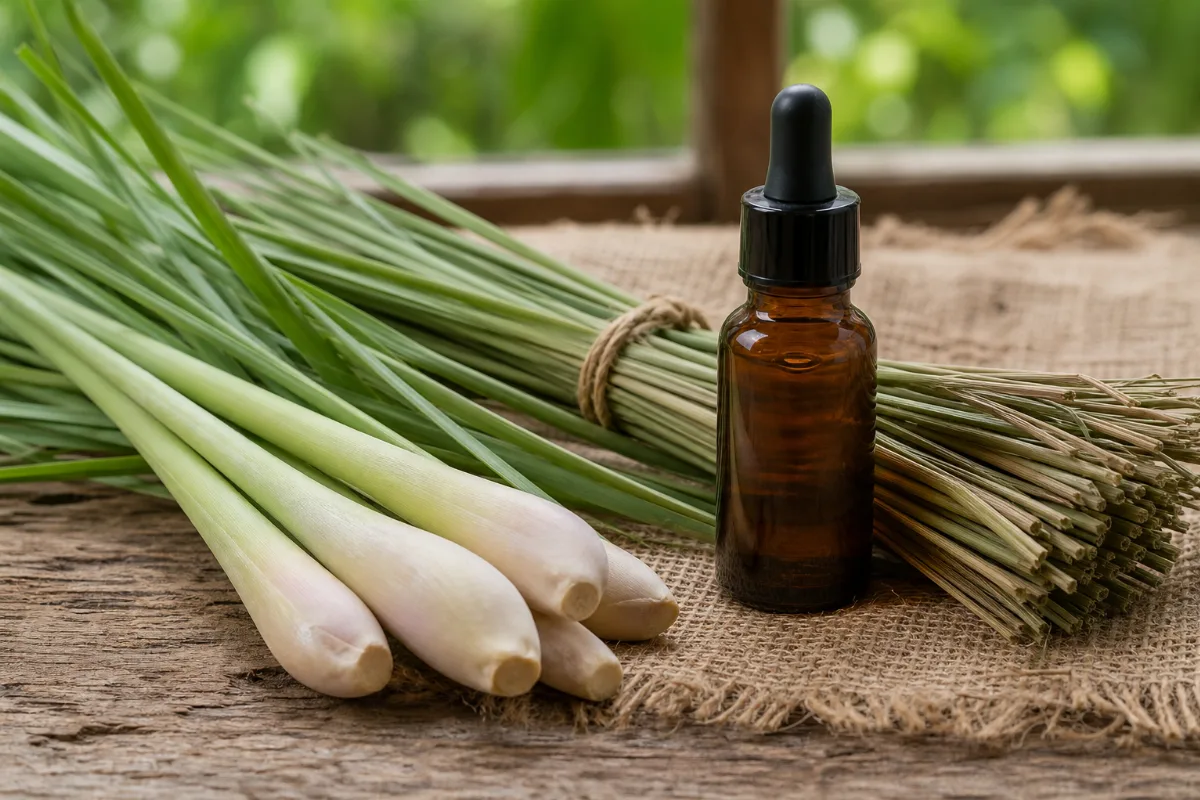
Essential Oils & Aromatherapy · Essential oil
Lemongrass Oil
Cymbopogon citratus and Cymbopogon flexuosus · also called Lemongrass essential oil, West Indian lemongrass oil, East Indian lemongrass oil, citral-rich oil
Lemongrass oil is the strong, lemony oil distilled from the leaves of lemongrass grasses. It is used as a scent, in hair and mouth products and in some insect repellents. The research is small: a few trials on scent and anxiety, dandruff and mouth rinses, with limited and mixed results. The main caution: the oil is a known skin allergen, it should not be swallowed, and it can harm pets.
General information, not medical advice. Last substantive update · Not medically reviewed. A named clinician has not signed off on this page. How this page is made
About Lemongrass Oil
Lemongrass oil is a strongly scented oil with a few small studies behind its uses. Safety comes first: it is a known skin allergen, it should not be swallowed, and essential oils can harm pets, especially cats and birds. The evidence for benefit is limited, mostly from small trials of made products rather than plain oil.
What lemongrass oil is
Lemongrass oil is distilled from the leaves of lemongrass grasses. Two species are used: Cymbopogon citratus (West Indian lemongrass) and Cymbopogon flexuosus (East Indian lemongrass). Several trials used C. flexuosus, and a result for one species or product does not carry over to another.
Citral is the main compound, about 65 to 85% of the oil by one review. Citral is also the compound behind the skin allergy and it breaks down in air. Citronella grasses are different species with different oil.
What people use it for, and how strong the evidence is
For anxiety, two small trials found lower scores while people breathed the oil during dental treatment or a lab stress test. Neither used a comparison scent that hid the oil from the person, so expectation could not be separated from the oil. Certainty is very low.
For dandruff, one small Thai trial of a hair tonic with the oil (C. flexuosus) reported about half the dandruff score or less after two weeks. For a yeast skin infection, a pilot of an oil shampoo and cream cleared about 60% of those who finished, and the standard drug did better. For mouth care, small trials of mouth rinses had mixed results. Certainty is low to very low.
For mosquitoes, a 2026 review said oil-based repellents usually protect two to four hours, less than DEET, while a 2002 test found most botanical repellents protected under 20 minutes. The CDC recommends registered repellents where mosquito-borne illness is a risk.
The research in one view
Most trials are small, short and run by regional groups. Several used made products with other ingredients, not plain oil. Animal and cell findings (calming effects, inflammation, blood sugar) have not been tested in people. A single 2026 report on a nicotine inhaler has surprising results and no repeat.
Nothing here shows that lemongrass oil treats a disease.
Oil, tea and herb are different things
Lemongrass leaf tea is a water extract with little oil, and the kidney and other findings from tea studies do not describe the oil. The herb and tea have their own pages. Do not use tea results to judge the oil, or the other way round.
What regulators say
We found no EMA monograph, no NCCIH lemongrass entry and no FDA approval of the oil as a medicine. EFSA treats the oil as a skin and respiratory sensitiser. LactMed says no valid trials support lemongrass for milk supply, and relays that the FDA treats the oil as GRAS in foods. An industry panel (FEMA) affirmed it as GRAS for flavour use only.
At a glance
Traditional uses history, not proof
- Scent in aromatherapy, perfumes and cosmetics.
- Flavouring in food (an industry panel affirmed it as GRAS for flavour use; FDA status relayed by LactMed).
- Plant-based insect repellent, often alongside citronella oil.
Studied for research
- Anxiety around dental work, scent, very low
- Dandruff, hair tonic with the oil, low
- Pityriasis versicolor (yeast skin infection), oil shampoo and cream, low
- Mosquito repellency, in products, low
- Bad breath and gum inflammation, mouth rinses, very low
- Menopausal symptoms, scent sessions, insufficient
- Nicotine dependence, inhaler, insufficient
Main compounds
- Citral (geranial and neral), the main compounds and the main allergen
- Geraniol
- Myrcene and limonene, named by LactMed
Common forms
- Essential oil (distilled from the leaves)
- Scent: diffuser or inhaler blends
- Made products: hair tonic, shampoo and cream, mouth rinse, repellents
- Lemongrass herb and tea (different products)
Research links: EFSA: Lemongrass oil opinion (abstract) · Poison Control: Essential oils · Pet Poison Helpline: Essential oils · ASPCA: Lemon grass (plant) · NCCIH: Aromatherapy · Skin allergy to essential oils, IVDK data (abstract) · Research Library · Genes & Biomarkers Library
What it is and its history
- Accepted scientific name
- Cymbopogon citratus (DC.) Stapf; the oil also comes from Cymbopogon flexuosus (Nees ex Steud.) W.Watson
- Naming authority
- (DC.) Stapf, Bulletin of Miscellaneous Information, Kew 1906: 322 (GBIF)
- Synonyms
- Andropogon citratus DC.; Andropogon citratus DC. ex Nees; Andropogon citriodorus Desf.; Andropogon cerifer Hack.; Andropogon roxburghii Nees ex Steud.
- Common names
- Lemongrass oil (English); Lemongrass essential oil (English); West Indian lemongrass (C. citratus) (English); East Indian lemongrass (C. flexuosus) (English)
- Family or group
- Poaceae (grass family). Cymbopogon is the lemongrass and citronella genus.
- Classification
- Plantae > Tracheophyta > Liliopsida > Poales > Poaceae > Cymbopogon > Cymbopogon citratus
- Native range
- NOT verified from a primary source. Commonly described as a tropical grass of Asia grown widely in the tropics (general knowledge).
- Habitat
- NOT verified.
- What it looks like
- Part used: The oil comes from the leaves or aerial parts. Blanco 2009 distilled fresh C. citratus leaves; EFSA describes oil from the aerial parts of C. flexuosus. Steam distillation is the usual method (graph summary; not re-checked here).
- Look-alikes and adulterants
- Name: Cymbopogon flexuosus (Nees ex Steud.) W.Watson (East Indian lemongrass); Note: A separate accepted species in GBIF (key 8571291). The dandruff trial and the diabetic-rat study used this species' oil, whose main compounds in one analysis were alpha-citral 53.21% and neral 19.42%. Do not assume results carry over to C. citratus.; Name: Cymbopogon nardus (L.) Rendle and Cymbopogon winterianus Jowitt ex Bor (citronella grasses); Note: Separate accepted species in GBIF (keys 2705267 and 2705273). Their oil is rich in citronellal and is used in insect repellents; a mouse study compared C. winterianus and C. citratus oils and found the lemongrass oil stronger on seizures.
- Sustainability and conservation
- Not verified. Lemongrass is a widely grown crop.
Traditional use and history history, not clinical proof
| Tradition or era | Documented use | Source |
|---|---|---|
| Aromatherapy and perfumery | Lemongrass oil is a common aromatherapy and cosmetic scent. NCCIH describes aromatherapy as the use of essential oils, most often inhaled or applied diluted to the skin, but its page does not name lemongrass. | NCCIH |
| Food flavouring | Lemongrass oil is used as a food flavouring; an industry panel affirmed it as GRAS for flavour use, and LactMed relays that the FDA treats it as GRAS in foods. | FEMA expert panel; LactMed |
| Repellent use | Lemongrass and citronella grasses are used in natural insect repellents; human tests show short protection compared with DEET. | Faridah 2026 |
| Origin and spread of the plant; EU and other herbal histories | NOT verified. No EMA/HMPC monograph was found and no primary historical source was read. | s-ema-hmpc-lemongrass-not-found |
Traditional use shows how it was used. It does not show that it works or is safe today.
What is inside, and how it may work
What it contains and how those compounds act in cells and animals. Laboratory and animal mechanisms are not proven effects in people.
Main compounds
| Compound | Family | Where it is concentrated | Activity studied | Level of evidence |
|---|---|---|---|---|
| Citral (geranial, trans form) PubChem 638011 | acyclic monoterpene aldehyde | Leaf (essential oil) About 65-85% of the oil (a review); one C. flexuosus oil analysis found alpha-citral 53.21% plus neral 19.42% (72.63% total citral) | In cells, citral activated PPAR alpha and gamma and lowered COX-2 (inflammation enzyme). A skin sensitiser: a human no-effect level for inducing allergy was estimated at 1400 micrograms/cm2 (fragrance-industry authors). Unstable in air. 34 17 18 21 | Laboratory research |
| Neral (cis citral) PubChem 643779 | acyclic monoterpene aldehyde | Leaf (essential oil) 19.42% of a C. flexuosus oil sample | Part of citral; separate effects not tested in the abstracts read. 17 | Unknown |
| Geraniol PubChem 637566 | acyclic monoterpene alcohol | Leaf (essential oil) Named as an oil component by LactMed and in a review of the oil | Named as an oil component. Its separate effects were not tested in the oil studies read here. 28 | Unknown |
| Beta-myrcene PubChem 31253 | monoterpene hydrocarbon | Leaf (essential oil) Named as an oil component by LactMed | Not tested in the abstracts read. 28 | Unknown |
| Limonene PubChem 22311 | monoterpene hydrocarbon | Leaf (essential oil) Named as an oil component by LactMed | Not tested in the abstracts read. 28 | Unknown |
| Citronellal PubChem 7794 | monoterpene aldehyde | Leaf (essential oil) Reported in lemongrass in the title of a pain study; the abstract was not read | Title of a 2011 J Med Food paper (PMID 21480794): 'Antinociceptive action and redox properties of citronellal, an essential oil present in lemongrass'. NOT verified beyond the title. 24 | Unknown |
Mechanisms, receptors and pathways
| Target or pathway | Gene or receptor | What was found | Level |
|---|---|---|---|
| PPAR alpha and gamma activation; COX-2 suppression | PPARA, PPARG, PTGS2 (COX-2) | Citral activated PPAR alpha and gamma and lowered COX-2 in human macrophage-like cells, which may explain anti-inflammatory effects. 18 | Laboratory research |
| GABA-A (benzodiazepine) site involvement in anti-seizure and sedative effects | GABA-A receptor | In mice, injected lemongrass oil delayed seizures; flumazenil blocked the effect and adding oil to a low diazepam dose strengthened it. 35 | Animal research |
| Sedative, anti-anxiety and anti-seizure effects in mice by mouth | unspecified | Oral oil at 0.5 or 1.0 g/kg lengthened barbiturate sleep and delayed seizures in mice. 2 | Animal research |
| Killing of mouth bacteria | bacterial cell effects | The oil was active against Aggregatibacter actinomycetemcomitans and Porphyromonas gingivalis and less active against Streptococcus mutans in dish tests. 33 | Laboratory research |
| Inflammation marker release (MPO) from white cells | myeloperoxidase | Both Cymbopogon oils blocked MPO release from human neutrophils in the dish without cell damage (LDH). 35 | Laboratory research |
| Antifungal activity | fungal cell effects | The pityriasis versicolor trial was designed around the oil's antifungal action; the human result was partial (about 60% cure, below the standard drug). 4 | Human (partial) |
Absorption, metabolism and elimination
- Absorption
- A review says oil compounds are quickly absorbed after oral, lung and skin exposure; reliable human data are lacking.
- Distribution
- Not established in people.
- Metabolism
- Swallowed citral is reportedly metabolised to acids and a biliary glucuronide (review). No data on the oil on skin or inhaled.
- Elimination
- Via urine, faeces and exhaled volatiles (review statement). No human numbers.
- Bioavailability
- Unknown in people. A review says there is no scientific evidence on long-term bioavailability of citral.
Isolated compounds versus whole extracts
The essential oil is mostly citral with geraniol, myrcene and other terpenes. It is not the same as lemongrass leaf tea (a water extract with little oil) or the whole herb, and results do not carry across. Citral, the main compound, is itself the skin sensitiser; whole oil and isolated citral behaved differently in some tests. The two species, C. citratus and C. flexuosus, also differ, and trials used both.
Nutritional composition
Lemongrass oil is not a nutrient. It is a concentrated flavour and fragrance product.
3 low certainty6 very low certainty5 not enough evidence
What was looked at
The 14 benefits and uses checked for Lemongrass Oil, each with how strong the evidence is. Tap one to open it.
- Calmer feelings after smelling lemongrass oil (lab stress test)Very low certainty
- Anxiety and heart rate during gum treatment (aroma in the dental chair)Very low certainty
- Anxiety in children having dental treatment (lemongrass aroma as a distraction)Not enough evidence
- Calming and anti-seizure effects (mice, large doses of oil)Very low certainty
- Nicotine dependence (3% lemongrass inhaler, one trial)Not enough evidence
- Dandruff (scalp tonic with lemongrass oil)Low certainty
- Pityriasis versicolor (yeast skin infection, topical oil)Low certainty
- Bad breath (lemongrass oil mouth rinse)Very low certainty
- Gum inflammation and plaque (0.25% lemongrass oil mouthwash)Very low certainty
- Cholesterol and blood fats (swallowed oil capsules, 1989)Very low certainty
- Blood sugar and diabetes (rat studies only)Not enough evidence
- Menopausal symptoms (aromatherapy)Not enough evidence
- Inflammation (lab findings only)Not enough evidence
- Mosquito repellency (oil in repellent products)Low certainty
Lab markers tracked in the studies
State anxiety and tension (self-rated)Heart rateDandruff score (D-Squame scale)Mycological cure (yeast cleared on lab culture)Volatile sulphur compounds (bad-breath gases)Plaque index and gingival (gum) indexTotal cholesterolComplete protection time (time before the first mosquito bite)
What is Lemongrass Oil good for?
The uses people ask about and how strong the evidence is for each. Read the certainty label first: none of these is better than low, and several come from a single small trial or from animals.
Benefits, one by one
Each card is a research question, not a promise. Tap a goal to filter. Open a card to see the studies, doses and limits.
Calmer feelings after smelling lemongrass oil (lab stress test)
Very low certaintyIn one small trial, healthy young men who breathed lemongrass oil for a short time felt less anxious and tense, and bounced back faster from a stressful task. It is one small study of a smell, not a treatment for anxiety.
1 studiesLemongrass (Cymbopogon citratus) essential oil, 3 or 6 drops inhaled …
Studies, doses and limits
What the trials found
Goes 2015: 40 healthy men, randomly placed in four groups. They breathed lemongrass oil (3 or 6 drops), tea tree oil (control smell) or water, then did a stressful colour-word test on video. State anxiety and tension were lower right after the lemongrass aroma, and the lemongrass groups recovered from the test in 5 minutes, unlike controls. Heart rate and muscle tension changes during the test were not prevented, the same as seen with diazepam in earlier work.
Results
Positive on self-rated anxiety and tension; no protection of body measures (heart rate, muscle activity).
Effect sizes as reported
Statistically significant versus tea tree and water on state anxiety and subjective tension; numbers not given in the abstract.
Why this rating
One trial of 40 young men, single short exposure, anxiety induced in the lab, no replication found. Self-rated scores are easily affected by smell and expectation.
Form and dose studied
Lemongrass (Cymbopogon citratus) essential oil, 3 or 6 drops inhaled once.
Who was studied
Healthy adult men (about 10 per group).
Limits
Healthy volunteers, not people with an anxiety disorder; single exposure; the abstract gives no numbers; no long-term data.
Why researchers looked
Lemongrass is a popular aromatherapy scent and is said to be calming, so researchers tested the aroma directly.
Traditional use
Lemongrass scent is used in aromatherapy for calm. No regulator we found accepts it for anxiety.
Proposed mechanism Animal research
Not worked out in people. In mice, lemongrass oil effects were blocked by flumazenil, which points to the brain's GABA calming system, but that was with injected oil.
A proposed mechanism does not show that the effect happens in people.
Safety is covered in the safety section. Lemongrass essential oil is a strong oil: it can cause skin allergy, and it should not be swallowed on the strength of these results.
Anxiety and heart rate during gum treatment (aroma in the dental chair)
Very low certaintyIn a small Iranian trial, adults who breathed lemongrass oil during a deep gum clean had lower anxiety, blood pressure and heart rate than adults who had no aroma. People knew which group they were in.
1 studiesLemongrass essential oil aroma during one treatment session; the oil …
Studies, doses and limits
What the trials found
Maybodi 2025: 38 patients having scaling and root planing (a deep gum clean). One group inhaled lemongrass oil during the work; the control group had the work with no aroma. The lemongrass group had lower systolic and diastolic blood pressure, heart rate and anxiety scores. Oxygen saturation, pain and satisfaction did not differ. Registered as IRCT20230615058492N2.
Results
Better on anxiety, blood pressure and heart rate after one session; no difference in pain or satisfaction.
Effect sizes as reported
Significant reductions reported for anxiety, systolic and diastolic blood pressure and heart rate; numbers not given in the abstract.
Why this rating
Very small (38), one session, no placebo aroma so people could tell their group, and anxiety is self-rated. Authors say lemongrass 'appears beneficial'.
Form and dose studied
Lemongrass essential oil aroma during one treatment session; the oil and amount are not given in the abstract.
Who was studied
Adults with gum disease treated at a university dental clinic in Yazd, Iran.
Limits
No blinding to aroma, single centre, short effect; the blood pressure change is a response to a nervous situation, not treatment of high blood pressure.
Why researchers looked
Dental visits cause worry that raises blood pressure and heart rate. Aromatherapy is a low-cost add-on researchers have tried.
Traditional use
No traditional use of lemongrass in the dental chair; aromatherapy use is modern.
Proposed mechanism Pharmacological theory
Not known. Possible effects of the smell on the brain's stress response are theory only.
A proposed mechanism does not show that the effect happens in people.
Safety is covered in the safety section. Lemongrass essential oil is a strong oil: it can cause skin allergy, and it should not be swallowed on the strength of these results.
Anxiety in children having dental treatment (lemongrass aroma as a distraction)
Not enough evidenceIn a large Indian trial of 5 ways to distract anxious children, all five (including lemongrass aroma) were linked to lower anxiety scores, but music and visual distraction did better than smell or taste.
1 studiesLemongrass oil aromatherapy during one dental visit; amount not in th…
Studies, doses and limits
What the trials found
Chawla 2025: 350 children aged 6 to 9, 70 in each of five groups: cards, lemongrass aroma, music, acupressure, honey taste. Every group had lower anxiety after treatment (P < 0.001). The abstract says music was best (mean change 1.10), visual next (1.04), and that smell and taste were less effective than those two. No lemongrass-specific number is given.
Results
Anxiety lower in the lemongrass aroma group, but less than with music or visual distraction; no figure in the abstract.
Effect sizes as reported
All groups P < 0.001 before versus after; lemongrass group number not in the abstract.
Why this rating
The abstract does not show a no-treatment group or a lemongrass figure, so it cannot show that the lemongrass smell, rather than the dental setting or the passing of time, lowered anxiety.
Form and dose studied
Lemongrass oil aromatherapy during one dental visit; amount not in the abstract.
Who was studied
Children aged 6 to 9 in India.
Limits
No lemongrass result in the abstract, no untreated comparison described, children's anxiety scale.
Why researchers looked
Fear of the dentist is common in children, and non-drug distraction methods are tried first.
Proposed mechanism Pharmacological theory
Not known; distraction and smell effects are theory.
A proposed mechanism does not show that the effect happens in people.
Essential oils should not be swallowed by children. This trial used the aroma only. Poison-centre guidance on children was not read here.
Calming and anti-seizure effects (mice, large doses of oil)
Very low certaintyIn mice, lemongrass oil made sedatives work longer, lowered signs of anxiety and made seizures harder to trigger. These were large doses, by mouth or injected, and they have not been tested in people.
2 studiesEssential oil, 0.5 to 1.0 g/kg by mouth (Blanco) or 50 to 200 mg/kg b…
Studies, doses and limits
Results
Positive in two mouse studies with the oil (given by mouth or injected); not tested in people.
Effect sizes as reported
Significant effects in mice; numbers not in the abstracts.
Why this rating
Animal data only; no human study of these effects.
Form and dose studied
Essential oil, 0.5 to 1.0 g/kg by mouth (Blanco) or 50 to 200 mg/kg by injection (Silva) in mice.
Who was studied
Mice; not applicable to people.
Limits
Large doses of oil by mouth or injection in mice. This says nothing about breathing a small amount of scent, and swallowing the oil is not advised.
Why researchers looked
To see whether the oil acts on the brain in animals, which might explain the calming reputation of the scent.
Proposed mechanism Animal research
Mouse work links the oil effect to the GABA system (the brain's main calming system), because flumazenil, a drug that blocks it, blocked the effect (Silva 2010, injected oil). Low doses of oil added to low doses of diazepam made the effect stronger.
A proposed mechanism does not show that the effect happens in people.
The animal results suggest that lemongrass oil could add to sedative medicines (see the interactions in the safety section).
Nicotine dependence (3% lemongrass inhaler, one trial)
Not enough evidenceOne 2026 trial of 100 young adult smokers reported lower dependence scores with a lemongrass oil inhaler than with a placebo inhaler over eight weeks. It is a single report with surprising results and no repeat, so it is not evidence that the oil helps people quit.
1 studiesNot covered. This page gives no amounts and no ways of using the oil.
Studies, doses and limits
What the trials found
Kumboyono 2026: 100 smokers aged 18 to 30, 3% lemongrass inhaler or placebo four times daily for eight weeks. The abstract reports a larger fall in the Fagerstrom dependence score (mean difference 2.3, p<0.001) and in a serum receptor marker (0.6 ng/mL, p=0.003).
Results
Lower self-rated dependence score than placebo. No quitting rate is described in the abstract.
Effect sizes as reported
FTND mean difference 2.3 (p<0.001); partial eta squared 0.390 (authors call it a large effect).
Why this rating
One report from one group, read as an abstract, with an unusually large effect for a scent, an unusual blood marker, and no replication.
Form and dose studied
Not covered. This page gives no amounts and no ways of using the oil.
Who was studied
Adult smokers aged 18 to 30 with moderate-to-high dependence.
Limits
Single trial, short follow-up, no abstinence outcome in the abstract, funding not stated, not repeated.
Why researchers looked
Citral, the main scent compound, was proposed to act on nicotine receptors in the brain.
Proposed mechanism Hypothesis
The authors propose that citral changes nicotinic receptor activity. This was not shown in the abstract beyond a blood marker.
A proposed mechanism does not show that the effect happens in people.
Do not treat this as a way to stop smoking. Ask a doctor or pharmacist about proven help.
Dandruff (scalp tonic with lemongrass oil)
Low certaintyIn a small Thai trial, a hair tonic with 5% to 15% East Indian lemongrass oil cut dandruff scores by about half or more in 2 weeks, with the 10% tonic doing best. It used a different species and has not been repeated.
2 studiesHair tonic with 5%, 10% or 15% lemongrass (C. flexuosus) essential oi…
Studies, doses and limits
What the trials found
Chaisripipat 2015: 30 volunteers with moderate dandruff in a double-blind, placebo-controlled split-head test applied tonics twice a day. Dandruff scores fell 33%, 75% and 51% at day 7 and 52%, 81% and 74% at day 14 with 5%, 10% and 15% oil. No details on side effects are in the abstract.
Results
Large, rapid reductions in dandruff score in a small trial.
Effect sizes as reported
Reductions of 52%, 81% and 74% at day 14 (5%, 10%, 15% oil), P < 0.005; the placebo result is not given in the abstract.
Why this rating
A double-blind placebo-controlled design is a strength, but there are only 30 people, 2 weeks, no repeat, and the oil was from Cymbopogon flexuosus, not C. citratus.
Form and dose studied
Hair tonic with 5%, 10% or 15% lemongrass (C. flexuosus) essential oil, twice a day for 14 days.
Who was studied
Thai adults aged 20 to 60 with dandruff.
Limits
Different species, tiny trial, short, no follow-up, cosmetic-science team. The abstract does not report skin irritation.
Why researchers looked
Dandruff is linked to Malassezia yeasts, and lemongrass oil kills yeasts in the dish.
Traditional use
Not a documented traditional use in the sources read.
Proposed mechanism Laboratory research
Citral and other oil compounds kill or slow yeasts in laboratory tests; Malassezia was targeted in the trial's design.
A proposed mechanism does not show that the effect happens in people.
Lemongrass oil is a known skin allergen (see the safety section); do not put undiluted oil on skin.
Pityriasis versicolor (yeast skin infection, topical oil)
Low certaintyIn a Brazilian pilot study, a shampoo and cream with lemongrass oil cleared the yeast in about 60% of people who finished, compared with over 80% for a ketoconazole version. The standard drug did better.
2 studiesLemongrass (C. citratus) essential oil at 1.25 microlitres/mL in sham…
Studies, doses and limits
What the trials found
Carmo 2013: Phase I in 20 healthy volunteers found no significant adverse events. In phase II, 47 people received the oil shampoo and cream and 29 received ketoconazole versions for 40 days. 30 (63.83%) on oil and 18 (62.07%) on ketoconazole finished. Mycological cure was 60% with the oil and over 80% with ketoconazole.
Results
Some antifungal effect, less than the standard drug; many dropped out.
Effect sizes as reported
60% cure (oil) versus over 80% (ketoconazole) at 40 days, both P < 0.05.
Why this rating
A randomised pilot against a standard drug with a measured cure rate, but small, about a third dropped out, no placebo, and the drug was better.
Form and dose studied
Lemongrass (C. citratus) essential oil at 1.25 microlitres/mL in shampoo (3 times a week) and cream (twice a day) for 40 days.
Who was studied
76 people with pityriasis versicolor, Brazil (plus 20 healthy volunteers for safety).
Limits
Pilot, high dropout, no placebo arm, culture-based cure.
Why researchers looked
Lemongrass oil is active against Malassezia yeasts in the dish.
Traditional use
Not a documented traditional use in the sources read.
Proposed mechanism Laboratory research
Oil compounds damage yeast cells in laboratory tests.
A proposed mechanism does not show that the effect happens in people.
Skin allergy to lemongrass oil is possible; see the safety section.
Bad breath (lemongrass oil mouth rinse)
Very low certaintyA tiny Thai trial found a lemongrass oil mouth rinse lowered bad-breath gases after 8 days. Volunteers did not like the spicy taste.
1 studiesLemongrass oil mouth rinse; concentration not in the abstract.
Studies, doses and limits
What the trials found
Satthanakul 2015: 20 healthy volunteers in a double-blind trial measured bad-breath gases with a Halimeter on day 0 and day 8. The rinse significantly reduced them on day 8 and appeared safe. Spiciness and taste were drawbacks.
Results
Positive, small, short.
Effect sizes as reported
Significant fall in volatile sulphur compounds on day 8; numbers not in the abstract.
Why this rating
Twenty healthy people, a pilot, 8 days, no numbers in the abstract.
Form and dose studied
Lemongrass oil mouth rinse; concentration not in the abstract.
Who was studied
Healthy adult volunteers, Thailand.
Limits
Pilot; healthy people; no long-term data.
Why researchers looked
Bad breath comes from mouth bacteria making sulphur gases, and lemongrass oil kills several of them in the dish.
Proposed mechanism Laboratory research
In the dish the oil was active against Aggregatibacter actinomycetemcomitans and Porphyromonas gingivalis and less so against Streptococcus mutans.
A proposed mechanism does not show that the effect happens in people.
Rinses should not be swallowed. Mouth and gum irritation was not reported in the abstract.
Gum inflammation and plaque (0.25% lemongrass oil mouthwash)
Very low certaintyIn a small Indian trial of braces patients, a 0.25% lemongrass mouthwash gave lower plaque and gum scores than a chlorhexidine mouthwash after 2 to 3 weeks. That is an unusual result and needs repeating.
3 studiesLemongrass oil 0.25% mouthwash, twice a day (21 days; Wasey) or 3 mon…
Studies, doses and limits
What the trials found
Wasey 2023: 60 orthodontic patients with mild-to-moderate gingivitis, 20 per group: 0.25% lemongrass oil mouthwash, 0.2% chlorhexidine, or oral cleaning only, for 21 days. Plaque and gum scores were lower with lemongrass than chlorhexidine by day 14 and day 21 (P < 0.001). In another small trial of severe gum disease (Subha 2017, 15 per group, 3 months), pocket depth and attachment loss improved in the lemongrass group and in the chlorhexidine group compared with cleaning alone.
Results
Positive in two small trials from India; one reports lemongrass better than chlorhexidine.
Effect sizes as reported
P < 0.001 versus chlorhexidine for plaque and gum index (scores not in the abstract).
Why this rating
Groups of 15 to 20, short, one setting each, comparisons with a gold-standard rinse that came out unusually in favour of the herbal one, no independent repeats found.
Form and dose studied
Lemongrass oil 0.25% mouthwash, twice a day (21 days; Wasey) or 3 months (Subha).
Who was studied
Adults with gum inflammation or periodontitis, India.
Limits
Small, no numbers in the abstracts, authors' links to products not stated.
Why researchers looked
Chlorhexidine mouthwash stains teeth and tastes unpleasant, so a herbal alternative is of interest.
Proposed mechanism Laboratory research
Oil compounds kill plaque bacteria in the dish.
A proposed mechanism does not show that the effect happens in people.
Do not swallow mouthwash. Contact allergy to lemongrass oil can affect the mouth and lips, though not reported in these trials' abstracts.
Cholesterol and blood fats (swallowed oil capsules, 1989)
Very low certaintyA 1989 study of 22 people with very high cholesterol gave lemongrass oil capsules for 90 days. On average the drop just missed statistical significance; 8 people dropped a lot and 14 did not respond. There was no placebo group. This does not make swallowing the oil advisable.
2 studiesNot covered. This page gives no amounts and no ways of using the oil.
Studies, doses and limits
What the trials found
Elson 1989: 22 people with raised cholesterol, lemongrass oil capsules for 90 days, no placebo group. A mouthwash trial in braces patients also measured blood fats and CRP (Subha 2017).
Results
The average fall in cholesterol just missed statistical significance in the capsule study; 8 people had a large fall and 14 did not respond.
Effect sizes as reported
Responders -38 +/- 10 mg/dl at 90 days (P < 0.025); non-responders -1 +/- 6; whole group P < 0.06.
Why this rating
One small uncontrolled study from 1989; no repeat.
Form and dose studied
Not covered. This page gives no amounts and no ways of using the oil.
Who was studied
People with high cholesterol.
Limits
No placebo group, small, old, and it used swallowed oil capsules, which this page does not advise.
Why researchers looked
A theory that compounds in lemongrass oil (geraniol and citral) could lower cholesterol by slowing its production.
Traditional use
Not a documented traditional use in the sources read.
Proposed mechanism Laboratory research
Oil compounds that touch the cholesterol-building pathway (mevalonate) were thought to lower cholesterol; citral also switches on PPAR-alpha and gamma in cells, which handle fats.
A proposed mechanism does not show that the effect happens in people.
Swallowed lemongrass oil capsules are not an approved use; the study did not report side effects in its abstract.
Blood sugar and diabetes (rat studies only)
Not enough evidenceNo human trial tests lemongrass oil for diabetes. In rats with induced diabetes, lemongrass oil (Cymbopogon flexuosus) lowered blood sugar. That is animal work only.
2 studiesNot covered. This page gives no amounts and no ways of using the oil.
Studies, doses and limits
Results
Lower blood glucose in diabetic rats given oil by mouth (Junior 2024). No human result.
Effect sizes as reported
Numbers not given in the abstracts.
Why this rating
Only rat data; no human trial.
Form and dose studied
Not covered. This page gives no amounts and no ways of using the oil.
Who was studied
Rats.
Limits
Rats only, doses far above scent exposure.
Why researchers looked
Folk and lab interest in lemongrass for diabetes; citral activates PPAR switches that affect sugar and fat handling in cells.
Traditional use
Not a documented traditional use in the sources read.
Proposed mechanism Laboratory research
Citral activated PPAR alpha and gamma in cell work (Katsukawa 2010).
A proposed mechanism does not show that the effect happens in people.
People using diabetes medicines should tell their doctor before using any lemongrass product in larger amounts (theory only).
Menopausal symptoms (aromatherapy)
Not enough evidenceA 2025 Indonesian trial found fewer menopausal symptoms after four weeks of daily aroma sessions with ginger oil, lemongrass oil or both. The abstract's numbers do not add up and there is no no-aroma group described.
1 studiesLemongrass oil aroma, 20 minutes a day for 4 weeks (alone, or combine…
Studies, doses and limits
What the trials found
Sari 2025: women at a public health centre received a 20-minute aroma session daily for 4 weeks with ginger oil, lemongrass oil, or both. All three arms had significantly lower Menopause Assessment Scale scores. The abstract says 355 women but 89 per arm (3 x 89 = 267), so the real size is unclear.
Results
Symptom scores fell in all arms, including lemongrass alone.
Effect sizes as reported
Statistically significant reductions in all three groups; numbers not given.
Why this rating
No comparison with no aroma is described, the numbers are inconsistent, and a combination arm is mixed with ginger.
Form and dose studied
Lemongrass oil aroma, 20 minutes a day for 4 weeks (alone, or combined with ginger oil).
Who was studied
Menopausal women, Indonesia.
Limits
No clear control; participant numbers inconsistent.
Why researchers looked
Aromatherapy is used for menopausal discomfort.
Proposed mechanism Pharmacological theory
Not known.
A proposed mechanism does not show that the effect happens in people.
Safety is covered in the safety section. Lemongrass essential oil is a strong oil: it can cause skin allergy, and it should not be swallowed on the strength of these results.
Inflammation (lab findings only)
Not enough evidenceIn cells, lemongrass oil and its main compound citral lowered an inflammation enzyme. No trial tests this in people.
2 studiesNot covered. This page gives no amounts and no ways of using the oil.
Studies, doses and limits
Results
Lab and animal only.
Effect sizes as reported
Dose-dependent COX-2 suppression in cells.
Why this rating
Cell and rat work; not a human result.
Form and dose studied
Not covered. This page gives no amounts and no ways of using the oil.
Who was studied
Cells; rats.
Limits
No human trial.
Why researchers looked
To explain folk use for pain and swelling.
Traditional use
Cuban folk use as an anti-inflammatory (Carbajal 1989).
Proposed mechanism Laboratory research
Citral activated PPAR alpha and gamma and lowered COX-2 expression in human macrophage-like cells (Katsukawa 2010). Both Cymbopogon oils blocked release of the inflammation marker MPO from human white cells in the dish (Silva 2010).
A proposed mechanism does not show that the effect happens in people.
None specific.
Mosquito repellency (oil in repellent products)
Low certaintyPlant oils including lemongrass may keep mosquitoes off for a short time. A 2026 review of human studies said oil-based repellents (citronella, lemon eucalyptus, neem, lemongrass) usually protect two to four hours, less than DEET. A 2002 volunteer test found most botanical repellents protected for under 20 minutes. Results disagree and are for products, not plain oil.
2 studiesNot covered. This page gives no amounts and no ways of using the oil.
Studies, doses and limits
What the trials found
Faridah 2026: systematic review of 19 human studies of repellents. Fradin 2002: 15 volunteers tested seven botanical repellents (oils not named in the abstract), DEET products and others in a mosquito room.
Results
Short protection compared with DEET in both; the 2002 test found botanical repellents mostly under 20 minutes, the 2026 review commonly two to four hours.
Effect sizes as reported
Review: natural repellents commonly 2 to 4 hours; DEET often 5 to 9 hours. 2002 test: most botanicals under 20 minutes; 23.8% DEET mean 301.5 minutes.
Why this rating
Human data exist but lemongrass is pooled with other oils, products and methods differ widely, and the two sources disagree on how long botanical products work.
Form and dose studied
Not covered. This page gives no amounts and no ways of using the oil.
Who was studied
Adult volunteers in repellent tests.
Limits
Lemongrass is not tested alone in the abstracts read, and the results depend on the product. Not tied to any disease prevention outcome.
Why researchers looked
Citronella-type grasses are used in repellents, and lemongrass oil is a close relative.
Traditional use
Lemongrass and citronella grasses are used as natural repellents in many places (general use; not from a regulator we read).
Proposed mechanism Hypothesis
Not established in the abstracts read. The scent masks or repels mosquitoes.
A proposed mechanism does not show that the effect happens in people.
The CDC recommends EPA-registered repellents where mosquito-borne illness is a risk; the lab and review results here do not make lemongrass oil a replacement.
Connections to the rest of health
How Lemongrass Oil connects to the rest of our health knowledge graph. Every link says what kind of connection it is. A safety link (for example to the liver) is a warning, not a benefit. A study that merely mentions a topic never creates a benefit link.
Explore every connection: goals, body systems, organs, symptoms, genes
A. Wellness goals
| Connected to | Kind of connection | Evidence status | Context | Studies |
|---|---|---|---|---|
| Anxiety Support | Potential benefit | Very low certainty | Calmer feelings after smelling lemongrass oil (lab stress test): In one small trial, healthy young men who breathed lemongrass oil for a short time felt less anxious and tense, and bounced back faster from a stressful task. It is one small study of a smell, not a treatment for anxiety. Anxiety and heart rate during gum treatment (aroma in the dental chair): In a small Iranian trial, adults who breathed lemongrass oil during a deep gum clean had lower anxiety, blood pressure and heart rate than adults who had no aroma. People knew which group they were in. | 16 22 6 |
| Calm Relaxation | Potential benefit | Very low certainty | Calmer feelings after smelling lemongrass oil (lab stress test): In one small trial, healthy young men who breathed lemongrass oil for a short time felt less anxious and tense, and bounced back faster from a stressful task. It is one small study of a smell, not a treatment for anxiety. Anxiety and heart rate during gum treatment (aroma in the dental chair): In a small Iranian trial, adults who breathed lemongrass oil during a deep gum clean had lower anxiety, blood pressure and heart rate than adults who had no aroma. People knew which group they were in. | 16 22 6 |
| Stress Reduction | Potential benefit | Very low certainty | Calmer feelings after smelling lemongrass oil (lab stress test): In one small trial, healthy young men who breathed lemongrass oil for a short time felt less anxious and tense, and bounced back faster from a stressful task. It is one small study of a smell, not a treatment for anxiety. Anxiety and heart rate during gum treatment (aroma in the dental chair): In a small Iranian trial, adults who breathed lemongrass oil during a deep gum clean had lower anxiety, blood pressure and heart rate than adults who had no aroma. People knew which group they were in. | 16 22 |
| Blood Pressure Support | Potential benefit | Very low certainty | Anxiety and heart rate during gum treatment (aroma in the dental chair): In a small Iranian trial, adults who breathed lemongrass oil during a deep gum clean had lower anxiety, blood pressure and heart rate than adults who had no aroma. People knew which group they were in. | 22 |
| Calm Relaxation | Preliminary mechanism | Very low certainty | Calming and anti-seizure effects (mice, large doses of oil): In mice, lemongrass oil made sedatives work longer, lowered signs of anxiety and made seizures harder to trigger. These were large doses, by mouth or injected, and they have not been tested in people. | 2 35 |
| Anxiety Support | Preliminary mechanism | Very low certainty | Calming and anti-seizure effects (mice, large doses of oil): In mice, lemongrass oil made sedatives work longer, lowered signs of anxiety and made seizures harder to trigger. These were large doses, by mouth or injected, and they have not been tested in people. | 2 35 |
| Better Sleep | Preliminary mechanism | Very low certainty | Calming and anti-seizure effects (mice, large doses of oil): In mice, lemongrass oil made sedatives work longer, lowered signs of anxiety and made seizures harder to trigger. These were large doses, by mouth or injected, and they have not been tested in people. | 2 35 |
| Anxiety Support | Not enough evidence | Nicotine dependence (3% lemongrass inhaler, one trial): One 2026 trial of 100 young adult smokers reported lower dependence scores with a lemongrass oil inhaler than with a placebo inhaler over eight weeks. It is a single report with surprising results and no repeat, so it is not evidence that the oil helps people quit. | 19 | |
| Hair Support | Potential benefit | Low certainty | Dandruff (scalp tonic with lemongrass oil): In a small Thai trial, a hair tonic with 5% to 15% East Indian lemongrass oil cut dandruff scores by about half or more in 2 weeks, with the 10% tonic doing best. It used a different species and has not been repeated. | 5 20 |
| Healthy Skin | Potential benefit | Low certainty | Dandruff (scalp tonic with lemongrass oil): In a small Thai trial, a hair tonic with 5% to 15% East Indian lemongrass oil cut dandruff scores by about half or more in 2 weeks, with the 10% tonic doing best. It used a different species and has not been repeated. Pityriasis versicolor (yeast skin infection, topical oil): In a Brazilian pilot study, a shampoo and cream with lemongrass oil cleared the yeast in about 60% of people who finished, compared with over 80% for a ketoconazole version. The standard drug did better. | 5 20 4 11 12 |
| Digestive Support | Potential benefit | Very low certainty | Bad breath (lemongrass oil mouth rinse): A tiny Thai trial found a lemongrass oil mouth rinse lowered bad-breath gases after 8 days. Volunteers did not like the spicy taste. Gum inflammation and plaque (0.25% lemongrass oil mouthwash): In a small Indian trial of braces patients, a 0.25% lemongrass mouthwash gave lower plaque and gum scores than a chlorhexidine mouthwash after 2 to 3 weeks. That is an unusual result and needs repeating. | 33 39 36 20 |
| Gut Health | Potential benefit | Very low certainty | Bad breath (lemongrass oil mouth rinse): A tiny Thai trial found a lemongrass oil mouth rinse lowered bad-breath gases after 8 days. Volunteers did not like the spicy taste. | 33 |
| Immune Support | Potential benefit | Very low certainty | Gum inflammation and plaque (0.25% lemongrass oil mouthwash): In a small Indian trial of braces patients, a 0.25% lemongrass mouthwash gave lower plaque and gum scores than a chlorhexidine mouthwash after 2 to 3 weeks. That is an unusual result and needs repeating. | 39 36 20 |
| Cholesterol Balance | Potential benefit | Very low certainty | Cholesterol and blood fats (swallowed oil capsules, 1989): A 1989 study of 22 people with very high cholesterol gave lemongrass oil capsules for 90 days. On average the drop just missed statistical significance; 8 people dropped a lot and 14 did not respond. There was no placebo group. This does not make swallowing the oil advisable. | 9 36 |
| Heart Health | Potential benefit | Very low certainty | Cholesterol and blood fats (swallowed oil capsules, 1989): A 1989 study of 22 people with very high cholesterol gave lemongrass oil capsules for 90 days. On average the drop just missed statistical significance; 8 people dropped a lot and 14 did not respond. There was no placebo group. This does not make swallowing the oil advisable. | 9 36 |
| Blood Sugar Balance | Preliminary mechanism | Not enough evidence | Blood sugar and diabetes (rat studies only): No human trial tests lemongrass oil for diabetes. In rats with induced diabetes, lemongrass oil (Cymbopogon flexuosus) lowered blood sugar. That is animal work only. | 17 18 |
| Metabolic Health | Preliminary mechanism | Not enough evidence | Blood sugar and diabetes (rat studies only): No human trial tests lemongrass oil for diabetes. In rats with induced diabetes, lemongrass oil (Cymbopogon flexuosus) lowered blood sugar. That is animal work only. | 17 18 |
| Menopause Support | Potential benefit | Not enough evidence | Menopausal symptoms (aromatherapy): A 2025 Indonesian trial found fewer menopausal symptoms after four weeks of daily aroma sessions with ginger oil, lemongrass oil or both. The abstract's numbers do not add up and there is no no-aroma group described. | 32 |
| Womens Wellness | Potential benefit | Not enough evidence | Menopausal symptoms (aromatherapy): A 2025 Indonesian trial found fewer menopausal symptoms after four weeks of daily aroma sessions with ginger oil, lemongrass oil or both. The abstract's numbers do not add up and there is no no-aroma group described. | 32 |
| Inflammation Balance | Preliminary mechanism | Not enough evidence | Inflammation (lab findings only): In cells, lemongrass oil and its main compound citral lowered an inflammation enzyme. No trial tests this in people. | 18 35 |
B. Body systems
| Connected to | Kind of connection | Evidence status | Context | Studies |
|---|---|---|---|---|
| Nervous System | Biological association | Very low certainty | Studied for: Calmer feelings after smelling lemongrass oil (lab stress test) Studied for: Anxiety and heart rate during gum treatment (aroma in the dental chair) | 16 22 6 2 35 19 |
| Stress Mood | Biological association | Very low certainty | Studied for: Calmer feelings after smelling lemongrass oil (lab stress test) Studied for: Anxiety and heart rate during gum treatment (aroma in the dental chair) | 16 22 6 |
| Cardiovascular System | Biological association | Very low certainty | Studied for: Anxiety and heart rate during gum treatment (aroma in the dental chair) Studied for: Cholesterol and blood fats (swallowed oil capsules, 1989) | 22 9 36 |
| Integumentary System | Biological association | Low certainty | Studied for: Dandruff (scalp tonic with lemongrass oil) Studied for: Pityriasis versicolor (yeast skin infection, topical oil) | 5 20 4 |
| Immune System | Biological association | Low certainty | Studied for: Pityriasis versicolor (yeast skin infection, topical oil) Studied for: Gum inflammation and plaque (0.25% lemongrass oil mouthwash) | 4 20 39 36 18 35 |
| Digestive System | Biological association | Very low certainty | Studied for: Bad breath (lemongrass oil mouth rinse) Studied for: Gum inflammation and plaque (0.25% lemongrass oil mouthwash) | 33 39 36 20 |
| Metabolism Weight | Biological association | Very low certainty | Studied for: Cholesterol and blood fats (swallowed oil capsules, 1989) Studied for: Blood sugar and diabetes (rat studies only) | 9 36 17 18 |
| Endocrine System | Biological association | Not enough evidence | Studied for: Blood sugar and diabetes (rat studies only) Studied for: Menopausal symptoms (aromatherapy) | 17 18 32 |
| Reproductive System | Biological association | Not enough evidence | Studied for: Menopausal symptoms (aromatherapy) | 32 |
| Skin Hair Beauty | Biological association | Low certainty | Studied for: Mosquito repellency (oil in repellent products) | 11 12 |
C. Body parts and organs
| Connected to | Kind of connection | Evidence status | Context | Studies |
|---|---|---|---|---|
| Skin | Adverse effect or risk | Low certainty | Contact allergy in 2.6% of 10,930 and 1.8% of 15,682 dermatitis patients patch tested; four occupational cases. Preparation or compound: Lemongrass essential oil (citral) |
15 38 3 |
| Lungs and airways | Adverse effect or risk | Documented risk | Regulatory classification; no human diffuser study. Preparation or compound: Lemongrass oil (respiratory sensitiser per EFSA) |
7 |
| Brain | Preliminary mechanism | Very low certainty | Calming, sleep-lengthening and anti-seizure effects in mice linked to GABA; no human data. Preparation or compound: Lemongrass essential oil |
35 2 |
E. Health conditions
| Connected to | Kind of connection | Evidence status | Context | Studies |
|---|---|---|---|---|
| Contact dermatitis | Adverse effect or risk | Documented risk | Patch-test and case data. Preparation or compound: Lemongrass oil |
15 38 3 40 |
I. Biomarkers
| Connected to | Kind of connection | Evidence status | Context | Studies |
|---|---|---|---|---|
| State anxiety and tension (self-rated) | Biological association | Very low certainty | Measured in trials: lowered. A lab change is not the same as a health benefit. | 16 22 |
| Heart rate | Biological association | Very low certainty | Measured in trials: mixed. A lab change is not the same as a health benefit. | 22 16 |
| Dandruff score (D-Squame scale) | Biological association | Low certainty | Measured in trials: lowered. A lab change is not the same as a health benefit. | 5 |
| Mycological cure (yeast cleared on lab culture) | Biological association | Low certainty | Measured in trials: lowered. A lab change is not the same as a health benefit. | 4 |
| Volatile sulphur compounds (bad-breath gases) | Biological association | Very low certainty | Measured in trials: lowered. A lab change is not the same as a health benefit. | 33 |
| Plaque index and gingival (gum) index | Biological association | Very low certainty | Measured in trials: lowered. A lab change is not the same as a health benefit. | 39 |
| Total cholesterol | Biological association | Very low certainty | Measured in trials: mixed. A lab change is not the same as a health benefit. | 9 36 |
| Complete protection time (time before the first mosquito bite) | Biological association | Low certainty | Measured in trials: increase. A lab change is not the same as a health benefit. | 11 12 |
J. Genes, receptors and enzymes
| Connected to | Kind of connection | Evidence status | Context | Studies |
|---|---|---|---|---|
| PPARA / PPARG | Preliminary mechanism | In vitro | Citral activates PPAR alpha and gamma in cells (inflammation and fat handling). | 18 |
| PTGS2 (COX-2) | Preliminary mechanism | In vitro | Citral suppressed LPS-induced COX-2 mRNA and protein in U937 cells. | 18 |
| GABA-A receptor | Preliminary mechanism | Animal | Anti-seizure effect of the oil in mice was blocked by flumazenil. | 35 |
| Myeloperoxidase (MPO) | Preliminary mechanism | In vitro | Oil blocked its release from human neutrophils in the dish. | 35 |
L. Active compounds
| Connected to | Kind of connection | Evidence status | Context | Studies |
|---|---|---|---|---|
| Citral | Adverse effect or risk | Low certainty | Skin sensitiser; human no-effect level for induction 1400 micrograms per cm2 (fragrance-industry authors). Preparation or compound: Citral (main compound in the oil) |
21 |
| Citral (geranial, trans form) | Biological association | In vitro | In cells, citral activated PPAR alpha and gamma and lowered COX-2 (inflammation enzyme). A skin sensitiser: a human no-effect level for inducing allergy was estimated at 1400 micrograms/cm2 (fragrance-industry authors). Unstable in air. Preparation or compound: Leaf (essential oil) |
34 17 18 21 |
| Neral (cis citral) | Biological association | Unknown | Part of citral; separate effects not tested in the abstracts read. Preparation or compound: Leaf (essential oil) |
17 |
| Geraniol | Biological association | Unknown | Named as an oil component. Its separate effects were not tested in the oil studies read here. Preparation or compound: Leaf (essential oil) |
28 |
| Beta-myrcene | Biological association | Unknown | Not tested in the abstracts read. Preparation or compound: Leaf (essential oil) |
28 |
| Limonene | Biological association | Unknown | Not tested in the abstracts read. Preparation or compound: Leaf (essential oil) |
28 |
| Citronellal | Biological association | Unknown | Title of a 2011 J Med Food paper (PMID 21480794): 'Antinociceptive action and redox properties of citronellal, an essential oil present in lemongrass'. NOT verified beyond the title. Preparation or compound: Leaf (essential oil) |
24 |
Each connection is stored with the ingredient, the connected record, the kind of connection, the evidence status, the supporting studies, the preparation or compound involved, and a review date (last reviewed October 25, 2026).
The evidence
The research centre for Lemongrass Oil. Every record here was checked against PubMed or the publisher's page; we never list a study we have not verified.
Evidence by outcome
Bars show how many studies we found for each outcome, not how well it works. People are added up across trials only (reviews are not added, to avoid double counting).
How we rate evidence
High certainty
Several well-run trials or reviews agree; further research is unlikely to change the picture much.
Moderate certainty
Good trials point the same way, but some doubt remains.
Low certainty
Small, short or inconsistent trials. The finding could change with better research.
Very low certainty
Very little or very weak human data. Treat as a possibility only.
Mixed findings
Trials or reviews disagree with each other.
Not enough evidence
Not enough human research to say either way.
Evidence against
Good research found no benefit, or found harm.
We take the reviewers' own risk-of-bias and GRADE statements where they exist, and otherwise judge from study size, design, consistency, directness and whether a product matches what is sold. Many publications do not make evidence high. Method note: We read the abstracts of the PubMed papers listed, plus the Poison Control, Pet Poison Helpline, ASPCA, Tisserand Institute and NCCIH pages, checked plant names in GBIF and NCBI and compounds in PubChem. We could not read LiverTox or an EMA document.
Study library: every study we checked 40
| Study | Design | People | Product, dose, length | Result |
|---|---|---|---|---|
| ASPCA Animal Poison Control 2026 Toxic and Non-toxic Plants: Lemon Grass aspca.org, read 2026-10-25 · Source |
Authoritative guidance n/a |
Dogs, cats, horses | Lemon grass plant (Cymbopogon citratus) |
The ASPCA lists lemon grass as toxic to dogs, cats and horses. Signs listed: stomach upset in dogs and cats; difficulty breathing, weakness and (rarely) death in horses. Methods, limits and fundingOutcomes: Plant toxicity listing Limitations: This is the plant, not the concentrated oil. It says nothing about diffusers or skin use of the oil. Read: full-text |
| Blanco 2009 Neurobehavioral effect of essential oil of Cymbopogon citratus in mice Phytomedicine · PMID 17561386 · DOI |
Animal research animal |
Male Swiss mice | Lemongrass essential oil from fresh leaves, by mouth leaf (oil) 0.5 or 1.0 g/kg Single dose 30 minutes before tests · vs Vehicle |
The oil lengthened sleeping time, increased time in open or light areas (an anxiety-lowering sign in mice) and raised the threshold for induced seizures, without impairing movement. Effects reported as significant at both doses; numbers not in the abstract. Methods, limits and fundingOutcomes: Pentobarbital sleeping time, elevated plus maze, light/dark box, seizure tests Limitations: Mouse study at very large doses of oil; says nothing about breathing a small amount of scent. Funding and conflicts: Not stated in the abstract Read: abstract |
| Bleasel 2002 Allergic contact dermatitis following exposure to essential oils Australas J Dermatol · PMID 12121401 · DOI |
Case series |
4 Three aromatherapists and one chemist, Australia/New Zealand |
Multiple essential oils; one person also reacted to swallowed lemongrass tea oil / leaf tea Occupational exposure |
Four cases of allergic contact dermatitis, mostly on the hands, each sensitised to several essential oils. One person's skin symptoms came back after swallowing lemongrass tea. Case series; no rates. Methods, limits and fundingOutcomes: Skin reactions, patch tests Limitations: Four cases show it can happen, not how often. Reactions were in people with heavy occupational oil exposure. Funding and conflicts: Not stated in the abstract Read: abstract |
| Carmo 2013 Treatment of pityriasis versicolor with topical application of essential oil of Cymbopogon citratus (DC) Stapf - therapeutic pilot study An Bras Dermatol · PMID 23793205 · DOI |
Controlled trial |
96 20 healthy volunteers (safety phase) and 76 people with pityriasis versicolor, a yeast skin infection (47 oil, 29 ketoconazole), Brazil |
Lemongrass essential oil shampoo (3 times a week) and cream (twice a day) at 1.25 microlitres per mL leaf (oil) 1.25 microlitres/mL, shampoo and cream 40 days · vs Same shampoo and cream with 2% ketoconazole |
No significant adverse events in the 20-person safety phase. In the trial, 30 of 47 on the oil and 18 of 29 on ketoconazole finished. Mycological cure was 60% with the oil and over 80% with ketoconazole. Cure 60% (oil) versus over 80% (ketoconazole), both P < 0.05 versus baseline. Methods, limits and fundingOutcomes: Safety; mycological cure Limitations: Pilot trial with about one third dropping out, no placebo, and the standard drug did better. Authors call for larger studies. Funding and conflicts: No conflict of interest declared Read: abstract |
| Chaisripipat 2015 Anti-dandruff Hair Tonic Containing Lemongrass (Cymbopogon flexuosus) Oil Forsch Komplementmed · PMID 26566122 · DOI |
Controlled trial |
30 30 Thai volunteers aged 20-60 with dandruff |
Hair tonic containing East Indian lemongrass (Cymbopogon flexuosus) essential oil at 5%, 10% or 15% leaf (oil) Tonic twice a day, 5/10/15% oil 14 days (checked at day 7 and day 14) · vs Placebo tonic, split-head design |
Dandruff fell by 33%, 75% and 51% at day 7 with 5%, 10% and 15% oil, and by 52%, 81% and 74% at day 14. The 10% tonic did best. P < 0.005 for all strengths at both times (reductions as listed). Methods, limits and fundingOutcomes: Dandruff score (D-Squame scale) Limitations: Only 30 people, 2 weeks, a different species (C. flexuosus, not C. citratus), done by a cosmetic-science school; no follow-up after stopping. Funding and conflicts: Not stated in the abstract Read: abstract |
| Chawla 2025 Comparative evaluation of effectiveness among various sensory distractors for reducing dental anxiety in pediatric population aged 6-9 years - A randomized controlled trial J Indian Soc Pedod Prev Dent · PMID 40159612 · DOI |
Controlled trial |
350 350 children aged 6 to 9 having dental treatment, India (70 per group) |
Lemongrass oil aromatherapy as one of five distraction methods leaf (oil; not stated) Not given in the abstract During one dental treatment · vs Four other distraction methods (cards, music, acupressure, honey taste); no stated no-treatment group |
All five methods lowered anxiety scores. Music had the biggest effect and visual distraction was next. The authors say the smell (lemongrass) and taste (honey) methods were less effective than music and visuals. All methods P < 0.001 before versus after; music mean change 1.10, visual 1.04; the lemongrass group's number is not given in the abstract. Methods, limits and fundingOutcomes: Anxiety scale (Chota Bheem Chutki Scale), pulse, oxygen saturation Limitations: Lemongrass was only one of five comparison arms; the abstract gives no figure for it and no group without any distraction, so it cannot show lemongrass itself caused the drop. Funding and conflicts: Not stated in the abstract Read: abstract |
| EFSA FEEDAP Panel (Bampidis 2023 Safety and efficacy of a feed additive consisting of an essential oil derived from the aerial parts of Cymbopogon flexuosus (Nees ex Steud.) Will. Watson (lemongrass oil) for use in all animal species (FEFANA asbl) EFSA Journal · PMID 37502018 · DOI |
Regulatory scientific opinion (animal feed additive) animal/regulatory |
Animal species (feed additive assessment); not a human study | Lemongrass oil (Cymbopogon flexuosus) aerial parts, essential oil |
The panel judged the oil safe in feed up to species-specific levels (lowest calculated safe level, 33 mg/kg complete feed, for cats and for other species). It concluded the oil should be treated as an irritant to skin and eyes and as a dermal and respiratory sensitiser. No concerns for consumers were found at the highest safe feed level. Methods, limits and fundingOutcomes: Safety for animals, consumers and environment; hazard class of the oil Limitations: Feed-additive opinion, so its numbers are for animal feed and say nothing about diffusers or skin products. It assessed C. flexuosus oil. Funding and conflicts: Regulatory panel; no industry funding stated in the abstract (the application came from a feed-additive trade association). Read: abstract |
| Ekpenyong 2015 Ethnopharmacology, phytochemistry, and biological activities of Cymbopogon citratus (DC.) Stapf extracts Chin J Nat Med · PMID 25986281 · DOI |
Narrative review mixed |
Review | Lemongrass extracts and essential oil leaf / oil |
The review says lemongrass oil compounds are absorbed quickly after oral, lung and skin exposure and are altered in the body by oxidation, glucuronidation, sulfation and methylation, then leave in urine, faeces and breath. It says reliable human pharmacokinetic data are lacking. Narrative. Methods, limits and fundingOutcomes: Pharmacology and pharmacokinetics Limitations: Narrative review by authors who also ran the 2015 tea trials. Funding and conflicts: Not stated in the abstract Read: abstract |
| Elson 1989 Impact of lemongrass oil, an essential oil, on serum cholesterol Lipids · PMID 2586227 · DOI |
Uncontrolled trial |
22 22 people with high cholesterol (about 315 mg/dl), USA |
Lemongrass oil capsule (oil rich in geraniol and citral) leaf (oil) 140 mg a day 90 days |
Across all 22, the average cholesterol change just missed significance (P < 0.06). People split into 14 who did not respond (changes of +2, +2 and -1 mg/dl at 30, 60, 90 days) and 8 who did (-25, -33 and -38 mg/dl). Six responders measured 90 days after stopping were back near their starting values (+8 mg/dl, not significant). Responders -38 +/- 10 mg/dl at 90 days (P < 0.025); non-responders -1 +/- 6 mg/dl; whole group P < 0.06. Methods, limits and fundingOutcomes: Serum cholesterol Limitations: No placebo group, 22 people, 1989, and splitting people into responders afterwards can exaggerate a result. The overall result was not significant. Funding and conflicts: University and research-support funding; details not in the abstract Read: abstract |
| European Medicines Agency 2026 EMA/HMPC herbal monograph search for Cymbopogon citratus Web search 2026-10-25 · Source |
Authoritative guidance |
Not applicable | Lemongrass (Cymbopogon citratus) unspecified |
A web search found no EMA/HMPC monograph on Cymbopogon citratus. The EMA site search could not be read directly (HTTP 401). Methods, limits and fundingOutcomes: Identity, regulatory status or safety statements Limitations: Not verified: absence in a web search is not proof that no EMA document exists. Read: summary-only |
| Faridah 2026 Effectiveness of mosquito repellents for human: A systematic review of human-based studies Acta Tropica · PMID 42285396 · DOI |
Systematic review |
19 19 human studies (2015 to 2025) of repellents |
Mosquito repellents including essential oils (citronella, lemon eucalyptus, neem, lemongrass) mixed products |
DEET products usually protected longest (often five to nine hours). Natural repellents based on oils such as citronella, lemon eucalyptus, neem and lemongrass usually reached shorter complete protection, commonly two to four hours; some microencapsulated or nanoemulsion formulations did better. Methods, limits and fundingOutcomes: Complete protection time, repellency rate Limitations: Lemongrass was one of several oils pooled in the sentence; the abstract gives no lemongrass-only figure. Methods varied too much to combine (described descriptively). Funding and conflicts: Not stated in the abstract. Read: abstract |
| Fradin 2002 Comparative efficacy of insect repellents against mosquito bites New England Journal of Medicine · PMID 12097535 · DOI |
Controlled laboratory comparison in volunteers |
15 15 volunteers in a controlled mosquito room |
Seven botanical repellents, DEET products, IR3535, wristbands and a moisturiser (the abstract does not name the botanical oils) mixed products |
DEET protected longest (23.8% DEET: mean 301.5 minutes). A soybean-oil repellent averaged 94.6 minutes. All other botanical repellents protected for under 20 minutes on average. The authors say non-DEET products cannot be relied on for prolonged protection where mosquito-borne disease is a threat. Methods, limits and fundingOutcomes: Complete protection time from mosquito bites Limitations: The abstract does not say which botanical oils were tested, so it cannot be tied to lemongrass; one lab setting; 2002 products. Funding and conflicts: Not stated in the abstract. Read: abstract |
| GBIF Secretariat 2026 GBIF Backbone Taxonomy: Cymbopogon citratus (DC.) Stapf GBIF API, checked 2026-10-25 · Source |
Database record |
Not applicable | Lemongrass (Cymbopogon citratus) unspecified |
Accepted species, key 2705275, family Poaceae, order Poales, authority (DC.) Stapf, Bull. Misc. Inform. Kew 1906: 322; synonyms include Andropogon citratus DC. Methods, limits and fundingOutcomes: Identity, regulatory status or safety statements Limitations: Database entry; synonym list shown is the first ten returned by the API. Read: full-text |
| GBIF Secretariat 2026 GBIF Backbone Taxonomy: Cymbopogon flexuosus, C. nardus and C. winterianus GBIF API, checked 2026-10-25 · Source |
Database record |
Not applicable | Lemongrass (Cymbopogon citratus) unspecified |
Cymbopogon flexuosus (Nees ex Steud.) W.Watson (key 8571291), C. nardus (L.) Rendle (key 2705267) and C. winterianus Jowitt ex Bor (key 2705273) are separate accepted species in the same genus and family. Methods, limits and fundingOutcomes: Identity, regulatory status or safety statements Limitations: Database entries. Read: full-text |
| Geier 2022 Contact sensitization to essential oils: IVDK data of the years 2010-2019 Contact Dermatitis · PMID 35417610 · DOI |
Observational |
10930 10,930 dermatitis patients patch tested with essential oils at German-speaking skin clinics, 2010-2019 |
Twelve essential oils including lemongrass oil, patch test oil Patch-test concentrations not in the abstract |
908 patients (8.3%) reacted to at least one oil. Lemongrass oil gave 2.6% positive patch tests, second only to ylang ylang (3.9%) among the 12 oils. Masseurs and cosmeticians were over-represented. Lemongrass oil 2.6% positive. Methods, limits and fundingOutcomes: Percentage with a positive patch test Limitations: Patients were already seen for dermatitis, so rates are higher than in the general public. Positive patch tests show allergy, not how common it is in ordinary users. Funding and conflicts: Not stated in the abstract Read: abstract |
| Goes 2015 Effect of Lemongrass Aroma on Experimental Anxiety in Humans J Altern Complement Med · PMID 26366471 · DOI |
Controlled trial |
40 Forty healthy male volunteers, Brazil |
Lemongrass (Cymbopogon citratus) essential oil, inhaled leaf (oil; plant part not stated in abstract) 3 or 6 drops, inhaled once Single brief exposure, then a stress test (Stroop Color-Word Test) · vs Tea tree essential oil (3 drops) or distilled water (3 drops) |
People who inhaled lemongrass (3 or 6 drops) reported lower state anxiety and tension straight after inhaling, and recovered from the stress test within 5 minutes, unlike the control groups. Body measures (heart rate, muscle activity) were not protected by any treatment. Statistically significant versus controls for state anxiety and subjective tension; numbers not given in the abstract. Methods, limits and fundingOutcomes: State anxiety, subjective tension, tranquilization, sedation, heart rate, muscle activity (EMG) Limitations: Forty young men, single exposure, lab stress test rather than a clinical anxiety disorder, short follow-up. Control aroma was tea tree, which has its own smell, and blinding to smell is difficult. Authors say clinical relevance is unclear. Funding and conflicts: Not stated in the abstract Read: abstract |
| Junior 2024 Influence of Lemongrass Essential Oil (Cymbopogon flexuosus) Supplementation on Diabetes in Rat Model Life (Basel) · PMID 38541661 · DOI |
Animal research animal |
Male Wistar rats with streptozotocin-induced type 1 diabetes | East Indian lemongrass (Cymbopogon flexuosus) essential oil (72.6% citral) and citral leaf (oil) 32 or 64 mg/kg oil; 32 mg/kg citral 14 days · vs Vehicle (Tween solution) |
The oil lessened the rise in blood sugar, abnormal blood fats and liver-enzyme changes caused by diabetes in these rats. Its main compounds were alpha-citral (53.21%) and neral (19.42%). Described as a mitigating effect; numbers not in the abstract. Methods, limits and fundingOutcomes: Blood sugar, lipids, antioxidant markers, ALT, AST Limitations: Rat model of type 1 diabetes, two weeks, different species from C. citratus. Funding and conflicts: Authors declare no conflicts of interest Read: abstract |
| Katsukawa 2010 Citral, a component of lemongrass oil, activates PPARalpha and gamma and suppresses COX-2 expression Biochim Biophys Acta · PMID 20656057 · DOI |
Laboratory research in-vitro |
Cell lines (human macrophage-like U937 cells) | Lemongrass oil and citral oil Cell doses Cell assays · vs Untreated cells |
Citral switched on two fat-handling and inflammation-control switches (PPAR alpha and gamma) and lowered COX-2 (an inflammation enzyme) in cells. Dose-dependent suppression of COX-2 in cells. Methods, limits and fundingOutcomes: COX-2 activity, PPAR activation Limitations: Cell work only; does not show an effect in people. Funding and conflicts: Not stated in the abstract Read: abstract |
| Kumboyono 2026 Randomized Controlled Trial of a Nicotine Dependence Intervention: Evaluating the Efficacy of a Lemongrass (Cymbopogon citratus) Inhaler via Modulation of Nicotinic Acetylcholine Receptors Current Pharmaceutical Biotechnology · PMID 42283179 · DOI |
Randomized controlled trial (pretest posttest) |
100 Adult smokers aged 18 to 30 with moderate-to-high nicotine dependence (FTND 5 or more) |
Lemongrass essential oil 3% inhaler versus placebo inhaler essential oil (aroma) |
Four times daily for eight weeks, the lemongrass group had a larger fall in FTND score than placebo (mean difference 2.3, p<0.001) and in the serum receptor marker (0.6 ng/mL, p=0.003). The authors call this a large treatment effect and suggest it as an adjunct to smoking-cessation methods. Methods, limits and fundingOutcomes: Fagerstrom nicotine dependence score (FTND); serum nicotinic receptor levels (ELISA) Limitations: One abstract-only report; the receptor blood marker is an unusual outcome, no smoking abstinence outcome is described, the effect is very large for a scent, and no replication was found. The authors call for longer follow-up. Funding and conflicts: Not stated in the abstract. Read: abstract |
| Kusuma 2024 Exploring the Clinical Applications of Lemongrass Essential Oil: A Scoping Review Pharmaceuticals (Basel) · PMID 38399374 · DOI |
Scoping review |
8 8 clinical articles (2013 to 2022), mostly oromucosal and topical treatment |
Lemongrass essential oil aerial parts, essential oil |
The authors say the oil might be useful for periodontitis, gingivitis and oral malodour, with similar effect to chlorhexidine (gingivitis) and doxycycline (periodontitis), and for pityriasis versicolor; it may have anti-dandruff effects. They call for more research on efficacy, safety, interactions and long-term tolerability. Methods, limits and fundingOutcomes: Gingivitis, periodontitis, oral malodour, pityriasis versicolor, skin ageing, dandruff Limitations: A scoping review maps studies and does not weigh their quality. Only 8 articles; the abstract gives no numbers. Funding and conflicts: Not stated in the abstract. Read: abstract |
| Lalko 2008 Citral: identifying a threshold for induction of dermal sensitization Regul Toxicol Pharmacol · PMID 18353514 · DOI |
Review |
Review of human and animal skin-sensitisation data on citral | Citral (main compound of lemongrass oil) oil compound Human no-effect level 1400 micrograms per cm2 of skin |
From a weight-of-evidence review the authors put the human no-observed-effect level for inducing skin sensitisation to citral at 1400 micrograms per cm2. Human NOEL 1400 micrograms/cm2. Methods, limits and fundingOutcomes: Threshold for induction of skin allergy Limitations: Authors work for the fragrance industry body (RIFM), and the figure is for citral, not whole lemongrass oil. Funding and conflicts: Industry-linked: authors are at the Research Institute for Fragrance Materials Read: abstract |
| Maybodi 2025 Effect of aromatherapy with lemongrass (Cymbopogon citratus) on the anxiety of patients undergoing scaling and root planning: a randomized clinical trial BMC Complement Med Ther · PMID 40069670 · DOI |
Controlled trial |
38 38 dental patients having non-surgical gum treatment (scaling and root planing), Yazd, Iran |
Lemongrass essential oil aroma, inhaled during treatment leaf (oil; plant part not stated in abstract) Not given in the abstract One treatment session · vs Same treatment with no aroma (no placebo aroma) |
The lemongrass group had lower systolic and diastolic blood pressure, lower heart rate and lower anxiety scores than the no-aroma group. Oxygen saturation, pain and satisfaction did not differ. Significant reductions in systolic and diastolic blood pressure, heart rate and anxiety score; numbers not given in the abstract. Methods, limits and fundingOutcomes: Spielberger anxiety score, blood pressure, heart rate, oxygen saturation, pain, satisfaction Limitations: Very small trial, one session, the comparison group got no aroma at all so people could tell which group they were in, anxiety is self-rated. The blood pressure change is a short-term reaction in nervous patients, not a treatment for high blood pressure. Funding and conflicts: Authors declare no competing interests Registration: IRCT20230615058492N2 Read: abstract |
| NCBI 2026 NCBI Taxonomy: Cymbopogon citratus (taxid 66014) NCBI Taxonomy, checked 2026-10-25 · Source |
Database record |
Not applicable | Lemongrass (Cymbopogon citratus) unspecified |
Species rank, taxid 66014, GenBank common name 'lemon grass', family Poaceae, genus Cymbopogon. Methods, limits and fundingOutcomes: Identity, regulatory status or safety statements Limitations: Database entry. Read: full-text |
| NCBI PubChem 2026 PubChem compound records (citral/geranial, neral, geraniol, myrcene, limonene, citronellal) PubChem PUG REST, checked 2026-10-25 · Source |
Database record in-vitro |
Not applicable | Lemongrass (Cymbopogon citratus) unspecified |
CIDs confirmed by name lookup: citral/geranial 638011, neral 643779, geraniol 637566, beta-myrcene 31253, limonene 22311, citronellal 7794. Methods, limits and fundingOutcomes: Identity, regulatory status or safety statements Limitations: Name lookup only; the lookup of the name 'geranial' returns the same CID as 'citral' (638011). Read: full-text |
| NCCIH 2020 Aromatherapy nccih.nih.gov/health/aromatherapy, last updated January 2020, read 2026-10-25 · Source |
Authoritative guidance n/a |
General public | Aromatherapy (essential oils) in general |
NCCIH says essential oils are most often inhaled or applied in diluted form to the skin. It says whether aromatherapy helps insomnia is unknown because little rigorous research exists, and describes one study where lemon and lavender scents did not change stress indicators. Lemongrass is not named. Methods, limits and fundingOutcomes: Definition of aromatherapy and evidence statements Limitations: Short general page from 2020; it does not discuss lemongrass. Read: full-text |
| NCCIH 2026 NCBI/NCCIH Herbs at a Glance list (checked for lemongrass) nccih.nih.gov/health/herbsataglance, checked 2026-10-25 · Source |
Authoritative guidance |
Not applicable | Lemongrass (Cymbopogon citratus) unspecified |
The NCCIH Herbs at a Glance page loaded (it lists Echinacea, Ginkgo, Turmeric) and has no lemongrass entry; the address /health/lemongrass returned 404. Methods, limits and fundingOutcomes: Identity, regulatory status or safety statements Limitations: Absence from a list is not an endorsement or a warning. Checked by text search of the page. Read: full-text |
| NIDDK LiverTox 2026 LiverTox: Lemongrass (not read) NCBI Bookshelf · Source |
Authoritative guidance |
Not applicable | Lemongrass (Cymbopogon citratus) unspecified |
The LiverTox page could not be opened (the NCBI site showed a bot check). Its content was not read. Methods, limits and fundingOutcomes: Identity, regulatory status or safety statements Limitations: Not verified. Read: summary-only |
| National Institute of Child Health and Human Development 2026 Lemongrass (Drugs and Lactation Database, LactMed) LactMed, NCBI Bookshelf (revised 2026-10-15) · PMID 42903793 |
Authoritative guidance |
Breastfeeding mothers and infants (database entry) | Lemongrass (C. citratus) and its essential oil leaf / oil |
LactMed says lemongrass is in some mixtures promoted to raise milk supply but no scientifically valid trials support this. It says lemongrass essential oil extract is generally recognised as safe (GRAS) in foods by the US FDA, that rare cases of liver toxicity and allergic sensitisation have occurred with lemongrass, and describes two aromatherapists who became allergic and one whose rash returned after lemongrass tea and Thai food. It also describes raised liver enzymes in a woman taking Mother's Milk Tea, which contains West Indian lemongrass leaf. Narrative database entry; only the PubMed record text was read, not the full entry. Methods, limits and fundingOutcomes: Use in lactation, safety statements Limitations: Only the PubMed summary of the record was read. The liver case involved a multi-herb tea, so lemongrass cannot be singled out. 'Rare' is LactMed's wording; no frequency is given. Funding and conflicts: US government database Read: abstract |
| Pet Poison Helpline 2026 Essential oils (Pet Poison Helpline) petpoisonhelpline.com, read 2026-10-25 · Source |
Authoritative guidance n/a |
Pets | Essential oils in general (lemongrass is not named in the text read) |
Essential oil poisoning can affect all species, but cats and birds are at greatest risk. Common signs include drooling, vomiting, lethargy, loss of appetite and irritation of the airways, skin and mouth, and signs usually appear within 6 to 8 hours. Owners should read labels and note the oil concentration. Methods, limits and fundingOutcomes: Pet toxicity statements Limitations: General statement for essential oils; no lemongrass-specific figures, no date shown. Read: full-text |
| Poison Control (America's Poison Centers) 2026 Essential oils: Poisonous when misused poison.org/articles/essential-oils, read 2026-10-25 · Source |
Authoritative guidance n/a |
General public | Essential oils in general (lemongrass is not named in the text read) |
Poison Control says many essential oils can cause rashes on the skin and some are poisonous if absorbed through skin or swallowed; that breathing swallowed oil into the lungs can cause pneumonia; that children have thin skin and immature livers and so may be more susceptible; that essential oils may interact with medicines; that diluting in a carrier oil is the best way to avoid a bad reaction; and not to use oils on damaged skin. It describes an 18-month-old made drowsy and confused by a small amount of lavender extract. Store oils where children and pets cannot reach them. Methods, limits and fundingOutcomes: Poisoning, skin, allergy and child safety statements Limitations: General advice for essential oils; it does not name lemongrass, give lemongrass case numbers or date the page. Read: full-text |
| Rosol 2023 FEMA GRAS assessment of natural flavor complexes: Lemongrass oil, chamomile oils, citronella oil and related flavoring ingredients Food Chem Toxicol · PMID 36870670 · DOI |
Authoritative guidance |
Safety evaluation of flavour ingredients | Natural flavour complexes from Cymbopogon and other genera (lemongrass oil among 23) oil Flavour-use levels |
An expert panel of the flavour industry association affirmed 23 natural flavour complexes, including ones from Cymbopogon, as GRAS under their intended conditions of use as flavourings. The scope does not include dietary supplements or products other than food. GRAS affirmed for flavour use. Methods, limits and fundingOutcomes: Generally recognised as safe (GRAS) status for use as flavouring Limitations: Industry-panel opinion (FEMA), covers flavour amounts in food only; not a statement about supplements, medicinal doses or swallowing the oil. Funding and conflicts: Industry-linked: panel members belong to FEMA and some authors are employed by a firm that supports FEMA Read: abstract |
| Sari 2025 The effect of ginger essential oil, lemongrass essential oil and combination of ginger and lemongrass essential oils on symptoms of menopausal women Afr J Reprod Health · PMID 41051148 · DOI |
Controlled trial |
355 Menopausal women at a public health centre, Padang, Indonesia |
Aromatherapy with ginger oil, lemongrass oil, or both oil (plant parts not stated) 20-minute session daily 4 weeks · vs No separate no-aroma group described in the abstract |
All three aroma groups had lower menopausal symptom scores after 4 weeks. Statistically significant reductions in all three arms; numbers not given in the abstract. The abstract says 355 women but also 89 per arm (3 x 89 = 267), so the true size is unclear. Methods, limits and fundingOutcomes: Menopause Assessment Scale symptom score Limitations: Numbers in the abstract do not add up, no no-treatment comparison is described, the combination arm mixes in ginger, and symptom scales are self-rated. Funding and conflicts: Authors declare no conflict of interest Read: abstract |
| Satthanakul 2015 Antimicrobial effect of lemongrass oil against oral malodour micro-organisms and the pilot study of safety and efficacy of lemongrass mouthrinse on oral malodour J Appl Microbiol · PMID 25327222 · DOI |
Controlled trial |
20 20 healthy volunteers, Thailand |
Lemongrass oil mouthrinse leaf (oil) Concentration not given in the abstract 8 days · vs Randomised double-blind comparison (comparator not named in the abstract) |
The rinse reduced bad-breath gases on day 8 and looked safe. In dish tests it was active against Aggregatibacter actinomycetemcomitans and Porphyromonas gingivalis and less active against Streptococcus mutans. Volunteers found the spicy taste a drawback. Significant reduction in volatile sulphur compounds on day 8; numbers not in the abstract. Methods, limits and fundingOutcomes: Volatile sulphur compounds (bad-breath gases) by Halimeter; lab killing of mouth bacteria Limitations: Pilot, 20 healthy people, 8 days. Funding and conflicts: Not stated in the abstract Read: abstract |
| Sharma 2021 Chemical Properties and Therapeutic Potential of Citral, a Monoterpene Isolated from Lemongrass Med Chem · PMID 31880247 · DOI |
Narrative review mixed |
Review | Citral oil compound |
The review puts citral at roughly 65-85% of lemongrass oil. It says swallowed citral is fully digested in the gut and leaves metabolites including a number of acids and a biliary glucuronide, and that citral is unstable in air. It says there is no scientific evidence on long-term bioavailability. Narrative. Methods, limits and fundingOutcomes: Chemistry, metabolism Limitations: Narrative review; abstract only. Funding and conflicts: Not stated in the abstract Read: abstract |
| Silva 2010 Comparative anticonvulsant activities of the essential oils (EOs) from Cymbopogon winterianus Jowitt and Cymbopogon citratus (DC) Stapf. in mice Naunyn Schmiedebergs Arch Pharmacol · PMID 20237771 · DOI |
Animal research animal |
Male Swiss mice; human neutrophils in the dish | Essential oils of C. citratus and C. winterianus, injected into the belly leaf (oil) 50, 100, 200 mg/kg intraperitoneal Acute · vs Vehicle and diazepam |
Both oils delayed seizures and lengthened barbiturate sleep; lemongrass oil was stronger. Effects were blocked by flumazenil, which points to the GABA (calming) system. Both oils blocked release of the inflammation marker MPO from human white cells in the dish. A low dose of oil added to a low dose of diazepam increased the effect. Reported as significant; numbers not in the abstract. Methods, limits and fundingOutcomes: Seizure latency, barbiturate sleeping time, MPO and LDH release from human neutrophils Limitations: Injected, not swallowed; animal and test-tube work. Funding and conflicts: Not stated in the abstract Read: abstract |
| Subha 2017 Periodontal Therapy with 0.25% Lemongrass Oil Mouthwash in Reducing Risk of Cardiovascular Diseases: A 3-Arm Prospective Parallel Experimental Study Ethiop J Health Sci · PMID 29217959 · DOI |
Controlled trial |
45 45 people with severe gum disease (periodontitis), India (15 per group) |
0.25% lemongrass oil mouthwash leaf (oil) 0.25% oil 3 months · vs 0.12% chlorhexidine; cleaning only |
In the lemongrass group CRP, pocket depth, attachment loss, total cholesterol and LDL fell compared with their own starting values. Between groups, only pocket depth and attachment loss differed (lemongrass and chlorhexidine each better than cleaning alone). Within-group falls in CRP, total cholesterol and LDL; between-group differences significant for pocket depth and attachment loss only. Numbers not in the abstract. Methods, limits and fundingOutcomes: Pocket depth, attachment loss, CRP, total cholesterol, HDL, LDL, triglycerides Limitations: 15 per group; blood-marker drops within one group do not show a real effect against the other groups. The authors' heart-risk wording goes beyond what the between-group results show. Funding and conflicts: Not stated in the abstract Read: abstract |
| Tisserand Institute 2026 Safety guidelines (Tisserand Institute) tisserandinstitute.org, read 2026-10-25 · Source |
Professional guidance n/a |
General public | Essential oils; lemongrass named as an oil more likely to cause skin reactions |
The institute says not to apply undiluted essential oils to the skin, and that some oils, such as lemongrass, clove or cinnamon bark, are more likely to cause skin reactions than others. It advises seeing a doctor or suitable practitioner before using pure essential oils if you have a skin condition, are pregnant, have epilepsy or asthma, or take prescribed medicines. Undiluted oil must not go in the eyes (chemical burn). Methods, limits and fundingOutcomes: Skin safety statements Limitations: The page has an age-based dilution table, but its figures could not be read as text, so none are given here. The Tisserand Institute is an aromatherapy education body, not a regulator; no date shown. Read: full-text |
| Uter 2010 Contact allergy to essential oils: current patch test results (2000-2008) from the Information Network of Departments of Dermatology (IVDK) Contact Dermatitis · PMID 20946456 · DOI |
Observational |
15682 15,682 dermatitis patients patch tested with essential oils, 2000-2008 |
Essential oils including lemongrass oil, patch test oil Not in the abstract |
637 patients reacted to at least one oil. Lemongrass oil gave a weighted mean of 1.8% positive tests, behind ylang-ylang (3.1%). Lemongrass oil 1.8% positive. Methods, limits and fundingOutcomes: Percentage with a positive patch test Limitations: Same limits as the later IVDK report: clinic patients, not the general public. Funding and conflicts: Not stated in the abstract Read: abstract |
| Wasey 2023 Comparative Evaluation of 0.25% Lemongrass Oil Mouthwash and 0.2% Chlorhexidine Mouthwash in Fixed Orthodontic Patients Suffering from Gingivitis J Contemp Dent Pract · PMID 37534506 · DOI |
Controlled trial |
60 60 orthodontic patients with mild-to-moderate gum inflammation, India |
0.25% lemongrass oil mouthwash, swished twice a day with brushing leaf (oil) 0.25% oil, twice daily 21 days · vs 0.2% chlorhexidine mouthwash; oral cleaning only |
Plaque and gum scores were lower with lemongrass oil than with chlorhexidine at day 14 and day 21 (P < 0.001). P < 0.001 versus chlorhexidine; scores not given in the abstract. Methods, limits and fundingOutcomes: Plaque index and gingival index Limitations: Three groups of 20, 3 weeks, small and from one setting. A result better than the standard mouthwash is unusual and needs repeating by independent teams. Funding and conflicts: Not stated in the abstract Read: abstract |
| de Groot 2016 Essential Oils, Part V: Peppermint Oil, Lavender Oil, and Lemongrass Oil Dermatitis · PMID 27775966 · DOI |
Narrative review |
Review | Lemongrass oil among three oils oil |
The review covers contact allergy and allergic contact dermatitis from lemongrass oil and the causative allergenic ingredients. The abstract gives no numbers. Not given in the abstract. Methods, limits and fundingOutcomes: Contact allergy and allergenic ingredients Limitations: Only the short abstract was read. Funding and conflicts: Not stated in the abstract Read: abstract |
What we do not know yet
- What the evidence supports: low for dandruff, a yeast skin infection and mosquito repellency; very low for scent and anxiety and mouth products; insufficient for menopause and nicotine.
- No safe skin dilution for lemongrass oil was verified from a readable source, so none is given.
- No lemongrass-specific source on poisoning, pets, pregnancy, babies, glaucoma or prostate problems.
- No human interaction study with any medicine.
- No LiverTox, EMA monograph or full LactMed page was read.
How new research is added
New studies are found by a saved PubMed search and are placed in a review queue. A person reads each one before it is added.
Lab markers
What changed in blood or saliva tests during trials. A changed number is not the same as feeling or being healthier, and we give no "normal ranges".
Metabolic 1
Total cholesterol
Mixed results in trials
The total amount of cholesterol in the blood.
Very low certaintyResults and what it means
Why it was measured
Standard heart-risk marker.
Statistical vs. clinical meaning
No placebo group in the main study; results inconsistent.
Safety implication
None specific.
| Study | Result | People | Product |
|---|---|---|---|
| 9 | Overall change approached significance (P < 0.06); 8 responders fell 25, 33, 38 mg/dl at 30, 60, 90 days; 14 non-responders +2, +2, -1 mg/dl | 22 people with cholesterol about 315 mg/dl | Lemongrass oil 140 mg a day for 90 days |
| 36 | Fell within the lemongrass mouthwash group; not significantly different between groups | 45 people with severe periodontitis | 0.25% lemongrass mouthwash, 3 months |
Other 7
State anxiety and tension (self-rated)
Lowered in trials
A questionnaire that scores how anxious a person feels right now. Lower is calmer.
Very low certaintyResults and what it means
Why it was measured
It is the main outcome in the scent anxiety trials.
Statistical vs. clinical meaning
Statistically significant in two small aroma trials; the size of change in everyday terms is not given in the abstracts.
Safety implication
None identified from this measure.
| Study | Result | People | Product |
|---|---|---|---|
| 16 | Lower state anxiety and subjective tension right after inhaling lemongrass oil (3 or 6 drops) than after tea tree oil or water; numbers not in the abstract | 40 healthy men | Lemongrass oil aroma, once |
| 22 | Lower Spielberger anxiety scores with aroma than without during gum treatment; numbers not in the abstract | 38 dental patients | Lemongrass oil aroma |
Heart rate
Mixed results in trials
Heartbeats per minute. Rises with stress.
Very low certaintyResults and what it means
Why it was measured
Used as a body sign of stress and calm.
Statistical vs. clinical meaning
One trial positive, one negative; both small.
Safety implication
Heart rate change in a nervous patient is not a treatment effect for heart disease.
Dandruff score (D-Squame scale)
Lowered in trials
A grade of how much scalp flaking there is, by pressing a tape on the scalp.
Low certaintyResults and what it means
Why it was measured
The main outcome of the hair-tonic trial.
Statistical vs. clinical meaning
Large statistical drops; clinical importance not stated.
Safety implication
Possible skin reactions to the oil; not reported in the abstract.
| Study | Result | People | Product |
|---|---|---|---|
| 5 | Dandruff reduced 33%, 75%, 51% at day 7 and 52%, 81%, 74% at day 14 with 5%, 10%, 15% lemongrass oil tonic | 30 Thai volunteers with dandruff | C. flexuosus oil tonic twice a day |
Mycological cure (yeast cleared on lab culture)
Lowered in trials
Whether the yeast can no longer be grown from the skin.
Low certaintyResults and what it means
Why it was measured
Standard measure for skin fungal infections.
Statistical vs. clinical meaning
Lower than the standard drug; about a third dropped out.
Safety implication
Phase I found no significant adverse events.
| Study | Result | People | Product |
|---|---|---|---|
| 4 | Cure 60% with lemongrass oil formulations versus over 80% with ketoconazole after 40 days | 76 people with pityriasis versicolor (30 oil, 18 ketoconazole finished) | Oil shampoo and cream versus ketoconazole versions |
Volatile sulphur compounds (bad-breath gases)
Lowered in trials
Gases made by mouth bacteria that cause bad breath, measured with a Halimeter.
Very low certaintyResults and what it means
Why it was measured
Objective measure of bad breath.
Statistical vs. clinical meaning
Small pilot.
Safety implication
Spicy taste; the rinse looked safe.
| Study | Result | People | Product |
|---|---|---|---|
| 33 | Significantly reduced on day 8 with the lemongrass rinse; numbers not in the abstract | 20 healthy volunteers | Lemongrass oil mouth rinse |
Plaque index and gingival (gum) index
Lowered in trials
Dentists' scores for how much plaque covers the teeth and how inflamed the gums are.
Very low certaintyResults and what it means
Why it was measured
Standard measures for gum health.
Statistical vs. clinical meaning
Small and unusually favourable to the herb.
Safety implication
None reported in the abstract.
| Study | Result | People | Product |
|---|---|---|---|
| 39 | Lower plaque and gum scores than chlorhexidine at day 14 and day 21 (P < 0.001); scores not in the abstract | 60 braces patients with gingivitis | 0.25% lemongrass oil mouthwash versus 0.2% chlorhexidine |
Complete protection time (time before the first mosquito bite)
Increase in trials
How long a repellent keeps all mosquitoes off treated skin.
Low certaintyResults and what it means
Why it was measured
Main outcome in repellent tests.
Statistical vs. clinical meaning
Measures bites avoided in a test, not illness prevented.
Safety implication
Where mosquito-borne disease is a risk, a longer-lasting registered repellent matters more than a plant oil.
Safety
What studies and official sources say about side effects, medicines and who should check first. Each point shows what kind of evidence it comes from.
Main points to know 9
- Lemongrass oil is a known skin allergen. Never put it on skin undiluted.. In skin clinics, 2.6% of 10,930 dermatitis patients patch tested between 2010 and 2019 reacted to lemongrass oil (1.8% in an earlier 15,682-patient series). Four case reports describe people who became allergic after heavy work exposure to essential oils. These people were already seen for skin problems, so the figures are not rates in ordinary users. EFSA says to treat the oil as an irritant to skin and eyes and as a skin and respiratory sensitiser. The Tisserand Institute lists lemongrass among oils more likely to cause skin reactions and says not to apply any essential oil undiluted. Observational 15 38 3 40 7 37
- Do not swallow the essential oil, and keep it away from children. Poison Control says some essential oils are poisonous if swallowed, that swallowed oil breathed into the lungs can cause pneumonia, and that children may be more susceptible because their skin is thin and their livers are immature. It does not name lemongrass, and we found no poisoning report for lemongrass oil in the sources we could read. One 1989 study gave oil capsules to 22 adults and its abstract reported no side effects, but that does not make swallowing the oil safe. Food flavouring use is a different matter: an industry panel affirmed lemongrass oil as GRAS for flavour use. If anyone, especially a child, may have swallowed essential oil, call a poison centre (US 1-800-222-1222) or your emergency number. Authoritative guidance 30 9 31
- Asthma and breathing: diffusing is not risk-free. EFSA says the oil should be treated as a respiratory sensitiser, meaning it may trigger breathing problems in people who become sensitised. That comes from a feed-additive review, not from diffuser studies in people. The Tisserand Institute advises seeing a doctor first if you have asthma or epilepsy. People with asthma or breathing problems should ask a clinician before diffusing it. Authoritative guidance 7 37
- Pets, especially cats and birds. Pet Poison Helpline says essential oil poisoning can affect all species and that cats and birds are at greatest risk. The ASPCA lists the lemon grass plant as toxic to dogs, cats and horses. EFSA set a lower safe feed level for cats (33 mg/kg complete feed) than for dogs (50 mg/kg), but those are feed figures, not diffuser or skin figures. No source we read says lemongrass oil is safe for pets. Call a vet or an animal poison line if a pet is exposed. Authoritative guidance 29 1 7
- Pregnancy, breastfeeding, babies and medicines: no lemongrass-specific answer. We found no source on lemongrass oil in pregnancy, in babies or in children, apart from general statements. Poison Control says children may be more susceptible and that essential oils may interact with medicines. The Tisserand Institute advises talking to a doctor first if you are pregnant or take prescribed medicines. LactMed says no valid trials support lemongrass for milk supply and mentions rare liver toxicity and allergic sensitisation. Ask a doctor or pharmacist before use. Authoritative guidance 30 37 28
- Eyes, broken skin and the inner nose. The Tisserand Institute warns that undiluted essential oil in the eyes causes a chemical burn and may cause temporary blindness. Poison Control says not to use essential oils on damaged skin. Keep the oil away from both. Authoritative guidance 37 30
- Sedative effects are shown only in mice. In mice, low doses of lemongrass oil strengthened diazepam and lengthened barbiturate sleep, and the effect was blocked by flumazenil, which points to the GABA calming system. No human interaction study was found. This was with injected or large oral doses, not scent. Animal research 35 2
- Glaucoma and prostate: no lemongrass-specific statement found. We searched the sources we read for glaucoma and prostate cautions and found none that name lemongrass oil. Not described is not proof of none. People with glaucoma or prostate problems who are unsure should ask their doctor. Absence 37 30
- Regulators: no medicine approval for the oil found. We found no EMA/HMPC monograph on lemongrass, no NCCIH lemongrass entry, and no FDA approval for the oil as a medicine. LactMed says the FDA treats the oil as GRAS in foods; an industry expert panel (FEMA) affirmed it as GRAS for flavour use only, excluding supplements. Authoritative guidance 10 26 28 31
Side effects 6
| Effect | How often | Severity and recovery | Evidence |
|---|---|---|---|
| Allergic contact dermatitis (skin allergy) from lemongrass oil Masseurs and cosmeticians were over-represented in one series. The percentages come from people already attending a dermatitis clinic and are not rates for the public. | 2.6% of 10,930 patch-tested clinic patients (2010 to 2019); 1.8% of 15,682 (2000 to 2008) | moderate Not stated in the abstracts; sensitisation can last (general dermatology knowledge, not from a source read). | Observational 15 38 3 40 |
| Skin and eye irritation from strong, undiluted oil EFSA says to treat the oil as an irritant to skin and eyes. The hair tonic and shampoo trials did not report irritation in their abstracts. | Not established | mild to moderate Not stated | Authoritative guidance 7 37 |
| Breathing symptoms in people who become sensitised EFSA classes the oil as a respiratory sensitiser. No diffuser study in people was found. | Not established | unknown Not stated | Authoritative guidance 7 |
| Spiciness and taste problems with a lemongrass oil mouth rinse The trial found the rinse acceptable but said spiciness and taste needed improving. | Not established | mild Not applicable | Controlled trial 33 |
| Pneumonia if swallowed oil is breathed into the lungs A general statement about essential oils from Poison Control, not a lemongrass case report. | Not established | serious Not stated | Authoritative guidance 30 |
| Rash returning after swallowing lemongrass in a person already allergic to oils A person sensitised at work had a rash recurrence after taking lemongrass tea; LactMed describes the same. This is about swallowing, so it is a reason for care in people with oil allergy. | Not established | moderate Not stated | Case series 3 28 |
Liver
We found no report of liver injury from lemongrass oil in the sources we could read. LactMed says rare cases of liver toxicity have occurred with lemongrass and describes raised liver enzymes in a woman taking a multi-herb milk-supply tea that included West Indian lemongrass leaf, so lemongrass cannot be singled out. Poison Control mentions that some essential oils are toxic to the liver but does not name lemongrass. LiverTox could not be opened. 28 30 27
How often. No frequency was found. The word rare is LactMed's own and no figure is given.
Monitoring. No agency monitoring advice was found. People with liver disease should ask a doctor before using any essential oil product.
This is a safety connection. It is not evidence that Lemongrass Oil supports liver health.
Medicines and supplements 4
| With | Why it matters | Importance | Evidence | What to do |
|---|---|---|---|---|
| Sedative medicines and herbs (benzodiazepines, barbiturates) sedatives | Theory from mice: lemongrass oil strengthened diazepam and barbiturate sleep and flumazenil blocked the effect. | No human interaction has been documented. | Animal research Very low certainty 35 2 | If you take sedatives or sleep medicine, ask your doctor or pharmacist before using lemongrass oil other than as a passing scent. |
| Any medicine, in general prescription | Poison Control says essential oils may interact with medicines. | General statement; no lemongrass-specific interaction study was found. | Authoritative guidance Not enough evidence 30 37 | Tell your pharmacist about all essential oils and herbs you use, especially if you take prescribed medicines. |
| Cytochrome P450 drug-processing enzymes prescription | No study of lemongrass oil and these enzymes was found in the sources read. | Unknown. | Pharmacological theory Not enough evidence 8 | No advice can be given beyond telling your pharmacist what you use. |
| Other fragrance or essential-oil products you are allergic to other | Cross-reaction: people allergic to citral or other fragrance ingredients may react to lemongrass oil. Patients in the IVDK data often reacted to more than one oil. | Documented as patch-test results, not interactions between products. | Observational Low certainty 15 38 21 | If you already have a fragrance or essential-oil allergy, avoid lemongrass oil and ask a dermatologist about patch testing. |
Who should check first 9
| Situation | Advice | Evidence |
|---|---|---|
| Allergy to lemongrass, citral or other fragrance or essential-oil ingredients, or a past rash from a lemongrass product | Do not use the oil. Seek medical advice. | Observational 3 15 |
| Swallowing the oil, especially by or near children | Do not swallow. If a child or pet may have swallowed any essential oil, call poison control (US 1-800-222-1222) or your emergency number. | Authoritative guidance 30 |
| Asthma, breathing problems or epilepsy | Ask a doctor before diffusing or using the oil (Tisserand Institute advice; EFSA lists the oil as a respiratory sensitiser). | Authoritative guidance 37 7 |
| Pregnancy | No lemongrass-specific source was found. The Tisserand Institute advises seeing a doctor first. Ask a doctor or midwife. | Authoritative guidance 37 |
| Breastfeeding | Ask a clinician. LactMed says no valid trials support lemongrass for milk supply and mentions rare liver toxicity and allergic sensitisation. | Authoritative guidance 28 |
| Babies and young children | Poison Control says children may be more susceptible. Do not use the oil on or near babies without asking a doctor. An aroma was used in one trial of children aged 6 to 9 for one dental visit; nothing else is known. | Authoritative guidance 30 6 |
| Skin condition, open wounds or broken skin | Do not apply the oil. Poison Control says not to use essential oils on damaged skin. | Authoritative guidance 30 37 |
| Eyes and the inner nose | Keep the oil out. Undiluted oil in the eye can cause a chemical burn (Tisserand Institute). | Authoritative guidance 37 |
| Households with cats, birds or other pets | Pet Poison Helpline names cats and birds as most at risk from essential oils. Ask a vet before diffusing or applying any oil near pets. | Authoritative guidance 29 1 |
Overdose, product quality and regulators
Summary. The concern is the concentrated oil (mostly citral), which is a skin allergen and irritant. We found no poisoning case report for lemongrass oil in the sources we could read.
Amounts. No safe amount is established, and this page gives none.
Onset and course. Not described for lemongrass oil. For pets, Pet Poison Helpline says signs usually appear within 6 to 8 hours with most essential oils.
Repeated use. Repeated skin contact is the setting for allergy in the patch-test series; heavy occupational exposure was linked with sensitisation.
Animal data. EFSA reviewed animal data for the oil as a feed additive and set safe feed levels by species, with the lowest calculated level for cats. A human skin-sensitisation no-effect level for citral of 1400 micrograms per cm2 was estimated by fragrance-industry scientists (not a safe-use figure for products).
Toxic parts. The essential oil, not the grass leaf, is the concentrated product. The ASPCA lists the lemon grass plant as toxic to dogs, cats and horses.
Not read. A poison-centre source naming lemongrass oil, a veterinary paper on lemongrass oil in cats, and the full EFSA opinion text were not read.
We found no study of contamination or adulteration of lemongrass oil. Essential oil products are not tightly regulated for medicinal use, and the oil of different Cymbopogon species varies.
Species mix-ups: C. citratus, C. flexuosus and citronella grasses. Several trials of lemongrass used Cymbopogon flexuosus (the dandruff and diabetic-rat studies), and citronella-type oil comes from different species and is rich in citronellal. Results from one cannot be assumed for another. 5 17 35
Oil is unstable in air. A review says citral breaks down on exposure to air. Old or oxidised oil may behave differently, and oxidised essential oils are a known allergy concern (general dermatology knowledge, not verified here). 34
Heavy metals, pesticides, adulteration. Not checked; no lemongrass-specific testing study was read.
| Body | Action | Date |
|---|---|---|
| EFSA FEEDAP Panel (EU) (European Union) | Opinion on lemongrass oil (Cymbopogon flexuosus) as an animal feed additive: the oil should be considered an irritant to skin and eyes and a dermal and respiratory sensitiser. It set the lowest calculated safe feed level (33 mg/kg complete feed) for cats and other species. These feed figures do not apply to diffusers or skin use. source | 2023-07 |
| Poison Control (America's Poison Centers) (United States) | General essential-oil warnings: some oils are poisonous if swallowed or absorbed; swallowed oil breathed into the lungs can cause pneumonia; children may be more susceptible; oils may interact with medicines; dilute in a carrier oil and never use on damaged skin. Lemongrass is not named. source | |
| LactMed (US National Library of Medicine) (United States) | Lactation entry for lemongrass: no scientifically valid trials support lemongrass to raise milk supply; the essential oil extract is described as GRAS in foods per the FDA; rare liver toxicity and allergic sensitisation have occurred. source | 2026-10-15 |
| FEMA Expert Panel (flavour industry association) (United States) | Affirmed natural flavour complexes from Cymbopogon (including lemongrass oil) as GRAS for flavour use; the scope excludes dietary supplements. source | 2023-03 |
| NCCIH (US National Center for Complementary and Integrative Health) (United States) | No lemongrass entry in the Herbs at a Glance list. The NCCIH aromatherapy page (January 2020) is general and does not name lemongrass. source | 2020-01 |
When to get medical help
- If anyone, especially a child, has swallowed lemongrass essential oil or any essential oil, or has choked on it: call a poison centre (US 1-800-222-1222) or your emergency number right away, even if they seem well.
- Vomiting, drowsiness, confusion, breathing trouble or a seizure after swallowing an essential oil: emergency help now.
- A widespread rash, swelling of the face or lips, wheezing or trouble breathing after using or smelling lemongrass oil: stop and get urgent medical help.
- A red, itchy, blistering or weeping rash where the oil touched the skin: wash it off with soap and water, stop using it and see a doctor or pharmacist.
- Oil in the eye: rinse with plenty of water and get medical help. A pet that drools, vomits, is very sleepy or has trouble breathing after exposure: call a vet or an animal poison line.
Stop using the product and contact a clinician or emergency service. In the US, Poison Control is 1-800-222-1222.
General information only, not medical advice. Ask a clinician or pharmacist before use, especially with medicines, in pregnancy or with a health condition. See the Natural Remedy Safety guide.
Frequently asked questions
Is lemongrass oil safe to swallow?
No. We do not advise swallowing essential oil. Poison Control warns that some essential oils are poisonous if swallowed and that oil breathed into the lungs can cause pneumonia. It does not name lemongrass, and we found no lemongrass poisoning report, but that is not proof of safety. If a child or pet may have swallowed any essential oil, call poison control (US: 1-800-222-1222) or your emergency number.
Can lemongrass oil cause a skin rash or allergy?
Yes. In a network of skin clinics, 2.6% of 10,930 patients patch tested between 2010 and 2019 had a positive test to lemongrass oil. These were people with skin problems, so the figure is not a rate for everyone. EFSA says to treat the oil as a skin irritant and sensitiser, and the Tisserand Institute says never to apply essential oil undiluted. Stop use and see a doctor or pharmacist if a rash appears.
Is lemongrass oil safe for cats and dogs?
We found no source saying it is safe. Pet Poison Helpline says essential oils can poison any pet, with cats and birds at greatest risk, and the ASPCA lists the lemon grass plant as toxic to dogs, cats and horses. Ask a vet before using any essential oil near pets, and call an animal poison line if a pet is exposed.
Is it safe in pregnancy or while breastfeeding?
We found no source on lemongrass oil in pregnancy. The Tisserand Institute advises seeing a doctor before using pure essential oils if you are pregnant. LactMed says no valid trials support lemongrass for milk supply and mentions rare liver toxicity and allergic sensitisation. Ask a doctor or midwife.
Is it safe for babies and children?
Poison Control says children have thin skin and immature livers and may be more susceptible to essential oils. We found no lemongrass-specific safety advice for babies. Keep the oil out of reach and ask a doctor before using it around babies. One trial used lemongrass scent for children aged 6 to 9 during a dental visit, with no wider safety finding.
Does lemongrass oil help anxiety?
Two small trials found lower anxiety scores while people breathed it during dental treatment or a lab stress test. Neither had a comparison scent that hid the oil, so expectation may play a part. In mice, large doses of oil were calming, which has not been tested in people. Certainty is very low, and it is not a treatment for anxiety disorders.
Does lemongrass oil help dandruff?
Does lemongrass oil repel mosquitoes?
For a short time, perhaps. A 2026 review said oil-based repellents (citronella, lemon eucalyptus, neem, lemongrass) usually protect two to four hours, less than DEET. A 2002 volunteer test found most botanical repellents protected under 20 minutes. Where mosquito-borne illness is a risk, the CDC recommends EPA-registered repellents.
Is lemongrass oil an antifungal?
Can I diffuse lemongrass oil if I have asthma?
Does lemongrass oil interact with medicines?
Is lemongrass oil the same as lemongrass tea or citronella oil?
Explore by health goal
Anxiety SupportCalm RelaxationHealthy SkinStress ReductionDigestive SupportBlood Pressure SupportBetter SleepHair SupportGut HealthImmune SupportCholesterol BalanceHeart HealthBlood Sugar BalanceMetabolic HealthMenopause SupportWomens WellnessInflammation Balance
Editorial transparency
- Written by
- AlternativeMed editorial team. Research compiled with AI assistance, then checked against PubMed records.
- Medical review
- None. This page has not been reviewed by a physician or pharmacist.
- First published
- 2026-10-25
- Last substantive update
- 2026-10-25
- How we research
- We read the abstracts of the PubMed papers listed, plus the Poison Control, Pet Poison Helpline, ASPCA, Tisserand Institute and NCCIH pages, checked plant names in GBIF and NCBI and compounds in PubChem. We could not read LiverTox or an EMA document.
- How we rate evidence
- See "How we rate evidence" in the Evidence tab.
- Independence
- No product is promoted on this page. No affiliate links are shown.
Sources 40
Each source was opened and checked. Where we read only the abstract, it says so. The small numbers in the text point here.
- ASPCA Animal Poison Control. Toxic and Non-toxic Plants: Lemon Grass. aspca.org, read 2026-10-25. 2026. (full-text)
- Blanco MM, Costa CA, Freire AO, et al.. Neurobehavioral effect of essential oil of Cymbopogon citratus in mice. Phytomedicine. 2009. PMID 17561386. DOI 10.1016/j.phymed.2007.04.007. (abstract)
- Bleasel N, Tate B, Rademaker M. Allergic contact dermatitis following exposure to essential oils. Australas J Dermatol. 2002. PMID 12121401. DOI 10.1046/j.1440-0960.2002.00598.x. (abstract)
- Carmo ES, Pereira FdO, Cavalcante NM, et al.. Treatment of pityriasis versicolor with topical application of essential oil of Cymbopogon citratus (DC) Stapf - therapeutic pilot study. An Bras Dermatol. 2013. PMID 23793205. DOI 10.1590/abd1806-4841.20131800. (abstract)
- Chaisripipat W, Lourith N, Kanlayavattanakul M. Anti-dandruff Hair Tonic Containing Lemongrass (Cymbopogon flexuosus) Oil. Forsch Komplementmed. 2015. PMID 26566122. DOI 10.1159/000432407. (abstract)
- Chawla T, Nangia T, Srivastava M, et al.. Comparative evaluation of effectiveness among various sensory distractors for reducing dental anxiety in pediatric population aged 6-9 years - A randomized controlled trial. J Indian Soc Pedod Prev Dent. 2025. PMID 40159612. DOI 10.4103/jisppd.jisppd_18_25. (abstract)
- EFSA FEEDAP Panel (Bampidis V, Azimonti G, et al). Safety and efficacy of a feed additive consisting of an essential oil derived from the aerial parts of Cymbopogon flexuosus (Nees ex Steud.) Will. Watson (lemongrass oil) for use in all animal species (FEFANA asbl). EFSA Journal. 2023. PMID 37502018. DOI 10.2903/j.efsa.2023.8180. (abstract)
- Ekpenyong CE, Akpan E, Nyoh A. Ethnopharmacology, phytochemistry, and biological activities of Cymbopogon citratus (DC.) Stapf extracts. Chin J Nat Med. 2015. PMID 25986281. DOI 10.1016/S1875-5364(15)30023-6. (abstract)
- Elson CE, Underbakke GL, Hanson P, et al.. Impact of lemongrass oil, an essential oil, on serum cholesterol. Lipids. 1989. PMID 2586227. DOI 10.1007/BF02535203. (abstract)
- European Medicines Agency. EMA/HMPC herbal monograph search for Cymbopogon citratus. Web search 2026-10-25. 2026. (summary-only)
- Faridah L, Nurhakim RA, Astuti RRUNW, et al. Effectiveness of mosquito repellents for human: A systematic review of human-based studies. Acta Tropica. 2026. PMID 42285396. DOI 10.1016/j.actatropica.2026.108182. (abstract)
- Fradin MS, Day JF. Comparative efficacy of insect repellents against mosquito bites. New England Journal of Medicine. 2002. PMID 12097535. DOI 10.1056/NEJMoa011699. (abstract)
- GBIF Secretariat. GBIF Backbone Taxonomy: Cymbopogon citratus (DC.) Stapf. GBIF API, checked 2026-10-25. 2026. (full-text)
- GBIF Secretariat. GBIF Backbone Taxonomy: Cymbopogon flexuosus, C. nardus and C. winterianus. GBIF API, checked 2026-10-25. 2026. (full-text)
- Geier J, Schubert S, Reich K, et al.. Contact sensitization to essential oils: IVDK data of the years 2010-2019. Contact Dermatitis. 2022. PMID 35417610. DOI 10.1111/cod.14126. (abstract)
- Goes TC, Ursulino FR, Almeida-Souza TH, et al.. Effect of Lemongrass Aroma on Experimental Anxiety in Humans. J Altern Complement Med. 2015. PMID 26366471. DOI 10.1089/acm.2015.0099. (abstract)
- Junior ASS, Aidar FJ, Silva LAS, et al.. Influence of Lemongrass Essential Oil (Cymbopogon flexuosus) Supplementation on Diabetes in Rat Model. Life (Basel). 2024. PMID 38541661. DOI 10.3390/life14030336. (abstract)
- Katsukawa M, Nakata R, Takizawa Y, et al.. Citral, a component of lemongrass oil, activates PPARalpha and gamma and suppresses COX-2 expression. Biochim Biophys Acta. 2010. PMID 20656057. DOI 10.1016/j.bbalip.2010.07.004. (abstract)
- Kumboyono K, Srihardyastutie A, Kumala YR, et al. Randomized Controlled Trial of a Nicotine Dependence Intervention: Evaluating the Efficacy of a Lemongrass (Cymbopogon citratus) Inhaler via Modulation of Nicotinic Acetylcholine Receptors. Current Pharmaceutical Biotechnology. 2026. PMID 42283179. DOI 10.2174/0113892010455442260522064407. (abstract)
- Kusuma IY, Perdana MI, Vagvolgyi C, et al. Exploring the Clinical Applications of Lemongrass Essential Oil: A Scoping Review. Pharmaceuticals (Basel). 2024. PMID 38399374. DOI 10.3390/ph17020159. (abstract)
- Lalko J, Api AM. Citral: identifying a threshold for induction of dermal sensitization. Regul Toxicol Pharmacol. 2008. PMID 18353514. DOI 10.1016/j.yrtph.2008.01.006. (abstract)
- Maybodi FR, Herandi V, Vaezpour MS. Effect of aromatherapy with lemongrass (Cymbopogon citratus) on the anxiety of patients undergoing scaling and root planning: a randomized clinical trial. BMC Complement Med Ther. 2025. PMID 40069670. DOI 10.1186/s12906-025-04834-w. (abstract)
- NCBI. NCBI Taxonomy: Cymbopogon citratus (taxid 66014). NCBI Taxonomy, checked 2026-10-25. 2026. (full-text)
- NCBI PubChem. PubChem compound records (citral/geranial, neral, geraniol, myrcene, limonene, citronellal). PubChem PUG REST, checked 2026-10-25. 2026. (full-text)
- NCCIH, National Institutes of Health. Aromatherapy. nccih.nih.gov/health/aromatherapy, last updated January 2020, read 2026-10-25. 2020. (full-text)
- NCCIH, National Institutes of Health. NCBI/NCCIH Herbs at a Glance list (checked for lemongrass). nccih.nih.gov/health/herbsataglance, checked 2026-10-25. 2026. (full-text)
- NIDDK LiverTox. LiverTox: Lemongrass (not read). NCBI Bookshelf. 2026. (summary-only)
- National Institute of Child Health and Human Development. Lemongrass (Drugs and Lactation Database, LactMed). LactMed, NCBI Bookshelf (revised 2026-10-15). 2026. PMID 42903793. (abstract)
- Pet Poison Helpline. Essential oils (Pet Poison Helpline). petpoisonhelpline.com, read 2026-10-25. 2026. (full-text)
- Poison Control (America's Poison Centers). Essential oils: Poisonous when misused. poison.org/articles/essential-oils, read 2026-10-25. 2026. (full-text)
- Rosol TJ, Cohen SM, Eisenbrand G, et al.. FEMA GRAS assessment of natural flavor complexes: Lemongrass oil, chamomile oils, citronella oil and related flavoring ingredients. Food Chem Toxicol. 2023. PMID 36870670. DOI 10.1016/j.fct.2023.113697. (abstract)
- Sari FN, Said MS, Rashid NA. The effect of ginger essential oil, lemongrass essential oil and combination of ginger and lemongrass essential oils on symptoms of menopausal women. Afr J Reprod Health. 2025. PMID 41051148. DOI 10.29063/ajrh2025/v29i9.12. (abstract)
- Satthanakul P, Taweechaisupapong S, Paphangkorakit J, et al.. Antimicrobial effect of lemongrass oil against oral malodour micro-organisms and the pilot study of safety and efficacy of lemongrass mouthrinse on oral malodour. J Appl Microbiol. 2015. PMID 25327222. DOI 10.1111/jam.12667. (abstract)
- Sharma S, Habib S, Sahu D, et al.. Chemical Properties and Therapeutic Potential of Citral, a Monoterpene Isolated from Lemongrass. Med Chem. 2021. PMID 31880247. DOI 10.2174/1573406416666191227111106. (abstract)
- Silva MR, Ximenes RM, da Costa JG, et al.. Comparative anticonvulsant activities of the essential oils (EOs) from Cymbopogon winterianus Jowitt and Cymbopogon citratus (DC) Stapf. in mice. Naunyn Schmiedebergs Arch Pharmacol. 2010. PMID 20237771. DOI 10.1007/s00210-010-0494-9. (abstract)
- Subha DS, Pradeep T. Periodontal Therapy with 0.25% Lemongrass Oil Mouthwash in Reducing Risk of Cardiovascular Diseases: A 3-Arm Prospective Parallel Experimental Study. Ethiop J Health Sci. 2017. PMID 29217959. DOI 10.4314/ejhs.v27i5.12. (abstract)
- Tisserand Institute. Safety guidelines (Tisserand Institute). tisserandinstitute.org, read 2026-10-25. 2026. (full-text)
- Uter W, Schmidt E, Geier J, et al.. Contact allergy to essential oils: current patch test results (2000-2008) from the Information Network of Departments of Dermatology (IVDK). Contact Dermatitis. 2010. PMID 20946456. DOI 10.1111/j.1600-0536.2010.01768.x. (abstract)
- Wasey F, Tantray S, Ahluwalia R, et al.. Comparative Evaluation of 0.25% Lemongrass Oil Mouthwash and 0.2% Chlorhexidine Mouthwash in Fixed Orthodontic Patients Suffering from Gingivitis. J Contemp Dent Pract. 2023. PMID 37534506. DOI 10.5005/jp-journals-10024-3516. (abstract)
- de Groot A, Schmidt E. Essential Oils, Part V: Peppermint Oil, Lavender Oil, and Lemongrass Oil. Dermatitis. 2016. PMID 27775966. DOI 10.1097/DER.0000000000000218. (abstract)
Where to buy
Check the label first. Whatever you buy, look for these:
- The botanical (Latin) name on the label and 100% pure oil
- A dark glass bottle and a batch number
- Essential oils are strong: dilute for skin, and do not swallow unless a qualified professional directs it
- Keep away from children and pets
Talk to a pharmacist or doctor before you start any supplement, especially if you take medicines. See the Safety tab for interactions.
Support our free guides: as an Amazon Associate we earn from qualifying purchases. Full disclosure.


