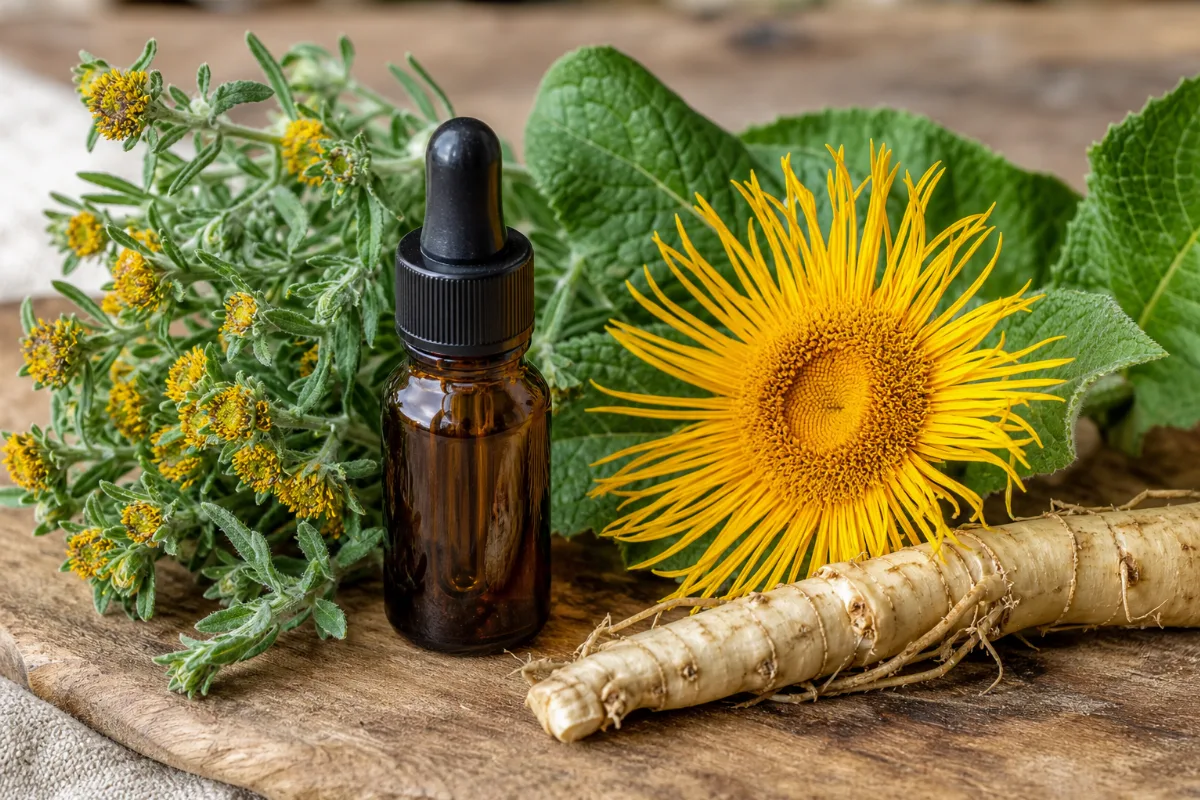
Essential Oils & Aromatherapy · Essential oil
Inula (Elecampane) Oil
Inula graveolens (Dittrichia graveolens) and Inula helenium · also called Elecampane oil, inula oil, Dittrichia graveolens oil
Inula oil is a strong plant oil with two possible sources: Inula graveolens (now filed as Dittrichia graveolens) or elecampane (Inula helenium). Both are daisy-family plants, a family known for skin allergy. We found no human trial of either oil, so no benefit is shown. Never swallow it, never put it on skin undiluted, and avoid it if you are allergic to daisy-family plants.
General information, not medical advice. Last substantive update · Not medically reviewed. A named clinician has not signed off on this page. How this page is made
About Inula (Elecampane) Oil
Inula oil is an unstudied oil from daisy-family plants. No human trial exists. Elecampane and its main root lactone triggered skin reactions in daisy-family-allergic patients in patch tests, so skin allergy is the main known risk. Do not swallow it, do not use it undiluted, and keep it away from pregnancy, children and pets.
Safety first
Daisy-family plants contain sesquiterpene lactones, which can sensitize skin. In a Danish study of 190 patients with daisy-family allergy, elecampane was among the extra plants that caused reactions, and alantolactone, a main elecampane root compound, was among the compounds that triggered patch tests. A 2002 review says elecampane seems to sensitize relatively often, though most of that evidence is anecdotal. These tests used plant extracts and pure compounds, not inula oil, so we cannot give a rate for the oil.
A review of daisy-family plants adds that people who are already sensitized can react to lactones they swallow. Poison Control warns that some essential oils are poisonous if swallowed and that oil reaching the lungs can cause pneumonia. No poisoning report for inula oil was found, and this page gives no way to take it by mouth.
Avoid it in pregnancy and breastfeeding and around babies and children, because no data exist. Cats and birds are at greatest risk from essential oils, and the plant Dittrichia graveolens is known to cause health problems in animals. If anyone may have swallowed it, call a poison centre or emergency services at once (US Poison Help: 1-800-222-1222; numbers elsewhere were not checked).
Which plant? Keep these apart
Inula graveolens (L.) Desf. is a synonym of Dittrichia graveolens (L.) Greuter in the GBIF plant database. Elecampane is a different species, Inula helenium L. Both are in the daisy family. Their oils come from different plant parts and have different make-ups: for example a root oil led by modhephen-8-beta-ol, an aerial-part oil led by borneol, and other Dittrichia graveolens oils led by borneol or bornyl acetate. We found no paper describing elecampane essential oil composition, so we say nothing about it.
Elecampane root is also one of three roots sold in Chinese medicine as "Muxiang". A 2026 review says they are easily confused. Check the Latin name and plant part on any label.
What the research shows
No human trial of any inula or elecampane oil was found. The research that exists is lab work: Dittrichia graveolens oils had slight activity against some bacteria, Inula graveolens oils repelled and killed flour beetles, and purified elecampane root lactones lowered inflammation signals in skin cells and mouse skin.
The mouse result needs care. The compounds that calmed mouse skin belong to the same family that causes skin allergy in sensitized people. Lab results do not show that an oil will do the same in a person.
At a glance
Traditional uses history, not proof
- Elecampane root for coughs and chest complaints (root, not oil)
- Elecampane root for skin complaints in folk medicine
- Scent and skin blends sold in small bottles
- Root sold in Chinese medicine as Tu-Mu-Xiang
Studied for research
- Any benefit in people: no human trial found (insufficient)
- Skin inflammation: mouse and cell work with elecampane root lactones, not the oil (very low)
- Germ-killing and beetle repelling: lab tests only (very low)
Main compounds
- Alantolactone and isoalantolactone: sesquiterpene lactones from elecampane root, and a known skin allergen
- Borneol and bornyl acetate: main compounds in some Dittrichia graveolens oils
- Caryophyllene oxide: found in an Inula graveolens aerial-part oil
Common forms
- Essential oil from the roots of Inula graveolens
- Essential oil from the above-ground parts of Inula graveolens
- Elecampane (Inula helenium) oil: its make-up was not found in the sources we read
Research links: Poison Control: Essential oils · Pet Poison Helpline: Essential oils · Allergic potential of daisy-family plants (review) · Research Library · Genes & Biomarkers Library
What it is and its history
- Accepted scientific name
- Dittrichia graveolens (L.) Greuter (the accepted name for Inula graveolens) and Inula helenium L. (elecampane)
- Naming authority
- GBIF Backbone API, checked 2026-10-25: Dittrichia graveolens (L.) Greuter is ACCEPTED (key 3101193); Inula graveolens (L.) Desf. is a SYNONYM of it (key 3101194); Inula helenium L. is ACCEPTED (key 3148340). All in the family Asteraceae.
- Synonyms
- Inula graveolens (L.) Desf.
- Common names
- Inula oil (English); Elecampane oil (English); Tu-Mu-Xiang (elecampane root, Chinese medicine) (Chinese (pinyin))
- Family or group
- Asteraceae (daisy family)
- Classification
- Plantae > Tracheophyta > Magnoliopsida > Asterales > Asteraceae > Dittrichia; Inula > Dittrichia graveolens; Inula helenium
- Native range
- A review says D. graveolens is an aromatic plant native to the Mediterranean region that is spreading north because of climate change. Elecampane range was not verified.
- Habitat
- Not verified.
- What it looks like
- Roots: Not verified.; Stems: Not verified.; Leaves: Not verified.; Flowers: Not verified.; Fruit: Not verified.
- Cultivation
- Not verified.
- Harvest and processing
- Oils described in the papers were made by hydrodistillation of roots or of aerial parts (I. graveolens). How elecampane oil is made was not read.
- Look-alikes and adulterants
- Name: Aucklandia lappa (Mu-Xiang) and Vladimiria souliei (Chuan-Mu-Xiang); Note: Two other roots sold as "Muxiang" in Chinese medicine, easy to confuse with elecampane (2026 review).
- Sustainability and conservation
- Not assessed in the sources read.
Photographs
Traditional use and history history, not clinical proof
| Tradition or era | Documented use | Source |
|---|---|---|
| Irish folk medicine (elecampane root) | Respiratory and skin ailments, as stated in the Irish ethnomedical literature summarised by a 2022 lab paper. | p35209195 |
| Traditional Chinese medicine (Tu-Mu-Xiang, elecampane root) | One of three Muxiang roots used for their therapeutic properties, as stated in the 2026 review abstract. | p41490555 |
Traditional use shows how it was used. It does not show that it works or is safe today.
What is inside, and how it may work
What it contains and how those compounds act in cells and animals. Laboratory and animal mechanisms are not proven effects in people.
Main compounds
| Compound | Family | Where it is concentrated | Activity studied | Level of evidence |
|---|---|---|---|---|
| Alantolactone PubChem 72724 | Sesquiterpene lactone | Elecampane root extract | Lab anti-staph activity; patch-test allergen in daisy-family-allergic patients. 6 10 12 | Laboratory research |
| Isoalantolactone PubChem 73285 | Sesquiterpene lactone | Elecampane root extract | Lab anti-staph activity; main lactone with alantolactone in a mouse skin study. 6 17 | Laboratory research |
| Borneol PubChem 64685 | Monoterpenoid alcohol | Dittrichia/Inula graveolens oil 28.8% of the aerial-part oil (2023 paper); 43.6% of another D. graveolens oil (2016 paper). | Main compound in some D. graveolens oils; activity of the oil not shown in people. 1 9 | Laboratory research |
| Bornyl acetate PubChem 93009 | Monoterpenoid ester | Dittrichia graveolens oil 9.4% (I. graveolens aerial oil); 21.7% and 38.3% in two other D. graveolens oils. | Main compound in some oils. 1 8 9 | Laboratory research |
| Caryophyllene oxide PubChem 1742210 | Sesquiterpenoid | Inula graveolens aerial-part oil 10.9% (2023 paper). | Present in the oil; activity not studied here. 1 | Not assessed |
Mechanisms, receptors and pathways
| Target or pathway | Gene or receptor | What was found | Level |
|---|---|---|---|
| NF-kB and STAT3 inflammation signalling in skin cells | NF-kB; STAT3 | Elecampane lactones lowered inflammatory gene activity in skin cells and mouse skin. Not shown in people. 17 2 | Laboratory research |
| Skin allergy to sesquiterpene lactones | Sesquiterpene lactones are the main allergens of daisy-family plants, and cross-reactivity between them is wide. The detailed mechanism is not given in the abstracts read. 7 12 | Human observational |
Absorption, metabolism and elimination
- Absorption
- Not studied for inula oils.
- Distribution
- Not studied.
- Metabolism
- Not studied.
- Elimination
- Not studied.
- Bioavailability
- Not studied.
Isolated compounds versus whole extracts
The studies on skin inflammation used purified root lactones; the studies on bacteria and beetles used oils or root extracts. Results for one do not carry over to another, and none was done in people.
Nutritional composition
Inula oil is not a nutrient or a food.
3 very low certainty2 not enough evidence
What was looked at
The 5 benefits and uses checked for Inula (Elecampane) Oil, each with how strong the evidence is. Tap one to open it.
- Any health benefit in people from inula or elecampane essential oil (scent, skin or breathing)Not enough evidence
- Skin inflammation: lab and mouse work with elecampane root lactones (not oil)Very low certainty
- Germ-killing in test tubes (Dittrichia graveolens oil; elecampane root compounds)Very low certainty
- Repelling stored-grain beetles (Inula graveolens oils, lab test)Very low certainty
- Traditional use for coughs, chest complaints and skin (elecampane root, not the oil)Not enough evidence
Lab markers tracked in the studies
Inflammatory signals in skin cells and mouse skin (lab)Bacterial growth in a lab dish
What is Inula (Elecampane) Oil good for?
Safety comes first with this oil. Below are the uses people try it for and how strong the research is. None has human evidence.
Benefits, one by one
Each card is a research question, not a promise. Tap a goal to filter. Open a card to see the studies, doses and limits.
Any health benefit in people from inula or elecampane essential oil (scent, skin or breathing)
Not enough evidenceNo human trial of any inula or elecampane essential oil was found for any use. So we cannot say it helps with anything. Reviews of the plant list lab activities only and call for clinical studies.
2 studiesNot covered. This page gives no amounts and no way to use the oil.
Studies, doses and limits
Results
No human result exists for the oil.
Why this rating
No human trial of any inula oil was found.
Form and dose studied
Not covered. This page gives no amounts and no way to use the oil.
Limits
Absence of trials is not proof that the oil does nothing, but it means no benefit has been shown. The search was limited to PubMed.
Why researchers looked
Elecampane root is an old respiratory and skin remedy, and Inula graveolens (Dittrichia graveolens) plants show lab activity.
Traditional use
Irish ethnomedical literature, as summarised in a 2022 lab paper, indicates elecampane for respiratory and skin ailments. That is about the root, not the oil.
Proposed mechanism Preliminary mechanism
Not studied for the oils in people.
A proposed mechanism does not show that the effect happens in people.
Daisy-family plants contain sesquiterpene lactones that can cause skin allergy. See the safety section.
Skin inflammation: lab and mouse work with elecampane root lactones (not oil)
Very low certaintyIn a mouse model and in skin cells, lactones purified from elecampane root lowered inflammation signals. This is lab and animal work on root compounds, not on essential oil, and not in people. The same kind of compound is a known cause of skin allergy in sensitized people.
3 studiesNot covered. This page gives no amounts and no way to use the oil.
Studies, doses and limits
Results
Mice: a 1% cream of total elecampane lactones reduced eczema-like skin signs and ear swelling and lowered blood IgE and cytokines. Cells: igalan lowered inflammatory chemokine genes and raised skin-barrier genes.
Effect sizes as reported
Mouse blood levels were lowered by 81% (IgE), 90% (TNF-alpha) and 88% (IFN-gamma) against untreated mice. These are lab numbers, not effects in people.
Why this rating
Mouse and cell work on purified compounds only; no human data; the compound type is a skin sensitizer.
Form and dose studied
Not covered. This page gives no amounts and no way to use the oil.
Who was studied
Mice; human skin cells in a dish.
Limits
Purified root lactones, not essential oil. Mouse eczema models often fail to carry over to people.
Why researchers looked
Elecampane root is used traditionally for skin ailments, and its lactones are active in cells.
Traditional use
Traditional skin and respiratory use of elecampane root is reported in a 2022 lab paper.
Proposed mechanism Preliminary mechanism
In skin cells the lactones lowered NF-kB and STAT inflammation signals, and igalan switched on an antioxidant pathway (Nrf2). Whether this matters in people is not shown.
A proposed mechanism does not show that the effect happens in people.
Alantolactone and related lactones triggered patch-test reactions in daisy-family-allergic patients.
Germ-killing in test tubes (Dittrichia graveolens oil; elecampane root compounds)
Very low certaintyIn test tubes, Dittrichia graveolens oil had slight activity against some bacteria, and elecampane root lactones were active against staph bacteria. These are lab results only. They do not show that any oil treats an infection.
4 studiesNot covered. This page gives no amounts and no way to use the oil.
Studies, doses and limits
Results
Oil of D. graveolens was active only against Gram-positive bacteria in a disk test. In another test it had slight antibacterial activity; with chloramphenicol and tetracycline it was mostly additive or synergistic in vitro, and with streptomycin it was strongly antagonistic against three strains.
Effect sizes as reported
No clinical effect sizes. Lab numbers were not repeated here.
Why this rating
Test-tube work only, on different materials (oil, root extract), with no animals or people.
Form and dose studied
Not covered. This page gives no amounts and no way to use the oil.
Who was studied
Bacteria and fungus strains in a lab.
Limits
Oils differ between batches. Findings with antibiotics must not be used to mix oils with medicines.
Why researchers looked
Rising antibiotic resistance and the traditional use of elecampane for skin and breathing complaints.
Traditional use
Respiratory and skin use of elecampane root is described in a 2022 lab paper.
Proposed mechanism Preliminary mechanism
Elecampane root: alantolactone, isoalantolactone, igalan and related lactones carried the anti-staph activity. D. graveolens oil: borneol and bornyl acetate dominated in two oils, but make-up varies.
A proposed mechanism does not show that the effect happens in people.
Antagonism with streptomycin in the lab is a reminder that oils can change how medicines work; nothing is known in people.
Repelling stored-grain beetles (Inula graveolens oils, lab test)
Very low certaintyOils from roots and from above-ground parts of Inula graveolens repelled and were toxic to flour beetles in a lab test. This is about insects on a surface, not about mosquitoes, skin or people.
1 studiesNot covered. This page gives no amounts and no way to use the oil.
Studies, doses and limits
Results
After 2 hours, repellency was 80.0% (root oil) and 90.0% (aerial-part oil); both were also toxic to the beetles on contact.
Effect sizes as reported
80% and 90% repellency of beetles in the lab test.
Why this rating
One lab study on one insect species.
Form and dose studied
Not covered. This page gives no amounts and no way to use the oil.
Who was studied
Flour beetles.
Limits
Not tested on mosquitoes, ticks or any pest of people; not a reason to put the oil on skin.
Why researchers looked
Interest in natural insect repellents for stored food.
Proposed mechanism Preliminary mechanism
Not studied.
A proposed mechanism does not show that the effect happens in people.
An oil that kills insects on contact can be harmful to other living things; keep away from pets.
Traditional use for coughs, chest complaints and skin (elecampane root, not the oil)
Not enough evidenceElecampane root has long been used in folk medicine for breathing and skin complaints. We found no human trial of the root or the oil. The three roots sold in Chinese medicine as "Muxiang" are easy to mix up, one of them being elecampane.
2 studiesNot covered. This page gives no amounts and no way to use the oil.
Studies, doses and limits
What the trials found
No human trial found.
Why this rating
Traditional use only; no clinical trial found.
Form and dose studied
Not covered. This page gives no amounts and no way to use the oil.
Limits
Traditional use is not proof of benefit or safety.
Why researchers looked
Long folk use of the root.
Traditional use
Irish ethnomedical literature indicates elecampane for respiratory and skin ailments (2022 paper). A 2026 review covers elecampane (Tu-Mu-Xiang) beside two look-alike roots.
Proposed mechanism Preliminary mechanism
Sesquiterpene lactones are the main compounds in the root; benefits in people are not shown.
A proposed mechanism does not show that the effect happens in people.
Daisy-family allergy risk. See safety.
Connections to the rest of health
How Inula (Elecampane) Oil connects to the rest of our health knowledge graph. Every link says what kind of connection it is. A safety link (for example to the liver) is a warning, not a benefit. A study that merely mentions a topic never creates a benefit link.
Explore every connection: goals, body systems, organs, symptoms, genes
A. Wellness goals
| Connected to | Kind of connection | Evidence status | Context | Studies |
|---|---|---|---|---|
| Healthy Skin | Very low certainty | Skin inflammation: lab and mouse work with elecampane root lactones (not oil): In a mouse model and in skin cells, lactones purified from elecampane root lowered inflammation signals. This is lab and animal work on root compounds, not on essential oil, and not in people. The same kind of compound is a known cause of skin allergy in sensitized people. | 17 2 10 | |
| Infection Support | Very low certainty | Germ-killing in test tubes (Dittrichia graveolens oil; elecampane root compounds): In test tubes, Dittrichia graveolens oil had slight activity against some bacteria, and elecampane root lactones were active against staph bacteria. These are lab results only. They do not show that any oil treats an infection. | 6 9 8 16 | |
| Insect Protection | Very low certainty | Repelling stored-grain beetles (Inula graveolens oils, lab test): Oils from roots and from above-ground parts of Inula graveolens repelled and were toxic to flour beetles in a lab test. This is about insects on a surface, not about mosquitoes, skin or people. | 1 | |
| Breathing Support | Traditional use | Not enough evidence | Traditional use for coughs, chest complaints and skin (elecampane root, not the oil): Elecampane root has long been used in folk medicine for breathing and skin complaints. We found no human trial of the root or the oil. The three roots sold in Chinese medicine as "Muxiang" are easy to mix up, one of them being elecampane. | 6 18 |
B. Body systems
| Connected to | Kind of connection | Evidence status | Context | Studies |
|---|---|---|---|---|
| Skin and hair | Adverse effect or risk | Documented | Daisy-family lactones triggered patch tests in allergic patients; no patch test of the oil itself was found. A safety relationship, not a benefit. Daisy-family lactones triggered patch tests in allergic patients; the oil itself was not patch-tested. A safety relationship, not a benefit. Preparation or compound: Elecampane (Inula helenium) extract and lactones such as alantolactone |
10 11 12 |
| Respiratory System | Biological association | Not enough evidence | Studied for: Any health benefit in people from inula or elecampane essential oil (scent, skin or breathing) Studied for: Traditional use for coughs, chest complaints and skin (elecampane root, not the oil) | 16 18 6 |
| Integumentary System | Biological association | Not enough evidence | Studied for: Any health benefit in people from inula or elecampane essential oil (scent, skin or breathing) Studied for: Skin inflammation: lab and mouse work with elecampane root lactones (not oil) | 16 18 17 2 10 6 9 8 |
| Immune System | Biological association | Very low certainty | Studied for: Germ-killing in test tubes (Dittrichia graveolens oil; elecampane root compounds) | 6 9 8 16 |
E. Health conditions
| Connected to | Kind of connection | Evidence status | Context | Studies |
|---|---|---|---|---|
| Allergic contact dermatitis | Adverse effect or risk | Documented | Patch-test and case-report evidence with plant extracts and pure compounds. Preparation or compound: Sesquiterpene lactones (alantolactone) from daisy-family plants including elecampane |
10 13 |
I. Biomarkers
| Connected to | Kind of connection | Evidence status | Context | Studies |
|---|---|---|---|---|
| Inflammatory signals in skin cells and mouse skin (lab) | Biological association | Very low certainty | Measured in trials: lowered. A lab change is not the same as a health benefit. | 17 2 |
| Bacterial growth in a lab dish | Biological association | Very low certainty | Measured in trials: lowered. A lab change is not the same as a health benefit. | 9 6 |
K. Biological pathways
L. Active compounds
| Connected to | Kind of connection | Evidence status | Context | Studies |
|---|---|---|---|---|
| Alantolactone | Biological association | In vitro | Lab anti-staph activity; patch-test allergen in daisy-family-allergic patients. Preparation or compound: Elecampane root extract |
6 10 12 |
| Isoalantolactone | Biological association | In vitro | Lab anti-staph activity; main lactone with alantolactone in a mouse skin study. Preparation or compound: Elecampane root extract |
6 17 |
| Borneol | Biological association | In vitro | Main compound in some D. graveolens oils; activity of the oil not shown in people. Preparation or compound: Dittrichia/Inula graveolens oil |
1 9 |
| Bornyl acetate | Biological association | In vitro | Main compound in some oils. Preparation or compound: Dittrichia graveolens oil |
1 8 9 |
| Caryophyllene oxide | Biological association | Not assessed | Present in the oil; activity not studied here. Preparation or compound: Inula graveolens aerial-part oil |
1 |
Each connection is stored with the ingredient, the connected record, the kind of connection, the evidence status, the supporting studies, the preparation or compound involved, and a review date (last reviewed October 25, 2026).
Evidence at a glance: what changed in 2 lab markers
Tap a number to show only those markers. Counts are markers, not people.
The evidence
The research centre for Inula (Elecampane) Oil. Every record here was checked against PubMed or the publisher's page; we never list a study we have not verified.
Evidence by outcome
Bars show how many studies we found for each outcome, not how well it works. People are added up across trials only (reviews are not added, to avoid double counting).
How we rate evidence
High certainty
Several well-run trials or reviews agree; further research is unlikely to change the picture much.
Moderate certainty
Good trials point the same way, but some doubt remains.
Low certainty
Small, short or inconsistent trials. The finding could change with better research.
Very low certainty
Very little or very weak human data. Treat as a possibility only.
Mixed findings
Trials or reviews disagree with each other.
Not enough evidence
Not enough human research to say either way.
Evidence against
Good research found no benefit, or found harm.
We take the reviewers' own risk-of-bias and GRADE statements where they exist, and otherwise judge from study size, design, consistency, directness and whether a product matches what is sold. Many publications do not make evidence high. Method note: We searched PubMed and read the abstract of every PubMed study cited (one 1995 case report has no abstract, so only its title is used). We read the Poison Control and Pet Poison Helpline pages in full and checked plant names against the GBIF database. Pages we could not open are named in the safety section.
Study library: every study we checked 18
| Study | Design | People | Product, dose, length | Result |
|---|---|---|---|---|
| Ben Mustapha 2023 Chemical Composition, Toxicity and Repellency of Inula graveolens Essential Oils from Roots and Aerial Parts against Stored-Product Beetle Tribolium castaneum Chemistry & biodiversity · PMID 36808818 · DOI |
Laboratory insect (lab) |
Adult flour beetles (Tribolium castaneum) in a lab test; no people | Essential oils of Inula graveolens roots and of aerial parts, made by hydrodistillation, and fractions of them Essential oil (roots; aerial parts) 0.12 microlitres per square centimetre in the repellency test (insects, not people) 2 hours exposure · vs Untreated surface |
Root oil: 28 compounds (97.9% of the oil); main ones modhephen-8-beta-ol 24.7%, cis-arteannuic alcohol 14.8%, neryl isovalerate 10.6%, thymol isobutyrate 8.5%. Aerial-part oil: 22 compounds (93.9%); main ones borneol 28.8%, caryophylla-4(14),8(15)-dien-6-ol 11.5%, caryophyllene oxide 10.9%, tau-cadinol 10.5%, bornyl acetate 9.4%. After 2 hours, repellency was 80.0% (root oil) and 90.0% (aerial-part oil). Both oils were also toxic to the beetles on contact. The two oils of the same species are very different mixtures, and both repelled and killed stored-grain beetles in the lab. Methods, limits and fundingOutcomes: Oil composition by GC/MS; repellency and contact toxicity to beetles Limitations: Insects in a lab test. Says nothing about people, skin, or smell. Funding and conflicts: Not stated in the abstract. Read: abstract |
| Dao 2020 Igalan from Inula helenium (L.) suppresses the atopic dermatitis-like response in stimulated HaCaT keratinocytes via JAK/STAT3 signaling Inflammation research · PMID 32002586 · DOI |
Laboratory human cells (lab) |
Human HaCaT skin cells in a dish | Igalan (a sesquiterpene lactone from Inula helenium) Purified compound Several concentrations in cell culture Cell culture · vs Untreated stimulated cells |
In stimulated skin cells, igalan lowered several inflammatory chemokine genes, raised expression of genes for skin-barrier proteins, and switched on an antioxidant pathway (Nrf2). Cell-level anti-inflammatory activity of one elecampane lactone. Methods, limits and fundingOutcomes: Inflammatory gene expression, skin-barrier gene expression, antioxidant pathway Limitations: Test-tube cells only; one purified compound; no animals or people. Funding and conflicts: Not stated in the abstract. Read: abstract |
| GBIF Secretariat 2026 Dittrichia graveolens (L.) Greuter, GBIF Backbone Taxonomy GBIF species API (checked 2026-10-25) · Source |
Reference database plant |
Not applicable | Essential oils (general) Essential oils |
GBIF API match for "Dittrichia graveolens (L.) Greuter": usage key 3101193, status ACCEPTED, family Asteraceae. Identity confirmed. Methods, limits and fundingOutcomes: Accepted name and synonyms Limitations: Taxonomy database only. Funding and conflicts: Not applicable Read: full-text |
| GBIF Secretariat 2026 Inula graveolens (L.) Desf., GBIF Backbone Taxonomy GBIF species API (checked 2026-10-25) · Source |
Reference database plant |
Not applicable | Essential oils (general) Essential oils |
GBIF API match for "Inula graveolens (L.) Desf.": usage key 3101194, status SYNONYM of Dittrichia graveolens (L.) Greuter (accepted key 3101193), family Asteraceae. Identity confirmed. Methods, limits and fundingOutcomes: Accepted name and synonyms Limitations: Taxonomy database only. Funding and conflicts: Not applicable Read: full-text |
| GBIF Secretariat 2026 Inula helenium L., GBIF Backbone Taxonomy GBIF species API (checked 2026-10-25) · Source |
Reference database plant |
Not applicable | Essential oils (general) Essential oils |
GBIF API match for "Inula helenium L.": usage key 3148340, status ACCEPTED, family Asteraceae. Identity confirmed. Methods, limits and fundingOutcomes: Accepted name and synonyms Limitations: Taxonomy database only. Funding and conflicts: Not applicable Read: full-text |
| Kenny 2022 From Monographs to Chromatograms: The Antimicrobial Potential of Inula helenium L. (Elecampane) Naturalised in Ireland Molecules (Basel, Switzerland) · PMID 35209195 · DOI |
Laboratory in vitro (bacteria) |
Lab study of root extracts (no people) | Hydro-ethanolic extracts of elecampane roots from several origins in Ireland Root extract (not essential oil) |
The authors say Irish ethnomedical literature indicates elecampane for respiratory and skin ailments. Anti-staphylococcal activity in vitro was traced to alantolactone, isoalantolactone, igalan and a mixture of dugesialactone and alloalantolactone. Geographical origin did not change potency or composition. They say further research is warranted. Lab activity of root sesquiterpene lactones against staph bacteria; no human result. Methods, limits and fundingOutcomes: Anti-staphylococcal activity of root fractions; identification of the active compounds Limitations: Test-tube study of root extracts, not of oil. Says nothing about safety or benefit in people. Funding and conflicts: Not stated in the abstract. Read: abstract |
| Kljucevsek 2025 Allergic Potential of Medicinal Plants From the Asteraceae Family Health science reports · PMID 39995792 · DOI |
Review review |
Review of medicinal Asteraceae plants (search up to January 2024, English only) | Asteraceae (daisy family) medicinal plants Plant materials |
Asteraceae are important sensitizers. Sesquiterpene lactones (SLs) in the family can sensitize and cause skin irritation and inflammation. SLs can also cause body-wide reactions if sensitized people swallow them. Cross-reactivity among SLs is wide, and many uncertainties remain about the key allergens. Supports caution with any daisy-family plant product in people who are already allergic, including by mouth. Methods, limits and fundingOutcomes: Allergic potential of daisy-family medicinal plants Limitations: Narrative review; the abstract does not mention inula oil. Wording about swallowing refers to plant material, not essential oils. Funding and conflicts: Not stated in the abstract. Read: abstract |
| Miladinovic 2016 In Vitro Trials of Dittrichia graveolens Essential Oil Combined with Antibiotics Natural product communications · PMID 27534137 · DOI |
Laboratory in vitro (bacteria) |
Lab study on 13 bacterial strains (no people) | Essential oil of Dittrichia graveolens, alone and with chloramphenicol, tetracycline or streptomycin Essential oil · vs Antibiotics alone |
Oxygenated monoterpenes made up 40.6% of the oil, with bornyl acetate (21.7%) the main compound. The oil showed slight antibacterial activity. With chloramphenicol and tetracycline the combinations were mostly synergistic or additive in the lab. With streptomycin the interactions were strongly antagonistic against E. coli, S. aureus and P. aeruginosa strains. Lab only. The oil changed how antibiotics worked in test tubes, in both directions. Methods, limits and fundingOutcomes: Antibacterial activity and interactions with antibiotics (broth microdilution, checkerboard) Limitations: No animals or people. Does not show that combining the oil with any medicine is safe or useful. Funding and conflicts: Not stated in the abstract. Read: abstract |
| Mitic 2016 Dittrichia graveolens (L.) Greuter Essential Oil: Chemical Composition, Multivariate Analysis, and Antimicrobial Activity Chemistry & biodiversity · PMID 26765355 · DOI |
Laboratory in vitro (bacteria, fungus) |
Lab study (no people) | Essential oil of Dittrichia graveolens Essential oil |
54 compounds were identified (92.9% of the oil); monoterpenoids made up 87.4%. The main components were borneol (43.6%) and bornyl acetate (38.3%). The oil was active only against Gram-positive bacteria. The authors also compared the oil profile with other published oils and found borneol and bornyl acetate drove the differences. Another D. graveolens oil with a different make-up (borneol and bornyl acetate dominated), with lab antibacterial activity only. Methods, limits and fundingOutcomes: Oil composition by GC; antimicrobial tests on 5 bacteria and 1 fungus (disk diffusion) Limitations: Lab disk test only. Composition differs from the I. graveolens oils in the 2023 paper, which shows batches vary. Funding and conflicts: Not stated in the abstract. Read: abstract |
| Paulsen 2001 Sensitization and cross-reaction patterns in Danish Compositae-allergic patients Contact dermatitis · PMID 11683829 · DOI |
Observational |
190 patients with confirmed Compositae (daisy-family) allergy seen over 8 years in Denmark | Patch tests with sesquiterpene lactone mix, Compositae mix and daisy-family plant extracts and allergens Plant extracts and allergens (not essential oils) 8-year period |
Feverfew gave positive reactions most often, then tansy, wild chamomile, yarrow and arnica. Among the sesquiterpene lactones, dehydrocostus lactone was most often positive, followed by alantolactone and costunolide. In people sensitized outside of work, garden plants including elecampane (Inula helenium) were additional important allergenic plants; elecampane, large yellow ox-eye and cosmea were picked up by the SL mix. In daisy-family-allergic patients, elecampane and alantolactone (a main elecampane root compound) triggered patch-test reactions. Methods, limits and fundingOutcomes: Positive patch-test reactions Limitations: Patients who already had a daisy-family allergy, not the general public. Plant extracts and pure allergens were tested, not any essential oil. Funding and conflicts: Not stated in the abstract. Read: abstract |
| Paulsen 2002 Contact sensitization from Compositae-containing herbal remedies and cosmetics Contact dermatitis · PMID 12492516 · DOI |
Review review |
Literature review of Compositae herbal remedies and cosmetics | Compositae (Asteraceae) herbal remedies and cosmetics Plant extracts in products |
At least 15 species, including arnica, German and Roman chamomile, calendula, echinacea and elecampane (Inula helenium), have been suspected of sensitizing or triggering Compositae dermatitis. Epidemiological data exist for only two species (arnica and German chamomile); the rest is anecdotal. Sensitization seems to occur relatively often with a few species such as arnica and elecampane. Sesquiterpene lactones are the most important allergens. The risk of a reaction from using such products in already-sensitized people is largely unknown. Elecampane is named among the daisy-family plants more likely to sensitize skin, although the evidence is mostly anecdotal. Methods, limits and fundingOutcomes: Reports of sensitization and contact dermatitis Limitations: Review from 2002; evidence for elecampane described as anecdotal. Not about essential oil. Funding and conflicts: Not stated in the abstract. Read: abstract |
| Paulsen 2023 The sesquiterpene lactone mix: A review of past, present and future aspects Contact dermatitis · PMID 37820718 · DOI |
Review human (review) |
Review of patch-test findings with the sesquiterpene lactone (SL) mix | SL mix (equal parts alantolactone, costunolide and dehydrocostus lactone) Pure compounds used for patch testing |
Sesquiterpene lactones are widespread in the daisy family and are the main allergens of those plants. The SL mix contains alantolactone, costunolide and dehydrocostus lactone. After it was added to standard patch-test series, the mean share of positive reactions was about 1% in Europe and 0.8% in North America, with 0% to 10.7% outside those regions. The author says the mix misses some sensitized people, so plant extracts may be needed too. Alantolactone, a main elecampane root compound, is one of the three allergens used to screen for daisy-family contact allergy. Methods, limits and fundingOutcomes: Prevalence of positive patch-test reactions to the SL mix Limitations: Review abstract only. Rates are from patch-tested clinic patients and are not rates for essential oil users. Funding and conflicts: Not stated in the abstract. Read: abstract |
| Pazzaglia 1995 Contact dermatitis due to a massage liniment containing Inula helenium extract Contact dermatitis · PMID 8654079 · DOI |
Case report human (case report) |
Not available (title only) | Massage liniment containing Inula helenium extract Extract in a liniment Not available Not available |
Only the title and record type (case report) were available: a case of contact dermatitis from a massage liniment containing elecampane extract. No abstract was read, so no detail is stated. A published case report links an elecampane-extract liniment to skin allergy. Methods, limits and fundingOutcomes: Not available Limitations: No abstract available on PubMed; only the title is used. An extract in a liniment is not the same as an essential oil. Funding and conflicts: Not stated in the abstract. Read: title-only |
| Pet Poison Helpline 2023 Essential oils petpoisonhelpline.com web article · Source |
Authoritative guidance animal (pets) |
Not applicable | Essential oils (general) Essential oils |
Read in full on 2026-10-25. Essential oil poisoning can affect all species, but cats and birds are at the greatest risk. Signs vary with the oil, dose, route and concentration. Common signs include drooling, vomiting and lethargy. Clinical signs may need 3 to 7 days to resolve. Inula is not named. Cats and birds are most at risk from essential oils in general. Methods, limits and fundingOutcomes: Safety information Limitations: Not specific to inula oils. Undated student-written page; no inula-specific advice. Funding and conflicts: Not applicable Read: full-text |
| Poison Control (National Capital Poison Center) 2024 Essential oils: Poisonous when misused poison.org web article (references accessed July 2024) · Source |
Authoritative guidance |
Not applicable | Essential oils (general) Essential oils |
Read in full on 2026-10-25. Many essential oils can cause rashes on skin, and some can be poisonous if absorbed through skin or swallowed. Breathing oil into the lungs can cause pneumonia. Children have thin skin and immature livers and may be more susceptible. Essential oils may interact with medicines. Diluting an oil in a carrier oil is the best way to avoid a bad reaction from direct skin contact. Stop using an oil immediately if a rash or other skin reaction occurs and wash it off. Keep oils locked up out of sight of children and pets. The page gives case examples of a toddler seizure and drowsiness after swallowing oils. For poisoning: call 1-800-222-1222 (US). General warnings that apply to every essential oil, including inula oils. Inula is not named. Methods, limits and fundingOutcomes: Safety information Limitations: Not specific to inula oils. US phone number only; numbers elsewhere were not checked. Funding and conflicts: Not applicable Read: full-text |
| Ponticelli 2022 Dittrichia graveolens (L.) Greuter, a Rapidly Spreading Invasive Plant: Chemistry and Bioactivity Molecules (Basel, Switzerland) · PMID 35164160 · DOI |
Review review of lab and animal work |
Plant studies (52 papers up to October 2021) | Dittrichia graveolens plant and extracts Whole plant |
The review says the plant has been studied for antioxidant, antitumour, antimicrobial, antifungal, anti-inflammatory and other activities in the lab, linked to terpenes and flavonoids such as borneol. It also says the plant is well known for causing health problems in animals and people, and that it is spreading north because of climate change. The authors call for studies of molecular pathways, absorption and clinical studies. Mostly lab findings; no clinical use shown. Confirms the plant has a record of causing health problems. Methods, limits and fundingOutcomes: Spread, chemistry (262 compounds), pharmacological effects and toxicology of the plant Limitations: Abstract only was read. It is about the plant and its extracts, not the essential oil in particular. The abstract does not say which health problems. Funding and conflicts: Not stated in the abstract. Read: abstract |
| Wang 2018 Total sesquiterpene lactones isolated from Inula helenium L. attenuates 2,4-dinitrochlorobenzene-induced atopic dermatitis-like skin lesions in mice Phytomedicine · PMID 30097125 · DOI |
Animal experiment mouse and human cells |
ICR mice with an induced eczema-like skin reaction, and human HaCaT skin cells | Total sesquiterpene lactones from Inula helenium (mainly alantolactone and isoalantolactone), 1% in an emollient cream on mouse skin Root extract (purified lactones), not essential oil 1% weight/weight in cream (mice) Repeated challenges over the experiment · vs Untreated controls |
In skin cells, the lactones lowered inflammatory signals (NF-kB, TNF-alpha, IL-1, IL-4). In mice, the 1% cream reduced dermatitis severity and ear swelling and lowered serum IgE, TNF-alpha and IFN-gamma (by 81%, 90% and 88% against untreated controls). Anti-inflammatory signals in mouse skin and cell tests with elecampane root lactones. Not shown in people. Methods, limits and fundingOutcomes: Skin lesion severity, ear swelling, blood IgE and cytokines Limitations: Mouse and cell study of purified root lactones, not oil. These same compound types are known skin sensitizers in people, so the result does not support using anything on skin. Funding and conflicts: Not stated in the abstract. Read: abstract |
| Wei 2026 Aucklandia lappa, Vladimiria souliei, and Inula helenium: A comprehensive review on the ethnomedicines, phytochemicals, quality control, pharmacology and modern applications of three Muxiang varieties Journal of ethnopharmacology · PMID 41490555 · DOI |
Review review of lab and animal work |
Review of literature from January 2015 to September 2025 | Dried roots of three Muxiang species including Inula helenium (Tu-Mu-Xiang) Root |
The three roots look alike and are easily confused. 429 compounds were found; sesquiterpene lactones (149 compounds) were the main active group in lab and animal work. DNA barcoding, GC-MS and other methods can tell the species apart. The authors say future work must confirm the differences between the species. Species confusion between the three Muxiang roots is real; the review is about roots, not essential oil. Methods, limits and fundingOutcomes: Traditional uses, chemistry, quality control and pharmacology Limitations: Abstract only. Pharmacology described is lab and animal level; the abstract gives no clinical trial. Funding and conflicts: Not stated in the abstract. Read: abstract |
What we do not know yet
- No human trial of any inula or elecampane essential oil for any use.
- No patch-test study of the oils themselves.
- Whether the oils contain allergenic lactones such as alantolactone is not shown in the abstracts read.
- Elecampane essential oil composition was not read.
- No pregnancy, children, pet or poisoning data for inula oils.
- EMA, FDA, LiverTox and LactMed could not be read or had no entry.
How new research is added
New studies are found by a saved PubMed search and placed in a review queue. A person reads each one before it changes any rating or safety wording.
Lab markers
What changed in blood or saliva tests during trials. A changed number is not the same as feeling or being healthier, and we give no "normal ranges".
Other 2
Inflammatory signals in skin cells and mouse skin (lab)
Lowered in trials
Lab measures of inflammation messengers such as TNF-alpha, IL-4, IgE and the NF-kB switch.
Very low certaintyResults and what it means
Why it was measured
Used to test whether elecampane root lactones calm eczema-like skin responses in models.
Statistical vs. clinical meaning
Lab measures, not a health outcome in people.
Safety implication
The same lactone family can sensitize skin in people.
| Study | Result | People | Product |
|---|---|---|---|
| 17 | Total elecampane lactones lowered NF-kB activation and TNF-alpha, IL-1 and IL-4 in skin cells, and lowered serum IgE, TNF-alpha and IFN-gamma in mice. | Skin cells; ICR mice | Total sesquiterpene lactones from I. helenium, 1% in cream (mice) |
| 2 | Igalan lowered inflammatory chemokine genes in stimulated skin cells. | HaCaT skin cells | Igalan, a purified lactone |
Bacterial growth in a lab dish
Lowered in trials
Whether bacteria grow or are stopped in a test tube or on an agar plate.
Very low certaintyResults and what it means
Why it was measured
A first-step screen for antimicrobial activity.
Statistical vs. clinical meaning
A lab screen, not an infection outcome.
Safety implication
None known; test-tube only.
Safety
What studies and official sources say about side effects, medicines and who should check first. Each point shows what kind of evidence it comes from.
Main points to know 7
- Daisy-family skin allergy: the main known risk. Inula plants belong to the daisy family (Asteraceae). Sesquiterpene lactones in this family can sensitize skin and cause irritation and inflammation. In 190 Danish patients with daisy-family allergy, elecampane (Inula helenium) was among the additional important allergenic plants, and alantolactone, an elecampane root compound, was among the lactones that triggered patch tests. A 2002 review names elecampane among daisy-family plants that seem to sensitize relatively often, but says most of that evidence is anecdotal. These tests used plant extracts and pure compounds, not inula essential oil. Whether the oils carry these lactones was not shown in the sources we read. Observational 7 10 11 12
- Very little research: no safety study of the oils in people. We found no human trial and no patch-test study of any inula or elecampane essential oil. No rate of harm and no safe amount is known. That is not proof of safety. Treat the oils as unstudied. Absence 16
- Do not swallow inula oil. Poison Control says some essential oils are poisonous if swallowed, and that oil getting into the lungs can cause pneumonia. A review of daisy-family plants adds that sensitized people can react to lactones they swallow. No poisoning report for inula oil was found, and this page gives no way to take it by mouth. Authoritative guidance 15 7
- Never use it undiluted on skin. Poison Control says pure essential oils are potent and diluting them in a carrier oil is the best way to avoid a bad reaction, and not to use oils on damaged skin. No inula dilution figure was found in any source we read, so none is given here. Stop and wash the skin if a rash appears. Authoritative guidance 15
- Pregnancy, breastfeeding, babies and children: no data. No source we read describes inula oil in pregnancy, breastfeeding or children, so we cannot call it safe. Poison Control says children have thin skin and immature livers and may be more susceptible to toxic effects. Ask a doctor first. Absence 15
- Pets: cats and birds are most at risk from essential oils. Pet Poison Helpline says cats and birds are at greatest risk of essential-oil poisoning. Inula is not named. A review says the plant Dittrichia graveolens is known for causing health problems in animals; that is about the plant, not the oil. Authoritative guidance 14 16
- Check which plant you have. "Inula oil" can mean Inula graveolens (now filed as Dittrichia graveolens) or elecampane (Inula helenium). They are different species with different oils. Results and warnings for one do not carry over to the other. Reference database 3 4 5 1
Side effects 3
| Effect | How often | Severity and recovery | Evidence |
|---|---|---|---|
| Allergic contact dermatitis (itchy red rash, blisters) in people sensitized to daisy-family plants Evidence is from plant extracts and pure compounds in patch tests and from a case-report title (liniment with elecampane extract). Rates for the oils are unknown. | Not established | moderate Not described in the abstracts read | Observational 10 11 13 |
| Skin irritation or rash from essential oils in general A general statement about essential oils; inula is not named. | Not established | mild to moderate Stop use and wash off (Poison Control) | Authoritative guidance 15 |
| Reactions after swallowing, in people already sensitized to daisy-family lactones Review-level statement about the plant family. No report involving inula oil was found. | Not established | unknown Not described | Review 7 |
Liver
We found no published human case of liver injury from inula or elecampane oil, and no entry for elecampane or Inula in the NIH LiverTox or LactMed databases (a search of the NCBI Bookshelf returned none). That is not proof of safety; it means nothing has been studied. 15
How often. Unknown.
Monitoring. No agency monitoring advice was found. Anyone with liver disease should ask a doctor before using any essential oil.
This is a safety connection. It is not evidence that Inula (Elecampane) Oil supports liver health.
Medicines and supplements 2
| With | Why it matters | Importance | Evidence | What to do |
|---|---|---|---|---|
| Medicines in general prescription | Poison Control says essential oils may interact with medications. No inula-specific interaction is described in any source we read. | Unknown for inula oils. | Authoritative guidance Very low certainty 15 | Tell your doctor or pharmacist about any essential oil you use, especially if you take regular medicines. |
| Antibiotics (chloramphenicol, tetracycline, streptomycin) prescription | Lab only: in test-tube bacteria, Dittrichia graveolens oil was mostly additive or synergistic with chloramphenicol and tetracycline, and strongly antagonistic with streptomycin against three strains. | Not shown in people or animals. It is a reason for caution, not a recommendation to combine anything. | Laboratory research Very low certainty 8 | Do not combine essential oils with antibiotics. Ask a pharmacist. |
Who should check first 7
| Situation | Advice | Evidence |
|---|---|---|
| Known allergy to daisy-family plants (arnica, chamomile, feverfew, tansy, yarrow, chrysanthemum, ragweed and others) | Avoid, or ask a clinician first. Daisy-family lactones cross-react widely in sensitized people. | Observational 10 7 11 |
| Swallowing (anyone) | Do not swallow. Poison centres warn that some essential oils are poisonous if swallowed. | Authoritative guidance 15 |
| Pregnancy and breastfeeding | No data were found. Avoid unless a doctor advises otherwise. | Absence 15 |
| Babies and children | No inula data. Poison Control says children may be more susceptible to essential oils. Keep oils locked away. | Authoritative guidance 15 |
| Damaged or broken skin | Do not use essential oils on damaged skin (Poison Control). | Authoritative guidance 15 |
| Households with cats or birds | Cats and birds are at greatest risk from essential oils; keep inula oils away from them. | Authoritative guidance 14 |
| Epilepsy, asthma and sun exposure | Not described for inula oils in any source we read, so no statement can be made. Ask a doctor. | Absence 15 |
Overdose, product quality and regulators
Summary. No toxicity study of the oils in mammals was found. The only toxicity figures are for insects.
Animal. A review says the plant Dittrichia graveolens is well known for causing health problems in animals (details not in the abstract). In a lab test, topical LD50 values for flour beetles were 7.44% (root oil) and 4.88% (aerial-part oil), which shows the oils are toxic to insects.
High dose or long term signals. Not studied.
Overdose response. If anyone swallows an essential oil, call a poison centre or emergency services (US Poison Help: 1-800-222-1222; numbers elsewhere were not checked).
Genotoxicity. Not studied.
Toxic or hazardous parts. Not established. The plant Dittrichia graveolens as a whole is linked to health problems in animals and people (review).
Naming and make-up are a quality problem. Oils called inula can come from different species and plant parts, and their make-up differs a lot.
Oil composition varies. Four oils from this plant had different main compounds: an Inula graveolens root oil led by modhephen-8-beta-ol (24.7%); an aerial-part oil led by borneol (28.8%); another Dittrichia graveolens oil led by borneol (43.6%) and bornyl acetate (38.3%); and a fourth with bornyl acetate (21.7%) as its main compound. 1 9 8
Look-alike names. Three different roots are sold in Chinese medicine as "Muxiang" (including elecampane), and are easy to confuse. 18
Adulteration and purity. No test of inula oil purity or adulteration was found.
| Body | Action | Date |
|---|---|---|
| Poison Control (National Capital Poison Center) (United States) | General warnings on essential oils: rashes, poisoning if swallowed, pneumonia if inhaled into the lungs, children more susceptible, possible medicine interactions, dilute for skin, keep away from children and pets. Inula is not named. source | 2024-07 |
| Pet Poison Helpline (United States) | Essential-oil poisoning risk is greatest in cats and birds. Inula is not named. source | 2023 |
When to get medical help
- Anyone who has swallowed an essential oil, or a product containing one: call a poison centre or emergency services now (US Poison Help 1-800-222-1222), even if they seem well.
- Coughing, choking or trouble breathing after oil was swallowed or breathed into the lungs.
- A spreading rash, swelling of the face or lips, hives, or blisters after skin contact: stop use, wash the skin and get medical help; call emergency services for swelling of the face or throat or trouble breathing.
- A seizure, confusion or unusual sleepiness in a child or adult after any essential oil.
- A pet that drools, vomits, is very sleepy or unsteady after contact with essential oils: call a vet or animal poison line.
Stop using the product and contact a clinician or emergency service. In the US, Poison Control is 1-800-222-1222.
General information only, not medical advice. Ask a clinician or pharmacist before use, especially with medicines, in pregnancy or with a health condition. See the Natural Remedy Safety guide.
Frequently asked questions
Is inula oil the same as elecampane oil?
Can inula oil cause an allergic reaction?
What does a daisy-family allergy have to do with it?
Can I swallow inula oil?
Is inula oil safe in pregnancy or breastfeeding?
Nobody knows. No source we read describes it in pregnancy or breastfeeding. Avoid it unless a doctor advises otherwise.
Is inula oil safe for children?
No inula data exist. Poison Control says children have thin skin and immature livers and may be more susceptible to essential oils. Keep all oils locked away.
Is inula oil safe around pets?
Does inula oil help coughs or colds?
Does inula oil kill germs?
Does inula oil repel insects?
In one lab test, Inula graveolens oils repelled and were toxic to stored-grain flour beetles. That test says nothing about mosquitoes, ticks or use on skin.
Can inula oil interact with medicines?
Explore by health goal
Healthy SkinInfection SupportInsect ProtectionBreathing Support
Editorial transparency
- Written by
- AlternativeMed editorial team. Research compiled with AI assistance, then checked against PubMed records.
- Medical review
- None. This page has not been reviewed by a physician or pharmacist.
- First published
- 2026-10-25
- Last substantive update
- 2026-10-25
- How we research
- We searched PubMed and read the abstract of every PubMed study cited (one 1995 case report has no abstract, so only its title is used). We read the Poison Control and Pet Poison Helpline pages in full and checked plant names against the GBIF database. Pages we could not open are named in the safety section.
- How we rate evidence
- See "How we rate evidence" in the Evidence tab.
- Independence
- No product is promoted on this page. No affiliate links are shown.
Sources 18
Each source was opened and checked. Where we read only the abstract, it says so. The small numbers in the text point here.
- Ben Mustapha M, Algethami FK, Elamin MR, et al.. Chemical Composition, Toxicity and Repellency of Inula graveolens Essential Oils from Roots and Aerial Parts against Stored-Product Beetle Tribolium castaneum. Chemistry & biodiversity. 2023. PMID 36808818. DOI 10.1002/cbdv.202200978. (abstract)
- Dao TTP, Song K, Kim YH, et al.. Igalan from Inula helenium (L.) suppresses the atopic dermatitis-like response in stimulated HaCaT keratinocytes via JAK/STAT3 signaling. Inflammation research. 2020. PMID 32002586. DOI 10.1007/s00011-020-01322-4. (abstract)
- GBIF Secretariat. Dittrichia graveolens (L.) Greuter, GBIF Backbone Taxonomy. GBIF species API (checked 2026-10-25). 2026. (full-text)
- GBIF Secretariat. Inula graveolens (L.) Desf., GBIF Backbone Taxonomy. GBIF species API (checked 2026-10-25). 2026. (full-text)
- GBIF Secretariat. Inula helenium L., GBIF Backbone Taxonomy. GBIF species API (checked 2026-10-25). 2026. (full-text)
- Kenny CR, Stojakowska A, Furey A, et al.. From Monographs to Chromatograms: The Antimicrobial Potential of Inula helenium L. (Elecampane) Naturalised in Ireland. Molecules (Basel, Switzerland). 2022. PMID 35209195. DOI 10.3390/molecules27041406. (abstract)
- Kljucevsek T, Kreft S. Allergic Potential of Medicinal Plants From the Asteraceae Family. Health science reports. 2025. PMID 39995792. DOI 10.1002/hsr2.70398. (abstract)
- Miladinovic DL, Ilic BS, Kocic BD, et al.. In Vitro Trials of Dittrichia graveolens Essential Oil Combined with Antibiotics. Natural product communications. 2016. PMID 27534137. DOI 10.1177/1934578X1601100642. (abstract)
- Mitic V, Stankov Jovanovic V, Ilic M, et al.. Dittrichia graveolens (L.) Greuter Essential Oil: Chemical Composition, Multivariate Analysis, and Antimicrobial Activity. Chemistry & biodiversity. 2016. PMID 26765355. DOI 10.1002/cbdv.201500028. (abstract)
- Paulsen E, Andersen KE, Hausen BM. Sensitization and cross-reaction patterns in Danish Compositae-allergic patients. Contact dermatitis. 2001. PMID 11683829. DOI 10.1034/j.1600-0536.2001.450402.x. (abstract)
- Paulsen E. Contact sensitization from Compositae-containing herbal remedies and cosmetics. Contact dermatitis. 2002. PMID 12492516. DOI 10.1034/j.1600-0536.2002.470401.x. (abstract)
- Paulsen E. The sesquiterpene lactone mix: A review of past, present and future aspects. Contact dermatitis. 2023. PMID 37820718. DOI 10.1111/cod.14419. (abstract)
- Pazzaglia M, Venturo N, Borda G, et al.. Contact dermatitis due to a massage liniment containing Inula helenium extract. Contact dermatitis. 1995. PMID 8654079. DOI 10.1111/j.1600-0536.1995.tb00479.x. (title-only)
- Pet Poison Helpline. Essential oils. petpoisonhelpline.com web article. 2023. (full-text)
- Poison Control (National Capital Poison Center). Essential oils: Poisonous when misused. poison.org web article (references accessed July 2024). 2024. (full-text)
- Ponticelli M, Lela L, Russo D, et al.. Dittrichia graveolens (L.) Greuter, a Rapidly Spreading Invasive Plant: Chemistry and Bioactivity. Molecules (Basel, Switzerland). 2022. PMID 35164160. DOI 10.3390/molecules27030895. (abstract)
- Wang X, Gao Y, Wu F, et al.. Total sesquiterpene lactones isolated from Inula helenium L. attenuates 2,4-dinitrochlorobenzene-induced atopic dermatitis-like skin lesions in mice. Phytomedicine. 2018. PMID 30097125. DOI 10.1016/j.phymed.2018.04.036. (abstract)
- Wei R, Gao Z, Cui D, et al.. Aucklandia lappa, Vladimiria souliei, and Inula helenium: A comprehensive review on the ethnomedicines, phytochemicals, quality control, pharmacology and modern applications of three Muxiang varieties. Journal of ethnopharmacology. 2026. PMID 41490555. DOI 10.1016/j.jep.2026.121163. (abstract)
Where to buy
Check the label first. Whatever you buy, look for these:
- The botanical (Latin) name on the label and 100% pure oil
- A dark glass bottle and a batch number
- Essential oils are strong: dilute for skin, and do not swallow unless a qualified professional directs it
- Keep away from children and pets
Talk to a pharmacist or doctor before you start any supplement, especially if you take medicines. See the Safety tab for interactions.
Support our free guides: as an Amazon Associate we earn from qualifying purchases. Full disclosure.


