Essential Oils & Aromatherapy · Essential oil
Blue Tansy Oil
Tanacetum annuum L. (aerial parts) · also called Moroccan blue chamomile, annual tansy
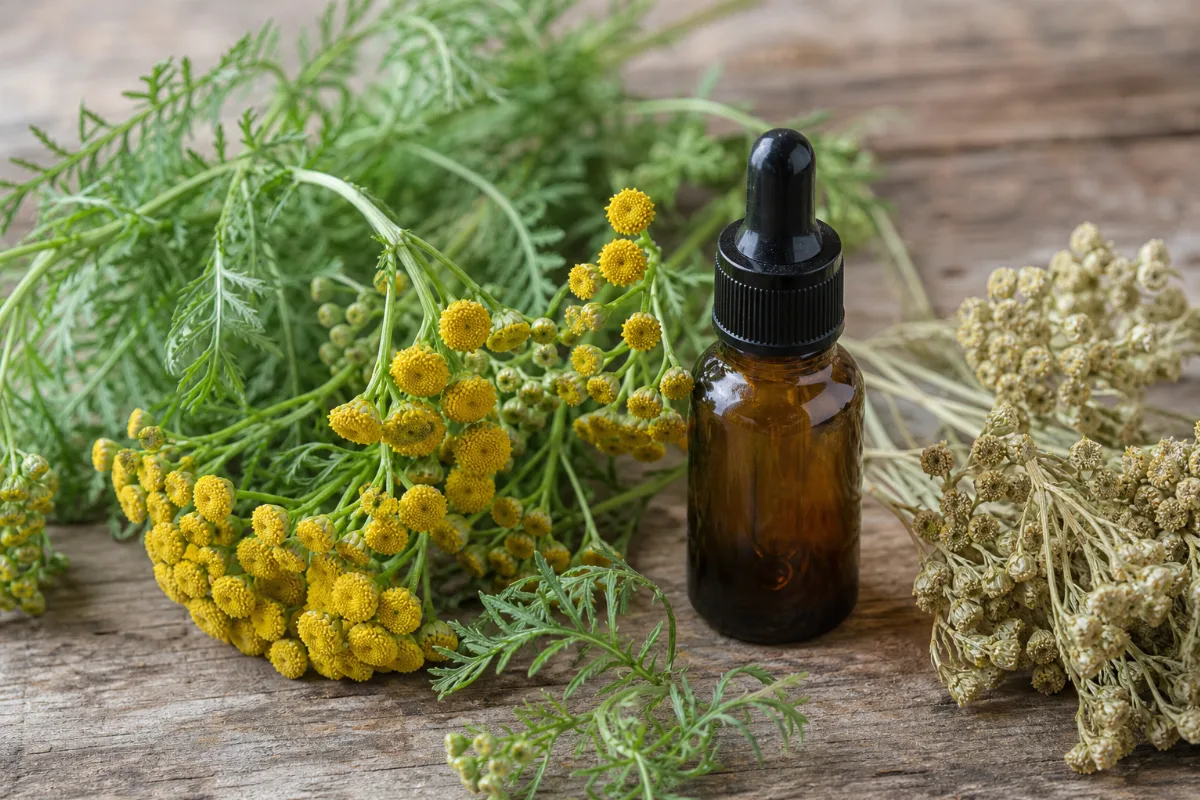
Blue tansy oil is a deep blue oil steam-distilled from a Mediterranean daisy-family plant. It is sold for calm and skin soothing. We found no human study of it at all, only lab work on its chemistry and on germs in a dish. The main cautions: it is a daisy-family allergen, it contains camphor, and it should never be swallowed or used undiluted.
General information, not medical advice. Last substantive update · Not medically reviewed. A named clinician has not signed off on this page. How this page is made
About Blue Tansy Oil
Blue tansy oil comes from a daisy-family plant that grows around the Mediterranean. The oil is dark blue and has a fruity, herb-like smell. It is sold for calm and skin soothing, but we found no human study of it. Safety comes first: it is a daisy-family allergen risk, it contains camphor, it should not be swallowed, and cats and birds are most at risk from essential oils.
What blue tansy oil is
Blue tansy is Tanacetum annuum, a daisy-family plant that grows wild in the Mediterranean, including northwestern Morocco, Portugal, Spain and southern France. The oil is made by hydrodistilling its stems, leaves and flowers. GBIF now lists the plant as a synonym of Vogtia annua, but the research and the oil trade still use the Tanacetum name.
The blue colour comes from chamazulene and related compounds. Their share, and everything else in the oil, varies. One Moroccan sample had 17.74% chamazulene, 14.39% sabinene and 14.21% camphor. Another had 16.69% camphor, 12.37% alpha-pinene, 11.97% bornyl acetate, 11.10% limonene and only 3.49% chamazulene. So a deep blue bottle does not tell you the make-up. Do not confuse it with common tansy (Tanacetum vulgare), whose oil a review lists at 45.2% beta-thujone with a convulsion risk.
What people use it for, and the evidence
It is sold for calm, sleep and soothing skin, and the oil is often called anti-inflammatory. We found no human trial for any of these. The skin claim leans on chamazulene: a 2025 mouse study found that 0.4% pure chamazulene, from a different plant's oil, lowered UVB skin-damage markers. That says nothing certain about blue tansy oil, which was not tested and also contains camphor.
What exists for the oil itself is lab work: it stopped a date-palm fungus in a dish, it slowed some bacteria in a dish, and plant extracts (not the oil) scored well in an antioxidant test. This page does not advise any amount or way of use.
The research in one view
A PubMed search for Tanacetum annuum and 'blue tansy' found only two relevant papers, both from Moroccan labs in 2023, on the oil's chemistry and its effect on germs in a dish. There is no human trial and no animal study of the whole oil. That is the honest picture: this is a popular oil with almost no research behind it.
Quality, 'blue' and fakes
Poison Control says essential oils are not well regulated, so it can be hard to know the species, strength or any contaminants in a bottle. A 2023 paper says blue tansy oil's high market value has limited its export. We did not find a study of how often shop-bought blue tansy oil is diluted, mixed with other oils or coloured, so we cannot say how common that is. The same paper showed that gamma irradiation changes the oil's make-up in the lab. Check the Latin name, the plant part and a batch test report.
What authorities say
The FDA says a product with claims to treat anxiety or help you sleep is a drug, that cosmetics do not need FDA approval before sale, and that a plant origin does not make an oil safe. Poison Control and Pet Poison Helpline give the general warnings above. We did not find or read an EMA, EFSA, SCCS, IFRA, RIFM, LiverTox or LactMed statement on blue tansy oil.
At a glance
Traditional uses history, not proof
- The authors of a 2023 lab paper say blue tansy is used in traditional medicine for inflammation, allergy and itch, citing earlier work we did not read.
- The oil's high market value has limited its export, according to a 2023 paper.
Studied for research
- Calm, mood and sleep, insufficient (no study)
- Skin soothing and anti-inflammatory claims, insufficient (mouse study of a single compound only)
- Slowing a plant fungus in a dish, insufficient
- Slowing bacteria in a dish, insufficient
- Antioxidant tests of plant extracts, insufficient
Main compounds
- Chamazulene, 3.49% to 17.74% (two samples)
- Camphor, 14.21% and 16.69% (two samples)
- Sabinene, 14.39% (one sample)
Common forms
- Essential oil (steam- or hydro-distilled aerial parts)
- Fragrance and aromatherapy blends
Research links: Blue tansy composition and antifungal lab study (abstract) · Blue tansy gamma-irradiation lab study (abstract) · Daisy-family allergy review (abstract) · Poison Control: Essential oils · Pet Poison Helpline: Essential oils · FDA: Aromatherapy · Research Library · Genes & Biomarkers Library
What it is and its history
- Accepted scientific name
- Vogtia annua (L.) Oberpr. & Sonboli
- Naming authority
- (L.) Oberpr. & Sonboli
- Synonyms
- Tanacetum annuum L.
- Common names
- Blue tansy (English); Moroccan blue chamomile (English); Annual tansy (English)
- Family or group
- Asteraceae (the daisy family; the papers call it Compositae), per GBIF and the papers.
- Classification
- Plantae > Tracheophyta > Magnoliopsida > Asterales > Asteraceae > Vogtia > Vogtia annua
- Native range
- A 2023 paper says it grows wild around the Mediterranean, including northwestern Morocco, Portugal, Spain and southern France.
- Habitat
- Not checked.
- What it looks like
- Part used: The oil in the lab papers was hydrodistilled from the aerial parts (stems, leaves and flowers). This page does not describe how to recognise the plant.
- Cultivation
- Not covered by the sources read.
- Harvest and processing
- Hydrodistillation of the dried aerial parts (3 hours, Clevenger apparatus in one paper). Yield was about 0.7% in one lab study and 0.23% in another.
- Look-alikes and adulterants
- Name: Common tansy (Tanacetum vulgare); Note: A different plant. A review lists its oil at 45.2% beta-thujone, with a convulsion risk. Check the Latin name on any bottle labelled 'tansy'.; Name: Other daisy-family oils (yarrow, chamomile, helichrysum); Note: Different plants with their own pages. They share the family allergy caution but are not blue tansy.
- Sustainability and conservation
- Not covered by the sources read.
Traditional use and history history, not clinical proof
| Tradition or era | Documented use | Source |
|---|---|---|
| Traditional use (claimed) | The authors of a 2023 lab paper say blue tansy is used in traditional medicine as an anti-inflammatory, anti-histamine, anti-flogistic and anti-itch plant, citing earlier papers. We did not read those earlier papers. Treat this as the authors' statement, not a verified history. | Ettakifi et al. 2023 |
| Modern market | A 2023 paper says the oil's high market value has limited its export. We found no source for when blue tansy oil became popular in aromatherapy. | Belcadi et al. 2023 |
Traditional use shows how it was used. It does not show that it works or is safe today.
What is inside, and how it may work
What it contains and how those compounds act in cells and animals. Laboratory and animal mechanisms are not proven effects in people.
Main compounds
| Compound | Family | Where it is concentrated | Activity studied | Level of evidence |
|---|---|---|---|---|
| Chamazulene PubChem 10719 | azulene (sesquiterpene hydrocarbon) | Hydrodistilled aerial parts 17.74% in one Moroccan sample; 3.49% in another. | The papers say chamazulene and its relatives (3,6-dihydrochamazulene and 5,6-dihydrochamazulene) give the oil its blue colour. In mice, pure chamazulene from another plant's oil lowered UVB skin-damage markers. Not tested in people. 11 2 4 7 | Animal research |
| Camphor PubChem 2537 | monoterpene ketone | Hydrodistilled aerial parts 14.21% in one Moroccan sample; 16.69% in another. | Dangerous if swallowed (Poison Control: seizures can start within minutes). The oil was not tested for this; the warning is about camphor products. 12 2 4 8 | Authoritative guidance |
| Sabinene PubChem 18818 | monoterpene | Hydrodistilled aerial parts 14.39% in one Moroccan sample. Not listed among the main compounds of the other. | No safety or benefit finding for sabinene alone in the sources read. 13 2 | Laboratory |
| Alpha-pinene, bornyl acetate and limonene | monoterpenes and an ester | Hydrodistilled aerial parts 12.37%, 11.97% and 11.10% in the second Moroccan sample. | Listed by the authors as main compounds. No finding in people. 4 | Laboratory |
Mechanisms, receptors and pathways
| Target or pathway | Gene or receptor | What was found | Level |
|---|---|---|---|
| PPAR-alpha and PPAR-gamma, p38 MAPK/COX-2 (chamazulene, from another plant's oil) | PPARA, PPARG, PTGS2 | In mouse skin exposed to UVB, 0.4% chamazulene raised PPAR-alpha and PPAR-gamma and lowered a p38 MAPK/COX-2 inflammation pathway. This is a pure compound from a different plant, not blue tansy oil. 7 | Animal research |
| Fungal growth | Oil and extracts stopped a date-palm fungus in a dish. The mechanism was not tested. 4 | Laboratory research |
Absorption, metabolism and elimination
- Absorption
- Not established for blue tansy oil.
- Distribution
- Not established.
- Metabolism
- Not established.
- Elimination
- Not established.
- Bioavailability
- Not established.
Isolated compounds versus whole extracts
The oil is a mixture of at least 39 compounds with large differences between samples. A result for one compound (such as chamazulene in mice) does not carry over to the whole oil, which also contains camphor.
Nutritional composition
Blue tansy oil is not a nutrient or a food.
5 not enough evidence
What is Blue Tansy Oil good for?
The uses people ask about and how strong the evidence is for each. Read the certainty label first: for blue tansy oil there are no human studies, only claims and lab work.
Benefits, one by one
Each card is a research question, not a promise. Tap a goal to filter. Open a card to see the studies, doses and limits.
Calm, mood and sleep (blue tansy scent)
Not enough evidenceWe found no study of blue tansy oil in people, for calm, mood, sleep or anything else. The claims come from marketing, not from research.
2 studiesSold as a scent for diffusers and diluted skin oils. No amounts are a…
Studies, doses and limits
What the trials found
None found. Searches of PubMed for Tanacetum annuum and 'blue tansy' returned only plant-chemistry and lab papers.
Results
No human results exist. The FDA says claims such as treating anxiety or helping you sleep make a product a drug claim, and that a plant origin does not make an oil safe.
Effect sizes as reported
No effect sizes: no study found.
Why this rating
No human, animal or lab study of blue tansy oil for these uses was found.
Form and dose studied
Sold as a scent for diffusers and diluted skin oils. No amounts are advised here. Bottled oil is concentrated: do not swallow it and do not use it undiluted on skin; ask a pharmacist.
Who was studied
None.
Limits
Absence of studies is not proof the oil does nothing. It means nobody knows.
Why researchers looked
It is not studied for this. The oil is sold as 'calming' because of its smell and its deep blue colour. Poison Control says few uses of essential oils have been studied scientifically.
Traditional use
No traditional use of the essential oil for calm or sleep was found in the sources read.
Proposed mechanism Preliminary mechanism
No mechanism has been tested for blue tansy oil and mood or sleep.
A proposed mechanism does not show that the effect happens in people.
Blue tansy is a daisy-family (Asteraceae) oil that contains camphor. Do not swallow it. Do not use it undiluted. See the Safety tab.
Skin soothing and anti-inflammatory claims
Not enough evidenceBlue tansy oil is sold as a skin soother because it contains chamazulene, which gives the blue colour. A 2025 mouse study of pure chamazulene from another plant's oil lowered skin-damage markers after UV light. Blue tansy oil itself was never tested for this, in animals or people.
4 studiesSold in diluted skin oils and serums. No amounts are advised here. Do…
Studies, doses and limits
What the trials found
None found for blue tansy oil or for chamazulene on human skin.
Results
Mouse study: 0.4% chamazulene on UVB-exposed skin restored fatty-acid balance and lowered a COX-2 inflammation pathway. The oil also contains camphor (about 14% to 17% in two samples), which is not a skin-soothing compound by any trial we read.
Effect sizes as reported
No effect sizes for blue tansy oil. In mice, a pure chamazulene cream (0.4%, from a different plant's oil) lowered markers of UVB skin damage.
Why this rating
One mouse study of a pure compound, from a different plant. Nothing on blue tansy oil in animals or people.
Form and dose studied
Sold in diluted skin oils and serums. No amounts are advised here. Do not use bottled oil undiluted.
Who was studied
Mice only.
Limits
The oil is a mixture. Chamazulene content ranged from 3.49% to 17.74% in two Moroccan samples, so even the key compound varies. The mouse paper is about chamazulene from Artemisia sieversiana oil.
Why researchers looked
Chamazulene is a blue compound found in a few plants. It is the reason the oil is marketed as 'anti-inflammatory'. The trade claim has been built on that one compound, not on trials of the oil.
Traditional use
The authors of one 2023 lab paper say blue tansy is used in traditional medicine as an anti-inflammatory, anti-histamine and anti-itch plant, citing earlier work. We did not read that earlier work, so this is a statement by the authors, not something we checked.
Proposed mechanism Preliminary mechanism
In the mouse study, chamazulene raised PPAR-alpha and PPAR-gamma activity and lowered the p38 MAPK/COX-2 inflammation pathway. This was a pure compound on mouse skin, not blue tansy oil.
A proposed mechanism does not show that the effect happens in people.
This is also a daisy-family oil: the allergy risk on skin is documented for the family and not tested for this oil. Patch-test it with a skin doctor's advice if you have any plant allergy. See the Safety tab.
Slowing a plant fungus in a dish
Not enough evidenceIn a Moroccan lab, blue tansy oil and plant extracts stopped growth of a fungus that attacks date palms. It is a plant disease, not a human infection, and it was a test-tube result.
1 studiesLab study only. No use is advised.
Studies, doses and limits
What the trials found
None.
Results
Oil from northern Morocco stopped fungus growth at 3.33 microlitres per millilitre and killed it at 4.58. Crude extracts needed 3.33 and 9.17 mg/mL.
Effect sizes as reported
Lowest amounts that stopped and killed the fungus in a dish: 3.33 and 4.58 microlitres per millilitre of oil.
Why this rating
One lab study, one plant fungus.
Form and dose studied
Lab study only. No use is advised.
Who was studied
None.
Limits
The authors' claim of use in the 'pharmaceutical industry' is not tested. Test-tube amounts are not safe amounts for a person.
Why researchers looked
Researchers wanted a natural way to control Bayoud disease of date palms.
Traditional use
No traditional use found for this.
Proposed mechanism Preliminary mechanism
The authors point to camphor, bornyl acetate, limonene and chamazulene as compounds with activity in earlier work. They did not test which compound did it.
A proposed mechanism does not show that the effect happens in people.
Concentrated oil can irritate skin and is poisonous to swallow (Poison Control). See the Safety tab.
Slowing bacteria in a dish (and what gamma irradiation did to the oil)
Not enough evidenceA Moroccan lab tested the oil against bacteria in a dish and found it slowed some of them. The study was really about what radiation does to the oil: it changed the oil's make-up. It does not show the oil treats any infection in a person.
1 studiesLab study only. No use is advised.
Studies, doses and limits
What the trials found
None.
Results
Untreated oil: chamazulene 17.74%, sabinene 14.39%, camphor 14.21%. After irradiation some compounds disappeared and new ones appeared, and the effect on bacteria depended on the germ and the radiation level.
Effect sizes as reported
Not reliably stated: the abstract and the results disagree on the effect of irradiation (see limitations).
Why this rating
One lab study with inconsistent descriptions of its own antibacterial result.
Form and dose studied
Lab study only. No use is advised.
Who was studied
None.
Limits
The abstract says irradiation increased antibacterial activity, while the full text describes a reduction for some germs and an increase for others. We do not repeat a firm number.
Why researchers looked
Some food and herb industries sterilise products with radiation, so the researchers asked what that does to the oil.
Traditional use
No traditional use found for this.
Proposed mechanism Preliminary mechanism
Irradiation changed which compounds were in the oil. No mechanism for killing bacteria was tested.
A proposed mechanism does not show that the effect happens in people.
No safety test of irradiated oil was done. Do not put undiluted oil on skin or wounds.
Antioxidant tests in a dish (plant extracts, not the oil)
Not enough evidenceExtracts of blue tansy stems, leaves and flowers scored well in a test-tube antioxidant test. That test used extracts made with solvents, not the essential oil, and a dish result does not show a benefit in the body.
1 studiesLab study only. No use is advised.
Studies, doses and limits
What the trials found
None.
Results
Methanol and water-methanol extracts had strong DPPH antioxidant activity (IC50 0.22 to 0.65 mg/mL).
Effect sizes as reported
Plant extracts: IC50 0.22 to 0.65 mg/mL in a test-tube DPPH test.
Why this rating
Lab test of extracts only.
Form and dose studied
Lab study only. No use is advised.
Who was studied
None.
Limits
Extracts are not the essential oil. Antioxidant tests in a dish are a weak guide to anything in the body.
Why researchers looked
Plants rich in phenolic compounds often score well in antioxidant tests.
Traditional use
No traditional use found for this.
Proposed mechanism Preliminary mechanism
The extracts contained apigenin 7-glucoside, luteolin 7-glucoside and salicylic acid, among 19 phenolic compounds. No mechanism in the body was tested.
A proposed mechanism does not show that the effect happens in people.
Not applicable: no use is advised.
Connections to the rest of health
How Blue Tansy Oil connects to the rest of our health knowledge graph. Every link says what kind of connection it is. A safety link (for example to the liver) is a warning, not a benefit. A study that merely mentions a topic never creates a benefit link.
Explore every connection: goals, body systems, organs, symptoms, genes
A. Wellness goals
| Connected to | Kind of connection | Evidence status | Context | Studies |
|---|---|---|---|---|
| Calm Relaxation | Not enough evidence | Calm, mood and sleep (blue tansy scent): We found no study of blue tansy oil in people, for calm, mood, sleep or anything else. The claims come from marketing, not from research. | 8 14 | |
| Stress Reduction | Not enough evidence | Calm, mood and sleep (blue tansy scent): We found no study of blue tansy oil in people, for calm, mood, sleep or anything else. The claims come from marketing, not from research. | 8 14 | |
| Better Sleep | Not enough evidence | Calm, mood and sleep (blue tansy scent): We found no study of blue tansy oil in people, for calm, mood, sleep or anything else. The claims come from marketing, not from research. | 8 14 | |
| Healthy Skin | Not enough evidence | Skin soothing and anti-inflammatory claims: Blue tansy oil is sold as a skin soother because it contains chamazulene, which gives the blue colour. A 2025 mouse study of pure chamazulene from another plant's oil lowered skin-damage markers after UV light. Blue tansy oil itself was never tested for this, in animals or people. | 7 2 4 6 | |
| Inflammation Balance | Not enough evidence | Skin soothing and anti-inflammatory claims: Blue tansy oil is sold as a skin soother because it contains chamazulene, which gives the blue colour. A 2025 mouse study of pure chamazulene from another plant's oil lowered skin-damage markers after UV light. Blue tansy oil itself was never tested for this, in animals or people. | 7 2 4 6 | |
| Insect Protection | Not enough evidence | Slowing a plant fungus in a dish: In a Moroccan lab, blue tansy oil and plant extracts stopped growth of a fungus that attacks date palms. It is a plant disease, not a human infection, and it was a test-tube result. | 4 | |
| Immune Support | Not enough evidence | Slowing bacteria in a dish (and what gamma irradiation did to the oil): A Moroccan lab tested the oil against bacteria in a dish and found it slowed some of them. The study was really about what radiation does to the oil: it changed the oil's make-up. It does not show the oil treats any infection in a person. | 2 | |
| Cellular Protection | Not enough evidence | Antioxidant tests in a dish (plant extracts, not the oil): Extracts of blue tansy stems, leaves and flowers scored well in a test-tube antioxidant test. That test used extracts made with solvents, not the essential oil, and a dish result does not show a benefit in the body. | 4 |
B. Body systems
| Connected to | Kind of connection | Evidence status | Context | Studies |
|---|---|---|---|---|
| Nervous System | Biological association | Not enough evidence | Studied for: Calm, mood and sleep (blue tansy scent) | 8 14 |
| Stress Mood | Biological association | Not enough evidence | Studied for: Calm, mood and sleep (blue tansy scent) | 8 14 |
| Skin Hair Beauty | Biological association | Not enough evidence | Studied for: Skin soothing and anti-inflammatory claims Studied for: Slowing bacteria in a dish (and what gamma irradiation did to the oil) | 7 2 4 6 |
| Integumentary System | Biological association | Not enough evidence | Studied for: Skin soothing and anti-inflammatory claims | 7 2 4 6 |
| Pain Inflammation | Biological association | Not enough evidence | Studied for: Skin soothing and anti-inflammatory claims | 7 2 4 6 |
| Whole Body | Biological association | Not enough evidence | Studied for: Slowing a plant fungus in a dish Studied for: Antioxidant tests in a dish (plant extracts, not the oil) | 4 |
| Immune System | Biological association | Not enough evidence | Studied for: Slowing bacteria in a dish (and what gamma irradiation did to the oil) | 2 |
E. Health conditions
| Connected to | Kind of connection | Evidence status | Context | Studies |
|---|---|---|---|---|
| Allergic contact dermatitis | Adverse effect or risk | Documented risk | Daisy-family plants and other Tanacetum extracts are documented skin sensitisers; blue tansy oil itself was not tested in the sources read. Preparation or compound: Blue tansy oil (daisy-family oil) |
6 1 |
| Essential oil poisoning | Adverse effect or risk | Documented risk | General warnings and camphor cases; no blue tansy case found. Preparation or compound: Swallowed essential oils in general; camphor |
8 5 9 |
L. Active compounds
| Connected to | Kind of connection | Evidence status | Context | Studies |
|---|---|---|---|---|
| Chamazulene | Biological association | Animal | The papers say chamazulene and its relatives (3,6-dihydrochamazulene and 5,6-dihydrochamazulene) give the oil its blue colour. In mice, pure chamazulene from another plant's oil lowered UVB skin-damage markers. Not tested in people. Preparation or compound: Hydrodistilled aerial parts |
11 2 4 7 |
| Camphor | Biological association | Authoritative guidance | Dangerous if swallowed (Poison Control: seizures can start within minutes). The oil was not tested for this; the warning is about camphor products. Preparation or compound: Hydrodistilled aerial parts |
12 2 4 8 |
| Sabinene | Biological association | Laboratory | No safety or benefit finding for sabinene alone in the sources read. Preparation or compound: Hydrodistilled aerial parts |
13 2 |
| Alpha-pinene, bornyl acetate and limonene | Biological association | Laboratory | Listed by the authors as main compounds. No finding in people. Preparation or compound: Hydrodistilled aerial parts |
4 |
Each connection is stored with the ingredient, the connected record, the kind of connection, the evidence status, the supporting studies, the preparation or compound involved, and a review date (last reviewed October 25, 2026).
The evidence
The research centre for Blue Tansy Oil. Every record here was checked against PubMed or the publisher's page; we never list a study we have not verified.
Evidence by outcome
Bars show how many studies we found for each outcome, not how well it works. People are added up across trials only (reviews are not added, to avoid double counting).
How we rate evidence
High certainty
Several well-run trials or reviews agree; further research is unlikely to change the picture much.
Moderate certainty
Good trials point the same way, but some doubt remains.
Low certainty
Small, short or inconsistent trials. The finding could change with better research.
Very low certainty
Very little or very weak human data. Treat as a possibility only.
Mixed findings
Trials or reviews disagree with each other.
Not enough evidence
Not enough human research to say either way.
Evidence against
Good research found no benefit, or found harm.
We take the reviewers' own risk-of-bias and GRADE statements where they exist, and otherwise judge from study size, design, consistency, directness and whether a product matches what is sold. Many publications do not make evidence high. Method note: We read the abstracts of 7 PubMed records (full text through Europe PMC for the four main ones) and the Poison Control, Pet Poison Helpline and FDA pages, and checked the plant name in GBIF and the compounds in PubChem. We did not find or read an EMA, EFSA, SCCS, IFRA, RIFM, LiverTox or LactMed statement.
Study library: every study we checked 14
| Study | Design | People | Product, dose, length | Result |
|---|---|---|---|---|
| Barbaud 2023 Allergic contact dermatitis from essential oil in consumer products: Mode of uses and value of patch tests with an essential oil series. Results of a French study of the DAG (Dermato-Allergology group of the French Society of Dermatology). Contact Dermatitis · PMID 37403438 · DOI |
Case series |
42 42 patients in French dermatology clinics with allergic contact dermatitis from their own essential oils (79% women, average age 50) |
Patients' own essential oils (mostly lavender, tea tree, ravintsara; helichrysum in 2) n/a n/a n/a · vs n/a |
All 42 patients were sensitised to the oil they used. The most common were lavender, tea tree and ravintsara. 8 patients needed hospital care. 71% had positive patch tests to fragrance mixes. 40% did not spontaneously say they used essential oils, and only 33% had received advice when buying. Blue tansy is not among the oils named in the abstract. Methods, limits and fundingOutcomes: Patch test results with a baseline series and an essential oil series; how the oils were used Limitations: Patients already referred for allergy, so it cannot give the chance of allergy in the general public. Blue tansy is not named in the abstract. Funding and conflicts: Not stated in the abstract. Read: abstract |
| Belcadi 2023 Gamma-irradiation effect on the chemical composition and antibacterial activity of the moroccan tanacetum annuum L. essential oil. Heliyon · PMID 37292271 · DOI |
Laboratory study in vitro |
Blue tansy plants (leaves, stems, flowers) from northern Morocco; bacteria in a dish | Essential oil, untreated and after gamma irradiation (5 and 10 kGy) aerial parts Test-tube concentrations only Lab test · vs Untreated oil |
In the untreated oil, chamazulene was the largest compound (17.74%), then sabinene (14.39%) and camphor (14.21%). The oil yield was 0.23%. Irradiation changed the make-up of the oil, adding some compounds and removing others. The abstract says this made the oil more active against bacteria, but the results section describes a mixed picture that depended on the germ and the radiation level (for example, a rise against Staphylococcus aureus at the lower level, a fall at the higher level, and a slight fall against Escherichia coli). We therefore state only that irradiation changed the oil and its effect on germs in a dish. Methods, limits and fundingOutcomes: Oil composition by GC-MS before and after irradiation; bacterial growth in a dish Limitations: Test-tube work on one sample. The abstract and the detailed results do not fully agree, so the antibacterial result is uncertain. The authors suggest irradiation could 'enhance' oils, but they did not test safety. Nothing was tested in animals or people. Funding and conflicts: No competing interests stated. Read: abstract plus full text (Europe PMC PMC10245259) |
| Dosoky 2021 Maternal Reproductive Toxicity of Some Essential Oils and Their Constituents. International Journal of Molecular Sciences · PMID 33673548 · DOI |
Review review |
Review of studies on essential oils and their compounds in pregnancy | Essential oils and compounds (camphor, thujone, sabinyl acetate and others) n/a n/a n/a · vs n/a |
The review says there is no decisive evidence that essential oils cause abortion in aromatherapy amounts, although whole plants such as tansy, savin, pennyroyal and rue can induce miscarriage; it adds that this is not proof of safety. It says swallowed camphor poisoning causes seizures, loss of coordination, slowed breathing, vomiting and coma, and that tansy oil (common tansy, Tanacetum vulgare, listed at 45.2% beta-thujone) is neurotoxic and carries a risk of convulsions. It lists blue tansy (Tanacetum annuum) only as a source of the compound beta-eudesmol (3.5% to 6.7%). Methods, limits and fundingOutcomes: Abortion, hormone effects, maternal toxicity, birth defects, harm to the foetus Limitations: A narrative review of animal, lab and case reports, not a study of blue tansy oil in pregnant women. Blue tansy is not named as a pregnancy hazard. Funding and conflicts: No conflicts declared. Read: abstract plus full text (Europe PMC PMC7956842) |
| Ettakifi 2023 Chemical Characterization and Antifungal Activity of Blue Tansy (Tanacetum annuum) Essential Oil and Crude Extracts against Fusarium oxysporum f. sp. albedinis, an Agent Causing Bayoud Disease of Date Palm. Antibiotics (Basel) · PMID 37760747 · DOI |
Laboratory study in vitro |
Blue tansy plants (stems, leaves, flowers) collected in northern Morocco; a date-palm plant fungus in a dish | Essential oil (hydrodistilled for 3 hours) and methanol or water-methanol extracts of the aerial parts aerial parts (stems, leaves, flowers) Test-tube concentrations only (not an amount for people) Lab test · vs n/a |
39 compounds were found in the oil. The main ones were camphor (16.69%), alpha-pinene (12.37%), bornyl acetate (11.97%) and limonene (11.10%); chamazulene was 3.49% in the full text. The oil yield was about 0.7% of dry plant. Plant extracts (not the oil) scored well in a test-tube antioxidant test (IC50 0.22 to 0.65 mg/mL). The oil stopped growth of a date-palm plant fungus (Fusarium oxysporum f. sp. albedinis) in a dish at 3.33 microlitres per millilitre and killed it at 4.58 microlitres per millilitre. The authors say the oil is a very dark blue with a fruity, herbaceous smell. Methods, limits and fundingOutcomes: Oil composition by GC-MS; phenolic and flavonoid content of extracts; antioxidant test (DPPH); growth of a plant fungus in a dish Limitations: Test-tube work on one sample from one region. The fungus is a date-palm disease, not a human germ. Nothing was tested in animals or people. The authors' own suggestion of 'pharmaceutical' use is not supported by anything they measured. Funding and conflicts: No competing interests stated. Read: abstract plus full text (Europe PMC PMC10526058) |
| Khine 2009 A cluster of children with seizures caused by camphor poisoning. Pediatrics · PMID 19403490 · DOI |
Case series |
3 3 children aged 15 to 36 months at a New York children's hospital |
Imported camphor products (not blue tansy oil) n/a n/a n/a · vs n/a |
Two children swallowed camphor and one was exposed by repeated rubbing on her skin. All three had seizures needing medicine to stop them, and one needed help with breathing for a short time. The authors say camphor products used as natural remedies are an under-recognised cause of seizures in children. Methods, limits and fundingOutcomes: Seizures and treatment Limitations: Three cases of camphor products, not blue tansy oil. It shows what camphor can do; it does not show that blue tansy oil does it, because we found no report that it has. Funding and conflicts: Not stated in the abstract. Read: abstract |
| Ključevšek 2025 Allergic Potential of Medicinal Plants From the Asteraceae Family. Health Science Reports · PMID 39995792 · DOI |
Review review |
Review of the allergic potential of daisy-family (Asteraceae) medicinal plants | Asteraceae plants and extracts n/a n/a n/a · vs n/a |
The family is an important cause of skin and airway allergy, mostly through sesquiterpene lactones, which can cause skin irritation and inflammation and, in sensitised people, reactions after swallowing. The full text says people already allergic to daisy-family plants or to feverfew should take care with topical products containing Tanacetum extracts, as they may cause allergic contact dermatitis. Blue tansy oil itself is not tested in the review. Methods, limits and fundingOutcomes: Skin and airway allergy, cross-reactions Limitations: A narrative review to January 2024, English only. It covers plants and extracts, not blue tansy essential oil. The authors say important uncertainties remain. Funding and conflicts: No conflicts declared. Read: abstract plus full text (Europe PMC PMC11847717) |
| Zhou 2025 Chamazulene Induces Metabolic Reprogramming and Mitigates Inflammation in Photoaged Skin: PPARα/γ as Potential Regulators. Antioxidants (Basel) · PMID 41300477 · DOI |
Animal study mouse |
Mice with skin exposed to UVB light | Pure chamazulene, 0.4% applied to the skin (the compound comes from Artemisia sieversiana oil, not blue tansy oil) n/a 0.4% topical (mice) Not stated in the abstract · vs Untreated UVB-exposed mice |
Chamazulene raised the activity of fatty-acid genes including PPAR-alpha and PPAR-gamma, restored the balance of omega-3 and omega-6 fats and lowered the p38 MAPK/COX-2 inflammation pathway in the mice's skin. The authors conclude chamazulene is a promising topical agent against UVB skin ageing. Methods, limits and fundingOutcomes: Gene activity, fatty acids and a skin-inflammation pathway after UVB Limitations: Mouse study of one pure compound from a different plant's oil. Blue tansy oil was not tested, and no human study was found. Whole oil contains many other compounds, including camphor. Funding and conflicts: No conflicts declared. Read: abstract |
| n/a Poison Control (America's Poison Centers): Essential oils, poisonous when misused (page read 2026-10-25; no date shown) n/a · Source |
Authoritative guidance n/a |
n/a | n/a n/a n/a n/a · vs n/a |
Misuse of essential oils can cause serious poisoning. Many oils cause rashes and some are poisonous if swallowed or absorbed. Swallowing and choking so that oil enters the lungs can cause pneumonia. Children have thin skin and immature livers and may be more susceptible. Essential oils may interact with medicines. Diluting in a carrier oil is the best way to avoid a bad reaction on skin; do not use on damaged skin. Allergy is a real possibility, and rash is the most common type. Essential oil products are not well regulated, so it can be hard to know the species, strength or contaminants. Few uses have been studied scientifically. Even a small amount of camphor is dangerous if swallowed and seizures can begin within minutes; camphor poisoning has occurred when camphor skin products were applied to children more often than the label said or were covered with extra layers of clothing. Methods, limits and fundingOutcomes: Uses, evidence and safety Limitations: A general page. Blue tansy is not mentioned. Read: full-text |
| n/a Pet Poison Helpline: Essential oils (page read 2026-10-25; written by a veterinary student extern, class of 2023) n/a · Source |
Authoritative guidance n/a |
n/a | n/a n/a n/a n/a · vs n/a |
Essential oil poisoning can affect all species, but cats and birds are at greatest risk. Common signs are drooling, vomiting, lethargy and irritation of the skin and mouth. Signs usually start within 6 to 8 hours; severe cases can take 3 to 7 days to resolve. Swallowing is the highest-risk route, then skin, then breathing. Its list of oils that can cause poisoning includes tansy (the species is not given), wormwood, mugwort, thuja, sage, cedar and others. Do not induce vomiting. Methods, limits and fundingOutcomes: Uses, evidence and safety Limitations: A helpline article, not a veterinary study. 'Tansy' is not tied to blue tansy specifically. Read: full-text |
| n/a GBIF Backbone Taxonomy via the GBIF species match API (read 2026-10-25): Tanacetum annuum L., key 3118596 n/a · Source |
Registry or database n/a |
n/a | n/a n/a n/a n/a · vs n/a |
GBIF lists Tanacetum annuum L. as a SYNONYM (match type EXACT, confidence 98). The accepted name is Vogtia annua (L.) Oberpr. & Sonboli (key 7392261), family Asteraceae. The research papers and the trade still use Tanacetum annuum. Methods, limits and fundingOutcomes: Accepted name Limitations: One database. Other taxonomic lists may differ. Not cross-checked against Plants of the World Online or Index Fungorum-style sources. Read: full-text |
| n/a PubChem compound record: chamazulene, CID 10719 (PubChem API, read 2026-10-25) n/a · Source |
Registry or database n/a |
n/a | n/a n/a n/a n/a · vs n/a |
Chamazulene, formula C14H16, IUPAC name 7-ethyl-1,4-dimethylazulene. Methods, limits and fundingOutcomes: Compound identity Limitations: Identity only. Read: full-text |
| n/a PubChem compound record: camphor, CID 2537 (PubChem API, read 2026-10-25) n/a · Source |
Registry or database n/a |
n/a | n/a n/a n/a n/a · vs n/a |
Camphor, formula C10H16O, IUPAC name 1,7,7-trimethylbicyclo[2.2.1]heptan-2-one. Methods, limits and fundingOutcomes: Compound identity Limitations: Identity only. Read: full-text |
| n/a PubChem compound record: sabinene, CID 18818 (PubChem API, read 2026-10-25) n/a · Source |
Registry or database n/a |
n/a | n/a n/a n/a n/a · vs n/a |
Sabinene, formula C10H16, IUPAC name 4-methylidene-1-propan-2-ylbicyclo[3.1.0]hexane. Methods, limits and fundingOutcomes: Compound identity Limitations: Identity only. Read: full-text |
| n/a 2023 US Food and Drug Administration (FDA): Aromatherapy (page read 2026-10-25; content current as of 8 September 2023) n/a · Source |
Authoritative guidance n/a |
n/a | n/a n/a n/a n/a · vs n/a |
Products sold with aromatherapy claims are regulated as cosmetics or drugs depending on intended use. Claims to ease pain, relax muscles, treat depression or anxiety or help you sleep are drug claims. A plant origin does not make an essential oil safe: many plants contain materials that are toxic, irritating or likely to cause allergic reactions on the skin. Cosmetics do not need FDA approval before sale. Methods, limits and fundingOutcomes: Uses, evidence and safety Limitations: A general page. Blue tansy is not named. Read: full-text |
What we do not know yet
- What the evidence supports: insufficient for every use, because no human study exists.
- No human or whole-oil animal study of any kind.
- No patch-test data for blue tansy oil.
- No poisoning case report for blue tansy oil in people or pets.
- No study of pregnancy, breastfeeding, children or asthma.
- No study of how often shop-bought blue tansy oil is adulterated.
- No EMA, EFSA, SCCS, IFRA, RIFM, LiverTox or LactMed statement was found or read.
How new research is added
New studies are found by a saved PubMed search and are placed in a review queue. A person reads each one before it is added.
Lab markers
What changed in blood or saliva tests during trials. A changed number is not the same as feeling or being healthier, and we give no "normal ranges".
Safety
What studies and official sources say about side effects, medicines and who should check first. Each point shows what kind of evidence it comes from.
Main points to know 6
- It is a daisy-family oil, and daisy-family allergy is well documented. Blue tansy belongs to the daisy family (Asteraceae). A 2025 review says this family is an important cause of skin allergy, mostly from compounds called sesquiterpene lactones, and that people allergic to daisy-family plants or to feverfew (a Tanacetum plant) should take care with topical products containing Tanacetum extracts. Blue tansy oil itself was not patch-tested in anything we found, and we found no source that says whether the oil contains these compounds. Treat it as a possible allergen. Do not use it if you are allergic to daisy-family plants. Review 6
- Swallowing it could be dangerous, and camphor is one reason. Poison Control says misuse of essential oils can cause serious poisoning and that even a small amount of camphor is dangerous if swallowed, with seizures beginning within minutes. Two Moroccan samples of blue tansy oil contained camphor at 14.21% and 16.69%. Those camphor warnings come from camphor products, not from blue tansy oil, and we found no poisoning report for blue tansy oil. A New York case series described three young children with seizures from imported camphor products. Keep the oil away from children and do not swallow it. Authoritative guidance 8 4 2 5
- Do not use it undiluted on skin. Poison Control says diluting an essential oil in a carrier oil is the best way to avoid a bad reaction on skin, and that oils should not go on damaged skin. We could not verify a safe dilution figure specific to blue tansy oil, so none is given. Poison Control also reports camphor poisoning in children when camphor skin products were applied more than the label said or covered with extra clothing. Authoritative guidance 8
- Pets, especially cats and birds. Pet Poison Helpline says cats and birds are at greatest risk from essential oils and lists 'tansy' (the species is not given) among oils that can cause poisoning. Do not use the oil around pets and call a vet or a pet poison line if one may have swallowed or licked any. Authoritative guidance 9
- Pregnancy and breastfeeding: no data, so be careful. We found no study or official advice about blue tansy oil in pregnancy or breastfeeding. A 2021 review says whole tansy plants can induce miscarriage, that there is no decisive evidence that essential oils do so in aromatherapy amounts, and that this is not proof of safety. It does not name blue tansy as a concern. Ask your doctor or midwife. Review 3
- Do not mix it up with common tansy. Common tansy (Tanacetum vulgare) is a different plant. The same review lists its oil at 45.2% beta-thujone and says tansy oil is neurotoxic with a risk of convulsions. We found no thujone reported for blue tansy in the papers we read, but a bottle labelled only 'tansy' could be either plant, so check the Latin name. Review 3 4 2
Side effects 3
| Effect | How often | Severity and recovery | Evidence |
|---|---|---|---|
| Skin rash or allergic contact dermatitis Documented for the daisy family and for essential oils generally; not measured for blue tansy oil. Poison Control says rash is the most common allergic reaction to essential oils. | Not established | mild to severe (8 of 42 patients in a French series of oil allergy needed hospital care; blue tansy not among the named oils) Not stated | Review and case series 6 1 8 |
| Poisoning if swallowed (seizures with camphor products) Evidence is about camphor and essential oils in general. No blue tansy case was found. | Not established | serious Not stated for blue tansy oil | Authoritative guidance and case series 8 5 |
| Lung problems if oil is inhaled into the lungs while swallowing Poison Control says choking so oil enters the lungs can cause pneumonia. | Not established | serious Not stated | Authoritative guidance 8 |
Liver
We found no report of liver injury from blue tansy oil. LiverTox was not searched. Poison Control gives swallowed pennyroyal oil as an example of an oil that is highly poisonous to the liver, which shows the risk exists for some oils, but it is not about blue tansy. 8
How often. Not established.
Monitoring. Not applicable.
This is a safety connection. It is not evidence that Blue Tansy Oil supports liver health.
Medicines and supplements 2
| With | Why it matters | Importance | Evidence | What to do |
|---|---|---|---|---|
| Allergy to daisy-family plants (chamomile, yarrow, feverfew, ragweed, mugwort, chrysanthemum) and to other Tanacetum extracts daisy-family-allergy | Sesquiterpene lactones and other compounds in Asteraceae plants cause cross-reactions between family members. | A person allergic to one daisy-family plant may react to another. This is inferred from the family; blue tansy oil was not tested. | Review Low certainty 6 | If you have a daisy-family allergy, avoid this oil and ask a dermatologist about patch testing. |
| Medicines in general medicines | Poison Control says essential oils may interact with medicines. No interaction was described for blue tansy oil. | Unknown. | Authoritative guidance Not enough evidence 8 | Ask a pharmacist before using it if you take regular medicines. |
Who should check first 3
| Situation | Advice | Evidence |
|---|---|---|
| Swallowing the oil, or any scent product not made to be swallowed | Do not swallow. If a child or pet may have swallowed any, call poison control (US: 1-800-222-1222) or your emergency number. | Authoritative guidance 8 |
| Allergy to daisy-family plants or to fragrances | Avoid, and ask a dermatologist about patch testing. | Review 6 1 |
| Use undiluted on skin, on damaged skin, or on children | Not advised. Poison Control says to dilute in a carrier oil and avoid damaged skin, and that children have thin skin and immature livers. | Authoritative guidance 8 |
Overdose, product quality and regulators
Summary. No poisoning case reports or lethal amounts for blue tansy oil were found. The risk is inferred from essential oils in general and from camphor.
Amounts. No safe amount for people is established, and this page gives none.
Onset and course. For pets, Pet Poison Helpline says signs usually appear within 6 to 8 hours and severe cases can take 3 to 7 days to resolve. For camphor, Poison Control says seizures can start within minutes.
Repeated use. Repeated skin use can sensitise; see above.
Animal data. None found for the whole oil.
Toxic parts. The oil is a concentrated distillate of the aerial parts (stems, leaves, flowers). No single toxic part is identified.
Not read. LiverTox, RIFM, IFRA, SCCS, EMA and poison-centre statistics for blue tansy were not found or read.
Quality is hard to judge from a bottle. The oil is very dark blue, but its make-up varies a lot, and the blue colour does not tell you what is in it.
Unknown species, strength and contaminants. Poison Control says essential oil products are not well regulated and it can be hard to know the species, the strength or any contaminants. 8
Composition varies between samples. Two Moroccan oils differed widely. One had chamazulene 17.74%, sabinene 14.39% and camphor 14.21%. Another had camphor 16.69%, alpha-pinene 12.37%, bornyl acetate 11.97%, limonene 11.10% and chamazulene 3.49%. The second paper's discussion also cites earlier samples with other mixes. 2 4
Cost and exports. The 2023 irradiation paper says the oil's high market value has limited its export. We did not find any study of how often blue tansy oil sold in shops is fake, diluted or mixed with other oils or dyes. That risk is a general one for expensive oils; we have no data for this oil. 2
Irradiation changes the oil. Gamma irradiation changed the oil's chemical make-up in the lab. We do not know whether commercial oils are irradiated. 2
| Body | Action | Date |
|---|---|---|
| Poison Control (US national poison help service) (United States) | General essential oil page: misuse can cause serious poisoning; dilute for skin use; stop if a rash appears; keep locked away from children and pets; even a small amount of camphor is dangerous if swallowed. Blue tansy is not mentioned. source | |
| US Food and Drug Administration (FDA) (United States) | Aromatherapy page: the legal status of a product depends on its claims; claims to ease pain, treat anxiety or help sleep are drug claims; natural does not mean safe. Blue tansy is not named. source | 2023-09-08 |
| Pet Poison Helpline (United States) | Essential oils article: cats and birds at greatest risk; its list of oils that can cause poisoning includes tansy (species not given). source |
When to get medical help
- If a child or pet may have swallowed essential oil, call poison control straight away (US: Poison Help 1-800-222-1222; for pets, a vet or a pet poison line) or your local emergency number. Do not make them vomit.
- A seizure, unusual sleepiness, confusion, unsteadiness, trouble breathing or being hard to wake: call emergency services at once.
- Coughing or choking while swallowing oil, then fever or breathing trouble later (possible oil in the lungs): get medical help.
- A spreading rash, blistering, or swelling of the face or lips after using a product with blue tansy: stop, wash the area with soap and water, and get medical help.
- Wheeze or a tight chest when oil is diffused: stop and move to fresh air. If it does not settle quickly, seek medical help.
Stop using the product and contact a clinician or emergency service. In the US, Poison Control is 1-800-222-1222.
General information only, not medical advice. Ask a clinician or pharmacist before use, especially with medicines, in pregnancy or with a health condition. See the Natural Remedy Safety guide.
Frequently asked questions
Is blue tansy oil safe to swallow?
No. Poison Control says misuse of essential oils can cause serious poisoning, and that even a small amount of camphor is dangerous if swallowed. Blue tansy oil contained 14% to 17% camphor in two lab samples. We found no poisoning report for the oil itself, so its toxicity is unknown. If a child or pet may have swallowed any, call poison control (US: 1-800-222-1222) or your emergency number.
Can blue tansy oil cause an allergic reaction?
It can. It comes from the daisy family, and a 2025 review says this family is an important cause of skin allergy. People allergic to daisy-family plants or feverfew should take care with Tanacetum products. The oil itself was not patch-tested in anything we found. Stop and wash if a rash appears.
Can I put blue tansy oil on my skin undiluted?
This page does not advise it. Poison Control says diluting an essential oil in a carrier oil is the best way to avoid a bad skin reaction, and that oils should not go on damaged skin. We could not verify a dilution for blue tansy, so none is given.
Is blue tansy oil proven to be anti-inflammatory?
No. No study of the oil for inflammation was found, in people or animals. A 2025 mouse study of pure chamazulene from a different plant's oil lowered UV skin-damage markers, but that is a single compound in mice, not blue tansy oil.
Does blue tansy oil help anxiety or sleep?
Why is blue tansy oil blue, and does the colour mean it is good?
Is blue tansy oil the same as tansy oil?
No. Common tansy (Tanacetum vulgare) is a different plant. A review lists its oil at 45.2% beta-thujone and says it is neurotoxic with a risk of convulsions. Check the Latin name on the label.
Is blue tansy oil safe for cats and dogs?
We found no source that says so. Pet Poison Helpline says cats and birds are at greatest risk from essential oils, and its poisoning list includes tansy (species not given). Keep it away from pets and call a vet if one may have licked or swallowed any.
Is blue tansy oil safe in pregnancy or breastfeeding?
We found no study or official advice. A 2021 review says whole tansy plants can induce miscarriage and that there is no decisive evidence about oils in aromatherapy amounts, which is not proof of safety. Ask your doctor or midwife.
Is blue tansy oil safe for children?
Does blue tansy oil treat infections?
Explore by health goal
Calm RelaxationStress ReductionBetter SleepHealthy SkinInflammation BalanceInsect ProtectionImmune SupportCellular Protection
Editorial transparency
- Written by
- AlternativeMed editorial team. Research compiled with AI assistance, then checked against PubMed records.
- Medical review
- None. This page has not been reviewed by a physician or pharmacist.
- First published
- 2026-10-25
- Last substantive update
- 2026-10-25
- How we research
- We read the abstracts of 7 PubMed records (full text through Europe PMC for the four main ones) and the Poison Control, Pet Poison Helpline and FDA pages, and checked the plant name in GBIF and the compounds in PubChem. We did not find or read an EMA, EFSA, SCCS, IFRA, RIFM, LiverTox or LactMed statement.
- How we rate evidence
- See "How we rate evidence" in the Evidence tab.
- Independence
- No product is promoted on this page. No affiliate links are shown.
Sources 14
Each source was opened and checked. Where we read only the abstract, it says so. The small numbers in the text point here.
- Barbaud A, Kurihara F, Raison-Peyron N, et al. Allergic contact dermatitis from essential oil in consumer products: Mode of uses and value of patch tests with an essential oil series. Results of a French study of the DAG (Dermato-Allergology group of the French Society of Dermatology).. Contact Dermatitis. 2023. PMID 37403438. DOI 10.1111/cod.14377. (abstract)
- Belcadi H, Aknouch A, El Amrani S, et al. Gamma-irradiation effect on the chemical composition and antibacterial activity of the moroccan tanacetum annuum L. essential oil.. Heliyon. 2023. PMID 37292271. DOI 10.1016/j.heliyon.2023.e16625. (abstract plus full text (Europe PMC PMC10245259))
- Dosoky NS, Setzer WN. Maternal Reproductive Toxicity of Some Essential Oils and Their Constituents.. International Journal of Molecular Sciences. 2021. PMID 33673548. DOI 10.3390/ijms22052380. (abstract plus full text (Europe PMC PMC7956842))
- Ettakifi H, Abbassi K, Maouni S, et al. Chemical Characterization and Antifungal Activity of Blue Tansy (Tanacetum annuum) Essential Oil and Crude Extracts against Fusarium oxysporum f. sp. albedinis, an Agent Causing Bayoud Disease of Date Palm.. Antibiotics (Basel). 2023. PMID 37760747. DOI 10.3390/antibiotics12091451. (abstract plus full text (Europe PMC PMC10526058))
- Khine H, Weiss D, Graber N, et al. A cluster of children with seizures caused by camphor poisoning.. Pediatrics. 2009. PMID 19403490. DOI 10.1542/peds.2008-2097. (abstract)
- Ključevšek T, Kreft S. Allergic Potential of Medicinal Plants From the Asteraceae Family.. Health Science Reports. 2025. PMID 39995792. DOI 10.1002/hsr2.70398. (abstract plus full text (Europe PMC PMC11847717))
- Zhou Y, Wang W, He L, et al. Chamazulene Induces Metabolic Reprogramming and Mitigates Inflammation in Photoaged Skin: PPARα/γ as Potential Regulators.. Antioxidants (Basel). 2025. PMID 41300477. DOI 10.3390/antiox14111320. (abstract)
- n/a. Poison Control (America's Poison Centers): Essential oils, poisonous when misused (page read 2026-10-25; no date shown). n/a. . (full-text)
- n/a. Pet Poison Helpline: Essential oils (page read 2026-10-25; written by a veterinary student extern, class of 2023). n/a. . (full-text)
- n/a. GBIF Backbone Taxonomy via the GBIF species match API (read 2026-10-25): Tanacetum annuum L., key 3118596. n/a. . (full-text)
- n/a. PubChem compound record: chamazulene, CID 10719 (PubChem API, read 2026-10-25). n/a. . (full-text)
- n/a. PubChem compound record: camphor, CID 2537 (PubChem API, read 2026-10-25). n/a. . (full-text)
- n/a. PubChem compound record: sabinene, CID 18818 (PubChem API, read 2026-10-25). n/a. . (full-text)
- n/a. US Food and Drug Administration (FDA): Aromatherapy (page read 2026-10-25; content current as of 8 September 2023). n/a. 2023. (full-text)