Essential Oils & Aromatherapy · Essential oil
Ravintsara Oil
Cinnamomum camphora ct. cineole · also called Ravintsara essential oil, camphor tree leaf oil (cineole type), Cinnamomum camphora ct. 1,8-cineole, Camphora officinarum (synonym)
Ravintsara oil is a fresh, eucalyptus-like essential oil from the camphor tree, sold mainly for colds, breathing and immunity. Almost no research in people exists: we found no trial of ravintsara itself. The main caution: the same tree also gives camphor-type oil, which is dangerous if swallowed, so check the label says cineole. Never swallow the oil, and keep it from babies, children and pets.
General information, not medical advice. Last substantive update · Not medically reviewed. A named clinician has not signed off on this page. How this page is made
About Ravintsara Oil
Ravintsara oil comes from the camphor tree, Cinnamomum camphora. Research on it in people is almost absent. Safety comes first: check you have the cineole type and not camphor-type oil from the same tree, never swallow it, and take extra care with babies, children, pregnancy and pets.
What ravintsara oil is
Ravintsara oil is a cineole-type essential oil from the camphor tree, Cinnamomum camphora. GBIF lists that as the accepted name, in the family Lauraceae. Camphora officinarum is listed as a synonym, and a 2026 review uses that name. The oil is usually sold from Madagascar.
The camphor tree makes several chemically different oils. A survey of 974 trees in China found six main chemotypes: eucalyptol, nerolidol, camphor, linalool, selina and mixed. Ravintsara belongs with the eucalyptol (1,8-cineole) group. We found no source giving the exact make-up of ravintsara oil, the plant part used or how it is distilled.
What people use it for, and how strong the evidence is
Ravintsara is mostly sold for colds, breathing and immunity. We found no controlled trial of ravintsara oil in people for any of these. The nearest regulator view is about eucalyptus oil, accepted in the EU for cough with a cold on long-standing use, not trials.
The one human study we found tested Cinnamomum camphora oil on 43 healthy students and reported lower diastolic blood pressure and pulse rate and better mood scores. It did not state the oil type. The rest is test-tube work.
The research in one view
Research on ravintsara in people is almost absent. The human findings are one small exposure study (very-low certainty) and a clinic series on allergy. Safety warnings are read across from eucalyptus and camphor and are labelled as such. Most other work is chemistry or test-tube.
Ravintsara, camphor oil and eucalyptus oil are not the same
Ravintsara (cineole type), camphor-type oil and linalool-type oil all come from Cinnamomum camphora, but have different chemistry and different dangers. Eucalyptus oil comes from a different tree and shares the main compound 1,8-cineole. Pure 1,8-cineole is another product again. Findings on one cannot be carried over to the others, and cautions on one are the nearest guidance for the others only until ravintsara-specific data exist.
What regulators say
We found no regulator statement on ravintsara itself. The EU treats eucalyptus oil medicines as traditional-use products and bans them for children under 30 months and for children with seizures. Poison Control (US) gives general essential-oil cautions. NCCIH says little rigorous research exists for aromatherapy and insomnia. We could not read LiverTox or LactMed for ravintsara.
At a glance
Traditional uses history, not proof
- No traditional-use source for ravintsara itself was read.
- The EU accepts eucalyptus oil, also rich in 1,8-cineole, for cough with a cold as traditional use (EMA). That is a different oil.
Studied for research
- Calm and relaxation signs, inhaled Cinnamomum camphora oil (type not stated), very-low
- Colds, cough, breathing and immunity, insufficient
- Germ-killing and enzyme results, test tube only, insufficient
Main compounds
- 1,8-cineole (eucalyptol)
- Camphor (in camphor-type oil, not ravintsara)
- Linalool (in linalool-type oil)
Common forms
- Essential oil (steam-distilled from camphor tree leaves; unverified)
- Diluted chest and massage blends
- Diffuser use
Research links: EMA: Eucalyptus oil · Poison Control: Essential oils · Pet Poison Helpline: Essential oils · NCCIH: Aromatherapy · French allergy series (abstract) · Camphor tree review (abstract) · Relaxation and EEG study (abstract) · Research Library · Genes & Biomarkers Library
What it is and its history
- Accepted scientific name
- Cinnamomum camphora
- Naming authority
- (L.) J.Presl
- Synonyms
- Name: Camphora officinarum Nees; Source: GBIF lists it as a synonym; a 2026 review uses it as the main name
- Common names
- Ravintsara (Malagasy / English trade name); Ravintsara oil (English); Camphor tree leaf oil, cineole type (English); Cinnamomum camphora ct. 1,8-cineole (Latin trade label)
- Family or group
- Lauraceae, per GBIF.
- Classification
- Plantae > Lauraceae > Cinnamomum > Cinnamomum camphora
- Native range
- A 2026 review says the camphor tree is a protected native resource in East Asia and an invasive plant in some regions where it was introduced. Madagascar, the usual source of ravintsara oil, is not stated in the abstract.
- Habitat
- Not checked.
- What it looks like
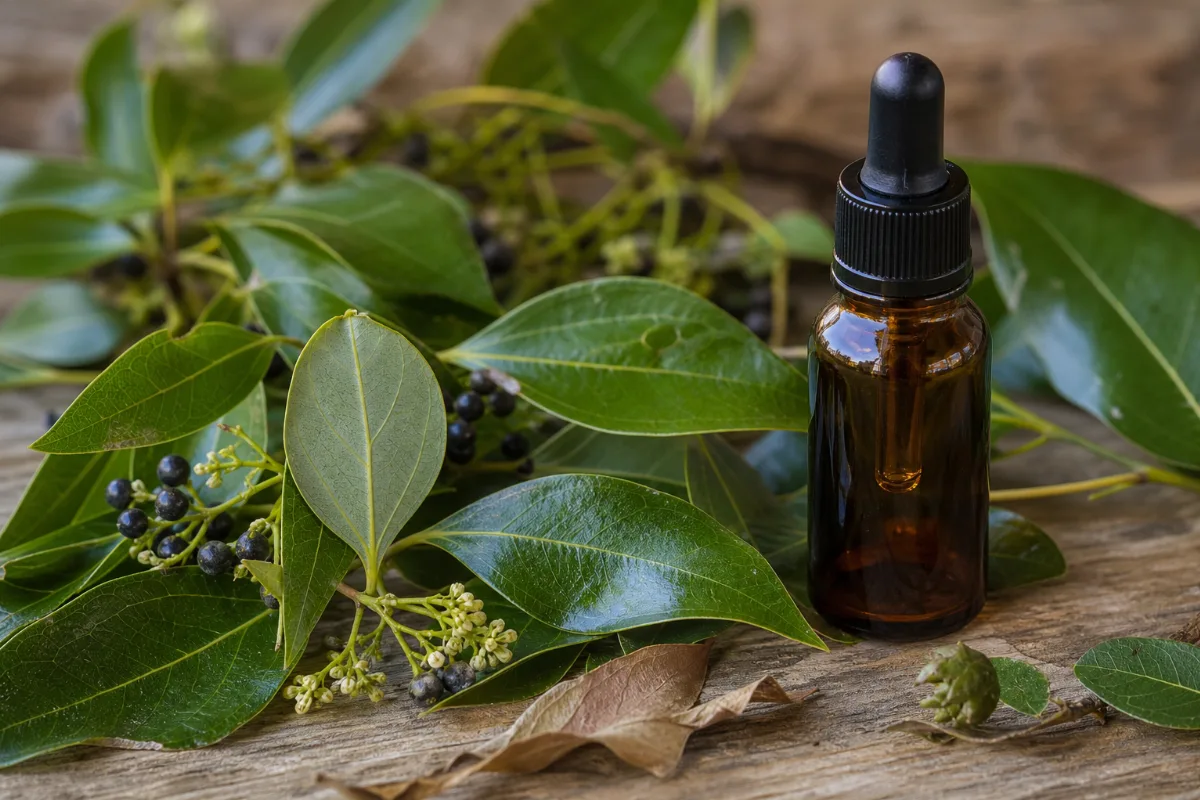
- Part used: Leaves are the usual trade source of ravintsara oil, but no source read states the plant part or distillation method; treat it as unverified.
- Look-alikes and adulterants
- Camphor-type, linalool-type, borneol-type and citral-type oils come from the same species but have different chemistry and different dangers. Ho wood oil is another type of Cinnamomum camphora. Eucalyptus oil is a different genus that also contains 1,8-cineole.
Traditional use and history history, not clinical proof
| Tradition or era | Documented use | Source |
|---|---|---|
| Modern aromatherapy trade | Ravintsara is sold as a cineole-type oil for breathing and immune support. No traditional-use source for ravintsara itself was read, so no history is claimed here. | No source |
| European regulation of a related oil | The EU committee treats eucalyptus oil, also rich in 1,8-cineole, as a traditional medicine for cough with a cold, meaning at least 30 years of use, not trial proof. | EMA, Eucalyptus oil |
Traditional use shows how it was used. It does not show that it works or is safe today.
What is inside, and how it may work
What it contains and how those compounds act in cells and animals. Laboratory and animal mechanisms are not proven effects in people.
Main compounds
| Compound | Family | Where it is concentrated | Activity studied | Level of evidence |
|---|---|---|---|---|
| 1,8-cineole (eucalyptol) PubChem 2758 | monoterpene ether | Leaf oil of the cineole (eucalyptol) chemotype A 2023 survey found eucalyptol-type trees gave the highest average oil yield (1.64%) of the types found. No percentage of cineole in ravintsara oil was read. | Main compound of eucalyptus oil per EMA. Its safety in young children is the basis of the EU age caution. 8 9 15 | Laboratory analysis and regulator |
| Camphor PubChem 2537 | monoterpene ketone | Camphor-type oil of the same species Not read for ravintsara. Defines the camphor chemotype, which is a different oil. | Dose-dependent toxicity is noted in a 2026 review; seizures in children after swallowing are reported in case reports. 6 5 4 16 | Review and case reports |
| Linalool PubChem 6549 | monoterpene alcohol | Linalool-type oil of the same species Defines the linalool chemotype, a different oil from ravintsara. | Linalool is among the compounds the French clinic study tested as a patch-test allergen for essential-oil allergy. 8 1 17 | Clinic series |
Mechanisms, receptors and pathways
| Target or pathway | Gene or receptor | What was found | Level |
|---|---|---|---|
| Enzyme blocking in the dish (alpha-amylase, alpha-glucosidase, cholinesterases) | Not applicable | A Cinnamomum camphora oil of unstated chemotype blocked two sugar-digesting enzymes at milligram-per-millilitre levels and cholinesterases only weakly in the test tube. Nothing shown in animals or people. 2 | Laboratory |
Absorption, metabolism and elimination
- Absorption
- Not described in any source read.
- Distribution
- Not established.
- Metabolism
- Not established.
- Elimination
- Not established.
- Bioavailability
- Not established.
Isolated compounds versus whole extracts
Ravintsara (cineole type), camphor-type oil, linalool-type oil, eucalyptus oil and pure 1,8-cineole are different products. The EU committee notes that its asthma and bronchitis studies used pure 1,8-cineole, not eucalyptus oil. Findings on one cannot be carried over to another.
Nutritional composition
Ravintsara oil is not a nutrient.
1 very low certainty2 not enough evidence
What is Ravintsara Oil good for?
The uses people ask about and how strong the evidence is for each. Read the certainty label before you read the claim.
Benefits, one by one
Each card is a research question, not a promise. Tap a goal to filter. Open a card to see the studies, doses and limits.
Calm, mood and relaxation signs (inhaled Cinnamomum camphora oil)
Very low certaintyIn one small Chinese study, 43 healthy students breathed Cinnamomum camphora essential oil. Afterwards their diastolic blood pressure and pulse rate were lower, brain-wave patterns changed in a way the authors link to relaxation, and mood questionnaires showed more positive feelings. The abstract does not say which type of camphor-tree oil was used, so it cannot be assumed to be ravintsara.
1 studiesNot covered. This page gives no amounts and no way to use the oil.
Studies, doses and limits
What the trials found
One study of 43 healthy university students. Heart rate, blood pressure, pulse, blood oxygen, EEG and a mood questionnaire (POMS) were recorded around exposure to the oil. The abstract does not describe a comparison group.
Results
Diastolic blood pressure and pulse rate fell after inhaling the oil. EEG showed lower absolute beta, absolute gamma, absolute high beta and relative gamma power and higher relative theta power. POMS showed more positive and fewer negative feelings.
Effect sizes as reported
Reported as significant changes; the abstract gives no figures.
Why this rating
One small study of healthy students, abstract only, no comparison group described, no figures given, and the oil type (chemotype) is not stated. Short-term measures, not anxiety or any illness.
Form and dose studied
Not covered. This page gives no amounts and no way to use the oil.
Who was studied
Healthy university students in China.
Limits
No one with anxiety or a health problem was studied. The type of camphor-tree oil is not given. No repeat study was found. Side effects are not reported in the abstract.
Why researchers looked
Ravintsara is sold mainly for breathing and immunity, but aromatherapy oils are often tested for calming effects.
Traditional use
No traditional-use source for ravintsara as a calming oil was read.
Proposed mechanism Preliminary mechanism
Not established. The authors read their EEG changes as a sign of relaxation. That is an interpretation of brain-wave patterns, not proof of a calming effect.
A proposed mechanism does not show that the effect happens in people.
See the Safety tab first. Never swallow the oil, and keep it from children and pets.
Colds, cough, breathing and immune support (inhaled or chest blends)
Not enough evidenceRavintsara is widely sold for colds, blocked noses and immunity. We found no controlled trial of ravintsara oil in people for any of these. The nearest regulator view is about eucalyptus oil, which is also rich in 1,8-cineole: the EU accepts it for cough with a cold on the basis of long-standing use, not trials.
2 studiesNot covered. This page gives no amounts and no way to use the oil.
Studies, doses and limits
What the trials found
None found for ravintsara. The EU committee looked at studies in bronchitis and asthma and said they used 1,8-cineole, not eucalyptus oil, and gave no firm conclusions.
Results
No result to report for ravintsara oil.
Effect sizes as reported
None available.
Why this rating
No human trial of ravintsara oil was found. The only support is a traditional-use statement about a different oil.
Form and dose studied
Not covered. This page gives no amounts and no way to use the oil.
Who was studied
Not studied.
Limits
Eucalyptus findings cannot be carried over to ravintsara. Marketing claims are not evidence.
Why researchers looked
Cineole-rich oils smell clear and fresh, and eucalyptus oil, a close relative in chemistry, has a long history for coughs.
Traditional use
The EU committee accepts eucalyptus oil medicines for cough with a cold and muscle pain as 'traditional use' (at least 30 years of use). That is a statement about eucalyptus oil, not ravintsara.
Proposed mechanism Preliminary mechanism
Not established for ravintsara.
A proposed mechanism does not show that the effect happens in people.
Cineole-rich oils are not for babies and young children and not for anyone with seizures. See the Safety tab.
Germ-killing, antioxidant and enzyme-blocking results in the lab
Not enough evidenceA 2025 test-tube study of Cinnamomum camphora oil found moderate antioxidant activity and stopped several plant fungi, but only at very high concentrations. It also blocked two sugar-digesting enzymes in the dish. This is chemistry on plant fungi and enzymes, not research in people.
1 studiesNot covered. This page gives no amounts and no way to use the oil.
Studies, doses and limits
What the trials found
None.
Results
Complete growth stop of five plant fungi only at 10,000 ppm; lowest effect (17.8%) on Aspergillus niger at the highest concentration tested; low effect on cholinesterase enzymes; alpha-amylase and alpha-glucosidase blocked at IC50 7.8 and 2.78 mg/mL.
Effect sizes as reported
Laboratory values only; they cannot be turned into a use for people.
Why this rating
Test-tube study only, chemotype not stated, concentrations far above anything a person would meet.
Form and dose studied
Not covered. This page gives no amounts and no way to use the oil.
Who was studied
No people. Plant fungi and enzymes in the lab.
Limits
Not tested in animals or people. The oil's chemotype is not stated in the abstract.
Why researchers looked
Many essential oils are screened in the lab for germ-killing and antioxidant activity.
Traditional use
None read.
Proposed mechanism Preliminary mechanism
Test-tube activity only. Not shown in animals or people.
A proposed mechanism does not show that the effect happens in people.
A result in a dish says nothing about safety or benefit on skin or in the body.
Connections to the rest of health
How Ravintsara Oil connects to the rest of our health knowledge graph. Every link says what kind of connection it is. A safety link (for example to the liver) is a warning, not a benefit. A study that merely mentions a topic never creates a benefit link.
Explore every connection: goals, body systems, organs, symptoms, genes
A. Wellness goals
| Connected to | Kind of connection | Evidence status | Context | Studies |
|---|---|---|---|---|
| Calm Relaxation | Very low certainty | Calm, mood and relaxation signs (inhaled Cinnamomum camphora oil): In one small Chinese study, 43 healthy students breathed Cinnamomum camphora essential oil. Afterwards their diastolic blood pressure and pulse rate were lower, brain-wave patterns changed in a way the authors link to relaxation, and mood questionnaires showed more positive feelings. The abstract does not say which type of camphor-tree oil was used, so it cannot be assumed to be ravintsara. | 3 | |
| Stress Reduction | Very low certainty | Calm, mood and relaxation signs (inhaled Cinnamomum camphora oil): In one small Chinese study, 43 healthy students breathed Cinnamomum camphora essential oil. Afterwards their diastolic blood pressure and pulse rate were lower, brain-wave patterns changed in a way the authors link to relaxation, and mood questionnaires showed more positive feelings. The abstract does not say which type of camphor-tree oil was used, so it cannot be assumed to be ravintsara. | 3 | |
| Breathing Support | Not enough evidence | Colds, cough, breathing and immune support (inhaled or chest blends): Ravintsara is widely sold for colds, blocked noses and immunity. We found no controlled trial of ravintsara oil in people for any of these. The nearest regulator view is about eucalyptus oil, which is also rich in 1,8-cineole: the EU accepts it for cough with a cold on the basis of long-standing use, not trials. | 9 6 | |
| Immune Support | Not enough evidence | Colds, cough, breathing and immune support (inhaled or chest blends): Ravintsara is widely sold for colds, blocked noses and immunity. We found no controlled trial of ravintsara oil in people for any of these. The nearest regulator view is about eucalyptus oil, which is also rich in 1,8-cineole: the EU accepts it for cough with a cold on the basis of long-standing use, not trials. | 9 6 |
B. Body systems
| Connected to | Kind of connection | Evidence status | Context | Studies |
|---|---|---|---|---|
| Nervous System | Biological association | Very low certainty | Studied for: Calm, mood and relaxation signs (inhaled Cinnamomum camphora oil) | 3 |
| Respiratory System | Biological association | Not enough evidence | Studied for: Colds, cough, breathing and immune support (inhaled or chest blends) | 9 6 |
E. Health conditions
| Connected to | Kind of connection | Evidence status | Context | Studies |
|---|---|---|---|---|
| Contact dermatitis | Documented risk | Named among the three main oils in 42 sensitised patients. Preparation or compound: Cinnamomum camphora oil (ravintsara) as listed in a clinic series |
1 | |
| Seizures | Insufficient for ravintsara | Seizure reports exist for camphor and eucalyptus; none found for ravintsara. Preparation or compound: Swallowed camphor and eucalyptus oil (read across) |
7 5 4 |
I. Biomarkers
| Connected to | Kind of connection | Evidence status | Context | Studies |
|---|---|---|---|---|
| Diastolic blood pressure and pulse rate | Biological association | Very low certainty | Measured in trials: decrease. A lab change is not the same as a health benefit. | 3 |
| EEG brain-wave power (beta, gamma, theta) | Biological association | Very low certainty | Measured in trials: mixed. A lab change is not the same as a health benefit. | 3 |
L. Active compounds
| Connected to | Kind of connection | Evidence status | Context | Studies |
|---|---|---|---|---|
| 1,8-cineole (eucalyptol) | Biological association | Laboratory analysis and regulator | Main compound of eucalyptus oil per EMA. Its safety in young children is the basis of the EU age caution. Preparation or compound: Leaf oil of the cineole (eucalyptol) chemotype |
8 9 15 |
| Camphor | Biological association | Review and case reports | Dose-dependent toxicity is noted in a 2026 review; seizures in children after swallowing are reported in case reports. Preparation or compound: Camphor-type oil of the same species |
6 5 4 16 |
| Linalool | Biological association | Clinic series | Linalool is among the compounds the French clinic study tested as a patch-test allergen for essential-oil allergy. Preparation or compound: Linalool-type oil of the same species |
8 1 17 |
Each connection is stored with the ingredient, the connected record, the kind of connection, the evidence status, the supporting studies, the preparation or compound involved, and a review date (last reviewed October 25, 2026).
Evidence at a glance: what changed in 1 lab markers
Tap a number to show only those markers. Counts are markers, not people.
The evidence
The research centre for Ravintsara Oil. Every record here was checked against PubMed or the publisher's page; we never list a study we have not verified.
Evidence by outcome
Bars show how many studies we found for each outcome, not how well it works. People are added up across trials only (reviews are not added, to avoid double counting).
How we rate evidence
High certainty
Several well-run trials or reviews agree; further research is unlikely to change the picture much.
Moderate certainty
Good trials point the same way, but some doubt remains.
Low certainty
Small, short or inconsistent trials. The finding could change with better research.
Very low certainty
Very little or very weak human data. Treat as a possibility only.
Mixed findings
Trials or reviews disagree with each other.
Not enough evidence
Not enough human research to say either way.
Evidence against
Good research found no benefit, or found harm.
We take the reviewers' own risk-of-bias and GRADE statements where they exist, and otherwise judge from study size, design, consistency, directness and whether a product matches what is sold. Many publications do not make evidence high. Method note: We read the abstracts of 8 PubMed papers and the EMA, NCCIH, Poison Control and Pet Poison Helpline pages, and checked the plant name in GBIF and the compounds in PubChem. We did not find LiverTox or LactMed for ravintsara.
Study library: every study we checked 17
| Study | Design | People | Product, dose, length | Result |
|---|---|---|---|---|
| Barbaud 2023 Allergic contact dermatitis from essential oil in consumer products: Mode of uses and value of patch tests with an essential oil series. Results of a French study of the DAG Contact Dermatitis · PMID 37403438 · DOI |
Clinic case series with patch testing, France |
42 Adults sensitised to their own essential oils (French dermatology clinics) |
n/a n/a n/a n/a · vs n/a |
42 patients with allergic contact dermatitis (79% women, average age 50); 8 needed hospital care. All were sensitised to the oil they used, mainly lavender, tea tree and ravintsara (listed as Cinnamomum camphora oil, CAS 92201-50-8); 2 cases were attributed to helichrysum. 40% did not spontaneously mention using essential oils and only 33% had received advice on their use at purchase. 71% reacted to fragrance mix I or II. Ravintsara among the three main oils named. Methods, limits and fundingOutcomes: Clinical features, patch-test results and how the oils were used Limitations: Patients who already had a rash, so it shows that the allergy happens and gives no rate in the general public. The abstract does not say how many cases were ravintsara or which chemotype the listed oil was. Funding and conflicts: Not stated in the abstract. Read: abstract |
| Cherif 2025 FTIR Characterization and Bioactivity Assessment of Cinnamomum camphora Essential Oil: Antioxidant, Anti-Enzymatic, and Antifungal Properties Against Phytopathogens Chem Biodivers · PMID 40522779 · DOI |
Laboratory (test tube) study in vitro |
Laboratory assays | Cinnamomum camphora essential oil (chemotype not stated in the abstract) not stated in the abstract Not applicable (test tube) n/a · vs n/a |
The oil showed moderate antioxidant activity. It fully stopped growth of five plant fungi only at 10,000 ppm, and had the lowest effect (17.8%) on Aspergillus niger at the highest tested concentration. Effects on cholinesterase enzymes were low. It blocked alpha-amylase and alpha-glucosidase in the dish at IC50 values of 7.8 and 2.78 mg/mL. Methods, limits and fundingOutcomes: Antioxidant, enzyme-blocking and antifungal activity Limitations: Test-tube work on plant fungi and enzymes. Chemotype not stated in the abstract. Says nothing about people. Read: abstract |
| Gong 2024 Assessing the Anxiolytic and Relaxation Effects of Cinnamomum camphora Essential Oil in University Students: A Comparative Study of EEG, Physiological Measures, and Psychological Responses Front Psychol · PMID 39131857 · DOI |
Small human exposure study with brain wave and body measures, China |
43 Healthy university students |
Cinnamomum camphora essential oil (CCEO) inhaled; chemotype not stated in the abstract not stated in the abstract Not reported here Not stated in the abstract · vs Not described in the abstract |
After the students inhaled the oil, diastolic blood pressure and pulse rate dropped. EEG showed lower absolute beta, absolute gamma, absolute high beta and relative gamma power and higher relative theta power. POMS scores showed more positive and fewer negative feelings. The authors conclude the oil may promote mental and physical relaxation. Significant changes in diastolic pressure, pulse rate, EEG power and POMS reported; no figures in the abstract. Methods, limits and fundingOutcomes: Heart rate, blood pressure, pulse rate, blood oxygen, EEG brain waves, Profile of Mood States (POMS) Limitations: The abstract does not say which chemotype (cineole, camphor, linalool) was used, so it cannot be assumed to be ravintsara. It gives no figures, no description of a comparison group and no amounts. Healthy students, short-term measures only. The authors' remarks about memory and attention are interpretations of EEG patterns, not tested outcomes. Funding and conflicts: Not stated in the abstract. Read: abstract |
| Mathen 2018 Camphor Poisoning: A Rare Cause of Acute Symptomatic Seizures in Children J Emerg Trauma Shock · PMID 30429634 · DOI |
Case reports, India |
Children with camphor poisoning | n/a n/a n/a n/a · vs n/a |
The authors say camphor is easily available and can cause fatal seizures in children when swallowed, that the danger is unknown in most homes, and that seizures are usually controlled with intravenous benzodiazepines. Methods, limits and fundingOutcomes: Clinical course Limitations: Abstract only, case-report level. About camphor, not ravintsara. Read: abstract |
| Salcedo 2025 From cultural remedy to medical emergency: a case report of camphor toxicity in a one-year-old male patient BMC Pediatr · PMID 39979814 · DOI |
Single case report, Dominican Republic |
1 One child aged 1 year |
n/a n/a n/a n/a · vs n/a |
A one-year-old who ate camphor tablets had generalized seizures at home and in hospital. Seizures were controlled with intravenous diazepam and levetiracetam; he was treated in intensive care and recovered without further complications. The authors say even small ingested amounts can be life-threatening in infants and children. Methods, limits and fundingOutcomes: Clinical course Limitations: One case of camphor (tablets), not ravintsara. Shown because camphor-type oil comes from the same tree. Read: abstract |
| Shah 2026 Camphora officinarum (Syn. Cinnamomum camphora): Botany, Phytochemistry, Biological Activities, Agro-Industrial Applications, and Biotechnology Plants (Basel) · PMID 42197601 · DOI |
Narrative review review |
Camphor tree (Camphora officinarum / Cinnamomum camphora) | n/a n/a n/a n/a · vs n/a |
The review says the camphor tree has chemically distinct chemotypes (camphor-, linalool-, borneol-, cineole- and citral-type profiles), discusses the dose-dependent toxicity of camphor, and notes the tree is a protected native resource in East Asia and an invasive plant in some introduced regions. Methods, limits and fundingOutcomes: Botany, chemistry (chemotypes), biology, safety, ecology Limitations: Narrative review, not a systematic one. Abstract only. It gives no ravintsara-specific safety statement. Read: abstract |
| Suresh 2025 Fatal Eucalyptus Oil Poisoning in an Adult Male: A Case Report With Comprehensive Autopsy and Histopathological Findings Cureus · PMID 40432665 · DOI |
Single case report, India |
1 One adult man |
n/a n/a n/a n/a · vs n/a |
An adult mistakenly swallowed 15 mL of eucalyptus oil stored in a cough-syrup container. He had generalized seizures within minutes, then unresponsiveness and slowed breathing, cardiac arrest and death at a tertiary centre. Autopsy showed corrosive damage to the tongue, windpipe, stomach and intestines, and damage to several organs. Methods, limits and fundingOutcomes: Clinical course and autopsy findings Limitations: One case of eucalyptus oil, not ravintsara. It is the nearest cineole-rich warning, read across, not proof about ravintsara. Read: abstract |
| Zhang 2023 Chemical Variation and Environmental Influence on Essential Oil of Cinnamomum camphora Molecules · PMID 36770639 · DOI |
Laboratory chemistry survey of 974 trees, China plant chemistry |
974 974 individual camphor trees from 35 populations |
n/a n/a n/a n/a · vs n/a |
Oils from 974 trees in 35 populations in 13 provinces had yields from 0.01% to 3.46%. Six main chemotypes were found: eucalyptol, nerolidol, camphor, linalool, selina and mixed. Eucalyptol-type trees had the highest average yield (1.64%). Environment strongly affected yield and profile. Methods, limits and fundingOutcomes: Oil yield and composition (GC-MS) by tree and location Limitations: Chemistry only, trees in China. No safety or health outcome. Does not give ravintsara (Madagascar) oil composition. Read: abstract |
| n/a EMA (EU): Eucalyptus oil (Eucalypti aetheroleum), summary for the public (page read 2026-10-25) n/a · Source |
Regulator public summary n/a |
n/a | n/a n/a n/a n/a · vs n/a |
Eucalyptus oil is the steam-distilled oil of eucalyptus species rich in 1,8-cineole. The EU committee accepts eucalyptus oil medicines for cough with a cold and localised muscle pain on the basis of long-standing (traditional) use, not clinical trials. Studies in bronchitis and asthma used 1,8-cineole, not eucalyptus oil, and gave no firm conclusions. Eucalyptus oil medicines must not be given to children with a history of seizures or to children under 30 months (risk of spasm of the voice box). No side effects had been reported at the time of assessment. Methods, limits and fundingOutcomes: Traditional use and risks of eucalyptus oil medicines Limitations: About eucalyptus oil medicines, not ravintsara. Summary dated 2016. Read: full-text |
| n/a Poison Control (US): Essential oils, poisonous when misused (page read 2026-10-25) n/a · Source |
Poison centre public page n/a |
n/a | n/a n/a n/a n/a · vs n/a |
Says misuse can cause serious poisoning; many oils cause rashes and some are poisonous if swallowed or absorbed through the skin; choking oil into the lungs can cause pneumonia; children have thin skin and immature livers and may be more susceptible; oils may interact with medicines; pure oils are potent and are best diluted in a carrier oil for skin contact, not on damaged skin; allergy is a real possibility, most often a skin rash; it can be hard to know the species, strength or contaminants in a bottle; it describes a 22-month-old who had a seizure lasting over an hour after eating a small piece of camphor. Keep oils locked up from children and pets. US poison centre line 1-800-222-1222. Methods, limits and fundingOutcomes: General essential-oil safety Limitations: General guidance. Ravintsara is not named on the page. Read: full-text |
| n/a Pet Poison Helpline: Essential oils (page read 2026-10-25) n/a · Source |
Pet poison centre public page n/a |
n/a | n/a n/a n/a n/a · vs n/a |
Says essential oil poisoning can affect all species but cats and birds are at the greatest risk. Common signs include drooling, vomiting, lethargy, loss of appetite and irritation of the airways, skin and mucous membranes. Methods, limits and fundingOutcomes: Essential-oil risk to pets Limitations: General page. Ravintsara is not named. Read: full-text |
| n/a Pet Poison Helpline: Eucalyptus is toxic to cats (page read 2026-10-25) n/a · Source |
Pet poison centre public page n/a |
n/a | n/a n/a n/a n/a · vs n/a |
Says eucalyptus contains eucalyptol; small ingestions of leaves or low-strength oil cause minor nausea, but exposure by mouth or skin to highly concentrated eucalyptus oil can cause severe signs including nerve signs and, rarely, kidney impairment. Methods, limits and fundingOutcomes: Eucalyptus oil and pets Limitations: About eucalyptus, not ravintsara. Read: full-text |
| n/a NCCIH (US): Aromatherapy (page read 2026-10-25; shows 'Last Updated January 2020') n/a · Source |
Government public page n/a |
n/a | n/a n/a n/a n/a · vs n/a |
Says essential oils are most often inhaled or applied diluted to the skin, and that for insomnia it is not known whether aromatherapy helps because little rigorous research has been done. Methods, limits and fundingOutcomes: What aromatherapy is and what is known Limitations: General page on aromatherapy. Ravintsara is not named. Read: full-text |
| n/a GBIF species match API: Cinnamomum camphora and Camphora officinarum (checked 2026-10-25) n/a · Source |
Taxonomy database n/a |
n/a | n/a n/a n/a n/a · vs n/a |
Cinnamomum camphora (L.) J.Presl: key 3033991, ACCEPTED, family Lauraceae, exact match. Camphora officinarum Nees: key 7357147, listed as a SYNONYM of key 3033991. Methods, limits and fundingOutcomes: Accepted name Limitations: Name checking only. A 2026 review (PMID 42197601) uses Camphora officinarum as the main name, so the two names are in use. Read: full-text |
| n/a PubChem compound record: 1,8-cineole (eucalyptol), CID 2758 (checked 2026-10-25) n/a · Source |
Chemistry database n/a |
n/a | n/a n/a n/a n/a · vs n/a |
Record exists with formula C10H18O. Methods, limits and fundingOutcomes: Compound identity Limitations: Identity only. Read: full-text |
| n/a PubChem compound record: camphor, CID 2537 (checked 2026-10-25) n/a · Source |
Chemistry database n/a |
n/a | n/a n/a n/a n/a · vs n/a |
Record exists with formula C10H16O. Methods, limits and fundingOutcomes: Compound identity Limitations: Identity only. Read: full-text |
| n/a PubChem compound record: linalool, CID 6549 (checked 2026-10-25) n/a · Source |
Chemistry database n/a |
n/a | n/a n/a n/a n/a · vs n/a |
Record exists with formula C10H18O. Methods, limits and fundingOutcomes: Compound identity Limitations: Identity only. Read: full-text |
What we do not know yet
- What the evidence supports: relaxation signs are very-low, colds and immunity are insufficient, lab results are test-tube only.
- No trial of a named ravintsara (cineole-type) oil in people was found.
- No poisoning, pregnancy, asthma, seizure or pet data for ravintsara were found.
- Child, seizure and pet cautions are read across from eucalyptus and camphor.
- The make-up, plant part and distillation of ravintsara oil are not given in any source read.
- LiverTox and LactMed could not be found for ravintsara.
How new research is added
New studies are found by a saved PubMed search and are placed in a review queue. A person reads each one before it is added.
Lab markers
What changed in blood or saliva tests during trials. A changed number is not the same as feeling or being healthier, and we give no "normal ranges".
Other 2
Diastolic blood pressure and pulse rate
Decrease in trials
The lower blood pressure number and the heartbeat count per minute, both read at rest.
Very low certaintyResults and what it means
Why it was measured
Used in the study as body signs of relaxation.
Statistical vs. clinical meaning
Small changes in healthy students do not show a benefit for health. People on blood pressure medicine should not treat an oil as a substitute.
Safety implication
None stated.
| Study | Result | People | Product |
|---|---|---|---|
| 3 | Both fell after the students inhaled Cinnamomum camphora oil (chemotype not stated). No figures in the abstract. |
EEG brain-wave power (beta, gamma, theta)
Mixed results in trials
Electrical brain activity recorded from the scalp and split into frequency bands.
Very low certaintyResults and what it means
Why it was measured
The study used it to look for signs of relaxation and attention.
Statistical vs. clinical meaning
EEG patterns are hard to read. They show the brain responded to something, not that the person felt or functioned better.
Safety implication
None stated.
| Study | Result | People | Product |
|---|---|---|---|
| 3 | Absolute beta, absolute gamma, absolute high beta and relative gamma power fell; relative theta power rose during exposure to the oil. |
Safety
What studies and official sources say about side effects, medicines and who should check first. Each point shows what kind of evidence it comes from.
Main points to know 5
- Make sure it is the cineole type, not camphor type. They come from the same tree.. Ravintsara is the cineole type of the camphor tree (Cinnamomum camphora). The same tree gives other types: camphor, linalool, borneol and citral. A 2026 review and a 2023 survey of 974 trees confirm these chemically different types. Camphor-type oil and camphor itself are dangerous if swallowed, especially for small children: case reports describe seizures in a one-year-old and in other children after swallowing camphor. A label that says only 'camphor tree' or 'Cinnamomum camphora' does not tell you which type is in the bottle. See our page on camphor oil dangers. Review, chemistry survey and case reports 6 8 5 4 10
- Do not swallow it. Keep it away from children.. Poison Control says some essential oils are poisonous if swallowed, and that choking oil into the lungs can cause pneumonia. It does not name ravintsara. The closest case is a fatal poisoning in an adult who swallowed 15 mL of eucalyptus oil (also cineole-rich), which caused seizures within minutes. We found no poisoning case report for ravintsara itself. If anyone may have swallowed any essential oil, call poison control (US 1-800-222-1222) or your emergency number. Poison centre guidance and case report (read across from eucalyptus) 10 7
- Skin allergy is documented.. In a French clinic series of 42 people with allergic contact dermatitis from their own essential oils, ravintsara was among the three main oils named, with lavender and tea tree. Eight people needed hospital care. 40% had not mentioned using essential oils, and only a third had been given advice when they bought them. The study shows the allergy happens; it cannot tell how common it is. Clinic case series 1
- Cineole-rich oils: not for babies, toddlers or people with seizures.. The EU regulator says eucalyptus oil medicines, rich in 1,8-cineole, must not be given to children under 30 months (risk of spasm of the voice box) or to children with a history of seizures. We found no ravintsara-specific statement. A cineole-type oil is, by its name, rich in the same compound, so we pass the caution on and do not treat it as proven for ravintsara. Regulatory (read across from eucalyptus) 9
- Pets, especially cats and birds.. Pet Poison Helpline says cats and birds are at greatest risk from essential oils, and that concentrated eucalyptus oil, by mouth or on skin, can cause severe signs in pets. We found no source on ravintsara and pets. Keep oils and diffusers away from them. Pet poison centre guidance (read across) 11 12
Side effects 3
| Effect | How often | Severity and recovery | Evidence |
|---|---|---|---|
| Allergic skin reaction (allergic contact dermatitis) Patients were people who already had a rash from an essential oil. | Not known. A clinic series cannot give a rate. | mild to severe; 8 of 42 patients needed hospital care Not stated. | Clinic case series 1 |
| Seizures, breathing problems and organ damage if swallowed (eucalyptus and camphor, read across) Eucalyptus case: 15 mL swallowed. Camphor cases: tablets swallowed by a one-year-old and other children. | Not known for ravintsara. | severe, can be fatal Not stated. | Case reports 7 5 4 |
| Lung inflammation (pneumonia) if oil is breathed into the lungs while swallowing General for essential oils. | Not given. | serious Not stated. | Poison centre guidance 10 |
Liver
We found no report of liver injury linked to ravintsara oil. The fatal eucalyptus case describes fatty change in the liver among widespread organ damage after a large swallowed amount. LiverTox and LactMed were not found for ravintsara. 7
How often. No ravintsara liver reports found.
Monitoring. Yellow skin or eyes, dark urine or pain in the upper right belly after any exposure needs a doctor.
This is a safety connection. It is not evidence that Ravintsara Oil supports liver health.
Medicines and supplements 2
| With | Why it matters | Importance | Evidence | What to do |
|---|---|---|---|---|
| Prescription and over-the-counter medicines medicines (general essential-oil caution) | Poison Control says essential oils may interact with medicines. No source on ravintsara and any named medicine was found. | Unknown for ravintsara. | Poison centre guidance Not enough evidence 10 | Tell your pharmacist or doctor about any essential oil you use, especially if you take seizure medicine. |
| Eucalyptus, camphor, menthol or camphor-based chest rubs other camphor-tree or cineole-rich products | These share cineole or camphor, and the cautions about children and swallowing repeat. No source describes the combined effect. | Unknown. Using several together adds to the load, which is why cautions stack. | Inference from regulator and poison centre sources Not enough evidence 9 10 | Avoid stacking several of these products, especially around children. |
Who should check first 6
| Situation | Advice | Evidence |
|---|---|---|
| Children under 30 months, or any child with a history of seizures | The EU regulator says eucalyptus oil medicines (rich in 1,8-cineole) must not be given to them. No ravintsara-specific statement exists. Do not use ravintsara on or near babies and toddlers. | Regulatory (read across) 9 |
| Swallowing, or using it undiluted on skin or on damaged skin | Do not swallow it. Poison Control says pure oils are potent, are best diluted in a carrier oil for skin contact and are not for damaged skin. This page gives no dilution figure. | Poison centre guidance 10 |
| Known allergy to essential oils or fragrance | Allergy to essential oils is a real possibility. Stop and wash off if a rash appears. Ask a doctor or pharmacist first if you have had a fragrance or essential-oil rash. | Poison centre guidance and clinic series 10 1 |
| Pregnancy or breastfeeding | We found no source on ravintsara in pregnancy or breastfeeding, so there is no evidence of safety. Ask a doctor or midwife before using it. | No data |
| Asthma or epilepsy | We found no ravintsara-specific source. The seizure caution for cineole-rich oils and camphor suggests extra care with epilepsy. Ask your doctor before using it. | No data; read across 9 |
| Homes with cats, dogs or birds | Keep oils and diffusers away from pets. Cats and birds are at greatest risk from essential oils. | Pet poison centre guidance 11 12 |
Overdose, product quality and regulators
Summary. No poisoning data for ravintsara oil were found. Warnings come from eucalyptus (also cineole-rich) and from camphor (a different type from the same tree).
Amounts. No safe amount is established, and this page gives none.
Onset and course. In the eucalyptus case, seizures began within minutes of swallowing 15 mL. For pets, Pet Poison Helpline lists drooling, vomiting, lethargy and airway irritation as common signs.
Repeated use. Not studied for ravintsara.
Animal data. None read for ravintsara.
Toxic parts. The essential oil is the concentrated form. Plant-part and distillation details for ravintsara oil were not stated in any source read.
Not read. LiverTox, LactMed and any ravintsara-specific poison-centre report were not found.
Essential oil products are not tightly checked, so what is in a bottle can differ from the label.
Mixed-up types of camphor-tree oil. The same tree gives camphor, linalool, borneol, cineole and citral types, and a survey of 974 trees found six main chemotypes. Oil from different types has a different makeup and different dangers, so the type on the label matters. 6 8
Unknown species, strength and contaminants. Poison Control says it can be hard to know the species, strength or contaminants in an essential oil product. 10
| Body | Action | Date |
|---|---|---|
| EMA / HMPC (EU), Eucalyptus oil medicines (read across; ravintsara is not covered) (European Union) | Accepts eucalyptus oil for cough with a cold and localised muscle pain as traditional use. Must not be given to children under 30 months or with a history of seizures. No side effects had been reported at assessment. source | 2016-12-05 |
| Poison Control (US), Essential oils (United States) | Warns that essential oils can poison when swallowed, harm the lungs if choked on, cause allergic rashes, and affect children more. Advises diluting pure oils in a carrier oil for skin contact. Describes a toddler's seizure after eating camphor. source | |
| NCCIH (US), Aromatherapy (United States) | Describes aromatherapy as mostly inhaled or diluted skin use; says little rigorous research exists on aromatherapy for insomnia. source | 2020-01-01 |
| Pet Poison Helpline, Essential oils and Eucalyptus (United States / Canada) | Cats and birds at greatest risk from essential oils; concentrated eucalyptus oil can cause severe signs in pets. source |
When to get medical help
- If anyone, or a pet, may have swallowed any essential oil, call poison control (US 1-800-222-1222; pets: Pet Poison Helpline 855-764-7661) or your emergency number at once.
- A seizure, trouble breathing, blue lips, or unusual sleepiness after a child or adult has been near or swallowed an oil is an emergency.
- Swelling of the lips, tongue or face, or a spreading or blistering rash after skin contact is an emergency. Stop use and wash off.
- Coughing or choking while swallowing oil needs urgent medical help, because oil in the lungs can cause pneumonia.
Stop using the product and contact a clinician or emergency service. In the US, Poison Control is 1-800-222-1222.
General information only, not medical advice. Ask a clinician or pharmacist before use, especially with medicines, in pregnancy or with a health condition. See the Natural Remedy Safety guide.
Frequently asked questions
Is ravintsara oil the same as camphor oil?
No, but they come from the same tree. Ravintsara is the cineole type of Cinnamomum camphora. Camphor oil is a different type of the same tree, and camphor is dangerous if swallowed, especially for small children. Case reports describe seizures in young children after swallowing camphor. Check that the label says 'ct. cineole', and see our page on camphor oil dangers.
Is ravintsara oil safe to swallow?
No. We do not advise swallowing essential oil. Poison Control says some essential oils are poisonous if swallowed and can cause pneumonia if choked into the lungs. It does not name ravintsara, and we found no ravintsara poisoning case. A fatal case is reported with 15 mL of eucalyptus oil, which is also rich in cineole. If anyone may have swallowed any essential oil, call poison control (US 1-800-222-1222) or your emergency number.
Is it safe for babies and young children?
We would not use it on or near them. The EU regulator says eucalyptus oil medicines, which are rich in 1,8-cineole, must not be given to children under 30 months because of a risk of spasm of the voice box, or to children with a history of seizures. We found no ravintsara-specific statement, so this is a caution carried over from a close relative in chemistry.
Can ravintsara oil cause an allergic rash?
Yes. In a French clinic series of 42 people with allergic contact dermatitis from essential oils, ravintsara was among the three main oils named, together with lavender and tea tree. Eight people needed hospital care. The study cannot tell how common the allergy is. Stop and wash off if a rash appears.
Does ravintsara oil help with colds or boost immunity?
Does it help with stress or relaxation?
Possibly a little, but the evidence is very thin. One small Chinese study of 43 healthy students found lower diastolic blood pressure and pulse rate and mood questionnaire changes after they breathed Cinnamomum camphora oil. The abstract does not say which type of oil it was, so it cannot be tied to ravintsara.
Is it safe in pregnancy or while breastfeeding?
We found no source on ravintsara oil in pregnancy or breastfeeding. Lack of data is not a sign of safety. Ask a doctor or midwife before using it.
Is ravintsara oil safe for cats, dogs and birds?
Keep it away from pets. Pet Poison Helpline says cats and birds are at greatest risk from essential oils, and that concentrated eucalyptus oil, by mouth or on skin, can cause severe signs. We found no source on ravintsara and pets. If a pet may have been exposed, call Pet Poison Helpline (855-764-7661) or a vet.
What does 'ct. cineole' on the label mean?
'ct.' stands for chemotype, the main chemical profile of the oil. 'Cineole' means rich in 1,8-cineole, also called eucalyptol. Trees of the same species can make very different oils: a survey of 974 camphor trees found six main chemotypes, including eucalyptol and camphor types. The label is how you tell them apart.
Is it the same as eucalyptus oil?
Is there lab research on ravintsara?
There is some test-tube work on Cinnamomum camphora oil: moderate antioxidant activity, plant-fungus growth stopped only at very high concentrations, and enzyme blocking in the dish. This tells us about chemistry, not about use in people.
Why is there so little research?
Explore by health goal
Calm RelaxationStress ReductionBreathing SupportImmune Support
Editorial transparency
- Written by
- AlternativeMed editorial team. Research compiled with AI assistance, then checked against PubMed records.
- Medical review
- None. This page has not been reviewed by a physician or pharmacist.
- First published
- 2026-10-25
- Last substantive update
- 2026-10-25
- How we research
- We read the abstracts of 8 PubMed papers and the EMA, NCCIH, Poison Control and Pet Poison Helpline pages, and checked the plant name in GBIF and the compounds in PubChem. We did not find LiverTox or LactMed for ravintsara.
- How we rate evidence
- See "How we rate evidence" in the Evidence tab.
- Independence
- No product is promoted on this page. No affiliate links are shown. Trials or assessments linked to industry are labelled.
Sources 17
Each source was opened and checked. Where we read only the abstract, it says so. The small numbers in the text point here.
- Barbaud A, Kurihara F, Raison-Peyron N, et al. Allergic contact dermatitis from essential oil in consumer products: Mode of uses and value of patch tests with an essential oil series. Results of a French study of the DAG. Contact Dermatitis. 2023. PMID 37403438. DOI 10.1111/cod.14377. (abstract)
- Cherif MC, Boughendjioua H, Caputo L, et al. FTIR Characterization and Bioactivity Assessment of Cinnamomum camphora Essential Oil: Antioxidant, Anti-Enzymatic, and Antifungal Properties Against Phytopathogens. Chem Biodivers. 2025. PMID 40522779. DOI 10.1002/cbdv.202500720. (abstract)
- Gong X, Yang Y, Xu T, Yao D, Lin S, Chang W. Assessing the Anxiolytic and Relaxation Effects of Cinnamomum camphora Essential Oil in University Students: A Comparative Study of EEG, Physiological Measures, and Psychological Responses. Front Psychol. 2024. PMID 39131857. DOI 10.3389/fpsyg.2024.1423870. (abstract)
- Mathen PG, Sreekrishnan TP, Kumar KPG, Mohan N. Camphor Poisoning: A Rare Cause of Acute Symptomatic Seizures in Children. J Emerg Trauma Shock. 2018. PMID 30429634. DOI 10.4103/JETS.JETS_21_18. (abstract)
- Salcedo YE, Soriano-Lopez AE, Almonte A, et al. From cultural remedy to medical emergency: a case report of camphor toxicity in a one-year-old male patient. BMC Pediatr. 2025. PMID 39979814. DOI 10.1186/s12887-025-05488-w. (abstract)
- Shah K, Dai W, Shen Q, et al. Camphora officinarum (Syn. Cinnamomum camphora): Botany, Phytochemistry, Biological Activities, Agro-Industrial Applications, and Biotechnology. Plants (Basel). 2026. PMID 42197601. DOI 10.3390/plants15101467. (abstract)
- Suresh D, VijayaKumar S, Pradhan P, Balasubramanian S. Fatal Eucalyptus Oil Poisoning in an Adult Male: A Case Report With Comprehensive Autopsy and Histopathological Findings. Cureus. 2025. PMID 40432665. DOI 10.7759/cureus.83053. (abstract)
- Zhang T, Zheng Y, Fu C, et al. Chemical Variation and Environmental Influence on Essential Oil of Cinnamomum camphora. Molecules. 2023. PMID 36770639. DOI 10.3390/molecules28030973. (abstract)
- n/a. EMA (EU): Eucalyptus oil (Eucalypti aetheroleum), summary for the public (page read 2026-10-25). n/a. . (full-text)
- n/a. Poison Control (US): Essential oils, poisonous when misused (page read 2026-10-25). n/a. . (full-text)
- n/a. Pet Poison Helpline: Essential oils (page read 2026-10-25). n/a. . (full-text)
- n/a. Pet Poison Helpline: Eucalyptus is toxic to cats (page read 2026-10-25). n/a. . (full-text)
- n/a. NCCIH (US): Aromatherapy (page read 2026-10-25; shows 'Last Updated January 2020'). n/a. . (full-text)
- n/a. GBIF species match API: Cinnamomum camphora and Camphora officinarum (checked 2026-10-25). n/a. . (full-text)
- n/a. PubChem compound record: 1,8-cineole (eucalyptol), CID 2758 (checked 2026-10-25). n/a. . (full-text)
- n/a. PubChem compound record: camphor, CID 2537 (checked 2026-10-25). n/a. . (full-text)
- n/a. PubChem compound record: linalool, CID 6549 (checked 2026-10-25). n/a. . (full-text)