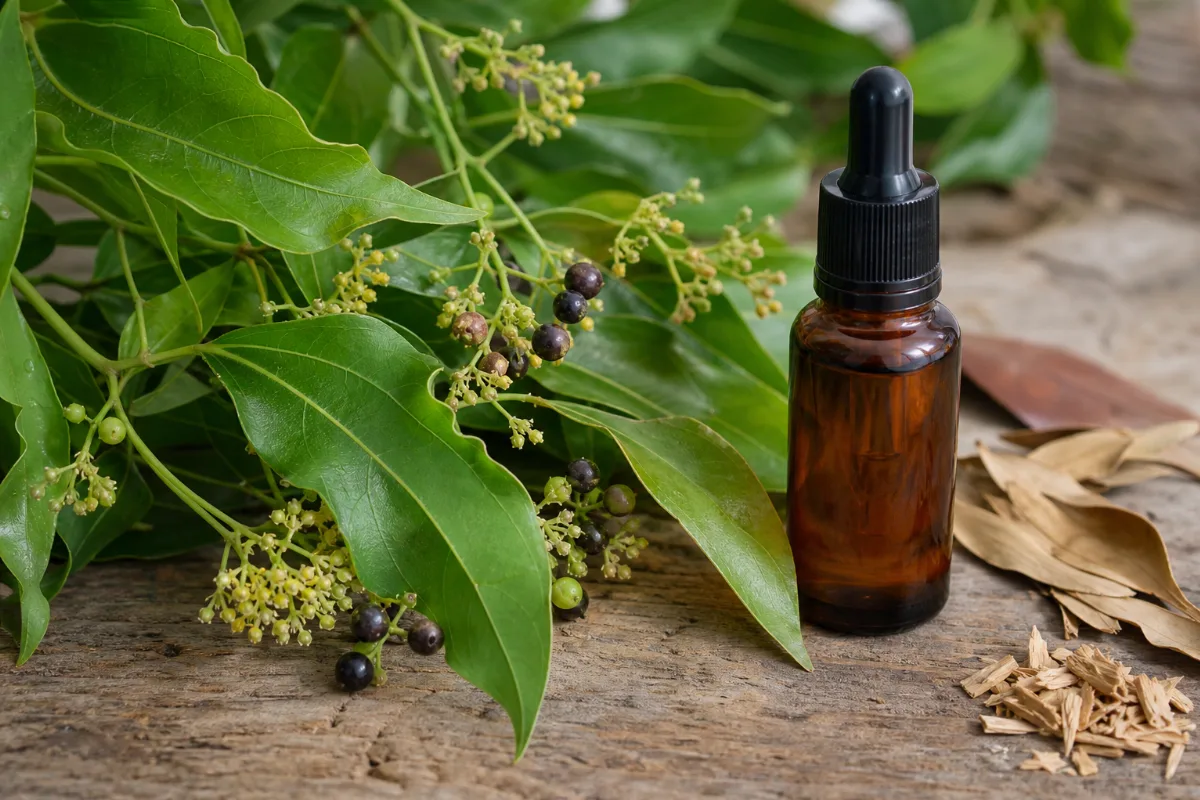
Essential Oils & Aromatherapy · Essential oil
Ho Wood Oil
Cinnamomum camphora ct. linalool · also called Ho wood oil, ho wood essential oil, linalool-type camphor tree oil
Ho wood oil is a sweet, floral-woody essential oil from a linalool-rich type of the camphor tree. People use it as a scent and in diluted massage blends, and some try it for stress. Human research on this exact oil is close to nothing; a few small studies looked at camphor-tree oil or at linalool alone. The main cautions: linalool turns into skin allergens when it meets air, the oil must not be mixed up with camphor-type oil or swallowed, and it is not shown safe in pregnancy.
General information, not medical advice. Last substantive update · Not medically reviewed. A named clinician has not signed off on this page. How this page is made
About Ho Wood Oil
Ho wood oil is a sweet floral-woody scent from the linalool type of the camphor tree. Safety comes first: air-oxidised linalool is a known skin allergen, the same tree also gives camphor-type oil that is dangerous if swallowed, and safety in pregnancy is not shown. Human research on ho wood oil itself was not found; a few small studies used camphor-tree oil or pure linalool.
What ho wood oil is
Ho wood oil comes from Cinnamomum camphora, a tree in the laurel family (Lauraceae, per GBIF). The name Camphora officinarum is a synonym. The oil people call ho wood is the linalool type, sometimes written Cinnamomum camphora ct. linalool or var. linaloolifera.
The tree's oils differ by chemotype. A survey of 974 trees found six main types: eucalyptol, nerolidol, camphor, linalool, selina and mixed. One elite cultivar had 88.30% linalool. The papers analysed leaf oils; the plant part of commercial ho wood oil was not confirmed.
What people use it for, and how strong the evidence is
For relaxation, one study of 43 healthy students found lower diastolic pressure and pulse and better mood scores after breathing camphor-tree oil, but did not state the chemotype. In a trial of 48 adults, pure linalool did not show a clear anxiety drop on the scale used, and it is not the whole oil.
A company-funded EEG study included kusunoki (camphor tree) oil but the abstract reports no result for it. We found no human trial of ho wood oil for sleep, skin, pain or infection. Online claims on those uses are not supported by the papers we read.
The research in one view
No human trial named ho wood oil. The few small studies used a different or unstated oil, or one compound, in healthy people for a short time. No meta-analysis was found.
Ho wood, camphor oil, ravintsara and rosewood are different things
Camphor-type oil from the same tree is dangerous if swallowed; see the camphor oil dangers page. Ravintsara oil is also Cinnamomum camphora and has its own page. Rosewood oil comes from a different tree (Aniba rosaeodora) and also contains linalool.
Poison Control says it can be hard to know what is in an essential oil bottle. Lab studies of lavender oil found signs of dilution or synthetic additions in some samples; we found no such study of ho wood, and no source we read says ho wood is sold in place of rosewood. Look for the full Latin name, the word linalool and a batch test report.
What regulators say
EFSA's 2022 opinion on camphor white oil (a whole-plant camphor-tree oil, for animal feed) said it should be considered an irritant to skin and eyes and a skin and respiratory sensitiser. That is about a different oil and about feed. We did not find or read a statement from FDA, IFRA, the EU cosmetics committee, EMA or NCCIH about ho wood oil.
At a glance
Traditional uses history, not proof
- A 2023 paper calls the camphor tree a traditional aromatic plant used in southern China to make linalool and borneol flavours.
- A 2026 review says the tree has a long history in traditional medicine; the abstract gives no detail.
- We found no source for the history of the name 'ho wood', so none is claimed.
Studied for research
- Relaxation and mood, smelling camphor-tree oil, very-low
- Anxiety, smelling pure linalool, very-low
- Brain activity, smelling kusunoki oil, insufficient
- Laboratory and plant work on the tree's oils, insufficient
Main compounds
- Linalool, the main compound of the linalool type
- Camphor, the main compound of the camphor type (not wanted here)
Common forms
- Essential oil (leaf oil in the papers read)
- Scent from a diffuser
- Diluted massage blends
- Cosmetic and fragrance products
Research links: Poison Control: Essential oils · Pet Poison Helpline: Essential oils · Oxidised linalool, six-country patch-test study (abstract) · Linalool hydroperoxide allergy, 10-year registry (abstract) · Chemotypes of the camphor tree, 974 trees (abstract) · Camphor-tree oil and relaxation, students (abstract) · GBIF: Cinnamomum camphora · Research Library · Genes & Biomarkers Library
What it is and its history
- Accepted scientific name
- Cinnamomum camphora
- Naming authority
- (L.) J.Presl
- Synonyms
- Camphora officinarum Nees
- Common names
- Ho wood oil (English); Camphor tree linalool oil (English)
- Family or group
- Lauraceae, per GBIF.
- Classification
- Plantae > Lauraceae > Cinnamomum > Cinnamomum camphora
- Native range
- Not checked in a source read. A 2026 review calls it a protected native tree in East Asia and an invasive plant in some introduced regions.
- Habitat
- Not checked.
- What it looks like
- Part used: Papers analyse leaf oils. The plant part of commercial ho wood oil was not confirmed.
- Look-alikes and adulterants
- Name: Camphor-type oil from the same species, and ravintsara oil; Note: Same species, different chemistry. One survey found camphor, linalool, eucalyptol, nerolidol and other chemotypes. Check the label.; Name: Rosewood oil (Aniba rosaeodora); Note: A different tree whose oil is also rich in linalool. A different plant with its own page.
- Sustainability and conservation
- Not checked beyond the review's statement above.
Photographs
Traditional use and history history, not clinical proof
| Tradition or era | Documented use | Source |
|---|---|---|
| Southern China | A 2023 paper calls the camphor tree a traditional aromatic plant used to produce linalool and borneol flavours in southern China. | Zhang 2023 (abstract) |
| Traditional medicine | A 2026 review says the tree has a long history in traditional medicine. No detail was read. | Shah 2026 (abstract) |
Traditional use shows how it was used. It does not show that it works or is safe today.
What is inside, and how it may work
What it contains and how those compounds act in cells and animals. Laboratory and animal mechanisms are not proven effects in people.
Main compounds
| Compound | Family | Where it is concentrated | Activity studied | Level of evidence |
|---|---|---|---|---|
| Linalool PubChem 6549 | monoterpene alcohol | Leaf oil of the linalool type 88.30% in one elite cultivar (Nan'an 1); other trees much lower. | Air-oxidised linalool forms allergens (patch-test and repeat-use studies). Inhaled pure linalool: see Benefits. 23 15 7 6 12 | Human data |
| Camphor PubChem 2537 | monoterpene ketone | Camphor-type oils Dominant in the camphor chemotype; amount in commercial ho wood not measured in the papers read. | Seizures when swallowed (case reports). 23 18 13 11 | Human case |
Mechanisms, receptors and pathways
| Target or pathway | Gene or receptor | What was found | Level |
|---|---|---|---|
| Linalool synthesis in the tree | Terpene synthase genes CcTPS14, 15, 16 and 32 | These four genes produced linalool in lab assays in one cultivar. 15 | Laboratory research |
| Skin immune response to linalool hydroperoxides | IL1 family, IL4, GATA3, CCL22 | Skin biopsies from allergic people showed raised activity of these genes after patch testing, consistent with contact allergy. 6 | Human data |
Absorption, metabolism and elimination
- Absorption
- Not established in the sources read.
- Distribution
- Not established.
- Metabolism
- Not established.
- Elimination
- Not established.
- Bioavailability
- Not established.
Isolated compounds versus whole extracts
The oil is a mixture whose makeup depends on the tree (six chemotypes in one survey). A study of pure linalool or a different chemotype does not describe ho wood oil.
Nutritional composition
Ho wood oil is not a nutrient and is not meant to be swallowed.
2 very low certainty2 not enough evidence
What is Ho Wood Oil good for?
The uses people ask about and how strong the evidence is for each. Read the certainty label first: nothing here is better than very low, and none of it tests ho wood oil by name.
Benefits, one by one
Each card is a research question, not a promise. Tap a goal to filter. Open a card to see the studies, doses and limits.
Relaxation and mood (smelling camphor-tree oil)
Very low certaintyIn 43 healthy students, a short time breathing camphor-tree oil was followed by lower diastolic blood pressure and pulse, calmer EEG patterns and better mood scores. The chemotype is not stated, so it may not be ho wood.
1 studiesNot covered. This page gives no amounts and no way to use the oil.
Studies, doses and limits
What the trials found
One controlled study: 43 healthy university students, inhaled Cinnamomum camphora essential oil.
Results
Diastolic pressure and pulse fell; EEG beta and gamma power fell and theta rose; mood scores were more positive.
Effect sizes as reported
No effect sizes in the abstract.
Why this rating
One small study of healthy young adults, short exposure, a scent cannot be hidden, self-rated mood, and the oil's chemotype (linalool or camphor type) is not stated.
Form and dose studied
Not covered. This page gives no amounts and no way to use the oil.
Who was studied
Healthy university students in China.
Limits
Not a test in people with anxiety. Does not show ho wood oil works. Abstract only.
Why researchers looked
Camphor-tree oils are used as scents, and researchers asked whether they change the body's stress response.
Traditional use
None specific in the sources read.
Proposed mechanism Preliminary mechanism
Not established. Smell and expectation may play a part; no mechanism was tested.
A proposed mechanism does not show that the effect happens in people.
Smelling an oil is not the same as swallowing it or putting it on skin. See Safety. The oil studied may not be the linalool type.
Anxiety during a stress task (smelling pure linalool)
Very low certaintyHo wood oil is rich in linalool. In a trial of 48 adults, smelling pure linalool did not show a clear drop in anxiety scores, unlike two other compounds. Linalool changed heart rate and systolic blood pressure.
1 studiesNot covered. This page gives no amounts and no way to use the oil.
Studies, doses and limits
What the trials found
One randomised trial, 48 healthy adults split across three compounds and a jojoba oil control.
Results
Beta-caryophyllene and citral lowered anxiety scores; the abstract reports no significant anxiety drop for linalool. Heart rate fell in all three groups; systolic blood pressure differed significantly in the linalool group.
Effect sizes as reported
No effect sizes in the abstract.
Why this rating
A single compound, not an oil; small groups; healthy adults; short exposure.
Form and dose studied
Not covered. This page gives no amounts and no way to use the oil.
Who was studied
Healthy adults under a lab stress task.
Limits
Says little about ho wood oil as sold. Abstract only.
Why researchers looked
Linalool is the main compound of the linalool type of camphor-tree oil and a common scent in many oils.
Traditional use
None specific in the sources read.
Proposed mechanism Preliminary mechanism
Not established in humans. The authors report different body responses for each compound.
A proposed mechanism does not show that the effect happens in people.
Linalool alone is not the whole oil.
Brain activity and memory task (kusunoki oil, with lemon and sandalwood)
Not enough evidenceA Japanese study had people smell lemon, sandalwood and kusunoki (camphor tree) oils. The summary reports a better memory-task score for lemon and brain changes for lemon and sandalwood, and nothing for the camphor-tree oil.
1 studiesNot covered. This page gives no amounts and no way to use the oil.
Studies, doses and limits
What the trials found
One human EEG study; the abstract gives no group size.
Results
No result for the camphor-tree oil is given in the abstract.
Effect sizes as reported
n/a
Why this rating
No camphor-tree result could be read, and the study was funded by an incense company.
Form and dose studied
Not covered. This page gives no amounts and no way to use the oil.
Who was studied
Adults doing a memory task.
Limits
Only the abstract was read; funded by Nippon Kodo Co., Ltd., whose employees are authors.
Why researchers looked
To see how different oils change brain activity and memory.
Traditional use
None specific in the sources read.
Proposed mechanism Preliminary mechanism
Not established.
A proposed mechanism does not show that the effect happens in people.
None specific.
Laboratory and plant-science work on camphor-tree oils
Not enough evidenceResearchers study the camphor tree's oils in labs and on plants, including how some trees make almost pure linalool. We found no human trial of ho wood oil for any health use other than the scent studies on the Mind side.
3 studiesNot covered. This page gives no amounts and no way to use the oil.
Studies, doses and limits
What the trials found
None found for ho wood oil.
Results
No human results.
Effect sizes as reported
n/a
Why this rating
Plant and laboratory work only.
Form and dose studied
Not covered. This page gives no amounts and no way to use the oil.
Who was studied
None.
Limits
Abstracts only. Nothing here shows the oil treats any condition.
Why researchers looked
The tree is widely grown, and its linalool is used in fragrance and flavour.
Traditional use
A 2026 review says the tree has a long history in traditional medicine (abstract only).
Proposed mechanism Preliminary mechanism
One cultivar had 88.30% linalool and four terpene synthase genes that make linalool in lab assays. This describes plant chemistry, not an effect in people.
A proposed mechanism does not show that the effect happens in people.
Laboratory findings are not advice to use the oil.
Connections to the rest of health
How Ho Wood Oil connects to the rest of our health knowledge graph. Every link says what kind of connection it is. A safety link (for example to the liver) is a warning, not a benefit. A study that merely mentions a topic never creates a benefit link.
Explore every connection: goals, body systems, organs, symptoms, genes
A. Wellness goals
| Connected to | Kind of connection | Evidence status | Context | Studies |
|---|---|---|---|---|
| Stress Reduction | Very low certainty | Relaxation and mood (smelling camphor-tree oil): In 43 healthy students, a short time breathing camphor-tree oil was followed by lower diastolic blood pressure and pulse, calmer EEG patterns and better mood scores. The chemotype is not stated, so it may not be ho wood. Anxiety during a stress task (smelling pure linalool): Ho wood oil is rich in linalool. In a trial of 48 adults, smelling pure linalool did not show a clear drop in anxiety scores, unlike two other compounds. Linalool changed heart rate and systolic blood pressure. | 9 12 | |
| Focus Memory | Not enough evidence | Brain activity and memory task (kusunoki oil, with lemon and sandalwood): A Japanese study had people smell lemon, sandalwood and kusunoki (camphor tree) oils. The summary reports a better memory-task score for lemon and brain changes for lemon and sandalwood, and nothing for the camphor-tree oil. | 16 |
B. Body systems
| Connected to | Kind of connection | Evidence status | Context | Studies |
|---|---|---|---|---|
| Nervous System | Biological association | Very low certainty | Studied for: Relaxation and mood (smelling camphor-tree oil) Studied for: Anxiety during a stress task (smelling pure linalool) | 9 12 16 |
E. Health conditions
| Connected to | Kind of connection | Evidence status | Context | Studies |
|---|---|---|---|---|
| Contact dermatitis | Adverse effect or risk | Documented risk | Air-oxidised linalool is a frequent fragrance allergen; ho wood oil itself was not patch-tested in the papers read. Preparation or compound: Oxidised linalool in ho wood oil |
7 5 |
| Seizures | Adverse effect or risk | Documented risk | Camphor products cause seizures in children; camphor-type tree oil must not be mistaken for the linalool type. Preparation or compound: Swallowed camphor |
13 11 |
I. Biomarkers
| Connected to | Kind of connection | Evidence status | Context | Studies |
|---|---|---|---|---|
| Mood and anxiety scores (POMS, STAI) | Biological association | Very low certainty | Measured in trials: decrease (anxiety); more positive mood. A lab change is not the same as a health benefit. | 9 12 |
| Blood pressure and pulse | Biological association | Very low certainty | Measured in trials: decrease. A lab change is not the same as a health benefit. | 9 12 |
L. Active compounds
| Connected to | Kind of connection | Evidence status | Context | Studies |
|---|---|---|---|---|
| Linalool | Biological association | Human | Air-oxidised linalool forms allergens (patch-test and repeat-use studies). Inhaled pure linalool: see Benefits. Preparation or compound: Leaf oil of the linalool type |
23 15 7 6 12 |
| Camphor | Biological association | Human case | Seizures when swallowed (case reports). Preparation or compound: Camphor-type oils |
23 18 13 11 |
Each connection is stored with the ingredient, the connected record, the kind of connection, the evidence status, the supporting studies, the preparation or compound involved, and a review date (last reviewed October 25, 2026).
The evidence
The research centre for Ho Wood Oil. Every record here was checked against PubMed or the publisher's page; we never list a study we have not verified.
Evidence by outcome
Bars show how many studies we found for each outcome, not how well it works. People are added up across trials only (reviews are not added, to avoid double counting).
How we rate evidence
High certainty
Several well-run trials or reviews agree; further research is unlikely to change the picture much.
Moderate certainty
Good trials point the same way, but some doubt remains.
Low certainty
Small, short or inconsistent trials. The finding could change with better research.
Very low certainty
Very little or very weak human data. Treat as a possibility only.
Mixed findings
Trials or reviews disagree with each other.
Not enough evidence
Not enough human research to say either way.
Evidence against
Good research found no benefit, or found harm.
We take the reviewers' own risk-of-bias and GRADE statements where they exist, and otherwise judge from study size, design, consistency, directness and whether a product matches what is sold. Many publications do not make evidence high. Method note: We read the abstracts of 19 PubMed papers, the Poison Control and Pet Poison Helpline pages, and checked the plant name in GBIF and two compounds in PubChem. We did not find or read a LiverTox, LactMed, IFRA or FDA statement.
Study library: every study we checked 23
| Study | Design | People | Product, dose, length | Result |
|---|---|---|---|---|
| Abouelela 2026 Uncovering adulteration and quality variations in commercial lavender essential oils from the Egyptian market using GC-MS and chemometrics. Sci Rep · PMID 42000791 · DOI |
Laboratory market analysis laboratory |
4 Four commercial lavender oils (Egyptian market) |
Lavender essential oils n/a Not repeated here n/a · vs n/a |
Some samples had unusual fatty-acid esters and synthetic glycols, suggesting dilution or adulteration; quality varied widely. n/a Methods, limits and fundingOutcomes: Composition and signs of adulteration Limitations: Lavender, not ho wood; used only to show that bottle quality can vary. Four samples from one market. Funding and conflicts: Authors declared no competing interests. Read: abstract |
| Andersch Björkman 2014 Air-oxidized linalool elicits eczema in allergic patients - a repeated open application test study. Contact Dermatitis · PMID 24588367 · DOI |
Repeated open application test |
6 People previously diagnosed with contact allergy to oxidised linalool |
Creams and fine fragrance with oxidised linalool at three strengths, twice a day for up to 3 weeks n/a Not repeated here n/a · vs n/a |
5 of 6 reacted to the cream with 3% oxidised linalool; 3 of 6 (cream) and 4 of 6 (fragrance) to 1%; 2 and 1 of 6 to the lowest cream and fragrance strengths. The authors conclude that repeated exposure to low concentrations can trigger allergic dermatitis in sensitised people. Dose-related reactions. Methods, limits and fundingOutcomes: Eczema at the test site Limitations: Six people, all already allergic. Shows what happens in sensitised people, not how often allergy begins. Funding and conflicts: No conflicts stated in the record. Read: abstract |
| Bahr 2019 The Effects of Various Essential Oils on Epilepsy and Acute Seizure: A Systematic Review. Evid Based Complement Alternat Med · PMID 31239862 · DOI |
Systematic review review |
Essential oils and seizures (human cases, animals, test tubes) | Essential oils in general n/a Not repeated here n/a · vs n/a |
The review says some oils can trigger seizures in healthy people and in people with epilepsy, and lists camphor among the oils whose internal use can cause seizures. It also lists linalool among compounds that are candidates for anticonvulsant study. n/a Methods, limits and fundingOutcomes: Seizure effects Limitations: Abstract only. It does not assess ho wood oil, and the linalool statement is about research candidates, not proof. Funding and conflicts: No conflicts stated in the record. Read: abstract |
| Barbaud 2023 Allergic contact dermatitis from essential oil in consumer products: Mode of uses and value of patch tests with an essential oil series. Results of a French study of the DAG (Dermato-Allergology group of the French Society of Dermatology). Contact Dermatitis · PMID 37403438 · DOI |
Case series |
42 People with allergic contact dermatitis from their own essential oils (France) |
Consumer essential oils n/a Not repeated here n/a · vs n/a |
All 42 were sensitised to the oil they used, mainly lavender, tea tree and ravintsara (Cinnamomum camphora oil); 8 needed hospital care. 71% reacted to fragrance mix I or II. 40% did not mention the oils they used, and only 33% had been given advice when buying. n/a Methods, limits and fundingOutcomes: Allergic reactions, patch tests Limitations: A case series of people who already had a problem; no rate of allergy in all users. Ravintsara is a different camphor-tree oil from ho wood, but from the same species. Funding and conflicts: No conflicts stated in the record. Read: abstract |
| Botvid 2026 Ten Years of Patch Testing to Hydroperoxides of Limonene and Linalool: Prevalence, Patterns and Clinical Insights. Contact Dermatitis · PMID 41638887 · DOI |
Retrospective registry analysis |
6719 Consecutive dermatitis patients patch-tested at a Danish hospital, 2014-2025 |
Linalool hydroperoxides (air-oxidised linalool) in a patch test n/a Not repeated here n/a · vs n/a |
3.1% had a positive reaction to linalool hydroperoxides. Most reactions were weak and peaked on day 3 or 4. The authors say co-reactivity with other fragrance allergens supports that it is a true allergen. 3.1% positive for linalool hydroperoxides (1.6% for limonene hydroperoxides). Methods, limits and fundingOutcomes: Positive patch-test reactions Limitations: Patients were people already sent for suspected contact allergy, so this is not a rate for the general public. It tests the chemical, not ho wood oil. Funding and conflicts: Authors declared no conflicts of interest. Read: abstract |
| Botvid 2026 Repeated Exposure to Hydroperoxides of Linalool Induces Immunologically Verified Allergic Contact Dermatitis. Contact Dermatitis · PMID 41713461 · DOI |
Patch test and repeated open application test |
32 12 people already allergic to linalool hydroperoxides and 20 healthy controls |
Linalool hydroperoxides in a simulated perfume at three strengths, twice a day for 21 days n/a Not repeated here n/a · vs n/a |
Reactions occurred in 4 of 12 allergic people at the highest strength, 2 of 12 at the middle one and 1 of 12 at the lowest (about 179 ppm). None in controls. Skin samples showed immune activation consistent with contact allergy. Dose-dependent reactions in sensitised people. Methods, limits and fundingOutcomes: Skin reactions; gene activity in skin biopsies Limitations: Small test in people already allergic; a perfume, not an essential oil. Funding and conflicts: Authors declared no conflicts of interest. Read: abstract |
| Bråred Christensson 2012 Air-oxidized linalool: a frequent cause of fragrance contact allergy. Contact Dermatitis · PMID 22906042 · DOI |
Multicentre patch test study |
2900 Consecutive dermatitis patients in Denmark, the UK, Singapore, Spain, Sweden and Australia |
Oxidised linalool 6.0% in petrolatum (patch test) n/a Not repeated here n/a · vs n/a |
6.9% (range 3-13% by centre) had positive reactions. The authors say pure linalool is not allergenic or only a very weak allergen, but it oxidises in air and the oxidation products can cause contact allergy. 6.9% positive. Methods, limits and fundingOutcomes: Positive patch-test reactions Limitations: Dermatitis patients, not the general public; tests the oxidised chemical, not ho wood oil. Funding and conflicts: No conflicts stated in the record. Read: abstract |
| EFSA FEEDAP Panel 2022 Safety and efficacy of a feed additive consisting of an essential oil from Cinnamomum camphora (L.) J. Presl (camphor white oil) for use in all animal species (FEFANA asbl). EFSA J · PMID 35058990 · DOI |
Regulatory scientific opinion regulatory opinion |
Animal feed additive; also consumer and user safety | Essential oil from the whole plant of Cinnamomum camphora ("camphor white oil") whole plant Not repeated here n/a · vs n/a |
The panel set safe feed levels by species (lowest for cats of the species listed) and found no concern for consumers at those levels. It said the oil should be considered an irritant to skin and eyes and a skin and respiratory sensitiser. n/a Methods, limits and fundingOutcomes: Safety for animals, consumers and users Limitations: A feed-additive opinion about camphor white oil from the whole plant, which is not the linalool type. Its handling wording is used here only as a hazard note for camphor-tree oils. Funding and conflicts: No conflicts stated in the record. Read: abstract |
| Gong 2024 Assessing the Anxiolytic and Relaxation Effects of Cinnamomum camphora Essential Oil in University Students: A Comparative Study of EEG, Physiological Measures, and Psychological Responses. Front Psychol · PMID 39131857 · DOI |
Controlled human exposure study |
43 Healthy university students (China) |
Cinnamomum camphora essential oil, inhaled (chemotype not stated in the abstract) Not stated in the abstract Not repeated here n/a · vs n/a |
Diastolic blood pressure and pulse fell after inhaling the oil. EEG power in some bands fell (beta, gamma) and theta rose. Mood scores showed more positive and fewer negative feelings. The authors conclude the oil may promote relaxation. Reported as significant changes; no effect sizes in the abstract. Methods, limits and fundingOutcomes: Heart rate, blood pressure, pulse, oxygen saturation, EEG, Profile of Mood States Limitations: Healthy young adults, short exposure, odour cannot be hidden, chemotype not stated (so it may not be the linalool type). The abstract does not say whether the control was the same people or a separate group. Self-rated mood is open to expectation. Funding and conflicts: Authors declared no commercial or financial relationships. Read: abstract |
| Lis-Balchin 1999 Possible health and safety problems in the use of novel plant essential oils and extracts in aromatherapy. J R Soc Promot Health · PMID 10673845 · DOI |
Review review |
Aromatherapy oils | Essential oils in general n/a Not repeated here n/a · vs n/a |
Common oils in massage are seldom dangerous at a weak dilution if not adulterated, but safety in pregnancy, childbirth and babies has not been clearly demonstrated. Sensitisation is a growing concern. n/a Methods, limits and fundingOutcomes: Safety of oils in aromatherapy Limitations: 1999 review, general, does not name ho wood oil. Funding and conflicts: No conflicts stated in the record. Read: abstract |
| Mathen 2018 Camphor Poisoning: A Rare Cause of Acute Symptomatic Seizures in Children. J Emerg Trauma Shock · PMID 30429634 · DOI |
Case reports human case |
Children with seizures after camphor | Camphor (swallowed) n/a Not repeated here n/a · vs n/a |
The authors say camphor is easy to buy and can cause fatal seizures in children if swallowed; seizures are usually controlled with injected benzodiazepines. n/a Methods, limits and fundingOutcomes: Seizures Limitations: Case reports, camphor itself. Funding and conflicts: No conflicts stated in the record. Read: abstract |
| Pei 2024 Exploring the physiological response differences of β-caryophyllene, linalool and citral inhalation and their anxiolytic potential. Heliyon · PMID 39430514 · DOI |
Randomised controlled trial (single compounds, not an oil) |
48 Healthy adults given a stress task (China) |
Pure linalool vapour, inhaled (one of three compounds; control = odourless jojoba oil) n/a (single compound) Not repeated here n/a · vs n/a |
Beta-caryophyllene and citral lowered anxiety scores; the abstract does not report a significant anxiety drop for linalool. Heart rate fell in all three groups. Systolic blood pressure in the linalool group differed significantly. Different compounds gave different body responses. No effect sizes in the abstract. Methods, limits and fundingOutcomes: State-Trait Anxiety Inventory, EEG, facial expression, heart rate, blood pressure Limitations: Linalool alone is not ho wood oil, which is a mixture. Small groups, healthy adults, short exposure, a stress task rather than an anxiety disorder. Funding and conflicts: Authors declared no competing interests. Read: abstract |
| Salcedo 2025 From cultural remedy to medical emergency: a case report of camphor toxicity in a one-year-old male patient. BMC Pediatr · PMID 39979814 · DOI |
Case report human case |
1 One-year-old boy, Dominican Republic |
Camphor tablets (swallowed) n/a Not repeated here n/a · vs n/a |
He had generalised seizures at home and in hospital after swallowing camphor tablets, was treated in intensive care and recovered without further complications. The authors say even small swallowed amounts can be life-threatening in infants and children. n/a Methods, limits and fundingOutcomes: Seizures, outcome Limitations: One case, and about camphor tablets, not ho wood oil. Funding and conflicts: Authors declared no competing interests. Read: abstract |
| Shah 2026 Camphora officinarum (Syn. Cinnamomum camphora): Botany, Phytochemistry, Biological Activities, Agro-Industrial Applications, and Biotechnology. Plants (Basel) · PMID 42197601 · DOI |
Narrative review review |
Review of the camphor tree and its products | Camphor tree essential oils (camphor-, linalool-, borneol-, cineole- and citral-type profiles) Not stated in the abstract Not repeated here n/a · vs n/a |
The abstract says the tree has chemically distinct chemotypes (camphor-, linalool-, borneol-, cineole- and citral-type), a long history in traditional medicine, camphor toxicity that depends on the amount, and a status as a protected native tree in East Asia and an invasive plant in some introduced regions. n/a Methods, limits and fundingOutcomes: Botany, chemistry, biological activities, safety, ecology Limitations: Only the abstract was read. A review of laboratory and plant science; it does not report human trials of ho wood oil. Funding and conflicts: Authors declared no conflicts. Read: abstract |
| Sun 2026 TPS-g structural divergence drives high-purity linalool accumulation in Cinnamomum camphora var. linaloolifera. Plant Physiol Biochem · PMID 41855624 · DOI |
Plant genetics and chemistry plant genetics |
One elite cultivar, Nan'an 1 | Cinnamomum camphora var. linaloolifera Not stated in the abstract Not repeated here n/a · vs n/a |
The cultivar had 88.30% linalool with few by-products. Four terpene synthase genes were shown to make linalool in lab assays. n/a Methods, limits and fundingOutcomes: Linalool purity, terpene synthase genes Limitations: One cultivar; says nothing about commercial oils or safety. Funding and conflicts: Authors declared no competing interests. Read: abstract |
| Ueda 2023 Effects of inhaling essential oils of Citrus limonum L., Santalum album, and Cinnamomum camphora on human brain activity. Brain Behav · PMID 36624922 · DOI |
Human exposure study with EEG |
Adults doing a working-memory task | Lemon, sandalwood and kusunoki (Cinnamomum camphora) oils, inhaled; fragrance-free control Not stated in the abstract Not repeated here n/a · vs n/a |
Performance improved after lemon oil. The abstract describes brain-activity changes for lemon and sandalwood only. It reports no result for the camphor-tree (kusunoki) oil. n/a Methods, limits and fundingOutcomes: Task performance, EEG brain activity Limitations: The abstract gives no number of people and no camphor-tree result, so nothing about this oil can be taken from it. Chemotype not stated. Funding and conflicts: Funded by Nippon Kodo Co., Ltd.; two authors are employees of that company (industry-linked). Read: abstract |
| Wang 2021 A novel approach for lavender essential oil authentication and quality assessment. J Pharm Biomed Anal · PMID 33831738 · DOI |
Laboratory method study laboratory |
72 72 lavender oil samples |
Lavender essential oils n/a Not repeated here n/a · vs n/a |
The authors say adulteration is encouraged by a growing market, and a method was developed to separate authentic from adulterated or poor-quality oils. n/a Methods, limits and fundingOutcomes: Detecting synthetic adulteration Limitations: Lavender, not ho wood; a lab method. Funding and conflicts: Authors declared no conflict of interest. Read: abstract |
| Zhang 2023 Chemical Variation and Environmental Influence on Essential Oil of Cinnamomum camphora. Molecules · PMID 36770639 · DOI |
Chemical survey plant chemistry |
974 974 individual camphor trees from 35 populations in 13 provinces of China |
Leaf essential oils by hydrodistillation, analysed by GC-MS leaf Not repeated here n/a · vs n/a |
41 compounds found. Oils fell into six main chemotypes: eucalyptol, nerolidol, camphor, linalool, selina and mixed. Oil yield ranged from 0.01% to 3.46%. Linalool and camphor showed geographic gradients. n/a Methods, limits and fundingOutcomes: Oil yield, composition, chemotypes Limitations: Laboratory chemistry on wild trees; it does not test any commercial bottle. Funding and conflicts: Authors declared no conflict of interest. Read: abstract |
| de Groot 2016 Essential Oils, Part IV: Contact Allergy. Dermatitis · PMID 27427818 · DOI |
Review review |
Review of essential-oil contact allergy | Essential oils in general n/a Not repeated here n/a · vs n/a |
Nearly 80 essential oils have caused contact allergy. Most reactions follow pure oils or high-concentration products. Massage professionals can develop occupational dermatitis. Co-reactivity among oils and with fragrance mix is frequent. n/a Methods, limits and fundingOutcomes: Contact allergy Limitations: The abstract does not name ho wood oil. Funding and conflicts: No conflicts stated in the record. Read: abstract |
| n/a 2026 Poison Control (National Capital Poison Center): Essential oils, poisonous when misused (page read 2026-10-25) n/a · Source |
Poison centre education page n/a |
n/a | n/a n/a Not repeated here n/a · vs n/a |
Some oils can be poisonous if swallowed or absorbed through skin. Even a small amount of camphor is dangerous if swallowed, and seizures can start within minutes. Choking on an essential oil can cause pneumonia. Children have thin skin and immature livers and may be more vulnerable. Diluting oil in a carrier oil is the best way to avoid a reaction on the skin; if a rash appears, wash the oil off; do not use on damaged skin. Bottles should be locked away from children and pets. The page does not address pregnancy and does not name ho wood oil. n/a Methods, limits and fundingOutcomes: Essential oil poisoning, general Limitations: General page, not ho wood specific. The page has no publication date. Read: full-text |
| n/a 2026 Pet Poison Helpline: Essential Oils (page read 2026-10-25) n/a · Source |
Animal poison centre education page n/a |
n/a | n/a n/a Not repeated here n/a · vs n/a |
Essential oil poisoning can affect all species, but cats and birds are at the greatest risk. Common signs are drooling, vomiting, lethargy, loss of appetite and irritation of skin and airways. Signs usually appear within 6 to 8 hours. Do not make a pet vomit. Its list of oils does not name ho wood, camphor, linalool or rosewood; that is not proof they are safe for pets. n/a Methods, limits and fundingOutcomes: Essential oil poisoning in pets Limitations: Not specific to ho wood. Read: full-text |
| n/a 2026 GBIF Backbone Taxonomy: Cinnamomum camphora (L.) J.Presl and Camphora officinarum Nees (match API read 2026-10-25) n/a · Source |
Registry or database n/a |
n/a | n/a n/a Not repeated here n/a · vs n/a |
Cinnamomum camphora (L.) J.Presl: species, status ACCEPTED, family Lauraceae (usage key 3033991, exact match, confidence 99). Camphora officinarum Nees: status SYNONYM of key 3033991. n/a Methods, limits and fundingOutcomes: Accepted name, synonym, family Limitations: The variety name linaloolifera and the chemotype label are not ranks checked in GBIF. Read: full-text |
| n/a 2026 PubChem compound records: linalool (CID 6549) and camphor (CID 2537) (API read 2026-10-25) n/a · Source |
Registry or database n/a |
n/a | n/a n/a Not repeated here n/a · vs n/a |
Linalool CID 6549, C10H18O, 3,7-dimethylocta-1,6-dien-3-ol. Camphor CID 2537, C10H16O, 1,7,7-trimethylbicyclo[2.2.1]heptan-2-one. n/a Methods, limits and fundingOutcomes: Names and formulas Limitations: Identity only. Read: full-text |
What we do not know yet
- No trial of ho wood oil by name; benefit evidence is very low.
- No patch-test or safety study of ho wood oil, and no test of camphor content in commercial bottles.
- No study in pregnancy, breastfeeding, children or pets for this oil.
- No regulator statement on ho wood oil was read (FDA, IFRA, SCCS, EMA, NCCIH, LiverTox, LactMed).
- No source read on ho wood as a rosewood substitute.
How new research is added
New studies are found by a saved PubMed search and are placed in a review queue. A person reads each one before it is added.
Lab markers
What changed in blood or saliva tests during trials. A changed number is not the same as feeling or being healthier, and we give no "normal ranges".
Other 2
Mood and anxiety scores (POMS, STAI)
Decrease (anxiety); more positive mood in trials
Self-rated numbers for mood and anxiety.
Very low certaintyResults and what it means
Why it was measured
Main outcomes in the two inhalation studies.
Statistical vs. clinical meaning
Self-rated and open to expectation.
Safety implication
A better score does not show the oil is safe.
Blood pressure and pulse
Decrease in trials
Body signs of the stress response.
Very low certaintyResults and what it means
Why it was measured
Used as signs of relaxation after smelling.
Statistical vs. clinical meaning
Small short-term changes in healthy people; no health outcome measured.
Safety implication
A short change does not mean a lasting benefit.
Safety
What studies and official sources say about side effects, medicines and who should check first. Each point shows what kind of evidence it comes from.
Main points to know 6
- Skin allergy: linalool turns into allergens when it meets air.. Ho wood oil is rich in linalool. Pure linalool is not allergenic or only a very weak allergen, but it oxidises in air and the products (linalool hydroperoxides) can cause contact allergy. In 2,900 dermatitis patients in six countries, 6.9% reacted to oxidised linalool. In a Danish registry of 6,719 patch-tested people, 3.1% reacted to the hydroperoxides. In people already allergic, repeated skin use caused reactions at low strengths. These are patients and tests of the chemical, not a rate for ho wood users, and no patch-test study of ho wood oil was found. An old or half-empty bottle exposed to air has had more chance to oxidise; no source we read measured that in ho wood oil. Observational 7 5 6 2
- Camphor-tree oils differ: the linalool type is not the camphor type.. One tree species gives different oils. A survey of 974 trees found six main chemotypes, including linalool and camphor types. A 2026 review says camphor toxicity depends on the amount. Poison Control says even a small amount of camphor is dangerous if swallowed, and swallowed camphor has caused seizures in children. Ho wood is sold as the linalool type, but we found no study that tested commercial bottles of ho wood oil for camphor. Check the Latin name and the word linalool on the label, and read our camphor oil dangers page. Authoritative guidance 18 14 20 13 11
- Do not swallow it.. Poison Control says some essential oils can be poisonous if swallowed, and that choking on an oil can cause pneumonia. No swallowing case of ho wood oil was found, and no safe amount is known. This page gives none. Authoritative guidance 20
- Children, pregnancy and breastfeeding.. Poison Control says children have thin skin and immature livers and may be more vulnerable. A 1999 review says safety in pregnancy, childbirth and babies has not been clearly demonstrated. We found no study of ho wood oil in pregnancy, breastfeeding or children. Authoritative guidance 20 10
- Pets, especially cats and birds.. Pet Poison Helpline says cats and birds are at the greatest risk from essential oils. Ho wood, camphor and linalool are not named on its page, which is not proof of safety. Authoritative guidance 21
- Bottle quality and substitutions.. Poison Control says essential oils are not well regulated and it can be hard to know what is in a bottle. Lab studies of lavender oils found signs of dilution or synthetic additions in some samples. We found no such study for ho wood oil, and no source we read says ho wood is sold in place of rosewood. Rosewood oil is a separate oil from a different tree. Laboratory 20 1 17
Side effects 4
| Effect | How often | Severity and recovery | Evidence |
|---|---|---|---|
| Skin irritation and allergic skin reaction (contact dermatitis) A French series of 42 people allergic to their own oils included ravintsara oil (also Cinnamomum camphora). Nearly 80 oils have caused contact allergy (review). | No rate found for ho wood oil. 3.1% positive patch tests to linalool hydroperoxides in a Danish dermatitis clinic registry; 6.9% in a six-country study. | Mostly weak reactions in the registry; 8 of 42 people in a French case series needed hospital care. Usually settles when exposure stops; Poison Control says wash the oil off if a rash appears. | Observational 7 5 4 19 |
| Seizures after swallowing camphor (camphor-type products, not shown for ho wood) The reports are about camphor tablets and camphor products; relevant here because camphor-type tree oil can be mistaken for the linalool type. | No rate found | Can be life-threatening in children Seizures were controlled with treatment in the reports read | Case report 13 11 20 |
| Lung injury if oil is inhaled while choking General statement about essential oils. | No rate found | Pneumonia, per Poison Control Not stated | Authoritative guidance 20 |
| Poisoning in cats and birds Ho wood is not named on the helpline page. | No rate found for this oil | Signs include drooling, vomiting, lethargy; severity varies by oil Mild cases often pass in hours (per the helpline) | Authoritative guidance 21 |
Liver
No liver injury linked to ho wood oil was found in the sources read. LiverTox was not checked.
How often. Not established.
Monitoring. Not applicable.
This is a safety connection. It is not evidence that Ho Wood Oil supports liver health.
Medicines and supplements 3
| With | Why it matters | Importance | Evidence | What to do |
|---|---|---|---|---|
| Fragrance mix, other essential oils, perfumes, lavender and tea tree allergy | People allergic to one fragrance often react to others; co-reactivity between oxidised linalool and other fragrance allergens was seen. | If you reacted to a perfume or oil before, you may react to this one. | Observational Low certainty 5 19 4 | Tell your doctor or dermatologist about oils you use. |
| Medicines in general unknown | Poison Control says essential oils may interact with medicines. | General statement; no interaction with ho wood oil was found. | Authoritative guidance Not enough evidence 20 | Ask a pharmacist. |
| Epilepsy and seizure conditions condition | A systematic review lists camphor among oils whose internal use can trigger seizures. Ho wood oil was not assessed. | Applies if the oil is the camphor type or is swallowed. | Narrative review Low certainty 3 | Ask your doctor before using any essential oil if you have epilepsy. |
Who should check first 5
| Situation | Advice | Evidence |
|---|---|---|
| Known allergy to fragrances, linalool or essential oils; a history of reacting to perfumes or lavender oil | Avoid. Cross-reactions are described among fragrance allergens and oils. | Observational 5 19 |
| Swallowing, any amount; or use by babies and young children without a doctor's advice | Do not swallow. Ask a children's doctor first. | Authoritative guidance 20 |
| Pregnancy and breastfeeding | Safety not shown. Ask your midwife or doctor. | Narrative review 10 |
| Damaged or broken skin | Poison Control says do not use essential oils on damaged skin. | Authoritative guidance 20 |
| Households with cats or birds | Keep bottles and diffusers away from them and ask a vet. | Authoritative guidance 21 |
Overdose, product quality and regulators
Summary. No toxic amount for ho wood oil is described in the sources read, and none is stated here.
Amounts. No safe amount is established, and this page gives none.
Onset and course. Poison Control says camphor seizures can start within minutes. Not described for ho wood oil.
Repeated use. Repeated skin use is the route linked to allergy; sensitised people reacted at low strengths of oxidised linalool.
Animal data. EFSA's feed opinion on camphor white oil set species-specific feed levels; not about ho wood.
Toxic parts. The oils come from the leaves or whole plant depending on the source. Which part commercial ho wood oil uses was not confirmed.
Not read. IFRA and SCCS standards, the full RIFM linalool assessment (2025 abstract had no text), FDA aromatherapy page, LiverTox, LactMed.
What is in a bottle can differ from the label.
Unknown species, strength, contaminants. Poison Control says essential oil products are not well regulated and it can be hard to know the species, concentration or contaminants. 20
Chemotype. The same tree gives camphor, linalool and other types. No study checked commercial ho wood bottles. 18
Adulteration in other oils. Lab studies of lavender oil found signs of dilution with carriers or synthetic additions in some market samples. No such study of ho wood was found. 1 17
| Body | Action | Date |
|---|---|---|
| European Food Safety Authority (EFSA), FEEDAP Panel (European Union) | 2022 opinion on camphor white oil (Cinnamomum camphora whole plant) as a feed additive: set feed levels; oil to be considered an irritant to skin and eyes and a skin and respiratory sensitiser. source | 2022-01 |
When to get medical help
- If a child or pet may have swallowed any essential oil, call poison control (US: 1-800-222-1222) or your local emergency number right away. For a pet, call a vet or an animal poison helpline.
- A seizure, drowsiness or confusion after swallowing an oil needs emergency care.
- Swelling of the face or throat, trouble breathing, or a spreading rash after contact with an oil needs urgent medical care.
- Choking or coughing after oil is swallowed can mean it has entered the lungs: seek emergency care.
- A rash after use: stop, wash the oil off with soap and water, and see a doctor if it does not clear.
Stop using the product and contact a clinician or emergency service. In the US, Poison Control is 1-800-222-1222.
General information only, not medical advice. Ask a clinician or pharmacist before use, especially with medicines, in pregnancy or with a health condition. See the Natural Remedy Safety guide.
Frequently asked questions
Is ho wood oil safe to swallow?
No. Do not swallow essential oil. Poison Control warns that some oils are poisonous if swallowed and that choking on oil can cause pneumonia. No safe amount of ho wood oil is known. If a child or pet may have swallowed any essential oil, call poison control (US: 1-800-222-1222) or your emergency number.
Can ho wood oil cause a skin allergy?
Is ho wood oil the same as camphor oil?
Does ho wood oil help anxiety or stress?
Is ho wood oil the same as rosewood oil?
No. Rosewood oil comes from a different tree, Aniba rosaeodora. Both are rich in linalool. We found no source saying ho wood is sold in place of rosewood.
Does ho wood oil help sleep, skin or pain?
We found no human study of ho wood oil for sleep, skin or pain.
Is ho wood oil safe in pregnancy or breastfeeding?
Not shown to be safe. A 1999 review says safety of aromatherapy oils in pregnancy has not been clearly demonstrated. We found no study of ho wood oil in pregnancy or breastfeeding. Ask your midwife or doctor.
Is ho wood oil safe for children?
Is ho wood oil safe for cats, dogs and birds?
Unknown. Pet Poison Helpline says cats and birds are at the greatest risk from essential oils, and does not name ho wood. Keep oils and diffusers away from pets and ask a vet.
Does old ho wood oil cause more allergy?
Can I buy a pure ho wood oil I can trust?
What should I do after a reaction?
Stop, wash the oil off with soap and water and see a doctor if a rash does not clear. For swelling, trouble breathing, seizures or swallowing, get emergency care.
Explore by health goal
Editorial transparency
- Written by
- AlternativeMed editorial team. Research compiled with AI assistance, then checked against PubMed records.
- Medical review
- None. This page has not been reviewed by a physician or pharmacist.
- First published
- 2026-10-25
- Last substantive update
- 2026-10-25
- How we research
- We read the abstracts of 19 PubMed papers, the Poison Control and Pet Poison Helpline pages, and checked the plant name in GBIF and two compounds in PubChem. We did not find or read a LiverTox, LactMed, IFRA or FDA statement.
- How we rate evidence
- See "How we rate evidence" in the Evidence tab.
- Independence
- No product is promoted on this page. No affiliate links are shown. Industry funding is labelled where the abstract gave it.
Sources 23
Each source was opened and checked. Where we read only the abstract, it says so. The small numbers in the text point here.
- Abouelela MB, El-Taher EM, Shawky EM, et al. Uncovering adulteration and quality variations in commercial lavender essential oils from the Egyptian market using GC-MS and chemometrics.. Sci Rep. 2026. PMID 42000791. DOI 10.1038/s41598-026-45972-6. (abstract)
- Andersch Björkman Y, Hagvall L, Siwmark C, et al. Air-oxidized linalool elicits eczema in allergic patients - a repeated open application test study.. Contact Dermatitis. 2014. PMID 24588367. DOI 10.1111/cod.12163. (abstract)
- Bahr TA, Rodriguez D, Beaumont C, et al. The Effects of Various Essential Oils on Epilepsy and Acute Seizure: A Systematic Review.. Evid Based Complement Alternat Med. 2019. PMID 31239862. DOI 10.1155/2019/6216745. (abstract)
- Barbaud A, Kurihara F, Raison-Peyron N, et al. Allergic contact dermatitis from essential oil in consumer products: Mode of uses and value of patch tests with an essential oil series. Results of a French study of the DAG (Dermato-Allergology group of the French Society of Dermatology).. Contact Dermatitis. 2023. PMID 37403438. DOI 10.1111/cod.14377. (abstract)
- Botvid S, Søgaard R, Schwensen JFB, et al. Ten Years of Patch Testing to Hydroperoxides of Limonene and Linalool: Prevalence, Patterns and Clinical Insights.. Contact Dermatitis. 2026. PMID 41638887. DOI 10.1111/cod.70102. (abstract)
- Botvid S, Bennike NH, Johansen JD, et al. Repeated Exposure to Hydroperoxides of Linalool Induces Immunologically Verified Allergic Contact Dermatitis.. Contact Dermatitis. 2026. PMID 41713461. DOI 10.1111/cod.70119. (abstract)
- Bråred Christensson J, Andersen KE, Bruze M, et al. Air-oxidized linalool: a frequent cause of fragrance contact allergy.. Contact Dermatitis. 2012. PMID 22906042. DOI 10.1111/j.1600-0536.2012.02134.x. (abstract)
- EFSA FEEDAP Panel, Bampidis V, Azimonti G, et al. Safety and efficacy of a feed additive consisting of an essential oil from Cinnamomum camphora (L.) J. Presl (camphor white oil) for use in all animal species (FEFANA asbl).. EFSA J. 2022. PMID 35058990. DOI 10.2903/j.efsa.2022.6985. (abstract)
- Gong X, Yang Y, Xu T, et al. Assessing the Anxiolytic and Relaxation Effects of Cinnamomum camphora Essential Oil in University Students: A Comparative Study of EEG, Physiological Measures, and Psychological Responses.. Front Psychol. 2024. PMID 39131857. DOI 10.3389/fpsyg.2024.1423870. (abstract)
- Lis-Balchin M. Possible health and safety problems in the use of novel plant essential oils and extracts in aromatherapy.. J R Soc Promot Health. 1999. PMID 10673845. DOI 10.1177/146642409911900407. (abstract)
- Mathen PG, Sreekrishnan TP, Kumar KPG, et al. Camphor Poisoning: A Rare Cause of Acute Symptomatic Seizures in Children.. J Emerg Trauma Shock. 2018. PMID 30429634. DOI 10.4103/JETS.JETS_21_18. (abstract)
- Pei S, Chen J, Lu J, et al. Exploring the physiological response differences of β-caryophyllene, linalool and citral inhalation and their anxiolytic potential.. Heliyon. 2024. PMID 39430514. DOI 10.1016/j.heliyon.2024.e38941. (abstract)
- Salcedo YE, Soriano-López AE, Almonte A, et al. From cultural remedy to medical emergency: a case report of camphor toxicity in a one-year-old male patient.. BMC Pediatr. 2025. PMID 39979814. DOI 10.1186/s12887-025-05488-w. (abstract)
- Shah K, Dai W, Shen Q, et al. Camphora officinarum (Syn. Cinnamomum camphora): Botany, Phytochemistry, Biological Activities, Agro-Industrial Applications, and Biotechnology.. Plants (Basel). 2026. PMID 42197601. DOI 10.3390/plants15101467. (abstract)
- Sun W, Li W, Lv Y, et al. TPS-g structural divergence drives high-purity linalool accumulation in Cinnamomum camphora var. linaloolifera.. Plant Physiol Biochem. 2026. PMID 41855624. DOI 10.1016/j.plaphy.2026.111207. (abstract)
- Ueda K, Horita T, Suzuki T. Effects of inhaling essential oils of Citrus limonum L., Santalum album, and Cinnamomum camphora on human brain activity.. Brain Behav. 2023. PMID 36624922. DOI 10.1002/brb3.2889. (abstract)
- Wang M, Zhao J, Ali Z, et al. A novel approach for lavender essential oil authentication and quality assessment.. J Pharm Biomed Anal. 2021. PMID 33831738. DOI 10.1016/j.jpba.2021.114050. (abstract)
- Zhang T, Zheng Y, Fu C, et al. Chemical Variation and Environmental Influence on Essential Oil of Cinnamomum camphora.. Molecules. 2023. PMID 36770639. DOI 10.3390/molecules28030973. (abstract)
- de Groot AC, Schmidt E. Essential Oils, Part IV: Contact Allergy.. Dermatitis. 2016. PMID 27427818. DOI 10.1097/DER.0000000000000197. (abstract)
- n/a. Poison Control (National Capital Poison Center): Essential oils, poisonous when misused (page read 2026-10-25). n/a. 2026. (full-text)
- n/a. Pet Poison Helpline: Essential Oils (page read 2026-10-25). n/a. 2026. (full-text)
- n/a. GBIF Backbone Taxonomy: Cinnamomum camphora (L.) J.Presl and Camphora officinarum Nees (match API read 2026-10-25). n/a. 2026. (full-text)
- n/a. PubChem compound records: linalool (CID 6549) and camphor (CID 2537) (API read 2026-10-25). n/a. 2026. (full-text)