Fermented Foods · Fermented food
Fermented Hot Sauce
Capsicum spp. (fermented chili peppers) · also called Fermented chili sauce, chili mash, lacto-fermented hot sauce
Fermented hot sauce is chili peppers soured by lactic acid bacteria in salty brine, usually then blended into a sauce. Lab studies show it becomes acidic and bacteria-rich, but no trial in people was found. The main cautions are salt, heartburn for some people, and cooked sauces that no longer hold live bacteria.
General information, not medical advice. Last substantive update · Not medically reviewed. A named clinician has not signed off on this page. How this page is made
About Fermented Hot Sauce
Fermented hot sauce is chili peppers soured by lactic acid bacteria in salty brine. It is a flavorful condiment, not a proven remedy. The research found is mostly lab work on how the ferment forms, and no study shows that eating the sauce improves a health outcome.
What it is
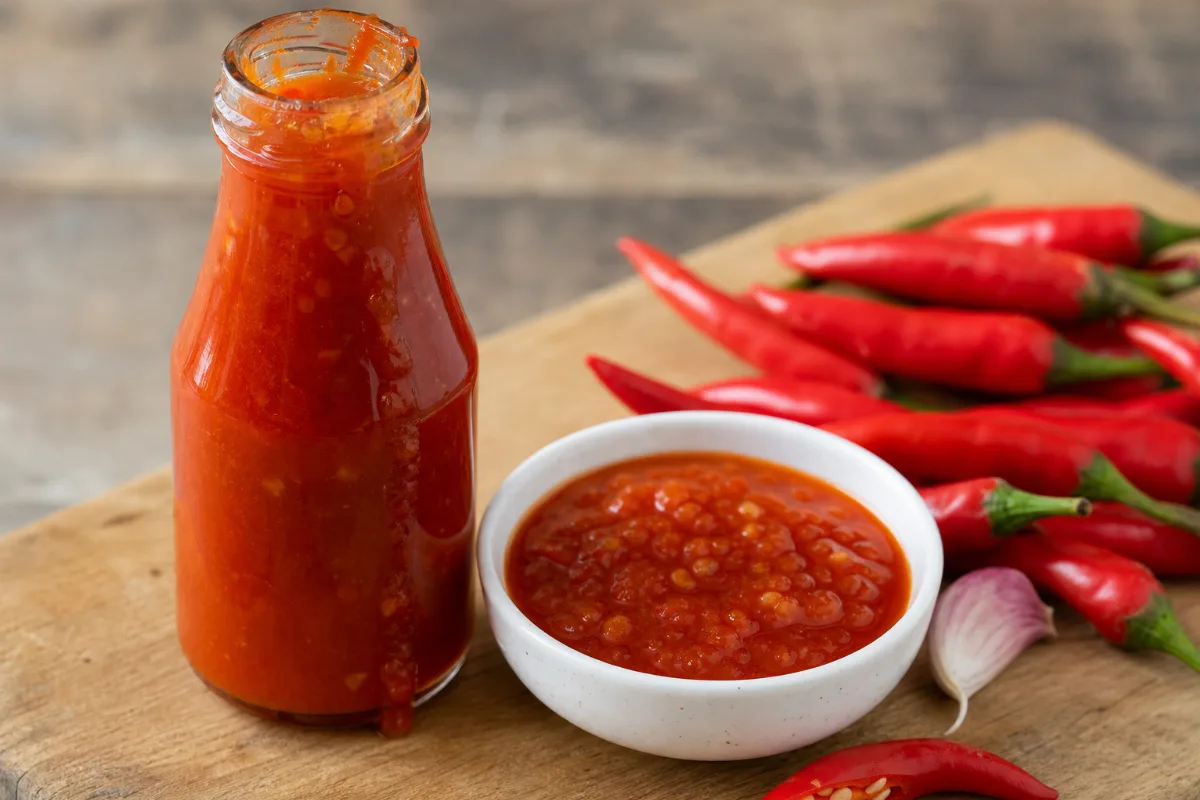
Fermented hot sauce starts as chopped chili peppers mixed with salt, or kept under salty brine, and left to ferment for days to months. Bacteria that live on the peppers make acid, which gives the sauce its tang. The mash is then often blended into a sauce, sometimes with vinegar, and sometimes cooked or pasteurized.
Lab studies describe the ferment. A 2022 study of fermented chili paste found lactic acid and acetic acid made up 10.57 to 12.20% and 3.39 to 4.10% of the freeze-dried powder, and plant-type lactic acid bacteria dominated. A 2025 study of six traditional red pepper sauces found their chemistry and microbes differed, and that capsaicin correlated with lower abundance of several bacterial genera.
What is in it
We found no USDA nutrition item for fermented hot sauce, and no published table of calories or sodium for a bottled sauce, so no per-portion values are shown. Sauces differ with the peppers, the salt, any vinegar, sugar, garlic or fruit, and whether the mix is cooked.
The only measured values read are for freeze-dried powder made from fermented chili paste, per 100 g of powder: vitamin C 398 to 1,107 mg, phenolic compounds 302 to 771 mg and carotenoids 544 to 2,462 micrograms per gram. A wet sauce holds far less of these, and for sodium the label is the best guide.
What the research shows
No trial of fermented hot sauce on gut health, blood pressure, weight or immunity was found. A 2026 lab study found two starter bacteria strains lowered pathogenic bacteria in fermented peppers, which speaks to how the ferment is made, not to any benefit to people.
One large Chinese cohort of 23,666 adults followed a median 12.6 years linked eating spicy food more than once a week with less new fatty liver disease (NAFLD/MASLD), but not advanced fibrosis. It covered spicy food of all kinds, used questionnaires and cannot show cause.
Food versus supplements
The composition numbers are for freeze-dried powder made from fermented chili paste. The liver finding is for spicy food of all kinds. The stomach finding is for capsaicin. Capsaicin capsules and chili extracts are different products from a sauce, and no trial of them was read for this page. Ask a doctor or pharmacist before using supplements.
At a glance
Traditional uses history, not proof
- Used as a condiment and flavoring
- Long use as food is not proof that it treats any condition
Studied for research
- Acid and microbes in the ferment, very low certainty (lab only)
- Vitamin C, phenolics and carotenoids, very low certainty (freeze-dried powder, lab)
- Gut health and live cultures, insufficient evidence
- Fatty liver, low certainty (spicy food in general, observational)
- Blood pressure, weight, immunity and detox, insufficient evidence
Main compounds
- Lactic acid and acetic acid
- Vitamin C
- Phenolic compounds
- Carotenoids
- Capsaicin
Common forms
- Raw fermented chili mash or sauce, as food (lab studies of pastes, not bottled sauce)
- Freeze-dried fermented chili powder (measured in one lab study)
- Blended, cooked or pasteurized bottled sauce (not tested in the studies read)
- Capsaicin capsules and chili extracts are different products and are not covered
Research links: 2022 lab study: fermented chili paste powders · 2025 study: spicy food and fatty liver · WHO: salt reduction fact sheet · Research Library · Genes & Biomarkers Library
What it is and its history
- Accepted scientific name
- Capsicum spp. (chili peppers), fermented
- Naming authority
- Capsicum L. (GBIF accepted genus); the food is a preparation, not a species
- Common names
- Fermented hot sauce (English); Fermented chili sauce (English); Chili mash (English); Lacto-fermented hot sauce (English); Salsa picante fermentada (Spanish)
- Family or group
- Solanaceae (nightshade family), per GBIF. The sauce itself is a processed food, not a plant.
- Classification
- Plantae > Tracheophyta > Magnoliopsida > Solanales > Solanaceae > Capsicum > spp.
- Native range
- Not verified from a source read.
- Habitat
- Not verified from a source read.
- What it looks like
- Roots: Not verified.; Stems: Not verified.; Leaves: Not verified.; Flowers: Not verified.; Fruit: The sauce is made from chili pepper fruits. Varieties named in the 2022 lab study include a Cayenne type (Capsicum annuum) and a Capsicum chinense type.
- Cultivation
- Not verified from a source read.
- Harvest and processing
- Chopped chili peppers are mixed with salt, or kept under salty brine, and left to ferment for days to months, then often blended into a sauce, sometimes with vinegar, and sometimes cooked or pasteurized. This general description comes from the project's earlier summary; the lab studies read describe fermented chili paste and pepper ferments but give no standard method. Bottled sauces differ widely.
- Look-alikes and adulterants
- Name: Vinegar-based hot sauce; Note: Not fermented, or only briefly; acid comes from added vinegar. Check the label.; Name: Gochujang and doenjang; Note: Korean fermented chili and soybean pastes, which have their own page.; Name: Capsaicin capsules and chili extracts; Note: Supplements, a different product from the sauce; no trial of them was read for this page.
- Sustainability and conservation
- Not assessed.
Photographs
What is inside, and how it may work
What it contains and how those compounds act in cells and animals. Laboratory and animal mechanisms are not proven effects in people.
Main compounds
| Compound | Family | Where it is concentrated | Activity studied | Level of evidence |
|---|---|---|---|---|
| Lactic acid | organic acid | Fruit (made by fermentation) 10.57 to 12.20% of freeze-dried fermented chili powder | Lowers pH and helps stabilize the ferment. 3 | Lab |
| Acetic acid | organic acid | Fruit (made by fermentation) 3.39 to 4.10% of freeze-dried fermented chili powder | Adds acidity and tang. 3 | Lab |
| Vitamin C | vitamin | Fruit 398 to 1,107 mg per 100 g of freeze-dried powder (highest in a Cayenne powder) | A measured content; no effect in people was tested. 3 | Lab |
| Phenolic compounds | phenolics | Fruit 302 to 771 mg per 100 g of freeze-dried powder | A measured content; no effect in people was tested. 3 | Lab |
| Carotenoids (including capsanthin esters) | carotenoids | Fruit 544 to 2,462 micrograms per gram of freeze-dried powder | Give red-orange color; no effect in people was tested. 3 | Lab |
| Capsaicin | capsaicinoid | Fruit Not given in the abstracts read | A 2025 sauce study found capsaicin correlated with lower abundance of several bacterial genera; a 2026 review linked capsaicin to dyspepsia flares. That capsaicin is what makes peppers hot is general knowledge, not a source read. 2 4 | Human data |
Mechanisms, receptors and pathways
| Target or pathway | Gene or receptor | What was found | Level |
|---|---|---|---|
| Acidification of the mash | Not applicable | Lactic acid bacteria make lactic and acetic acid. In the 2022 lab study the acids lowered the pH of salami filling they were added to. This describes food chemistry, not an effect in people. 3 | Lab |
| Salt and microbe selection | Not applicable | NCHFP says in fermented foods salt favors desirable bacteria and inhibits others (written for sauerkraut and pickles). A 2026 review says salt sets water activity, osmotic pressure and the ionic environment that shape flavor, safety and stability. 9 5 | Lab |
| Capsaicin and the microbes in the sauce | Not specified | In six red pepper sauces, capsaicin, pigment and water content correlated negatively with the abundance of several bacterial genera. These are correlations in a small sample. 2 | Lab |
| Capsaicin and upper stomach symptoms | Not specified in the abstract | The review notes some studies of capsaicin with impaired epithelial barrier function, immune activation or microbiota changes in functional dyspepsia. The abstract does not say which studies, so this is a reported pattern only. 4 | Human data |
Absorption, metabolism and elimination
- Absorption
- Not found for fermented hot sauce.
- Distribution
- Not found.
- Metabolism
- Not found.
- Elimination
- Not found.
- Bioavailability
- Not established.
Isolated compounds versus whole extracts
The lab composition numbers are for freeze-dried fermented chili powder, not wet sauce. The liver finding is for spicy food of all kinds. The dyspepsia finding is for capsaicin. Capsaicin capsules and chili extracts are different products and none were studied here.
Nutritional composition
No USDA FoodData Central item exists in the project's copy for fermented hot sauce, and a fresh USDA search on 2026-10-26 hit the public key rate limit, so no calories, sodium or other per-portion values are shown. We did not read a published table of calories or sodium for a bottled fermented hot sauce. Sauces differ a lot with the peppers, the salt, any vinegar, sugar, garlic or fruit, and whether the mix is cooked. The only measured values read are for freeze-dried powder made from fermented chili paste (2022 lab study, per 100 g of powder): lactic acid 10.57 to 12.20%, acetic acid 3.39 to 4.10%, vitamin C 398 to 1,107 mg, phenolics 302 to 771 mg and carotenoids 544 to 2,462 micrograms per gram. A wet sauce contains far less of these. For sodium, the label is the best guide.
1 low certainty2 very low certainty2 not enough evidence
What was looked at
The 5 benefits and uses checked for Fermented Hot Sauce, each with how strong the evidence is. Tap one to open it.
- Acid and microbes in the chili ferment (lab)Very low certainty
- Vitamin C, phenolics and carotenoids (measured in freeze-dried fermented chili powder)Very low certainty
- Gut health and live culturesNot enough evidence
- Fatty liver (spicy food in general)Low certainty
- Blood pressure, weight, immunity and 'detox'Not enough evidence
What is Fermented Hot Sauce good for?
The studied uses and how strong the evidence is for each. There are no human trials of fermented hot sauce, so most entries are lab findings or studies of spicy food in general.
Benefits, one by one
Each card is a research question, not a promise. Tap a goal to filter. Open a card to see the studies, doses and limits.
Acid and microbes in the chili ferment (lab)
Very low certaintyIn the lab, chili paste fermented with salt becomes acidic and is dominated by lactic acid bacteria. Selected starter bacteria lowered harmful bacteria in lab batches of fermented peppers. These are food-science findings, not health results in people.
3 studiesFermented chili paste, freeze-dried powder and lab batches with start…
Studies, doses and limits
Results
A 2022 lab study found lactic acid 10.57 to 12.20% and acetic acid 3.39 to 4.10% in freeze-dried fermented chili powder, with plant-type lactic acid bacteria dominating. A 2026 lab study found two starter bacteria strains reduced pathogenic bacteria in fermented peppers.
Effect sizes as reported
Acids: lactic 10.57 to 12.20%, acetic 3.39 to 4.10% (of freeze-dried powder). No effect sizes in people.
Why this rating
Laboratory work only, on powders and starter-culture batches that are not the same as a bottled sauce. No human outcome was measured.
Form and dose studied
Fermented chili paste, freeze-dried powder and lab batches with starter cultures. Bottled sauces were not tested.
Limits
Lab only. The sauce you buy may be blended, cooked or pasteurized, which these studies did not test.
Why researchers looked
Food scientists study how the acid and microbes in a chili ferment shape its flavor and keep it stable and safe.
Traditional use
Chili peppers have long been fermented in salt as a way to keep them and to flavor them. No source read describes the history.
Proposed mechanism Laboratory
Lactic acid bacteria make lactic and acetic acid, which lowers the pH. Salt favors these bacteria over others (NCHFP, for sauerkraut and pickles).
A proposed mechanism does not show that the effect happens in people.
Home fermentation needs tested methods; see the Safety tab.
Vitamin C, phenolics and carotenoids (measured in freeze-dried fermented chili powder)
Very low certaintyA lab study measured vitamin C, phenolic compounds and carotenoids in freeze-dried powders of fermented chili paste. The powder is much more concentrated than a spoonful of wet sauce, so these numbers do not describe what a sauce gives you.
1 studiesFreeze-dried powder only.
Studies, doses and limits
Results
Vitamin C 398 to 1,107 mg per 100 g of powder, phenolics 302 to 771 mg per 100 g and carotenoids 544 to 2,462 micrograms per gram.
Effect sizes as reported
Per 100 g of freeze-dried powder: vitamin C 398 to 1,107 mg; phenolics 302 to 771 mg. Carotenoids 544 to 2,462 micrograms per gram.
Why this rating
Composition measured in a dry powder in one lab study. No test of what bottled sauce contains or of any effect in people.
Form and dose studied
Freeze-dried powder only.
Limits
Dry powder, not sauce. Content depends on the pepper, the ferment and cooking.
Why researchers looked
Peppers contain vitamin C and colored plant compounds, and the researchers wanted to know what the fermented paste kept.
Traditional use
Not covered by any source read.
Proposed mechanism Laboratory
These are measured amounts in a food, not a tested mechanism in people.
A proposed mechanism does not show that the effect happens in people.
None specific.
Gut health and live cultures
Not enough evidenceRaw, unheated chili ferments contain bacteria in the lab, but no trial of fermented hot sauce and gut health was found. Many bottled sauces are cooked or pasteurized, which would remove live cultures.
2 studiesUnpasteurized or pasteurized sauce were not compared.
Studies, doses and limits
What the trials found
No trial or cohort study of fermented hot sauce and gut bacteria or digestion was found.
Results
Not studied in people. A 2025 study of red pepper sauces described the bacteria and fungi present, and no counts of live bacteria in bottled sauce were read.
Why this rating
No human data and no measurement of live bacteria in bottled sauce.
Form and dose studied
Unpasteurized or pasteurized sauce were not compared.
Limits
A label saying 'live' or 'raw' was not checked against any test.
Why researchers looked
People ask whether fermented foods act like probiotics.
Traditional use
Not covered by any source read.
Proposed mechanism Theoretical
Lactic acid bacteria in the ferment could in theory reach the gut if they survive; this was not tested for hot sauce.
A proposed mechanism does not show that the effect happens in people.
Spicy food can trigger reflux in some people; see the Safety tab.
Fatty liver (spicy food in general)
Low certaintyIn a large Chinese study, adults who ate spicy food more than once a week developed fatty liver disease less often over about 12 years. This is a link, it was about spicy food of all kinds and not fermented hot sauce, and it was not seen for advanced liver scarring.
1 studiesSpicy food of all kinds, reported by questionnaire.
Studies, doses and limits
What the trials found
One cohort of 23,666 adults without liver disease at the start, followed a median 12.6 years. 42.2% ate spicy food at least weekly.
Results
Spicy food more than once a week went with a significantly lower risk of NAFLD/MASLD, with a dose-response pattern. No link was seen for advanced fibrosis.
Effect sizes as reported
Lower NAFLD/MASLD risk with weekly spicy food; the abstract gives no hazard ratio.
Why this rating
A single observational study of spicy food of all kinds, based on questionnaires from one region of China. It cannot show cause and it is not about fermented sauce.
Form and dose studied
Spicy food of all kinds, reported by questionnaire.
Who was studied
Adults aged 25 to 60 at a check-up center in Shijiazhuang, China.
Limits
Observational. Other habits that go with eating spicy food could explain the result. No analysis of hot sauce in particular.
Why researchers looked
Lab work suggests capsaicin may protect against fatty liver, and the authors wanted to check this in a population.
Traditional use
Not covered by any source read.
Proposed mechanism Laboratory suggestion
Capsaicin is suggested to protect against steatotic liver disease in lab work, according to the authors. This was not tested here.
A proposed mechanism does not show that the effect happens in people.
Spicy food may worsen reflux in some people; see the Safety tab.
Blood pressure, weight, immunity and 'detox'
Not enough evidenceFermented hot sauce is sometimes promoted for these. No study of the sauce on blood pressure, weight, immune health or detox was found in the sources read.
1 studiesNone.
Studies, doses and limits
Results
Not studied. On blood pressure, the one thing sources do say is that high sodium raises it, and many sauces contain salt.
Why this rating
No studies were found on these outcomes for this food.
Limits
Absence of studies is not proof of no effect, but it means these claims are not supported.
Why researchers looked
These are common claims about fermented and spicy foods.
Traditional use
Not covered by any source read.
Proposed mechanism None
None tested.
A proposed mechanism does not show that the effect happens in people.
See the sodium note on the Safety tab.
Connections to the rest of health
How Fermented Hot Sauce connects to the rest of our health knowledge graph. Every link says what kind of connection it is. A safety link (for example to the liver) is a warning, not a benefit. A study that merely mentions a topic never creates a benefit link.
Explore every connection: goals, body systems, organs, symptoms, genes
A. Wellness goals
| Connected to | Kind of connection | Evidence status | Context | Studies |
|---|---|---|---|---|
| Gut Digestive Health | Very low certainty | Acid and microbes in the chili ferment (lab): In the lab, chili paste fermented with salt becomes acidic and is dominated by lactic acid bacteria. Selected starter bacteria lowered harmful bacteria in lab batches of fermented peppers. These are food-science findings, not health results in people. | 3 1 9 | |
| Preventive Wellness | Very low certainty | Vitamin C, phenolics and carotenoids (measured in freeze-dried fermented chili powder): A lab study measured vitamin C, phenolic compounds and carotenoids in freeze-dried powders of fermented chili paste. The powder is much more concentrated than a spoonful of wet sauce, so these numbers do not describe what a sauce gives you. | 3 | |
| Gut Digestive Health | Not enough evidence | Gut health and live cultures: Raw, unheated chili ferments contain bacteria in the lab, but no trial of fermented hot sauce and gut health was found. Many bottled sauces are cooked or pasteurized, which would remove live cultures. | 2 1 | |
| Liver Health | Low certainty | Fatty liver (spicy food in general): In a large Chinese study, adults who ate spicy food more than once a week developed fatty liver disease less often over about 12 years. This is a link, it was about spicy food of all kinds and not fermented hot sauce, and it was not seen for advanced liver scarring. | 6 | |
| Preventive Wellness | Not enough evidence | Blood pressure, weight, immunity and 'detox': Fermented hot sauce is sometimes promoted for these. No study of the sauce on blood pressure, weight, immune health or detox was found in the sources read. | 12 |
B. Body systems
| Connected to | Kind of connection | Evidence status | Context | Studies |
|---|---|---|---|---|
| Digestive System | Biological association | Very low certainty | Studied for: Acid and microbes in the chili ferment (lab) Studied for: Vitamin C, phenolics and carotenoids (measured in freeze-dried fermented chili powder) | 3 1 9 2 6 |
| Cardiovascular System | Biological association | Not enough evidence | Studied for: Blood pressure, weight, immunity and 'detox' | 12 |
| Immune System | Biological association | Not enough evidence | Studied for: Blood pressure, weight, immunity and 'detox' | 12 |
E. Health conditions
| Connected to | Kind of connection | Evidence status | Context | Studies |
|---|---|---|---|---|
| Gastroesophageal reflux disease | Adverse effect or risk | Documented risk | NIDDK lists spicy foods among foods some people find trigger reflux symptoms; responses vary. Preparation or compound: Spicy food |
10 |
| Functional dyspepsia | Adverse effect or risk | Documented risk | A 2026 systematic review linked capsaicin to symptom exacerbation in some studies. Preparation or compound: Capsaicin |
4 |
| High blood pressure | Adverse effect or risk | Documented risk | WHO links high sodium intake to raised blood pressure; the sodium in typical hot sauce was not read. WHO links high sodium to raised blood pressure; the sodium in typical hot sauce was not read. Preparation or compound: Sodium in salted ferments |
12 |
K. Biological pathways
| Connected to | Kind of connection | Evidence status | Context | Studies |
|---|---|---|---|---|
| Lactic acid bacteria | Preliminary mechanism | Lab | Plant-type lactic acid bacteria dominated fermented chili paste, powder and salami in a 2022 lab study. | 3 |
| Capsaicin | Preliminary mechanism | Human | Linked with symptom exacerbation in some functional dyspepsia studies. | 4 |
| Sodium | Preliminary mechanism | Human | Salt is used to make and protect the ferment; WHO links high sodium to raised blood pressure. | 12 9 |
L. Active compounds
| Connected to | Kind of connection | Evidence status | Context | Studies |
|---|---|---|---|---|
| Lactic acid | Biological association | Lab | Lowers pH and helps stabilize the ferment. Preparation or compound: Fruit (made by fermentation) |
3 |
| Acetic acid | Biological association | Lab | Adds acidity and tang. Preparation or compound: Fruit (made by fermentation) |
3 |
| Vitamin C | Biological association | Lab | A measured content; no effect in people was tested. Preparation or compound: Fruit |
3 |
| Phenolic compounds | Biological association | Lab | A measured content; no effect in people was tested. Preparation or compound: Fruit |
3 |
| Carotenoids (including capsanthin esters) | Biological association | Lab | Give red-orange color; no effect in people was tested. Preparation or compound: Fruit |
3 |
| Capsaicin | Biological association | Human | A 2025 sauce study found capsaicin correlated with lower abundance of several bacterial genera; a 2026 review linked capsaicin to dyspepsia flares. That capsaicin is what makes peppers hot is general knowledge, not a source read. Preparation or compound: Fruit |
2 4 |
Each connection is stored with the ingredient, the connected record, the kind of connection, the evidence status, the supporting studies, the preparation or compound involved, and a review date (last reviewed October 26, 2026).
Evidence at a glance: what the research found for 5 outcomes
Each outcome below is one thing researchers measured. Certainty is how far the evidence can be trusted, not how well it works. The full studies are on the next tab.
The evidence
The research centre for Fermented Hot Sauce. Every record here was checked against PubMed or the publisher's page; we never list a study we have not verified.
Evidence by outcome
Bars show how many studies we found for each outcome, not how well it works. People are added up across trials only (reviews are not added, to avoid double counting).
How we rate evidence
High certainty
Several well-run trials or reviews agree; further research is unlikely to change the picture much.
Moderate certainty
Good trials point the same way, but some doubt remains.
Low certainty
Small, short or inconsistent trials. The finding could change with better research.
Very low certainty
Very little or very weak human data. Treat as a possibility only.
Mixed findings
Trials or reviews disagree with each other.
Not enough evidence
Not enough human research to say either way.
Evidence against
Good research found no benefit, or found harm.
We take the reviewers' own risk-of-bias and GRADE statements where they exist, and otherwise judge from study size, design, consistency, directness and whether a product matches what is sold. Many publications do not make evidence high. Method note: We started from our existing fermented hot sauce summary, re-read the health agency pages (WHO, NIDDK, FDA, NCHFP) and re-read PubMed abstracts for lab studies, one cohort study and two reviews. Only abstracts were read for studies. Very little research on this food exists, so the page is short on purpose. Items we could not verify are flagged in the research gaps.
Study library: every study we checked 12
| Study | Design | People | Product, dose, length | Result |
|---|---|---|---|---|
| Chen 2026 Enhancing microbial safety and flavor of fermented peppers through inoculation of distinct lactic acid bacteria and yeasts. Food Chem X · PMID 42179953 · DOI |
Laboratory study n/a |
16 laboratory-fermented pepper batches made with chosen starter bacteria and yeasts; nine were selected after tasting | Fermented peppers with added lactic acid bacteria and yeasts Fermented peppers with starter cultures |
Two lactic acid bacteria (Pediococcus pentosaceus AO and Limosilactobacillus fermentum AD) showed strong antibacterial activity against foodborne pathogens and reduced the abundance of pathogenic bacteria in the fermented peppers. 138 flavor compounds were found. The authors conclude that the bacteria improved microbial safety and the yeasts improved flavor. Starter bacteria lowered pathogen abundance in lab ferments (no numbers in the abstract) (Not in the abstract) Methods, limits and fundingOutcomes: Sugars used, antibacterial activity, microbe mix and flavor compounds Limitations: Lab batches with chosen starter cultures, not home or factory hot sauce. No people were involved. Only the abstract was read. Funding and conflicts: Not stated in the abstract. Read: abstract |
| Gong 2025 Metabarcoding insights into microbial drivers of flavor development and quality stability in traditional Chinese red pepper sauce: impacts of varietal selection and solar/shade fermentation. Environ Microbiome · PMID 40448237 · DOI |
Laboratory study n/a |
Six traditional Chinese red pepper sauces analysed in the lab | Fermented red pepper sauce Red pepper sauce fermented in sun or shade |
The six sauces differed in amino acids, lactate, pectin, reducing sugar, flavonoids, phenolics, pigments and an enzyme (alcohol dehydrogenase). Water content, pigment and capsaicin were negatively correlated with the abundance of several bacterial genera. The authors say the work gives a basis for understanding flavor and quality stability. Capsaicin correlated negatively with the abundance of several bacterial genera (Not in the abstract) Methods, limits and fundingOutcomes: Sauce chemistry (amino acids, lactate, pectin, sugars, phenolics, pigments, capsaicin) and the bacteria and fungi present Limitations: Six sauces; correlations, not cause. Describes microbes and flavor, not any effect on people. Funded by Sichuan provincial agricultural research programmes. Funding and conflicts: Public research grants listed in the record (Sichuan Provincial Vegetable Breeding Key project; Natural Science Foundation of Sichuan Province; SAAS 1+9 Program). No company funding listed. Read: abstract |
| Paucean 2022 Freeze-Dried Powder of Fermented Chili Paste-New Approach to Cured Salami Production. Foods · PMID 36429308 · DOI |
Laboratory study n/a |
Lab analysis of freeze-dried powders made from fermented chili pastes (several Capsicum varieties) and of salami made with them | Freeze-dried powder of fermented chili paste Chili paste fermented, then freeze-dried (powder form) |
Lactic acid was 10.57 to 12.20% and acetic acid 3.39 to 4.10% of the powder. Vitamin C was 398 to 1,107 mg per 100 g (highest in a Cayenne chili powder), phenolic compounds 302 to 771 mg per 100 g and carotenoids 544 to 2,462 micrograms per gram. Plant-type lactic acid bacteria dominated the fermented paste, the powder and the salami. The acids lowered the pH of the salami filling. Lactic acid 10.57 to 12.20%; acetic acid 3.39 to 4.10%; vitamin C 398 to 1,107 mg/100 g; phenolics 302 to 771 mg/100 g; carotenoids 544 to 2,462 micrograms/g (Not applicable (descriptive lab values)) Methods, limits and fundingOutcomes: Acids, vitamin C, phenolics, carotenoids, aroma and microbes in the paste and powders Limitations: A concentrated dry powder made for use in salami, not a wet bottled sauce. Numbers do not show any effect in people. Not a health study. Funding and conflicts: Not stated in the abstract. Read: abstract |
| Phang 2026 Functional dyspepsia redefined: evidence supporting inflammatory dyspepsia - a systematic review. Gastroenterol Hepatol Bed Bench · PMID 42535192 · DOI |
Systematic review |
14 14 studies in adults with functional dyspepsia (Rome criteria), published 2000 to 2024 |
Dietary factors, including capsaicin Capsaicin (chili compound) · vs Varied |
High-FODMAP foods, gluten and capsaicin were linked to symptom exacerbation in some of the 14 studies. Anti-inflammatory or microbiota-modulating items such as probiotics, peppermint-caraway oil, herbal formulations and ginger supplements were found to mitigate symptoms. The authors call for large randomised trials. Capsaicin was linked to symptom exacerbation in some studies (Not applicable) Methods, limits and fundingOutcomes: Symptoms of functional dyspepsia (fullness, early satiety, upper stomach pain and burning) Limitations: Few studies of varied quality, 14 across seven dietary categories; capsaicin is only one of them. It does not test hot sauce. Only the abstract was read. Funding and conflicts: Not stated in the abstract. Read: abstract |
| Shen 2026 Advances in Salt Reduction in Salt-Dependent Traditional Fermented Foods: From Microecological Responses to Flavor and Safety Control. Compr Rev Food Sci Food Saf · PMID 42643123 · DOI |
Narrative review n/a |
Review of salt-dependent traditional ferments (soy sauce, fish sauce, shrimp paste, doubanjiang, kimchi, suancai, fermented olives) | Salt in fermented foods Salt in ferments |
The review says salt sets the conditions (water activity, osmotic pressure, ionic environment) that let a ferment develop flavor, stay stable and stay safe. It says successful salt reduction needs coordinated management of microbes, flavor, safety assurance and process stability, and it calls for product-specific salt-control systems. Descriptive review; no single effect size (Not applicable) Methods, limits and fundingOutcomes: How salt level changes fermentation, flavor, safety risk and stability Limitations: A review of other ferments; chili sauce is not among the foods named in the abstract (doubanjiang, a chili bean paste, is). Not about health outcomes in people. Only the abstract was read. Funding and conflicts: Not stated in the abstract. Read: abstract |
| Zhao 2025 Association between spicy food consumption and the risk of non-alcoholic fatty liver disease/metabolic dysfunction-associated steatotic liver disease and liver fibrosis. Front Nutr · PMID 41383348 · DOI |
Cohort study |
23666 23,666 adults aged 25 to 60 without liver disease at the start, from a health check-up database in Shijiazhuang, China, followed a median 12.6 years |
Spicy food of all kinds (questionnaire) Spicy food in general · vs Non-consumers of spicy food |
In the group who ate spicy food more than once a week (42.2% ate it at least weekly), new NAFLD/MASLD was significantly less common than in non-consumers, with a dose-response pattern. The link was not seen for advanced liver fibrosis. 7,965 NAFLD and 7,311 MASLD cases were found. Lower risk of NAFLD/MASLD with weekly spicy food; no link for advanced fibrosis (Hazard ratios and intervals not in the abstract) Methods, limits and fundingOutcomes: New fatty liver disease (NAFLD/MASLD) and advanced liver fibrosis Limitations: Observational, so it cannot show spicy food protects the liver. Spicy food of all kinds, not fermented hot sauce. One region of China, self-reported intake. Only the abstract was read. Funding and conflicts: Not stated in the abstract. Read: abstract |
| s-fda-allergens US FDA: Food Allergies · Source |
Health agency n/a |
Methods, limits and fundingRead: full-text | ||
| s-gbif-capsicum GBIF species match: Capsicum L. (genus) · Source |
Taxonomy database n/a |
Methods, limits and fundingRead: full-text | ||
| s-nchfp-ferment National Center for Home Food Preservation: Fermenting, pickles and sauerkraut (general information) · Source |
Health agency n/a |
Methods, limits and fundingRead: full-text | ||
| s-niddk-gerd NIDDK: Eating, Diet, & Nutrition for GER and GERD in Adults · Source |
Health agency n/a |
Methods, limits and fundingRead: full-text | ||
| s-usda-no-item USDA FoodData Central: no item for fermented hot sauce (saved copy in this project) · Source |
Reference database n/a |
Methods, limits and fundingRead: not-found | ||
| s-who-salt WHO: Salt reduction (fact sheet) · Source |
Health agency n/a |
Methods, limits and fundingRead: full-text |
What we do not know yet
- No trial or cohort study of fermented hot sauce itself was found; the evidence is lab work and studies of spicy food in general.
- No USDA or published nutrition table, and no sodium figure, for bottled fermented hot sauce was found.
- No count of live bacteria in bottled sauces was found, and no data on histamine or tyramine in this food.
- No hot-sauce-specific home-fermentation safety rule from an official body was read.
- The liver finding is observational and covers spicy food of all kinds.
- Pregnancy, breastfeeding, children, skin and eye irritation and capsaicin supplements were not researched.
How new research is added
New studies are found by a saved PubMed search and placed in a review queue before the page changes.
Lab markers
What changed in blood or saliva tests during trials. A changed number is not the same as feeling or being healthier, and we give no "normal ranges".
Safety
What studies and official sources say about side effects, medicines and who should check first. Each point shows what kind of evidence it comes from.
Main points to know 4
- Salt is part of both the safety and the sodium load. Salt favors the helpful bacteria in a ferment and holds back others, and official home-fermentation advice says not to cut the salt in tested sauerkraut and pickle recipes. WHO says high sodium raises blood pressure, which raises the risk of heart and kidney disease, and recommends adults take in less than 2000 mg of sodium a day. We did not read a sodium figure for typical hot sauce, so check the label. Authoritative guidance 9 12 5
- Heartburn, reflux and sensitive stomachs. NIDDK lists spicy foods among foods and drinks commonly linked to GERD symptoms, and says people differ. A 2026 review linked capsaicin to symptom flares in functional dyspepsia in some studies. If hot sauce brings on heartburn or upper stomach pain, talk to your doctor. Authoritative guidance 10 4
- Home fermenting needs tested methods. Official guidance for pickles and sauerkraut says to use only tested recipes, not to cut the salt, and that acid level is vital to prevent botulinum growth in pickled products. It does not give hot-sauce-specific rules. Do not rely on taste or smell to judge a batch. Authoritative guidance 9
- Check the label for other allergens. Chili pepper is not one of the nine major US food allergens. But sauces can contain other ingredients, and major allergens must be named on packaged food labels in the US. Authoritative guidance 7
Side effects 2
| Effect | How often | Severity and recovery | Evidence |
|---|---|---|---|
| Heartburn or acid reflux symptoms after spicy food Spicy foods in general, not hot sauce in particular. | Not given. NIDDK says some people with GERD find spicy foods trigger or worsen symptoms. | mild to moderate discomfort Not described in the sources read. | Authoritative guidance 10 |
| Upper stomach pain, fullness or burning (functional dyspepsia) flaring with capsaicin Capsaicin as a compound, not hot sauce specifically. | Not given; some of 14 studies in a review linked capsaicin to flares. | mild to moderate Not described. | Systematic review 4 |
Liver
No liver injury from hot sauce was found in the sources read. A liver-safety source such as LiverTox was not searched. A cohort study linked weekly spicy food with less new fatty liver disease, which is an association and not a safety study. 6
How often. No frequency was found.
Monitoring. No agency monitoring advice was found.
This is a safety connection. It is not evidence that Fermented Hot Sauce supports liver health.
Medicines and supplements 3
| With | Why it matters | Importance | Evidence | What to do |
|---|---|---|---|---|
| MAOI antidepressants (and histamine or tyramine sensitivity) prescription | Some fermented foods contain tyramine or histamine. No source read measured them in fermented hot sauce. | Unknown for this food. No source describing a direct interaction was found. | None found Not enough evidence | If you take an MAOI, ask your pharmacist or prescriber about fermented foods in general. |
| Low-sodium diets, high blood pressure or kidney disease advice condition | Salt is used to make and protect the ferment, and WHO links high sodium to raised blood pressure and to heart and kidney disease. | The sodium in a typical hot sauce was not found. The risk depends on how much salt the sauce contains and how it fits your whole day. | Authoritative guidance Moderate certainty 12 | Read the sodium on the label and tell your care team if you are told to limit salt. |
| Acid-reflux or stomach medicines prescription | No source read describes an interaction between hot sauce and any medicine. | None found Not enough evidence 10 | Ask a doctor or pharmacist if your symptoms continue. |
Who should check first 5
| Situation | Advice | Evidence |
|---|---|---|
| Reflux, GERD or functional dyspepsia that spicy food worsens | Notice whether hot sauce triggers symptoms for you and talk to your doctor if it does. | Authoritative guidance 10 4 |
| A medical need to limit sodium | Count the sauce in your daily sodium and ask your care team how it fits. | Authoritative guidance 12 |
| Food allergy to an ingredient in the sauce (for example fish sauce, soy or wheat if listed) | Read the ingredient list. For trouble breathing or swelling of the face, lips or throat, call 911 or your local emergency number. | Authoritative guidance 7 |
| Pregnancy and breastfeeding | No official advice that singles out fermented hot sauce was found in the sources read. Ask your midwife or doctor, especially if spicy food gives you heartburn. | None found |
| Young children | No official advice that singles out hot sauce was found, and no source read says more. Ask your child's doctor. | None found |
Overdose, product quality and regulators
Summary. No toxicity from hot sauce as a condiment was found in the sources read. Concentrated capsaicin products were not researched.
Animal. Not reviewed.
High dose or long term signals. Not researched.
Overdose response. Not found.
Genotoxicity. Not researched.
Pathogens, molds, histamine and skin or eye irritation from handling hot peppers were not found in the sources read for this food, except a lab study in which chosen starter bacteria lowered pathogen bacteria in fermented peppers.
Pathogens in lab pepper ferments. Two lactic acid bacteria strains showed strong antibacterial activity against foodborne pathogens and reduced pathogenic bacteria in lab batches of fermented peppers. 1
Spoilage. NCHFP warns that yeasts, molds and enzymes can spoil pickled products. This is written for pickles, not hot sauce. 9
| Body | Action | Date |
|---|---|---|
| US FDA (United States) | Food Allergies: lists nine major food allergens; chili pepper is not among them; major allergens must be named on packaged food labels. source | 2026-03-11 |
| WHO (International) | Salt reduction fact sheet: recommends adults take in less than 2000 mg/day of sodium; high sodium raises blood pressure and heart and kidney disease risk. source | 2026-05-11 |
| NIDDK (United States) | Eating, Diet, and Nutrition for GER and GERD: spicy foods are among foods commonly linked to GERD symptoms. source | 2020-07 |
| NCHFP (University of Georgia, USDA-supported) (United States) | General information on fermenting (pickles and sauerkraut): use tested recipes and do not cut the salt. source | undated |
When to get medical help
- Trouble breathing, wheezing, swelling of the lips, face, tongue or throat, widespread hives, repeated vomiting, dizziness or collapse after eating a sauce (possible anaphylaxis to an ingredient): use epinephrine if prescribed, then call 911 or your local emergency number
Stop using the product and contact a clinician or emergency service. In the US, Poison Control is 1-800-222-1222.
General information only, not medical advice. Ask a clinician or pharmacist before use, especially with medicines, in pregnancy or with a health condition. See the Natural Remedy Safety guide.
Frequently asked questions
What is fermented hot sauce?
Does fermented hot sauce have probiotics?
Is fermented hot sauce good for gut health?
Is fermented hot sauce high in sodium?
Can hot sauce cause heartburn?
Is spicy food good for the liver?
One large Chinese study linked weekly spicy food with less new fatty liver disease, but not with less advanced liver scarring. It was an association about spicy food of all kinds, not fermented sauce, and it does not prove spicy food protects the liver.
Does fermented hot sauce lower blood pressure or help weight loss?
No study of the sauce on these was found. Sodium in salted foods is linked to higher blood pressure, so the salt in a sauce matters.
Can I ferment hot sauce at home safely?
Official advice for fermented pickles and sauerkraut is to use only tested recipes, not to cut the salt and to use clean equipment. It names no hot-sauce rules. Do not use a batch that looks or smells wrong, and do not taste it to check.
What is the difference between fermented and vinegar-based hot sauce?
Is chili pepper a common allergen?
Chili pepper is not one of the nine major US food allergens. But sauces can contain other ingredients, such as fish sauce, soy or wheat, so read the label. For trouble breathing or swelling of the face, lips or throat, call 911 or your local emergency number.
Is it the same as taking capsaicin capsules?
Why is there no nutrition table for fermented hot sauce?
No USDA item for this food was found, and no published table of calories or sodium for a bottled sauce was read. Sauces vary with the peppers, salt and added ingredients, so the label on your bottle is the best source.
Explore by health goal
Editorial transparency
- Written by
- AlternativeMed editorial team. Research compiled with AI assistance, then checked against the sources listed.
- Medical review
- None. This page has not been reviewed by a physician or pharmacist.
- First published
- 2026-10-26
- Last substantive update
- 2026-10-26
- How we research
- We started from our existing fermented hot sauce summary, re-read the health agency pages (WHO, NIDDK, FDA, NCHFP) and re-read PubMed abstracts for lab studies, one cohort study and two reviews. Only abstracts were read for studies. Very little research on this food exists, so the page is short on purpose. Items we could not verify are flagged in the research gaps.
- How we rate evidence
- See "How we rate evidence" in the Evidence tab.
- Independence
- No product is promoted on this page. No affiliate links are shown.
Sources 12
Each source was opened and checked. Where we read only the abstract, it says so. The small numbers in the text point here.
- Chen Z, et al.. Enhancing microbial safety and flavor of fermented peppers through inoculation of distinct lactic acid bacteria and yeasts.. Food Chem X. 2026. PMID 42179953. DOI 10.1016/j.fochx.2026.103990. (abstract)
- Gong X, et al.. Metabarcoding insights into microbial drivers of flavor development and quality stability in traditional Chinese red pepper sauce: impacts of varietal selection and solar/shade fermentation.. Environ Microbiome. 2025. PMID 40448237. DOI 10.1186/s40793-025-00717-2. (abstract)
- Paucean A, et al.. Freeze-Dried Powder of Fermented Chili Paste-New Approach to Cured Salami Production.. Foods. 2022. PMID 36429308. DOI 10.3390/foods11223716. (abstract)
- Phang L, et al.. Functional dyspepsia redefined: evidence supporting inflammatory dyspepsia - a systematic review.. Gastroenterol Hepatol Bed Bench. 2026. PMID 42535192. DOI 10.22037/ghfbb.v19i01.3287. (abstract)
- Shen S, et al.. Advances in Salt Reduction in Salt-Dependent Traditional Fermented Foods: From Microecological Responses to Flavor and Safety Control.. Compr Rev Food Sci Food Saf. 2026. PMID 42643123. DOI 10.1111/1541-4337.70630. (abstract)
- Zhao N, et al.. Association between spicy food consumption and the risk of non-alcoholic fatty liver disease/metabolic dysfunction-associated steatotic liver disease and liver fibrosis.. Front Nutr. 2025. PMID 41383348. DOI 10.3389/fnut.2025.1729349. (abstract)
- . US FDA: Food Allergies. . . (full-text)
- . GBIF species match: Capsicum L. (genus). . . (full-text)
- . National Center for Home Food Preservation: Fermenting, pickles and sauerkraut (general information). . . (full-text)
- . NIDDK: Eating, Diet, & Nutrition for GER and GERD in Adults. . . (full-text)
- . USDA FoodData Central: no item for fermented hot sauce (saved copy in this project). . . (not-found)
- . WHO: Salt reduction (fact sheet). . . (full-text)
Where to buy
Check the label first. Whatever you buy, look for these:
- Live and active cultures on the label, if that is what you want
- Refrigerated or shelf-stable, since shelf-stable versions may be heat treated
- Added sugar and sodium
- A best-by date
Talk to a pharmacist or doctor before you start any supplement, especially if you take medicines. See the Safety tab for interactions.
Support our free guides: as an Amazon Associate we earn from qualifying purchases. Full disclosure.


