Fermented Foods · Fermented food
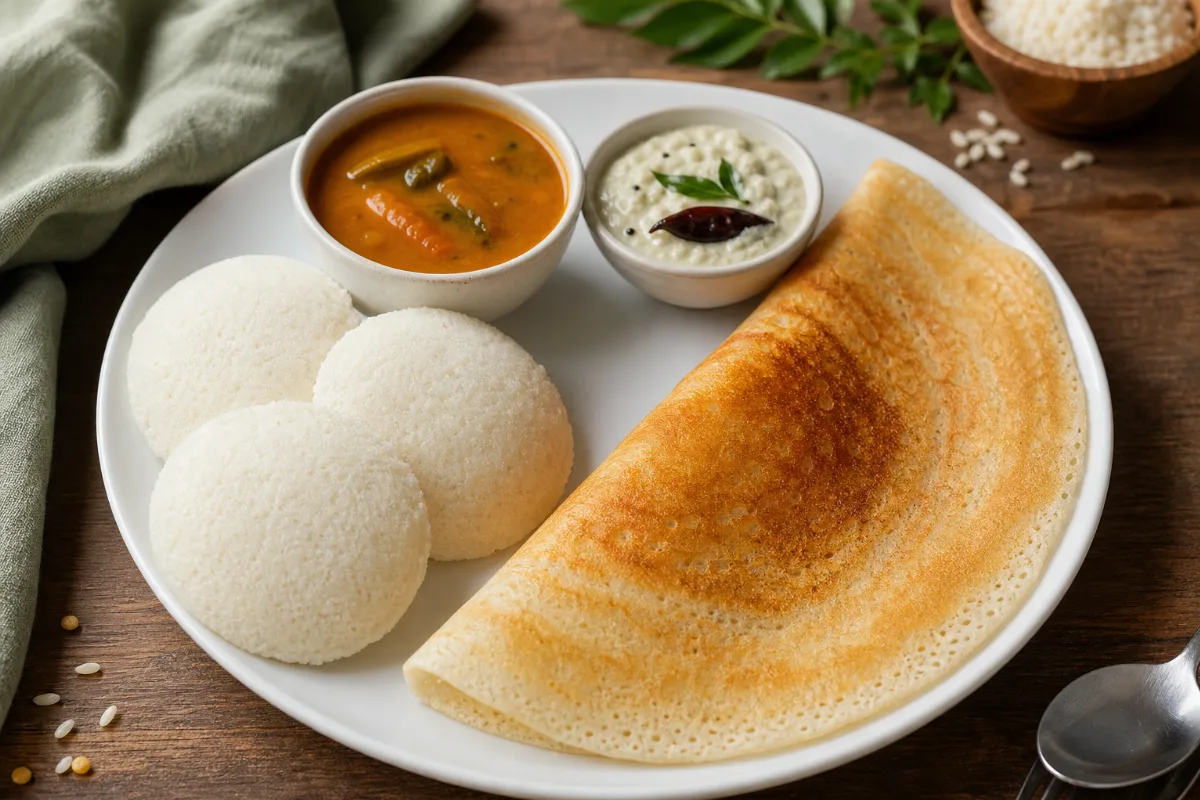
Idli and Dosa
Oryza sativa and Vigna mungo (the two ingredients) · also called Idly, dosai, fermented rice and black gram batter
Idli and dosa are South Indian foods made from a fermented batter of rice and urad dal. Idli is steamed; dosa is cooked on a griddle. People eat them as everyday staple foods. In a small trial, both raised blood sugar quickly, and we found no trial showing a health benefit. The main cautions are blood sugar, gluten from mixes or shared griddles, and allergy if you react to peanuts or legumes.
General information, not medical advice. Last substantive update · Not medically reviewed. A named clinician has not signed off on this page. How this page is made
About Idli and Dosa
Idli and dosa are everyday fermented foods, not proven remedies. Research is thin, so this page is short and says plainly where the evidence stops.
What they are
Idli and dosa are made from a batter of rice and urad dal (black gram, a small pulse). In the 2011 laboratory study the batter was made by soaking polished parboiled rice and decorticated black gram for 4 hours, grinding them with water, and fermenting with a little salt. Idli is steamed into soft cakes; dosa is cooked thin on a hot griddle.
Fermentation is run by lactic acid bacteria that come from the grains themselves. They sour the batter and make gas, which is why it rises. In the lab, grains that were surface-sterilised did not ferment.
We found no USDA entry or peer-reviewed table for calories, protein or minerals in cooked idli or dosa, and we will not guess them. Check the label of a shop mix or an Indian food composition table.
What the research shows
Blood sugar is the one outcome measured in people. In a 2018 trial of 19 healthy young men, rice idli had a glycaemic index of 85 and rice dosa 76, both high. A 2019 paper reports 77 for traditional idli and proposes roasting the rice first; we could not read human numbers for that version.
In the lab, soaking, fermenting and steaming idli ingredients lowered tannins by 100%, phytic acid by 89% and trypsin inhibitor activity by 58%, while total biogenic amines rose 339%. That is food chemistry, not a health result.
B vitamins in the batter: one paper found riboflavin, thiamine and folic acid rose; a later one found natural fermentation did not raise riboflavin and halved folate. We found no study of gut health in people eating idli or dosa.
At a glance
Traditional uses history, not proof
- A South Indian breakfast and everyday meal
- Rice and urad dal ground and left to ferment, then steamed (idli) or griddled (dosa)
- Long use as food is not proof that it treats any condition
Studied for research
- Blood sugar response, low certainty and it points to a caution (high glycaemic index)
- Heat-treated rice idli, very low certainty (numbers not read)
- Antinutrients and protein breakdown in the batter, laboratory measurements only
- B vitamins in the batter, mixed laboratory results
- Gut health, insufficient evidence for idli or dosa
Main compounds
- Rice starch
- Lactic acid
- B vitamins (laboratory batter)
- Tannins and phytic acid
- Lectins and trypsin inhibitors
- Biogenic amines (formed in fermented batter)
Common forms
- Home or shop batter, steamed idli, griddle dosa
- Ready batter and dry mixes (ingredients vary)
- Raw fermenting batter (laboratory studies only)
- Heat-treated rice idli (research method, not a product)
Research links: 2018 trial: glycaemic index of idli, dosa and other breakfast foods · 2019 laboratory study: microbes fermenting idli batter · 2011 study: legume allergy and cross-reactivity in India · Research Library · Genes & Biomarkers Library
What it is and its history
- Accepted scientific name
- Not a single species: a prepared food of Oryza sativa L. (rice) and Vigna mungo (L.) Hepper (urad dal, black gram)
- Naming authority
- GBIF: Oryza sativa L.; Vigna mungo (L.) Hepper
- Common names
- Idli (idly) (Tamil/Telugu/Kannada/English); Dosa (dosai) (Tamil/Telugu/Kannada/English); Fermented rice and black gram batter (English); Idli y dosa (panqueques y pastelitos fermentados de arroz y urad dal) (Spanish)
- Family or group
- A cooked food made from two plants: rice (grass family) and urad dal or black gram (legume family).
- Classification
- Plantae > Tracheophyta > Not verified from a source read > Poales (rice); Fabales (black gram) > Poaceae (rice); Fabaceae (black gram) > Oryza; Vigna > Oryza sativa; Vigna mungo
- Native range
- Not verified from a source read.
- What it looks like
- Fruit: Idli are soft round steamed cakes; dosa are thin crisp or soft griddle-cooked crepes, both from the same fermented batter (existing summary and 2019 review abstracts).
- Harvest and processing
- Idli batter in the 2011 laboratory study was made by soaking polished parboiled rice and decorticated black gram for 4 h at 30 C, grinding with water, then fermenting in ratios of 2:1, 3:1 or 4:1 rice to black gram with 2% salt. Ordinary home and shop recipes vary. Idli is then steamed; dosa is cooked on a hot griddle.
- Look-alikes and adulterants
- Name: Dokala (dhokla); Note: A related steamed fermented food mentioned alongside idli in one paper; a different recipe.; Name: Injera; Note: Another fermented grain flatbread (teff), with its own page.; Name: Ready batter and dry mixes; Note: Shop products; ingredients, fermentation and any gluten-free claim vary.
- Sustainability and conservation
- Not assessed.
Photographs
What is inside, and how it may work
What it contains and how those compounds act in cells and animals. Laboratory and animal mechanisms are not proven effects in people.
Main compounds
| Compound | Family | Where it is concentrated | Activity studied | Level of evidence |
|---|---|---|---|---|
| Starch (mostly from rice) | carbohydrate | Rice grain Not measured in the papers read | Digested quickly according to one review; the trial found a high glycaemic index for rice idli and dosa. 10 2 | Human data |
| Lactic acid and other organic acids | fermentation products | Batter Total acidity 0.44% to 0.91% in one laboratory study of batter | Sour the batter; pH fell from 5.9 to 4.21 in the same study. 3 | Lab |
| Riboflavin, thiamine, folate (B vitamins) | vitamins | Batter Riboflavin 0.76, thiamine 0.73, folic acid 0.75 mg per 100 g at peak in one study of raw batter; a second study found natural fermentation did not raise riboflavin and halved folate | Results disagree; neither measured cooked food. 3 1 | Lab |
| Tannins and phytic acid | antinutrients | Raw ingredients Lowered by 100% and 89% in finished idli versus raw ingredients (one lab study) | Can bind minerals; lowered by soaking, fermenting and steaming in the lab. 9 4 | Lab |
| Trypsin inhibitors and lectins (hemagglutinating activity) | proteins | Raw black gram Trypsin inhibitor activity lowered 58% and hemagglutinating activity 100% in finished idli (one lab study) | Can interfere with protein digestion in raw seed; lowered in finished idli in the lab. 9 | Lab |
| Biogenic amines | fermentation products | Batter Total up 339% in finished idli versus raw ingredients (one lab study); individual amines not read | Formed by microbes during fermentation; no health link shown in the sources read. 9 | Lab |
| Lactic acid bacteria (Weissella and others) | microbes | Batter 86% of bacteria in fermenting batter (one lab study) | Drive the fermentation and make gas that raises the batter. Live counts in cooked food were not found. 6 | Lab |
Mechanisms, receptors and pathways
| Target or pathway | Gene or receptor | What was found | Level |
|---|---|---|---|
| Fermentation of the batter | Not specified | Lactic acid bacteria from the grains ferment the batter, make acid and gas, and break down phytin and starch; antinutrients fall in finished idli (laboratory). 6 9 3 | Lab |
| Post-meal glucose rise | Not specified | Rice idli and dosa produced a high glycaemic index in healthy men. 10 | Human data |
Absorption, metabolism and elimination
- Absorption
- Not found for idli or dosa.
- Distribution
- Not found.
- Metabolism
- Not found.
- Elimination
- Not found.
- Bioavailability
- Not established. Mineral and protein uptake from idli was not measured in people in the sources read.
Isolated compounds versus whole extracts
The glycaemic trial used cooked rice idli and rice dosa as foods. The vitamin, microbe and antinutrient work was done on raw or optimised laboratory batter, and one vitamin study used added starter microbes. Dry mixes and supplements were not studied.
Nutritional composition
No USDA FoodData Central reference entry for idli or dosa was read: the USDA search service was rate-limited when we tried (2026-10-26) and the earlier summary found no matching entry, so we show no USDA numbers and will not guess energy, protein or mineral values. We also did not read a peer-reviewed table of cooked idli or dosa nutrients. What papers did measure is B vitamins and acidity in raw fermenting batter (Ghosh 2011) and glycaemic index of rice idli and dosa (Tan 2018). Check the label of a shop mix, or an Indian food composition table, for calories and protein. A plate of idli with sambar and chutney also holds other foods whose salt, fat and sugar change the meal.
1 mixed findings1 low certainty2 very low certainty2 not enough evidence
What was looked at
The 6 benefits and uses checked for Idli and Dosa, each with how strong the evidence is. Tap one to open it.
- Blood sugar response after eating (glycaemic index)Low certainty
- Idli made from heat-treated rice (a lab and food-science idea)Very low certainty
- Protein breakdown and antinutrients in the batter (laboratory)Very low certainty
- B vitamins in the batter (laboratory, mixed results)Mixed findings
- Gut health and live bacteriaNot enough evidence
- Which microbes ferment the batter (laboratory description)Not enough evidence
Lab markers tracked in the studies
Glycaemic index (blood sugar rise after a food)
What is Idli and Dosa good for?
What research says about eating idli and dosa. Only one small trial measured blood sugar in people, so most rows rest on laboratory studies of the batter or on reviews of fermented foods in general.
Benefits, one by one
Each card is a research question, not a promise. Tap a goal to filter. Open a card to see the studies, doses and limits.
Blood sugar response after eating (glycaemic index)
Low certaintyIn a small crossover trial, rice idli and rice dosa both raised blood sugar quickly: a high glycaemic index. This is a caution, not a benefit.
2 studiesCommercial rice idli and rice dosa as eaten (trial detail, not advice…
Studies, doses and limits
What the trials found
A 2018 randomised crossover study in Singapore gave 19 healthy young men ten breakfast foods and measured blood sugar and insulin for 2 hours. Rice idli had a glycaemic index of 85 and rice dosa 76. Both are high. A 2019 paper reports 77 plus or minus 2 for traditionally made idli.
Results
Both idli and dosa were in the high range in the trial. Foods with more protein, fat and fibre had a lower GI across the foods tested. What the GI means in a mixed meal with sambar or chutney was not measured in these papers.
Effect sizes as reported
Rice idli GI 85 (SEM 4); rice dosa GI 76 (SEM 5); traditional idli 77 +/- 2 in the 2019 paper.
Why this rating
One small trial in 19 healthy young men, plus one paper with unclear methods. Both point the same way (high GI), but they are few, and products and recipes vary.
Form and dose studied
Commercial rice idli and rice dosa as eaten (trial detail, not advice).
Who was studied
Healthy young Chinese and Indian men in Singapore (trial); people with diabetes not shown in the abstracts.
Limits
Healthy young men only. Commercial products. Single foods, not whole meals. Two authors of the trial work for a food company.
Why researchers looked
Idli and dosa are mostly rice starch, so researchers measure how fast blood sugar rises after them.
Traditional use
Idli and dosa are everyday South Indian foods made from a fermented batter of rice and urad dal (black gram). Long use as food is not proof that they treat any condition.
Proposed mechanism Unknown
Rice starch in the batter is digested quickly (stated by the authors of one review).
A proposed mechanism does not show that the effect happens in people.
People who watch their blood sugar can ask a dietitian how idli and dosa fit their meals.
Idli made from heat-treated rice (a lab and food-science idea)
Very low certaintyOne paper proposes that roasting the parboiled rice first gives an idli that releases glucose more slowly. We could not confirm the human numbers.
1 studiesParboiled rice roasted before making idli (research method, not a pro…
Studies, doses and limits
What the trials found
A 2019 paper made idli from parboiled rice roasted at 155 to 165 C for 65 to 75 seconds and compared it with idli from untreated rice. The abstract says glycaemic index and load were tested in normal and diabetic people, but it gives no numbers. We did not see human results for the heat-treated version in the text we read.
Results
The authors report better microbiological, physical and sensory properties, and slightly higher nutritive value, for the heat-treated version. No size of blood sugar benefit was read.
Effect sizes as reported
No numbers read for the heat-treated version.
Why this rating
The abstract gives no figures, PubMed lists the paper as a review, the title makes a claim ('suitable for diabetic patients') the abstract does not support with data, and it is a single group. Heat-treated rice idli is not what is sold in shops.
Form and dose studied
Parboiled rice roasted before making idli (research method, not a product).
Who was studied
Normal and diabetic people, numbers not read.
Limits
Title claim not supported by numbers we could read. Not independently repeated.
Why researchers looked
Researchers look for ways to make idli friendlier for people managing blood sugar.
Traditional use
Idli and dosa are everyday South Indian foods made from a fermented batter of rice and urad dal (black gram). Long use as food is not proof that they treat any condition.
Proposed mechanism Laboratory research
Heat treatment of rice changes how quickly its starch becomes glucose (laboratory starch tests).
A proposed mechanism does not show that the effect happens in people.
None specific.
Protein breakdown and antinutrients in the batter (laboratory)
Very low certaintyIn the laboratory, soaking, fermenting and steaming idli ingredients lowered several antinutrients. This is food chemistry, not a measured health benefit.
3 studiesLaboratory idli made with optimised soaking, fermenting and steaming.
Studies, doses and limits
What the trials found
No study in people was found. In one laboratory study, finished idli compared with the raw ingredients had tannins down 100%, phytic acid down 89%, trypsin inhibitor activity down 58% and hemagglutinating (lectin test) activity down 100%. Amino nitrogen, which the authors use as a sign of protein breakdown, was measured in a separate batter study. A 2026 review says fermentation lowers phytates, tannins and saponins in legumes by more than 60%.
Results
The antinutrients measured fell in the lab. Whether that makes protein or minerals easier to absorb in people eating idli or dosa was not studied in the papers read.
Effect sizes as reported
Idli versus raw ingredients: tannins -100%, phytic acid -89%, trypsin inhibitors -58%, lectin test -100%.
Why this rating
Laboratory chemistry only, from one optimised recipe, plus a general review of legumes. No human measurement of digestion or mineral uptake.
Form and dose studied
Laboratory idli made with optimised soaking, fermenting and steaming.
Limits
One optimised recipe; ordinary home recipes differ. Chemistry, not a health outcome.
Why researchers looked
Rice and black gram contain compounds that can block mineral or protein uptake, so researchers measure how fermentation changes them.
Traditional use
Idli and dosa are everyday South Indian foods made from a fermented batter of rice and urad dal (black gram). Long use as food is not proof that they treat any condition.
Proposed mechanism Laboratory research
Microbes and heat break down tannins, phytic acid and some proteins in the batter (laboratory measurement).
A proposed mechanism does not show that the effect happens in people.
None specific.
B vitamins in the batter (laboratory, mixed results)
Mixed findingsOne lab study found B vitamins rose in fermenting idli batter, but a later study found natural fermentation did not raise riboflavin and halved folate. The results disagree.
2 studiesRaw batter in the laboratory.
Studies, doses and limits
What the trials found
No study in people was found. A 2011 paper measured peaks of riboflavin 0.76 mg and thiamine 0.73 mg per 100 g of raw batter and folic acid 0.75 mg per 100 g after 10 hours. A 2017 laboratory study in Finland found that natural idli fermentation did not raise riboflavin and cut folate by about half; adding selected starter microbes raised both by 40 to 90%.
Results
The two lab papers disagree about natural fermentation, and the 2011 paper has unit inconsistencies. Neither measured vitamins in cooked idli or dosa, or in people's blood.
Effect sizes as reported
2011: riboflavin 0.76, thiamine 0.73, folic acid 0.75 mg/100 g peak (raw batter). 2017: natural fermentation, riboflavin not raised, folate about halved.
Why this rating
Two laboratory papers disagree, one has unit problems, and neither tested cooked food or any human outcome.
Form and dose studied
Raw batter in the laboratory.
Limits
Raw batter only; steaming and griddle heat can change vitamin levels. Starter strains used in the 2017 paper are not part of ordinary home idli.
Why researchers looked
Fermenting microbes can make or use up B vitamins, so researchers measure them in batter.
Traditional use
Idli and dosa are everyday South Indian foods made from a fermented batter of rice and urad dal (black gram). Long use as food is not proof that they treat any condition.
Proposed mechanism Laboratory research
Fermenting microbes can make or consume vitamins (laboratory).
A proposed mechanism does not show that the effect happens in people.
None specific.
Gut health and live bacteria
Not enough evidenceFermented foods in general are studied for gut health, but we found no human study of idli or dosa. The cooking step also matters.
3 studiesNot applicable.
Studies, doses and limits
What the trials found
No trial of idli or dosa and gut bacteria, digestion or symptoms was found. A 2025 systematic narrative review of 125 human reports on ethnic fermented foods says natto, kimchi and tempeh are better studied and many others remain understudied; the abstract does not name idli or dosa. A second 2025 review describes fermented foods as a way to introduce microbes and says people respond very differently.
Results
No result for idli or dosa can be stated. In lab work on the raw batter, lactic acid bacteria were 86% of the bacteria, but steaming or griddle heat is expected to affect live bacteria in the cooked food. We found no source that counted them, so we do not claim a probiotic effect.
Effect sizes as reported
No effect size for idli or dosa.
Why this rating
No human study of this food exists in the sources read; the reviews are about fermented foods in general.
Limits
General reviews, mixed human and animal work, and a food-company funding statement on one author laboratory in the first review.
Why researchers looked
Many people ask whether fermented foods help digestion or the gut microbiome.
Traditional use
Idli and dosa are everyday South Indian foods made from a fermented batter of rice and urad dal (black gram). Long use as food is not proof that they treat any condition.
Proposed mechanism Unknown
Fermented foods can carry microbes and metabolites to the gut (general reviews). Idli and dosa are steamed or griddle-cooked.
A proposed mechanism does not show that the effect happens in people.
None specific.
Which microbes ferment the batter (laboratory description)
Not enough evidenceDNA studies show idli batter is fermented mostly by lactic acid bacteria from the grains themselves, led by a genus called Weissella.
1 studiesRaw batter in the laboratory.
Studies, doses and limits
What the trials found
No study in people was found. In a 2019 laboratory study, lactic acid bacteria made up 86% of the bacteria in fermenting batter, Weissella was the most important genus, and grains that had been surface-sterilised did not ferment. The authors predicted genes for starch- and phytin-degrading enzymes and B vitamin production.
Results
This describes the batter, not a health effect. The authors suggest idli may be a useful functional food; that is their view and was not tested in people.
Effect sizes as reported
Lactic acid bacteria 86% of the bacteria.
Why this rating
A description of microbes in raw batter in the laboratory, with no human outcome.
Form and dose studied
Raw batter in the laboratory.
Limits
Not cooked idli or dosa. The microbes in shop batter or dry mixes may differ.
Why researchers looked
Scientists describe the microbes so the traditional fermentation is understood and can be made reliable.
Traditional use
Idli and dosa are everyday South Indian foods made from a fermented batter of rice and urad dal (black gram). Long use as food is not proof that they treat any condition.
Proposed mechanism Laboratory research
Lactic acid bacteria make acid and gas that sour and raise the batter (laboratory).
A proposed mechanism does not show that the effect happens in people.
None specific.
Connections to the rest of health
How Idli and Dosa connects to the rest of our health knowledge graph. Every link says what kind of connection it is. A safety link (for example to the liver) is a warning, not a benefit. A study that merely mentions a topic never creates a benefit link.
Explore every connection: goals, body systems, organs, symptoms, genes
A. Wellness goals
| Connected to | Kind of connection | Evidence status | Context | Studies |
|---|---|---|---|---|
| Blood Sugar Balance | Low certainty | Blood sugar response after eating (glycaemic index): In a small crossover trial, rice idli and rice dosa both raised blood sugar quickly: a high glycaemic index. This is a caution, not a benefit. Idli made from heat-treated rice (a lab and food-science idea): One paper proposes that roasting the parboiled rice first gives an idli that releases glucose more slowly. We could not confirm the human numbers. | 10 2 | |
| Digestive Support | Very low certainty | Protein breakdown and antinutrients in the batter (laboratory): In the laboratory, soaking, fermenting and steaming idli ingredients lowered several antinutrients. This is food chemistry, not a measured health benefit. Which microbes ferment the batter (laboratory description): DNA studies show idli batter is fermented mostly by lactic acid bacteria from the grains themselves, led by a genus called Weissella. | 9 3 4 6 | |
| Energy Vitality | Mixed findings | B vitamins in the batter (laboratory, mixed results): One lab study found B vitamins rose in fermenting idli batter, but a later study found natural fermentation did not raise riboflavin and halved folate. The results disagree. | 3 1 | |
| Gut Health | Not enough evidence | Gut health and live bacteria: Fermented foods in general are studied for gut health, but we found no human study of idli or dosa. The cooking step also matters. | 8 7 6 | |
| Digestive Support | Not enough evidence | Gut health and live bacteria: Fermented foods in general are studied for gut health, but we found no human study of idli or dosa. The cooking step also matters. | 8 7 6 |
B. Body systems
| Connected to | Kind of connection | Evidence status | Context | Studies |
|---|---|---|---|---|
| Endocrine System | Biological association | Low certainty | Studied for: Blood sugar response after eating (glycaemic index) Studied for: Idli made from heat-treated rice (a lab and food-science idea) | 10 2 |
| Digestive System | Biological association | Very low certainty | Studied for: Protein breakdown and antinutrients in the batter (laboratory) Studied for: Gut health and live bacteria | 9 3 4 8 7 6 |
| Metabolism Weight | Biological association | Mixed findings | Studied for: B vitamins in the batter (laboratory, mixed results) | 3 1 |
E. Health conditions
| Connected to | Kind of connection | Evidence status | Context | Studies |
|---|---|---|---|---|
| Food allergy | Adverse effect or risk | Documented risk | In 355 patients in India with a history of legume allergy, black gram showed laboratory cross-reactivity with kidney bean, peanut and pigeon pea. Preparation or compound: Urad dal protein in idli and dosa batter |
5 12 |
| Celiac disease | Adverse effect or risk | Documented risk | Rice and black gram are not gluten grains, but other flours or shared equipment can add gluten. Preparation or compound: Gluten cross-contact in mixes and shared equipment |
18 11 14 |
| Type 2 diabetes | Preliminary | Both had a high glycaemic index in a small trial of healthy men. Preparation or compound: Rice idli and rice dosa |
10 |
I. Biomarkers
| Connected to | Kind of connection | Evidence status | Context | Studies |
|---|---|---|---|---|
| Glycaemic index (blood sugar rise after a food) | Biological association | Low certainty | Measured in trials: raised. A lab change is not the same as a health benefit. | 10 2 |
K. Biological pathways
| Connected to | Kind of connection | Evidence status | Context | Studies |
|---|---|---|---|---|
| Type 2 diabetes | Preliminary mechanism | Human | Rice idli and dosa had a high glycaemic index in a small trial. | 10 |
| Food allergy | Preliminary mechanism | Human | Laboratory cross-reactivity of black gram with kidney bean, peanut and pigeon pea in patients with legume allergy. | 5 |
L. Active compounds
| Connected to | Kind of connection | Evidence status | Context | Studies |
|---|---|---|---|---|
| Starch (mostly from rice) | Biological association | Human | Digested quickly according to one review; the trial found a high glycaemic index for rice idli and dosa. Preparation or compound: Rice grain |
10 2 |
| Lactic acid and other organic acids | Biological association | Lab | Sour the batter; pH fell from 5.9 to 4.21 in the same study. Preparation or compound: Batter |
3 |
| Riboflavin, thiamine, folate (B vitamins) | Biological association | Lab | Results disagree; neither measured cooked food. Preparation or compound: Batter |
3 1 |
| Tannins and phytic acid | Biological association | Lab | Can bind minerals; lowered by soaking, fermenting and steaming in the lab. Preparation or compound: Raw ingredients |
9 4 |
| Trypsin inhibitors and lectins (hemagglutinating activity) | Biological association | Lab | Can interfere with protein digestion in raw seed; lowered in finished idli in the lab. Preparation or compound: Raw black gram |
9 |
| Biogenic amines | Biological association | Lab | Formed by microbes during fermentation; no health link shown in the sources read. Preparation or compound: Batter |
9 |
| Lactic acid bacteria (Weissella and others) | Biological association | Lab | Drive the fermentation and make gas that raises the batter. Live counts in cooked food were not found. Preparation or compound: Batter |
6 |
Each connection is stored with the ingredient, the connected record, the kind of connection, the evidence status, the supporting studies, the preparation or compound involved, and a review date (last reviewed October 26, 2026).
Evidence at a glance: what changed in 1 lab markers
Tap a number to show only those markers. Counts are markers, not people.
The evidence
The research centre for Idli and Dosa. Every record here was checked against PubMed or the publisher's page; we never list a study we have not verified.
Evidence by outcome
Bars show how many studies we found for each outcome, not how well it works. People are added up across trials only (reviews are not added, to avoid double counting).
How we rate evidence
High certainty
Several well-run trials or reviews agree; further research is unlikely to change the picture much.
Moderate certainty
Good trials point the same way, but some doubt remains.
Low certainty
Small, short or inconsistent trials. The finding could change with better research.
Very low certainty
Very little or very weak human data. Treat as a possibility only.
Mixed findings
Trials or reviews disagree with each other.
Not enough evidence
Not enough human research to say either way.
Evidence against
Good research found no benefit, or found harm.
We take the reviewers' own risk-of-bias and GRADE statements where they exist, and otherwise judge from study size, design, consistency, directness and whether a product matches what is sold. Many publications do not make evidence high. Method note: We started from our existing idli and dosa summary, re-read PubMed abstracts for each study cited, read the FDA, NIDDK, Celiac Disease Foundation and food-preservation pages, and checked scientific names against GBIF. Items we could not verify are flagged in the research gaps.
Study library: every study we checked 18
| Study | Design | People | Product, dose, length | Result |
|---|---|---|---|---|
| Chandrasekar Rajendran 2017 Biofortification of riboflavin and folate in idli batter, based on fermented cereal and pulse, by Lactococcus lactis N8 and Saccharomyces boulardii SAA655. J Appl Microbiol · PMID 28339160 · DOI |
Laboratory measurement n/a |
Idli batter of wet-ground rice and black gram in a laboratory in Finland | Naturally fermented batter versus batter with added starter strains (Lactococcus lactis N8, Saccharomyces boulardii SAA655) Batter Fermentation (time not given in the abstract) · vs Naturally fermented batter |
Natural idli fermentation did not raise riboflavin and cut folate by about half. Adding the starter strains raised riboflavin and folate by 40 to 90% compared with the natural batter. Natural fermentation: riboflavin not raised, folate about halved (Not applicable) Methods, limits and fundingOutcomes: Riboflavin and folate in batter, leavening, pH Limitations: Laboratory batter, not cooked idli. The starter strains are not used in ordinary home idli. No health outcome. Funding and conflicts: Funding not stated in the abstract. Read: abstract |
| Chelliah 2019 Effect of Rice Processing towards Lower Rapidly Available Glucose (RAG) Favors Idli, a South Indian Fermented Food Suitable for Diabetic Patients. Nutrients · PMID 31262013 · DOI |
Review with experimental work |
Idli and rice dokala made from untreated or heat-treated parboiled rice; glycaemic tests in 'normal and diabetic persons' as described in the abstract | Parboiled rice roasted at 155 to 165 C for 65 to 75 seconds, then made into idli Idli made from heat-treated rice · vs Idli made from untreated parboiled rice |
The abstract says idli from heat-treated rice was better than untreated on microbiological profile, physicochemical properties and sensory scores, and that glycaemic index and load were studied in normal and diabetic people. It gives no GI numbers. The full text, as read, states that traditionally made idli has a GI of 77 plus or minus 2 (high) and a glycaemic load over 40 for a 250 g serving. Human results for the heat-treated version were not shown in the text we read. Traditional idli GI 77 +/- 2 (stated in the full text); heat-treated rice version: no numbers read (Not applicable) Methods, limits and fundingOutcomes: Rapidly and slowly available glucose, resistant starch, microbiology, sensory scores, glycaemic index and load Limitations: PubMed lists this paper as a review. The title says idli is 'suitable for diabetic patients', which the abstract does not back with numbers. Part of the full text was garbled when read, so the GI figure is reported as the paper states it, not re-calculated. The full text of Tan 2018 gives a higher GI (85) for rice idli. Funding and conflicts: Authors declared no conflict of interest. Read: abstract + full text (partly garbled) |
| Ghosh 2011 Preparation of idli batter, its properties and nutritional improvement during fermentation. J Food Sci Technol · PMID 23572795 · DOI |
Laboratory measurement n/a |
Idli batter (polished parboiled rice and decorticated black gram, ratios 2:1, 3:1, 4:1) in a laboratory | Raw batter fermented for different times with 2% salt Rice and black gram batter Fermentation for different periods (up to 10 h) · vs Batter before fermentation |
pH fell between 5.9 and 4.21 and total acidity rose between 0.44% and 0.91%. Peak riboflavin 0.76 mg/100 g and thiamine 0.73 mg/100 g (3:1 ratio) and folic acid 0.75 mg/100 g after 10 h. Digestibility was judged by amino nitrogen (formol titration). Riboflavin 0.76, thiamine 0.73, folic acid 0.75 mg per 100 g batter at peak (Not applicable) Methods, limits and fundingOutcomes: Viscosity, density, pH, acidity, riboflavin, thiamine, folic acid, amino nitrogen Limitations: Raw batter, not cooked idli. Units and times are inconsistent in the paper (mg per 100 g versus 100 ml; 7 h versus 10 h), and the folic acid value looks unusually high, so treat the vitamin numbers as approximate. Contradicted for riboflavin and folate by Chandrasekar 2017 (natural fermentation did not raise riboflavin and halved folate). No health outcome. Funding and conflicts: Funding not stated in the abstract. Read: abstract |
| Janahar 2026 Nutritional and Functional Attributes of Legumes: A Review of Processing Methods and Their Impacts. J Food Sci · PMID 42494153 · DOI |
Narrative review n/a |
Review of how processing changes legumes (not idli specifically) | Grinding, soaking, germination, fermentation, heat treatment Legumes |
The review says fermentation markedly lowers phytates, tannins and saponins in legumes by more than 60% and makes bioactive peptides. Heat treatment neutralises heat-sensitive antinutrients but may lower antioxidant capacity. Phytates, tannins, saponins lowered by more than 60% with fermentation (legumes in general) (Not applicable) Methods, limits and fundingOutcomes: Antinutrients (phytic acid, tannins, lectins, trypsin inhibitors), protein breakdown Limitations: About legumes in general, not idli or dosa. Food chemistry, not human health outcomes. Funding and conflicts: Authors declared no conflicts of interest. Read: abstract |
| Kasera 2011 Kidney bean: a major sensitizer among legumes in asthma and rhinitis patients from India. PLoS One · PMID 22096535 · DOI |
Observational clinic study |
355 355 patients in India with a history of legume allergy (asthma and rhinitis patients) |
Skin-prick tests with 10 legumes, blood IgE tests and laboratory inhibition assays Legume extracts |
Kidney bean sensitised 78 patients (22.0%), chickpea 65 (18.0%) and peanut 53 (15%). Inhibition assays showed extensive cross-reactivity among kidney bean, peanut, black gram and pigeon pea. Black gram cross-reactivity shown in laboratory inhibition tests (Not applicable) Methods, limits and fundingOutcomes: Which legumes sensitised patients; cross-reactivity between legumes Limitations: Patients already had a history of legume allergy, so this does not show how common black gram allergy is. Cross-reactivity in a lab test is not the same as a reaction after eating idli or dosa. Black gram sensitisation rates were not in the abstract. Funding and conflicts: Authors declared no competing interests. Read: abstract |
| Mandhania 2019 Diversity and Succession of Microbiota during Fermentation of the Traditional Indian Food Idli. Appl Environ Microbiol · PMID 31053581 · DOI |
Laboratory microbiology n/a |
Idli batter fermented in a laboratory, with samples from different places | Batter sampled at different fermentation times and analysed by DNA sequencing and culture Batter Over the course of fermentation |
Lactic acid bacteria made up 86% of the bacteria, and Weissella was the most important genus. The microbes came from the grains themselves: grains that were surface-sterilised did not ferment. Genes for starch- and phytin-degrading enzymes and for B vitamin production were predicted. Some isolates tolerated acid and bile in the lab, which the authors say suggests idli may be a useful food; this is a lab idea, not a human result. Lactic acid bacteria 86% of bacteria (Not applicable) Methods, limits and fundingOutcomes: Which microbes are present and how they change; acid and gas production Limitations: Describes the raw batter while it ferments, not cooked idli or dosa, and not any effect in people. 'Potential dietary supplement' in the abstract is the authors' view, not a finding in humans. Funding and conflicts: Funding not stated in the abstract. Read: abstract |
| Park 2025 Fermented Foods as Functional Systems: Microbial Communities and Metabolites Influencing Gut Health and Systemic Outcomes. Foods · PMID 40647044 · DOI |
Narrative review mixed |
Review of clinical and preclinical studies of fermented foods in general | Fermented foods Fermented foods |
The review says fermented foods deliver live microbes and metabolites, and that people vary a lot in how they respond. It covers clinical and preclinical studies, and does not single out idli or dosa in the abstract. Not applicable (Not applicable) Methods, limits and fundingOutcomes: Gut microbiome, immune, metabolic, cognitive outcomes Limitations: A general review mixing human and animal work. It says live microbes are delivered, which applies to foods eaten uncooked or unheated; idli is steamed and dosa is griddle-cooked, and no source we read counted live bacteria in the cooked foods. Funding and conflicts: Authors declared no conflicts of interest. Read: abstract |
| Santa 2025 Health benefits of ethnic fermented foods. Front Nutr · PMID 41080174 · DOI |
Systematic narrative review |
125 reports of human studies of ethnic fermented foods, selected from 3,488 search results | Ethnic fermented foods (natto, kimchi, tempeh and many others) Fermented foods |
The review says natto, kimchi and tempeh are better known, while multiple other ethnic fermented foods remain unknown and understudied. Idli and dosa are not named in the abstract. Not applicable (Not applicable) Methods, limits and fundingOutcomes: Reported health endpoints: gut, immune, metabolic, cognitive, cardiovascular, bone, oral, eye, skin Limitations: A narrative review. The abstract does not name idli or dosa, so it cannot be used as evidence for them. One author laboratory has received funding from food and probiotic companies (declared). Funding and conflicts: Conflict statement lists research funding to one author laboratory from food and probiotic companies. Read: abstract |
| Sharma 2016 Minimization of Antinutrients in Idli by Using Response Surface Process Optimization. J Food Process Preserv · Source · DOI |
Laboratory measurement n/a |
Idli batter ingredients (black gram dal and rice) analysed in a laboratory | Soaking, fermenting and steaming black gram dal and rice to make idli Black gram dal and rice Optimised conditions reported by the authors: soak 18 h, ferment 19 h at 35 C, steam 20 min · vs Raw ingredients |
Compared with the raw ingredients, finished idli had tannins down 100%, phytic acid down 89%, trypsin inhibitor activity down 58% and hemagglutinating activity down 100%. Total biogenic amines rose by 339%. Biogenic amines +339%; other antinutrients reduced (Not applicable) Methods, limits and fundingOutcomes: Tannins, phytic acid, trypsin inhibitor activity, hemagglutinating activity, biogenic amines Limitations: Chemical measurements in food, not health outcomes. The abstract was read through Crossref/Europe PMC; the paper was not found in PubMed. Not tied to any symptom. Funding and conflicts: Funding is not stated in the abstract. Read: abstract (Crossref/Europe PMC) |
| Tan 2018 The glycaemic index and insulinaemic index of commercially available breakfast and snack foods in an Asian population. Br J Nutr · PMID 29759105 · DOI |
Randomised crossover trial |
19 19 healthy young men (9 Chinese, 10 Indian), average age 24.7 years, in Singapore |
Ten commercial breakfast foods eaten after an overnight fast, including rice idli and rice dosa Cooked foods as sold Blood sampled for 180 minutes after each food · vs Each food compared in the same people (crossover); glucose reference as the GI method requires |
Rice idli GI 85 (SEM 4), rice dosa GI 76 (SEM 5), upma 71 (SEM 6): high GI. The Western whole-grain breakfast foods tested were low GI (44 to 55). GI was lower in foods with more protein, fat and fibre. Rice idli GI 85; rice dosa GI 76 (Not given in the abstract (SEM shown)) Methods, limits and fundingOutcomes: Glycaemic index and insulinaemic index (blood sugar and insulin response over 120 minutes) Limitations: Healthy young men only, so it does not show the response in women, older adults or people with diabetes. Commercially available idli and dosa, not a standard home recipe. Individual products vary. The abstract does not give portion sizes. Funding and conflicts: Two authors are from General Mills, Inc. (a food company); funding details were not in the abstract. Read: abstract |
| s-celiac-org Celiac Disease Foundation: Gluten-free foods · Source |
Patient organisation n/a |
Methods, limits and fundingRead: full-text | ||
| s-fda-allergens FDA: Food allergies · Source |
Health agency n/a |
Methods, limits and fundingRead: full-text | ||
| s-fda-arsenic FDA: What you can do to limit exposure to arsenic · Source |
Health agency n/a |
Methods, limits and fundingRead: full-text | ||
| s-fda-glutenfree FDA: Gluten-free labeling of foods · Source |
Health agency n/a |
Methods, limits and fundingRead: full-text | ||
| s-gbif-oryza GBIF species match: Oryza sativa L. · Source |
Reference database n/a |
Methods, limits and fundingRead: api-record | ||
| s-gbif-vigna GBIF species match: Vigna mungo (L.) Hepper · Source |
Reference database n/a |
Methods, limits and fundingRead: api-record | ||
| s-nchfp-fermenting National Center for Home Food Preservation: General information on fermenting · Source |
University extension n/a |
Methods, limits and fundingRead: full-text | ||
| s-niddk-celiac NIDDK: Celiac disease, definition and facts · Source |
Health agency n/a |
Methods, limits and fundingRead: full-text |
What we do not know yet
- No trial of idli or dosa in people was found for gut health, cholesterol, weight or any outcome other than blood sugar response.
- Dosa has one glycaemic result, from healthy young men; people with diabetes were not tested in the papers read.
- No USDA or peer-reviewed nutrient table for cooked idli or dosa was read.
- Vitamins after cooking, and live bacteria in cooked food, were not found.
- Arsenic, mycotoxins, and pregnancy, children, kidney, gout and FODMAP questions were not researched for idli or dosa.
How new research is added
New studies are found by a saved PubMed search and placed in a review queue before the page changes.
Lab markers
What changed in blood or saliva tests during trials. A changed number is not the same as feeling or being healthier, and we give no "normal ranges".
Other 1
Glycaemic index (blood sugar rise after a food)
Raised in trials
A score for how fast blood sugar rises after eating a food, compared with pure glucose. Higher means a faster rise.
Low certaintyResults and what it means
Why it was measured
It is a standard way to compare how foods affect blood sugar.
Statistical vs. clinical meaning
Both foods raised blood sugar quickly in a small trial of healthy men. This is a caution, not a benefit.
Safety implication
People managing blood sugar can ask a dietitian about portions and what is eaten alongside.
| Study | Result | People | Product |
|---|---|---|---|
| 10 | Rice idli GI 85 (SEM 4); rice dosa GI 76 (SEM 5); both high | 19 healthy young men in a crossover trial | Commercial rice idli and rice dosa eaten after an overnight fast |
Safety
What studies and official sources say about side effects, medicines and who should check first. Each point shows what kind of evidence it comes from.
Main points to know 5
- Blood sugar: both foods have a high glycaemic index. In a small trial of 19 healthy young men, rice idli had a glycaemic index of 85 and rice dosa 76, both high. Another paper reports 77 for traditional idli. This does not mean people with diabetes must avoid them, but it is a reason to ask a dietitian about portions and what is eaten alongside, especially if you take medicine for blood sugar. Clinical trial 10 2
- Gluten: not gluten grains, but cross-contact can happen. Celiac disease is triggered by gluten from wheat, barley and rye (NIDDK). Rice and black gram are not on that list. Shop batter, ready mixes, restaurant dosa and shared griddles can add gluten through other flours or equipment. 'Gluten-free' on a label is a voluntary FDA-defined claim, and the Celiac Disease Foundation says to buy versions tested to under 20 parts per million when unsure. We found no gluten testing of idli or dosa. Authoritative guidance 18 14 11
- Rice and arsenic. FDA says rice tends to absorb arsenic more readily than other crops, but people can eat rice as part of a well-balanced diet, and advises a varied diet. For infants, rice cereal should not be the only cereal. FDA notes cooking rice in extra water and draining lowers inorganic arsenic by 40 to 60 percent, but that advice is for plain cooked rice. No arsenic measurement of idli or dosa was found, because the rice is ground and steamed or griddled rather than boiled and drained. Authoritative guidance 13
- Allergy: rice and black gram are not major US allergens, but any food can cause a reaction. FDA lists nine major allergens (milk, eggs, fish, crustacean shellfish, tree nuts, peanuts, wheat, soybeans and sesame). Rice and black gram are not on it. In 355 patients in India with a history of legume allergy, laboratory tests showed extensive cross-reactivity among kidney bean, peanut, black gram and pigeon pea. If you have a peanut or legume allergy, ask an allergist before eating foods made with urad dal. Idli and dosa are often served with chutneys and sambar that may contain peanuts, sesame or other allergens; check ingredients. Observational 12 5
- Home batter hygiene. Official home fermenting advice is written for vegetables such as pickles and sauerkraut. It says acidity matters for safety and recipes should not be altered. We found no safety guidance written for idli or dosa batter. In the lab, the batter souring (pH about 4.2 in one study) is part of normal fermentation, but this is not a safety test. Keep batter clean and cool, and discard batter that smells rotten or shows mould. Authoritative guidance 17 3
Side effects 3
| Effect | How often | Severity and recovery | Evidence |
|---|---|---|---|
| Fast rise in blood sugar after eating (high glycaemic index) Measured in 19 healthy men; people with diabetes were not tested in the abstract read. | Not established | matters most for people with diabetes or prediabetes Temporary after a meal | Clinical trial 10 |
| Allergic reactions, from itching and hives to anaphylaxis, in people allergic to legumes or other ingredients in the meal The clinic study included only patients who already had a history of legume allergy. It does not show how common an idli or dosa allergy is. | Not established | can be severe (anaphylaxis) Not found for idli or dosa | Observational 5 12 |
| Gluten exposure in people with celiac disease from mixes or shared equipment The plain ingredients are not gluten grains; the risk is cross-contact or added flours. | Not established | varies Not applicable | Authoritative guidance 18 11 |
Liver
No liver injury from eating idli or dosa was found in the sources read. A liver-safety source such as LiverTox was not searched for a food.
How often. No frequency was found.
Monitoring. No agency monitoring advice was found.
This is a safety connection. It is not evidence that Idli and Dosa supports liver health.
Medicines and supplements 2
| With | Why it matters | Importance | Evidence | What to do |
|---|---|---|---|---|
| Medicines for diabetes (including insulin) prescription | A high-GI food can raise blood sugar quickly, which could matter for how much medicine is needed. | No source read tied idli or dosa to a specific medicine interaction. This is a general caution, not a documented interaction. | Theoretical Not enough evidence 10 | Ask your clinician or pharmacist before big diet changes if you take diabetes medicine. |
| MAOI medicines (a class of antidepressant) and tyramine-containing foods prescription | Fermented foods can contain biogenic amines. A laboratory study found total biogenic amines in finished idli were 339% higher than in the raw ingredients, but it did not say which amines or how much. | No source read links idli or dosa to an MAOI reaction. The amine rise is a laboratory finding only. | Theoretical Not enough evidence 9 | If you take an MAOI, ask your pharmacist about fermented foods in general; do not assume idli and dosa are free of risk or that they are a problem. |
Who should check first 4
| Situation | Advice | Evidence |
|---|---|---|
| Known or suspected peanut or legume allergy | Ask an allergist before eating foods made with urad dal. Cross-reactivity among legumes was shown in laboratory tests. | Observational 5 12 |
| Celiac disease or gluten-related disorders | Choose batter or mixes labelled and tested gluten-free, and ask about shared griddles in restaurants. | Authoritative guidance 18 11 14 |
| Pregnancy and breastfeeding | We read no official advice that singles out idli or dosa. FDA's arsenic advice is for rice foods in general: eat a varied diet. Ask your midwife or doctor about fermented batter safety if unsure. | Authoritative guidance 13 |
| Infants and young children | FDA says rice cereal should not be the only cereal for infants. We read no source on idli or dosa for infants. Soft idli is easy to swallow, but we read no choking guidance; ask the child's clinician. | Authoritative guidance 13 |
Overdose, product quality and regulators
Summary. No toxicity from cooked idli or dosa as ordinary food was found in the sources read. Raw ingredients hold antinutrients that soaking, fermenting and steaming lower in the lab.
Animal. Not reviewed.
Human doses studied. No trial of idli or dosa for safety outcomes was found.
Overdose response. Not found.
Genotoxicity. Not researched.
Arsenic in rice, gluten cross-contact and batter spoilage are the questions raised by the sources. Mycotoxins, pesticides and metals in black gram were not researched.
Arsenic in rice. FDA says rice absorbs arsenic more readily than other crops and recommends a varied diet; draining excess cooking water lowers inorganic arsenic in plain cooked rice by 40 to 60 percent. No idli or dosa measurement was read. 13
Home batter. No safety guidance written for idli batter was found. Official home-fermenting advice is for vegetables and stresses tested recipes. 17
| Body | Action | Date |
|---|---|---|
| US Food and Drug Administration (United States) | Arsenic and rice: rice tends to absorb arsenic more readily than other crops, people can eat rice as part of a well-balanced diet, eat a varied diet, and rice cereal should not be an infant's only cereal. source | 2022-04-27 |
| US Food and Drug Administration (United States) | Major food allergens: milk, eggs, fish, crustacean shellfish, tree nuts, peanuts, wheat, soybeans and sesame. Rice and black gram are not listed. source | 2026-03-11 |
| US Food and Drug Administration (United States) | 'Gluten-free' is a voluntary label claim that makers may use if they meet the FDA definition (2013 final rule). source | 2026-03-17 |
When to get medical help
- Trouble breathing, swelling of the lips, face or throat, widespread hives, repeated vomiting or collapse after eating (possible anaphylaxis): call emergency services
- Very high blood sugar symptoms in a person with diabetes (extreme thirst, confusion, vomiting): seek medical advice
- Severe or bloody diarrhoea, or fever with vomiting, after eating spoiled batter: seek medical advice
Stop using the product and contact a clinician or emergency service. In the US, Poison Control is 1-800-222-1222.
General information only, not medical advice. Ask a clinician or pharmacist before use, especially with medicines, in pregnancy or with a health condition. See the Natural Remedy Safety guide.
Frequently asked questions
What are idli and dosa?
Are idli and dosa good for diabetes?
Do idli and dosa have a high glycaemic index?
Does fermenting the batter make idli healthier?
Do idli and dosa have probiotics?
Does fermenting the batter add B vitamins?
Do idli and dosa help digestion or gut health?
Are idli and dosa gluten-free?
Is the arsenic in rice a problem for idli and dosa?
FDA says rice absorbs more arsenic than other crops, but rice can be part of a well-balanced diet, and advises a varied diet. We found no arsenic measurement of idli or dosa itself.
Can I eat idli and dosa if I am allergic to peanuts or legumes?
Is it safe to ferment idli batter at home?
Official home-fermenting advice is written for vegetables such as pickles, not batter. We found no guidance for idli batter. Keep it clean and cool, and discard batter that smells rotten or shows mould.
Explore by health goal
Digestive SupportBlood Sugar BalanceEnergy VitalityGut Health
Editorial transparency
- Written by
- AlternativeMed editorial team. Research compiled with AI assistance, then checked against the sources listed.
- Medical review
- None. This page has not been reviewed by a physician or pharmacist.
- First published
- 2026-10-26
- Last substantive update
- 2026-10-26
- How we research
- We started from our existing idli and dosa summary, re-read PubMed abstracts for each study cited, read the FDA, NIDDK, Celiac Disease Foundation and food-preservation pages, and checked scientific names against GBIF. Items we could not verify are flagged in the research gaps.
- How we rate evidence
- See "How we rate evidence" in the Evidence tab.
- Independence
- No product is promoted on this page. No affiliate links are shown.
Sources 18
Each source was opened and checked. Where we read only the abstract, it says so. The small numbers in the text point here.
- Chandrasekar Rajendran SC, Chamlagain B, Kariluoto S, et al.. Biofortification of riboflavin and folate in idli batter, based on fermented cereal and pulse, by Lactococcus lactis N8 and Saccharomyces boulardii SAA655.. J Appl Microbiol. 2017. PMID 28339160. DOI 10.1111/jam.13453. (abstract)
- Chelliah R, Chandrashekar S, Saravanakumar K, et al.. Effect of Rice Processing towards Lower Rapidly Available Glucose (RAG) Favors Idli, a South Indian Fermented Food Suitable for Diabetic Patients.. Nutrients. 2019. PMID 31262013. DOI 10.3390/nu11071497. (abstract + full text (partly garbled))
- Ghosh D, Chattopadhyay P.. Preparation of idli batter, its properties and nutritional improvement during fermentation.. J Food Sci Technol. 2011. PMID 23572795. DOI 10.1007/s13197-010-0148-4. (abstract)
- Janahar JJ, Balasubramaniam H, Zhang Y. Nutritional and Functional Attributes of Legumes: A Review of Processing Methods and Their Impacts.. J Food Sci. 2026. PMID 42494153. DOI 10.1111/1750-3841.71318. (abstract)
- Kasera R, Singh BP, Lavasa S, et al.. Kidney bean: a major sensitizer among legumes in asthma and rhinitis patients from India.. PLoS One. 2011. PMID 22096535. DOI 10.1371/journal.pone.0027193. (abstract)
- Mandhania MH, Paul D, Suryavanshi MV, et al.. Diversity and Succession of Microbiota during Fermentation of the Traditional Indian Food Idli.. Appl Environ Microbiol. 2019. PMID 31053581. DOI 10.1128/AEM.00368-19. (abstract)
- Park I, Mannaa M. Fermented Foods as Functional Systems: Microbial Communities and Metabolites Influencing Gut Health and Systemic Outcomes.. Foods. 2025. PMID 40647044. DOI 10.3390/foods14132292. (abstract)
- Santa D, Huch M, Stoll DA, et al.. Health benefits of ethnic fermented foods.. Front Nutr. 2025. PMID 41080174. DOI 10.3389/fnut.2025.1677478. (abstract)
- Sharma A, Kumari S, Nout MJR, Sarkar PK. Minimization of Antinutrients in Idli by Using Response Surface Process Optimization.. J Food Process Preserv. 2016. DOI 10.1111/jfpp.13099. (abstract (Crossref/Europe PMC))
- Tan WSK, Tan WJK, Ponnalagu SD, et al.. The glycaemic index and insulinaemic index of commercially available breakfast and snack foods in an Asian population.. Br J Nutr. 2018. PMID 29759105. DOI 10.1017/S0007114518000703. (abstract)
- . Celiac Disease Foundation: Gluten-free foods. . . (full-text)
- . FDA: Food allergies. . . (full-text)
- . FDA: What you can do to limit exposure to arsenic. . . (full-text)
- . FDA: Gluten-free labeling of foods. . . (full-text)
- . GBIF species match: Oryza sativa L.. . . (api-record)
- . GBIF species match: Vigna mungo (L.) Hepper. . . (api-record)
- . National Center for Home Food Preservation: General information on fermenting. . . (full-text)
- . NIDDK: Celiac disease, definition and facts. . . (full-text)
Where to buy
Check the label first. Whatever you buy, look for these:
- Live and active cultures on the label, if that is what you want
- Refrigerated or shelf-stable, since shelf-stable versions may be heat treated
- Added sugar and sodium
- A best-by date
Talk to a pharmacist or doctor before you start any supplement, especially if you take medicines. See the Safety tab for interactions.
Support our free guides: as an Amazon Associate we earn from qualifying purchases. Full disclosure.


