Fermented Foods · Fermented food
Injera
Eragrostis tef (the grain it is traditionally made from) · also called Enjera, Ethiopian sourdough flatbread
Injera is a soft, sour flatbread from Ethiopia, traditionally made from fermented teff flour. Teff is naturally gluten-free, but injera is only gluten-free if nothing else is mixed in. We found no trial of eating injera, so health claims are unproven. The main cautions are gluten from mixed flours, phytic acid that can bind iron, and soil and metals in teff.
General information, not medical advice. Last substantive update · Not medically reviewed. A named clinician has not signed off on this page. How this page is made
About Injera
Injera is a very common flatbread in Ethiopia, made from fermented teff flour. It is naturally free of wheat when made from teff alone, but it is a food, not a proven remedy: we found no human trial of eating injera, so this page is shorter than most.
What it is
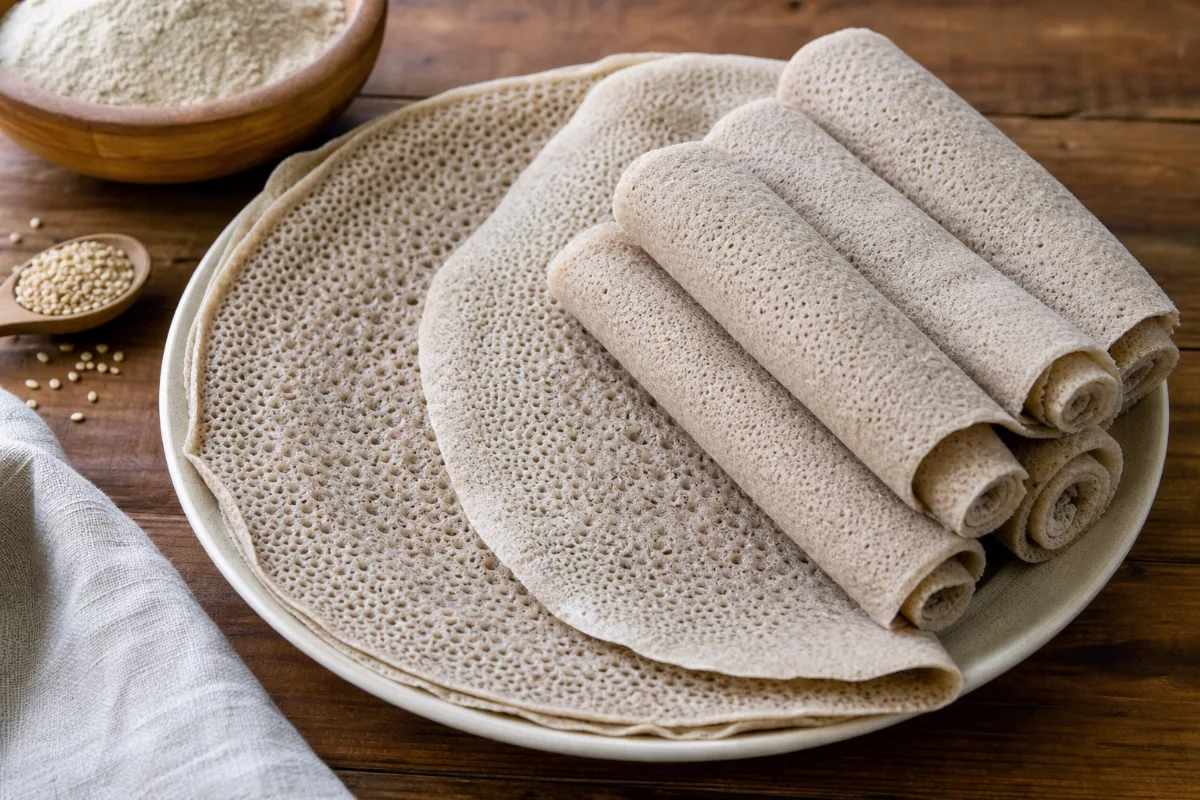
Injera is a soft, sour, pancake-like flatbread baked from fermented batter. It is traditionally made from teff (Eragrostis tef) flour mixed with water and left to ferment, then baked on a griddle. A 2026 review describes it as a sourdough flatbread and an essential part of the daily diet in Ethiopia. Methods vary between households.
USDA FoodData Central has no injera entry that we read. For cooked teff grain, per 100 g, USDA lists 101 kcal, 3.87 g protein, 2.8 g fibre, 2.05 mg iron and 2.86 mg manganese; one cup (252 g) is about 255 kcal. These are for the plain grain and were taken from the earlier page, not re-opened today. Baked, fermented injera differs.
What the research shows
We found no trial of eating injera. In 30 Ethiopian households, fermentation cut phytic acid in the batter from 0.87 to 0.58 g per 100 g dry matter, a modest drop. In a laboratory, a selected bacterium cut it by 68% in cooked injera, against 42% with traditional fermentation. Phytic acid can bind iron and zinc, but absorption in people was not measured.
In a Dutch questionnaire of 1545 people with biopsy-proven celiac disease, 66% used tef products and 17% reported symptoms afterwards, against 61% among non-users on their regular gluten-free diet. It was self-reported, with no gluten testing. Reviews say fermentation improves digestibility and gut health, and teff helps cholesterol and blood sugar, but name no trial.
At a glance
Traditional uses history, not proof
- Eaten as an everyday staple flatbread in Ethiopia, with stews
- Described by a 2026 review as part of the daily diet and cultural heritage; this records use, not measured health effects
Studied for research
- Teff in celiac diets, low certainty (one self-reported survey)
- Lower phytic acid from fermentation, low certainty (measurements of batter)
- Fibre and minerals, high certainty for teff grain only (injera not measured)
- Iron levels, insufficient evidence
- Gut health, cholesterol and blood sugar, insufficient evidence
Main compounds
- Phytic acid
- Iron (much of it soil iron in batter)
- Fibre
- Manganese, magnesium, phosphorus and zinc (teff grain)
- Lead and arsenic (in teff grain from one region)
Common forms
- Injera made from teff flour and water
- Injera mixed with other flours (different; may contain gluten)
- Teff grain values are for the plain grain, not injera
- Starter-culture injera is a laboratory topic
Research links: Dutch survey: tef in celiac patients (2008) · Fermentation and iron in injera (2017) · Celiac Disease Foundation: gluten-free foods · Research Library · Genes & Biomarkers Library
What it is and its history
- Accepted scientific name
- Injera
- Common names
- Injera (English); Enjera (English); Ethiopian sourdough flatbread (English)
- Family or group
- Fermented flatbread, traditionally from teff flour
- Native range
- Ethiopia (and Eritrea), according to the sources: the 2026 review calls it an essential part of the daily diet and cultural heritage in Ethiopia.
- What it looks like
- Fruit: A soft, sour, pancake-like flatbread (earlier page; the reviews call it a soft pancake baked from fermented batter).
- Harvest and processing
- Teff flour is mixed with water and left to ferment, then baked on a griddle. The 2014 paper describes fermentation with lactic acid bacteria among the dominating microorganisms; the 2017 paper measured 48 hours of household fermentation. Methods vary between households.
- Look-alikes and adulterants
- Name: Kocho and tella; Note: Other Ethiopian fermented foods named in the 2026 review: kocho is made from the enset plant, tella is a fermented drink.; Name: Idli and dosa; Note: Fermented batter foods from India with their own page.
Photographs
Traditional use and history history, not clinical proof
| Tradition or era | Documented use | Source |
|---|---|---|
Traditional use shows how it was used. It does not show that it works or is safe today.
What is inside, and how it may work
What it contains and how those compounds act in cells and animals. Laboratory and animal mechanisms are not proven effects in people.
Main compounds
| Compound | Family | Where it is concentrated | Activity studied | Level of evidence |
|---|---|---|---|---|
| Phytic acid | antinutrient | Batter, injera 0.87 g/100 g dry batter before fermentation, 0.58 after 48 hours (households); 1.05 to 0.34 g/100 g in cooked injera with a selected starter (lab) | Can bind iron and zinc in the gut; lowered by fermentation. 2 3 | Other |
| Iron (mostly soil iron in batter) | mineral | Batter Batter mean 34.7 mg/100 g dry matter; estimated intrinsic teff iron 4.4 mg/100 g; 86 to 97% estimated from soil | Nutrient content; soil iron absorption not measured. 2 | Human data |
| Manganese, iron, fibre in teff grain | mineral and carbohydrate | Grain USDA cooked teff per 100 g: manganese 2.86 mg, iron 2.05 mg, fibre 2.8 g (grain, not injera) | Nutrient content only. 11 | Human data |
| Lead and arsenic | contaminant | Grain Teff grain from Rift Valley: lead 70 and arsenic 24.7 micrograms/kg (means) | Contaminants measured in grain; no health outcome. 5 | Other |
Mechanisms, receptors and pathways
| Target or pathway | Gene or receptor | What was found | Level |
|---|---|---|---|
| Phytic acid breakdown by fermenting microbes | Not specified | In the household study, low phytase activity in teff flour and a rapid pH drop indicated that phytic acid breakdown was driven by microbial phytases. 2 | Human data |
| Phytic acid binding of iron and zinc | Not specified | The 2014 paper states phytic acid chelates iron and zinc in the human digestive tract and strongly inhibits their absorption. This was not measured in the study itself. 3 | Other |
Absorption, metabolism and elimination
- Absorption
- Not measured for injera.
- Distribution
- Not found.
- Metabolism
- Not found.
- Elimination
- Not found.
- Bioavailability
- Low iron bioavailability was indicated by phytic acid to iron ratios; absorption in people was not measured.
Isolated compounds versus whole extracts
The USDA values are for plain cooked and dry teff grain. The fermentation studies used batter and injera, the metals study used grain, and the overview covered teff grain and flour. These are different products from baked injera, and no trial of any of them was read.
Nutritional composition
USDA FoodData Central lists no entry for injera in the sources we read (the earlier version of this page said the same; the USDA site could not be re-opened today because its public API was rate-limited). The only USDA numbers available are for teff grain, and they were taken from that earlier page, read on 2026-10-24 (SR Legacy, April 2018). Cooked teff (FDC 168918), per 100 g: 101 kcal, 3.87 g protein, 0.65 g fat, 19.86 g carbohydrate, 2.8 g fibre, 49 mg calcium, 2.05 mg iron, 50 mg magnesium, 120 mg phosphorus, 1.11 mg zinc, 2.86 mg manganese, 0.226 mg copper and 0.183 mg thiamin (B1). One cup cooked (252 g) is about 255 kcal, 9.8 g protein, 7.1 g fibre, 5.2 mg iron and 7.2 mg manganese (the per-100-g values multiplied by 2.52). Dry teff (FDC 169747), per 100 g: 367 kcal, 13.3 g protein, 8.0 g fibre and 7.63 mg iron. Injera is fermented, wet and baked, so its water, acidity and some nutrients differ; the batter study also found iron levels in batter far above the grain because of soil. Values vary with variety, growing place and cooking.
1 high certainty2 low certainty3 not enough evidence
What was looked at
The 6 benefits and uses checked for Injera, each with how strong the evidence is. Tap one to open it.
- Teff in a gluten-free diet (celiac disease)Low certainty
- Fermentation lowers phytic acid in the batterLow certainty
- Fibre and minerals in teff grain (injera not measured)High certainty
- Iron intake and anaemiaNot enough evidence
- Digestibility and gut healthNot enough evidence
- Cholesterol, blood sugar and bone claims about teffNot enough evidence
What is Injera good for?
The main studied uses and how strong the evidence is for each. For injera itself there is very little human research, so most ratings are low or insufficient.
Benefits, one by one
Each card is a research question, not a promise. Tap a goal to filter. Open a card to see the studies, doses and limits.
Teff in a gluten-free diet (celiac disease)
Low certaintyIn a Dutch survey of 1545 people with biopsy-proven celiac disease, 66% used tef products and 17% of them reported symptoms afterwards, against 61% of non-users reporting symptoms on their regular gluten-free diet. It was a questionnaire, not a trial, and it did not test injera.
4 studiesTeff products as eaten at home.
Studies, doses and limits
What the trials found
The Celiac Disease Foundation lists teff among naturally gluten-free grains and warns that some may carry gluten from cross-contact in harvesting and processing. In a 2008 Dutch questionnaire study, 1545 people with biopsy-proven celiac disease reported on commercial tef products: 66% used them and 17% reported symptoms afterwards, compared with 61% symptoms on a regular gluten-free diet among non-users (p = 0.0001). The authors suggest this could relate to less gluten or more fibre.
Results
Teff products were tolerated by most respondents, but the survey cannot show that every product was gluten-free. Injera was not named in the abstract, and restaurant injera may be mixed with other flours (see Safety).
Effect sizes as reported
17% vs 61% reporting symptoms (self-reported)
Why this rating
Low: one self-reported survey, no control group assigned, no gluten testing, and it did not look at injera specifically.
Form and dose studied
Teff products as eaten at home.
Who was studied
Adults with biopsy-proven celiac disease in the Netherlands.
Limits
Questionnaire design; people who did well on teff may have kept using it; products were not tested for gluten.
Why researchers looked
Teff is a naturally gluten-free grain, so people avoiding gluten ask whether injera fits their diet.
Traditional use
Injera is a staple flatbread in Ethiopia and Eritrea, made from fermented teff batter. Long use as food is not proof that it treats any condition.
Proposed mechanism Authoritative guidance
Teff is a grass grain outside wheat, barley and rye; the sources read list it as naturally gluten-free.
A proposed mechanism does not show that the effect happens in people.
See the Safety tab on mixed flours and cross-contact.
Fermentation lowers phytic acid in the batter
Low certaintyPhytic acid is a natural compound in grains that can bind iron and zinc. In 30 Ethiopian households, it fell from 0.87 to 0.58 g per 100 g of dry batter over 48 hours. In a laboratory, a selected bacterium cut it by 68% in cooked injera versus 42% for traditional fermentation.
2 studiesInjera batter and cooked injera.
Studies, doses and limits
What the trials found
Cercamondi and colleagues (2017) measured 30 households in Debre Zeyit, Ethiopia: phytic acid in injera batter fell from 0.87 to 0.58 g/100 g dry matter after 48 hours (P < 0.001), and they concluded the effect of traditional fermentation is modest. Fischer and colleagues (2014) found in the laboratory that a starter with Lactobacillus buchneri MF58 lowered phytic acid in cooked injera from 1.05 to 0.34 g/100 g (68% degradation) compared with 42% for non-inoculated fermentation.
Results
This is a change in the food, not a health result. Neither study measured how much iron or zinc people absorbed.
Effect sizes as reported
Batter phytic acid 0.87 to 0.58 g/100 g; 68% vs 42% degradation in cooked injera (lab)
Why this rating
Low: the batter measurement is direct (30 households, P < 0.001) but the starter result is laboratory-only, and neither study measured a health outcome.
Form and dose studied
Injera batter and cooked injera.
Who was studied
Household batters in Ethiopia; laboratory fermentations.
Limits
The selected starter is not what most households use. Absorption in people was not measured.
Why researchers looked
Fermentation is said to make injera more nutritious, and phytic acid in the batter can be measured.
Traditional use
Injera is a staple flatbread in Ethiopia and Eritrea, made from fermented teff batter. Long use as food is not proof that it treats any condition.
Proposed mechanism Preliminary mechanism
Microbial phytases, enzymes made by fermenting microbes, break down phytic acid as the batter sours.
A proposed mechanism does not show that the effect happens in people.
None.
Fibre and minerals in teff grain (injera not measured)
High certaintyUSDA lists cooked teff grain, per 100 g, with 2.8 g fibre, 2.86 mg manganese and 2.05 mg iron. These numbers are for the grain, not injera, and we found no USDA entry for injera.
3 studiesCooked teff grain (values), injera (not measured).
Studies, doses and limits
What the trials found
Per 100 g of cooked teff grain, USDA lists 101 kcal, 3.87 g protein, 2.8 g fibre, 2.86 mg manganese, 2.05 mg iron, 50 mg magnesium, 120 mg phosphorus and 1.11 mg zinc. USDA FoodData Central has no entry for injera that we read, so these figures are for the grain and not the baked, fermented bread. A Rift Valley study also found more magnesium, calcium, iron, manganese and copper in teff than in wheat and maize grain.
Results
Injera is made from the same flour but is fermented, wet and baked, so its per-serving values are different and were not found.
Effect sizes as reported
Teff grain, cooked, per 100 g: 2.8 g fibre, 2.05 mg iron
Why this rating
High for the nutrient content of teff grain (reference database); not rated for injera, which USDA does not list in the sources read.
Form and dose studied
Cooked teff grain (values), injera (not measured).
Limits
USDA values were taken from the earlier page (read 2026-10-24); the USDA site could not be re-opened today because its public API was rate-limited.
Why researchers looked
Teff is praised for fibre and minerals, so people ask whether injera shares them.
Traditional use
Injera is a staple flatbread in Ethiopia and Eritrea, made from fermented teff batter. Long use as food is not proof that it treats any condition.
Proposed mechanism Unknown
Not applicable: these are nutrient amounts.
A proposed mechanism does not show that the effect happens in people.
See the Safety tab on soil iron and metals.
Iron intake and anaemia
Not enough evidenceTeff has iron on paper, but in one Ethiopian study 86 to 97% of the iron in injera batter was estimated to come from soil, and the phytic acid to iron ratios pointed to low iron availability. No study showed that eating injera raises iron levels.
2 studiesInjera and batter.
Studies, doses and limits
What the trials found
In the 2017 household study, iron in batter ranged from 14.5 to 160.4 mg/100 g dry matter, mostly from soil. In 10 young children, estimated daily iron intake was 18.9 mg including soil iron and 4.9 mg without it (P < 0.01). Phytic acid to iron ratios indicated low iron bioavailability, particularly without soil iron. The 2014 laboratory paper says further phytic acid degradation is probably needed to improve iron absorption from injera.
Results
No measurement of iron levels in people eating injera was read. Iron deficiency should be assessed by a clinician.
Effect sizes as reported
Soil iron 86-97% of batter iron (estimate); 18.9 vs 4.9 mg/day (10 children)
Why this rating
Insufficient: food measurements and intake estimates only; no study of iron status after eating injera.
Form and dose studied
Injera and batter.
Who was studied
Households and 10 young children in Ethiopia.
Limits
Small, from one town; soil iron absorption was not measured.
Why researchers looked
Injera is a staple in places where iron deficiency is common, so iron from injera has been studied.
Traditional use
Injera is a staple flatbread in Ethiopia and Eritrea, made from fermented teff batter. Long use as food is not proof that it treats any condition.
Proposed mechanism Preliminary mechanism
Phytic acid binds iron in the gut and lowers its absorption; soil iron may be absorbed differently.
A proposed mechanism does not show that the effect happens in people.
Ask a doctor if you think you are anaemic; do not rely on injera for iron deficiency.
Digestibility and gut health
Not enough evidenceA 2026 review of Ethiopian fermented foods states that fermentation improves digestibility and supports gut health, but its abstract names no trial of injera.
1 studiesInjera as food.
Studies, doses and limits
What the trials found
The Worku review (2026) says fermentation enhances nutrient bioavailability, improves digestibility and contributes beneficial microorganisms, and also notes limited standardisation and insufficient scientific documentation of traditional fermentation.
Results
Statements from a review; no human trial of injera and gut symptoms was found.
Effect sizes as reported
No numbers in the abstract
Why this rating
Insufficient: narrative review statements without named trials.
Form and dose studied
Injera as food.
Limits
Preparation varies by household; baked injera is not a live-culture food and this was not checked.
Why researchers looked
Fermented foods are often linked with gut health.
Traditional use
Injera is a staple flatbread in Ethiopia and Eritrea, made from fermented teff batter. Long use as food is not proof that it treats any condition.
Proposed mechanism Unknown
Fermenting microbes are said to pre-digest parts of the grain and add live microbes, but injera is baked, which would usually remove live microbes; this was not examined in the sources read.
A proposed mechanism does not show that the effect happens in people.
None found.
Cholesterol, blood sugar and bone claims about teff
Not enough evidenceA 2025 overview says teff may help cholesterol, blood sugar and bones, but its abstract names no human trial. We found none for teff or for injera.
1 studiesTeff grain and flour (overview).
Studies, doses and limits
What the trials found
The 2025 overview of teff states that it reduces cholesterol, stabilises blood sugar and strengthens bones, without a named trial in its abstract. We found no glycemic index or trial for injera.
Results
Treat these claims as unproven.
Effect sizes as reported
No numbers in the abstract
Why this rating
Insufficient: review statements, no trial of teff or injera.
Form and dose studied
Teff grain and flour (overview).
Limits
Overview only; not specific to fermented, baked injera.
Why researchers looked
Teff is marketed with these claims, so people ask whether injera does the same.
Traditional use
Injera is a staple flatbread in Ethiopia and Eritrea, made from fermented teff batter. Long use as food is not proof that it treats any condition.
Proposed mechanism Unknown
Not established.
A proposed mechanism does not show that the effect happens in people.
None found.
Connections to the rest of health
How Injera connects to the rest of our health knowledge graph. Every link says what kind of connection it is. A safety link (for example to the liver) is a warning, not a benefit. A study that merely mentions a topic never creates a benefit link.
Explore every connection: goals, body systems, organs, symptoms, genes
A. Wellness goals
| Connected to | Kind of connection | Evidence status | Context | Studies |
|---|---|---|---|---|
| Digestive Support | Biological association | Low certainty | Teff in a gluten-free diet (celiac disease): In a Dutch survey of 1545 people with biopsy-proven celiac disease, 66% used tef products and 17% of them reported symptoms afterwards, against 61% of non-users reporting symptoms on their regular gluten-free diet. It was a questionnaire, not a trial, and it did not test injera. Fermentation lowers phytic acid in the batter: Phytic acid is a natural compound in grains that can bind iron and zinc. In 30 Ethiopian households, it fell from 0.87 to 0.58 g per 100 g of dry batter over 48 hours. In a laboratory, a selected bacterium cut it by 68% in cooked injera versus 42% for traditional fermentation. | 4 7 10 9 2 3 6 |
| Digestive Support | High certainty | Fibre and minerals in teff grain (injera not measured): USDA lists cooked teff grain, per 100 g, with 2.8 g fibre, 2.86 mg manganese and 2.05 mg iron. These numbers are for the grain, not injera, and we found no USDA entry for injera. | 11 12 5 | |
| Energy And Vitality | High certainty | Fibre and minerals in teff grain (injera not measured): USDA lists cooked teff grain, per 100 g, with 2.8 g fibre, 2.86 mg manganese and 2.05 mg iron. These numbers are for the grain, not injera, and we found no USDA entry for injera. | 11 12 5 | |
| Energy And Vitality | Biological association | Not enough evidence | Iron intake and anaemia: Teff has iron on paper, but in one Ethiopian study 86 to 97% of the iron in injera batter was estimated to come from soil, and the phytic acid to iron ratios pointed to low iron availability. No study showed that eating injera raises iron levels. | 2 3 |
| Cholesterol Balance | Biological association | Not enough evidence | Cholesterol, blood sugar and bone claims about teff: A 2025 overview says teff may help cholesterol, blood sugar and bones, but its abstract names no human trial. We found none for teff or for injera. | 1 |
| Blood Sugar Balance | Biological association | Not enough evidence | Cholesterol, blood sugar and bone claims about teff: A 2025 overview says teff may help cholesterol, blood sugar and bones, but its abstract names no human trial. We found none for teff or for injera. | 1 |
B. Body systems
| Connected to | Kind of connection | Evidence status | Context | Studies |
|---|---|---|---|---|
| Digestive System | Biological association | Low certainty | Studied for: Teff in a gluten-free diet (celiac disease) Studied for: Fermentation lowers phytic acid in the batter | 4 7 10 9 2 3 11 12 5 6 |
| Blood | Biological association | High certainty | Studied for: Fibre and minerals in teff grain (injera not measured) Studied for: Iron intake and anaemia | 11 12 5 2 3 |
| Cardiovascular System | Biological association | Not enough evidence | Studied for: Cholesterol, blood sugar and bone claims about teff | 1 |
| Endocrine System | Biological association | Not enough evidence | Studied for: Cholesterol, blood sugar and bone claims about teff | 1 |
E. Health conditions
| Connected to | Kind of connection | Evidence status | Context | Studies |
|---|---|---|---|---|
| Celiac disease | Documented risk | Teff is naturally gluten-free, but injera made with other flours or on shared equipment may contain gluten; choose labelled products. Preparation or compound: Injera and teff flour |
7 10 9 4 | |
| Food allergy | Adverse effect or risk | Not enough evidence | Teff is not one of the nine major US allergens, but no teff allergy source was read; any food can cause allergy. Preparation or compound: Injera as food |
8 |
K. Biological pathways
| Connected to | Kind of connection | Evidence status | Context | Studies |
|---|---|---|---|---|
| Phytic acid | Preliminary mechanism | Human | Fermentation lowers phytic acid in batter; it can bind iron and zinc. | 2 3 |
| Iron | Preliminary mechanism | Human | Much of the iron in household batter was soil iron; effect on iron status not found. | 2 |
| Manganese | Preliminary mechanism | Human | Cooked teff grain is high in manganese by USDA data. | 11 |
L. Active compounds
| Connected to | Kind of connection | Evidence status | Context | Studies |
|---|---|---|---|---|
| Phytic acid | Biological association | Other | Can bind iron and zinc in the gut; lowered by fermentation. Preparation or compound: Batter, injera |
2 3 |
| Iron (mostly soil iron in batter) | Biological association | Human | Nutrient content; soil iron absorption not measured. Preparation or compound: Batter |
2 |
| Manganese, iron, fibre in teff grain | Biological association | Human | Nutrient content only. Preparation or compound: Grain |
11 |
| Lead and arsenic | Biological association | Other | Contaminants measured in grain; no health outcome. Preparation or compound: Grain |
5 |
Each connection is stored with the ingredient, the connected record, the kind of connection, the evidence status, the supporting studies, the preparation or compound involved, and a review date (last reviewed October 26, 2026).
Evidence at a glance: what the research found for 6 outcomes
Each outcome below is one thing researchers measured. Certainty is how far the evidence can be trusted, not how well it works. The full studies are on the next tab.
The evidence
The research centre for Injera. Every record here was checked against PubMed or the publisher's page; we never list a study we have not verified.
Evidence by outcome
Bars show how many studies we found for each outcome, not how well it works. People are added up across trials only (reviews are not added, to avoid double counting).
How we rate evidence
High certainty
Several well-run trials or reviews agree; further research is unlikely to change the picture much.
Moderate certainty
Good trials point the same way, but some doubt remains.
Low certainty
Small, short or inconsistent trials. The finding could change with better research.
Very low certainty
Very little or very weak human data. Treat as a possibility only.
Mixed findings
Trials or reviews disagree with each other.
Not enough evidence
Not enough human research to say either way.
Evidence against
Good research found no benefit, or found harm.
We take the reviewers' own risk-of-bias and GRADE statements where they exist, and otherwise judge from study size, design, consistency, directness and whether a product matches what is sold. Many publications do not make evidence high. Method note: We started from our earlier injera and teff pages, re-read the Celiac Disease Foundation, NIDDK and FDA pages, and read the PubMed abstracts for the studies cited. Only abstracts were read for studies. USDA values were not re-opened today. Items we could not verify are flagged in the research gaps.
Study library: every study we checked 12
| Study | Design | People | Product, dose, length | Result |
|---|---|---|---|---|
| Abebe 2025 Nutritional Characteristics, Health-Related Properties, and Food Application of Teff (Eragrostis tef): An Overview. Int J Mol Sci · PMID 41096562 · DOI |
Narrative review |
Review of teff composition, uses and health claims | Teff grain and flour Whole grain, flour |
The overview describes teff as rich in macro- and micronutrients, with flavonoids and phenolic acids, naturally gluten-free, and states that it reduces cholesterol, supports heart health, stabilises blood sugar, strengthens bones and supports immunity. The abstract does not name any human trial behind these statements. Review statements, no numbers in the abstract (See abstract) Methods, limits and fundingOutcomes: Nutrient profile, plant compounds, health statements Limitations: The health statements are not tied to named human trials in the abstract, so they cannot be checked from it. Funding and conflicts: Funding is not stated in the abstract. Read: abstract |
| Cercamondi 2017 The Potential of Fermentation and Contamination of Teff by Soil to Influence Iron Intake and Bioavailability from Injera Flatbread. Int J Vitam Nutr Res · PMID 29052470 · DOI |
Observational food analysis |
30 30 households in Debre Zeyit, Ethiopia (batter samples); 10 young children (3-day weighed food records) |
Household injera batter fermented 48 hours Teff flour batter 48 hours of fermentation · vs Batter before fermentation |
After 48 hours of fermentation, phytic acid in batter fell from 0.87 to 0.58 g/100 g dry matter (P < 0.001). Iron in batter ranged from 14.5 to 160.4 mg/100 g dry matter, mostly from soil contamination: the authors estimate 86 to 97% of the iron was from soil. In 10 young children, median daily iron intake was 18.9 mg including soil iron and 4.9 mg without it (P < 0.01). Phytic acid to iron ratios indicated low iron bioavailability, especially without soil iron. The authors conclude traditional fermentation has a modest effect on phytic acid and that soil iron bioavailability needs study. Phytic acid 0.87 to 0.58 g/100 g; soil iron 86-97% of batter iron (P < 0.001 for the phytic acid change) Methods, limits and fundingOutcomes: Phytic acid in batter, iron in batter (with and without soil iron), children's estimated iron intake Limitations: Household batter samples and 10 children's intake estimates, not a trial of iron status. Soil iron absorption was not measured. Funding and conflicts: Funding is not stated in the abstract. Read: abstract |
| Fischer 2014 Phytic acid degrading lactic acid bacteria in tef-injera fermentation. Int J Food Microbiol · PMID 25180667 · DOI |
Laboratory study in vitro |
76 bacterial isolates from 13 Ethiopian household tef fermentations; model and full-scale injera fermentations in a laboratory | Tef batter fermented with a selected bacterium (Lactobacillus buchneri MF58) or spontaneously Tef flour batter Fermentation step · vs Traditional, non-inoculated fermentation |
In cooked injera, phytic acid fell from 1.05 to 0.34 g/100 g with the selected bacterium (68% degradation), compared with 42% degradation in injera from traditional fermentation. The phytic acid to iron ratio was 4 and to zinc 12, about half of traditional fermentation. The authors expect better zinc absorption but say further degradation is probably needed to improve iron absorption. Phytic acid degraded 68% (selected starter) vs 42% (traditional) (Not given in the abstract) Methods, limits and fundingOutcomes: Phytic acid in fermented tef and cooked injera; molar ratios of phytic acid to iron and zinc Limitations: Laboratory fermentation with a starter culture. No people ate the injera, so absorption was not measured. Traditional fermentation is not the same as the starter used. Funding and conflicts: Funding is not stated in the abstract. Read: abstract |
| Hopman 2008 Tef in the diet of celiac patients in The Netherlands. Scand J Gastroenterol · PMID 18266174 · DOI |
Cross sectional survey |
1545 Members of the Dutch Celiac Disease Society; 1545 respondents to the second questionnaire had biopsy-proven celiac disease |
Commercially available tef products as used at home (injera not named in the abstract) Grain products Median 1.4 years of tef use · vs Patients not using tef, reporting on their regular gluten-free diet |
Of the 1545 with biopsy-proven celiac disease, 66% used tef and 17% reported symptoms after eating it. Symptoms were reported by 61% of those not using tef on their regular gluten-free diet (p = 0.0001). The authors suggest the difference may relate to less gluten or more fibre. 17% vs 61% reporting symptoms (Not given in the abstract (p = 0.0001)) Methods, limits and fundingOutcomes: Symptoms after eating tef compared with symptoms on a regular gluten-free diet Limitations: A questionnaire, not a trial: self-reported symptoms, no control group assigned, no gluten testing of the products. The abstract does not say injera was eaten. Funding and conflicts: Funding is not stated in the abstract. Read: abstract |
| Nyachoti 2021 Elemental composition of teff (a gluten-free grain), maize and wheat: Staple crops in the Main Ethiopian Rift Valley. J Food Compost Anal · PMID 34366562 · DOI |
Laboratory study food science |
Teff, maize and wheat grain from the Main Ethiopian Rift Valley (sample number not given in the abstract) | Teff grain analysed by ICP-MS Grain · vs Wheat and maize grain from the same region |
Mean arsenic was 24.7 and lead 70 micrograms/kg in teff, higher than in wheat and maize (arsenic 4.5 and lead 8.9). Cadmium in teff (4.8) was similar to wheat (5.4) and below the Codex limit of 100. Only one teff sample exceeded the Codex lead limit of 200 micrograms/kg. Teff also had more magnesium, calcium, iron, manganese and copper than wheat and maize. Arsenic 24.7 and lead 70 micrograms/kg (teff) vs 4.5 and 8.9 (wheat and maize) (See abstract) Methods, limits and fundingOutcomes: Toxic and essential elements in grain Limitations: Grain from one volcanic-soil region, not injera and not grain sold abroad. Soil dust may contribute. No health outcome measured. Funding and conflicts: The authors report no competing interests (full text record). Read: abstract |
| Worku 2026 Fermented Foods and Beverages of Ethiopia: Substrates, Traditional Preparation Techniques, and Nutritional Quality. Food Sci Nutr · PMID 42145823 · DOI |
Narrative review |
Review of Ethiopian fermented foods and drinks, including injera, kocho and tella | Traditional Ethiopian fermented foods Fermented food |
The review describes injera as a sourdough flatbread prepared from teff flour, an essential part of the daily diet and cultural heritage. It states that fermentation enhances nutrient bioavailability, improves digestibility and contributes beneficial microorganisms that support gut health, and that limited standardisation and variability in preparation affect quality. The abstract names no trial behind these statements. Review statements, no numbers in the abstract (Not applicable) Methods, limits and fundingOutcomes: Substrates, preparation methods, nutritional quality Limitations: The health statements cannot be checked from the abstract. Preparation varies between households. Funding and conflicts: The authors declare no conflicts of interest. Read: abstract |
| s-celiac Celiac Disease Foundation: Gluten-free foods · Source |
Patient organisation n/a |
Methods, limits and fundingRead: full-text | ||
| s-fda-allergens FDA: Food allergies · Source |
Regulator n/a |
Methods, limits and fundingRead: full-text | ||
| s-fda-gf FDA: Questions and Answers, Gluten-Free Food Labeling Final Rule · Source |
Regulator n/a |
Methods, limits and fundingRead: full-text | ||
| s-niddk NIDDK: Eating, diet and nutrition for celiac disease · Source |
Health agency n/a |
Methods, limits and fundingRead: full-text | ||
| s-usda-fdc-168918 USDA FoodData Central: Teff, cooked (SR Legacy, FDC 168918) · Source |
Reference database n/a |
Methods, limits and fundingRead: summary-only | ||
| s-usda-fdc-169747 USDA FoodData Central: Teff, uncooked (SR Legacy, FDC 169747) · Source |
Reference database n/a |
Methods, limits and fundingRead: summary-only |
What we do not know yet
- No human trial of eating injera was found for gut health, cholesterol, blood sugar, weight or iron status.
- No gluten-testing study of injera, and no nutrient table for baked injera, was found.
- The claims in the 2025 and 2026 reviews could not be traced to trials from their abstracts.
- Teff allergy, pregnancy, breastfeeding, young children, mould, storage and home fermentation safety were not researched.
- USDA values for teff grain were not re-opened today because the public API was rate-limited; they come from the earlier page, read 2026-10-24.
How new research is added
New studies are found by a saved PubMed search and placed in a review queue before the page changes.
Lab markers
What changed in blood or saliva tests during trials. A changed number is not the same as feeling or being healthier, and we give no "normal ranges".
Safety
What studies and official sources say about side effects, medicines and who should check first. Each point shows what kind of evidence it comes from.
Main points to know 4
- Gluten: only gluten-free if made from teff alone. Teff is listed as a naturally gluten-free grain by the Celiac Disease Foundation, which also says some naturally gluten-free grains may pick up gluten from cross-contact in harvesting and processing. NIDDK explains that cross-contact can make gluten-free foods unsafe for people with celiac disease. Injera made with wheat or barley flour, or cooked on a shared griddle, is not gluten-free. We found no source that tested injera for gluten, so ask how it was made and look for a gluten-free label. In the US the label means gluten below 20 parts per million, and using it is voluntary. Authoritative guidance 7 10 9 4
- Lead and arsenic in teff grain. A study of grain from the Main Ethiopian Rift Valley found higher average arsenic (24.7 micrograms/kg) and lead (70 micrograms/kg) in teff than in wheat and maize. Only one teff sample was over the Codex lead limit of 200 micrograms/kg, and cadmium was below its limit. This was grain from one region, not injera, and the effect on health was not measured. Other 5
- Soil in teff flour and low iron availability. In 30 Ethiopian households, the authors estimated that 86 to 97% of the iron in injera batter came from soil contamination. Phytic acid, which fermentation lowers only modestly, can bind iron and zinc. Do not rely on injera to treat low iron; ask a doctor. Other 2 3
- Allergy: no teff source found. The FDA lists nine major food allergens, and teff is not one of them. We found no source on how often teff causes allergy, so it is unknown. Any food can cause an allergic reaction. For trouble breathing or swelling of the face, lips or throat, call emergency services. Gap 8
Side effects 2
| Effect | How often | Severity and recovery | Evidence |
|---|---|---|---|
| Allergic reaction to teff or another ingredient Absence of a source is not proof that teff never causes allergy. | No teff allergy source was found | can be severe for any food allergy (anaphylaxis) Not found | Gap 8 |
| Symptoms in people with celiac disease after teff products Self-reported; the cause (gluten contamination, fibre or something else) was not established. | 17% of 1545 respondents using tef reported symptoms (questionnaire) | Not described in the abstract Not described | Observational 4 |
Liver
No liver injury from eating injera was found in the sources read. A liver-safety source (such as LiverTox) was not searched for food.
How often. No frequency was found.
Monitoring. No agency monitoring advice was found.
This is a safety connection. It is not evidence that Injera supports liver health.
Medicines and supplements 2
| With | Why it matters | Importance | Evidence | What to do |
|---|---|---|---|---|
| Medicines (any) prescription | No mechanism was read. | No source read names any medicine interaction with injera. | None found Not enough evidence | If you take medicine and plan a big change in diet, ask your clinician or pharmacist. |
| Iron or zinc supplements supplement | Phytic acid in grains can bind iron and zinc in the gut and lower absorption. | Shown for phytic acid in injera fermentation papers in general; not studied with supplements. | Other Not enough evidence 3 2 | Ask your clinician or pharmacist about timing if you take mineral supplements. |
Who should check first 2
| Situation | Advice | Evidence |
|---|---|---|
| Celiac disease or gluten sensitivity, when the injera is not made only from teff or not labelled gluten-free | Ask how it was made, avoid shared griddles and mixed flours, and check with your care team. | Authoritative guidance 7 10 9 |
| Known allergy to teff or to another ingredient in the injera | Avoid it and ask an allergist. For trouble breathing or swelling of the face or throat, call emergency services. | Gap 8 |
Overdose, product quality and regulators
Summary. No toxicity from injera eaten as ordinary food was found in the sources read.
Animal. Not reviewed.
Human doses studied. No trial of injera was found.
Overdose response. Not found.
Genotoxicity. Not researched.
Gluten cross-contact or mixed flours are the main documented concern. A single-region study found more lead and arsenic in teff grain than in wheat and maize, and soil in teff flour. Mould toxins and pesticide residues were not researched, and no source on mould or storage of injera or its batter was read.
Gluten cross-contact. The Celiac Disease Foundation says naturally gluten-free grains may contain gluten from cross-contact during harvesting and processing and advises against bulk bins. NIDDK describes how cross-contact happens. 7 10
Gluten-free label. The FDA Q&A says unavoidable gluten in a food labelled gluten-free must be below 20 parts per million and the claim is voluntary. 9
Lead and arsenic. Teff grain from the Main Ethiopian Rift Valley averaged 24.7 micrograms/kg arsenic and 70 micrograms/kg lead, higher than wheat and maize; one sample exceeded the Codex lead limit of 200 micrograms/kg. 5
Soil in flour. An estimated 86 to 97% of iron in household injera batter came from soil contamination. 2
| Body | Action | Date |
|---|---|---|
| FDA (United States) | Gluten-free labelling: unavoidable gluten below 20 parts per million; the claim is voluntary. source | 2022-06-30 |
| FDA (United States) | Lists nine major food allergens (milk, eggs, fish, crustacean shellfish, tree nuts, peanuts, wheat, soybeans, sesame); teff is not among them. source | 2026-03-11 |
| NIDDK (US National Institutes of Health) (United States) | Celiac diet page: cross-contact can make gluten-free foods unsafe. Teff and injera are not named. source | 2020-10 |
When to get medical help
- Trouble breathing, swelling of the lips, face or throat, widespread hives, repeated vomiting or collapse after eating (possible anaphylaxis): call emergency services
- Ongoing stomach pain, diarrhoea or weight loss in someone with celiac disease after eating injera: see your care team
Stop using the product and contact a clinician or emergency service. In the US, Poison Control is 1-800-222-1222.
General information only, not medical advice. Ask a clinician or pharmacist before use, especially with medicines, in pregnancy or with a health condition. See the Natural Remedy Safety guide.
Frequently asked questions
Is injera gluten-free?
Is injera safe for people with celiac disease?
Many Dutch people with celiac disease used tef products: 66% of 1545 respondents, and 17% of them reported symptoms, against 61% symptoms on a regular gluten-free diet among non-users. It was a questionnaire, and injera was not named. Ask your care team.
What is injera made of?
Traditionally teff flour and water, fermented and baked into a soft, sour flatbread. A 2026 review calls it a sourdough flatbread prepared from teff flour.
Does fermentation make injera healthier?
Is injera a good source of iron?
What nutrients does injera have?
USDA lists no entry for injera that we read. For cooked teff grain, per 100 g, it lists 101 kcal, 3.87 g protein, 2.8 g fibre and 2.05 mg iron. Baked, fermented injera differs from the grain.
Does injera lower cholesterol or blood sugar?
A 2025 overview of teff says teff does, but its abstract names no trial, and we found none for teff or injera. Treat it as unproven.
Does injera contain lead or arsenic?
A study of teff grain from the Ethiopian Rift Valley found more lead and arsenic than in wheat and maize from the same region, and one sample over the Codex lead limit. It tested grain, not injera, and measured no health effect.
Is teff a common allergen?
Teff is not one of the nine major US food allergens listed by the FDA. We found no source on teff allergy, and any food can cause a reaction. For trouble breathing or swelling of the face or throat, call emergency services.
Is injera safe in pregnancy or for children?
No injera-specific warning or advice was found in the sources read. Ask your doctor, midwife or your child's clinician.
Does injera interact with medicines?
No source we read names a medicine interaction with injera. Phytic acid in grains can bind iron and zinc, so ask your pharmacist about timing if you take mineral supplements.
Explore by health goal
Digestive SupportEnergy And VitalityCholesterol BalanceBlood Sugar Balance
Editorial transparency
- Written by
- AlternativeMed editorial team. Research compiled with AI assistance, then checked against the sources listed.
- Medical review
- None. This page has not been reviewed by a physician or pharmacist.
- First published
- 2026-10-26
- Last substantive update
- 2026-10-26
- How we research
- We started from our earlier injera and teff pages, re-read the Celiac Disease Foundation, NIDDK and FDA pages, and read the PubMed abstracts for the studies cited. Only abstracts were read for studies. USDA values were not re-opened today. Items we could not verify are flagged in the research gaps.
- How we rate evidence
- See "How we rate evidence" in the Evidence tab.
- Independence
- No product is promoted on this page. No affiliate links are shown.
Sources 12
Each source was opened and checked. Where we read only the abstract, it says so. The small numbers in the text point here.
- Abebe BS, Aprodu I, Istrati DI, Vizireanu C. Nutritional Characteristics, Health-Related Properties, and Food Application of Teff (Eragrostis tef): An Overview.. Int J Mol Sci. 2025. PMID 41096562. DOI 10.3390/ijms26199293. (abstract)
- Cercamondi CI, Fischer MM, Worku TGH, Wyss N, Herter-Aeberli I, Zimmermann MB, Egli IM, Hurrell RF. The Potential of Fermentation and Contamination of Teff by Soil to Influence Iron Intake and Bioavailability from Injera Flatbread.. Int J Vitam Nutr Res. 2017. PMID 29052470. DOI 10.1024/0300-9831/a000422. (abstract)
- Fischer MM, Egli IM, Aeberli I, Hurrell RF, Meile L. Phytic acid degrading lactic acid bacteria in tef-injera fermentation.. Int J Food Microbiol. 2014. PMID 25180667. DOI 10.1016/j.ijfoodmicro.2014.08.018. (abstract)
- Hopman E, Dekking L, Blokland ML, Wuisman M, Zuijderduin W, Koning F, Schweizer J. Tef in the diet of celiac patients in The Netherlands.. Scand J Gastroenterol. 2008. PMID 18266174. DOI 10.1080/00365520701714871. (abstract)
- Nyachoti S, Adebayo S, Godebo TR. Elemental composition of teff (a gluten-free grain), maize and wheat: Staple crops in the Main Ethiopian Rift Valley.. J Food Compost Anal. 2021. PMID 34366562. DOI 10.1016/j.jfca.2020.103660. (abstract)
- Worku LA, Bachheti RK, Rana V, Joshi G, Bachheti A, Pandey DP. Fermented Foods and Beverages of Ethiopia: Substrates, Traditional Preparation Techniques, and Nutritional Quality.. Food Sci Nutr. 2026. PMID 42145823. DOI 10.1002/fsn3.71887. (abstract)
- . Celiac Disease Foundation: Gluten-free foods. . . (full-text)
- . FDA: Food allergies. . . (full-text)
- . FDA: Questions and Answers, Gluten-Free Food Labeling Final Rule. . . (full-text)
- . NIDDK: Eating, diet and nutrition for celiac disease. . . (full-text)
- . USDA FoodData Central: Teff, cooked (SR Legacy, FDC 168918). . . (summary-only)
- . USDA FoodData Central: Teff, uncooked (SR Legacy, FDC 169747). . . (summary-only)
Where to buy
Check the label first. Whatever you buy, look for these:
- Live and active cultures on the label, if that is what you want
- Refrigerated or shelf-stable, since shelf-stable versions may be heat treated
- Added sugar and sodium
- A best-by date
Talk to a pharmacist or doctor before you start any supplement, especially if you take medicines. See the Safety tab for interactions.
Support our free guides: as an Amazon Associate we earn from qualifying purchases. Full disclosure.


