Whole Grains · Whole grain
Teff
Eragrostis tef · also called Tef, injera grain, Ethiopian teff
Teff is a tiny grain from a grass grown in Ethiopia, eaten as a whole grain or ground into flour. It is naturally gluten-free and is rich in manganese, iron and fibre by USDA data. We found no human trial of eating teff, so claims about cholesterol or blood sugar are unproven. The main cautions are gluten cross-contact if you have celiac disease and phytic acid, and we found no source on teff allergy.
General information, not medical advice. Last substantive update · Not medically reviewed. A named clinician has not signed off on this page. How this page is made
About Teff
Teff is a very small grain from Ethiopia, eaten as a whole grain or as flour. It is naturally gluten-free and high in manganese, iron and fibre. It is a nutritious food, not a proven remedy: we found no human trial of teff, so this page is shorter than most because the research is thin.
What it is
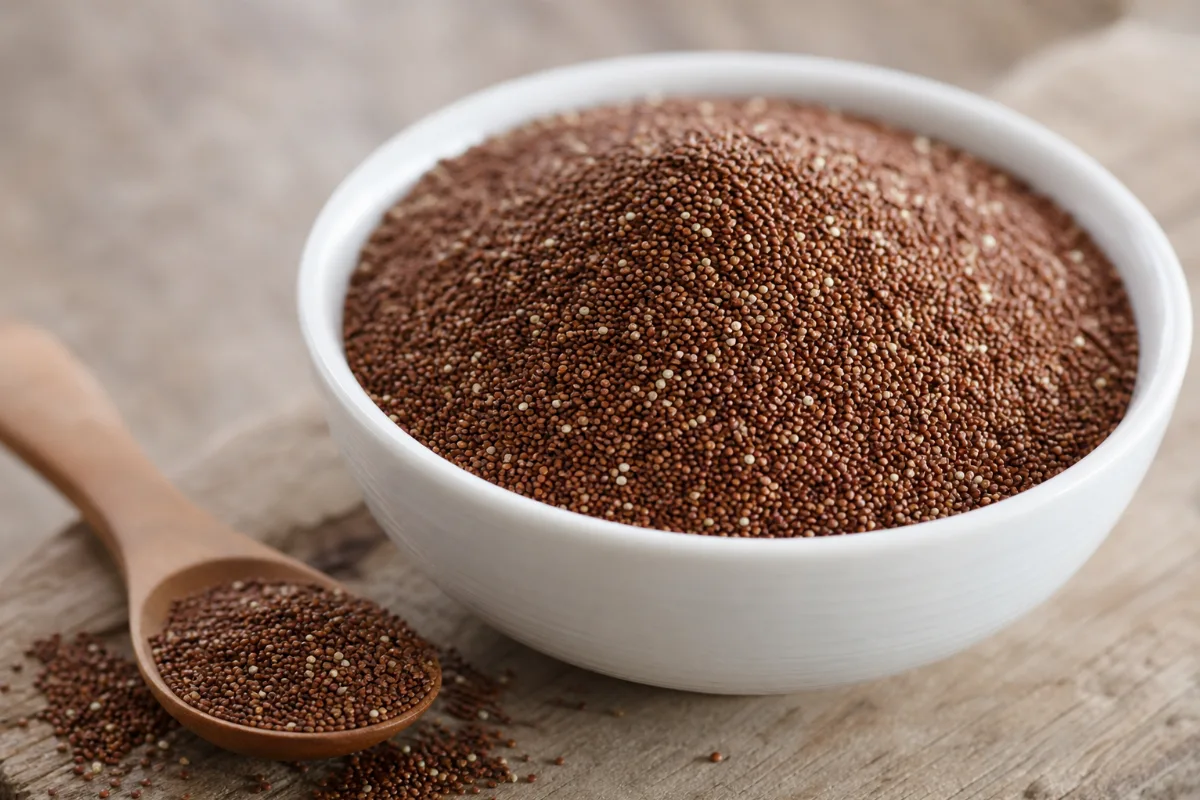
Teff (Eragrostis tef) is the seed of a cereal grass grown in Ethiopia, where it has long cultural importance. The grains are about the size of poppy seeds and are sold in brown, ivory or red varieties, as whole grain or flour.
USDA data for cooked teff: 101 kcal per 100 g. One cup (252 g) has about 255 kcal, 9.8 g protein, 7.1 g fibre, 7.2 mg manganese, 5.2 mg iron and 126 mg magnesium. Dry teff is much denser (367 kcal and 13.3 g protein per 100 g), so compare cooked with cooked. These values were taken from the earlier version of this page and not re-opened today.
What the research shows
We found no randomised trial of eating teff. A 2025 overview states that teff reduces cholesterol, stabilises blood sugar and strengthens bones, but its abstract names no trial behind this, so we treat it as unproven. A community study in Western Ethiopia recorded beliefs about teff as medicine, which is not measured evidence. Lab work found plant compounds in teff flour extracts, with no human outcome.
Large cohort studies link more whole grains in general to lower risk of heart disease and death (relative risk 0.83 for death from any cause per 90 g a day). Teff was not analysed on its own, and this is association, not proof.
Food versus flour and extracts
The nutrient values are for cooked whole grain. The lab study used extracts of teff flour and the noodle study used flour in a recipe. These are different products, and no human trial of any of them was found. Injera and other teff foods were not covered.
Portions
The USDA household portion for cooked teff is 1 cup (252 g). The NHS advises wholegrain starchy foods as a source of fibre without naming teff, and Harvard's Nutrition Source lists teff among unprocessed whole grains. This page gives no amounts to eat. Ask a doctor, pharmacist or dietitian what is right for you, especially if you have celiac disease, a food allergy or take medicine.
At a glance
Traditional uses history, not proof
- Eaten as a staple grain in Ethiopia, often ground into flour
- In a 2025 community study, people described dabi teff as medicine for energy and bones; this records belief, not measured effects
Studied for research
- Naturally gluten-free grain, moderate certainty (statements from a patient organisation and a review)
- Fibre and minerals as a food, high certainty for the nutrient content
- Cholesterol and blood sugar, insufficient evidence (no human trial of teff)
- Iron levels and anaemia, insufficient evidence
- Whole grains and long-term health, low certainty (observational, not teff-specific)
- Plant compounds, very-low certainty (lab extracts only)
Main compounds
- Manganese
- Iron
- Dietary fibre
- Magnesium, phosphorus, copper and zinc
- Phenolic compounds
- Phytic acid
Common forms
- Cooked whole teff grain (porridge)
- Teff flour (nutrient values not read)
- Injera and other foods made from teff flour are different products and are not covered
- Teff extracts are a laboratory topic
Research links: 2025 overview of teff · 2016 meta-analysis: whole grains and health · Celiac Disease Foundation: gluten-free foods · Research Library · Genes & Biomarkers Library
What it is and its history
- Accepted scientific name
- Eragrostis tef
- Naming authority
- (Zucc.) Trotter, as given in the 2025 overview
- Common names
- Teff (English); Tef (English); Injera grain (English)
- Family or group
- Cereal grass (the 2025 overview calls teff an ancient grain); botanical family not verified from a source read.
- Classification
- Plantae > Poaceae (grass family), as is usual for cereals; not checked in a source read > Eragrostis > Eragrostis tef
- Native range
- Grown in Western Ethiopia, according to the 2025 community study; the wider native range was not verified.
- Habitat
- Not verified from a source read.
- What it looks like
- Roots: Not verified.; Stems: Not verified.; Leaves: Not verified.; Flowers: Not verified.; Fruit: A tiny grain eaten whole or ground into flour (existing site page). USDA gives a household portion of 1 cup cooked = 252 g.
- Cultivation
- The 2025 community study says dabi teff reaches maturity in a short time and is harvested twice in one rainy season in Western Ethiopia, and that its cultivation there is declining.
- Harvest and processing
- Sold as whole grain, in brown, ivory or red varieties, and as flour (existing nutrient summary).
- Look-alikes and adulterants
- Name: Millet, amaranth, quinoa and sorghum; Note: Other small gluten-free grains with their own pages; not interchangeable in nutrient values.
- Sustainability and conservation
- Not assessed.
Photographs
Traditional use and history history, not clinical proof
| Tradition or era | Documented use | Source |
|---|---|---|
Traditional use shows how it was used. It does not show that it works or is safe today.
What is inside, and how it may work
What it contains and how those compounds act in cells and animals. Laboratory and animal mechanisms are not proven effects in people.
Main compounds
| Compound | Family | Where it is concentrated | Activity studied | Level of evidence |
|---|---|---|---|---|
| Manganese | mineral | Grain USDA: 2.86 mg per 100 g cooked (about 7.2 mg per cup) | Nutrient content only; no upper limit from food was read. 13 | Human data |
| Iron | mineral | Grain USDA: 2.05 mg per 100 g cooked; 7.63 mg per 100 g dry | Nutrient content only; absorption from teff was not read. 13 14 | Human data |
| Dietary fibre | carbohydrate | Grain USDA: 2.8 g per 100 g cooked; 8.0 g per 100 g dry | Wholegrain foods are good sources of fibre, says the NHS. 13 11 | Human data |
| Magnesium, phosphorus, copper, zinc | minerals | Grain USDA per 100 g cooked: magnesium 50 mg, phosphorus 120 mg, copper 0.226 mg, zinc 1.11 mg | Nutrient content only. 13 | Human data |
| Phenolic compounds (epicatechin, hesperidin, ferulic acid) | polyphenols | Flour extract Lab extract: epicatechin 113.55, hesperidin 163.64, ferulic acid 41.79 micrograms/g | Antioxidant activity measured in the lab; no human data. 2 1 | Laboratory research |
| Phytic acid | antinutrient | Grain, flour Not measured in cooked grain in the sources read | Can bind minerals; teff and flaxseed flours raised phytic acid in noodles. 4 2 | Other |
Mechanisms, receptors and pathways
| Target or pathway | Gene or receptor | What was found | Level |
|---|---|---|---|
| Phytic acid and mineral binding | Not specified | The 2026 bread review describes phytate as reducing iron bioavailability, with mixed results for iron status in long-term trials. This was not shown for teff. 5 | Human data |
| Antioxidant activity of phenolic compounds | Not specified | Phenolic compounds in teff flour extracts showed antioxidant activity in the laboratory; whether this occurs in people eating cooked teff is not known. 2 | Laboratory research |
Absorption, metabolism and elimination
- Absorption
- Not found for teff.
- Distribution
- Not found.
- Metabolism
- Not found.
- Elimination
- Not found.
- Bioavailability
- Not established for teff minerals in the sources read.
Isolated compounds versus whole extracts
The USDA values are for cooked whole teff grain. The lab study used ethanol extracts of teff flour, and the noodle study used teff flour in a recipe. These are different products from the cooked grain, and no human trial of any of them was read.
Nutritional composition
Nutrition from USDA FoodData Central (SR Legacy, April 2018 release). Values were taken from the existing teff page, which read them on 2026-10-24; the USDA site was not re-opened today because its public API was rate-limited. Cooked teff (FDC 168918), per 100 g: 101 kcal, 3.87 g protein, 0.65 g fat, 2.8 g fibre, 2.86 mg manganese, 2.05 mg iron, 50 mg magnesium, 120 mg phosphorus, 0.226 mg copper, 1.11 mg zinc, 49 mg calcium, 0.183 mg thiamin (B1), 18 micrograms folate (DFE) and 107 mg potassium. One cup cooked (252 g) is about 255 kcal, 9.8 g protein, 7.1 g fibre, 7.2 mg manganese, 5.2 mg iron, 126 mg magnesium, 302 mg phosphorus, 0.57 mg copper, 2.8 mg zinc and 123 mg calcium (the per-100-g values multiplied by 2.52). Dry teff (FDC 169747), per 100 g: 367 kcal, 13.3 g protein, 8.0 g fibre, 7.63 mg iron and 180 mg calcium; compare cooked with cooked because cooked grain holds much water. USDA lists no vitamin B12 in cooked teff. Values vary with variety, growing place and cooking water.
1 high certainty1 moderate certainty1 low certainty1 very low certainty3 not enough evidence
What was looked at
The 7 benefits and uses checked for Teff, each with how strong the evidence is. Tap one to open it.
- Naturally gluten-free grainModerate certainty
- Fibre and minerals as a foodHigh certainty
- Cholesterol and blood sugarNot enough evidence
- Iron levels and anaemiaNot enough evidence
- Whole grains and long-term health (not teff-specific)Low certainty
- Traditional belief in EthiopiaNot enough evidence
- Plant compounds (antioxidants)Very low certainty
What is Teff good for?
The main studied uses and how strong the human evidence is for each. For teff itself there is almost no human research, so most ratings are low or insufficient.
Benefits, one by one
Each card is a research question, not a promise. Tap a goal to filter. Open a card to see the studies, doses and limits.
Naturally gluten-free grain
Moderate certaintyTeff is listed as a naturally gluten-free grain by the Celiac Disease Foundation, and a 2025 overview says the same. The foundation warns that grains can pick up gluten from cross-contact and advises against bulk bins. This is a statement about the food, not a trial in people with celiac disease.
4 studiesCooked or ground teff as food.
Studies, doses and limits
What the trials found
The Celiac Disease Foundation lists teff among naturally gluten-free grains and says some naturally gluten-free grains may contain gluten from cross-contact in harvesting and processing. A 2025 overview says teff is gluten-free and acceptable for people with celiac disease or gluten sensitivity. NIDDK's celiac diet page lists the grains that contain gluten and explains cross-contact; teff is not named on it. The FDA says a gluten-free label means less than 20 parts per million and is voluntary.
Results
Teff is accepted as a gluten-free grain, but a plain package is not tested. No study of teff eaten by people with celiac disease was read.
Effect sizes as reported
FDA label limit: less than 20 parts per million gluten.
Why this rating
Moderate: consistent statements from a patient organisation and a review, but no gluten-testing study or trial in people with celiac disease was read.
Form and dose studied
Cooked or ground teff as food.
Who was studied
People on a gluten-free diet.
Limits
Statements, not a trial. Cross-contact in the field, mill or kitchen can add gluten.
Why researchers looked
People with celiac disease or gluten sensitivity need grains without gluten.
Traditional use
Teff is eaten as a staple grain in Ethiopia, often ground into flour. Long use as food is not proof that it treats any condition.
Proposed mechanism Authoritative guidance
Teff is a cereal grass, and the sources read treat it as outside the gluten-containing grains (wheat, barley and rye).
A proposed mechanism does not show that the effect happens in people.
See the Safety tab on cross-contact.
Fibre and minerals as a food
High certaintyPer cup of cooked teff (252 g), USDA lists about 7.1 g of fibre, 7.2 mg of manganese, 5.2 mg of iron, 126 mg of magnesium and 9.8 g of protein. These are nutrient facts about the food, not trials of teff.
4 studiesCooked whole teff grain.
Studies, doses and limits
What the trials found
USDA values for cooked teff per 100 g: 101 kcal, 3.87 g protein, 2.8 g fibre, 2.86 mg manganese, 2.05 mg iron, 50 mg magnesium, 120 mg phosphorus, 0.226 mg copper, 1.11 mg zinc, 49 mg calcium. The NHS says wholegrain starchy foods are good sources of fibre. Dry teff has 7.63 mg of iron per 100 g, but it is cooked before eating and cooked grain holds much more water. A 2025 noodle study found noodles made with teff and flaxseed flours had 1.3 to 4.0 times the calcium, iron, magnesium and manganese of plain gluten-free noodles.
Results
Teff is a mineral-rich grain by USDA data. No trial was read showing that eating teff changes iron status or any other blood level.
Effect sizes as reported
Per cup cooked (252 g): about 255 kcal, 7.1 g fibre, 7.2 mg manganese, 5.2 mg iron, 126 mg magnesium.
Why this rating
High for the nutrient content (reference database values); not a claim about any health outcome.
Form and dose studied
Cooked whole teff grain.
Who was studied
General adult diet.
Limits
Values vary with variety, growing place and cooking. USDA values were taken from the existing site page and not re-opened today. Phytic acid in grains can reduce how much of some minerals is absorbed (see the Safety tab).
Why researchers looked
Teff is often chosen for its minerals and fibre, so people ask how it compares with other grains.
Traditional use
Teff is eaten as a staple grain in Ethiopia, often ground into flour. Long use as food is not proof that it treats any condition.
Proposed mechanism Unknown
Not applicable: these are nutrient amounts.
A proposed mechanism does not show that the effect happens in people.
None specific.
Cholesterol and blood sugar
Not enough evidenceA 2025 overview states that teff reduces cholesterol and stabilises blood sugar, but its abstract names no human trial, and we found none. Treat this as unproven.
1 studiesTeff grain or flour as food.
Studies, doses and limits
What the trials found
A 2025 overview (Abebe and colleagues) says teff reduces cholesterol levels, supports heart health and stabilises blood sugar. The abstract names no trial and gives no numbers. No randomised trial of eating teff was found for cholesterol or blood sugar.
Results
No measured result for teff was found.
Effect sizes as reported
No effect size exists for teff.
Why this rating
Insufficient: a review statement with no trial behind it in the abstract.
Form and dose studied
Teff grain or flour as food.
Limits
The claim cannot be traced to a human study from the abstract.
Why researchers looked
Whole grains and fibre are linked to heart and blood sugar health, so teff is often said to share this.
Traditional use
Teff is eaten as a staple grain in Ethiopia, often ground into flour. Long use as food is not proof that it treats any condition.
Proposed mechanism Unknown
Not established for teff.
A proposed mechanism does not show that the effect happens in people.
None specific.
Iron levels and anaemia
Not enough evidenceTeff has a lot of iron on paper, but no study was found showing that eating teff raises iron levels in people. A 2026 review of bread studies found mixed results, and its only positive result in children was for fermented amaranth bread, not teff.
2 studiesTeff as food; bread studies used other grains.
Studies, doses and limits
What the trials found
USDA lists 2.05 mg of iron per 100 g of cooked teff. A 2026 systematic review of 8 human studies on bread fermentation and phytate found that single meals with less phytate gave more iron absorption, but long-term trials did not improve ferritin or body iron. In anaemic children, fermented amaranth bread raised haemoglobin by 8.9 g/L compared with control bread. Teff is not named in the abstract.
Results
No evidence for teff was found. The related bread studies are inconclusive and are not about teff.
Effect sizes as reported
Amaranth bread: haemoglobin +8.9 g/L (95% CI 3.5 to 14.3) in anaemic children; not teff.
Why this rating
Insufficient for teff: no teff study of iron status was found.
Form and dose studied
Teff as food; bread studies used other grains.
Who was studied
Anaemic children (amaranth bread study).
Limits
The evidence is about other grains and bread, not teff.
Why researchers looked
Teff is often described as an iron-rich grain, so people ask whether it helps with anaemia.
Traditional use
Teff is eaten as a staple grain in Ethiopia, often ground into flour. Long use as food is not proof that it treats any condition.
Proposed mechanism Pharmacological theory
Phytic acid in grains can bind iron and reduce absorption (see the 2026 review); teff-specific absorption was not read.
A proposed mechanism does not show that the effect happens in people.
Anaemia needs a medical check; do not rely on a grain.
Whole grains and long-term health (not teff-specific)
Low certaintyLarge observational studies link eating more whole grains to lower risk of heart disease and early death. Teff is a whole grain, but it was not analysed on its own, and these studies cannot prove cause.
2 studiesWhole grains as food.
Studies, doses and limits
What the trials found
A 2016 BMJ meta-analysis of 45 prospective studies found that for each extra 90 g a day of whole grains (about three servings), relative risk was 0.81 for coronary heart disease, 0.78 for cardiovascular disease, 0.85 for cancer death and 0.83 for death from any cause; the stroke result (0.88, 0.75 to 1.03) was not statistically clear. Harvard's Nutrition Source lists teff among unprocessed whole grains.
Results
Whole grain eating goes with lower risk in observational data. Whole grains were studied as a group, so this cannot be credited to teff.
Effect sizes as reported
RR 0.83 (0.77 to 0.90) all-cause mortality per 90 g a day; RR 0.78 (0.73 to 0.85) cardiovascular disease.
Why this rating
Low for teff: observational, and teff was not analysed on its own. People who eat more whole grains may differ in other ways.
Form and dose studied
Whole grains as food.
Who was studied
Adults in cohort studies.
Limits
Observational; teff was not examined; may be affected by other habits.
Why researchers looked
Teff is a whole grain, so researchers ask whether whole grain eating in general helps.
Traditional use
Teff is eaten as a staple grain in Ethiopia, often ground into flour. Long use as food is not proof that it treats any condition.
Proposed mechanism Unknown
Not established in the abstract.
A proposed mechanism does not show that the effect happens in people.
None specific.
Traditional belief in Ethiopia
Not enough evidenceIn a 2025 community study in Western Ethiopia, people described dabi teff foods as medicine that increases blood volume, boosts energy and strengthens bones. This records belief, not measured effects.
1 studiesTraditional teff foods.
Studies, doses and limits
What the trials found
A qualitative study using focus groups and key informant interviews recorded that dabi teff is prized as medicine, and that eating a food called mooqa manyee is said to increase blood volume, boost energy and repair and strengthen bones.
Results
Beliefs were documented. Nothing was measured in people.
Why this rating
Insufficient: interviews record belief and show nothing about effect.
Form and dose studied
Traditional teff foods.
Who was studied
Community members in Western Ethiopia.
Limits
No outcomes measured.
Why researchers looked
Teff has long cultural importance in Ethiopia.
Traditional use
Teff is eaten as a staple grain in Ethiopia, often ground into flour. Long use as food is not proof that it treats any condition.
Proposed mechanism Unknown
Not applicable.
A proposed mechanism does not show that the effect happens in people.
None specific.
Plant compounds (antioxidants)
Very low certaintyLab work found that extracts of teff flour contain plant compounds such as epicatechin, hesperidin and ferulic acid. This was done on extracts in the laboratory, and no study shows these act in people who eat cooked teff.
2 studiesFlour extracts, not cooked grain.
Studies, doses and limits
What the trials found
A 2026 laboratory study measured phenolic compounds in an ultrasound-assisted ethanol extract of teff flour, including epicatechin, hesperidin and ferulic acid, plus antioxidant activity. A 2025 overview says teff contains flavonoids and phenolic acids.
Results
Lab and food-science work only; no human outcome.
Effect sizes as reported
Epicatechin 113.55 micrograms/g in extract; ferulic acid 41.79.
Why this rating
Very low: laboratory extracts, no human data.
Form and dose studied
Flour extracts, not cooked grain.
Limits
Extract conditions are not eating conditions; amounts after cooking are unknown.
Why researchers looked
Plant compounds in grains are studied for antioxidant activity.
Traditional use
Teff is eaten as a staple grain in Ethiopia, often ground into flour. Long use as food is not proof that it treats any condition.
Proposed mechanism Laboratory research
Antioxidant activity measured in the lab.
A proposed mechanism does not show that the effect happens in people.
None specific.
Connections to the rest of health
How Teff connects to the rest of our health knowledge graph. Every link says what kind of connection it is. A safety link (for example to the liver) is a warning, not a benefit. A study that merely mentions a topic never creates a benefit link.
Explore every connection: goals, body systems, organs, symptoms, genes
A. Wellness goals
| Connected to | Kind of connection | Evidence status | Context | Studies |
|---|---|---|---|---|
| Digestive Support | Biological association | Moderate certainty | Naturally gluten-free grain: Teff is listed as a naturally gluten-free grain by the Celiac Disease Foundation, and a 2025 overview says the same. The foundation warns that grains can pick up gluten from cross-contact and advises against bulk bins. This is a statement about the food, not a trial in people with celiac disease. | 7 1 12 8 |
| Digestive Support | Demonstrated clinical effect | High certainty | Fibre and minerals as a food: Per cup of cooked teff (252 g), USDA lists about 7.1 g of fibre, 7.2 mg of manganese, 5.2 mg of iron, 126 mg of magnesium and 9.8 g of protein. These are nutrient facts about the food, not trials of teff. | 13 14 11 4 |
| Energy And Vitality | Demonstrated clinical effect | High certainty | Fibre and minerals as a food: Per cup of cooked teff (252 g), USDA lists about 7.1 g of fibre, 7.2 mg of manganese, 5.2 mg of iron, 126 mg of magnesium and 9.8 g of protein. These are nutrient facts about the food, not trials of teff. | 13 14 11 4 |
| Cholesterol Balance | Not enough evidence | Cholesterol and blood sugar: A 2025 overview states that teff reduces cholesterol and stabilises blood sugar, but its abstract names no human trial, and we found none. Treat this as unproven. | 1 | |
| Blood Sugar Balance | Not enough evidence | Cholesterol and blood sugar: A 2025 overview states that teff reduces cholesterol and stabilises blood sugar, but its abstract names no human trial, and we found none. Treat this as unproven. | 1 | |
| Energy And Vitality | Not enough evidence | Iron levels and anaemia: Teff has a lot of iron on paper, but no study was found showing that eating teff raises iron levels in people. A 2026 review of bread studies found mixed results, and its only positive result in children was for fermented amaranth bread, not teff. | 13 5 | |
| Heart Health | Low certainty | Whole grains and long-term health (not teff-specific): Large observational studies link eating more whole grains to lower risk of heart disease and early death. Teff is a whole grain, but it was not analysed on its own, and these studies cannot prove cause. | 3 9 | |
| Healthy Aging | Low certainty | Whole grains and long-term health (not teff-specific): Large observational studies link eating more whole grains to lower risk of heart disease and early death. Teff is a whole grain, but it was not analysed on its own, and these studies cannot prove cause. | 3 9 | |
| Energy And Vitality | Traditional use | Not enough evidence | Traditional belief in Ethiopia: In a 2025 community study in Western Ethiopia, people described dabi teff foods as medicine that increases blood volume, boosts energy and strengthens bones. This records belief, not measured effects. | 6 |
| Healthy Aging | Very low certainty | Plant compounds (antioxidants): Lab work found that extracts of teff flour contain plant compounds such as epicatechin, hesperidin and ferulic acid. This was done on extracts in the laboratory, and no study shows these act in people who eat cooked teff. | 2 1 |
B. Body systems
| Connected to | Kind of connection | Evidence status | Context | Studies |
|---|---|---|---|---|
| Digestive System | Biological association | Moderate certainty | Studied for: Naturally gluten-free grain Studied for: Fibre and minerals as a food | 7 1 12 8 13 14 11 4 |
| Blood | Biological association | High certainty | Studied for: Fibre and minerals as a food Studied for: Iron levels and anaemia | 13 14 11 4 5 |
| Cardiovascular System | Biological association | Not enough evidence | Studied for: Cholesterol and blood sugar Studied for: Whole grains and long-term health (not teff-specific) | 1 3 9 2 |
| Endocrine System | Biological association | Not enough evidence | Studied for: Cholesterol and blood sugar | 1 |
| Musculoskeletal System | Biological association | Not enough evidence | Studied for: Traditional belief in Ethiopia | 6 |
E. Health conditions
| Connected to | Kind of connection | Evidence status | Context | Studies |
|---|---|---|---|---|
| Celiac disease | Documented risk | Teff is naturally gluten-free, but cross-contact can add gluten; choose labelled products. Preparation or compound: Teff grain and flour |
7 12 8 | |
| Food allergy | Adverse effect or risk | Not enough evidence | No teff allergy source was read; any food can cause allergy. Preparation or compound: Teff as food |
10 |
K. Biological pathways
| Connected to | Kind of connection | Evidence status | Context | Studies |
|---|---|---|---|---|
| Manganese | Preliminary mechanism | Human | Cooked teff is high in manganese by USDA data. | 13 |
| Iron | Preliminary mechanism | Human | Teff contains iron; effect on iron status was not found. | 13 5 |
| Dietary fibre | Preliminary mechanism | Human | A wholegrain source of fibre. | 11 |
L. Active compounds
| Connected to | Kind of connection | Evidence status | Context | Studies |
|---|---|---|---|---|
| Manganese | Biological association | Human | Nutrient content only; no upper limit from food was read. Preparation or compound: Grain |
13 |
| Iron | Biological association | Human | Nutrient content only; absorption from teff was not read. Preparation or compound: Grain |
13 14 |
| Dietary fibre | Biological association | Human | Wholegrain foods are good sources of fibre, says the NHS. Preparation or compound: Grain |
13 11 |
| Magnesium, phosphorus, copper, zinc | Biological association | Human | Nutrient content only. Preparation or compound: Grain |
13 |
| Phenolic compounds (epicatechin, hesperidin, ferulic acid) | Biological association | In vitro | Antioxidant activity measured in the lab; no human data. Preparation or compound: Flour extract |
2 1 |
| Phytic acid | Biological association | Other | Can bind minerals; teff and flaxseed flours raised phytic acid in noodles. Preparation or compound: Grain, flour |
4 2 |
Each connection is stored with the ingredient, the connected record, the kind of connection, the evidence status, the supporting studies, the preparation or compound involved, and a review date (last reviewed October 26, 2026).
Evidence at a glance: what the research found for 7 outcomes
Each outcome below is one thing researchers measured. Certainty is how far the evidence can be trusted, not how well it works. The full studies are on the next tab.
The evidence
The research centre for Teff. Every record here was checked against PubMed or the publisher's page; we never list a study we have not verified.
Evidence by outcome
Bars show how many studies we found for each outcome, not how well it works. People are added up across trials only (reviews are not added, to avoid double counting).
How we rate evidence
High certainty
Several well-run trials or reviews agree; further research is unlikely to change the picture much.
Moderate certainty
Good trials point the same way, but some doubt remains.
Low certainty
Small, short or inconsistent trials. The finding could change with better research.
Very low certainty
Very little or very weak human data. Treat as a possibility only.
Mixed findings
Trials or reviews disagree with each other.
Not enough evidence
Not enough human research to say either way.
Evidence against
Good research found no benefit, or found harm.
We take the reviewers' own risk-of-bias and GRADE statements where they exist, and otherwise judge from study size, design, consistency, directness and whether a product matches what is sold. Many publications do not make evidence high. Method note: We started from our existing teff page and nutrient summary, re-read the health agency pages (Celiac Disease Foundation, NIDDK, FDA, MedlinePlus, Harvard, NHS) and PubMed abstracts for the reviews and studies cited. Only abstracts were read for studies. USDA values were not re-opened today. Items we could not verify are flagged in the research gaps.
Study library: every study we checked 14
| Study | Design | People | Product, dose, length | Result |
|---|---|---|---|---|
| Abebe 2025 Nutritional Characteristics, Health-Related Properties, and Food Application of Teff (Eragrostis tef): An Overview. Int J Mol Sci · PMID 41096562 · DOI |
Narrative review |
Review of teff composition, uses and health claims | Teff grain and flour Whole grain, flour |
The overview describes teff as rich in macro- and micronutrients, with flavonoids and phenolic acids, naturally gluten-free, and states that it reduces cholesterol, supports heart health, stabilises blood sugar, strengthens bones and supports immunity. The abstract does not name any human trial behind these statements. Review statements, no numbers in the abstract (See abstract) Methods, limits and fundingOutcomes: Nutrient profile, plant compounds, health statements Limitations: The health statements are not tied to named human trials in the abstract, so they cannot be checked from it. Funding and conflicts: Funding is not stated in the abstract. Read: abstract |
| Abebe 2026 Physicochemical Characterization and Optimized Ultrasound-Assisted Extraction of Bioactive Compounds from Teff (Eragrostis tef): Phenolic Profile, Antioxidant Activity, Prebiotic Potential, and Phytic Acid Degradation. Foods · PMID 42587975 · DOI |
Laboratory study in vitro |
Teff flour extracts tested in the laboratory | Ultrasound-assisted ethanol extracts of teff flour Flour extract |
The best extraction (50% ethanol, 60 C, 45 min) gave phenolics including epigallocatechin (2960.30 micrograms/g), epicatechin (113.55), hesperidin (163.64) and ferulic acid (41.79). In a lab test at 4 C, the extract lowered counts of the bacterium L. plantarum in a concentration-dependent way. Phytic acid in the extracts broke down faster at higher temperatures. Epicatechin 113.55 micrograms/g; hesperidin 163.64; ferulic acid 41.79 (flour extract) (See abstract) Methods, limits and fundingOutcomes: Phenolic compounds, antioxidant activity, effect on Lactobacillus plantarum counts, phytic acid breakdown on heating Limitations: Laboratory work on extracts, not on the cooked grain. No human outcome. The abstract's 'prebiotic potential' test showed falling bacterial counts at the tested concentrations. Funding and conflicts: Funding is not stated in the abstract. Read: abstract |
| Aune 2016 Whole grain consumption and risk of cardiovascular disease, cancer, and all cause and cause specific mortality: systematic review and dose-response meta-analysis of prospective studies. BMJ · PMID 27301975 · DOI |
Systematic review meta analysis |
45 prospective (observational) studies | Whole grains in general (not teff specifically) Whole grains as food Per 90 g a day higher intake (about three servings) Follow-up in cohort studies · vs Lower intake |
Per 90 g a day, relative risk was 0.81 for coronary heart disease, 0.88 (not statistically clear) for stroke, 0.78 for cardiovascular disease, 0.85 for cancer death and 0.83 for death from any cause. Teff is not named in the abstract. RR 0.83 (0.77 to 0.90) all-cause mortality per 90 g a day (See abstract) Methods, limits and fundingOutcomes: Heart disease, stroke, cancer, death from any cause Limitations: Observational, so it shows association, not cause. About whole grains in general; teff was not analysed. Results for diabetes death were not statistically clear. Funding and conflicts: Funding is not stated in the abstract. Read: abstract |
| Kurt 2025 Effect of teff and flaxseed flours on physicochemical, textural, and sensory properties of gluten-free noodles. J Sci Food Agric · PMID 40635519 · DOI |
Laboratory study food science |
Gluten-free noodle recipes made with 10 to 30% teff or flaxseed flour | Teff flour and flaxseed flour in noodles Flour 10 to 30% substitution (recipe detail) · vs Plain gluten-free noodles |
Noodles with teff and flaxseed flours had more protein, ash and phytic acid than the control and 1.3 to 4.0 times more calcium, iron, magnesium and manganese. Teff flour was judged suitable below 20% of the recipe for texture and taste. Minerals 1.3 to 4.0 times control (noodles) (See abstract) Methods, limits and fundingOutcomes: Noodle texture, taste, protein, minerals, phytic acid, phenolics Limitations: Food-science study of noodles, not of people. It shows that phytic acid rose with teff and flaxseed flours, not what happens in the body. Funding and conflicts: Funding is not stated in the abstract. Read: abstract |
| Nikolaou 2026 Effects of sourdough- or regular-bread fermentation, and phytate reduction on iron bioavailability, absorption, and iron status in humans: a systematic review of intervention studies. Front Nutr · PMID 42163962 · DOI |
Systematic review |
8 8 human intervention studies of bread fermentation and phytate reduction (teff not named in the abstract) |
Sourdough and regular bread fermentation, phytate reduction Bread Short-term meals and trials up to 12 weeks · vs Regular or high-phytate bread |
Results were inconclusive. Single-meal studies often showed more iron absorbed from low-phytate breads, but long-term trials did not improve ferritin or total body iron, and in one case they fell. In anaemic children, fermented amaranth bread raised haemoglobin (adjusted beta 8.9 g/L, 95% CI 3.5 to 14.3) and lowered anaemia (32% vs 56%) compared with control bread. Haemoglobin +8.9 g/L (amaranth bread, anaemic children) (See abstract) Methods, limits and fundingOutcomes: Iron absorption, iron status, haemoglobin Limitations: About bread, not teff. The authors say no human study addressed the question with the appropriate control and quality. Funding and conflicts: Funding is not stated in the abstract. Read: abstract |
| Tura 2025 Ethnographic Qualitative Study to Explore the Sociocultural Values, Nutritional Potential, and Health Benefits of Dabi Teff (Eragrostis Tef) Grown in Western Ethiopia. Food Sci Nutr · PMID 41140440 · DOI |
Qualitative study |
Community participants in Western Ethiopia (number not given in the abstract) | Dabi teff foods as eaten locally Whole grain as food |
Participants described dabi teff as prized as medicine and said that eating it increases blood volume, boosts energy and strengthens bones. The author reports that its farming is declining. Beliefs only; no measured health effect (See abstract) Methods, limits and fundingOutcomes: Local beliefs about health benefits and farming Limitations: Focus groups and interviews record belief, not measured effects. Number of participants not given in the abstract. Funding and conflicts: Funding is not stated in the abstract. Read: abstract |
| s-celiac Celiac Disease Foundation: Gluten-free foods · Source |
Patient organisation n/a |
Methods, limits and fundingRead: full-text | ||
| s-fda-gf FDA: Questions and Answers, Gluten-Free Food Labeling Final Rule · Source |
Regulator n/a |
Methods, limits and fundingRead: full-text | ||
| s-harvard-wholegrains Harvard T.H. Chan School of Public Health, The Nutrition Source: Whole grains · Source |
University guidance n/a |
Methods, limits and fundingRead: full-text | ||
| s-medlineplus-foodallergy MedlinePlus: Food allergy · Source |
Health agency n/a |
Methods, limits and fundingRead: full-text | ||
| s-nhs-starchy NHS: Starchy foods and carbohydrates · Source |
Health agency n/a |
Methods, limits and fundingRead: full-text | ||
| s-niddk NIDDK: Eating, diet and nutrition for celiac disease · Source |
Health agency n/a |
Methods, limits and fundingRead: full-text | ||
| s-usda-fdc-168918 USDA FoodData Central: Teff, cooked (SR Legacy, FDC 168918) · Source |
Reference database n/a |
Methods, limits and fundingRead: summary-only | ||
| s-usda-fdc-169747 USDA FoodData Central: Teff, uncooked (SR Legacy, FDC 169747) · Source |
Reference database n/a |
Methods, limits and fundingRead: summary-only |
What we do not know yet
- No human trial of eating teff was found for cholesterol, blood sugar, weight, gut health or iron status.
- The claims in the 2025 overview could not be traced to trials from its abstract.
- No study of teff in people with celiac disease, or gluten-testing study of teff products, was found.
- Teff allergy, pregnancy, breastfeeding, young children, heavy metals, mould toxins and pesticide residues were not researched for teff.
- USDA values were not re-opened today because the public API was rate-limited; they come from the earlier page, read 2026-10-24.
How new research is added
New studies are found by a saved PubMed search and placed in a review queue before the page changes.
Lab markers
What changed in blood or saliva tests during trials. A changed number is not the same as feeling or being healthier, and we give no "normal ranges".
Safety
What studies and official sources say about side effects, medicines and who should check first. Each point shows what kind of evidence it comes from.
Main points to know 3
- Gluten cross-contact (celiac disease). Teff is naturally gluten-free, but the Celiac Disease Foundation says some naturally gluten-free grains may pick up gluten from cross-contact when harvested and processed, and it advises against buying grains from bulk bins. NIDDK explains that cross-contact can happen at any time and makes foods unsafe for people with celiac disease. In the US a package labelled gluten-free must have less than 20 parts per million of gluten, but the label is voluntary. NIDDK's page does not name teff, so ask your care team if unsure. Authoritative guidance 7 12 8
- Allergy: no teff source found. We did not find a source we could read on teff allergy, so how common it is, if at all, is unknown. Any food can cause an allergic reaction. For trouble breathing or swelling of the face, lips or throat, call emergency services. Gap 10
- Phytic acid and mineral absorption. Grains contain phytic acid, which can bind minerals. In a food-science study, noodles with teff and flaxseed flours had more phytic acid than plain noodles. A 2026 systematic review of bread found lowering phytate helped iron absorption at single meals but long-term trials did not improve iron stores. No teff study of mineral absorption was read. Other 4 5
Side effects 1
| Effect | How often | Severity and recovery | Evidence |
|---|---|---|---|
| Allergic reaction to teff Absence of a source is not proof that teff never causes allergy. | No teff allergy source was found | can be severe for any food allergy (anaphylaxis) Not found | Gap 10 |
Liver
No liver injury from eating teff was found in the sources read. A liver-safety source (such as LiverTox) was not searched for food.
How often. No frequency was found.
Monitoring. No agency monitoring advice was found.
This is a safety connection. It is not evidence that Teff supports liver health.
Medicines and supplements 2
| With | Why it matters | Importance | Evidence | What to do |
|---|---|---|---|---|
| Medicines (any) prescription | No mechanism was read. | No source read names any medicine interaction with teff. | None found Not enough evidence | If you take medicine and plan a big change in diet, ask your clinician or pharmacist. |
| Iron, calcium or zinc supplements supplement | Phytic acid in whole grains can bind minerals in the gut and lower absorption. | Shown for phytate in bread studies in general; not studied for teff and supplements. | Other Not enough evidence 5 | Ask your clinician or pharmacist about timing if you take mineral supplements. |
Who should check first 2
| Situation | Advice | Evidence |
|---|---|---|
| Celiac disease or gluten sensitivity, when the teff product is not labelled gluten-free | Choose packages labelled gluten-free and avoid bulk bins; ask your care team about any product you are unsure of. | Authoritative guidance 7 8 12 |
| Known allergy to teff | Avoid it and ask an allergist. For trouble breathing or swelling of the face or throat, call emergency services. | Gap 10 |
Overdose, product quality and regulators
Summary. No toxicity from cooked teff eaten as ordinary food was found in the sources read.
Animal. Not reviewed.
Human doses studied. No human trial of teff was found.
Overdose response. Not found.
Genotoxicity. Not researched.
Gluten cross-contact is the main documented concern. Heavy metals, arsenic, mould toxins and pesticide residues in teff were not researched.
Gluten cross-contact. The Celiac Disease Foundation says naturally gluten-free grains may contain gluten from cross-contact during harvesting and processing and advises against bulk bins. NIDDK describes how cross-contact happens. 7 12
Gluten-free label. The FDA says a food labelled gluten-free must have less than 20 parts per million of gluten and that use of the claim is voluntary. 8
| Body | Action | Date |
|---|---|---|
| FDA (United States) | Gluten-free labelling: less than 20 parts per million gluten; the claim is voluntary. source | 2022-06-30 |
| NIDDK (US National Institutes of Health) (United States) | Celiac diet page: gluten occurs in wheat, barley and rye; cross-contact can make gluten-free foods unsafe. Teff is not named. source | 2020-10 |
| MedlinePlus (US National Library of Medicine) (United States) | Food allergy page: anaphylaxis is a medical emergency; call 911 for its symptoms. source |
When to get medical help
- Trouble breathing, swelling of the lips, face or throat, widespread hives, repeated vomiting or collapse after eating (possible anaphylaxis): call emergency services
- Ongoing stomach pain, diarrhoea or weight loss in someone with celiac disease after eating a grain product: see your care team
Stop using the product and contact a clinician or emergency service. In the US, Poison Control is 1-800-222-1222.
General information only, not medical advice. Ask a clinician or pharmacist before use, especially with medicines, in pregnancy or with a health condition. See the Natural Remedy Safety guide.
Frequently asked questions
Is teff gluten-free?
What does teff contain?
By USDA data, a cup of cooked teff (252 g) has about 255 kcal, 9.8 g protein, 7.1 g fibre, 7.2 mg manganese, 5.2 mg iron and 126 mg magnesium. USDA lists no vitamin B12 in cooked teff.
Is teff high in iron?
Does teff lower cholesterol or blood sugar?
A 2025 overview says it does, but its abstract names no human trial and we found none. Treat it as unproven.
Why is teff so high in manganese?
USDA lists 2.86 mg of manganese per 100 g of cooked teff. We did not read a source on why, or on an upper limit for manganese from food.
Can teff cause an allergic reaction?
We did not find a source on teff allergy, so this is unknown. Any food can cause a reaction. For trouble breathing or swelling of the face or throat, call emergency services.
What is phytic acid in teff?
Phytic acid is a natural compound in grains that can bind minerals. In a food-science study, noodles with teff and flaxseed flours had more phytic acid than plain noodles. A 2026 review of bread found that lowering phytate helped iron absorption at single meals but not long-term iron stores. Neither tested teff in people.
Is teff a whole grain?
Does teff treat anaemia?
No evidence was found. A 2026 review of bread studies found mixed results, and its positive result in anaemic children was for fermented amaranth bread, not teff. See a doctor if you think you are anaemic.
What do traditional beliefs say about teff?
In a 2025 community study in Western Ethiopia, people said dabi teff foods increase blood volume, boost energy and strengthen bones. This records belief, not measured effects.
Is teff safe in pregnancy or for children?
No teff-specific warning or advice was found in the sources read. Ask your doctor or midwife, or your child's clinician.
Explore by health goal
Energy And VitalityDigestive SupportHealthy AgingCholesterol BalanceBlood Sugar BalanceHeart Health
Editorial transparency
- Written by
- AlternativeMed editorial team. Research compiled with AI assistance, then checked against the sources listed.
- Medical review
- None. This page has not been reviewed by a physician or pharmacist.
- First published
- 2026-10-26
- Last substantive update
- 2026-10-26
- How we research
- We started from our existing teff page and nutrient summary, re-read the health agency pages (Celiac Disease Foundation, NIDDK, FDA, MedlinePlus, Harvard, NHS) and PubMed abstracts for the reviews and studies cited. Only abstracts were read for studies. USDA values were not re-opened today. Items we could not verify are flagged in the research gaps.
- How we rate evidence
- See "How we rate evidence" in the Evidence tab.
- Independence
- No product is promoted on this page. No affiliate links are shown.
Sources 14
Each source was opened and checked. Where we read only the abstract, it says so. The small numbers in the text point here.
- Abebe BS, Aprodu I, Istrati DI, Vizireanu C. Nutritional Characteristics, Health-Related Properties, and Food Application of Teff (Eragrostis tef): An Overview.. Int J Mol Sci. 2025. PMID 41096562. DOI 10.3390/ijms26199293. (abstract)
- Abebe BS, Aprodu I, Istrati DI, Balan N. Physicochemical Characterization and Optimized Ultrasound-Assisted Extraction of Bioactive Compounds from Teff (Eragrostis tef): Phenolic Profile, Antioxidant Activity, Prebiotic Potential, and Phytic Acid Degradation.. Foods. 2026. PMID 42587975. DOI 10.3390/foods15152717. (abstract)
- Aune D, Keum N, Giovannucci E, Fadnes LT. Whole grain consumption and risk of cardiovascular disease, cancer, and all cause and cause specific mortality: systematic review and dose-response meta-analysis of prospective studies.. BMJ. 2016. PMID 27301975. DOI 10.1136/bmj.i2716. (abstract)
- Kurt E, Seref B, Levent H, Solmaz B. Effect of teff and flaxseed flours on physicochemical, textural, and sensory properties of gluten-free noodles.. J Sci Food Agric. 2025. PMID 40635519. DOI 10.1002/jsfa.70041. (abstract)
- Nikolaou A, Assuncao R, Cvetkovic B, Fardet A. Effects of sourdough- or regular-bread fermentation, and phytate reduction on iron bioavailability, absorption, and iron status in humans: a systematic review of intervention studies.. Front Nutr. 2026. PMID 42163962. DOI 10.3389/fnut.2026.1778997. (abstract)
- Tura DC. Ethnographic Qualitative Study to Explore the Sociocultural Values, Nutritional Potential, and Health Benefits of Dabi Teff (Eragrostis Tef) Grown in Western Ethiopia.. Food Sci Nutr. 2025. PMID 41140440. DOI 10.1002/fsn3.71130. (abstract)
- . Celiac Disease Foundation: Gluten-free foods. . . (full-text)
- . FDA: Questions and Answers, Gluten-Free Food Labeling Final Rule. . . (full-text)
- . Harvard T.H. Chan School of Public Health, The Nutrition Source: Whole grains. . . (full-text)
- . MedlinePlus: Food allergy. . . (full-text)
- . NHS: Starchy foods and carbohydrates. . . (full-text)
- . NIDDK: Eating, diet and nutrition for celiac disease. . . (full-text)
- . USDA FoodData Central: Teff, cooked (SR Legacy, FDC 168918). . . (summary-only)
- . USDA FoodData Central: Teff, uncooked (SR Legacy, FDC 169747). . . (summary-only)
Where to buy
Check the label first. Whatever you buy, look for these:
- Whole grain listed first, with no added sugar
- Gluten-free labeling if you need it, since cross-contact is common
- A best-by date and airtight storage
- Allergen statements
Talk to a pharmacist or doctor before you start any supplement, especially if you take medicines. See the Safety tab for interactions.
Support our free guides: as an Amazon Associate we earn from qualifying purchases. Full disclosure.


