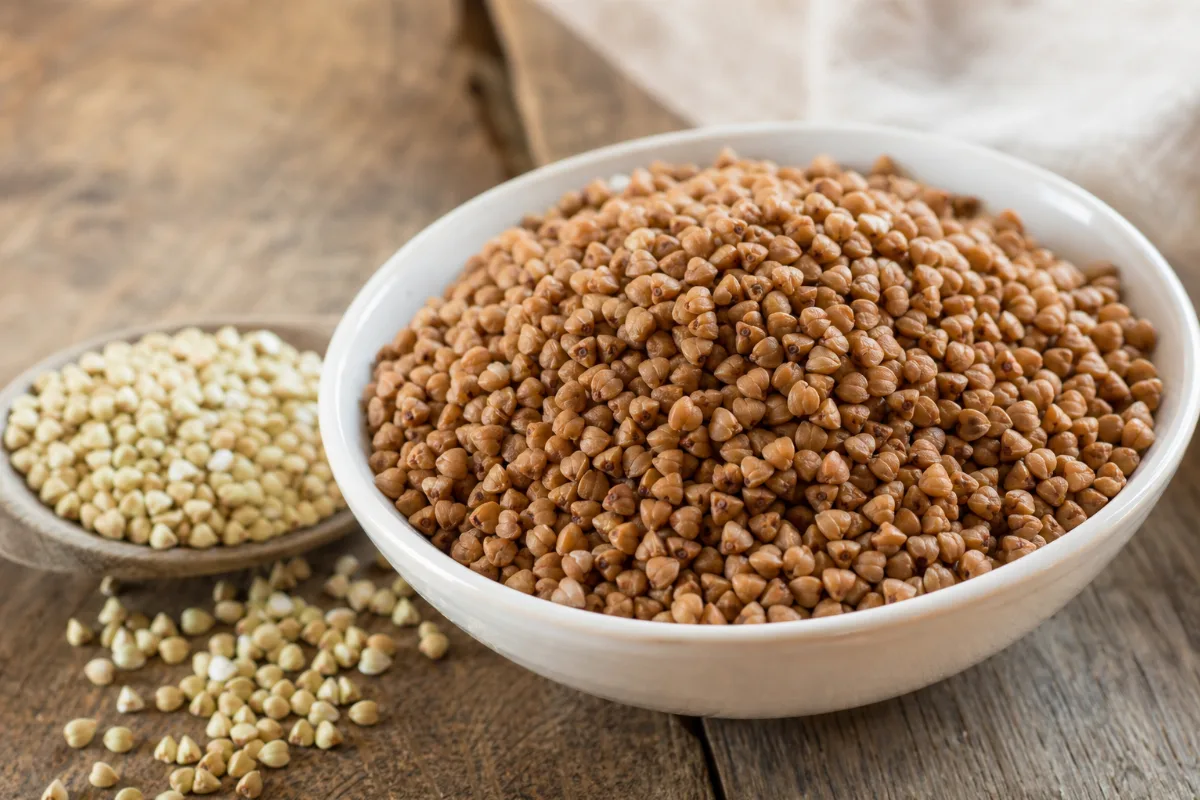
Whole Grains · Whole grain
Buckwheat
Fagopyrum esculentum · also called Common buckwheat, kasha (roasted groats), soba (noodles), trigo sarraceno (Spanish)
Buckwheat is the seed of a plant in the knotweed family. Despite the name it is not wheat, and it is naturally gluten-free. It is eaten cooked like a grain, as flour in pancakes and noodles, and as bread. Pooled trials hint at lower blood sugar and cholesterol, but the results are mixed and the best head-to-head trial found no difference from rice or bulgur. The main cautions are buckwheat allergy, which can be severe, and gluten cross-contact in processing.
General information, not medical advice. Last substantive update · Not medically reviewed. A named clinician has not signed off on this page. How this page is made
About Buckwheat
Buckwheat is the seed of a plant in the knotweed family. It is not wheat, and it is naturally gluten-free. It is cooked like a grain. The blood sugar and cholesterol findings are mixed and come from short trials; the allergy risk is better documented.
What it is
Buckwheat (Fagopyrum esculentum) is the seed of a plant in the knotweed family (Polygonaceae), according to GBIF. It is called a pseudocereal because it is eaten like a grain. The seeds are sold as raw or roasted groats (roasted groats are also called kasha), as flour, and as noodles such as soba.
USDA data for cooked roasted groats: 92 kcal per 100 g. One cup (168 g) has about 155 kcal, 5.7 g protein, 4.5 g fibre, 86 mg magnesium, 0.68 mg manganese and 0.25 mg copper. Raw buckwheat is much denser (343 kcal and 13.25 g protein per 100 g) because cooked groats hold a lot of water, so compare cooked with cooked.
What the research shows
The firmest facts are about nutrients and gluten: buckwheat gives magnesium, manganese and copper, and it is naturally gluten-free. Those are not trials of health effects.
A 2018 pooled analysis of 13 human trials found blood glucose, total cholesterol and triglycerides lower after buckwheat, with high unexplained differences between studies. A 2022 pooled analysis of 8 studies found much smaller changes that did not reach significance. The best head-to-head trial, 148 adults eating 40 g a day for 4 weeks, found no difference from quinoa, rice or bulgur. Small single-meal and short tests hint at a smaller blood sugar rise after buckwheat bread, but they are 20 people or fewer.
Gut health findings are mostly from lab and animal work. Whole grains in general are linked to lower risk of heart disease in cohort studies, but buckwheat was not examined alone.
Food versus tea, sprouts and extracts
The trials here used buckwheat groats, flour, bread or pasta; one used Tartary buckwheat, a different species. Buckwheat tea, sprouts, flowers and rutin extracts are different products, and the fagopyrin concern is mainly raised for sprouts, herb, flowers and extracts. We did not read trials of those and make no claim about them.
Portions
The USDA household portion for cooked roasted groats is 1 cup (168 g). This page gives no amounts to eat. Ask a doctor, pharmacist or dietitian what is right for you, especially if you have a food allergy, celiac disease or take medicine for blood sugar or clotting.
At a glance
Traditional uses history, not proof
- Eaten as a traditional staple in parts of East Asia (Japan, Korea, northern China) and in Russia, as groats, kasha, noodles and flour
- Long use as food is not proof that it treats any condition
Studied for research
- Fibre, magnesium, manganese and copper, high certainty for the nutrient content, no trial
- A naturally gluten-free grain-like food, high certainty (health organisation statements)
- Blood sugar and insulin, low certainty (mixed)
- Cholesterol and blood fats, low certainty (mixed)
- Blood pressure and body fat, insufficient evidence (no difference from other grains)
- Fullness and appetite, insufficient evidence (two very small studies)
- Gut health, very-low certainty (mostly lab and animal studies)
- Non-celiac gluten sensitivity symptoms, very-low certainty (one trial of 19 people)
- Whole grains and long-term health, low certainty (observational, not buckwheat-specific)
Main compounds
- Dietary fibre
- Protein
- Magnesium, manganese and copper
- Rutin
- Fagopyrin F
- Phytosterols and tocols
Common forms
- Cooked roasted groats (kasha) and cooked raw groats as food
- Buckwheat flour in bread, pancakes and noodles (values not read)
- Fibre-enriched buckwheat pasta (a processed product, one small trial)
- Tartary buckwheat is a different species used in some trials
- Buckwheat tea, sprouts, flowers and rutin extracts are different products and are not covered
Research links: 2018 review: buckwheat and heart risk markers · 2026 trial: buckwheat, quinoa, rice and bulgur · 2026 study: buckwheat allergy in China · Research Library · Genes & Biomarkers Library
What it is and its history
- Accepted scientific name
- Fagopyrum esculentum
- Naming authority
- Moench (GBIF accepted)
- Common names
- Buckwheat (English); Common buckwheat (English); Kasha (roasted groats) (English); Soba (buckwheat noodles) (Japanese); Trigo sarraceno (Spanish)
- Family or group
- Polygonaceae (the knotweed family), as given by GBIF. It is not a grass and not related to wheat.
- Classification
- Plantae > Tracheophyta > Magnoliopsida > Caryophyllales > Polygonaceae > Fagopyrum > Fagopyrum esculentum
- Native range
- Not verified from a source read. A 2021 review says cultivated buckwheat includes two species that originate from China: common buckwheat and Tartary buckwheat.
- Habitat
- Not verified from a source read.
- What it looks like
- Roots: Not verified.; Stems: Not verified.; Leaves: Not verified.; Flowers: Not verified.; Fruit: The seed (groat) is eaten after the husk is removed. The husk can cause breathing symptoms in some allergic people (2026 hospital series). Two reviews call buckwheat a pseudocereal: a seed eaten like a grain.
- Cultivation
- Not verified from a source read.
- Harvest and processing
- Sold as raw groats, roasted groats (kasha, USDA lists them dry and cooked), flour, noodles and tea (existing nutrient summary). USDA values were read for raw buckwheat and for roasted groats dry and cooked.
- Look-alikes and adulterants
- Name: Tartary buckwheat (Fagopyrum tataricum); Note: A different species used in some trials and foods (2016 trial; 2021 review). Results for it should not be assumed for common buckwheat.; Name: Wheat, rye and barley; Note: Gluten-containing grains; buckwheat is not related to them.; Name: Quinoa and amaranth; Note: Other pseudocereals with their own pages; one trial compared quinoa and buckwheat.
- Sustainability and conservation
- Not assessed.
Photographs
Traditional use and history history, not clinical proof
| Tradition or era | Documented use | Source |
|---|---|---|
| Traditional staple in East Asia and Russia | A 2025 review describes buckwheat as a traditional staple in parts of East Asia (Japan, Korea and northern China) and in Russia, and rarely eaten in Southeast Asia where rice dominates. Its growing use in gluten-free products has increased exposure worldwide. | PubMed 41696952, abstract read 2026-10-26. No older historical source was read. |
Traditional use shows how it was used. It does not show that it works or is safe today.
What is inside, and how it may work
What it contains and how those compounds act in cells and animals. Laboratory and animal mechanisms are not proven effects in people.
Main compounds
| Compound | Family | Where it is concentrated | Activity studied | Level of evidence |
|---|---|---|---|---|
| Dietary fibre | carbohydrate | Seed USDA: 2.7 g per 100 g roasted groats cooked; 10.3 g per 100 g roasted groats dry; 10.0 g per 100 g raw | Nutrient content only; the types of fibre were not read. 28 27 26 | Human data |
| Protein | protein | Seed USDA: 3.38 g per 100 g cooked; 11.73 g per 100 g roasted dry; 13.25 g per 100 g raw | Nutrient content only; digestibility was not read. Buckwheat proteins are also the allergens (for example Fag e 2 and Fag e 3). 28 27 26 5 7 | Human data |
| Magnesium, manganese and copper | minerals | Seed USDA, roasted groats cooked per 100 g: magnesium 51 mg, manganese 0.403 mg, copper 0.146 mg; raw per 100 g: magnesium 231 mg, manganese 1.3 mg, copper 1.1 mg | Nutrient content only; absorption was not read. 28 26 | Human data |
| Rutin | flavonoid | Seed (and other plant parts) Generally higher in buckwheat than oat (2021 review); amounts depend on variety and cooking (2026 laboratory study) | Laboratory chemistry. No human outcome from rutin in buckwheat food was read. 16 8 | Laboratory |
| Fagopyrin F | photosensitiser | Seed; the 2015 review also names sprouts, herb and flowers Lowered by all seven household methods tested (2026) | A light-sensitising compound that can cause fagopyrism at high intakes of sprouts, herb, flowers or fagopyrin-rich extracts (2015 review). 3 8 | Review |
| Phytosterols and tocols | plant sterols and vitamin E forms | Seed Generally higher in buckwheat than oat (2021 review) | Laboratory chemistry only. 16 | Laboratory |
Mechanisms, receptors and pathways
| Target or pathway | Gene or receptor | What was found | Level |
|---|---|---|---|
| Why buckwheat does not trigger celiac disease | Not specified in the sources read | The Celiac Disease Foundation, NIDDK and FDA treat buckwheat as a naturally gluten-free food that is acceptable on a gluten-free diet. Mechanisms were not discussed. 19 25 20 | Authoritative guidance |
| Allergen proteins | IgE antibodies to proteins such as Fag e 2 and Fag e 3 (common buckwheat) and a 22-24 kDa protein | Reviews and the 2026 hospital series describe IgE-binding proteins; sensitisation to a 22-24 kDa protein was linked to husk allergy. Fag e 2, a 2S albumin that resists stomach acid, is recognised by up to 90% of symptomatic patients (2025 review). 4 5 7 | Human data |
| Possible gut effects in animals and lab studies | Not specified | In animals buckwheat went with lower gut inflammation, more diverse gut microbiome and more short-chain fatty acids; extracts were toxic to human gut cancer cell lines in the lab. Not shown in people. 17 | Lab and animal |
Absorption, metabolism and elimination
- Absorption
- Not found for buckwheat nutrients in the sources read.
- Distribution
- Not found.
- Metabolism
- Not found.
- Elimination
- Not found.
- Bioavailability
- Not established for buckwheat nutrients or rutin in the sources read.
Isolated compounds versus whole extracts
The food trials used buckwheat groats, flour, bread or pasta; one trial used Tartary buckwheat (a different species). The 2022 pooled analysis also included rutin and quercetin-3-glucoside studies. Extracts, tea, sprouts, flowers and supplements are different products. The 2015 review says seeds, flour and teas are generally safe in normal amounts, while diets mostly of sprouts, herb, flowers or fagopyrin-rich extracts may cause fagopyrism.
Nutritional composition
Nutrition from USDA FoodData Central (SR Legacy, April 2018 release; values read 2026-10-26 from a saved copy of the data feed). Roasted buckwheat groats, cooked, without added salt (FDC 170686), per 100 g: 92 kcal, 3.38 g protein, 0.62 g fat, 19.94 g carbohydrate, 0.9 g sugars, 2.7 g fibre, about 75.6 g water, 7 mg calcium, 0.8 mg iron, 51 mg magnesium, 70 mg phosphorus, 88 mg potassium, 4 mg sodium, 0.61 mg zinc, 0.403 mg manganese, 0.146 mg copper, 0.94 mg niacin, 14 micrograms folate (DFE) and 1.9 micrograms vitamin K. One cup cooked (168 g, the USDA household portion): about 155 kcal, 5.7 g protein, 4.5 g fibre, 86 mg magnesium, 0.68 mg manganese, 0.25 mg copper, 1.3 mg iron and 148 mg potassium (the per-100-g values multiplied by 1.68). Raw buckwheat (FDC 170286) per 100 g: 343 kcal, 13.25 g protein, 10.0 g fibre, 231 mg magnesium, 1.3 mg manganese; 1 cup raw = 170 g. Roasted groats, dry (FDC 170685): 346 kcal, 11.73 g protein, 10.3 g fibre per 100 g; 1 cup = 164 g. Dry and raw values look very different from cooked ones because cooked buckwheat holds a lot of water, so compare like with like. USDA lists no vitamin B12 or vitamin C. Values vary with variety, roasting and cooking. Flour, noodles and bread values were not read.
2 high certainty3 low certainty2 very low certainty4 not enough evidence
What was looked at
The 11 benefits and uses checked for Buckwheat, each with how strong the evidence is. Tap one to open it.
- Blood sugar and insulinLow certainty
- Cholesterol and blood fatsLow certainty
- Fibre, minerals and plant protein (nutrient content)High certainty
- A naturally gluten-free grain-like foodHigh certainty
- Fullness and appetiteNot enough evidence
- Blood pressure and body fatNot enough evidence
- Gut healthVery low certainty
- Symptoms in non-celiac gluten sensitivityVery low certainty
- Blood sugar after a pasta meal (type 1 diabetes with celiac disease)Not enough evidence
- Whole grains and long-term health (not buckwheat-specific)Low certainty
- Rutin and other plant compounds (chemistry)Not enough evidence
Lab markers tracked in the studies
Blood glucoseTotal cholesterolTriglyceridesFasting insulinBlood pressurePlasma homocysteine
What is Buckwheat good for?
The main studied uses and how strong the human evidence is for each. Most results are for buckwheat foods in short trials, and several are mixed.
Benefits, one by one
Each card is a research question, not a promise. Tap a goal to filter. Open a card to see the studies, doses and limits.
Blood sugar and insulin
Low certaintyA 2018 pooled analysis of 13 human trials found blood glucose about 0.85 mmol/L lower after buckwheat than in control groups, but with very high differences between studies. A 2022 pooled analysis found a smaller, non-significant fall (0.18 mmol/L). A 148-person trial found no difference from rice, bulgur or quinoa. In single-meal tests, bread with 50% buckwheat gave a smaller rise in blood glucose than wheat bread in 20 healthy adults.
5 studiesBuckwheat foods (groats, flour, bread). Trial detail: 40 g a day for …
Studies, doses and limits
What the trials found
2018 meta-analysis (Li): 13 randomised human studies, blood glucose -0.85 mmol/L (95% CI -1.31 to -0.39) with high unexplained heterogeneity. 2022 meta-analysis (Llanaj): 8 studies, 464 people with mild metabolic problems, glucose -0.18 mmol/L (95% CI -0.36 to 0.003), not significant. 2016 trial of Tartary buckwheat (a different species) in 165 people with type 2 diabetes: fasting insulin lower than the control diet after 4 weeks, but no significant difference in blood glucose or HbA1c. 2026 trial of 148 adults with overweight or obesity (40 g a day for 4 weeks): changes did not differ significantly between buckwheat, quinoa, rice and bulgur. 2025 crossover trial: bread with 50% buckwheat flour gave a smaller blood glucose rise than control bread in 20 healthy adults.
Results
Some pooled trials point to lower blood glucose, but the results are inconsistent. The best head-to-head trial found no advantage over other grains. Meal tests show a smaller rise after buckwheat bread, which is not the same as long-term control.
Effect sizes as reported
Glucose -0.85 mmol/L (2018); -0.18 mmol/L, non-significant (2022); no between-group difference (2026 trial).
Why this rating
Low and mixed: one pooled analysis found a fall with high heterogeneity, a later one did not reach significance, and the best head-to-head trial found no difference. Many different buckwheat products were used.
Form and dose studied
Buckwheat foods (groats, flour, bread). Trial detail: 40 g a day for 4 weeks in the head-to-head trial; not advice.
Who was studied
Healthy adults, adults with overweight or obesity, people with type 2 diabetes.
Limits
Many buckwheat products and amounts. High heterogeneity. Short trials. Blood glucose in a trial is a marker, not diabetes control. The Tartary buckwheat trial used a different species.
Why researchers looked
Buckwheat has fibre and plant compounds, and is eaten instead of refined grains, so researchers ask whether it changes blood sugar.
Traditional use
Buckwheat is eaten cooked as groats or kasha, as flour in pancakes and noodles, and as bread. A review describes it as a traditional staple in parts of East Asia (Japan, Korea, northern China) and in Russia. Long use as food is not proof that it treats any condition.
Proposed mechanism Not established
Not established in the abstracts read. The authors of the pooled analyses say the mechanisms behind any effect are unclear.
A proposed mechanism does not show that the effect happens in people.
No safety signal for blood sugar. Buckwheat allergy can be severe; see the Safety tab. Ask your care team before changing diet or medicines for diabetes.
Cholesterol and blood fats
Low certaintyA 2018 pooled analysis found total cholesterol about 0.5 mmol/L lower and triglycerides about 0.25 mmol/L lower after buckwheat than in control groups, with high unexplained differences between studies. A 2022 pooled analysis found much smaller changes that were not significant, and LDL was essentially unchanged. A 4-week trial of Tartary buckwheat found lower total and LDL cholesterol in people with type 2 diabetes.
4 studiesBuckwheat foods and, in one trial, Tartary buckwheat food (not advice…
Studies, doses and limits
What the trials found
2018 meta-analysis (Li): total cholesterol 0.50 mmol/L lower (95% CI -0.80 to -0.20) and triglycerides 0.25 mmol/L lower (95% CI -0.49 to -0.02); HDL results were inconsistent. 2022 meta-analysis (Llanaj, 8 studies, 464 people): total cholesterol -0.14 mmol/L (95% CI -0.30 to 0.02), LDL -0.03 (95% CI -0.22 to 0.16), triglycerides -0.02 (95% CI -0.15 to 0.11), all non-significant. 2016 trial: in 165 people with type 2 diabetes, Tartary buckwheat lowered total cholesterol (5.08 to 4.79 mmol/L) and LDL (3.00 to 2.80 mmol/L) compared with a control diet at 4 weeks (P<.05). 2026 trial: no significant difference between buckwheat, rice, bulgur and quinoa; HDL fell in women within the buckwheat group.
Results
The 2018 pooled results suggest lower total cholesterol and triglycerides; the 2022 analysis, which looked more carefully at study quality, did not confirm it. The effect, if real, is small and uncertain.
Effect sizes as reported
Total cholesterol -0.50 mmol/L and triglycerides -0.25 mmol/L (2018); total cholesterol -0.14 and LDL -0.03, non-significant (2022).
Why this rating
Low and mixed: two pooled analyses disagree about significance, both report high heterogeneity, and 66.7% of the studies in the 2022 analysis had risk-of-bias concerns.
Form and dose studied
Buckwheat foods and, in one trial, Tartary buckwheat food (not advice).
Who was studied
Adults, including people with mild high cholesterol, diabetes or overweight.
Limits
Cholesterol and triglycerides are markers, not heart attacks or strokes. The 2022 analysis mixed buckwheat with rutin and quercetin-3-glucoside studies. Short trials.
Why researchers looked
Fibre-containing whole grains are linked to heart health, so researchers test whether buckwheat changes blood fats.
Traditional use
Buckwheat is eaten cooked as groats or kasha, as flour in pancakes and noodles, and as bread. A review describes it as a traditional staple in parts of East Asia (Japan, Korea, northern China) and in Russia. Long use as food is not proof that it treats any condition.
Proposed mechanism Not established
Not established in the abstracts read. The 2018 authors say it remains unclear whether buckwheat benefits LDL cholesterol or other markers, and the mechanisms are unclear.
A proposed mechanism does not show that the effect happens in people.
None specific. See allergy cautions on the Safety tab.
Fibre, minerals and plant protein (nutrient content)
High certaintyCooked roasted buckwheat groats give 4.5 g of fibre, 5.7 g of protein, 86 mg of magnesium, 0.68 mg of manganese and 0.25 mg of copper in one cup (168 g), by USDA data. This is nutrient content, not a trial of health effects.
3 studiesCooked roasted groats as food (the USDA household portion, not advice…
Studies, doses and limits
What the trials found
USDA FoodData Central, roasted groats cooked (FDC 170686), per 100 g: 92 kcal, 3.38 g protein, 2.7 g fibre, 51 mg magnesium, 0.403 mg manganese, 0.146 mg copper, 70 mg phosphorus, 0.61 mg zinc, 0.8 mg iron, 88 mg potassium, 14 micrograms folate (DFE). Raw buckwheat (FDC 170286) has 343 kcal, 13.25 g protein and 10 g fibre per 100 g because it holds little water. The Harvard Nutrition Source lists buckwheat among unprocessed whole grains.
Results
A nutrient fact: cooked buckwheat is a modest source of fibre and protein and a good source of magnesium, manganese and copper. No source read shows that eating buckwheat corrects any deficiency.
Effect sizes as reported
Per cup cooked (168 g): about 155 kcal, 5.7 g protein, 4.5 g fibre, 86 mg magnesium, 0.68 mg manganese, 0.25 mg copper (USDA values multiplied by 1.68).
Why this rating
High for the nutrient content (a government food database). Not a trial of health effects.
Form and dose studied
Cooked roasted groats as food (the USDA household portion, not advice).
Who was studied
General diet.
Limits
Values vary with variety, roasting and cooking water. The old SR Legacy data are from 2018. Absorption of the minerals was not read.
Why researchers looked
Buckwheat is eaten as a whole-grain-style food, so people ask what nutrients it adds.
Traditional use
Buckwheat is eaten cooked as groats or kasha, as flour in pancakes and noodles, and as bread. A review describes it as a traditional staple in parts of East Asia (Japan, Korea, northern China) and in Russia. Long use as food is not proof that it treats any condition.
Proposed mechanism Nutrient database
Nutrient database values. Not a study of health effects.
A proposed mechanism does not show that the effect happens in people.
See the Safety tab for allergy and gluten cross-contact.
A naturally gluten-free grain-like food
High certaintyBuckwheat is not wheat and is naturally gluten-free. The Celiac Disease Foundation lists buckwheat groats (kasha) as naturally gluten-free, and NIDDK says flour made from buckwheat is safe on a gluten-free diet. Gluten from cross-contact can still get in, so choose products tested to under 20 ppm.
4 studiesGroats and flour from labelled gluten-free sources.
Studies, doses and limits
What the trials found
Celiac Disease Foundation: buckwheat groats are on the naturally gluten-free list; do not buy grains from bulk bins; buy versions tested to under 20 parts per million if concerned. NIDDK (reviewed October 2020): flour made from buckwheat is safe to eat on a gluten-free diet. FDA (content current as of 2022-06-30): any grain other than wheat, rye, barley or their hybrids can be labelled gluten-free if unavoidable cross-contact is under 20 ppm.
Results
Buckwheat can be part of a gluten-free diet. The risk is cross-contact, not buckwheat itself. This is a labelling and diet fact, not a claim that buckwheat treats celiac disease.
Effect sizes as reported
Gluten-free label threshold in the US: less than 20 ppm gluten.
Why this rating
High for the statement that buckwheat is naturally gluten-free and acceptable on a gluten-free diet (three health organisations agree). Not a treatment claim.
Form and dose studied
Groats and flour from labelled gluten-free sources.
Who was studied
People with celiac disease or avoiding gluten.
Limits
Cross-contact in growing, milling and bulk bins. Buckwheat allergy is a separate and sometimes severe problem.
Why researchers looked
People with celiac disease or gluten sensitivity need grain-like foods that do not contain wheat, rye or barley.
Traditional use
Buckwheat is eaten cooked as groats or kasha, as flour in pancakes and noodles, and as bread. A review describes it as a traditional staple in parts of East Asia (Japan, Korea, northern China) and in Russia. Long use as food is not proof that it treats any condition.
Proposed mechanism Authoritative guidance
Buckwheat is a different plant from wheat and does not contain the gluten proteins of wheat, rye and barley (guidance statements from the Celiac Disease Foundation, NIDDK and FDA).
A proposed mechanism does not show that the effect happens in people.
Buckwheat is sometimes an unlabelled ingredient in gluten-free foods (2025 review), and buckwheat allergy can be severe; see the Safety tab.
Fullness and appetite
Not enough evidenceIn a 7-day crossover study of 20 healthy adults, a buckwheat-based diet was as filling as the usual diet. In a single-meal test, bread with 50% buckwheat showed a trend toward more early fullness than wheat bread. Both studies were tiny.
2 studiesBuckwheat-based diets and bread with 50% buckwheat flour (trial detai…
Studies, doses and limits
What the trials found
2025 crossover trial (Neacsu): 20 healthy volunteers, two 7-day diets (buckwheat-based and fava bean-based); both were as satiating as the usual diet (p = 0.234). 2025 crossover trial (Begum): 20 healthy adults; buckwheat bread showed a trend toward more satiety between 15 and 60 minutes; no gut problems noted.
Results
Buckwheat did not make people less full than their usual diet. There is no sign it makes people fuller than other foods.
Effect sizes as reported
p = 0.234 versus habitual diet (no difference).
Why this rating
Two very small, short crossover studies. One shows no difference from the usual diet and the other shows a trend.
Form and dose studied
Buckwheat-based diets and bread with 50% buckwheat flour (trial detail, not advice).
Who was studied
Healthy adults.
Limits
20 people each; the whole diet changed in the 7-day study; a trend is not a significant result.
Why researchers looked
Fibre-containing foods may fill people up, which matters for appetite.
Traditional use
Buckwheat is eaten cooked as groats or kasha, as flour in pancakes and noodles, and as bread. A review describes it as a traditional staple in parts of East Asia (Japan, Korea, northern China) and in Russia. Long use as food is not proof that it treats any condition.
Proposed mechanism Not established
Not established in the abstracts read.
A proposed mechanism does not show that the effect happens in people.
None specific.
Blood pressure and body fat
Not enough evidenceIn the 148-person trial, blood pressure and body fat fell within the buckwheat group (blood pressure mainly in women), but changes did not differ significantly from rice, bulgur or quinoa. The 2018 pooled analysis said it remained unclear whether weight, blood pressure or insulin change. The 2022 pooled analysis found body weight changed by only 0.14 kg, not significant.
3 studiesBuckwheat as food (trial detail: 40 g a day for 4 weeks; not advice).
Studies, doses and limits
What the trials found
2026 trial (Oztekin): 148 adults with overweight or obesity, 40 g a day of quinoa, buckwheat, rice or bulgur for 4 weeks. Between-group differences were not significant. Within the buckwheat group, fat mass and blood pressure fell (blood pressure mainly in women). 2022 meta-analysis: body weight -0.14 kg (95% CI -1.50 to 1.22). 2018 meta-analysis: unclear whether weight, blood pressure, insulin or LDL change.
Results
No proof of an advantage over rice or bulgur. Within-group changes can happen without any food effect.
Effect sizes as reported
No significant between-group difference (2026); weight -0.14 kg, non-significant (2022).
Why this rating
The only head-to-head trial found no difference between groups and the pooled analyses found no significant effect on weight.
Form and dose studied
Buckwheat as food (trial detail: 40 g a day for 4 weeks; not advice).
Who was studied
Adults with overweight or obesity.
Limits
Four weeks. The comparison grains also changed measures within groups. Small subgroups by sex.
Why researchers looked
Whole grains are linked to heart health, so trials look at blood pressure and body measures.
Traditional use
Buckwheat is eaten cooked as groats or kasha, as flour in pancakes and noodles, and as bread. A review describes it as a traditional staple in parts of East Asia (Japan, Korea, northern China) and in Russia. Long use as food is not proof that it treats any condition.
Proposed mechanism Not established
Not established in the abstracts read.
A proposed mechanism does not show that the effect happens in people.
None specific.
Gut health
Very low certaintyA 2022 systematic review of 32 studies found only one randomised trial in people. Most findings were from lab and animal work, where buckwheat went with less gut inflammation and more short-chain fatty acids. Human evidence is limited.
2 studiesBuckwheat foods and extracts (different products).
Studies, doses and limits
What the trials found
2022 systematic review (Valido): 32 studies (1 randomised trial, 1 non-randomised trial, 3 observational, 9 in vitro, 18 animal). Buckwheat extracts were toxic to human gut cancer cell lines in the lab. Human studies were limited and mostly at moderate risk of bias. 2025 trial (Begum): no gut problems were noted in 20 healthy adults after buckwheat bread.
Results
The promising gut findings are lab and animal findings. No conclusion about people can be drawn from them.
Effect sizes as reported
No pooled human result.
Why this rating
Mostly lab and animal evidence; one randomised human trial.
Form and dose studied
Buckwheat foods and extracts (different products).
Who was studied
Mostly cells and animals.
Limits
Extracts used in the lab are not the food. Cell toxicity to cancer lines is not a treatment.
Why researchers looked
Buckwheat has fibre and plant compounds that gut bacteria can use.
Traditional use
Buckwheat is eaten cooked as groats or kasha, as flour in pancakes and noodles, and as bread. A review describes it as a traditional staple in parts of East Asia (Japan, Korea, northern China) and in Russia. Long use as food is not proof that it treats any condition.
Proposed mechanism In vitro and animal
In animals and lab studies the review links buckwheat to anti-oxidant and anti-inflammatory potential and to gut microbiome changes. Not shown in people.
A proposed mechanism does not show that the effect happens in people.
None specific.
Symptoms in non-celiac gluten sensitivity
Very low certaintyIn a small 12-week crossover trial of 19 people with non-celiac gluten sensitivity, abdominal pain and bloating were less severe during 6 weeks on buckwheat products than on their usual gluten-free diet. It was a very small study without a placebo.
1 studiesBuckwheat products (amounts not stated in the abstract).
Studies, doses and limits
What the trials found
2017 randomised crossover trial (Dinu): 19 people with non-celiac gluten sensitivity; 6 weeks on buckwheat products and 6 weeks on their usual gluten-free diet, in random order. During buckwheat, abdominal pain and bloating were less severe (p=0.03), serum magnesium rose 4.7%, and interferon gamma (-33.3%) and monocyte chemotactic protein-1 (-46.5%) were lower.
Results
A small positive signal for symptoms in one group of people, against their own gluten-free diet. It does not show buckwheat treats gluten sensitivity.
Effect sizes as reported
Abdominal pain and bloating lower (p=0.03); magnesium +4.7%; interferon gamma -33.3%; MCP-1 -46.5%.
Why this rating
One small trial of 19 people, no placebo, symptom questionnaires.
Form and dose studied
Buckwheat products (amounts not stated in the abstract).
Who was studied
Adults with non-celiac gluten sensitivity (not celiac disease).
Limits
Small, short, compared with the participants' own gluten-free diet. Not tested in celiac disease.
Why researchers looked
People avoiding gluten want alternatives to wheat-based gluten-free products.
Traditional use
Buckwheat is eaten cooked as groats or kasha, as flour in pancakes and noodles, and as bread. A review describes it as a traditional staple in parts of East Asia (Japan, Korea, northern China) and in Russia. Long use as food is not proof that it treats any condition.
Proposed mechanism Authors hypothesis
Not established. The authors suggest nutrient and inflammation changes but the abstract only reports the measured markers.
A proposed mechanism does not show that the effect happens in people.
Buckwheat allergy can be severe; see the Safety tab. Celiac disease needs medical care.
Blood sugar after a pasta meal (type 1 diabetes with celiac disease)
Not enough evidenceIn 10 adults with both type 1 diabetes and celiac disease, a meal of fibre-enriched buckwheat pasta gave a different blood sugar pattern from corn pasta. Corn pasta was lower in the first 3 hours and higher in hours 3 to 6. The authors saw a less variable profile after buckwheat pasta. This is a processed product in 10 people.
1 studiesFibre-enriched buckwheat pasta, a different product from groats.
Studies, doses and limits
What the trials found
2019 acute randomised trial (Vetrani): 10 adults with type 1 diabetes and celiac disease ate two meals with the same carbohydrate, one with fibre-enriched buckwheat pasta and one with corn pasta, after the same insulin dose, with continuous glucose monitoring for 6 hours. The incremental area under the curve differed between meals, with opposite directions in hours 0-3 (p=0.040) and 3-6 (p=0.030).
Results
Different timing of the blood sugar rise, not clearly better control.
Effect sizes as reported
iAUC 0-3 h: corn -38 vs buckwheat 305; 3-6 h: corn 432 vs buckwheat 308.
Why this rating
10 people, single meals, a processed fibre-enriched product.
Form and dose studied
Fibre-enriched buckwheat pasta, a different product from groats.
Who was studied
Adults with type 1 diabetes and celiac disease.
Limits
Tiny, acute, and a specially formulated pasta.
Why researchers looked
People with type 1 diabetes and celiac disease need gluten-free foods that do not spike blood sugar.
Proposed mechanism Authors hypothesis
The authors discuss fibre slowing glucose rise. Not tested directly in the abstract.
A proposed mechanism does not show that the effect happens in people.
Insulin dosing needs medical advice; this page gives none.
Whole grains and long-term health (not buckwheat-specific)
Low certaintyLarge cohort studies link eating more whole grains to lower risk of heart disease, some cancers and death from any cause. Buckwheat is listed among whole grains by Harvard, but these studies did not look at buckwheat alone, and they cannot show cause.
2 studiesWhole grain foods in general (analysis unit: 90 g a day; not advice).
Studies, doses and limits
What the trials found
2016 dose-response meta-analysis (Aune) of 45 prospective studies: per 90 g a day more whole grains, coronary heart disease RR 0.81 (0.75-0.87), cardiovascular disease RR 0.78 (0.73-0.85), all-cause mortality RR 0.83 (0.77-0.90), total cancer mortality RR 0.85 (0.80-0.91); stroke RR 0.88 (0.75-1.03) did not reach significance. Harvard's Nutrition Source lists buckwheat among unprocessed whole grains.
Results
An association between whole grains as a group and lower risk. Not proof, and not shown for buckwheat alone.
Effect sizes as reported
Per 90 g/day: CHD RR 0.81; CVD RR 0.78; all-cause mortality RR 0.83; cancer mortality RR 0.85; stroke RR 0.88 (not significant).
Why this rating
Observational data about whole grains in general; people who eat whole grains differ in other habits. Buckwheat was not separated.
Form and dose studied
Whole grain foods in general (analysis unit: 90 g a day; not advice).
Who was studied
Adults in cohort studies.
Limits
Not buckwheat-specific. Observational. Self-reported eating.
Why researchers looked
Researchers ask what whole-grain eating means for long-term health.
Traditional use
Buckwheat is eaten cooked as groats or kasha, as flour in pancakes and noodles, and as bread. A review describes it as a traditional staple in parts of East Asia (Japan, Korea, northern China) and in Russia. Long use as food is not proof that it treats any condition.
Proposed mechanism Not tested
Not examined in the abstract.
A proposed mechanism does not show that the effect happens in people.
None specific.
Rutin and other plant compounds (chemistry)
Not enough evidenceA review of 154 laboratory studies found buckwheat generally has more flavonoids, rutin, plant sterols and tocols than oats. It also contains fagopyrin F, a light-sensitising compound. This is chemistry, not proof of any benefit in people.
2 studiesBuckwheat grain. Rutin extracts and supplements are different product…
Studies, doses and limits
What the trials found
2021 systematic review (Raguindin): of 154 studies, 178 bioactive compounds were reported in buckwheat; phytosterols, tocols, flavonoids and rutin were generally higher than in oat. Most studies were published before the 2010s and used different methods. 2026 laboratory study (Kim): buckwheat contains rutin and fagopyrin F; heat treatments reduced fagopyrin F and in some cases kept rutin.
Results
Buckwheat has several plant compounds in measurable amounts. Whether they matter for health in people was not shown in these sources.
Why this rating
Laboratory chemistry only, no human outcome.
Form and dose studied
Buckwheat grain. Rutin extracts and supplements are different products and were not read.
Limits
Chemistry from older studies with different methods. No health outcome.
Why researchers looked
Researchers measure the plant compounds that might explain buckwheat's reported effects.
Proposed mechanism Laboratory
Rutin is a flavonoid. No human outcome of rutin from buckwheat food was read in these sources.
A proposed mechanism does not show that the effect happens in people.
Fagopyrin F is a photosensitiser; see the Safety tab.
Connections to the rest of health
How Buckwheat connects to the rest of our health knowledge graph. Every link says what kind of connection it is. A safety link (for example to the liver) is a warning, not a benefit. A study that merely mentions a topic never creates a benefit link.
Explore every connection: goals, body systems, organs, symptoms, genes
A. Wellness goals
| Connected to | Kind of connection | Evidence status | Context | Studies |
|---|---|---|---|---|
| Blood Sugar Balance | Low certainty | Blood sugar and insulin: A 2018 pooled analysis of 13 human trials found blood glucose about 0.85 mmol/L lower after buckwheat than in control groups, but with very high differences between studies. A 2022 pooled analysis found a smaller, non-significant fall (0.18 mmol/L). A 148-person trial found no difference from rice, bulgur or quinoa. In single-meal tests, bread with 50% buckwheat gave a smaller rise in blood glucose than wheat bread in 20 healthy adults. | 10 11 14 15 2 | |
| Metabolic Health | Low certainty | Blood sugar and insulin: A 2018 pooled analysis of 13 human trials found blood glucose about 0.85 mmol/L lower after buckwheat than in control groups, but with very high differences between studies. A 2022 pooled analysis found a smaller, non-significant fall (0.18 mmol/L). A 148-person trial found no difference from rice, bulgur or quinoa. In single-meal tests, bread with 50% buckwheat gave a smaller rise in blood glucose than wheat bread in 20 healthy adults. | 10 11 14 15 2 | |
| Cholesterol Balance | Low certainty | Cholesterol and blood fats: A 2018 pooled analysis found total cholesterol about 0.5 mmol/L lower and triglycerides about 0.25 mmol/L lower after buckwheat than in control groups, with high unexplained differences between studies. A 2022 pooled analysis found much smaller changes that were not significant, and LDL was essentially unchanged. A 4-week trial of Tartary buckwheat found lower total and LDL cholesterol in people with type 2 diabetes. | 10 11 15 14 | |
| Heart Health | Low certainty | Cholesterol and blood fats: A 2018 pooled analysis found total cholesterol about 0.5 mmol/L lower and triglycerides about 0.25 mmol/L lower after buckwheat than in control groups, with high unexplained differences between studies. A 2022 pooled analysis found much smaller changes that were not significant, and LDL was essentially unchanged. A 4-week trial of Tartary buckwheat found lower total and LDL cholesterol in people with type 2 diabetes. | 10 11 15 14 | |
| Nutrient Support | High certainty | Fibre, minerals and plant protein (nutrient content): Cooked roasted buckwheat groats give 4.5 g of fibre, 5.7 g of protein, 86 mg of magnesium, 0.68 mg of manganese and 0.25 mg of copper in one cup (168 g), by USDA data. This is nutrient content, not a trial of health effects. | 28 26 22 | |
| Balanced Nutrition | High certainty | Fibre, minerals and plant protein (nutrient content): Cooked roasted buckwheat groats give 4.5 g of fibre, 5.7 g of protein, 86 mg of magnesium, 0.68 mg of manganese and 0.25 mg of copper in one cup (168 g), by USDA data. This is nutrient content, not a trial of health effects. | 28 26 22 | |
| Digestive Support | High certainty | A naturally gluten-free grain-like food: Buckwheat is not wheat and is naturally gluten-free. The Celiac Disease Foundation lists buckwheat groats (kasha) as naturally gluten-free, and NIDDK says flour made from buckwheat is safe on a gluten-free diet. Gluten from cross-contact can still get in, so choose products tested to under 20 ppm. | 19 25 20 5 | |
| Balanced Nutrition | High certainty | A naturally gluten-free grain-like food: Buckwheat is not wheat and is naturally gluten-free. The Celiac Disease Foundation lists buckwheat groats (kasha) as naturally gluten-free, and NIDDK says flour made from buckwheat is safe on a gluten-free diet. Gluten from cross-contact can still get in, so choose products tested to under 20 ppm. | 19 25 20 5 | |
| Weight Management | Not enough evidence | Fullness and appetite: In a 7-day crossover study of 20 healthy adults, a buckwheat-based diet was as filling as the usual diet. In a single-meal test, bread with 50% buckwheat showed a trend toward more early fullness than wheat bread. Both studies were tiny. | 12 2 | |
| Balanced Nutrition | Not enough evidence | Fullness and appetite: In a 7-day crossover study of 20 healthy adults, a buckwheat-based diet was as filling as the usual diet. In a single-meal test, bread with 50% buckwheat showed a trend toward more early fullness than wheat bread. Both studies were tiny. | 12 2 | |
| Blood Pressure Support | Not enough evidence | Blood pressure and body fat: In the 148-person trial, blood pressure and body fat fell within the buckwheat group (blood pressure mainly in women), but changes did not differ significantly from rice, bulgur or quinoa. The 2018 pooled analysis said it remained unclear whether weight, blood pressure or insulin change. The 2022 pooled analysis found body weight changed by only 0.14 kg, not significant. | 14 11 10 | |
| Weight Management | Not enough evidence | Blood pressure and body fat: In the 148-person trial, blood pressure and body fat fell within the buckwheat group (blood pressure mainly in women), but changes did not differ significantly from rice, bulgur or quinoa. The 2018 pooled analysis said it remained unclear whether weight, blood pressure or insulin change. The 2022 pooled analysis found body weight changed by only 0.14 kg, not significant. | 14 11 10 | |
| Digestive Support | Very low certainty | Gut health: A 2022 systematic review of 32 studies found only one randomised trial in people. Most findings were from lab and animal work, where buckwheat went with less gut inflammation and more short-chain fatty acids. Human evidence is limited. | 17 2 | |
| Gut Health | Very low certainty | Gut health: A 2022 systematic review of 32 studies found only one randomised trial in people. Most findings were from lab and animal work, where buckwheat went with less gut inflammation and more short-chain fatty acids. Human evidence is limited. | 17 2 | |
| Digestive Support | Very low certainty | Symptoms in non-celiac gluten sensitivity: In a small 12-week crossover trial of 19 people with non-celiac gluten sensitivity, abdominal pain and bloating were less severe during 6 weeks on buckwheat products than on their usual gluten-free diet. It was a very small study without a placebo. | 6 | |
| Blood Sugar Balance | Not enough evidence | Blood sugar after a pasta meal (type 1 diabetes with celiac disease): In 10 adults with both type 1 diabetes and celiac disease, a meal of fibre-enriched buckwheat pasta gave a different blood sugar pattern from corn pasta. Corn pasta was lower in the first 3 hours and higher in hours 3 to 6. The authors saw a less variable profile after buckwheat pasta. This is a processed product in 10 people. | 18 | |
| Heart Health | Low certainty | Whole grains and long-term health (not buckwheat-specific): Large cohort studies link eating more whole grains to lower risk of heart disease, some cancers and death from any cause. Buckwheat is listed among whole grains by Harvard, but these studies did not look at buckwheat alone, and they cannot show cause. | 1 22 | |
| Healthy Aging | Low certainty | Whole grains and long-term health (not buckwheat-specific): Large cohort studies link eating more whole grains to lower risk of heart disease, some cancers and death from any cause. Buckwheat is listed among whole grains by Harvard, but these studies did not look at buckwheat alone, and they cannot show cause. | 1 22 | |
| Cellular Protection | Not enough evidence | Rutin and other plant compounds (chemistry): A review of 154 laboratory studies found buckwheat generally has more flavonoids, rutin, plant sterols and tocols than oats. It also contains fagopyrin F, a light-sensitising compound. This is chemistry, not proof of any benefit in people. | 16 8 |
B. Body systems
| Connected to | Kind of connection | Evidence status | Context | Studies |
|---|---|---|---|---|
| Endocrine System | Biological association | Low certainty | Studied for: Blood sugar and insulin Studied for: Blood sugar after a pasta meal (type 1 diabetes with celiac disease) | 10 11 14 15 2 18 |
| Metabolism Weight | Biological association | Low certainty | Studied for: Blood sugar and insulin Studied for: Fullness and appetite | 10 11 14 15 2 12 |
| Cardiovascular System | Biological association | Low certainty | Studied for: Cholesterol and blood fats Studied for: Blood pressure and body fat | 10 11 15 14 1 22 |
| Nutrition | Biological association | High certainty | Studied for: Fibre, minerals and plant protein (nutrient content) | 28 26 22 |
| Digestive System | Biological association | High certainty | Studied for: Fibre, minerals and plant protein (nutrient content) Studied for: A naturally gluten-free grain-like food | 28 26 22 19 25 20 5 12 2 17 6 |
| Immune System | Biological association | Very low certainty | Studied for: Symptoms in non-celiac gluten sensitivity | 6 |
| Whole Body | Biological association | Low certainty | Studied for: Whole grains and long-term health (not buckwheat-specific) | 1 22 |
| Cellular | Biological association | Not enough evidence | Studied for: Rutin and other plant compounds (chemistry) | 16 8 |
E. Health conditions
| Connected to | Kind of connection | Evidence status | Context | Studies |
|---|---|---|---|---|
| Food allergy | Adverse effect or risk | Documented risk | In a 2026 hospital series of 46 buckwheat-allergic patients, 45 had immediate reactions and 33 had anaphylaxis. Buckwheat is a recognised allergen; in a 2026 hospital series 45 of 46 allergic patients had immediate reactions and 33 had anaphylaxis. Preparation or compound: Buckwheat proteins in food, flour or husk dust |
4 5 13 |
| Anaphylaxis | Adverse effect or risk | Documented risk | A 2025 review lists buckwheat among growing causes of anaphylaxis. Preparation or compound: Buckwheat as food |
9 4 |
| Celiac disease | Documented risk | Buckwheat is naturally gluten-free, but cross-contact can occur; choose products tested to under 20 ppm. Preparation or compound: Buckwheat groats and flour |
19 25 20 |
I. Biomarkers
| Connected to | Kind of connection | Evidence status | Context | Studies |
|---|---|---|---|---|
| Blood glucose | Preliminary or mixed | Lower in a 2018 pooled analysis; smaller and not significant in 2022; no difference from rice or bulgur in a 2026 trial. Preparation or compound: Buckwheat foods |
10 11 14 | |
| Blood glucose | Biological association | Low certainty | Measured in trials: lowered. A lab change is not the same as a health benefit. | 10 11 2 14 |
| Total cholesterol | Biological association | Low certainty | Measured in trials: lowered. A lab change is not the same as a health benefit. | 10 11 15 |
| Triglycerides | Biological association | Low certainty | Measured in trials: lowered. A lab change is not the same as a health benefit. | 10 11 |
| Fasting insulin | Biological association | Not enough evidence | Measured in trials: lowered. A lab change is not the same as a health benefit. | 15 |
| Blood pressure | Biological association | Not enough evidence | Measured in trials: lowered. A lab change is not the same as a health benefit. | 14 10 |
| Plasma homocysteine | Biological association | Not enough evidence | Measured in trials: lowered. A lab change is not the same as a health benefit. | 12 |
K. Biological pathways
| Connected to | Kind of connection | Evidence status | Context | Studies |
|---|---|---|---|---|
| Magnesium | Preliminary mechanism | Human | Cooked buckwheat contains magnesium; serum magnesium rose 4.7% in one small trial of buckwheat products. | 28 6 |
| Rutin | Preliminary mechanism | Laboratory | A flavonoid found in buckwheat; chemistry only in these sources. | 16 |
L. Active compounds
| Connected to | Kind of connection | Evidence status | Context | Studies |
|---|---|---|---|---|
| Dietary fibre | Biological association | Human | Nutrient content only; the types of fibre were not read. Preparation or compound: Seed |
28 27 26 |
| Protein | Biological association | Human | Nutrient content only; digestibility was not read. Buckwheat proteins are also the allergens (for example Fag e 2 and Fag e 3). Preparation or compound: Seed |
28 27 26 5 7 |
| Magnesium, manganese and copper | Biological association | Human | Nutrient content only; absorption was not read. Preparation or compound: Seed |
28 26 |
| Rutin | Biological association | Laboratory | Laboratory chemistry. No human outcome from rutin in buckwheat food was read. Preparation or compound: Seed (and other plant parts) |
16 8 |
| Fagopyrin F | Biological association | Review | A light-sensitising compound that can cause fagopyrism at high intakes of sprouts, herb, flowers or fagopyrin-rich extracts (2015 review). Preparation or compound: Seed; the 2015 review also names sprouts, herb and flowers |
3 8 |
| Phytosterols and tocols | Biological association | Laboratory | Laboratory chemistry only. Preparation or compound: Seed |
16 |
Each connection is stored with the ingredient, the connected record, the kind of connection, the evidence status, the supporting studies, the preparation or compound involved, and a review date (last reviewed October 26, 2026).
The evidence
The research centre for Buckwheat. Every record here was checked against PubMed or the publisher's page; we never list a study we have not verified.
Evidence by outcome
Bars show how many studies we found for each outcome, not how well it works. People are added up across trials only (reviews are not added, to avoid double counting).
How we rate evidence
High certainty
Several well-run trials or reviews agree; further research is unlikely to change the picture much.
Moderate certainty
Good trials point the same way, but some doubt remains.
Low certainty
Small, short or inconsistent trials. The finding could change with better research.
Very low certainty
Very little or very weak human data. Treat as a possibility only.
Mixed findings
Trials or reviews disagree with each other.
Not enough evidence
Not enough human research to say either way.
Evidence against
Good research found no benefit, or found harm.
We take the reviewers' own risk-of-bias and GRADE statements where they exist, and otherwise judge from study size, design, consistency, directness and whether a product matches what is sold. Many publications do not make evidence high. Method note: We started from our existing buckwheat summary, re-checked nutrition against USDA FoodData Central data, read the health agency pages (FDA, NIDDK, Celiac Disease Foundation, MedlinePlus, Harvard) and re-read PubMed abstracts for the reviews, trials and allergy studies. Only abstracts were read for studies. Items we could not verify are flagged in the research gaps.
Study library: every study we checked 28
| Study | Design | People | Product, dose, length | Result |
|---|---|---|---|---|
| Aune 2016 Whole grain consumption and risk of cardiovascular disease, cancer, and all cause and cause specific mortality: systematic review and dose-response meta-analysis of prospective studies. BMJ · PMID 27301975 · DOI |
Systematic review meta analysis |
45 prospective (cohort) studies, 64 publications | Whole grains in general (buckwheat is not analysed separately in the abstract) Whole grain foods Per 90 g a day higher intake (an analysis unit, not advice) Follow-up in cohort studies · vs Lower intake |
Higher whole grain intake was linked to lower risk of coronary heart disease, cardiovascular disease, total cancer and death from all causes. The stroke result did not reach significance. It is an association, not proof. Per 90 g/day: coronary heart disease RR 0.81; cardiovascular disease RR 0.78; stroke RR 0.88; all-cause mortality RR 0.83; total cancer mortality RR 0.85 (CHD 0.75-0.87; CVD 0.73-0.85; stroke 0.75-1.03; all-cause 0.77-0.90; cancer 0.80-0.91) Methods, limits and fundingOutcomes: Heart disease, stroke, cancer, deaths from all causes Limitations: Observational. Whole grains as a group; buckwheat was not examined alone. People who eat whole grains often differ in other habits. Funding and conflicts: Funding is not stated in the abstract. Read: abstract |
| Begum 2025 Effect of Buckwheat-Containing Bread on Postprandial Glycemia, Appetite, Palatability, and Gastrointestinal Well-Being. Food Science & Nutrition · PMID 40433112 · DOI |
Randomised crossover trial |
20 20 healthy adults |
Bread made with 50% buckwheat flour Seed flour in bread Portion with 50 g of available carbohydrate (trial detail, not advice) Single test meals · vs Control wheat bread |
Blood glucose was lower after the buckwheat bread than after the control bread, with significant differences at 30, 45 and 60 minutes and a lower incremental area under the curve. Appetite scores showed a trend toward more fullness early on. No gut problems were noted. Lower glucose rise and lower iAUC after buckwheat bread (no numbers in the abstract) (Not stated in the abstract) Methods, limits and fundingOutcomes: Blood glucose over 2 hours, appetite, palatability, gut comfort Limitations: Healthy people, single meals, not a long-term trial. Half-buckwheat bread, not whole groats. The abstract's conclusion about appetite is stronger than its own results (a trend). Funding and conflicts: Funding is not stated in the abstract. Read: abstract |
| Benkovic 2015 Fagopyrins and Protofagopyrins: Detection, Analysis, and Potential Phototoxicity in Buckwheat. Journal of Agricultural and Food Chemistry · PMID 26024291 · DOI |
Systematic review |
Systematic review of fagopyrins and buckwheat phototoxicity | Buckwheat seeds, flour, teas, sprouts, herb and flowers Various plant parts |
Reliable quantitative data on fagopyrin toxicity are not yet available. Buckwheat seeds, flour and teas are generally safe in normal amounts. Diets made mostly of buckwheat sprouts, herb and especially flowers, or of fagopyrin-rich extracts, may cause fagopyrism. Not applicable (Not applicable) Methods, limits and fundingOutcomes: Fagopyrin content and fagopyrism (light-triggered skin reaction) Limitations: No quantitative toxicity data. Abstract only was read. Funding and conflicts: Funding is not stated in the abstract. Read: abstract |
| Bian 2026 Clinical characteristics and IgE-binding protein profiles of patients with buckwheat allergy in China. World Allergy Organization Journal · PMID 42256020 · DOI |
Case series |
46 46 patients with diagnosed buckwheat allergy at Peking Union Medical College Hospital (average age 26), followed 2023 to 2024 |
Buckwheat (food and exposure to husks) Seed and husk |
45 of 46 patients (97.8%) had immediate allergic reactions after eating buckwheat. Anaphylaxis occurred in 33 (73.3%). 17 (37.0%) had breathing symptoms on exposure to buckwheat husks. Sensitisation to a 22-24 kDa protein was linked to husk allergy (OR 5.22, 95% CI 1.21-22.60). Immediate reaction 97.8%; anaphylaxis 73.3%; husk breathing symptoms 37.0% (OR 5.22, 95% CI 1.21 to 22.60 for the 22-24 kDa protein and husk allergy) Methods, limits and fundingOutcomes: Type of reaction after buckwheat, IgE-binding proteins Limitations: Retrospective series of people already diagnosed at one hospital in China. It cannot show how common buckwheat allergy is in the general public. Funding and conflicts: Funding is not stated in the abstract. Read: abstract |
| Chen 2025 Buckwheat allergy. Asian Pacific Journal of Allergy and Immunology · PMID 41696952 · DOI |
Narrative review |
Review of buckwheat allergy | Not applicable |
Buckwheat allergy can cause hives, rhinitis or conjunctivitis, asthma, or life-threatening anaphylaxis, from eating it or from breathing it in at work. Cross-reactivity with latex, peanut and wheat is reported, but how much it matters must be judged person by person. Strict avoidance is the cornerstone of management and no immunotherapy is approved. Buckwheat is often an unlabelled ingredient in 'gluten-free' foods. Not applicable (Not applicable) Methods, limits and fundingOutcomes: Symptoms, diagnosis, cross-reactivity, management Limitations: A narrative review, not a trial. Abstract only was read. Funding and conflicts: Funding is not stated in the abstract. Read: abstract |
| Dinu 2017 Symptomatic efficacy of buckwheat products in Non-Celiac Gluten Sensitivity (NCGS). Asia Pacific Journal of Clinical Nutrition · PMID 28582812 · DOI |
Randomised crossover trial |
19 19 people with non-celiac gluten sensitivity |
Buckwheat products Seed products 6 weeks on buckwheat and 6 weeks on their usual gluten-free diet, in random order (12 weeks total) · vs Their normal gluten-free diet |
On buckwheat products, abdominal pain and bloating were significantly less severe (p=0.03). The comparison gluten-free diet showed a worsening trend for several symptoms. Serum magnesium rose 4.7% and the inflammation markers interferon gamma (-33.3%) and monocyte chemotactic protein-1 (-46.5%) were lower. Abdominal pain and bloating lower (p=0.03); magnesium +4.7%; interferon gamma -33.3%; MCP-1 -46.5% (Not stated in the abstract) Methods, limits and fundingOutcomes: Gut and other symptoms (two questionnaires), blood markers Limitations: Only 19 people. Symptom questionnaires and no blinding stated. The comparison was their own gluten-free diet, so it shows buckwheat products against that diet, not against placebo. Funding and conflicts: Funding is not stated in the abstract. Read: abstract |
| Kajita 2024 Buckwheat Allergy in Asia. Current Allergy and Asthma Reports · PMID 38976201 · DOI |
Narrative review |
Review of buckwheat allergy mainly from Japan and Korea | Not applicable |
The review describes three forms: immediate food allergy, food-dependent exercise-induced anaphylaxis, and food protein-induced enterocolitis syndrome. Seven components of common buckwheat and four of Tartary buckwheat have been implicated. Blood IgE to whole buckwheat has limited use for diagnosis; Fag e 3-specific IgE and the skin prick test are useful. Not applicable (Not applicable) Methods, limits and fundingOutcomes: Types of buckwheat allergy, diagnosis Limitations: A narrative review; abstract only was read. Funding and conflicts: Funding is not stated in the abstract. Read: abstract |
| Kim 2026 Effects of Household Processing on Rutin and Fagopyrin F in Common and Tartary Buckwheat. Foods · PMID 42794069 · DOI |
Laboratory study n/a (laboratory chemistry) |
Laboratory measurements on common and Tartary buckwheat grains | Boiling, steaming, microwave, pan roasting, oven heating, deep frying and air frying Grain Short heating times · vs Untreated grain |
All seven household treatments reduced measured fagopyrin F. The largest reductions came after medium-flame pan roasting, oven heating at 200 C, deep frying at 190 C and air frying at 180-200 C. Reductions were larger in common buckwheat than in Tartary. Rutin was kept at about 96 to 106% of control in some Tartary treatments. Fagopyrin F lower after all seven methods (Not applicable) Methods, limits and fundingOutcomes: Rutin and fagopyrin F content Limitations: Laboratory chemistry. It measures the compound, not skin reactions in people. Funding and conflicts: Funding is not stated in the abstract. Read: abstract |
| Leung 2025 Global trend of food-induced anaphylaxis: Up to date. Pediatric Allergy and Immunology · PMID 41332221 · DOI |
Narrative review |
Review of worldwide food anaphylaxis patterns | Not applicable |
The review lists the expanding prevalence of buckwheat, tree nut and seed anaphylaxis among emerging trends, and non-priority legumes as new allergen sources that evade current regulatory frameworks. Not applicable (Not applicable) Methods, limits and fundingOutcomes: Trends in food-induced anaphylaxis Limitations: A broad review; buckwheat is one item. No buckwheat numbers in the abstract. Funding and conflicts: Funding is not stated in the abstract. Read: abstract |
| Li 2018 Buckwheat and CVD Risk Markers: A Systematic Review and Meta-Analysis. Nutrients · PMID 29762481 · DOI |
Systematic review meta analysis |
13 randomised controlled human studies, 2 cross-sectional human studies and 21 animal studies | Buckwheat foods and products Seed (groats, flour and products) Varied between studies (not pooled in the abstract) Varied between studies · vs Control diets |
After buckwheat, blood glucose, total cholesterol and triglycerides were lower than in controls. Results were similar in two cross-sectional studies. In animals, 19 of 21 studies showed lower total cholesterol. All results showed high unexplained heterogeneity, HDL results were inconsistent, and it stayed unclear whether weight, blood pressure, insulin or LDL change. Glucose -0.85 mmol/L; total cholesterol 0.50 mmol/L lower; triglycerides 0.25 mmol/L lower (the abstract prints the cholesterol and triglyceride values without a minus sign but gives negative confidence intervals) (Glucose 95% CI -1.31 to -0.39; total cholesterol 95% CI -0.80 to -0.20; triglycerides 95% CI -0.49 to -0.02) Methods, limits and fundingOutcomes: Blood glucose, total cholesterol, triglycerides, HDL, other cardiovascular risk markers Limitations: High unexplained heterogeneity in every pooled result. Many different buckwheat products and amounts. The animal studies are a separate part of the review. Funding and conflicts: Funding is not stated in the abstract. Read: abstract |
| Llanaj 2022 Buckwheat and Cardiometabolic Health: A Systematic Review and Meta-Analysis. Journal of Personalized Medicine · PMID 36556161 · DOI |
Systematic review meta analysis |
464 16 human studies (831 people with mild metabolic problems such as high cholesterol, diabetes or overweight); 8 studies (464 people) in the meta-analyses |
Buckwheat, rutin or quercetin-3-glucoside Mostly grain components Varied between studies Varied between studies · vs Controls |
None of the pooled differences reached statistical significance. Total cholesterol and glucose trended lower. Most studies (66.7%) had risk-of-bias concerns and there was high heterogeneity. The authors call the evidence limited. Total cholesterol -0.14 mmol/L; LDL -0.03; HDL -0.04; triglycerides -0.02; glucose -0.18 mmol/L; body weight -0.14 kg (Total cholesterol -0.30 to 0.02; LDL -0.22 to 0.16; glucose -0.36 to 0.003; body weight -1.50 to 1.22) Methods, limits and fundingOutcomes: Total cholesterol, LDL, HDL, triglycerides, glucose, body weight and other cardiovascular risk markers Limitations: Pooled results not significant. High heterogeneity and risk of bias. Includes rutin and quercetin-3-glucoside studies as well as buckwheat foods. Funding and conflicts: Funding is not stated in the abstract. Read: abstract |
| Neacsu 2025 Fava bean and buckwheat are sustainable food sources which support satiety and beneficially modulate several biomarkers, bacteria and metabolites associated with human health. European Journal of Nutrition · PMID 40481954 · DOI |
Randomised crossover trial |
20 20 healthy adults (6 men, 14 women, average age 42) |
Buckwheat-based diet (and a fava bean-based diet in the other period) Seed as food Diets provided to match each person's resting energy needs (trial detail, not advice) 7 days per diet · vs Habitual diet |
The buckwheat diet was as satiating as the usual diet (p = 0.234). Plasma homocysteine fell with the buckwheat diet (p < 0.01). Both diets raised plasma non-esterified fatty acids and lowered plasma urea. The fava bean diet, not the buckwheat diet, lowered fasting glucose and insulin and changed gut bacteria. Homocysteine lower after the buckwheat diet (p < 0.01) (Not stated in the abstract) Methods, limits and fundingOutcomes: Hunger, gut bacteria, blood lipids, glucose, insulin, urea, homocysteine, metabolites Limitations: Very small and short. The whole diet changed, not only buckwheat. No buckwheat effect on glucose or insulin was reported. Funding and conflicts: Funding is not stated in the abstract. Read: abstract |
| Norback 2021 A Review on Epidemiological and Clinical Studies on Buckwheat Allergy. Plants · PMID 33806876 · DOI |
Narrative review |
Review of PubMed studies on buckwheat allergy from 1970 to 2020 | Not applicable |
Buckwheat can cause IgE-mediated allergy through eating it, handling it at work, or sleeping on husk pillows. Prevalence is estimated at 0.1 to 0.4% in Japan, Korea and buckwheat-eating areas of China; 2 to 7% of allergy clinic patients had confirmed buckwheat allergy. Cross-reactivity has been described with peanut, latex, coconut, quinoa and poppy seed. The authors conclude that severe reactions are rare. Prevalence 0.1-0.4% in endemic areas; severe reactions estimated at 0.1 to 0.01 per 100,000 person-years (Not applicable) Methods, limits and fundingOutcomes: Prevalence, severity, cross-reactivity, exposure routes Limitations: Review of reports from Asia where buckwheat is common; numbers may differ elsewhere. The authors' own wording on severity should be read next to the 2026 hospital series. Funding and conflicts: Funding is not stated in the abstract. Read: abstract |
| Oztekin 2026 Comparative Effects of Quinoa, Buckwheat, Bulgur, and Rice on Cardiometabolic Health in Adults with Overweight or Obesity: A Randomized Controlled Study. Metabolites · PMID 42783753 · DOI |
Randomised controlled trial |
148 148 adults aged 25 to 45 with overweight or obesity |
Buckwheat compared with quinoa, rice and bulgur Seed (grain) as food 40 g a day (trial detail, not advice) 4 weeks · vs Rice and bulgur (and quinoa as another pseudocereal) |
Changes did not differ significantly between the four groups. Within the buckwheat group, fat mass fell, blood pressure fell (mainly in women), insulin response fell in men, and HDL fell in women, but these within-group changes are not proof of an advantage over rice or bulgur. No significant difference between groups (Not stated in the abstract) Methods, limits and fundingOutcomes: Body measures, blood pressure, blood fats, glucose and insulin responses Limitations: No difference between groups. Within-group changes can happen without any food effect. Small subgroups by sex. Four weeks. Funding and conflicts: Funding is not stated in the abstract. Read: abstract |
| Qiu 2016 Dietary tartary buckwheat intake attenuates insulin resistance and improves lipid profiles in patients with type 2 diabetes: a randomized controlled trial. Nutrition Research · PMID 27919453 · DOI |
Randomised controlled trial |
165 165 people with type 2 diabetes |
Tartary buckwheat food (Fagopyrum tataricum, a different species from common buckwheat) Seed foods replacing part of the staple food Subgroup analysis found results above 110 g a day (trial detail, not advice) 4 weeks · vs Control diet plan with intensive nutrition education |
The Tartary buckwheat group had lower fasting insulin, total cholesterol and LDL than the control group at 4 weeks (P<.05). Blood glucose and HbA1c did not differ significantly. Total cholesterol 5.08 to 4.79 mmol/L; LDL 3.00 to 2.80 mmol/L; fasting insulin 2.46 to 2.39 Ln mU/L (Tartary group) (Not stated in the abstract) Methods, limits and fundingOutcomes: Fasting insulin, insulin resistance, total cholesterol, LDL, fasting glucose, HbA1c Limitations: Open-label (people knew their diet). Four weeks only. It is Tartary buckwheat, not common buckwheat. Authors' dose subgroup result is exploratory. Funding and conflicts: Funding is not stated in the abstract. Read: abstract |
| Raguindin 2021 A systematic review of phytochemicals in oat and buckwheat. Food Chemistry · PMID 32950005 · DOI |
Systematic review n/a (laboratory chemistry) |
154 laboratory chemistry studies of oat and buckwheat | Oat and buckwheat Grain |
178 bioactive compounds were reported in buckwheat. Total phytosterols, tocols, flavonoids and rutin were generally higher in buckwheat than oat. Most studies were published before the 2010s and used different methods, so results could not be pooled. Not applicable (chemistry) (Not applicable) Methods, limits and fundingOutcomes: Amounts of bioactive compounds Limitations: Chemistry only, no health outcome. Older studies with different methods. Funding and conflicts: Funding is not stated in the abstract. Read: abstract |
| Valido 2022 Systematic Review of Human and Animal Evidence on the Role of Buckwheat Consumption on Gastrointestinal Health. Nutrients · PMID 36615659 · DOI |
Systematic review human, animal and in vitro |
32 studies: 1 randomised trial, 1 non-randomised trial, 3 observational, 9 lab (in vitro) and 18 animal studies | Buckwheat foods and buckwheat extracts Seed and extracts Varied Varied · vs Varied |
In lab and animal studies buckwheat was linked to less gut inflammation, higher gut microbiome diversity and more short-chain fatty acids. Extracts were toxic to human gut cancer cell lines in the lab. Human studies were limited and mostly at moderate risk of bias. No pooled human result (Not applicable) Methods, limits and fundingOutcomes: Gut inflammation, gut bacteria, short-chain fatty acids, gut cancer cell lines Limitations: Only one randomised human trial. The lab and animal findings may not apply to people. Extracts are not the food. Funding and conflicts: Funding is not stated in the abstract. Read: abstract |
| Vetrani 2019 Fibre-enriched buckwheat pasta modifies blood glucose response compared to corn pasta in individuals with type 1 diabetes and celiac disease: Acute randomized controlled trial. Diabetes Research and Clinical Practice · PMID 30779970 · DOI |
Randomised crossover trial |
10 10 adults with type 1 diabetes and celiac disease |
Fibre-enriched buckwheat pasta (a processed product) Seed flour pasta A meal with the same carbohydrate amount as the corn pasta meal Single meals, glucose monitored for 6 hours · vs Corn pasta |
Blood glucose differed over time: lower in the first 3 hours after corn pasta, and higher in hours 3 to 6 after corn pasta than after buckwheat pasta. The authors saw a less variable profile after buckwheat pasta. iAUC 0-3 h: corn -38 vs buckwheat 305 (p=0.040); 3-6 h: corn 432 vs buckwheat 308 (p=0.030) (Not stated in the abstract) Methods, limits and fundingOutcomes: Blood glucose after the meal (continuous glucose monitoring) Limitations: Only 10 people, single meals. Fibre-enriched buckwheat pasta, not whole buckwheat. The two meals gave different timing, not clearly better control. Funding and conflicts: Funding is not stated in the abstract. Read: abstract |
| s-celiac-foundation Celiac Disease Foundation: Gluten-free foods · Source |
Patient organisation n/a |
Methods, limits and fundingRead: full-text | ||
| s-fda-glutenfree FDA: Questions and Answers: Gluten-Free Food Labeling Final Rule · Source |
Health agency n/a |
Methods, limits and fundingRead: full-text | ||
| s-gbif-fagopyrum-esculentum GBIF Backbone: Fagopyrum esculentum Moench (usageKey 2889373) · Source |
Reference database n/a |
Methods, limits and fundingRead: full-text | ||
| s-harvard-wholegrains Harvard T.H. Chan School of Public Health: Whole Grains (The Nutrition Source) · Source |
University health page n/a |
Methods, limits and fundingRead: full-text | ||
| s-medlineplus-anaphylaxis MedlinePlus: Anaphylaxis · Source |
Health agency n/a |
Methods, limits and fundingRead: full-text | ||
| s-medlineplus-foodallergy MedlinePlus: Food allergy · Source |
Health agency n/a |
Methods, limits and fundingRead: full-text | ||
| s-niddk-celiac NIDDK: Eating, Diet and Nutrition for Celiac Disease · Source |
Health agency n/a |
Methods, limits and fundingRead: full-text | ||
| s-usda-fdc-170286 USDA FoodData Central: Buckwheat, raw (SR Legacy, FDC 170286) · Source |
Reference database n/a |
Methods, limits and fundingRead: full-text | ||
| s-usda-fdc-170685 USDA FoodData Central: Buckwheat groats, roasted, dry (SR Legacy, FDC 170685) · Source |
Reference database n/a |
Methods, limits and fundingRead: full-text | ||
| s-usda-fdc-170686 USDA FoodData Central: Buckwheat groats, roasted, cooked (SR Legacy, FDC 170686) · Source |
Reference database n/a |
Methods, limits and fundingRead: full-text |
What we do not know yet
- No large, long trial of common buckwheat groats alone was found for blood sugar, cholesterol or blood pressure; the pooled analyses mix many products, rutin and Tartary buckwheat.
- How common buckwheat allergy is in the United States, Europe and Latin America was not found; the numbers come mainly from Asia and from clinic series.
- Pregnancy, breastfeeding, babies, heavy metals, pesticide residues, mycotoxins, FODMAP rating, oxalate and kidney advice were not researched for buckwheat.
- Native range, plant description, cultivation and older history were not read from a source.
How new research is added
New studies are found by a saved PubMed search and placed in a review queue before the page changes.
Lab markers
What changed in blood or saliva tests during trials. A changed number is not the same as feeling or being healthier, and we give no "normal ranges".
Metabolic 3
Blood glucose
Lowered in trials
The amount of sugar in the blood, measured fasting or after a meal.
Low certaintyResults and what it means
Why it was measured
It is the basic marker used in diet trials for blood sugar control.
Statistical vs. clinical meaning
Mixed: one pooled analysis found a fall, a later one did not reach significance, and the best head-to-head trial found no difference from other grains.
Safety implication
People on diabetes medicine should ask their care team before changing their diet.
| Study | Result | People | Product |
|---|---|---|---|
| 10 | Blood glucose -0.85 mmol/L (95% CI -1.31 to -0.39) versus controls; high unexplained heterogeneity | 13 randomised human studies | Buckwheat foods and products, varied amounts |
| 11 | Glucose -0.18 mmol/L (95% CI -0.36 to 0.003), not significant | 8 studies, 464 people with mild metabolic problems | Buckwheat, mostly grain components |
| 2 | Lower blood glucose at 30, 45 and 60 minutes and lower incremental area under the curve after buckwheat bread than control bread | 20 healthy adults | Bread with 50% buckwheat flour, single meal |
Total cholesterol
Lowered in trials
All cholesterol carried in the blood, including LDL and HDL.
Low certaintyResults and what it means
Why it was measured
A common marker in diet trials for heart risk.
Statistical vs. clinical meaning
Possible small fall in some trials; not confirmed by the later pooled analysis.
Safety implication
None specific.
| Study | Result | People | Product |
|---|---|---|---|
| 10 | Total cholesterol 0.50 mmol/L lower (95% CI -0.80 to -0.20) | 13 randomised human studies | Buckwheat foods and products, varied amounts |
| 11 | Total cholesterol -0.14 mmol/L (95% CI -0.30 to 0.02), not significant | 8 studies, 464 people | Buckwheat, mostly grain components |
| 15 | Total cholesterol 5.08 to 4.79 mmol/L in the Tartary buckwheat group, lower than the control group (P<.05) | 165 people with type 2 diabetes | Tartary buckwheat food replacing part of the staple food, 4 weeks |
Triglycerides
Lowered in trials
A type of fat in the blood. High levels are linked to heart disease risk.
Low certaintyResults and what it means
Why it was measured
A standard blood fat marker in diet trials.
Statistical vs. clinical meaning
The two pooled analyses disagree; any effect is small.
Safety implication
None specific.
Other 3
Fasting insulin
Lowered in trials
Insulin in the blood after an overnight fast; high levels can signal insulin resistance.
Not enough evidenceResults and what it means
Why it was measured
Used in diet trials to see whether the body needs less insulin to keep glucose steady.
Statistical vs. clinical meaning
One 4-week open-label trial of a different species (Tartary buckwheat).
Safety implication
None specific.
| Study | Result | People | Product |
|---|---|---|---|
| 15 | Fasting insulin 2.46 to 2.39 Ln mU/L in the Tartary buckwheat group, lower than the control group (P<.05) | 165 people with type 2 diabetes | Tartary buckwheat food, 4 weeks |
Blood pressure
Lowered in trials
The pressure of blood in the arteries; high blood pressure raises the risk of heart attack and stroke.
Not enough evidenceResults and what it means
Why it was measured
A standard measure in diet trials for heart risk.
Statistical vs. clinical meaning
A within-group change in one trial, not a difference from the comparison grains.
Safety implication
None specific.
| Study | Result | People | Product |
|---|---|---|---|
| 14 | Blood pressure fell significantly within the buckwheat group, mainly in women; between-group differences were not significant | 148 adults with overweight or obesity | Buckwheat 40 g a day for 4 weeks |
Plasma homocysteine
Lowered in trials
An amino acid in the blood. High levels have been linked to heart and vascular disease risk, but lowering it has not been shown here to protect anyone.
Not enough evidenceResults and what it means
Why it was measured
It was one of the blood markers measured in a 7-day diet study.
Statistical vs. clinical meaning
A marker change in 20 healthy adults over a week; the whole diet changed.
Safety implication
None specific.
| Study | Result | People | Product |
|---|---|---|---|
| 12 | Plasma homocysteine decreased with the buckwheat diet (p < 0.01) | 20 healthy adults | Buckwheat-based diet for 7 days (crossover) |
Safety
What studies and official sources say about side effects, medicines and who should check first. Each point shows what kind of evidence it comes from.
Main points to know 4
- Buckwheat allergy is real and can be severe. In a 2026 hospital series of 46 patients with diagnosed buckwheat allergy in China, 45 (97.8%) had immediate reactions after eating buckwheat and 33 (73.3%) had anaphylaxis. 17 (37.0%) had breathing symptoms on exposure to buckwheat husks. A 2025 review lists buckwheat among the growing causes of anaphylaxis. A 2021 review estimates buckwheat allergy at 0.1 to 0.4% of people in Japan, Korea and buckwheat-eating areas of China and says severe reactions are rare, so the numbers from allergy clinics should not be read as how likely a reaction is for everyone. Anaphylaxis is a medical emergency. Observational 4 9 13 23
- Buckwheat can be hidden in 'gluten-free' foods. A 2025 review says buckwheat is frequently included in unlabelled 'gluten-free' foods, which raises the risk for people allergic to it. Read ingredient lists if you have a buckwheat allergy. Narrative review 5
- Naturally gluten-free, but cross-contact can happen. The Celiac Disease Foundation lists buckwheat groats (kasha) as naturally gluten-free, NIDDK says buckwheat flour is safe on a gluten-free diet, and the FDA allows a 'gluten-free' label when unavoidable cross-contact is under 20 ppm. The Celiac Disease Foundation says some naturally gluten-free grains can pick up gluten in harvesting and processing, and it advises against buying grains from bulk bins. Authoritative guidance 19 25 20
- Fagopyrin: a light-triggered skin reaction from heavy use of some buckwheat parts. Buckwheat contains fagopyrins, which are photosensitisers. A systematic review (2015) says buckwheat seeds, flour and teas are generally safe in normal amounts, but diets made mostly of buckwheat sprouts, herb and especially flowers, or of fagopyrin-rich extracts, may cause fagopyrism (skin reaction to light). No reliable toxicity numbers exist. A 2026 laboratory study found all seven household cooking methods lowered measured fagopyrin F. Narrative review 3 8
Side effects 4
| Effect | How often | Severity and recovery | Evidence |
|---|---|---|---|
| Allergic reactions to buckwheat, from hives, runny nose and asthma to anaphylaxis Clinic series show what happens in people already allergic. They do not show how likely a reaction is for everyone. | In the 46-patient hospital series: immediate reaction 97.8%, anaphylaxis 73.3%, breathing symptoms on exposure to husks 37.0%. Population estimates: 0.1 to 0.4% in buckwheat-eating areas of Asia; 2 to 7% of allergy clinic patients in different countries. | can be severe (anaphylaxis) Not found. | Observational 4 13 5 |
| Reactions linked to exercise after eating buckwheat, and a delayed gut reaction in some children A 2024 review of buckwheat allergy in Asia describes food-dependent exercise-induced anaphylaxis and food protein-induced enterocolitis syndrome as forms of buckwheat allergy. | Not found. | can be severe Not found. | Narrative review 7 |
| Skin reaction to light (fagopyrism) from very large amounts of sprouts, flowers or fagopyrin-rich extracts The review says seeds, flour and teas are generally safe in normal amounts. We did not read a report of skin problems from cooked groats. | No reliable frequency data (2015 review). | Not stated in the abstract Not found. | Narrative review 3 |
| Gut symptoms Small trials. A FODMAP rating for buckwheat was not read. | No gut problems were noted in 20 healthy adults after buckwheat bread. In 19 people with non-celiac gluten sensitivity, abdominal pain and bloating were lower on buckwheat than on their usual gluten-free diet. | none noted Not applicable | Clinical trial 2 6 |
Liver
No liver injury from eating buckwheat was found in the sources read. A liver-safety source (such as LiverTox) was not searched for food.
How often. No frequency was found.
Monitoring. No agency monitoring advice was found.
This is a safety connection. It is not evidence that Buckwheat supports liver health.
Medicines and supplements 3
| With | Why it matters | Importance | Evidence | What to do |
|---|---|---|---|---|
| Medicines for diabetes prescription | Some buckwheat trials found lower blood glucose or insulin. In theory a big change in diet could change how much medicine a person needs. | No source read tied buckwheat to a specific medicine interaction. This is a general caution, not a documented interaction. | Theoretical Not enough evidence 10 11 | Ask your clinician or pharmacist before making big diet changes if you take diabetes medicine or insulin. |
| Warfarin and other blood thinners prescription | No source read describes an interaction between buckwheat food and warfarin. | None found Not enough evidence 28 | Ask your clinic about large diet changes if you take warfarin. | |
| Other medicines, herbs and supplements other | No medicine interaction with buckwheat food was found in the sources read. Rutin extracts, buckwheat tea and sprout or flower products were not checked. | None found Not enough evidence | A pharmacist can check your own medicines, and should be asked before you use concentrated buckwheat extracts. |
Who should check first 2
| Situation | Advice | Evidence |
|---|---|---|
| Known or suspected buckwheat allergy | Avoid buckwheat and products that may contain it (flour, noodles such as soba, breads, 'gluten-free' mixes, husk pillows) until an allergist has advised you. | Observational 4 5 13 |
| Allergy to latex, peanut, or other foods named in cross-reactivity reports | Ask an allergist. Reviews report cross-reactivity between buckwheat and latex, peanut and wheat (2025), and also coconut, quinoa and poppy seed (2021). How much it matters differs from person to person. | Narrative review 5 13 |
Overdose, product quality and regulators
Summary. No toxicity from cooked buckwheat as ordinary food was found in the sources read. The documented concerns are allergy and, for very large intakes of sprouts, herb, flowers or fagopyrin-rich extracts, fagopyrism.
Animal. Not reviewed.
Human doses studied. Trials of buckwheat foods for up to 12 weeks (for example 40 g a day for 4 weeks, and bread with 50% buckwheat flour) reported no safety problems in the abstracts; this is trial detail, not advice.
Overdose response. Not found.
Genotoxicity. Not researched.
Toxic or hazardous parts. The 2015 review links fagopyrism to diets made mostly of buckwheat sprouts, herb or flowers, or to fagopyrin-rich extracts. Amounts in each plant part were not read.
Gluten cross-contact is the practical concern for people with celiac disease. Arsenic, cadmium and other heavy metals, pesticide residues and mycotoxins in buckwheat were not researched.
Gluten cross-contact. The Celiac Disease Foundation says some naturally gluten-free grains may contain gluten from cross-contact with gluten-containing grains during harvesting and processing; it recommends buying versions tested to under 20 ppm and not buying from bulk bins. The FDA allows a 'gluten-free' label on any grain other than wheat, rye or barley if unavoidable cross-contact is under 20 ppm. 19 20
Buckwheat as an unlabelled ingredient. A 2025 review says buckwheat is frequently included in unlabelled gluten-free foods, which matters for people with buckwheat allergy. 5
Fagopyrin F and cooking. A 2026 laboratory study measured fagopyrin F in common and Tartary buckwheat grains; all seven household methods lowered it, most after pan roasting, oven heating at 200 C, deep frying and air frying. 8
| Body | Action | Date |
|---|---|---|
| FDA (United States) (United States) | Gluten-free labelling: any grain other than wheat, rye, barley or their hybrids (the page names buckwheat) can be labelled gluten-free if unavoidable cross-contact gluten is under 20 ppm. source | 2022-06-30 |
| NIDDK (US National Institutes of Health) (United States) | Celiac disease diet: flour made from gluten-free foods such as buckwheat is safe to eat on a gluten-free diet. source | 2020-10 |
| Celiac Disease Foundation (United States) | Lists buckwheat groats (kasha) as naturally gluten-free; advises against grains from bulk bins and suggests tested products under 20 ppm. source | |
| MedlinePlus (US National Library of Medicine) (United States) | Food allergy: anaphylaxis is a medical emergency; call 911 if someone has symptoms of anaphylaxis. Anaphylaxis page: symptoms develop quickly, often within seconds or minutes, and need medical attention right away. source | 2025-11-19 |
When to get medical help
- Trouble breathing, wheezing, a tight throat, or swelling of the lips, face, tongue or throat after eating buckwheat or breathing in buckwheat dust or husk
- Widespread hives, repeated vomiting, dizziness, fainting or collapse soon after buckwheat. Call 911 or your local emergency number.
- Wheezing, chest tightness or severe sneezing after handling buckwheat flour or sleeping on a husk pillow (people with buckwheat allergy)
Stop using the product and contact a clinician or emergency service. In the US, Poison Control is 1-800-222-1222.
General information only, not medical advice. Ask a clinician or pharmacist before use, especially with medicines, in pregnancy or with a health condition. See the Natural Remedy Safety guide.
Frequently asked questions
Is buckwheat a type of wheat?
Is buckwheat gluten-free?
What is buckwheat good for?
Does buckwheat lower blood sugar?
Does buckwheat lower cholesterol?
Can you be allergic to buckwheat?
Yes, and it can be severe. In a 2026 hospital series of 46 allergic patients in China, 33 had anaphylaxis. A 2021 review estimates 0.1 to 0.4% of people in buckwheat-eating parts of Asia are allergic and says severe reactions are rare. Ask an allergist. For trouble breathing or swelling of the face or throat, call 911 or your local emergency number.
If I am allergic to latex or peanuts, can I eat buckwheat?
Is buckwheat hidden in gluten-free foods?
Sometimes. A 2025 review says buckwheat is frequently an unlabelled ingredient in gluten-free foods. If you are allergic to buckwheat, read ingredient lists.
What is fagopyrin and should I worry?
Fagopyrins are light-sensitising compounds in buckwheat. A 2015 review says seeds, flour and teas are generally safe in normal amounts, and that diets mostly of sprouts, herb, flowers or fagopyrin-rich extracts may cause fagopyrism, a skin reaction to light. We did not read a report of skin problems from cooked groats.
Does cooking change buckwheat?
A 2026 laboratory study found all seven household methods lowered fagopyrin F, most after pan roasting, oven heating at 200 C, deep frying and air frying. Cooking effects on nutrients or on allergy were not researched here.
Is buckwheat safe with warfarin or other medicines?
No source read names a medicine interaction with buckwheat food. Cooked roasted groats have little vitamin K (1.9 micrograms per 100 g by USDA). Ask your clinic about big diet changes if you take warfarin, or diabetes medicine or insulin.
Is buckwheat safe in pregnancy or for children?
No buckwheat-specific warning was found, but we did not find an official source on this either. Ask your doctor or midwife about pregnancy, and an allergist or paediatrician about introducing buckwheat to a child, especially with a history of food allergy.
Explore by health goal
Balanced NutritionDigestive SupportBlood Sugar BalanceHeart HealthWeight ManagementMetabolic HealthCholesterol BalanceNutrient SupportBlood Pressure SupportGut HealthHealthy AgingCellular Protection
Editorial transparency
- Written by
- AlternativeMed editorial team. Research compiled with AI assistance, then checked against the sources listed.
- Medical review
- None. This page has not been reviewed by a physician or pharmacist.
- First published
- 2026-10-26
- Last substantive update
- 2026-10-26
- How we research
- We started from our existing buckwheat summary, re-checked nutrition against USDA FoodData Central data, read the health agency pages (FDA, NIDDK, Celiac Disease Foundation, MedlinePlus, Harvard) and re-read PubMed abstracts for the reviews, trials and allergy studies. Only abstracts were read for studies. Items we could not verify are flagged in the research gaps.
- How we rate evidence
- See "How we rate evidence" in the Evidence tab.
- Independence
- No product is promoted on this page. No affiliate links are shown.
Sources 28
Each source was opened and checked. Where we read only the abstract, it says so. The small numbers in the text point here.
- Aune D, Keum N, Giovannucci E, et al.. Whole grain consumption and risk of cardiovascular disease, cancer, and all cause and cause specific mortality: systematic review and dose-response meta-analysis of prospective studies.. BMJ. 2016. PMID 27301975. DOI 10.1136/bmj.i2716. (abstract)
- Begum K, Khan I, H Al-Rizeiqi M, et al.. Effect of Buckwheat-Containing Bread on Postprandial Glycemia, Appetite, Palatability, and Gastrointestinal Well-Being.. Food Science & Nutrition. 2025. PMID 40433112. DOI 10.1002/fsn3.4697. (abstract)
- Benkovic ET, Kreft S. Fagopyrins and Protofagopyrins: Detection, Analysis, and Potential Phototoxicity in Buckwheat.. Journal of Agricultural and Food Chemistry. 2015. PMID 26024291. DOI 10.1021/acs.jafc.5b01163. (abstract)
- Bian S, Geng Z, Zhou Y, et al.. Clinical characteristics and IgE-binding protein profiles of patients with buckwheat allergy in China.. World Allergy Organization Journal. 2026. PMID 42256020. DOI 10.1016/j.waojou.2026.101403. (abstract)
- Chen F, Xu Y, Ma K, et al.. Buckwheat allergy.. Asian Pacific Journal of Allergy and Immunology. 2025. PMID 41696952. DOI 10.12932/AP-171025-2165. (abstract)
- Dinu M, Macchia D, Pagliai G, et al.. Symptomatic efficacy of buckwheat products in Non-Celiac Gluten Sensitivity (NCGS).. Asia Pacific Journal of Clinical Nutrition. 2017. PMID 28582812. DOI 10.6133/apjcn.072016.07. (abstract)
- Kajita N, Yoshida K. Buckwheat Allergy in Asia.. Current Allergy and Asthma Reports. 2024. PMID 38976201. DOI 10.1007/s11882-024-01166-6. (abstract)
- Kim J, Lee SA, Kim J. Effects of Household Processing on Rutin and Fagopyrin F in Common and Tartary Buckwheat.. Foods. 2026. PMID 42794069. DOI 10.3390/foods15183284. (abstract)
- Leung AS, Estrada-Reyes E, Goto K, et al.. Global trend of food-induced anaphylaxis: Up to date.. Pediatric Allergy and Immunology. 2025. PMID 41332221. DOI 10.1111/pai.70246. (abstract)
- Li L, Lietz G, Seal C. Buckwheat and CVD Risk Markers: A Systematic Review and Meta-Analysis.. Nutrients. 2018. PMID 29762481. DOI 10.3390/nu10050619. (abstract)
- Llanaj E, Ahanchi NS, Dizdari H, et al.. Buckwheat and Cardiometabolic Health: A Systematic Review and Meta-Analysis.. Journal of Personalized Medicine. 2022. PMID 36556161. DOI 10.3390/jpm12121940. (abstract)
- Neacsu M, Sayegh M, Vaughan NJ, et al.. Fava bean and buckwheat are sustainable food sources which support satiety and beneficially modulate several biomarkers, bacteria and metabolites associated with human health.. European Journal of Nutrition. 2025. PMID 40481954. DOI 10.1007/s00394-025-03726-6. (abstract)
- Norback D, Wieslander G. A Review on Epidemiological and Clinical Studies on Buckwheat Allergy.. Plants. 2021. PMID 33806876. DOI 10.3390/plants10030607. (abstract)
- Oztekin Y, Gonen-Colak B, Tekin S, et al.. Comparative Effects of Quinoa, Buckwheat, Bulgur, and Rice on Cardiometabolic Health in Adults with Overweight or Obesity: A Randomized Controlled Study.. Metabolites. 2026. PMID 42783753. DOI 10.3390/metabo16090628. (abstract)
- Qiu J, Liu Y, Yue Y, et al.. Dietary tartary buckwheat intake attenuates insulin resistance and improves lipid profiles in patients with type 2 diabetes: a randomized controlled trial.. Nutrition Research. 2016. PMID 27919453. DOI 10.1016/j.nutres.2016.11.007. (abstract)
- Raguindin PF, Adam Itodo O, Stoyanov J, et al.. A systematic review of phytochemicals in oat and buckwheat.. Food Chemistry. 2021. PMID 32950005. DOI 10.1016/j.foodchem.2020.127982. (abstract)
- Valido E, Stoyanov J, Gorreja F, et al.. Systematic Review of Human and Animal Evidence on the Role of Buckwheat Consumption on Gastrointestinal Health.. Nutrients. 2022. PMID 36615659. DOI 10.3390/nu15010001. (abstract)
- Vetrani C, Bozzetto L, Giorgini M, et al.. Fibre-enriched buckwheat pasta modifies blood glucose response compared to corn pasta in individuals with type 1 diabetes and celiac disease: Acute randomized controlled trial.. Diabetes Research and Clinical Practice. 2019. PMID 30779970. DOI 10.1016/j.diabres.2019.02.013. (abstract)
- . Celiac Disease Foundation: Gluten-free foods. . . (full-text)
- . FDA: Questions and Answers: Gluten-Free Food Labeling Final Rule. . . (full-text)
- . GBIF Backbone: Fagopyrum esculentum Moench (usageKey 2889373). . . (full-text)
- . Harvard T.H. Chan School of Public Health: Whole Grains (The Nutrition Source). . . (full-text)
- . MedlinePlus: Anaphylaxis. . . (full-text)
- . MedlinePlus: Food allergy. . . (full-text)
- . NIDDK: Eating, Diet and Nutrition for Celiac Disease. . . (full-text)
- . USDA FoodData Central: Buckwheat, raw (SR Legacy, FDC 170286). . . (full-text)
- . USDA FoodData Central: Buckwheat groats, roasted, dry (SR Legacy, FDC 170685). . . (full-text)
- . USDA FoodData Central: Buckwheat groats, roasted, cooked (SR Legacy, FDC 170686). . . (full-text)
Where to buy
Check the label first. Whatever you buy, look for these:
- Whole grain listed first, with no added sugar
- Gluten-free labeling if you need it, since cross-contact is common
- A best-by date and airtight storage
- Allergen statements
Talk to a pharmacist or doctor before you start any supplement, especially if you take medicines. See the Safety tab for interactions.
Support our free guides: as an Amazon Associate we earn from qualifying purchases. Full disclosure.


