Legumes · Legume
Urad Dal (Black Gram)
Vigna mungo · also called Black gram, urad, urid, black matpe, urd bean, maash
Urad dal is the seed of the black gram plant, a cousin of the mung bean. It is cooked as a dal and ground into batter for idli and dosa. People eat it for plant protein. We found no trials of urad dal itself in people, so health claims rest on studies of pulses in general. The main cautions are to cook it fully and to ask an allergist if you have a peanut or legume allergy.
General information, not medical advice. Last substantive update · Not medically reviewed. A named clinician has not signed off on this page. How this page is made
About Urad Dal (Black Gram)
Urad dal is a seed eaten for plant protein. It is a food, not a proven remedy. Very little research exists on black gram itself, so this page is short and says plainly where the evidence stops.
What it is
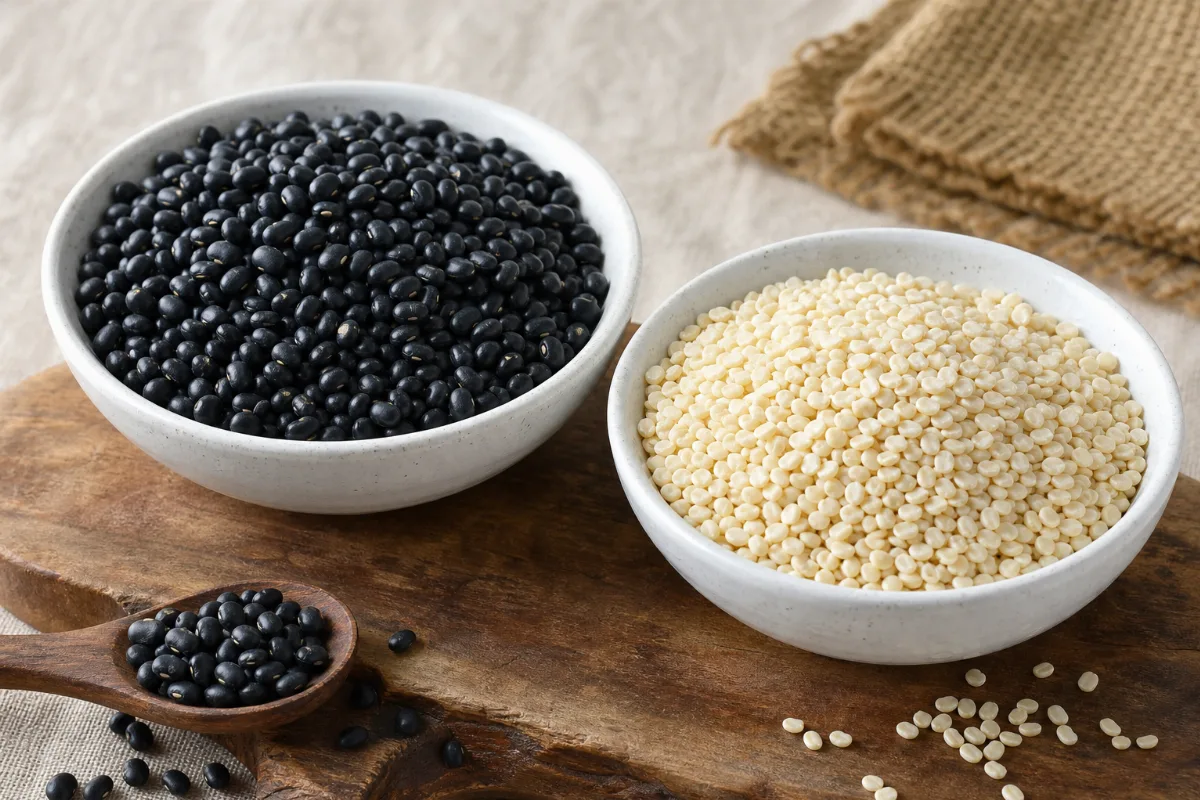
Urad dal is the seed of black gram (Vigna mungo), a legume in the pea family and a cousin of the mung bean. It is sold dry, whole or split, and cooked as a dal. It is also soaked, ground and fermented with rice for idli and dosa batter.
We did not find a USDA reference entry for it. The numbers we use come from one 2026 laboratory paper on raw black gram: per 100 g, 24.13 g protein, 55.53 g carbohydrate, 5.13 g crude fibre (a different measure from label fibre), 1.44 g fat, 3.28 g ash and 10.49 g moisture, plus tannin 4.45 mg per g and phytic acid 6.32 mg per g. Raw seed holds little water, so a cooked serving has far less protein per gram.
What the research shows
We found no trial of urad dal in people. Pooled trials of pulses as a group (beans, chickpeas, lentils and peas) found a small average fall in LDL cholesterol (0.17 mmol/L), lower fasting glucose and insulin, and a very small weight change (0.34 kg). Black gram was not singled out in those abstracts, so the results cannot be assumed for it.
Laboratory studies show that fermenting idli batter lowers antinutrients such as tannins and phytic acid, and raises biogenic amines. These are chemistry results, not health results.
At a glance
Traditional uses history, not proof
- Cooked as a dal, a staple of South Asian meals
- Ground and fermented with rice for idli and dosa batter
- Long use as food is not proof that it treats any condition
Studied for research
- Plant protein, laboratory composition only
- Cholesterol, insufficient evidence for black gram (low for pulses as a group)
- Blood sugar, insufficient evidence for black gram (low for pulses as a group)
- Body weight, insufficient evidence for black gram (low for pulses as a group)
- Fermentation and antinutrients in idli, laboratory measurements only
Main compounds
- Plant protein
- Tannins
- Phytic acid
- Lectins
- Trypsin inhibitors
- Biogenic amines (formed in fermented batter)
Common forms
- Cooked whole or split urad dal as food
- Fermented idli and dosa batter (laboratory studies only)
- Flour and extracts are different products and were not read
Research links: 2014 meta-analysis: pulses and LDL cholesterol · 2016 meta-analysis: pulses and body weight · 2011 study: legume allergy and cross-reactivity in India · Research Library · Genes & Biomarkers Library
What it is and its history
- Accepted scientific name
- Vigna mungo
- Naming authority
- (L.) Hepper
- Common names
- Urad dal (Hindi); Black gram (English); Urid (English); Black matpe (English); Urd bean (English); Frijol urad / lenteja negra (urad dal) (Spanish)
- Family or group
- Fabaceae (the legume or pea family), as given by GBIF. A cousin of the mung bean (Vigna radiata) in the same genus.
- Classification
- Plantae > Tracheophyta > Magnoliopsida > Fabales > Fabaceae > Vigna > Vigna mungo
- Native range
- Not verified from a source read.
- Habitat
- Not verified from a source read.
- What it looks like
- Roots: Not verified.; Stems: Not verified.; Leaves: Not verified.; Flowers: Not verified.; Fruit: The seed is eaten after cooking, as whole or split dal (existing nutrient summary; not verified from a source read).
- Cultivation
- Not verified from a source read.
- Harvest and processing
- Sold dry as whole or split seed, and ground into flour or batter (existing nutrient summary). Idli and dosa batter is made by soaking, grinding and fermenting urad dal with rice (idli study abstract).
- Look-alikes and adulterants
- Name: Mung bean (Vigna radiata); Note: A close relative with its own page; not the same food.; Name: Pigeon pea and other dals; Note: Other dals sold under similar names in shops.
- Sustainability and conservation
- Not assessed.
Photographs
What is inside, and how it may work
What it contains and how those compounds act in cells and animals. Laboratory and animal mechanisms are not proven effects in people.
Main compounds
| Compound | Family | Where it is concentrated | Activity studied | Level of evidence |
|---|---|---|---|---|
| Plant protein | protein | Seed 24.13 g per 100 g raw (laboratory analysis) | Gives the seed its protein. In a laboratory digestion model about 70.86% of the raw protein was digested. 5 | Lab |
| Tannins | polyphenol antinutrient | Seed 4.45 mg per g raw (laboratory analysis) | An antinutrient that can bind minerals and slow protein digestion (laboratory description). Lowered by fermentation in the lab. 5 6 | Lab |
| Phytic acid | phosphorus-storage compound | Seed 6.32 mg per g raw (laboratory analysis) | An antinutrient that can reduce mineral absorption. Lowered by soaking, fermenting and cooking in the lab. 5 6 | Lab |
| Lectins | protein | Seed Not detected in raw urid beans by one 2021 assay; hemagglutinating activity reported in the raw idli ingredients in another study | Raw legumes hold the highest lectin levels; cooking with wet heat inactivates most (Harvard). 1 6 9 | Lab |
| Trypsin inhibitors | protein | Seed Measured in raw idli ingredients; value not read | Can interfere with protein digestion in raw seeds; reduced 58% in finished idli (lab). 6 | Lab |
| Biogenic amines | amines formed during fermentation | Fermented batter Total biogenic amines rose 339% in finished idli versus raw ingredients | Compounds formed from amino acids during fermentation. No source read linked them to symptoms in people. 6 | Lab |
Mechanisms, receptors and pathways
| Target or pathway | Gene or receptor | What was found | Level |
|---|---|---|---|
| Fermentation and antinutrients | Not specified | Soaking, fermenting and steaming lowered tannins, phytic acid, trypsin inhibitor activity and hemagglutinating activity in idli versus raw ingredients (laboratory measurement). Fermenting black gram flour with a mould raised in vitro protein digestibility. 6 5 | Lab |
| Legume allergen cross-reactivity | IgE antibodies (laboratory inhibition assays) | Black gram proteins inhibited IgE binding to kidney bean, peanut and pigeon pea in laboratory assays, which means shared allergenic features. 3 | Human data |
Absorption, metabolism and elimination
- Absorption
- Not found for urad dal.
- Distribution
- Not found.
- Metabolism
- Not found.
- Elimination
- Not found.
- Bioavailability
- Not established. Harvard says mineral-blocking effects of antinutrients are suggested by animal and cell studies, with very limited human research.
Isolated compounds versus whole extracts
The pooled trials on cholesterol, blood sugar and weight used whole pulses as food and did not name black gram. Black gram flour fermented with a mould and idli batter were studied only in the laboratory. Extracts and supplements were not read and are different products.
Nutritional composition
No USDA reference entry for urad dal or black gram was used; a few branded product labels exist in USDA FoodData Central, but those are manufacturer figures and were not read. The numbers here come from one 2026 laboratory paper on raw (unfermented) black gram, read in full text: per 100 g, protein 24.13 g, carbohydrate 55.53 g, crude fibre 5.13 g, fat 1.44 g, ash (total minerals) 3.28 g and moisture 10.49 g, plus tannin 4.45 mg per g and phytic acid 6.32 mg per g. The paper states the protein figure as a percentage of the raw material. Crude fibre is not the same measure as the dietary fibre on food labels. The paper gives no vitamin or mineral values that we read, and no cooked-food values. Cooked dal holds a lot of water, so a cooked serving has far less protein per gram than raw seed.
5 not enough evidence
What was looked at
The 5 benefits and uses checked for Urad Dal (Black Gram), each with how strong the evidence is. Tap one to open it.
- Plant protein and carbohydrate (laboratory measurement)Not enough evidence
- Cholesterol (pulses as a group)Not enough evidence
- Blood sugar and insulin (pulses as a group)Not enough evidence
- Body weight (pulses as a group)Not enough evidence
- Fermenting urad dal for idli and dosa (laboratory measurements)Not enough evidence
Lab markers tracked in the studies
LDL cholesterolFasting blood glucoseBody weight
What is Urad Dal (Black Gram) good for?
What research says about eating urad dal. No trial of black gram itself was found, so most rows rest on studies of pulses as a group, or on laboratory measurements.
Benefits, one by one
Each card is a research question, not a promise. Tap a goal to filter. Open a card to see the studies, doses and limits.
Plant protein and carbohydrate (laboratory measurement)
Not enough evidenceA 2026 laboratory paper measured raw black gram at 24.13 g protein, 55.53 g carbohydrate and 5.13 g crude fibre per 100 g. These are food-composition numbers, not a test of health.
1 studiesRaw black gram flour or seed, laboratory analysis.
Studies, doses and limits
What the trials found
No trial in people was found. The numbers come from a laboratory analysis of raw black gram.
Results
Raw black gram is a good source of plant protein by weight. In a laboratory digestion model about 70.86% of the protein was digested. This was not tested in people.
Effect sizes as reported
Per 100 g raw: protein 24.13 g, carbohydrate 55.53 g, crude fibre 5.13 g, fat 1.44 g, moisture 10.49 g, ash 3.28 g.
Why this rating
These are laboratory values for one sample. Values vary by variety and growing place, and no human health outcome was measured.
Form and dose studied
Raw black gram flour or seed, laboratory analysis.
Limits
The paper does not say whether it used whole seed or split dal. Crude fibre is a different lab measure from the dietary fibre on food labels. Cooked values were not read.
Why researchers looked
Urad dal is eaten mostly for its plant protein and starch, so researchers measure what is in it.
Traditional use
Urad dal is a staple of South Asian cooking. It is eaten as a dal, ground into batters for idli and dosa, and made into fritters. Long use as food is not proof that it treats any condition.
Proposed mechanism Unknown
A food-composition fact: the seed holds protein, starch and fibre.
A proposed mechanism does not show that the effect happens in people.
Cook the seeds; see the Safety tab.
Cholesterol (pulses as a group)
Not enough evidencePooled trials of beans, chickpeas, lentils and peas found a small average fall in LDL cholesterol. No trial of black gram itself was found.
1 studiesPulses as food in trials (not advice).
Studies, doses and limits
What the trials found
A 2014 meta-analysis of 26 randomised trials (1,037 adults) found diets emphasising pulses lowered LDL cholesterol by 0.17 mmol/L on average, at a median of about one serving a day, for at least 3 weeks. No effect was seen on apolipoprotein B or non-HDL cholesterol.
Results
A small average fall in LDL in short trials of pulses. Black gram was not named in the abstract, so the result cannot be assumed for urad dal.
Effect sizes as reported
LDL mean difference -0.17 mmol/L (95% CI -0.25 to -0.09).
Why this rating
For black gram itself there is no trial. For pulses as a group the evidence is low: short trials, a small effect, and the authors ask for longer, better trials.
Form and dose studied
Pulses as food in trials (not advice).
Who was studied
Adults in trials.
Limits
Pulses mixed together; black gram not separated; short duration.
Why researchers looked
Pulses are rich in fibre and protein, so researchers ask whether eating them changes cholesterol.
Traditional use
Urad dal is a staple of South Asian cooking. It is eaten as a dal, ground into batters for idli and dosa, and made into fritters. Long use as food is not proof that it treats any condition.
Proposed mechanism Unknown
Not established in the abstract.
A proposed mechanism does not show that the effect happens in people.
None specific.
Blood sugar and insulin (pulses as a group)
Not enough evidencePooled trials of pulses found lower fasting blood sugar and insulin. No trial of black gram itself was found.
1 studiesPulses as food in trials (not advice).
Studies, doses and limits
What the trials found
A 2009 meta-analysis of 41 randomised trials found pulses alone (11 trials) lowered fasting glucose and insulin, and pulses within low-GI diets lowered HbA1c or fructosamine. Differences between trials were large and mostly unexplained.
Results
Pulses as a group improved markers of longer-term blood sugar in these pooled trials. Black gram was not singled out.
Effect sizes as reported
Standardised mean difference: fasting glucose -0.82 (95% CI -1.36 to -0.27) for pulses alone.
Why this rating
No black gram trial. For pulses as a group the evidence is low: old pooled review, high unexplained differences between trials.
Form and dose studied
Pulses as food in trials (not advice).
Who was studied
People with and without diabetes.
Limits
Pulses mixed together; published in 2009; high heterogeneity.
Why researchers looked
Pulses are slowly digested, high-fibre foods, so researchers ask whether they help blood sugar control.
Traditional use
Urad dal is a staple of South Asian cooking. It is eaten as a dal, ground into batters for idli and dosa, and made into fritters. Long use as food is not proof that it treats any condition.
Proposed mechanism Systematic review
The 2009 abstract describes pulses as a source of slowly digestible carbohydrate, fibre and plant protein.
A proposed mechanism does not show that the effect happens in people.
If you take diabetes medicine, ask your clinician or pharmacist before big diet changes.
Body weight (pulses as a group)
Not enough evidencePooled trials found people eating pulses lost slightly more weight than people not eating them, about 0.34 kg over about 6 weeks. No trial of black gram itself was found.
1 studiesPulses as food (trial detail, median 132 g a day, not advice).
Studies, doses and limits
What the trials found
A 2016 meta-analysis of 21 randomised trials (940 adults, median 6 weeks) found diets with about one serving a day of pulses gave a weight change of -0.34 kg compared with diets without pulses.
Results
A very small average weight change, even when diets were not meant to cut calories. Long-term effects are unknown. Black gram was not named in the abstract.
Effect sizes as reported
Weight -0.34 kg (95% CI -0.63 to -0.04), median 6 weeks.
Why this rating
No black gram trial. For pulses as a group the evidence is low: a very small effect in short trials.
Form and dose studied
Pulses as food (trial detail, median 132 g a day, not advice).
Who was studied
Adults in trials.
Limits
Short trials; pulses as a group; the average change is tiny.
Why researchers looked
Pulses are filling foods rich in fibre and protein, so researchers ask whether they help weight control.
Traditional use
Urad dal is a staple of South Asian cooking. It is eaten as a dal, ground into batters for idli and dosa, and made into fritters. Long use as food is not proof that it treats any condition.
Proposed mechanism Unknown
Not established in the abstract.
A proposed mechanism does not show that the effect happens in people.
None specific.
Fermenting urad dal for idli and dosa (laboratory measurements)
Not enough evidenceIn a laboratory idli study, soaking, fermenting and steaming lowered several antinutrients compared with the raw ingredients, while compounds called biogenic amines went up. These are food chemistry results, not health results.
2 studiesIdli batter (black gram dal and rice); black gram flour fermented wit…
Studies, doses and limits
What the trials found
No study in people was found. In one laboratory study of idli, finished idli versus the raw ingredients: tannins down 100%, phytic acid down 89%, trypsin inhibitor activity down 58%, hemagglutinating activity (the lectin test) down 100%, and total biogenic amines up 339%. A separate 2026 laboratory study fermented black gram flour with a mould (Aspergillus awamori), lowering tannin and phytic acid and raising in vitro protein digestibility from 70.86% to 82.89% by day 6.
Results
Lab measurements show antinutrient levels fall with processing. What this means for people eating idli or dosa was not studied in the papers read. The rise in biogenic amines was not linked to symptoms in the sources read.
Effect sizes as reported
Idli versus raw ingredients: tannins -100%, phytic acid -89%, trypsin inhibitor activity -58%, hemagglutinating activity -100%, biogenic amines +339%.
Why this rating
Laboratory food measurements only, from one idli recipe optimised for the study and a mould fermentation that is not the idli method. No health outcome measured.
Form and dose studied
Idli batter (black gram dal and rice); black gram flour fermented with a mould in a lab.
Limits
The idli abstract was read through Europe PMC and not found in PubMed. Home recipes differ from the optimised study conditions.
Why researchers looked
Urad dal batter is fermented for idli and dosa, and researchers measure how that changes compounds that can block mineral and protein uptake.
Traditional use
Idli and dosa batters of urad dal and rice are a long-standing South Asian food. Long use as food is not proof of a health benefit.
Proposed mechanism Laboratory research
Soaking, fermenting and steaming change the compounds in the batter (laboratory measurement).
A proposed mechanism does not show that the effect happens in people.
Fermented batters raised biogenic amines in the study; see the Safety tab.
Connections to the rest of health
How Urad Dal (Black Gram) connects to the rest of our health knowledge graph. Every link says what kind of connection it is. A safety link (for example to the liver) is a warning, not a benefit. A study that merely mentions a topic never creates a benefit link.
Explore every connection: goals, body systems, organs, symptoms, genes
A. Wellness goals
| Connected to | Kind of connection | Evidence status | Context | Studies |
|---|---|---|---|---|
| Energy Vitality | Not enough evidence | Plant protein and carbohydrate (laboratory measurement): A 2026 laboratory paper measured raw black gram at 24.13 g protein, 55.53 g carbohydrate and 5.13 g crude fibre per 100 g. These are food-composition numbers, not a test of health. | 5 | |
| Cholesterol Balance | Not enough evidence | Cholesterol (pulses as a group): Pooled trials of beans, chickpeas, lentils and peas found a small average fall in LDL cholesterol. No trial of black gram itself was found. | 2 | |
| Heart Health | Not enough evidence | Cholesterol (pulses as a group): Pooled trials of beans, chickpeas, lentils and peas found a small average fall in LDL cholesterol. No trial of black gram itself was found. | 2 | |
| Blood Sugar Balance | Not enough evidence | Blood sugar and insulin (pulses as a group): Pooled trials of pulses found lower fasting blood sugar and insulin. No trial of black gram itself was found. | 7 | |
| Healthy Weight | Not enough evidence | Body weight (pulses as a group): Pooled trials found people eating pulses lost slightly more weight than people not eating them, about 0.34 kg over about 6 weeks. No trial of black gram itself was found. | 4 | |
| Digestive Support | Not enough evidence | Fermenting urad dal for idli and dosa (laboratory measurements): In a laboratory idli study, soaking, fermenting and steaming lowered several antinutrients compared with the raw ingredients, while compounds called biogenic amines went up. These are food chemistry results, not health results. | 6 5 |
B. Body systems
| Connected to | Kind of connection | Evidence status | Context | Studies |
|---|---|---|---|---|
| Metabolism Weight | Biological association | Not enough evidence | Studied for: Plant protein and carbohydrate (laboratory measurement) Studied for: Blood sugar and insulin (pulses as a group) | 5 7 4 |
| Cardiovascular System | Biological association | Not enough evidence | Studied for: Cholesterol (pulses as a group) | 2 |
| Digestive System | Biological association | Not enough evidence | Studied for: Fermenting urad dal for idli and dosa (laboratory measurements) | 6 5 |
E. Health conditions
| Connected to | Kind of connection | Evidence status | Context | Studies |
|---|---|---|---|---|
| Food allergy | Adverse effect or risk | Documented risk | In 355 patients in India with a history of legume allergy, black gram showed laboratory cross-reactivity with kidney bean, peanut and pigeon pea. Preparation or compound: Black gram protein in cooked urad dal |
3 11 |
I. Biomarkers
| Connected to | Kind of connection | Evidence status | Context | Studies |
|---|---|---|---|---|
| LDL cholesterol | Biological association | Low certainty | Measured in trials: lowered. A lab change is not the same as a health benefit. | 2 |
| Fasting blood glucose | Biological association | Low certainty | Measured in trials: lowered. A lab change is not the same as a health benefit. | 7 |
| Body weight | Biological association | Low certainty | Measured in trials: lowered. A lab change is not the same as a health benefit. | 4 |
K. Biological pathways
| Connected to | Kind of connection | Evidence status | Context | Studies |
|---|---|---|---|---|
| Protein | Preliminary mechanism | Lab | Urad dal is eaten for plant protein; laboratory analysis found 24.13 g per 100 g raw. | 5 |
| Food allergy | Preliminary mechanism | Human | Laboratory cross-reactivity of black gram with kidney bean, peanut and pigeon pea. | 3 |
L. Active compounds
| Connected to | Kind of connection | Evidence status | Context | Studies |
|---|---|---|---|---|
| Plant protein | Biological association | Lab | Gives the seed its protein. In a laboratory digestion model about 70.86% of the raw protein was digested. Preparation or compound: Seed |
5 |
| Tannins | Biological association | Lab | An antinutrient that can bind minerals and slow protein digestion (laboratory description). Lowered by fermentation in the lab. Preparation or compound: Seed |
5 6 |
| Phytic acid | Biological association | Lab | An antinutrient that can reduce mineral absorption. Lowered by soaking, fermenting and cooking in the lab. Preparation or compound: Seed |
5 6 |
| Lectins | Biological association | Lab | Raw legumes hold the highest lectin levels; cooking with wet heat inactivates most (Harvard). Preparation or compound: Seed |
1 6 9 |
| Trypsin inhibitors | Biological association | Lab | Can interfere with protein digestion in raw seeds; reduced 58% in finished idli (lab). Preparation or compound: Seed |
6 |
| Biogenic amines | Biological association | Lab | Compounds formed from amino acids during fermentation. No source read linked them to symptoms in people. Preparation or compound: Fermented batter |
6 |
Each connection is stored with the ingredient, the connected record, the kind of connection, the evidence status, the supporting studies, the preparation or compound involved, and a review date (last reviewed October 26, 2026).
The evidence
The research centre for Urad Dal (Black Gram). Every record here was checked against PubMed or the publisher's page; we never list a study we have not verified.
Evidence by outcome
Bars show how many studies we found for each outcome, not how well it works. People are added up across trials only (reviews are not added, to avoid double counting).
How we rate evidence
High certainty
Several well-run trials or reviews agree; further research is unlikely to change the picture much.
Moderate certainty
Good trials point the same way, but some doubt remains.
Low certainty
Small, short or inconsistent trials. The finding could change with better research.
Very low certainty
Very little or very weak human data. Treat as a possibility only.
Mixed findings
Trials or reviews disagree with each other.
Not enough evidence
Not enough human research to say either way.
Evidence against
Good research found no benefit, or found harm.
We take the reviewers' own risk-of-bias and GRADE statements where they exist, and otherwise judge from study size, design, consistency, directness and whether a product matches what is sold. Many publications do not make evidence high. Method note: We started from our existing urad dal summary, re-read the full text of the 2026 laboratory paper and the 2021 lectin survey, read the health agency pages (Harvard, Health Canada, MedlinePlus) and re-read PubMed or Europe PMC abstracts for the reviews and studies. Items we could not verify are flagged in the research gaps.
Study library: every study we checked 11
| Study | Design | People | Product, dose, length | Result |
|---|---|---|---|---|
| Adamcova 2021 Lectin Activity in Commonly Consumed Plant-Based Foods: Calling for Method Harmonization and Risk Assessment. Foods · PMID 34829077 · DOI |
Laboratory market survey |
Raw and processed edible plants bought in shops (urid beans among about 100 samples) | Raw and soaked or boiled plant foods tested for lectin activity with a hemagglutination assay Dried seeds and other plant foods |
The highest lectin activity was in plants of the legume family, and soaking and boiling lowered active lectins. In the full text, no assay detected active lectins in urid (black gram) beans, but the authors note that results differ between labs and rabbit blood strains. Not applicable (Not applicable) Methods, limits and fundingOutcomes: Active lectin activity (laboratory assay) Limitations: A lab assay, not a health result. The authors call for agreed methods and say no assay was run on human outcomes. A negative result for one sample does not prove raw black gram is safe. Funding and conflicts: Authors declared no conflict of interest. Read: abstract |
| Ha 2014 Effect of dietary pulse intake on established therapeutic lipid targets for cardiovascular risk reduction: a systematic review and meta-analysis of randomized controlled trials. CMAJ · PMID 24710915 · DOI |
Systematic review meta analysis |
1037 1,037 adults in 26 randomised trials |
Diets emphasising pulses (beans, chickpeas, lentils and peas) Pulses as food Median 130 g a day, about one serving (trial detail, not advice) At least 3 weeks · vs Isocaloric diets without pulses |
Diets emphasising pulses lowered LDL cholesterol compared with control diets. No effect was seen on apolipoprotein B or non-HDL cholesterol. LDL mean difference -0.17 mmol/L (95% CI -0.25 to -0.09 mmol/L) Methods, limits and fundingOutcomes: LDL cholesterol, apolipoprotein B, non-HDL cholesterol Limitations: Pulses as a group; black gram was not named in the abstract. The authors say longer, higher-quality trials are needed. Funding and conflicts: Registered NCT01594567. Funding is not stated in the abstract. Registration: NCT01594567 Read: abstract |
| Kasera 2011 Kidney bean: a major sensitizer among legumes in asthma and rhinitis patients from India. PLoS One · PMID 22096535 · DOI |
Observational clinic study |
355 355 patients in India with a history of legume allergy (asthma and rhinitis patients) |
Skin-prick tests with 10 legumes, blood IgE tests and laboratory inhibition assays Legume extracts |
Kidney bean sensitised 78 patients (22.0%), chickpea 65 (18.0%) and peanut 53 (15%). Inhibition assays showed extensive cross-reactivity among kidney bean, peanut, black gram and pigeon pea. Sensitisation: kidney bean 22.0%, chickpea 18.0%, peanut 15%; black gram cross-reactivity shown in laboratory inhibition tests (Not applicable) Methods, limits and fundingOutcomes: Which legumes sensitised patients; cross-reactivity between legumes Limitations: Patients already had a history of legume allergy, so this does not show how common black gram allergy is. Cross-reactivity in a lab test is not the same as a reaction after eating. Black gram sensitisation rates were not given in the abstract. Funding and conflicts: Authors declared no competing interests. Read: abstract |
| Kim 2016 Effects of dietary pulse consumption on body weight: a systematic review and meta-analysis of randomized controlled trials. Am J Clin Nutr · PMID 27030531 · DOI |
Systematic review meta analysis |
940 940 adults in 21 randomised trials |
Diets containing whole pulses (beans, lentils, chickpeas, dry peas) as food Pulses as food Median 132 g a day, about one serving (trial detail, not advice) Median 6 weeks (at least 3 weeks) · vs Diets without a pulse intervention |
Diets with pulses gave a small weight reduction compared with diets without them, with low heterogeneity. Six trials also suggested lower body fat percentage. Body weight -0.34 kg (95% CI -0.63 to -0.04 kg; P = 0.03) Methods, limits and fundingOutcomes: Body weight, waist circumference, body fat Limitations: A very small average change over a short time. Pulses as a group; black gram was not named in the abstract. Funding and conflicts: Registered NCT01594567. Funding is not stated in the abstract. Registration: NCT01594567 Read: abstract |
| Sadh 2026 Solid-State Fermentation of Black Gram: Improvement of Protein Digestibility and Functional Properties for Composite Flour Applications. Foods · PMID 42511305 · DOI |
Laboratory fermentation |
Black gram (Vigna mungo) flour analysed in a laboratory | Raw black gram flour, then fermented with the mould Aspergillus awamori for 0 to 12 days Black gram flour 0 to 12 days of fermentation · vs Unfermented black gram |
Unfermented black gram: protein 24.13%, carbohydrate 55.53%, moisture 10.49%, crude fibre 5.13%, ash 3.28%, fat 1.44% (full text). Tannin 4.45 mg/g and phytic acid 6.32 mg/g. Fermentation with the mould lowered tannin and phytic acid and raised in vitro protein digestibility from 70.86% to 82.89% by day 6. In vitro protein digestibility 70.86% to 82.89% (day 6) (Not applicable) Methods, limits and fundingOutcomes: Composition, tannin, phytic acid, in vitro protein digestibility Limitations: Laboratory work on flour. The abstract does not say whether whole seed or split dal was used. In vitro digestibility is not a human result. Mould fermentation of this kind is not how idli or dosa are made. Funding and conflicts: The paper states it received no external funding. Read: abstract |
| Sharma 2017 Minimization of antinutrients in idli by using response surface process optimization. J Food Process Preserv · Source · DOI |
Laboratory measurement n/a |
Idli batter ingredients (black gram dal and rice) analysed in a laboratory | Soaking, fermenting and steaming black gram dal and rice to make idli Black gram dal and rice Soak 18 h, ferment 19 h at 35 C, steam 20 min (optimised conditions) · vs Raw ingredients |
Compared with the raw ingredients, finished idli had tannins down 100%, phytic acid down 89%, trypsin inhibitor activity down 58% and hemagglutinating activity down 100%. Total biogenic amines rose by 339%. Biogenic amines +339%; other antinutrients reduced (Not applicable) Methods, limits and fundingOutcomes: Tannins, phytic acid, trypsin inhibitor activity, hemagglutinating activity, biogenic amines Limitations: Chemical measurements in food, not health outcomes. The abstract was read through Europe PMC; it was not found in PubMed. Funding and conflicts: Funding is not stated in the abstract. Read: abstract (Europe PMC) |
| Sievenpiper 2009 Effect of non-oil-seed pulses on glycaemic control: a systematic review and meta-analysis of randomised controlled experimental trials in people with and without diabetes. Diabetologia · PMID 19526214 · DOI |
Systematic review meta analysis |
41 randomised trials in people with and without diabetes | Non-oil-seed pulses (chickpeas, beans, peas, lentils and others), alone or in low-GI or high-fibre diets Pulses as food Trial detail not given in the abstract At least 7 days · vs Control diets |
Pulses alone (11 trials) lowered fasting glucose and insulin. Pulses in low-GI diets (19 trials) lowered HbA1c or fructosamine. Pulses in high-fibre diets (11 trials) lowered fasting glucose and glycosylated proteins. Standardised mean differences: fasting glucose -0.82 (pulses alone); glycosylated proteins -0.28 (low-GI diets) (Fasting glucose -0.82 (-1.36 to -0.27); insulin -0.49 (-0.93 to -0.04); glycosylated proteins -0.28 (-0.42 to -0.14)) Methods, limits and fundingOutcomes: Fasting blood glucose, insulin, glycosylated proteins (HbA1c or fructosamine) Limitations: Pulses as a group, not black gram. Between-study differences were high and mostly unexplained. Published in 2009. Funding and conflicts: Funding is not stated in the abstract. Read: abstract |
| s-gbif-vigna-mungo GBIF species match: Vigna mungo (L.) Hepper · Source |
Reference database n/a |
Methods, limits and fundingRead: api-record | ||
| s-harvard-lectins Harvard T.H. Chan School of Public Health: Lectins (The Nutrition Source) · Source |
Health agency n/a |
Methods, limits and fundingRead: full-text | ||
| s-healthcanada-lectins Health Canada: Lectins in Dry Legumes · Source |
Health agency n/a |
Methods, limits and fundingRead: full-text | ||
| s-medlineplus-foodallergy MedlinePlus: Food allergy · Source |
Health agency n/a |
Methods, limits and fundingRead: full-text |
What we do not know yet
- No trial of urad dal or black gram in people was found for any health outcome.
- The pooled trials mix beans, chickpeas, lentils and peas; a black gram result was not in the abstracts read.
- No USDA reference values, cooked values, vitamins, minerals or dietary fibre were read for urad dal.
- How common black gram allergy is, and pregnancy, children, kidney disease, FODMAP, oxalate, purine, contaminant and mould questions, were not researched.
How new research is added
New studies are found by a saved PubMed search and placed in a review queue before the page changes.
Lab markers
What changed in blood or saliva tests during trials. A changed number is not the same as feeling or being healthier, and we give no "normal ranges".
Metabolic 2
LDL cholesterol
Lowered in trials
The 'bad' cholesterol carried in the blood. Higher levels are linked to more heart disease.
Low certaintyResults and what it means
Why it was measured
It is the usual blood marker used in diet trials for heart risk.
Statistical vs. clinical meaning
A small average fall in short trials of pulses as a group. Not tested for black gram.
Safety implication
None specific.
| Study | Result | People | Product |
|---|---|---|---|
| 2 | LDL mean difference -0.17 mmol/L (95% CI -0.25 to -0.09); no effect on apoB or non-HDL | 1,037 adults in 26 trials | Diets emphasising pulses (not black gram specifically), median 130 g/day, at least 3 weeks |
Body weight
Lowered in trials
Weight in kilograms measured in a trial.
Low certaintyResults and what it means
Why it was measured
A basic measure used in diet trials.
Statistical vs. clinical meaning
A very small average change in short trials of pulses, not black gram alone.
Safety implication
None specific.
| Study | Result | People | Product |
|---|---|---|---|
| 4 | Body weight -0.34 kg (95% CI -0.63 to -0.04), P = 0.03, median 6 weeks | 940 adults in 21 trials | Diets with whole pulses (black gram not specified), median 132 g/day |
Other 1
Fasting blood glucose
Lowered in trials
Blood sugar measured after not eating overnight.
Low certaintyResults and what it means
Why it was measured
It is a standard marker of blood sugar control.
Statistical vs. clinical meaning
Lower on average in pooled trials of pulses, with high unexplained differences between trials. Not tested for black gram.
Safety implication
None specific.
| Study | Result | People | Product |
|---|---|---|---|
| 7 | Pulses alone (11 trials): fasting glucose SMD -0.82 (95% CI -1.36 to -0.27); insulin SMD -0.49 (-0.93 to -0.04) | Part of 41 trials in people with and without diabetes | Pulses as food (black gram not specified) |
Safety
What studies and official sources say about side effects, medicines and who should check first. Each point shows what kind of evidence it comes from.
Main points to know 2
- Cook the seeds; do not eat dry black gram raw. Raw legumes hold the highest lectin levels, and Harvard says wet-heat cooking or soaking can inactivate most lectins. Health Canada says lectins occur in varying levels in many legumes and that illness has mostly followed improperly cooked red kidney beans (nausea, vomiting and diarrhoea within 1 to 3 hours). Black gram is not named by either source. A 2021 laboratory survey did not detect active lectin in raw urid (black gram) beans with its method, but the authors say methods are not harmonised and one sample does not show a safe level. We read no report of poisoning from black gram and no study that fed people raw black gram. Authoritative guidance 9 10 1
- Legume and peanut allergy: possible cross-reactivity. In 355 patients in India with a history of legume allergy, laboratory inhibition tests showed extensive cross-reactivity among kidney bean, peanut, black gram and pigeon pea. This shows the proteins look alike to the immune system in tests. It does not show how many people react to black gram after eating it. If you have a peanut or legume allergy, ask your allergist before eating urad dal. Observational 3 11
Side effects 2
| Effect | How often | Severity and recovery | Evidence |
|---|---|---|---|
| Allergic reactions, from itching and hives to anaphylaxis, in people with legume allergy The clinic study included only patients who already had a history of legume allergy. It does not show how common black gram allergy is. | Not established | can be severe (anaphylaxis) Not found for black gram | Observational 3 11 |
| Nausea, vomiting and diarrhoea after eating undercooked legumes (lectins) Black gram is not named by Health Canada. No black gram case was found. | Not established | usually short-lived; reported mostly for red kidney beans Symptoms generally subside within a short period (Health Canada, for red kidney beans) | Authoritative guidance 10 |
Liver
No liver injury from eating urad dal was found in the sources read. A liver-safety source (such as LiverTox) was not searched for food.
How often. No frequency was found.
Monitoring. No agency monitoring advice was found.
This is a safety connection. It is not evidence that Urad Dal (Black Gram) supports liver health.
Medicines and supplements 1
| With | Why it matters | Importance | Evidence | What to do |
|---|---|---|---|---|
| Medicines for diabetes or high cholesterol prescription | Pooled trials of pulses lowered blood sugar and LDL cholesterol a little; a large change in diet could in theory add to a medicine. | No source read tied urad dal to any specific medicine interaction. This is a general caution, not a documented interaction. | Theoretical Not enough evidence 2 7 | Ask your clinician or pharmacist before making big diet changes if you take diabetes or cholesterol medicine. |
Who should check first 1
Overdose, product quality and regulators
Summary. No toxicity from cooked urad dal as ordinary food was found in the sources read. Raw legumes contain lectins and other antinutrients that cooking reduces.
Animal. Not reviewed.
Human doses studied. No trial of urad dal in people was found.
Overdose response. Not found.
Genotoxicity. Not researched.
Toxic or hazardous parts. Raw or undercooked seeds: lectins (Harvard, Health Canada). Raw black gram also holds tannins and phytic acid (laboratory paper) that can reduce mineral absorption; Harvard says this effect is suggested by animal and cell studies with very limited human research.
Mould, pesticide residues, heavy metals and recalls were not researched for urad dal.
Cooking dry legumes. Health Canada gives soaking and boiling steps for dry red kidney beans and says slow cookers do not reach high enough temperatures for those beans; Harvard says raw beans simmered at low heat may keep their lectins. Neither names black gram. Bring legumes to a full boil rather than only slow cooking. 10 9
| Body | Action | Date |
|---|---|---|
| Health Canada (Canada) | Lectins in dry legumes: lectins are found in varying levels in many legumes; illness is usually from improperly cooked red kidney beans; soaking and boiling steps are for dry red kidney beans. Black gram is not named. source | 2017-05-04 |
| MedlinePlus (US National Library of Medicine) (United States) | Food allergy: a food allergy can cause anaphylaxis, a life-threatening reaction with trouble breathing, a severe drop in blood pressure and loss of consciousness; it is a medical emergency. source | 2025-11-19 |
When to get medical help
- Trouble breathing, swelling of the lips, face or throat, widespread hives, repeated vomiting or collapse after eating urad dal (possible anaphylaxis): call emergency services
- Severe vomiting or diarrhoea after eating undercooked legumes: seek medical advice
Stop using the product and contact a clinician or emergency service. In the US, Poison Control is 1-800-222-1222.
General information only, not medical advice. Ask a clinician or pharmacist before use, especially with medicines, in pregnancy or with a health condition. See the Natural Remedy Safety guide.
Frequently asked questions
What is urad dal?
It is the seed of the black gram plant, a cousin of the mung bean. It is cooked as a dal and used in idli and dosa batter.
Is urad dal the same as black gram?
Yes. Urad dal is the Hindi name for black gram, the seed of Vigna mungo. It is also called urid or black matpe.
Is urad dal high in protein?
A 2026 laboratory analysis found 24.13 g protein per 100 g raw black gram, with a laboratory digestibility of about 71%. A cooked serving has far less protein per gram because cooking adds water.
Is it safe to eat urad dal raw?
Can I eat urad dal if I am allergic to peanuts?
Ask your allergist. In patients in India with legume allergy, laboratory tests showed cross-reactivity among peanut, kidney bean, black gram and pigeon pea. That does not show how many people react after eating it.
Does urad dal lower cholesterol?
We found no trial of urad dal itself. Pooled trials of pulses as a group found a small average fall in LDL cholesterol of 0.17 mmol/L.
Does urad dal help with blood sugar?
No black gram trial was found. Pooled trials of pulses found lower fasting glucose and insulin, with large differences between trials. If you take diabetes medicine, ask your clinician before big diet changes.
Does urad dal help with weight loss?
Not shown for urad dal. Pooled trials of pulses found a very small average change of 0.34 kg over about 6 weeks.
Does fermenting urad dal for idli and dosa make it healthier?
In one laboratory study, fermenting and steaming idli batter lowered tannins, phytic acid and trypsin inhibitors compared with the raw ingredients, and raised biogenic amines by 339%. No health benefit in people was shown.
Do tannins and phytic acid in urad dal matter?
Is urad dal safe in pregnancy or for children?
We found no urad dal-specific advice from an official body. As a cooked food it is eaten widely, but ask a clinician about your situation.
Explore by health goal
Energy VitalityCholesterol BalanceHeart HealthBlood Sugar BalanceHealthy WeightDigestive Support
Editorial transparency
- Written by
- AlternativeMed editorial team. Research compiled with AI assistance, then checked against the sources listed.
- Medical review
- None. This page has not been reviewed by a physician or pharmacist.
- First published
- 2026-10-26
- Last substantive update
- 2026-10-26
- How we research
- We started from our existing urad dal summary, re-read the full text of the 2026 laboratory paper and the 2021 lectin survey, read the health agency pages (Harvard, Health Canada, MedlinePlus) and re-read PubMed or Europe PMC abstracts for the reviews and studies. Items we could not verify are flagged in the research gaps.
- How we rate evidence
- See "How we rate evidence" in the Evidence tab.
- Independence
- No product is promoted on this page. No affiliate links are shown.
Sources 11
Each source was opened and checked. Where we read only the abstract, it says so. The small numbers in the text point here.
- Adamcova A, Laursen KH, Ballin NZ. Lectin Activity in Commonly Consumed Plant-Based Foods: Calling for Method Harmonization and Risk Assessment.. Foods. 2021. PMID 34829077. DOI 10.3390/foods10112796. (abstract)
- Ha V, Sievenpiper JL, de Souza RJ, et al.. Effect of dietary pulse intake on established therapeutic lipid targets for cardiovascular risk reduction: a systematic review and meta-analysis of randomized controlled trials.. CMAJ. 2014. PMID 24710915. DOI 10.1503/cmaj.131727. (abstract)
- Kasera R, Singh BP, Lavasa S, et al.. Kidney bean: a major sensitizer among legumes in asthma and rhinitis patients from India.. PLoS One. 2011. PMID 22096535. DOI 10.1371/journal.pone.0027193. (abstract)
- Kim SJ, de Souza RJ, Choo VL, et al.. Effects of dietary pulse consumption on body weight: a systematic review and meta-analysis of randomized controlled trials.. Am J Clin Nutr. 2016. PMID 27030531. DOI 10.3945/ajcn.115.124677. (abstract)
- Sadh PK, Patil ND, Mundalia N, et al.. Solid-State Fermentation of Black Gram: Improvement of Protein Digestibility and Functional Properties for Composite Flour Applications.. Foods. 2026. PMID 42511305. DOI 10.3390/foods15142559. (abstract)
- Sharma A, Kumari S, Nout MJR, Sarkar PK. Minimization of antinutrients in idli by using response surface process optimization.. J Food Process Preserv. 2017. DOI 10.1111/jfpp.13099. (abstract (Europe PMC))
- Sievenpiper JL, Kendall CW, Esfahani A, et al.. Effect of non-oil-seed pulses on glycaemic control: a systematic review and meta-analysis of randomised controlled experimental trials in people with and without diabetes.. Diabetologia. 2009. PMID 19526214. DOI 10.1007/s00125-009-1395-7. (abstract)
- . GBIF species match: Vigna mungo (L.) Hepper. . . (api-record)
- . Harvard T.H. Chan School of Public Health: Lectins (The Nutrition Source). . . (full-text)
- . Health Canada: Lectins in Dry Legumes. . . (full-text)
- . MedlinePlus: Food allergy. . . (full-text)
Where to buy
Check the label first. Whatever you buy, look for these:
- A recent packed-on date: very old dried beans cook unevenly
- Organic or not, and the country of origin
- Whether you want dried or canned
- Soak and cook thoroughly; some raw beans are unsafe
Talk to a pharmacist or doctor before you start any supplement, especially if you take medicines. See the Safety tab for interactions.
Support our free guides: as an Amazon Associate we earn from qualifying purchases. Full disclosure.


