Functional Foods · Fermented food
Natto
Glycine max (fermented with Bacillus subtilis var. natto) · also called Japanese fermented soybeans
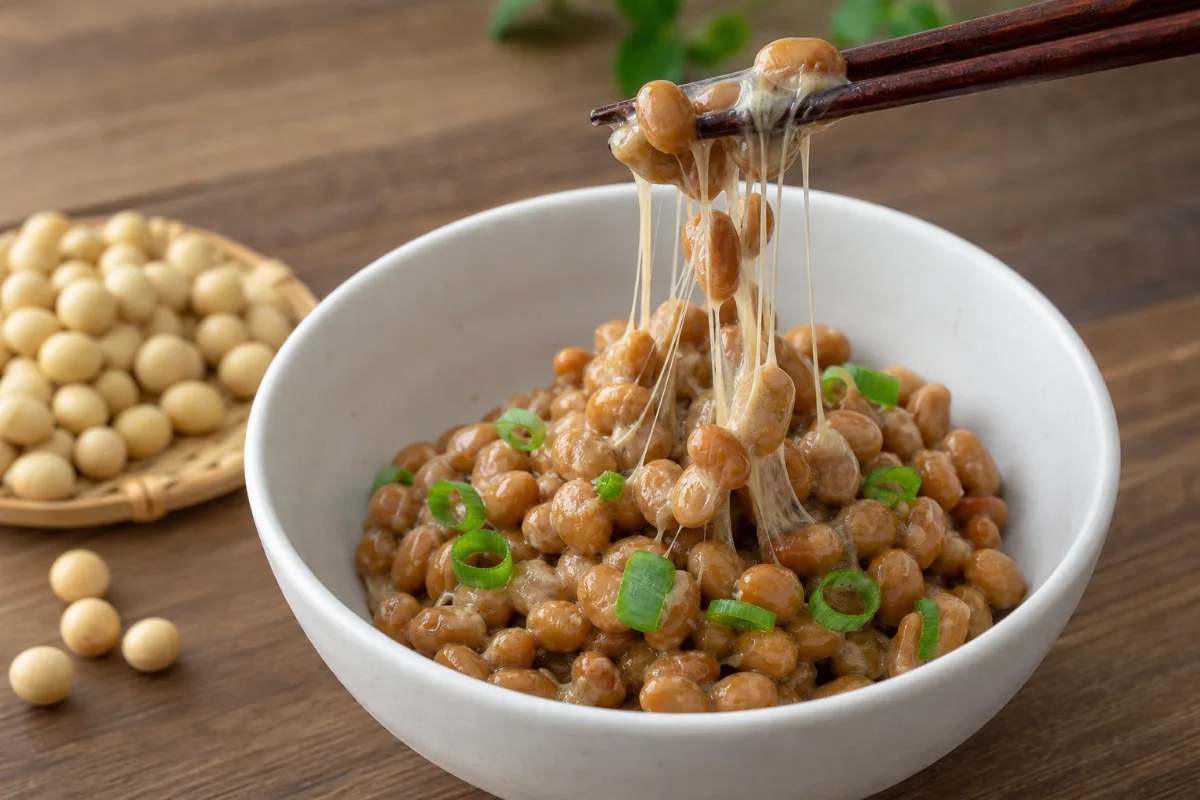
Natto is a sticky Japanese food made from fermented soybeans. It is very high in vitamin K2, and studies in Japan link regular eating with higher blood K2 and with fewer bone fractures and deaths, though these are observational and cannot prove cause. The most important caution is warfarin: natto is a vitamin K-rich food, so check with your anticoagulation clinic before changing how much you eat. Soy allergy is the other main caution.
General information, not medical advice. Last substantive update · Not medically reviewed. A named clinician has not signed off on this page. How this page is made
About Natto
Natto is a sticky Japanese food made from fermented soybeans. It is high in protein and very high in vitamin K2. It is a food, not a proven remedy: the heart and bone findings are mostly observational, and the main cautions are warfarin and soy allergy.
What it is
Natto is whole soybeans (Glycine max) fermented with Bacillus subtilis var. natto. Two papers read call it a traditional Japanese fermented soybean food, and a 2025 pooled analysis calls it the richest natural source of menaquinone-7 (MK-7), a form of vitamin K2. The sticky strands contain poly-gamma-glutamic acid and an enzyme called nattokinase.
USDA data per 100 g: 211 kcal, 19.4 g protein, 11.0 g fat, 12.68 g carbohydrate, 5.4 g fibre, 217 mg calcium, 8.6 mg iron, 729 mg potassium and 7 mg sodium. USDA's 1 cup (175 g) portion has about 34 g of protein and 15 mg of iron. One bone study counts a pack as about 40 g, which would be about 8 g of protein and 3.4 mg of iron.
Vitamin K2: what the numbers mean
USDA lists only vitamin K1 (phylloquinone) for natto, 23.1 micrograms per 100 g, and no K2 value. A separate Japanese laboratory analysis measured MK-7 at 939 micrograms per 100 g of natto. They are different forms of vitamin K, and products vary, so neither number is an amount to plan around.
In volunteers, eating natto raised blood MK-7 from 1.86 to 14.54 ng/mL at 5 hours, and it was still raised at 48 hours. Boiled natto raised it only to 4.02 ng/mL. A pooled analysis found natto eaters had clearly higher serum MK-7 (certainty moderate).
What the research shows
The bone findings are mixed. Cohorts of Japanese women linked natto with less bone loss at the femoral neck and, at 7 or more packs a week, with fewer osteoporotic fractures (HR 0.56, fully adjusted). The lower intake group (1 to 6 packs a week, HR 0.79) was not significant. A one-year trial in 73 premenopausal women found no change in bone stiffness, though some bone-formation markers differed. The pooled analysis rated certainty low or very low.
For death rates, older Japanese men who ate natto several packs a week had a lower risk (HR 0.603) than those who ate none. In about 29,000 Japanese adults, the highest quarter of natto intake had lower cardiovascular death (HR 0.75) and stroke death (HR 0.68). A review of 52 cohorts saw a modest link for fermented soy but said the evidence is insufficient for health claims.
For blood sugar and cholesterol, trials of fermented soy products found small average drops, but they pooled many products and a review of reviews called the benefits inconclusive. No trial of natto alone was found for those.
Food versus supplements
The bone, death-rate and blood K2 results are for natto eaten as food. The blood sugar and cholesterol results are for fermented soy products in general. A warning that MK-7 preparations giving 50 micrograms a day or more may interfere with blood-thinning treatment comes from a supplement study. Nattokinase and MK-7 supplements are different products from natto, and results for one do not transfer to the other.
At a glance
Traditional uses history, not proof
- Eaten as a traditional Japanese fermented soybean food
- Long use as food is not proof that it treats any condition
Studied for research
- Protein, fibre, iron and other nutrients, high certainty for the nutrient content
- Vitamin K2 (MK-7) in the blood, moderate certainty (pooled observational studies and a volunteer study)
- Bone density, bone markers and fractures, low certainty (mostly observational; one small trial found no change in bone stiffness)
- Death from any cause, low certainty (observational)
- Death from heart disease and stroke, low certainty (one large cohort)
- Blood sugar, cholesterol and waist size, insufficient evidence for natto (trials used fermented soy in general)
- Probiotic benefit, insufficient evidence
Main compounds
- Vitamin K2 (MK-7)
- Protein
- Poly-gamma-glutamic acid (sticky mucilage)
- Nattokinase (enzyme)
- Iron, copper, manganese and fibre
Common forms
- Natto as food, USDA item read
- Boiled natto (a volunteer study; lower MK-7)
- Frozen, flavoured and seasoned natto (not read)
- Nattokinase and MK-7 supplements are different products and are not covered
Research links: 2025 pooled analysis: natto, blood K2 and bone (6 studies) · 2017 study: natto and cardiovascular death (Takayama) · 2020 study: natto and osteoporotic fractures · Research Library · Genes & Biomarkers Library
What it is and its history
- Accepted scientific name
- Glycine max (L.) Merr. fermented with Bacillus subtilis var. natto
- Naming authority
- Soybean: (L.) Merr. (GBIF accepted). The fermenting bacterium is Bacillus subtilis (GBIF accepted); the "var. natto" naming comes from the papers read.
- Common names
- Natto (English); Natto (Japanese fermented soybeans) (English); Natto (Spanish)
- Family or group
- Fabaceae (the legume family), as given by GBIF for the soybean. Natto itself is a processed food, not a plant.
- Classification
- Plantae (soybean); Bacteria (fermenting organism) > Tracheophyta > Magnoliopsida > Fabales > Fabaceae > Glycine > Glycine max
- Native range
- Not verified from a source read.
- Habitat
- Not verified from a source read.
- What it looks like
- Fruit: Natto is whole soybeans fermented with Bacillus subtilis var. natto; the abstracts read describe it as a traditional Japanese fermented soybean food whose sticky mucilage contains poly-gamma-glutamic acid and nattokinase.
- Harvest and processing
- Natto is made by fermenting soybeans with Bacillus subtilis var. natto (per the papers read). Details of the making process, strains, timing and temperature were not read from a source. Boiling reduced living Bacillus subtilis and the MK-7 content in one study.
- Look-alikes and adulterants
- Name: Tempeh and miso; Note: Other fermented soy foods with their own pages; they use different fermenting organisms and differ in nutrients and amines.; Name: Nattokinase and natto-named supplements; Note: Supplements are separate products; results for them do not transfer to the food.; Name: Soy sauce and fermented tofu; Note: Other fermented soy products with different salt, amine and processing profiles.
- Sustainability and conservation
- Not assessed.
Photographs
Traditional use and history history, not clinical proof
| Tradition or era | Documented use | Source |
|---|---|---|
| Traditional Japanese food | Two papers read describe natto as a traditional Japanese fermented soybean food and, in one, as a "culturally grounded dietary approach". Dates, regions and origin stories were not read from a source and are not stated. | p41393956 |
Traditional use shows how it was used. It does not show that it works or is safe today.
What is inside, and how it may work
What it contains and how those compounds act in cells and animals. Laboratory and animal mechanisms are not proven effects in people.
Main compounds
| Compound | Family | Where it is concentrated | Activity studied | Level of evidence |
|---|---|---|---|---|
| Vitamin K2 (menaquinone-7, MK-7) | vitamin K2 | Fermented soybean 939 micrograms per 100 g in one Japanese laboratory analysis (USDA lists no K2 value) | Made by the fermenting bacterium. Natto is called the richest natural source of MK-7. In volunteers, eating natto raised blood MK-7 for 48 hours. Boiling cut MK-7 content. 4 20 2 | Human data |
| Vitamin K1 (phylloquinone) | vitamin K1 | Soybean USDA: 23.1 micrograms per 100 g | The only vitamin K form USDA lists for natto. 26 | Reference data |
| Protein | protein | Fermented soybean USDA: 19.4 g per 100 g | Also the source of the soy allergen. 26 | Reference data |
| Poly-gamma-glutamic acid | polymer of glutamic acid | Sticky mucilage Not read | Reported by case-report authors as the main natto allergen. Allergy to it can be delayed. 17 19 | Human data |
| Nattokinase | enzyme (subtilisin-type protease) | Sticky mucilage Not read | An enzyme in natto; reported as a further natto allergen in 8 patients. The Takayama authors note it is a potent fibrinolytic (clot-breaking) enzyme. Natto-named supplements are different products. 19 11 | Human data |
| Iron, copper, manganese and fibre | minerals and fibre | Fermented soybean USDA per 100 g: iron 8.6 mg, copper 0.667 mg, manganese 1.528 mg, fibre 5.4 g | Nutrient amounts only. 26 | Reference data |
| Biogenic amines (tyramine, histamine) | amines | Fermented soybean Not read for natto | Reviews say fermented soybean foods vary, with most within safe levels but some above toxic levels; natto is not named in the abstracts. 15 8 | Review |
Mechanisms, receptors and pathways
| Target or pathway | Gene or receptor | What was found | Level |
|---|---|---|---|
| Osteocalcin activation (carboxylation) | Osteocalcin (bone protein) | Natto intake went with lower undercarboxylated osteocalcin in a pooled analysis, consistent with vitamin K2 activating osteocalcin. This is an association in observational studies. 20 | Human data |
| Vitamin K and blood clotting | Vitamin K-dependent clotting factors (the target of warfarin) | Vitamin K is needed to make clotting factors; warfarin lessens vitamin K's action, so a change in vitamin K intake changes its effect (patient guidance read). 21 25 | Human data |
| Fermentation-derived compounds | Not specified | The mortality review authors name bioactive peptides, polyphenols, isoflavones, nattokinase and vitamin K2 as plausible reasons for a link between fermented foods and lower mortality. This is a proposal, not a tested mechanism. 13 | Hypothesis |
Absorption, metabolism and elimination
- Absorption
- In volunteers, plasma MK-7 peaked by 5 hours after eating natto and was still raised at 48 hours. A supplement study found MK-7 stays in the blood much longer than vitamin K1.
- Distribution
- Not found.
- Metabolism
- Not found.
- Elimination
- Not found.
- Bioavailability
- Boiled natto, with less MK-7, raised blood MK-7 much less than untreated natto in the same volunteer study.
Isolated compounds versus whole extracts
The bone, death-rate and blood MK-7 results here are for natto eaten as food. The blood sugar and cholesterol results are for fermented soy products of many kinds. The MK-7 warning for blood thinners at 50 micrograms a day comes from a supplement study. Nattokinase and MK-7 supplements are different products from natto, and food results do not transfer to them.
Nutritional composition
Nutrition from USDA FoodData Central, natto (FDC 172443, SR Legacy, April 2018 release), read 2026-10-26 from a saved copy of the USDA data. Per 100 g: 211 kcal, 19.4 g protein, 11.0 g fat (1.591 g saturated), 12.68 g carbohydrate (4.89 g sugars), 5.4 g fibre, 217 mg calcium, 8.6 mg iron, 115 mg magnesium, 174 mg phosphorus, 729 mg potassium, 7 mg sodium, 3.03 mg zinc, 1.528 mg manganese, 0.667 mg copper and 8.8 micrograms selenium. USDA's household portion is 1 cup (175 g; the 100 g values multiplied by 1.75): about 369 kcal, 34 g protein, 19 g fat, 10 g fibre, 380 mg calcium, 15 mg iron and 1276 mg potassium. That is much more than one pack. One study of natto and fractures counts a pack as about 40 g (the 100 g values multiplied by 0.4): about 84 kcal, 7.8 g protein, 2.2 g fibre, 87 mg calcium and 3.4 mg iron. Vitamin K: USDA lists only vitamin K1 (phylloquinone), 23.1 micrograms per 100 g, and no K2 (MK-7) value. A separate Japanese laboratory analysis measured MK-7 at 939 micrograms per 100 g of natto. Those two numbers measure different forms of vitamin K, and products vary, so neither is an amount to plan around. Seasoning packs that come with some natto were not read, so sodium from sauce is not included. Frozen or flavoured natto and other brands were not read.
1 high certainty1 moderate certainty3 low certainty2 not enough evidence
What was looked at
The 7 benefits and uses checked for Natto, each with how strong the evidence is. Tap one to open it.
- Protein, fibre, iron and other nutrients (nutrient content)High certainty
- Vitamin K2 (MK-7) in the bloodModerate certainty
- Bone density, bone markers and fracturesLow certainty
- Death from any cause (observational)Low certainty
- Death from heart disease and stroke (observational)Low certainty
- Blood sugar, cholesterol and waist size (fermented soy in general)Not enough evidence
- Is natto a probiotic food?Not enough evidence
Lab markers tracked in the studies
Serum vitamin K2 (MK-7)Undercarboxylated osteocalcin (ucOC)Bone mineral densityFasting blood glucoseTotal cholesterol
What is Natto good for?
The main studied uses and how strong the human evidence is for each. Most results come from Japanese people and from observational studies, which cannot show that natto caused the difference.
Benefits, one by one
Each card is a research question, not a promise. Tap a goal to filter. Open a card to see the studies, doses and limits.
Protein, fibre, iron and other nutrients (nutrient content)
High certaintyBy USDA data, 100 g of natto has 19.4 g of protein, 5.4 g of fibre, 8.6 mg of iron, 217 mg of calcium and 729 mg of potassium. It also has plenty of copper and manganese. A 1 cup (175 g) USDA portion is much larger than one pack of about 40 g.
1 studiesNatto as food (USDA item, SR Legacy). Frozen, flavoured or seasoned p…
Studies, doses and limits
What the trials found
No trial was read showing that eating natto corrects a low nutrient level. Absorption of its iron or minerals was not studied in the sources read.
Results
Natto is a source of protein, fibre and several minerals on paper.
Effect sizes as reported
USDA per 100 g: protein 19.4 g, fibre 5.4 g, iron 8.6 mg, calcium 217 mg, magnesium 115 mg, potassium 729 mg, zinc 3.03 mg.
Why this rating
High that the food contains these amounts (USDA table). Not tested as a treatment for any shortfall.
Form and dose studied
Natto as food (USDA item, SR Legacy). Frozen, flavoured or seasoned products were not read.
Who was studied
General adult diet.
Limits
Nutrient facts, not trials. Brands and recipes differ.
Why researchers looked
People eat natto as a protein-rich fermented soy food.
Traditional use
Natto is described in the research as a traditional Japanese food. Long use as food is not proof that it treats any condition.
Proposed mechanism Nutrient database
These are nutrient amounts in the food, taken from the USDA table.
A proposed mechanism does not show that the effect happens in people.
Natto is high in vitamin K, which matters for warfarin, and soy is a major allergen; see the Safety tab.
Vitamin K2 (MK-7) in the blood
Moderate certaintyNatto is the richest natural food source of MK-7, a form of vitamin K2, according to a 2025 pooled analysis. People who ate natto regularly had clearly higher MK-7 in their blood. In volunteers, a single serving of natto raised blood MK-7, and it was still raised two days later.
3 studiesNatto eaten as food. Boiled natto was also tested. MK-7 supplements a…
Studies, doses and limits
What the trials found
A pooled analysis of 6 observational and quasi-experimental studies (2,327 Japanese people) found habitual natto eaters had higher serum MK-7 than low or non-eaters. In a small volunteer study, untreated natto raised plasma MK-7 from 1.86 to 14.54 ng/mL at 5 hours; boiled natto raised it only to 4.02 ng/mL.
Results
Natto eating goes with higher blood MK-7. Boiling lowers both the MK-7 in natto and what shows up in the blood.
Effect sizes as reported
Pooled difference d = 2.10 (95% CI 1.55 to 2.66) after removing one outlier study. Volunteer study: plasma MK-7 14.54 ng/mL at 5 h for untreated natto versus 4.02 ng/mL for boiled.
Why this rating
The meta-analysis authors rated certainty moderate for serum MK-7. The designs were observational or quasi-experimental, all in Japanese people.
Form and dose studied
Natto eaten as food. Boiled natto was also tested. MK-7 supplements are a different product.
Who was studied
Japanese adults (pooled analysis); volunteers (small study, size not given in the abstract).
Limits
Higher blood MK-7 is a biomarker, not a health outcome. Only 6 studies. Results beyond Japanese people need more study, as the authors say.
Why researchers looked
MK-7 helps activate proteins such as osteocalcin that are involved in bone, so researchers check how much natto raises it.
Traditional use
Natto is a traditional Japanese fermented soybean food.
Proposed mechanism Food analysis
Bacillus subtilis var. natto makes MK-7 during fermentation. A laboratory analysis found 939 micrograms per 100 g in natto, far above other foods measured.
A proposed mechanism does not show that the effect happens in people.
High vitamin K intake matters if you take warfarin; see the Safety tab.
Bone density, bone markers and fractures
Low certaintyStudies in Japanese adults link regular natto eating with higher bone density and fewer broken bones, but they are observational. The one randomised trial found no change in bone stiffness. The best pooled analysis rated certainty low or very low.
4 studiesNatto eaten as food in all studies listed. Natto-derived MK-7 supplem…
Studies, doses and limits
What the trials found
Pooled analysis (6 studies, 2,327 people): modestly greater bone density with natto, d = 0.65 (sensitivity analysis d = 0.35). A cohort of 944 Japanese women found less bone loss at the femoral neck with more natto. A cohort of 1,417 postmenopausal women found fewer osteoporotic fractures at the highest intake (7 or more packs a week, fully adjusted HR 0.56, CI 0.32 to 0.99; 1 to 6 packs a week HR 0.79 was not significant). A one-year trial in 73 premenopausal women found no change in bone stiffness; some bone-formation markers differed in the group eating natto three times a week.
Results
Mostly positive but observational, with weak or non-significant results at lower intakes. The trial did not show a bone density benefit.
Effect sizes as reported
Bone density d = 0.65 (95% CI 0.09 to 1.21); fractures HR 0.56 for 7 or more packs/week (0.32 to 0.99); trial: no difference in stiffness index.
Why this rating
The pooled analysis rated certainty low or very low for osteocalcin and bone density. Cohort studies cannot show cause, and the fracture result for the top group only just excludes no effect.
Form and dose studied
Natto eaten as food in all studies listed. Natto-derived MK-7 supplements are different.
Who was studied
Japanese women (mostly postmenopausal) and one premenopausal trial.
Limits
Observational, Japanese people only, food questionnaires, other lifestyle differences. No trial of fractures. Tofu and other soy foods were not linked to fractures in the same cohort.
Why researchers looked
Natto is rich in MK-7, and vitamin K is needed to activate osteocalcin, a bone protein.
Traditional use
Natto is a traditional Japanese food; its link to bone is a modern research question.
Proposed mechanism Human biomarker and hypothesis
Vitamin K2 helps carboxylate (activate) osteocalcin; natto eating went with lower undercarboxylated osteocalcin. The authors of one study also suggest that isoflavones in natto might contribute. These are proposed explanations, not proven.
A proposed mechanism does not show that the effect happens in people.
Do not change warfarin-related eating on your own; see the Safety tab.
Death from any cause (observational)
Low certaintyIn older Japanese men, those who ate natto several packs a week died less over about 12 years than those who ate none. A wider review of fermented foods saw a modest link for fermented soy, especially natto, but called the evidence insufficient for health claims.
2 studiesNatto eaten as food, by questionnaire.
Studies, doses and limits
What the trials found
A cohort of 1,548 men aged 65 or older followed for a mean of 12 years: HR 0.603 for several packs a week and 0.786 (not significant) for a pack a day or more, compared with none. A systematic review of 52 cohorts saw a modest inverse link for fermented soy products, particularly natto.
Results
A lower death risk in the middle intake group; the highest-intake group was not significantly different. Cohorts cannot show cause.
Effect sizes as reported
HR 0.603 (95% CI 0.441 to 0.825) several packs/week; HR 0.786 (0.539 to 1.145) pack/day or more; sustained intake HR 0.700 (0.507 to 0.966).
Why this rating
Observational. The review authors judged the evidence insufficient for health claims and say randomised trials would be needed. One cohort of older Japanese men.
Form and dose studied
Natto eaten as food, by questionnaire.
Who was studied
Older Japanese men; adults in general in the review.
Limits
People who eat natto may differ in other ways. Self-reported intake. Not a trial.
Why researchers looked
Natto is a traditional food in a long-lived population, so researchers look at whether eating it goes with lower death rates.
Traditional use
A traditional Japanese food; long use is not proof of a health effect.
Proposed mechanism Hypothesis
The review authors name possible fermentation compounds (bioactive peptides, isoflavones, nattokinase, vitamin K2) as plausible explanations. This is a suggestion, not a tested mechanism.
A proposed mechanism does not show that the effect happens in people.
None specific.
Death from heart disease and stroke (observational)
Low certaintyIn a large Japanese study of about 29,000 adults followed for 16 years, people in the highest quarter of natto eating had fewer deaths from cardiovascular disease and from stroke than those in the lowest quarter. Soy protein and isoflavones from other foods did not show the same link.
2 studiesNatto eaten as food, by questionnaire in 1992.
Studies, doses and limits
What the trials found
Highest versus lowest quarter of natto intake: total cardiovascular death HR 0.75, stroke death HR 0.68, ischemic stroke death HR 0.67. Soy protein and isoflavones from foods other than natto were not significantly linked to total cardiovascular death.
Results
Lower cardiovascular and stroke death risk at the highest natto intake, in one large cohort.
Effect sizes as reported
HR 0.75 (95% CI 0.64 to 0.88); stroke HR 0.68 (0.52 to 0.88); ischemic stroke HR 0.67 (0.47 to 0.95).
Why this rating
A single large observational cohort in Japan plus a review that called the evidence insufficient. Cannot show cause.
Form and dose studied
Natto eaten as food, by questionnaire in 1992.
Who was studied
Japanese men and women aged 35 or older.
Limits
One questionnaire at the start; people who eat natto may differ in other ways; Japanese only.
Why researchers looked
Natto contains nattokinase, an enzyme that breaks down clots in laboratory tests, so natto has been looked at for heart and stroke outcomes.
Traditional use
A traditional Japanese food.
Proposed mechanism Hypothesis
The Takayama authors note that natto contains a potent fibrinolytic (clot-breaking) enzyme. Whether eating natto does this in people is not shown by that study.
A proposed mechanism does not show that the effect happens in people.
If you take warfarin, see the Safety tab before changing how much natto you eat.
Blood sugar, cholesterol and waist size (fermented soy in general)
Not enough evidenceTrials of fermented soy products found small average improvements in fasting glucose, total cholesterol, waist size and visceral fat. These are not trials of natto in particular, and a review of reviews called the benefits of fermented soy inconclusive.
2 studiesVarious fermented soy foods, not specifically natto.
Studies, doses and limits
What the trials found
A meta-analysis of 15 randomised trials of fermented soy (various products): body mass index -0.14 kg/m2, waist -1.50 cm, visceral fat -692.17 mm2, fasting glucose -6.39 mg/dL, total cholesterol -5.0 mg/dL; other markers not significant. An umbrella review said benefits of fermented soy products were inconclusive and some studies indicated possible adverse effects.
Results
Small average changes for fermented soy foods overall. No trial of natto alone on these markers was found.
Effect sizes as reported
Fasting glucose -6.39 mg/dL (95% CI -10.38 to -2.40); total cholesterol -5.0 mg/dL (-6.60 to -3.39); waist -1.50 cm (-2.94 to -0.07).
Why this rating
The trials pooled many fermented soy products, the abstract names no natto trial, and the umbrella review called the evidence inconclusive.
Form and dose studied
Various fermented soy foods, not specifically natto.
Who was studied
Adults in 15 trials; details not given in the abstract.
Limits
Mixed products; small changes; no natto-specific result.
Why researchers looked
Soy foods are studied for heart and metabolic health, and fermented soy is a sub-question.
Traditional use
Not specific.
Proposed mechanism Not studied
Not studied for natto in the sources read.
A proposed mechanism does not show that the effect happens in people.
None specific.
Is natto a probiotic food?
Not enough evidenceNot automatically. Experts define a fermented food as one made through desired microbial growth and keep this separate from probiotics. Natto is fermented with Bacillus subtilis var. natto, but no source read shows that eating natto gives a proven probiotic benefit.
1 studiesNot applicable.
Studies, doses and limits
What the trials found
No trial of natto on gut symptoms or the gut microbiome was found in the sources read. The ISAPP definition separates fermented foods from probiotics.
Results
No natto-specific gut result.
Why this rating
No human trial of natto for gut outcomes was read; the consensus statement is a definition.
Limits
Definition only.
Why researchers looked
People often assume fermented foods are probiotic.
Traditional use
Not specific.
Proposed mechanism Not studied
Not studied for natto in the sources read.
A proposed mechanism does not show that the effect happens in people.
Bacillus subtilis var. natto can rarely cause bloodstream infection in unwell people; see the Safety tab.
Connections to the rest of health
How Natto connects to the rest of our health knowledge graph. Every link says what kind of connection it is. A safety link (for example to the liver) is a warning, not a benefit. A study that merely mentions a topic never creates a benefit link.
Explore every connection: goals, body systems, organs, symptoms, genes
A. Wellness goals
| Connected to | Kind of connection | Evidence status | Context | Studies |
|---|---|---|---|---|
| Preventive Wellness | High certainty | Protein, fibre, iron and other nutrients (nutrient content): By USDA data, 100 g of natto has 19.4 g of protein, 5.4 g of fibre, 8.6 mg of iron, 217 mg of calcium and 729 mg of potassium. It also has plenty of copper and manganese. A 1 cup (175 g) USDA portion is much larger than one pack of about 40 g. | 26 | |
| Bone Health | Moderate certainty | Vitamin K2 (MK-7) in the blood: Natto is the richest natural food source of MK-7, a form of vitamin K2, according to a 2025 pooled analysis. People who ate natto regularly had clearly higher MK-7 in their blood. In volunteers, a single serving of natto raised blood MK-7, and it was still raised two days later. | 20 2 4 | |
| Preventive Wellness | Moderate certainty | Vitamin K2 (MK-7) in the blood: Natto is the richest natural food source of MK-7, a form of vitamin K2, according to a 2025 pooled analysis. People who ate natto regularly had clearly higher MK-7 in their blood. In volunteers, a single serving of natto raised blood MK-7, and it was still raised two days later. | 20 2 4 | |
| Bone Health | Low certainty | Bone density, bone markers and fractures: Studies in Japanese adults link regular natto eating with higher bone density and fewer broken bones, but they are observational. The one randomised trial found no change in bone stiffness. The best pooled analysis rated certainty low or very low. | 20 3 6 5 | |
| Healthy Aging | Low certainty | Bone density, bone markers and fractures: Studies in Japanese adults link regular natto eating with higher bone density and fewer broken bones, but they are observational. The one randomised trial found no change in bone stiffness. The best pooled analysis rated certainty low or very low. | 20 3 6 5 | |
| Longevity | Low certainty | Death from any cause (observational): In older Japanese men, those who ate natto several packs a week died less over about 12 years than those who ate none. A wider review of fermented foods saw a modest link for fermented soy, especially natto, but called the evidence insufficient for health claims. | 1 13 | |
| Healthy Aging | Low certainty | Death from any cause (observational): In older Japanese men, those who ate natto several packs a week died less over about 12 years than those who ate none. A wider review of fermented foods saw a modest link for fermented soy, especially natto, but called the evidence insufficient for health claims. | 1 13 | |
| Heart Health | Low certainty | Death from heart disease and stroke (observational): In a large Japanese study of about 29,000 adults followed for 16 years, people in the highest quarter of natto eating had fewer deaths from cardiovascular disease and from stroke than those in the lowest quarter. Soy protein and isoflavones from other foods did not show the same link. | 11 13 | |
| Blood Sugar Balance | Not enough evidence | Blood sugar, cholesterol and waist size (fermented soy in general): Trials of fermented soy products found small average improvements in fasting glucose, total cholesterol, waist size and visceral fat. These are not trials of natto in particular, and a review of reviews called the benefits of fermented soy inconclusive. | 9 7 | |
| Cholesterol Balance | Not enough evidence | Blood sugar, cholesterol and waist size (fermented soy in general): Trials of fermented soy products found small average improvements in fasting glucose, total cholesterol, waist size and visceral fat. These are not trials of natto in particular, and a review of reviews called the benefits of fermented soy inconclusive. | 9 7 | |
| Metabolic Health | Not enough evidence | Blood sugar, cholesterol and waist size (fermented soy in general): Trials of fermented soy products found small average improvements in fasting glucose, total cholesterol, waist size and visceral fat. These are not trials of natto in particular, and a review of reviews called the benefits of fermented soy inconclusive. | 9 7 | |
| Gut Health | Not enough evidence | Is natto a probiotic food?: Not automatically. Experts define a fermented food as one made through desired microbial growth and keep this separate from probiotics. Natto is fermented with Bacillus subtilis var. natto, but no source read shows that eating natto gives a proven probiotic benefit. | 10 | |
| Digestive Support | Not enough evidence | Is natto a probiotic food?: Not automatically. Experts define a fermented food as one made through desired microbial growth and keep this separate from probiotics. Natto is fermented with Bacillus subtilis var. natto, but no source read shows that eating natto gives a proven probiotic benefit. | 10 |
B. Body systems
| Connected to | Kind of connection | Evidence status | Context | Studies |
|---|---|---|---|---|
| Nutrition | Biological association | High certainty | Studied for: Protein, fibre, iron and other nutrients (nutrient content) Studied for: Vitamin K2 (MK-7) in the blood | 26 20 2 4 |
| Bones Joints Muscles | Biological association | Moderate certainty | Studied for: Vitamin K2 (MK-7) in the blood Studied for: Bone density, bone markers and fractures | 20 2 4 3 6 5 |
| Whole Body | Biological association | Low certainty | Studied for: Death from any cause (observational) | 1 13 |
| Cardiovascular System | Biological association | Low certainty | Studied for: Death from heart disease and stroke (observational) | 11 13 |
| Metabolism Weight | Biological association | Not enough evidence | Studied for: Blood sugar, cholesterol and waist size (fermented soy in general) | 9 7 |
| Digestive System | Biological association | Not enough evidence | Studied for: Is natto a probiotic food? | 10 |
E. Health conditions
| Connected to | Kind of connection | Evidence status | Context | Studies |
|---|---|---|---|---|
| Food allergy | Adverse effect or risk | Documented risk | Soybeans are a major food allergen; natto allergy can be delayed. Preparation or compound: Soy and natto |
22 17 |
| Osteoporosis | Preliminary | Observational links with bone density and fractures in Japanese women; a small trial found no change in bone stiffness. Preparation or compound: Natto as food |
20 6 |
I. Biomarkers
| Connected to | Kind of connection | Evidence status | Context | Studies |
|---|---|---|---|---|
| Serum vitamin K2 (MK-7) | Biological association | Moderate certainty | Measured in trials: raised. A lab change is not the same as a health benefit. | 20 2 |
| Undercarboxylated osteocalcin (ucOC) | Biological association | Low certainty | Measured in trials: lowered. A lab change is not the same as a health benefit. | 20 5 |
| Bone mineral density | Biological association | Low certainty | Measured in trials: raised. A lab change is not the same as a health benefit. | 20 3 5 |
| Fasting blood glucose | Biological association | Not enough evidence | Measured in trials: lowered. A lab change is not the same as a health benefit. | 9 7 |
| Total cholesterol | Biological association | Not enough evidence | Measured in trials: lowered. A lab change is not the same as a health benefit. | 9 7 |
K. Biological pathways
| Connected to | Kind of connection | Evidence status | Context | Studies |
|---|---|---|---|---|
| Vitamin K2 (MK-7) | Preliminary mechanism | Human | Natto is the richest food source in the 2025 pooled analysis; blood levels rise when it is eaten. | 20 2 |
| Undercarboxylated osteocalcin | Preliminary mechanism | Human | Lower in natto eaters in a pooled analysis. | 20 |
| Nattokinase | Preliminary mechanism | Human | An enzyme in natto and a reported allergen; supplements are separate products. | 19 |
L. Active compounds
| Connected to | Kind of connection | Evidence status | Context | Studies |
|---|---|---|---|---|
| Vitamin K2 (menaquinone-7, MK-7) | Biological association | Human | Made by the fermenting bacterium. Natto is called the richest natural source of MK-7. In volunteers, eating natto raised blood MK-7 for 48 hours. Boiling cut MK-7 content. Preparation or compound: Fermented soybean |
4 20 2 |
| Vitamin K1 (phylloquinone) | Biological association | Reference data | The only vitamin K form USDA lists for natto. Preparation or compound: Soybean |
26 |
| Protein | Biological association | Reference data | Also the source of the soy allergen. Preparation or compound: Fermented soybean |
26 |
| Poly-gamma-glutamic acid | Biological association | Human | Reported by case-report authors as the main natto allergen. Allergy to it can be delayed. Preparation or compound: Sticky mucilage |
17 19 |
| Nattokinase | Biological association | Human | An enzyme in natto; reported as a further natto allergen in 8 patients. The Takayama authors note it is a potent fibrinolytic (clot-breaking) enzyme. Natto-named supplements are different products. Preparation or compound: Sticky mucilage |
19 11 |
| Iron, copper, manganese and fibre | Biological association | Reference data | Nutrient amounts only. Preparation or compound: Fermented soybean |
26 |
| Biogenic amines (tyramine, histamine) | Biological association | Review | Reviews say fermented soybean foods vary, with most within safe levels but some above toxic levels; natto is not named in the abstracts. Preparation or compound: Fermented soybean |
15 8 |
Each connection is stored with the ingredient, the connected record, the kind of connection, the evidence status, the supporting studies, the preparation or compound involved, and a review date (last reviewed October 26, 2026).
The evidence
The research centre for Natto. Every record here was checked against PubMed or the publisher's page; we never list a study we have not verified.
Evidence by outcome
Bars show how many studies we found for each outcome, not how well it works. People are added up across trials only (reviews are not added, to avoid double counting).
How we rate evidence
High certainty
Several well-run trials or reviews agree; further research is unlikely to change the picture much.
Moderate certainty
Good trials point the same way, but some doubt remains.
Low certainty
Small, short or inconsistent trials. The finding could change with better research.
Very low certainty
Very little or very weak human data. Treat as a possibility only.
Mixed findings
Trials or reviews disagree with each other.
Not enough evidence
Not enough human research to say either way.
Evidence against
Good research found no benefit, or found harm.
We take the reviewers' own risk-of-bias and GRADE statements where they exist, and otherwise judge from study size, design, consistency, directness and whether a product matches what is sold. Many publications do not make evidence high. Method note: We started from our existing natto summary, re-checked nutrition against saved USDA FoodData Central data, read the MedlinePlus, FDA and hospital patient pages, and re-read PubMed abstracts for reviews, cohort studies, a trial and case reports. Only abstracts were read for studies. Items we could not verify are flagged in the research gaps.
Study library: every study we checked 26
| Study | Design | People | Product, dose, length | Result |
|---|---|---|---|---|
| Fujita 2025 A 15-year cohort study of self-reported fermented soybean (natto) intake and all-cause mortality in elderly men. Clin Nutr ESPEN · PMID 40516860 · DOI |
Prospective cohort |
1548 1,548 men aged 65 or older in Japan (final analysis), mean follow-up 12.0 years, 430 deaths |
Natto eaten as food (self-reported, by questionnaire) Whole fermented soybeans Mean 12.0 years of follow-up · vs No natto consumption |
Compared with no natto, men who ate natto several packs a week had a lower risk of death (HR 0.603). Men who ate a pack a day or more had HR 0.786, which is not statistically significant because the range includes 1. A long-term pattern of several packs a week or more was linked to HR 0.700. Several packs/week HR 0.603; pack/day or more HR 0.786; sustained intake HR 0.700 (0.441 to 0.825; 0.539 to 1.145; 0.507 to 0.966) Methods, limits and fundingOutcomes: All-cause mortality Limitations: Observational; self-reported intake; older Japanese men only; the highest-intake group was not significant. Funding and conflicts: Authors declared no competing interests. Read: abstract |
| Homma 2006 Treatment of natto, a fermented soybean preparation, to prevent excessive plasma vitamin K concentrations in patients taking warfarin. J Nutr Sci Vitaminol (Tokyo) · PMID 17190098 |
Controlled trial volunteers |
Volunteers (number not given in the abstract); not patients on warfarin | Untreated natto versus boiled natto, eaten as food Whole fermented soybeans Not given in the abstract Blood samples at 5, 8, 24 and 48 hours · vs Boiled natto |
Untreated natto raised blood MK-7 from 1.86 to 14.54 ng/mL at 5 hours, and it stayed raised at 48 hours (5.37 ng/mL). Boiling cut living Bacillus subtilis and the MK-7 content of natto (from 660.40 to 78.50 ng/mL) and raised blood MK-7 only mildly (1.61 to 4.02 ng/mL at 5 hours). The authors suggest patients on warfarin may be able to eat boiled natto; this was not tested in patients. Plasma MK-7 at 5 h: untreated 14.54 ng/mL, boiled 4.02 ng/mL (Not given (means with standard deviations in the abstract)) Methods, limits and fundingOutcomes: Plasma MK-7 (vitamin K2) after eating natto Limitations: Volunteers, not patients; sample size not given in the abstract; effect on blood clotting tests not measured. Funding and conflicts: Funding is not stated in the abstract. Read: abstract |
| Ikeda 2006 Intake of fermented soybeans, natto, is associated with reduced bone loss in postmenopausal women: Japanese Population-Based Osteoporosis (JPOS) Study. J Nutr · PMID 16614424 · DOI |
Prospective cohort |
944 944 Japanese women aged 20 to 79, bone density measured at baseline and 3 years later |
Natto eaten as food (food frequency questionnaire) Whole fermented soybeans 3 years · vs Lower natto intake |
In postmenopausal women, higher natto intake went with higher total hip bone density at baseline and with less bone loss at the femoral neck and the lower forearm. The femoral neck link remained after adjustment. No link was seen for tofu or other soy products. Positive trend for total hip BMD (P for trend 0.0034); BMD change at femoral neck P < 0.0001, distal radius P = 0.0002 (Not given in the abstract) Methods, limits and fundingOutcomes: Bone mineral density and its change over 3 years Limitations: Observational; short follow-up; food frequency questionnaire; Japanese women only. Funding and conflicts: Funding is not stated in the abstract. Read: abstract |
| Kamao 2007 Vitamin K content of foods and dietary vitamin K intake in Japanese young women. J Nutr Sci Vitaminol (Tokyo) · PMID 18202532 · DOI |
Food analysis n/a |
58 food items analysed in the laboratory, plus a diet survey of young women in eastern Japan | Laboratory measurement of vitamin K forms in foods Food samples |
MK-7 was found characteristically in fermented soybean products such as natto, at 939 micrograms per 100 g. Green vegetables and algae supplied most K1. MK-7 from pulses (including fermented soybean foods) was a major source of total vitamin K for the women surveyed. Natto MK-7 939 micrograms per 100 g (Not applicable) Methods, limits and fundingOutcomes: Phylloquinone (K1), MK-4 and MK-7 content of foods Limitations: One analysis of Japanese food samples (the abstract does not say how many natto samples); products vary, so the number is not an amount to plan around. Funding and conflicts: Funding is not stated in the abstract. Read: abstract |
| Katsuyama 2004 Promotion of bone formation by fermented soybean (Natto) intake in premenopausal women. J Nutr Sci Vitaminol (Tokyo) · PMID 15242015 · DOI |
Randomised trial |
73 73 healthy premenopausal Japanese women in 4 groups |
Natto eaten at lunch as food Whole fermented soybeans Group 1 none, Group 2 once a month, Group 3 once a week, Group 4 three times a week 1 year · vs No natto (Group 1) |
There was no difference in the bone stiffness index over the year. A bone formation marker (bone-specific alkaline phosphatase) was higher in the three-times-a-week group than the once-a-week group at 1 year, and undercarboxylated osteocalcin was lower in that group at 6 months. The authors suggest natto may have promoted bone formation. No difference in stiffness index; marker differences in the three-times-a-week group only (Not given in the abstract) Methods, limits and fundingOutcomes: Bone stiffness index (ultrasound) and bone turnover markers Limitations: Small trial (73 women); premenopausal women; marker changes rather than bone density or fractures; the abstract does not say whether the trial was blinded. Funding and conflicts: Funding is not stated in the abstract. Read: abstract |
| Kojima 2020 Natto Intake is Inversely Associated with Osteoporotic Fracture Risk in Postmenopausal Japanese Women. J Nutr · PMID 31825069 · DOI |
Prospective cohort |
1417 1,417 postmenopausal Japanese women, median follow-up 15.2 years, 172 osteoporotic fractures |
Natto eaten as food (food frequency questionnaire; the paper counts one pack as about 40 g) Whole fermented soybeans Median 15.2 years · vs Less than 1 pack a week |
After full adjustment, 1 to 6 packs a week gave HR 0.79 (not significant) and 7 or more packs a week gave HR 0.56 compared with under 1 pack a week. Tofu and other soy products were not linked to fracture risk. The authors say natto may be linked to fewer fractures independent of bone density. 1-6 packs/week HR 0.79; 7 or more packs/week HR 0.56 (fully adjusted) (0.56 to 1.10; 0.32 to 0.99) Methods, limits and fundingOutcomes: Osteoporotic fracture Limitations: Observational; the lower-intake group was not significant; the top-intake group is small and its range barely excludes 1; Japanese women only. There is a published correction to this paper; the abstract results above are as given in the abstract. Funding and conflicts: Funding is not stated in the abstract. Registration: UMIN 000032869 Read: abstract |
| Li 2026 Soy Foods Consumption and Multiple Health Outcomes: An Umbrella Review of Meta-Analyses. Mol Nutr Food Res · PMID 41327897 · DOI |
Umbrella review |
23 meta-analyses of observational studies (39 outcomes) and 1 meta-analysis of randomised trials (4 outcomes) | Soy foods eaten as food, including fermented soy Foods as eaten · vs Lower intake |
Soy food intake was judged more beneficial than harmful, especially for cancer and cardiometabolic diseases. The authors state that the benefits of fermented soy products were inconclusive and that some studies indicated possible adverse effects. Not given as a single number in the abstract (Not given in the abstract) Methods, limits and fundingOutcomes: Many health outcomes Limitations: A review of reviews; the abstract does not say which adverse effects were meant or whether they involved natto. Funding and conflicts: Funding is not stated in the abstract. Read: abstract |
| Mah 2019 Bacterial Production and Control of Biogenic Amines in Asian Fermented Soybean Foods. Foods · PMID 30823593 · DOI |
Narrative review n/a |
Review of Asian fermented soybean foods | Not applicable (review) Fermented soybean foods |
The amounts of biogenic amines in most fermented soybean products have been reported to be within safe levels, but certain products contain vasoactive biogenic amines above toxic levels. The authors note that no government legislation on biogenic amines in fermented soybean foods was found worldwide. Not applicable (Not applicable) Methods, limits and fundingOutcomes: Biogenic amines in fermented soybean foods Limitations: Review of a group of foods; natto is not named in the abstract. Funding and conflicts: Authors declared no conflict of interest. Read: abstract |
| Maleki Sedgi 2025 Effect of fermented soybean on metabolic outcomes, anthropometric indices, and body composition: a systematic review and meta-analysis of clinical trials. Food Funct · PMID 39763426 · DOI |
Systematic review meta analysis |
15 randomised trials of fermented soy products (various products, not only natto) | Fermented soy products (various) Foods as eaten Varied Varied · vs Controls |
Fermented soy gave small improvements in body mass index, waist circumference, visceral fat, fasting glucose and total cholesterol. Other markers were not significantly changed. The abstract does not say which fermented soy products were used, so it cannot be read as a natto result. BMI -0.14 kg/m2; waist -1.50 cm; visceral fat -692.17 mm2; fasting glucose -6.39 mg/dL; total cholesterol -5.0 mg/dL (BMI -0.28 to -0.01; waist -2.94 to -0.07; visceral fat -1011.58 to -372.77; glucose -10.38 to -2.40; total cholesterol -6.60 to -3.39) Methods, limits and fundingOutcomes: Body mass index, waist, visceral fat, fasting glucose, cholesterol and other markers Limitations: Pooled many different products; small average changes; the abstract gives no certainty rating. Funding and conflicts: Funding is not stated in the abstract. Read: abstract |
| Marco 2021 The International Scientific Association for Probiotics and Prebiotics (ISAPP) consensus statement on fermented foods. Nat Rev Gastroenterol Hepatol · PMID 33398112 · DOI |
Expert consensus n/a |
Expert panel convened September 2019 | Not applicable (definition and review) |
The panel defined fermented foods as "foods made through desired microbial growth and enzymatic conversions of food components" and separated them from probiotics. Not applicable (Not applicable) Methods, limits and fundingOutcomes: Definition of fermented foods and their difference from probiotics Limitations: A definition and review, not a trial; natto is not named in the abstract. Funding and conflicts: Several panel members declared consulting or grants from food and probiotic companies. Read: abstract |
| Nagata 2017 Dietary soy and natto intake and cardiovascular disease mortality in Japanese adults: the Takayama study. Am J Clin Nutr · PMID 27927636 · DOI |
Prospective cohort |
29079 13,355 men and 15,724 women aged 35 or older in Takayama, Japan; 16 years of follow-up; 1,678 cardiovascular deaths |
Natto eaten as food (food frequency questionnaire, highest versus lowest quarter of intake) Whole fermented soybeans 16 years of follow-up · vs Lowest quarter of intake |
The highest quarter of natto intake had lower cardiovascular death (HR 0.75) and stroke death (HR 0.68), and ischemic stroke death (HR 0.67), than the lowest. Total soy protein and soy isoflavone, and soy from foods other than natto, were not significantly linked to total cardiovascular death. Total CVD death HR 0.75; stroke death HR 0.68; ischemic stroke death HR 0.67 (0.64 to 0.88; 0.52 to 0.88; 0.47 to 0.95) Methods, limits and fundingOutcomes: Deaths from cardiovascular disease, stroke and ischemic stroke Limitations: Observational; intake from a single questionnaire in 1992; people who eat natto may differ in other ways; Japanese adults only. Funding and conflicts: Funding is not stated in the abstract. Read: abstract |
| Nakajima 2021 First Clinical Trial of a Newly Developed, Low Menaquinone-7, Fermented Soybean Natto in Warfarin-Dependent Patients. J Med Food · PMID 34406879 · DOI |
Small clinical trial |
10 10 warfarin-dependent patients; a lab-made natto with a changed Bacillus subtilis strain and 19 to 24% of the usual MK-7 |
Special low-MK-7 natto (not ordinary natto) Whole fermented soybeans 10 g a day and 20 g a day 7-day ingestion test |
This tests a specially bred low-MK-7 natto, not ordinary natto. At 20 g a day plasma MK-7 rose; at 10 g a day it did not. Neither dose changed PT-INR or caused adverse events. The authors state ordinary natto must be avoided by warfarin-dependent patients and suggest this new product may be eaten by them. No change in PT-INR at 10 g or 20 g a day of the low-MK-7 natto (Not given in the abstract) Methods, limits and fundingOutcomes: Plasma MK-7 and PT-INR (blood clotting test) Limitations: Only 10 patients and 7 days; a special product that is not ordinary natto; authors include staff of the food company that makes natto (Takano Foods), so the work is industry-linked. Funding and conflicts: Industry-linked: authors listed at Takano Foods Co. Ltd.; funding is not stated in the abstract. Read: abstract |
| Paveljšek 2025 A systematic review of prospective evidence linking non-alcoholic fermented food consumption with lower mortality risk. Front Nutr · PMID 41256929 · DOI |
Systematic review |
52 prospective cohort studies in generally healthy adults, all fermented foods | Fermented foods eaten as food (milk products, chocolate, soy products, cheese, vegetables, meat) Foods as eaten · vs Lower intake |
Fermented milk products (including yogurt), chocolate and fermented soy products (particularly natto) suggested a modest inverse link with all-cause and cardiovascular mortality. Evidence for cancer mortality was weaker. The authors concluded the evidence remains insufficient to support health claims under the European Food Safety Authority framework and that randomised trials would be needed to show cause. Direction only in the abstract: modest inverse association; no pooled number given (Not given in the abstract) Methods, limits and fundingOutcomes: All-cause, cardiovascular and cancer mortality Limitations: Observational cohorts; natto is one part of a group of fermented soy products; no pooled estimate for natto in the abstract. Funding and conflicts: Authors declared no commercial or financial relationships (one declared being a Frontiers editorial board member). Registration: OSF vg7f6 Read: abstract |
| Sada 2025 The Majority of Bacillus subtilis Strains Isolated From Blood Cultures Were Derived From Traditional Japanese Fermented Soybeans Natto: A Single-center Retrospective Study. Open Forum Infect Dis · PMID 41018695 · DOI |
Retrospective cohort |
25 One hospital in Japan, April 2016 to March 2023: 4,634 positive blood cultures |
Not an intervention (infection records) Bacillus subtilis var. natto |
Of 70 blood cultures with B. subtilis, 69 were the natto variety by gene tests. Of those, 25 were confirmed as true bloodstream infection. Median age was 79; 7 of 25 needed urgent surgery or an endoscopic procedure and 4 (16%) died within 30 days. The authors say clinicians should not dismiss this strain as harmless. The abstract does not say that these patients had eaten natto. 25 true bacteremia cases; 16% 30-day mortality; 28% urgent procedures (Not applicable) Methods, limits and fundingOutcomes: Bloodstream infection with Bacillus subtilis Limitations: One hospital; mostly older people with other illnesses (intra-abdominal infection, pneumonia, urinary infection); no link to eating natto shown in the abstract; the abstract does not give how many people in the community eat natto. Funding and conflicts: Authors reported no conflicts of interest. Read: abstract |
| Saha Turna 2024 A review of biogenic amines in fermented foods: Occurrence and health effects. Heliyon · PMID 38304783 · DOI |
Narrative review n/a |
Review of fermented foods in general | Not applicable (review) Fermented foods |
Several fermented foods can contain histamine, tyramine or phenylethylamine at levels above documented toxic doses. Reported effects include migraines, raised blood pressure and fast heartbeat. The review says toxicity can occur at levels far below suggested toxic doses in sensitive people, or with alcohol or certain medicines. Natto is not named in the abstract. Not applicable (Not applicable) Methods, limits and fundingOutcomes: Histamine, tyramine and other biogenic amines in fermented foods Limitations: Review of fermented foods in general; no natto values in the abstract. Funding and conflicts: Authors declared no competing interests. Read: abstract |
| Schurgers 2007 Vitamin K-containing dietary supplements: comparison of synthetic vitamin K1 and natto-derived menaquinone-7. Blood · PMID 17158229 · DOI |
Controlled trial volunteers |
Healthy volunteers (number not given in the abstract) | Vitamin K1 versus natto-derived MK-7, as supplements Supplement, not the food Not given in the abstract Prolonged intake · vs Vitamin K1 |
This is a supplement study, not natto food. MK-7 stayed in the blood much longer than K1 (7- to 8-fold higher levels with prolonged intake) and gave more complete osteocalcin carboxylation. The authors warn that preparations giving 50 micrograms a day or more of MK-7 may interfere with oral blood-thinning treatment in a clinically relevant way. MK-7 accumulated 7- to 8-fold higher than K1 with prolonged intake (Not given in the abstract) Methods, limits and fundingOutcomes: Serum vitamin K levels and osteocalcin carboxylation Limitations: Supplement preparations, not food; healthy volunteers; sample size not given in the abstract. Funding and conflicts: Authors are listed at VitaK, a vitamin K research institute; funding is not stated in the abstract. Read: abstract |
| Shigeno 2024 Natto (fermented soybeans)-induced anaphylaxis in a surfer with the possibility of sensitization to poly(γ-glutamic acid) from cutaneous exposure to jellyfish sting: a case report. Int J Emerg Med · PMID 38500076 · DOI |
Case report |
1 One 49-year-old man |
Natto eaten as food Whole fermented soybeans |
A case of anaphylaxis from natto allergy. The authors say the main natto allergen is poly(gamma-glutamic acid) in the sticky mucilage, and that because it is a large molecule, natto allergy though IgE-mediated often shows as late-onset anaphylaxis, typically about half a day after eating. One case; no frequency (Not applicable) Methods, limits and fundingOutcomes: Anaphylaxis after natto Limitations: A single case report; frequency is unknown. The jellyfish sensitisation idea is the authors' suggestion, not proven. Funding and conflicts: Authors declared no competing interests. Read: abstract |
| Shulman 1999 Refining the MAOI diet: tyramine content of pizzas and soy products. J Clin Psychiatry · PMID 10192596 |
Laboratory analysis n/a |
Laboratory analysis of pizzas, soy sauces and other soybean products | Tyramine measurement in soy products Foods |
Marked variability was found in soy products, including clinically significant tyramine in tofu stored for a week and high tyramine in one soy sauce. The authors advised that all soybean products should be avoided on an MAOI, especially soy sauce and tofu. Natto is not named in the abstract. Not given as a single number in the abstract (Not applicable) Methods, limits and fundingOutcomes: Tyramine content (6 mg or less was considered safe) Limitations: A 1999 lab analysis of products then on sale; natto not named in the abstract. Funding and conflicts: Funding is not stated in the abstract. Read: abstract |
| Suzuki 2023 Nattokinase (Bac s 1), a subtilisin family serine protease, is a novel allergen contained in the traditional Japanese fermented food natto. Allergol Int · PMID 36517353 · DOI |
Case series |
8 8 patients with allergic symptoms after eating natto |
Skin prick tests and blood tests with natto parts Natto sticky substance and enzymes |
In 8 patients with natto allergy, four reacted to poly(gamma-glutamic acid) on skin tests and four did not. Some of those who did not react to it reacted to nattokinase, an enzyme in the sticky substance. The authors identify nattokinase as another allergen in natto. 4 of 8 reacted to poly(gamma-glutamic acid) (Not applicable) Methods, limits and fundingOutcomes: IgE reactions to poly(gamma-glutamic acid) and nattokinase Limitations: Only 8 patients; not a measure of how common natto allergy is. Funding and conflicts: Funding is not stated in the abstract; one author is listed at Hoyu Co., Ltd., a company. Read: abstract |
| Wen 2025 Habitual natto intake elevates serum MK-7 levels, enhances osteocalcin carboxylation, and supports bone density: a meta-analysis of Japanese evidence. Front Nutr · PMID 41393956 · DOI |
Systematic review meta analysis |
2327 6 observational and quasi-experimental studies in Japanese people, N = 2,327 |
Natto eaten as food (habitual intake) Whole fermented soybeans · vs Low or non-consumers of natto |
Natto intake went with higher serum MK-7, higher OC, lower ucOC and modestly higher BMD. The authors rated certainty as moderate for serum MK-7 and low or very low for osteocalcin and BMD, because most designs were observational. They state that publication bias appeared minimal and that results beyond Japanese people need more study. Serum MK-7 d = 2.10 (after removing an outlier); OC d = 0.26; ucOC d = -0.50; BMD d = 0.65 (sensitivity analysis d = 0.35) (MK-7 1.55 to 2.66; OC 0.08 to 0.43; ucOC -0.74 to -0.26; BMD 0.09 to 1.21 (sensitivity 0.21 to 0.48)) Methods, limits and fundingOutcomes: Serum MK-7, osteocalcin (OC), undercarboxylated osteocalcin (ucOC), bone mineral density (BMD) Limitations: Observational and quasi-experimental studies only; Japanese people only; few studies (6); imprecision noted by the authors. Funding and conflicts: Authors declared no commercial or financial relationships. Read: abstract |
| s-cedars-warfarin Cedars-Sinai: For Warfarin: Eating a Consistent Vitamin K Diet · Source |
Health system patient education n/a |
Methods, limits and fundingRead: full-text | ||
| s-fda-allergens US FDA: Food Allergies · Source |
Health agency n/a |
Methods, limits and fundingRead: full-text | ||
| s-gbif-bacillus-subtilis GBIF Backbone: Bacillus subtilis (usageKey 10826006) · Source |
Reference database n/a |
Methods, limits and fundingRead: full-text | ||
| s-gbif-glycine-max GBIF Backbone: Glycine max (L.) Merr. (usageKey 5359660) · Source |
Reference database n/a |
Methods, limits and fundingRead: full-text | ||
| s-medlineplus-vitk MedlinePlus: Vitamin K · Source |
Health agency n/a |
Methods, limits and fundingRead: full-text | ||
| s-usda-fdc-172443 USDA FoodData Central: Natto (FDC 172443, SR Legacy, April 2018) · Source |
Reference database n/a |
Methods, limits and fundingRead: full-text |
What we do not know yet
- No randomised trial of natto on fractures, heart disease, death rates, blood sugar or cholesterol was found; most evidence is from Japanese cohorts.
- The MK-7 content figure (939 micrograms per 100 g) is from one laboratory analysis; USDA lists no K2 value.
- No natto-specific advice for pregnancy, breastfeeding, children, tyramine or histamine was found.
- How common natto allergy and natto-bacterium infection are is unknown; the sources are case reports and one hospital study.
- Isoflavones, nattokinase content, sodium in packaged natto, kidney and gout advice, and how natto is made were not researched.
How new research is added
New studies are found by a saved PubMed search and placed in a review queue before the page changes.
Lab markers
What changed in blood or saliva tests during trials. A changed number is not the same as feeling or being healthier, and we give no "normal ranges".
Metabolic 1
Total cholesterol
Lowered in trials
All the cholesterol carried in the blood.
Not enough evidenceResults and what it means
Why it was measured
A usual blood marker used in diet trials for heart risk.
Statistical vs. clinical meaning
A small average fall from mixed products; not a natto result.
Safety implication
None specific.
| Study | Result | People | Product |
|---|---|---|---|
| 9 | -5.0 mg/dL (95% CI -6.60 to -3.39) with fermented soy versus controls | 15 randomised trials, various fermented soy products | Fermented soy foods of many kinds, not only natto |
Other 4
Serum vitamin K2 (MK-7)
Raised in trials
The amount of MK-7, a form of vitamin K2, in the blood.
Moderate certaintyResults and what it means
Why it was measured
It shows how much of the vitamin from food reaches the blood.
Statistical vs. clinical meaning
A large, clear rise in a blood level; this is a biomarker, not a health result.
Safety implication
Matters for people on warfarin.
| Study | Result | People | Product |
|---|---|---|---|
| 20 | d = 2.10 (95% CI 1.55 to 2.66) higher serum MK-7 in habitual natto eaters after removing an outlier | 6 studies, 2,327 Japanese people | Habitual natto intake versus low or no intake |
| 2 | Plasma MK-7 1.86 to 14.54 ng/mL at 5 hours after untreated natto; 1.61 to 4.02 ng/mL after boiled natto | Volunteers (number not given in the abstract) | Untreated or boiled natto eaten once |
Undercarboxylated osteocalcin (ucOC)
Lowered in trials
A form of the bone protein osteocalcin that has not been fully activated by vitamin K.
Low certaintyResults and what it means
Why it was measured
Lower ucOC is used as a sign of better vitamin K status in bone.
Statistical vs. clinical meaning
A bone-protein marker, not fractures. The pooled analysis rated certainty low or very low for osteocalcin outcomes.
Safety implication
None specific.
| Study | Result | People | Product |
|---|---|---|---|
| 20 | ucOC d = -0.50 (95% CI -0.74 to -0.26) with natto intake | 6 studies, 2,327 Japanese people | Habitual natto intake versus low or no intake |
| 5 | ucOC lower at 6 months in the group eating natto three times a week than in the other groups | 73 premenopausal women | Natto at lunch: none, monthly, weekly or three times a week for 1 year |
Bone mineral density
Raised in trials
A scan measure of how dense the bones are.
Low certaintyResults and what it means
Why it was measured
Lower density is linked to a higher chance of breaking a bone.
Statistical vs. clinical meaning
Observational links only; the one trial found no change in bone stiffness.
Safety implication
None specific.
| Study | Result | People | Product |
|---|---|---|---|
| 20 | BMD d = 0.65 (95% CI 0.09 to 1.21); sensitivity analysis d = 0.35 (0.21 to 0.48) | 6 studies, 2,327 Japanese people | Habitual natto intake versus low or no intake |
| 3 | Less bone loss at the femoral neck over 3 years with higher natto intake, which persisted after adjustment | 944 Japanese women, postmenopausal subgroup | Natto intake by questionnaire |
Fasting blood glucose
Lowered in trials
Blood sugar after not eating overnight.
Not enough evidenceResults and what it means
Why it was measured
It is a standard sign of blood sugar control.
Statistical vs. clinical meaning
A small average change from mixed fermented soy products; not specific to natto.
Safety implication
If you take diabetes medicine, ask your prescriber before changing your diet.
| Study | Result | People | Product |
|---|---|---|---|
| 9 | -6.39 mg/dL (95% CI -10.38 to -2.40) with fermented soy versus controls | 15 randomised trials, various fermented soy products | Fermented soy foods of many kinds, not only natto |
Safety
What studies and official sources say about side effects, medicines and who should check first. Each point shows what kind of evidence it comes from.
Main points to know 4
- Warfarin and other vitamin K questions: read this first. A health-system patient page for people taking warfarin lists natto among vitamin K-rich foods and advises keeping the amount about the same from day to day. MedlinePlus says sudden changes in vitamin K can change the effect of warfarin. If you take warfarin, do not start, stop or change how much natto you eat without asking your anticoagulation clinic, prescriber or pharmacist. Natto is unusual because it is very high in vitamin K2 (MK-7): a laboratory analysis measured 939 micrograms per 100 g, while USDA lists only vitamin K1 (23.1 micrograms per 100 g) and no K2 value. Boiling lowered the MK-7 in natto and the blood rise in volunteers, and one 10-patient trial of a specially bred low-MK-7 natto showed no change in clotting tests, but neither is a plan for ordinary natto. Authoritative guidance and small studies 21 25 26 4 2 12
- Soy allergy and natto allergy. Soybeans are one of the nine major food allergens listed by the US FDA, and natto is made from soybeans. Case reports describe an allergy to natto itself, with the sticky substance (poly-gamma-glutamic acid) as the main allergen and nattokinase as another. Natto allergy can show up late, about half a day after eating, which makes the cause hard to spot. Frequency is unknown. If you have a soy allergy, avoid natto and ask an allergist. Authoritative guidance and case reports 22 17 19
- Rare bloodstream infection with the natto bacterium in unwell people. In one hospital in Japan over seven years, 69 of 70 Bacillus subtilis blood cultures were the natto variety. Of those, 25 were confirmed as true bloodstream infection, in people with a median age of 79 who mostly had other illnesses; 16% died within 30 days. The study does not say these patients ate natto, and it cannot show how often natto leads to infection. If you are very ill, have a weak immune system or have had surgery, ask your care team whether natto fits your diet. Retrospective case series 14
- MAOI antidepressants, tyramine and histamine. Reviews say some fermented foods can contain tyramine and histamine, and that amounts vary a lot between products. A 1999 laboratory analysis found marked variability in soy products and advised MAOI users to avoid all soybean products; natto is not named in its abstract and no natto value was read. If you take an MAOI antidepressant or are sensitive to histamine, ask your prescriber or pharmacist about natto. Reviews and laboratory analysis 15 8 18
Side effects 2
| Effect | How often | Severity and recovery | Evidence |
|---|---|---|---|
| Allergic reactions to natto or soy, from hives to anaphylaxis, sometimes delayed by hours Frequency of natto allergy is unknown from the sources read. | Not found for natto; two reports read (1 case, 8 patients) | can be severe (anaphylaxis) Not described. | Case reports 17 19 22 |
| Bacillus subtilis var. natto bloodstream infection Link to eating natto not shown in the abstract. | 25 confirmed cases over 7 years at one hospital (4,634 positive blood cultures reviewed) | serious (16% died within 30 days; patients were mostly elderly with other illnesses) Not described. | Retrospective cohort 14 |
Liver
No liver injury from eating natto was found in the sources read. A liver-safety source (such as LiverTox) was not searched for natto.
How often. No frequency was found.
Monitoring. No agency monitoring advice was found.
This is a safety connection. It is not evidence that Natto supports liver health.
Medicines and supplements 3
| With | Why it matters | Importance | Evidence | What to do |
|---|---|---|---|---|
| Warfarin (blood thinner) prescription | Warfarin works by blocking vitamin K. Vitamin K in food can lessen its effect, so a sudden change in vitamin K intake changes how well it works. Natto is very high in MK-7 (939 micrograms per 100 g in one analysis). | Patient guidance names natto as a vitamin K-rich food and advises a steady intake. A healthy-volunteer study showed natto raises blood MK-7 for two days. A separate supplement study warned that MK-7 preparations giving 50 micrograms a day or more may interfere with oral blood-thinning treatment. A small trial of a specially bred low-MK-7 natto in 10 warfarin patients showed no change in clotting tests, but it was not ordinary natto and its authors are linked to the food company. | Authoritative guidance and small studies Low certainty 21 25 4 2 16 12 | Ask your anticoagulation clinic, prescriber or pharmacist before changing how much natto you eat. Never change a prescribed medicine yourself. |
| Other blood thinners and nattokinase supplements prescription | The warfarin sources discuss warfarin only. No source read gave natto-specific advice for other blood thinners. | Not described in the sources read. Nattokinase supplements are separate products and were not assessed. | Not found Not enough evidence 21 | If you take any blood thinner, ask your prescriber or pharmacist about natto and any natto-named supplement. |
| MAOI antidepressants (monoamine oxidase inhibitors) prescription | Tyramine in some fermented foods can raise blood pressure when an MAOI blocks its breakdown. Reviews say tyramine and histamine amounts in fermented foods vary widely. | No natto-specific tyramine value was read. The 1999 analysis advised avoiding soybean products on an MAOI, naming soy sauce and tofu. | Reviews and laboratory analysis Very low certainty 15 8 18 | Ask your prescriber or pharmacist about natto before eating it on an MAOI. |
Who should check first 6
| Situation | Advice | Evidence |
|---|---|---|
| Taking warfarin | Do not change how much natto you eat without asking your anticoagulation clinic, prescriber or pharmacist. | Authoritative guidance 21 25 |
| Known or suspected soy allergy, or a past reaction to natto | Avoid natto and ask an allergist. For trouble breathing or swelling of the face, lips or throat, call 911 or your local emergency number. A reaction can come hours later. | Authoritative guidance and case reports 22 17 |
| Taking an MAOI antidepressant, or sensitive to histamine | Ask your prescriber or pharmacist about natto first. | Reviews 15 8 |
| Pregnancy or breastfeeding | No official statement about natto was found. Ask your midwife, doctor or dietitian about your own diet. | Not found |
| Young children | No source read gave natto-specific advice for children, including choking risk with sticky food. Ask a paediatrician or dietitian. | Not found |
| Very ill, weakened immune system or recent surgery | Ask your care team whether natto fits your diet, because of the rare bloodstream infections reported. | Retrospective cohort 14 |
Overdose, product quality and regulators
Summary. No toxicity from natto as ordinary food was found in the sources read. The safety points are warfarin, allergy and rare infection in unwell people.
Animal. Not reviewed.
High dose or long term signals. Not found. Studies of habitual eating in Japan (up to 16 years of follow-up) did not report harm in their abstracts, but they were not designed to look for it.
Overdose response. Not found.
Genotoxicity. Not researched.
Contamination (pesticides, mould, genetic modification) and storage safety of natto were not researched. The one infection finding is in the section above.
Bacillus subtilis var. natto in blood cultures. Most B. subtilis found in blood cultures at one hospital were the natto variety (69 of 70); 25 were true infections in mostly older, unwell people. 14
| Body | Action | Date |
|---|---|---|
| US FDA (United States) | Food Allergies: soybeans are one of nine major food allergens. source | 2026-03-11 |
| MedlinePlus (US National Library of Medicine) (United States) | Vitamin K: if you take warfarin you may need to eat the same amount of vitamin K foods every day; sudden changes can change the medicine's effect. source | 2025-01-21 |
| Cedars-Sinai (health system patient page) (United States) | For Warfarin: lists natto among vitamin K-rich foods and advises keeping the amount about the same from day to day. source | undated |
When to get medical help
- Trouble breathing, wheezing, swelling of the lips, face, tongue or throat, widespread hives, repeated vomiting, dizziness or collapse after eating natto or another soy food (possible anaphylaxis, which can be delayed by hours): use epinephrine if prescribed, then call 911 or your local emergency number
- Unusual bleeding or bruising while taking warfarin: seek urgent medical help
Stop using the product and contact a clinician or emergency service. In the US, Poison Control is 1-800-222-1222.
General information only, not medical advice. Ask a clinician or pharmacist before use, especially with medicines, in pregnancy or with a health condition. See the Natural Remedy Safety guide.
Frequently asked questions
What is natto?
Can I eat natto if I take warfarin?
How much vitamin K2 does natto have?
Does natto protect bones?
Does natto lower the risk of heart disease or early death?
Does natto lower blood sugar or cholesterol?
Is natto the same as nattokinase?
Can people with soy allergy eat natto?
Is natto a probiotic?
Not automatically. Experts define a fermented food as one made through desired microbial growth and keep this separate from probiotics. No trial of natto for gut health was read.
Is natto safe with MAOI antidepressants?
Can natto cause infection?
A study at one Japanese hospital found 25 confirmed bloodstream infections with the natto bacterium in seven years, mostly in elderly, unwell people. It does not say they ate natto. If you are very ill or have a weak immune system, ask your care team.
Is natto safe in pregnancy?
No natto-specific official guidance was found. Ask your midwife, doctor or dietitian about your own diet.
Explore by health goal
Preventive WellnessBone HealthHealthy AgingLongevityHeart HealthBlood Sugar BalanceCholesterol BalanceMetabolic HealthGut HealthDigestive Support
Editorial transparency
- Written by
- AlternativeMed editorial team. Research compiled with AI assistance, then checked against the sources listed.
- Medical review
- None. This page has not been reviewed by a physician or pharmacist.
- First published
- 2026-10-26
- Last substantive update
- 2026-10-26
- How we research
- We started from our existing natto summary, re-checked nutrition against saved USDA FoodData Central data, read the MedlinePlus, FDA and hospital patient pages, and re-read PubMed abstracts for reviews, cohort studies, a trial and case reports. Only abstracts were read for studies. Items we could not verify are flagged in the research gaps.
- How we rate evidence
- See "How we rate evidence" in the Evidence tab.
- Independence
- No product is promoted on this page. No affiliate links are shown. One warfarin trial cited has authors at a natto producer (Takano Foods); this is stated where it is used.
Sources 26
Each source was opened and checked. Where we read only the abstract, it says so. The small numbers in the text point here.
- Fujita Y, Kouda K, Tamaki J, Tachiki T, et al.. A 15-year cohort study of self-reported fermented soybean (natto) intake and all-cause mortality in elderly men.. Clin Nutr ESPEN. 2025. PMID 40516860. DOI 10.1016/j.clnesp.2025.06.017. (abstract)
- Homma K, Wakana N, Suzuki Y, Nukui M, et al.. Treatment of natto, a fermented soybean preparation, to prevent excessive plasma vitamin K concentrations in patients taking warfarin.. J Nutr Sci Vitaminol (Tokyo). 2006. PMID 17190098. (abstract)
- Ikeda Y, Iki M, Morita A, Kajita E, et al.. Intake of fermented soybeans, natto, is associated with reduced bone loss in postmenopausal women: Japanese Population-Based Osteoporosis (JPOS) Study.. J Nutr. 2006. PMID 16614424. DOI 10.1093/jn/136.5.1323. (abstract)
- Kamao M, Suhara Y, Tsugawa N, Uwano M, et al.. Vitamin K content of foods and dietary vitamin K intake in Japanese young women.. J Nutr Sci Vitaminol (Tokyo). 2007. PMID 18202532. DOI 10.3177/jnsv.53.464. (abstract)
- Katsuyama H, Ideguchi S, Fukunaga M, Fukunaga T, et al.. Promotion of bone formation by fermented soybean (Natto) intake in premenopausal women.. J Nutr Sci Vitaminol (Tokyo). 2004. PMID 15242015. DOI 10.3177/jnsv.50.114. (abstract)
- Kojima A, Ikehara S, Kamiya K, Kajita E, et al.. Natto Intake is Inversely Associated with Osteoporotic Fracture Risk in Postmenopausal Japanese Women.. J Nutr. 2020. PMID 31825069. DOI 10.1093/jn/nxz292. (abstract)
- Li W, Wei X, Zhang J, Wang L, et al.. Soy Foods Consumption and Multiple Health Outcomes: An Umbrella Review of Meta-Analyses.. Mol Nutr Food Res. 2026. PMID 41327897. DOI 10.1002/mnfr.70255. (abstract)
- Mah JH, Park YK, Jin YH, Lee JH, et al.. Bacterial Production and Control of Biogenic Amines in Asian Fermented Soybean Foods.. Foods. 2019. PMID 30823593. DOI 10.3390/foods8020085. (abstract)
- Maleki Sedgi F, Mozaffari N, Pashaei MR, Hajizadeh-Sharafabad F. Effect of fermented soybean on metabolic outcomes, anthropometric indices, and body composition: a systematic review and meta-analysis of clinical trials.. Food Funct. 2025. PMID 39763426. DOI 10.1039/d4fo02668c. (abstract)
- Marco ML, Sanders ME, Gänzle M, Arrieta MC, et al.. The International Scientific Association for Probiotics and Prebiotics (ISAPP) consensus statement on fermented foods.. Nat Rev Gastroenterol Hepatol. 2021. PMID 33398112. DOI 10.1038/s41575-020-00390-5. (abstract)
- Nagata C, Wada K, Tamura T, Konishi K, et al.. Dietary soy and natto intake and cardiovascular disease mortality in Japanese adults: the Takayama study.. Am J Clin Nutr. 2017. PMID 27927636. DOI 10.3945/ajcn.116.137281. (abstract)
- Nakajima T, Taya Y, Nishikawa T, Kitamura Y, et al.. First Clinical Trial of a Newly Developed, Low Menaquinone-7, Fermented Soybean Natto in Warfarin-Dependent Patients.. J Med Food. 2021. PMID 34406879. DOI 10.1089/jmf.2021.0036. (abstract)
- Paveljšek D, Pertziger E, Fardet A, Panagiotakos DB, et al.. A systematic review of prospective evidence linking non-alcoholic fermented food consumption with lower mortality risk.. Front Nutr. 2025. PMID 41256929. DOI 10.3389/fnut.2025.1657100. (abstract)
- Sada RM, Yamamoto G, Hamaguchi S, Kuroda E, et al.. The Majority of Bacillus subtilis Strains Isolated From Blood Cultures Were Derived From Traditional Japanese Fermented Soybeans Natto: A Single-center Retrospective Study.. Open Forum Infect Dis. 2025. PMID 41018695. DOI 10.1093/ofid/ofaf574. (abstract)
- Saha Turna N, Chung R, McIntyre L. A review of biogenic amines in fermented foods: Occurrence and health effects.. Heliyon. 2024. PMID 38304783. DOI 10.1016/j.heliyon.2024.e24501. (abstract)
- Schurgers LJ, Teunissen KJ, Hamulyak K, Knapen MH, et al.. Vitamin K-containing dietary supplements: comparison of synthetic vitamin K1 and natto-derived menaquinone-7.. Blood. 2007. PMID 17158229. DOI 10.1182/blood-2006-08-040709. (abstract)
- Shigeno A, Suzuki T, Obayashi M, Asada K, et al.. Natto (fermented soybeans)-induced anaphylaxis in a surfer with the possibility of sensitization to poly(γ-glutamic acid) from cutaneous exposure to jellyfish sting: a case report.. Int J Emerg Med. 2024. PMID 38500076. DOI 10.1186/s12245-024-00617-1. (abstract)
- Shulman KI, Walker SE. Refining the MAOI diet: tyramine content of pizzas and soy products.. J Clin Psychiatry. 1999. PMID 10192596. (abstract)
- Suzuki K, Nakamura M, Sato N, Futamura K, et al.. Nattokinase (Bac s 1), a subtilisin family serine protease, is a novel allergen contained in the traditional Japanese fermented food natto.. Allergol Int. 2023. PMID 36517353. DOI 10.1016/j.alit.2022.11.010. (abstract)
- Wen Z, Zhen M, Wang J, Agudamu A, et al.. Habitual natto intake elevates serum MK-7 levels, enhances osteocalcin carboxylation, and supports bone density: a meta-analysis of Japanese evidence.. Front Nutr. 2025. PMID 41393956. DOI 10.3389/fnut.2025.1713726. (abstract)
- . Cedars-Sinai: For Warfarin: Eating a Consistent Vitamin K Diet. . . (full-text)
- . US FDA: Food Allergies. . . (full-text)
- . GBIF Backbone: Bacillus subtilis (usageKey 10826006). . . (full-text)
- . GBIF Backbone: Glycine max (L.) Merr. (usageKey 5359660). . . (full-text)
- . MedlinePlus: Vitamin K. . . (full-text)
- . USDA FoodData Central: Natto (FDC 172443, SR Legacy, April 2018). . . (full-text)


