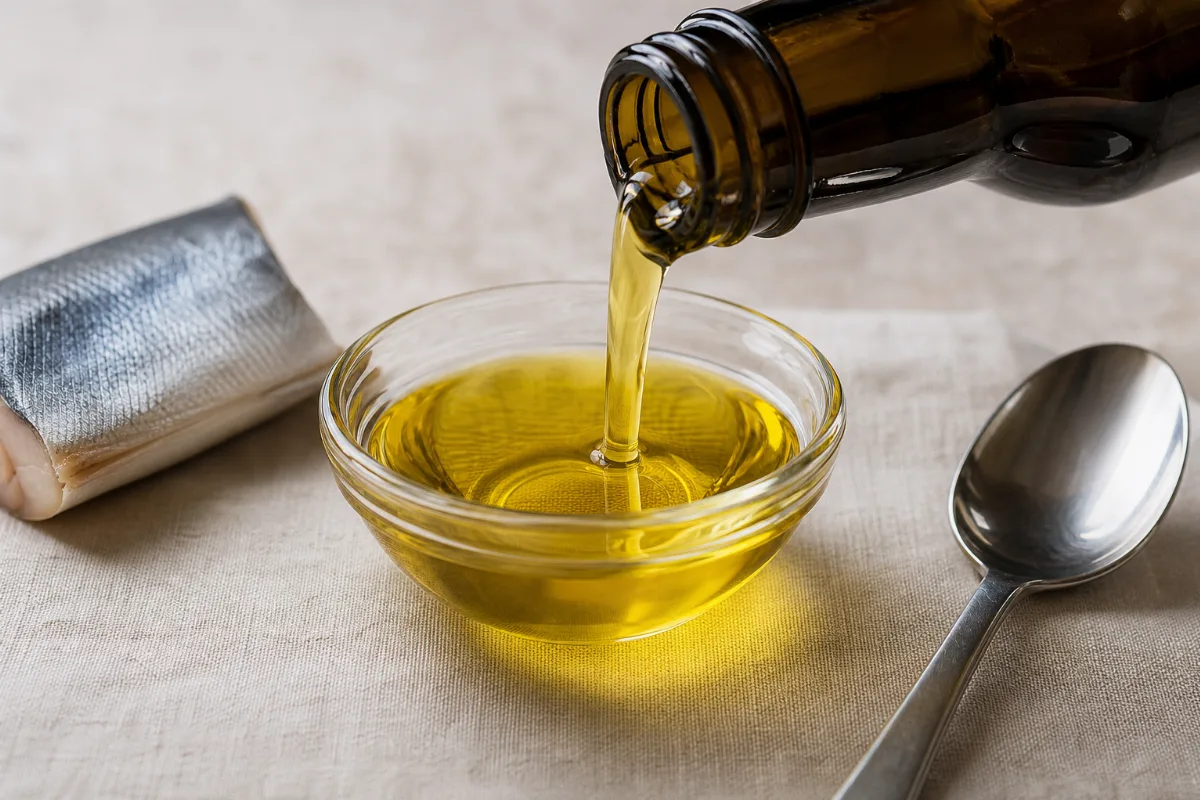
Oils & Fats · Fish oil
Cod Liver Oil and Fish Oil
Gadus morhua (cod liver oil); Salmo salar (salmon oil) · also called Cod liver oil, fish liver oil, fish oil, salmon oil, aceite de higado de bacalao, aceite de pescado
Cod liver oil comes from the liver of the cod; fish oil comes from oily fish such as salmon. Both are almost pure fat and carry the omega-3 fats EPA and DHA. In large reviews, EPA and DHA lowered blood triglycerides by about 15% but made little or no difference to most heart outcomes. The key caution is that cod liver oil is very rich in vitamin A, so the NHS says to avoid it in pregnancy and to watch the total over time.
General information, not medical advice. Last substantive update · Not medically reviewed. A named clinician has not signed off on this page. How this page is made
About Cod Liver Oil and Fish Oil
Cod liver oil is the oil from the liver of the cod; fish oil, such as salmon oil, comes from the body of oily fish. Both are pure fat with about 123 calories a tablespoon in the USDA data, and both contain the omega-3 fats EPA and DHA. Cod liver oil is also very high in vitamin A and has vitamin D. The research is mostly about omega-3 capsules: triglycerides fall about 15%, most heart outcomes barely change, and cod liver oil did not prevent covid-19 or colds. The key cautions are vitamin A in pregnancy and over years, fish allergy, an irregular heartbeat signal and variable product quality.
What is in it
USDA FoodData Central lists cod liver oil (item 173577) and salmon oil (item 172343). Both have 902 kcal and 100 g of fat per 100 g, with no protein, carbohydrate or fiber. In 1 tablespoon (13.6 g) that is about 123 kcal and 13.6 g of fat.
Cod liver oil per tablespoon: about 3.1 g saturated, 6.4 g monounsaturated and 3.1 g polyunsaturated fat, 78 mg cholesterol and about 4,080 micrograms of vitamin A. Salmon oil per tablespoon: about 2.7 g saturated, 3.9 g monounsaturated and 5.5 g polyunsaturated fat, 66 mg cholesterol and no vitamin A.
USDA does not list EPA and DHA separately, and its vitamin D value for cod liver oil looks very low next to the trial product, so check the label. These are averages, not a label.
What the research shows
Triglycerides: EPA and DHA lowered them by about 15% in a dose-related way (Cochrane, high certainty), mostly in capsule trials.
Heart: little or no effect on deaths or cardiovascular events (high certainty), and a possible small fall in coronary heart disease events (RR 0.91, low certainty).
Infections: in 34,601 Norwegian adults, daily cod liver oil through the winter did not lower covid-19 or other respiratory infections. The trial had company support.
Mood: NCCIH says it is uncertain whether omega-3 supplements help depression, and any effect may be too small to matter.
Food, capsule or fish
Nearly all trials tested capsules or liquids, not these oils eaten as food. Eating oily fish is a different thing: NCCIH says that for some conditions the evidence for seafood is stronger than for supplements.
The NHS suggests at least 2 portions of fish a week, one of them oily. That is advice about fish, not about cod liver oil.
Quality and freshness
Two product surveys disagreed. In New Zealand, 83% of 32 fish oil capsules exceeded the recommended peroxide level and most held less EPA and DHA than labelled. In France, all 20 products met industry oxidation limits.
Best-before date, price and origin were poor signs of quality in the New Zealand study. Neither study names brands. Follow the label's storage line, and do not use an oil with a sharp, rancid smell.
At a glance
Traditional uses history, not proof
- No history or traditional-use source was read for these oils, so none is claimed here.
Studied for research
- Blood triglycerides (EPA and DHA from fish-type oils), high certainty for supplements as a group; about 15% lower
- Heart attacks, strokes and deaths (EPA and DHA), low; mostly little or no effect, a possible small fall in coronary events
- Covid-19 and other respiratory infections (cod liver oil), moderate; no benefit found in a 34,601-person trial
- Depression (omega-3 supplements), very-low; any effect may be too small to matter
- Joints, skin, memory and other claims, insufficient; no relevant trial read
Main compounds
- EPA and DHA (omega-3 fats)
- Vitamin A (high in cod liver oil)
- Vitamin D (varies by product)
- Saturated, monounsaturated and polyunsaturated fats
Common forms
- Bottled liquid oil
- Capsules (a supplement, not the same as the food)
- Eating oily fish (a different food, not covered here)
Research links: Cochrane review of omega-3 and heart disease (abstract) · Cod liver oil and covid-19 trial, BMJ (abstract) · Omega-3 and atrial fibrillation (abstract) · NCCIH: omega-3 supplements · NHS: fish and shellfish · NHS: vitamin A · Research Library · Genes & Biomarkers Library
What it is and its history
- Accepted scientific name
- Gadus morhua (cod liver oil); Salmo salar (salmon oil)
- Naming authority
- Linnaeus, 1758
- Common names
- Cod liver oil (English); Fish liver oil (English); Fish oil (English); Salmon oil (English); Aceite de higado de bacalao (Spanish); Aceite de pescado (Spanish)
- Family or group
- Gadidae (cod) and Salmonidae (salmon)
- Classification
- Animalia > Gadiformes (cod); Salmoniformes (salmon) > Gadidae (cod); Salmonidae (salmon) > Gadus; Salmo > Gadus morhua; Salmo salar
- Native range
- Not checked.
- Habitat
- Not checked.
- Harvest and processing
- Not checked. The sources read do not describe how the oils are made or refined.
- Look-alikes and adulterants
- Name: Fish oil capsules; Note: Most trials tested capsules, which are supplements, not the oil used as a food.; Name: Krill oil and algal oil; Note: Other omega-3 oils (NCCIH); not covered here.; Name: Eating oily fish; Note: A different food with protein and other nutrients; NCCIH says evidence for seafood is stronger than for supplements for some conditions.
- Sustainability and conservation
- Not checked.
What is inside, and how it may work
What it contains and how those compounds act in cells and animals. Laboratory and animal mechanisms are not proven effects in people.
Main compounds
| Compound | Family | Where it is concentrated | Activity studied | Level of evidence |
|---|---|---|---|---|
| Eicosapentaenoic acid (EPA) PubChem 5282847 | omega-3 polyunsaturated fatty acid | Oil Not listed separately by USDA. | One of the two fish-type omega-3s that NCCIH says most research has focused on. 7 | Chemistry |
| Docosahexaenoic acid (DHA) PubChem 445580 | omega-3 polyunsaturated fatty acid | Oil Not listed separately by USDA. | The second fish-type omega-3. 7 | Chemistry |
| Vitamin A (retinol) PubChem 445354 | fat-soluble vitamin | Liver oil 30,000 micrograms RAE per 100 g in the USDA cod liver oil entry; 0 in salmon oil. | Why cod liver oil needs a pregnancy and bone caution. 13 8 | Chemistry |
| Vitamin D PubChem 5280795 | fat-soluble vitamin | Liver oil Varies by product (NCCIH); the Norwegian trial product supplied 10 micrograms in 5 mL. | A reason cod liver oil is used in winter; too much raises blood calcium. 7 4 9 | Chemistry |
Mechanisms, receptors and pathways
| Target or pathway | Gene or receptor | What was found | Level |
|---|---|---|---|
| Not described | Not specified in the sources read | None of the abstracts or pages read describes how EPA and DHA lower triglycerides. No mechanism is claimed. | None |
Absorption, metabolism and elimination
- Absorption
- Not described in the sources read.
- Distribution
- Not described.
- Metabolism
- Not described.
- Elimination
- Not described.
- Bioavailability
- Not described.
Isolated compounds versus whole extracts
Cod liver oil, fish oil, krill oil, algal oil, prescription omega-3 products and eating oily fish are different things. NCCIH says prescription products differ from ordinary supplements, and that for some conditions evidence for seafood is stronger than for supplements. Nearly all trials here tested capsules, so results do not carry over to oil used as a food.
Nutritional composition
Nutrition from USDA FoodData Central (SR Legacy, April 2018 release; values read 2026-10-26 from a saved copy of the data feed in the project files, because the public API key was rate-limited). Cod liver oil (FDC 173577), per 100 g: 902 kcal, 100 g fat (22.6 g saturated, 46.7 g monounsaturated, 22.5 g polyunsaturated), 570 mg cholesterol, 30,000 micrograms vitamin A (RAE). One USDA portion of 1 tablespoon (13.6 g, the 100 g values multiplied by 0.136): about 123 kcal, 13.6 g fat (3.1 g saturated, 6.4 g monounsaturated, 3.1 g polyunsaturated), 78 mg cholesterol and about 4,080 micrograms of vitamin A. Salmon oil (FDC 172343), per 100 g: 902 kcal, 100 g fat (19.9 g saturated, 29.0 g monounsaturated, 40.3 g polyunsaturated), 485 mg cholesterol, no vitamin A; per tablespoon about 123 kcal, 13.6 g fat (2.7 g saturated, 3.9 g monounsaturated, 5.5 g polyunsaturated). Both are pure fat with no protein, carbohydrate or fiber. USDA does not list EPA and DHA separately, so no gram figure is given for them. The USDA vitamin D value for cod liver oil (20.7 micrograms per 100 g) looks very low next to the 10 micrograms in 5 mL of the trial product, so check the label. These are averages, not a label.
1 high certainty1 moderate certainty1 low certainty1 very low certainty1 not enough evidence
What was looked at
The 5 benefits and uses checked for Cod Liver Oil and Fish Oil, each with how strong the evidence is. Tap one to open it.
- Blood triglycerides (EPA and DHA, the fish-type omega-3s)High certainty
- Heart attacks, strokes and deaths (EPA and DHA)Low certainty
- Covid-19 and other respiratory infections (cod liver oil)Moderate certainty
- Depression (omega-3 supplements)Very low certainty
- Joints, skin, memory and other claimsNot enough evidence
Lab markers tracked in the studies
Triglycerides
What is Cod Liver Oil and Fish Oil good for?
What the research shows for each use, and how strong it is. Almost all of it is about fish oil capsules and similar supplements, not cod liver oil or fish oil used as a food. Read the Safety tab too.
Benefits, one by one
Each card is a research question, not a promise. Tap a goal to filter. Open a card to see the studies, doses and limits.
Blood triglycerides (EPA and DHA, the fish-type omega-3s)
High certaintyIn a very large Cochrane review, more EPA and DHA lowered blood triglycerides by about 15%, and the fall grew with the amount.
2 studiesMostly capsules of fish-type oils; amounts varied widely between tria…
Studies, doses and limits
What the trials found
Cochrane review of 86 trials (162,796 adults). NCCIH reports the same size of effect from a 2020 review of 23 studies (43,998 people).
Results
Triglycerides about 15% lower, in a dose-related way (high certainty), with evidence mainly from supplement trials. The review found little or no effect of omega-3s on body fat, other blood fats or blood pressure.
Effect sizes as reported
About 15% lower triglycerides.
Why this rating
The Cochrane authors rate the triglyceride result high certainty. This holds for EPA and DHA supplements as a group; no trial of cod liver oil as a food for this measure was read.
Form and dose studied
Mostly capsules of fish-type oils; amounts varied widely between trials.
Who was studied
Adults at varying heart risk, mainly in high-income countries.
Limits
A blood measure, not a disease outcome. Not tested for cod liver oil as a food. NCCIH notes that prescription omega-3 products differ from ordinary supplements.
Why researchers looked
Cod liver oil and fish oil are rich sources of EPA and DHA, and high triglycerides are linked to heart risk.
Proposed mechanism Review
Not described in the abstracts read.
A proposed mechanism does not show that the effect happens in people.
These trials used fish oil capsules and similar products, not cod liver oil as a food. Cod liver oil is high in vitamin A (see the Safety tab).
Heart attacks, strokes and deaths (EPA and DHA)
Low certaintyThe Cochrane review found little or no effect on deaths, cardiovascular events or stroke, and a possible small fall in coronary heart disease events.
2 studiesFish-type omega-3s as capsules, foods or advice; amounts from 0.5 g a…
Studies, doses and limits
What the trials found
Cochrane review of 86 trials (162,796 adults). Most trials gave capsules; some used foods or advice. The authors say there is little evidence about eating fish.
Results
All-cause death RR 0.97 (95% CI 0.93 to 1.01) and cardiovascular events RR 0.96 (0.92 to 1.01), both high certainty of little or no effect. Stroke RR 1.02 (0.94 to 1.12); arrhythmia RR 0.99 (0.92 to 1.06). Cardiovascular death RR 0.92 (0.86 to 0.99, moderate). Coronary heart disease deaths RR 0.90 (0.81 to 1.00) and events RR 0.91 (0.85 to 0.97), low certainty.
Effect sizes as reported
CHD events RR 0.91 (0.85 to 0.97); CHD deaths RR 0.90 (0.81 to 1.00); all-cause death RR 0.97.
Why this rating
High certainty that most outcomes barely change; low certainty for the possible small coronary benefit, where one interval reaches 1.00.
Form and dose studied
Fish-type omega-3s as capsules, foods or advice; amounts from 0.5 g a day to more than 5 g a day.
Who was studied
Adults at varying heart risk.
Limits
Not cod liver oil as a food. Benefit is small and uncertain. NCCIH also says the evidence for seafood is stronger than for supplements for some conditions.
Why researchers looked
Fish and fish oil are often linked with heart health.
Proposed mechanism Review
Not described in the abstracts read.
A proposed mechanism does not show that the effect happens in people.
Pooled supplement trials also found more atrial fibrillation (see the Safety tab).
Covid-19 and other respiratory infections (cod liver oil)
Moderate certaintyA large Norwegian trial gave adults cod liver oil through the winter and found no fewer covid-19 cases or other respiratory infections than with placebo.
1 studiesLiquid cod liver oil supplying a low vitamin D amount, daily.
Studies, doses and limits
What the trials found
One quadruple-blind randomized trial: 34,601 adults aged 18 to 75, up to six months.
Results
Positive covid test 1.31% with cod liver oil and 1.32% with placebo (RR 1.00, adjusted CI 0.82 to 1.22). Serious covid-19 0.70% and 0.58% (RR 1.20, 0.87 to 1.65). Other respiratory infections 22.94% and 22.13% (RR 1.04, 0.97 to 1.11).
Effect sizes as reported
RR 1.00 for covid-19 infection; RR 1.04 for other respiratory infections.
Why this rating
A single large, well-run trial with a clear null result, but one country, one winter and one product.
Form and dose studied
Liquid cod liver oil supplying a low vitamin D amount, daily.
Who was studied
Healthy adults not taking daily vitamin D, in Norway.
Limits
Industry support is declared (Orkla Health AS). The trial studied infections, not general nutrition. Results may differ for other groups.
Why researchers looked
Cod liver oil is a traditional source of vitamin D, and low vitamin D has been linked to infections.
Proposed mechanism Clinical trial
Not established.
A proposed mechanism does not show that the effect happens in people.
Only low-grade side effects were reported in the trial.
Depression (omega-3 supplements)
Very low certaintyNCCIH says it is uncertain whether omega-3 supplements help with depression, and that any effect may be too small to matter.
1 studiesOmega-3 supplements in general, not cod liver oil specifically.
Studies, doses and limits
What the trials found
A short NCCIH summary of a 2021 review of 35 studies (1,964 people); the studies themselves were not read.
Results
If there is an effect it may be too small to be meaningful, and the review authors judged the evidence low or very low quality.
Why this rating
Rated low or very low quality by the review authors, as reported by NCCIH; not re-checked in the original paper.
Form and dose studied
Omega-3 supplements in general, not cod liver oil specifically.
Who was studied
Adults with depression.
Limits
Second-hand summary. Not specific to cod liver oil or to food.
Why researchers looked
Omega-3 fats are part of brain cell structure and are widely marketed for mood.
Proposed mechanism Authoritative guidance
None described by NCCIH in the summary read.
A proposed mechanism does not show that the effect happens in people.
Depression is a serious illness; see a health professional.
Joints, skin, memory and other claims
Not enough evidenceNo trial of cod liver oil or fish oil as foods for these uses was read, so nothing is claimed.
1 studiesNot applicable.
Studies, doses and limits
Results
Not assessed. NCCIH says research on omega-3 supplements for ADHD in children has conflicting results, and a 2023 review of 36 studies found no evidence of improvement.
Why this rating
No relevant evidence was read for these uses in cod liver oil.
Limits
This entry only records that evidence was not found.
Why researchers looked
These are common claims for cod liver oil.
Proposed mechanism None
Not applicable.
A proposed mechanism does not show that the effect happens in people.
Connections to the rest of health
How Cod Liver Oil and Fish Oil connects to the rest of our health knowledge graph. Every link says what kind of connection it is. A safety link (for example to the liver) is a warning, not a benefit. A study that merely mentions a topic never creates a benefit link.
Explore every connection: goals, body systems, organs, symptoms, genes
A. Wellness goals
| Connected to | Kind of connection | Evidence status | Context | Studies |
|---|---|---|---|---|
| Heart Health | Demonstrated clinical effect | High certainty | Blood triglycerides (EPA and DHA, the fish-type omega-3s): In a very large Cochrane review, more EPA and DHA lowered blood triglycerides by about 15%, and the fall grew with the amount. | 1 7 |
| Cholesterol Balance | Demonstrated clinical effect | High certainty | Blood triglycerides (EPA and DHA, the fish-type omega-3s): In a very large Cochrane review, more EPA and DHA lowered blood triglycerides by about 15%, and the fall grew with the amount. | 1 7 |
| Heart Health | Low certainty | Heart attacks, strokes and deaths (EPA and DHA): The Cochrane review found little or no effect on deaths, cardiovascular events or stroke, and a possible small fall in coronary heart disease events. | 1 7 | |
| Immune Support | Moderate certainty | Covid-19 and other respiratory infections (cod liver oil): A large Norwegian trial gave adults cod liver oil through the winter and found no fewer covid-19 cases or other respiratory infections than with placebo. | 4 | |
| Mood Support | Very low certainty | Depression (omega-3 supplements): NCCIH says it is uncertain whether omega-3 supplements help with depression, and that any effect may be too small to matter. | 7 | |
| Joint Support | Not enough evidence | Joints, skin, memory and other claims: No trial of cod liver oil or fish oil as foods for these uses was read, so nothing is claimed. | 7 | |
| Memory Support | Not enough evidence | Joints, skin, memory and other claims: No trial of cod liver oil or fish oil as foods for these uses was read, so nothing is claimed. | 7 |
B. Body systems
| Connected to | Kind of connection | Evidence status | Context | Studies |
|---|---|---|---|---|
| Cardiovascular System | Biological association | High certainty | Studied for: Blood triglycerides (EPA and DHA, the fish-type omega-3s) Studied for: Heart attacks, strokes and deaths (EPA and DHA) | 1 7 |
| Immune System | Biological association | Moderate certainty | Studied for: Covid-19 and other respiratory infections (cod liver oil) | 4 |
| Nervous System | Biological association | Very low certainty | Studied for: Depression (omega-3 supplements) Studied for: Joints, skin, memory and other claims | 7 |
| Musculoskeletal System | Biological association | Not enough evidence | Studied for: Joints, skin, memory and other claims | 7 |
C. Body parts and organs
| Connected to | Kind of connection | Evidence status | Context | Studies |
|---|---|---|---|---|
| Heart | Low certainty | Cochrane: little or no effect on most outcomes; possible small fall in coronary events; more atrial fibrillation in pooled supplement trials. Preparation or compound: EPA and DHA from fish-type oils (mostly supplements) |
1 5 |
E. Health conditions
| Connected to | Kind of connection | Evidence status | Context | Studies |
|---|---|---|---|---|
| Atrial fibrillation | Systematic review | Pooled trials found a higher risk (HR 1.25). Preparation or compound: Marine omega-3 supplements |
5 | |
| Too much vitamin A | Authoritative guidance | NHS: fish liver oil is high in vitamin A; long-term excess may weaken bones. Preparation or compound: Cod liver oil |
8 10 | |
| Fish allergy | Contraindication | Authoritative guidance | NHS: allergy to one fish often extends to others. Preparation or compound: Fish oils |
10 |
I. Biomarkers
| Connected to | Kind of connection | Evidence status | Context | Studies |
|---|---|---|---|---|
| Triglycerides | Demonstrated clinical effect | High certainty | Cochrane: about 15% lower, dose-related. Preparation or compound: EPA and DHA from fish-type oils (mostly supplements) |
1 |
| Triglycerides | Biological association | High certainty | Measured in trials: lowered by about 15% (EPA and DHA supplements). A lab change is not the same as a health benefit. | 1 |
L. Active compounds
| Connected to | Kind of connection | Evidence status | Context | Studies |
|---|---|---|---|---|
| Eicosapentaenoic acid (EPA) | Biological association | Chemistry | One of the two fish-type omega-3s that NCCIH says most research has focused on. Preparation or compound: Oil |
7 |
| Docosahexaenoic acid (DHA) | Biological association | Chemistry | The second fish-type omega-3. Preparation or compound: Oil |
7 |
| Vitamin A (retinol) | Biological association | Chemistry | Why cod liver oil needs a pregnancy and bone caution. Preparation or compound: Liver oil |
13 8 |
| Vitamin D | Biological association | Chemistry | A reason cod liver oil is used in winter; too much raises blood calcium. Preparation or compound: Liver oil |
7 4 9 |
Each connection is stored with the ingredient, the connected record, the kind of connection, the evidence status, the supporting studies, the preparation or compound involved, and a review date (last reviewed October 26, 2026).
Evidence at a glance: what the research found for 5 outcomes
Each outcome below is one thing researchers measured. Certainty is how far the evidence can be trusted, not how well it works. The full studies are on the next tab.
The evidence
The research centre for Cod Liver Oil and Fish Oil. Every record here was checked against PubMed or the publisher's page; we never list a study we have not verified.
Evidence by outcome
Bars show how many studies we found for each outcome, not how well it works. People are added up across trials only (reviews are not added, to avoid double counting).
How we rate evidence
High certainty
Several well-run trials or reviews agree; further research is unlikely to change the picture much.
Moderate certainty
Good trials point the same way, but some doubt remains.
Low certainty
Small, short or inconsistent trials. The finding could change with better research.
Very low certainty
Very little or very weak human data. Treat as a possibility only.
Mixed findings
Trials or reviews disagree with each other.
Not enough evidence
Not enough human research to say either way.
Evidence against
Good research found no benefit, or found harm.
We take the reviewers' own risk-of-bias and GRADE statements where they exist, and otherwise judge from study size, design, consistency, directness and whether a product matches what is sold. Many publications do not make evidence high. Method note: We re-opened and read the PubMed abstracts of 7 papers and read the NCCIH page and four NHS pages in full. We read USDA values from a saved copy of the data feed, and checked the animal names in GBIF and compounds in PubChem. Certainty ratings are the compiler's own reading. Funding is stated for the Norwegian trial and not stated in most other abstracts. No study is cited that we could not verify.
Study library: every study we checked 13
| Study | Design | People | Product, dose, length | Result |
|---|---|---|---|---|
| Abdelhamid 2020 Omega-3 fatty acids for the primary and secondary prevention of cardiovascular disease Cochrane Database Syst Rev · PMID 32114706 |
Systematic review meta analysis review |
162796 86 randomized trials (162,796 adults, mainly in high-income countries); trials lasted 12 to 88 months |
Extra long-chain omega-3 (EPA and DHA) or plant omega-3 (ALA), mostly as capsules, some as foods or advice oil Varied (0.5 g a day to more than 5 g a day for EPA and DHA) 12 to 88 months · vs Usual or lower intake or placebo |
EPA and DHA: little or no effect on deaths from any cause (RR 0.97, 95% CI 0.93 to 1.01, high certainty), on cardiovascular events (RR 0.96, 0.92 to 1.01, high certainty), stroke (RR 1.02, 0.94 to 1.12) or arrhythmia (RR 0.99, 0.92 to 1.06). Cardiovascular death RR 0.92 (0.86 to 0.99, moderate). A possible slight fall in coronary heart disease deaths (RR 0.90, 0.81 to 1.00) and coronary events (RR 0.91, 0.85 to 0.97), both low certainty. Triglycerides about 15% lower, dose-related (high certainty). The authors say there is little evidence about eating fish. Little or no effect on deaths and most events; a possible small fall in coronary events (low certainty); triglycerides about 15% lower. Methods, limits and fundingOutcomes: Deaths, cardiovascular events, stroke, arrhythmia, blood fats, blood pressure, body fat Limitations: Mostly capsules of fish-type oils, not cod liver oil as a food and not one named product. Abstract only was read. Coronary results are low certainty and one interval touches 1.00. Funding and conflicts: Cochrane review; the abstract lists no conflicts for the authors. Read: abstract |
| Akintoye 2018 Fish Oil and Perioperative Bleeding Circ Cardiovasc Qual Outcomes · PMID 30571332 · DOI |
Randomized controlled trial |
1516 1,516 patients having heart surgery in several countries |
Fish oil (EPA plus DHA) before and after surgery oil High-dose perioperative course set by the trial A few days before surgery and after · vs Placebo |
Major bleeding was not higher with fish oil (odds ratio 0.81, 95% CI 0.53 to 1.24) and fewer blood units were used (mean 1.61 versus 1.92, P<0.001). The authors say the findings support reconsidering advice to stop fish oil before cardiac surgery. No extra bleeding with fish oil around heart surgery. Methods, limits and fundingOutcomes: Major perioperative bleeding, blood units transfused Limitations: One trial in cardiac surgery; fish oil, not cod liver oil. Abstract read in full via PubMed. Funding and conflicts: Not stated in the abstract. One author is listed at OmegaQuant, LLC. Registration: NCT00970489 Read: abstract |
| Albert 2015 Fish oil supplements in New Zealand are highly oxidised and do not meet label content of n-3 PUFA Sci Rep · PMID 25604397 · DOI |
Laboratory analysis lab |
32 32 encapsulated fish oil supplements sold in New Zealand |
Fish oil supplements (capsules) oil · vs Recommended oxidation limits |
Only 3 of 32 products had as much EPA and DHA as labelled; 69% had less than 67% of the labelled amount. 83% exceeded the recommended peroxide level, 25% the anisidine level and 50% the total oxidation level; only 8% met all three. Best-before date, cost and country of origin were poor markers of quality. Most products tested were more oxidised than recommended and held less EPA and DHA than labelled. Methods, limits and fundingOutcomes: EPA and DHA content, peroxide, anisidine and total oxidation values Limitations: New Zealand market, one point in time, capsules not bottled cod liver oil; no brands named. A published erratum exists (Sci Rep 2016) and was not read. Abstract read in full via PubMed. Funding and conflicts: Not stated in the abstract. Read: abstract |
| Brunvoll 2022 Prevention of covid-19 and other acute respiratory infections with cod liver oil supplementation, a low dose vitamin D supplement: quadruple blinded, randomised placebo controlled trial BMJ · PMID 36215222 · DOI |
Randomized controlled trial |
34601 34,601 adults aged 18 to 75 in Norway, not taking daily vitamin D supplements; winter 2020 to 2021 |
Liquid cod liver oil (the trial product supplied 10 micrograms of vitamin D) oil Daily, set by the trial Up to six months (median 164 days) · vs Placebo |
No reduction in any of the four main endpoints. Positive SARS-CoV-2 test: 1.31% with cod liver oil and 1.32% with placebo (RR 1.00, adjusted CI 0.82 to 1.22). Serious covid-19: 0.70% and 0.58% (RR 1.20, 0.87 to 1.65). Other respiratory infections reported: 22.94% and 22.13% (RR 1.04, 0.97 to 1.11). Only low-grade side effects were reported in both groups. No benefit on covid-19 or other respiratory infections. Methods, limits and fundingOutcomes: Positive SARS-CoV-2 test, serious covid-19, other acute respiratory infections Limitations: Adults in one country in winter; the trial was about infections, not about nutrition. Abstract read in full via PubMed. Funding and conflicts: Support from Orkla Health AS, Oslo University Hospital and the University of Oslo is stated in the record's conflict-of-interest statement; some authors also declare research grants from other companies. Registration: NCT04609423 Read: abstract |
| Gencer 2021 Effect of Long-Term Marine omega-3 Fatty Acids Supplementation on the Risk of Atrial Fibrillation in Randomized Controlled Trials of Cardiovascular Outcomes: A Systematic Review and Meta-Analysis Circulation · PMID 34612056 · DOI |
Systematic review meta analysis review |
81210 7 randomized trials, 81,210 patients, mean age 65, follow-up about 4.9 years |
Marine omega-3 (EPA and DHA) supplements oil Up to and above 1 g a day across trials (dose-response checked) About 4.9 years on average · vs Placebo or control |
Marine omega-3 supplements were linked to more atrial fibrillation (HR 1.25, 95% CI 1.07 to 1.46). The hazard ratio was higher in trials testing more than 1 g a day (1.49, 1.04 to 2.15) than in trials testing 1 g a day or less (1.12, 1.03 to 1.22). About 25% higher risk of atrial fibrillation; greater in trials with higher daily amounts. Methods, limits and fundingOutcomes: New atrial fibrillation (an irregular heart rhythm) Limitations: Large trials of cardiovascular outcomes, mostly in people at higher heart risk; supplements, not cod liver oil as a food. Abstract read in full via PubMed. Funding and conflicts: Not stated in the abstract. Read: abstract |
| Javaid 2024 Bleeding Risk in Patients Receiving Omega-3 Polyunsaturated Fatty Acids: A Systematic Review and Meta-Analysis of Randomized Clinical Trials J Am Heart Assoc · PMID 38742535 · DOI |
Systematic review meta analysis review |
120643 11 randomized trials, 120,643 patients |
Omega-3 fatty acid supplements, including high-dose purified EPA in some trials oil Varied Varied · vs Control group |
No difference in overall bleeding (rate ratio 1.09, 95% CI 0.91 to 1.31); hemorrhagic stroke, intracranial and gastrointestinal bleeding were also similar. In the prespecified group on high-dose purified EPA, relative risk of bleeding was 50% higher but the absolute rise was modest (0.6%). Bleeding risk was linked to the EPA dose but not to background antiplatelet use. No overall rise in bleeding; a small absolute rise with high-dose purified EPA. Methods, limits and fundingOutcomes: Overall bleeding, hemorrhagic stroke, intracranial and gastrointestinal bleeding Limitations: Supplement trials, mostly in people with heart disease; cod liver oil was not singled out. Abstract read in full via PubMed. Funding and conflicts: Not stated in the abstract. Read: abstract |
| NCCIH 2024 Omega-3 Supplements: What You Need To Know (NCCIH, US National Institutes of Health) nccih.nih.gov · Source |
Regulator page n/a |
Public information page | Omega-3 supplements including fish oil and cod liver oil |
Says fish liver oil supplements such as cod liver oil contain EPA and DHA and also vitamins A and D in amounts that vary from product to product, and that vitamins A and D can be harmful in excessive amounts. Says that for some conditions the evidence for seafood is stronger than for supplements. Heart: some evidence that people with heart disease or high triglycerides may benefit; a 2020 review of 23 studies (43,998 people) showed EPA and DHA reduce triglycerides by about 15 percent but do not affect body fat or other lipids. Depression: uncertain whether omega-3 supplements help; a 2021 review of 35 studies (1,964 people) judged any effect possibly too small to be meaningful, with low or very low quality evidence. ADHD: research has conflicting results; a 2023 review of 36 studies found no evidence of improvement in children. Side effects are usually mild: unpleasant taste, bad breath, bad-smelling sweat, headache, and heartburn, nausea or diarrhea. Women who are pregnant or breastfeeding are advised (Dietary Guidelines, FDA and EPA) to eat at least 8 but no more than 12 ounces of seafood a week from choices lower in methyl mercury. Official summary; see the results text. Methods, limits and fundingOutcomes: What omega-3 supplements are, what the science says, side effects Limitations: About supplements in general; it does not discuss interactions with medicines, allergy or cod liver oil as a food. Last updated November 2024; read in full on 2026-10-26. Funding and conflicts: Public information page. Read: full-page |
| NHS 2020 Vitamin A (NHS) nhs.uk · Source |
Regulator page n/a |
Public information page | Vitamin A in food and supplements including fish liver oil |
Says fish liver oil supplements are high in vitamin A. Says daily intake from food and supplements should not exceed 1.5 mg (1,500 micrograms); an average of 1.5 mg a day or less from diet and supplements together is unlikely to cause any harm. Says having more than that on average for many years may weaken bones (osteoporosis and fracture risk), and that postmenopausal women and older men should be most careful. Advises no more than 1.5 mg a day from supplements, including fish liver oil, if you do not eat liver; none if you eat liver weekly. Official summary; see the results text. Methods, limits and fundingOutcomes: Safe upper level and who should be careful Limitations: General adult advice. The page shows last reviewed 3 August 2020, with a next review due date of 3 August 2023 that has passed. Read in full on 2026-10-26. Funding and conflicts: Public information page. Read: full-page |
| NHS 2020 Vitamin D (NHS) nhs.uk · Source |
Regulator page n/a |
Public information page | Vitamin D in food and supplements |
Says too much vitamin D can build up calcium in the body (hypercalcaemia), which can weaken bones and damage the kidneys and the heart. Says not to take more than 100 micrograms (4,000 IU) a day from supplements for adults and children aged 11 to 17, 50 micrograms (2,000 IU) for ages 1 to 10, with a lower limit for infants. Lists oily fish among the few food sources. Official summary; see the results text. Methods, limits and fundingOutcomes: Safe upper level and harm from too much Limitations: General advice. Page last reviewed 3 August 2020, next review due 3 August 2023, now passed. Read in full on 2026-10-26. Funding and conflicts: Public information page. Read: full-page |
| NHS 2026 Fish and shellfish: nutrition (NHS) nhs.uk · Source |
Regulator page n/a |
Public information page | Fish, shellfish and fish liver oil supplements |
Says a balanced diet should include at least 2 portions of fish a week, one of them oily. Says fish liver oil supplements are high in vitamin A, that over many years too much could be harmful, and that people who are pregnant should avoid supplements containing vitamin A, including fish liver oil supplements such as cod liver oil. Also says to avoid fish liver oil supplements when trying for a baby unless a GP advises otherwise. Says allergies to fish are quite common and can cause severe reactions, people allergic to one type of fish often react to other types, and cooking does not make a reaction less likely. Official summary; see the results text. Methods, limits and fundingOutcomes: Fish portions, fish liver oil, pregnancy, allergy Limitations: General advice. Page last reviewed 26 June 2026; read in full on 2026-10-26. Funding and conflicts: Public information page. Read: full-page |
| NHS 2026 Foods to avoid in pregnancy (NHS) nhs.uk · Source |
Regulator page n/a |
Public information page | Oily fish and liver in pregnancy |
Says oily fish (salmon, trout, mackerel, sardines, herring) should be limited to no more than 2 portions a week in pregnancy, because oily fish can contain pollutants including mercury. Says liver and foods containing liver have high levels of vitamin A, which can be harmful to the baby. Official summary; see the results text. Methods, limits and fundingOutcomes: Foods to limit in pregnancy Limitations: General advice; does not mention cod liver oil by name. Page last reviewed 15 June 2026; read on 2026-10-26. Funding and conflicts: Public information page. Read: full-page |
| Pasini 2022 Assessment of Lipid Quality in Commercial Omega-3 Supplements Sold in the French Market Biomolecules · PMID 36291569 · DOI |
Laboratory analysis lab |
20 20 unflavored omega-3 supplements sold in France |
Omega-3 supplements oil · vs Industry oxidation limits (GOED) |
Only 2.5% of the supplements did not meet their label claims for omega-3 content. All of them met the GOED limits for peroxide, p-anisidine and Totox values and were not oxidized. In France, the 20 products tested were within oxidation limits and mostly matched their labels. Methods, limits and fundingOutcomes: Omega-3 content, triglyceride and tocol composition, oxidation values Limitations: 20 products, one market; brands not named in the abstract. Abstract read in full via PubMed. Funding and conflicts: The abstract record states no conflicts of interest. Read: abstract |
| U.S. Department of Agriculture 2018 USDA FoodData Central, SR Legacy: Fish oil, cod liver (FDC 173577) and Fish oil, salmon (FDC 172343) fdc.nal.usda.gov (April 2018 SR Legacy release) · Source |
Database record n/a |
Food composition data | Cod liver oil and salmon oil oil Per 100 g and per household portion |
Cod liver oil per 100 g: 902 kcal, 100 g fat (22.6 g saturated, 46.7 g monounsaturated, 22.5 g polyunsaturated), 570 mg cholesterol, 30,000 micrograms vitamin A (RAE), 20.7 micrograms vitamin D. Salmon oil per 100 g: 902 kcal, 100 g fat (19.9 g saturated, 29.0 g monounsaturated, 40.3 g polyunsaturated), 0 micrograms vitamin A. USDA household portions for both: 1 teaspoon 4.5 g, 1 tablespoon 13.6 g, 1 cup 218 g. EPA and DHA are not listed separately. No protein, carbohydrate, fiber, sodium or other minerals are listed. Nutrient values for two oils. Methods, limits and fundingOutcomes: Energy, fats, cholesterol, vitamins A and D Limitations: Values were read on 2026-10-26 from a saved copy of the USDA data feed in the project files (docs/research/foods-graph/usda), because the public USDA API key was rate-limited. SR Legacy is an average, not a product label. The cod liver oil vitamin D value (20.7 micrograms per 100 g) looks very low next to the 10 micrograms in 5 mL reported for the trial product in the BMJ paper, so it is not used here. Funding and conflicts: n/a Read: database |
What we do not know yet
- What the evidence supports: high certainty for the triglyceride fall and for little effect on most heart outcomes (supplements as a group); low for a small coronary benefit; moderate for no effect on respiratory infections; very-low for depression; insufficient for joints, skin and memory.
- No trial of cod liver oil or fish oil used as a food was read for triglycerides or heart outcomes; nearly all tested capsules.
- Children and breastfeeding: only the NHS vitamin A and D upper limits were read; no child-specific or breastfeeding advice for cod liver oil.
- No FDA, EFSA, EMA or LiverTox statement was read. No case reports of bleeding or liver harm were read.
- USDA values were read from a saved copy; EPA and DHA gram amounts are not listed there. Only abstracts were read for the studies. The NHS vitamin A and D pages are past their review dates.
How new research is added
New studies are found by a saved PubMed search and placed in a review queue. A person reads each one before it changes any rating or safety wording.
Lab markers
What changed in blood or saliva tests during trials. A changed number is not the same as feeling or being healthier, and we give no "normal ranges".
Metabolic 1
Triglycerides
Lowered by about 15% (EPA and DHA supplements) in trials
A type of fat in the blood; high levels are linked to heart risk.
High certaintyResults and what it means
Why it was measured
A standard blood fat test.
Statistical vs. clinical meaning
A blood marker; the same review found only a small, uncertain effect on coronary events.
Safety implication
Atrial fibrillation was more common in pooled supplement trials (see Safety).
| Study | Result | People | Product |
|---|---|---|---|
| 1 | About 15% lower, dose-related, high certainty. | Adults in 86 trials | EPA and DHA, mostly capsules |
Safety
What studies and official sources say about side effects, medicines and who should check first. Each point shows what kind of evidence it comes from.
Main points to know 5
- Cod liver oil is very high in vitamin A. USDA lists 30,000 micrograms of vitamin A (RAE) per 100 g of cod liver oil, which is about 4,080 micrograms in 1 tablespoon (13.6 g). The NHS says vitamin A from food and supplements together should not exceed 1.5 mg (1,500 micrograms) a day, and counts fish liver oil toward that. That is about 2.7 times the NHS figure from one tablespoon. Products differ from the USDA average, so the label matters. Averaging more than 1.5 mg a day for many years may weaken bones and raise fracture risk, mainly for older people and women after menopause. Salmon oil in the same USDA data lists no vitamin A. Authoritative guidance 13 8 10 7
- Pregnancy and trying for a baby: avoid fish liver oil unless a doctor says otherwise. The NHS says to avoid fish liver oil supplements such as cod liver oil when pregnant or trying for a baby unless a GP advises otherwise, because too much vitamin A can harm an unborn baby. This is about vitamin A, not omega-3. The NHS also says to limit oily fish to 2 portions a week in pregnancy. Authoritative guidance 10 11
- Fish allergy. The NHS says fish allergy is quite common and can cause severe reactions, people allergic to one fish often react to others, and cooking does not lower the risk. Ask an allergist before using fish oils. For trouble breathing or swelling of the face or throat, call emergency services. Authoritative guidance 10
- More atrial fibrillation in pooled supplement trials. Seven trials with about 81,000 people found more atrial fibrillation (an irregular heartbeat) with marine omega-3 supplements (HR 1.25, 95% CI 1.07 to 1.46), and the risk looked greater in trials using higher daily amounts. If you have a heart rhythm condition, ask a clinician first. Systematic review 5
- Vitamin D can also build up. Cod liver oil also carries vitamin D, in amounts that vary by product (NCCIH). The NHS says too much vitamin D can build up calcium in the body and harm bones, kidneys and heart, with lower limits for children. Count all vitamin D you take. Authoritative guidance 7 9
Side effects 5
| Effect | How often | Severity and recovery | Evidence |
|---|---|---|---|
| Unpleasant taste, bad breath, bad-smelling sweat, headache, heartburn, nausea or diarrhea NCCIH describes omega-3 supplements in general. | Not stated | Usually mild, per NCCIH Not stated | Authoritative guidance 7 |
| Irregular heartbeat (atrial fibrillation) Marine omega-3 supplements, mostly in people at higher heart risk. | HR 1.25 in pooled trials of about 81,000 people | Can be serious Not stated | Systematic review 5 |
| Too much vitamin A over years: weaker bones The NHS describes an average above 1.5 mg a day for many years. | Not stated | Can be serious Not stated | Authoritative guidance 8 |
| Too much vitamin D: raised blood calcium Bones, kidneys and heart can be harmed. | Not stated | Can be serious Not stated | Authoritative guidance 9 |
| Allergic reaction to fish Allergy to one fish often extends to others. | Not stated | Can be severe Not stated | Authoritative guidance 10 |
Liver
No liver injury linked to cod liver oil was found in the sources read. LiverTox was not read. Very high vitamin A intake is a recognised concern for the liver, but no source read describes it, so no claim is made.
How often. Not known.
This is a safety connection. It is not evidence that Cod Liver Oil and Fish Oil supports liver health.
Medicines and supplements 2
| With | Why it matters | Importance | Evidence | What to do |
|---|---|---|---|---|
| Blood thinners (anticoagulant and antiplatelet drugs) drug | Omega-3s have been suspected of raising bleeding risk. | A review of 11 trials (120,643 people) found no overall rise in bleeding; high-dose purified EPA showed a 50% relative rise but only a 0.6% absolute rise. A heart-surgery trial of 1,516 people found no extra bleeding with fish oil. | Systematic review Moderate certainty 6 2 | Tell your pharmacist or doctor, and ask before surgery. NCCIH does not discuss medicine interactions. |
| Other vitamin A or vitamin D products supplement | Amounts add up across everything you take. | NHS upper figures apply to food and supplements combined (vitamin A) and to supplements in total (vitamin D). | Authoritative guidance Moderate certainty 8 9 | Add up the labels with a pharmacist. |
Who should check first 3
| Situation | Advice | Evidence |
|---|---|---|
| Pregnant or trying for a baby (fish liver oil) | The NHS says avoid unless a GP advises otherwise. | Authoritative guidance 10 |
| Known fish allergy | Avoid until an allergist says otherwise. | Authoritative guidance 10 |
| Heart rhythm condition | Ask a clinician first because of the atrial fibrillation finding. | Systematic review 5 |
Overdose, product quality and regulators
Summary. The main poisoning concerns in the sources read are too much vitamin A and too much vitamin D, both stated by the NHS. No poisoning data for the oil itself were read.
Animal. Not reviewed.
Human doses studied. Trials in the reviews used supplement amounts that this page does not repeat; the Norwegian trial reported only low-grade side effects.
High dose or long term signals. Long-term vitamin A above an average of 1.5 mg a day: weaker bones (NHS). Excess vitamin D: raised calcium (NHS).
Overdose response. Not described in the sources read.
Genotoxicity. Not read.
Quality varies. Two product surveys reached different answers, so the label and brand matter and neither survey names brands.
Oxidation and label accuracy (New Zealand). Of 32 fish oil capsules, 83% exceeded the recommended peroxide level and 50% the total oxidation level; only 3 had as much EPA and DHA as labelled. Best-before date, cost and origin were poor markers of quality. 3
Oxidation and label accuracy (France). Of 20 omega-3 products, all met industry oxidation limits and only 2.5% missed their label claims for omega-3. 12
Pollutants and mercury. The NHS says oily fish can contain pollutants including mercury and advises limits in pregnancy. No source read measured pollutants in cod liver oil itself. 11
| Body | Action | Date |
|---|---|---|
| NHS (UK) (UK) | Avoid fish liver oil supplements (cod liver oil) in pregnancy or when trying for a baby unless a GP advises; limit vitamin A to 1.5 mg a day from food and supplements combined; supplement vitamin D not above 100 micrograms a day for adults; limit oily fish to 2 portions a week in pregnancy. source | 2026-10-26 |
| NCCIH (US National Institutes of Health) (US) | Says cod liver oil contains vitamins A and D in amounts that vary by product and that these can be harmful in excess; side effects of omega-3 supplements are usually mild. source | 2026-10-26 |
When to get medical help
- Hives, swelling of the lips, face or throat, wheeze or trouble breathing after eating fish or taking fish oil: call emergency services.
- A fast, pounding or very irregular heartbeat, fainting or chest pain: seek urgent medical care.
Stop using the product and contact a clinician or emergency service. In the US, Poison Control is 1-800-222-1222.
General information only, not medical advice. Ask a clinician or pharmacist before use, especially with medicines, in pregnancy or with a health condition. See the Natural Remedy Safety guide.
Frequently asked questions
Is cod liver oil safe in pregnancy?
The NHS says to avoid fish liver oil supplements such as cod liver oil when pregnant or trying for a baby, unless a GP advises otherwise, because they are high in vitamin A. Ask your midwife or doctor.
How much vitamin A is in cod liver oil?
Does cod liver oil prevent colds or covid-19?
Not in the best trial read. In 34,601 Norwegian adults, daily cod liver oil did not reduce covid-19 (RR 1.00) or other respiratory infections (RR 1.04).
Does fish oil lower triglycerides?
Does it protect the heart?
Mostly not: the Cochrane review found little or no effect on deaths or cardiovascular events (high certainty), and a possible small fall in coronary events (low certainty).
Can fish oil cause an irregular heartbeat?
Pooled trials of about 81,000 people found more atrial fibrillation with marine omega-3 supplements (HR 1.25), more so with higher daily amounts. Ask a clinician if you have a rhythm condition.
Can I take it with blood thinners?
Can people with fish allergy use it?
Ask an allergist first. The NHS says people allergic to one fish often react to others and that cooking does not lower the risk. Call emergency services for trouble breathing or swelling of the face or throat.
What are the side effects?
NCCIH says side effects of omega-3 supplements are usually mild: unpleasant taste, bad breath, bad-smelling sweat, headache, heartburn, nausea or diarrhea.
Does cod liver oil help depression or joints?
NCCIH says it is uncertain whether omega-3 supplements help depression and any effect may be too small to matter. No trial of cod liver oil for joints was read.
Are all fish oil products the same quality?
Explore by health goal
Heart HealthCholesterol BalanceImmune SupportMood SupportJoint SupportMemory Support
Editorial transparency
- Written by
- AlternativeMed editorial team. Research compiled with AI assistance, then checked against PubMed records.
- Medical review
- None. This page has not been reviewed by a physician or pharmacist.
- First published
- 2026-10-26
- Last substantive update
- 2026-10-26
- How we research
- We re-opened and read the PubMed abstracts of 7 papers and read the NCCIH page and four NHS pages in full. We read USDA values from a saved copy of the data feed, and checked the animal names in GBIF and compounds in PubChem. Certainty ratings are the compiler's own reading. Funding is stated for the Norwegian trial and not stated in most other abstracts. No study is cited that we could not verify.
- How we rate evidence
- See "How we rate evidence" in the Evidence tab.
- Independence
- No product is promoted on this page. No affiliate links are shown.
Sources 13
Each source was opened and checked. Where we read only the abstract, it says so. The small numbers in the text point here.
- Abdelhamid AS, Brown TJ, Brainard JS et al. Omega-3 fatty acids for the primary and secondary prevention of cardiovascular disease. Cochrane Database Syst Rev. 2020. PMID 32114706. (abstract)
- Akintoye E, Sethi P, Harris WS et al. Fish Oil and Perioperative Bleeding. Circ Cardiovasc Qual Outcomes. 2018. PMID 30571332. DOI 10.1161/CIRCOUTCOMES.118.004584. (abstract)
- Albert BB, Derraik JG, Cameron-Smith D et al. Fish oil supplements in New Zealand are highly oxidised and do not meet label content of n-3 PUFA. Sci Rep. 2015. PMID 25604397. DOI 10.1038/srep07928. (abstract)
- Brunvoll SH, Nygaard AB, Ellingjord-Dale M et al. Prevention of covid-19 and other acute respiratory infections with cod liver oil supplementation, a low dose vitamin D supplement: quadruple blinded, randomised placebo controlled trial. BMJ. 2022. PMID 36215222. DOI 10.1136/bmj-2022-071245. (abstract)
- Gencer B, Djousse L, Al-Ramady OT et al. Effect of Long-Term Marine omega-3 Fatty Acids Supplementation on the Risk of Atrial Fibrillation in Randomized Controlled Trials of Cardiovascular Outcomes: A Systematic Review and Meta-Analysis. Circulation. 2021. PMID 34612056. DOI 10.1161/CIRCULATIONAHA.121.055654. (abstract)
- Javaid M, Kadhim K, Bawamia B et al. Bleeding Risk in Patients Receiving Omega-3 Polyunsaturated Fatty Acids: A Systematic Review and Meta-Analysis of Randomized Clinical Trials. J Am Heart Assoc. 2024. PMID 38742535. DOI 10.1161/JAHA.123.032390. (abstract)
- NCCIH. Omega-3 Supplements: What You Need To Know (NCCIH, US National Institutes of Health). nccih.nih.gov. 2024. (full-page)
- NHS. Vitamin A (NHS). nhs.uk. 2020. (full-page)
- NHS. Vitamin D (NHS). nhs.uk. 2020. (full-page)
- NHS. Fish and shellfish: nutrition (NHS). nhs.uk. 2026. (full-page)
- NHS. Foods to avoid in pregnancy (NHS). nhs.uk. 2026. (full-page)
- Pasini F, Gomez-Caravaca AM, Blasco T et al. Assessment of Lipid Quality in Commercial Omega-3 Supplements Sold in the French Market. Biomolecules. 2022. PMID 36291569. DOI 10.3390/biom12101361. (abstract)
- U.S. Department of Agriculture. USDA FoodData Central, SR Legacy: Fish oil, cod liver (FDC 173577) and Fish oil, salmon (FDC 172343). fdc.nal.usda.gov (April 2018 SR Legacy release). 2018. (database)
Where to buy
Check the label first. Whatever you buy, look for these:
- Cold-pressed or refined, to match how you cook
- A harvest or best-by date and a dark glass or tin container
- The oil's origin and any testing statement
- Smoke point for the way you cook
Talk to a pharmacist or doctor before you start any supplement, especially if you take medicines. See the Safety tab for interactions.
Support our free guides: as an Amazon Associate we earn from qualifying purchases. Full disclosure.


