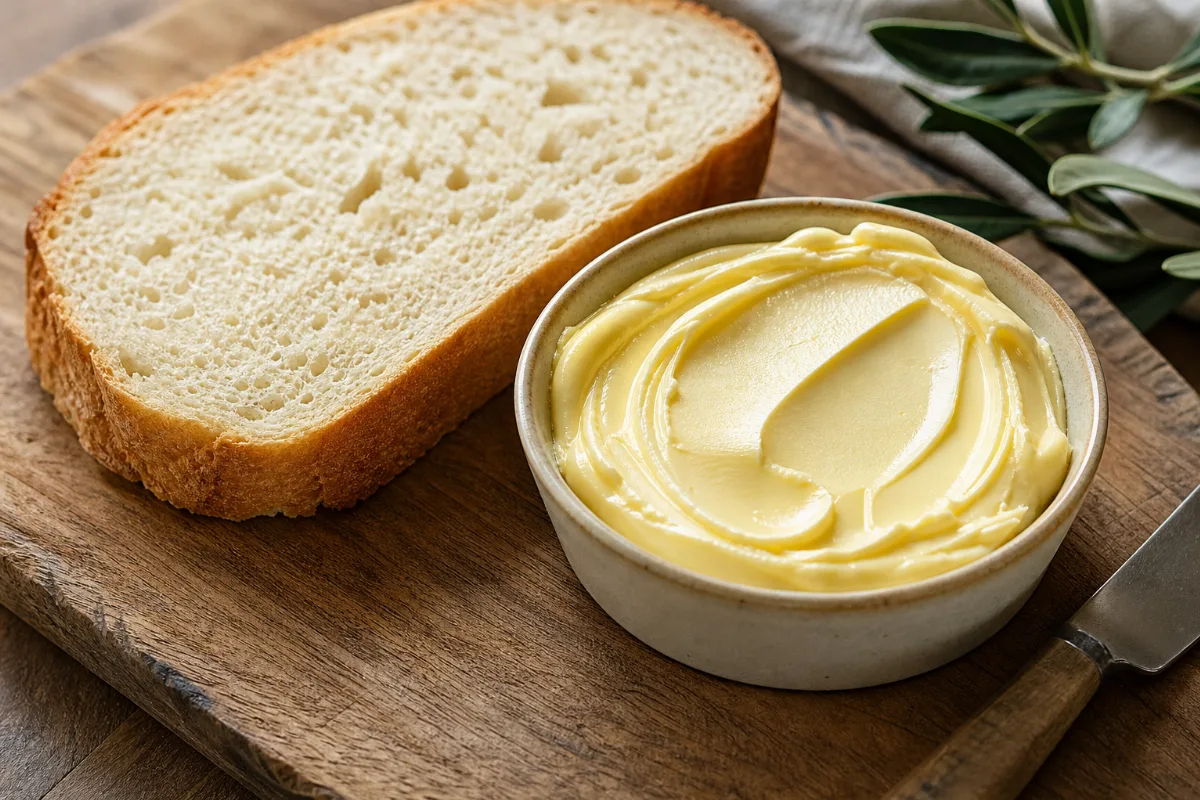
Oils & Fats · Spread
Margarine & Plant-Oil Spreads
Blended plant-oil spread (a manufactured food, not a single plant) · also called Margarine, vegetable oil spread, tub spread, hard margarine
Margarine is a spread made mostly from vegetable oils mixed with water, used in place of butter. Its health effect depends on the fats inside: swapping saturated fat for unsaturated fat lowers LDL cholesterol in trials, while artificial trans fat from older hard margarines raises it. Spreads with added plant sterols lower LDL further, but only a few studies compare margarine itself with butter. Key cautions: trans fat, milk and soy allergy, and warfarin.
General information, not medical advice. Last substantive update · Not medically reviewed. A named clinician has not signed off on this page. How this page is made
About Margarine & Plant-Oil Spreads
Margarine and plant-oil spreads are blends of fats used instead of butter. Whether one is good for you depends on its fats: the research favours unsaturated fat over saturated fat, and warns against artificial trans fat from older hard margarines. Only one small trial compared margarine itself with butter.
What it is
Margarine is a spread made mostly from vegetable oils with water. USDA lists two kinds: a tub spread (67 to 70% fat) and a regular hard soybean margarine, described as hydrogenated.
Per tablespoon (14 g) of tub spread USDA lists about 85 kcal, 9.6 g fat, 2.3 g saturated fat, 0.46 g trans fat and 75 mg sodium. These are 2018 values and brands differ.
How it is used
It is used in place of butter on bread and in cooking and baking. The NHS lists reduced-fat spreads based on olive or sunflower oils as one way to cut fat.
Spreads with added plant sterols or stanols are sold to lower cholesterol and are a separate product.
What the research shows
The cholesterol evidence is about fats, not brands. In 54 trials most plant oils lowered LDL more than butter, and the American Heart Association advises the swap. One small crossover trial found cholesterol fell after a margarine breakfast. A Cochrane review found 17% fewer combined cardiovascular events when saturated fat was cut.
Trans fat is the exception: a 106-adult trial and cohort studies show harm. Sterol spreads lowered LDL 6 to 12% in a pooled analysis whose authors include food-company staff.
Rules and labels
In the US, trans fat must be listed on the Nutrition Facts label, and a health claim about plant sterol or stanol esters and heart disease is allowed under set wording. WHO advises under 10% of energy from saturated fat and under 1% from trans fat.
We did not read the UK ingredient-labelling rule for hydrogenated oils.
At a glance
Traditional uses history, not proof
- No traditional use is described in the sources read. It is a modern manufactured food.
Studied for research
- LDL cholesterol when unsaturated oils replace saturated fat, moderate
- Margarine versus butter on cholesterol, very low (one small trial)
- Plant sterol spreads and LDL, moderate
- Heart events when saturated fat is cut, moderate (diet changes)
- Trans fat and heart disease, harm, moderate
- Weight, heart attacks or deaths for margarine itself, insufficient
Main compounds
- Saturated, monounsaturated and polyunsaturated fat
- Alpha-linolenic acid (omega-3)
- Trans fat (older products)
- Plant sterols (small amounts, more in sterol spreads)
- Vitamins E and D (USDA values)
Common forms
- Tub spread (67 to 70% fat)
- Hard (stick) margarine
- Plant sterol or stanol enriched spreads
- Reduced-fat spreads
Research links: FDA: Trans fat · FDA: Final determination on partially hydrogenated oils · WHO: updated guidelines on fats · Margarine versus butter trial (abstract) · Plant sterols and LDL, 124 studies (abstract) · Research Library · Genes & Biomarkers Library
What it is and its history
- Accepted scientific name
- Not a plant: a manufactured spread
- Common names
- Margarine (English); Plant-oil spread (English); Vegetable oil spread (English (USDA wording)); Margarina (Spanish)
- Harvest and processing
- The FDA describes partially hydrogenated oils as formed by a manufacturing process that converts vegetable oil into a fat that is solid at room temperature. How a given spread is made was not researched beyond that.
- Look-alikes and adulterants
- Name: Butter; Note: A dairy fat with more saturated fat and natural trans fat; a separate page.; Name: Plant sterol or stanol spreads; Note: Spreads with added plant sterols or stanols; a different product with different evidence.
Traditional use and history history, not clinical proof
| Tradition or era | Documented use | Source |
|---|---|---|
| Trans fat labelling and removal in the US | The FDA required trans fat to be listed on the Nutrition Facts label from January 2006, made a preliminary finding in November 2013 that partially hydrogenated oils are not generally recognised as safe, and finalised it on June 16, 2015. Most uses had to stop by June 18, 2018. | s-fda-pho |
| Origin of margarine | Not covered by the sources read; no history is claimed. | n/a |
Traditional use shows how it was used. It does not show that it works or is safe today.
What is inside, and how it may work
What it contains and how those compounds act in cells and animals. Laboratory and animal mechanisms are not proven effects in people.
Main compounds
| Compound | Family | Where it is concentrated | Activity studied | Level of evidence |
|---|---|---|---|---|
| Saturated fat | fat | Tub spread 16.688 g per 100 g; hard soybean margarine 16.7 g per 100 g (USDA) | Raises LDL cholesterol more than unsaturated fat does (AHA, NMA). 14 10 11 | Human data |
| Monounsaturated and polyunsaturated fat | fat | Tub: 24.748 g mono and 23.794 g poly per 100 g; hard: 39.3 g mono and 20.9 g poly (USDA) | The swap from saturated to unsaturated fat is the AHA's advised change. 14 10 | Human data |
| Alpha-linolenic acid (omega-3 plant fat) | polyunsaturated fat | 2.925 g per 100 g in the tub spread (USDA) | No outcome study in the sources read. 14 | Composition data |
| Trans fat (artificial, from partially hydrogenated oil) | trans fatty acids | Tub spread 3.265 g per 100 g (USDA, 2018 release); no value listed for the hard margarine item | Raises LDL and apolipoprotein B in a 106-adult feeding trial; linked to heart disease in cohorts. 14 4 20 | Human data |
| Plant sterols (phytosterols) | sterols | 146 mg per 100 g in the hard margarine item (USDA); added in larger amounts to sterol spreads | Lower LDL cholesterol in pooled trials when added to foods. 14 9 | Human data |
Mechanisms, receptors and pathways
| Target or pathway | Gene or receptor | What was found | Level |
|---|---|---|---|
| LDL cholesterol | n/a | Replacing saturated fat with unsaturated fat lowers LDL cholesterol, which the AHA calls a cause of atherosclerosis. Trans fat does the opposite. How sterols lower LDL is not described in the abstracts read. 10 4 | Human data |
| Blood plant sterol levels | ABCG5 and ABCG8 (in sitosterolemia) | Sterol spreads roughly double plasma plant sterols. In sitosterolemia, mutations in ABCG5 or ABCG8 impair removal of plant sterols so they build up. 12 1 | Human review |
Absorption, metabolism and elimination
- Absorption
- Not described for spreads in the sources read.
- Distribution
- Plasma plant sterols rise by about a factor of 2 with regular sterol-spread intake (review).
- Metabolism
- Not described.
- Elimination
- Impaired in sitosterolemia (review).
- Bioavailability
- Not described.
Isolated compounds versus whole extracts
Ordinary margarine, hard margarine, tub spreads and sterol-enriched spreads are different foods. The cholesterol evidence is about the fats inside (saturated, unsaturated, trans) and, for sterol spreads, the added sterols. Butter and plant oils are compared in other studies but are not the same as spreads.
Nutritional composition
Source: USDA FoodData Central, SR Legacy, April 2018 release, values read 2026-10-26 from the project's saved copy of the USDA data (the live API key was rate-limited). Margarine-like vegetable oil spread, 67-70% fat, tub (FDC 171431), per 100 g: 606 kcal, 68.3 g fat (16.7 g saturated, 24.7 g monounsaturated, 23.8 g polyunsaturated, 3.3 g trans), 2.9 g omega-3 ALA, 0.6 g carbohydrate, 536 mg sodium, 13 mg vitamin E, 24.3 mcg vitamin D. One tablespoon (14 g) is about 85 kcal, 9.6 g fat (2.3 g saturated, 0.46 g trans), 75 mg sodium, 1.8 mg vitamin E and 3.4 mcg vitamin D. Margarine, regular, hard, soybean (hydrogenated) (FDC 171018), per 100 g: 719 kcal, 80.5 g fat (16.7 g saturated, 39.3 g monounsaturated, 20.9 g polyunsaturated), 0.9 g protein, 943 mg sodium, 146 mg phytosterols, 819 mcg vitamin A (RAE), 39.1 mcg vitamin D, 42 mg potassium; no trans fat or vitamin K value is listed. USDA's only small household portion for that item is 1 teaspoon (4.7 g), about 34 kcal. Added vitamins and today's recipes vary by brand: check the label.
5 moderate certainty1 low certainty2 very low certainty1 not enough evidence
What was looked at
The 9 benefits and uses checked for Margarine & Plant-Oil Spreads, each with how strong the evidence is. Tap one to open it.
- LDL cholesterol when unsaturated oils replace saturated fatModerate certainty
- Cholesterol with margarine compared with butter (one small trial)Very low certainty
- LDL cholesterol with plant sterol or stanol spreadsModerate certainty
- Artificial trans fat from partially hydrogenated oil raises LDL (evidence against older hard margarines)Moderate certainty
- Heart and blood-vessel events when saturated fat is cutModerate certainty
- Long-term death rates: butter versus plant oils (large US cohorts)Low certainty
- Heart disease risk and trans fat intake (large observational studies)Moderate certainty
- Blood plant sterol and carotenoid levels with sterol spreadsVery low certainty
- "Healthier than butter" for weight, heart attacks or deaths (margarine itself)Not enough evidence
Lab markers tracked in the studies
LDL cholesterol ("bad" cholesterol)HDL cholesterol ("good" cholesterol)Apolipoprotein BBlood beta-carotene
What is Margarine & Plant-Oil Spreads good for?
What the research shows for each use, and how strong it is. Most of it is about fats in general, not margarine itself. Read the Safety tab too.
Benefits, one by one
Each card is a research question, not a promise. Tap a goal to filter. Open a card to see the studies, doses and limits.
LDL cholesterol when unsaturated oils replace saturated fat
Moderate certaintyAcross 54 trials, most plant oils lowered LDL ("bad") cholesterol more than butter did. The American Heart Association advises swapping saturated fat for unsaturated fat. These studies tested oils and solid fats, not spreads, so the result carries over to a spread only when its fats are mostly unsaturated.
2 studiesPlant oils and solid fats eaten as part of the diet. Amounts are in t…
Studies, doses and limits
What the trials found
A network meta-analysis of 54 randomised trials of oils and solid fats, and an AHA advisory reviewing the wider evidence.
Results
Safflower, sunflower, rapeseed, flaxseed, corn, olive, soybean, palm and coconut oil and beef fat lowered LDL by 0.23 to 0.42 mmol/l compared with butter. The AHA concluded strongly that lowering saturated fat and replacing it with unsaturated fat, especially polyunsaturated fat, lowers cardiovascular disease.
Effect sizes as reported
LDL -0.42 to -0.23 mmol/l versus butter (oils, not spreads).
Why this rating
Many randomised trials agree on LDL, but they tested oils and solid fats and not margarine, and LDL is a blood measure.
Form and dose studied
Plant oils and solid fats eaten as part of the diet. Amounts are in the papers and are not given here.
Who was studied
Adults in the trials.
Limits
Margarine was not one of the fats compared. The advisory is expert opinion on a body of research. A published erratum to the AHA paper was not read.
Why researchers looked
Spreads are used in place of butter. Researchers ask whether the type of fat, not the spread itself, changes cholesterol.
Traditional use
No traditional use is described in the sources read; margarine is a modern manufactured food.
Proposed mechanism Authoritative guidance
Saturated fat raises LDL cholesterol; unsaturated fat does less so. The AHA abstract says this links the biology to the heart-disease trials.
A proposed mechanism does not show that the effect happens in people.
Margarine and spreads vary a lot by recipe. Older hard margarines could contain artificial trans fat. See the Safety tab.
Cholesterol with margarine compared with butter (one small trial)
Very low certaintyOne crossover trial in postmenopausal women at heart-disease risk gave each woman butter, margarine or olive oil at breakfast for a month. After the margarine month, total and LDL cholesterol fell and HDL rose. After the butter month, total cholesterol and HDL rose. The abstract does not give the number of women or the type of margarine.
1 studiesBreakfast with butter, margarine (type not stated) or virgin olive oi…
Studies, doses and limits
What the trials found
One randomised crossover trial in postmenopausal women (six one-month periods with washouts).
Results
Butter raised total cholesterol and HDL. Margarine lowered total cholesterol and LDL and raised HDL. Olive oil tended the same way as margarine. Triglycerides, BMI and blood pressure did not differ. Margarine was the only breakfast that significantly raised the share of women with an optimal lipid profile.
Effect sizes as reported
p-values and numbers not given in the abstract.
Why this rating
Single small trial, group size and margarine recipe not stated in the abstract, blood fats only.
Form and dose studied
Breakfast with butter, margarine (type not stated) or virgin olive oil added. Amounts are not given in the abstract.
Who was studied
Postmenopausal women at risk of cardiovascular disease.
Limits
Funding not stated in the abstract. No other margarine-versus-butter trial was found in this search.
Why researchers looked
People choose between butter and margarine every day, so researchers compared them directly.
Traditional use
No traditional use is described in the sources read; margarine is a modern manufactured food.
Proposed mechanism Authors interpretation
Not tested. The authors say the polyunsaturated fat in the breakfast may have improved the lipid profile.
A proposed mechanism does not show that the effect happens in people.
Margarine and spreads vary a lot by recipe. Older hard margarines could contain artificial trans fat. See the Safety tab.
LDL cholesterol with plant sterol or stanol spreads
Moderate certaintySpreads made with added plant sterols or stanols are a different product from ordinary margarine. In a pooled analysis of 124 studies, plant sterols and stanols lowered LDL cholesterol by 6 to 12% on average. In one 48-man trial, a low-fat sterol spread lowered LDL by 7.1% over 3 weeks. This is a blood measure, not fewer heart attacks.
2 studiesPlant sterol or stanol esters added to spreads and other foods. Studi…
Studies, doses and limits
What the trials found
A meta-analysis of 124 studies of sterols and stanols (foods and supplements) and one randomised, double-blind crossover trial of a sterol ester spread in 48 men with high cholesterol.
Results
Intakes of 0.6 to 3.3 g a day lowered LDL by 6 to 12% on average; the effect kept rising to about 3 g a day (12%). In the trial, LDL fell 7.1%, total cholesterol 4.6% and apolipoprotein B fell too (p<0.05 or lower).
Effect sizes as reported
LDL -6 to -12% (pooled); -7.1% (trial).
Why this rating
Large pooled body and a consistent direction, but it is a blood measure, results mix foods and supplements, and two of the three meta-analysis authors work for a food company.
Form and dose studied
Plant sterol or stanol esters added to spreads and other foods. Studied amounts are in the papers.
Who was studied
Mostly adults with normal to high cholesterol; the trial was in men with high cholesterol.
Limits
Not ordinary margarine. Industry-linked authors on the meta-analysis. No trial of heart attacks. See the Safety tab for blood sterol levels.
Why researchers looked
Plant sterols look like cholesterol and are added to some spreads to lower LDL.
Traditional use
No traditional use is described in the sources read; margarine is a modern manufactured food.
Proposed mechanism Preliminary mechanism
Not described in the abstracts read. A review says regular intake lowers LDL about 10% and roughly doubles blood plant sterol levels.
A proposed mechanism does not show that the effect happens in people.
Only spreads with added plant sterols or stanols were studied. They raise blood plant sterol levels. See the Safety tab.
Artificial trans fat from partially hydrogenated oil raises LDL (evidence against older hard margarines)
Moderate certaintyThis one runs the other way. In a controlled feeding trial of 106 adults, a diet with industrial trans fat (the kind made from partially hydrogenated oil, once common in hard margarines) raised LDL cholesterol and related measures by 2 to 6% compared with a control diet.
1 studiesAbout 3% of energy as industrial trans fat in controlled diets.
Studies, doses and limits
What the trials found
One randomised, double-blind crossover feeding trial (24 days on each diet).
Results
Compared with the control diet, industrial trans fat raised total cholesterol, LDL cholesterol, the total-to-HDL ratio and apolipoprotein B by 2 to 6% (p<0.05).
Effect sizes as reported
+2 to +6% LDL and related measures.
Why this rating
A well-controlled trial and regulators (FDA, WHO) act on the same finding, but it tested a specific amount of trans fat in healthy adults over 24 days.
Form and dose studied
About 3% of energy as industrial trans fat in controlled diets.
Who was studied
106 healthy adults.
Limits
Short. Blood measures only. The FDA says most uses of partially hydrogenated oils were stopped in the US, so this applies to older formulas, not to products labelled free of them.
Why researchers looked
Hard margarines were once a major source of artificial trans fat, so the effect of that fat is relevant to older products.
Traditional use
No traditional use is described in the sources read; margarine is a modern manufactured food.
Proposed mechanism Not described
Not described in the abstract.
A proposed mechanism does not show that the effect happens in people.
This is a harm finding. Check the label for trans fat and for partially hydrogenated oil.
Heart and blood-vessel events when saturated fat is cut
Moderate certaintyA Cochrane review of 15 long trials (56,675 adults, at least 2 years) found that cutting saturated fat lowered combined cardiovascular events by 17%. It made little or no difference to deaths from any cause or from heart disease. The trials changed whole diets; none tested margarine on its own.
1 studiesDiet changes that cut saturated fat for at least 2 years.
Studies, doses and limits
What the trials found
A systematic review and meta-analysis of 15 randomised trials.
Results
Combined cardiovascular events fell 17% (RR 0.83, 95% CI 0.70 to 0.98; 12 trials; GRADE moderate). All-cause death: RR 0.96 (0.90 to 1.03). Cardiovascular death: RR 0.95 (0.80 to 1.12), both moderate GRADE. Replacing with polyunsaturated fat or carbohydrate looked useful; with monounsaturated fat it was unclear.
Effect sizes as reported
RR 0.83 for combined events; little or no effect on deaths.
Why this rating
The review's own GRADE for combined events and for deaths is moderate, but the trials were diet changes and advice, and results varied between trials.
Form and dose studied
Diet changes that cut saturated fat for at least 2 years.
Who was studied
Adults with and without heart disease.
Limits
Not a margarine trial. Funded by a grant from the World Health Organization (a disclosed link).
Why researchers looked
Spreads are often chosen to cut saturated fat, so researchers ask whether doing so protects the heart.
Traditional use
No traditional use is described in the sources read.
Proposed mechanism Review finding
Lower LDL cholesterol after a drop in saturated fat; the review found bigger cuts in saturated fat meant bigger cuts in events.
A proposed mechanism does not show that the effect happens in people.
Margarine and spreads vary a lot by recipe. Older hard margarines could contain artificial trans fat. See the Safety tab.
Long-term death rates: butter versus plant oils (large US cohorts)
Low certaintyThree large US studies followed 221,054 adults for up to 33 years. People who ate the most butter had 15% higher risk of death from any cause. People who ate the most plant oils (safflower, soybean, corn, canola, olive) had 16% lower risk. Margarine was not one of the foods measured. These links cannot prove cause.
1 studiesButter and plant oils added at the table and in cooking. Amounts are …
Studies, doses and limits
What the trials found
One prospective cohort analysis from three long-running studies (food questionnaires every 4 years).
Results
Highest versus lowest intake of butter: total mortality HR 1.15 (1.08 to 1.22). Highest versus lowest plant oils: HR 0.84 (0.79 to 0.90). Replacing 10 g a day of butter with plant oils: total mortality HR 0.83 (0.79 to 0.86).
Effect sizes as reported
HR 0.84 for plant oils; HR 1.15 for butter.
Why this rating
Large and long, but observational with self-reported diet; the exposure was oils and butter, not margarine.
Form and dose studied
Butter and plant oils added at the table and in cooking. Amounts are in the paper.
Who was studied
US health professionals and nurses.
Limits
Observational. Indirect for spreads. One author reports a grant from a nut and dried fruit trade council outside this work.
Why researchers looked
Spreads are mostly made of plant oils, so the butter-versus-plant-oil question is relevant to them.
Traditional use
No traditional use is described in the sources read; margarine is a modern manufactured food.
Proposed mechanism Not established
Not tested.
A proposed mechanism does not show that the effect happens in people.
Margarine and spreads vary a lot by recipe. Older hard margarines could contain artificial trans fat. See the Safety tab.
Heart disease risk and trans fat intake (large observational studies)
Moderate certaintyA pooled analysis of prospective cohort studies linked total trans fat intake to higher risk of coronary heart disease (RR 1.21) and death from any cause (RR 1.34). The link was seen for industrial trans fat, the kind once in many hard margarines, and not for ruminant trans fat from milk and meat.
1 studiesDietary trans fat. Amounts vary by study.
Studies, doses and limits
What the trials found
A systematic review and meta-analysis of prospective cohort studies.
Results
Total trans fat: all-cause death RR 1.34 (1.16 to 1.56), CHD death 1.28 (1.09 to 1.50), total CHD 1.21 (1.10 to 1.33). No link with stroke or type 2 diabetes. Industrial trans fat and CHD: 1.42 (1.05 to 1.92). Ruminant: 0.93 (0.73 to 1.18). The authors graded the CHD link as moderate certainty.
Effect sizes as reported
RR 1.21 for CHD.
Why this rating
The authors' own GRADE is moderate for trans fat and CHD, but the studies are observational.
Form and dose studied
Dietary trans fat. Amounts vary by study.
Who was studied
Adults in prospective cohorts.
Limits
Observational. It says nothing about today's trans-fat-free spreads. The same paper found no link for saturated fat, with very-low certainty, which shows how debated the topic is.
Why researchers looked
Older hard margarines were a source of industrial trans fat.
Traditional use
No traditional use is described in the sources read; margarine is a modern manufactured food.
Proposed mechanism Not described
Not described in the abstract.
A proposed mechanism does not show that the effect happens in people.
Margarine and spreads vary a lot by recipe. Older hard margarines could contain artificial trans fat. See the Safety tab.
Blood plant sterol and carotenoid levels with sterol spreads
Very low certaintySterol-enriched spreads roughly double the plant sterols in the blood, and a review says safety questions have been raised about that. In one 48-man trial, blood beta-carotene was lower after the sterol spread, but not after adjusting for blood fats; other carotenoids and vitamin E forms did not change.
2 studiesSterol ester spread (trial); sterol and stanol foods (review).
Studies, doses and limits
What the trials found
One randomised crossover trial in 48 men and a narrative review.
Results
After the sterol spread, total beta-carotene fell, but the change was not significant after lipid standardisation. Retinol, alpha-carotene, lutein, zeaxanthin, lycopene and both tocopherols did not change. The review says plasma plant sterols rise by about a factor of 2 and discusses the arguments raised against the foods.
Effect sizes as reported
Plasma sterols about x2 (review); beta-carotene not significant after adjustment.
Why this rating
One small trial and a review whose abstract does not state its conclusion.
Form and dose studied
Sterol ester spread (trial); sterol and stanol foods (review).
Who was studied
Men with high cholesterol (trial).
Limits
Trial tested only carotenoids and vitamin E forms. Whether higher blood plant sterols cause harm is not settled by anything read.
Why researchers looked
Because plant sterols reach the bloodstream in small amounts, researchers check they do not cause harm.
Traditional use
No traditional use is described in the sources read; margarine is a modern manufactured food.
Proposed mechanism Pharmacological theory
Plant sterols compete with cholesterol and carotenoids for absorption. This is general background and was not tested in these abstracts.
A proposed mechanism does not show that the effect happens in people.
Only for spreads with added plant sterols or stanols. See the Safety tab.
"Healthier than butter" for weight, heart attacks or deaths (margarine itself)
Not enough evidenceNo trial or cohort read measured weight loss, heart attacks or deaths for margarine eaten as margarine. The best direct evidence is one small cholesterol trial. Claims that margarine is healthier than butter depend on which fats are inside.
0 studiesn/a
Studies, doses and limits
What the trials found
No margarine-specific outcome study was found in the sources read.
Results
Nothing to report.
Why this rating
No study found.
Limits
The searches here were targeted and may have missed studies.
Why researchers looked
A common question, so it is stated plainly.
Traditional use
No traditional use is described in the sources read; margarine is a modern manufactured food.
Proposed mechanism Not assessed
n/a
A proposed mechanism does not show that the effect happens in people.
Calories are high: a tablespoon of tub spread is about 85 kcal (USDA).
Connections to the rest of health
How Margarine & Plant-Oil Spreads connects to the rest of our health knowledge graph. Every link says what kind of connection it is. A safety link (for example to the liver) is a warning, not a benefit. A study that merely mentions a topic never creates a benefit link.
Explore every connection: goals, body systems, organs, symptoms, genes
A. Wellness goals
| Connected to | Kind of connection | Evidence status | Context | Studies |
|---|---|---|---|---|
| Cholesterol Balance | Moderate certainty | LDL cholesterol when unsaturated oils replace saturated fat: Across 54 trials, most plant oils lowered LDL ("bad") cholesterol more than butter did. The American Heart Association advises swapping saturated fat for unsaturated fat. These studies tested oils and solid fats, not spreads, so the result carries over to a spread only when its fats are mostly unsaturated. | 11 10 | |
| Cholesterol Balance | Very low certainty | Cholesterol with margarine compared with butter (one small trial): One crossover trial in postmenopausal women at heart-disease risk gave each woman butter, margarine or olive oil at breakfast for a month. After the margarine month, total and LDL cholesterol fell and HDL rose. After the butter month, total cholesterol and HDL rose. The abstract does not give the number of women or the type of margarine. | 6 | |
| Cholesterol Balance | Moderate certainty | LDL cholesterol with plant sterol or stanol spreads: Spreads made with added plant sterols or stanols are a different product from ordinary margarine. In a pooled analysis of 124 studies, plant sterols and stanols lowered LDL cholesterol by 6 to 12% on average. In one 48-man trial, a low-fat sterol spread lowered LDL by 7.1% over 3 weeks. This is a blood measure, not fewer heart attacks. | 9 3 | |
| Cholesterol Balance | Adverse effect or risk | Moderate certainty | Artificial trans fat from partially hydrogenated oil raises LDL (evidence against older hard margarines): This one runs the other way. In a controlled feeding trial of 106 adults, a diet with industrial trans fat (the kind made from partially hydrogenated oil, once common in hard margarines) raised LDL cholesterol and related measures by 2 to 6% compared with a control diet. | 4 |
| Heart Health | Moderate certainty | Heart and blood-vessel events when saturated fat is cut: A Cochrane review of 15 long trials (56,675 adults, at least 2 years) found that cutting saturated fat lowered combined cardiovascular events by 17%. It made little or no difference to deaths from any cause or from heart disease. The trials changed whole diets; none tested margarine on its own. | 5 | |
| Heart Health | Low certainty | Long-term death rates: butter versus plant oils (large US cohorts): Three large US studies followed 221,054 adults for up to 33 years. People who ate the most butter had 15% higher risk of death from any cause. People who ate the most plant oils (safflower, soybean, corn, canola, olive) had 16% lower risk. Margarine was not one of the foods measured. These links cannot prove cause. Heart disease risk and trans fat intake (large observational studies): A pooled analysis of prospective cohort studies linked total trans fat intake to higher risk of coronary heart disease (RR 1.21) and death from any cause (RR 1.34). The link was seen for industrial trans fat, the kind once in many hard margarines, and not for ruminant trans fat from milk and meat. | 19 20 | |
| Cholesterol Balance | Very low certainty | Blood plant sterol and carotenoid levels with sterol spreads: Sterol-enriched spreads roughly double the plant sterols in the blood, and a review says safety questions have been raised about that. In one 48-man trial, blood beta-carotene was lower after the sterol spread, but not after adjusting for blood fats; other carotenoids and vitamin E forms did not change. | 3 12 | |
| Weight Management | Not enough evidence | "Healthier than butter" for weight, heart attacks or deaths (margarine itself): No trial or cohort read measured weight loss, heart attacks or deaths for margarine eaten as margarine. The best direct evidence is one small cholesterol trial. Claims that margarine is healthier than butter depend on which fats are inside. |
B. Body systems
| Connected to | Kind of connection | Evidence status | Context | Studies |
|---|---|---|---|---|
| Cardiovascular System | Biological association | Moderate certainty | Studied for: LDL cholesterol when unsaturated oils replace saturated fat Studied for: Cholesterol with margarine compared with butter (one small trial) | 11 10 6 9 3 4 5 19 20 12 |
E. Health conditions
| Connected to | Kind of connection | Evidence status | Context | Studies |
|---|---|---|---|---|
| Food allergy | Adverse effect or risk | Documented risk | Milk and soybeans are major allergens; which spreads contain them was not read. Milk and soybeans are major allergens. Preparation or compound: Milk or soy in spreads |
17 8 |
I. Biomarkers
| Connected to | Kind of connection | Evidence status | Context | Studies |
|---|---|---|---|---|
| LDL Cholesterol | Moderate certainty | Falls with unsaturated fat and plant sterols; rises with artificial trans fat. Preparation or compound: Fat swaps, sterol spreads and trans fat |
11 9 4 | |
| LDL cholesterol ("bad" cholesterol) | Biological association | Moderate certainty | Measured in trials: mixed. A lab change is not the same as a health benefit. | 9 3 6 11 4 |
| HDL cholesterol ("good" cholesterol) | Biological association | Very low certainty | Measured in trials: increased. A lab change is not the same as a health benefit. | 6 |
| Apolipoprotein B | Biological association | Moderate certainty | Measured in trials: mixed. A lab change is not the same as a health benefit. | 3 4 |
| Blood beta-carotene | Biological association | Very low certainty | Measured in trials: decreased. A lab change is not the same as a health benefit. | 3 |
L. Active compounds
| Connected to | Kind of connection | Evidence status | Context | Studies |
|---|---|---|---|---|
| Saturated fat | Biological association | Human | Raises LDL cholesterol more than unsaturated fat does (AHA, NMA). | 14 10 11 |
| Monounsaturated and polyunsaturated fat | Biological association | Human | The swap from saturated to unsaturated fat is the AHA's advised change. | 14 10 |
| Alpha-linolenic acid (omega-3 plant fat) | Biological association | Composition data | No outcome study in the sources read. | 14 |
| Trans fat (artificial, from partially hydrogenated oil) | Biological association | Human | Raises LDL and apolipoprotein B in a 106-adult feeding trial; linked to heart disease in cohorts. | 14 4 20 |
| Plant sterols (phytosterols) | Biological association | Human | Lower LDL cholesterol in pooled trials when added to foods. | 14 9 |
Each connection is stored with the ingredient, the connected record, the kind of connection, the evidence status, the supporting studies, the preparation or compound involved, and a review date (last reviewed October 26, 2026).
The evidence
The research centre for Margarine & Plant-Oil Spreads. Every record here was checked against PubMed or the publisher's page; we never list a study we have not verified.
Evidence by outcome
Bars show how many studies we found for each outcome, not how well it works. People are added up across trials only (reviews are not added, to avoid double counting).
How we rate evidence
High certainty
Several well-run trials or reviews agree; further research is unlikely to change the picture much.
Moderate certainty
Good trials point the same way, but some doubt remains.
Low certainty
Small, short or inconsistent trials. The finding could change with better research.
Very low certainty
Very little or very weak human data. Treat as a possibility only.
Mixed findings
Trials or reviews disagree with each other.
Not enough evidence
Not enough human research to say either way.
Evidence against
Good research found no benefit, or found harm.
We take the reviewers' own risk-of-bias and GRADE statements where they exist, and otherwise judge from study size, design, consistency, directness and whether a product matches what is sold. Many publications do not make evidence high. Method note: We read PubMed abstracts of 11 papers, plus the FDA, WHO, NHS and 21 CFR 101.83 pages and a saved copy of the USDA data. One AHA erratum was seen but not read. Certainty ratings are the compiler's own reading unless a review gives its own. Funding is not stated in most abstracts; food-company links are flagged.
Study library: every study we checked 20
| Study | Design | People | Product, dose, length | Result |
|---|---|---|---|---|
| Ajagbe 2015 Plant Sterols, Stanols, and Sitosterolemia J AOAC Int · PMID 25941971 · DOI |
Narrative review |
People with sitosterolemia | Plant sterols and stanols |
Sitosterolemia (phytosterolemia) is a rare inherited disease in which plant sterols and stanols cannot be cleared and build up in blood and tissues, with a raised risk of early atherosclerosis. Ezetimibe is the routine treatment. n/a Methods, limits and fundingOutcomes: Blood plant sterol levels and disease Limitations: Review of a rare disease; the abstract does not say how much sterol intake matters for these patients. Funding and conflicts: Funding and conflicts of interest are not stated in the abstract. Read: abstract |
| Booth 1999 Vitamin K: a practical guide to the dietary management of patients on warfarin Nutr Rev · PMID 10568341 · DOI |
Narrative review |
People on warfarin | Dietary vitamin K plant oils and foods made with them (baked goods, margarines, salad dressings) |
Certain plant oils and foods made with them, including margarines, contain vitamin K. A constant dietary vitamin K intake is the most acceptable practice on warfarin. Whether cooking with vitamin K-rich oils adds to the interaction had not been confirmed in a clinical trial. n/a Methods, limits and fundingOutcomes: Warfarin anticoagulation Limitations: 1999 review; modern margarine recipes may differ. No margarine-specific numbers in the abstract. Funding and conflicts: Funding and conflicts of interest are not stated in the abstract. Read: abstract |
| Colgan 2004 Increased intake of fruit and vegetables and a low-fat diet, with and without low-fat plant sterol-enriched spread consumption: effects on plasma lipoprotein and carotenoid metabolism J Hum Nutr Diet · PMID 15546434 · DOI |
Crossover trial (randomised, double blind) |
48 48 men with high cholesterol |
Low-fat plant sterol ester (PSE) spread versus placebo spread plant sterol ester spread 21 g of spread a day 3 weeks per arm with a 3-week washout · vs Placebo spread |
Total cholesterol fell 4.6% and LDL cholesterol 7.1% after the sterol spread (p<0.05). Apolipoprotein B was lower (p<0.0005). Total plasma beta-carotene was lower, but not after lipid standardisation. Retinol, alpha-carotene, lutein, zeaxanthin, lycopene and the tocopherols did not change. LDL -7.1%, total cholesterol -4.6% (p<0.05) Methods, limits and fundingOutcomes: LDL and total cholesterol, apolipoprotein B, plasma carotenoids Limitations: Men only, 3 weeks, special low-fat sterol spread, 2004 trial. Funding and conflicts: Funding and conflicts of interest are not stated in the abstract. Read: abstract |
| Gebauer 2015 Vaccenic acid and trans fatty acid isomers from partially hydrogenated oil both adversely affect LDL cholesterol: a double-blind, randomized controlled trial Am J Clin Nutr · PMID 26561632 · DOI |
Crossover trial (randomised, double blind, controlled feeding) |
106 106 healthy adults |
Industrial trans fat (from partially hydrogenated oil) at about 3% of energy, versus control diet industrial trans fat replacing stearic acid about 3% of energy 24 days per diet · vs Control diet with 0.1% trans fat |
Compared with the control diet, industrial trans fat raised total cholesterol, LDL cholesterol, the ratio of total to HDL cholesterol and apolipoprotein B by 2 to 6% (p<0.05). 2 to 6% higher LDL and related measures (p<0.05) Methods, limits and fundingOutcomes: Total, LDL and HDL cholesterol, apolipoproteins, triglycerides Limitations: 24-day feeding diets in healthy adults; blood measures, not heart attacks. The paper also compared a ruminant trans fat, not summarised here. Registered NCT00942656. Funding and conflicts: The abstract does not state funders; the authors include US Department of Agriculture staff and others. Read: abstract |
| Hooper 2020 Reduction in saturated fat intake for cardiovascular disease Cochrane Database Syst Rev · PMID 32827219 · DOI |
Systematic review meta analysis |
56675 15 randomised trials (16 comparisons), 56,675 adults, at least 24 months |
Reduced saturated fat intake (food or advice), replaced with polyunsaturated fat, carbohydrate, monounsaturated fat or protein diet change at least 2 years · vs Higher saturated fat or usual diet |
Cutting saturated fat cut combined cardiovascular events by 17% (RR 0.83, 95% CI 0.70 to 0.98; 12 trials; GRADE moderate). There was little or no effect on all-cause death (RR 0.96, 0.90 to 1.03) or cardiovascular death (RR 0.95, 0.80 to 1.12), both moderate GRADE. Replacing with polyunsaturated fat or carbohydrate looked useful; monounsaturated fat was unclear. No harm from the cut was found. RR 0.83 for combined events Methods, limits and fundingOutcomes: Combined cardiovascular events, deaths Limitations: Trials tested diet changes and advice, not margarine. Considerable differences between trials (I2 67%). Funding and conflicts: Funded by a grant from the World Health Organization; one author sits on a WHO nutrition guidance group and WHO paid her travel expenses. Read: abstract |
| Morillas-Ruiz 2014 The type of fat ingested at breakfast influences the plasma lipid profile of postmenopausal women Biomed Res Int · PMID 25136625 · DOI |
Crossover trial |
Postmenopausal women at risk of cardiovascular disease | Breakfast with butter, margarine or virgin olive oil added margarine (type not stated in the abstract) not given in the abstract one month per breakfast type (six periods with two washouts) · vs Butter breakfast and olive oil breakfast |
The butter breakfast raised total cholesterol and HDL. The margarine breakfast lowered total cholesterol and LDL and raised HDL. Olive oil showed a tendency to lower total cholesterol and LDL and raise HDL. Triglycerides, BMI and blood pressure did not differ. Margarine was the only breakfast that significantly raised the share of women with optimal lipid profiles. p-values and group size not given in the abstract Methods, limits and fundingOutcomes: Plasma lipids, weight, blood pressure, heart rate, BMI Limitations: Number of women, the margarine recipe (including trans fat) and funding are not in the abstract. Single trial, blood lipids only. Funding and conflicts: Funding and conflicts of interest are not stated in the abstract. Read: abstract |
| NHS (UK) 2023 NHS: How to eat less saturated fat NHS web page (last reviewed 19 June 2023) · Source |
Official consumer guidance n/a |
n/a | n/a |
UK guidelines: the average man should eat no more than 30 g of saturated fat a day and the average woman no more than 20 g. The page lists reduced-fat spreads based on olive or sunflower oils as a way to cut fat. Methods, limits and fundingOutcomes: Reference statement Limitations: Page read 2026-10-26. Read: full-text |
| NHS (UK) 2026 NHS: Food allergy NHS web page (last reviewed 20 August 2026) · Source |
Official consumer guidance n/a |
n/a | n/a |
Symptoms can include itchy skin or hives, swelling of the lips, face and eyes, wheezing and breathlessness, sickness and diarrhoea, and can start straight after eating or days later. Call 999 if lips, mouth, throat or tongue suddenly swell, breathing is very fast or difficult, the throat feels tight, or someone becomes very confused, drowsy or faint. Methods, limits and fundingOutcomes: Reference statement Limitations: Page read 2026-10-26. Read: full-text |
| Ras 2014 LDL-cholesterol-lowering effect of plant sterols and stanols across different dose ranges: a meta-analysis of randomised controlled studies Br J Nutr · PMID 24780090 · DOI |
Systematic review meta analysis |
124 124 studies (201 strata) of plant sterols and stanols, in foods and supplements |
Plant sterols and stanols added to foods (including spreads) and supplements; the abstract does not split by food 0.6 to 3.3 g a day in the range pooled not given in the abstract · vs Control |
Intakes of 0.6 to 3.3 g a day lowered LDL cholesterol by 6 to 12% on average. The effect kept rising up to about 3 g a day (average 12%). Sterols and stanols behaved alike. 6 to 12% lower LDL at 0.6 to 3.3 g/day Methods, limits and fundingOutcomes: LDL cholesterol Limitations: Not limited to spreads. LDL is a blood measure, not heart attacks. Doses above 4 g/day were too scarce to pool. Funding and conflicts: Two of the three authors list Unilever R&D Vlaardingen (a food company) as their affiliation. No funding statement is in the abstract. Read: abstract |
| Sacks 2017 Dietary Fats and Cardiovascular Disease: A Presidential Advisory From the American Heart Association Circulation · PMID 28620111 · DOI |
Expert advisory review |
General adult population | Lowering saturated fat and replacing it with unsaturated fat |
The panel concluded strongly that lowering saturated fat and replacing it with unsaturated fat, especially polyunsaturated fat, will lower the incidence of cardiovascular disease. Trials that replaced saturated fat with polyunsaturated vegetable oil reduced cardiovascular disease by about 30%. Replacing it with mostly refined carbohydrates and sugars did not help. about 30% in the trials the panel pooled (its own summary) Methods, limits and fundingOutcomes: Cardiovascular disease and LDL cholesterol Limitations: An advisory about fats in general, not about margarine. A published erratum exists (Circulation 2017;136:e195); its content was not read. Funding and conflicts: The American Heart Association states its writing group members disclose relationships; no specific funder is named in the abstract. Read: abstract |
| Schwingshackl 2018 Effects of oils and solid fats on blood lipids: a systematic review and network meta-analysis J Lipid Res · PMID 30006369 · DOI |
Systematic review meta analysis |
54 54 randomised trials of at least 3 weeks |
Plant oils, beef fat, palm and coconut oil versus butter oils and solid fats per 10% of energy exchanged 3 weeks or longer · vs Other oils and butter |
Safflower, sunflower, rapeseed, flaxseed, corn, olive, soybean, palm and coconut oil, and beef fat, lowered LDL cholesterol more than butter (by 0.23 to 0.42 mmol/l). Margarine was not one of the fats compared. -0.42 to -0.23 mmol/l LDL versus butter Methods, limits and fundingOutcomes: LDL-C, total cholesterol, HDL-C, triglycerides Limitations: Compares oils and solid fats, not spreads. The authors note limitations in the data. Funding and conflicts: The authors declare no competing interests. Read: abstract |
| Silbernagel 2015 Cardiovascular Safety of Plant Sterol and Stanol Consumption J AOAC Int · PMID 25942652 · DOI |
Narrative review |
n/a | Plant sterol and stanol functional foods |
Regular intake of these foods lowers LDL cholesterol by about 10% and raises plasma plant sterol or stanol concentrations by about a factor of 2. Because of the rise in circulating plant sterols, safety questions have been raised, and the paper evaluates the arguments against. LDL about -10%; plasma sterols about x2 Methods, limits and fundingOutcomes: LDL cholesterol; blood plant sterol levels; safety questions Limitations: The abstract states the question but not the conclusion on each argument; the full text was not read. No trial settling the question was read. Funding and conflicts: Funding and conflicts of interest are not stated in the abstract. Read: abstract |
| U.S. Code of Federal Regulations (Cornell Legal Information Institute copy) 2026 21 CFR 101.83: Health claims: plant sterol/stanol esters and risk of coronary heart disease e-CFR · Source |
Regulation n/a |
n/a | n/a |
FDA allows a health claim that diets including plant sterol or stanol esters may or might reduce the risk of heart disease, if the claim says they should be eaten as part of a diet low in saturated fat and cholesterol. The regulation does not allow the claim to give a degree of risk reduction. It names intake levels and says they should be eaten in two servings at different times of the day with other foods. It also relaxes the total-fat disqualifying level for spreads. Methods, limits and fundingOutcomes: Reference statement Limitations: Text read 2026-10-26 on a copy site; the effective date of the current wording was not checked. Read: full-text |
| U.S. Department of Agriculture 2018 USDA FoodData Central: Margarine, margarine-like vegetable oil spread, 67-70% fat, tub (SR Legacy, FDC 171431) and Margarine, regular, hard, soybean (hydrogenated) (FDC 171018) USDA FoodData Central, SR Legacy (April 2018 release) · Source |
Nutrient database n/a |
n/a | n/a |
Tub spread per 100 g: 606 kcal, 68.29 g fat, 16.688 g saturated, 24.748 g monounsaturated, 23.794 g polyunsaturated, 2.925 g ALA, 3.265 g trans, 536 mg sodium, 13.0 mg vitamin E, 24.299 mcg vitamin D. Hard soybean margarine per 100 g: 719 kcal, 80.5 g fat, 16.7 g saturated, 39.3 g monounsaturated, 20.9 g polyunsaturated, 943 mg sodium, 146 mg phytosterols, 819 mcg vitamin A (RAE), 39.1 mcg vitamin D; no trans fat or vitamin K value listed. Methods, limits and fundingOutcomes: Nutrient composition Limitations: Read 2026-10-26 from the project's saved copy of the USDA data (live API key was rate-limited), not re-fetched. Older formulations, from before the June 2018 US removal date for partially hydrogenated oils. Brands today differ. Read: saved copy of database |
| U.S. Food and Drug Administration 2024 FDA: Trans Fat FDA web page (content current as of 04/30/2024) · Source |
Official consumer guidance n/a |
n/a | n/a |
Eating trans fat raises LDL cholesterol, which increases heart disease risk. In 2015 FDA determined that partially hydrogenated oils are no longer Generally Recognized as Safe. After June 18, 2018 manufacturers could not add them to foods for most uses; the final compliance date for products in distribution was extended to January 1, 2021. Trans fat also occurs naturally in milk, butter, cheese and meat from ruminant animals; the FDA actions did not cover these. Methods, limits and fundingOutcomes: Reference statement Limitations: Page read 2026-10-26. Read: full-text |
| U.S. Food and Drug Administration 2024 FDA: Final Determination Regarding Partially Hydrogenated Oils (Removing Trans Fat) FDA web page (content current as of 10/01/2024) · Source |
Regulatory page n/a |
n/a | n/a |
Final determination released June 16, 2015. For most uses, June 18, 2018 was the date after which manufacturers cannot add PHOs; foods made before then could stay in distribution until January 1, 2020, and certain petitioned uses were extended to June 18, 2019 (manufacture) and January 1, 2021 (distribution). Trans fat will not be completely gone because small amounts occur naturally in meat and dairy and at very low levels in other edible oils. Trans fat has been required on the Nutrition Facts label since January 2006. Methods, limits and fundingOutcomes: Reference statement Limitations: Page read 2026-10-26. Read: full-text |
| U.S. Food and Drug Administration 2026 FDA: Food Allergies FDA web page (content current as of 03/11/2026) · Source |
Official consumer guidance n/a |
n/a | n/a |
The nine major food allergens in US law are milk, eggs, fish, crustacean shellfish, tree nuts, peanuts, wheat, soybeans and sesame. Reactions range from hives and lip swelling to life-threatening anaphylaxis. FDA enforces rules that require ingredients to be listed on packaged foods, with more specific labelling for allergens. Methods, limits and fundingOutcomes: Reference statement Limitations: Page read 2026-10-26. It does not say which spreads contain milk or soy. Read: full-text |
| World Health Organization 2023 WHO updates guidelines on fats and carbohydrates WHO news item, 17 July 2023 · Source |
Official guidance n/a |
n/a | n/a |
Adults should limit total fat to 30% of energy or less. Fat for everyone aged 2 and older should be mainly unsaturated, with no more than 10% of energy from saturated fat and no more than 1% from trans fat (industrial and ruminant). Trans fat is found in baked and fried foods, pre-packaged snacks, and ruminant meat and dairy. Methods, limits and fundingOutcomes: Reference statement Limitations: News item read 2026-10-26; the full guidelines were not read. Read: full-text |
| Zhang 2025 Butter and Plant-Based Oils Intake and Mortality JAMA Intern Med · PMID 40048719 · DOI |
Cohort prospective |
221054 221,054 US adults followed up to 33 years (Nurses' Health Study I and II, Health Professionals Follow-up Study) |
Butter versus plant-based oils (safflower, soybean, corn, canola, olive) added fats; margarine was not one of the named exposures by quartile of intake up to 33 years · vs Lowest intake |
The highest butter intake was linked to 15% higher total mortality (HR 1.15, 1.08 to 1.22). The highest plant-oil intake was linked to 16% lower total mortality (HR 0.84, 0.79 to 0.90). Swapping 10 g a day of butter for plant oils was linked to 17% lower total mortality (HR 0.83, 0.79 to 0.86). HR 0.83 for the butter-to-plant-oil swap Methods, limits and fundingOutcomes: Total, cancer and cardiovascular mortality Limitations: Observational, so it cannot prove cause. Self-reported food questionnaires. Margarine and spreads were not the exposure. Funding and conflicts: One author reports a grant from the International Nut and Dried Fruit Council outside the submitted work; others report NIH grants. Read: abstract |
| de Souza 2015 Intake of saturated and trans unsaturated fatty acids and risk of all cause mortality, cardiovascular disease, and type 2 diabetes: systematic review and meta-analysis of observational studies BMJ · PMID 26268692 · DOI |
Systematic review (observational cohort studies) |
Prospective cohorts; trans fat analyses pooled 12,942 to 230,135 participants | Dietary trans fat (total, industrial, ruminant) · vs Lowest intake |
Total trans fat intake was linked to higher all-cause death (RR 1.34, 1.16 to 1.56), CHD death (1.28, 1.09 to 1.50) and total CHD (1.21, 1.10 to 1.33), but not stroke or type 2 diabetes. Industrial trans fat was linked to CHD (1.42, 1.05 to 1.92); ruminant trans fat was not (0.93, 0.73 to 1.18). The authors rated the certainty for trans fat and CHD as moderate. Saturated fat was not linked to the outcomes, with very-low certainty. RR 1.21 for total CHD Methods, limits and fundingOutcomes: All-cause mortality, CHD, CHD mortality, stroke, type 2 diabetes Limitations: Observational. Not specific to margarine; the heart link rests on industrial trans fat intake in older diets. Funding and conflicts: The abstract lists scholarships and CIHR grants; no industry funding is stated there. Read: abstract |
What we do not know yet
- Evidence: moderate for fat swaps and sterol spreads on LDL (blood measure), very low for margarine versus butter, insufficient for weight and for heart attacks or deaths with margarine.
- Only one small margarine versus butter trial, and its abstract gives no group size or recipe.
- No data on sterol spreads in pregnancy, breastfeeding or children, and no trial of margarine with warfarin.
- USDA values are from 2018; current products differ.
How new research is added
New studies are found by a saved PubMed search and placed in a review queue. A person reads each one before it changes any rating or safety wording.
Lab markers
What changed in blood or saliva tests during trials. A changed number is not the same as feeling or being healthier, and we give no "normal ranges".
Metabolic 2
LDL cholesterol ("bad" cholesterol)
Mixed results in trials
The cholesterol carried in low-density lipoproteins; high levels raise the risk of clogged arteries.
Moderate certaintyResults and what it means
Why it was measured
The main blood measure that fat swaps and sterol spreads are tested on.
Statistical vs. clinical meaning
Direction depends on which fats are inside the spread.
Safety implication
Rises with trans fat and falls with unsaturated fat or sterols.
| Study | Result | People | Product |
|---|---|---|---|
| 9 | Lowered 6 to 12% on average with plant sterols or stanols at 0.6 to 3.3 g a day. | 124 studies, mostly adults | Plant sterols and stanols in foods and supplements |
| 3 | Lowered 7.1% (p<0.05) after the sterol ester spread. | 48 men with high cholesterol | Low-fat plant sterol ester spread, 3 weeks |
| 6 | Lowered after the margarine month, as reported in the abstract. | Postmenopausal women at risk | Margarine-based breakfast, 1 month |
| 11 | Lower with most plant oils than with butter (0.23 to 0.42 mmol/l). | 54 randomised trials | Oils compared with butter |
| 4 | Raised 2 to 6% (p<0.05) with industrial trans fat. | 106 healthy adults | Industrial trans fat, 24 days |
HDL cholesterol ("good" cholesterol)
Increased in trials
The cholesterol carried in high-density lipoproteins.
Very low certaintyResults and what it means
Why it was measured
Reported alongside LDL in the margarine and butter trial.
Statistical vs. clinical meaning
One small trial; group size not in the abstract.
Safety implication
None reported in the abstract.
| Study | Result | People | Product |
|---|---|---|---|
| 6 | Rose after the margarine breakfast and also after butter; tended to rise after olive oil. | Postmenopausal women at risk | Margarine, butter or olive oil breakfast, 1 month each |
Other 2
Apolipoprotein B
Mixed results in trials
A protein on the particles that carry cholesterol into artery walls.
Moderate certaintyResults and what it means
Why it was measured
A measure of the number of cholesterol-carrying particles.
Statistical vs. clinical meaning
Moves the same way as LDL.
Safety implication
Rises with trans fat.
Blood beta-carotene
Decreased in trials
A pigment from plants that the body can turn into vitamin A.
Very low certaintyResults and what it means
Why it was measured
Checked because plant sterols can compete with carotenoids for absorption.
Statistical vs. clinical meaning
One trial, effect lost after adjustment.
Safety implication
No harm reported in the abstract.
| Study | Result | People | Product |
|---|---|---|---|
| 3 | Total plasma beta-carotene was lower after the sterol spread (p<0.05), but not after standardising for blood lipids. | 48 men with high cholesterol | Low-fat sterol ester spread, 3 weeks |
Safety
What studies and official sources say about side effects, medicines and who should check first. Each point shows what kind of evidence it comes from.
Main points to know 6
- Trans fat from partially hydrogenated oil is the main safety point for older hard margarines. The FDA says eating trans fat raises LDL cholesterol and raises heart disease risk. In 2015 it ruled that partially hydrogenated oils, the main source of artificial trans fat, are no longer Generally Recognized as Safe. Most uses had to stop by June 18, 2018, and products already in distribution had until January 1, 2020 (a few petitioned uses to January 1, 2021). WHO advises no more than 1% of energy from trans fat. The USDA tub spread entry on this page still lists 3.3 g of trans fat per 100 g (about 0.5 g a tablespoon), from older data. Check the Nutrition Facts label and the ingredient list for partially hydrogenated oil. Authoritative guidance 15 16 18 14
- Milk and soy allergy: read the label. The FDA lists milk and soybeans among the nine major food allergens, and allergic reactions can be life threatening. The sources read do not say which spreads contain milk or soy, so check the ingredient list. For swelling of the lips, mouth, throat or tongue, trouble breathing or collapse, call 911 (US) or 999 (UK) at once. Authoritative guidance 17 8
- Warfarin and vitamin K in plant-oil foods. A nutrition review notes that plant oils and foods made with them, including margarines, contain vitamin K, and that a constant vitamin K intake is the most acceptable practice for people on warfarin. USDA lists no vitamin K value for the two margarine items read. If you take warfarin, tell your clinic if you change the spread you use. Review 2 14
- Plant sterol spreads raise blood plant sterol levels. Spreads enriched with plant sterols or stanols lower LDL about 10% but roughly double plant sterols in the blood, and a review says this has raised safety questions. People with the rare inherited disease sitosterolemia cannot clear plant sterols, and their sterol levels build up. Ask your doctor before using these spreads if you have that condition or take cholesterol medicines. Review 12 1
- Saturated fat and calories still count. USDA lists about 85 kcal and 2.3 g of saturated fat in a tablespoon of tub spread. WHO advises no more than 10% of energy from saturated fat for everyone aged 2 and older; the NHS gives 30 g a day for the average man and 20 g for the average woman as a UK limit. Authoritative guidance 14 18 7
- Sodium. USDA lists 536 mg of sodium per 100 g of tub spread (about 75 mg a tablespoon) and 943 mg per 100 g of hard margarine. Salted and unsalted products differ, so check the label. Nutrient database 14
Side effects 3
| Effect | How often | Severity and recovery | Evidence |
|---|---|---|---|
| Allergic reaction to milk or soy ingredients (hives, swelling, breathing trouble) General allergen statements; no study of reactions to spreads was read. | Not known for spreads | mild to life threatening Not stated | Authoritative guidance 17 8 |
| Higher LDL cholesterol from artificial trans fat Applies to products made with partially hydrogenated oil. | 2 to 6% rise in LDL and related measures in a 106-person feeding trial | a risk factor, not an illness by itself Not described in the abstract | Clinical trial 4 15 |
| Lower blood beta-carotene (sterol spreads) Only for sterol-enriched spreads. | Seen in one 48-man trial, not significant after adjusting for blood fats | not reported as harmful Not described | Clinical trial 3 |
Liver
No source read describes liver injury from margarine or spreads. LiverTox was not read for this page.
How often. Not known.
This is a safety connection. It is not evidence that Margarine & Plant-Oil Spreads supports liver health.
Medicines and supplements 2
| With | Why it matters | Importance | Evidence | What to do |
|---|---|---|---|---|
| Warfarin (a blood thinner) prescription | Vitamin K in plant oils and in foods made with them, including margarines, can work against warfarin. | A 1999 review advises a constant vitamin K intake. Whether cooking with vitamin K-rich oils adds to the interaction had not been confirmed in a clinical trial. USDA lists no vitamin K value for the two margarine items read. | Review Low certainty 2 14 | Keep your usual spread steady and tell your clinic or pharmacist if you change it. |
| Cholesterol-lowering medicines (statins, ezetimibe) and plant sterol spreads prescription | Not described in the sources read. | No source read covers combining sterol spreads with these medicines. The sitosterolemia review names ezetimibe only as treatment for that disease. | Insufficient Not enough evidence 1 | Ask your doctor or pharmacist before adding a sterol spread to cholesterol treatment. |
Who should check first 4
| Situation | Advice | Evidence |
|---|---|---|
| Milk or soy allergy | Read every label; some spreads may contain milk or soy. Ask an allergist about your own case. | Authoritative guidance 17 8 |
| Sitosterolemia (phytosterolemia), or a doctor has told you to limit plant sterols | Ask your doctor before using sterol or stanol spreads. | Review 1 |
| Taking warfarin | Keep intake of vitamin K sources steady and ask your anticoagulant clinic about changing spreads. | Review 2 |
| Pregnancy, breastfeeding and young children | No source read names a problem with ordinary spreads as food. Sterol-enriched spreads were not assessed in pregnancy, breastfeeding or children in any source read. WHO's limits on saturated and trans fat apply from age 2. Ask a midwife, doctor or dietitian. | Insufficient 18 |
Overdose, product quality and regulators
Summary. No poisoning from eating margarine or spreads as food is described in the sources read.
Animal. Not assessed.
Human doses studied. Trials fed the spreads as part of the diet for 3 weeks to 1 month (sterol spread and margarine breakfast) or trans fat for 24 days. Amounts are in the papers.
High dose or long term signals. Not found in the sources read, other than the trans fat and blood sterol points on this tab.
Overdose response. Not described.
Genotoxicity. Not assessed.
Quality is mostly a question of recipe: trans fat, allergen ingredients and sterol additions. Other contaminants and storage were not researched.
Artificial trans fat. Partially hydrogenated oils were the main source of artificial trans fat. The FDA says very low levels of trans fat can still be present in other edible oils, and small amounts occur naturally in meat and dairy. 16 15
Age of the nutrient data. The USDA entries read are from the April 2018 release, just before the June 2018 US removal date, so they may not match the product on the shelf. 14
| Body | Action | Date |
|---|---|---|
| US FDA (United States) | Final determination (2015): partially hydrogenated oils are not Generally Recognized as Safe. Most uses banned from June 18, 2018; distribution of earlier products until January 1, 2020 (a few petitioned uses to January 1, 2021). Trans fat must be declared on the Nutrition Facts label (since January 2006). source | 2024-10-01 |
| WHO (International) | Saturated fat under 10% of energy and trans fat under 1% of energy, for everyone aged 2 and older; total fat 30% or less for adults. source | 2023-07-17 |
| US FDA (21 CFR 101.83) (United States) | A health claim is allowed that diets including plant sterol or stanol esters may or might reduce the risk of heart disease, if eaten as part of a diet low in saturated fat and cholesterol; it may not state a degree of risk reduction. source | not stated on the copy read |
| NHS (UK) (United Kingdom) | UK guidelines: no more than 30 g saturated fat a day for the average man and 20 g for the average woman. Lists reduced-fat spreads based on olive or sunflower oils as an option. source | 2023-06-19 |
| US FDA (United States) | Milk and soybeans are two of nine major food allergens; ingredient labelling rules apply. source | 2026-03-11 |
When to get medical help
- Swelling of the lips, mouth, throat or tongue, trouble breathing, a tight throat, widespread hives, or sudden confusion, drowsiness or collapse after eating a spread (possible severe allergic reaction): use epinephrine if prescribed, then call 911 or your local emergency number.
Stop using the product and contact a clinician or emergency service. In the US, Poison Control is 1-800-222-1222.
General information only, not medical advice. Ask a clinician or pharmacist before use, especially with medicines, in pregnancy or with a health condition. See the Natural Remedy Safety guide.
Frequently asked questions
Is margarine healthier than butter?
It depends on the recipe. Swapping saturated fat for unsaturated fat lowered LDL cholesterol in trials of oils, and the American Heart Association advises it. One small trial found cholesterol fell after a margarine breakfast and total cholesterol rose after butter. Older margarines with artificial trans fat were worse for LDL.
Does margarine still contain trans fat?
The FDA says manufacturers could not add partially hydrogenated oils for most uses after June 18, 2018, and earlier products had until January 1, 2020 to clear (a few until 2021). The USDA tub spread data read here is from 2018 and still shows 3.3 g per 100 g. Check the Nutrition Facts label and the ingredient list.
What is trans fat and why does it matter?
Do plant sterol spreads really lower cholesterol?
Are plant sterol spreads safe for everyone?
Can I eat margarine with a milk or soy allergy?
Does margarine affect warfarin?
Is margarine high in saturated fat?
Does margarine lower the risk of heart attack or death?
Is a plant-oil spread a source of vitamin D or E?
USDA lists vitamin E at 13 mg and vitamin D at 24.3 mcg per 100 g of tub spread, and vitamin A and vitamin D in the hard margarine item. Added vitamins vary by brand and year, so check the label.
Explore by health goal
Editorial transparency
- Written by
- AlternativeMed editorial team. Research compiled with AI assistance, then checked against PubMed records.
- Medical review
- None. This page has not been reviewed by a physician or pharmacist.
- First published
- 2026-10-26
- Last substantive update
- 2026-10-26
- How we research
- We read PubMed abstracts of 11 papers, plus the FDA, WHO, NHS and 21 CFR 101.83 pages and a saved copy of the USDA data. One AHA erratum was seen but not read. Certainty ratings are the compiler's own reading unless a review gives its own. Funding is not stated in most abstracts; food-company links are flagged.
- How we rate evidence
- See "How we rate evidence" in the Evidence tab.
- Independence
- No product is promoted on this page. No affiliate links are shown.
Sources 20
Each source was opened and checked. Where we read only the abstract, it says so. The small numbers in the text point here.
- Ajagbe BO, Othman RA, Myrie SB. Plant Sterols, Stanols, and Sitosterolemia. J AOAC Int. 2015. PMID 25941971. DOI 10.5740/jaoacint.SGEAjagbe. (abstract)
- Booth SL, Centurelli MA. Vitamin K: a practical guide to the dietary management of patients on warfarin. Nutr Rev. 1999. PMID 10568341. DOI 10.1111/j.1753-4887.1999.tb01815.x. (abstract)
- Colgan HA, Floyd S, Noone EJ, Gibney MJ, Roche HM. Increased intake of fruit and vegetables and a low-fat diet, with and without low-fat plant sterol-enriched spread consumption: effects on plasma lipoprotein and carotenoid metabolism. J Hum Nutr Diet. 2004. PMID 15546434. DOI 10.1111/j.1365-277X.2004.00564.x. (abstract)
- Gebauer SK, Destaillats F, Dionisi F, Krauss RM, Baer DJ. Vaccenic acid and trans fatty acid isomers from partially hydrogenated oil both adversely affect LDL cholesterol: a double-blind, randomized controlled trial. Am J Clin Nutr. 2015. PMID 26561632. DOI 10.3945/ajcn.115.116129. (abstract)
- Hooper L, Martin N, Jimoh OF, Kirk C, Foster E, Abdelhamid AS. Reduction in saturated fat intake for cardiovascular disease. Cochrane Database Syst Rev. 2020. PMID 32827219. DOI 10.1002/14651858.CD011737.pub3. (abstract)
- Morillas-Ruiz JM, Delgado-Alarcon JM, Rubio-Perez JM, Albaladejo Oton MD. The type of fat ingested at breakfast influences the plasma lipid profile of postmenopausal women. Biomed Res Int. 2014. PMID 25136625. DOI 10.1155/2014/815915. (abstract)
- NHS (UK). NHS: How to eat less saturated fat. NHS web page (last reviewed 19 June 2023). 2023. (full-text)
- NHS (UK). NHS: Food allergy. NHS web page (last reviewed 20 August 2026). 2026. (full-text)
- Ras RT, Geleijnse JM, Trautwein EA. LDL-cholesterol-lowering effect of plant sterols and stanols across different dose ranges: a meta-analysis of randomised controlled studies. Br J Nutr. 2014. PMID 24780090. DOI 10.1017/S0007114514000750. (abstract)
- Sacks FM, Lichtenstein AH, Wu JHY et al.. Dietary Fats and Cardiovascular Disease: A Presidential Advisory From the American Heart Association. Circulation. 2017. PMID 28620111. DOI 10.1161/CIR.0000000000000510. (abstract)
- Schwingshackl L, Bogensberger B, Bencic A, Knuppel S, Boeing H, Hoffmann G. Effects of oils and solid fats on blood lipids: a systematic review and network meta-analysis. J Lipid Res. 2018. PMID 30006369. DOI 10.1194/jlr.P085522. (abstract)
- Silbernagel G, Baumgartner I, Marz W. Cardiovascular Safety of Plant Sterol and Stanol Consumption. J AOAC Int. 2015. PMID 25942652. DOI 10.5740/jaoacint.SGESilbernagel. (abstract)
- U.S. Code of Federal Regulations (Cornell Legal Information Institute copy). 21 CFR 101.83: Health claims: plant sterol/stanol esters and risk of coronary heart disease. e-CFR. 2026. (full-text)
- U.S. Department of Agriculture. USDA FoodData Central: Margarine, margarine-like vegetable oil spread, 67-70% fat, tub (SR Legacy, FDC 171431) and Margarine, regular, hard, soybean (hydrogenated) (FDC 171018). USDA FoodData Central, SR Legacy (April 2018 release). 2018. (saved copy of database)
- U.S. Food and Drug Administration. FDA: Trans Fat. FDA web page (content current as of 04/30/2024). 2024. (full-text)
- U.S. Food and Drug Administration. FDA: Final Determination Regarding Partially Hydrogenated Oils (Removing Trans Fat). FDA web page (content current as of 10/01/2024). 2024. (full-text)
- U.S. Food and Drug Administration. FDA: Food Allergies. FDA web page (content current as of 03/11/2026). 2026. (full-text)
- World Health Organization. WHO updates guidelines on fats and carbohydrates. WHO news item, 17 July 2023. 2023. (full-text)
- Zhang Y, Chadaideh KS, Li Y et al.. Butter and Plant-Based Oils Intake and Mortality. JAMA Intern Med. 2025. PMID 40048719. DOI 10.1001/jamainternmed.2025.0205. (abstract)
- de Souza RJ, Mente A, Maroleanu A et al.. Intake of saturated and trans unsaturated fatty acids and risk of all cause mortality, cardiovascular disease, and type 2 diabetes: systematic review and meta-analysis of observational studies. BMJ. 2015. PMID 26268692. DOI 10.1136/bmj.h3978. (abstract)
Where to buy
Check the label first. Whatever you buy, look for these:
- Cold-pressed or refined, to match how you cook
- A harvest or best-by date and a dark glass or tin container
- The oil's origin and any testing statement
- Smoke point for the way you cook
Talk to a pharmacist or doctor before you start any supplement, especially if you take medicines. See the Safety tab for interactions.
Support our free guides: as an Amazon Associate we earn from qualifying purchases. Full disclosure.


