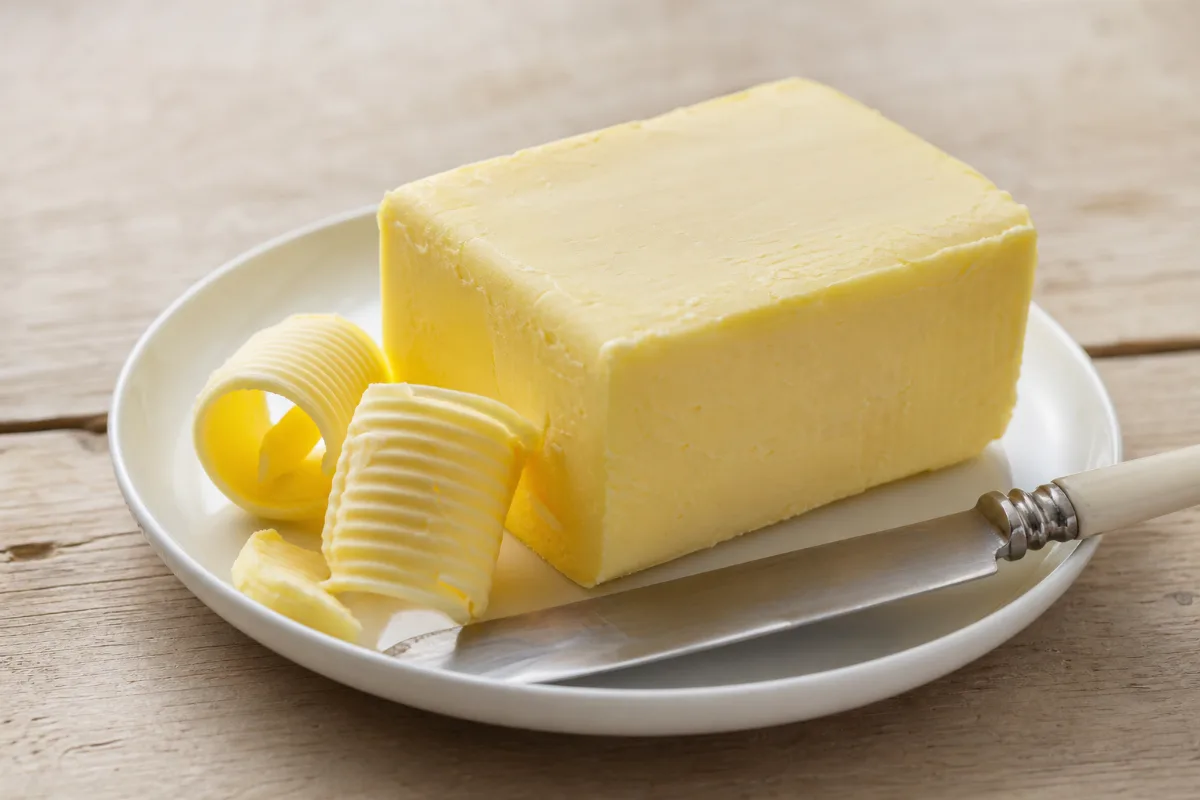
Oils & Fats · Dairy fat
Butter
Dairy fat (cows' milk) · also called Cows' milk butter, mantequilla (Spanish)
Butter is the fat of cows' milk, made by churning cream. A tablespoon has about 102 calories and 7.3 g of saturated fat. In trials it raises LDL cholesterol more than most liquid plant oils. Large studies of eating habits found no clear link between butter and heart disease, but that is an association, not proof. The main cautions are milk allergy and, in pregnancy, unpasteurised butter.
General information, not medical advice. Last substantive update · Not medically reviewed. A named clinician has not signed off on this page. How this page is made
About Butter
Butter is a flavourful, calorie-dense dairy fat. Trials show it raises LDL cholesterol more than most liquid plant oils, while eating-habit studies find no clear link with heart disease. Official advice still ranks unsaturated oils above it, so it is best seen as a food to enjoy in moderation rather than a health food.
What it is
Butter is the fat of cows' milk. It is made by churning cream until the fat separates from the liquid, and it is sold salted or unsalted.
One tablespoon (14.2 g) of salted butter has about 102 calories, 11.5 g of fat and 7.3 g of saturated fat (USDA). It has almost no protein, carbohydrate or fibre. It supplies some vitamin A (about 97 micrograms) and vitamin E, and about 91 mg of sodium when salted.
What the research shows
The firmest result is about LDL cholesterol. In a pooled analysis of 54 trials, many plant oils and beef fat lowered LDL more than butter. A Nordic review agreed.
Reviews of trials of cutting saturated fat found fewer combined heart events after two years or more. Those trials were about saturated fat overall, so they do not test butter alone.
Large studies of eating habits found no clear link between butter and heart disease or stroke, a very small link with higher all-cause death and a small link with lower diabetes. These show links, not cause. The authors said the data do not support a big push to eat more or less butter.
At a glance
Traditional uses history, not proof
- Everyday cooking and baking fat
- No source we read documents traditional health uses
Studied for research
- Blood LDL cholesterol compared with other fats, moderate certainty (butter raises it more)
- Heart disease and stroke in eating-habit studies, low certainty (no clear link)
- Cutting saturated fat in general and heart events, moderate certainty
- Type 2 diabetes risk, very low certainty
- Swapping butter for olive oil, low certainty
Main compounds
- Saturated fat (about 7.3 g per tablespoon)
- Natural trans fat (about 0.5 g per tablespoon)
- Vitamin A as retinol (about 97 micrograms per tablespoon)
- Cholesterol (about 31 mg per tablespoon)
Common forms
- Salted butter (the form the nutrition figures describe)
- Unsalted butter
- Cultured or European-style butter
- Ghee and margarine are different products, covered on their own pages
Research links: NHS: Eat less saturated fat · NHS: Foods to avoid in pregnancy · Butter and cardiovascular disease, diabetes and death, meta-analysis (PLoS One, 2016) · Oils and solid fats and blood lipids, network meta-analysis (Journal of Lipid Research, 2018) · Research Library · Genes & Biomarkers Library
What it is and its history
- Accepted scientific name
- Butter
- Naming authority
- A dairy food, not a plant or species
- Common names
- Butter (English); Cow's milk butter (English); Mantequilla (Spanish)
- Family or group
- Dairy fats (the existing summary groups it as an animal fat).
- Harvest and processing
- Made by churning cream so the fat separates from the liquid; sold salted or unsalted (existing summary; no source read for the method). Cultured or European-style butter is made from fermented cream (existing summary).
- Look-alikes and adulterants
- Name: Ghee (clarified butter); Note: A different product with the water and milk solids removed; evidence on butter does not automatically apply to it.; Name: Margarine and spreads; Note: Made from vegetable oils, not milk fat; a separate page covers them.
Photographs
Traditional use and history history, not clinical proof
| Tradition or era | Documented use | Source |
|---|---|---|
| Everyday cooking fat | Butter is a long-standing household food; no source read documents when or where it began. | NOT verified (no source read) |
Traditional use shows how it was used. It does not show that it works or is safe today.
What is inside, and how it may work
What it contains and how those compounds act in cells and animals. Laboratory and animal mechanisms are not proven effects in people.
Main compounds
| Compound | Family | Where it is concentrated | Activity studied | Level of evidence |
|---|---|---|---|---|
| Saturated fat | fat | Whole butter 51.4 g per 100 g; 7.3 g in 1 tablespoon (USDA) | Raises LDL cholesterol in trials compared with unsaturated oils. 13 6 | Human trials and composition data |
| Natural trans fat | fat | Whole butter About 3.3 g per 100 g (USDA) | Occurs naturally in milk fat from ruminant animals; the FDA says its actions on industrial trans fat do not cover it. 13 7 | Composition data and regulator statement |
| Vitamin A (retinol) | fat-soluble vitamin | Whole butter 684 micrograms RAE per 100 g; 97 micrograms in 1 tablespoon (USDA) | Provides preformed vitamin A in the diet; not tested here as a treatment. 13 12 | Composition data |
Mechanisms, receptors and pathways
| Target or pathway | Gene or receptor | What was found | Level |
|---|---|---|---|
| Saturated fat and LDL cholesterol | Replacing saturated fat with unsaturated fat lowers LDL cholesterol, which the AHA calls a cause of atherosclerosis; the specific pathways were not read. 5 6 | Human trials and expert advisory |
Absorption, metabolism and elimination
- Absorption
- Not researched.
- Distribution
- Not found.
- Metabolism
- Not found.
- Elimination
- Not found.
- Bioavailability
- Not established.
Isolated compounds versus whole extracts
Everything here is about butter as a food. Ghee, margarine and spreads, fish oil and supplements are different products and are not covered by these studies. Studies of saturated fat overall do not test butter alone.
Nutritional composition
Per 100 g of salted butter (USDA FoodData Central, SR Legacy item 173410, taken from a saved copy of the data): 717 kcal, 81.1 g fat (51.4 g saturated, 21.0 g monounsaturated, 3.0 g polyunsaturated, 3.3 g trans), 215 mg cholesterol, 643 mg sodium, 684 micrograms vitamin A (RAE), 2.32 mg vitamin E, 0.85 g protein, 0.06 g carbohydrate. One tablespoon (14.2 g) has about 102 kcal and 7.3 g saturated fat. Butter has almost no protein, carbohydrate or fibre. Unsalted butter has the same calories and fat but far less sodium. Values vary with the cow's feed and the brand.
2 moderate certainty2 low certainty2 very low certainty2 not enough evidence
What was looked at
The 8 benefits and uses checked for Butter, each with how strong the evidence is. Tap one to open it.
- Blood LDL cholesterol compared with other fats and oilsModerate certainty
- Heart disease and stroke in people who eat more butterLow certainty
- Cutting saturated fat (the main fat in butter) and heart eventsModerate certainty
- Type 2 diabetes risk in people who eat more butterVery low certainty
- Death from any causeVery low certainty
- Swapping butter for olive oilLow certainty
- CancerNot enough evidence
- Claims that butter is a health food (grass-fed, 'natural fat', brain health)Not enough evidence
Lab markers tracked in the studies
LDL cholesterolCombined cardiovascular events (saturated fat in general)All-cause mortalityNew cases of type 2 diabetes
What is Butter good for?
The main studied questions and how strong the human evidence is for each. Most results are links seen in eating habits or changes in a blood marker. Butter is a food, and none of this shows that it treats or prevents a disease.
Benefits, one by one
Each card is a research question, not a promise. Tap a goal to filter. Open a card to see the studies, doses and limits.
Blood LDL cholesterol compared with other fats and oils
Moderate certaintyIn controlled trials, butter raised LDL ('bad') cholesterol more than most liquid plant oils and beef fat. This is a harm signal, not a benefit, and it is the best-supported finding about butter.
2 studiesButter eaten as a food, compared with other fats and oils in the diet.
Studies, doses and limits
What the trials found
A 2018 network meta-analysis of 54 trials found that safflower, sunflower, rapeseed, flaxseed, corn, olive, soybean, palm and coconut oil, and beef fat all lowered LDL by 0.23 to 0.42 mmol/L more than butter. A Nordic review agreed that butter raises LDL compared with virtually all other fats and oils.
Results
Higher LDL with butter than with most other fats and oils tested.
Effect sizes as reported
LDL 0.23 to 0.42 mmol/L lower with the listed oils and beef fat than with butter (Schwingshackl 2018).
Why this rating
Randomised trials, and the Nordic review and the AHA advisory point the same way. The abstract gives no GRADE rating, the outcome is a blood marker, and the Nordic authors call the reviews they found low in methodological quality.
Form and dose studied
Butter eaten as a food, compared with other fats and oils in the diet.
Who was studied
Adults in trials of 3 weeks or longer.
Limits
Measures LDL, not heart attacks. Trials differ in how the fats were given.
Why researchers looked
Butter is about half saturated fat, and saturated fat is known to raise LDL cholesterol.
Proposed mechanism Authoritative guidance
Saturated fat raises LDL in the blood; the exact pathways were not read in the sources used.
A proposed mechanism does not show that the effect happens in people.
People with high cholesterol or heart disease should ask their clinician about their own fat intake.
Heart disease and stroke in people who eat more butter
Low certaintyLarge studies that followed people over time found no clear link between how much butter they ate and heart disease or stroke. This does not show butter protects the heart.
1 studiesButter as eaten in usual diets.
Studies, doses and limits
What the trials found
A 2016 review of 9 publications (15 cohorts, 636,151 people) found butter was not significantly linked with cardiovascular disease, coronary heart disease or stroke. No randomised trial of butter and heart attacks was found.
Results
No clear link in either direction.
Effect sizes as reported
Per 14 g (1 tablespoon) a day: cardiovascular disease RR 1.00 (0.98-1.02); coronary heart disease RR 0.99 (0.96-1.03); stroke RR 1.01 (0.98-1.03).
Why this rating
Observational data only. People who eat more butter may differ in other ways. The search ended in 2015. The authors say the findings do not support a major emphasis on eating more or less butter.
Form and dose studied
Butter as eaten in usual diets.
Who was studied
Adults in cohort studies in several countries.
Limits
Association, not cause; no butter trial on heart events.
Why researchers looked
Dairy fat has been suggested to behave differently from other saturated fat, so researchers pooled the eating-habit studies on butter.
Proposed mechanism Unknown
Not established.
A proposed mechanism does not show that the effect happens in people.
See the safety tab.
Cutting saturated fat (the main fat in butter) and heart events
Moderate certaintyTrials of lowering saturated fat for at least two years found fewer combined heart events. This is about saturated fat overall, not butter on its own.
2 studiesDiets that reduced saturated fat from any source.
Studies, doses and limits
What the trials found
A Cochrane review of 15 randomised trials (about 59,000 people) found that reducing saturated fat for at least two years cut combined cardiovascular events by 21%, with little or no effect on deaths. The American Heart Association advises replacing saturated fat with unsaturated fat, especially polyunsaturated fat.
Results
Fewer combined cardiovascular events; little or no effect on all-cause or cardiovascular death.
Effect sizes as reported
Combined cardiovascular events RR 0.79 (95% CI 0.66-0.93, 11 trials); all-cause death RR 0.96 (0.90-1.03).
Why this rating
The Cochrane authors rated the combined-events result moderate (GRADE). It is about saturated fat overall, and butter was not tested alone. A later update of the review exists.
Form and dose studied
Diets that reduced saturated fat from any source.
Who was studied
Adults in trials lasting 24 months or more.
Limits
Not specific to butter. High variation between trials (I2 65%). WHO-funded.
Why researchers looked
Butter is a large source of saturated fat in many diets, so advice on saturated fat is relevant to it.
Proposed mechanism Human trial
Lower saturated fat lowers LDL cholesterol, and the Cochrane authors found larger cuts in saturated fat went with larger drops in heart events.
A proposed mechanism does not show that the effect happens in people.
None specific.
Type 2 diabetes risk in people who eat more butter
Very low certaintyPeople who ate more butter had a slightly lower chance of type 2 diabetes in cohort studies. This is a link, not proof, and it is a small difference.
2 studiesButter as eaten in usual diets.
Studies, doses and limits
What the trials found
The 2016 review of 11 cohorts found a small inverse link with diabetes. The Nordic scoping review also reports a possible slightly lower risk in prospective cohorts.
Results
Slightly lower diabetes risk with more butter.
Effect sizes as reported
Per 14 g a day: type 2 diabetes RR 0.96 (95% CI 0.93-0.99, 11 cohorts).
Why this rating
Observational only, a very small effect, and a lower bound close to no effect. The Nordic authors rate the reviews low in methodological quality.
Form and dose studied
Butter as eaten in usual diets.
Who was studied
Adults in cohort studies.
Limits
Association, not cause. It does not show that eating butter prevents diabetes.
Why researchers looked
Dairy foods have been linked with lower diabetes risk, so butter was pooled on its own.
Proposed mechanism Unknown
Not established.
A proposed mechanism does not show that the effect happens in people.
People with diabetes should ask their care team about fats in their own plan.
Death from any cause
Very low certaintyIn the same studies, more butter went with a very slightly higher chance of death from any cause. The size is tiny and the finding is borderline.
2 studiesButter as eaten in usual diets.
Studies, doses and limits
What the trials found
The 2016 review of 9 cohorts found a weak link with higher all-cause death. The Nordic review says the same pattern may exist.
Results
Very slightly higher risk with more butter.
Effect sizes as reported
Per 14 g a day: all-cause death RR 1.01 (95% CI 1.00-1.03, 9 cohorts).
Why this rating
Observational, with a confidence interval touching 1.00, so it could be chance or other habits of people who eat more butter.
Form and dose studied
Butter as eaten in usual diets.
Who was studied
Adults in cohort studies.
Limits
Association only; tiny effect.
Why researchers looked
Researchers pooled butter intake against total deaths to see whether it helps or harms overall.
Proposed mechanism Unknown
Not established.
A proposed mechanism does not show that the effect happens in people.
None specific.
Swapping butter for olive oil
Low certaintyIn long-term studies, people whose diets used olive oil instead of butter had a slightly lower risk of cardiovascular disease.
1 studiesOlive oil replacing butter in the diet.
Studies, doses and limits
What the trials found
A 2023 review of prospective cohorts rated as moderate certainty (GRADE) a lower cardiovascular disease risk when olive oil replaced butter, from 3 cohorts.
Results
Slightly lower risk with olive oil instead of butter.
Effect sizes as reported
Cardiovascular disease SHR 0.96 (95% CI 0.95-0.98, 3 cohorts).
Why this rating
The authors' own GRADE for this result was moderate, but it comes from only 3 observational cohorts and the effect is small, so we show it as low.
Form and dose studied
Olive oil replacing butter in the diet.
Who was studied
Adults in cohort studies.
Limits
Association, not cause; people who choose olive oil may differ in other ways.
Why researchers looked
Public advice is to replace saturated fat with unsaturated fat, and olive oil is a common choice.
Proposed mechanism Preliminary mechanism
Likely linked to the LDL difference between the fats, but not tested in these studies.
A proposed mechanism does not show that the effect happens in people.
None specific.
Cancer
Not enough evidenceThe evidence on butter and cancer is thin. One review says butter may be linked with some cancer types. This is not settled.
1 studiesButter as eaten.
Studies, doses and limits
What the trials found
The Nordic scoping review says the cancer evidence is sparse and mainly from case-control studies, and that butter may be associated with increased risk of certain cancer types.
Results
Possible higher risk for some cancers; no figures in the abstract.
Why this rating
Sparse, case-control evidence in low-quality reviews, as the authors state.
Form and dose studied
Butter as eaten.
Who was studied
Adults.
Limits
No effect sizes read.
Why researchers looked
Researchers looked for links between dietary fats and cancer.
Proposed mechanism Unknown
Not established.
A proposed mechanism does not show that the effect happens in people.
None specific.
Claims that butter is a health food (grass-fed, 'natural fat', brain health)
Not enough evidenceNo source read shows butter protects the heart or brain or treats any condition. Claims about grass-fed butter were not checked.
1 studiesButter as eaten.
Studies, doses and limits
What the trials found
The 2016 review concluded that butter data do not support major emphasis on eating more or less of it. No trial was found showing a health benefit of butter.
Results
No benefit shown.
Why this rating
No trials of butter for these claims were found in the sources read.
Form and dose studied
Butter as eaten.
Limits
Grass-fed versus conventional butter was not looked up.
Why researchers looked
Popular books and social media often promote butter as a healthy fat.
Traditional use
Butter has been a household food for a very long time; no source read documents health uses.
Proposed mechanism Unknown
Not established.
A proposed mechanism does not show that the effect happens in people.
None specific.
Connections to the rest of health
How Butter connects to the rest of our health knowledge graph. Every link says what kind of connection it is. A safety link (for example to the liver) is a warning, not a benefit. A study that merely mentions a topic never creates a benefit link.
Explore every connection: goals, body systems, organs, symptoms, genes
A. Wellness goals
| Connected to | Kind of connection | Evidence status | Context | Studies |
|---|---|---|---|---|
| Heart Health | Moderate certainty | Blood LDL cholesterol compared with other fats and oils: In controlled trials, butter raised LDL ('bad') cholesterol more than most liquid plant oils and beef fat. This is a harm signal, not a benefit, and it is the best-supported finding about butter. | 6 4 | |
| Heart Health | Low certainty | Heart disease and stroke in people who eat more butter: Large studies that followed people over time found no clear link between how much butter they ate and heart disease or stroke. This does not show butter protects the heart. Swapping butter for olive oil: In long-term studies, people whose diets used olive oil instead of butter had a slightly lower risk of cardiovascular disease. | 3 2 | |
| Heart Health | Moderate certainty | Cutting saturated fat (the main fat in butter) and heart events: Trials of lowering saturated fat for at least two years found fewer combined heart events. This is about saturated fat overall, not butter on its own. | 1 5 | |
| Blood Sugar Balance | Very low certainty | Type 2 diabetes risk in people who eat more butter: People who ate more butter had a slightly lower chance of type 2 diabetes in cohort studies. This is a link, not proof, and it is a small difference. | 3 4 | |
| Longevity | Very low certainty | Death from any cause: In the same studies, more butter went with a very slightly higher chance of death from any cause. The size is tiny and the finding is borderline. | 3 4 |
B. Body systems
| Connected to | Kind of connection | Evidence status | Context | Studies |
|---|---|---|---|---|
| Cardiovascular System | Biological association | Moderate certainty | Studied for: Blood LDL cholesterol compared with other fats and oils Studied for: Heart disease and stroke in people who eat more butter | 6 4 3 1 5 2 |
| Endocrine System | Biological association | Very low certainty | Studied for: Type 2 diabetes risk in people who eat more butter | 3 4 |
E. Health conditions
| Connected to | Kind of connection | Evidence status | Context | Studies |
|---|---|---|---|---|
| High cholesterol | Adverse effect or risk | Documented risk | Butter raised LDL more than most liquid plant oils in trials. Butter raised LDL cholesterol more than most liquid plant oils in trials. Preparation or compound: Butter eaten as food |
6 |
| Milk allergy | Adverse effect or risk | Documented risk | Butter is made from cows' milk; the NHS lists milk among common allergens. Butter is made from cows' milk. Preparation or compound: Butter |
8 |
I. Biomarkers
| Connected to | Kind of connection | Evidence status | Context | Studies |
|---|---|---|---|---|
| LDL cholesterol | Biological association | Moderate certainty | Measured in trials: higher with butter than with most other fats and oils. A lab change is not the same as a health benefit. | 6 |
| Combined cardiovascular events (saturated fat in general) | Biological association | Moderate certainty | Measured in trials: fewer events when saturated fat was reduced. A lab change is not the same as a health benefit. | 1 |
| All-cause mortality | Biological association | Very low certainty | Measured in trials: very slightly higher with more butter. A lab change is not the same as a health benefit. | 3 |
| New cases of type 2 diabetes | Biological association | Very low certainty | Measured in trials: very slightly lower with more butter. A lab change is not the same as a health benefit. | 3 |
L. Active compounds
| Connected to | Kind of connection | Evidence status | Context | Studies |
|---|---|---|---|---|
| Saturated fat | Biological association | Human trials and composition data | Raises LDL cholesterol in trials compared with unsaturated oils. Preparation or compound: Whole butter |
13 6 |
| Natural trans fat | Biological association | Composition data and regulator statement | Occurs naturally in milk fat from ruminant animals; the FDA says its actions on industrial trans fat do not cover it. Preparation or compound: Whole butter |
13 7 |
| Vitamin A (retinol) | Biological association | Composition data | Provides preformed vitamin A in the diet; not tested here as a treatment. Preparation or compound: Whole butter |
13 12 |
Each connection is stored with the ingredient, the connected record, the kind of connection, the evidence status, the supporting studies, the preparation or compound involved, and a review date (last reviewed October 26, 2026).
Evidence at a glance: what the research found for 8 outcomes
Each outcome below is one thing researchers measured. Certainty is how far the evidence can be trusted, not how well it works. The full studies are on the next tab.
The evidence
The research centre for Butter. Every record here was checked against PubMed or the publisher's page; we never list a study we have not verified.
Evidence by outcome
Bars show how many studies we found for each outcome, not how well it works. People are added up across trials only (reviews are not added, to avoid double counting).
How we rate evidence
High certainty
Several well-run trials or reviews agree; further research is unlikely to change the picture much.
Moderate certainty
Good trials point the same way, but some doubt remains.
Low certainty
Small, short or inconsistent trials. The finding could change with better research.
Very low certainty
Very little or very weak human data. Treat as a possibility only.
Mixed findings
Trials or reviews disagree with each other.
Not enough evidence
Not enough human research to say either way.
Evidence against
Good research found no benefit, or found harm.
We take the reviewers' own risk-of-bias and GRADE statements where they exist, and otherwise judge from study size, design, consistency, directness and whether a product matches what is sold. Many publications do not make evidence high. Method note: We started from our existing butter summary, kept its USDA nutrition figures (taken from a saved copy of the USDA data), re-read PubMed abstracts for the reviews cited and re-read the NHS and FDA pages. CDC and food-allergy-charity pages could not be opened and are flagged. Only abstracts were read for studies.
Study library: every study we checked 13
| Study | Design | People | Product, dose, length | Result |
|---|---|---|---|---|
| Hooper 2020 Reduction in saturated fat intake for cardiovascular disease. Cochrane Database Syst Rev · PMID 32428300 · DOI |
Systematic review and meta analysis of randomised trials |
59000 15 randomised trials (16 comparisons), about 59,000 adults, at least 24 months, reducing saturated fat or replacing it |
Lower saturated fat intake (all sources; butter is not tested alone) At least 24 months · vs Higher saturated fat or usual diet |
Cutting saturated fat for at least two years lowered combined cardiovascular events by 21% (RR 0.79), GRADE moderate. Little or no effect on all-cause or cardiovascular death. The authors say replacing saturated fat with polyunsaturated fat or carbohydrate seems useful, while replacement with monounsaturated fat is unclear. Combined cardiovascular events RR 0.79 (95% CI 0.66-0.93, 11 trials); all-cause death RR 0.96 (0.90-1.03); cardiovascular death RR 0.95 (0.80-1.12) (0.66-0.93 (combined events)) Methods, limits and fundingOutcomes: Deaths and cardiovascular events Limitations: About saturated fat overall, not butter. Heterogeneity was high (I2 65%). A later update of this review exists (version pub3, August 2020); numbers here are from the version read. Funding and conflicts: Funded by a grant from the World Health Organization; the lead author is a member of a WHO nutrition guidance group Read: abstract |
| Neuenschwander 2023 Substitution of animal-based with plant-based foods on cardiometabolic health and all-cause mortality: a systematic review and meta-analysis of prospective studies. BMC Med · PMID 37968628 · DOI |
Systematic review (observational cohort studies, substitution analysis) |
37 publications from 24 prospective cohorts | Statistical swap of butter for olive oil in the diet (3 cohorts) Cohort follow-up · vs Butter |
For cardiovascular disease, swapping butter for olive oil was linked with a lower risk (summary hazard ratio 0.96), rated moderate certainty by the authors using GRADE. Butter replaced by olive oil: cardiovascular disease SHR 0.96 (95% CI 0.95-0.98, 3 cohorts) (0.95-0.98) Methods, limits and fundingOutcomes: Cardiovascular disease, type 2 diabetes, all-cause death Limitations: Observational substitution estimates from 3 cohorts; a small effect; people who choose olive oil may differ in other ways. Funding and conflicts: Authors declared no competing interests Read: abstract |
| Pimpin 2016 Is Butter Back? A Systematic Review and Meta-Analysis of Butter Consumption and Risk of Cardiovascular Disease, Diabetes, and Total Mortality. PLoS One · PMID 27355649 · DOI |
Systematic review (observational cohort studies) |
636151 9 publications covering 15 country-specific cohorts of adults; 636,151 people, 6.5 million person-years, 28,271 deaths, 9,783 cases of cardiovascular disease and 23,954 cases of diabetes. No randomised trials were found. |
Usual butter intake reported by participants, compared per 14 g (1 tablespoon) a day Cohort follow-up varied · vs Lower butter intake |
Butter was weakly linked with higher all-cause death (RR 1.01 per 14 g a day), not linked with cardiovascular disease, coronary heart disease or stroke, and linked with slightly lower diabetes (RR 0.96). The authors found no sign of publication bias and concluded the links are small or neutral. Per 14 g/day: all-cause death RR 1.01 (95% CI 1.00-1.03); cardiovascular disease RR 1.00 (0.98-1.02); coronary heart disease RR 0.99 (0.96-1.03); stroke RR 1.01 (0.98-1.03); type 2 diabetes RR 0.96 (0.93-0.99) (See effect) Methods, limits and fundingOutcomes: All-cause death, cardiovascular disease, coronary heart disease, stroke, type 2 diabetes Limitations: Observational: shows links, not cause. Search ended in May 2015, so newer cohorts are not included. Butter is only one part of a person's diet. Funding and conflicts: No funding statement in the abstract. The conflict statement lists consulting or honoraria for the senior author from several companies, including the Haas Avocado Board; the paper says this does not alter its data-sharing policies. Read: abstract |
| Rosqvist 2024 Fats and oils - a scoping review for Nordic Nutrition Recommendations 2023. Food Nutr Res · PMID 38370114 · DOI |
Scoping review of systematic reviews |
Systematic reviews and meta-analyses of fats and oils at food level | n/a |
Butter was not linked with cardiovascular disease in cohort studies, but may be linked with slightly lower type 2 diabetes and higher total death. The evidence on cancer is sparse and mostly case-control; butter may be linked with some cancer types. Butter raised LDL cholesterol compared with virtually all other fats and oils. The authors prefer unsaturated oils (olive, canola) over butter and tropical oils. Narrative summary; no pooled figure Methods, limits and fundingOutcomes: Cardiovascular disease, type 2 diabetes, total death, cancer, blood fats Limitations: All the reviews found were of low methodological quality, so the authors urge caution. Funding and conflicts: Authors declared none Read: abstract |
| Sacks 2017 Dietary Fats and Cardiovascular Disease: A Presidential Advisory From the American Heart Association. Circulation · PMID 28620111 · DOI |
Expert advisory (narrative review of trials and cohorts) |
Evidence review by an American Heart Association writing group | n/a |
The advisory concludes strongly that lowering saturated fat and replacing it with unsaturated fats, especially polyunsaturated fats, lowers cardiovascular disease. It reports that trials replacing saturated fat with polyunsaturated vegetable oil reduced disease by about 30%, and that replacing it with refined carbohydrates and sugars did not help. Advisory statement; not a new trial Methods, limits and fundingOutcomes: Effect of saturated fat and its replacement on cardiovascular disease Limitations: Expert synthesis, not a new analysis. Butter is not tested alone in the abstract. Funding and conflicts: American Heart Association; members' disclosures are on file with the journal Read: abstract |
| Schwingshackl 2018 Effects of oils and solid fats on blood lipids: a systematic review and network meta-analysis. J Lipid Res · PMID 30006369 · DOI |
Systematic review and network meta analysis of randomised trials |
54 randomised trials (3 weeks or longer) comparing at least two oils or solid fats, including butter, in adults | Safflower, sunflower, rapeseed, hempseed, flaxseed, corn, olive, soybean, palm and coconut oil, lard, beef fat and butter Modelled per 10% energy exchanged (statistical unit) 3 weeks or longer · vs Other oils or fats |
Safflower, sunflower, rapeseed, flaxseed, corn, olive, soybean, palm and coconut oil, and beef fat all lowered LDL cholesterol more than butter did (by 0.23 to 0.42 mmol/L). The authors say the findings support replacing high-saturated-fat foods with unsaturated oils. LDL cholesterol lower than with butter by 0.23 to 0.42 mmol/L for the listed oils and beef fat (Not given in the abstract) Methods, limits and fundingOutcomes: LDL cholesterol, total cholesterol, HDL cholesterol, triglycerides Limitations: The authors note limits in the data. It measures a blood marker, not heart attacks or strokes. The abstract does not give a GRADE rating. Funding and conflicts: Authors declared no competing interests Read: abstract |
| s-fda-trans-fat US FDA: Trans Fat · Source |
Authoritative guidance n/a |
Methods, limits and fundingRead: full-text | ||
| s-nhs-food-allergy NHS: Food allergy · Source |
Authoritative guidance n/a |
Methods, limits and fundingRead: full-text | ||
| s-nhs-lactose NHS: Lactose intolerance · Source |
Authoritative guidance n/a |
Methods, limits and fundingRead: full-text | ||
| s-nhs-pregnancy-foods NHS: Foods to avoid in pregnancy · Source |
Authoritative guidance n/a |
Methods, limits and fundingRead: full-text | ||
| s-nhs-saturated-fat NHS: Eat less saturated fat · Source |
Authoritative guidance n/a |
Methods, limits and fundingRead: full-text | ||
| s-nhs-vitamin-a NHS: Vitamin A · Source |
Authoritative guidance n/a |
Methods, limits and fundingRead: full-text | ||
| s-usda-fdc-173410 USDA FoodData Central: Butter, salted (FDC 173410, SR Legacy, April 2018) · Source |
Reference database n/a |
Methods, limits and fundingRead: partial |
What we do not know yet
- No trial has tested butter itself against other fats for heart attacks, stroke or death.
- The butter cohort review searched up to May 2015; newer cohorts were not read.
- Grass-fed, cultured and unsalted butter were not compared in any source read.
- Pregnancy beyond the unpasteurised-butter warning, breastfeeding, and infant use were not covered.
- The lactose content of butter and contaminants were not found in the sources read.
How new research is added
New studies are found by a saved PubMed search and placed in a review queue before the page changes.
Lab markers
What changed in blood or saliva tests during trials. A changed number is not the same as feeling or being healthier, and we give no "normal ranges".
Metabolic 1
LDL cholesterol
Higher with butter than with most other fats and oils in trials
The so-called bad cholesterol carried in the blood.
Moderate certaintyResults and what it means
Why it was measured
A common heart-risk marker.
Statistical vs. clinical meaning
A clear difference in a blood marker; the size of the effect on heart attacks depends on the whole diet.
Safety implication
Relevant for people with high cholesterol or heart disease.
| Study | Result | People | Product |
|---|---|---|---|
| 6 | Safflower, sunflower, rapeseed, flaxseed, corn, olive, soybean, palm and coconut oil and beef fat lowered LDL by 0.23 to 0.42 mmol/L more than butter | Adults in 54 randomised trials | Butter compared with other oils and solid fats |
Other 3
Combined cardiovascular events (saturated fat in general)
Fewer events when saturated fat was reduced in trials
Heart attacks, strokes and similar events counted together.
Moderate certaintyResults and what it means
Why it was measured
The outcome that matters most for heart health.
Statistical vs. clinical meaning
Supports the advice to swap saturated fat for unsaturated fat; it does not test butter itself.
Safety implication
None specific.
| Study | Result | People | Product |
|---|---|---|---|
| 1 | RR 0.79 (95% CI 0.66-0.93) over at least two years | About 53,300 adults in 11 trials | Reduced saturated fat from any source, not butter alone |
All-cause mortality
Very slightly higher with more butter in trials
Death from any cause during follow-up.
Very low certaintyResults and what it means
New cases of type 2 diabetes
Very slightly lower with more butter in trials
How many people develop type 2 diabetes during follow-up.
Very low certaintyResults and what it means
Safety
What studies and official sources say about side effects, medicines and who should check first. Each point shows what kind of evidence it comes from.
Main points to know 3
- Butter is a milk product: do not eat it with a cows' milk allergy. The NHS lists cows' milk among the most common food allergies. Butter is made from milk, so people with a milk allergy should get advice from an allergist before eating it. Swelling of the face or throat or trouble breathing is an emergency. Authoritative guidance 8
- Butter is high in saturated fat and raises LDL cholesterol. USDA lists about 51 g of saturated fat per 100 g, or 7.3 g in a tablespoon. Trials show butter raises LDL more than most liquid plant oils. The NHS lists butter among foods high in saturated fat. Controlled trial 6 11 13
- Unpasteurised butter is on the NHS 'avoid in pregnancy' list. The NHS says pasteurised butter is safe in pregnancy but unpasteurised butter should be avoided because of listeria. Most butter in UK supermarkets is pasteurised, and the label tells you. Authoritative guidance 10
Side effects 3
| Effect | How often | Severity and recovery | Evidence |
|---|---|---|---|
| Higher LDL cholesterol compared with unsaturated oils A change in a blood marker, not a measured heart attack. | Not established | moderate for people with high cholesterol or heart disease LDL falls when saturated fat is replaced with unsaturated fat in trials. | Controlled trial 6 |
| Allergic reaction in people allergic to cows' milk No source read gives how much milk protein butter holds. | Not established | mild to life-threatening Depends on the reaction. | Authoritative guidance 8 |
| Lactose-intolerance symptoms such as tummy pain, bloating or diarrhoea The NHS lists butter among dairy foods; no source read gives butter's lactose content, so how much lactose it holds is not stated here. | Not established | mild to moderate The NHS says symptoms can be prevented by eating smaller portions of lactose-containing foods or avoiding them. | Authoritative guidance 9 |
Liver
No liver injury linked to eating butter was found in the sources read. LiverTox was not checked.
How often. No frequency found.
This is a safety connection. It is not evidence that Butter supports liver health.
Medicines and supplements 2
| With | Why it matters | Importance | Evidence | What to do |
|---|---|---|---|---|
| Prescription and over-the-counter medicines prescription | No source read describes a medicine interaction with butter as food. | None found Not enough evidence | A pharmacist can check your own medicines. | |
| Vitamin A supplements, fish liver oil and liver supplement-or-food | Butter contains preformed vitamin A (retinol), which adds to vitamin A from other sources. | The NHS says an average over 1,500 micrograms a day over many years may affect bones. One tablespoon of butter provides about 97 micrograms (USDA), well below that. | Authoritative guidance Low certainty 12 13 | Count butter with other sources if you take vitamin A supplements. |
Who should check first 2
Overdose, product quality and regulators
Summary. Butter is an ordinary food. The concerns in the sources read are saturated fat and cholesterol, milk allergy, and germs in unpasteurised products.
Animal. Not reviewed.
Human doses studied. Cohort studies of usual intake found no clear link with heart disease or stroke and a very small link with all-cause death.
High dose or long term signals. A very small link with higher all-cause death (RR 1.01) in cohort studies; not proof of harm.
Overdose response. Not found.
Genotoxicity. Not reviewed.
The main food-safety point found is raw (unpasteurised) milk products. Contaminants such as dioxins or pesticide residues in butter were not looked up.
Unpasteurised butter and listeria (NHS pregnancy list). The NHS lists unpasteurised butter among foods to avoid in pregnancy and says unpasteurised dairy foods may contain listeria, which can cause listeriosis. 10
Natural trans fat. USDA lists about 3.3 g total trans fat per 100 g of butter. The FDA says trans fat also occurs naturally in milk, butter, cheese and meat from ruminant animals and that its actions on partially hydrogenated oils have not affected those natural sources. 13 7
| Body | Action | Date |
|---|---|---|
| NHS (United Kingdom) | Pasteurised butter is safe in pregnancy; unpasteurised butter is a food to avoid. source | Page last reviewed 15 June 2026 |
| NHS (United Kingdom) | Saturated fat guidance: no more than 30 g a day for the average man and 20 g for the average woman; butter listed as a high-saturated-fat food. source | Page last reviewed 19 June 2023 |
| US FDA (United States) | Trans fat from partially hydrogenated oils is being removed from food; the actions do not affect trans fat that occurs naturally in dairy and meat. source | Not shown in the page text read |
| American Heart Association (United States) | Advisory: replacing saturated fat with unsaturated fat, especially polyunsaturated fat, lowers cardiovascular disease. source | 2017 |
When to get medical help
- Swelling of the lips, face, tongue or throat
- Trouble breathing, wheezing or a tight throat
- Fainting, dizziness or a pale, floppy feeling after eating
- Widespread hives or repeated vomiting soon after eating
- Fever, stomach cramps or diarrhoea after unpasteurised dairy, especially in pregnancy: contact a doctor
Stop using the product and contact a clinician or emergency service. In the US, Poison Control is 1-800-222-1222.
General information only, not medical advice. Ask a clinician or pharmacist before use, especially with medicines, in pregnancy or with a health condition. See the Natural Remedy Safety guide.
Frequently asked questions
Is butter bad for your heart?
Does butter raise cholesterol?
Is butter better for you than oils?
Is butter better than margarine?
The sources we read compare butter with oils, not with modern spreads, so we cannot answer this here. See the margarine and spreads page.
What nutrition does butter have?
A tablespoon of salted butter has about 102 calories, 11.5 g fat, 7.3 g saturated fat, 31 mg cholesterol, 91 mg sodium and 97 micrograms vitamin A (USDA). Almost no protein or carbohydrate.
Does butter have trans fat?
Can I eat butter with a milk allergy?
Butter is made from milk, and the NHS lists cows' milk among common allergens. Ask an allergist. Call emergency services for swelling of the face or throat or trouble breathing.
Is butter safe in pregnancy?
The NHS says pasteurised butter is safe to eat and unpasteurised butter should be avoided because of listeria. Check the label.
Is butter OK if I am lactose intolerant?
The NHS lists butter among dairy foods that contain lactose and says smaller portions or avoiding them can prevent symptoms. We found no source giving butter's exact lactose content.
Does butter lower the risk of diabetes?
Is grass-fed butter healthier?
We did not read a source on this question, so we make no claim.
Explore by health goal
Editorial transparency
- Written by
- AlternativeMed editorial team. Research compiled with AI assistance, then checked against the sources listed.
- Medical review
- None. This page has not been reviewed by a physician or pharmacist.
- First published
- 2026-10-26
- Last substantive update
- 2026-10-26
- How we research
- We started from our existing butter summary, kept its USDA nutrition figures (taken from a saved copy of the USDA data), re-read PubMed abstracts for the reviews cited and re-read the NHS and FDA pages. CDC and food-allergy-charity pages could not be opened and are flagged. Only abstracts were read for studies.
- How we rate evidence
- See "How we rate evidence" in the Evidence tab.
- Independence
- No product is promoted on this page. No affiliate links are shown. One review author lists consulting for an avocado industry board; this is stated in the study record.
Sources 13
Each source was opened and checked. Where we read only the abstract, it says so. The small numbers in the text point here.
- Hooper L, Martin N, Jimoh OF, et al.. Reduction in saturated fat intake for cardiovascular disease.. Cochrane Database Syst Rev. 2020. PMID 32428300. DOI 10.1002/14651858.CD011737.pub2. (abstract)
- Neuenschwander M, Stadelmaier J, Eble J, et al.. Substitution of animal-based with plant-based foods on cardiometabolic health and all-cause mortality: a systematic review and meta-analysis of prospective studies.. BMC Med. 2023. PMID 37968628. DOI 10.1186/s12916-023-03093-1. (abstract)
- Pimpin L, Wu JH, Haskelberg H, Del Gobbo L, Mozaffarian D. Is Butter Back? A Systematic Review and Meta-Analysis of Butter Consumption and Risk of Cardiovascular Disease, Diabetes, and Total Mortality.. PLoS One. 2016. PMID 27355649. DOI 10.1371/journal.pone.0158118. (abstract)
- Rosqvist F, Niinisto S. Fats and oils - a scoping review for Nordic Nutrition Recommendations 2023.. Food Nutr Res. 2024. PMID 38370114. DOI 10.29219/fnr.v68.10487. (abstract)
- Sacks FM, Lichtenstein AH, Wu JHY, et al.. Dietary Fats and Cardiovascular Disease: A Presidential Advisory From the American Heart Association.. Circulation. 2017. PMID 28620111. DOI 10.1161/CIR.0000000000000510. (abstract)
- Schwingshackl L, Bogensberger B, Bencic A, et al.. Effects of oils and solid fats on blood lipids: a systematic review and network meta-analysis.. J Lipid Res. 2018. PMID 30006369. DOI 10.1194/jlr.P085522. (abstract)
- . US FDA: Trans Fat. . . (full-text)
- . NHS: Food allergy. . . (full-text)
- . NHS: Lactose intolerance. . . (full-text)
- . NHS: Foods to avoid in pregnancy. . . (full-text)
- . NHS: Eat less saturated fat. . . (full-text)
- . NHS: Vitamin A. . . (full-text)
- . USDA FoodData Central: Butter, salted (FDC 173410, SR Legacy, April 2018). . . (partial)
Where to buy
Check the label first. Whatever you buy, look for these:
- Cold-pressed or refined, to match how you cook
- A harvest or best-by date and a dark glass or tin container
- The oil's origin and any testing statement
- Smoke point for the way you cook
Talk to a pharmacist or doctor before you start any supplement, especially if you take medicines. See the Safety tab for interactions.
Support our free guides: as an Amazon Associate we earn from qualifying purchases. Full disclosure.


