Oils & Fats · Cooking fat
Lard & Beef Tallow
Sus scrofa (pork fat); Bos taurus (beef fat) · also called Rendered pork fat, rendered beef fat
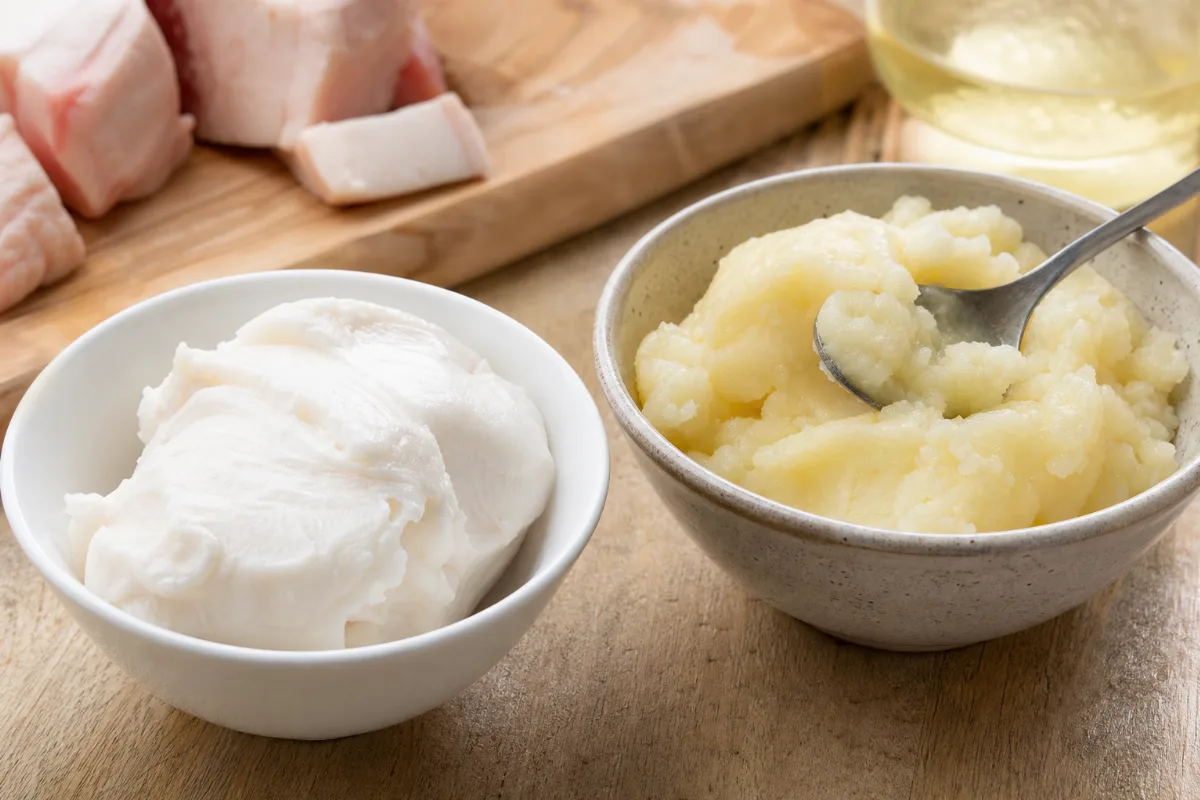
Lard is rendered pork fat and beef tallow is rendered beef fat. Both are almost pure fat, about 115 kcal in a tablespoon, and rich in saturated fat. Trials show unsaturated oils lower LDL cholesterol more than saturated fats, but there are almost no studies of lard or tallow themselves. The main cautions are saturated fat, alpha-gal allergy to mammal products and artificial trans fat in hydrogenated products.
General information, not medical advice. Last substantive update · Not medically reviewed. A named clinician has not signed off on this page. How this page is made
About Lard & Beef Tallow
Lard is rendered pork fat and beef tallow is rendered beef fat. They are almost pure fat, high in saturated fat, and used for cooking. They are foods, not health remedies: the best evidence is about saturated fat in general, and there is very little research on lard or tallow themselves.
What it is
Lard is the fat of pigs (Sus scrofa) and beef tallow is the fat of cattle (Bos taurus), melted and strained. USDA lists them as "Lard" and "Fat, beef tallow".
USDA data per 100 g. Lard: 902 kcal, 39.2 g saturated fat, 45.1 g monounsaturated, 11.2 g polyunsaturated, 95 mg cholesterol. Beef tallow: 902 kcal, 49.8 g saturated, 41.8 g monounsaturated, 4.0 g polyunsaturated, 109 mg cholesterol. A tablespoon (12.8 g) of either has about 115 kcal. Neither has protein, carbohydrate or fibre.
What is in it
Per tablespoon (the 100 g values multiplied by 0.128): about 5.0 g of saturated fat in lard and 6.4 g in tallow, and about 12 mg and 14 mg of cholesterol. Vitamin E and choline are present in small amounts: 0.6 mg and 49.7 mg per 100 g in lard, and 2.7 mg and 79.8 mg per 100 g in tallow.
Lard has more polyunsaturated fat than tallow, and tallow has more saturated fat. The amounts vary with the animal and how the fat is made. USDA also lists vitamin D for both, but the figures look unusually high and were not re-checked, so they are not used here.
What the research shows
A 2018 analysis of 54 trials found that many plant oils and beef fat lowered LDL cholesterol more than butter did. It gave no separate lard result in the abstract. A small 2024 crossover trial (18 adults) found an olive-oil-rich diet lowered LDL by 7.0% compared with a saturated-fat-rich diet, and its title names lard as the source of the saturated fat.
A Cochrane review of 15 trials found cutting saturated fat for at least two years lowered combined heart events by 21% (moderate-quality evidence) with little or no effect on deaths. The AHA advises replacing saturated fat with unsaturated fat. These findings are about saturated fat as a whole.
Two 12-week trials from one research group gave healthy adults 30 g a day of soybean oil, lard or a blend. Blood pressure and liver enzymes improved more with the blend than with lard alone, and weight, waist and blood lipids did not differ between groups. No study of heart attacks or death from lard or tallow was found.
At a glance
Traditional uses history, not proof
- Used for frying, pastry and roasting
- Long use as food is not proof that it treats any condition
Studied for research
- Calories and fat content, high certainty (USDA data)
- LDL cholesterol compared with other fats, low certainty for lard and tallow specifically
- Cutting saturated fat and heart events, moderate certainty (saturated fat overall, not lard alone)
- Blood pressure, low certainty (one trial of a lard and soybean oil blend)
- Liver enzymes, very low certainty (one trial of a blend)
- Heart disease and death from lard or tallow, insufficient evidence
- Skin, hormone and detox claims, insufficient evidence
Main compounds
- Saturated fat
- Monounsaturated fat
- Polyunsaturated fat
- Cholesterol
- Vitamin E and choline (small amounts)
Common forms
- Rendered lard (USDA 171401)
- Rendered beef tallow (USDA 171400)
- Hydrogenated lard (not covered by USDA values; may contain artificial trans fat)
- Skin-care or supplement forms are not covered
Research links: 2018 analysis: oils, solid fats and blood lipids (54 trials) · 2020 Cochrane review: reducing saturated fat · 2017 AHA advisory: dietary fats and heart disease · Research Library · Genes & Biomarkers Library
What it is and its history
- Accepted scientific name
- Sus scrofa domesticus (pork fat) and Bos taurus (beef fat)
- Naming authority
- GBIF accepted names: Sus scrofa Linnaeus, 1758 and Bos taurus Linnaeus, 1758
- Common names
- Lard (English); Beef tallow (English); Manteca de cerdo (Spanish); Sebo de res (Spanish)
- Family or group
- Not a plant. Lard is the fat of pigs and tallow is the fat of cattle.
- Classification
- Animalia > Chordata > Mammalia > Artiodactyla > Suidae (pig) and Bovidae (cattle) > Sus and Bos > Sus scrofa and Bos taurus
- Harvest and processing
- Both are rendered (melted and strained) animal fats, per the existing summary and the USDA item names ("Lard", "Fat, beef tallow"). Details of rendering and which body fat is used were not verified from a source read.
- Look-alikes and adulterants
- Name: Suet, butter, ghee, duck, goose and chicken fat, and hydrogenated lard; Note: Other animal fats with their own pages or different processing; hydrogenated lard may contain artificial trans fat.
- Sustainability and conservation
- Not assessed.
Photographs
Traditional use and history history, not clinical proof
| Tradition or era | Documented use | Source |
|---|---|---|
| p37461334 |
Traditional use shows how it was used. It does not show that it works or is safe today.
What is inside, and how it may work
What it contains and how those compounds act in cells and animals. Laboratory and animal mechanisms are not proven effects in people.
Main compounds
| Compound | Family | Where it is concentrated | Activity studied | Level of evidence |
|---|---|---|---|---|
| Saturated fat | fat | Rendered fat USDA per 100 g: lard 39.2 g; beef tallow 49.8 g | Raises LDL cholesterol more than unsaturated fat (AHA). 14 13 6 | Human data |
| Monounsaturated fat | fat | Rendered fat USDA per 100 g: lard 45.1 g; beef tallow 41.8 g | Not studied in these foods in the sources read. 14 13 | N/a |
| Polyunsaturated fat | fat | Rendered fat USDA per 100 g: lard 11.2 g; beef tallow 4.0 g | Not studied in these foods in the sources read. 14 13 | N/a |
| Cholesterol | sterol | Rendered fat USDA per 100 g: lard 95 mg; beef tallow 109 mg | Not assessed in the sources read. 14 13 | N/a |
| Vitamin E (alpha-tocopherol) | vitamin | Rendered fat USDA per 100 g: lard 0.6 mg; beef tallow 2.7 mg | Not assessed in the sources read. 14 13 | N/a |
| Choline | nutrient | Rendered fat USDA per 100 g: lard 49.7 mg; beef tallow 79.8 mg | Not assessed in the sources read. 14 13 | N/a |
Mechanisms, receptors and pathways
| Target or pathway | Gene or receptor | What was found | Level |
|---|---|---|---|
| LDL cholesterol and the type of fat | Not specified in the sources read | The AHA concludes that replacing saturated fat with unsaturated fat lowers LDL cholesterol, which links the biology to disease rates in cohorts and trials. This is about saturated fat in general. 6 2 | Human data |
| Alpha-gal allergy | IgE antibodies to the sugar galactose-alpha-1,3-galactose | The AAAAI answer says alpha-gal may be present in products from non-primate mammals including pigs, cows and sheep, and stresses that animal fat content matters. 8 | Human data |
Absorption, metabolism and elimination
- Absorption
- Not researched for these fats.
- Distribution
- Not researched.
- Metabolism
- Not researched.
- Elimination
- Not researched.
Isolated compounds versus whole extracts
The studies here are about eating the fats. The 12-week feeding trials used a 50:50 blend of lard and soybean oil as well as lard alone, so blend results are not lard results. No trial of lard or tallow used on the skin or as a supplement was read.
Nutritional composition
Nutrition from USDA FoodData Central (SR Legacy, April 2018 release; values read 2026-10-26 from a saved copy of the data in our research folder; the USDA web page was not opened). Lard (FDC 171401), per 100 g: 902 kcal; 100 g fat of which 39.2 g saturated, 45.1 g monounsaturated, 11.2 g polyunsaturated; 95 mg cholesterol; 0.6 mg vitamin E; 49.7 mg choline; 0.11 mg zinc; 0.2 microgram selenium; no protein, carbohydrate or fibre. Beef tallow (FDC 171400), per 100 g: 902 kcal; 100 g fat of which 49.8 g saturated, 41.8 g monounsaturated, 4.0 g polyunsaturated; 109 mg cholesterol; 2.7 mg vitamin E; 79.8 mg choline; 0.2 microgram selenium; no protein, carbohydrate or fibre. Per tablespoon (12.8 g, the USDA household portion, calculated by multiplying the 100 g values by 0.128): about 115 kcal for both; saturated fat 5.0 g (lard) and 6.4 g (tallow); cholesterol 12 mg (lard) and 14 mg (tallow). USDA also lists vitamin D for both, but the figures look unusually high and were not re-checked, so they are left out. Values change with the animal's feed and how the fat is made.
1 high certainty1 moderate certainty2 low certainty1 very low certainty2 not enough evidence
What was looked at
The 7 benefits and uses checked for Lard & Beef Tallow, each with how strong the evidence is. Tap one to open it.
- Calories and fat content (nutrient content)High certainty
- LDL cholesterol compared with other fatsLow certainty
- Cutting saturated fat and heart eventsModerate certainty
- Blood pressure (lard alone and lard with soybean oil)Low certainty
- Liver enzymes (lard alone and lard with soybean oil)Very low certainty
- Heart disease and death from eating lard or tallowNot enough evidence
- Popular claims: skin, hormones, "nutrient density" and "detox"Not enough evidence
Lab markers tracked in the studies
LDL cholesterolBlood pressureLiver enzymes (AST and ALT)
What is Lard & Beef Tallow good for?
The main studied uses and how strong the human evidence is for each. Most results are about saturated fat in general, or about a lard and soybean oil blend, not about lard or tallow alone.
Benefits, one by one
Each card is a research question, not a promise. Tap a goal to filter. Open a card to see the studies, doses and limits.
Calories and fat content (nutrient content)
High certaintyLard and beef tallow are almost pure fat. A tablespoon (12.8 g) of either has about 115 kcal and no protein, carbohydrate or fibre, by USDA data. They are mostly saturated and monounsaturated fat, with a little vitamin E and choline.
2 studiesRendered lard (USDA 171401) and beef tallow (USDA 171400). Hydrogenat…
Studies, doses and limits
What the trials found
No trial was read that tested lard or tallow as a source of any vitamin or mineral.
Results
Both are concentrated energy and fat. Vitamin E and choline are present in small amounts; neither fat is a notable source of other vitamins or minerals in the USDA values read.
Effect sizes as reported
USDA per 100 g, lard: 902 kcal, 39.2 g saturated fat, 45.1 g monounsaturated, 11.2 g polyunsaturated, 95 mg cholesterol. Beef tallow: 902 kcal, 49.8 g saturated, 41.8 g monounsaturated, 4.0 g polyunsaturated, 109 mg cholesterol.
Why this rating
High that the fats contain these amounts (USDA data, SR Legacy). It is a nutrient fact, not a health effect. Real products vary with the animal and how the fat was made.
Form and dose studied
Rendered lard (USDA 171401) and beef tallow (USDA 171400). Hydrogenated lard, leaf lard, suet and flavoured products were not covered.
Who was studied
General adult diet.
Limits
Values come from one old USDA release (2018) and change with feed and rendering.
Why researchers looked
People use these fats for cooking and want to know what is in them.
Traditional use
Lard has been used as a food for a very long time; the authors of a 2023 feeding trial say humans have eaten it for thousands of years. Long use is not proof of any health effect.
Proposed mechanism Nutrient database
These are nutrient amounts in the fat, taken from USDA tables.
A proposed mechanism does not show that the effect happens in people.
Very high in calories and saturated fat; see the Safety tab.
LDL cholesterol compared with other fats
Low certaintyIn pooled trials, many plant oils and beef fat lowered LDL ("bad") cholesterol more than butter did. The lard result was not reported in the abstract. A small trial found that swapping a saturated-fat-rich diet for an olive-oil-rich diet lowered LDL by 7%.
4 studiesRendered lard, beef fat (not confirmed as tallow), butter and plant o…
Studies, doses and limits
What the trials found
A 2018 network meta-analysis of 54 trials found safflower, sunflower, rapeseed, flaxseed, corn, olive, soybean, palm and coconut oil and beef fat all lowered LDL more than butter. It gave no separate lard result in the abstract. A 2024 crossover trial of 18 adults with insulin-resistance-linked high blood fats found that an olive-oil-rich diet lowered LDL by 7.0% versus a saturated-fat-rich diet (the title names lard as the source). A 12-week feeding trial of 334 healthy adults found no significant differences in blood lipids between lard, soybean oil and a lard and soybean oil blend.
Results
The direction is clear for saturated fat in general, but results for lard and tallow themselves are thin and not all the same. One healthy-adult trial that included a lard arm saw no lipid differences between oils.
Effect sizes as reported
Versus butter, LDL difference -0.42 to -0.23 mmol/L for the oils and beef fat named (range). Olive-oil diet versus saturated-fat diet: LDL -7.0%, non-HDL -2.5% (n = 18).
Why this rating
Low for lard and tallow specifically: the large analysis does not report lard, the crossover trial is small (18 people) and describes the diet by fat amounts, and a larger trial saw no lipid difference. The general rule that unsaturated fats lower LDL more than saturated fats is stated by the AHA.
Form and dose studied
Rendered lard, beef fat (not confirmed as tallow), butter and plant oils in trial diets. Trials gave oils in set amounts; this page gives no amounts to eat.
Who was studied
Adults, healthy and with raised blood fats.
Limits
Beef fat may not be the same as tallow. Results are for blood markers, not heart attacks.
Why researchers looked
Lard and tallow are rich in saturated fat, which is known to raise LDL cholesterol, so researchers compare them with unsaturated oils.
Proposed mechanism Human clinical
Replacing saturated fat with unsaturated fat lowers LDL cholesterol, according to the American Heart Association review. This is a human blood-marker effect, not a proven effect on disease for these two fats.
A proposed mechanism does not show that the effect happens in people.
People with high LDL or heart disease should ask their clinician about animal fats.
Cutting saturated fat and heart events
Moderate certaintyLong trials of people who cut back on saturated fat found about 21% fewer combined heart and blood vessel events, but little or no change in deaths. This is about saturated fat overall, not lard or tallow alone.
3 studiesTrial interventions varied from providing all food to giving advice.
Studies, doses and limits
What the trials found
A Cochrane review of 15 trials (about 59,000 people, at least two years) found reducing saturated fat cut combined cardiovascular events by 21%, with moderate-quality evidence. It found little or no effect on all-cause or cardiovascular death. The AHA advises replacing saturated fat with unsaturated fat, especially polyunsaturated fat.
Results
Cutting saturated fat lowered combined heart events in trials. The review could not say whether the swap to polyunsaturated fat or to carbohydrate mattered more. No trial of lard or tallow itself was found.
Effect sizes as reported
Combined cardiovascular events RR 0.79 (95% CI 0.66 to 0.93); all-cause mortality RR 0.96 (0.90 to 1.03); cardiovascular mortality RR 0.95 (0.80 to 1.12).
Why this rating
Moderate by the Cochrane authors' GRADE for combined events and for the lack of an effect on deaths. It is not lard- or tallow-specific.
Form and dose studied
Trial interventions varied from providing all food to giving advice.
Who was studied
Adults with or without heart disease.
Limits
Trials differed a lot (I2 = 65%). Replacing saturated fat with refined carbohydrates and sugars was not linked to lower rates by the AHA.
Why researchers looked
Lard and tallow are high in saturated fat, so guidance on saturated fat applies to them.
Proposed mechanism Human clinical
Lower saturated fat intake lowers LDL cholesterol, and the Cochrane authors found that bigger cholesterol drops went with bigger drops in events.
A proposed mechanism does not show that the effect happens in people.
A guidance statement, not a dose recommendation.
Blood pressure (lard alone and lard with soybean oil)
Low certaintyIn a 12-week trial of healthy adults, a 50:50 blend of lard and soybean oil lowered blood pressure more than soybean oil or lard on their own. In the lard-only group the top number fell 1.2 mmHg and the bottom number rose 3.3 mmHg.
1 studiesLard, soybean oil or a 50:50 blend in the diet (30 g a day in the tri…
Studies, doses and limits
What the trials found
A parallel randomised feeding trial: 334 healthy adults, three groups, 30 g of oil a day for 12 weeks (245 finished). Changes were different between groups (P = 0.023 for systolic, 0.008 for diastolic). Weight, waist, blood lipids and glucose did not differ between groups.
Results
The blend, not lard alone, lowered blood pressure. Lard alone did not lower the bottom number; it rose.
Effect sizes as reported
Systolic/diastolic at 12 weeks: blend -6.0/+0.8 mmHg; soybean oil -3.3/+1.5; lard -1.2/+3.3.
Why this rating
A single trial from one research group, healthy and mostly young adults, 12 weeks, 27% did not finish, a blend rather than lard alone, and blood pressure only.
Form and dose studied
Lard, soybean oil or a 50:50 blend in the diet (30 g a day in the trial).
Who was studied
Healthy adults in China, mean age 33.
Limits
No replication found. Not tested in people with high blood pressure as a main group.
Why researchers looked
Researchers wanted to know whether a blend of lard and soybean oil changes heart-risk markers compared with either oil.
Proposed mechanism Not established
The trial authors did not establish how; the abstract gives no mechanism.
A proposed mechanism does not show that the effect happens in people.
None specific beyond the saturated fat points on the Safety tab.
Liver enzymes (lard alone and lard with soybean oil)
Very low certaintyA 12-week trial in healthy adults found AST and ALT (liver enzymes) fell more with a lard and soybean oil blend than with either oil alone. The abstract gives no separate numbers for lard alone.
1 studiesLard, soybean oil or the blend, 12 weeks.
Studies, doses and limits
What the trials found
A randomised feeding trial of 345 healthy adults given soybean oil, lard or a 50:50 blend (30 g a day) for 12 weeks. Other liver function markers did not differ between groups.
Results
Liver enzymes improved more with the blend. These are healthy people, so it says nothing about treating liver disease.
Effect sizes as reported
No numbers for the lard-only group in the abstract.
Why this rating
One trial group, healthy adults, blood markers only, a blend rather than lard alone, and no numbers for the lard arm in the abstract. The same group reported the blood pressure trial.
Form and dose studied
Lard, soybean oil or the blend, 12 weeks.
Who was studied
Healthy adults.
Limits
Not a trial in people with liver disease. The authors speculate about fatty liver prevention, which was not tested.
Why researchers looked
Animal studies suggested the blend might be easier on the liver than either oil alone, so the same group tested it in people.
Proposed mechanism Not established
The abstract gives no mechanism for people. The authors refer to earlier animal studies.
A proposed mechanism does not show that the effect happens in people.
None specific.
Heart disease and death from eating lard or tallow
Not enough evidenceNo study read measured heart attacks, stroke or death in people eating lard or tallow. A 2024 review of fats and oils as foods did not mention lard or tallow in its abstract and rated all the reviews it found as low quality.
1 studiesNot applicable.
Studies, doses and limits
What the trials found
A Nordic scoping review looked for reviews of fats and oils as foods. It found few, all of low methodological quality. Its abstract names butter, olive oil, palm, coconut and canola oil but not lard or tallow.
Results
There is not enough evidence to say lard or tallow, as eaten, raise or lower the chance of heart disease or death.
Effect sizes as reported
No numbers.
Why this rating
No direct studies of lard or tallow outcomes were found.
Limits
The review was about fats and oils in general.
Why researchers looked
Online claims say these fats are healthy or harmful; people want direct evidence.
Proposed mechanism Not applicable
Not applicable.
A proposed mechanism does not show that the effect happens in people.
Guidance on saturated fat applies; see the Safety tab.
Popular claims: skin, hormones, "nutrient density" and "detox"
Not enough evidenceNo human trial read supports claims that eating lard or tallow heals skin, balances hormones or detoxifies the body. USDA lists only small amounts of vitamin E and choline.
2 studiesNot applicable.
Studies, doses and limits
What the trials found
No study was found or read on these claims. Nothing here covers lard or tallow used on the skin or sold as a supplement.
Results
No benefit shown.
Effect sizes as reported
No numbers.
Why this rating
No studies read.
Limits
Absence of evidence is not proof of harm or of no effect.
Why researchers looked
These claims are common online. They are listed here so readers can see that no trial was found.
Proposed mechanism Not applicable
Not applicable.
A proposed mechanism does not show that the effect happens in people.
Do not rely on these claims for any health problem.
Connections to the rest of health
How Lard & Beef Tallow connects to the rest of our health knowledge graph. Every link says what kind of connection it is. A safety link (for example to the liver) is a warning, not a benefit. A study that merely mentions a topic never creates a benefit link.
Explore every connection: goals, body systems, organs, symptoms, genes
A. Wellness goals
| Connected to | Kind of connection | Evidence status | Context | Studies |
|---|---|---|---|---|
| Preventive Wellness | High certainty | Calories and fat content (nutrient content): Lard and beef tallow are almost pure fat. A tablespoon (12.8 g) of either has about 115 kcal and no protein, carbohydrate or fibre, by USDA data. They are mostly saturated and monounsaturated fat, with a little vitamin E and choline. | 14 13 | |
| Cholesterol Balance | Low certainty | LDL cholesterol compared with other fats: In pooled trials, many plant oils and beef fat lowered LDL ("bad") cholesterol more than butter did. The lard result was not reported in the abstract. A small trial found that swapping a saturated-fat-rich diet for an olive-oil-rich diet lowered LDL by 7%. | 7 1 3 6 | |
| Heart Health | Moderate certainty | Cutting saturated fat and heart events: Long trials of people who cut back on saturated fat found about 21% fewer combined heart and blood vessel events, but little or no change in deaths. This is about saturated fat overall, not lard or tallow alone. | 2 6 12 | |
| Heart Health | Low certainty | Blood pressure (lard alone and lard with soybean oil): In a 12-week trial of healthy adults, a 50:50 blend of lard and soybean oil lowered blood pressure more than soybean oil or lard on their own. In the lard-only group the top number fell 1.2 mmHg and the bottom number rose 3.3 mmHg. | 3 | |
| Liver Health | Very low certainty | Liver enzymes (lard alone and lard with soybean oil): A 12-week trial in healthy adults found AST and ALT (liver enzymes) fell more with a lard and soybean oil blend than with either oil alone. The abstract gives no separate numbers for lard alone. | 4 | |
| Heart Health | Not enough evidence | Heart disease and death from eating lard or tallow: No study read measured heart attacks, stroke or death in people eating lard or tallow. A 2024 review of fats and oils as foods did not mention lard or tallow in its abstract and rated all the reviews it found as low quality. | 5 | |
| Skin Hair | Not enough evidence | Popular claims: skin, hormones, "nutrient density" and "detox": No human trial read supports claims that eating lard or tallow heals skin, balances hormones or detoxifies the body. USDA lists only small amounts of vitamin E and choline. | 14 13 |
B. Body systems
| Connected to | Kind of connection | Evidence status | Context | Studies |
|---|---|---|---|---|
| Cardiovascular System | Biological association | High certainty | Studied for: Calories and fat content (nutrient content) Studied for: LDL cholesterol compared with other fats | 14 13 7 1 3 6 2 12 5 |
| Digestive System | Biological association | Very low certainty | Studied for: Liver enzymes (lard alone and lard with soybean oil) | 4 |
| Integumentary System | Biological association | Not enough evidence | Studied for: Popular claims: skin, hormones, "nutrient density" and "detox" | 14 13 |
E. Health conditions
| Connected to | Kind of connection | Evidence status | Context | Studies |
|---|---|---|---|---|
| Alpha-gal syndrome | Adverse effect or risk | Documented risk | Health-agency materials list mammal products as possible triggers; neither source read names lard or tallow. Health bodies list mammal products as possible triggers; the sources read do not name lard or tallow. Preparation or compound: Mammal fats such as lard and tallow |
8 9 |
| High cholesterol | Adverse effect or risk | Documented risk | Saturated fat raises LDL cholesterol more than unsaturated fat; lard-specific results are limited. Preparation or compound: Saturated fat in lard and tallow |
7 6 |
I. Biomarkers
| Connected to | Kind of connection | Evidence status | Context | Studies |
|---|---|---|---|---|
| LDL cholesterol | Biological association | Low certainty | Measured in trials: mixed. A lab change is not the same as a health benefit. | 7 1 |
| Blood pressure | Biological association | Low certainty | Measured in trials: mixed. A lab change is not the same as a health benefit. | 3 |
| Liver enzymes (AST and ALT) | Biological association | Very low certainty | Measured in trials: mixed. A lab change is not the same as a health benefit. | 4 |
K. Biological pathways
| Connected to | Kind of connection | Evidence status | Context | Studies |
|---|---|---|---|---|
| LDL cholesterol | Preliminary mechanism | Human | Saturated-fat-rich fats raise LDL more than many unsaturated oils. | 7 1 |
| Alpha-gal syndrome | Preliminary mechanism | Human | Mammal fats are listed by health bodies as possible triggers; lard and tallow are not named. | 8 |
L. Active compounds
| Connected to | Kind of connection | Evidence status | Context | Studies |
|---|---|---|---|---|
| Saturated fat | Biological association | Human | Raises LDL cholesterol more than unsaturated fat (AHA). Preparation or compound: Rendered fat |
14 13 6 |
| Monounsaturated fat | Biological association | N/a | Not studied in these foods in the sources read. Preparation or compound: Rendered fat |
14 13 |
| Polyunsaturated fat | Biological association | N/a | Not studied in these foods in the sources read. Preparation or compound: Rendered fat |
14 13 |
| Cholesterol | Biological association | N/a | Not assessed in the sources read. Preparation or compound: Rendered fat |
14 13 |
| Vitamin E (alpha-tocopherol) | Biological association | N/a | Not assessed in the sources read. Preparation or compound: Rendered fat |
14 13 |
| Choline | Biological association | N/a | Not assessed in the sources read. Preparation or compound: Rendered fat |
14 13 |
Each connection is stored with the ingredient, the connected record, the kind of connection, the evidence status, the supporting studies, the preparation or compound involved, and a review date (last reviewed October 26, 2026).
The evidence
The research centre for Lard & Beef Tallow. Every record here was checked against PubMed or the publisher's page; we never list a study we have not verified.
Evidence by outcome
Bars show how many studies we found for each outcome, not how well it works. People are added up across trials only (reviews are not added, to avoid double counting).
How we rate evidence
High certainty
Several well-run trials or reviews agree; further research is unlikely to change the picture much.
Moderate certainty
Good trials point the same way, but some doubt remains.
Low certainty
Small, short or inconsistent trials. The finding could change with better research.
Very low certainty
Very little or very weak human data. Treat as a possibility only.
Mixed findings
Trials or reviews disagree with each other.
Not enough evidence
Not enough human research to say either way.
Evidence against
Good research found no benefit, or found harm.
We take the reviewers' own risk-of-bias and GRADE statements where they exist, and otherwise judge from study size, design, consistency, directness and whether a product matches what is sold. Many publications do not make evidence high. Method note: We started from our existing lard and tallow summary, re-checked nutrition against saved USDA FoodData Central data, read the NHS, FDA and AAAAI pages and re-read PubMed abstracts for the reviews and trials cited. Only abstracts were read for studies. The CDC page could not be opened and is flagged. Items we could not verify are in the research gaps.
Study library: every study we checked 14
| Study | Design | People | Product, dose, length | Result |
|---|---|---|---|---|
| Desjardins 2024 Substitution of dietary monounsaturated fatty acids from olive oil for saturated fatty acids from lard increases low-density lipoprotein apolipoprotein B-100 fractional catabolic rate in subjects with dyslipidemia associated with insulin resistance: a randomized controlled trial. Am J Clin Nutr · PMID 38518848 · DOI |
Randomised crossover trial |
18 Adults with high blood fats linked to insulin resistance (n = 18) |
A diet rich in saturated fat (title names lard as the source) versus a diet rich in monounsaturated fat from olive oil Diet, all food provided Saturated fat 13.4% of energy versus 7.1% of energy 4 weeks per diet, 4-week washout · vs Olive-oil-rich diet |
The olive-oil-rich diet lowered LDL cholesterol by 7.0% and non-HDL cholesterol by 2.5% compared with the saturated-fat-rich diet. LDL-C -7.0% (P = 0.01); non-HDL-C -2.5% (P = 0.04) (Not given in the abstract) Methods, limits and fundingOutcomes: LDL cholesterol, non-HDL cholesterol, apoB kinetics Limitations: Only 18 people, all with insulin-resistant dyslipidaemia, so it may not apply to everyone. The abstract describes the saturated-fat diet by its fat amounts and names lard only in the title. It tests a swap, not lard on its own. Funding and conflicts: Funding is not stated in the abstract. Read: abstract |
| Hooper 2020 Reduction in saturated fat intake for cardiovascular disease. Cochrane Database Syst Rev · PMID 32428300 · DOI |
Systematic review meta analysis |
15 randomised trials (16 comparisons), about 59,000 adults, intervention at least 24 months | Advice or food provision to reduce saturated fat (not lard or tallow specifically) Fat as eaten At least 24 months · vs Higher saturated fat intake or usual diet |
Reducing saturated fat cut combined cardiovascular events by 21% (moderate-quality evidence). There was little or no effect on all-cause or cardiovascular death. Combined cardiovascular events RR 0.79; all-cause mortality RR 0.96; cardiovascular mortality RR 0.95 (0.66 to 0.93 (events); 0.90 to 1.03 (all-cause deaths); 0.80 to 1.12 (cardiovascular deaths)) Methods, limits and fundingOutcomes: Mortality, cardiovascular events Limitations: The trials used many kinds of interventions (all food provided to advice only) and results differed between trials (I2 = 65%). It is about saturated fat overall, not lard or tallow. Funding and conflicts: Funding is not stated in the abstract. Read: abstract |
| Liu 2023 Effect of lard plus soybean oil on blood pressure and other cardiometabolic risk factors in healthy subjects: a randomized controlled-feeding trial. Food Funct · PMID 37461334 · DOI |
Randomised controlled feeding trial |
334 334 healthy adults (mean age 33; 60% women); 245 finished |
Soybean oil, lard, or a 50:50 blend of lard and soybean oil Cooking oil provided in the diet 30 g of oil a day 12 weeks · vs Soybean oil alone and lard alone |
Blood pressure fell more with the lard and soybean oil blend than with either oil alone. In the lard-only group the top number fell 1.2 mmHg and the bottom number rose 3.3 mmHg. There were no significant differences between groups in weight, waist, blood lipids or glucose. Systolic/diastolic change at 12 weeks: blend -6.0/+0.8 mmHg; soybean oil -3.3/+1.5; lard alone -1.2/+3.3 (Lard alone: systolic -3.7 to 1.4; diastolic 0.9 to 5.8) Methods, limits and fundingOutcomes: Blood pressure, body weight, waist, blood lipids, glucose Limitations: Healthy, mostly young adults, 12 weeks, in China. The result is for a blend, which is not lard on its own, and 27% of people did not finish. The abstract does not state funding. Funding and conflicts: Funding is not stated in the abstract. Read: abstract |
| Liu 2023 Effect of Lard or Plus Soybean Oil on Markers of Liver Function in Healthy Subjects: A Randomized Controlled-Feeding Trial. Foods · PMID 37174432 · DOI |
Randomised controlled feeding trial |
345 345 healthy adults |
Soybean oil, lard, or a 50:50 blend of lard and soybean oil Cooking oil provided in the diet 30 g of oil a day 12 weeks · vs Soybean oil alone and lard alone |
The blend lowered AST and ALT more than soybean oil alone or lard alone. There were no significant differences in the other liver markers. The abstract gives no separate numbers for the lard-only group. No numbers for the lard-only group in the abstract (Not given in the abstract) Methods, limits and fundingOutcomes: Liver enzymes (AST, ALT) and other liver function markers Limitations: Healthy adults, 12 weeks, liver enzymes only; no liver disease outcome. The result is for a blend, and the lard-only numbers were not in the abstract. The authors say the blend "might help prevent" fatty liver, which this trial did not test. Funding and conflicts: The PubMed record lists a grant from the Natural Science Foundation of China (public funder). Read: abstract |
| Rosqvist 2024 Fats and oils - a scoping review for Nordic Nutrition Recommendations 2023. Food Nutr Res · PMID 38370114 · DOI |
Scoping review |
Systematic reviews and meta-analyses on fats and oils at the food level | Fats and oils (olive oil, butter, palm, coconut, canola and others) Fat as eaten |
There are few reviews that look at fats and oils as foods, and all the ones found were of low methodological quality. The abstract does not mention lard or tallow. It concludes that oils rich in unsaturated fat are preferred over fats rich in saturated fat. No numbers in the abstract (Not applicable) Methods, limits and fundingOutcomes: Cardiovascular disease, type 2 diabetes, mortality, cancer, blood lipids Limitations: A summary of other reviews, with low-quality evidence. The abstract names butter, olive oil, palm, coconut and canola oil, but not lard or tallow. Funding and conflicts: Funding is not stated in the abstract. Read: abstract |
| Sacks 2017 Dietary Fats and Cardiovascular Disease: A Presidential Advisory From the American Heart Association. Circulation · PMID 28620111 · DOI |
Guideline advisory |
American Heart Association review of trials and cohort studies on dietary fats | Dietary saturated fat and its replacement by other fats Fat as eaten |
The AHA concludes strongly that lowering saturated fat and replacing it with unsaturated fats, especially polyunsaturated fats, will lower the rate of cardiovascular disease. Replacing saturated fat with refined carbohydrates and sugars is not linked to lower rates. Trials that replaced saturated fat with polyunsaturated vegetable oil reduced cardiovascular disease by about 30% (Not given in the abstract) Methods, limits and fundingOutcomes: Cardiovascular disease Limitations: An expert advisory, not a new trial. It is about saturated fat in general and does not rate lard or tallow on their own. Funding and conflicts: Written by the American Heart Association; funding is not stated in the abstract. Read: abstract |
| Schwingshackl 2018 Effects of oils and solid fats on blood lipids: a systematic review and network meta-analysis. J Lipid Res · PMID 30006369 · DOI |
Systematic review network meta analysis |
54 randomised trials (at least 3 weeks) comparing at least two of 10 plant oils, lard, beef fat and butter | Oils and solid fats including lard, beef fat and butter Fat as eaten Per 10% isocaloric exchange (modelled) At least 3 weeks · vs Other oils or fats, including butter |
Safflower, sunflower, rapeseed, flaxseed, corn, olive, soybean, palm and coconut oil, as well as beef fat, lowered LDL cholesterol more than butter did. The abstract gives no separate LDL result for lard. LDL-C difference versus butter: -0.42 to -0.23 mmol/L across the oils and beef fat named in the abstract (range, not a separate result for each) (Not given per fat in the abstract) Methods, limits and fundingOutcomes: LDL cholesterol, total cholesterol, HDL cholesterol, triglycerides Limitations: The abstract does not report lard separately and does not say whether the beef fat in the trials was tallow. The authors note limitations in the data. Results are modelled per 10% calorie swap. Funding and conflicts: Funding is not stated in the abstract. Read: abstract |
| s-aaaai-alpha-gal AAAAI, Ask the Expert: Galactose-alpha-1,3-galactose (alpha-gal) allergy · Source |
Professional society n/a |
Methods, limits and fundingRead: full-text | ||
| s-cdc-alpha-gal CDC: About alpha-gal syndrome · Source |
Health agency n/a |
Methods, limits and fundingRead: summary-only | ||
| s-fda-pho US FDA: Final Determination Regarding Partially Hydrogenated Oils (Removing Trans Fat) · Source |
Regulator n/a |
Methods, limits and fundingRead: full-text | ||
| s-gbif-sus-bos GBIF Backbone: Sus scrofa Linnaeus, 1758 (key 7705930) and Bos taurus Linnaeus, 1758 (key 2441022) · Source |
Reference database n/a |
Methods, limits and fundingRead: full-text | ||
| s-nhs-sat-fat NHS: Eat less saturated fat · Source |
Health agency n/a |
Methods, limits and fundingRead: full-text | ||
| s-usda-171400 USDA FoodData Central: Fat, beef tallow (FDC 171400, SR Legacy, April 2018) · Source |
Reference database n/a |
Methods, limits and fundingRead: full-text | ||
| s-usda-171401 USDA FoodData Central: Lard (FDC 171401, SR Legacy, April 2018) · Source |
Reference database n/a |
Methods, limits and fundingRead: full-text |
What we do not know yet
- No study of heart attacks, stroke or death from lard or tallow was found.
- The large cholesterol analysis gave no separate lard result in its abstract.
- The lard and soybean oil trials are from one group and use a blend.
- Pregnancy, children, medicine interactions, contamination and storage were not researched.
- The CDC alpha-gal page could not be re-read.
How new research is added
New studies are found by a saved PubMed search and placed in a review queue before the page changes.
Lab markers
What changed in blood or saliva tests during trials. A changed number is not the same as feeling or being healthier, and we give no "normal ranges".
Metabolic 1
LDL cholesterol
Mixed results in trials
The 'bad' cholesterol carried in the blood. Higher levels are linked to more heart disease.
Low certaintyResults and what it means
Why it was measured
It is the usual blood marker used in diet trials for heart risk.
Statistical vs. clinical meaning
Unsaturated fats lower LDL more than saturated fats in general. The lard- and tallow-specific numbers are not clear.
Safety implication
Higher LDL is linked to more heart disease; ask a clinician if yours is high.
| Study | Result | People | Product |
|---|---|---|---|
| 7 | Beef fat, and many plant oils, lowered LDL by 0.23 to 0.42 mmol/L more than butter (range across the fats named); no lard result in the abstract | Adults in 54 trials | Oil or solid fat swaps, per 10% of calories, at least 3 weeks |
| 1 | LDL -7.0% on an olive-oil-rich diet versus a saturated-fat-rich diet (title names lard) | 18 adults with insulin-resistance-linked high blood fats | 4 weeks per diet, all food provided |
Other 2
Blood pressure
Mixed results in trials
The force of blood on artery walls. The top number is systolic and the bottom is diastolic.
Low certaintyResults and what it means
Why it was measured
High blood pressure raises the risk of heart attack and stroke.
Statistical vs. clinical meaning
The blend did better than lard alone; lard alone did not lower diastolic pressure.
Safety implication
None specific.
| Study | Result | People | Product |
|---|---|---|---|
| 3 | Lard alone: systolic -1.2 mmHg (95% CI -3.7 to 1.4), diastolic +3.3 mmHg (0.9 to 5.8); blend: -6.0/+0.8 | 334 healthy adults | 30 g/day of oil for 12 weeks |
Liver enzymes (AST and ALT)
Mixed results in trials
Blood tests that rise when liver cells are stressed or damaged.
Very low certaintyResults and what it means
Why it was measured
Used as a general check on liver health.
Statistical vs. clinical meaning
Markers in healthy people; not a disease outcome.
Safety implication
None specific.
| Study | Result | People | Product |
|---|---|---|---|
| 4 | AST and ALT fell more with a lard and soybean oil blend than with lard or soybean oil alone; no numbers for the lard-only group in the abstract | 345 healthy adults | 30 g/day of oil for 12 weeks |
Safety
What studies and official sources say about side effects, medicines and who should check first. Each point shows what kind of evidence it comes from.
Main points to know 4
- Very high in saturated fat and calories. A tablespoon (12.8 g) of lard has about 5.0 g of saturated fat and one of tallow about 6.4 g (USDA values). The NHS lists lard and suet among foods high in saturated fat and says eating a lot of saturated fat can raise cholesterol and the risk of heart disease. The AHA advises replacing saturated fat with unsaturated fat. If your LDL cholesterol is high or you have heart disease, ask your clinician about animal fats. Authoritative guidance 14 13 12 6 2
- Alpha-gal syndrome (allergy to mammal products). Alpha-gal syndrome is a serious allergy that can develop after a tick bite and causes reactions to red meat and other mammal products. An expert answer on the AAAAI site says alpha-gal may be present in products from pigs, cows and sheep, and that fat content matters, but it does not name lard or tallow. It calls reactions to several mammal-derived products 'extremely unlikely but nevertheless possible'. If you have this diagnosis, ask your allergist about animal fats. Authoritative guidance 8 9
- Hydrogenated lard may contain artificial trans fat. FDA determined in 2015 that partially hydrogenated oils are not generally recognized as safe and are the main dietary source of artificial trans fat. Compliance dates for most uses were June 2018, extended to January 2020 for products already made. USDA values for plain lard and tallow list no trans fat figure, so check the label on any product that says hydrogenated. Regulatory 10 14 13
- Lard is pork fat. Lard comes from pigs (Sus scrofa), so it is not suitable for people who avoid pork. Bought pastry and fried food may list only "animal fat". Ask the maker if you need to know the source. Identity fact 11
Side effects 2
| Effect | How often | Severity and recovery | Evidence |
|---|---|---|---|
| Allergic reactions in people with alpha-gal syndrome The sources do not name lard or tallow; they refer to mammal products and animal fat in general. | No frequency for lard or tallow was found. | can be severe (anaphylaxis) Not described in the sources read. | Authoritative guidance 8 9 |
| Higher LDL cholesterol compared with unsaturated oils A 12-week trial of healthy adults found no significant lipid differences between lard, soybean oil and a blend, so the result is not the same in every study. | Pooled trials: unsaturated oils and beef fat lowered LDL 0.23 to 0.42 mmol/L more than butter; no lard result in the abstract. | A risk marker, not a symptom Not described. | Human clinical 7 1 6 |
Liver
No liver injury from eating lard or tallow was found in the sources read. A 12-week trial in healthy adults reported liver enzymes (AST, ALT) improved more with a lard and soybean oil blend than with lard or soybean oil alone, but gave no lard-only numbers in the abstract. LiverTox was not searched for this page. 4
How often. No frequency was found.
Monitoring. No agency monitoring advice was found.
This is a safety connection. It is not evidence that Lard & Beef Tallow supports liver health.
Medicines and supplements 0
| With | Why it matters | Importance | Evidence | What to do |
|---|
Who should check first 3
| Situation | Advice | Evidence |
|---|---|---|
| Alpha-gal syndrome | Ask your allergist before eating lard, tallow or other mammal fats. | Authoritative guidance 8 9 |
| High LDL cholesterol or heart disease | Ask your clinician how animal fats fit your diet. | Authoritative guidance 12 6 |
| Avoiding pork for religious or personal reasons | Lard is pork fat. Check labels and ask the maker. | Identity fact 11 |
Overdose, product quality and regulators
Summary. No toxicity from lard or tallow as ordinary food was found in the sources read. The points above are about saturated fat, allergy and trans fat.
Animal. Not reviewed.
Human doses studied. A 12-week feeding trial gave healthy adults 30 g of oil a day (soybean oil, lard or a blend). This is a research fact, not advice.
High dose or long term signals. Not found beyond the saturated fat points.
Overdose response. Not found.
Genotoxicity. Not researched.
Contamination (for example persistent pollutants stored in animal fat, or rancidity) was not researched for this page and no source was read.
| Body | Action | Date |
|---|---|---|
| US FDA (United States) | Final determination: partially hydrogenated oils are not Generally Recognized as Safe (the main source of artificial trans fat). Most uses had to stop by 18 June 2018; products already made had until 1 January 2020. source | 2015 |
| UK NHS (United Kingdom) | Eat less saturated fat: lists lard and suet among foods high in saturated fat; UK guidelines say the average man should eat no more than 30 g of saturated fat a day and the average woman 20 g. source | 2026-10 |
| American Heart Association (United States) | Presidential advisory: lowering saturated fat and replacing it with unsaturated fats, especially polyunsaturated fats, will lower the rate of cardiovascular disease. source | 2017 |
| AAAAI (American Academy of Allergy, Asthma and Immunology) (United States) | Expert answer on alpha-gal: mammal products and animal fat content matter; reactions to several mammal-derived products are extremely unlikely but possible; highly sensitive patients should have epinephrine available. source | 2026 |
When to get medical help
- Trouble breathing, wheezing, swelling of the lips, face, tongue or throat, widespread hives, or fainting after eating mammal fats: call 911 or your local emergency number. This is general allergy first-aid advice, not from a lard-specific source.
- Stomach pain, hives or other reactions that begin hours after eating red meat or mammal fats, especially after a tick bite: see a doctor or allergist.
Stop using the product and contact a clinician or emergency service. In the US, Poison Control is 1-800-222-1222.
General information only, not medical advice. Ask a clinician or pharmacist before use, especially with medicines, in pregnancy or with a health condition. See the Natural Remedy Safety guide.
Frequently asked questions
What is lard?
What is beef tallow?
Is beef tallow healthier than seed oils?
Is lard healthier than butter?
No head-to-head trial of lard and butter was found, so this page cannot say. The large trial analysis compared beef fat and plant oils with butter but gave no separate lard result in its abstract.
Do lard or tallow cause heart disease?
What nutrients do lard and tallow have?
Do lard and tallow contain trans fat?
Can I eat lard or tallow if I have alpha-gal syndrome?
Do lard and tallow heal skin or balance hormones?
Is lard suitable if I avoid pork?
No. Lard is pork fat. Tallow comes from cattle. On bought pastry and fried food, a label that says only "animal fat" may not tell you which animal, so ask the maker.
What did the lard and soybean oil trials find?
Two 12-week feeding trials in healthy adults gave 30 g a day of soybean oil, lard or a 50:50 blend. Blood pressure and liver enzymes improved more with the blend than with either oil alone. Lard alone did not lower diastolic blood pressure. They are single-group findings in healthy adults and are about a blend, not lard alone.
Is lard or tallow safe in pregnancy or for children?
No source read gave advice on this, so the page cannot say. Ask your doctor or midwife about your own diet.
Explore by health goal
Heart HealthPreventive WellnessCholesterol BalanceLiver HealthSkin Hair
Editorial transparency
- Written by
- AlternativeMed editorial team. Research compiled with AI assistance, then checked against the sources listed.
- Medical review
- None. This page has not been reviewed by a physician or pharmacist.
- First published
- 2026-10-26
- Last substantive update
- 2026-10-26
- How we research
- We started from our existing lard and tallow summary, re-checked nutrition against saved USDA FoodData Central data, read the NHS, FDA and AAAAI pages and re-read PubMed abstracts for the reviews and trials cited. Only abstracts were read for studies. The CDC page could not be opened and is flagged. Items we could not verify are in the research gaps.
- How we rate evidence
- See "How we rate evidence" in the Evidence tab.
- Independence
- No product is promoted on this page. No affiliate links are shown. One liver-enzyme trial lists a public research grant (Natural Science Foundation of China).
Sources 14
Each source was opened and checked. Where we read only the abstract, it says so. The small numbers in the text point here.
- Desjardins LC, Brière F, Tremblay AJ, Rancourt-Bouchard M, et al.. Substitution of dietary monounsaturated fatty acids from olive oil for saturated fatty acids from lard increases low-density lipoprotein apolipoprotein B-100 fractional catabolic rate in subjects with dyslipidemia associated with insulin resistance: a randomized controlled trial.. Am J Clin Nutr. 2024. PMID 38518848. DOI 10.1016/j.ajcnut.2024.03.015. (abstract)
- Hooper L, Martin N, Jimoh OF, Kirk C, et al.. Reduction in saturated fat intake for cardiovascular disease.. Cochrane Database Syst Rev. 2020. PMID 32428300. DOI 10.1002/14651858.CD011737.pub3. (abstract)
- Liu Z, Yuan J, Wen P, Guo X, et al.. Effect of lard plus soybean oil on blood pressure and other cardiometabolic risk factors in healthy subjects: a randomized controlled-feeding trial.. Food Funct. 2023. PMID 37461334. DOI 10.1039/d3fo01765f. (abstract)
- Liu Z, Yuan J, Wen P, Guo X, et al.. Effect of Lard or Plus Soybean Oil on Markers of Liver Function in Healthy Subjects: A Randomized Controlled-Feeding Trial.. Foods. 2023. PMID 37174432. DOI 10.3390/foods12091894. (abstract)
- Rosqvist F, Niinistö S, et al.. Fats and oils - a scoping review for Nordic Nutrition Recommendations 2023.. Food Nutr Res. 2024. PMID 38370114. DOI 10.29219/fnr.v68.10487. (abstract)
- Sacks FM, Lichtenstein AH, Wu JHY, Appel LJ, et al.. Dietary Fats and Cardiovascular Disease: A Presidential Advisory From the American Heart Association.. Circulation. 2017. PMID 28620111. DOI 10.1161/CIR.0000000000000510. (abstract)
- Schwingshackl L, Bogensberger B, Benčič A, Knüppel S, et al.. Effects of oils and solid fats on blood lipids: a systematic review and network meta-analysis.. J Lipid Res. 2018. PMID 30006369. DOI 10.1194/jlr.P085522. (abstract)
- . AAAAI, Ask the Expert: Galactose-alpha-1,3-galactose (alpha-gal) allergy. . . (full-text)
- . CDC: About alpha-gal syndrome. . . (summary-only)
- . US FDA: Final Determination Regarding Partially Hydrogenated Oils (Removing Trans Fat). . . (full-text)
- . GBIF Backbone: Sus scrofa Linnaeus, 1758 (key 7705930) and Bos taurus Linnaeus, 1758 (key 2441022). . . (full-text)
- . NHS: Eat less saturated fat. . . (full-text)
- . USDA FoodData Central: Fat, beef tallow (FDC 171400, SR Legacy, April 2018). . . (full-text)
- . USDA FoodData Central: Lard (FDC 171401, SR Legacy, April 2018). . . (full-text)
Where to buy
Check the label first. Whatever you buy, look for these:
- Cold-pressed or refined, to match how you cook
- A harvest or best-by date and a dark glass or tin container
- The oil's origin and any testing statement
- Smoke point for the way you cook
Talk to a pharmacist or doctor before you start any supplement, especially if you take medicines. See the Safety tab for interactions.
Support our free guides: as an Amazon Associate we earn from qualifying purchases. Full disclosure.


