Duck, Goose & Chicken Fat: Nutrients, What Research Shows and Safety
Duck, goose and chicken fat as foods: USDA values for chicken and goose fat, how their fat mix differs from butter, what research shows (little), and safety notes.
Content last updated . This page has not been medically reviewed.
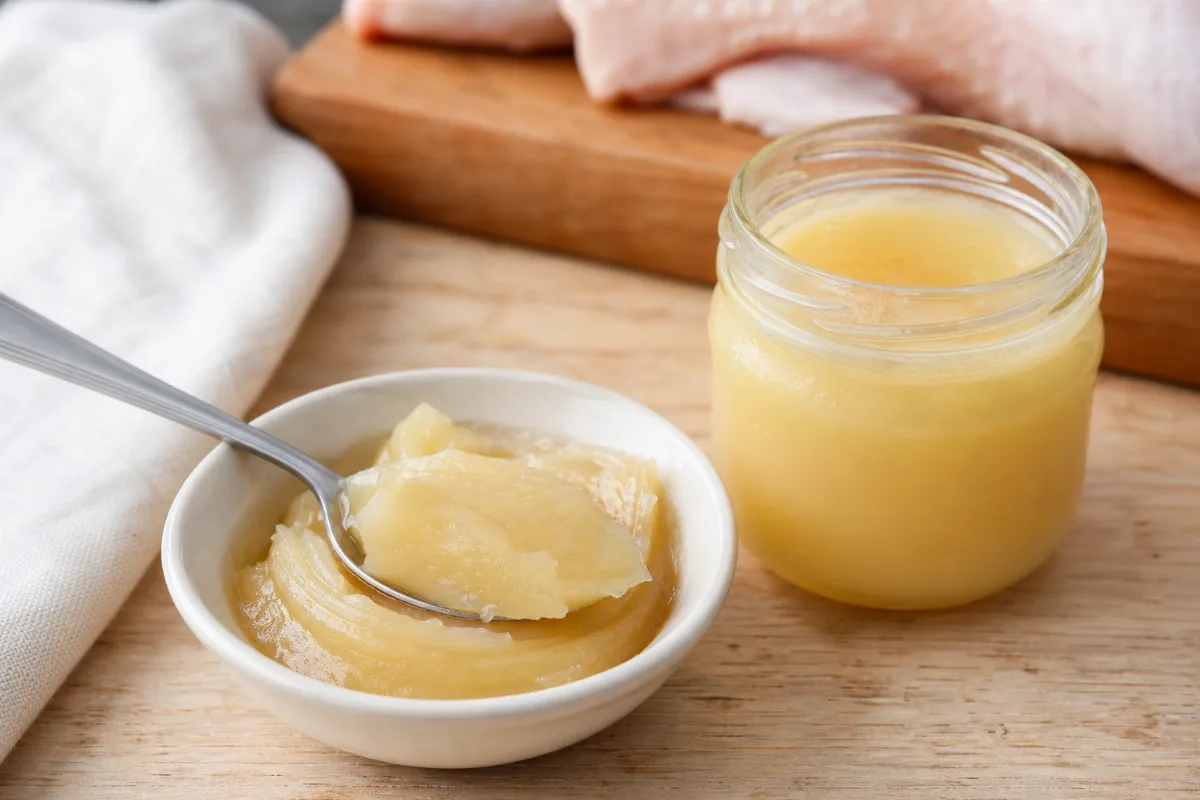
Poultry fats are the fats rendered from the skin and fatty tissue of chickens (sometimes called schmaltz), ducks and geese. They are soft or liquid at warm room temperature and are used for roasting potatoes, frying, confit and traditional baking. This page keeps these fats as foods apart from supplements, skin-care uses and online claims, and says plainly that human research on them is very limited.
Read this first
- They are still almost pure fat. USDA lists about 115 kcal in 1 tablespoon (12.8 g) of chicken or goose fat. [1] [2]
- Less saturated fat than butter, lard or beef tallow, per tablespoon. USDA lists 3.8 g in chicken fat (19% of the FDA Daily Value) and 3.6 g in goose fat (18%), compared with 7.3 g in a tablespoon of butter. [1] [2] [8]
- The mix is mostly monounsaturated fat (the type found in olive oil, though olive oil has more). Goose fat has the most, at about 7.3 g a tablespoon. [2]
- We found no human trial of duck, goose or chicken fat on cholesterol or heart disease in the sources we searched. So their health effect is an inference from their fat mix, not something shown in people.
- Duck fat: USDA has no duck fat item in the data file we use, so we give no duck numbers.
- Honest summary: a good flavor fat, somewhat better in fat mix than butter, but not a health food. Official advice still ranks liquid plant oils higher. [3] [6]
What is in it (USDA values)
The values are for chicken fat (USDA FoodData Central item 173564, SR Legacy) and goose fat (item 173572). [1] [2] The serving column is the USDA household portion of 1 tablespoon, 12.8 g.
| Nutrient | Chicken fat per 100 g | Chicken fat per tablespoon (12.8 g) | Goose fat per 100 g | Goose fat per tablespoon (12.8 g) |
|---|---|---|---|---|
| Energy | 900 kcal | 115 kcal | 900 kcal | 115 kcal |
| Total fat | 99.8 g | 12.8 g (16% DV) | 99.8 g | 12.8 g (16% DV) |
| Saturated fat | 29.8 g | 3.8 g (19% DV) | 27.7 g | 3.6 g (18% DV) |
| Monounsaturated fat | 44.7 g | 5.7 g | 56.7 g | 7.3 g |
| Polyunsaturated fat | 20.9 g | 2.7 g | 11.0 g | 1.4 g |
| Cholesterol | 85 mg | 11 mg (4% DV) | 100 mg | 13 mg (4% DV) |
| Vitamin E (alpha-tocopherol) | 2.7 mg | 0.35 mg (2% DV) | 2.7 mg | 0.35 mg (2% DV) |
| Choline | 122.4 mg | 16 mg (3% DV) | not listed | not listed |
% Daily Value uses the FDA 2016 Daily Values; values vary with the bird's feed and breed and how the fat was rendered. The serving figures are the 100 g values multiplied by 0.128. Neither fat has protein, carbohydrate or fiber of note, and USDA lists no vitamin A or K for them. [1] [2] USDA's file also lists vitamin D values for both, but they look unusually high and we could not re-check them against the USDA web page, so we left them out. Chicken fat has about twice as much polyunsaturated fat as goose fat. [1] [2]
What research says
| Health goal | What the sources found | Strength of evidence | What was studied |
|---|---|---|---|
| LDL (bad) cholesterol | The trials in the 2018 network meta-analysis compared butter, lard, beef fat and many plant oils; we found no poultry fat result in the abstract. [4] | Insufficient evidence | Not applicable |
| Heart disease and death | A Nordic scoping review of fats and oils did not assess poultry fats, and rated the reviews it found as low in methodological quality. [5] | Insufficient evidence | Not applicable |
| Replacing saturated fat | A Cochrane review of 15 trials (about 59,000 people) found cutting saturated fat for two years or more lowered combined heart events by about 21%. [7] | Established for the defined outcome; applies to saturated fat overall | Long trials of diet changes |
| "Heart-healthy like olive oil" claims | Duck and goose fat are mostly monounsaturated fat, but we found no trial that tested them in people. [2] | No good evidence of benefit found in the sources we read | Not applicable |
We also searched a research database for human diet trials on poultry or chicken fat and found none. This does not prove the fats are harmless or harmful. It means the question has not been tested in the work we could read.
Food vs other uses. All the figures above are for eating the fat. We did not read any trial of these fats used on the skin or as a supplement.
How much is a normal serving
The USDA household portion for each is 1 tablespoon (12.8 g), about 115 kcal. [1] [2] That is information from USDA, not a prescription. The NHS gives a maximum of 30 g of saturated fat a day for men and 20 g for women, and advises removing the skin from poultry to cut saturated fat. [6] Press coverage in January 2026 of the 2025-2030 US Dietary Guidelines says they keep a limit of 10% of calories from saturated fat; we read this only in a news report. [9]
Safety, allergy and medicines
- Calories and saturated fat: 115 kcal in a tablespoon, with 18% to 19% of the saturated fat Daily Value. [1] [2] People with high cholesterol or heart disease should ask their clinician.
- Poultry allergy: we did not read a source describing allergy to rendered poultry fat, so we make no claim. Anyone with a food allergy should read labels on prepared products. For trouble breathing or swelling of the face or throat, call 911 (or your local emergency number). See food allergy basics and emergency signs.
- Alpha-gal syndrome: health-agency materials about alpha-gal focus on mammal products; we did not read a source about bird fat, so we make no claim for or against.
- Heating: we did not read a verified smoke point or heated-fat study for poultry fats, so we give no number. See smoke points and cooking with oil.
- Pregnancy, children and medicines: we found no source naming a problem with poultry fat in normal food use and no direct medicine interaction. See foods in pregnancy.
Choosing, storing and food safety
- We did not read an official source on storage times for rendered poultry fat, so follow the label on bought products and the USDA FoodKeeper tool for current guidance.
- Read the label for added ingredients; the fat from a ready meal or can may include salt or seasoning that USDA's plain-fat values do not cover.
- Fat that smells sharp or paint-like is probably rancid. This is general kitchen advice, not from a source we read.
Related pages
Health connections for Duck, Goose & Chicken Fat
What research links to eating or drinking this food, and how strong the evidence is. Many studies are observational or use juice, powder, oil or extracts rather than the food as eaten; each card says which.
Poultry fat mix compared with butter
Not enough evidenceUSDA lists 3.8 g (chicken) and 3.6 g (goose) of saturated fat per tablespoon, against 7.3 g for butter; goose fat is 56.7% monounsaturated by weight.
Supplements: No human trial of duck, goose or chicken fat was found.
Poultry fat and LDL cholesterol
Not enough evidenceThe 2018 network meta-analysis of oils and solid fats gave no poultry fat result in its abstract.
Supplements: Not applicable.
Saturated fat limits
Clinically supportedCochrane trials found cutting saturated fat for two years or more lowered combined heart events by about 21%; the NHS gives maximums of 30 g (men) and 20 g (women) a day and advises removing poultry skin to cut saturated fat.
Supplements: About saturated fat overall; not a dose recommendation.
Heart disease and death from poultry fats
Not enough evidenceA Nordic scoping review did not assess poultry fats and rated the reviews it found low in methodological quality.
Supplements: Not applicable.
'Heart-healthy like olive oil' claims
Not enough evidenceDuck and goose fat are mostly monounsaturated, but we found no trial in people.
Supplements: Not supported by trials read.
Documented risks and interactions (1)
- Calories and saturated fat in poultry fats. About 115 kcal per tablespoon of chicken or goose fat.
Frequently asked questions
Is duck fat healthier than butter?
It has less saturated fat per tablespoon in the poultry fats USDA lists: 3.6 g (goose) and 3.8 g (chicken) against 7.3 g in butter. [1] [2] [8] There is no human trial that shows a health benefit, and USDA has no duck fat item in our file.
Is goose fat like olive oil?
Both are mostly monounsaturated fat, but goose fat also has saturated fat (about 28 g per 100 g by USDA). [2] Olive oil is not the same food. See our olive oil page.
Does chicken fat (schmaltz) raise cholesterol?
We found no trial of chicken fat. Saturated fat in general raises LDL, and cutting it for two years or more lowered heart events in trials. [4] [7] Chicken fat has less saturated fat than butter.
Can I use poultry fat for frying?
Many cooks do. We did not read a verified smoke point, so we give no number; see our smoke point guide.
Should I remove the skin from poultry?
The NHS says removing poultry skin is one way to cut saturated fat. [6]
References
- USDA FoodData Central. Fat, chicken (FDC 173564). SR Legacy, April 2018. Values taken from the USDA data file prepared for this site, 2026-10-24; the USDA web page itself could not be opened at the time of writing.
- USDA FoodData Central. Fat, goose (FDC 173572). SR Legacy, April 2018. Same note as above.
- Sacks FM, et al., American Heart Association. Dietary Fats and Cardiovascular Disease: A Presidential Advisory. Circulation 2017. Abstract read 2026-10-24.
- Schwingshackl L, et al. Effects of oils and solid fats on blood lipids: a systematic review and network meta-analysis. J Lipid Res 2018. Abstract read 2026-10-24.
- Nordic Nutrition Recommendations 2023 scoping review. Fats and oils. Food Nutr Res 2024. Abstract read 2026-10-24.
- NHS. Eat less saturated fat. Read 2026-10-24.
- Hooper L, et al. Reduction in saturated fat intake for cardiovascular disease. Cochrane Database Syst Rev 2020. Abstract read 2026-10-24.
- USDA FoodData Central. Butter, salted (FDC 173410), used for the butter comparison. SR Legacy, April 2018. Same note as above.
- FOX 5 New York. Foods that Americans were told to avoid for decades are back under Trump's new nutrition rules. 18 January 2026. News report on the 2025-2030 Dietary Guidelines. Read 2026-10-24.