Oils & Fats · Cooking oil
Palm Oil
Elaeis guineensis (oil) · also called Palm fat, palm olein
Palm oil is a cooking oil pressed from the fruit of the oil palm. It is about half saturated fat, and a pooled analysis of trials found it raised LDL cholesterol more than oils low in saturated fat. Evidence on heart attacks and strokes is too thin to say. The main cautions are saturated fat for people watching cholesterol, and contaminants formed when oils are refined.
General information, not medical advice. Last substantive update · Not medically reviewed. A named clinician has not signed off on this page. How this page is made
About Palm Oil
Palm oil is a cooking oil from the fruit of the oil palm. It is almost all fat, about half of it saturated. It is a food, not a remedy: the cholesterol finding points the wrong way for heart health compared with oils low in saturated fat, and evidence on heart disease events is very low.
What it is
Palm oil is the oil of Elaeis guineensis, the oil palm. One review says it supplies about 40% of all traded vegetable oil and is eaten daily by over three billion people, mostly in Asia. This page covers palm oil as a food. Palm kernel oil, red palm oil and tocotrienol supplements are different products. It looks at health evidence only; farming and environmental questions are outside what this page judges.
USDA data for palm oil, per 100 g: 884 kcal, 100 g fat (49.3 g saturated, 37.0 g monounsaturated, 9.3 g polyunsaturated), 15.94 mg vitamin E as alpha-tocopherol, 8.0 micrograms vitamin K, and no protein, carbohydrate, fibre or cholesterol. One tablespoon (13.6 g) has about 120 kcal, 13.6 g fat, 6.7 g saturated fat and 2.2 mg vitamin E. USDA also lists a vitamin D value that looks implausible for an oil, so it is not used. Values vary with the palm variety, refining and fractionation.
What the research shows
Cholesterol: in a pooled analysis of trials of at least 2 weeks, palm oil raised LDL cholesterol by 0.24 mmol/L compared with vegetable oils low in saturated fat, and by 0.31 mmol/L in randomised trials. HDL was slightly higher (0.02 mmol/L). The authors say this is what its saturated fat content would predict. The AHA advises replacing saturated fat with unsaturated fat.
Heart disease: a systematic review found one study on stroke and four on coronary heart disease, graded all evidence very low, and could not pool them. A Spanish expert consensus said moderate intake within a healthy diet presents no risk and found no link to cancer. That is an expert opinion, and one author works at a food company.
Other findings are small. Palm olein did better than a trans-rich fat and an interesterified fat in 30 people, but was not tested against oils low in saturated fat; its first author is at the Malaysian Palm Oil Board. In 65 adults with fatty liver disease, palm oil and soybean oil did not differ significantly in liver fat after adjustment; the lead author reports soy industry funding. A tocotrienol supplement made from palm oil lowered serum creatinine in a 45-person pilot, but that is a supplement, not the food.
Food versus other palm products
The cholesterol finding is for palm oil eaten as food. Palm olein, red palm oil, palm kernel oil and tocotrienol supplements are different products. The only supplement trial read was small (45 people, 8 weeks) and tells us nothing about eating palm oil. NHS says up to 540 mg a day of vitamin E from supplements is unlikely to cause harm; that is about supplements, not oil.
Cooking and storage
In a kitchen test, palm oil and rapeseed oil gave off relatively fewer aldehydes than sunflower oil, and deep frying gave off the most. This is a fume test, not a health study. We did not read a reliable smoke point for palm oil, so we give none. Keep the oil closed, cool and away from light; no palm-oil-specific storage source was read.
At a glance
Traditional uses history, not proof
- Eaten daily by over three billion people, mostly in Asia, according to one review
- Long use as food is not proof of health benefit
Studied for research
- Energy and vitamin E, high certainty for the nutrient content
- LDL cholesterol, evidence against: higher than with oils low in saturated fat (pooled trials)
- Heart disease and stroke, insufficient evidence
- Compared with trans-fat and interesterified fats, low certainty (one small study)
- Liver fat in fatty liver disease, insufficient evidence
- Palm tocotrienol supplements in diabetic kidney disease, very low certainty (a supplement, not the food)
Main compounds
- Saturated fat, mostly palmitic acid
- Monounsaturated fat
- Polyunsaturated fat
- Vitamin E (alpha-tocopherol)
- Tocotrienols (not listed in the USDA item)
Common forms
- Palm oil as food (USDA item 171015 read)
- Palm olein, the liquid part, used in one small study
- Red (unrefined) palm oil, palm kernel oil and tocotrienol supplements are different products and are not covered
Research links: 2015 review: palm oil and LDL cholesterol (pooled trials) · 2018 review: palm oil and cardiovascular disease · 2018 EFSA risk assessment: 3-MCPD and its esters · Research Library · Genes & Biomarkers Library
What it is and its history
- Accepted scientific name
- Elaeis guineensis Jacq. (the oil palm, the plant the oil comes from)
- Naming authority
- Jacq. (GBIF accepted name)
- Common names
- Palm oil (English); Palm fat (English); Palm olein (the liquid part) (English); Aceite de palma (Spanish)
- Family or group
- Arecaceae (the palm family), as given by GBIF. Palm oil is the oil from the fruit of this palm.
- Classification
- Plantae > Tracheophyta > Liliopsida > Arecales > Arecaceae > Elaeis > Elaeis guineensis
- Native range
- Not verified from a source read.
- Habitat
- Not verified from a source read. One review says most palm oil is eaten in Asia.
- What it looks like
- Roots: Not verified.; Stems: Not verified.; Leaves: Not verified.; Flowers: Not verified.; Fruit: Not verified for the fruit itself. The oil is pressed from the oil palm's fruit (our existing summary); no source read describes how.
- Cultivation
- A 2021 review says oil palm is a perennial crop with a life cycle of more than 25 years, yielding about 81 million tonnes of oil a year from about 19 million hectares. Environmental and farming questions are outside what this page judges.
- Harvest and processing
- A 2020 review says 3-MCPD is a heat- and process-induced contaminant of vegetable oils, found most in palm oil. No source read describes how palm oil is pressed or refined.
- Look-alikes and adulterants
- Name: Palm kernel oil; Note: A different oil, from the seed; not covered here.; Name: Red (unrefined) palm oil; Note: Not covered by the USDA item; no trial of it was read.; Name: Palm olein; Note: The liquid part of palm oil, used in one small feeding study.; Name: Coconut oil; Note: Another high-saturated-fat oil with its own page. WHO lists both.
- Sustainability and conservation
- Not assessed.
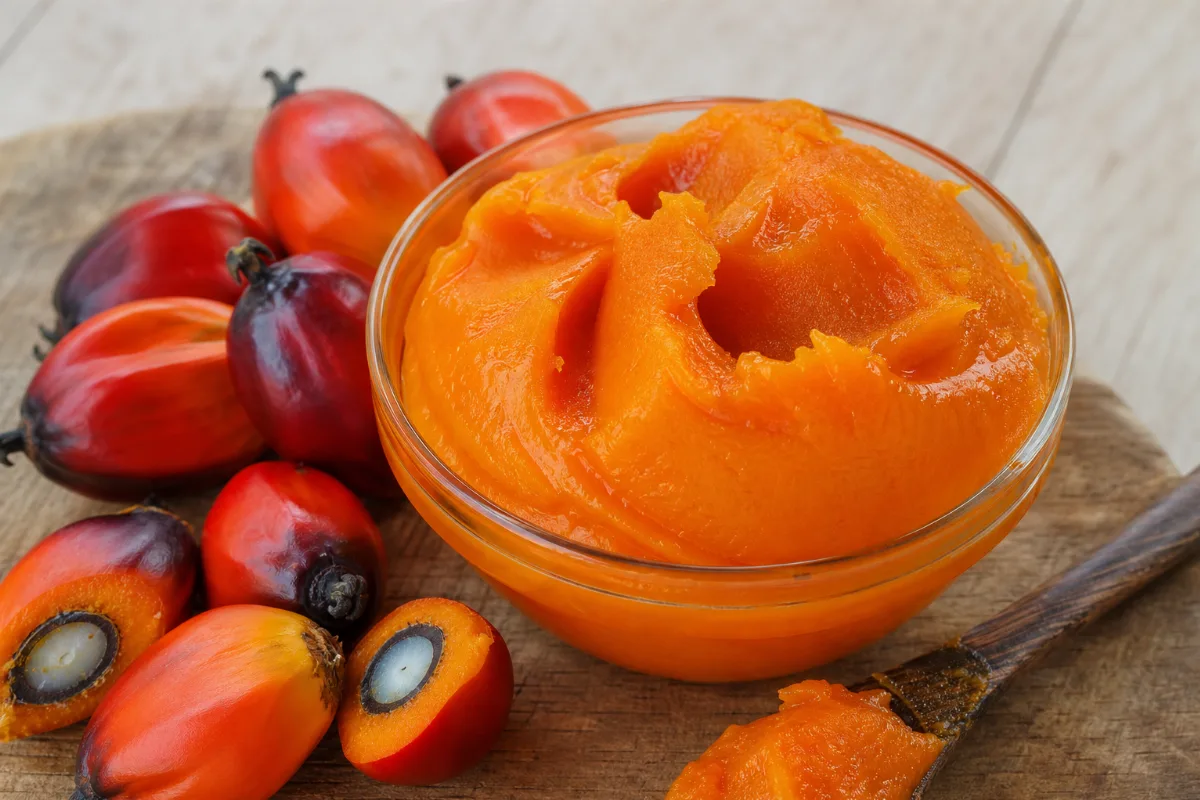
Photographs
What is inside, and how it may work
What it contains and how those compounds act in cells and animals. Laboratory and animal mechanisms are not proven effects in people.
Main compounds
| Compound | Family | Where it is concentrated | Activity studied | Level of evidence |
|---|---|---|---|---|
| Saturated fat (mostly palmitic acid) | fatty acid | Fruit oil USDA: 49.3 g saturated fat per 100 g. A 2015 review says palmitic acid is the main fat in refined palm oil. | Pooled trials found higher LDL cholesterol than with oils low in saturated fat. 16 6 10 | Human data |
| Monounsaturated fat | fatty acid | Fruit oil USDA: 37.0 g per 100 g | Not studied on its own in the sources read. 16 | Reference |
| Polyunsaturated fat | fatty acid | Fruit oil USDA: 9.3 g per 100 g | Not studied on its own in the sources read. 16 | Reference |
| Vitamin E (alpha-tocopherol) | vitamin | Fruit oil USDA: 15.94 mg per 100 g (about 2.2 mg per tablespoon) | A nutrient. NHS says supplements up to 540 mg a day are unlikely to cause harm; that is about supplements. 16 15 | Reference |
| Tocotrienols | vitamin E form | Fruit oil Not listed in the USDA item. | A small trial of a concentrated palm tocotrienol supplement lowered serum creatinine but not other markers in people with diabetic kidney disease. 12 | Human (supplement) |
| Vitamin K (phylloquinone) | vitamin | Fruit oil USDA: 8.0 micrograms per 100 g (about 1.1 micrograms per tablespoon) | A trace amount. No interaction source was read. 16 | Reference |
Mechanisms, receptors and pathways
| Target or pathway | Gene or receptor | What was found | Level |
|---|---|---|---|
| Blood LDL cholesterol | Not specified in the sources read | The 2015 authors say the LDL effects are as expected from palm oil's high saturated fat content. The AHA advisory says swapping saturated for unsaturated fat lowers LDL. This is the authors' interpretation, not a tested mechanism in the abstract. 10 9 | Human data |
Absorption, metabolism and elimination
- Absorption
- Not found.
- Distribution
- Not found.
- Metabolism
- Not found.
- Elimination
- Not found.
- Bioavailability
- Not established.
Isolated compounds versus whole extracts
The cholesterol results are for palm oil eaten as food versus other oils. Palm olein (one study), red palm oil, palm kernel oil and tocotrienol supplements are different products, and the supplement trial says nothing about eating palm oil.
Nutritional composition
Nutrition from USDA FoodData Central, item 171015 'Oil, palm' (SR Legacy, April 2018 release), read 2026-10-26 from the saved copy of the USDA data in the project because the public API key was rate-limited. Per 100 g: 884 kcal, 100 g fat (49.3 g saturated, 37.0 g monounsaturated, 9.3 g polyunsaturated), no protein, carbohydrate, fibre, sugar or cholesterol, 15.94 mg vitamin E (alpha-tocopherol), 8.0 micrograms vitamin K and almost no minerals (0.01 mg iron, the rest listed as zero). One tablespoon (13.6 g, the 100 g values multiplied by 0.136) is about 120 kcal, 13.6 g fat, 6.7 g saturated, 5.0 g monounsaturated, 1.3 g polyunsaturated fat, 2.2 mg vitamin E and 1.1 micrograms vitamin K. One teaspoon is 4.5 g. USDA also lists 36.6 micrograms of vitamin D, which looks implausible for an oil, so it is left out. Values vary with the palm variety, refining and fractionation.
1 high certainty1 low certainty1 very low certainty3 not enough evidence1 evidence against
What was looked at
The 7 benefits and uses checked for Palm Oil, each with how strong the evidence is. Tap one to open it.
- Energy and vitamin E (nutrient content)High certainty
- LDL cholesterol compared with other oilsEvidence against
- Heart disease and strokeNot enough evidence
- Palm olein compared with trans-fat and interesterified fatLow certainty
- Liver fat in people with fatty liver diseaseNot enough evidence
- Palm tocotrienol supplement in diabetic kidney disease (a supplement, not the food)Very low certainty
- Fumes when cooking with the oil (kitchen test)Not enough evidence
Lab markers tracked in the studies
LDL cholesterolHDL cholesterolLDL/HDL ratioFasting blood glucoseLiver fat (MRI spectroscopy)Serum creatinine (supplement trial)
What is Palm Oil good for?
The main studied uses and how strong the human evidence is for each. Most results are about cholesterol; the evidence on heart disease itself is thin.
Benefits, one by one
Each card is a research question, not a promise. Tap a goal to filter. Open a card to see the studies, doses and limits.
Energy and vitamin E (nutrient content)
High certaintyPalm oil is an energy-dense fat. USDA lists 884 kcal and 15.94 mg of vitamin E (alpha-tocopherol) per 100 g. One tablespoon (13.6 g) works out to about 120 kcal and 2.2 mg of vitamin E.
2 studiesPalm oil as listed in USDA SR Legacy. Red palm oil, palm olein, palm …
Studies, doses and limits
What the trials found
No trial was read for this. The numbers come from USDA FoodData Central. USDA lists only alpha-tocopherol for vitamin E. Tocotrienols, another form of vitamin E often linked to palm oil, are not listed in the USDA item.
Results
Palm oil has no protein, carbohydrate, fibre or cholesterol. It is almost all fat. It gives vitamin E and a little vitamin K (8.0 micrograms per 100 g).
Effect sizes as reported
USDA per 100 g: 884 kcal; 100 g fat; 15.94 mg vitamin E; 8.0 micrograms vitamin K. Per tablespoon (13.6 g, the 100 g values multiplied by 0.136): about 120 kcal, 13.6 g fat, 2.2 mg vitamin E, 1.1 micrograms vitamin K.
Why this rating
High that the oil contains these nutrients (USDA data). Values vary with the palm variety, refining and fractionation. Not a health outcome.
Form and dose studied
Palm oil as listed in USDA SR Legacy. Red palm oil, palm olein, palm kernel oil and supplements were not covered by this item.
Who was studied
General adult diet.
Limits
A nutrient fact, not a trial. NHS says the 540 mg a day limit for vitamin E supplements is about supplements, not oil.
Why researchers looked
People use cooking oil mainly for energy and cooking, and USDA records what is in it.
Traditional use
Palm oil is eaten daily by over three billion people, mostly in Asia, according to one review. Long use as food is not proof that it treats any condition.
Proposed mechanism Reference database
Not applicable; this is a nutrient fact.
A proposed mechanism does not show that the effect happens in people.
See the Safety tab for saturated fat, contaminants and cooking.
LDL cholesterol compared with other oils
Evidence againstA pooled analysis of clinical trials found palm oil raised LDL ('bad') cholesterol by 0.24 mmol/L compared with vegetable oils low in saturated fat. The rise was 0.31 mmol/L in randomised trials. This is a higher-LDL finding, not a benefit.
3 studiesPalm oil eaten as food, compared with other oils. Not supplements.
Studies, doses and limits
What the trials found
Pooled trials of at least 2 weeks compared palm oil with vegetable oils low in saturated fat, trans-fat oils and animal fats. Palm oil raised LDL against low-saturated oils overall (+0.24 mmol/L) and in randomised trials (+0.31 mmol/L), but not in non-randomised trials (+0.03 mmol/L).
Results
Higher LDL than with oils low in saturated fat. The authors say this supports replacing palm oil with oils low in saturated and trans fat. Compared with trans-fat oils, palm oil gave higher HDL.
Effect sizes as reported
LDL +0.24 mmol/L (95% CI 0.13 to 0.35; I2 83.2%); randomised trials +0.31 (0.20 to 0.42); non-randomised +0.03 (-0.15 to 0.20).
Why this rating
Moderate-to-good for the direction (a pooled analysis of trials, with the randomised trials consistent after considering dose and comparison oil), so this is evidence against palm oil as a cholesterol-friendly choice versus oils low in saturated fat. It measures blood cholesterol, not heart attacks.
Form and dose studied
Palm oil eaten as food, compared with other oils. Not supplements.
Who was studied
Adults in trials of at least 2 weeks.
Limits
Big differences between trials overall. Blood measure only. The abstract does not give the amounts of oil used. The authors are at the National University of Singapore; funding is not stated in the abstract.
Why researchers looked
Palm oil is high in saturated fat compared with most other vegetable oils, and studies had reported inconsistent effects on blood fats.
Traditional use
Palm oil is a staple cooking oil in many places. Long use as food does not show how it affects cholesterol.
Proposed mechanism Authoritative guidance
The authors say the effects are what would be expected from palm oil's high saturated fat content. The AHA advisory says replacing saturated fat with unsaturated fat lowers LDL cholesterol.
A proposed mechanism does not show that the effect happens in people.
See the Safety tab for what the AHA and WHO say about saturated fat.
Heart disease and stroke
Not enough evidenceWhether eating palm oil causes or prevents heart disease is not settled. A systematic review found only a few studies and graded all of the evidence very low.
3 studiesPalm oil as food, in mixed designs.
Studies, doses and limits
What the trials found
The systematic review found 1 study for stroke and 4 for coronary heart disease, mixed in design, and could not pool them. A Spanish expert consensus said a moderate intake within a healthy diet presents no risk, but this is an opinion statement.
Results
No clear answer either way. Palmitic acid was linked to heart attack in one included study (OR 2.76), but the risk estimates were described as non-significant and imprecise.
Effect sizes as reported
Palmitic acid and heart attack OR 2.76 (95% CI 1.39 to 5.47); palm oil versus soybean oil with 5% trans fat OR 1.33 (1.09 to 1.62); versus 22% trans fat OR 1.16 (0.86 to 1.56).
Why this rating
Insufficient: all evidence graded very low by its authors, the studies could not be pooled, and the consensus statement is an expert opinion from a group that includes a food company author.
Form and dose studied
Palm oil as food, in mixed designs.
Who was studied
Adults; includes a country-level analysis.
Limits
Very few studies, bias in selection, other foods eaten with palm oil, and a country-level analysis that may be out of date. No funding stated in the review's abstract.
Why researchers looked
Because palm oil raises LDL, people ask whether it also raises heart attacks and strokes.
Proposed mechanism Reasoning from biomarker
Not shown. LDL cholesterol is a recognised heart risk factor, but the effect of palm oil on heart events was not shown.
A proposed mechanism does not show that the effect happens in people.
See the Safety tab for AHA and WHO advice on saturated fat.
Palm olein compared with trans-fat and interesterified fat
Low certaintyIn a small feeding study of 30 people, palm olein (the liquid part of palm oil) gave a lower LDL/HDL ratio and lower fasting glucose than a trans-rich fat or a stearic-acid-rich interesterified fat. It was not compared with oils low in saturated fat.
1 studiesPalm olein providing about 12% of energy as palmitic acid, as part of…
Studies, doses and limits
What the trials found
30 volunteers ate controlled whole-food diets for three 4-week periods in a crossover design. The trans-rich fat and the interesterified fat both raised the LDL/HDL ratio and fasting glucose compared with palm olein.
Results
Palm olein did better than the trans-rich and interesterified fats on these measures. This does not show palm olein is better than olive, canola or soybean oil; those were not tested.
Effect sizes as reported
Fasting glucose almost 20% higher with the interesterified fat; after-meal glucose area 40% higher; fasting insulin 22% lower with the interesterified fat (p<0.001).
Why this rating
Low: one small, short study whose first author is at the Malaysian Palm Oil Board.
Form and dose studied
Palm olein providing about 12% of energy as palmitic acid, as part of fully controlled diets.
Who was studied
30 healthy volunteers.
Limits
Small, short, industry-linked author, and does not test palm olein against unsaturated oils.
Why researchers looked
Palm oil is used in food manufacturing in place of trans fats and hardened fats, so researchers compared the options.
Proposed mechanism Not stated
Not established in the abstract.
A proposed mechanism does not show that the effect happens in people.
See the Safety tab for saturated fat advice.
Liver fat in people with fatty liver disease
Not enough evidenceIn 65 adults with fatty liver disease, 30 g a day of palm oil or soybean oil for 16 weeks did not differ significantly in liver fat after adjusting for starting liver fat.
1 studiesPalm oil in study foods, 30 g of oil a day, for 16 weeks.
Studies, doses and limits
What the trials found
Double-masked randomised trial with a 2-week run-in and a 16-week diet. Liver fat was measured by magnetic resonance spectroscopy. The overall difference between groups was no longer significant after adjusting for baseline liver fat.
Results
No significant difference after adjustment. Liver fat tended to fall with soybean oil and tended to rise with palm oil within each group, but those changes were not significant either.
Effect sizes as reported
Adjusted group difference p = 0.14; within-group changes p = 0.11 each.
Why this rating
Insufficient: one small trial with no significant adjusted difference. The lead author reports funding from a soy industry body, and soybean oil was the comparison.
Form and dose studied
Palm oil in study foods, 30 g of oil a day, for 16 weeks.
Who was studied
65 adults with fatty liver disease (MAFLD), mean age about 53, BMI 36.
Limits
Small sample; the authors call for larger trials. Does not apply to people without fatty liver disease.
Why researchers looked
The type of fat in the diet may affect liver fat, and soybean oil is rich in linoleic acid while palm oil is a mix of saturated, mono- and polyunsaturated fats.
Proposed mechanism Randomised trial
Not established; the authors tested whether weight change explained the result and found it did not (p = 0.11).
A proposed mechanism does not show that the effect happens in people.
Fatty liver disease is a medical condition; ask a clinician before changing your diet for it.
Palm tocotrienol supplement in diabetic kidney disease (a supplement, not the food)
Very low certaintyA small pilot trial of a concentrated tocotrienol supplement made from palm oil in 45 people with diabetes and kidney damage lowered serum creatinine but not other kidney or blood sugar measures. It does not apply to eating palm oil.
1 studiesTocovid (a tocotrienol-rich supplement made from palm oil), 200 mg tw…
Studies, doses and limits
What the trials found
Randomised, double-blind, placebo-controlled pilot trial: 22 people got the supplement and 23 got placebo for 8 weeks. Serum creatinine was lower with the supplement. eGFR, urine albumin, HbA1c, blood pressure and other biomarkers did not change significantly.
Results
One kidney blood marker moved; most did not.
Effect sizes as reported
Serum creatinine significantly lower than placebo; no significant change in eGFR, UACR, HbA1c or blood pressure.
Why this rating
Very low for any use: a small 8-week pilot of a concentrated supplement, and the abstract reports no safety data. It is not palm oil as food.
Form and dose studied
Tocovid (a tocotrienol-rich supplement made from palm oil), 200 mg twice a day. Not palm oil as food.
Who was studied
People with type 2 diabetes and kidney damage (diabetic nephropathy).
Limits
Pilot, 45 people, 8 weeks, one supplement product.
Why researchers looked
Tocotrienols are a form of vitamin E found in palm oil, and rat studies had suggested a benefit in diabetes.
Proposed mechanism Animal research
The abstract credits antioxidant, anti-blood-sugar and anti-inflammatory properties seen in diabetic rats. That is animal evidence.
A proposed mechanism does not show that the effect happens in people.
Supplements are not covered by food rules. Ask a doctor or pharmacist, especially with kidney disease or medicines.
Fumes when cooking with the oil (kitchen test)
Not enough evidenceIn a kitchen test, palm oil and rapeseed oil gave off relatively fewer aldehydes in cooking fumes than sunflower oil. Deep frying gave the most.
1 studiesPalm oil heated in a typical kitchen. No smoke point was read, so non…
Studies, doses and limits
What the trials found
Not a study of people. The test compared four oils, three cooking methods and two foods.
Results
Palm oil was among the lower-emission oils. Stir frying produced fewer aldehydes than deep frying.
Effect sizes as reported
No numbers in the abstract.
Why this rating
A lab emissions test only; it does not show any effect on health.
Form and dose studied
Palm oil heated in a typical kitchen. No smoke point was read, so none is given.
Limits
Kitchen test; no health outcomes.
Why researchers looked
Heated oils give off aldehydes, and some aldehydes are considered carcinogenic.
Proposed mechanism Laboratory analysis
The authors link long-chain aldehyde formation to the fatty acids in the oil. Oils low in unsaturated fatty acids gave fewer.
A proposed mechanism does not show that the effect happens in people.
See the Safety tab for cooking and storage.
Connections to the rest of health
How Palm Oil connects to the rest of our health knowledge graph. Every link says what kind of connection it is. A safety link (for example to the liver) is a warning, not a benefit. A study that merely mentions a topic never creates a benefit link.
Explore every connection: goals, body systems, organs, symptoms, genes
A. Wellness goals
| Connected to | Kind of connection | Evidence status | Context | Studies |
|---|---|---|---|---|
| Energy Boost | High certainty | Energy and vitamin E (nutrient content): Palm oil is an energy-dense fat. USDA lists 884 kcal and 15.94 mg of vitamin E (alpha-tocopherol) per 100 g. One tablespoon (13.6 g) works out to about 120 kcal and 2.2 mg of vitamin E. | 16 15 | |
| Cholesterol Balance | Evidence against | LDL cholesterol compared with other oils: A pooled analysis of clinical trials found palm oil raised LDL ('bad') cholesterol by 0.24 mmol/L compared with vegetable oils low in saturated fat. The rise was 0.31 mmol/L in randomised trials. This is a higher-LDL finding, not a benefit. | 10 9 17 | |
| Heart Health | Evidence against | LDL cholesterol compared with other oils: A pooled analysis of clinical trials found palm oil raised LDL ('bad') cholesterol by 0.24 mmol/L compared with vegetable oils low in saturated fat. The rise was 0.31 mmol/L in randomised trials. This is a higher-LDL finding, not a benefit. | 10 9 17 | |
| Heart Health | Not enough evidence | Heart disease and stroke: Whether eating palm oil causes or prevents heart disease is not settled. A systematic review found only a few studies and graded all of the evidence very low. | 5 4 6 | |
| Cholesterol Balance | Low certainty | Palm olein compared with trans-fat and interesterified fat: In a small feeding study of 30 people, palm olein (the liquid part of palm oil) gave a lower LDL/HDL ratio and lower fasting glucose than a trans-rich fat or a stearic-acid-rich interesterified fat. It was not compared with oils low in saturated fat. | 11 | |
| Liver Support | Not enough evidence | Liver fat in people with fatty liver disease: In 65 adults with fatty liver disease, 30 g a day of palm oil or soybean oil for 16 weeks did not differ significantly in liver fat after adjusting for starting liver fat. | 2 | |
| Blood Sugar Balance | Very low certainty | Palm tocotrienol supplement in diabetic kidney disease (a supplement, not the food): A small pilot trial of a concentrated tocotrienol supplement made from palm oil in 45 people with diabetes and kidney damage lowered serum creatinine but not other kidney or blood sugar measures. It does not apply to eating palm oil. | 12 |
B. Body systems
| Connected to | Kind of connection | Evidence status | Context | Studies |
|---|---|---|---|---|
| Metabolism Weight | Biological association | High certainty | Studied for: Energy and vitamin E (nutrient content) | 16 15 |
| Cardiovascular System | Biological association | Evidence against | Studied for: LDL cholesterol compared with other oils Studied for: Heart disease and stroke | 10 9 17 5 4 6 11 |
| Hepatic System | Biological association | Not enough evidence | Studied for: Liver fat in people with fatty liver disease | 2 |
| Urinary System | Biological association | Very low certainty | Studied for: Palm tocotrienol supplement in diabetic kidney disease (a supplement, not the food) | 12 |
| Endocrine System | Biological association | Very low certainty | Studied for: Palm tocotrienol supplement in diabetic kidney disease (a supplement, not the food) | 12 |
| Respiratory System | Biological association | Not enough evidence | Studied for: Fumes when cooking with the oil (kitchen test) | 8 |
E. Health conditions
| Connected to | Kind of connection | Evidence status | Context | Studies |
|---|---|---|---|---|
| Heart disease | Not enough evidence | A systematic review graded all evidence on palm oil and heart disease very low. Preparation or compound: Palm oil as food |
5 |
I. Biomarkers
| Connected to | Kind of connection | Evidence status | Context | Studies |
|---|---|---|---|---|
| LDL cholesterol | Adverse effect or risk | Documented risk | Pooled trials found higher LDL with palm oil than with oils low in saturated fat (+0.24 mmol/L). Preparation or compound: Palm oil as food |
10 9 |
| LDL cholesterol | Biological association | Moderate certainty | Measured in trials: raised. A lab change is not the same as a health benefit. | 10 9 |
| HDL cholesterol | Biological association | Low certainty | Measured in trials: slightly raised. A lab change is not the same as a health benefit. | 10 |
| LDL/HDL ratio | Biological association | Low certainty | Measured in trials: lower than with trans-rich and interesterified fat. A lab change is not the same as a health benefit. | 11 |
| Fasting blood glucose | Biological association | Low certainty | Measured in trials: lower than with the interesterified fat. A lab change is not the same as a health benefit. | 11 |
| Liver fat (MRI spectroscopy) | Biological association | Not enough evidence | Measured in trials: no significant difference after adjustment. A lab change is not the same as a health benefit. | 2 |
| Serum creatinine (supplement trial) | Biological association | Very low certainty | Measured in trials: lowered (supplement). A lab change is not the same as a health benefit. | 12 |
K. Biological pathways
L. Active compounds
| Connected to | Kind of connection | Evidence status | Context | Studies |
|---|---|---|---|---|
| Saturated fat (mostly palmitic acid) | Biological association | Human | Pooled trials found higher LDL cholesterol than with oils low in saturated fat. Preparation or compound: Fruit oil |
16 6 10 |
| Monounsaturated fat | Biological association | Reference | Not studied on its own in the sources read. Preparation or compound: Fruit oil |
16 |
| Polyunsaturated fat | Biological association | Reference | Not studied on its own in the sources read. Preparation or compound: Fruit oil |
16 |
| Vitamin E (alpha-tocopherol) | Biological association | Reference | A nutrient. NHS says supplements up to 540 mg a day are unlikely to cause harm; that is about supplements. Preparation or compound: Fruit oil |
16 15 |
| Tocotrienols | Biological association | Human (supplement) | A small trial of a concentrated palm tocotrienol supplement lowered serum creatinine but not other markers in people with diabetic kidney disease. Preparation or compound: Fruit oil |
12 |
| Vitamin K (phylloquinone) | Biological association | Reference | A trace amount. No interaction source was read. Preparation or compound: Fruit oil |
16 |
Each connection is stored with the ingredient, the connected record, the kind of connection, the evidence status, the supporting studies, the preparation or compound involved, and a review date (last reviewed October 26, 2026).
Evidence at a glance: what changed in 1 lab markers
Tap a number to show only those markers. Counts are markers, not people.
The evidence
The research centre for Palm Oil. Every record here was checked against PubMed or the publisher's page; we never list a study we have not verified.
Evidence by outcome
Bars show how many studies we found for each outcome, not how well it works. People are added up across trials only (reviews are not added, to avoid double counting).
How we rate evidence
High certainty
Several well-run trials or reviews agree; further research is unlikely to change the picture much.
Moderate certainty
Good trials point the same way, but some doubt remains.
Low certainty
Small, short or inconsistent trials. The finding could change with better research.
Very low certainty
Very little or very weak human data. Treat as a possibility only.
Mixed findings
Trials or reviews disagree with each other.
Not enough evidence
Not enough human research to say either way.
Evidence against
Good research found no benefit, or found harm.
We take the reviewers' own risk-of-bias and GRADE statements where they exist, and otherwise judge from study size, design, consistency, directness and whether a product matches what is sold. Many publications do not make evidence high. Method note: We started from our existing palm oil summary, re-read the USDA FoodData Central values from a saved copy, read the WHO, FDA and NHS pages, and re-checked the PubMed abstracts for reviews, trials and the EFSA assessment. Only abstracts were read for studies. Little research exists beyond cholesterol and contaminants, so this page is smaller than some others. Items we could not verify are flagged in the research gaps.
Study library: every study we checked 17
| Study | Design | People | Product, dose, length | Result |
|---|---|---|---|---|
| Arris 2020 A Revisit to the Formation and Mitigation of 3-Chloropropane-1,2-Diol in Palm Oil Production. Foods · PMID 33260330 · DOI |
Narrative review n/a |
Review of 3-MCPD occurrence in vegetable oils and ways to reduce it | 3-MCPD contaminant in vegetable oils, mostly palm oil Oil · vs Other vegetable oils |
The review says 3-MCPD is a heat- and process-induced contaminant of vegetable oils, that it is reviewed mostly in palm oil because palm oil has the highest 3-MCPD content, and that it covers ways to reduce or remove it. No numbers in the abstract (Not applicable) Methods, limits and fundingOutcomes: Occurrence, formation and reduction of 3-MCPD Limitations: A review of production methods, not of health outcomes. Only the abstract was read. Funding and conflicts: Authors declared no conflict of interest. Read: abstract |
| Belury 2026 Dietary Soybean vs. Palm Oils Differ in Effects on Liver Fat in Adults With MAFLD: A 16-Week, Double-Masked, Randomized Controlled Trial. Diabetes Obes Metab · PMID 42677730 · DOI |
Randomised controlled trial |
65 65 adults with fatty liver disease (MAFLD), mean age about 53, BMI 36 |
Palm oil in study foods Oil 30 g of oil per day 16 weeks after a 2-week run-in · vs Soybean oil (high in linoleic acid) |
The liver-fat change differed between soybean oil and palm oil groups overall, but not after adjusting for starting liver fat (p = 0.14). Liver fat tended to fall with soybean oil and tended to rise with palm oil within groups (both p = 0.11). Adjusted difference not significant (p = 0.14); within-group changes p = 0.11 each (Not stated in the abstract) Methods, limits and fundingOutcomes: Liver fat by magnetic resonance imaging; secondary blood markers Limitations: Small trial. Within-group changes did not reach significance. The authors call for larger trials. This is about people who already have fatty liver disease, not the general public. Funding and conflicts: The lead author reports research funding and speaker sponsorship from the United Soybean Board and Soy Nutrition Institute Global, a soy industry body; soybean oil was the comparison oil. Also NIH and USDA research funding. Registration: ClinicalTrials.gov NCT05199948 Read: abstract |
| EFSA Panel on Contaminants in the Food Chain (CONTAM) 2018 Update of the risk assessment on 3-monochloropropane diol and its fatty acid esters. EFSA J · PMID 32625654 · DOI |
Regulatory risk assessment rat (toxicity) and human (exposure) |
Review of animal toxicity data and dietary exposure across the European population | 3-MCPD and its fatty acid esters (process contaminants in food) Group tolerable daily intake of 2 micrograms per kg body weight a day |
In rats, 3-MCPD above 1 mg/kg a day for a short time reduced sperm motility. The panel set a group tolerable daily intake of 2 micrograms per kg body weight a day. It is not exceeded in the adult population. A slight exceedance was seen in high consumers in the younger age groups, especially for infants who receive formula only. The abstract does not name which foods drive the exposure. Tolerable daily intake 2 micrograms/kg body weight/day; reference point for kidney effects 0.20 mg/kg/day in male rats (Not applicable) Methods, limits and fundingOutcomes: Kidney and male fertility effects in rats; exposure by age group Limitations: A risk assessment built on animal toxicity data. It is about contaminants in food in general and the abstract does not name palm oil. Funding and conflicts: EFSA scientific panel; no commercial funding stated. Read: abstract |
| Gesteiro 2019 Palm Oil on the Edge. Nutrients · PMID 31454938 · DOI |
Expert consensus statement n/a |
Spanish experts in food industry, nutrition, toxicology, sustainability and veterinary science who met in Madrid in July 2018 | Palm oil as a food ingredient Oil |
The group concluded that a moderate intake of palm oil within a healthy diet presents no risk to health, that no evidence justifies changing fat intake recommendations, and that there is no evidence linking palm oil to higher cancer risk, incidence or mortality in humans. No numbers in the abstract (Not applicable) Methods, limits and fundingOutcomes: Food safety, nutrition and sustainability conclusions Limitations: An expert opinion statement, not a trial or pooled analysis. One author works at a food company (Europastry S.A.). Abstract does not say what 'moderate' means. Funding and conflicts: Authors declared no conflict of interest and say funders had no role. Who paid for the meeting is not stated in the abstract; one author's affiliation is a food company. Read: abstract |
| Ismail 2018 Systematic review of palm oil consumption and the risk of cardiovascular disease. PLoS One · PMID 29489910 · DOI |
Systematic review |
Interventional and observational studies in adults: 1 study for stroke and 4 for coronary heart disease | Palm oil consumption Oil · vs Lower or no palm oil intake, or other oils |
The five included studies could not be pooled. All evidence was graded very low. The review could not show strong evidence for or against a link between palm oil and heart disease. Palmitic acid and heart attack OR 2.76; palm oil versus soybean oil with 5% trans fat OR 1.33 (not significant against 22% trans fat, OR 1.16); country-level analysis: 68 CHD deaths per 100,000 per extra kg of palm oil per person per year in developing countries (Palmitic acid 1.39 to 5.47; 5% trans fat comparison 1.09 to 1.62; 22% trans fat comparison 0.86 to 1.56; country-level 21 to 115) Methods, limits and fundingOutcomes: Coronary heart disease, stroke and heart-disease deaths Limitations: Very few studies, no pooled estimate, bias in how studies were selected, other foods eaten together with palm oil, and an older country-level analysis. The authors call the risk estimates non-significant and imprecise. Funding and conflicts: No competing interests declared. Authors are at the Institute for Medical Research, Kuala Lumpur, Malaysia; funding is not stated in the abstract. Read: abstract |
| Mancini 2015 Biological and Nutritional Properties of Palm Oil and Palmitic Acid: Effects on Health. Molecules · PMID 26393565 · DOI |
Narrative review n/a |
Review of studies on palm oil and palmitic acid, obesity, type 2 diabetes, cardiovascular disease and cancer | Palm oil and palmitic acid Oil |
The abstract says palmitic acid, a saturated fatty acid, is the main fat in refined palm oil, and that studies on its health effects have been controversial. It gives no numbers. No numbers in the abstract (Not applicable) Methods, limits and fundingOutcomes: Role in obesity, type 2 diabetes, cardiovascular disease and cancer Limitations: Narrative review, and only the abstract was read, so its conclusions on each disease are not stated here. Funding and conflicts: Authors declared no conflict of interest. Read: abstract |
| Murphy 2021 Oil palm in the 2020s and beyond: challenges and solutions. CABI Agric Biosci · PMID 34661165 · DOI |
Narrative review n/a |
Review of the global oil palm crop | Oil palm crop Fruit · vs Soybean and rapeseed |
The review says oil palm, Elaeis guineensis, supplies about 40% of all traded vegetable oil, and that palm oils are eaten daily by over three billion people, mostly in Asia. It is a perennial crop with a life cycle of more than 25 years. Worldwide it yields about 81 million tonnes of oil from about 19 million hectares. 40% of traded vegetable oil; over 3 billion people daily; 81 Mt of oil from 19 Mha (Not applicable) Methods, limits and fundingOutcomes: Share of world oil supply, land use and crop challenges Limitations: A review of the crop, not of health. Only the abstract was read. Funding and conflicts: Authors declared no competing interests. Read: abstract |
| Peng 2017 Effects of cooking method, cooking oil, and food type on aldehyde emissions in cooking oil fumes. J Hazard Mater · PMID 27780622 · DOI |
Laboratory analysis n/a |
Fumes from four cooking oils, three cooking methods and two foods (potato, pork loin) in a typical kitchen | Palm, rapeseed, sunflower and soybean oil heated for cooking Oil · vs The other oils and cooking methods |
Deep frying gave the most aldehydes, then pan frying, then stir frying. Sunflower oil gave the most total aldehydes. Rapeseed oil and palm oil gave relatively less. No numbers in the abstract (Not applicable) Methods, limits and fundingOutcomes: Aldehydes in cooking oil fumes (several are considered carcinogenic) Limitations: A kitchen emissions test, not a study of people's health. Fume levels do not show harm to anyone eating the food. Funding and conflicts: Funding is not stated in the abstract. Read: abstract |
| Sacks 2017 Dietary Fats and Cardiovascular Disease: A Presidential Advisory From the American Heart Association. Circulation · PMID 28620111 · DOI |
Guideline advisory n/a |
Review of trials and cohort studies on dietary saturated fat and cardiovascular disease | Dietary saturated fat replaced by other fats or carbohydrates |
Replacing saturated fat with polyunsaturated vegetable oil reduced cardiovascular disease by about 30% in randomised trials. Replacing it with mostly refined carbohydrates and sugars did not. The advisory concludes strongly that lowering saturated fat and replacing it with unsaturated fats, especially polyunsaturated fats, will lower cardiovascular disease. It does not name palm oil in the abstract. About 30% fewer cardiovascular events in trials that swapped saturated fat for polyunsaturated vegetable oil (Not stated in the abstract) Methods, limits and fundingOutcomes: Cardiovascular disease Limitations: General advice about saturated fat; palm oil is not named in the abstract. Funding and conflicts: American Heart Association advisory; conflict-of-interest disclosure required of all writers. Read: abstract |
| Sun 2015 Palm Oil Consumption Increases LDL Cholesterol Compared with Vegetable Oils Low in Saturated Fat in a Meta-Analysis of Clinical Trials. J Nutr · PMID 25995283 · DOI |
Systematic review meta analysis |
Clinical trials of at least 2 weeks comparing palm oil with other cooking oils (PubMed and Cochrane Library search) | Palm oil eaten as food Oil Not given in the abstract At least 2 weeks per trial · vs Vegetable oils low in saturated fat; trans-fat-containing oils; animal fats |
Palm oil raised LDL cholesterol compared with vegetable oils low in saturated fat. The rise was seen in randomised trials but not in non-randomised trials. HDL was slightly higher than with low-saturated oils and higher than with trans-fat oils. LDL +0.24 mmol/L overall; +0.31 mmol/L in randomised trials; +0.03 mmol/L in non-randomised trials; HDL +0.02 mmol/L versus low-saturated oils and +0.09 mmol/L versus trans-fat oils (LDL overall 0.13 to 0.35; randomised 0.20 to 0.42; non-randomised -0.15 to 0.20; HDL 0.01 to 0.04 (low-saturated oils) and 0.06 to 0.11 (trans-fat oils)) Methods, limits and fundingOutcomes: LDL and HDL cholesterol Limitations: Large differences between trials overall (I2 83.2%), which fell to 27.5% in randomised trials after the oil dose and comparison oil were considered. Measures blood cholesterol, not heart attacks or strokes. Funding and conflicts: Funding is not stated in the abstract. Registered with PROSPERO (CRD42012002601). Registration: PROSPERO CRD42012002601 Read: abstract |
| Sundram 2007 Stearic acid-rich interesterified fat and trans-rich fat raise the LDL/HDL ratio and plasma glucose relative to palm olein in humans. Nutr Metab (Lond) · PMID 17224066 · DOI |
Randomised crossover feeding trial |
30 30 human volunteers fed complete whole-food diets in three 4-week periods |
Palm olein (liquid part of palm oil) as the main test fat, about 12% of energy as palmitic acid Oil fraction More than 70% of about 31% of daily energy from test fats 4 weeks per diet, crossover · vs Trans-rich partially hydrogenated soybean oil; stearic-acid-rich interesterified fat |
Both the trans-rich fat and the interesterified fat raised the LDL/HDL ratio and fasting glucose compared with palm olein. The interesterified fat raised fasting glucose by almost 20%. This compares palm olein with those two fats, not with oils low in saturated fat. Fasting glucose almost 20% higher with the interesterified fat; fasting insulin 22% lower with it (p<0.001); after-meal glucose area 40% higher after the interesterified meal (Not stated in the abstract) Methods, limits and fundingOutcomes: LDL/HDL ratio, fasting glucose and insulin, after-meal glucose Limitations: Small (30 people, 19 in the after-meal part), short (4 weeks per diet) and does not test palm olein against olive, canola or soybean oil. The first author is at the Malaysian Palm Oil Board. Funding and conflicts: Funding is not stated in the abstract. The first author's affiliation is the Malaysian Palm Oil Board, a palm oil industry body. Read: abstract |
| Tan 2018 Tocotrienol-Rich Vitamin E from Palm Oil (Tocovid) and Its Effects in Diabetes and Diabetic Nephropathy: A Pilot Phase II Clinical Trial. Nutrients · PMID 30227659 · DOI |
Randomised controlled trial |
45 45 people with type 2 diabetes and kidney damage (22 treated, 23 placebo) |
Tocovid, a tocotrienol-rich vitamin E supplement made from palm oil (a concentrated product, not palm oil as food) Oil extract 200 mg twice a day 8 weeks · vs Placebo |
The supplement lowered serum creatinine compared with placebo but not eGFR, urine albumin, HbA1c, blood pressure or the other blood markers. Serum creatinine lower than placebo (significant); no significant change in the other measures (Not stated in the abstract) Methods, limits and fundingOutcomes: Serum creatinine, kidney filtration (eGFR), urine albumin, HbA1c, blood pressure Limitations: A pilot trial with 45 people over 8 weeks. This is a supplement, so it says nothing about eating palm oil. The abstract reports no safety data. Funding and conflicts: The authors declared no conflict of interest and say the sponsors had no role. Read: abstract |
| s-fda-allergens US FDA: Food Allergies · Source |
Health agency n/a |
Methods, limits and fundingRead: full-text | ||
| s-gbif-elaeis-guineensis GBIF Backbone: Elaeis guineensis Jacq. (usageKey 2731882) · Source |
Reference database n/a |
Methods, limits and fundingRead: full-text | ||
| s-nhs-vitamin-e NHS: Vitamin E · Source |
Health agency n/a |
Methods, limits and fundingRead: full-text | ||
| s-usda-fdc-171015 USDA FoodData Central: Oil, palm (SR Legacy, FDC 171015) · Source |
Reference database n/a |
Methods, limits and fundingRead: full-text | ||
| s-who-healthy-diet WHO: Healthy diet fact sheet · Source |
Health agency n/a |
Methods, limits and fundingRead: full-text |
What we do not know yet
- No good-quality study of palm oil and heart attacks or strokes was found; the one systematic review graded all of it very low.
- The oil dose in the pooled cholesterol trials was not in the abstract, and red palm oil and palm kernel oil were not studied against other oils in the sources read.
- No source read gave palm-oil-specific advice for pregnancy, breastfeeding, children, kidney disease or diabetes, and no medicine interaction was found.
- Glycidyl esters, other contaminants, pesticide residues, smoke point, storage, and the oil's history and origin were not researched.
- Only abstracts were read for the studies; the EFSA full opinion was not read.
How new research is added
New studies are found by a saved PubMed search and placed in a review queue before the page changes.
Lab markers
What changed in blood or saliva tests during trials. A changed number is not the same as feeling or being healthier, and we give no "normal ranges".
Metabolic 3
LDL cholesterol
Raised in trials
The 'bad' cholesterol carried in the blood. Higher levels are linked to more heart disease.
Moderate certaintyResults and what it means
Why it was measured
It is the usual blood marker used in diet trials for heart risk.
Statistical vs. clinical meaning
A higher LDL is the wrong direction for heart health. The rise is expected from saturated fat.
Safety implication
People with high cholesterol can ask a clinician how much saturated fat to aim for.
| Study | Result | People | Product |
|---|---|---|---|
| 10 | LDL +0.24 mmol/L (95% CI 0.13 to 0.35) overall and +0.31 mmol/L (0.20 to 0.42) in randomised trials, palm oil versus vegetable oils low in saturated fat | Adults in clinical trials of at least 2 weeks | Palm oil as food versus oils low in saturated fat |
HDL cholesterol
Slightly raised in trials
The 'good' cholesterol carried in the blood. Higher levels are usually seen as favourable, though raising HDL by diet has not been shown to protect the heart.
Low certaintyResults and what it means
Why it was measured
It is measured together with LDL in diet trials.
Statistical vs. clinical meaning
A very small rise against low-saturated oils. The size is tiny and the abstract does not say it matters for health.
Safety implication
None specific.
| Study | Result | People | Product |
|---|---|---|---|
| 10 | HDL +0.02 mmol/L (95% CI 0.01 to 0.04) versus oils low in saturated fat; +0.09 mmol/L (0.06 to 0.11) versus trans-fat oils | Adults in clinical trials of at least 2 weeks | Palm oil as food |
Fasting blood glucose
Lower than with the interesterified fat in trials
Blood sugar measured after not eating overnight.
Low certaintyResults and what it means
Why it was measured
Dietary fat type may change blood sugar handling.
Statistical vs. clinical meaning
A comparison between two fats in a small trial.
Safety implication
None specific.
| Study | Result | People | Product |
|---|---|---|---|
| 11 | Fasting glucose was almost 20% higher after the interesterified fat than after palm olein | 30 volunteers | Palm olein versus interesterified fat |
Other 3
LDL/HDL ratio
Lower than with trans-rich and interesterified fat in trials
LDL cholesterol divided by HDL cholesterol. A lower ratio is usually seen as better for the heart.
Low certaintyResults and what it means
Why it was measured
It sums up the balance of 'bad' and 'good' cholesterol in one number.
Statistical vs. clinical meaning
Shows palm olein beat two specific manufactured fats. It does not show it beats unsaturated oils.
Safety implication
None specific.
| Study | Result | People | Product |
|---|---|---|---|
| 11 | Trans-rich fat and interesterified fat both raised the LDL/HDL ratio compared with palm olein | 30 volunteers on controlled diets | Palm olein versus trans-rich and interesterified fats, 4 weeks each |
Liver fat (MRI spectroscopy)
No significant difference after adjustment in trials
The share of the liver that is fat, measured by imaging.
Not enough evidenceResults and what it means
Why it was measured
It is the main marker for fatty liver disease.
Statistical vs. clinical meaning
The trial could not show a difference.
Safety implication
None specific.
| Study | Result | People | Product |
|---|---|---|---|
| 2 | Palm oil versus soybean oil, adjusted for baseline liver fat: p = 0.14 | 65 adults with MAFLD | 30 g of oil a day for 16 weeks |
Serum creatinine (supplement trial)
Lowered (supplement) in trials
A waste product measured in blood to check kidney function.
Very low certaintyResults and what it means
Why it was measured
Used to follow kidney function in diabetes.
Statistical vs. clinical meaning
A single marker in a small pilot of a supplement.
Safety implication
Not applicable to palm oil as food.
| Study | Result | People | Product |
|---|---|---|---|
| 12 | Lower than placebo with the tocotrienol supplement; eGFR and urine albumin did not change significantly | 45 people with type 2 diabetes and kidney damage | Tocotrienol-rich supplement 200 mg twice a day, 8 weeks |
Safety
What studies and official sources say about side effects, medicines and who should check first. Each point shows what kind of evidence it comes from.
Main points to know 3
- High in saturated fat, and it raised LDL in trials. USDA lists 49.3 g of saturated fat per 100 g of palm oil, about 6.7 g in a tablespoon. WHO names palm oil among sources of saturated fat, says unsaturated fat is preferable, and says no more than 10% of total energy should come from saturated fat. A pooled analysis of trials found palm oil raised LDL by 0.24 mmol/L compared with vegetable oils low in saturated fat. The AHA advises replacing saturated fat with unsaturated fat. People with high cholesterol or on cholesterol medicine can ask a clinician how much saturated fat to aim for. Authoritative guidance 16 17 10 9
- Process contaminants in refined oils (3-MCPD). 3-MCPD and its fatty acid esters are contaminants that form when vegetable oils are refined. A 2020 review says palm oil has the highest 3-MCPD content among vegetable oils. EFSA set a group tolerable daily intake of 2 micrograms per kg of body weight a day, found it not exceeded in adults, and found it slightly exceeded by high consumers in the younger age groups, especially infants who receive formula only. The EFSA abstract does not say which foods drive this exposure. The rat data behind the limit showed kidney changes and reduced sperm motility at higher doses. Regulatory risk assessment 3 1
- Palm oil is not one of the major food allergens. The US FDA's list of nine major food allergens (milk, eggs, fish, crustacean shellfish, tree nuts, peanuts, wheat, soybeans, sesame) does not include palm oil. We found no study of palm oil allergy. For trouble breathing or swelling of the face, lips or throat after any food, call 911 or your local emergency number. Authoritative guidance 13
Side effects 1
| Effect | How often | Severity and recovery | Evidence |
|---|---|---|---|
| Higher LDL ('bad') cholesterol compared with oils low in saturated fat For palm oil as food versus oils low in saturated fat. Compared with trans-fat oils, HDL was higher with palm oil. | Average rise of 0.24 mmol/L (95% CI 0.13 to 0.35) in pooled trials; 0.31 mmol/L in randomised trials | A blood measure; the effect on heart attacks and strokes was not shown Not described in the abstract. | Systematic review of trials 10 5 |
Liver
No liver injury from eating palm oil was found in the sources read. In 65 adults who already had fatty liver disease, palm oil and soybean oil (30 g a day for 16 weeks) did not differ significantly in liver fat after adjustment. A liver-safety source (such as LiverTox) was not searched for palm oil. 2
How often. No frequency was found.
Monitoring. No agency monitoring advice was found.
This is a safety connection. It is not evidence that Palm Oil supports liver health.
Medicines and supplements 0
| With | Why it matters | Importance | Evidence | What to do |
|---|
Who should check first 1
Overdose, product quality and regulators
Summary. No toxicity from palm oil as ordinary food was found in the sources read. The points to know are saturated fat and refining contaminants.
Animal. The EFSA assessment of 3-MCPD is based on rat studies (kidney changes and reduced sperm motility at higher doses). It is about the contaminant, not palm oil itself.
High dose or long term signals. NHS says 540 mg a day or less of vitamin E from supplements is unlikely to cause harm. That is about supplements, not oil.
Overdose response. Not found.
Genotoxicity. Not researched.
Refined vegetable oils, palm oil included, can contain 3-MCPD and its esters. Other contaminants, pesticide residues and quality differences between brands were not researched.
3-MCPD in refined oils. A 2020 review says palm oil has the highest 3-MCPD content among vegetable oils and discusses ways to reduce it. EFSA's 2018 assessment found the tolerable daily intake not exceeded in adults and slightly exceeded in high consumers in younger groups. 1 3
Heated oil. In a kitchen test, palm oil and rapeseed oil gave off fewer aldehydes than sunflower oil, and deep frying gave off the most. No smoke point for palm oil was read, so none is given. 8
| Body | Action | Date |
|---|---|---|
| WHO (International) | Healthy diet fact sheet: palm oil is named among saturated fat sources; unsaturated fat is preferable; no more than 10% of total energy from saturated fat and no more than 1% from trans fat; total fat 30% or less of energy for adults. source | 2026-01-26 |
| EFSA (European Food Safety Authority) (European Union) | Update of the 3-MCPD risk assessment: group tolerable daily intake of 2 micrograms per kg of body weight a day for 3-MCPD and its fatty acid esters; not exceeded in adults; slightly exceeded in high consumers in younger age groups. source | 2018-01-10 |
| US FDA (United States) | Food Allergies: lists the nine major food allergens (milk, eggs, fish, crustacean shellfish, tree nuts, peanuts, wheat, soybeans, sesame). Palm oil is not on the list. source | 2026-03-11 |
| American Heart Association (United States) | Presidential advisory: lowering saturated fat and replacing it with unsaturated fats, especially polyunsaturated fats, will lower cardiovascular disease. Palm oil is not named in the abstract. source | 2017-07-18 |
| NHS (UK) (United Kingdom) | Vitamin E: taking 540 mg (800 IU) or less a day of vitamin E supplements is unlikely to cause harm. About supplements, not oil. source | 2020-08-03 |
When to get medical help
- Trouble breathing, wheezing, swelling of the lips, face, tongue or throat, widespread hives, repeated vomiting, dizziness or collapse after eating any food (possible anaphylaxis): use epinephrine if prescribed, then call 911 or your local emergency number
Stop using the product and contact a clinician or emergency service. In the US, Poison Control is 1-800-222-1222.
General information only, not medical advice. Ask a clinician or pharmacist before use, especially with medicines, in pregnancy or with a health condition. See the Natural Remedy Safety guide.
Frequently asked questions
Is palm oil bad for cholesterol?
Compared with vegetable oils low in saturated fat, it raised LDL cholesterol by 0.24 mmol/L in a pooled analysis of trials (0.31 in randomised trials). Compared with trans-fat oils, HDL was higher with palm oil. This is a blood measure, not a heart attack result.
Does palm oil cause heart disease?
How much saturated fat is in palm oil?
USDA lists 49.3 g of saturated fat per 100 g, which is about 6.7 g in a tablespoon (13.6 g). It is about half saturated fat.
What do health bodies say about saturated fat?
Is palm oil safe in moderation?
What are 3-MCPD and its esters?
Is palm oil an allergen?
It is not one of the nine major food allergens the FDA lists, and no study of palm oil allergy was found. For trouble breathing or swelling of the face or throat after any food, call 911 or your local emergency number.
Does palm oil have vitamin E?
USDA lists 15.94 mg of vitamin E (alpha-tocopherol) per 100 g, about 2.2 mg in a tablespoon. USDA does not list tocotrienols for this item.
Are palm tocotrienol supplements the same as palm oil?
No. They are concentrated products. A 45-person pilot trial found a palm tocotrienol supplement lowered serum creatinine but not other kidney or blood sugar markers. It says nothing about eating palm oil.
Is palm oil better than trans fat?
In one small feeding study of 30 people, palm olein gave a lower LDL/HDL ratio than a trans-rich fat. It was not compared with oils low in saturated fat, and the first author is at the Malaysian Palm Oil Board.
Does palm oil affect fatty liver?
In 65 adults with fatty liver disease, palm oil and soybean oil did not differ significantly in liver fat after adjustment (p = 0.14). The lead author reports soy industry funding, and soybean oil was the comparison.
Is palm oil safe for heating?
In a kitchen test, palm oil gave off relatively fewer aldehydes than sunflower oil. We did not read a smoke point for palm oil, so we give none.
Explore by health goal
Cholesterol BalanceHeart HealthEnergy BoostLiver SupportBlood Sugar Balance
Editorial transparency
- Written by
- AlternativeMed editorial team. Research compiled with AI assistance, then checked against the sources listed.
- Medical review
- None. This page has not been reviewed by a physician or pharmacist.
- First published
- 2026-10-26
- Last substantive update
- 2026-10-26
- How we research
- We started from our existing palm oil summary, re-read the USDA FoodData Central values from a saved copy, read the WHO, FDA and NHS pages, and re-checked the PubMed abstracts for reviews, trials and the EFSA assessment. Only abstracts were read for studies. Little research exists beyond cholesterol and contaminants, so this page is smaller than some others. Items we could not verify are flagged in the research gaps.
- How we rate evidence
- See "How we rate evidence" in the Evidence tab.
- Independence
- No product is promoted on this page. No affiliate links are shown. Industry links are stated where they apply: the small feeding study's first author is at the Malaysian Palm Oil Board, and the fatty liver trial's lead author reports soy industry funding.
Sources 17
Each source was opened and checked. Where we read only the abstract, it says so. The small numbers in the text point here.
- Arris FA, Thai VTS, Manan WN, Sajab MS. A Revisit to the Formation and Mitigation of 3-Chloropropane-1,2-Diol in Palm Oil Production.. Foods. 2020. PMID 33260330. DOI 10.3390/foods9121769. (abstract)
- Belury MA, Cole RM, Ni A, Kolipaka A, et al.. Dietary Soybean vs. Palm Oils Differ in Effects on Liver Fat in Adults With MAFLD: A 16-Week, Double-Masked, Randomized Controlled Trial.. Diabetes Obes Metab. 2026. PMID 42677730. DOI 10.1111/dom.71237. (abstract)
- EFSA Panel on Contaminants in the Food Chain (CONTAM), Knutsen HK, Alexander J, et al.. Update of the risk assessment on 3-monochloropropane diol and its fatty acid esters.. EFSA J. 2018. PMID 32625654. DOI 10.2903/j.efsa.2018.5083. (abstract)
- Gesteiro E, Guijarro L, Sanchez-Muniz FJ, Vidal-Carou MDC, et al.. Palm Oil on the Edge.. Nutrients. 2019. PMID 31454938. DOI 10.3390/nu11092008. (abstract)
- Ismail SR, Maarof SK, Siedar Ali S, Ali A. Systematic review of palm oil consumption and the risk of cardiovascular disease.. PLoS One. 2018. PMID 29489910. DOI 10.1371/journal.pone.0193533. (abstract)
- Mancini A, Imperlini E, Nigro E, Montagnese C, et al.. Biological and Nutritional Properties of Palm Oil and Palmitic Acid: Effects on Health.. Molecules. 2015. PMID 26393565. DOI 10.3390/molecules200917339. (abstract)
- Murphy DJ, Goggin K, Paterson RRM. Oil palm in the 2020s and beyond: challenges and solutions.. CABI Agric Biosci. 2021. PMID 34661165. DOI 10.1186/s43170-021-00058-3. (abstract)
- Peng CY, Lan CH, Lin PC, Kuo YC. Effects of cooking method, cooking oil, and food type on aldehyde emissions in cooking oil fumes.. J Hazard Mater. 2017. PMID 27780622. DOI 10.1016/j.jhazmat.2016.10.045. (abstract)
- Sacks FM, Lichtenstein AH, Wu JHY, Appel LJ, et al.. Dietary Fats and Cardiovascular Disease: A Presidential Advisory From the American Heart Association.. Circulation. 2017. PMID 28620111. DOI 10.1161/CIR.0000000000000510. (abstract)
- Sun Y, Neelakantan N, Wu Y, Lote-Oke R, et al.. Palm Oil Consumption Increases LDL Cholesterol Compared with Vegetable Oils Low in Saturated Fat in a Meta-Analysis of Clinical Trials.. J Nutr. 2015. PMID 25995283. DOI 10.3945/jn.115.210575. (abstract)
- Sundram K, Karupaiah T, Hayes KC. Stearic acid-rich interesterified fat and trans-rich fat raise the LDL/HDL ratio and plasma glucose relative to palm olein in humans.. Nutr Metab (Lond). 2007. PMID 17224066. DOI 10.1186/1743-7075-4-3. (abstract)
- Tan SMQ, Chiew Y, Ahmad B, Kadir KA. Tocotrienol-Rich Vitamin E from Palm Oil (Tocovid) and Its Effects in Diabetes and Diabetic Nephropathy: A Pilot Phase II Clinical Trial.. Nutrients. 2018. PMID 30227659. DOI 10.3390/nu10091315. (abstract)
- . US FDA: Food Allergies. . . (full-text)
- . GBIF Backbone: Elaeis guineensis Jacq. (usageKey 2731882). . . (full-text)
- . NHS: Vitamin E. . . (full-text)
- . USDA FoodData Central: Oil, palm (SR Legacy, FDC 171015). . . (full-text)
- . WHO: Healthy diet fact sheet. . . (full-text)
Where to buy
Check the label first. Whatever you buy, look for these:
- Cold-pressed or refined, to match how you cook
- A harvest or best-by date and a dark glass or tin container
- The oil's origin and any testing statement
- Smoke point for the way you cook
Talk to a pharmacist or doctor before you start any supplement, especially if you take medicines. See the Safety tab for interactions.
Support our free guides: as an Amazon Associate we earn from qualifying purchases. Full disclosure.


