Oils & Fats · Sauce and spread
Mayonnaise
Egg and oil emulsion · also called Mayo, salad dressing
Mayonnaise is a thick sauce of oil whisked into egg yolk with an acid such as vinegar or lemon juice. It is mostly fat, about 94 kcal in a tablespoon. No study of mayonnaise and health was found, so benefits are not proven. The main cautions are raw-egg Salmonella in homemade versions, egg allergy and vitamin K for people on warfarin.
General information, not medical advice. Last substantive update · Not medically reviewed. A named clinician has not signed off on this page. How this page is made
About Mayonnaise
Mayonnaise is a thick sauce of oil, egg yolk and an acid. It is a high-calorie condiment rather than a health food, and no study tested it for health benefits. The safety points are the best documented: raw egg in homemade versions, egg allergy, and vitamin K for people on warfarin.
What it is
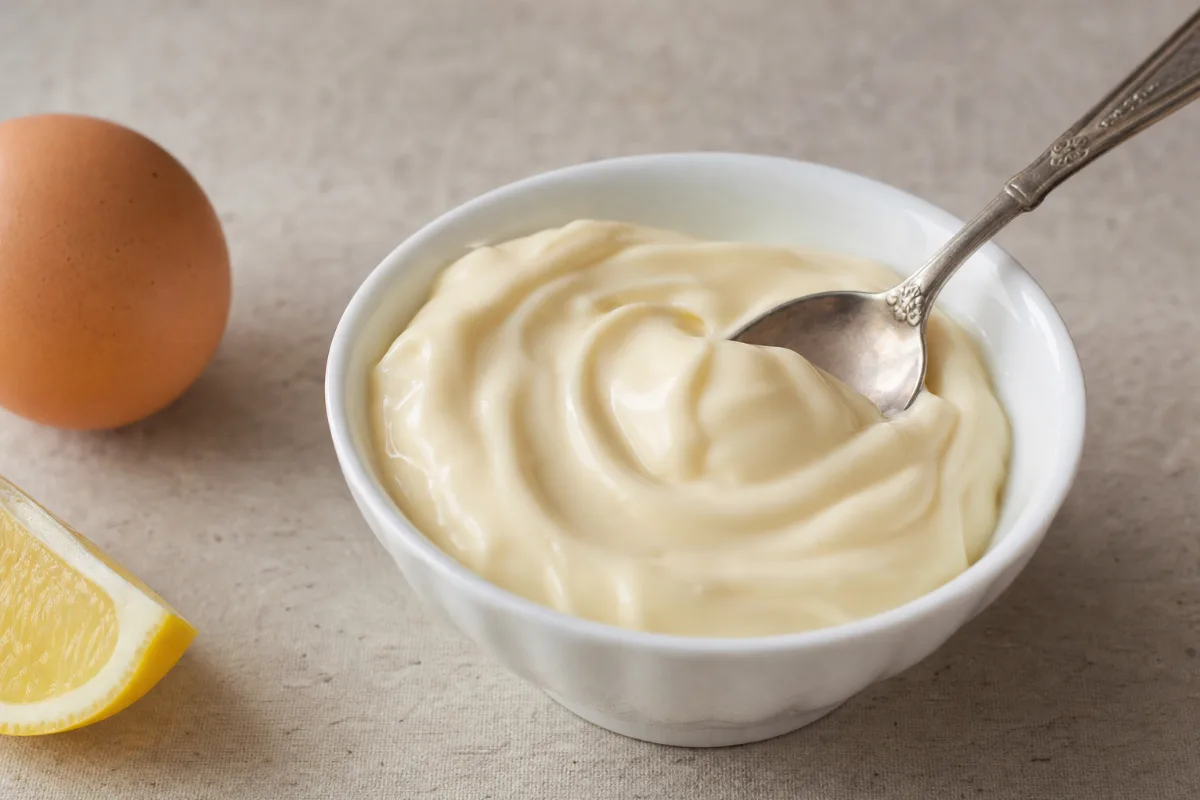
Mayonnaise is a thick sauce made by whisking oil into egg yolk with an acid such as vinegar or lemon juice. It is an emulsion, which means oil and a water-based liquid held together as a smooth cream. USDA calls the regular product "salad dressing, mayonnaise, regular".
USDA data for regular mayonnaise, per 100 g: 680 kcal, 74.85 g fat, 0.96 g protein, 0.57 g carbohydrate, 42 mg cholesterol, 635 mg sodium, 163 micrograms vitamin K and 3.28 mg vitamin E. A tablespoon (13.8 g) has about 94 kcal, 10.3 g fat, 1.6 g saturated fat, 5.8 mg cholesterol and 88 mg sodium.
The fat in it
Most of the fat is polyunsaturated: 44.69 g per 100 g, including 38.94 g of linoleic acid (omega-6) and 5.33 g of alpha-linolenic acid (omega-3). Monounsaturated fat is 16.84 g and saturated fat is 11.70 g. USDA lists 0.187 g of trans fat per 100 g.
The American Heart Association says swapping saturated fat for unsaturated fat lowers heart disease risk and LDL cholesterol. That is a finding about fats in the whole diet. Brands, light versions and home recipes use different oils, and the USDA item does not say which oil was used.
What the research shows
No study was found that tested mayonnaise as a food for heart health, cholesterol, weight or blood sugar. For those goals the evidence is insufficient.
Large studies of whole eggs and dietary cholesterol, including 27,078 men followed about 31 years and a pooled analysis of cohort studies, link more eggs and cholesterol to slightly higher death risk. These are observational, differ between regions and are about whole eggs, not mayonnaise.
At a glance
Traditional uses history, not proof
- Used as a sauce, spread and salad dressing base
- Long use as food is not proof that it treats any condition
Studied for research
- Energy and fat content, high certainty for the nutrient values (USDA)
- Heart health and fat type, insufficient evidence for mayonnaise itself
- Vitamin K and vitamin E content, high certainty for the nutrient values
- Eggs, cholesterol and death, mixed (observational, whole eggs, not mayonnaise)
Main compounds
- Fat (mostly polyunsaturated)
- Vitamin K
- Vitamin E
- Cholesterol (small amount from egg yolk)
- Acetic acid
Common forms
- Regular commercial mayonnaise (USDA values read)
- Homemade mayonnaise, often made with raw egg yolk
- Reduced-fat and egg-free versions are different products and were not measured
Research links: 2016 review: Salmonella in raw-egg mayonnaise · 2000 review: microbiological safety of commercial mayonnaise · 2017 AHA advisory: dietary fats and heart disease · Research Library · Genes & Biomarkers Library
What it is and its history
- Accepted scientific name
- Mayonnaise (an emulsion of oil and egg yolk)
- Common names
- Mayonnaise (English); Mayo (English); Salad dressing (USDA item name) (English); Mayonesa (Spanish)
- Family or group
- Special fats and spreads (oils and fats section). A prepared food of oil, egg yolk and an acid.
- Harvest and processing
- Mayonnaise is a thick sauce made by whisking oil into egg yolk with an acid such as vinegar or lemon juice, which holds oil and a water-based liquid together as an emulsion (existing site summary; the general description was not re-checked against a cooking or food-science source). Reviews describe commercial products as acidified, with acetic acid the main acid, and homemade versions as raw-egg products.
- Look-alikes and adulterants
- Name: Egg-free or vegan mayonnaise; Note: A different product; USDA values here do not apply and the egg allergy warning does not apply in the same way.; Name: Reduced-fat mayonnaise and mayonnaise-based sauces; Note: Different recipes; the 1994 lab study tested four such sauces separately.; Name: Margarine and spreads; Note: A different fat product with its own page.
Photographs
What is inside, and how it may work
What it contains and how those compounds act in cells and animals. Laboratory and animal mechanisms are not proven effects in people.
Main compounds
| Compound | Family | Where it is concentrated | Activity studied | Level of evidence |
|---|---|---|---|---|
| Total fat | Lipid | USDA: 74.85 g per 100 g; about 10.3 g in a tablespoon (13.8 g). | The main energy source in the food. 12 | Nutrient database |
| Polyunsaturated fat (linoleic acid 38.94 g and alpha-linolenic acid 5.33 g per 100 g) | Lipid | USDA: 44.69 g per 100 g; about 6.2 g in a tablespoon. | Replacing saturated with unsaturated fat lowers LDL cholesterol, according to the AHA advisory (a general finding, not for mayonnaise). 12 4 | Human data |
| Saturated fat | Lipid | USDA: 11.703 g per 100 g; about 1.6 g in a tablespoon. | See the AHA advisory above. 12 4 | Human data |
| Cholesterol | Sterol | USDA: 42 mg per 100 g; about 5.8 mg in a tablespoon. | Studies of dietary cholesterol and eggs are observational and about whole eggs. 12 7 | Human data |
| Vitamin K (phylloquinone) | Vitamin | USDA: 163 micrograms per 100 g; about 22 micrograms in a tablespoon. | Vitamin K can change how warfarin works. 12 1 3 | Human data |
| Vitamin E (alpha-tocopherol) | Vitamin | USDA: 3.28 mg per 100 g; about 0.45 mg in a tablespoon. | No study of mayonnaise and vitamin E status was read. 12 | Nutrient database |
| Acetic acid and other acids | Organic acid | Not measured in the sources read; reviews describe acetic acid as the main acid in commercial products. | Kills food poisoning bacteria in the product, mainly through low pH (lab and review evidence). 5 | Lab |
Mechanisms, receptors and pathways
| Target or pathway | Gene or receptor | What was found | Level |
|---|---|---|---|
| Acidity (pH set with acetic acid) and bacteria | Not applicable | The 2000 review found that pH adjusted with acetic acid, then acetic acid concentration, were the main factors that kill pathogens in commercial dressings. The highest reported manufacturing target pH was 4.4. 5 | Lab |
| Salmonella survival in raw-egg mayonnaise | Not applicable | The 2016 review says there is no agreed critical pH limit; acid type matters; refrigeration protected Salmonella from acid in some studies; Salmonella can adapt to acid stress. 2 | Lab |
| Vitamin K and blood clotting (warfarin) | Vitamin K-dependent clotting; CYP2C9 genotype affected warfarin dose in the 2004 study | Dietary vitamin K reduced INR by 0.2 per 100 micrograms a day in 53 patients on warfarin. 3 1 | Human data |
Absorption, metabolism and elimination
- Absorption
- Not found for mayonnaise.
- Distribution
- Not found.
- Metabolism
- Not found.
- Elimination
- Not found.
- Bioavailability
- Not established for any nutrient in mayonnaise in people.
Isolated compounds versus whole extracts
The egg and cholesterol studies are about whole eggs and total dietary cholesterol. The fat advice is about dietary fats in general. The bacteria studies are lab tests on the product. None of these is a trial of eating mayonnaise.
Nutritional composition
Nutrition from USDA FoodData Central (SR Legacy, April 2018 release; item "Salad dressing, mayonnaise, regular", FDC 171009), read from the saved data file 2026-10-26. Per 100 g: 680 kcal, 74.85 g fat (11.70 g saturated, 16.84 g monounsaturated, 44.69 g polyunsaturated), 0.96 g protein, 0.57 g carbohydrate, 0 g fibre, 42 mg cholesterol, 635 mg sodium, 20 mg potassium, 163 micrograms vitamin K, 3.28 mg vitamin E, 34.2 mg choline. A tablespoon (13.8 g) has about 94 kcal, 10.3 g fat, 1.6 g saturated fat, 5.8 mg cholesterol, 88 mg sodium and 22 micrograms vitamin K. Brands, light versions and homemade recipes differ. A USDA vitamin D value looked implausible for mayonnaise and is not used.
2 high certainty1 mixed findings1 not enough evidence
What was looked at
The 4 benefits and uses checked for Mayonnaise, each with how strong the evidence is. Tap one to open it.
- Energy and fat content (nutrient content)High certainty
- Heart health and fat typeNot enough evidence
- Vitamin K and vitamin E (nutrient content)High certainty
- Egg and cholesterol intake and death (observational)Mixed findings
Lab markers tracked in the studies
LDL cholesterolINR (blood clotting test)Overall and cardiovascular death (clinical outcome)
What is Mayonnaise good for?
What mayonnaise has been studied for and how strong the evidence is. No study tested mayonnaise itself for a health benefit, so most rows are nutrient facts or general findings about fats and eggs.
Benefits, one by one
Each card is a research question, not a promise. Tap a goal to filter. Open a card to see the studies, doses and limits.
Energy and fat content (nutrient content)
High certaintyRegular mayonnaise is mostly oil. USDA lists about 75 g of fat and 680 kcal per 100 g, which is about 10 g of fat and 94 kcal in a tablespoon. Most of that fat is polyunsaturated.
1 studiesRegular commercial mayonnaise (USDA item). Reduced-fat, egg-free and …
Studies, doses and limits
What the trials found
No trial was read that tested regular mayonnaise as a food. This is a nutrient fact, not a study of health effects.
Results
A calorie-dense condiment. The fat is mostly polyunsaturated (44.69 g per 100 g), then monounsaturated (16.84 g) and saturated (11.70 g). It has 5.33 g of alpha-linolenic acid (an omega-3 fat) and 38.94 g of linoleic acid (an omega-6 fat) per 100 g. USDA lists 0.187 g of trans fat per 100 g.
Effect sizes as reported
USDA, regular mayonnaise per 100 g: 680 kcal, fat 74.85 g, saturated fat 11.703 g. In 1 tablespoon (13.8 g): about 94 kcal, 10.3 g fat, 1.6 g saturated fat.
Why this rating
High that the food contains these amounts on average (USDA data). It is not a claim about any health effect. Brands, light versions and home recipes differ.
Form and dose studied
Regular commercial mayonnaise (USDA item). Reduced-fat, egg-free and homemade versions were not measured.
Who was studied
General adult diet.
Limits
A table of averages from one USDA item, SR Legacy April 2018. The oil used is not stated.
Why researchers looked
People ask whether a creamy sauce fits a healthy way of eating. Its nutrient content is the first thing to know.
Traditional use
Mayonnaise is a sauce made by whisking oil into egg yolk with an acid such as vinegar or lemon juice. Long use in cooking is not evidence of a health effect.
Proposed mechanism Nutrient database
These are nutrient amounts in the food, taken from a USDA table.
A proposed mechanism does not show that the effect happens in people.
Egg allergy and raw-egg Salmonella are covered on the Safety tab.
Heart health and fat type
Not enough evidenceNo study of mayonnaise and heart health was found. The American Heart Association says swapping saturated fat for unsaturated fat lowers heart disease risk, and USDA lists mostly unsaturated fat in mayonnaise. That is a general fat finding, not a mayonnaise result.
2 studiesDietary fat in general.
Studies, doses and limits
What the trials found
The AHA advisory (2017) reviewed trials and cohort studies of fats in general. In trials, replacing saturated fat with polyunsaturated vegetable oil reduced cardiovascular disease by about 30 percent. Replacing saturated fat with mostly refined carbohydrates and sugars did not. The abstract does not name mayonnaise.
Results
Insufficient for mayonnaise itself. A swap that lowers saturated fat in a whole diet matters more than one condiment, and the oil used differs by brand.
Effect sizes as reported
About 30 percent lower cardiovascular disease in the pooled trials (replacement of saturated fat with polyunsaturated vegetable oil); not a mayonnaise result.
Why this rating
Strong evidence for the general fat swap, but none for mayonnaise itself, so insufficient for this food. Because it is so calorie-dense, it is a small part of any diet.
Form and dose studied
Dietary fat in general.
Who was studied
General adult populations in the trials reviewed.
Limits
Indirect. The oil in each product is not the same, and mayonnaise also adds egg yolk and calories.
Why researchers looked
Because the fat in mayonnaise is mostly unsaturated, people ask whether it counts as a heart-friendly fat.
Proposed mechanism Authoritative guidance
Replacing saturated with unsaturated fat lowers LDL cholesterol, according to the AHA advisory.
A proposed mechanism does not show that the effect happens in people.
None specific.
Vitamin K and vitamin E (nutrient content)
High certaintyUSDA lists 163 micrograms of vitamin K and 3.28 mg of vitamin E per 100 g. A tablespoon has about 22 micrograms of vitamin K, which matters mainly for people on warfarin.
2 studiesRegular commercial mayonnaise (USDA). Other versions differ.
Studies, doses and limits
What the trials found
No study measured whether eating mayonnaise changes vitamin K or vitamin E status. The warfarin review (1999) says a vitamin K effect of food preparation has not been confirmed in a clinical trial.
Results
A modest source of vitamin K and vitamin E on paper. Amounts depend on the oil used in each product.
Effect sizes as reported
USDA per 100 g: vitamin K 163 micrograms, vitamin E (alpha-tocopherol) 3.28 mg, choline 34.2 mg. Per tablespoon (13.8 g): about 22 micrograms vitamin K, 0.45 mg vitamin E, 4.7 mg choline.
Why this rating
High that the average food has these amounts (USDA data). Not tested as a way to correct any deficiency.
Form and dose studied
Regular commercial mayonnaise (USDA). Other versions differ.
Who was studied
General adult diet.
Limits
Nutrient facts, not trials. One USDA item.
Why researchers looked
Plant oils and the foods made from them carry vitamin K and vitamin E.
Proposed mechanism Nutrient database
Amounts come from a USDA table. A review notes dietary vitamin K is found in certain plant oils and in prepared foods made with them, such as salad dressings.
A proposed mechanism does not show that the effect happens in people.
Vitamin K and warfarin: see the Safety tab.
Egg and cholesterol intake and death (observational)
Mixed findingsLarge studies of whole eggs and dietary cholesterol link more intake to a slightly higher risk of death. Mayonnaise has only about 6 mg of cholesterol in a tablespoon, and none of these studies tested it.
2 studiesWhole eggs and dietary cholesterol (not mayonnaise).
Studies, doses and limits
What the trials found
A 2022 analysis of 27,078 men followed for about 31 years plus a meta-analysis of cohort studies found more dietary cholesterol and eggs went with higher overall and cardiovascular mortality. In the meta-analysis one extra 50 g egg a day went with a pooled relative risk of 1.04 for cardiovascular disease (95% CI 1.00 to 1.08), with large differences between studies and no link in Asian cohorts.
Results
Mixed and observational. These are results for whole eggs and total dietary cholesterol, not for mayonnaise.
Effect sizes as reported
Per extra 300 mg dietary cholesterol a day: HR 1.10 overall, 1.13 cardiovascular. Per extra 50 g egg a day: HR 1.06 overall, 1.09 cardiovascular.
Why this rating
Observational data that cannot show cause, large differences between studies and regions, and the foods studied are not mayonnaise.
Form and dose studied
Whole eggs and dietary cholesterol (not mayonnaise).
Who was studied
Men in a Finnish cohort (ATBC) plus pooled cohorts worldwide.
Limits
Observational. Not mayonnaise. USDA lists 42 mg of cholesterol per 100 g, so about 6 mg in a tablespoon.
Why researchers looked
Mayonnaise is made with egg yolk, so people ask if it counts toward egg and cholesterol worries.
Proposed mechanism Observational
Not established. The study reports associations.
A proposed mechanism does not show that the effect happens in people.
None specific.
Connections to the rest of health
How Mayonnaise connects to the rest of our health knowledge graph. Every link says what kind of connection it is. A safety link (for example to the liver) is a warning, not a benefit. A study that merely mentions a topic never creates a benefit link.
Explore every connection: goals, body systems, organs, symptoms, genes
A. Wellness goals
| Connected to | Kind of connection | Evidence status | Context | Studies |
|---|---|---|---|---|
| Preventive Wellness | High certainty | Energy and fat content (nutrient content): Regular mayonnaise is mostly oil. USDA lists about 75 g of fat and 680 kcal per 100 g, which is about 10 g of fat and 94 kcal in a tablespoon. Most of that fat is polyunsaturated. Vitamin K and vitamin E (nutrient content): USDA lists 163 micrograms of vitamin K and 3.28 mg of vitamin E per 100 g. A tablespoon has about 22 micrograms of vitamin K, which matters mainly for people on warfarin. | 12 1 | |
| Heart Health | Not enough evidence | Heart health and fat type: No study of mayonnaise and heart health was found. The American Heart Association says swapping saturated fat for unsaturated fat lowers heart disease risk, and USDA lists mostly unsaturated fat in mayonnaise. That is a general fat finding, not a mayonnaise result. Egg and cholesterol intake and death (observational): Large studies of whole eggs and dietary cholesterol link more intake to a slightly higher risk of death. Mayonnaise has only about 6 mg of cholesterol in a tablespoon, and none of these studies tested it. | 4 12 7 |
B. Body systems
| Connected to | Kind of connection | Evidence status | Context | Studies |
|---|---|---|---|---|
| Digestive System | Biological association | High certainty | Studied for: Energy and fat content (nutrient content) | 12 |
| Cardiovascular System | Biological association | Not enough evidence | Studied for: Heart health and fat type Studied for: Vitamin K and vitamin E (nutrient content) | 4 12 1 7 |
E. Health conditions
| Connected to | Kind of connection | Evidence status | Context | Studies |
|---|---|---|---|---|
| Food allergy | Adverse effect or risk | Documented risk | Egg is a major food allergen and classic mayonnaise is made with egg yolk. Egg is a major food allergen and mayonnaise is made with egg yolk. Preparation or compound: Egg yolk in mayonnaise |
8 10 |
| Salmonella infections | Adverse effect or risk | Documented risk | Outbreaks are mostly linked to eggs and raw egg products such as mayonnaise. Raw-egg homemade mayonnaise can carry Salmonella. Preparation or compound: Raw-egg homemade mayonnaise |
9 2 |
I. Biomarkers
| Connected to | Kind of connection | Evidence status | Context | Studies |
|---|---|---|---|---|
| LDL cholesterol | Biological association | Not enough evidence | Measured in trials: lowered. A lab change is not the same as a health benefit. | 4 |
| INR (blood clotting test) | Biological association | Low certainty | Measured in trials: lowered. A lab change is not the same as a health benefit. | 3 1 |
| Overall and cardiovascular death (clinical outcome) | Biological association | Low certainty | Measured in trials: raised. A lab change is not the same as a health benefit. | 7 |
K. Biological pathways
| Connected to | Kind of connection | Evidence status | Context | Studies |
|---|---|---|---|---|
| Vitamin K | Preliminary mechanism | Human | Mayonnaise has vitamin K on paper, which matters for warfarin. | 12 3 |
| Omega-3 (ALA) and omega-6 (linoleic acid) | Preliminary mechanism | Nutrient database | USDA lists 5.33 g alpha-linolenic acid and 38.94 g linoleic acid per 100 g. | 12 |
L. Active compounds
| Connected to | Kind of connection | Evidence status | Context | Studies |
|---|---|---|---|---|
| Total fat | Biological association | Nutrient database | The main energy source in the food. | 12 |
| Polyunsaturated fat (linoleic acid 38.94 g and alpha-linolenic acid 5.33 g per 100 g) | Biological association | Human | Replacing saturated with unsaturated fat lowers LDL cholesterol, according to the AHA advisory (a general finding, not for mayonnaise). | 12 4 |
| Saturated fat | Biological association | Human | See the AHA advisory above. | 12 4 |
| Cholesterol | Biological association | Human | Studies of dietary cholesterol and eggs are observational and about whole eggs. | 12 7 |
| Vitamin K (phylloquinone) | Biological association | Human | Vitamin K can change how warfarin works. | 12 1 3 |
| Vitamin E (alpha-tocopherol) | Biological association | Nutrient database | No study of mayonnaise and vitamin E status was read. | 12 |
| Acetic acid and other acids | Biological association | Lab | Kills food poisoning bacteria in the product, mainly through low pH (lab and review evidence). | 5 |
Each connection is stored with the ingredient, the connected record, the kind of connection, the evidence status, the supporting studies, the preparation or compound involved, and a review date (last reviewed October 26, 2026).
The evidence
The research centre for Mayonnaise. Every record here was checked against PubMed or the publisher's page; we never list a study we have not verified.
Evidence by outcome
Bars show how many studies we found for each outcome, not how well it works. People are added up across trials only (reviews are not added, to avoid double counting).
How we rate evidence
High certainty
Several well-run trials or reviews agree; further research is unlikely to change the picture much.
Moderate certainty
Good trials point the same way, but some doubt remains.
Low certainty
Small, short or inconsistent trials. The finding could change with better research.
Very low certainty
Very little or very weak human data. Treat as a possibility only.
Mixed findings
Trials or reviews disagree with each other.
Not enough evidence
Not enough human research to say either way.
Evidence against
Good research found no benefit, or found harm.
We take the reviewers' own risk-of-bias and GRADE statements where they exist, and otherwise judge from study size, design, consistency, directness and whether a product matches what is sold. Many publications do not make evidence high. Method note: We started from our existing mayonnaise summary, re-checked nutrition against the saved USDA FoodData Central item, re-read the FDA and NHS pages, and re-read PubMed abstracts for the reviews, the warfarin studies and the egg and cholesterol analysis. Only abstracts were read for studies. Items we could not verify are flagged in the research gaps.
Study library: every study we checked 12
| Study | Design | People | Product, dose, length | Result |
|---|---|---|---|---|
| Booth 1999 Vitamin K: a practical guide to the dietary management of patients on warfarin. Nutr Rev · PMID 10568341 · DOI |
Narrative review |
Patients on warfarin (review of food analysis and diet studies) | Dietary vitamin K, including plant oils and prepared foods such as baked goods, margarines and salad dressings |
Dietary vitamin K is found in certain plant oils and in prepared foods made with them, such as baked goods, margarines and salad dressings. A constant dietary vitamin K intake is the most acceptable practice for patients on warfarin. Whether food preparation with vitamin K-rich oils contributes has not been confirmed in a clinical trial. A dose-response has not been established. No numbers for mayonnaise in the abstract (Not applicable) Methods, limits and fundingOutcomes: Vitamin K and warfarin response Limitations: A 1999 review; it names salad dressings, not mayonnaise. Funding and conflicts: Funding is not stated in the abstract. Read: abstract |
| Keerthirathne 2016 A Review of Temperature, pH, and Other Factors that Influence the Survival of Salmonella in Mayonnaise and Other Raw Egg Products. Pathogens · PMID 27869756 · DOI |
Narrative review n/a |
Published studies on Salmonella control in raw-egg mayonnaise and similar products | Raw-egg (homemade-style) mayonnaise and other raw egg products |
Outbreaks of salmonellosis are mostly linked to eggs and raw egg products such as mayonnaise. Apart from pasteurized eggs, the main control identified is pH, but there is no agreement on a critical pH limit. Lemon juice versus vinegar is debated. In some studies refrigeration protected Salmonella from acid. No numbers in the abstract (Not applicable) Methods, limits and fundingOutcomes: Salmonella survival and control (pasteurized eggs, pH, acid type, storage temperature, fat, salt, herbs) Limitations: A narrative review of mostly lab studies; the abstract gives no outbreak counts. Funding and conflicts: The authors declare no conflict of interest. Read: abstract |
| Khan 2004 Dietary vitamin K influences intra-individual variability in anticoagulant response to warfarin. Br J Haematol · PMID 14717783 · DOI |
Observational cohort |
53 53 patients on stable warfarin, 4 weeks of dietary records and weekly blood tests |
Dietary vitamin K from all foods Whole diet (diet records) 4 weeks |
For each rise of 100 micrograms a day in dietary vitamin K the INR fell by 0.2. There was no correlation between warfarin dose and average vitamin K intake over 28 days; CYP2C9 genotype and age explained more of the dose differences. A consistent vitamin K intake could reduce variation in response. INR lower by 0.2 per 100 micrograms a day (Not given in the abstract) Methods, limits and fundingOutcomes: INR (blood clotting test), warfarin dose Limitations: Small study of all dietary vitamin K, not mayonnaise. Funding and conflicts: Funding is not stated in the abstract. Read: abstract |
| Sacks 2017 Dietary Fats and Cardiovascular Disease: A Presidential Advisory From the American Heart Association. Circulation · PMID 28620111 · DOI |
Guideline advisory review |
Trials and cohort studies on dietary fat and cardiovascular disease | Dietary saturated, polyunsaturated and monounsaturated fats in general (not mayonnaise) Dietary fats · vs Replacing saturated fat with unsaturated fat |
Trials that lowered saturated fat and replaced it with polyunsaturated vegetable oil reduced cardiovascular disease by about 30 percent. Replacing saturated fat with mostly refined carbohydrates and sugars did not lower rates. Replacing saturated with unsaturated fat lowers LDL cholesterol. The authors conclude lowering saturated fat and replacing it with unsaturated fat, especially polyunsaturated fat, lowers the incidence of cardiovascular disease, within an overall healthy dietary pattern. About 30 percent lower cardiovascular disease in the trials pooled (Not given in the abstract) Methods, limits and fundingOutcomes: Cardiovascular disease, LDL cholesterol Limitations: General advice on fats; no trial of mayonnaise was named in the abstract. Funding and conflicts: American Heart Association advisory; the group states it screens for conflicts of interest. Read: abstract |
| Smittle 2000 Microbiological safety of mayonnaise, salad dressings, and sauces produced in the United States: a review. J Food Prot · PMID 10945595 · DOI |
Narrative review with statistical analysis n/a |
Published lab inoculation data on commercial mayonnaise, dressings and sauces | Commercial acidic mayonnaise, dressings and sauces |
No foodborne illness reports were found linked directly to commercially prepared acidic dressings and sauces. Salmonella, E. coli O157:H7, E. coli, Listeria monocytogenes, Staphylococcus aureus and Yersinia enterocolitica die when inoculated into mayonnaise and dressings, mainly through pH set with acetic acid and acetic acid concentration. The author concludes the products are very safe. Highest reported manufacturing target pH 4.4 (below the 4.75 pKa of acetic acid) (Not applicable) Methods, limits and fundingOutcomes: Death and survival of Salmonella, E. coli O157:H7 and Listeria monocytogenes in the products Limitations: Absence of illness reports is not proof of zero risk; the abstract does not give report counts. The author works at a food testing laboratory group; funding is not stated. Funding and conflicts: Funding is not stated in the abstract. The author is listed at Silliker Laboratories Group, a food testing company. Read: abstract |
| Weagant 1994 Survival of Escherichia coli O157:H7 in Mayonnaise and Mayonnaise-Based Sauces at Room and Refrigerated Temperatures. J Food Prot · PMID 31121702 · DOI |
Laboratory analysis n/a |
Three E. coli O157:H7 strains added to commercial mayonnaise and four mayonnaise-based sauces | Commercially prepared mayonnaise and mayonnaise-based sauces (lab inoculation) 25 C or 7 C for mayonnaise; 5 C for sauces, tested up to 35 days |
At 25 C the bacteria became undetectable after 72 hours in mayonnaise. At 7 C they were detectable for up to 35 days. In mayonnaise-based sauces at 5 C they were detectable past 35 days in three of the four sauces. 72 hours (25 C) versus up to 35 days (7 C) (Not applicable) Methods, limits and fundingOutcomes: Survival of detectable E. coli O157:H7 Limitations: A 1994 lab study with added bacteria; it is not a kitchen storage rule and does not describe illness in people. Funding and conflicts: Funding is not stated; the authors are at a US FDA district laboratory. Read: abstract |
| Zhao 2022 Associations of Dietary Cholesterol, Serum Cholesterol, and Egg Consumption With Overall and Cause-Specific Mortality: Systematic Review and Updated Meta-Analysis. Circulation · PMID 35360933 · DOI |
Cohort plus systematic review meta analysis |
27078 27,078 men in the ATBC cohort (22,035 deaths over 31 years) plus a meta-analysis of cohort studies (49 risk estimates, 3,601,401 participants) |
Dietary cholesterol and whole eggs Whole eggs and dietary cholesterol (not mayonnaise) About 31 years follow-up · vs Lower intake |
Greater dietary cholesterol and egg intake were associated with higher overall and cardiovascular mortality. Hazard ratios per extra 300 mg of cholesterol a day were 1.10 (overall) and 1.13 (cardiovascular). Per extra 50 g egg a day they were 1.06 and 1.09. In the meta-analysis one extra 50 g egg a day went with a pooled relative risk of 1.04 for cardiovascular disease, with large differences between studies (I2 80.1%), a higher risk in US cohorts (1.08) and no link in Asian cohorts. HR 1.10 per 300 mg cholesterol; HR 1.06 per 50 g egg; pooled RR 1.04 (Pooled RR 1.04 (95% CI 1.00 to 1.08); US cohorts 1.08 (1.02 to 1.14)) Methods, limits and fundingOutcomes: Overall and cardiovascular mortality Limitations: Observational, so it cannot show cause. Whole eggs and total dietary cholesterol, not mayonnaise. The ATBC cohort was men who smoked at the start. Funding and conflicts: Funding is not stated in the abstract; the paper lists NIH intramural research support. Read: abstract |
| s-fda-allergens US FDA: Food Allergies · Source |
Health agency n/a |
Methods, limits and fundingRead: full-text | ||
| s-fda-egg-safety US FDA: What You Need to Know About Egg Safety · Source |
Health agency n/a |
Methods, limits and fundingRead: full-text | ||
| s-nhs-food-allergy NHS: Food allergy · Source |
Health agency n/a |
Methods, limits and fundingRead: full-text | ||
| s-nhs-foods-to-avoid-pregnancy NHS: Foods to avoid in pregnancy · Source |
Health agency n/a |
Methods, limits and fundingRead: full-text | ||
| s-usda-fdc-171009 USDA FoodData Central: Salad dressing, mayonnaise, regular (FDC 171009, SR Legacy) · Source |
Nutrient database n/a |
Methods, limits and fundingRead: full-text |
What we do not know yet
- No trial of mayonnaise as a food was found for heart health, cholesterol, weight or blood sugar.
- The egg and cholesterol studies are observational and about whole eggs, not mayonnaise.
- The oil used in the USDA item is not stated, and light, egg-free and homemade versions were not measured.
- Soy-oil mayonnaise and soy allergy, breastfeeding, kidney disease, children and official storage times for opened jars were not researched.
- The CDC Salmonella page could not be opened, so only the FDA and NHS statements are used.
How new research is added
New studies are found by a saved PubMed search and placed in a review queue before the page changes.
Lab markers
What changed in blood or saliva tests during trials. A changed number is not the same as feeling or being healthier, and we give no "normal ranges".
Metabolic 1
LDL cholesterol
Lowered in trials
The 'bad' cholesterol carried in the blood. Higher levels are linked to more heart disease.
Not enough evidenceResults and what it means
Why it was measured
It is the usual blood marker used in diet trials for heart risk.
Statistical vs. clinical meaning
True for the general fat swap, but nothing was read that measured LDL after eating mayonnaise.
Safety implication
None specific.
| Study | Result | People | Product |
|---|---|---|---|
| 4 | Replacing saturated fat with unsaturated fat lowers LDL cholesterol (advisory conclusion; no number in the abstract) | General adults in the trials and cohorts reviewed | Swap of saturated for unsaturated fat in the diet, not mayonnaise |
Other 2
INR (blood clotting test)
Lowered in trials
A blood test that shows how slowly the blood clots. People on warfarin have it checked to keep the blood in a safe range.
Low certaintyResults and what it means
Why it was measured
Vitamin K from food can change how well warfarin works.
Statistical vs. clinical meaning
A small average effect in a small study of all foods. Keeping vitamin K intake steady is the usual advice.
Safety implication
Ask your anticoagulation clinic before changing how much vitamin K-containing food you eat.
| Study | Result | People | Product |
|---|---|---|---|
| 3 | INR lower by 0.2 for each 100 micrograms a day rise in dietary vitamin K | 53 patients on stable warfarin, 4 weeks of diet records | Dietary vitamin K from all foods (not mayonnaise specifically) |
Overall and cardiovascular death (clinical outcome)
Raised in trials
Whether people in a study died during follow-up, and from heart or blood vessel disease.
Low certaintyResults and what it means
Why it was measured
The big cohort studies of eggs and dietary cholesterol use it as the outcome.
Statistical vs. clinical meaning
A link, not proof of cause, for eggs and cholesterol; not tested for mayonnaise.
Safety implication
None specific.
| Study | Result | People | Product |
|---|---|---|---|
| 7 | Overall mortality HR 1.10 per extra 300 mg cholesterol a day; HR 1.06 per extra 50 g egg a day | 27,078 men followed about 31 years (22,035 deaths) | Dietary cholesterol and whole eggs (not mayonnaise) |
Safety
What studies and official sources say about side effects, medicines and who should check first. Each point shows what kind of evidence it comes from.
Main points to know 4
- Raw-egg homemade mayonnaise can carry Salmonella. The FDA says fresh eggs, even with clean, uncracked shells, may contain Salmonella, and says recipes that use raw or undercooked eggs should use pasteurized eggs or pasteurized egg products. A 2016 review says outbreaks are mostly linked to eggs and raw egg products such as mayonnaise. Children, older adults, pregnant women and people with weakened immune systems are at greater risk of severe illness. Authoritative guidance 9 2
- Egg allergy. Egg is one of the nine major food allergens listed by the US FDA, and the NHS lists eggs among the most common allergic foods. Mayonnaise is made with egg yolk, so people with egg allergy should treat it as an egg food unless a product is clearly labelled egg-free. Call emergency services for trouble breathing or swelling of the lips, mouth, tongue or throat. Authoritative guidance 8 10
- Warfarin and vitamin K. USDA lists about 22 micrograms of vitamin K in a tablespoon. A review says plant oils and prepared foods made with them, such as salad dressings, add vitamin K, and that a constant dietary intake is the most acceptable practice on warfarin. Ask your anticoagulation clinic or pharmacist. Review and observational 12 1 3
- Store-bought mayonnaise is acidic and has a good safety record in the literature. A 2000 review found no reports of illness linked directly to commercially prepared acidic dressings and sauces, and found that the main food poisoning bacteria die in them. That is a review of lab studies and reports, not a guarantee. Follow the label for storage. Laboratory and review 5
Side effects 2
| Effect | How often | Severity and recovery | Evidence |
|---|---|---|---|
| Salmonella infection (diarrhea, fever, stomach cramps, vomiting) The FDA page does not name mayonnaise. The review links raw-egg mayonnaise to outbreaks. | No frequency for mayonnaise was found. The FDA says symptoms start 12 to 72 hours after infection and usually last 4 to 7 days. | can be severe in children, older adults, pregnant women and people with weakened immune systems Most people get better without treatment, according to the FDA. | Authoritative guidance 9 2 |
| Allergic reaction to egg, from hives and lip swelling to anaphylaxis The sources describe egg allergy in general, not mayonnaise specifically. | No frequency found in the sources read. | can be severe (anaphylaxis) Not described in the sources read. | Authoritative guidance 8 10 |
Liver
No liver injury linked to eating mayonnaise was found in the sources read. No liver-safety source was searched for this page.
This is a safety connection. It is not evidence that Mayonnaise supports liver health.
Medicines and supplements 1
| With | Why it matters | Importance | Evidence | What to do |
|---|---|---|---|---|
| Warfarin (blood thinner) prescription | Vitamin K from food can lower the blood-thinning effect of warfarin. USDA lists vitamin K in mayonnaise. | A 2004 study of 53 patients found the INR fell by 0.2 for each 100 micrograms a day rise in dietary vitamin K, and that a consistent intake could reduce variation. A tablespoon has about 22 micrograms. A 1999 review says consistent intake is the usual advice and names salad dressings, not mayonnaise. | Observational and review Low certainty 12 1 3 | Do not change your medicine yourself. Ask your anticoagulation clinic or pharmacist how food with vitamin K fits your plan. |
Who should check first 3
| Situation | Advice | Evidence |
|---|---|---|
| Egg allergy | Avoid mayonnaise unless a product is clearly labelled egg-free, and ask an allergist about your own case. For trouble breathing or swelling of the face, lips, tongue or throat, call emergency services. | Authoritative guidance 8 10 |
| Pregnancy, older age, young children or a weakened immune system, with raw-egg homemade mayonnaise | The FDA says these groups face greater risk from Salmonella. Pasteurized eggs or store-bought acidic mayonnaise are the usual lower-risk choices according to the sources. | Authoritative guidance 9 11 |
| Taking warfarin | Ask your anticoagulation clinic or pharmacist about vitamin K in food. | Review 1 |
Overdose, product quality and regulators
Summary. No toxicity from mayonnaise as an ordinary food was found in the sources read. The safety points are food poisoning from raw egg and egg allergy.
Animal. Not reviewed.
Overdose response. Not found.
Genotoxicity. Not researched.
The main contamination risk found is Salmonella from raw eggs in homemade mayonnaise. Commercial mayonnaise is acidic and has a good record in the literature.
Raw-egg homemade mayonnaise. A 2016 review says outbreaks are mostly linked to eggs and raw egg products such as mayonnaise. Apart from pasteurized eggs, the main control is pH, but there is no agreement on a critical pH limit, the type of acid matters, and in some studies refrigeration protected Salmonella from acid. 2
Commercial acidic mayonnaise. A 2000 review of lab inoculation studies found that Salmonella, E. coli O157:H7, Listeria monocytogenes and other bacteria die in mayonnaise and dressings, mainly because of acetic acid and low pH, and found no illness reports linked directly to commercial products. 5
Storage (lab only). In a 1994 lab study, E. coli O157:H7 added to commercial mayonnaise became undetectable after 72 hours at 25 C but was still detectable up to 35 days at 7 C. This was an experiment with added bacteria, not a kitchen rule. 6
| Body | Action | Date |
|---|---|---|
| US FDA (United States) | Egg safety: eggs may contain Salmonella; for recipes with raw or undercooked eggs, use pasteurized eggs or egg products. Greater risk for children, older adults, pregnant women and people with weakened immune systems. source | 2024-03-05 |
| NHS (United Kingdom) | Foods to avoid in pregnancy: foods like mayonnaise and mousse made with raw eggs are fine if made with British Lion eggs or hen eggs produced under the Laid in Britain scheme; other hen eggs should be well cooked. source | 2026-06-15 |
| US FDA (United States) | Food Allergies: eggs are one of nine major food allergens. Highly refined oils are among the products outside the labelling law. source | 2026-03-11 |
| NHS (United Kingdom) | Food allergy: eggs are among the most common allergic foods; call 999 for swollen lips, mouth, throat or tongue, or trouble breathing. source | 2026-08-20 |
When to get medical help
- Trouble breathing, wheezing, a tight throat, trouble swallowing, or swelling of the lips, mouth, tongue, face or throat after eating: call emergency services (911 in the US, 999 in the UK).
- Skin, tongue or lips turning blue, grey or pale, or feeling faint or collapsing after eating.
- After eating raw-egg food: severe or bloody diarrhea, high fever, signs of dehydration, or symptoms that do not improve. Contact a doctor, and do so sooner if you are pregnant, older, very young or have a weakened immune system.
Stop using the product and contact a clinician or emergency service. In the US, Poison Control is 1-800-222-1222.
General information only, not medical advice. Ask a clinician or pharmacist before use, especially with medicines, in pregnancy or with a health condition. See the Natural Remedy Safety guide.
Frequently asked questions
What is mayonnaise?
Is mayonnaise healthy?
No study tested mayonnaise as a food for health benefits. USDA shows it is mostly fat and calorie-dense, with about 94 kcal in a tablespoon, and most of that fat is polyunsaturated.
Is store-bought mayonnaise safe?
A 2000 review found no reports of illness linked directly to commercially prepared acidic dressings and sauces, and found that the main bacteria die in them. Follow the label for storage.
Is homemade mayonnaise with raw egg safe?
Can you eat mayonnaise in pregnancy?
Can I eat mayonnaise with an egg allergy?
Does mayonnaise have vitamin K, and does it matter on warfarin?
Is mayonnaise bad for cholesterol?
Does mayonnaise have unhealthy fats?
How long does mayonnaise last once opened?
We did not read an official storage time for opened jars, so follow the label. A 1994 lab study found E. coli added to mayonnaise lasted up to 35 days at 7 C but under 72 hours at 25 C. That is not a kitchen rule.
Is vegan mayonnaise the same?
No. Egg-free mayonnaise is a different product, and the USDA values and egg allergy warning on this page are for regular egg mayonnaise.
Does mayonnaise help with weight loss or skin?
No source we read supports this. We found no study of mayonnaise for weight, skin or hair.
Explore by health goal
Editorial transparency
- Written by
- AlternativeMed editorial team. Research compiled with AI assistance, then checked against the sources listed.
- Medical review
- None. This page has not been reviewed by a physician or pharmacist.
- First published
- 2026-10-26
- Last substantive update
- 2026-10-26
- How we research
- We started from our existing mayonnaise summary, re-checked nutrition against the saved USDA FoodData Central item, re-read the FDA and NHS pages, and re-read PubMed abstracts for the reviews, the warfarin studies and the egg and cholesterol analysis. Only abstracts were read for studies. Items we could not verify are flagged in the research gaps.
- How we rate evidence
- See "How we rate evidence" in the Evidence tab.
- Independence
- No product is promoted on this page. No affiliate links are shown. One review is by an author at a food testing laboratory company (Silliker); this is stated where it is used.
Sources 12
Each source was opened and checked. Where we read only the abstract, it says so. The small numbers in the text point here.
- Booth SL, Centurelli MA. Vitamin K: a practical guide to the dietary management of patients on warfarin.. Nutr Rev. 1999. PMID 10568341. DOI 10.1111/j.1753-4887.1999.tb01815.x. (abstract)
- Keerthirathne TP, Ross K, Fallowfield H, Whiley H. A Review of Temperature, pH, and Other Factors that Influence the Survival of Salmonella in Mayonnaise and Other Raw Egg Products.. Pathogens. 2016. PMID 27869756. DOI 10.3390/pathogens5040063. (abstract)
- Khan T, Wynne H, Wood P, Torrance A, et al.. Dietary vitamin K influences intra-individual variability in anticoagulant response to warfarin.. Br J Haematol. 2004. PMID 14717783. DOI 10.1046/j.1365-2141.2003.04787.x. (abstract)
- Sacks FM, Lichtenstein AH, Wu JHY, Appel LJ, et al.. Dietary Fats and Cardiovascular Disease: A Presidential Advisory From the American Heart Association.. Circulation. 2017. PMID 28620111. DOI 10.1161/CIR.0000000000000510. (abstract)
- Smittle RB. Microbiological safety of mayonnaise, salad dressings, and sauces produced in the United States: a review.. J Food Prot. 2000. PMID 10945595. DOI 10.4315/0362-028x-63.8.1144. (abstract)
- Weagant SD, Bryant JL, Bark DH. Survival of Escherichia coli O157:H7 in Mayonnaise and Mayonnaise-Based Sauces at Room and Refrigerated Temperatures.. J Food Prot. 1994. PMID 31121702. DOI 10.4315/0362-028X-57.7.629. (abstract)
- Zhao B, Gan L, Graubard BI, Mannisto S, et al.. Associations of Dietary Cholesterol, Serum Cholesterol, and Egg Consumption With Overall and Cause-Specific Mortality: Systematic Review and Updated Meta-Analysis.. Circulation. 2022. PMID 35360933. DOI 10.1161/CIRCULATIONAHA.121.057642. (abstract)
- . US FDA: Food Allergies. . . (full-text)
- . US FDA: What You Need to Know About Egg Safety. . . (full-text)
- . NHS: Food allergy. . . (full-text)
- . NHS: Foods to avoid in pregnancy. . . (full-text)
- . USDA FoodData Central: Salad dressing, mayonnaise, regular (FDC 171009, SR Legacy). . . (full-text)
Where to buy
Check the label first. Whatever you buy, look for these:
- Cold-pressed or refined, to match how you cook
- A harvest or best-by date and a dark glass or tin container
- The oil's origin and any testing statement
- Smoke point for the way you cook
Talk to a pharmacist or doctor before you start any supplement, especially if you take medicines. See the Safety tab for interactions.
Support our free guides: as an Amazon Associate we earn from qualifying purchases. Full disclosure.


